Watch 80 Free Documentaries from Kino Lorber
?si=k3Y8ij1cKH2JqSxH
NOTE: Some of the documentaries mentioned below are no longer being streamed online. To find Kino Lorber’s current list of free documentaries, please visit this list.
M. C. Escher, Hannah Arendt, Hieronymus Bosch, Hilma af Kint, Stanley Kubrick: if you’re a regular reader of Open Culture, you’re no doubt fascinated some or all of these figures. Now, thanks to film distributor Kino Lorber, you can watch entire films about them on Youtube. Having evidently put a good deal of energy toward expanding their Youtube channel in recent months, Kino Lorber has uploaded such documentaries as M. C. Escher: Journey to Infinity, Vita Activa: The Spirit of Hannah Arendt, Hieronymous Bosch: Touched by the Devil, Beyond the Visible: Hilma af Kint, and Filmworker (about Kubrick’s right-hand man, the late Leon Vitali) — all of them free to watch.
So far, Kino Lorber’s playlist of free documentaries contains 80 films, a number that may vary depending on your location. Some popular selections focus on music: that of Elvis Presley, that of Levon Helm and The Band, that of Greenwich Village in the nineteen-sixties and seventies.
But the documentary is a versatile form, able in the right directorial hands to contain a wide range of real-life subjects, from art (Louise Bourgeois: The Spider the Mistress and the Tangerine, The Jeff Koons Show) to food (Sushi: Global Catch, El Bulli: Cooking in Progress) to nature (More than Honey, The Woman Who Loves Giraffes) to religion (Brilliant Moon: Glimpses of Dilgo Khyentse Rinpoche, The Last Dalai Lama?), to cinema itself (Captured on Films: The True Story of Marion Davies, Blank City).
All this gives only a hint of the sheer aesthetic, intellectual, and cultural variety of Kino Lorber-distributed documentaries. To get a fuller sense, you’ll have to explore the playlist itself, down to its most recent additions like Finding Fela, Nollywood Babylon, and Lina Wertmüller: Behind the White Glasses. Like all documentaries worth watching, these don’t just address subjects of interest, but leave their viewers with newly open avenues of curiosity to follow. Your journey may begin with films about Glenn Gould, Charlotte Rampling, Johnny Cash, or Maya Deren, but to what realm it will take you — that of the Ballets Russes, of Mexican lucha libre wrestling, of the female Buddhists of the Kathmandu Valley — cannot be foretold.
If you would like to support the mission of Open Culture, consider making a donation to our site. It’s hard to rely 100% on ads, and your contributions will help us continue providing the best free cultural and educational materials to learners everywhere. You can contribute through PayPal, Patreon, and Venmo (@openculture). Thanks!
Related content:
285 Free Documentaries Online
The 10 Greatest Documentaries of All Time According to 340 Filmmakers and Critics
50 Must-See Documentaries, Selected by 10 Influential Documentary Filmmakers
Based in Seoul, Colin Marshall writes and broadcasts on cities, language, and culture. His projects include the Substack newsletter Books on Cities, the book The Stateless City: a Walk through 21st-Century Los Angeles and the video series The City in Cinema. Follow him on Twitter at @colinmarshall or on Facebook.
Read More...The Untold Story of Disco and Its Black, Latino & LGBTQ Roots
As a white Midwestern child of the ‘70s, I received two messages loud and clear: disco was a breathtakingly glamorous, sexy urban scene, and “disco sucks.”
Culturally, the latter prevailed.
It was the opinion voiced most loudly by the popular boys.
Dissenters pushed back at their own peril.
I didn’t know what YMCA was about, and I’m not convinced the ski jacketed, puka-necklaced alpha males at my school did either.
(My father, who sang along joyfully whenever it came on the car radio, definitely did.)
Disco’s been dead for a long time now.
In the four plus decades since disgruntled Chicago radio DJ Steve Dahl commandeered a baseball stadium for a Disco Demolition Night where fans tossed around homophobic and racist epithets while destroying records, there’s been notable social progress.
This progress is the lens that makes Noah Lefevre’s Polyphonic video essay The Untold History of Disco, and other investigations into the racial and sexual underpinnings of disco possible.
I certainly never heard of Stonewall as a kid, but many contemporary viewers, coming of age in a country that is, on the whole, much more LGBTQ-friendly than the world of their parents and grandparents, are familiar with it as a gay rights milestone.
Lefevre ties the birth of disco to the 1969 Stonewall Uprising, and a subculture born of necessity, wherein gay men improvised underground dance clubs where they could cut freely loose with same sex partners.
Instead of live dance music, these venues boasted DJs, crate diggers open to any groove that would keep the party going on the dance floor: psychedelic, classic soul, progressive soul, jazz fusion, Latin American dance music, African pop…
(Thus the name discotheque)
A disco sound began to coalesce around existing hits as the O‑jays’ Love Train and Isaac Hayes’ Theme from Shaft.
You can hear it in Jimmy Nolen’s chicken scratch lead guitar for James Brown and session drummer Earl Young’s open high hat and four-to-the-floor beat on Harold Melvin and the Blue Notes’ The Love I Lost.
In the beginning, crowds were primarily Black, Latino and gay at New York City discos like The Loft, which started out as a rent party, and The Sanctuary, housed in a deconsecrated midtown German Baptist church. Mapplethorpe model Leigh Lee recalled The Sanctuary’s cachet to the Village Voice’s Peter Braunstein:
It was supposed to be a secret, but I don’t know how secret it could have been when faggots and lesbians can come out of a church from midnight till sunrise.
As discotheque DJs began driving the record charts, mainstream producers took note, opening the gates for such monster hits as the Barry White-helmed Love Unlimited Orchestra’s Love’s Theme, Donna Summer’s Love to Love Ya, and Chic’s Le Freak.
A glitter-bedecked nude man rode a white horse into Bianca Jagger’s birthday party at Studio 54 on the stroke of midnight, while hinterland squares did The Hustle at their local Holiday Inns.
By the time celebs like the Rolling Stones and Rod Stewart starting horning in on the act, disco had already reached its tipping point.
Little twerps like me, whose mothers wouldn’t let them see the R‑rated Saturday Night Fever bought Bee Gees 45s from our local Peaches and sang along to Gloria Gaynor’s I Will Survive, as did some of our dads…
(An unexpected pleasure of Lefevre’s video is seeing all those familiar record labels spinning just the way they did on our precious stereos — Atlantic! Casablanca! Polydor! RSO! Somebody pass me a Dr. Pepper and a yellow plastic insert!)
Radio DJ Rick Dees’ novelty hit with Disco Duck seemed so harmless at the time, but it was surely music to the mainstream “disco sucks” crowd’s ears. (Good luck to any punk who betrayed a fondness for Disco Duck )
Disco’s reign was brief — Lefevre notes that its end coincides with the beginning of the AIDS crisis — but its impact has been greater than many assume at first blush.
Disco’s emphasis on turntables and long play versions influenced hip hop and electronic dance music.
Nearly half a century after discomania seized the land, its deep connection to Black, Latino and LGBTQ history must not be tossed aside lightly.
Watch more of Noah Lefevre’s Polyphonic video essays here.
Related Content
- Ayun Halliday is the Chief Primatologist of the East Village Inky zine and author, most recently, of Creative, Not Famous: The Small Potato Manifesto. Her Indiana ties resulted in an invitation to Rick “Disco Duck” Dees’ 1977 wedding. Follow her @AyunHalliday.
Read More...When Salvador Dalí Dressed — and Angrily Demolished — a Department Store Window in New York City (1939)
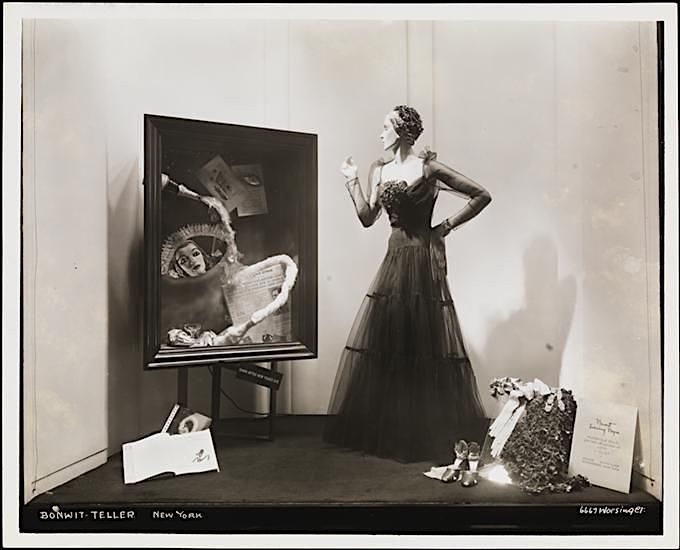
If you want to understand the history of art in twentieth-century America, you can’t overlook the corner of Fifth Avenue and 56th Street in New York City. No, not Trump Tower, but the building it replaced: Bonwit Teller, the luxury department store that had stood on the site since 1929. Then as now, any shop on Fifth Avenue has to find a way to set itself apart, and by 1939 Bonwit Teller had built a “reputation for having Manhattan’s screwiest window displays.” So says Time magazine, covering a minor debacle that year over one of the installations by “the world’s No. 1 surrealist, Salvador Dalí.”
Dalí had previously dressed Bonwit Teller’s windows without incident in 1936, riding high on the buzz from his first American exhibition that same year. When invited back by the store to create a new display, writes Tim McNeese in Salvador Dalí, “he decided to use the windows to depict the ‘Narcissus complex,’ ” divided into day and night. “In the Day window, Narcissus is personified,” says The Art Story. “Three wax hands holding mirrors reached out of a bathtub lined with black lambskin and filled with water. A mannequin entered the tub in a scant outfit of green feathers. For the Night window, the feet of a poster bed are replaced by buffalo legs and the canopy is topped by its pigeon-eating head. A wax mannequin sat nearby on a bed of coals.”
As for the public reaction, writes the New York Times’ Michael Pollak, “words were exchanged, not all of them complimentary, and the store’s staff made quick changes. The skinny-dipper in ‘Day’ was quickly replaced by an attired mannequin. Out went the sleeper in ‘Night’; in went a standing model.” As soon as he caught sight of the unauthorized modifications, Dalí took corrective action. McNeese quotes the artist’s own memory of the proceedings: “I dashed into the window to disarrange it, so that my name, signed in the window, should not be dishonored. I was never so surprised as when the bathtub just shot through the window when I pushed it and I was thereafter most confused.”
Dalí was charged with disorderly conduct but issued a suspended sentence since, as the judge put it, “These are some of the privileges that an artist with temperament seems to enjoy.” Nothing like this happened to Andy Warhol when he later dressed Bonwit Teller’s windows, writes i‑D’s Briony Wright, though “a commission for the department store in 1961 brought what could be considered his big break.” Those same windows also became opportunities for a host of other artists including Sari Dienes, James Rosenquist, Jasper Johns, and Robert Rauschenberg, the last two of whom collaborated on a display as Maston Jones. They had their own reasons for the pseudonym, but an artist of Dalí’s particular sensibility knows you don’t turn down a chance to get your name on Fifth Avenue.
Related content:
When Salvador Dali Met Sigmund Freud, and Changed Freud’s Mind About Surrealism (1938)
When Salvador Dalí Created a Surrealist Funhouse at New York World’s Fair (1939)
When Salvador Dalí Created Christmas Cards That Were Too Avant Garde for Hallmark (1960)
Based in Seoul, Colin Marshall writes and broadcasts on cities, language, and culture. His projects include the Substack newsletter Books on Cities, the book The Stateless City: a Walk through 21st-Century Los Angeles and the video series The City in Cinema. Follow him on Twitter at @colinmarshall or on Facebook.
Read More...A Relaxing, ASMR Re-Creation of People Cooking Thanksgiving Dinner in the 1820s
Americans today can acquire every element of their Thanksgiving dinner practically ready to eat, in need of little more than some heat before being set on the table. This very Thursday, in fact, many Americans will no doubt do just that. But it wasn’t an option two centuries ago, especially for those who lived on the wild frontier. To see how they’d have put their Thanksgiving dinner together, you’ll want to consult one Youtube channel in particular: Early American, previously featured here on Open Culture for its videos re-creating various meals as they would have been prepared circa 1820.
The creators of Early American, Justine Dorn and Ron Rayfield, also happen to be a married couple in real life. In their videos they appear to play historical versions of themselves, adhering to the domestic division of labor custom would have dictated in rural America of the early nineteenth century.
When Ron steps in the door with the fruits of a bountiful hunt, two rabbits and a duck, Justine knows just how to put them at the center of a full-fledged Thanksgiving dinner. This involves not just cooking the meat, but preparing a variety of accompaniments like cranberries, corn, mushroom gravy, and sweet potato pie.
All this happens at the hearth, which demands a set of skills (and a set of tools, including an hourglass) not normally possessed by home-cooking enthusiasts of the twenty-twenties. But the meal that results will surely look appetizing even to modern viewers. Though Abraham Lincoln made Thanksgiving a national holiday in 1863, George Washington first issued a proclamation for “a day of public thanksgiving and prayer” in 1789. And by that time, many of Thanksgiving’s dishes had already become established tradition. (Turkey and cranberry were linked together in the first American cookbook in 1796, NPR notes.) As always, Justine provides the original recipes (scant in detail though they often are) at the end. Use them well, it seems, and you can have a grand Thanksgiving feast even if you don’t bring home a turkey.
Related content:
The First American Cookbook: Sample Recipes from American Cookery (1796)
Read 800+ Thanksgiving Books Free at the Internet Archive
Marilyn Monroe’s Handwritten Turkey-and-Stuffing Recipe
F. Scott Fitzgerald’s 13 Tips for What to Do with Your Leftover Thanksgiving Turkey
Based in Seoul, Colin Marshall writes and broadcasts on cities, language, and culture. His projects include the Substack newsletter Books on Cities, the book The Stateless City: a Walk through 21st-Century Los Angeles and the video series The City in Cinema. Follow him on Twitter at @colinmarshall or on Facebook.
Read More...Celebrate Kurt Vonnegut’s 100 Birthday with a Collection of Songs Based on His Work
There’s a passage from Kurt Vonnegut’s Breakfast of Champions that crosses our desk a lot at this time of year. It’s the one in which he declares Armistice Day, which coincidentally falls on his birthday, sacred:
What else is sacred? Oh, Romeo and Juliet, for instance.
And all music is.
Here, here!
Hopefully Shakespeare won’t take umbrage if we skip over his doomed teenaged lovers to celebrate Kurt Vonnegut’s 11/11 Centennial with songs inspired by his work.
Take the Kilgore Trout Experience’s tribute to Sirens of Titan, above.
The driving force behind the KTE Tim Langsford, a drummer who mentors Autistic students at the University of Plymouth, was looking for ways to help his “foggy mind remember the key concepts, characters, and memorable lines that occur in each” of Vonnegut’s 14 books.
The solution? Community and accountability to an ongoing assignment. Langsford launched the Plymouth Vonnegut Collective in 2019 with a typewritten manifesto, inviting interested parties to read (or re-read) the novels in publication order, then gather for monthly discussions.
His loftier goal was for book club members to work collaboratively on a 14-track concept album informed by their reading.
They stuck to it, with efforts spanning a variety of genres.
Mother Night might make your ears bleed.
The psychedelic God Bless You, Mister Rosewater mixes quotes from the book with edited clips of the collective’s discussion of the novel.
The project pushed Langsford out from behind the drum kit, as well as his comfort zone:
It has taken an awful lot to be comfortable with the songs on which I sing. However, I have tried to invoke KV’s sense of creation as if no one is watching. It doesn’t matter so do it for yourself…. Although do I contradict that by sharing these things to the internet rather than trashing them unseen or unheard?!
Ah, but isn’t one of the most beautiful uses of the Internet as a tool for finding out what we have in common with our fellow humans?
Congratulations to our fellow Vonnegut fans in Plymouth, who will be celebrating their achievement and the legendary author’s 100th birthday with an event featuring poetry, art, music and film inspired by the birthday boy’s novels.
Folk rocker Al Stewart is another who “was drawn by the Sirens of Titan.” The lyrics make perfect sense if the novel is fresh in your mind:
But here in the yellow and blue of my days
I wander the endless Mercurian caves
Watching for the signs the Harmonians make
The words on the walls
The lyrics to Nice, Nice, Very Nice by Stewart’s peers in Ambrosia are pulled straight from the holy scripture of Bokononism, the religion Vonnegut invented in Cat’s Cradle.
The band gave the author a writing credit. He repaid the compliment with a fan letter:
I was at my daughter’s house last night, and the radio was on. By God if the DJ didn’t play our song, and say it was number ten in New York, and say how good you guys are in general. You can imagine the pleasure that gave me. Luck has played an enormous part in my life. Those who know pop music keep telling me how lucky I am to be tied in with you. And I myself am crazy about our song, of course, but what do I know and why wouldn’t I be? This much I have always known, anyway: Music is the only art that’s really worth a damn. I envy you guys.
If that isn’t nice, we don’t know what is.
Vonnegut’s best known work, the time-traveling, perennially banned anti-war novel, Slaughterhouse-Five, presents an irresistible songwriting challenge, judging from the number of tunes that have sprouted from its fertile soil.
Susan Hwang is uniquely immersed in all things Vonnegut, as founder of the Bushwick Book Club, a loose collective of musicians who convene monthly to present songs inspired by a pre-selected title — including almost every novel in the Vonnegut oeuvre, as well as the short stories in Welcome to the Monkey House and the essays comprising A Man Without a Country.
She was a Kurt Vonnegut Museum & Library 2022 Banned Books Week artist-in-residence.
She titled her recent EP of five Vonnegut-inspired songs, Everything is Sateen, a nod to the Sateen Dura-Luxe house paint Vonnegut’s abstract expressionist, Rabo Karabekian, favors in Bluebeard.
We’re fairly confident that Hwang’s No Answer, offered above as a thank you to crowdfunders of a recent tour, will be the bounciest adaptation of Slaughterhouse-Five you’ll hear all day.
Keep listening.
Sweet Soubrette, aka Ellia Bisker, another Bushwick Book Club fixture and one half of the goth-folk duo Charming Disaster, leaned into the horrors of Dresden for her Slaughterhouse-Five contribution, namechecking rubble, barbed wire, and the “mustard gas and roses” breath born of a night’s heavy drinking.
Songwriting musicologist Gail Sparlin’s My Blue Heaven: The Love Song of Montana Wildhack — seen here in a library performance — is as girlish and sweet as Valerie Perrine’s take on the character in George Roy Hill’s 1972 film of Slaughterhouse-Five.
Back in 1988, Hawkwind’s The War I Survived suffused Slaughterhouse-Five with some very New Wave synths…
The chorus of Sam Ford’s wistful So It Goes taps into the novel’s time traveling aspect, and touches on the challenges many soldiers experience when attempting to reintegrate into their pre-combat lives :
That ain’t the way home
Who says I wanna go home?
I’m always home
I’m always home.
Having invoked Vonnegut’s evergreen phrase, there’s no getting away without mentioning Nick Lowe’s 1976 power pop hit, though it may make for a tenuous connection.
Hi ho!
Still, tenuous connections can count as connections, especially when you tally up all the references to Cat’s Cradle’s secret government weapon, Ice Nine, in lyrics and band names.
Then there are the submerged references. We may not pick up on them, but we’re willing to believe they’re there.
Pearl Jam’s front man Eddie Vedder wrote that “books like Cat’s Cradle, God Bless You, Mr. Rosewater, Player Piano…they’ve had as much influence on me as any record I’ve ever owned.”
He also earned a permanent spot in the karass by passing out copies of Bluebeard to attendees at the 4th Annual Kokua Festival to benefit environmental education in Hawaii.
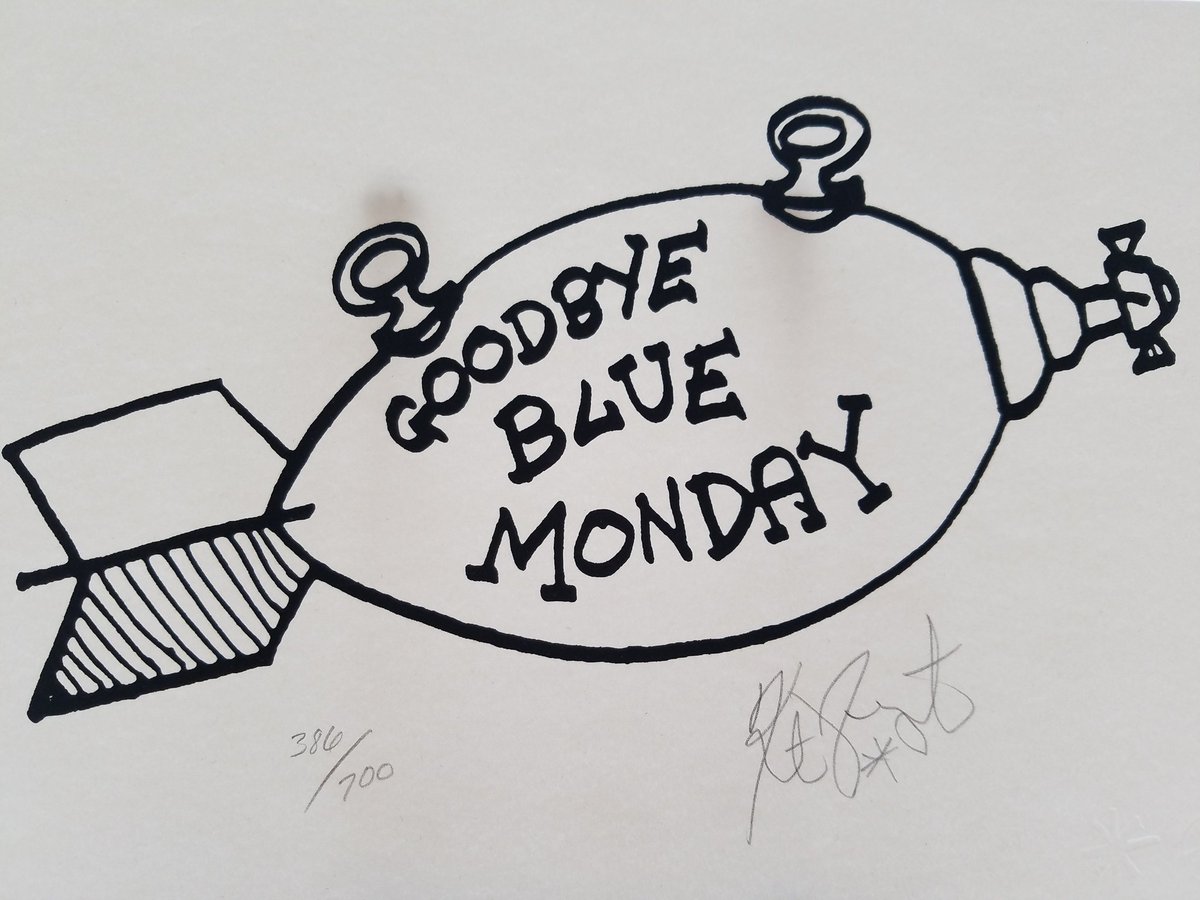
A memorable Breakfast of Champions illustration is said to have lit a flame with New Order, propelling Vonnegut out onto the dance floor.
And Ringo Starr edged his way to favorite Beatle status when he tipped his hat to Breakfast of Champions, dedicating his 1973 solo album to “Kilgore Trout and all the beavers.”
There are dozens more we could mention — you’ll find some of them in the playlist below — but without further ado, let’s welcome to the stage Special K and His Crew!
Yes, that’s Phish drummer (and major Vonnegut fan) Jon Fishman on vacuum.
But who’s that mystery front man, spitting Chaucer’s Canterbury Tales?
Happy 100th, Kurt Vonnegut! We’re glad you were born.
Related Content
Kurt Vonnegut Diagrams the Shape of All Stories in a Master’s Thesis Rejected by U. Chicago
Kurt Vonnegut Gives Advice to Aspiring Writers in a 1991 TV Interview
Kurt Vonnegut: Where Do I Get My Ideas From? My Disgust with Civilization
- Ayun Halliday is the Chief Primatologist of the East Village Inky zine and author, most recently, of Creative, Not Famous: The Small Potato Manifesto. Join her for a free Vonnegut Centennial Fanzine Workshop at the Kurt Vonnegut Museum & Library on November 19. Follow her @AyunHalliday.
Read More...The Mastermind of Devo, Mark Mothersbaugh, Presents His Personal Synthesizer Collection
Mark Mothersbaugh’s studio is located in a cylindrical structure painted bright green — it looks more like a festive auto part than an office building. It’s a fitting place for the iconoclast musician. For those of you who didn’t spend your childhoods obsessively watching the early years of MTV, Mark Mothersbaugh was the mastermind behind the band Devo. They skewered American conformity by dressing alike in shiny uniforms and their music was nervy, twitchy and weird. They taught a nation that if you must whip it, you should whip it good.
In the years since, Mothersbaugh has segued into a successful career as a Hollywood composer, spinning scores for 21 Jump Street and The Royal Tenenbaums among others.
In the video above, you can see Mothersbaugh hang out in his studio filled with synthesizers of various makes and vintages, including Bob Moog’s own personal Memorymoog. Watching Mothersbaugh pull out and play with each one is a bit like watching a precocious child talk about his toys. He just has an infectious energy that is a lot of fun to watch.
Probably the best part in the video is when he shows off a device that can play sounds backward. It turns out that if you say, “We smell sausage” backwards it sounds an awful lot like “Jesus loves you.” Who knew?
Below you can see Mothersbaugh in action with Devo, performing live in Japan during the band’s heyday in 1979.
If you would like to support the mission of Open Culture, consider making a donation to our site. It’s hard to rely 100% on ads, and your contributions will help us continue providing the best free cultural and educational materials to learners everywhere. You can contribute through PayPal, Patreon, and Venmo (@openculture). Thanks!
Note: An earlier version of this post appeared on our site in February 2015.
Related Content:
See Devo Perform Live for the Very First Time (Kent State University, 1973)
Jonathan Crow is a Los Angeles-based writer and filmmaker whose work has appeared in Yahoo!, The Hollywood Reporter, and other publications. You can follow him at @jonccrow. And check out his blog Veeptopus, featuring lots of pictures of badgers and even more pictures of vice presidents with octopuses on their heads. The Veeptopus store is here.
Read More...Behold a 21st-Century Medieval Castle Being Built with Only Tools & Materials from the Middle Ages
Construction sites are hives of specialized activity, but there’s no particular training needed to ferry 500 lbs of stone several stories to the masons waiting above. All you need is the stamina for a few steep flights and a medieval treadwheel crane or “squirrel cage.”
The technology, which uses simple geometry and human exertion to hoist heavy loads, dates to ancient Roman times.
Retired in the Victorian era, it has been resurrected and is being put to good use on the site of a former sandstone quarry two hours south of Paris, where the castle of an imaginary, low ranking 13th-century nobleman began taking shape in 1997.
There’s no typo in that timeline.
Château de Guédelon is an immersive educational project, an open air experimental archeology lab, and a highly unusual working construction site.
With a project timeline of 35 years, some 40 quarrypeople, stonemasons, woodcutters, carpenters, tilers, blacksmiths, rope makers and carters can expect another ten years on the job.
That’s longer than a medieval construction crew would have taken, but unlike their 21st-century counterparts, they didn’t have to take frequent breaks to explain their labors to the visiting public.
A team of archeologists, art historians and castellologists strive for authenticity, eschewing electricity and any vehicle that doesn’t have hooves.
Research materials include illuminated manuscripts, stained glass windows, financial records, and existing castles.
The 1425-year-old Canterbury Cathedral has a non-reproduction treadmill crane stored in its rafters, as well as a levers and pulleys activity sheet for young visitors that notes that operating a “human treadmill” was both grueling and dangerous:
Philosopher John Stuart Mill wrote that they were “unequalled in the modern annals of legalized torture.”
Good call, then, on the part of Guédelon’s leadership to allow a few anachronisms in the name of safety.
Guédelon’s treadmill cranes, including a double drum model that pivots 360º to deposit loads of up to 1000 lbs wherever the stonemasons have need of them, have been outfitted with brakes. The walkers inside the wooden wheels wear hard hats, as are the overseer and those monitoring the brakes and the cradle holding the stones.
The onsite worker-educators may be garbed in period-appropriate loose-fitting natural fibers, but rest assured that their toes are steel-reinforced.
Château de Guédelon guide Sarah Preston explains the reasoning:
Obviously, we’re not trying to discover how many people were killed or injured in the 13th-century.
Learn more about Château de Guédelon, including how you can arrange a visit, here.
Explore the history of treadmill cranes here.
And see how the Château de Guédelon has housed Ukrainian refugees here.
Related Content
The Medieval City Plan Generator: A Fun Way to Create Your Own Imaginary Medieval Cities
A Medieval Book That Opens Six Different Ways, Revealing Six Different Books in One
- Ayun Halliday is the Chief Primatologist of the East Village Inky zine and author, most recently, of Creative, Not Famous: The Small Potato Manifesto. Follow her @AyunHalliday.
Read More...Getting Dressed Over the Centuries: 35 Videos Show How Women & Men Put on Clothes During Ancient, Medieval & Modern Times
Across vast swathes of the world, many of us — arguably too many of us — have grown accustomed to putting on little more than a T‑shirt and jeans every morning, regardless of our status in society. We all know it wasn’t always this way, but we may not fully understand just how much it wasn’t always this way. Throughout most of civilized human history, dressing didn’t just reflect one’s way of life, it practically constituted a way of life in itself. Thanks to Youtube channel Crow’s Eye Productions, we here in the twenty-first century can enjoy detailed, even cinematic re-creations of the dressing process in various eras and places the West, from Roman Britain to Renaissance Florence to 1969 London.
You can watch all 35 of these dressing videos in chronological order with this playlist. Many of the dressers, including such august personages as Prince Albert and Queen Victoria (on Christmas Day, no less), occupy elevated social positions.
But the maids and gardeners of the Victorian era had to get dressed too, and though their clothing may be simpler than that worn by the royals — or even by the middle class — it’s no less revealing of history. One could no doubt tell an even richer story of technological, economic, and cultural change over the centuries through the clothing of “the masses” than through the clothing of the elites.
Even war, that most traditional historical subject of all, has its connections with dress. This playlist features three videos on the dressing routines of soldiers, nurses, and young women during the First World War, as well as one on the members of the Women’s Land Army during the Second World War. Established in 1917, the WLA organized “Land Girls” to take over the agricultural work while the men who’d been doing it were out fighting on the front.
This was just the kind of effort necessitated by total war, as well as one that could only have been performed by women. It’s also, therefore, engagingly approachable by a series like this, with its primary focus on women’s dress — which, at least since the Great Male Renunciation, has had a pretty spectacular history of its own.
Related content:
How Wealthy Women (Like the Mona Lisa) Got Dressed in Renaissance Florence
How Fashionable Dutch Women (Like the Girl with a Pearl Earring) Got Dressed in 1665
Author Imagines in 1893 the Fashions That Would Appear Over the Next 100 Years
Fashion Designers in 1939 Predict How People Would Dress in the Year 2000
Life Magazine Predicts in 1914 How People Would Dress in the 1950s
Based in Seoul, Colin Marshall writes and broadcasts on cities, language, and culture. His projects include the Substack newsletter Books on Cities, the book The Stateless City: a Walk through 21st-Century Los Angeles and the video series The City in Cinema. Follow him on Twitter at @colinmarshall, on Facebook, or on Instagram.
Read More...Historian Timothy Snyder Presents 20 Lessons for Defending Democracy Against Tyranny in a New Video Series
Yale professor and historian Timothy Snyder has sounded alarm bells about autocracy and fascism for several years now, in both his scholarly and popular books about Russian and German history. Whether you’ve followed his warnings or just started paying attention, it’s not too late to get caught up on the lessons he brings from his rigorous studies of 20th century totalitarianism. To make his relevant points more accessible, Snyder has distilled them over the years, aiming at the widest popular audience.
First, he published On Tyranny in 2017, drawing 20 lessons about unfreedom from the lives of those under the Nazi, Soviet, and other fascist and totalitarian regimes. Without arguing that history repeats, exactly, Snyder noted similarities and differences to past events, and adapted general principles to the geopolitics of the early 21st century. These lessons get reiterated and distilled even further in an edition of the best-selling On Tyranny illustrated by artist Nora Krug.
Published in 2021 and reflecting four years of Trumpism, the illustrated edition continues what we might call Snyder’s Chomskyan commitment to public intellectualism. Trump may be out of power, but the threats to democracy are wired in — in one judicial action after another, and in states like North Carolina, where an illegal, racially-gerrymandered state legislature has held power for years, and now seeks to nullify federal elections at state level, with many other states threatening to follow suit.
This kind of political secessionism imposes the permanent will of a minority on a rapidly changing nation, ensuring that history never catches up with the elites, a category that includes leaders on both sides of the euphemistic “aisle.” For increasing numbers of Americans, political divisions are more aptly characterized by barricades, prison walls, or indivisible codes of silence(ing), repression, and complicity. Snyder meets this time of creeping (loping?) fascism with a YouTube series in which he speaks directly to the camera.
He isn’t giving up on more people paying attention to the bigger picture, and he’s never given up on effective responses to 21st century tyranny. Voting alone has never been enough, and it could be rendered meaningless in the near future. The lessons — “Do not obey in advance”; “Defend institutions”; “Beware the one-party state” — may be familiar to us now, or they may not. But if they bear repeating, it’s worth hearing them from Snyder himself, who closes some of the distance between the intellectual and the public by stepping away from print altogether — a medium perhaps unsuited to the malleable demands of the online present.
How does the media affect, or become, Snyder’s message, especially when it’s effectively one-sidedly televisual, the medium of the 20th century of fascism par excellence? Snyder does not address these theoretical questions, except indirectly by way of a generic book talk aesthetic complete with rumpled shirt, rustling lapel mic, and requisite background shelves of books you’ll find yourself trying to identify as you learn to “be wary of paramilitaries.”
Being wary is one thing, but to what does Snyder’s hyper vigilance add up without the power to make change where we are? Ah, but in asking such a question, maybe we find we are already in the trap, obeying in advance by assuming powerlessness and freely giving up control. It’s our job as individuals to apply the relevant lessons where we can in our own lives, and to read (or watch) Snyder critically, in relation to other trustworthy voices within, and far outside of, Ivy League academic departments.
We do not lack the information we need to understand our moment through a historical lens. But we often lack the knowledge to make sense of things at world-historical scale. Historians like Snyder can bridge the gap, and it’s good to take advantage of the freely-offered professional experience of skilled readers, researchers, and educators. In this instance, Snyder’s approach seems well-tailored to counter innumerable presentations that trivialize WWII history into overfamiliarity and perverse spectacle… or what another anti-fascist public intellectual, Walter Benjamin, identified as the aestheticization of politics — fascism-by-passive-consumerism that leads us down the path to horrors we’d never contemplate outright.…
Watch all 20 lessons above, or find them here.
Related Content:
The Making of Modern Ukraine: A Free Online Course from Yale Professor Timothy Snyder
Josh Jones is a writer and musician based in Durham, NC. Follow him at @jdmagness
Read More...Sally Schmitt, the Creator of the French Laundry & Unsung Hero of California Cuisine, Gets Her Due in a Poignant, Short Documentary
One of the New York Times’ most compelling regular features is Overlooked, which gives remarkable individuals whose deaths passed unremarked by the Times obit column a rousing, overdue sendoff.
Sally Schmitt — “one of the great unsung heroes of California Cuisine” as per Michael Bauer, the San Francisco Chronicle’s fearsome former food critic — is not one of those.
When Schmitt died earlier this spring at the age of 90, a few weeks shy of the release of her book, Six California Kitchens: A Collection of Recipes, Stories, and Cooking Lessons From a Pioneer of California Cuisine, the Times took note.
Schmitt received a grand obituary that delved into her personal history, philosophy, and her connection to Napa Valley’s The French Laundry, a three star Michelin restaurant which Anthony Bourdain hailed as the best in the world.
The French Laundry’s renown is such that one needn’t run in foodie circles to be aware of it, and its award-winning chef/owner, Thomas Keller.
Keller, however, did not found the restaurant that brought him fame.
Schmitt did, with the help of her husband, Don and their five children, who pitched in in both the kitchen and the front of the house.
Family was important to Schmitt, and having deferred her dreams for the many years it took to raise hers, she was determined to maintain balance between home and work lives.
In Ben Proudfoot’s New York Times op-doc, above, Schmitt recalls growing up outside of Sacramento, where her mother taught her how to cook using in-season local produce.
Meanwhile, her father helped California produce make it all the way to the East Coast by supplying ice to the Southern Pacific Railroad, an innovation that Schmitt identifies as “the beginning of the whole supermarket situation” and a distressing geographic disconnect between Americans and food.
The Schmitts launched The French Laundry in 1978, with a shockingly affordable menu.
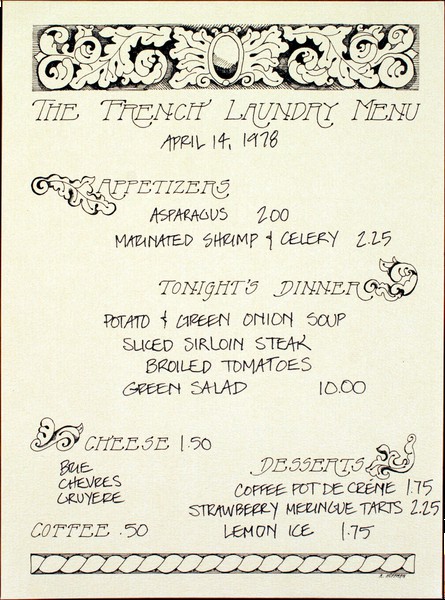
Julia Child, a fan, once “burst into the kitchen,” demanding, “My dear, what was in that dessert sauce?”
(Answer: sugar, butter and cream)
Sixteen years after its founding, The French Laundry was for sale.
Schmitt’s facial expressions are remarkably poignant describing the transfer of power. There’s a lot at play — pride, nostalgia, fondness for Keller, a “really charming young chef, who’d made a name for himself in New York…and was down on his luck.”
Schmitt is gracious, but there’s no question she feels a bit of a twinge at how Keller took her dream and ran with it.
“In high school, I was always the vice president…vice president of everything,” Schmitt says, before sharing a telling anecdote about her best friend beating her out for the highest academic honor:
I went home and cried. Yeah, I thought that I should have it, you know. And my mother said, “Let her have her moment of glory. Don’t worry. There will be moments of glory for you.”
This documentary is one, however posthumous.
Accompanying it is a brief essay in which Proudfoot contrasts the lives of his workaholic late father and Schmitt, with her “delightfully coy candor a message about the rewards of balance and the trap of ambition:”
I made this film for all of us who struggle “to stir and taste the soup” that already sits in front of us.
Another moment of glory:
In Keller’s landmark The French Laundry Cookbook, the final recipe is Sally Schmitt’s Cranberry and Apple Kuchen (with the hot Cream Sauce that so captivated Julia Child.)
Sally Schmitt’s Cranberry and Apple Kuchen with hot Cream Sauce
Serves 8
KUCHEN:
6 tablespoons (3/4 stick) unsalted butter, room temperature, plus more for the pan
3/4 cup sugar
1 large egg
1 1/2 cups all-purpose flour
2 teaspoons baking powder
1/4 teaspoon kosher salt
1/4 teaspoon freshly grated nutmeg
1/2 cup milk or light cream
3 to 4 Gravenstein or Golden Delicious apples
1 cup cranberries or firm blueberries
Cinnamon sugar: 1 tablespoon sugar mixed with 1/4 teaspoon cinnamon
HOT CREAM SAUCE:
2 cups heavy cream
1/2 cup sugar
8 tablespoons (1 stick) unsalted butter
1. Preheat oven to 350 degrees. Butter a 9‑inch round cake pan.
2. For the kuchen: Using an electric mixer, beat butter, sugar and egg together until the mixture is fluffy and lightened in texture.
3. Combine the flour, baking powder, salt and nutmeg. Add dry ingredients and the milk alternately to the butter mixture; mix just until combined.
4. Peel and core apples. Slice them into 1/4‑inch wedges
5. Spoon batter into the pan. Press apple slices, about 1/4‑inch apart and core side down, into the batter, working in a circular pattern around the outside edge (like the spokes of a wheel. Arrange most of the cranberries in a ring inside the apples and sprinkle remainder around the edges of the kuchen. Sprinkle kuchen with the cinnamon sugar.
6. Bake for 40 to 50 minutes, or until a cake tester inserted into the center of the kuchen comes out clean. Set on a rack to cool.
7. Combine the cream sauce ingredients in a medium saucepan. Bring to a boil, lower heat and simmer for 5 to 8 minutes, to reduce and thicken it slightly.
8. Serve the cake warm or at room temperature, drizzled with the hot cream sauce
Related Content
Watch Anthony Bourdain’s First Food-and-Travel Series A Cook’s Tour Free Online (2002–03)
Watch 26 Free Episodes of Jacques Pépin’s TV Show, More Fast Food My Way
Watch Werner Herzog Eat His Shoe, Cooked by Chef Alice Waters (1980)
- Ayun Halliday is the Chief Primatologist of the East Village Inky zine and author, most recently, of Creative, Not Famous: The Small Potato Manifesto. Follow her @AyunHalliday.
Read More...Support Us
We're hoping to rely on loyal readers, rather than erratic ads. Please click the Donate button and support Open Culture. You can use Paypal, Venmo, Patreon, even Crypto! We thank you!

About Us

Open Culture scours the web for the best educational media. We find the free courses and audio books you need, the language lessons & educational videos you want, and plenty of enlightenment in between.
Advertise With Us

FREE UPDATES!
GET OUR DAILY EMAIL
Get the best cultural and educational resources on the web curated for you in a daily email. We never spam. Unsubscribe at any time.
FOLLOW ON SOCIAL MEDIA

Open Culture editor Dan Colman scours the web for the best educational media. He finds the free courses and audio books you need, the language lessons & movies you want, and plenty of enlightenment in between.
Advertise With Us


