Liam Neeson Stars as Raymond Chandler’s Legendary Detective Philip Marlowe: Watch the Trailer for the New Film
Behold the new trailer for Marlowe, a new film directed by Neil Jordan. As the title suggests, the film centers around Philip Marlowe, the gumshoe detective that Raymond Chandler first unveiled in The Big Sleep in 1939. Between then and now, Marlowe has been portrayed in films by Humphrey Bogart, Robert Mitchum, Elliott Gould, and James Garner. Now, Liam Neeson takes his turn. Here’s how the producers pitch the film:
MARLOWE, a gripping noir crime thriller set in late 1930’s Los Angeles, centers around a street-wise, down on his luck detective; Philip Marlowe, played by Liam Neeson, who is hired to find the ex-lover of a glamorous heiress (Diane Kruger), daughter of a well-known movie star (Jessica Lange). The disappearance unearths a web of lies, and soon Marlowe is involved in a dangerous, deadly investigation where everyone involved has something to hide.
Marlowe arrives in theaters on February 15.
If you would like to support the mission of Open Culture, consider making a donation to our site. It’s hard to rely 100% on ads, and your contributions will help us continue providing the best free cultural and educational materials to learners everywhere. You can contribute through PayPal, Patreon, and Venmo (@openculture). Thanks!
Related Content
Raymond Chandler’s Ten Commandments for Writing a Detective Novel
Watch Raymond Chandler’s Long-Unnoticed Cameo in Double Indemnity
Read More...Contribute a Song to WNYC’s Public Song Project & Use Your Creativity to Explore the Public Domain

We recognize that Open Culture readers are a creative bunch.
As proof, we point to your Getty Museum Challenge entries and the fact that one of your number won Yale University Press’s Kafka Caption Contest.
We’ve identified another opportunity to show off your creative streak, compliments of All Of It with Alison Stewart, a daily live culture program on WNYC, New York City’s public radio station.
You have until February 13 to write and record an original song inspired by a work in the public domain, and submit it to The All Of It Public Song Project.
Amateurs are welcome to take a crack at it and any genre is cricket, including rap, spoken word, and instrumentals.
Even if you limit yourself to the works that entered the public domain on January 1 of this year, the possibilities are almost endless.
Should you be inclined toward a faithful cover, we encourage you to consider one of 1927’s deep cuts, like Fats Waller’s “Soothin’ Syrup Stomp” or Jelly Roll Morton’s “Hyena Stomp,” though we understand the attraction of Irving Berlin’s enduringly popular “Puttin’ on the Ritz”.
Apologies to Emily Joy, the accomplished young classical pianist, above — participation is limited to entrants aged 18 or older.
The rest of us are free to invent new lyrics for an existing composition, or a brand new tune for existing lyrics.
You might musicalize a poem or speech, some dialogue from a film, or a page from a book.
A bluegrass spin on Fritz Lang’s Metropolis, perhaps?
A death metal re-envisioning of Buttercup Days from A.A. Milne’s Now We Are Six?
How about a sissy bounce take on these lines from “The Adventure of the Mazarin Stone,” the first short story in Arthur Conan Doyle’s collection, The Case-Book of Sherlock Holmes:
“Billy, you will see a large and ugly gentleman outside the front door. Ask him to come up.”
“If he won’t come, sir?”
“No violence, Billy. Don’t be rough with him. If you tell him that Count Sylvius wants him he will certainly come.”
“What are you going to do now?” asked the Count as Billy disappeared.
“My friend Watson was with me just now. I told him that I had a shark and a gudgeon in my net; now I am drawing the net and up they come together.”
The Count had risen from his chair, and his hand was behind his back. Holmes held something half protruding from the pocket of his dressing-gown.
“You won’t die in your bed, Holmes.”
Okay, we’re being silly, but only because we don’t want to put ideas in your head!
You could even concoct something entirely new — perhaps a ballad from the POV of To the Lighthouse’s young James Ramsay, or a ditty apologizing to Virginia Woolf for reading the Cliffs Notes instead of the actual novel when it was assigned in your college Women’s Literature class.
…we’re doing it again, aren’t we?
All right, we’ll leave you to it, with a reminder that anything outside of your public domain source material must be wholly original — no borrowing a catchy tune from Lennon and McCartney, capisci?
Winners will get a chance to discuss their works on WNYC and all qualifying entries will be posted at contest’s end for the public’s listening pleasure.
Contest rules and information on how to submit to The All Of It Public Song Project can be found here.
Good luck! We can’t wait to hear what you come up with.
Related Content
A Search Engine for Finding Free, Public Domain Images from World-Class Museums
400,000+ Sound Recordings Made Before 1923 Have Entered the Public Domain
- Ayun Halliday is the Chief Primatologist of the East Village Inky zine and author, most recently, of Creative, Not Famous: The Small Potato Manifesto and Creative, Not Famous Activity Book. Follow her @AyunHalliday.
Read More...An Introduction to Hokusai’s Great Wave, One of the Most Recognizable Artworks in the World
You need not be a student of Japanese Ukiyo‑e woodblock prints to recognize artist Katsushika Hokusai’s Under the Wave Off Kanagawa — or the Great Wave, as it has come to be known.
Like Leonardo da Vinci’s Mona Lisa and Botticelli’s The Birth of Venus, it’s been reproduced on all manner of improbable items and subjected to liberal reimagining — something Sarah Urist Green, describes in the above episode of her series The Art Assignment as “numerous crimes against this image perpetrated across the internet.”
Such repurposing is the ultimate compliment.
The Great Wave is so graphically indelible, anyone who co-opts it can expect it to do a lot of heavy lifting.
For those who bother looking closely enough to take in the three boatloads of fishermen struggling to escape with their lives, it’s also narratively gripping, a terrifying woodblock still from an easily imagined disaster film.
It’s also an homage to Mount Fuji, one of a series of 36.
Thousands of prints were produced in the early 1830s for the domestic tourist trade. Visitors to Mount Fuji snapped these souvenirs up for about the same price as a bowl of noodle soup.

Green, a curator and educator, points out how the water-obsessed Hokusai borrowed elements from both the Rinpa school and Western realism for the Great Wave. The latter can be seen in the use of linear perspective, a low horizon line, and Prussian blue.
An 1867 posthumous showing at the International Exhibition in Paris turned such notable artists as Claude Monet, Edgar Degas, Mary Cassatt, and Henri de Toulouse-Lautrec into major Ukiyo‑e fans.
Without them, this iconic plunging breaker might never have spilled over onto our dorm room walls, our shower curtains, our yoga mats, t‑shirts, Doc Martens, street art, and tattoos.
Hell, there’s even a Lego set and an official Sanrio characters greeting card showing Hello Kitty nonchalantly surfing the crest in a two piece bathing suit, more interested in disporting herself than considering the sort of extreme oceanic events we can expect more of, owing to climate change.
Related Content
View 103 Discovered Drawings by Famed Japanese Woodcut Artist Katsushika Hokusai
- Ayun Halliday is the Chief Primatologist of the East Village Inky zine and author, most recently, of Creative, Not Famous: The Small Potato Manifesto. Follow her @AyunHalliday.
Read More...Watch Cher Play All the Major Parts in a 12-Minute Remake of West Side Story (1978)
Cher, the mononymous Goddess of Pop, gifted the small screens of the 70s with a lot of over-the-top glamour.
Her work ethic, comedic flair and unapologetic embrace of camp helped her stand out from the crowd, conferring the fame she had longed for since childhood, when she commandeered her 5th grade classmates for an unofficial, and, from the sounds of it, all-female production of Oklahoma, covering the male roles herself when the boys declined to participate.
Some twenty years later, she was a household name — one that was no longer appended to that of ex-husband Sonny Bono, co-host of the popular eponymous variety hour in which they sang, hammed their way through goofy skits, and busted each other’s chops to the delight of the live studio audience.
The 1978 television event Cher…special found her bringing many of those same talents to bear, along with country star Dolly Parton, rocker Rod Stewart, outré glam band, The Tubes, and the crowd-pleasing array of spangled, skin-baring Bob Mackie designs that defined her look.
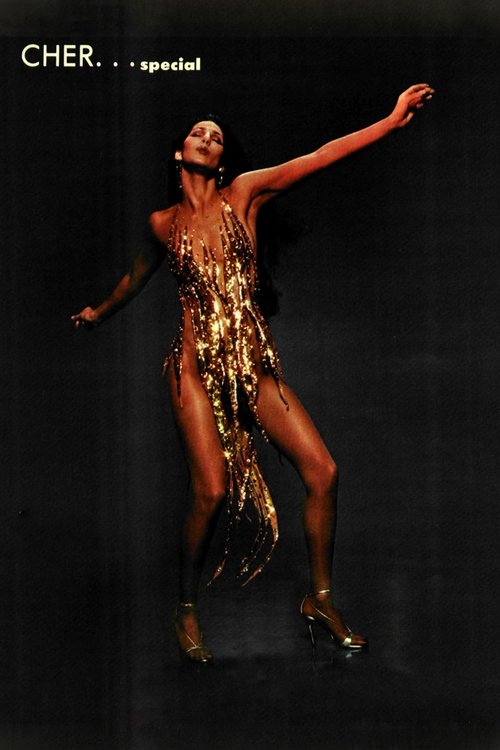
More shocking than any of Mackie’s creations or the Musical Battle to Save Cher’s Soul, a set piece wherein Parton and a gospel choir endeavor to coax the diva from a kinky disco hellscape, is the star’s 12-and-a-half minute solo version of West Side Story, above.
This is no mere medley. Cher puts the big pot in the little, donning multiple wigs, a facsimile of the chaste white party dress Natalie Wood wore to the dance at the gym, and flats (!) to embody Tony, Maria, Anita, Bernardo and various Jets, sans irony.
Some of Stephen Sondheim’s award-winning songs have been transposed to a different key to accommodate Cher’s contralto, and when they haven’t, her famous voice is stretched a bit thin.
Vocally, she makes a more convincing Jet than she does the ingenue, Maria.
(Speaking of which, let’s not forget that that’s ghost singer Marni Nixon, not Wood, as Maria on the 1961 film’s soundtrack…)
Why West Side Story?
Why not Godspell or Jesus Christ Superstar? Wouldn’t those fit better thematically with the portion of the special that has Dolly and a white-robed chorus battling the denizens of Satan’s sexy playpen?
Two words:
1. Variety. That’s what Cher was peddling in the 70s.
2. Nostalgia. As Cher recalls in On the Dance Floor: Spinning Out on Screen:
I remember dancing around my living room to West Side Story (1961). I would sing all the parts and dance every single dance, when there was no one else around.
That admission helps us reframe the cringe factor. Before ye cast the first stone, think: hast thou never stood before a mirror singing into a hairbrush?
And if, by some chance, you’re unfamiliar with West Side Story’s dramatis personae and plot, don’t look to Cher for clarification.
Instead, we refer you to Romeo and Juliet, and for some modern context touching on green screens, genderfluidity, and the color-conscious casting of the 2021 remake, the below episode of Chris Frank’s snarky Bad Music Video Theater.
Related Content
David Bowie and Cher Sing Duet of “Young Americans” and Other Songs on 1975 Variety Show
- Ayun Halliday is the Chief Primatologist of the East Village Inky zine and author, most recently, of Creative, Not Famous: The Small Potato Manifesto. Follow her @AyunHalliday.
Read More...How to Watch Hundreds of Free Movies on YouTube
We lived in the age of movie theaters, then we lived in the age of home video, and now we live in the age of streaming. Like every period in the history of cinema, ours has its advantages and its disadvantages. The quasi-religiosity of the cinephile viewing experience is, arguably, not as well served by clicking on a Youtube video as it is by attending a screening at a grand revival house. But on the whole, we do have the advantage of access, whenever and wherever we like, to a great many films that most of us may have been wholly unable to see just a couple of decades ago — and often, we can watch them for free.
That said, these are still relatively early days for on-demand viewing, and finding out just where to do it isn’t as easy as it could be. That’s why we’ve rounded up this collection of Youtube channels with free movies, which together constitute one big meta-collection of hundreds of films. Among them are numerous black-and-white classics, of course, but also critically acclaimed pictures by international auteurs, rather less critically acclaimed (but nonetheless enjoyable) cult favorites, documentaries on a wide variety of subjects, and even twenty-first-century Hollywood releases.
Which films you can watch will vary, unfortunately, depending on which part of the world you happen to be watching them in. But no matter your location, you should easily be able to find more than a few worthwhile selections on all these channels. One under-appreciated aspect of our streaming age is that, though the number of choices may sometimes overwhelm, it’s never been easier to give a movie a chance. One click may, after all, transport you into a picture that changes the way you experience cinema itself — and if it doesn’t, well, at least the price was right.
- Cult Cinema Classics: This channel features cult classic films from the 30s, 40s, 50s, 60, 70s and 80s, providing access to 100 horror films, almost 400 western films, and a large number of Pre-Code films.
- Kino Lorber: Kino Lorber, a leading film distributor, has put 145 films on YouTube. The collection includes 80 documentaries on topics like on M.C. Escher, Stanley Kubrick, Hannah Arendt, and Hilma af Klint.
- Korean Classic Films: This channel lets you experience decades of Korean cinema, including but not limited to those of mid-20th-century masters like Kim Ki-young, Im Kwon-taek, and Kim Soo-yong, director of haunting, even brazen pictures of the 1960s and 70s like Mist and Night Journey. Enter the channel here.
- Mosfilm: One of the oldest film studios in Russia & Europe, Mosfilm has put online hundreds of Russian and Soviet films, many with English subtitles. The collection includes major films by Andrei Tarkovsky and an epic adaptation of War & Peace. Here, you will also find Battleship Potemkin and other films by Sergei Eisenstein. Enter the channel here.
- National Film Board of Canada: Canada’s public film producer and distributor has put online a large collection of short films. The channel features over 50 films from celebrated Canadian animator Norman McLaren, plus curated collections of films from the 1940s, 50s, 60s, 70s, 80s, and beyond.
- New Yorker’s Screening Room: On The New Yorker’s YouTube channel, you can find a Screening Room that hosts nearly 70 award-winning short films. This collection includes some wonderful claymations and animations. We previously featured the collection on our site in 2021.
- PizzaFlix: A passion project created by two film industry professionals with 50 years combined experience. They control a large, privately-held broadcast-quality film & TV library and have put online over 300 cowboy westerns, 80+ noir films, 200+ classic thriller and mystery films, and a number of films by Roger Corman.
- Popcorn Flix: A little like PizzaFlix (above), this archive has playlists of action movies, sci fi films, westerns, thrillers, comedies, dramas, and more.
- Timeless Classic Movies: Just as the title says, it’s a fine collection of timeless classic movies. Among other things, you can find 35 noir films and 60 classic thrillers here.
- YouTube’s Free Streaming Movies: YouTube itself hosts a large number of free streaming movies, mostly mainstream Hollywood productions. That said, you can also find some classics there, like the Coen Brothers’O Brother, Where Art Thou?, Akira Kurosawa’s Dreams, Yasujiro Ozu’s Tokyo Story, and Clint Eastwood’s The Good, The Bad, and The Ugly and also Fistful of Dollars. Enter the channel here.
If you know of other YouTube channels that legitimately host films online, please add them to the comments section below.
And, for more films, be sure to explore our collection, 4,000+ Free Movies Online: Great Classics, Indies, Noir, Westerns, Documentaries & More
Related Content
Watch 3,000+ Films Free Online from the National Film Board of Canada
Watch 30+ Exceptional Short Films for Free in The New Yorker’s Online Screening Room
Watch More Than 400 Classic Korean Films Free Online Thanks to the Korean Film Archive
Charade, the Best Hitchcock Film Hitchcock Never Made: Stars Cary Grant & Audrey Hepburn
Based in Seoul, Colin Marshall writes and broadcasts on cities, language, and culture. His projects include the Substack newsletter Books on Cities, the book The Stateless City: a Walk through 21st-Century Los Angeles and the video series The City in Cinema. Follow him on Twitter at @colinmarshall or on Facebook.
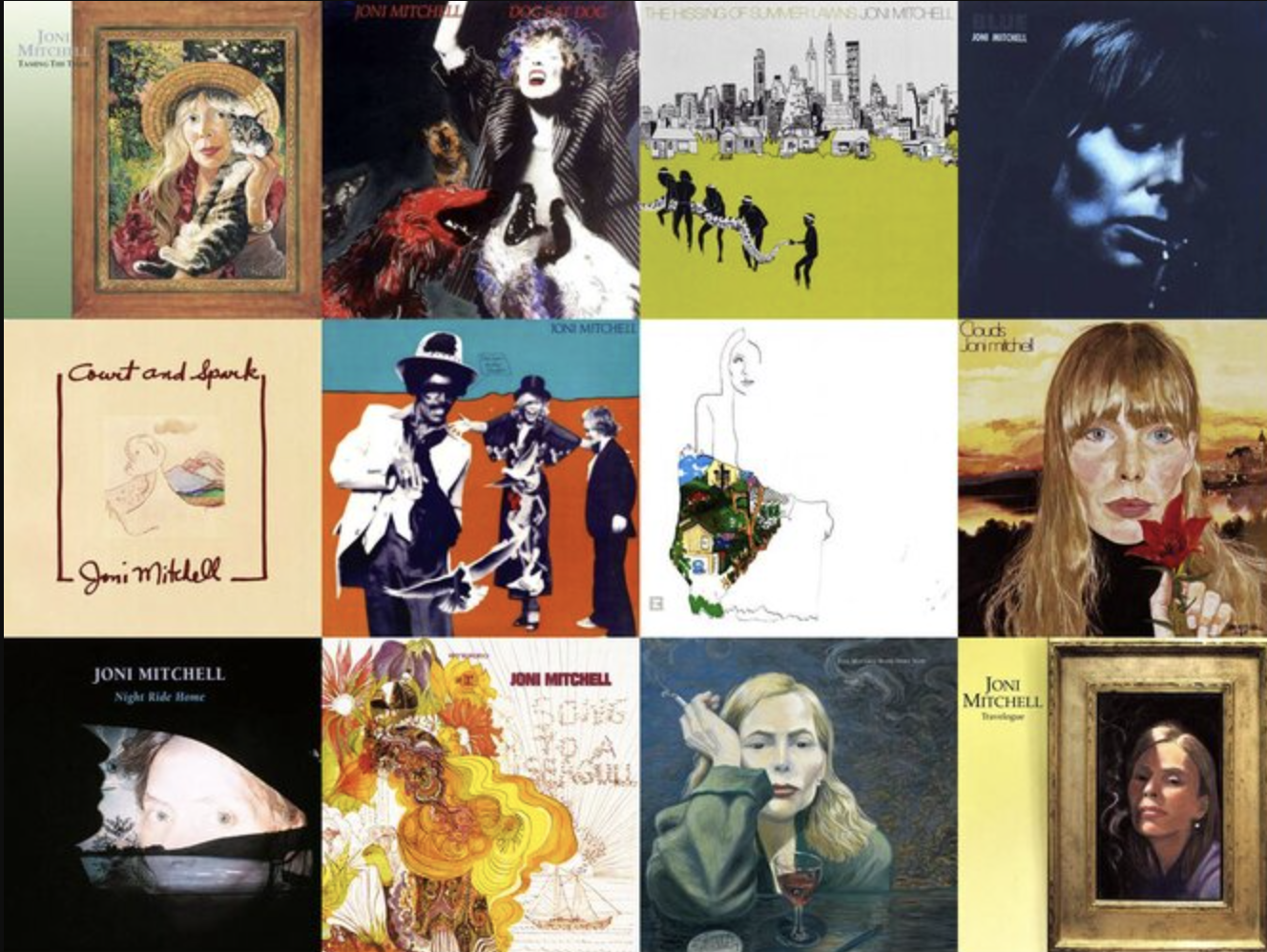
Read More...Joni Mitchell’s Catalog of Albums Now on YouTube: Stream Them Online
2022 — another difficult year for so many — has drawn to a close.
While not a remedy for all the hardships and privations we’ve been privy to, Joni Mitchell’s music remains good medicine. Listening to her always makes us feel more connected, reflective and calm for at least an hour or two.
Lucky us. The beloved singer-songwriter has given us a New Year’s gift — all her albums posted to her official Youtube channel.
What a lovely way to usher the old year offstage, and quietly welcome the new.
We all have our allegiances, though many who identify as fans may discover they’ve missed a couple releases along the way.
She has, to date, released 19 studio albums, 5 live albums, and an EP, as well as inspiring 2 tribute albums. A recent remark on Elton John’s Rocket Hour left us hopeful that more may be in the offing.
Sir Elton is but one of many well known musicians who are unabashed Mitchell fans. Artists as diverse as Harry Styles, k.d. lang, and Herbie Hancock have written songs in response to their favorite Joni cuts.
And the internet teems with covers from both heavy hitters and unknowns. (See them organized by song title on Mitchell’s website, where “Both Sides Now” remains the champ with a whopping 1576 renditions.)
Her fourth album, 1971’s Blue, seems to garner the most fervent praise…
Taylor Swift: She wrote it about her deepest pains and most haunting demons. Songs like ‘River,’ which is just about her regrets and doubts of herself – I think this album is my favorite because it explores somebody’s soul so deeply.”
James Taylor: I said it probably too many times that Joni is like, you tap the tree, and you know, it’s like maple syrup. This stuff, this nectar comes out of the most unusual places.
Jewel: On Blue, you hear everything she experienced, the highs and the lows. It’s such a lonely album — not in the “I don’t have any friends” sense but in the sense that you’re a little bit removed, and always watching. It takes a lot of courage to be that honest, especially as a woman.
Prince on The Hissing of Summer Lawns:
It was the last album I loved all the way through.
Boy George on Court and Spark:
I’ve bought this for many people because it is probably her most accessible [album]. I love unusual voices and I’ve sat and cried to so many of her songs. My favorite is Car On A Hill because I’ve done what it’s about: waited for the boyfriend to turn up as the cars go by.
Björk on 1977’s double album, Don Juan’s Reckless Daughter and Hejira:
I think it was that accidental thing in Iceland, where the wrong albums arrive to shore, because I was obsessed with Don Juan’s Reckless Daughter and Hejira as a teenager. I hear much more of her in those albums. She almost made her own type of music style with those, it’s more a woman’s world.”
Sisters Danielle and Este Haim on 1974’s live album Miles of Aisles:
There’s a little bit of everything. Songs from all her albums up until then, and she’s playing them with the L.A. Express, which was this amazing jazz band… a reimagining of a lot of her early work through this jazz lens.
Enjoy a lovely wander through Joni Mitchell’s oeuvre here. When you click on this page, scroll down to the “Albums & Singles” section, and then move (from left to right) through the entire discography.
Related Content
Songs by Joni Mitchell Re-Imagined as Pulp Fiction Book Covers & Vintage Movie Posters
Hear Demos & Outtakes of Joni Mitchell’s Blue on the 50th Anniversary of the Classic Album
- Ayun Halliday is the Chief Primatologist of the East Village Inky zine and author, most recently, of Creative, Not Famous: The Small Potato Manifesto. Follow her @AyunHalliday.
Read More...Watch You Suck at Cooking, a Hilarious Source for Tasty Recipes and Food Hacks of Questionable Veracity
Is it just us, or did half of Gen Z teach themselves how to cook on TikTok during the height of the pandemic?
The recipes that go viral have more in common with gonzo science experiments than Julia Child’s Coq au Vin.
Hacks are golden in this forum — whether or not they actually work — and running time is of the essence.
There’s an unmistakable visual vocabulary, too — from the god shots of manicured hands dumping pre-measured ingredients into mixing bowls to the reveal of the completed dish just seconds later.
One has to be conversant in these tropes to subvert them as gleefully as the anonymous creator of the seven year old online series You Suck at Cooking.
Unlike such TikTok heavy hitters as cloud bread or whipped coffee, most of You Suck at Cooking’s dishes are things you might consider preparing on a regular basis, however trendy they may be at the moment.
The responsible party’s cooking and editing skills are solid, but his writing is the real star here. We also appreciate the massive amount of planning and care that goes into every five minute episode.
He’s an unabashed coiner of vocabulary and elaborate ways to refer to straightforward appliances and ingredients. His delivery is mild mannered, but he doesn’t mince words when it comes to culinary biases — e.g., condimenting only one side of the bun is a certifiable burger crime and if you don’t like pickles, one thing you can do is seek help.
Simple dishes such as overnight oats require so little instruction, he’s freed up to skewer the questionable claims of food-focused wellness “experts” by leaning all the way in.
The spirit of the project carries over into his written step-by-steps on the rare occasions when mere video demonstration will not suffice.
(His cookbook, You Suck at Cooking: The Absurdly Practical Guide to Sucking Slightly Less at Making Food, was published anonymously in 2019.)
To get the most from your experience, we recommend you first watch his deep fried Korean-style corndog How To, then follow the written recipe:
1. Go to the store
2. Buy corn dogs
3. Enjoy
If you insist on making corn dogs yourself, first read these frying safety tips
The reason home fryers are safer than doing it on the stovetop is because they limit the heat of your oil so it won’t catch fire. It’s easy to let it get too hot which is very bad news.
Batter
-
- 1 ¼ cups flour
- 2 tablespoon sugar
- ½ teaspoon salt
- 1.3 teaspoon yeast
- 1 egg
- 100 ml warm water
Wangjangle until your wrist is furious (I did it for a few minutes tops)
Let it sit for half an hour
Dry off anything you’re rolling in it
Peg your dogs
Roll ‘em
Roll them in artisan Italian bread crumbs (okay seriously this is a flavor game changer and I can’t recommend them enough. Kortalian food just has such depth.
Fry for 3 minutes
Cool for a few minutes
I think anything else is pretty straight forward
When it comes to cooking hacks, our hero is a champion fabulist.
It’s safe to assume that the first tip is legit, after which… well, let’s just say that some of his orange peeling methods remind us in the best possible way of our old pal Shel Silverstein’s Uncle Shelby’s ABZ Book.
Enjoy a playlist of all 150 episodes of You Suck at Cooking here.
Related Content
- Ayun Halliday is the Chief Primatologist of the East Village Inky zine and author, most recently, of Creative, Not Famous: The Small Potato Manifesto. Follow her @AyunHalliday.
Read More...How Fast Food Began: The History of This Thoroughly American (and Now Global) Form of Dining
What is the most American institution of all? The mind first goes in the directions of church, of the military, of football. But if we consider only the systems of modern life developed on United States soil, the most influential must surely be fast food. That influence manifests in not just the homeland but the rest of the world as well, and like every robust American creation, fast food both changes and adapts to the foreign lands in which it takes root. Though unknown in the U.S., the yellow motorcycles of McDonald’s deliverymen are an everyday sight in the capital of South Korea, where I live. That could hardly have figured in even the farthest-reaching visions Richard and Maurice McDonald had for the entirely new model of hamburger stand they launched in San Bernardino, California, in 1948.
Back in postwar America, “car culture reigns supreme. Drive-in movies and drive-in restaurants become all the rage, taking convenience to another level.” So says the narrator of the clip above, from the fast-food episode of the Netflix series History 101. But before long, drive-ins would be relegated to the status of historical curiosity, and fast food on the McDonald’s model would become nearly omnipresent.
As with much else in American industrial history, the key was efficiency. Having previously run a drive-in, the McDonald brothers understood well how cumbersome such operations could be, and how they encouraged customers to linger rather than spend their money and be on their way. The stripped-down menu, the streamlined cooking process: every element was now engineered for speed above all.
McDonald’s did not, however, invent the drive-through. That honor goes to a Texas establishment called Pig Stand, which first erected that pillar of the American way of life back in 1921. In Fast Food: The Fast Lane of Life, the History Chanel documentary above, the president of Texas Pig Stands says that the chain’s founder Jessie G. Kirby “was famous for his quote of saying that people with cars are so lazy that they don’t want to get out of them to go eat. That prophecy proved to be very true.” Even as the spread of car ownership across America and then the world made drive-through fast food into a viable proposition, it put (and continues to put) greater and greater pressure on the businesses to deliver their product in shorter and shorter times.
“Beyond the challenges of technical hardware that delivered things fast, the industry had to deliver a pipeline to deliver the food,” says the documentary’s narrator. “Throughout the eighties, the burger giants set about designing a network of suppliers that could deliver millions of tons of foods to thousands of restaurants at exacting standards of uniformity.” This uniformity — hamburgers that cost and taste exactly the same, everywhere — enchanted Andy Warhol, that maven of American mass culture. It has also, arguably, done its part to trivialize the rituals of preparing and consuming food, to say nothing of the health dangers posed by frequent indulgence in salty, sugary, oily meals, especially in the context of a sedentary automotive lifestyle. But if you don’t understand fast food — and all the technological, economic, and social factors that have made it not just possible but world-dominant — can you claim understand America?
Related content:
How Eating Kentucky Fried Chicken Became a Christmas Tradition in Japan
A Brief History of the Great American Road Trip
McDonald’s Opens a Tiny Restaurant — and It’s Only for Bees
Based in Seoul, Colin Marshall writes and broadcasts on cities, language, and culture. His projects include the Substack newsletter Books on Cities, the book The Stateless City: a Walk through 21st-Century Los Angeles and the video series The City in Cinema. Follow him on Twitter at @colinmarshall or on Facebook.
Read More...Behold! The Very First Christmas Card (1843)
Christmas cards aren’t just an anachronism.
They’re almost an endangered species, the victim of the Internet, postal rate increases, and the jettisoning of any time consuming tradition whose execution has been found to bring the opposite of joy.
Above, Victoria and Albert Museum curators Alice Power and Sarah Beattie take us on a backwards trip to a time when the exchange of Christmas cards was a source of true social merriment.
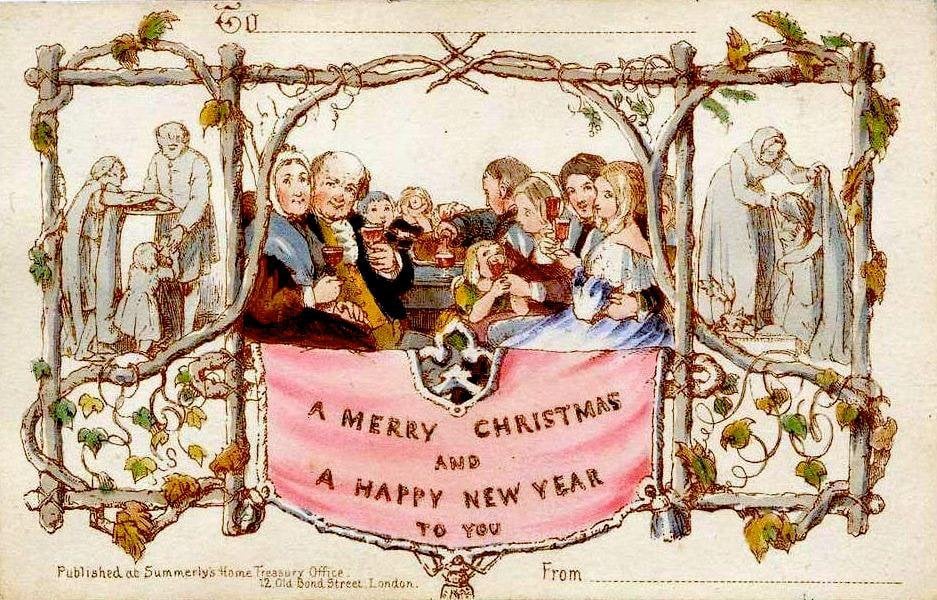
Christmas cards must hold a special place in both the V&A’s collections and heart, given that the museum’s founder, Henry Cole, inadvertently invented them in 1843.
As a well respected man about town, he received a great many more holiday letters than he had time or inclination to respond to, but neither did he wish to appear rude.
So he enlisted his friend, painter J.C. Horsley, to create a festive illustration with a built-in holiday greeting, leaving just enough space to personalize with a recipient’s name and perhaps, a handwritten line or two.
He then had enough postcard-sized reproductions printed up to send to 1000 of his friends.
(It’s hell being popular…)
Talk about zeitgeist: Charles Dickens’ A Christmas Carol was first published that very same holiday season.
No wonder everyone wanted in on the fun.
Part of the reason the cards in the V&A’s collection are so well preserved is that their recipients prized them enough to keep them in souvenir albums.
Understandably. They’re very appealing little artifacts.
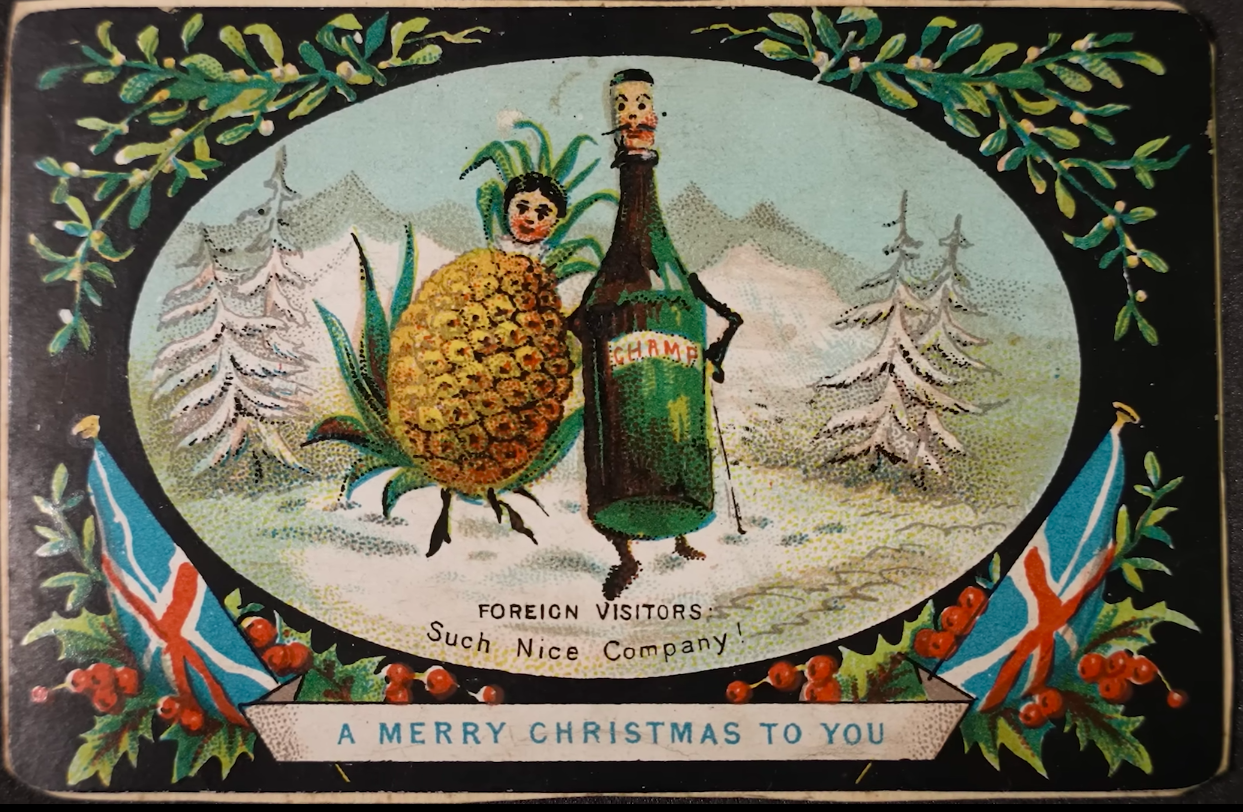
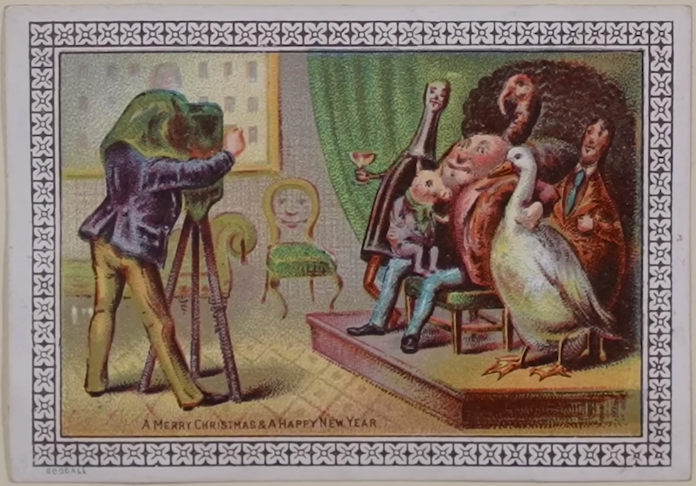
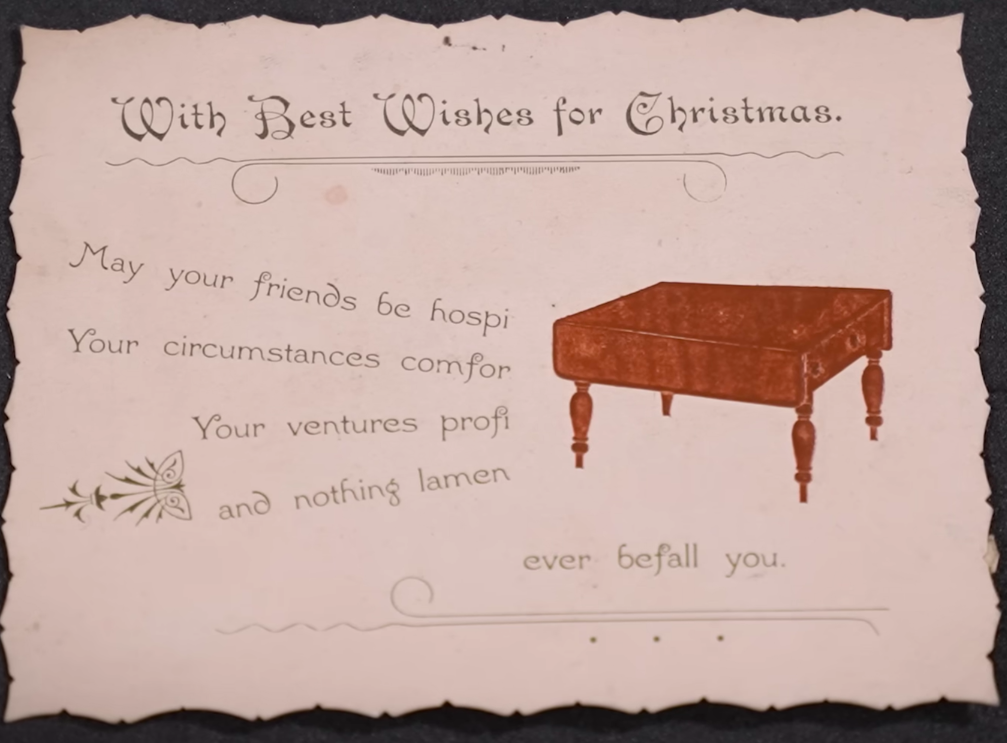
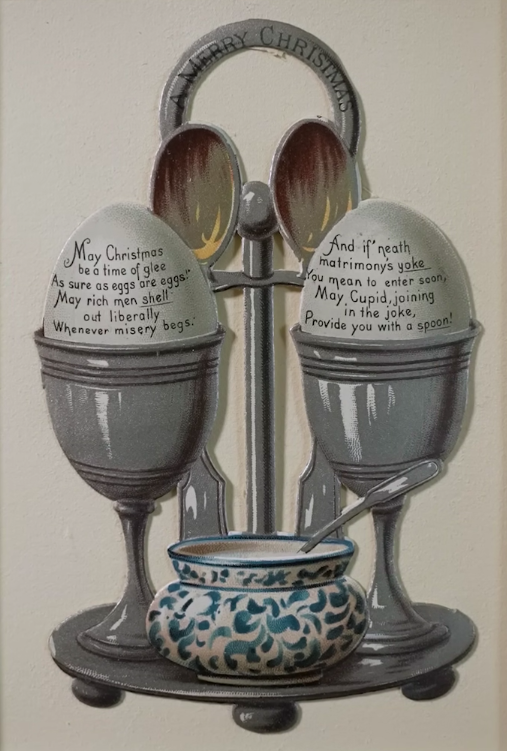
The upper crust could afford such fancy design elements as clever die-cut shapes, pop up elements, and translucent windows that encouraged the recipients to hold them up to actual windows.
Technological advances in the printing industry, and the creation of the cost-effective Penny Post allowed those whose budgets were more modest than Mr. Cole’s to participate too.
Their cards tended to be simpler in execution, though not necessarily concept.
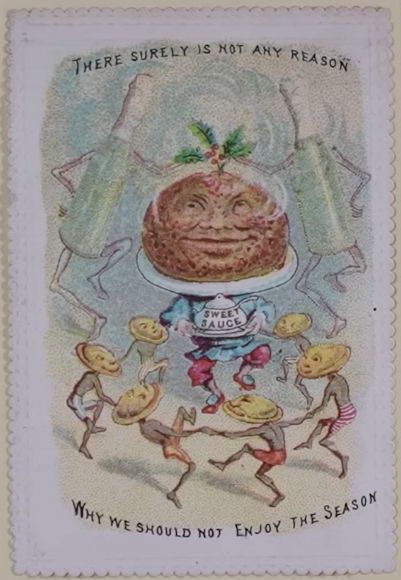
In addition to the views we’ve come to expect — winter, Father Christmas, holly — the Victorians had a thing for jolly anthropomorphized food and some truly shameless puns.
Enjoy these Ghosts of Christmas Past, dear readers. We’re almost inspired to revive the tradition!
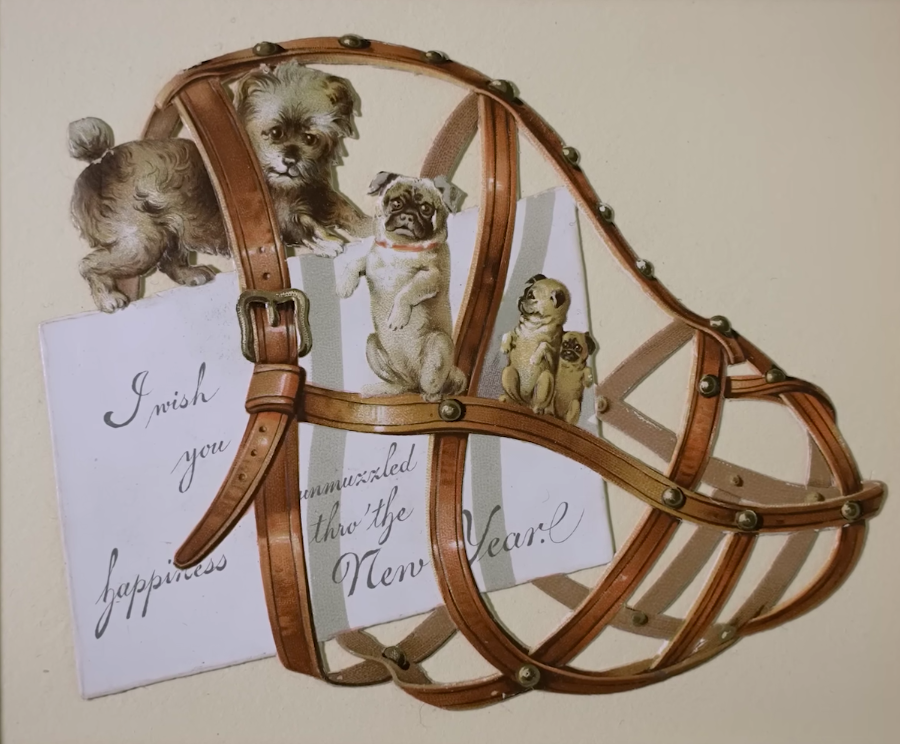
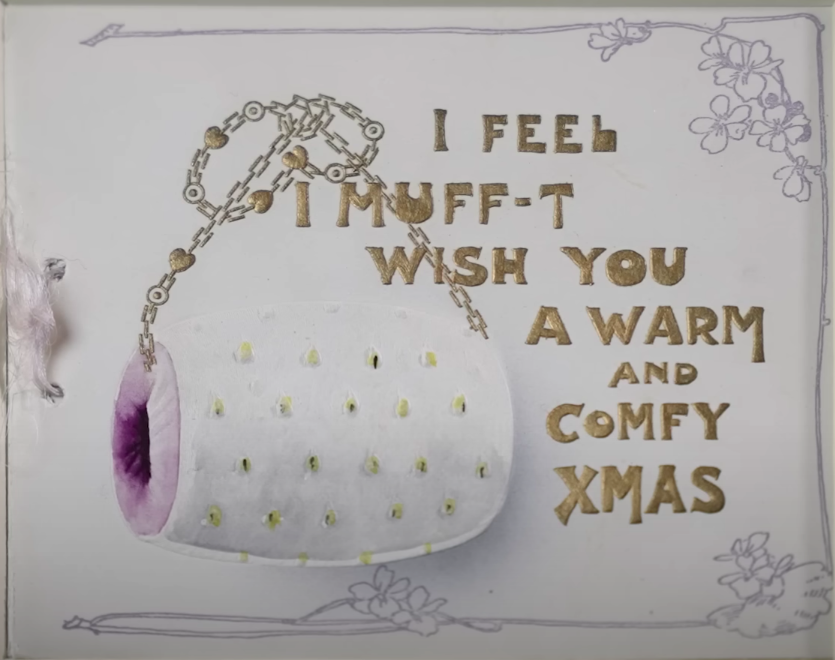
Read more about the advent of this tradition, including how it jumped the pond, in Smithsonian Magazine’s History of the Christmas Card.
Related Content
When Salvador Dalí Created Christmas Cards That Were Too Avant Garde for Hallmark (1960)
J.R.R. Tolkien Sent Illustrated Letters from Father Christmas to His Kids Every Year (1920–1943)
Langston Hughes’ Homemade Christmas Cards From 1950
Watch Terry Gilliam’s Animated Short, The Christmas Card (1968)
Hear Neil Gaiman Read A Christmas Carol Just Like Charles Dickens Read It
An Oscar-Winning Animation of Charles Dickens’ Classic Tale, A Christmas Carol (1971)
- Ayun Halliday is the Chief Primatologist of the East Village Inky zine and author, most recently, of Creative, Not Famous: The Small Potato Manifesto. Follow her @AyunHalliday.
Read More...Mudlarking on the Thames: A Treasure Trove of History Washes Ashore Every Low Tide
If you’re looking for free outdoor activities to pull you from the digital realm, may we recommend mudlarking?
Lara Maiklem, author of Mudlarking: Lost and Found on the River Thames and A Field Guide to Larking, has developed a keen eye in the 20 years she’s been scavenging historic detritus from the foreshore of the Thames at low tide.
I never use a metal detector and I often walk little more than a mile in 5 hours, yet I can travel 2,000 years back in time through the objects that are revealed by the tide. Prehistoric flint tools, medieval pilgrim badges, Tudor shoes, Georgian wig curlers and Victorian pottery, ordinary objects left behind by the ordinary people who made London what it is today.
As she says in the short film above, her first find has become one of her most common — a clay pipe fragment.
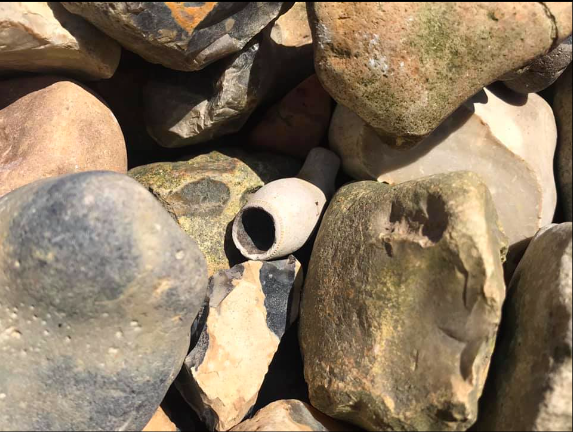
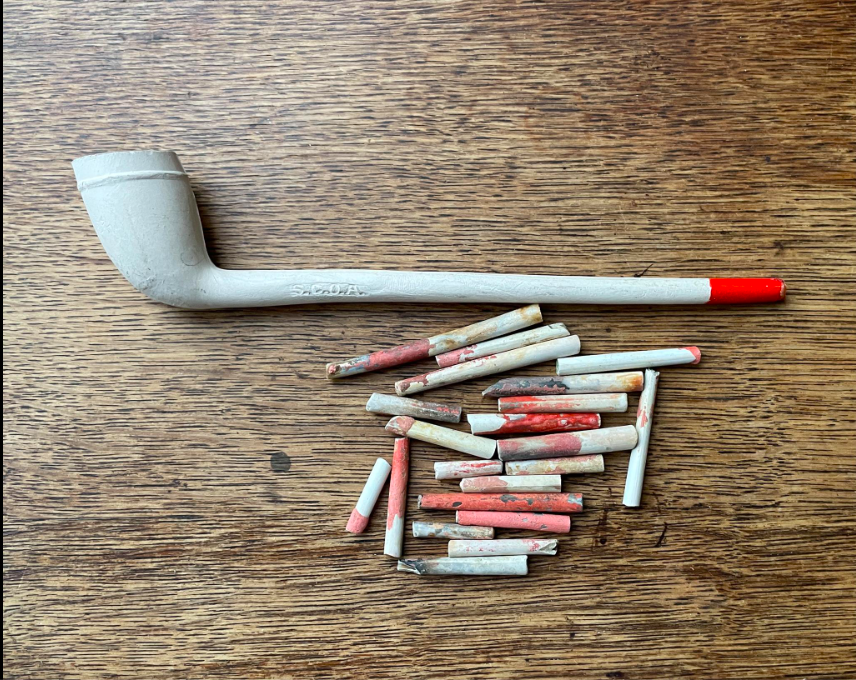

The term mudlark was invented to describe the poverty stricken Victorians who scoured the foreshore for copper, wire, and other items with resale value, as well as things they could clean off and use themselves.
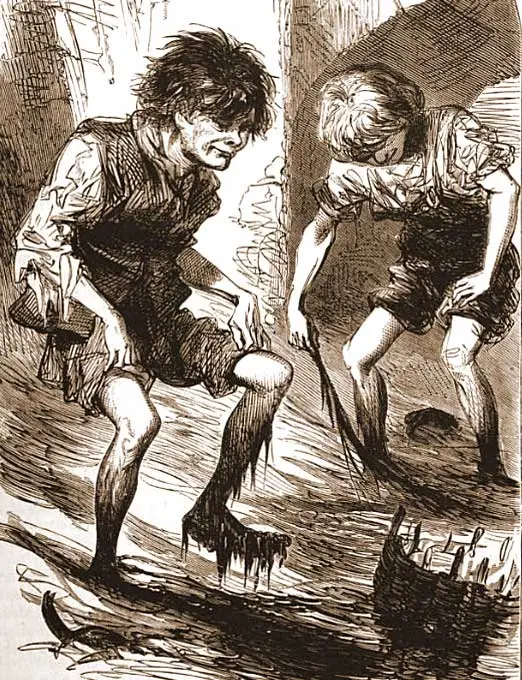
Today’s mudlarks are primarily history buffs and amateur archeologists.
The hobby has become so popular that The Port of London Authority, which controls the Thames waterway along with the Crown Estate, has started to require foreshore permits of all prospective debris hunters.
Permitted mudlarks can claim as souvenirs however many Victorian clay pipes and blue and white pottery shards they dig up, but are legally obliged by the Portable Antiquities Scheme to report items of potentially greater historic and monetary value — i.e. Treasure — to a museum-trained Finds Liason Officer:
- Any metallic object, other than a coin, provided that at least 10 per cent by weight of metal is precious metal (that is, gold or silver) and that it is at least 300 years old when found. If the object is of prehistoric date it will be Treasure provided any part of it is precious metal.
- Any group of two or more metallic objects of any composition of prehistoric date that come from the same find (see note below).
- Two or more coins from the same find provided they are at least 300 years old when found and contain 10 per cent gold or silver (if the coins contain less than 10 per cent of gold or silver there must be at least ten of them). Only the following groups of coins will normally be regarded as coming from the same find: Hoards that have been deliberately hidden; Smaller groups of coins, such as the contents of purses, that may been dropped or lost; Votive or ritual deposits.
- Any object, whatever it is made of, that is found in the same place as, or had previously been together with, another object that is Treasure.
How did all this historic refuse come to be in the Thames? Maiklem told Collectors Weekly that there are many reasons:
Obviously, it’s been used as a rubbish dump. It was a useful place to chuck your household waste. It was essentially a busy highway, so people accidentally dropped things and lost things as they traveled on it. Of course, people also lived right up against it. London was centered on the Thames so houses were all along it, and there was all this stuff coming out of the houses and off the bridges. It was the biggest port in the world in the 18th century, so there was all the shipbuilding and industry going on.
And then of course, there’s the rubbish that was used to build up the foreshore and create barge beds. The riverbed in its natural state is a V shape, so they had to build up the sides next to the river wall to make them flatter so the flat-bottom barges could rest there at low tide. They did that by pouring rubbish and building spoil and kiln waste, anything they could find—industrial waste, domestic waste. When they dug into the ground further up, they’d bring the spoil down and use it to build up the foreshore, and cap it off with a layer of chalk, which was soft and didn’t damage the bottom of the barges.
One of the reasons we’re finding so much in the river now is because there’s so much erosion. While it was a “working river,” these barge beds were patched up and the revetments, or the wooden walls that held them in, were repaired when they broke. But now, they’re being left to fall apart, and these barge beds are eroding as the river is getting busier with river traffic.
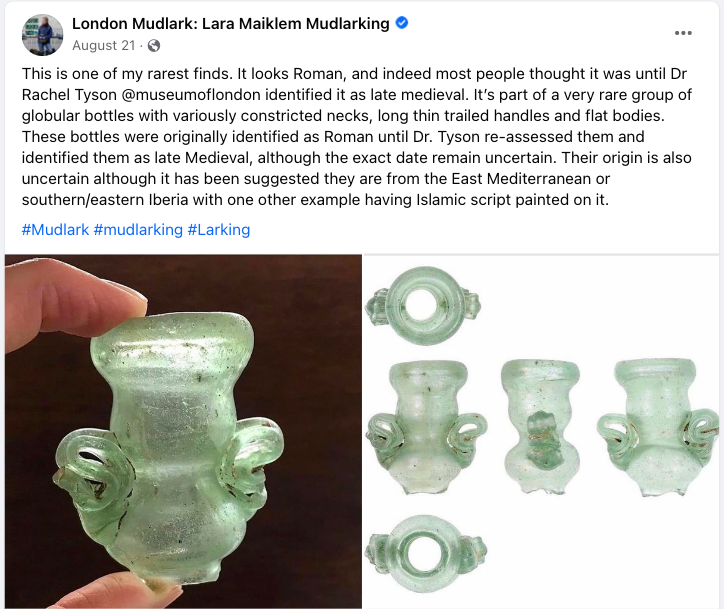
There are numerous social media groups where modern mudlarks can proudly share their finds, and seek assistance in identifying strange or fragmented objects.
Maiklem’s London Mudlark Facebook page is an education in and of itself, a reflection of her abiding interest in the historic significance of the items she truffles up.

Witness the pewter buckle plate dating to the 14th or 15th-century that she spotted on the foreshore in late November, turned over to her Finds Liaison Officer and researched with the help of historic pewter craftsman Colin Torode:
Prior to c.1350 pewter belt fittings seem to have been rather rare, although a London Girdlers’ Guild Charter of 1321 which banned the use of pewter belt fittings does show that the metal was certainly in use. In 1344 the Girdlers’ guild again reiterated the ban on what they felt were inferior metals such as pewter, tin and lead. In 1391 however, a statute recognized that these metals had been in use for some time and that their use could continue without restriction
This ornate plate would have had a separate buckle frame attached to it and is probably a cheaper copy of the more upmarket copper alloy or silver versions that were produced at the time. Although the the openwork design is similar to those found in in furniture or church screens, it’s not religious or pilgrim related.
Maiklem also challenges fans to play along from home with “spot the find” videos for such items as a Tudor clothes hook, Georgian cufflink, and a German salt glazed, stoneware bottle’s neck embossed with a human face.
She also reminds would be mudlarks to always wear gloves as it’s not all medieval thimbles, WWI medals and 16th-century boxwood combs, beautifully preserved by the Thames’ anaerobic mud.
The river also spews up plenty of drowned rats, flushing them out with the sewage after a heavy rain. Other potential hazards include hypodermic needles and broken glass.
In addition to such safety precautions as gloves, sturdy footwear, and remaining mindful of incoming tides, Maiklem advises novice mudlarks to look for straight lines and perfect circles — “the things that nature doesn’t make.”
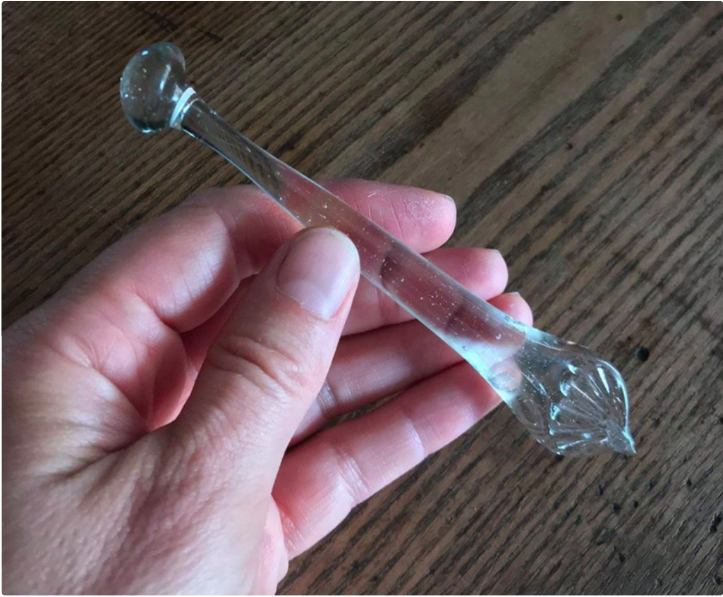
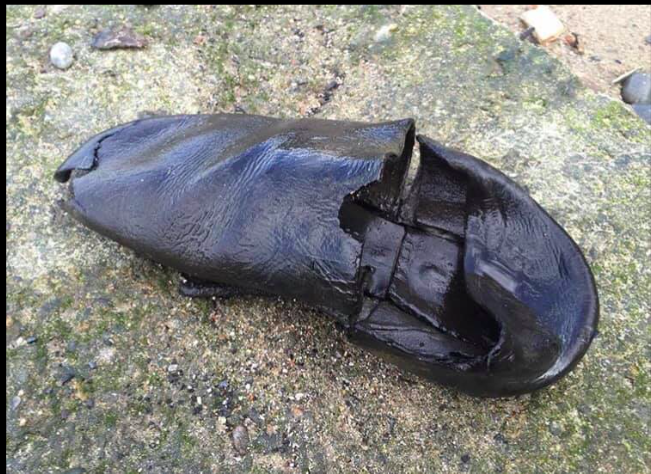

It takes practice and patience to develop a skilled eye, but don’t get discouraged if your first outings don’t yield the sort of jaw dropping discoveries Maiklem has made — an intact glass Victorian sugar crusher, a 16th-century child’s leather shoe and Roman era pottery shards galore.
Sometimes even plastic comes with a compelling story.
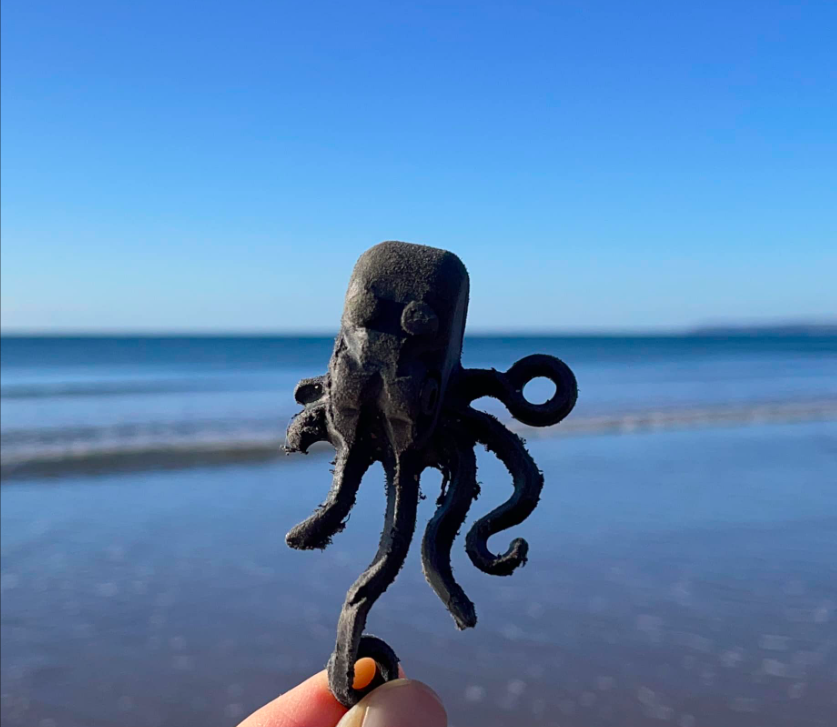
I’m still feeling quite giddy over this bit of plastic. I came to Cornwall this week to write and to beachcomb. I hoped I might find a small piece of Lost Lego, but I wasn’t holding out much hope. Calm weather means less plastic: good for the beach, bad for the Lego looker. Then I found this wedged between two boulders. It’s one of the black octopuses from the Lego spill of 1997 when, 20 miles from Land’s End, a huge wave hit the cargo ship Tokio Express. It tilted 45 degrees and 62 containers slid into the water. One container was filled with nearly 5 million pieces of Lego, much of which was sea themed. Little scuba tanks, flippers, octopuses, cutlasses, life rafts, spear guns, dragons and octopuses like this still wash up on the beaches of Cornwall and further afield.
Stay abreast of Lara Maiklem’s mudlarking finds here.
Try your hand at mudlarking the Thames in person, during a guided tour with the Thames Explorer Trust.
Related Content
Prize-Winning Animation Lets You Fly Through 17th Century London
- Ayun Halliday is a mudlarking newbie, the Chief Primatologist of the East Village Inky zine and author, most recently, of Creative, Not Famous: The Small Potato Manifesto. Follow her @AyunHalliday.
Read More...Support Us
We're hoping to rely on loyal readers, rather than erratic ads. Please click the Donate button and support Open Culture. You can use Paypal, Venmo, Patreon, even Crypto! We thank you!

About Us

Open Culture scours the web for the best educational media. We find the free courses and audio books you need, the language lessons & educational videos you want, and plenty of enlightenment in between.
Advertise With Us

FREE UPDATES!
GET OUR DAILY EMAIL
Get the best cultural and educational resources on the web curated for you in a daily email. We never spam. Unsubscribe at any time.
FOLLOW ON SOCIAL MEDIA

Open Culture editor Dan Colman scours the web for the best educational media. He finds the free courses and audio books you need, the language lessons & movies you want, and plenty of enlightenment in between.
Advertise With Us

