Next time the credits are rolling, stick around so you can educate your fellow audience members on what exactly a gaffer does.
This is but one of the mysteries addressed in Who’s Who on a Movie Crew, a campy but undeniably informative primer on film set responsibilities and hierarchies. Some job details get glossed over — grips have far more to keep track of than can ever fit in a rhyming couplet — but it’s in keeping with the deliberately anachronistic animation style and equipment. The breezy style makes for appropriate viewing for all ages. Hundreds of starry-eyed youngsters (and their parents) stand to benefit.
Honey, are you sure you want to be a production assistant?
More in-depth, non-rhyming explanations of the various roles can be found on Vimeo’s Video School. Ditto Producer Christine Vachon’s dishy how-to / memoir A Killer Life, which goes into key positions that failed to make the Video School cut, such as parking manager and caterer (when you’re starving and bored, there’s no one who’s greater-er….)
Ayun Halliday appears as the least believable female cop in NYC in an upcoming short adaption of Italo Calvino’s The Man Who Only Came Out at Night. Follow her at @AyunHalliday.
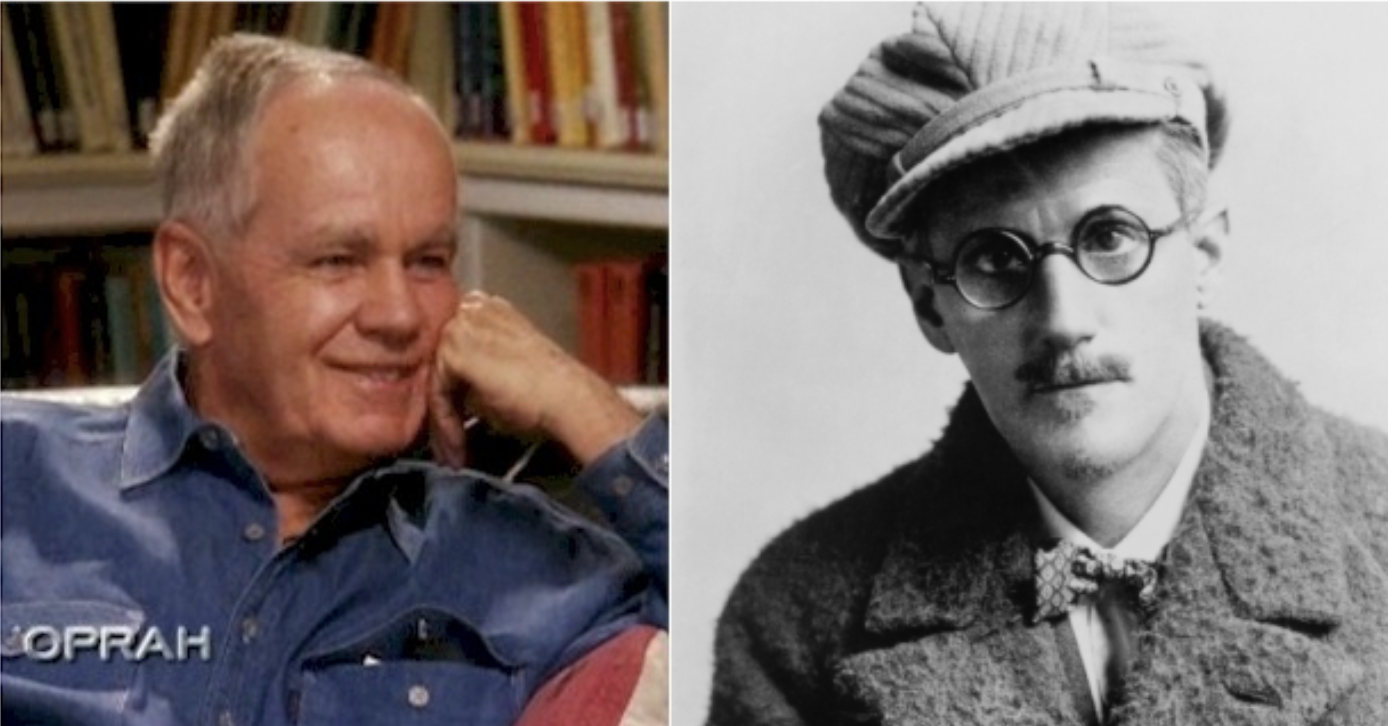
Cormac McCarthy has been—as one 1965 reviewer of his first novel, The Orchard Keeper, dubbed him—a “disciple of William Faulkner.” He makes admirable use of Faulknerian traits in his prose, and I’d always assumed he inherited his punctuation style from Faulkner as well. But in his very rare 2008 televised interview with Oprah Winfrey, McCarthy cites two other antecedents: James Joyce and forgotten novelist MacKinlay Kantor, whose Andersonville won the Pulitzer Prize in 1955. Joyce’s influence dominates, and in discussion of punctuation, McCarthy stresses that his minimalist approach works in the interest of maximum clarity. Speaking of Joyce, he says,
James Joyce is a good model for punctuation. He keeps it to an absolute minimum. There’s no reason to blot the page up with weird little marks. I mean, if you write properly you shouldn’t have to punctuate.
So what “weird little marks” does McCarthy allow, or not, and why? Below is a brief summary of his stated rules for punctuation:
1. Quotation Marks:
McCarthy doesn’t use ’em. In his Oprah interview, he says MacKinlay Kantor was the first writer he read who left them out. McCarthy stresses that this way of writing dialogue requires particular deliberation. Speaking of writers who have imitated him, he says, “You really have to be aware that there are no quotation marks, and write in such a way as to guide people as to who’s speaking.” Otherwise, confusion reigns.
2. Colons and semicolons:
Careful McCarthy reader Oprah says she “saw a colon once” in McCarthy’s prose, but she never encountered a semicolon. McCarthy confirms: “No semicolons.”
Of the colon, he says: “You can use a colon, if you’re getting ready to give a list of something that follows from what you just said. Like, these are the reasons.” This is a specific occasion that does not present itself often. The colon, one might say, genuflects to a very specific logical development, enumeration. McCarthy deems most other punctuation uses needless.
3. All other punctuation:
Aside from his restrictive rationing of the colon, McCarthy declares his stylistic convictions with simplicity: “I believe in periods, in capitals, in the occasional comma, and that’s it.” It’s a discipline he learned first in a college English class, where he worked to simplify 18th century essays for a textbook the professor was editing. Early modern English is notoriously cluttered with confounding punctuation, which did not become standardized until comparatively recently.
McCarthy, enamored of the prose style of the Neoclassical English writers but annoyed by their over-reliance on semicolons, remembers paring down an essay “by Swift or something” and hearing his professor say, “this is very good, this is exactly what’s needed.” Encouraged, he continued to simplify, working, he says to Oprah, “to make it easier, not to make it harder” to decipher his prose. For those who find McCarthy sometimes maddeningly opaque, this statement of intent may not help clarify things much. But lovers of his work may find renewed appreciation for his streamlined syntax.
The outspoken, ragged-edged poet and novelist Charles Bukowski entered our world 93 years ago this Friday, and presumably began making trouble immediately. HarperCollins marks the occasion a bit early this year by releasing today eight Bukowski audiobooks, the first of their kind. (Sign up for a Free Trial with Audible.com and you can get one for free.) Alas, Bukowski didn’t live quite long enough to commit Post Office, South of No North, Factotum, Women, Ham on Rye, Hot Water Music, Hollywood, and Pulp to tape himself. ”
It would be Bukowski himself reading here, if the technology had advanced quickly enough,” Galleycat quotes publisher Daniel Halpern as saying, “but his voice rings clear and deep in these renditions – and from them, the genius of Bukowski flows forth.” Whether or not you plan to purchase these new audiobooks, we offer you here a dose of Bukowski out loud.
At the top you’ll find one of Bukowski’s own readings, “The Secret of My Endurance,” a poem that appeared in Dangling In The Tournefortia(1982). Down below you can hear Bukowski’s “Nirvana” as read by Tom Waits, who possesses a voice famously evocative of unforgiving American life, one that perhaps sounds more like that of a Bukowski poem than Bukowski’s own. And if you missed our earlier post featuring Waits’ interpretation of “The Laughing Heart (middle),” what more suitable occasion could you have to circle back and heed its battered yet optimistic guidance: “Your life is your life. Don’t let it be clubbed into dank submission.”
If you would like to support the mission of Open Culture, consider making a donation to our site. It’s hard to rely 100% on ads, and your contributions will help us continue providing the best free cultural and educational materials to learners everywhere. You can contribute through PayPal, Patreon, and Venmo (@openculture). Thanks!
One of my favorite songs comes from the Quiet Beatle, George Harrison. A tune that can rival anything from the Lennon/McCartney songbook, Here Comes the Sun was written in 1969, during a fairly bleak time. Harrison sets the scene is his 1980 book, I, Me, Mine. He recalls:
“Here Comes the Sun” was written at the time when Apple [the Beatles’ record label] was getting like school, where we had to go and be businessmen: ‘Sign this’ and ‘sign that’. Anyway, it seems as if winter in England goes on forever, by the time spring comes you really deserve it. So one day I decided I was going to sag off Apple and I went over to Eric Clapton’s house. The relief of not having to go see all those dopey accountants was wonderful, and I walked around the garden with one of Eric’s acoustic guitars and wrote “Here Comes the Sun.”
It’s a song about getting through the darkness — personal, professional, seasonal, etc. And it’s simply a perfect pick for the flashmob performance you’ll witness above. Unlike so many other feel-good flashmob performances staged in Europe (see below), this one takes place in a dreary unemployment office in Spain (Madrid, to be precise) where unemployment hovers around 26% and homelessness is on the rise. It doesn’t try to sugarcoat life in Spain. It just provides a little ray of hope.
Soon after I started driving, back in high school, I got a mobile phone capable of SMS messaging. As with any technology not yet widespread, it then seemed more novelty than convenience; I hardly knew anybody else with a cellphone, much less with one capable of receiving my messages. But in the intervening dozen years, everyone started texting, and the practice turned from oddity into near-necessity, no matter the time, no matter the place.
Now, having taken for granted the ability to instantly send short messages across the city, country, or world to one another, society has, inevitably, begun to focus on the associated dangers of texting. But few of us have thought quite as hard about them as has Werner Herzog, director of Aguirre, the Wrath of God, Fitzcarraldo, Cave of Forgotten Dreams, and now a documentary against texting while driving. But don’t people already know the dangers? Haven’t public service announcements cautioned them not to do it, and stiff, fee-threatening laws gone on the books across America?
Judging by the sudden popularity of Herzog’s new 35-minute film From One Second to the Next, sponsored by cell service provider AT&T, a German New Wave luminary’s words carry more weight. “I’m not a participant of texting and driving — or texting at all,” many have already quoted him as saying, “but I see there’s something going on in civilization which is coming with great vehemence at us.” Despite not having driven regularly since high school, I do on my rare occasions at the wheel feel that strangely strong temptation to text in motion. Having watched Herzog’s unblinking take on the real-life consequences of doing so — unpayably high medical bills at best, paralysis and death at worst — I don’t see myself giving in next time. Whether or not it similarly effects the students of the 40,000 schools in which it will screen, it marks a vast improvement upon all the murky, heavy-handed cautionary videos I remember from my own driver’s ed days. Perhaps what Herzog did for Bad Lieutenant, he should now do for that classroom classic Red Asphalt.
You can find From One Second to the Next in our collection of 550 Free Movies Online.
The song was written especially for Warwick. David’s lyrics are about a woman’s daily thoughts of her man, who is away in Vietnam. Bacharach arranged and produced the original recording in April of 1966, but was unhappy with the result. “I thought I blew it,” he told the Los Angeles Times in 1998. “The tempo seemed too fast. I never wanted the record to come out. So what happens? They put out the record and it was a huge hit. I was wrong.” The song was released over Bacharach’s objections in October, 1967 and rose to number 4 on the Billboard Hot 100 and number 8 on the Billboard R & B charts.
Aretha Franklin:
A few months after Warwick’s single came out, Aretha Franklin and The Sweet Inspirations were singing “I Say a Little Prayer” for fun during a break in recording sessions for Aretha Now. Producer Jerry Wexler liked what he heard, and decided to record the song. With Franklin on piano and the Muscle Shoals Rhythm Section behind her, it was recorded in one take. Franklin’s version has more of a gospel and rhythm & blues feel, with a fluid call-and-response interplay between the lead and backup singers.
Released in July of 1968, the single was less of a crossover hit than Warwick’s version — it peaked at number 10 on the Hot 100 chart — but rose all the way to number 3 on the R & B chart. Overshadowed at first, Franklin’s recording has grown in stature over the years. Even Bacharach likes it better than the one he made with Warwick. As he told Mitch Albom earlier this year, “Aretha just made a far better record.”
You can listen above, as Warwick performs “I Say a Little Prayer” in an unidentified television broadcast and Franklin sings it with the Sweethearts of Soul on the August 31, 1970 Cliff Richard Show. Tell us: Which version do you think is better?
Last night marked the beginning of the final season of Breaking Bad, the AMC television series that chronicles the life and times of Walter White, the chemistry teacher-turned-meth kingpin. To get in the spirit of things, Andrew Huang decided to record the Breaking Bad theme song with a guitar and some meth lab equipment. On his YouTube page he writes:
I don’t know anything about making meth but a little Googling let me know that if you come across a meth lab you might find, among other things:
Other than the guitar, all of the sounds in this piece were produced using the items above, with minimal effects and some speed adjustments to change pitches.
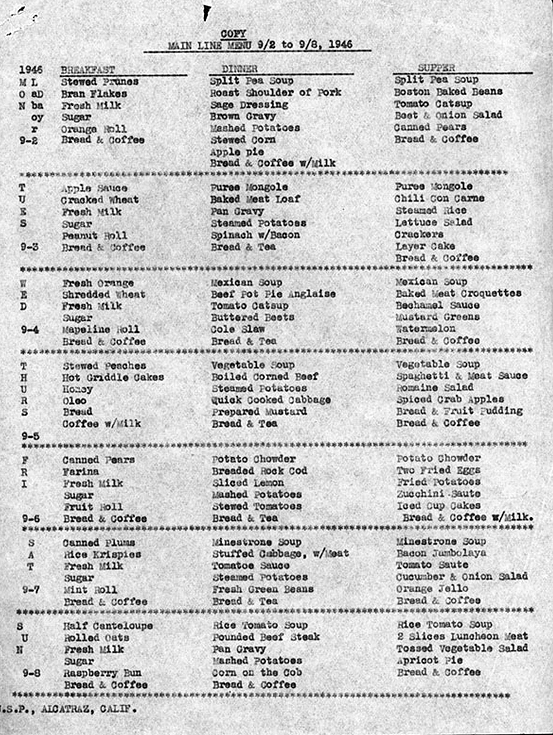
Why would you want to escape from Alcatraz when you could eat Beef Pot Pie Anglaise for lunch on Tuesday, Baked Meat Croquettes on Wednesday, and Bacon Jambalaya on Saturday? On second thought, why wouldn’t you want to escape.
Above, we have the actual menu for the meals served at Alcatraz during one week in September, 1946. (View it in a slightly larger format here.) Alcatraz was, of course, a high security federal prison that operated off of the coast of San Francisco from 1933 until 1963. Some of America’s more notorious criminals spent time dining there — good fellows like Al Capone, George “Machine Gun” Kelly, Bumpy Johnson, and James “Whitey” Bulger.
As you may know, Bulger is now back on trial in Boston. After being released from prison during the 1960s, he allegedly re-immersed himself in the world of organized crime, before eventually spending 16 years living as a fugitive, largely in California. While on the lam, he amazingly had the chutzpah to visit Alcatraz (now a tourist site) and pose for a picture where he donned a striped suit and stood behind mock prison bars. I have to wonder whether he had some Puree Mongole for old times’ sake?
Here’s an update to our original 2011 post: The social theorist and geographer David Harvey has produced a free online course where he gives a close reading of Karl Marx’s Capital (1867). Often considered to be Marx’s masterpiece, Capital is where he elaborated a critique of capitalism and laid the groundwork for an ideology that took the 20th century by storm. Harvey has taught courses on Capital for over 40 years, both in universities (Johns Hopkins and CUNY) and in the community as well. Now his 26 lecture course is freely available on the web. You can watch the first lecture above. (It’s preceded by an introductory, six-minute interview.) The rest of the lectures can be accessed via Harvey’s web site, YouTube, iTunes, and the Economics section of our collection of Free Online Courses.
Marking a new phase of the project, Professor Harvey is now looking for volunteers to help translate his lectures into 36 languages. If you speak English and languages like Urdu, Arabic or Italian (just to list a few), you can start helping with translations here.
Also note that Harvey published A Companion to Marx’s Capitalin 2010. It’s something you’ll want read along with the lectures.
“Breaking Bad is the first story to truly commit the full spectrum of New Mexico to film,” writes Rachel Syme in a New Yorker post on the critically acclaimed AMC series’ use of and effect on her home state. “The grandiose vistas, the soaring altitudes, the banal office complexes, the Kokopellis and Kachina dolls, the seamy warehouses, the marshmallow clouds. The show seems to root itself deeper in the landscape with every new montage. It has become our newest monument.” With the concluding season of the exploits of chemistry-teacher-turned-methamphetamine-dealer Walter White debuting this Sunday, Breaking Bad fans have no doubt steeled themselves for a televisual plunge back into its very own Albuquerque, which “still looks like the Wild West, a scorched, hazy, lawless place where rugged individualism might just tip over into criminal behavior at any moment,” an interpretation Syme deems “not wholly inaccurate.”
To assist you in your own re-entry into Breaking Bad’s thoroughly amoral but unstoppably compelling reality, we’ve rounded up a few audition tapes which let you witness the early formation of three of the show’s characters. Everyone talks about Bryan Cranston’s starring performance as Walter, and given his grounded execution of a near-novelistic arc of improbable transformation, rightly so. But what about his wife and eventual money launderer Skyler, as portrayed by Anna Gunn? Or her brother-in-law Hank, the gung-ho DEA agent played by Dean Norris? Or Aaron Paul as Jesse, Walter’s former student and current partner in crime? In a series so highly praised for the writing of its characters, you don’t want to think about just one. Or maybe your memories of them have grown dim, in which case you’ll want to spend eight minutes with this recap of the previous seasons before you settle down for the final one.
Today, we bring the two together, in two versions of Smith reading Ginsberg’s “Footnote to Howl,” the orgiastic coda to his 1955 epic. This makes so much sense I wonder why we haven’t featured it before, and yet, here we are. In the first rendition, above, from 2012, Smith is backed by Philip Glass, her own Incredible Band, and some saffron-clad Tibetan monks. The ensemble convened in honor of a visit by the Dalai Lama.
There are doubtless dozens of stories to tell about Ginsberg and Smith. My favorite is their first chance meeting in 1969:
It’s November 1969 and Ms. Smith is trying to buy a cheese sandwich at the Horn & Hardart Automat on West 23rd Street in Manhattan. When she finds herself a dime short, Ginsberg approaches her and asks if he can help. He offers her the extra 10 cents and also treats her to a cup of coffee. The two are talking about Walt Whitman when Ginsberg suddenly leans forward and asks if she’s a girl.
“Is that a problem?” she asks.
He laughs and says: “I’m sorry. I took you for a very pretty boy.”
“Well, does this mean I return the sandwich?”
“No, enjoy it. It was my mistake.”
Holy that sandwich! Watch Smith above in Florence, Italy forty years later, chanting a cappella from “Footnote to Howl” while the audience claps, and howls, along. It’s decidedly rough footage, taken with a handheld camera (cell phone?) from the crowd, but the audio is good, and it’s stirring stuff despite, or because of, the raw quality.
We're hoping to rely on loyal readers, rather than erratic ads. Please click the Donate button and support Open Culture. You can use Paypal, Venmo, Patreon, even Crypto! We thank you!
Open Culture scours the web for the best educational media. We find the free courses and audio books you need, the language lessons & educational videos you want, and plenty of enlightenment in between.