Happy Wednesday.…
h/t Allie
We humans did a number on ourselves, as they say, when we invented agriculture, global trade routes, refrigeration, pasteurization, and so forth. Yes, we made it so that millions of people around the world could have abundant food. We’ve also created food that’s full of empty calories and lacking in essential nutrients. Fortunately, in places where healthy alternatives are plentiful, attitudes toward food have changed, and nutrition has become a paramount concern.
“As a society, we are comfortable with the idea that we feed our bodies,” says neuroscientist Lisa Mosconi. We research foods that cause inflammation and increase cancer risk, etc. But we are “much less aware,” says Mosconi—author of Brain Food: The Surprising Science of Eating for Cognitive Power—“that we’re feeding our brains too. Parts of the foods we eat will end up being the very fabric of our brains…. Put simply: Everything in the brain that isn’t made by the brain itself is ‘imported’ from the food we eat.”
We learn much more about the constituents of brain matter in the animated TED-Ed lesson above by Mia Nacamulli. Amino acids, fats, proteins, traces of micronutrients, and glucose—“the brain is, of course, more than the sum of its nutritional parts, but each component does have a distinct impact on functioning, development, mood, and energy.” Post-meal blahs or insomnia can be closely correlated with diet.
What should we be eating for brain health? Luckily, current research falls well in line with what nutritionists and doctors have been suggesting we eat for overall health. Anne Linge, registered dietitian and certified diabetes care and education specialist at the Nutrition Clinic at the University of Washington Medical Center-Roosevelt, recommends what researchers have dubbed the MIND diet, a combination of the Mediterranean diet and the DASH diet.
“The Mediterranean diet focuses on lots of vegetables, fruits, nuts and heart-healthy oils,” Linge says. “When we talk about the DASH diet, the purpose is to stop high blood pressure, so we’re looking at more servings of fruits and vegetables, more fiber and less saturated fat.” The combination of the two, reports Angela Cabotaje at the University of Washington Medicine blog Right as Rain, results in a diet high in folate, carotenoids, vitamin E, flavonoids and antioxidants. “All of these things seem to have potential benefits to the cognitive function,” says Linge, who breaks MIND foods down into the 10 categories below:
Leafy greens (6x per week)
Vegetables (1x per day)
Nuts (5x per week)
Berries (2x per week)
Beans (3x per week)
Whole grains (3x per day)
Fish (1x per week)
Poultry (2x per week)
Olive oil (regular use)
Red wine (1x per day)
As you’ll note, red meat, dairy, sweets, and fried foods aren’t included: researchers recommend we consume these much less often. Harvard’s Healthbeat blog further breaks down some of these categories and includes tea and coffee, a welcome addition for people who prefer caffeinated beverages to alcohol.
“You might think of the MIND diet as a list of best practices,” says Linge. “You don’t have to follow every guideline, but wow, if how you eat can prevent or delay cognitive decline, what a fabulous thing.” It is, indeed. For a scholarly overview of the effects of nutrition on the brain, read the 2015 study on the MIND diet here and another, 2010 study on the critical importance of “brain foods” here.
Related Content:
How to Live to Be 100 and Beyond: 9 Diet & Lifestyle Tips
Josh Jones is a writer and musician based in Durham, NC. Follow him at @jdmagness
Those who see the world from only one narrow point of view get called a number of things–parochial, provincial, and worse–and are encouraged to seek out other perspectives and broaden their view. Not everyone can travel the world, but the world comes to us through immigration and the internet, restaurants and recipes. Most of us, if we are inclined, can learn about and appreciate the cultures, cuisines, and histories of others.
But can we see ourselves the way that others see us? This is a harder ask, I think, especially for Americans, who are used to the world coming to us and to defining the world on our terms, whether through soft power or military force.
When we read about history, we might diversify our sources, taking in perspectives from writers with different ideological commitments and beliefs. But how often do we hear the observations, say, of Japanese historians, recording their impressions of the U.S. as they saw it in the 19th century?
A great part of why we don’t read such histories is that we generally don’t even know they exist. The YouTube project Voices of the Past aims to remedy this, introducing viewers to primary historical sources from the past, and from all over the world, that show professional historians and ordinary people recording events across barriers of language, culture, nation state, and social class. At the top, we have a reading from “Konyo Zukishi,” written in 1845 by Japanese geographer and historian Mitsukuri Shōgo, who, in turn, based much of his knowledge of the outside world on Dutch books, “as they were the only European trading partner through the Sakoku period of isolation,” a caption in the video informs us.
Mitsukuri Shōgo’s history accepts as fact that the territories of North America “didn’t even have a name” before the arrival of European settlers, completely ignoring the presence of hundreds of indigenous nations. The descriptions of those settlers are charmingly revealing, if not wholly accurate. “Several tens of thousands of Englishmen, who refused to subscribe to the tenets of the Anglican church, were arrested and sent to this distant country,” we learn. “These people lacked sufficient food and clothing at that time, but they privately rejoiced because there were no rulers in this land.”
Further up, we have an early third century commentary written by Chinese historian Yu Huan. Hundreds of years before European navigators set out to find and appropriate the riches of the Indies, only to end up in the Americas, the Chinese wrote of a world history that included the Roman Empire, reached by way of Egypt, which is called Haixi, “because it is west of the sea,” and which contains the great city of Wuchisan, or Alexandria. Yu Huan writes as though he’s giving driving directions, and leaves every impression of having made the journey himself or transcribed the words of those who had.
Above, a young soldier in Napoleon’s Grande Armée describes the real horror of the death marches through Russia in 1812 in excerpts from Jakob Walter’s Diary of Napoleonic Foot Soldier. He calls one march “indescribable and inconceivable for people who have not seen anything of it,” then goes on to paint a grisly scene in the kind of grim detail we do not get in Napoleon’s justifications of the invasion, below, taken from The Corsican: A Diary of Napoleon’s Life in His Own Words. There are many more histories we rarely, if ever, encounter, which show a world that has been networked and connected for thousands of years, as in excerpts below from an Arabic compilation of travel accounts, Abū Zayd al-Sīrāfī’s “Accounts of China and India,” written in 852.
Hear many more fascinating and usually inaccessible primary sources from ancient and modern history read aloud at Voices of the Past.
Related Content:
Get the History of the World in 46 Lectures, Courtesy of Columbia University
Free Courses in Ancient History, Literature & Philosophy
Josh Jones is a writer and musician based in Durham, NC. Follow him at @jdmagness
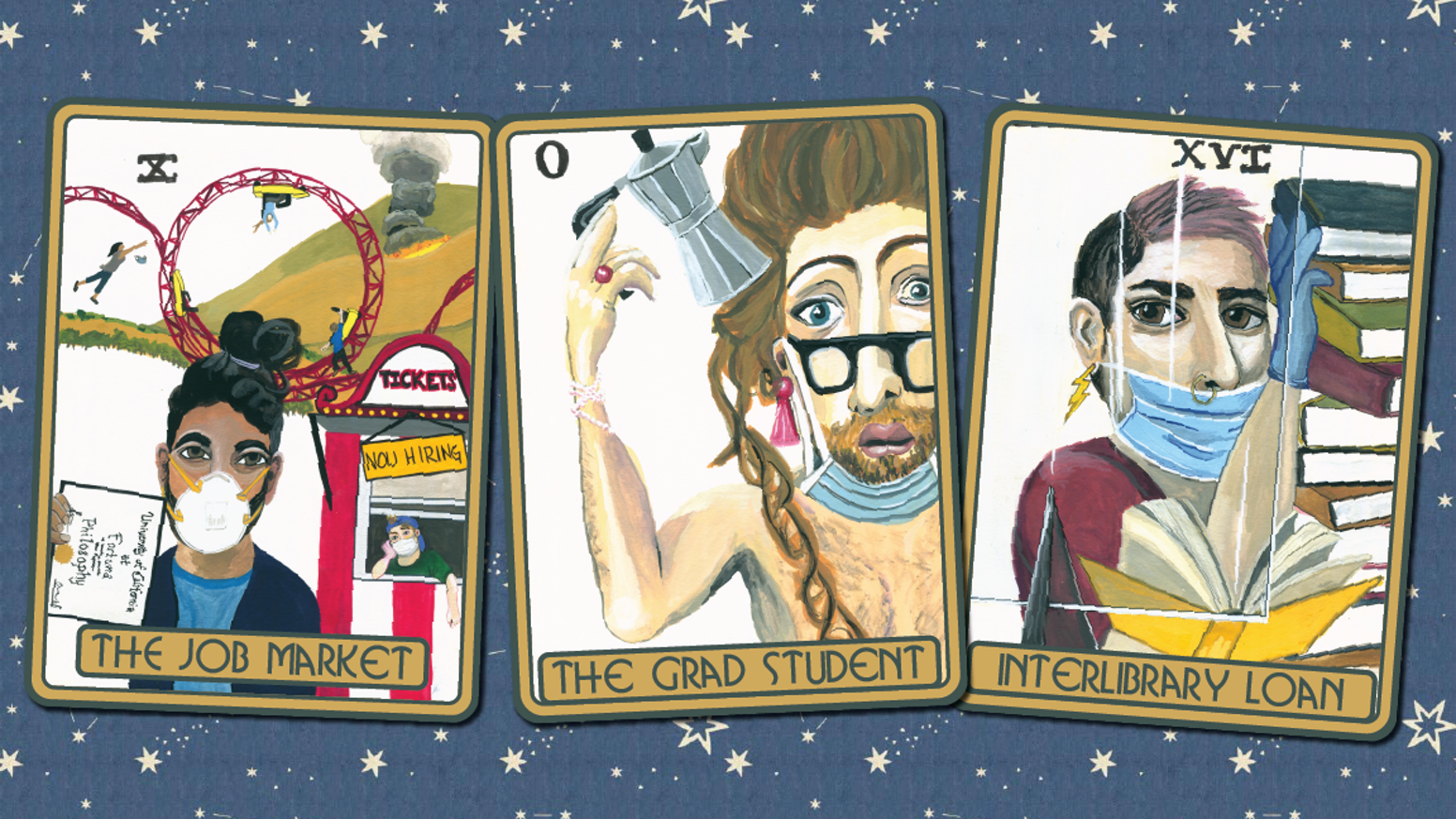
“Speculations about the creators of Tarot cards include the Sufis, the Cathars, the Egyptians, Kabbalists, and more,” writes “expert cartomancer” Joshua Hehe. All of these suppositions are wrong, it seems. “The actual historical evidence points to northern Italy sometime in the early part of the 1400s,” when the so-called “major arcana” came into being. “Contrary to what many have claimed, there is absolutely no proof of the Tarot having originated in any other time or place.”
A bold claim, yet there are precedents much older than tarot: “A few decades before the Tarot was born, ordinary playing cards came to Europe by way of Arabs, arriving in many different cities between 1375 and 1378. These cards were an adaptation of the Islamic Mamluk cards,” with suits of cups, swords, coins, and polo sticks, “the latter of which were seen by Europeans as staves.”
Whether the playing cards invented by the Mamluks were used for divination may be a matter of controversy. The history and art of the Mamluk sultanate itself is a subject worthy of study for the tarot historian. Originally a slave army (“mamluk” means “slave” in Arabic) under the Ayyubid sultans in Egypt and Syria, the Mamluks overthrew their rulers and created “the greatest Islamic empire of the later Middle Ages.”
What does this have to do with tarot reading? These are academic concerns, perhaps, of little interest to the average tarot enthusiast. But then, the average tarot enthusiast is not the audience for the “Academic Tarot,” a project of the Visionary Futures Collective, or VFC, a group of 22 scholars “fighting for what higher education needs most,” Stephanie Malak writes at Hyperallergic, “a bringing together of thinkers who ‘believe in the transformational power and vital importance of the humanities.’”
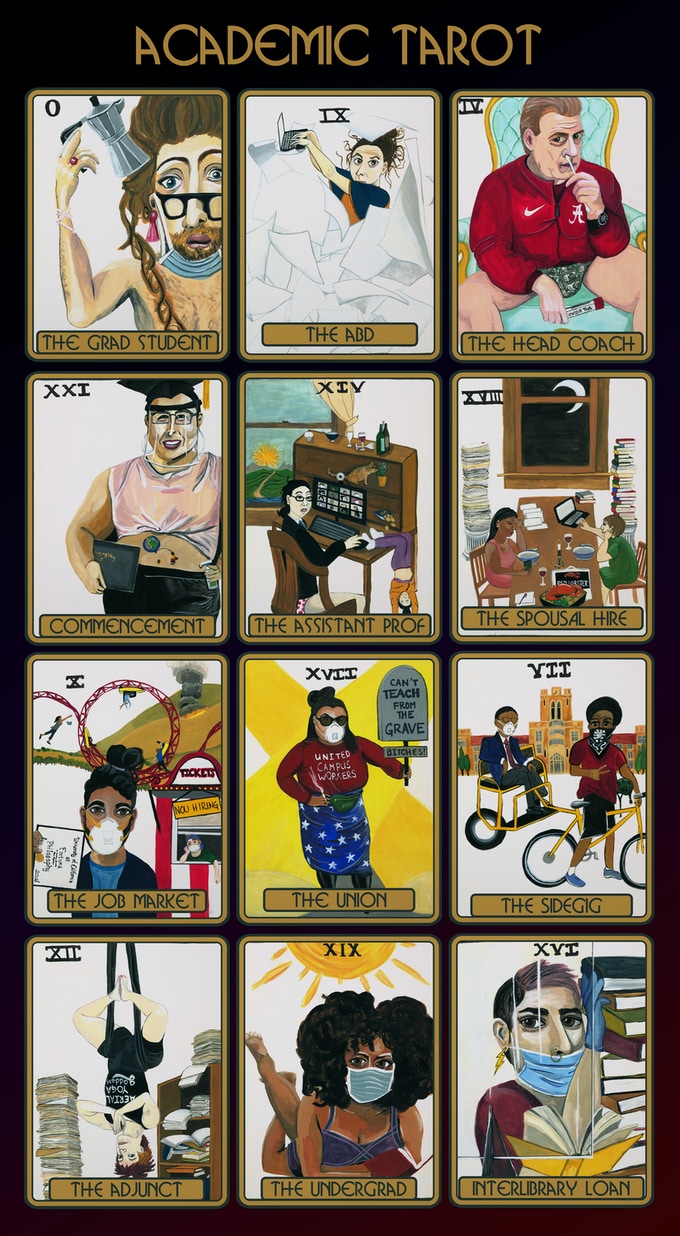
To that end, the Academic Tarot features exactly the kinds of characters who love to chase down abstruse historical questions—characters like the lowly, confused Grad Student, standing in here for The Fool. It also features those who can make academic life, with its endless rounds of meetings and committees, so difficult: figures like The President (see here), doing duty here as the Magician, and pictured shredding “campus-wide COVID results.”
The VFC, founded in the time of COVID-19 pandemic and “in the midst of the long-overdue national reckoning led by the Black Lives Matter movement,” aims to “trace the contours of things that define our shared human condition,” says Collective member Dr. Brian DeGrazia. In the case of the Academic Tarot, the conditions represented are shared by a specific subset of humans, many of whom responded to “feelings surveys” put out by the VFC in a biweekly newsletter.
The surveys have been used to make art that reflects the experiences of the grad students, professors, and professional staff working the academic humanities at this time:
VFC artist-in-residence Claire Chenette, a Grammy-nominated Knoxville Symphony Orchestra musician furloughed due to COVID-19, brought the tarot cards to life. What began as a three-card project to complement the VFC newsletter grew in spirit and in number.
“In tarot, the cards read us,” the VFC writes, “telling a story about ourselves that can provide clarity, guidance and hope.” What story do the 22 Major Arcana cards in the Academic Tarot tell? That depends on who’s asking, as always, but one gets the sense that unless the querent is familiar with life in a higher-ed humanities department, these cards may not reveal much. For those who have seen themselves in the cards, however, “the images made them laugh out loud,” says Chenette, or “they hit hard. Or… they even made them cry, but… it needed to happen.”
Struggling through yet another pandemic semester of attempting to teach, research, write, and generally stay afloat? The Academic Tarot cards are currently sold out, but you can pre-order now for the second run.
via Hyperallergic
Related Content:
Behold the Sola-Busca Tarot Deck, the Earliest Complete Set of Tarot Cards (1490)
Josh Jones is a writer and musician based in Durham, NC. Follow him at @jdmagness
Animation is childish. So believe those who never watch animated films — but also, on another, deeper level, those who hold up animated films as the most complete form of cinema. Whatever our generation, most of us alive today grew up watching cartoons meant in every sense for children, and often artistically flimsy ones at that. But even on such a low-nutrition viewing regimen, we could now and again glimpse the vast possibilities of the form. Or perhaps it was just our imagination — but then, as Stephen King once pointed out, nothing is “just” our imagination in childhood, a time when we occupy “a secret world that exists by its own rules and lives in its own culture.”
In order to navigate this reality apart, where nothing is entirely for real and nothing entirely pretend, children “think around corners instead of in straight lines.” The best animators retain this ability into adulthood, harnessing it to create a purer kind of cinema that reflects and engages the imagination in a way even the freest live-action films never can. The work of such animators constitutes the subject matter of “The Animation that Changed Cinema,” a new essay from The Cinema Cartography. In just over half an hour, the series’ creators Lewis Bond and Luiza Liz Bond explore animation produced all over the world over nearly the past century in search of the films that have widened the boundaries of the medium.
Though most video essays from The Cinema Cartography and its predecessor Channel Criswell have focused on conventional film, Bond has already demonstrated his profound understanding of animation in video essays on Studio Ghibli co-founder Hayao Miyazaki and the acclaimed cult anime series Cowboy Bebop. “The Animation that Changed Cinema” spends a great deal of time on other works from Japan, the one country that has done more than any other to elevate the animated film, including that of Miyazaki’s Ghibli partner Isao Takahata, Perfect Blue auteur Satoshi Kon, and Katsuhiro Otomo, whose Akira permanently changed much of the world’s understanding of “cartoons” as cinematic art. But as with The Cinema Cartography’s previous “The Cinematography that Changed Cinema,” the cultural-geographical mandate ranges widely.
Among these visionary animators are several previously featured here on Open Culture: the German Lotte Reiniger, creator of the all-silhouette The Adventures of Prince Achmed; Europeans from farther east (and possessed of wilder sensibilities) like Jan Švankmajer; Americans like Don Hertzfeldt, the Brothers Quay, and Wes Anderson (whose filmography includes the stop-motion The Fantastic Mr. Fox and Isle of Dogs). That last group includes even Hollywood director Brad Bird, now best known for Pixar movies like The Incredibles and Ratatouille, but here celebrated for The Iron Giant, a picture that sank upon its release, but in the two decades since has come to be appreciated as just the kind of work of art that, as Bond puts it, “makes us forget that we’re watching moving drawings” — whatever age we happen to be.
Related Content:
Free Animated Films: From Classic to Modern
How the Films of Hayao Miyazaki Work Their Animated Magic, Explained in 4 Video Essays
What Made Studio Ghibli Animator Isao Takahata (RIP) a Master: Two Video Essays
How Master Japanese Animator Satoshi Kon Pushed the Boundaries of Making Anime: A Video Essay
Based in Seoul, Colin Marshall writes and broadcasts on cities, language, and culture. His projects include the Substack newsletter Books on Cities, the book The Stateless City: a Walk through 21st-Century Los Angeles and the video series The City in Cinema. Follow him on Twitter at @colinmarshall or on Facebook.
Jazz and hip hop have been in a lively conversation in recent years, breaking new ground for both forms, as the work of artists like Kendrick Lamar and his collaborators amply shows. Lamar created his majorly-acclaimed albums To Pimp a Butterfly and Damn with the indispensable playing and arranging of jazz-fusion saxophonist Kamasi Washington and his frequent sideman, bassist Stephen “Thundercat” Bruner, who have contributed to the work of Flying Lotus. That’s the artist name of Stephen Ellison, nephew of Alice and John Coltrane, who has also been instrumental, no pun intended, in reshaping the sound of contemporary hip hop.
“The influence cuts both ways—from jazz to hip hop and back again,” writes John Lewis at The Guardian. Or as Washington puts it, “We’ve now got a whole generation of jazz musicians who have been brought up with hip-hop. We’ve grown up alongside rappers and DJs, we’ve heard this music all our life. We are as fluent in J Dilla and Dr Dre as we are in Mingus and Coltrane.”
The fusion of avant-garde hip hop with live jazz improvisation, instrumentation, and arranging may seem like a new phenomenon, though one could date it at least as far back as the Roots’ early 90s debut.
“Hip hop’s love affair with jazz goes back more than 30 years,” Lewis writes. The music was everywhere in the 90s, in the foreground on the records of A Tribe Called Quest, De La Soul, and Digable Planets and in more cut-and-paste ways in albums like Nas’ instant classic Illmatic, produced by Pete Rock, who crafted tracks like “N.Y. State of Mind” from layered samples of Ahmad Jamal, Donald Byrd, and little-known jazz-funk outfits like Jimmy Gordon & His Jazznpops Band. As pianist Robert Glasper shows above in the brief NPR Jazz Night in America video at the top, “Jazz is the mother of hip-hop.”
Both jazz and hip hop were born out of oppression, and both are forms of protest music, “going against the grain,” Glasper argues. But there’s more to it. Why do hip hop producers gravitate toward jazz, chopping and lifting classics and obscure rarities? For a wealth of melodic content—”for a mood, for a sonic timbre, for a unique rhythmic component,” writes interviewer Alex Ariff on YouTube; for a shared history of struggle and celebration and a desire to change the sound of music with each release. Glasper’s brief, three-minute demonstration is fascinating and it could, as one YouTube commenter points out, easily extend to three hours.
Until he makes that video, you can find jazz samples in hip hop records to your heart’s eternal content at Whosampled.com and consider how the influence of hip hop on jazz musicians has created new forms of fusion akin to Miles Davis’ experiments in the 70s. “I never had a problem moving between jazz and hip hop,” says Washington. “People like to compartmentalize music, especially African-American music, but it’s really one thing. One very wide thing…. When I first played some Coltrane-type stuff on the Pimp a Butterfly sessions, Kendrick got it immediately. ‘I want it to sound like it’s on fire,’ he’d say. That’s the kind of common ground that the best jazz and the best hip-hop have.”
Related Content:
How Nina Simone Became Hip Hop’s “Secret Weapon”: From Lauryn Hill to Jay Z and Kanye West
Josh Jones is a writer and musician based in Durham, NC. Follow him at @jdmagness
Carl Jung founded the field of analytical psychology more than a century ago, and many reference his insights into the human mind and condition still today. Alan Watts certainly did his bit to keep the Jungian flame alive, whatever the outward differences between a Swiss psychiatrist and an English interpreter of Taoism, Hinduism, and Buddhism, especially of the Zen variety. Both men believed in casting a wide spiritual net, all the better to expose the common core elements of seemingly disparate ancient traditions. And in so doing they could hardly afford to ignore the religious underpinnings of the European civilization, broadly speaking, from which they emerged. In fact, Watts became an ordained Episcopal priest at the age of 30 — though, owing to the complexities of his beliefs as well as his personal life, he resigned the ministry by age 35.
But Watts’ investment in certain tenets of Christianity endured, and he named as one of Jung’s greatest writings a lecture delivered to a Swiss clergy group. “People forget that even doctors have moral scruples and that certain patient’s confessions are hard even for a doctor to swallow,” begins the speech as Watts reads it aloud in the video above. “Yet the patient does not feel himself accepted unless the very worst in him is accepted too. No one can bring this about by mere words. It comes only through reflection and through the doctor’s attitude towards himself and his own dark side.” To help another person, in other words, one must first accept that person as he is; but to accept another person as he is first requires taking oneself straight, less-than-admirable qualities and all.
According to Watts, Jung himself demonstrated this rare self-awareness. “He knew and recognized what I sometimes call the element of irreducible rascality in himself,” says Watts in a talk of his own previously featured here on Open Culture. “He knew it so strongly and so clearly, and in a way so lovingly, that he would not condemn the same thing in others, and would therefore not be led into those thoughts, feelings, and acts of violence towards others which are always characteristic of the people who project the devil in themselves upon the outside, upon somebody else, upon the scapegoat.” As Jung puts it to his clerical audience, “In the sphere of social or national relations, the state of suffering may be civil war, and this state is to be cured by the Christian virtue of forgiveness and love of one’s enemies.”
What Christianity holds as true of the outer world goes just as well, Jung argues, for the inner one. “This is why modern man has heard enough about guilt and sin. He is sorely beset by his own bad conscience and wants, rather, to know how he is to reconcile himself with his own nature, how he is to love the enemy in his own heart and call the wolf his brother.” He “does not want to know in what way he can imitate Christ, but in what way he can live his own individual life, however meagre and uninteresting it may be.” Only by being allowed to follow this “egoism” to its conclusion of “complete isolation” can he “get to know himself and learn what an invaluable treasure is the love of his fellow beings”; it is only “in the state of complete abandonment and loneliness that we experience the helpful powers of our own natures.” Without knowing our own natures, we can hardly expect even the most time-tested belief systems to put an end to the civil wars inside us.
Related Content:
Zen Master Alan Watts Explains What Made Carl Jung Such an Influential Thinker
Carl Jung Explains His Groundbreaking Theories About Psychology in a Rare Interview (1957)
Alan Watts On Why Our Minds And Technology Can’t Grasp Reality
Face to Face with Carl Jung: ‘Man Cannot Stand a Meaningless Life’ (1959)
The Wisdom of Alan Watts in Four Thought-Provoking Animations
Based in Seoul, Colin Marshall writes and broadcasts on cities, language, and culture. His projects include the Substack newsletter Books on Cities, the book The Stateless City: a Walk through 21st-Century Los Angeles and the video series The City in Cinema. Follow him on Twitter at @colinmarshall or on Facebook.
In central North Carolina, not far from where I live, sits the Franklinton Center at Bricks, a 224-acre educational campus and conference center built on the remains of a historic “Agricultural, Industrial, and Normal School,” then junior college, for the descendants of enslaved people. These schools were themselves built on the land of a former cotton plantation, on former territory of the Tuscarora Nation. The campus acts as a palimpsest of Southern U.S. history. Each successive generation on the site after the Civil War has built memorials alongside modern institutions of learning and activism. The model is rare. As historian Damian Pargas of Leiden University tells Atlas Obscura’s Sabrina Imbler, “slavery is largely invisible in the [current] Southern landscape, and therefore easy to ignore or forget.”
Even at the Franklinton Center, the remnants of the slave past consist only of a whipping post, the focus of a remembrance area on the campus, and an antebellum slave cemetery a short distance away. All traces of slave quarters and houses have been wiped away. Where they remain in the U.S., writes Imbler, such buildings often “bear no visible trace of their past; many have been converted into garages, offices, or sometimes—unnervingly—bed-and-breakfasts. In some cases the structures have fallen into ruin or vanished entirely, leaving behind a depression in the ground.” Since 2012, Jobie Hill, a preservation architect, has tried to change that with her project Saving Slave Houses.
Hill is determined to build a first-of-its-kind database that honors and preserves these spaces in more than memory, and to unite the houses with the stories of people who once inhabited them. As she sees it, such a repository is long overdue. “There has never been a national survey of slave houses, except for the one I’m trying to do,” Hill says.
Houses, says Hill, in her TEDx talk above, “can tell us a lot about the people that lived there…. Each slave house has a valuable story to tell.” A slave house, Hill writes, on the project’s site, “was a place where enslaved people found strength and comfort from one another; but at the same time, it was a place that imposed physical limitations and psychological trauma.”
The project grew out of Hill’s master’s theses in preservation architecture and through an internship for the Historic American Buildings Survey (HABS), “a federal program established in 1933 to employ architects and draftsmen” during the Great Depression, Imbler notes. She has been able to identify slave houses by their small size, location on a property, “and if the building has a fireplace or chimney,” she says, noting that such buildings were rarely included in surveys. She has also cross-referenced surveys with the “largest, best-known collection of interviews from formerly enslaved people: the 1936–1938 WPA Slave Narrative Collection.”
These interviews “paint a grim picture of the cruel and cramped quarters enslaved people were forced to live in.” But slave houses are not only markers of a painful past. “A slave house simultaneously embodies suffering, yet perseverance and strong family bonds,” writes Hill. They are symbols of survival against daunting odds, and like the magnolia tree that marks the remembrance site at the Franklinton Center, they can “serve as a reminder that we too must do more than survive. We must find a way to thrive.” Learn more about Hill’s Saving Slave Houses project here.
via Atlas Obscura
Related Content:
Josh Jones is a writer and musician based in Durham, NC. Follow him at @jdmagness
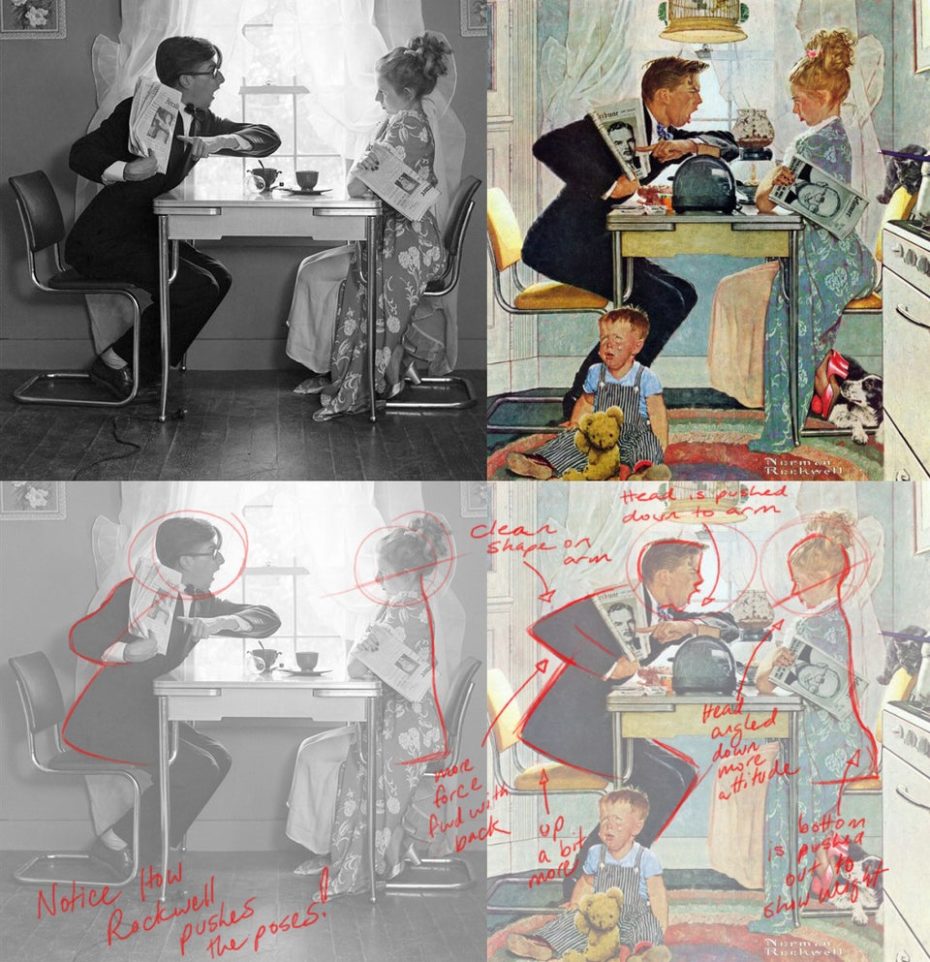
More than 40 years after Norman Rockwell’s death, the question of whether his paintings are realistic or unrealistic remains open for debate. On one hand, critical opinion has long dismissed his Saturday Evening Post-adorning visions of American life as sheerest fantasy. “A little girl with a black eye, an elderly woman saying grace with her grandson, a boy going to war: Rockwellian scenes represent a certain sentimental America — an ideal America, or at least Rockwell’s ideal,” says a 2009 NPR story on his work.
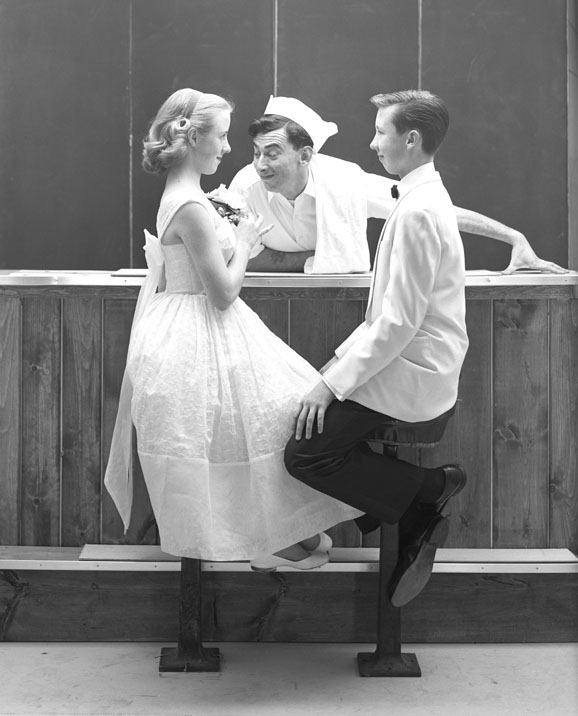
On the other hand, if Rockwell’s admirers give him a pass on this sentimentality, his detractors often turn a blind eye to his obvious technical mastery. Say what you will about his themes, the man might as well have been a camera. Indeed, his process began with an actual camera. According to that NPR piece, he “used photos, taken by a rotating cast of photographers, to make his illustrations — and all of his models were neighbors and friends,” residents of his small town of Stockbridge, Massachusetts.
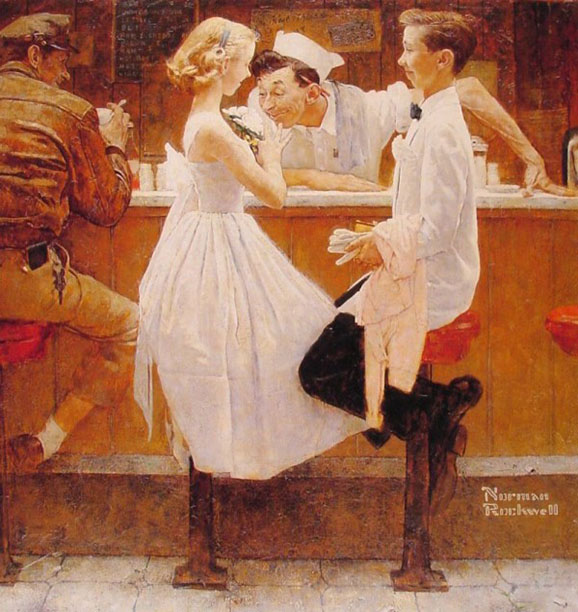
The cameramen included a German immigrant named Clemens Kalischer: “An artist-photographer himself, Kalischer was at odds with the tracing techniques and saccharine subject matter in Rockwell’s work. After all, Rockwell never painted freehand, and almost all of his paintings were commissioned by magazines and advertising companies.”
But “although he may not have clicked the shutter, Rockwell directed every facet of every composition,” as you can see by examining his paintings and reference photos together, featured as they’ve been on sites like Petapixel.
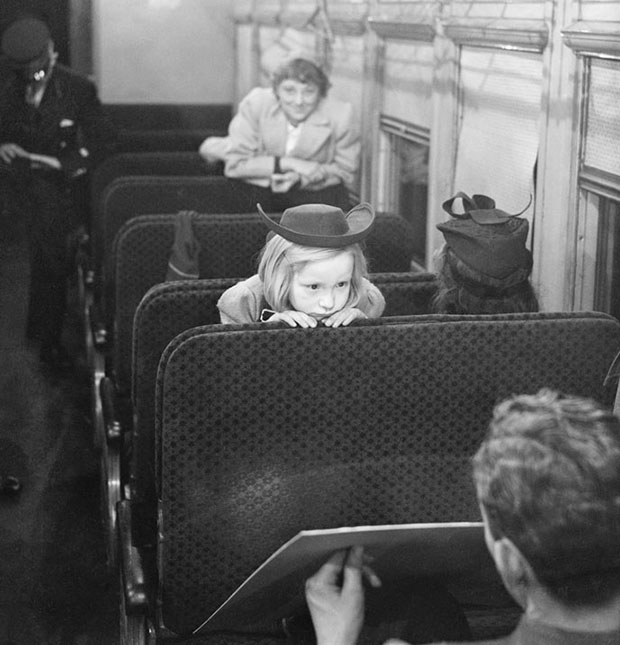
At Google Arts & Culture, you can scroll through a short exhibition of Rockwell’s late work on race relations in America that reveals how he had not just one but many photographs taken as source material for each painting, which he would then combine into a single image. This quasi-cinematic “editing” process brings to mind the “storyboarding” of Edward Hopper, who stands alongside Rockwell as one of the most American painters of the 20th century.
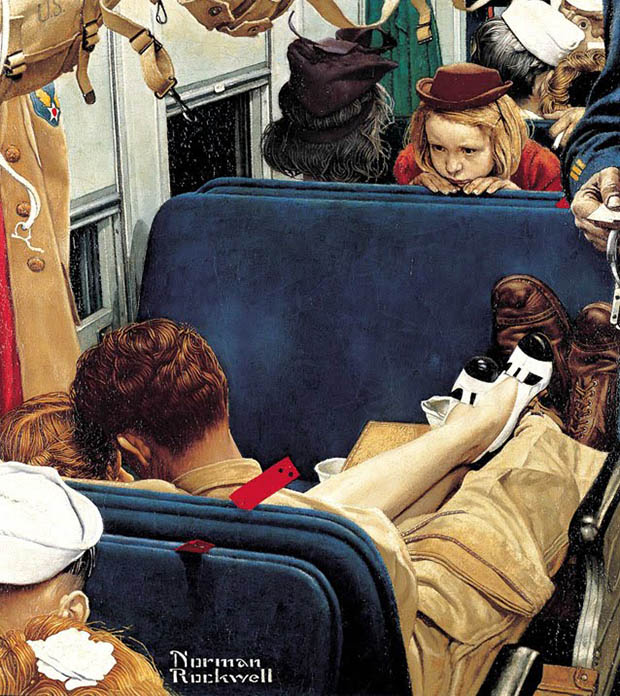
But while Hopper gave artistic form to the country’s alienation, Rockwell — whom history hasn’t remembered as a particularly happy man — created an “American sanctuary others wished to share.” And though neither Hopper nor Rockwell’s America may ever have existed, they were crafted from the pieces of American life the artists found everywhere around them.
Related Content:
Norman Rockwell Illustrates Mark Twain’s Tom Sawyer & Huckleberry Finn (1936–1940)
Norman Rockwell’s Typewritten Recipe for His Favorite Oatmeal Cookies
Yale Launches an Archive of 170,000 Photographs Documenting the Great Depression
Based in Seoul, Colin Marshall writes and broadcasts on cities, language, and culture. His projects include the Substack newsletter Books on Cities, the book The Stateless City: a Walk through 21st-Century Los Angeles and the video series The City in Cinema. Follow him on Twitter at @colinmarshall or on Facebook.
Jesus, that ear. He should donate it to the Smithsonian.
—Bob Dylan on Brian Wilson
The Beach Boys tarnished their reputation when they reformed in later years and tried to “reclaim their wholesomeness,” Dan Caffrey writes at Consequence of Sound, “only to find that it had all but disappeared.” But in the days when they sounded like the most wholesome thing on earth, they also had the distinct advantage of sounding seriously weird: “Weirder than Waits, weirder than Zappa, and definitely weirder than the Beatles. The immaculate vocal harmony that made them famous was their weirdest weapon of all; a sunny fortress of euphony that shone through the darkest of times and strangest of lyrics in their latter days.”
The phenomenon could emerge “only out of the ferment that characterizes today’s pop music scene,” said Leonard Bernstein when he heard “Surf’s Up.” Despite the surface-level corniness, there were “really deep, profound emotions” in the band’s music, emotions “that came out of a lot of pain,” Linda Ronstadt remarked.
The full depths of Pet Sounds may never be plumbed, yet one can also put it on and immediately feel the SoCal sunshine hit them squarely in the face. Only a genius like Brian Wilson could turn surf pop into classical composition, without compromising the simple emotions of pop or the profundity of a classical arrangement. (“I figure no one is educated musically ’til they’ve heard ‘Pet Sounds,’ ” says Paul McCartney.)
And only the Beach Boys as a group could pull off those harmonies. The rest of the band may not have quite grasped what their quixotic leader was up to. (Mike Love once famously complained, “Who’s gonna hear this shit? The ears of a dog?”) But they knew how to sing together like no one else before or since. (When David Crosby heard “In My Room,” he says, “I thought, ‘I give up–I can’t do that–I’ll never be able to do that.’”) They were so good, they could pull off gorgeous a‑capella passages like those in “Sloop John B,” Pet Sounds’ lead single. Hear it at the top in a full isolated vocal version.
A traditional folk song that originated in the Bahamas and was recorded in the sixties by everyone from Johnny Cash to Lonnie Donegan to the Kingston Trio, the arranging of the song took only 24 hours, Al Jardine remembers, from the time he brought it to Wilson as a possible cover to the time Wilson completed his version of the track. The vocals were another matter. Jardine assumed he would sing lead, but Wilson had a process:
It was like interviewing for a job. Pretty funny. He didn’t like any of us. My vocal had a much more mellow approach because I was bringing it from the folk idiom. For the radio, we needed a more rock approach. Brian and Mike ended up singing it.
Those demanding vocal recording sessions, Jardine wrote in the Pet Sounds liner notes, could last 12–15 hours a day. The end results are an especially impressive feat considering that the backing vocals were all recorded at once, with no overdubbing or any of the digital studio wizardry used today to nudge stray voices into the right pitch and rhythm:
At the vocal sessions, there was so much good tension. At any one time, you would have four out of five of us get our parts just fine, and there would be one who would screw up. But it wouldn’t be the same person each time. Then the next take, he would get it right, but somebody else would get it wrong. Kind of like the chaos theory at work. The more people you have in a given situation, the more chance there is for error. Then, there would be the magic moment when it all came together, and then you had your take.
Just below, hear Pet Sounds’ saddest song, “Caroline, No,” in a vocal take featuring only Wilson. He thought of it as “probably the best [song] I’ve ever written… a pretty love song about how this guy and this girl lost it and there’s no way to get it back. I just felt sad, so I wrote a sad song.” It’s also a song, for all its melancholy, born from the sense of innocent longing the band brought to all their music in their prime, conveyed in harmonies that would never shine as brightly for any other band at any other time. Hear more of the Beach Boys, a‑cappella, in the YouTube playlist here.
Related Content:
How the Beach Boys Created Their Pop Masterpieces: “Good Vibrations,” Pet Sounds, and More
Josh Jones is a writer and musician based in Durham, NC. Follow him at @jdmagness
“I enjoy poking fun at anything educated people do and civilized society perpetuates that is odd, frustrating, wacky, or hypocritical,” cartoonist Amy Kurzweil, above, recently told the New York Public Library’s Margo Moore.
Unsurprisingly, she’s been getting published in The New Yorker a lot of late.
The process for getting cartoons accepted there is the stuff of legend, though reportedly less grueling since Emma Allen, the magazine’s youngest and first-ever female cartoon editor, took over. Allen has made a point of seeking out fresh voices, and working with them to help mold their submissions into something in The New Yorker vein, rather than “this endless game of presenting work and then hearing ‘yes’ or ‘no.’”
Kurzweil has a fondness for literary themes (and the same brand of pencils that John Steinbeck, Truman Capote, and Vladimir Nabokov preferred—Blackwings—whether in her hand or, conversing with Allen on Zoom, above, in her ears.)
Getting the joke of a New Yorker cartoon often depends on getting the reference, and while both women seem tickled at the first example, Kurzweil’s mash-up of Proust’s Remembrance of Things Past and the picture book If You Give a Mouse a Cookie, it may go over many readers’ heads.
The thing that holds it all together?
Madeleines, of course, though outside France, not every Proust lover is able to identify an inked representation of this evocative cookie by shape.
Kurzweil states that she has never actually read the children’s book that supplies half the context.
(It’s okay. Like the idea that memories can be triggered by certain nostalgic scents, its concept is pretty easy to grasp.)
Nor has she read philosopher Derek Parfit’s whopping 1,928-page On What Matters. Her inspiration for using it in a cartoon is her personal connection to the massive, unread three-volume set in her family’s library. Because both the size and the title are part of the joke, she directs the viewer’s eye to the unwieldy tome with a light watercolor wash.
She also has a good tip for anyone drawing a library scene—go figurative, rather than literal, varying sizes and shapes until the eye is tricked into seeing what is merely suggested.
A all-too-true literary experience informs her second example at the 4:30 mark—that of a little known author giving a reading in a bookstore. Despite a preference for drawing “fleshy things like people and animals” she forgoes depicting the author or those in attendance, giving the punchline instead to the event posters in the store’s window.
As she told the NYPL’s Moore:
A cartoon is always an opportunity to showcase a contemporary phenomenon by exaggerating it or placing it in a different context.
Over the last year, a huge number of New Yorker cartoons have concerned themselves with the domestic dullness of the pandemic, but when Allen asked if she has a favorite New Yorker cartoon cliché, Kurzweil went with “the Moby Dick trope, because whales are easy to draw, and I like a good metaphor for the unattainable.”
Related Content:
New Yorker Cartoon Editor Bob Mankoff Reveals the Secret of a Successful New Yorker Cartoon
The Not Yorker: A Collection of Rejected & Late Cover Submissions to The New Yorker
Download a Complete, Cover-to-Cover Parody of The New Yorker: 80 Pages of Fine Satire
Ayun Halliday is an author, illustrator, theater maker and Chief Primatologist of the East Village Inky zine. She most recently appeared as a French Canadian bear who travels to New York City in search of food and meaning in Greg Kotis’ short film, L’Ourse. Follow her @AyunHalliday.


Open Culture scours the web for the best educational media. We find the free courses and audio books you need, the language lessons & educational videos you want, and plenty of enlightenment in between.

©2006-2026 Open Culture, LLC.
All rights reserved.

