There’s still something to be said for the old ways, though.
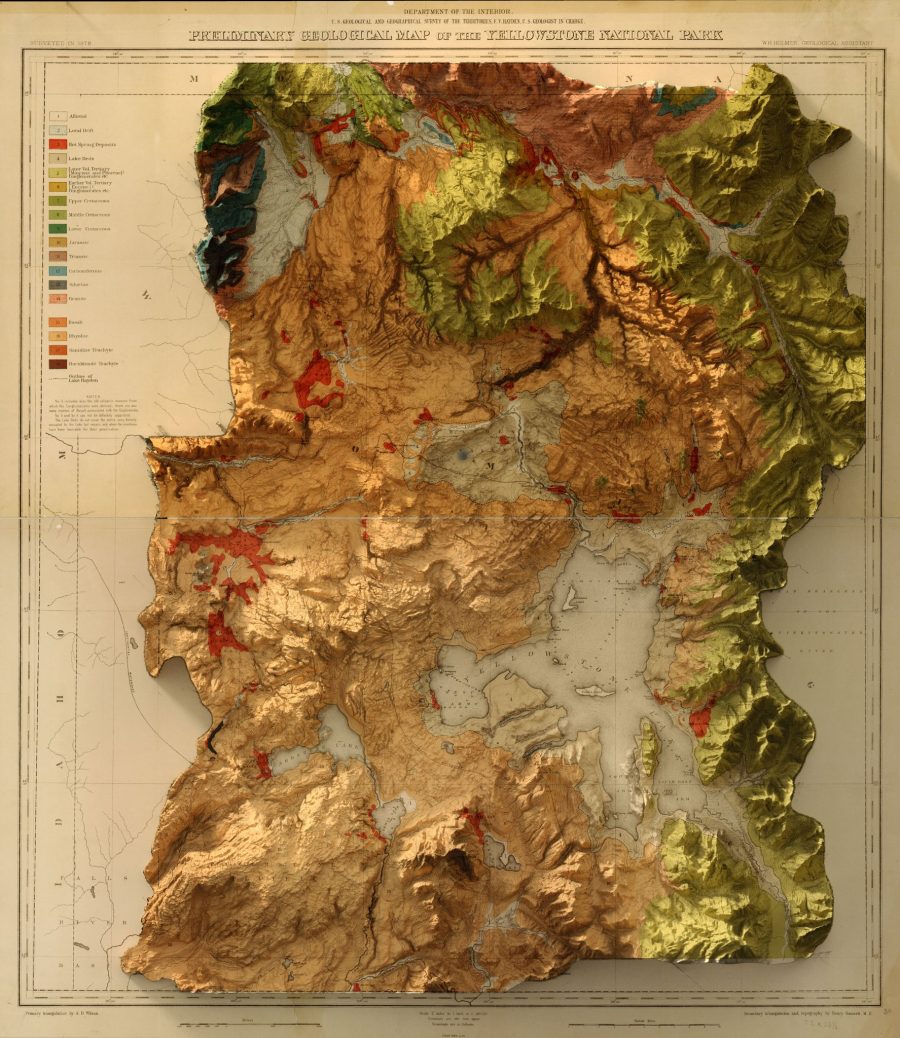
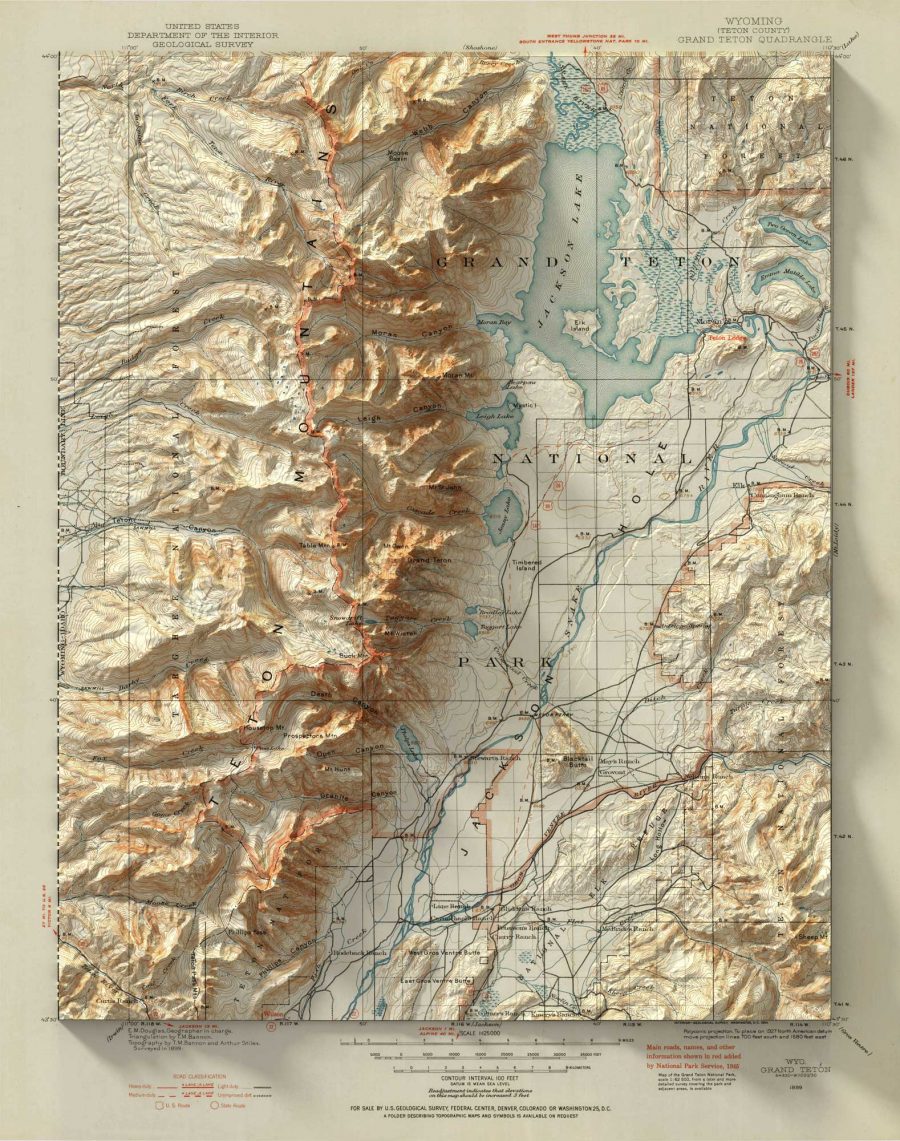
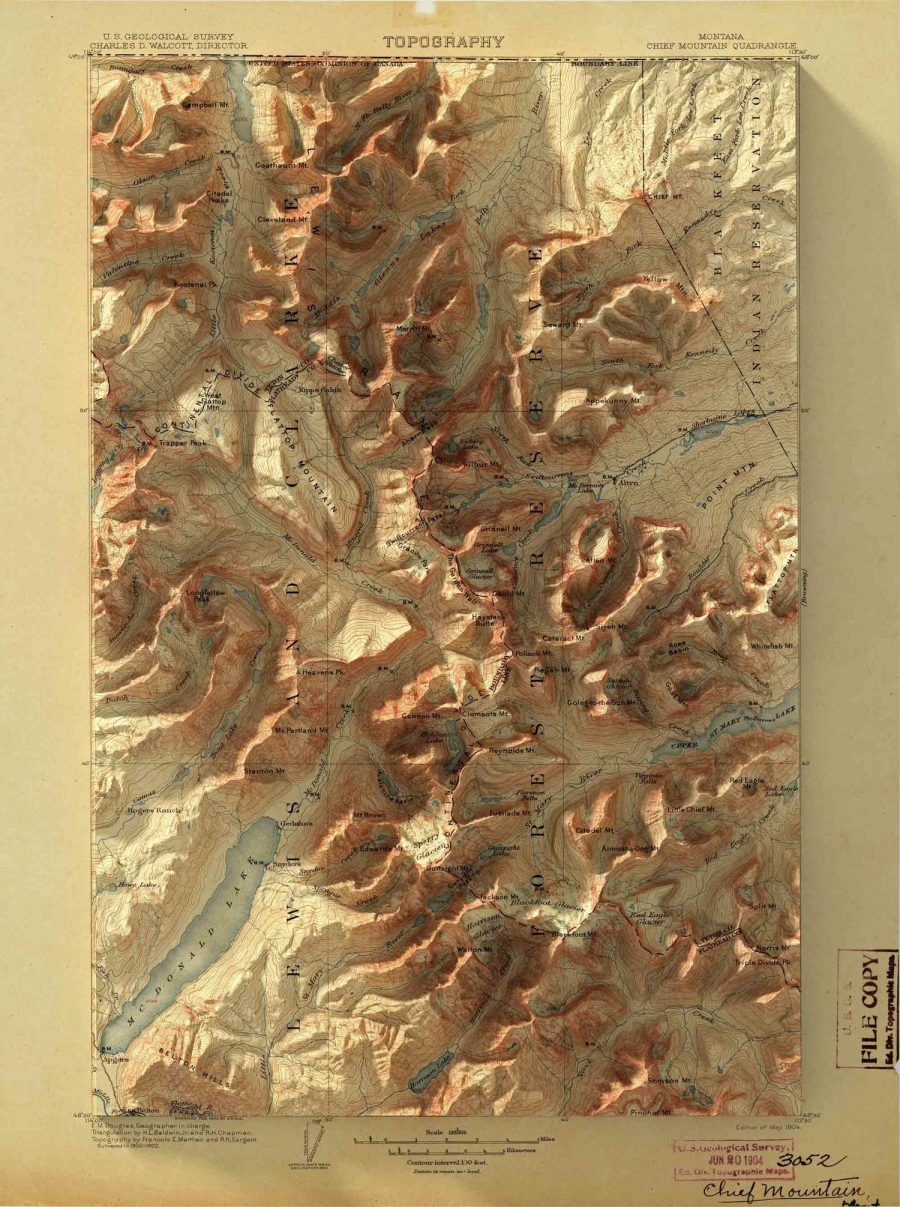
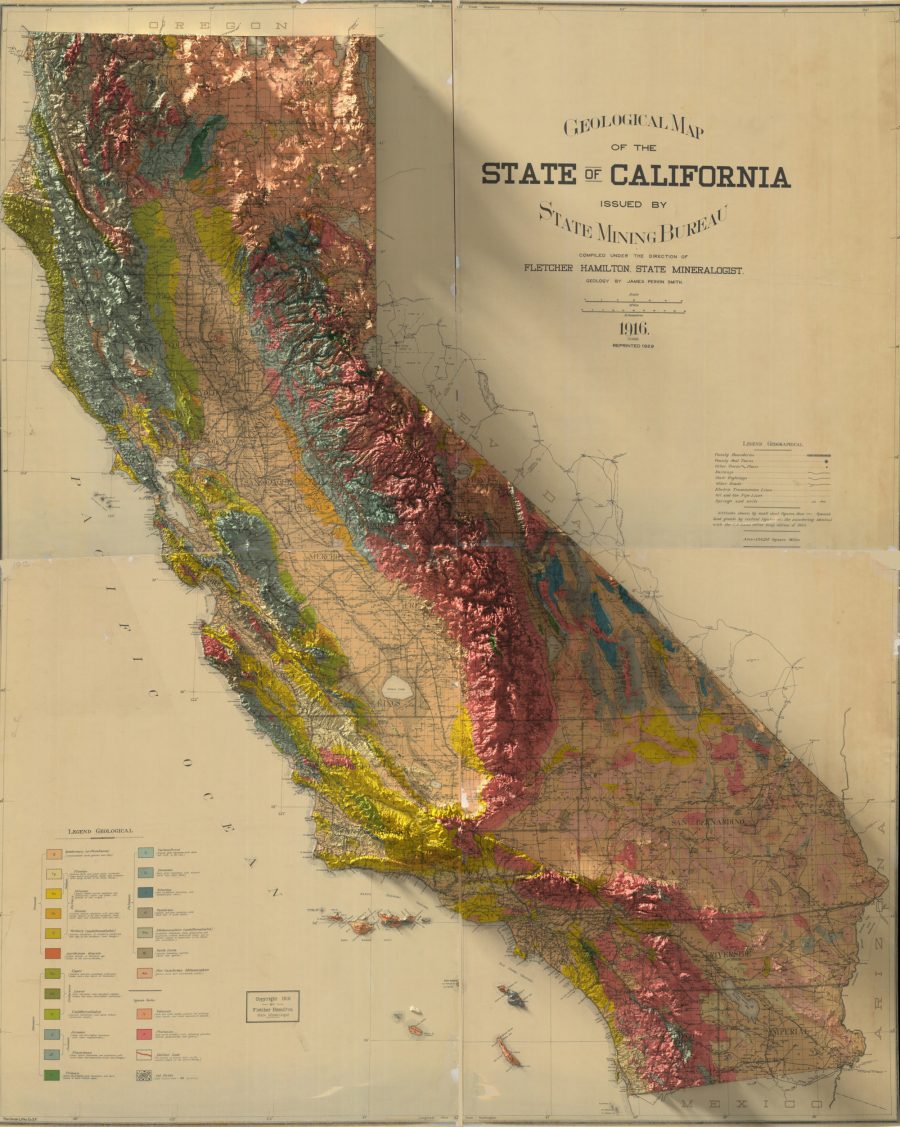
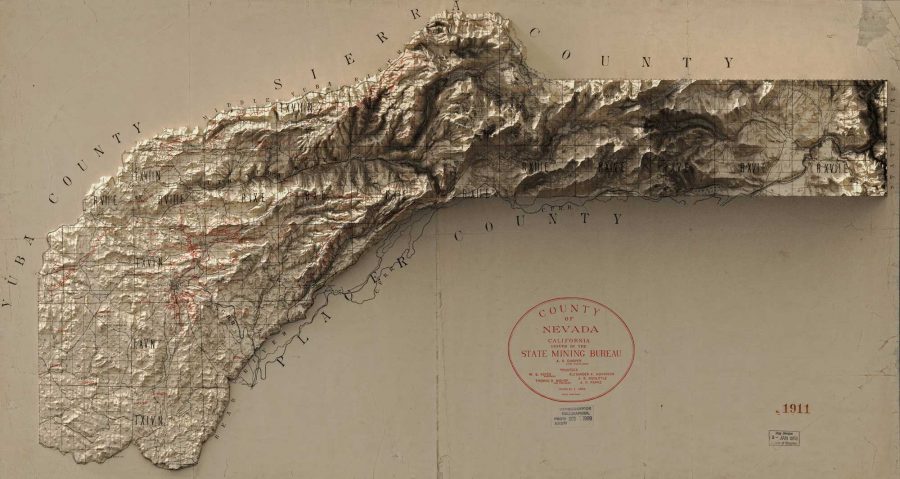
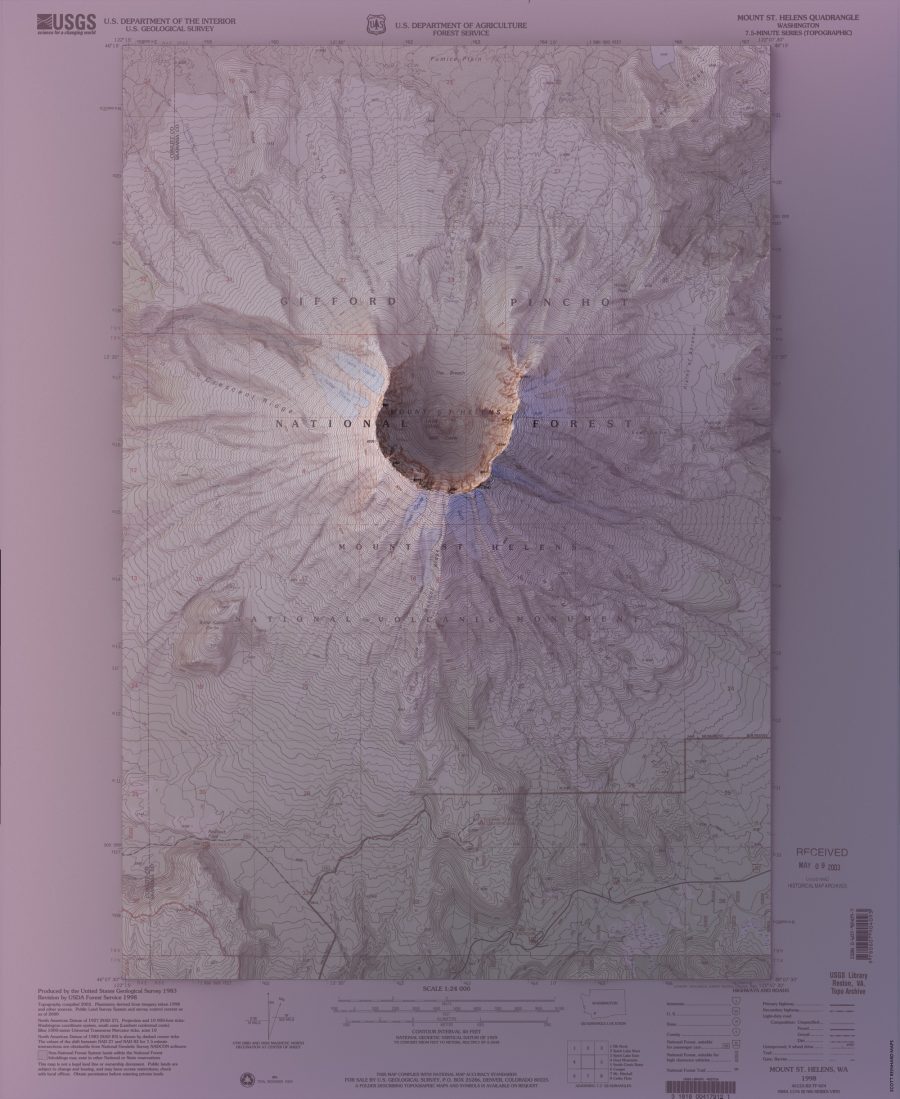
Graphic designer Scott Reinhard has all the latest technological advances at his disposal, but it took combining them with hundred-year-old maps for him to get a truly 3‑D appreciation for locations he has visited around the United States, as well as his childhood home.
When I began rendering the elevation data for the state, the story of the land emerged. The glaciers that receded across the northern half of the state after the last ice age scraped and gouged and shaped the land in a way that is spectacularly clear…I felt empowered by the ability to collect and process the vast amounts of information freely available, and create beautiful images.
(The government shut-down has not damaged the accuracy of Reinhard’s maps, but the U.S. Geological Survey’s website does warn the public that the effects of any earthquakes or other force majeure occurring during this black-out period will not immediately be reflected in their topos.)
(Nor are they able to respond to any inquiries, which puts a damper on holiday weekend plans for making salt dough maps, another Hoosier state fave, at least in 1974…)
As writer Jason Kottke notes, the shadows the mountains cast on the margins of Reinhard’s maps are a particularly effective optical trick.
You can see more of Reinhard’s digitally enhanced maps from the late 19th and early 20th-century, and order prints in his online shop.
When we go to a concert of orchestral music today, we hear most every piece played on the same range of instruments — instruments we know and love, to be sure, but instruments designed and operated within quite strict parameters. The pleasing quality of the sounds they produce may make us believe that we’re hearing everything just as the composer originally intended, but we usually aren’t. To hear what the likes of Mozart, Beethoven, Handel, and Haydn would have had in their head as they composed back in their day, you’d have to have an orchestra go so far as to play it not with modern instruments, but the same ones orchestras used back in those composers’ lifetimes.
Enter London’s Orchestra of the Age of the Enlightenment, which takes its name from the era of the late 18th century from which it draws most of its repertoire — and from which it draws most of its instruments, a vital part of its mission to achieve period-accurate sound. You can read more about the OAE’s instruments on its web site, or better yet, head over to its Youtube channel to hear those instruments demonstrated and their historical backgrounds explained. Here we have four of the OAE’s videos: on the clarinet they use for Mozart’s Clarinet Concerto, on the contrabassoon they use for Beethoven’s Fifth Symphony and Haydn’s Creation, the organ they use for Handel’s Organ Concerto, and an oboe like the one Haydn would have known.
“We love the music we play,” says OAE double bassist Cecelia Bruggemeyer, “and we love asking questions about the music we play.” So when you use an instrument like the 300-year-old bass she shows off in another video, “you suddenly find it doesn’t necessarily do the things a modern instrument will do, and that sets up a whole train of questions.” These include, “What would Bach have heard? How might the players in his day have played? What does that mean for us, playing today? What does that mean for live music now, with this historic information? We’re not trying to re-create the past. We’re trying to make something that’s exciting now but using what was from the past” — not a bad metaphor, come to think of it, for the entire enterprise of classical-music performance in the 21st century.
Based in Seoul, Colin Marshall writes and broadcasts on cities, language, and culture. His projects include the book The Stateless City: a Walk through 21st-Century Los Angeles and the video series The City in Cinema. Follow him on Twitter at @colinmarshall or on Facebook.
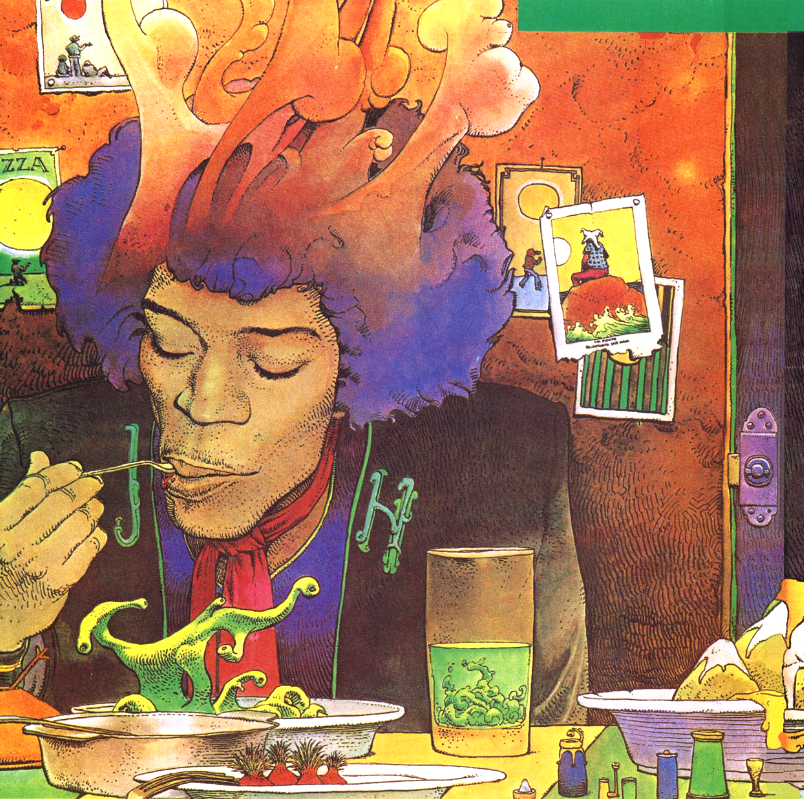
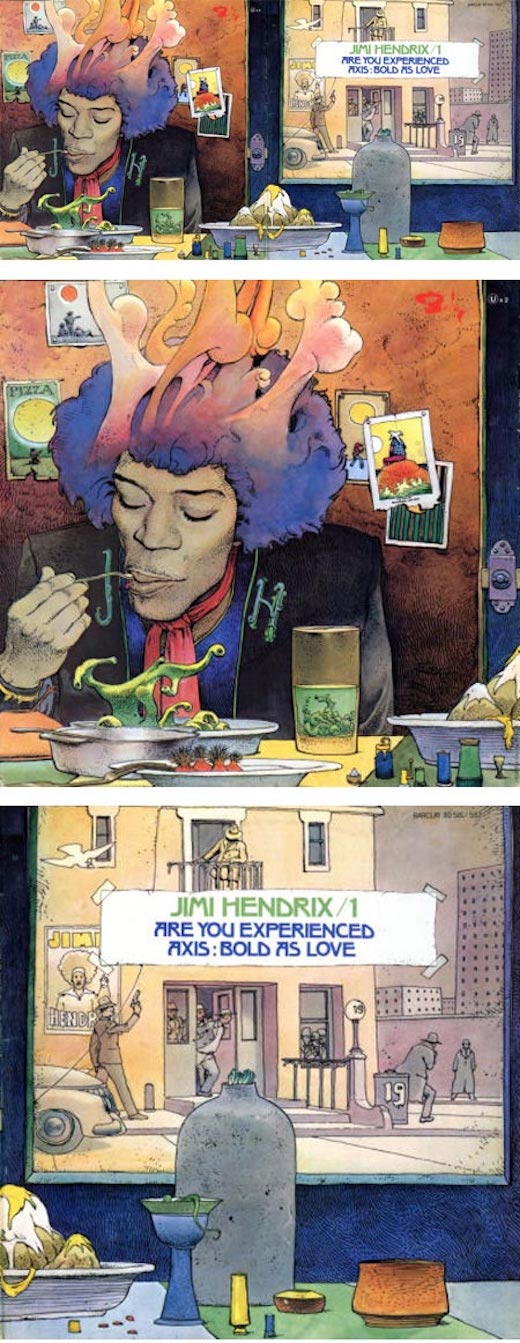
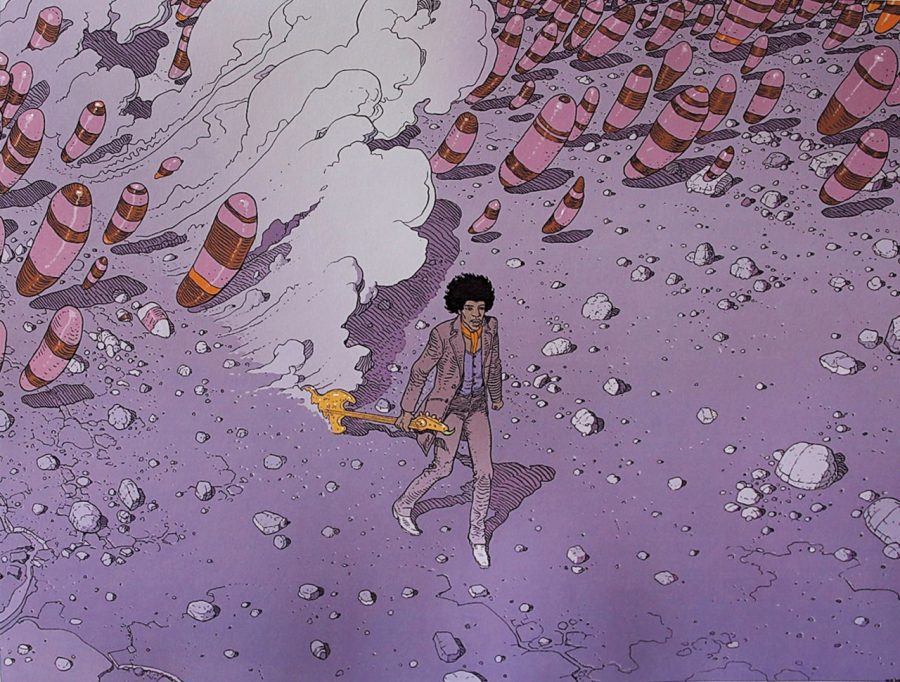
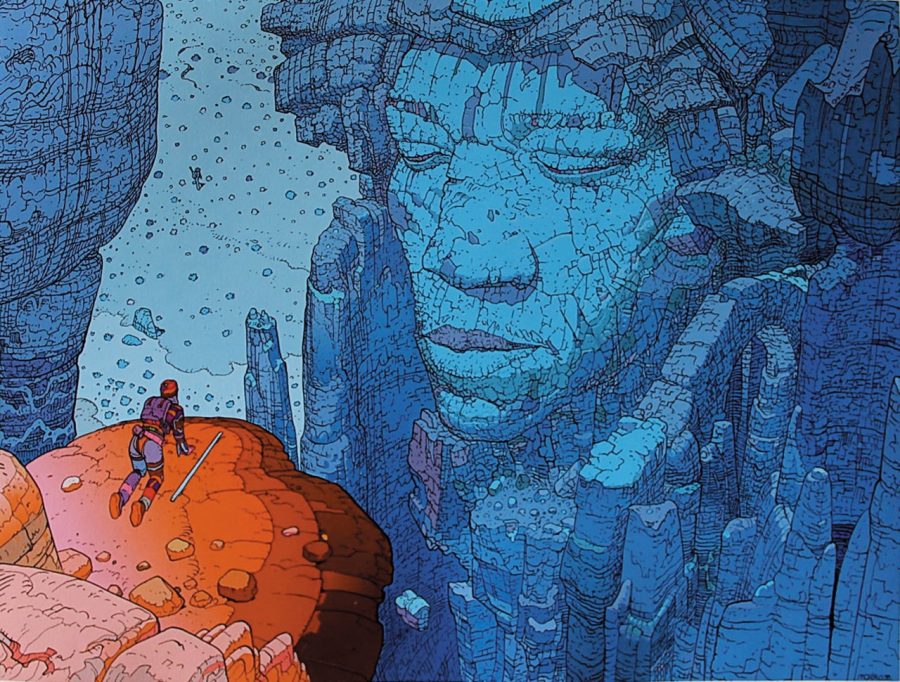
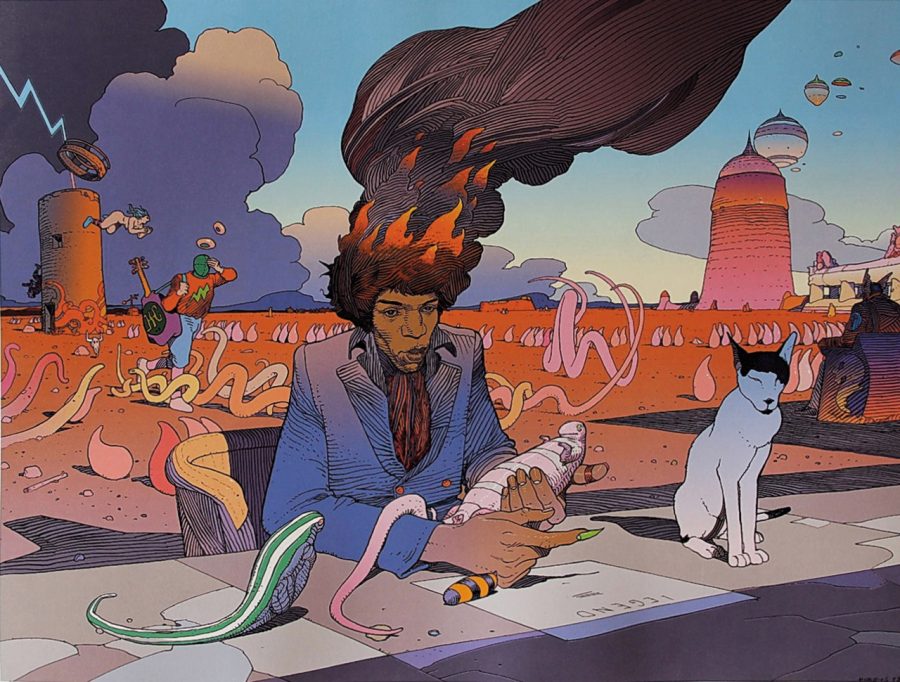
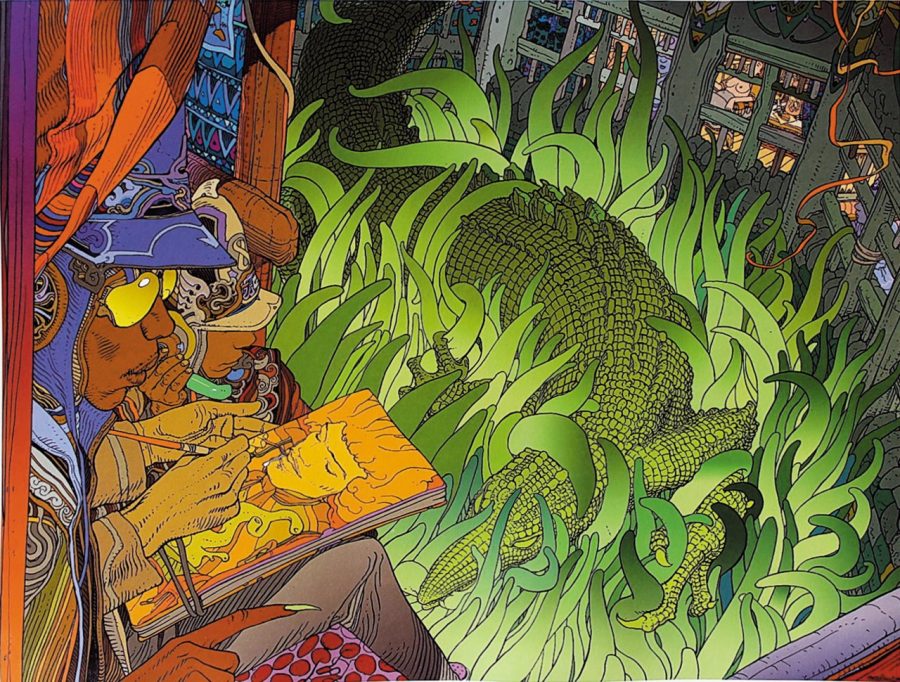
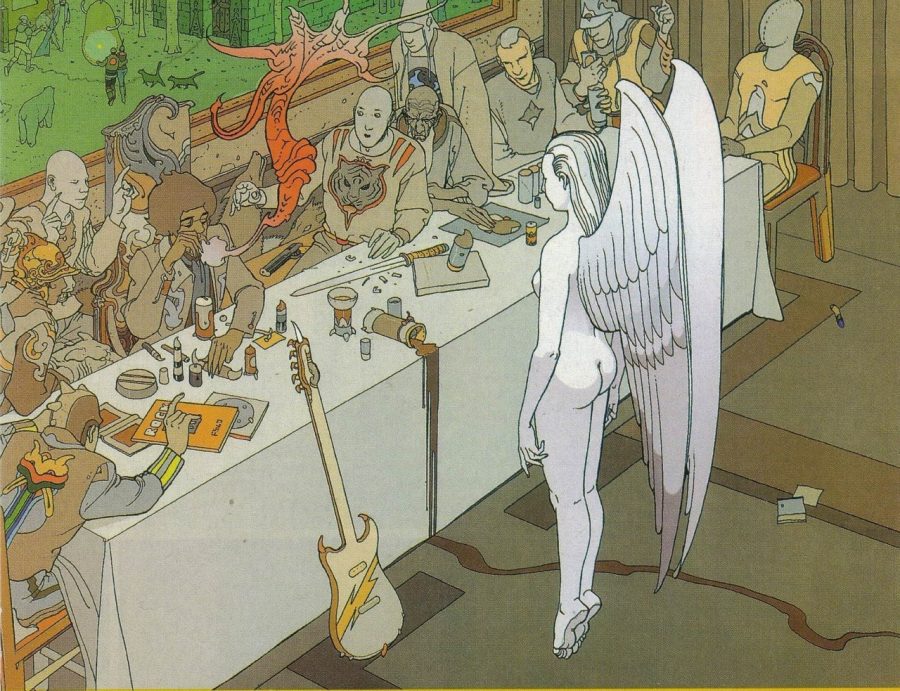
The 1995 release of posthumous Jimi Hendrix compilation Voodoo Souphas divided fans and critics for over two decades now. But whatever its merits, its cover art should hold an honored place in every Hendrix fan’s collection. Drawn by the legendary cult comic artist Moebius from a photograph of Hendrix eating soup in France, it captures the sound Hendrix was moving toward at the end of his life—his head exploding in flames, or mushroom clouds, or pink psychedelic bronchial tubes, or whatever. The image comes from a larger gatefold, excerpted below, which Moebius drew for the French double LP Are You Experienced/Axis: Bold as Lovein 1975.
Journalist Jean-Nöel Coghe was supposedly very upset that he did not even receive mention for taking the original photo, but in the nineties he and Moebius came together again for a project that would do them both credit, a book called Emotions électriquesthat Coghe wrote of his experiences traveling through France as Hendrix’s guide during the Experience’s first tour of the country in 1967.
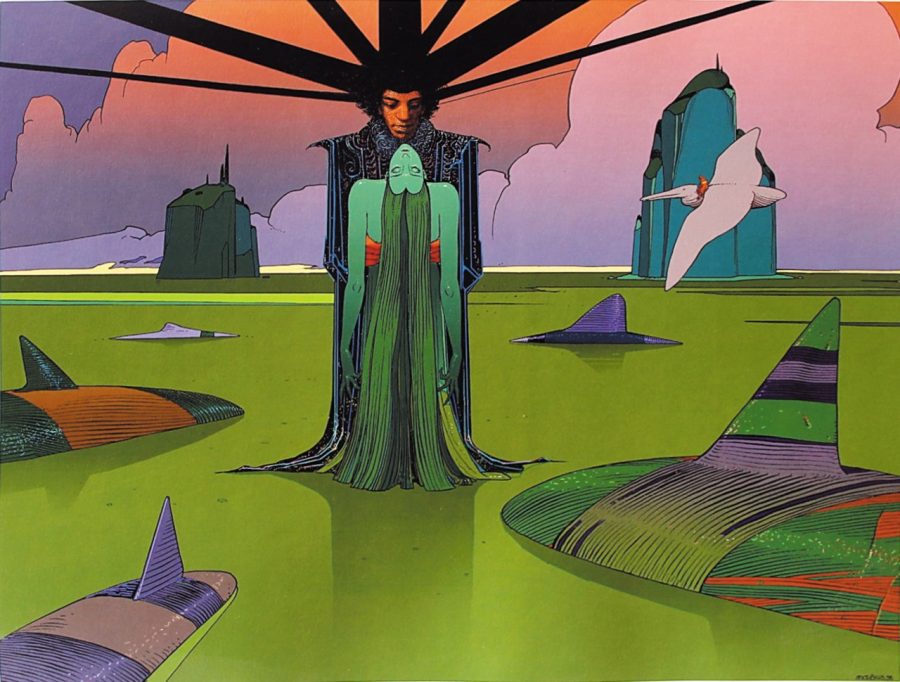
Moebius provided the book’s illustrations, many of which you can see below, “each of them,” as the publisher’s description has it, “imagining Hendrix in a classic Moebius landscape of dreams.”
Obviously a huge Hendrix fan, Moebius is in many ways as responsible for the psychedelic space race of the 1970s as the guitarist himself. His work in the French comic magazine Métal hurlant—Heavy Metal in the American version—epitomized the sci-fi and fantasy elements that came to dominate heavy rock. His work with Alejandro Jodorowsky on the Chilean visionary filmmaker’s aborted Dune is the stuff of legend.
Moebius had illustrated album covers since the early seventies, mostly those of European artists. But his creations as a magazine and comics illustrator (and film scenarist) have the most enduring appeal for much the same reason as Hendrix’s music. They are both unparalleled masters and natural storytellers whose imagined worlds are so richly detailed and consistently surprising they have birthed entire genres. The two may have crossed paths too late to actually work together, but I like to think Moebius carried on the spirit of Hendrix in a visual form.
It may not be common knowledge that Hendrix hated his album covers, leaving detailed notes about them for his record company, who ignored them. His own choices, one must admit, including a Linda McCartney photo for the cover of Electric Ladyland that makes the band look like they’re on the set of a proto-Sesame Street, do not exactly sell the records’ treasures. But Jimi might have loved Moebius’ interpretations of his headspace, a visual continuation of a prominent strand of Hendrix’s imagination. See all of Moebius’ Hendrix illustrationshere.
We can now eat cheese nearly anywhere in the world, and most world cuisines seem to have found — to varying degrees of success — ways of working the stuff into their native dishes. But if cheese has gone and continues to go global, from where did its journey begin? The TED-Ed video above can tell you that and more, having been written by University of Vermont professor of nutrition and food sciences Paul Kindstedt, author of Cheese and Culture: A History of Cheese and its Place in Western Civilization. Titled “A Brie(f) History of Cheese,” it begins in 8000 BCE in the Fertile Crescent and arrives at our avidly cheese-eating present in under six minutes.
Humanity’s discovery of cheese happened not long after its implementation of agriculture. Left under the sun, the milk of domesticated animals would separate into a liquid, which we now call whey, and solids, called curds. These curds, says Kindstedt, “became the building blocks of cheese, which would eventually be aged, pressed, ripened, and whizzed into a diverse cornucopia of dairy delights.”
Cheese gained popularity quickly enough to become a standard commodity, even a staple, throughout the eastern Mediterranean by the end of the Bronze Age. In the fullness of time, regional variations developed, from the hard, sun-dried Mongolian byaslag to Egyptian goat’s-milk cottage cheese to south Asian paneer.
Some populations, of course, have an easier time eating cheese than others, and some individuals simply don’t like it. But examined closely, few foods reveal as much about humanity’s long efforts to nourish itself with as much efficiency and variety as possible as cheese does. “Today, the world produces roughly 22 billion kilograms of cheese a year,” says Kindstedt, “shipped and produced around the globe. But 10,000 years after its invention, local farms are still following in the footsteps of their Neolithic ancestors, hand-crafting one of humanity’s oldest and favorite foods.” And the more you appreciate that fact — learnable in greater depth in the accompanying TED-Ed lesson, the harder time you’ll have, say, turning down the cheese course when next you dine at a French restaurant. Cheese may be rich, but it’s rich not least in history.
Based in Seoul, Colin Marshall writes and broadcasts on cities, language, and culture. His projects include the book The Stateless City: a Walk through 21st-Century Los Angeles and the video series The City in Cinema. Follow him on Twitter at @colinmarshall or on Facebook.
Every generation of schoolchildren no doubt first assumes homework to be a historically distinct form of punishment, developed expressly to be inflicted on them. But the parents of today’s miserable homework-doers also, of course, had to do homework themselves, as did their parents’ parents. It turns out that you can go back surprisingly far in history and still find examples of the menace of homework, as far back as ancient Egypt, a civilization from which one example of an out-of-classroom assignment will go on display at the British Library’s exhibition Writing: Making Your Mark, which opens this spring.
“Beginning with the origins of writing in Egypt, Mesopotamia, China and the Americas, the exhibition will explore the many manifestations, purposes and forms of writing, demonstrating how writing has continually enabled human progress and questioning the role it plays in an increasingly digital world,” says the British Library’s press release.
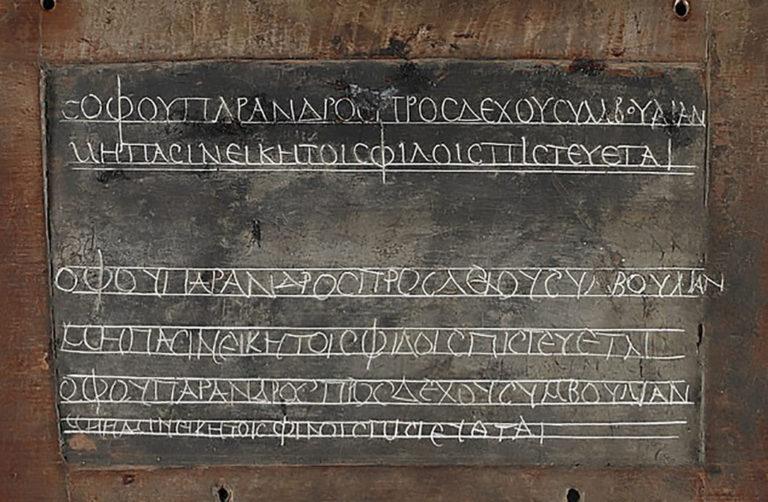
“From an ancient wax tablet containing a schoolchild’s homework as they struggle to learn their Greek letters to a Chinese typewriter from the 1970s, Writing: Making Your Mark will showcase over 30 different writing systems to reveal that every mark made – whether on paper or on a screen – is the continuation of a 5,000 year story and is a step towards determining how writing will be used in the future.”
That wax tablet, preserved since the second century A.D., bears Greek words that Livescience’s Mindy Weisberger describes as “familiar to any kid whose parents worry about them falling in with a bad crowd”: “You should accept advice from a wise man only” and “You cannot trust all your friends.” First acquired by the British Library in 1892 but not publicly displayed since the 1970s, the tablet’s surface preserves “a two-part lesson in Greek that provides a snapshot of daily life for a pupil attending primary school in Egypt about 1,800 years ago.” Its lines, “copied by this long-ago student were not just for practicing penmanship; they were also intended to impart moral lessons.”
But why Greek? “In the 2nd century A.D., when this lesson was written,” writes Smithsonian.com’s Jason Daley, “Egypt had been under Roman rule for almost 200 years following 300 years of Greek and Macedonian rule under the Ptolemy dynasty. Greeks in Egypt held a special status below Roman citizens but higher than those of Egyptian descent. Any educated person in the Roman world, however, would be expected to know Latin, Greek and — depending on where they lived — local or regional languages.” It was a bit like the situation today with the English language, which has become a requirement for educated people in a variety of cultures — and a subject especially loathed by many a homework-burdened student the world over.
Based in Seoul, Colin Marshall writes and broadcasts on cities, language, and culture. His projects include the book The Stateless City: a Walk through 21st-Century Los Angeles and the video series The City in Cinema. Follow him on Twitter at @colinmarshall or on Facebook.
Earlier this month, NBC reporter and analyst William Arkin ended a 30-year career as a journalist, announcing in a “scathing letter,” Democracy Now! reports, that “he would be leaving the network. Arkin accuses “the media of warmongering while ignoring the, quote, ‘creeping fascism of homeland security.’” He does not equivocate in a follow-up interview with Amy Goodman. “The generals and the national security leadership” are also now, he says, “the commentators and the analysts who populate the news media” (Arkin himself is a former Army intelligence officer).
The problem isn’t only NBC, in his estimation, and it isn’t only supposed journalists cheerleading for war. Most of the conflicts the country is currently engaged in are un- or under-reported in major sources. His letter “applies to all of the mainstream networks, applies to CNN and Fox, as well…. We’ve just become so shallow that we’re not really able even to see the truth, which is that we’re at war right now in nine countries around the world where we’re bombing, and we hardly report any of it on a day-to-day basis.”
This isn’t the case with independent media organizations like Democracy Now!, The Intercept, or Airwars. Secular and religious refugee relief organizations like the International Rescue Committee, World Relief, or Muslim Global Relief are paying attention. Many of these organizations are non‑U.S.-based or connected to the “civilian experts” Arkin says once appeared regularly in the national media and represented opposing views, “people who might be university professors or activists… or experts who were associated with think tanks.”
At the top of the post, see a map (view in a larger format here) from the Cost of War Project’s Stephanie Savell, 5W Infographics, and the Smithsonian of all the regions where the U.S. is “combatting terrorism.” While most of the media orgs and non-profits mentioned above would probably dispute the use of that term in some or all of the conflict zones, Savell sticks with the official language to describe the situation—one in which the nation “is now operating in 40 percent of the world’s nations,” as she writes at Smithsonian.com.
Maybe no one needs an editorial to imagine the enormous toll this level of military engagement has taken over the course of 17 years since the inception of the “Global War on Terror.” The map covers the past two, illustrating “80 countries, engaged through 40 U.S. military bases,” and conducting training, exercises, active combat, and air and drone strikes on six continents. The selections, writes Savell, are “conservative,” and sourced from both independent and mainstream media outlets and international government and military sources.
“The most comprehensive depiction in civilian circles of U.S. military and government antiterrorist actions overseas,” the America at War map provides information we don’t often get in our daily—or hourly, or by-the-minute—diet of news. “Contrary to what most Americans believe, the war on terror is not winding down.” It is expanding. Given the country’s history of sustained mass movements against legally suspect, grossly expensive wars with high civilian casualties, disease epidemics, starvation, and refugee crises, one would think that a sizable segment of the population would want to know what their country’s military and civilian defense contractors are doing around the world.
For millions watching in the UK and around the world, anticipating the looming Brexit deadline over the past two years has been like watching the slowest train wreck in history. But for those not following the coverage daily, the impending UK secession from the European Union is mystifying. Just how many trains are there, and where are they coming from, and how fast, exactly, are they going?
From the future of food and drug imports, to the status of the “currently invisible” border between Northern Ireland and the Republic of Ireland, to all of the legal minutiae no one mentioned during the campaign, the consequences of the recent failure of a Brexit deal could be disastrous. Were “leave” campaigners honest in their sale of Brexit to the voters? Did they have any idea how such a thing would work? Ample evidence shows the answer to both questions is an unqualified No.
The Vote Leave campaign director now describes the referendum as a “dumb idea.” Wealthy UK residents, including many a Brexit politician, are fast moving their assets out of the country. So how did Brexit get sold to voters if it’s such a potential catastrophe? The usual methods worked quite well, Stephen Fry explains in the video above.
By stoking xenophobic fears over migrants and refugees, Brexiteers, he says, created “false assumptions about the EU, some very dark, and some comical.” They were assisted in conjuring a “mythical EU dragon” by tabloid journalists who called migrants “cockroaches” and “feral humans.” Rhetoric indistinguishable from Nazi propaganda drove a spike in hate crimes on both sides of the Atlantic.
Despite the insistence of many voters that their choice was not driven by racial animus, the Brexit campaign, like the Trump campaign, Fry says above, undeniably was. The consequences of these votes for migrant workers and refugees speak for themselves. In the UK, Theresa May’s “hostile environment” policies have deprived British citizens from migrant families of livelihoods and safety. Some have faced threats of deportation, a situation similar to that facing the children of Vietnam War refugees in the US.
Fry calls for identifying a “new enemy” of the people: misleading information like the false claim that the NHS would save 350 million pounds a week after Brexit and the repeated lies in the U.S. about undocumented immigrants, crime, and terrorism. “Perception of crime levels,” he says, “has become completely detached from reality,” especially since the biggest security threats come from hate crimes and right-wing violence, a situation reported on, warned about, and ignored, for several years.
As in the US, so in the UK: relentlessly repeated claims about “invasions” has created a very hostile environment for millions of people. Are the facts likely to sway those voters who were carried away by excesses of hate and fear? Probably not. But those who care about the truth should pay attention to Fry’s debunking. The facts about immigration and other issues used to sell far right policies and politicians, as he outlines in these videos, are entirely different than what Brexit leaders and their counterparts in the US want the public to believe.
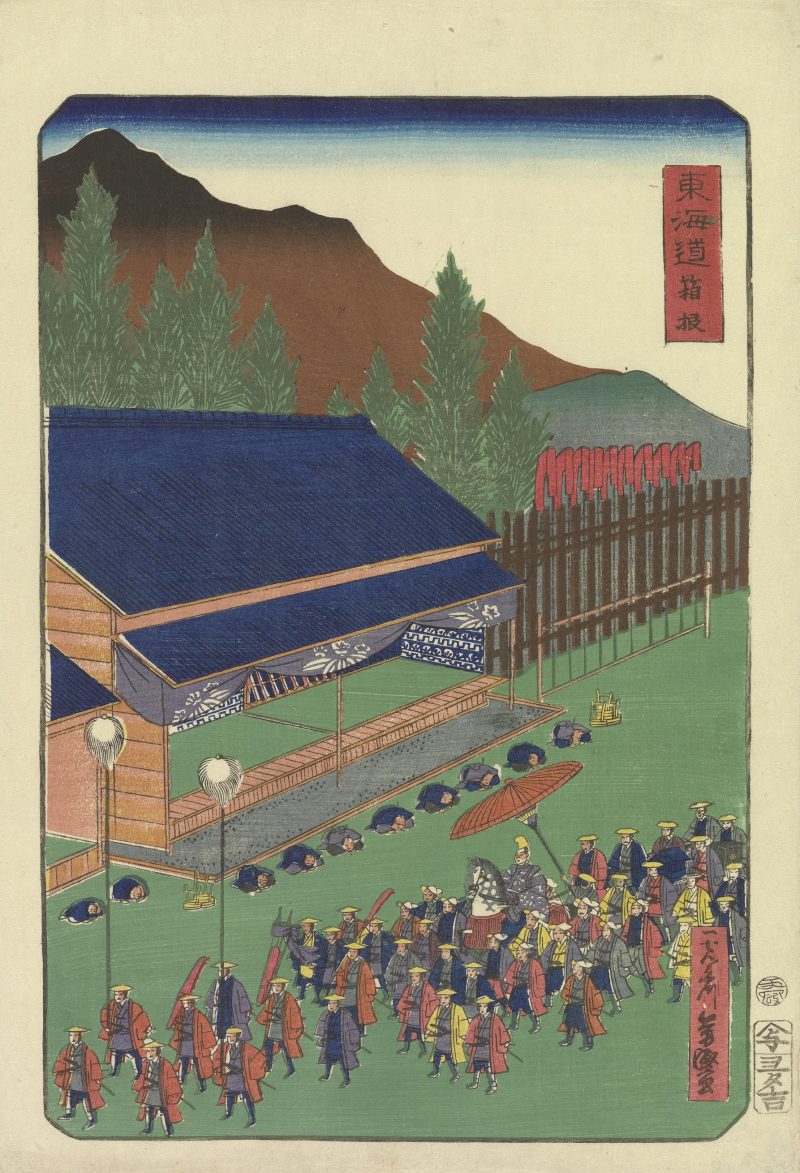
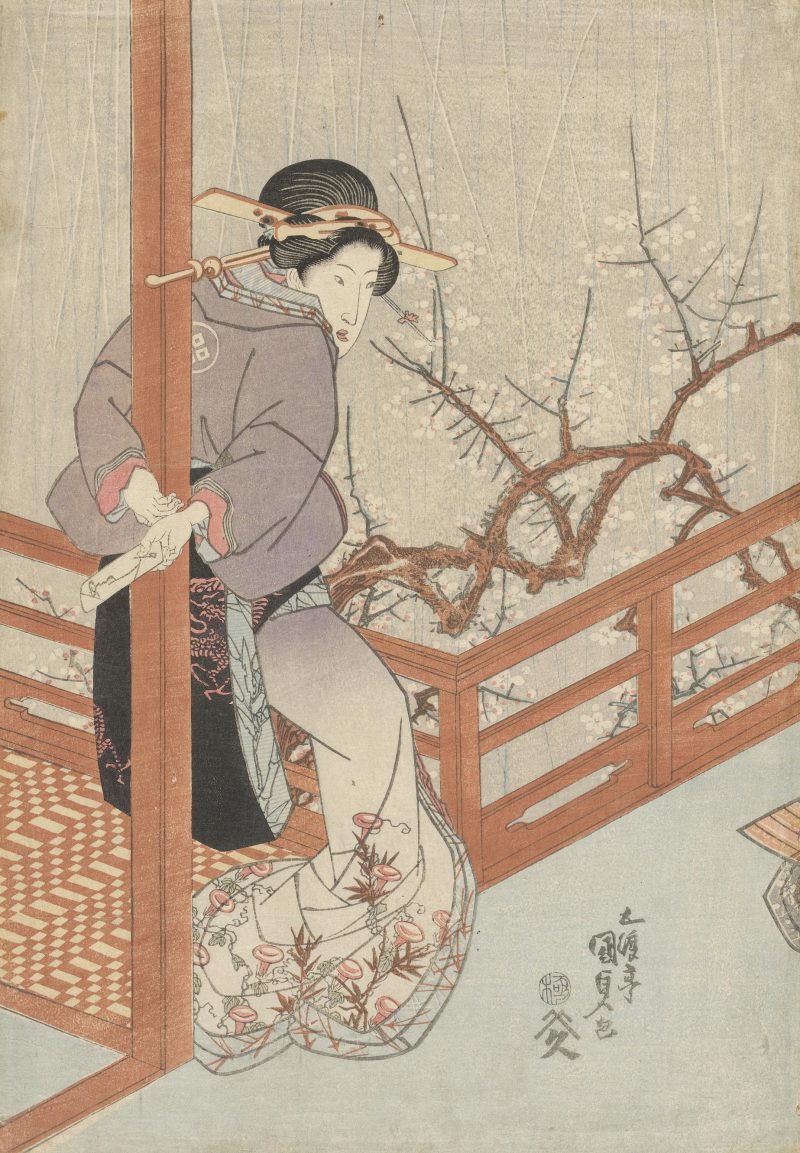
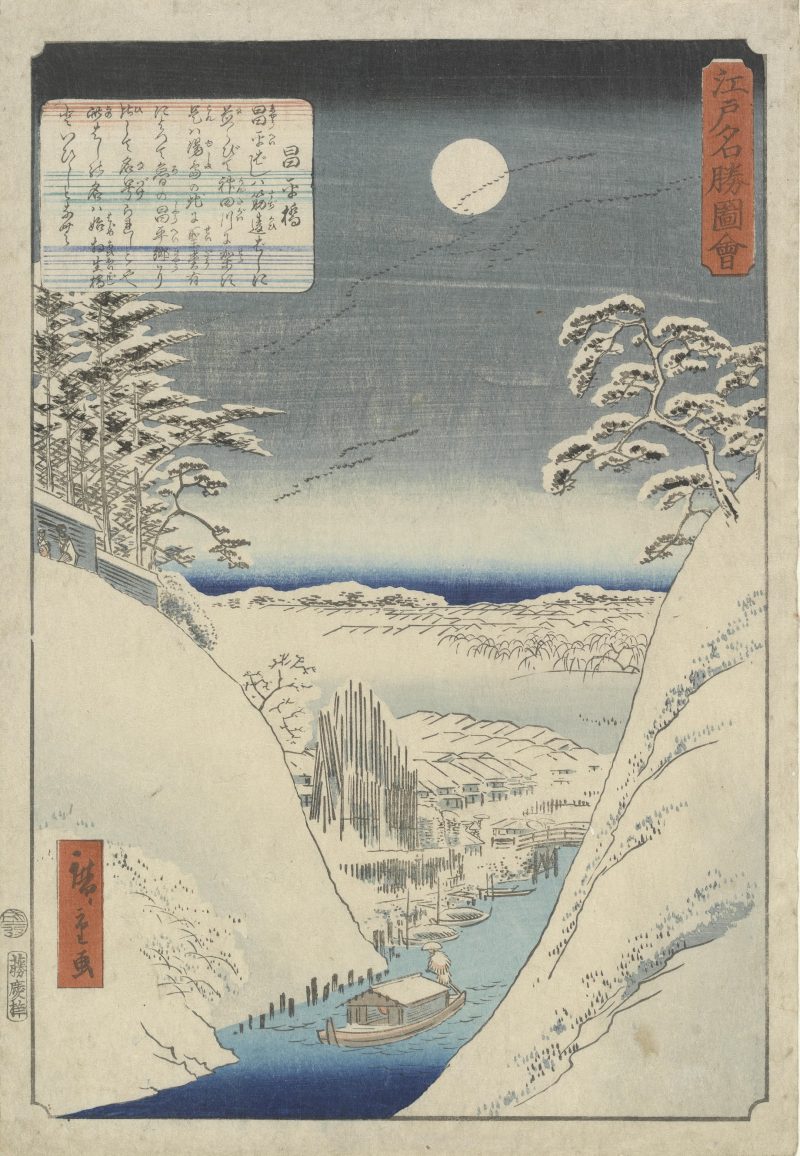
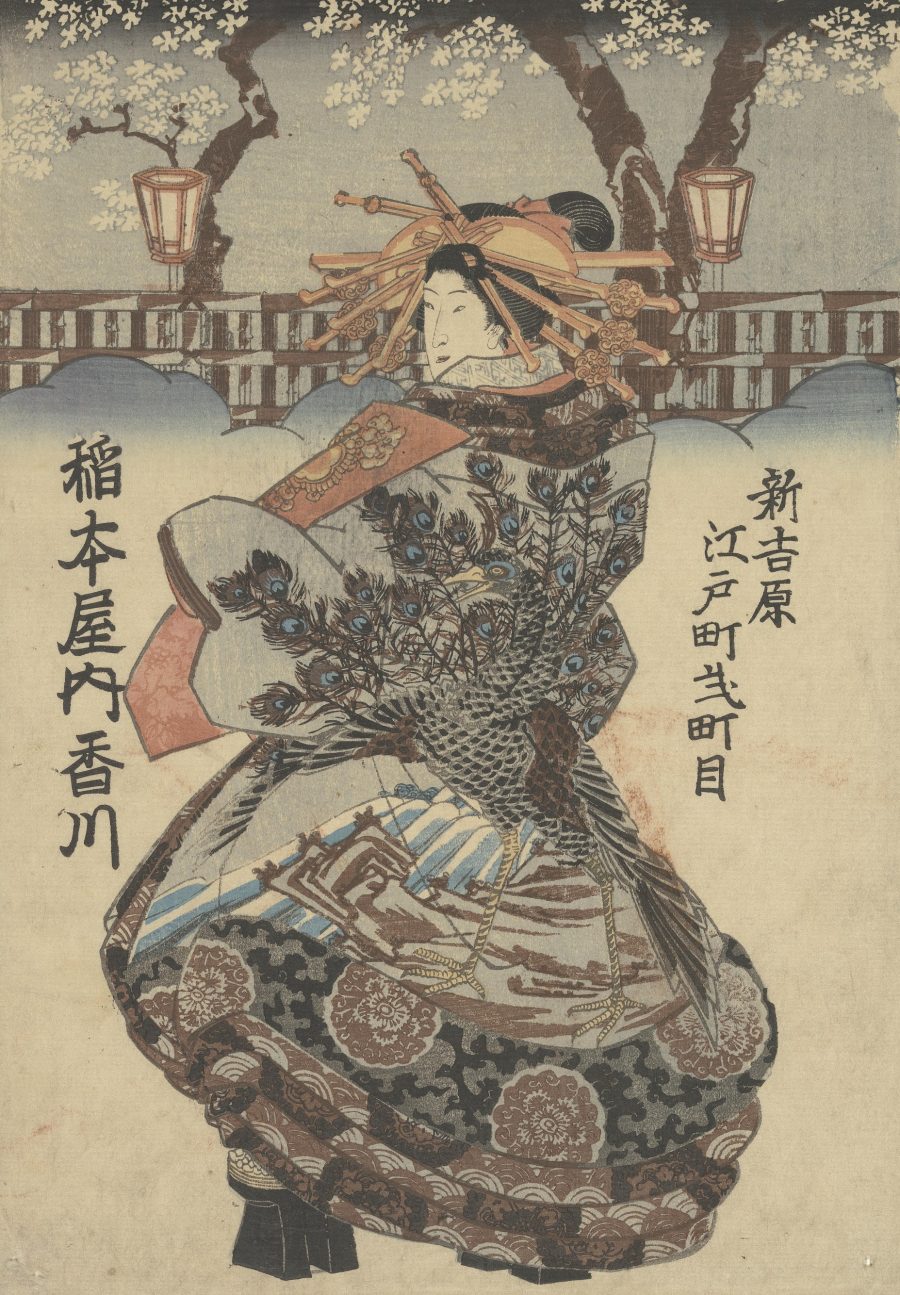
Vincent van Gogh never went to Japan, but he did spend quite a bit of time in Arles, which he considered the Japan of France. What made him think of the place that way had to do entirely with aesthetics. The Netherlands-born painter had moved to Paris in 1886, but two years later he set off for the south of France in hopes of finding real-life equivalents of the “clearness of the atmosphere and the gay colour effects” of Japanese prints. These days, we’ve all seen at least a few examples of that kind of art and can imagine more or less exactly what he was talking about. But how did the man who painted Sunflowers and The Starry Night come to draw such inspiration from what must have felt like such exotic art of such distant a provenance?
“There was huge admiration for all things Japanese in the second half of the nineteenth century,” says the Van Gogh Museum’s visual essay on the painter’s relationship with Japan. “Very few artists in the Netherlands studied Japanese art. In Paris, by contrast, it was all the rage. So it was there that Vincent discovered the impact Oriental art was having on the West, when he decided to modernise his own art.”
Having got a deal on about 660 Japanese woodcuts in the winter of 1886–87, apparently with an intent to trade them, he ultimately held on to them, copied them, and even used their elements as backgrounds for his own portraits.
“My studio’s quite tolerable,” he wrote to his brother Theo, “mainly because I’ve pinned a set of Japanese prints on the walls that I find very diverting. You know, those little female figures in gardens or on the shore, horsemen, flowers, gnarled thorn branches.” More than a diversion, he saw in their radical difference from the rigorously realistic, convention-bound traditional European painting a way toward “the art of the future,” which he was convinced “had to be colourful and joyous, just like Japanese printmaking.” As he developed what he called a “Japanese eye” while living in Arles, “his compositions became flatter, more intense in colour, with clear lines and decorative patterns.”
The Van Gogh Museum has digitized and made available to download Van Gogh’s Japanese art collection, or at least most of them: you can read about the hundred or so “missing” works here, and you can view the 500 the museum has retained here. Every time you reload the front page, the selection it presents reshuffles; otherwise, you can browse the collection by subject, person and institution, technique, object type, and style. Some of the best-represented categories include landscape, actor print, spring, and female beauty. Whether the Japan-inspired Van Gogh (or colleagues who shared his interest, chiefly Paul Gauguin) succeeded in creating the art of the future is up to art historians to debate, but no one who sees his collection of Japanese art will ever be able to unsee its influence on his own work. Not that Van Gogh didn’t admit it himself: “All my work,” he wrote in a later letter to Theo, “is based to some extent on Japanese art.”
Based in Seoul, Colin Marshall writes and broadcasts on cities, language, and culture. His projects include the book The Stateless City: a Walk through 21st-Century Los Angeles and the video series The City in Cinema. Follow him on Twitter at @colinmarshall or on Facebook.
In many an audio engineering course, I’ve come across the Fourier Transform, an idea so fundamental in sound production that it seems essential for everyone to know it. My limited understanding was, you might say, functional. It’s some kind of mathematical reverse engineering machine that turns waveforms into frequencies, right? Yes, but it’s much more than that. The idea can seem overwhelming to the non-mathematically-inclined among us.
The Fourier Transform, named for French mathematician and physicist Jean-Baptiste Joseph Fourier, “decomposes” any wave form into frequencies, and “virtually everything in the world can be described via a waveform,” writes one introduction to the theory. That includes not only sounds but “electromagnetic fields, the elevation of a hill versus location… the price of your favorite stock versus time,” the signals of an MRI scanner.
The concept “extends well beyond sound and frequency into many disparate areas of math and even physics. It is crazy just how ubiquitous this idea is,” notes the 3Blue1Brown video above, one of dozens of animated explorations of mathematical concepts. I know far more than I did yesterday thanks to this comprehensive animated lecture. Even if it all seems old hat to you, “there is something fun and enriching,” the video assures us, “about seeing what all of its components look like.”
Things get complicated rather quickly when we get into the dense equations, but the video illustrates every formula with graphs that transform the numbers into meaningful moving images.
In shorter lessons, you can learn to count to 1000 on two hands, or, just below, learn what it feels like to invent math. (It feels weird at first.)
Sanderson’s short courses “tend to fall into one of two categories,” he writes: topics “people might be seeking out,” like many of those mentioned above, and “problems in math which many people may not have heard of, and which seem really hard at first, but where some shift in perspective makes it both doable and beautiful.” These puzzles with elegantly clever solutions can be found here. Whether you’re a hardcore math-head or not, you’ll find Sanderson’s series of 3Blue1Brown animations illuminating. Find them all here.
“I could do that” goes the refrain of philistines at modern art galleries, sometimes followed by a “Hell, my dog/cat/baby/elephant could do that!” Sophisticates smirk knowing smirks. Oh no, sir or madam, they most certainly could not. But maybe everyone, at some level, comes across Agnes Martin’s White Stone or Jo Baer’s Untitled (White Square Lavender)and thinks it looks like someone “just took a tube of white paint and spread it on a canvas.”
It’s tempting to imagine, notes Vox in the explainer video above, but “it’s not actually that easy.”
Oh, really? Enlighten us…. Why exactly did Robert Ryman’s all-white painting Bridgesell for $20.6 million dollars? This question may be answered in another video. Here, we get a little bit of art history—on the origins of the all-white painting in the minimalism of Kazimir Malevich (he preferred to call it “Suprematism”) and the development of Minimalism, capital “M.”
Elisabeth Sherman, assistant curator at the Whitney Museum in New York says that “white isn’t ever a pure thing, white is always tinted in some way.” Of course we know this, she acknowledges, because we’ve marveled at the dozens of shades of white in the paint section of the hardware store. Attend to the subtle gradations of white, from warm to cool, and the range of textures, lines, patterns, shapes, and “subtle intricacies,” and the all-white painting begins to reveal itself as an almost living, breathing thing rather than a piece of decorative drywall.
Art historically, the variety of white paintings came about principally in the 50s as a response to Abstract Expressionism’s emotional excesses and the outsized gestural personalities of De Kooning and Pollock. Artists like Bauhaus alum Josef Albers and Minimalist purist Frank Stella proposed that “the art object” should “be as far removed from the author as possible.” No greater an attack could be launched on the idea of art as personal expression than the all-white painting.
This tendency toward total abstraction—reducing art to fields of color, non-color, and simple shapes—has made a lot of people very upset. Vox includes several clips of “men getting angry” at Minimalist art. The word “pretentious” pops up a lot. The all-white painting has even inspired a play, Yasmina Reza’s Art, about “a group of lifelong friends who are torn apart when one of them buys an all-white painting for $200,000.”
As for “I could do that”… in nearly every show she’s worked on in her career as a curator, Sherman remarks, “someone has said that.” Well, she says, yes, maybe you could. “But you didn’t.” So there. If looking at an all-white painting (or an all-black painting) makes you feel angry, annoyed, or dismissive, maybe, she says, try and get beyond that first impression and engage with the subtleties of the work. And maybe don’t ask how much the museum paid for it.
If you find yourself thinking you aren’t a victim of fashion, maybe take another look. Yes, we can consciously train ourselves to resist trends through force of habit. We can declare our preferences and stand on principle. But we aren’t consciously aware of what’s happening in the hidden turnings of our brains. Maybe what we call the unconscious has more control over us than we would like to think.
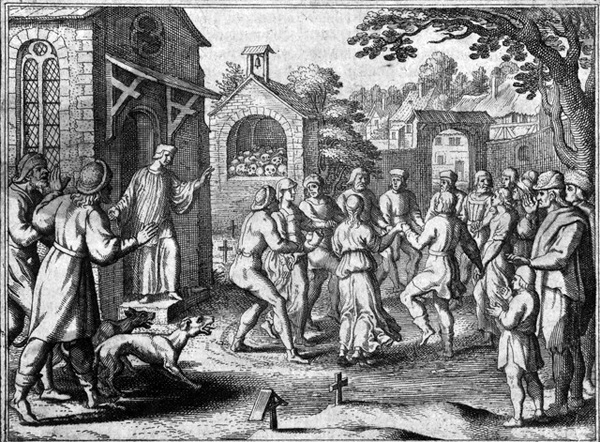
Inexplicable episodes of mass obsession and compulsion serve as disquieting examples. Mass panics and delusions tend to occur, argues author John Waller, “in people who are under extreme psychological distress, and who believe in the possibility of spirit possession. All of these conditions were satisfied in Strasbourg in 1518,” the year the Dancing Plague came to the town in Alsace—an involuntary communal dance festival with deadly outcomes.
The event began with one person, as you’ll learn in the almost jaunty animated BBC video below, a woman known as Frau Troffea. One day she began dancing in the street. People came out of their houses and gawked, laughed, and clapped. Then she didn’t stop. She “continued to dance, without resting, morning, afternoon, and night for six whole days.” Then her neighbors joined in. Within a month, 400 people were “dancing relentlessly without music or song.”
We might expect that town leaders in this late-Medieval period would have declared it a mass possession event and commenced with exorcisms or witch burnings. Instead, it was said to be a natural phenomenon. Drawing on humoral theory, “local physicians blamed it on ‘hot blood,’” History.com’s Evan Andrews writes. They “suggested the afflicted simply gyrate the fever away. A stage was constructed and professional dancers were brought in. The town even hired a band to provide backing music.”
Soon, however, bloody and exhausted, people began dying from strokes and heart attacks. The dancing went on for months. It was not a fad. No one was enjoying themselves. On the contrary, Waller writes, “contemporaries were certain that the afflicted did not want to dance and the dancers themselves, when they could, expressed their misery and need for help.” This contradicts suggestions they were willing members of a cult, and paints an even darker picture of the event.
Certain psychonauts might see in the 1518 Dancing Plague a shared unconscious, working something out while dragging the poor Strasbourgians along behind it. Other, more or less plausible explanations have included ergotism, or poisoning “from a psychotropic mould that grows on stalks of rye.” However, Waller points out, ergot “typically cuts off blood supply to the extremities making coordinated movement very difficult.”
He suggests the dancing mania came about through the meeting of two prior conditions: “The city’s poor were suffering from severe famine and disease,” and many people in the region believed they could obtain good health by dancing before a statue of Saint Vitus. They also believed, he writes, that “St. Vitus… had the power to take over their minds and inflict a terrible, compulsive dance. Once these highly vulnerable people began to anticipate the St. Vitus curse they increased the likelihood that they’d enter the trance state.”
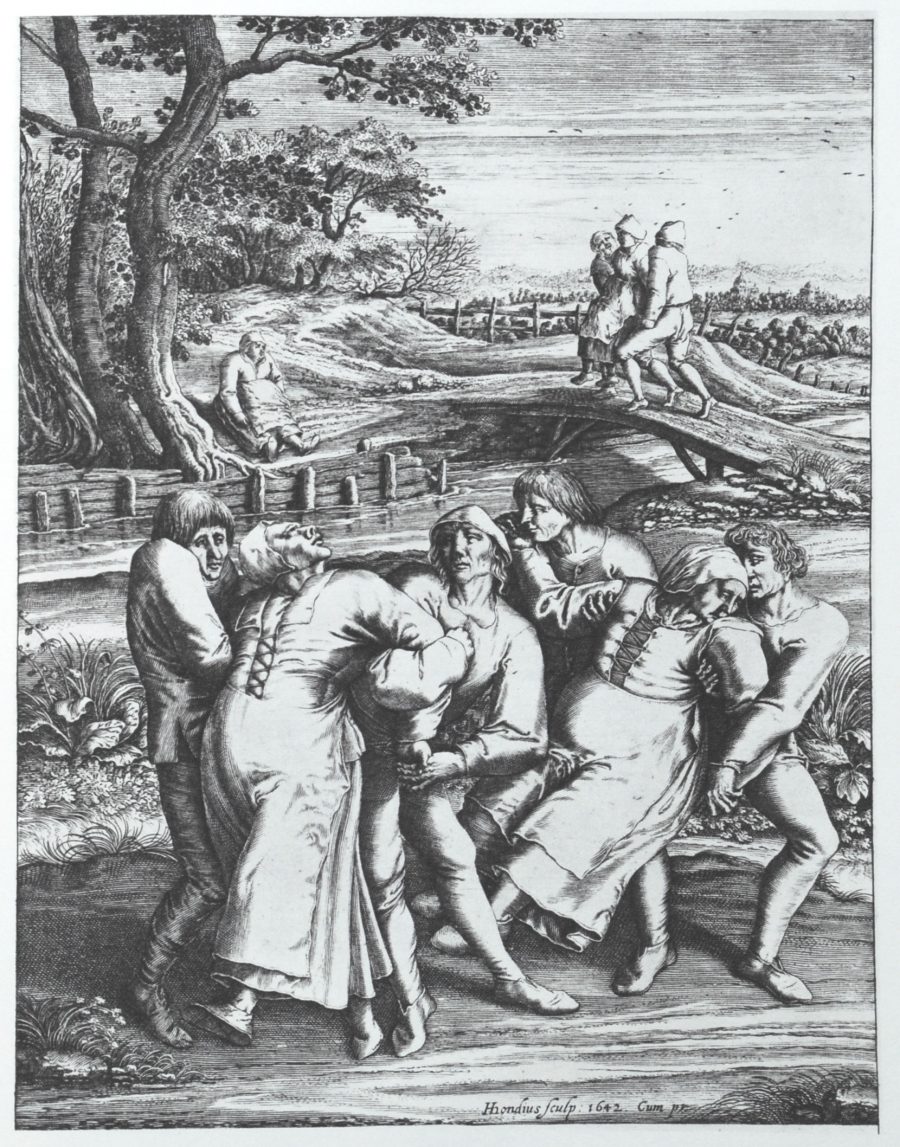
The mystery cannot be definitively solved, but it does seem that what Waller calls “fervent supernaturalism” played a key role, as it has in many mass hysterias, including “ten such contagions which had broken out along the Rhine and Moselle rivers since 1374,” as the Public Domain Review notes. Further up, see a 1642 engraving based on a 1564 drawing by Peter Breughel of another dancing epidemic which occurred that year in Molenbeek. The 17th century German engraving above of a dancing epidemic in a churchyard features a man holding a severed arm.
We see mass panics and delusions around the world, for reasons that are rarely clear to scholars, psychiatrists, historians, anthropologists, and physicians during or after the fact. What is medically known as Saint Vitus dance, or Sydenham’s Chorea, has recognized physical causes like rheumatic fever and occurs in a specific subset of the population. The historical Saint Vitus Dance, or Dancing Plague, however, affected people indiscriminately and seems to have been a phenomenon of mass suggestion, like many other social-psychological events around the world.
Episodes of epidemic manias related to outmoded supernatural beliefs can seem especially bizarre, but the mass psychology of 21st century western culture includes many episodes of social contagion and compulsion no less strange, and perhaps no less widespread or deadly, especially during times of extreme stress.
We're hoping to rely on loyal readers, rather than erratic ads. Please click the Donate button and support Open Culture. You can use Paypal, Venmo, Patreon, even Crypto! We thank you!
Open Culture scours the web for the best educational media. We find the free courses and audio books you need, the language lessons & educational videos you want, and plenty of enlightenment in between.






/https://public-media.si-cdn.com/filer/76/45/7645fe6c-a982-4828-bdff-7043074884b2/counterterrorismmapweb.png)