At this time of the year, the Swedish island of Gotland puts on Medeltidsveckan, or “Medieval Week,” the country’s largest historical festival. According to its official About page, it offers its visitors the chance to “watch knights on horseback, drink something cold, take a crafting course, practice archery, listen to a concert or picnic along the beach, while waiting for some ruin show or performance in some moat!” If next year’s Medeltidsveckan incorporates electronic-music sessions as well, it will surely be thanks to inspiration from the EP-1320 sampler, or instrumentalis electronicum, just released by Swedish electronics company Teenage Engineering.
Billed as “the world’s first medieval electronic instrument,” the EP-1320 is modeled on Teenage Engineering’s successful EP-133 drum sampler/composer, but pre-loaded with a selection of playable musical instruments from the Middle Ages, from frame drums, battle toms, and coconut horse hooves to bagpipes, bowed harps, and, yes, hurdy-gurdies.
Users can also evoke a complete medieval world — or at least a certain idea of one, not untainted by fantasy — with swords, livestock, witches, “rowdy peasants,” and “actual dragons.” To get a sense of how it works, have a look at the video at the top of the post from B&H Photo Video Pro Audio, which offers a rundown of its many technical and aesthetic features.
“Even the design of the sampler and music composer looks medieval, from the font style all over the board” — often used to label buttons and other controls in Latin, or Latin of a kind — “to the color, presentation, packaging, and imagery,” writes Designboom’s Matthew Burgos. “The electronic instrument is portable too, and the design team includes a quilted hardcover case, t‑shirt, keychain, and a vinyl record featuring songs and samples.” Clearly, the EP-1320 isn’t just a piece of novelty studio gear, but a symbol of its owner’s appreciation for the transposition of all things medieval into our modern digital world. It’s worth considering as a Christmas gift for the electronic-music creator in your life; just imagine how they could use it to reinterpret the classic songs of the holiday season with not just lutes, trumpets, and citoles at their command, but “torture-chamber reverb” as well.
Based in Seoul, Colin Marshall writes and broadcasts on cities, language, and culture. His projects include the Substack newsletterBooks on Cities and the book The Stateless City: a Walk through 21st-Century Los Angeles. Follow him on Twitter at @colinmarshall or on Facebook.
Anyone who’s followed the late Michael Apted’s Up documentaries knows that becoming a London cab driver is no mean feat. Tony Walker, one of the series’ most memorable participants, was selected at the age of seven from an East End primary school, already distinguished as a character by his energetic manner, classic cockney accent, and enthusiastically expressed ambition to become a jockey. By 21 Up, however, he’d got off the horse and into a taxicab — or was aiming to do so, having immersed himself in the studies required for the necessary licensing exams. For many non-British viewers, this constituted an introduction to what’s known as “the Knowledge,” the formidable testing process licensed London taxicab drivers have undergone since 1865.
“It is without question a unique intellectual, psychological and physical ordeal, demanding unnumbered thousands of hours of immersive study.” For the Tony Walkers of the world, it has also long offered a route to stable, well-compensated, and even prestigious work: everyone, regardless of social class, acknowledges the expertise of London that the black-taxicab driver possesses.
In recent years, those classic black cabs have faced greatly intensified competition from rideshare and “minicab” services, whose drivers aren’t required to pass the Knowledge. Instead, they rely on the same thing the rest of us do: GPS-enabled devices that automatically compute the route between point A and point B. Though one would imagine this technology having long since rendered the Knowledge redundant, the flow of aspirants to the status of black-cab driver hasn’t dried up entirely. Take Tom the Taxi Driver, a full-fledged London cabbie who’s also millennial enough to have elaborate tattoos and his own Youtube channel, on which he explains not just the experience of driving a taxi in London, but also of taking the tests to do so, which involve plotting Point-A-to-Point‑B routes verbally, on the spot.
The question of whether the Knowledge beats the GPS is settled on the channel of another, similarly named English Youtuber: Tom Scott, who in the video above, drives one route through London using his mobile phone while Tom the Taxi Driver does another of the same length while consulting only his own mental map of the city. This modern-day John Henry showdown is less interesting for its outcome than for what we see along the way: Tom the Taxi Driver’s perception and experience of London differ considerably from that of Tom the non-taxi driver, and as neuroscientific research has suggested, that difference is probably reflected in the physical nature of his brain.
“The posterior hippocampus, the area of the brain known to be important for memory, is bigger in London taxi drivers than in most people, and that a successful Knowledge candidate’s posterior hippocampus enlarges as he progresses through the test,” writes Rosen. The applicants’ having to master fine-grained detail both geographic and historical (over a period of nearly three years on average) also underscores that “the Knowledge stands for, well, knowledge — for the Enlightenment ideal of encyclopedic learning, for the humanist notion that diligent intellectual endeavor is ennobling, an end in itself.” For any of us, habitually offloading the mental work of not just wayfinding but remembering, calculating, and much else besides onto apps may well induce a kind of mental obesity, one we can only fight off by mastering the Knowledge of our own pursuits, whatever those pursuits may be.
Based in Seoul, Colin Marshall writes and broadcasts on cities, language, and culture. His projects include the Substack newsletterBooks on Cities and the book The Stateless City: a Walk through 21st-Century Los Angeles. Follow him on Twitter at @colinmarshall or on Facebook.
If you were to come across an Olivetti Programma 101, you probably wouldn’t recognize it as a computer. With its 36 keys and its paper-strip printer, it might strike you as some kind of oversized adding machine, albeit an unusually handsome one. But then, you’d expect that quality from Olivetti, a company best remembered for its enormously successful typewriters that now occupy prime space in museums of twentieth-century design. Among its lesser-known products, at least outside its native Italy, are its computers, a line that began with mainframes in the mid-nineteen-fifties and ended with IBM PC clones in the nineties, reaching the height of its innovation with the Programma 101 in 1965.
The Programma 101 is also known as the P101 or the Perottina, a name derived from that of its inventor, engineer Pier Giorgio Perotto. “I dreamed of a friendly machine to which you could delegate all those menial tasks which are prone to errors,” he later said, “a machine that could quietly learn and perform tasks, that could store simple data and instructions, that could be used by anyone, that would be inexpensive and the size of other office products which people used.”
To realize that vision required not just a technical effort but also an aesthetic one, which fell to the young architect and industrial designer Mario Bellini, who had followed his colleague (and later Memphis Group founder) Ettore Sottsass into consulting work for Olivetti.
All this work took place at a time of crisis for the company. Following the death of its head Adriano Olivetti in 1960, writes Opinionated Designer, it “got into severe financial difficulties after buying the giant US Underwood company, and the electronics division was sold off to General Electric early in 1965.” Olivetti’s son Roberto had already “given the go-ahead in 1962 for the development of a small ‘desk-top’ computer.” In order “to avoid their project being swallowed up by GE, Perotto’s team changed some of the specifications of the 101 to make it appear to be a ‘calculator’ rather than a ‘computer’ which meant the project could stay with Olivetti.” Yet on a technical level, the Perottina remained very much a computer indeed.
In addition to subtraction, multiplication, and division, “it could also perform logical operations, conditional and unconditional jumps, and print the data stored in a register, all through a custom-made alphanumeric programming language,” writes Riccardo Bianchini at Inexhibit. In the video above, enthusiast Wladimir Zaniewski demonstrates its capabilities with a simple alphanumeric lunar-lander game: a historically apt project, since NASA bought ten of them for use in planning the Apollo 11 moon landing. Yet even more important was the device’s comparatively down-to-earth achievement of being, in Bianchini’s words, “an unintimidating object everyone could use, even at home. In that sense, there is no doubt that the Olivetti Programma 101 truly is the first personal computer in history.”
Based in Seoul, Colin Marshall writes and broadcasts on cities, language, and culture. His projects include the Substack newsletterBooks on Cities and the book The Stateless City: a Walk through 21st-Century Los Angeles. Follow him on Twitter at @colinmarshall or on Facebook.
Ernest Hemingway’s romantic adventure of man and marlin, The Old Man and the Sea, has perhaps spent more time on high school freshman English reading lists than any other work of fiction, which might lead one to think of the novel as young adult fiction. But beyond the book’s ability to communicate broad themes of perseverance, courage, and loss, it has an appeal that also reaches old, wizened men like Hemingway’s Santiago and young, imaginative boyish apprentices like his Manolin. The 1952 novella reinvigorated Hemingway’s career, won him a Pulitzer Prize, and eventually contributed to his Nobel win in 1954. And luckily for all those high school English students, Hemingway’s story has lent itself to some worthy screen adaptations, including the 1958 film starring Spencer Tracy as the indefatigable Spanish-Cuban fisherman and a 1990 version with the mighty Anthony Quinn in the role.
One adaptation that readers of Hemingway might miss is the animation above, a co-production with Canadian, Russian, and Japanese studios created by Russian animator Aleksander Petrov. Winner of a 2000 Academy Award for animated short, the film has as much appeal to a range of viewers young and old as Hemingway’s book, and for some of the same reasons—it’s captivatingly vivid depiction of life on the sea, with its long periods of inactivity and short bursts of extreme physical exertion and considerable risk.
Both states provide ample opportunities for complex character development and rich storytelling as well as exciting white-knuckle suspense. Petrov’s film illustrates them all, opening with images of Santiago’s stories of his seafaring boyhood off the coast of Africa and staging the dramatic contests between Santiago, his “brother” the marlin, and the sharks who devour his prize.
But the production here, unlike Hemingway’s spare prose, makes a dazzling display of its technique. For his The Old Man and the Sea, Petrov—only one of a handful of animators skilled in this art—handpainted over 29,000 frames on glass (with help from his son, Dmitri) using slow-drying oils. Petrov moved the paint with his fingers to capture the movement in the next shot, and while the magical effect resembles a moving painting, the shooting itself was very technologically advanced, involving a specially constructed motion-capture camera. Petrov and son began their painting in 1997 and finished two years later, taking to heart some of the lessons of the book, it seems. The film’s creators, however, fared better than The Old Man’s protagonist, richly rewarded for their struggle. In addition to an Oscar, the short won awards from BAFTA, the San Diego Film Festival, and a handful of other prestigious international bodies.
Taking a first glance at the Babylonian Map of the World, few of us could recognize it for what it is. But then again, few of us are anything like the British Museum Middle East department curator Irving Finkel, whose vast knowledge (and ability to share it compellingly) have made him a viewer favorite on the institution’s Youtube channel. In the Curator’s Corner video above, he offers an up-close view of the Babylonian Map of the World — or rather, the fragment of the clay tablet from the eighth or seventh century BC that he and other experts have determined contains a piece of the oldest map of the known world in existence.
“If you look carefully, you will see that the flat surface of the clay has a double circle,” Finkel says. Within the circle is cuneiform writing that describes the shape as the “bitter river” that surrounds the known world: ancient Mesopotamia, or modern-day Iraq.
Inside the circle lie representations of both the Euphrates River and the mighty city of Babylon; outside it lie a series of what scholars have determined were originally eight triangles. “Sometimes people say they are islands, sometimes people say they are districts, but in point of fact, they are almost certainly mountains,” which stand “far beyond the known world” and represent, to the ancient Babylonians, “places full of magic, and full of mystery.”
Coming up with a coherent explanation of the map itself hinged on the discovery, in the nineteen-nineties, of one of those triangles originally thought to have been lost. This owes to the enthusiasm of a non-professional, a student in Finkel’s cuneiform night classes named Edith Horsley. During one of her once-a-week volunteer shifts at the British Museum, she set aside a particularly intriguing clay fragment. As soon as Finkel saw it, he knew just the artifact to which it belonged. After the piece’s reattachment, much fell into place, not least that the map purported to show the distant location of the beached (or rather, mountained) ark built by “the Babylonian version of Noah” — the search for which continues these nine or so millennia later.
Based in Seoul, Colin Marshall writes and broadcasts on cities, language, and culture. His projects include the Substack newsletterBooks on Cities and the book The Stateless City: a Walk through 21st-Century Los Angeles. Follow him on Twitter at @colinmarshall or on Facebook.
Sometimes it can seem as though the more we think we know a historical figure, the less we actually do. Helen Keller? We’ve all seen (or think we’ve seen) some version of The Miracle Worker, right?—even if we haven’t actually read Keller’s autobiography. And Mark Twain? He can seem like an old family friend. But I find people are often surprised to learn that Keller was a radical socialist firebrand, in sympathy with workers’ movements worldwide. In a short article in praise of Lenin, for example, Keller once wrote, “I cry out against people who uphold the empire of gold…. I am perfectly sure that love will bring everything right in the end, but I cannot help sympathizing with the oppressed who feel driven to use force to gain the rights that belong to them.”
Twain took a more pessimistic, ironic approach, yet he thoroughly opposed religious dogma, slavery, and imperialism. “I am always on the side of the revolutionists,” he wrote, “because there never was a revolution unless there were some oppressive and intolerable conditions against which to revolute.” While a great many people grow more conservative with age, Twain and Keller both grew more radical, which in part accounts for another little-known fact about these two nineteenth-century American celebrities: they formed a very close and lasting friendship that, at least in Keller’s case, may have been one of the most important relationships in either figure’s lives.
Twain’s importance to Keller, and hers to him, begins in 1895, when the two met at a lunch held for Keller in New York. According to the Mark Twain Library’s extensive documentary exhibit, Keller “seemed to feel more at ease with Twain than with any of the other guests.” She would later write, “He treated me not as a freak, but as a handicapped woman seeking a way to circumvent extraordinary difficulties.”Twain was taken as well, surprised by “her quickness and intelligence.” After the meeting, he wrote to his benefactor Henry H. Rogers, asking Rogers to fund Keller’s education. Rogers, the Mark Twain Library tells us, “personally took charge of Helen Keller’s fortunes, and out of his own means made it possible for her to continue her education and to achieve for herself the enduring fame which Mark Twain had foreseen.”
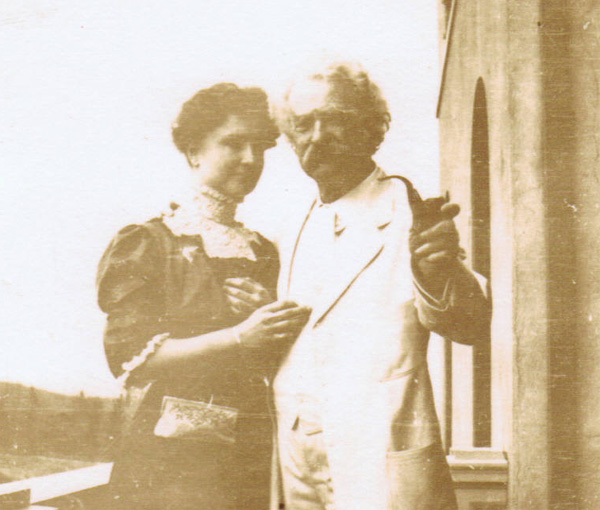
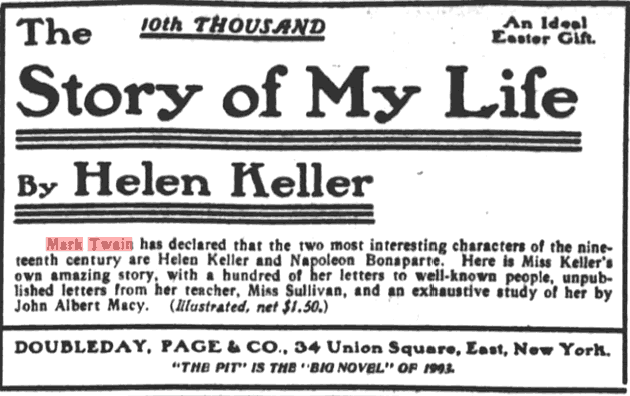
Twain wrote to his wealthy friend, “It won’t do for America to allow this marvelous child to retire from her studies because of poverty. If she can go on with them she will make a fame that will endure in history for centuries.” Thereafter, the two would maintain a “special friendship,” sustained not only by their political sentiments, but also by a love of animals, travel, and other personal similarities. Both writers came to live in Fairfield County, Connecticut at the end of their lives, and she visited him at his Redding home, Stormfield, in 1909, the year before his death (see them there at the top of the post, and more photos here). Twain was especially impressed by Keller’s autobiography, writing to her, “I am charmed with your book—enchanted.” (See his endorsement in a 1903 advertisement, below.)
Twain also came to Keller’s defense, ten years later, after reading in her book about a plagiarism scandal that occurred in 1892 when, at only twelve years old, she was accused of lifting her short story “The Frost King” from Margaret Canby’s “Frost Fairies.” Though a tribunal acquitted Keller of the charges, the incident still piqued Twain, who called it “unspeakably funny and owlishly idiotic and grotesque” in a 1903 letter in which he also declared: “The kernel, the soul—let us go further and say the substance, the bulk, the actual and valuable material of all human utterance—is plagiarism.” What differs from work to work, he contends is “the phrasing of a story”; Keller’s accusers, he writes protectively, were “solemn donkeys breaking a little child’s heart.”
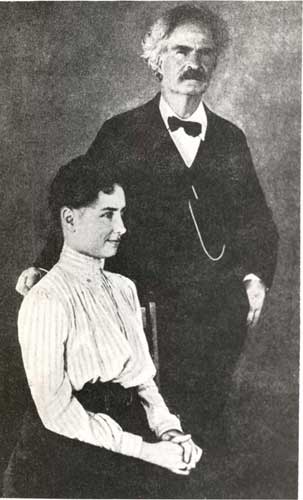
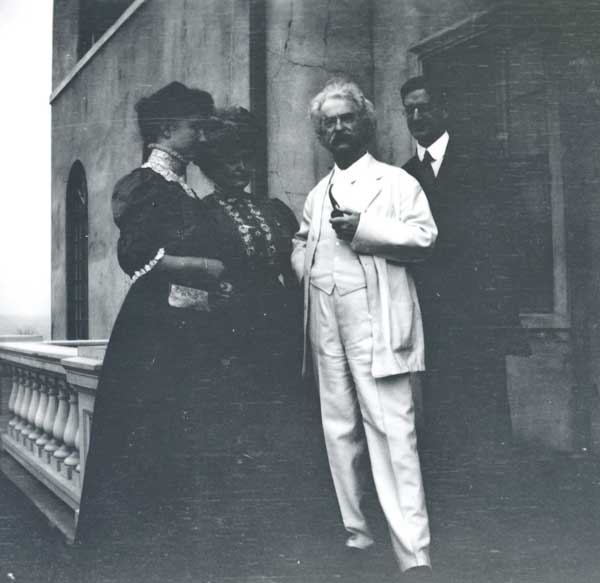
We also have Twain—not playwright William Gibson—to thank for the “miracle worker” title given to Keller’s teacher, Anne Sullivan. (See Keller, Sullivan, Twain, and Sullivan’s husband John Macy above at Twain’s home). As a tribute to Sullivan for her tireless work with Keller, he presented her with a postcard that read, “To Mrs. John Sullivan Macy with warm regard & with limitless admiration of the wonders she has performed as a ‘miracle-worker.’” In his 1903 letter to Keller, he called Sullivan “your other half… for it took the pair of you to make complete and perfect whole.”
Twain praised Sullivan effusively for “her brilliancy, penetration, originality, wisdom, character, and the fine literary competencies of her pen.” But he reserved his highest praise for Keller herself. “You are a wonderful creature,” he wrote, “The most wonderful in the world.” Keller’s praise of her friend Twain was no less lofty. “I have been in Eden three days and I saw a King,” she wrote in his guestbook during her visit to Stormfield, “I knew he was a King the minute I touched him though I had never touched a King before.” The last words in Twain’s autobiography, the first volume anyway—which he only allowed to be published in 2010—are Keller’s; “You once told me you were a pessimist, Mr. Clemons,” he quotes her as saying, “but great men are usually mistaken about themselves. You are an optimist.”
Many of us have put off a visit to Venice for fear of the hordes of tourists who roam its streets and boat down its canals day in and day out. To judge by the most visible of its economic activity, the once-mighty city-state now exists almost solely as an Instagramming destination. It wasn’t always this way. “Despite having no roads, no land, and no fresh water, the Venetians managed to turn a muddy swamp into the most powerful and wealthiest city of its time,” says the narration of the Primal Space video above. Its “unique layout of canals and bridges woven through hundreds of islands made Venice incredibly accessible, and it became the epicenter of all business.”
Venice, in other words, was at its height what world capitals like London or New York would become in later eras. But on a physical level, it faced challenges unknown in those cities, challenges that demanded a variety of ingenious medieval engineering solutions, most of which still function today. First, the builders of Venice had to bring timber from the forests of Croatia and drive it into the soft soil, creating a platform sturdy enough to bear the weight of an entire urban built environment. Construction of the buildings on top proved to be a trial-and-error affair, which came around to using bricks with lime mortar to ensure flexibility on the slowly shifting ground.
“Instead of expanding outwards like most cities,” Venice’s islands “expanded into each other.” Eventually, they had to be connected, though “there were no bridges for the first 500 years of Venice’s existence,” not until the Doge offered a prize for the best design that could link the financial center of Rialto to the rest of the city. But what really mattered was the test of time, one long since passed by the Ponte di Rialto, which has stood fundamentally unaltered since it was rebuilt in stone in 1591. The combination of bridges and canals, with what we would now call their separation of traffic, did its part to make Venice “the most powerful and richest city in Europe” by the fifteenth century.
Even the richest and most powerful cities need water, and Venice had an abundance of only the “extremely salty and undrinkable” kind. To meet the needs of the city’s fast-growing population, engineers built wells surrounded by sand-and-stone filtration systems into Venice’s characteristic squares, turning the city into “an enormous funnel.” The related problem of waste management necessitated the construction of “a network of underground tunnels” directed into canals, flushed out by the motion of the tides. Venice’s plumbing has since been brought up to modern standards, among other ambitious engineering projects. But on the whole, the city still works as it did in the days of the Doge, and that fact alone makes it a sight worth seeing.
Based in Seoul, Colin Marshall writes and broadcasts on cities, language, and culture. His projects include the Substack newsletterBooks on Cities and the book The Stateless City: a Walk through 21st-Century Los Angeles. Follow him on Twitter at @colinmarshall or on Facebook.
If hearing such stories sets off an existential panic attack because you squandered your 20s with too much reality TV and graduate school, then take heart — you’re not necessarily a failure.
As Adam Westbrook points out in his video essay The Long Game, Leonardo da Vinci was a loser before he painted The Last Supperat age 46. As a youth, Leonardo planned grandiose projects that he wouldn’t be able to finish. This, of course, did little for his reputation and even less for his career as a freelance artist. But he continued to work, eking out a living by enduring the demands of picky, small-minded clients, and, through this lean period, Leonardo emerged as a great artist. Robert Greene, in his book Mastery, calls this period “The Difficult Years.” Every successful creative slogs through some form of the Difficult Years, even child prodigies. Mozart just went through his struggles at a time when most children are learning to read.
In other words, “genius” has less to do with innate talent than just doing the work. Of course, that isn’t nearly as good a story as that of the romantic genius. But it is encouraging for those of us who haven’t quite yet won that MacArthur grant.
You can watch Westbrook’s video essay in various parts above.
Jonathan Crow is a writer and filmmaker whose work has appeared in Yahoo!, The Hollywood Reporter, and other publications. You can follow him at @jonccrow.
In the 1950s, it was fashionable to drop Freud’s name — often as not in pseudo-intellectual sex jokes. Freud’s preoccupations had as much to do with his fame as the actual practice of psychotherapy, and it was assumed — and still is to a great degree — that Freud had “won” the debate with his former student and friend Carl Jung, who saw religion, psychedelic drugs, occult practices, etc. as valid forms of individualizing and integrating human selves — selves that were after all, he thought, connected by far more than biological drives for sex and death.
Now Jung’s insights permeate the culture, in increasingly popular fields like transpersonal psychology, for example, that see humans as “radically interconnected, not just isolated individuals,” psychologist Harris L. Friedman argues. Movements like these grew out of the “counterculture movements of the 1960s,” psychology lecturer and author Steve Taylor explains, “and the wave of psycho-experimentation it involved, through psychedelic substances, meditation and other consciousness-changing practices” — the very practices Jung explored in his work.
Indeed, Jung was the first “to legitimize a spiritual approach to the practice of depth psychology,” Mark Kasprow and Bruce Scotton point out, and “suggested that psychological development extends to include higher states of consciousness and can continue throughout life, rather than stop with the attainment of adult ego maturation.” Against Freud, who thought transcendence was regression, Jung “proposed that transcendent experience lies within and is accessible to everyone, and that the healing and growth stimulated by such experience often make use of the languages of symbolic imagery and nonverbal experience.”
Jung’s work became increasingly important after his death in 1961, leading to the publication of his collected works in 1969. These introduced readers to all of his “key concepts and ideas, from archetypal symbols to analytical psychology to UFOs,” notes a companion guide. Near the end of his life, Jung himself provided a verbal survey of his life’s work in the form of four one-hour interviews conducted in 1957 by University of Houston’s Dr. Richard Evans at the Eidgenossische Technische Hoschschule (Federal Institute of Technology) in Zurich.
“The conversations were filmed as part of an educational project designed for students of the psychology department. Evans is a poor interviewer, but Jung compensates well,” the Gnostic Society Library writes. The edited interviews begin with a question about Jung’s concept of persona (also, incidentally, the theme and title of Ingmar Bergman’s 1966 masterpiece). In response, Jung describes the persona in plain terms and with everyday examples as a fictional self “partially dictated by society and partially dictated by the expectations or the wishes one nurses oneself.”
The less we’re consciously aware of our public selves as performances in these terms, the more we’re prone, Jung says, to neuroses, as the pressure of our “shadow,” exerts itself. Jung and Evans’ discussion of persona only grazes the surface of their wide-ranging conversation about the unconscious and the many ways to access it. Throughout, Jung’s examples are clear and his explanations lucid. Above, you can see a transcribed video of the same interviews. Read a published transcript in the collection C.G. Jung Speaking, and see more Jung interviews and documentaries at the Gnostic Society Library.
A recreation of the military sandals. (Photo: Bavarian State Office for Monument Preservation)
Whether you’re putting together a stage play, a film, or a television series, if the story is set in ancient Rome, you know you’re going to have to get a lot of sandals on order. This task may sound more straightforward than it is, for simply copying the styles of classic productions that take place in the Roman Empire will put you on the wrong side of the historical research. We now know, for instance, that some ancient Romans wore their sandals with socks, a look that, seen in today’s cultural context, may not give quite the desired impression. And thanks to an even more recent discovery, it seems we also need to think about what’s on their soles.
Discovered near the Bavarian city of Oberstimm, “an ancient Roman sandal, largely decayed but reconstructed through X‑ray, suggests the spread of military fashion to local populations.” So writes Madeleine Muzdakis at My Modern Met, explaining that its type were known as caligae, which “had tough soles with hobnails [that] provided traction for the troops,” who did a fair bit of marching.
This particular caliga dates from between 60 and 130, around the time the Roman army switched from sandals to boots, and it shows that, during their time in this part of Bavaria, their footwear had an influence on what the civilians were wearing.
An x‑ray of the ancient sandals. (Photo: Bavarian State Office for Monument Preservation
The idea that standard-issue military gear could influence popular fashion may surprise anyone who’s ever had to wear a pair of “GI glasses.” But in its heyday, the Roman army wasn’t just a group of occupiers installed to project force on the part of a distant metropole, but an extension of civilization itself. If the hobnails in Roman military sandals afforded extra traction in addition to the subtle suggestion of cultural sophistication, so much the better. Though the question of just how far and wide this particular type of footwear (which appears reconstructed at the top of the post, and in X‑ray just above) spread through the Roman Empire remains a matter for further research, now would be as good a time as any for costume designers to stock up on nails.
Based in Seoul, Colin Marshall writes and broadcasts on cities, language, and culture. His projects include the Substack newsletterBooks on Cities and the book The Stateless City: a Walk through 21st-Century Los Angeles. Follow him on Twitter at @colinmarshall or on Facebook.
The Olympic Games have their origins in antiquity, but their modern revival has also been going on longer than any of us has been here. Even the fifth Summer Olympics, which took place in Stockholm in 1912, has passed out of living memory. But thanks to the technology of the twenty-first century, we can call up surprisingly crisp footage of its competitions any time we like, much as we’re doing with that of the currently ongoing thirty-third Summer Olympics in Paris. One especially fascinating use of these resources, for those invested in sporting history, is to compare the performances of Olympic athletes over time: we know they’ve improved, but it’s one thing to see the numbers, and quite another to see a side-by-side comparison.
Take the venerable men’s 100 meters, whose 1912 and 2020 finals both appear in the video above. 112 years ago, the United States of America’s Ralph Craig won the day (after seven false starts, and arguably an eighth as well) with a time of 10.8 seconds. Three years ago (Tokyo 2020 having been delayed by COVID-19 to 2021), the victor of that same event was Italy’s Marcell Jacobs, who crossed the finish line at 9.8 seconds.
An even greater evolution manifests in the javelin throw, in which the Swedish Eric Lemming’s 60.64 meters in 1912 becomes Neeraj Chopra’s 87.58 meters in 2020. (Nor has Chopra finished setting records, at least judging by the media fanfare in his homeland that attended his recent arrival in Paris’ Olympic village.)
Pole vaulting, too, has undergone a great leap forward, or rather, upward. Just above, you can see the 1912 record of 3.95 meters set by Henry S. Babcock of the United States, then the 2020 record of 6.02 meters set by Armand “Mondo” Duplantis of Sweden — or technically, of both Sweden and the U.S., having been born and raised in the latter, but able to represent the former due to his mother’s being Swedish. In recent decades, such cases of nationally mixed parentage (the American-born Italian Jacobs being another) have become more common in the Olympics, which in that and other respects has long reflected changes in the wider world. And though whether humanity is improving on the whole remains a matter of heated debate, we’ve undeniably been getting a lot better at running, throwing, and jumping with the aid of big sticks.
Based in Seoul, Colin Marshall writes and broadcasts on cities, language, and culture. His projects include the Substack newsletterBooks on Cities and the book The Stateless City: a Walk through 21st-Century Los Angeles. Follow him on Twitter at @colinmarshall or on Facebook.
We're hoping to rely on loyal readers, rather than erratic ads. Please click the Donate button and support Open Culture. You can use Paypal, Venmo, Patreon, even Crypto! We thank you!
Open Culture scours the web for the best educational media. We find the free courses and audio books you need, the language lessons & educational videos you want, and plenty of enlightenment in between.