Great swathes of rock music since the nineteen-sixties would never have existed, we’re sometimes told, were it not for the recordings of Robert Johnson. Certainly the likes of Keith Richards, Eric Clapton, Robert Plant, and Bob Dylan have never hesitated to acknowledge his influence. “From the first note the vibrations from the loudspeaker made my hair stand up,” Dylan writes in his autobiography of his first encounter with Johnson’s music. “The stabbing sounds from the guitar could almost break a window. When Johnson started singing, he seemed like a guy who could have sprung from the head of Zeus in full armor. I immediately differentiated between him and anyone else I had ever heard.” Not bad for a recording older than Dylan himself.
In the early nineteen-sixties, the blues as Johnson played it seems to have sounded electrifyingly revelatory to the generation of then-young musicians who managed to hear it, regardless of their own origins. All such recordings date from 1936 or 1937, the fruits of just two sessions in makeshift Texas studios overseen by producer Don Law.
Though the “king of the Delta blues singers” left behind only this small body of work after his still-unexplained death at the age of 27, it’s been endlessly scrutinized by the genre’s enthusiasts. All of them will surely regard as a godsend the newly discovered shellac master test pressing above of “Cross Road Blues,” a song that plays an outsized part in the legend of Robert Johnson, who some say sold his soul to the devil at just such a location in exchange for his formidable guitar skills.
Though it contains no reference to any such unholy pact, nor to any denizen of the underworld, “Cross Road Blues” does have a haunting sound that goes with the shadowy ambience of the man’s short life story. Some of that had to do with the less-than-ideal quality of the recordings that have long circulated, but this test pressing of Johnson’s second take sounds different. Uploaded by sound restorer Nick Dellow, it was originally made in 1940 straight from the metal master by Columbia Records producer George Avakian, who would go on to work with everyone from Miles Davis to Edith Piaf to John Cage. The sonic muddiness of most Robert Johnson releases thus far has done its part to prevent modern-day listeners from getting quite what the big deal was about him. But perhaps the unprecedented clarity of this recording will get the hair of young musicians and mature connoisseurs alike standing on end.
Based in Seoul, Colin Marshall writes and broadcasts on cities, language, and culture. He’s the author of the newsletterBooks on Cities as well as the books 한국 요약 금지 (No Summarizing Korea) and Korean Newtro.Follow him on the social network formerly known as Twitter at @colinmarshall.
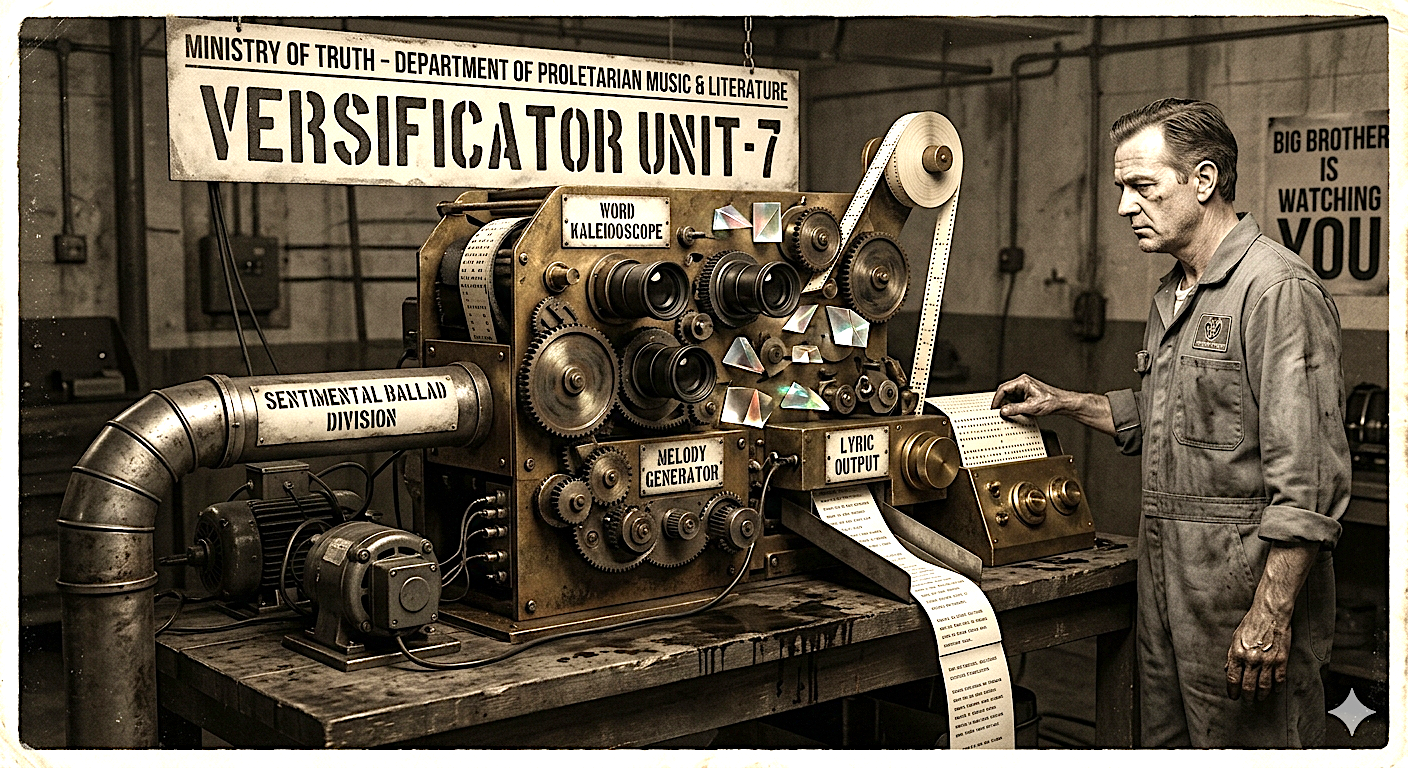
We’ve lived but a few years so far into the age when artificial intelligence can produce convincing stories, songs, essays, poems, novels, and even films. For many of us, these recently implemented functions have already come to feel necessary in our daily life, but it may surprise us to consider how many people had long assumed that computers could already perform them. That belief surely owes in part to the roles played by effectively sentient machines in popular fictions since at least the early decades of the twentieth century. Revisiting George Orwell’s Nineteen Eighty-Four, we even find a device very much like today’s large language models in use at the Ministry of Truth, the employer of protagonist Winston Smith.
Within the Ministry is “a whole chain of separate departments dealing with proletarian literature, music, drama, and entertainment generally. Here were produced rubbishy newspapers containing almost nothing except sport, crime and astrology, sensational five-cent novelettes, films oozing with sex, and sentimental songs which were composed entirely by mechanical means on a special kind of kaleidoscope known as a versificator.” Much later in the novel, Smith overhears a hit song composed on that very kaleidoscope, “without any human intervention whatever,” sung by a woman of this dystopian England’s lowest class, whose very baseness liberates it from the watchful eye that Big Brother’s vast surveillance system keeps on his ostensibly privileged Party members.
All the “proles” really require, in the view of the state, is the freedom to satisfy their vices and a steady stream of pacifying media. The extrusions of the versificator may now bring to mind the ever-increasing quantities of “AI slop,” often created with vanishingly small amounts of human intervention, whose potential to flood the internet has lately become a matter of public concern. What’s more chilling to consider is that such low-effort, high-volume content wouldn’t have attained such a presence if it weren’t genuinely popular. Much like the junk culture pumped out by the Ministry of Truth, AI slop reflects less the ill intent of (or at least neglect by) the powers that be than the undemanding nature of the public.
Perhaps we can provisionally chalk this one up in the “Orwell was right” column. It’s possible that, in light of real technological developments, even Isaac Asimov could be convinced to give it to him. Here on Open Culture, we recently featured Asimov’s critique of Nineteen Eighty-Four as a poor prophecy of the future, not least from a technological standpoint. That piece was written in 1980 at the very end of an “AI winter,” one of the fallow periods in artificial intelligence research. A boom was soon to come, but the truly astonishing developments wouldn’t happen until the twenty-twenties, about thirty years after Asimov’s death. When describing the versificator, Orwell was presumably extrapolating from the distracting, disposable entertainments of nineteen-forties England. Even if his readers couldn’t believe the idea of that sort of thing being created automatically, more than a few probably agreed with his diagnosis of its quality. Now, collective human intelligence may face its most formidable challenger, but individual human discernment has never been more valuable.
Based in Seoul, Colin Marshall writes and broadcasts on cities, language, and culture. He’s the author of the newsletterBooks on Cities as well as the books 한국 요약 금지 (No Summarizing Korea) and Korean Newtro.Follow him on the social network formerly known as Twitter at @colinmarshall.
Simplicity is not the goal. It is the by-product of a good idea and modest expectations.
Thus spake designer Paul Rand, a man who knew something about making an impression, having created iconic logos for such immediately recognizable brands as ABC, IBM, and UPS.
An example of Rand’s observation, La Linea, aka Mr. Line, a beloved and deceptively simple cartoon character drawn with a single unbroken line, began as a shill for an Italian cookware company. No matter what he manages to get up to in two or three minutes, it’s determined that he’ll eventually butt up against the limitations of his lineal reality.
His chattering, apoplectic response proved such a hit with viewers that a few episodes in, the cookware connection was severed. Mr. Line went on to become a global star in his own right, appearing in 90 short animations throughout his 15-year history, starting in 1971. Find many of the episodes on YouTube here.
The formula does sound rather simple. Animator Osvaldo Cavandoli starts each episode by drawing a horizontal line in white grease pencil. The line takes on human form. Mr. Line’s a zesty guy, the sort who throws himself into whatever it is he’s doing, whether ogling girls at the beach, playing classical piano or ice skating.
Whenever he bumps up against an obstacle—an uncrossable gap in his baseline, an inadvertently exploded penis—he calls upon the godlike hand of the animator to make things right.
(Bawdy humor is a staple of La Linea, though the visual format keeps things fairly chaste. Innuendo aside, it’s about as graphic as a big rig’s silhouetted mudflap girl.)
Voiceover artist Carlo Bonomi contributes a large part of the charm. Mr. Line may speak with an Italian accent, but his vocal track is 90% improvised gibberish, with a smattering of Lombard dialect. Watch him channel the character in the recording booth, below.
I love hearing him take the even-keeled Cavandoli to task. I don’t speak Italian, but I had the sensation I understood where both players are coming from in the scene below.
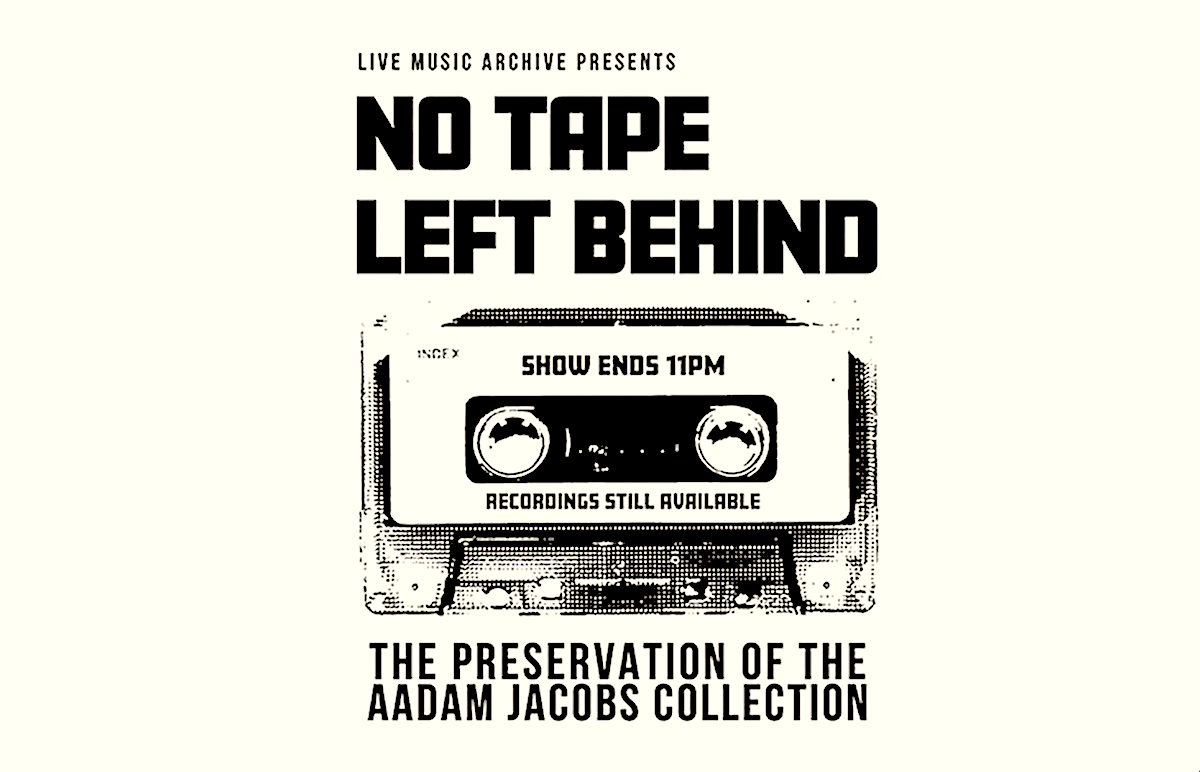
Perhaps you’ve had the experience of moving to a new city and immediately being told that you’ve missed its golden age of live music. To an extent, this has happened in more or less every period of the past fifty or sixty years. But what if the person regaling you with those stories had an archive of more than 10,000 concert recordings to back them up? Chicago’s Aadam Jacobs has made just such an archive, and a few years ago he and it became the subject of Katlin Schneider’s documentary Melomaniac. Apart from their stories of Jacobs’ exploits with his increasingly bulky recording rig, the various rock musicians and club owners interviewed therein express one concern above all: what will become of all his tapes in the future?
If you have a certain taste in rock — and especially if you belong to a certain generation — you may well, in the fullness of time, find a Jacobs-recorded show by your favorite band. But you’re just as likely to discover a performance by the best act you’ve never heard of before.
Pursuing his avocation of concert-recording with the industriousness of a professional, and indeed an obsessive one, Jacobs captured multiple shows each night at the height of his activity. He has his particular tastes, as emphasized in Melomaniac, but also demonstrates remarkably little discrimination about which bands are “cool” and which aren’t, to say nothing of their level of commercial success. When Chicago musicians first saw Jacobs’ familiar long-haired, heavy-backpacked figure turn up at their own shows, they knew they had a chance of “making it.” Even so, as Jacobs acknowledges, there’s scant correlation between which bands blew up, which bands he likes as people, and which bands have created his favorite records. His tapes constitute a valuable record of the sound of Chicago between the eighties and the twenty-tens, and it will only grow more so, the more accessible it becomes. But as we enjoy it, we should also bear in mind the efforts of the man who created it, and the love of music he personifies. Enter the archive here.
Based in Seoul, Colin Marshall writes and broadcasts on cities, language, and culture. He’s the author of the newsletterBooks on Cities as well as the books 한국 요약 금지 (No Summarizing Korea) and Korean Newtro.Follow him on the social network formerly known as Twitter at @colinmarshall.
After his radical conversion to Christian anarchism, Leo Tolstoy adopted a deeply contrarian attitude. The vehemence of his attacks on the class and traditions that produced him were so vigorous that certain critics, now mostly obsolete, might call his struggle Oedipal. Tolstoy thoroughly opposed the patriarchal institutions he saw oppressing working people and constraining the spiritual life he embraced. He championed revolution, “a change of a people’s relation towards Power,” as he wrote in a 1907 pamphlet, “The Meaning of the Russian Revolution”: “Such a change is now taking place in Russia, and we, the whole Russian people, are accomplishing it.”
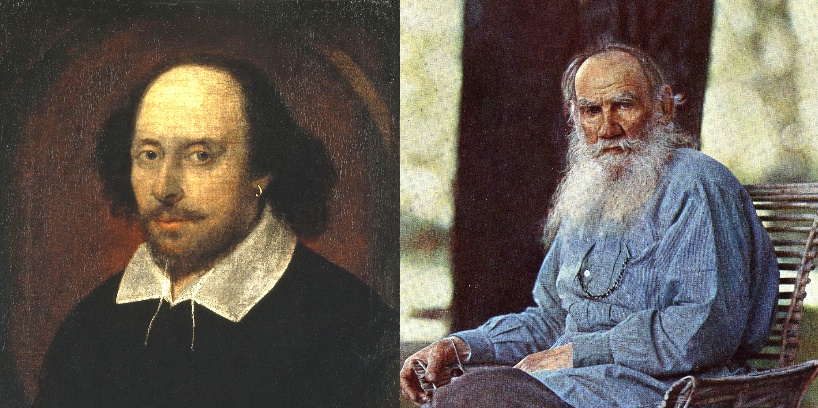
In that “we,” Tolstoy aligns himself with the Russian peasantry, as he does in other pamphlets like the 1909-10 journal, “Three Days in the Village.” These essays and others of the period rough out a political philosophy and cultural criticism, often aimed at affirming the ruddy moral health of the peasantry and pointing up the decadence of the aristocracy and its institutions. In keeping with the theme, one of Tolstoy’s pamphlets, a 1906 essay on Shakespeare, takes on that most hallowed of literary forefathers and expresses “my own long-established opinion about the works of Shakespeare, in direct opposition, as it is, to that established in all the whole European world.”
After a lengthy analysis of King Lear, Tolstoy concludes that the English playwright’s “works do not satisfy the demands of all art, and, besides this, their tendency is of the lowest and most immoral.” But how had all of the Western world been led to universally admire Shakespeare, a writer who “might have been whatever you like, but he was not an artist”? Through what Tolstoy calls an “epidemic suggestion” spread primarily by German professors in the late 18th century. In 21st-century parlance, we might say the Shakespeare-as-genius meme went viral.
Tolstoy also characterizes Shakespeare-veneration as a harmful cultural vaccination administered to everyone without their consent: “free-minded individuals, not inoculated with Shakespeare-worship, are no longer to be found in our Christian society,” he writes, “Every man of our society and time, from the first period of his conscious life, has been inoculated with the idea that Shakespeare is a genius, a poet, and a dramatist, and that all his writings are the height of perfection.”
In truth, Tolstoy proclaims, the venerated Bard is “an insignificant, inartistic writer…. The sooner people free themselves from the false glorification of Shakespeare, the better it will be.”
I have felt with… firm, indubitable conviction that the unquestionable glory of a great genius which Shakespeare enjoys, and which compels writers of our time to imitate him and readers and spectators to discover in him non-existent merits — thereby distorting their aesthetic and ethical understanding — is a great evil, as is every untruth.
What could have possessed the writer of such celebrated classics as War and Peace and Anna Karenina to so forcefully repudiate the author of King Lear? Forty years later, George Orwell responded to Tolstoy’s attack in an essay titled “Lear, Tolstoy and the Fool” (1947). His answer? Tolstoy’s objections “to the raggedness of Shakespeare’s plays, the irrelevancies, the incredible plots, the exaggerated language,” are at bottom an objection to Shakespeare’s earthy humanism, his “exuberance,” or—to use another psychoanalytic term—his jouissance. “Tolstoy,” writes Orwell, “is not simply trying to rob others of a pleasure he does not share. He is doing that, but his quarrel with Shakespeare goes further. It is the quarrel between the religious and the humanist attitudes towards life.”
Orwell grants that “much rubbish has been written about Shakespeare as a philosopher, as a psychologist, as a ‘great moral teacher’, and what-not.” In reality, he says, the playwright, was not “a systematic thinker,” nor do we even know “how much of the work attributed to him was actually written by him.” Nonetheless, he goes on to show the ways in which Tolstoy’s critical summary of Lear relies on highly biased language and misleading methods. Furthermore, Tolstoy “hardly deals with Shakespeare as a poet.”
But why, Orwell asks, does Tolstoy pick on Lear, specifically? Because of the character’s strong resemblance to Tolstoy himself. “Lear renounces his throne,” he writes, “but expects everyone to continue treating him as a king.”
But is it not also curiously similar to the history of Tolstoy himself? There is a general resemblance which one can hardly avoid seeing, because the most impressive event in Tolstoy’s life, as in Lear’s, was a huge and gratuitous act of renunciation. In his old age, he renounced his estate, his title and his copyrights, and made an attempt — a sincere attempt, though it was not successful — to escape from his privileged position and live the life of a peasant. But the deeper resemblance lies in the fact that Tolstoy, like Lear, acted on mistaken motives and failed to get the results he had hoped for. According to Tolstoy, the aim of every human being is happiness, and happiness can only be attained by doing the will of God. But doing the will of God means casting off all earthly pleasures and ambitions, and living only for others. Ultimately, therefore, Tolstoy renounced the world under the expectation that this would make him happier. But if there is one thing certain about his later years, it is that he was NOT happy.
Though Orwell doubts the Russian novelist was aware of it—or would have admitted it had anyone said so—his essay on Shakespeare seems to take the lessons of Lear quite personally. “Tolstoy was not a saint,” Orwell writes, “but he tried very hard to make himself into a saint, and the standards he applied to literature were other-worldly ones.” Thus, he could not stomach Shakespeare’s “considerable streak of worldliness” and “ordinary, belly-to-earth selfishness,” in part because he could not stomach these qualities in himself. It’s a common, sweeping, charge, that a critic’s judgment reflects much of their personal preoccupations and little of the work itself. Such psychologizing of a writer’s motives is often uncalled-for. But in this case, Orwell seems to have laid bare a genuinely personal psychological struggle in Tolstoy’s essay on Shakespeare, and perhaps put his finger on a source of Tolstoy’s violent reaction to King Lear in particular, which “points out the results of practicing self-denial for selfish reasons.”
Orwell draws an even larger point from the philosophical differences Tolstoy has with Shakespeare: “Ultimately it is the Christian attitude which is self-interested and hedonistic,” he writes, “since the aim is always to get away from the painful struggle of earthly life and find eternal peace in some kind of Heaven or Nirvana…. Often there is a seeming truce between the humanist and the religious believer, but in fact their attitudes cannot be reconciled: one must choose between this world and the next.” On this last point, no doubt, Tolstoy and Orwell would agree. In Orwell’s analysis, Tolstoy’s polemic against Shakespeare’s humanism further “sharpens the contradictions,” we might say, between the two attitudes, and between his own former humanism and the fervent, if unhappy, religiosity of his later years.
Note: An earlier version of this post appeared on our site in 2016.
The Pacific Palisades fire of January 25 destroyed much of that coastal Los Angeles neighborhood, but it somehow spared the Charles and Ray Eames house. Anyone who’s paid it a visit, or at least pored over the many photos of it in existence, knows that it’s more than a preserved work of California modernism once inhabited by a famed pair of husband-and-wife designers. In truth, it’s more like a world, or at least a worldview, made domestic. From the outside, one first notices the clean, vaguely Japanese lines, the sharp angles, and the planes of Mondrian color. Once inside, one hardly knows what to look at first: the Isamu Noguchi lamp? The Native American baskets? The kokeshi dolls? The Eames Lounge Chair?
?si=DQ-M1lsNTauOahsy
After a few months’ closure to repair smoke damage, the Eames House re-opened to visitors last summer. But wherever in the world you happen to be, you can tour the place in its prime, and as its makers would have wanted you to see it, through the short film from 1955 at the top of the post.
Titled simply “House: After Five Years of Living,” it briefly animates the title building’s construction process, shows its context in nature and some of the textures to be seen on and around its exterior walls, and soon makes tentative moves— albeit almost entirely with still shots — toward the interior. Shot and edited by the Eames themselves, the film showcases their aesthetic and communicative sensibility as much as does the house itself, or indeed the pieces of furniture inside that they themselves designed.
So, each one in a different way, do the 35 Eames shorts collected on this Youtube playlist. It includes, of course, “Powers of Ten,” an eight-minute-long zoom out from a picnic on Lake Michigan to 100 light years away in outer space, then back again and down to the microscopic scale of “a proton in the nucleus of a carbon atom beneath the skin on the hand of a sleeping man at the picnic.” In addition to stewarding the house, the Charles & Ray Eames Foundation has plans to bring that acclaimed film back out for its 50th anniversary next year. Until then, this playlist will give you a chance to get acquainted with a bit more of their large body of cinematic work, reflecting as it does the Eameses’ signature instinct for modernist creativity and lighthearted pedagogy, but also their proximity to the world that the mid-twentieth century was fast bringing into being.
Take the series of productions they did for IBM, like “A Computer Perspective: Background to the Computer Age” just above, commissioned for an exhibition of the same name. Beginning its story with humanity’s earliest calculating machines, it makes its jazzy visual-historical way up to the postwar decades, during which, as the narrator puts it, “the variety of demands on the computer began to multiply. It was asked to be not only calculator and analyzer, but information storage and retrieval device, instrument of communication, and interlocutor.” If only the Eamses could have lived, we might think, to see how fully the computer would come to occupy that last role. Nor, revisiting “Powers of Ten,” could any of us ignore how much the viewing experience reminds us of our idle explorations on Google Earth, a technological development they surely wouldn’t have found implausible — and surely would have found captivating.
Based in Seoul, Colin Marshall writes and broadcasts on cities, language, and culture. He’s the author of the newsletterBooks on Cities as well as the books 한국 요약 금지 (No Summarizing Korea) and Korean Newtro.Follow him on the social network formerly known as Twitter at @colinmarshall.
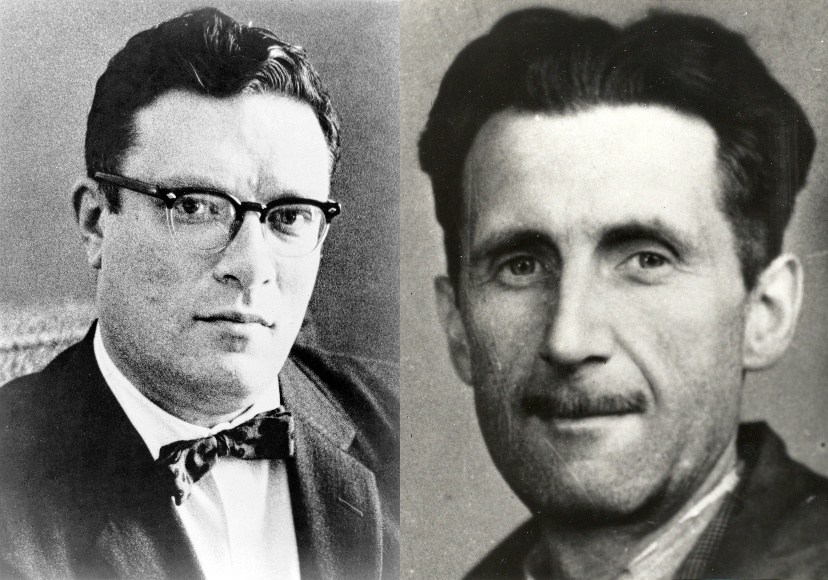
Here in the twenty-twenties, a young reader first hearing of George Orwell’s Nineteen Eighty-Four would hardly imagine it to be a work of science fiction. That wouldn’t have been the case in 1949, when the novel was first published, and when the eponymous year would have sounded like the distant future. Even as the actual nineteen-eighties came around, it still evoked visions of a techno-totalitarian dystopia ahead. “So thoroughly has 1984-ophobia penetrated the consciousness of many who have not read the book and have no notion of what it contains, that one wonders what will happen to us after 31 December 1984,” wrote Isaac Asimov in 1980. “When New Year’s Day of 1985 arrives and the United States is still in existence and facing very much the problems it faces today, how will we express our fears of whatever aspect of life fills us with apprehension?”
The occasion was one of a series of syndicated newspaper columns that Asimov seems to have published each new year. At the dawn of Nineteen Eighty-Four’s decade, the syndicate asked him to revisit Orwell’s novel, which had already been a common cultural reference for decades. As a work of science fiction (the genre for which his own name had practically come to stand), he finds it lacking, to say the least. “The London in which the story is placed is not so much moved thirty-five years forward in time, from 1949 to 1984, as it is moved a thousand miles east in space to Moscow,” he writes. Far from attempting to imagine the future, in Asimov’s view, Orwell simply converted the England he knew into a dreary Stalinist-type state. Apart from certain implausible surveillance systems, the setting is “incredibly old-fashioned when compared with the real world of the 1980s.”
Orwell doesn’t even bother to imagine any new vices: “His characters are all gin hounds and tobacco addicts,” Asimov writes, “and part of the horror of his picture of 1984 is his eloquent description of the low quality of the gin and tobacco.” That telling detail hints at one of Orwell’s major sources of inspiration: the British Ministry of Information, his wife’s employer during World War II, and the source of the material he broadcast to India while working at the BBC around the same time. The Ministry’s canteen, according to his letters, was not of the highest standard. What’s more, the 850-word “Basic English” that it insisted on using in its broadcasts bears more than a passing resemblance to Nineteen Eight-Four’s Newspeak, the pared-down language developed and mandated by the government in order to limit its citizens’ range of thought.
Asimov doesn’t buy that either. “There is no sign that such compressions of the language have ever weakened it as a mode of expression,” he writes. “As a matter of fact, political obfuscation has tended to use many words rather than few, long words rather than short, to extend rather than to reduce.” (This, of course, was something Orwell knew.) Whatever Nineteen Eighty-Four’s shortcomings as prophecy, sci-fi, or indeed literature, Asimov does credit Orwell with a certain geopolitical savvy. Its world-ruling trio of Oceania, Eurasia, and Eastasia “fits in, very roughly, with the three actual superpowers of the 1980s: the United States, the Soviet Union, and China.” Orwell knew, as many didn’t, that the latter two would not join forces, perhaps thanks to his own frustrating experience fighting for factionalism-prone left causes. But not even as future-oriented a mind as Asimov’s would have guessed that, just a few years later, the USSR would be out of the game — and a few decades later, the word Orwellian would be applied most often to China.
If you would like to support the mission of Open Culture, consider making a donation to our site. It’s hard to rely 100% on ads, and your contributions will help us continue providing the best free cultural and educational materials to learners everywhere. You can contribute through PayPal, Patreon, and Venmo (@openculture). Thanks!
Based in Seoul, Colin Marshall writes and broadcasts on cities, language, and culture. He’s the author of the newsletterBooks on Cities as well as the books 한국 요약 금지 (No Summarizing Korea) and Korean Newtro.Follow him on the social network formerly known as Twitter at @colinmarshall.
Are you feeling confident about the future? No? We understand. Would you like to know what it was like to feel a deep certainty that the decades to come were going to be filled with wonder and the fantastic? Well then, gaze upon this clip from the BBC Archive YouTube channel of sci-fi author Arthur C. Clarke predicting the future in 1964.
Although we best know him for writing 2001: A Space Odyssey, the 1964 television-viewing public would have known him for his futurism and his talent for calmly explaining all the great things to come. In the late 1940s, he had already predicted telecommunication satellites. In 1962 he published his collected essays, Profiles of the Future, which contains many of the ideas in this clip.
Here he correctly predicts the ease with which we can be contacted wherever in the world we choose to, where we can contact our friends “anywhere on earth even if we don’t know their location.” What Clarke doesn’t predict here is how “location” isn’t a thing when we’re on the internet. He imagines people working just as well from Tahiti or Bali as they do from London. Clarke sees this advancement as the downfall of the modern city, as we do not need to commute into the city to work. Now, as so many of us are doing our jobs from home post-COVID, we’ve also discovered the dystopia in that fantasy. (It certainly hasn’t dropped the cost of rent.)
Next, he predicts advances in biotechnology that would allow us to, say, train monkeys to work as servants and workers. (Until, he jokes, they form a union and “we’d be back right where we started.) Perhaps, he says, humans have stopped evolving—what comes next is artificial intelligence (although that phrase had yet to be used) and machine evolution, where we’d be honored to be the “stepping stone” towards that destiny. Make of that what you will. I know you might think it would be cool to have a monkey butler, but c’mon, think of the ethics, not to mention the cost of bananas.
Pointing out where Clarke gets it wrong is too easy—nobody gets it right all of the time. However, it is fascinating that some things that have never come to pass—being able to learn a language overnight, or erasing your memories—have managed to resurface over the years as science fiction films, like Eternal Sunshine of the Spotless Mind. His ideas of cryogenic suspension are staples of numerous hard sci-fi films.
And we are still waiting for the “Replicator” machine, which would make exact duplicates of objects (and by so doing cause a collapse into “gluttonous barbarism” because we’d want unlimited amounts of everything.) Some commenters call this a precursor to 3‑D printing. I’d say otherwise, but something very close to it might be around the corner. Who knows? Clarke himself agrees about all this conjecture—it’s doomed to fail.
“That is why the future is so endlessly fascinating. Try as we can, we’ll never outguess it.”
Note: An earlier version of this post appeared on our site in 2022.
We all learn in school, or at least from our more rigorous choices of science fiction, that we’ll never be able to travel faster than the speed of light. At first, this may sound disappointing, but upon reflection, 186,000 miles per second is nothing to sneeze at. Questions about how to achieve that speed soon give way to questions about what an attempt to do so would be like, many of them answered by the animated video from ScienceClic above. The first surprise is that moving so fast, in and of itself, would have no negative effect on us. When we travel by bicycle, car, airplane, spacecraft, or what have you, we feel only the acceleration. If that remains at a safe rate, no absolute speed will be a problem, in theory, assuming you can get up to it. Still, it couldn’t hurt to buckle up, not that it would help much in the event of a collision, even with a speck of dust.
Putting that out of our minds by assuming that “our ship is equipped with a force field that repels dangerous objects and allows us to roam freely through space,” we can concentrate on what we’d see through the window. First, “the stars in front of us, which we get closer to, seem to gradually move away. The sky contracts before us,” much as rain appears to fall from the front when you’re driving through it.
“Behind us, the sky seems to widen, and becomes darker,” and any object we pass “would appear to be slightly angled in our direction.” Just as the light in the sky we see while stargazing takes some time to reach us, thus constituting a view of the stars as they were in the past, events on the Earth from which we’re moving away — presuming we had a way to see them — would appear to be taking place in “slow motion.” Earth’s image would shift toward the color red, and that of everything in front of us would shift toward blue. After a few hundred days, our ship begins to approach light speed, and that’s when things get even stranger.
This, scientifically speaking, is when special relativity comes into play, causing our ship to swerve onto its own “time axis” apart from the one followed by Earth. From our perspective, the entire universe would contract along our length of motion, making our journey shorter than we’d expected. As we move faster and faster, the view in front of us intensifies, while the view behind us turns completely black. And what would happen when we finally reach light speed? Nothing, because we can’t reach it: “You may try to catch a light ray, but from your point of view, it will always escape at the same speed.” Accelerate all you like; “from your point of view, you are still motionless, and light escapes inexorably.” At best, “our ship will continue to accelerate forever, and our field of vision will shrink ever more, until forming an infinitely bright spot in front of us, surrounded by an infinitely black sky.” But there may be a loophole, in that, even if an object can’t do it, “nothing prohibits space itself from moving faster than light” — a premise for some truly mind-blowing sci-fi if ever there was one.
Based in Seoul, Colin Marshall writes and broadcasts on cities, language, and culture. He’s the author of the newsletterBooks on Cities as well as the books 한국 요약 금지 (No Summarizing Korea) and Korean Newtro.Follow him on the social network formerly known as Twitter at @colinmarshall.
No art enthusiast’s visit to the United Kingdom would be complete without days at the British Museum, the Tate, the V&A and the National Gallery. The fact that all those respected institutions are in London constitutes a plausible excuse never to stray outside the capital. But that capital is surrounded, lest we forget, by not just a whole country, but a whole United Kingdom’s worth of countries. Each region of England has its own museums and galleries worth visiting, and so do Scotland, Wales, and Northern Ireland. But why just visit museums and galleries? Universities, libraries, town halls, hospitals, homes: these places and more also put art on display for anyone who cares to visit them, which you can now do not just physically, but also online at Art UK.
As even that short list reflects, what’s on digital display at Art UK is by no means limited to British works, nor are there any restrictions on medium or sensibility. Paintings, drawings, photographs, sculptures, ceramics, digital art: if it’s held at a UK institution, it’s available for your viewing pleasure — or your education, your research, whatever your purpose may be.
A decade into Art UK’s evolution, one of the most fascinating sections of its digital holdings may hardly contain any work by artists whose names you’ve heard. That’s because it’s a collection of the UK’s murals and street art, whose digitization began in early 2024. “The project followed the successful, award-winning sculpture digitization and engagement project, which firmly established Art UK as the home for showcasing the UK’s public realm artworks,” writes photographer Tracy Jenkins. “We have now recorded over 6,600 murals, bringing the total number of public artworks on the website to 21,400.” Dating from 1000 AD to the present, these “include wall paintings in historic churches, post-war ceramic and concrete works, and contemporary painted murals and mosaics.” Collectively, they remind us that, in our haste to tour the most august temples of art, we ignore at our peril the museums without walls — or rather, the museums that are walls. Enter Art UK here.
Based in Seoul, Colin Marshall writes and broadcasts on cities, language, and culture. He’s the author of the newsletterBooks on Cities as well as the books 한국 요약 금지 (No Summarizing Korea) and Korean Newtro.Follow him on the social network formerly known as Twitter at @colinmarshall.
More than a century after women’s suffrage in the United States, it’s not enough to bone up on the platforms of female primary candidates (though that’s an excellent start).
A Twitter user and self-described Old Crone named Robyn urged her fellow Americans to take a good long gander at a list of nine freedoms that women in the United States were not universally granted in 1971, the year Helen Reddy released the soon-to-be anthem, “I Am Woman,” above.
Even those of us who remember singing along as children may experience some shock that these facts check out on Snopes.
CREDIT CARDS: Prior to the Equal Credit Opportunity Act of 1974, married women couldn’t get credit cards without their husbands’ signatures. Single women, divorcees, and widows were often required to have a man co-sign. The double standard also meant female applicants were frequently issued card limits up to 50% lower than that of males who earned identical wages.
PREGNANT WORKERS: The Pregnancy Discrimination Act of 1978 protected pregnant women from being fired because of their impending maternity. But it came with a major loophole that’s still in need of closing. The language of the law stipulates that employers must accommodate pregnant workers only if concessions are being made for other employees who are “similar in their ability or inability to work.”
MILITARY COMBAT: In 2013, former Secretary of Defense Leon Panetta and former Chairman of the Joint Chiefs of Staff, General Martin Dempsey announced that the Pentagon was rescinding the direct combat exclusion rule that barred women from serving in artillery, armor, infantry and other such battle roles. At the time of the announcement, the military had already seen more than 130 female soldiers killed, and 800 wounded on the front lines in Iraq and Afghanistan.
HEALTH INSURANCE: In 2010, the Patient Protection and Affordable Care Act decreed that any health insurance plan established after March of that year could not charge women higher premiums than men for identical benefits. This was bad news for women who got their health insurance through their jobs, and whose employers were grandfathered into discriminatory plans established prior to 2010. Of course, that’s all ancient history now.
CONTRACEPTIVES: In 1972, the Supreme Court made it legal for all citizens to possess birth control, irrespective of marital status, stating “if the right of privacy means anything, it is the right of the individual, married or single, to be free from unwarranted governmental intrusion into matters so fundamentally affecting a person as the decision whether to bear or beget a child.” (It’s worth noting, however, that in 1972, states could still constitutionally prohibit and punish sex outside of marriage.)
Feminism is NOT just for other women.
Note: An earlier version of this post appeared on our site in 2019.
We're hoping to rely on loyal readers, rather than erratic ads. Please click the Donate button and support Open Culture. You can use Paypal, Venmo, Patreon, even Crypto! We thank you!
Open Culture scours the web for the best educational media. We find the free courses and audio books you need, the language lessons & educational videos you want, and plenty of enlightenment in between.