They’re the ones who spur us to study hard, so we can make something of ourselves, in order to better our communities.
They name our babies, choose our clothes, decide what we’re hungry for.
They make and break laws, organize protests, fritter away hours on social media, and give us the green light to binge watch a bunch of dumb shows when we could be reading War and Peace.
They also plant the seeds for Fitzcarraldo-like creative endeavors that take over our lives and generate little to no income.
We may describe such endeavors as a labor of love, into which we’ve poured our entire heart and soul, but think for a second.
Who’s really responsible here?
The heart, that muscular fist-sized Valentine, content to just pump-pump-pump its way through life, lub-dub, lub-dub, from cradle to grave?
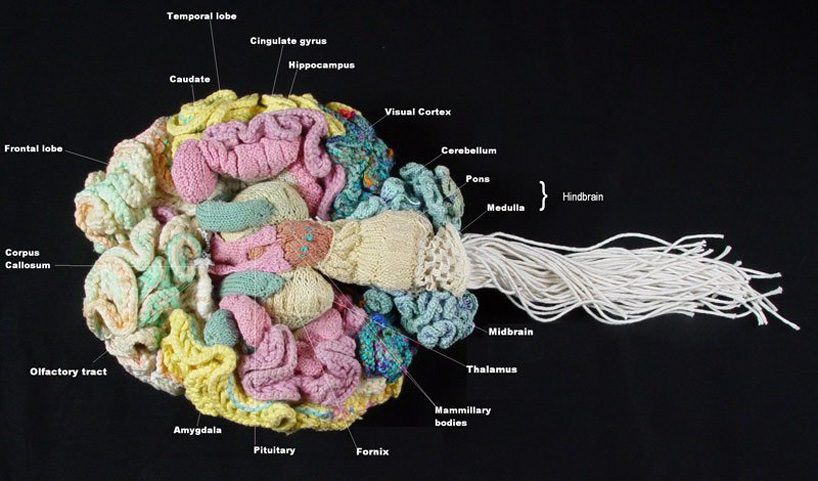
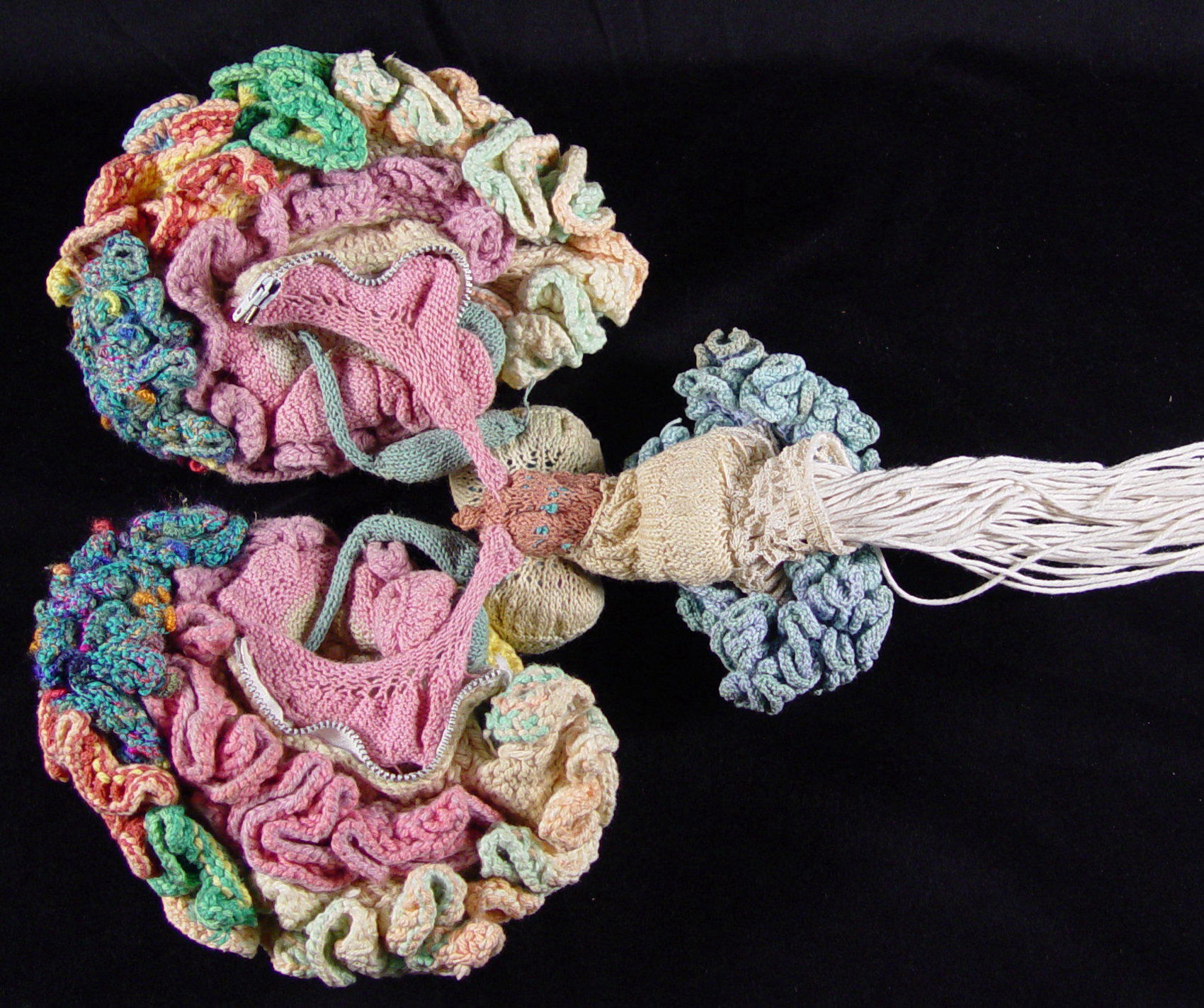
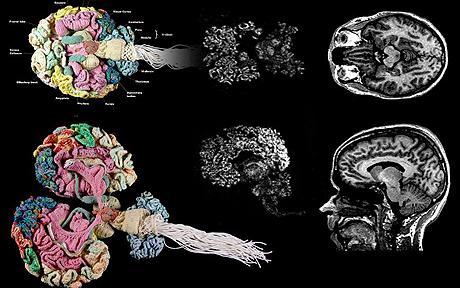
On a lighter note, it also told her to devote nine months to knitting an anatomically correct replica of the human brain.
(Twelve, if you count three months of research before casting on.)
How did her brain convince her to embark on this madcap assignment?
Easy. It arranged for her to be in the middle of a more prosaic knitting project, then goosed her into noticing how the ruffles of that project resembled the wrinkles of the cerebral cortex.
Coincidence?
Not likely. Especially when one of the cerebral cortex’s most important duties is decision making.
As she explained in an interview with The Telegraph, brain development is not unlike the growth of a knitted piece:
You can see very naturally how the ‘rippling’ effect of the cerebral cortex emerges from properties that probably have to do with nerve cell growth. In the case of knitting, the effect is created by increasing the number of stitches in each row.
Dr. Norberg—who, yes, has on occasion referred to her project as a labor of love—told Scientific American that such a massive crafty undertaking appealed to her sense of humor because “it seemed so ridiculous and would be an enormously complicated, absurdly ambitious thing to do.”
That’s the point at which many people’s brains would give them permission to stop, but Dr. Norberg and her brain persisted, pushing past the hypothetical, creating colorful individual structures that were eventually sewn into two cuddly hemispheres that can be joined with a zipper.
(She also let slip that her brain—by which she means the knitted one, though the observation certainly holds true for the one in her head—is female, due to its robust corpus callosum, the “tough body” whose millions of fibers promote communication and connection.)
Note: An earlier version of this post appeared on our site in 2019.
No artist became a Renaissance master through a single piece of work, though now, half a millennium later, that may be how most of us identify them. Leonardo? Painter of the Mona Lisa. Michelangelo? Painter of the Sistine Chapel ceiling (or, perhaps, the sculptor of the most famous David, depending on your medium of choice). Raphael? Painter of The School of Athens, as recently featured here on Open Culture. Raphael painted that masterwork in Vatican City’s Apostolic Palace between the years 1509 and 1511, when he was in his mid-twenties. Understanding how he could have attained that level of skill by that age requires examining his other work, as Evan Puschak, better known as the Nerdwriter, does in the new video above.
Specifically, Puschak examines Raphael’s Madonnas, a subject to which he returned over and over again throughout the course of his short but productive career. In what seems to have been his first rendition of Mary and her holy son, Puschak says, “you can see that Raphael has a better sense of three-dimensional bodies and how to make them feel like they’re part of the space that they’re in” than his father, who’d been a well-regarded painter himself, or even than Piero della Francesca, from whom his father learned.
“Yet the painting also suffers from “an awkwardness in the arrangement of the figures,” as well as a lack of “emotion, relationships, or any sense of narrative” — much like “a thousand other Madonnas that came before.”
Yet Raphael was a quick study, a trait reflected in the development of the many Madonnas he painted thereafter. From Leonardo he learned techniques like sfumato, the creation of soft transitions between colors; from Michelangelo, “how to use the human body as an expressive tool.” But what most clearly emerges is the concept contemporary theorist Leon Battista Alberti called historia: a narrative that plays out even within the confines of a static image. In Raphael’s circular, abundantly detailed Alba Madonna of 1511, Puschak sees the infant Jesus “not so much taking as grabbing his future and pulling it closer” as Mary looks on with emotions subtly layered into her face. How, exactly, Raphael honed his instinct for drama is a question for art historians. But would it be too much of a reach to guess that he also learned a thing or two from his time as a stage-set designer?
Based in Seoul, Colin Marshall writes and broadcasts on cities, language, and culture. His projects include the Substack newsletterBooks on Cities and the book The Stateless City: a Walk through 21st-Century Los Angeles. Follow him on the social network formerly known as Twitter at @colinmarshall.
A painting is not thought out and settled in advance. While it is being done, it changes as one’s thoughts change. And when it’s finished, it goes on changing, according to the state of mind of whoever is looking at it. — Pablo Picasso
In a famous story about Guernica, Pablo Picasso’s wrenching 1937 anti-war mural, a gestapo officer barges into the painter’s Paris studio and asks, “did you do that?”, to which Picasso acerbically replies, “you did.” The title refers to the 1937 bombing of a Basque town during the Spanish Civil War, carried out by Spanish Nationalists and the Luftwaffe. Whether or not the anecdote about Picasso and the Nazi ever happened is unimportant; it encapsulates the artist’s disgust and outrage over the atrocities of war and the takeover of his country by Franco’s Nationalists, unyielding sentiments found not only in the painting but also its path through the world.
“Guernica had this really unique relationship with Picasso and his life,” says art historian Patricia Failing. “In a way it was his alter ego.” This is a bold claim considering that during most of his career, “Picasso generally avoids politics,” notes PBS, “and disdains overtly political art.” After the mural’s exhibition at the Spanish Pavilion of the 1937 Paris World’s Fair, however, the painting was sent on tours of Europe and North America “to raise consciousness about the threat of fascism.”
In 1939, after the fall of Madrid, the artist declared, “The painting will be turned over to the government of the Spanish Republic the day the Republic is restored in Spain!” Then, almost 30 years later,
In a surprisingly ironic turn, Franco launched a campaign in 1968 for repatriation of the painting, assuring Picasso that the Spanish Government had no objection to the controversial subject matter. One can only imagine how incredulous Picasso must have been. Through his lawyers, Picasso turned the offer down flat, making it clear that Guernica would be turned over only when democracy and public liberties were restored to Spain.
Picasso died in 1973 and never saw his country free from fascism. Franco died two years later. The painting was not exhibited in Spain until 1981 — not a “return,” but a restoration, perhaps, of an international icon that had endured 44 years of exile, had become a potent anti-war symbol during the Vietnam War, and had survived a vandal attack the year after the artist’s death.
In the Great Art Explained video above, James Payne “looks at some of the more acknowledged interpretations along with techniques, composition and artistic inspiration,” as the video’s description notes. “We all know that Art is not truth,” Picasso said, consistently discouraging tidy interpretations of Guernica as a straightforward protest painting. “Art is a lie that makes us realize truth.” What do we realize when we stand before the mural — all 11 by 25 feet of it? It depends upon our state of mind, the artist might say, as he engulfs viewers in an allegorical nightmare standing in for a very real horror.
Note: An earlier version of this post appeared on our site in 2021.
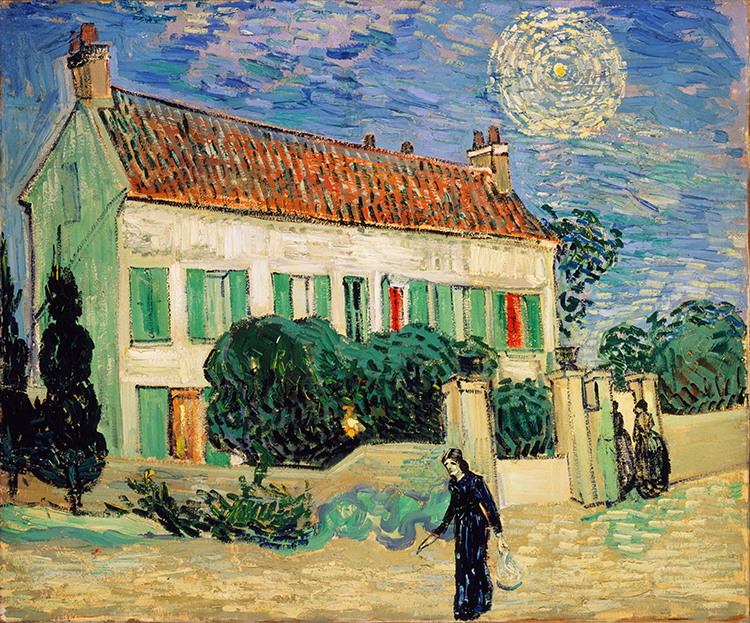
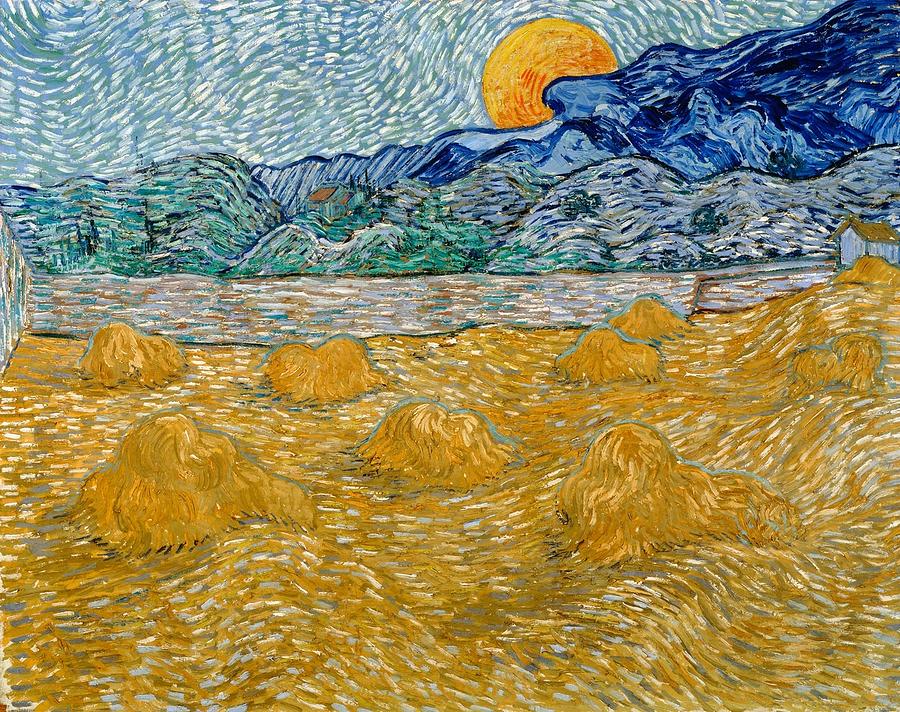
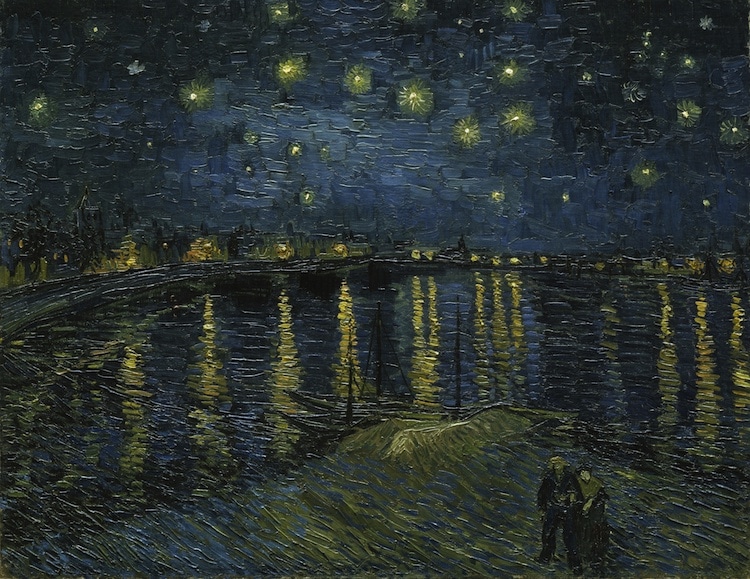
It gets dark before dinner now in my part of the world, a recipe for seasonal depression. Vincent van Gogh wrote about such low feelings with deep insight. “One feels as if one were lying bound hand and foot at the bottom of a deep dark well, utterly helpless.” Yet, when he looked up at the night sky he saw not darkness but blazing light: a full moon shines yellow from White House at Night like the sun, and peeks like a gold coin from behind blue mountains in Landscape with Wheat Sheaves and Rising Moon. The stars in Starry Night Over the Rhône appear like fireworks. We are all familiar with the blazing night sky of its sequel, The Starry Night.
It’s been suggested that Van Gogh saw halos of light because of lead poisoning from his paint, and that the Digitalis Dr. Gachet prescribed for his temporal lobe epilepsy caused him to “see in yellow,” the Van Gogh Gallery Blog writes, “or see yellow spots which could explain van Gogh’s consistent use of the color yellow in his later works.”
His most brilliant works date from this later period, during his time at the hospital at Arles, where he painted his famous bedroom. All of these paintings, and hundreds more, can be found in high-resolution scans at the new van Gogh resource, Van Gogh Worldwide, “a consortium of museums,” notes Madeleine Muzdakis at My Modern Met, “doing their part to bring the work of one of the world’s most famous artists to the global masses.”
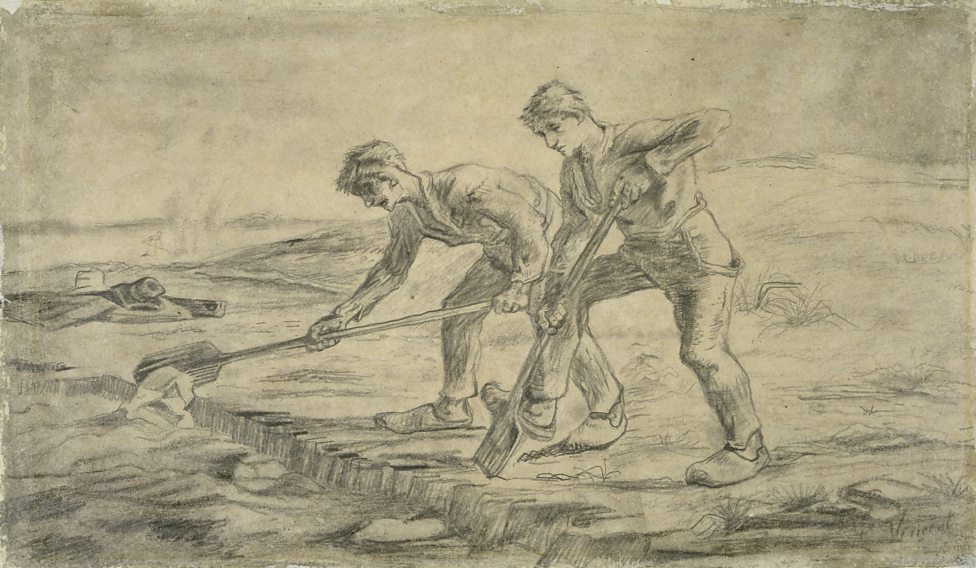
The museums represented here are all in the Netherlands and include the Van Gogh Museum, Kröller-Müller Museum, the Rijksmuseum, the Netherlands Institute for Art History, and the Museum Boijmans Van Beuningen. Van Gogh was not only a prolific painter, of shining night scenes and otherwise, but he was “also a prolific sketch artist. His pencil and paper drawings are worth exploration; they depict landscapes as well as emotive figures from Van Gogh’s everyday life. Van Gogh Worldwide provides insight into these works of art and the artist behind them. One can also find behind-the-scenes museum information, such as details of restorations, verso (back) images, and other curatorial notes.”
Van Gogh Worldwide expands other digital collections like the Van Gogh Museum’s almost 1,000 online works. Where that resource includes short informational articles and links to literature about the artworks, Van Gogh Worldwide does not, as yet, feature such additional materials, but it does include links to Van Gogh’s letters. In one of them, he writes to his brother, Theo, about their parents: “They’ll find it difficult to understand my state of mind, and not know what drives me when they see me do things that seem strange and peculiar to them—will blame them on dissatisfaction, indifference or nonchalance, while the cause lies elsewhere, namely the desire, at all costs, to pursue what I must have for my work.”
Note: An earlier version of this post appeared on our site in 2020.
Many artists have attempted to illustrate Dante Alighieri’s epic poem the Divine Comedy, but none have made such an indelible stamp on our collective imagination as the Frenchman Gustave Doré.
Doré was 23 years old in 1855, when he first decided to create a series of engravings for a deluxe edition of Dante’s classic. He was already the highest-paid illustrator in France, with popular editions of Rabelais and Balzac under his belt, but Doré was unable to convince his publisher, Louis Hachette, to finance such an ambitious and expensive project. The young artist decided to pay the publishing costs for the first book himself. When the illustrated Inferno came out in 1861, it sold out fast. Hachette summoned Doré back to his office with a telegram: “Success! Come quickly! I am an ass!”
Hachette published Purgatorio and Paradiso as a single volume in 1868. Since then, Doré’s Divine Comedy has appeared in hundreds of editions. Although he went on to illustrate a great many other literary works, from the Bible to Edgar Allan Poe’s “The Raven,” Doré is perhaps best remembered for his depictions of Dante. At The World of Dante, art historian Aida Audeh writes:
Characterized by an eclectic mix of Michelangelesque nudes, northern traditions of sublime landscape, and elements of popular culture, Doré’s Dante illustrations were considered among his crowning achievements — a perfect match of the artist’s skill and the poet’s vivid visual imagination. As one critic wrote in 1861 upon publication of the illustrated Inferno: “we are inclined to believe that the conception and the interpretation come from the same source, that Dante and Gustave Doré are communicating by occult and solemn conversations the secret of this Hell plowed by their souls, traveled, explored by them in every sense.”
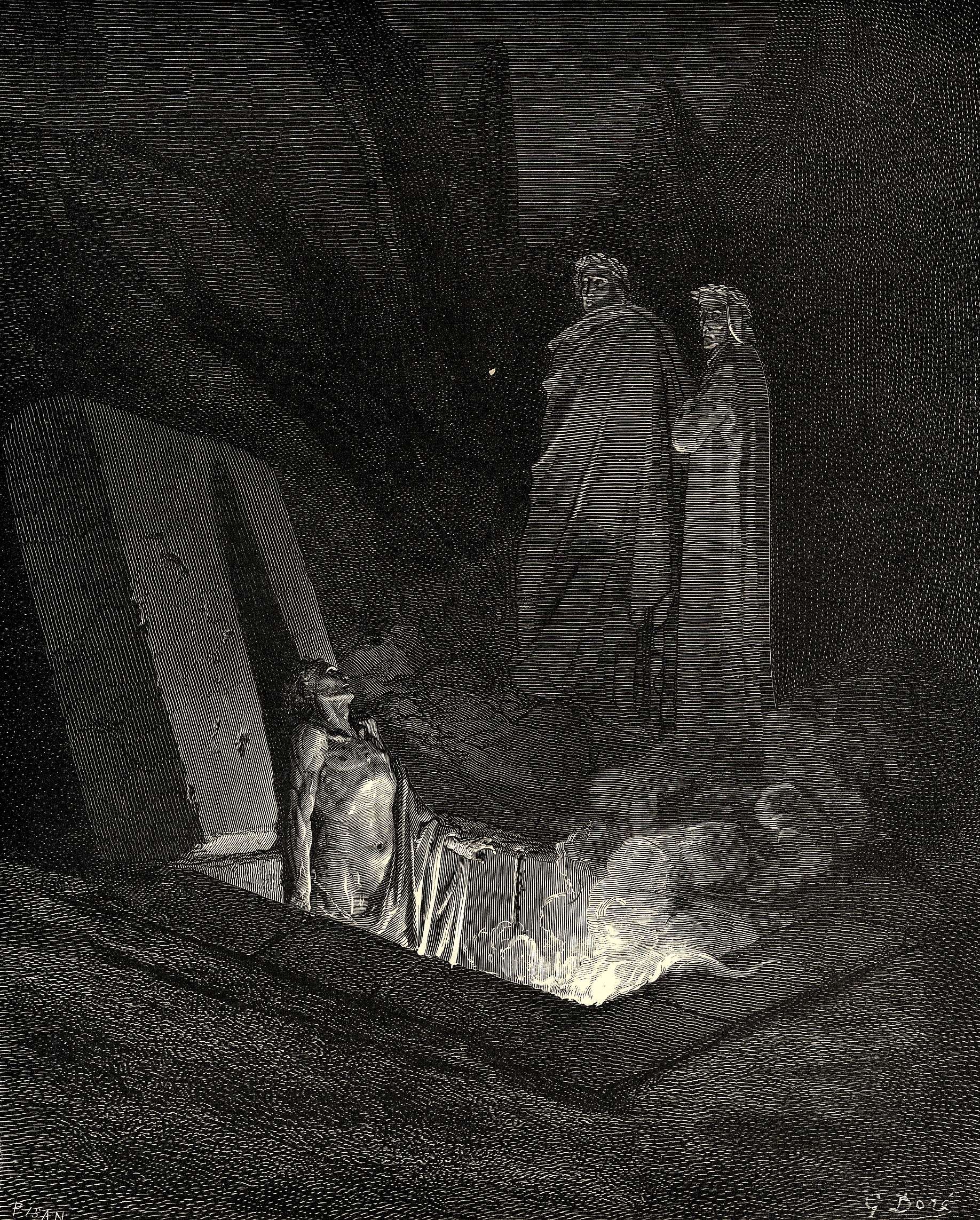
The scene above is from Canto X of the Inferno. Dante and his guide, Virgil, are passing through the Sixth Circle of Hell, in a place reserved for the souls of heretics, when they look down and see the imposing figure of Farinata degli Uberti, a Tuscan nobleman who had agreed with Epicurus that the soul dies with the body, rising up from an open grave. In the translation by John Ciardi, Dante writes:
My eyes were fixed on him already. Erect, he rose above the flame, great chest, great brow; he seemed to hold all Hell in disrespect
Inferno, Canto XVI:
As Dante and Virgil prepare to leave Circle Seven, they are met by the fearsome figure of Geryon, Monster of Fraud.Virgil arranges for Geryon to fly them down to Circle Eight. He climbs onto the monster’s back and instructs Dante to do the same.
Then he called out: “Now, Geryon, we are ready: bear well in mind that his is living weight and make your circles wide and your flight steady.”
As a small ship slides from a beaching or its pier, backward, backward — so that monster slipped back from the rim. And when he had drawn clear
he swung about, and stretching out his tail he worked it like an eel, and with his paws he gathered in the air, while I turned pale.
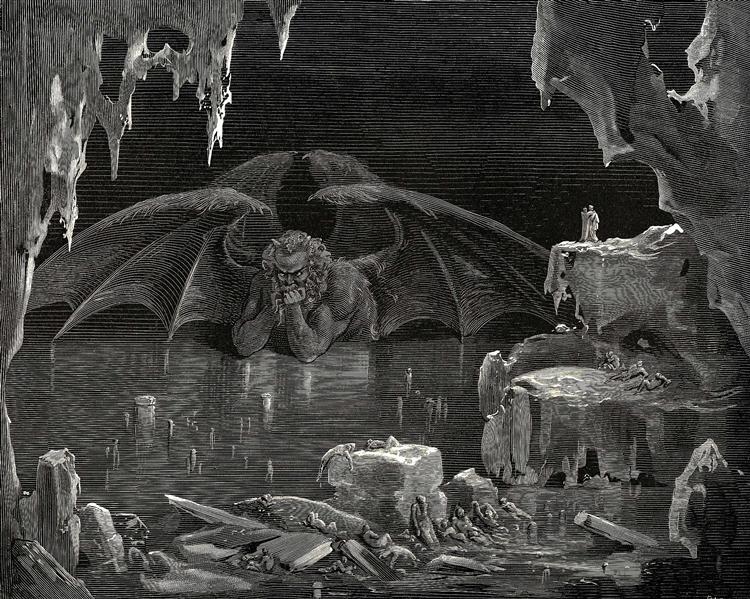
Inferno, Canto XXXIV:
In the Ninth Circle of Hell, at the very center of the Earth, Dante and Virgil encounter the gigantic figure of Satan. As Ciardi writes in his commentary:
He is fixed into the ice at the center to which flow all the rivers of guilt; and as he beats his great wings as if to escape, their icy wind only freezes him more surely into the polluted ice. In a grotesque parody of the Trinity, he has three faces, each a different color, and in each mouth he clamps a sinner whom he rips eternally with his teeth. Judas Iscariot is in the central mouth: Brutus and Cassius in the mouths on either side.
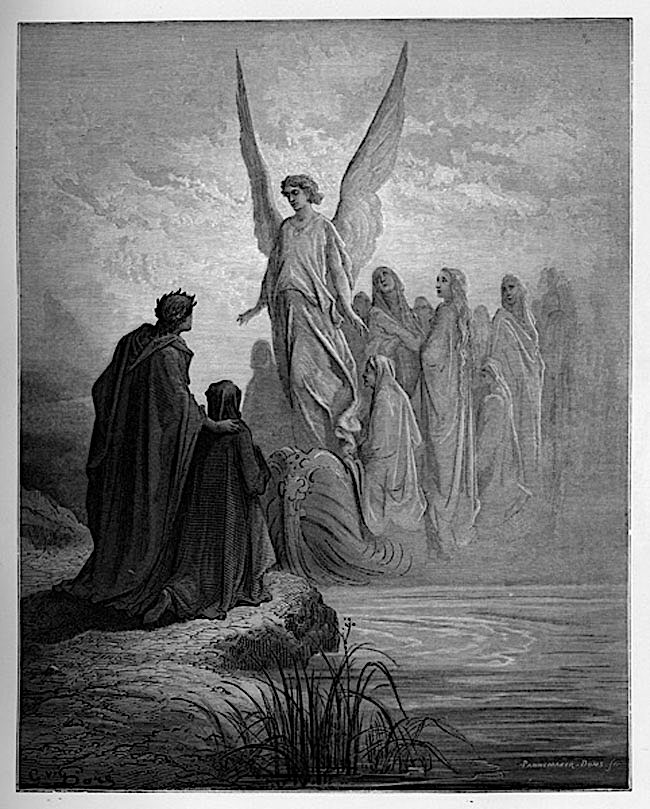
Purgatorio, Canto II:
At dawn on Easter Sunday, Dante and Virgil have just emerged from Hell when they witness The Angel Boatman speeding a new group of souls to the shore of Purgatory.
Then as that bird of heaven closed the distance between us, he grew brighter and yet brighter until I could no longer bear the radiance,
and bowed my head. He steered straight for the shore, his ship so light and swift it drew no water; it did not seem to sail so much as soar.
Astern stood the great pilot of the Lord, so fair his blessedness seemed written on him; and more than a hundred souls were seated forward,
singing as if they raised a single voice
in exitu Israel de Aegypto. Verse after verse they made the air rejoice.
The angel made the sign of the cross, and they cast themselves, at his signal, to the shore. Then, swiftly as he had come, he went away.
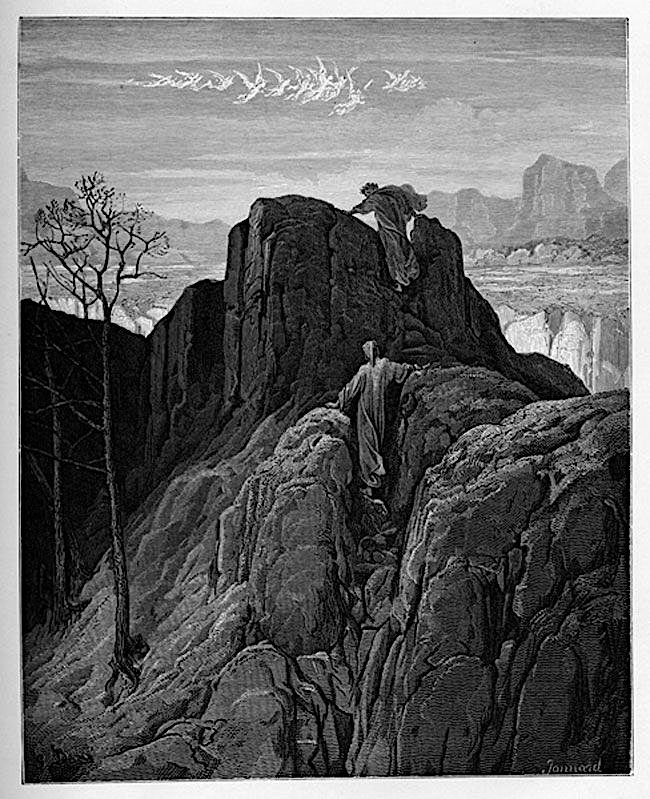
Purgatorio, Canto IV:
The poets begin their laborious climb up the Mount of Purgatory. Partway up the steep path, Dante cries out to Virgil that he needs to rest.
The climb had sapped my last strength when I cried: “Sweet Father, turn to me: unless you pause I shall be left here on the mountainside!”
He pointed to a ledge a little ahead that wound around the whole face of the slope. “Pull yourself that much higher, my son,” he said.
His words so spurred me that I forced myself to push on after him on hands and knees until at last my feet were on that shelf.
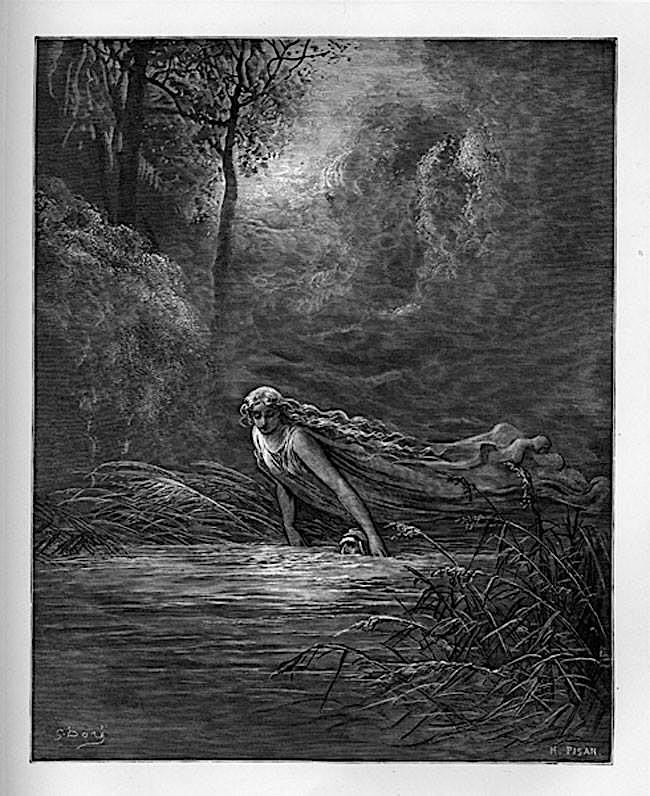
Purgatorio, Canto XXXI:
Having ascended at last to the Garden of Eden, Dante is immersed in the waters of the Lethe, the river of forgetfulness, and helped across by the maiden Matilda. He drinks from the water, which wipes away all memory of sin.
She had drawn me into the stream up to my throat, and pulling me behind her, she sped on over the water, light as any boat.
Nearing the sacred bank, I heard her say in tones so sweet I cannot call them back, much less describe them here: “Asperges me.”
Then the sweet lady took my head between her open arms, and embracing me, she dipped me and made me drink the waters that make clean.
Paradiso, Canto V:
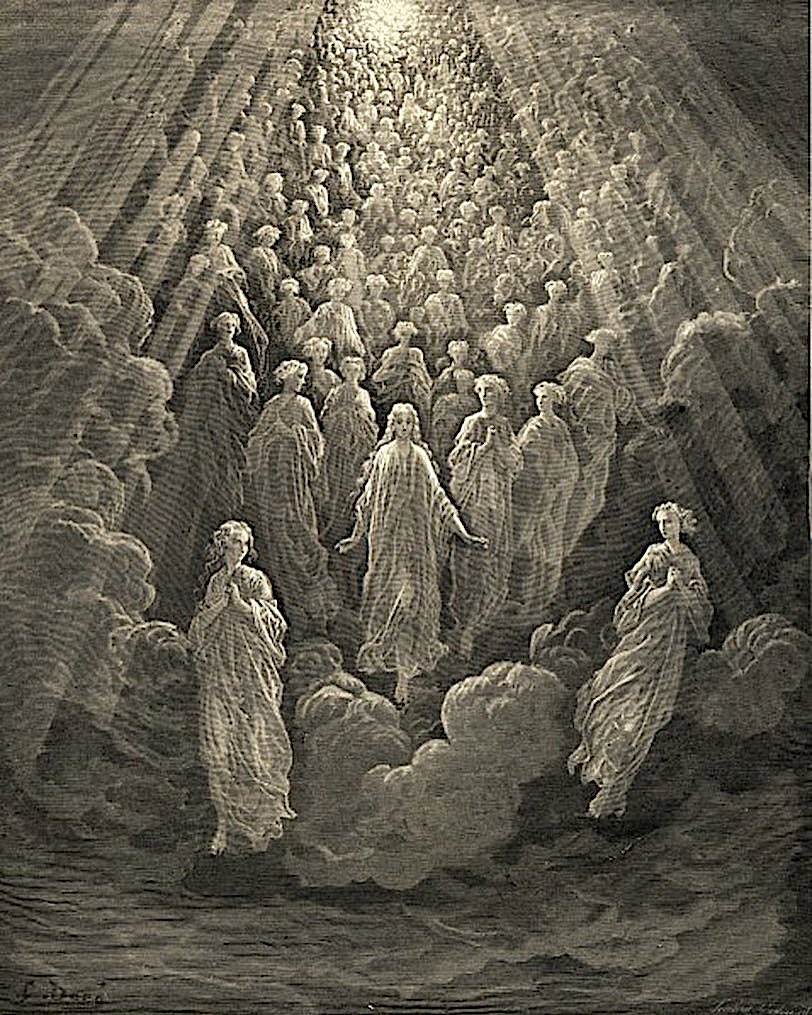
In the Second Heaven, the Sphere of Mercury, Dante sees a multitude of glowing souls. In the translation by Allen Mandelbaum, he writes:
As in a fish pool that is calm and clear, the fish draw close to anything that nears from outside, it seems to be their fare, such were the far more than a thousand splendors I saw approaching us, and each declared: “Here now is one who will increase our loves.” And even as each shade approached, one saw, because of the bright radiance it set forth, the joyousness with which that shade was filled.
Paradiso, Canto XXVIII:
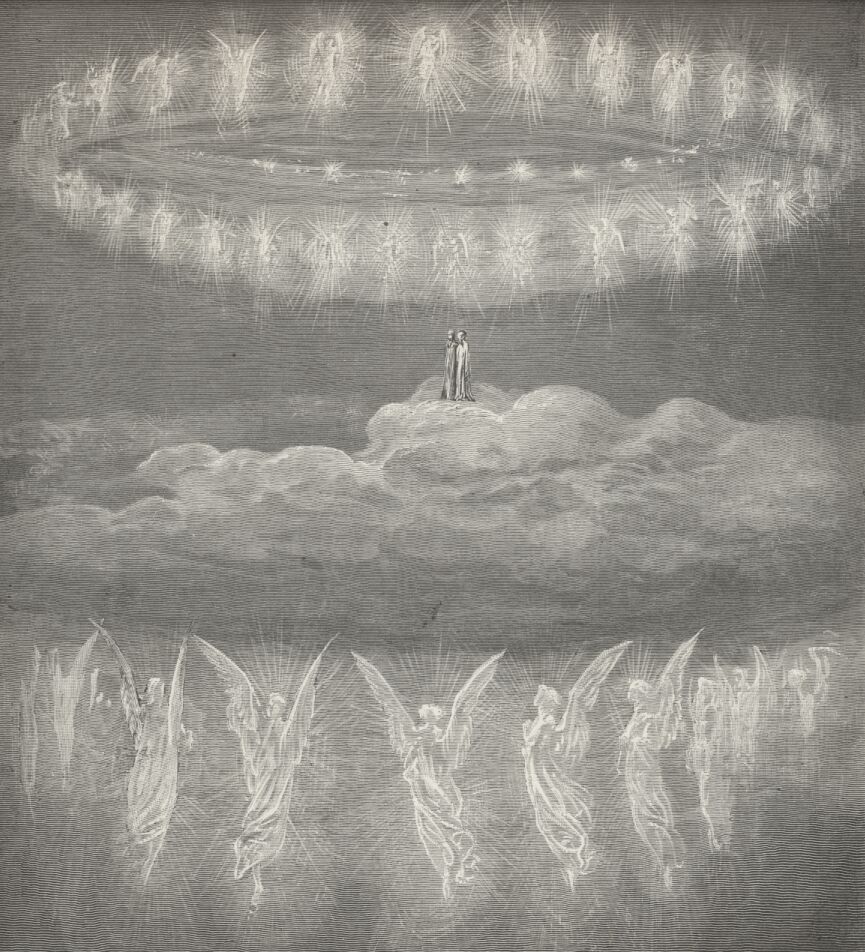
Upon reaching the Ninth Heaven, the Primum Mobile, Dante and his guide Beatrice look upon the sparkling circles of the heavenly host. (The Christian Beatrice, who personifies Divine Love, took over for the pagan Virgil, who personifies Reason, as Dante’s guide when he reached the summit of Purgatory.)
And when I turned and my own eyes were met By what appears within that sphere whenever one looks intently at its revolution, I saw a point that sent forth so acute a light, that anyone who faced the force with which it blazed would have to shut his eyes, and any star that, seen from the earth, would seem to be the smallest, set beside that point, as star conjoined with star, would seem a moon. Around that point a ring of fire wheeled, a ring perhaps as far from that point as a halo from the star that colors it when mist that forms the halo is most thick. It wheeled so quickly that it would outstrip the motion that most swiftly girds the world.
Paradiso, Canto XXXI:
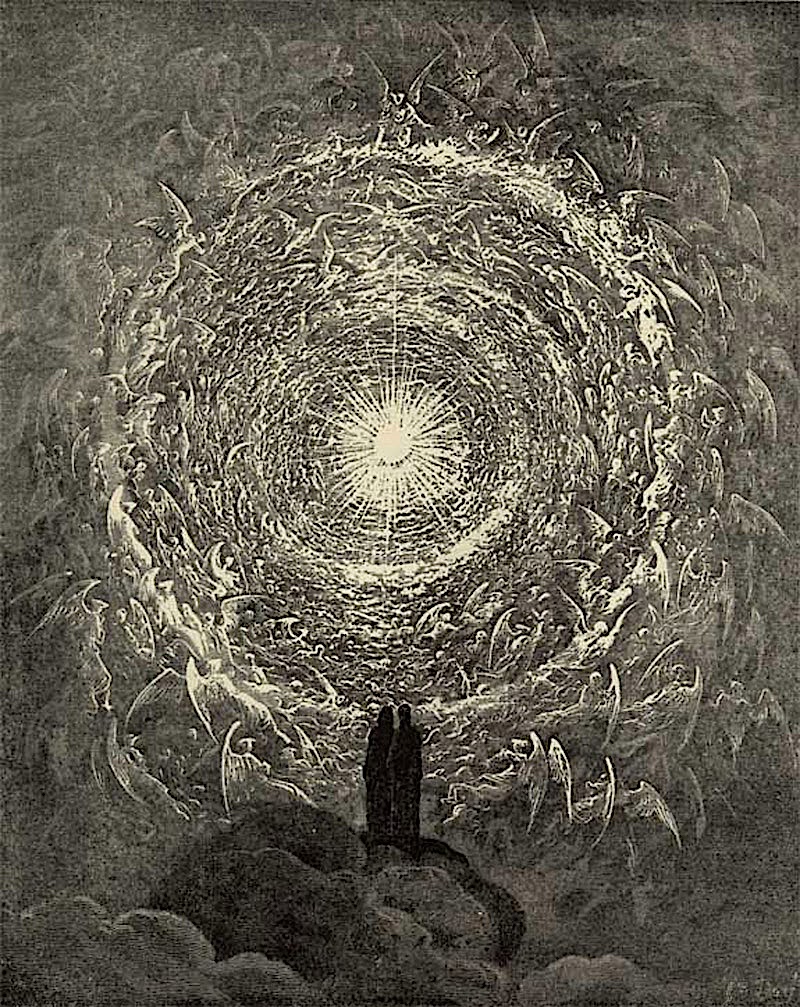
In the Empyrean, the highest heaven, Dante is shown the dwelling place of God. It appears in the form of an enormous rose, the petals of which house the souls of the faithful. Around the center, angels fly like bees carrying the nectar of divine love.
So, in the shape of that white Rose, the holy legion has shown to me — the host that Christ, with His own blood, had taken as His bride. The other host, which, flying, sees and sings the glory of the One who draws its love, and that goodness which granted it such glory, just like a swarm of bees that, at one moment, enters the flowers and, at another, turns back to that labor which yields such sweet savor, descended into that vast flower graced with many petals, then again rose up to the eternal dwelling of its love.
If you would like to support the mission of Open Culture, consider making a donation to our site. It’s hard to rely 100% on ads, and your contributions will help us continue providing the best free cultural and educational materials to learners everywhere. You can contribute through PayPal, Patreon, and Venmo (@openculture). Thanks!
Note: An earlier version of this post appeared on our site in October 2013.
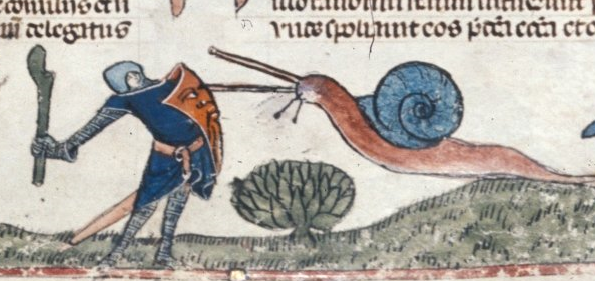
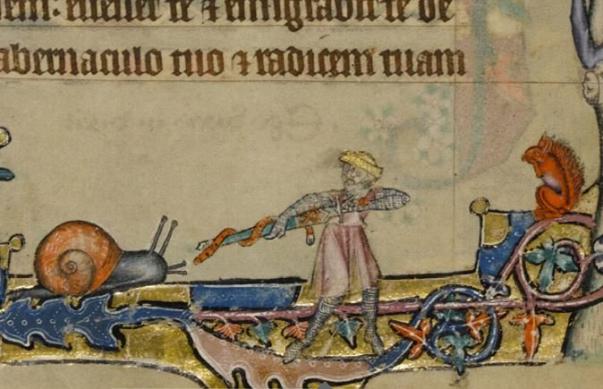
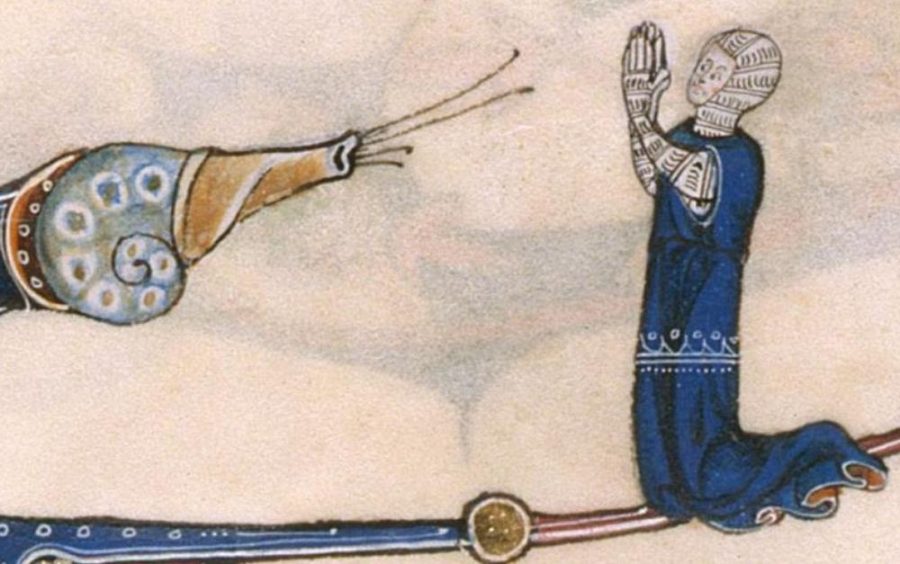
The snail may leave a trail of slime behind him, but a little slime will do a man no harm… whilst if you dance with dragons, you must expect to burn.
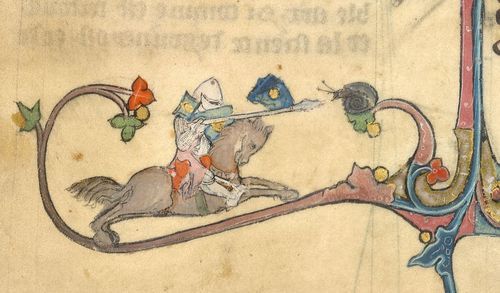
Randall, who found some 70 instances of man-on-snail combat in 29 manuscripts dating from the late 1200s to early 1300s, believed that the tiny mollusks were stand ins for the Germanic Lombards who invaded Italy in the 8th century.
After Charlemagne trounced the Lombards in 772, declaring himself King of Lombardy, the vanquished turned to usury and pawnbroking, earning the enmity of the rest of the populace, even those who required their services.
Their profession conferred power of a sort, the kind that tends to get one labelled cowardly, greedy, malicious … and easy to put down.
Which rather begs the question why the knights going toe-to- …uh, facing off against them in the margins of these illuminated manuscripts look so damn intimidated.
Let us remember that the doodles in medieval marginalia are editorial cartoons wrapped in enigmas, much as today’s memes would seem, 800 years from now. Whatever point—or joke—the scribe was making, it’s been obscured by the mists of time.
And these things have a way of evolving. The snail vs. knight motif disappeared in the 14th-century, only to resurface toward the end of the 15th, when any existing significance would very likely have been tailored to fit the times.
Other theories that scholars, art historians, bloggers, and armchair medievalists have floated with regard to the symbolism of these rough and ready snails haunting the margins:
I like to imagine a monk drawing out his fantastical daydreams, the snail being his nemesis, leaving unsightly trails across the page and him building up in his head this great victory wherein he vanquishes them forever, never again to be plagued by the beastly buggers while creating his masterpieces.
The expression “YOLO” may now be just passé enough to require explanation. It stands, as only some of us would try to deny remembering, for “You only live once,” a sentiment that reflects an eternal truth. Some bodies of religious belief don’t strictly agree with it, of course, but that was also true 24 centuries ago, when an unknown artist created the so-called “YOLO mosaic” that was unearthed in Southern Turkey in the twenty-tens. That artifact, whose depiction of a wine-drinking skeleton living it up even in death has delighted thousands upon thousands of viewers on the internet, is at the center of the new Hochelaga video above.
To the side of that merry set of bones is the Greek text “ΕΥΦΡΟΣΥΝΟΣ,” often translated as “Be cheerful and live your life.” As Hochelaga creator Tommie Trelawny points out, that’s a somewhat loose interpretation, since the word “roughly means ‘joyful-minded,’ or simply ‘cheerful.’ ” A more important element not often taken into consideration is the mosaic’s context.
It was discovered during the excavation of a third-century BC Greco-Roman villa, where it constituted one end of a dining-room triptych. In the middle was a scene, a trope in comedies of the time, of a toga-clad young “gatecrasher” running in hopes of a free dinner. On the other end is a mostly destroyed image of a type of figure known as “the African fisherman.”
Taken together, this domestic artwork could reflect the Epicurean teaching that “life should be about pursuing happiness and enjoying the simple pleasures while you still can.” But if the “cheerful skeleton,” as Trelawny calls it, draws attention from the rest of the triptych, that speaks to its symbolic power across the ages. Common not only in ancient Rome, the symbolic figure also makes vivid appearances in medieval art (especially during the time of the Black Death), Renaissance portraiture, the Día de Muertos-ready drawings of José Guadalupe Posada, and even Disney cartoons like The Skeleton Dance. As long as death remains undefeated, each era needs its own memento mori, and the cheerful skeleton, in all its paradoxical appeal, will no doubt keep turning up to the job — sometimes with a drink in hand.
Based in Seoul, Colin Marshall writes and broadcasts on cities, language, and culture. His projects include the Substack newsletterBooks on Cities and the book The Stateless City: a Walk through 21st-Century Los Angeles. Follow him on the social network formerly known as Twitter at @colinmarshall.
Marcel Duchamp (1887–1968) made some heady art. His whole goal was to “put art back in the service of the mind,” or to create what Jasper Johns once called the “field where language, thought and vision act on one another.” And that’s precisely what Duchamp’s 1926 avant-garde film Anémic Cinéma delivers. You can watch a restored version above.
Drawing on his inheritance, Duchamp shot Anémic Cinéma (almost a palindrome) in Man Ray’s studio with the help of cinematographer Marc Allégret. The Dada-inspired film features nine whirling optical illusions, known as Rotoreliefs, alternating with spiraling puns and complex word play. Vision acts on language and thought, indeed.
If you would like to support the mission of Open Culture, consider making a donation to our site. It’s hard to rely 100% on ads, and your contributions will help us continue providing the best free cultural and educational materials to learners everywhere. You can contribute through PayPal, Patreon, and Venmo (@openculture). Thanks!
We're hoping to rely on loyal readers, rather than erratic ads. Please click the Donate button and support Open Culture. You can use Paypal, Venmo, Patreon, even Crypto! We thank you!
Open Culture scours the web for the best educational media. We find the free courses and audio books you need, the language lessons & educational videos you want, and plenty of enlightenment in between.