You don’t need to understand French to appreciate the project. In 1964, the Swiss pharmaceutical company Sandoz (now Novartis) commissioned the Belgian writer, poet and painter Henri Michaux to produce a film that demonstrated the effects of hallucinogenic drugs. The company saw the film as a way to help its scientists get closer to the hallucinogenic experience — not surprising, given that Sandoz was the company that first synthesized LSD back in 1938.
Henri Michaux had already published accounts where he used words, signs and drawings to recount his experiences with trip-inducing drugs. (See his translated book, Miserable Miracle.) And that continued with the new film, Images du monde visionnaire (Images of a Visionary World.) At the top, you can find the trippy segment devoted to mescaline, and, below that, Michaux’s visual treatment of hashish. Watch the complete film, except for one unfortunately blemished minute, here.
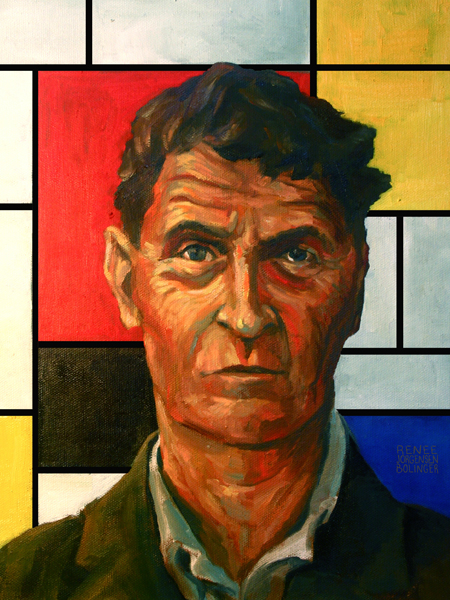
“Many of Mondrian’s pieces explore the relationships between adjacent spaces,” says Bolinger “and in particular the formative role of each on the boundaries and possibilities of the other. I based this painting [see above] off of Wittgenstein’s Tractatus, in which he develops a theory of meaning grounded in the idea that propositions have meaning only insofar as they constrain the ways the world could be; a meaningful proposition is thus very like one of Mondrian’s color squares, forming a boundary and limiting the possible configurations of the adjacent spaces.”
A second-year PhD student in the philosophy program at the University of Southern California, Bolinger studied painting a Biola University before making philosophy her second major. “I actually came to philosophy quite late in my college career,” Bolinger says, “only adding the major in my junior year. I was fortunate to have two particularly excellent and philosophic art teachers, Jonathan Puls and Jonathan Anderson, who convinced me that my two passions were not mutually exclusive, and encouraged me to pursue both as I began my graduate education.”
Bolinger now works primarily on the philosophy of language, with side interests in logic, epistemology, mind and political philosophy. She continues to paint. We asked her how she reconciles her two passions, which seem to occupy opposite sides of the mind. “I do work in analytic philosophy,” she says, “but it’s only half true that philosophy and painting engage opposite sides of the mind. The sort of realist drawing and painting that I do is all about analyzing the relationships between the lines, shapes and color tones, and so still very left-brain. Nevertheless, it engages the mind in a different way than do the syllogisms of analytic philosophy. I find that the two types of mental exertion complement each other well, each serving as a productive break from the other.”
Bolinger has created a series of philosopher portraits, each one pairing a philosopher with an artist, or art style, in an intriguing way. In addition to Wittgenstein, she painted ten philosophers in her first series, many of them by request. They can all be seen on her Web site, where high quality prints can be ordered.
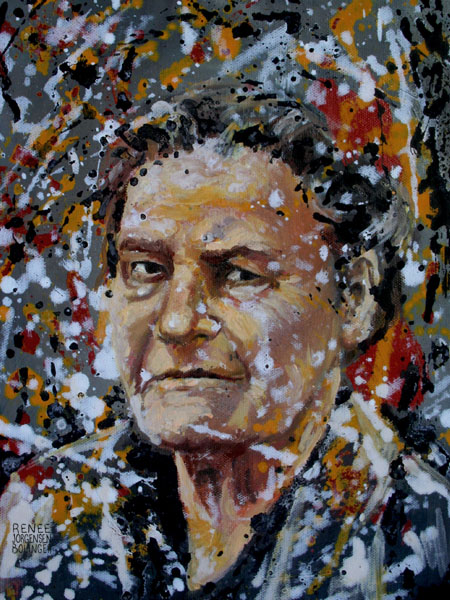
G.E.M. Anscombe/Jackson Pollock:
Bolinger says she paired the British analytic philosopher Elizabeth Anscombe with the American abstract painter Jackson Pollock for two reasons: “First, the loose style of Pollock’s action painting fits the argumentative (and organizational) style of Wittgenstein’s Philosophical Investigations, which Anscombe helped to edit and was instrumental in publishing. Second, her primary field of work, in which she wrote a seminal text, is philosophy of action, which has obvious connections to the themes present in any of Pollock’s action paintings.”
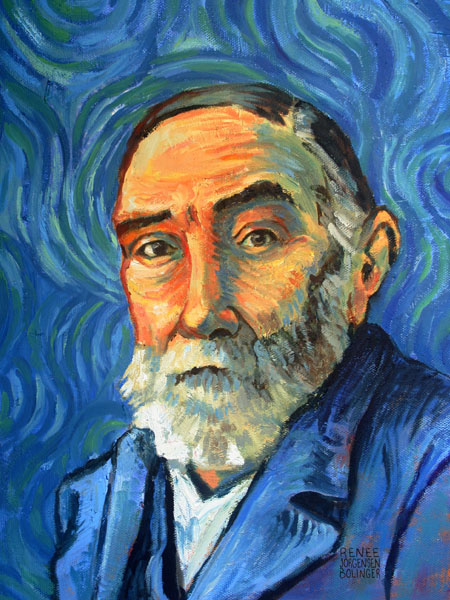
Gottlob Frege/Vincent Van Gogh:
Bolinger paired the German logician, mathematician and philosopher Gottlob Frege with the Dutch painter Vincent Van Gogh as a tongue-in-cheek reference to Van Gogh’s famous painting The Starry Night and Frege’s puzzle concerning identity statements such as “Hesperus is Phosphorus,” or “the evening star is identical to the morning star.”
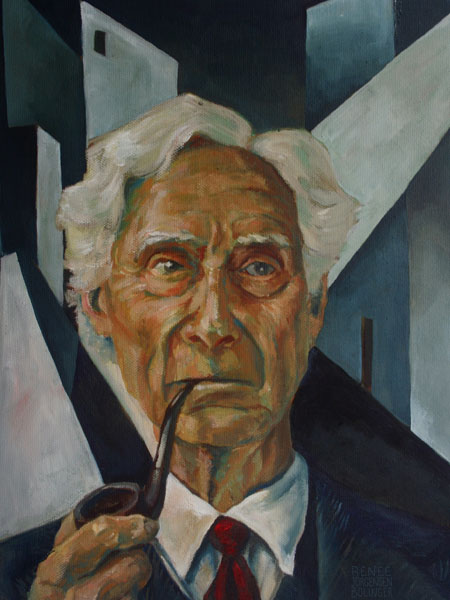
Bertrand Russell/Art Deco:
Bolinger painted the British logician and philosopher Bertrand Russell in the Art Deco style. “This pairing is a bit more about the gestalt, and a bit harder to articulate,” says Bolinger. “The simplification of form and reduction to angled planes that takes place in the background of this Art Deco piece are meant to cohere with Russell’s locial atomism (the reduction of complex logical propositions to their fundamental logical ‘atoms’).”
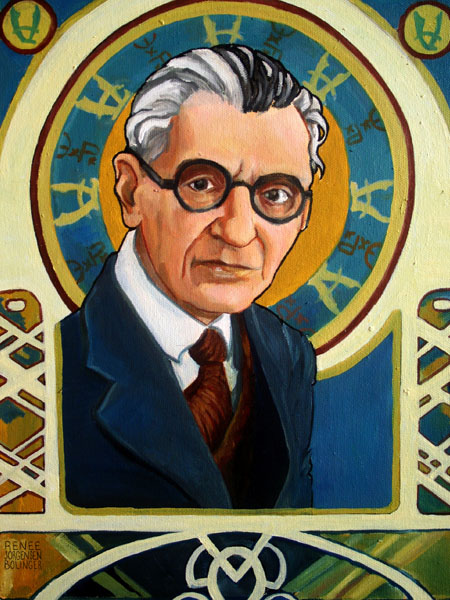
Kurt Gödel/Art Nouveau:
Bolinger paired the Austrian logician Kurt Gödel with Art Nouveau. “The Art Nouveau movement developed around the theme of mechanization and the repetition of forms,” says Bolinger, “and centrally involves a delicate balance between organic shapes — typically a figure that dominates the portrait — and schematized or abstracted patterns, often derived from organic shapes, but made uniform and repetitive (often seen in the flower motifs that ornament most Art Nouveau portraits). I paired this style with Kurt Gödel because his work was dedicated to defining computability in terms of recursive functions, and using the notion to prove the Completeness and Incompleteness theorems.”
Before William Faulkner more or less defined the genre of Southern literature with his folksy short stories, tragicomic epic novels, and studies in the stream of damaged consciousness, he made a very sincere effort as a poet with a 1924 collection called The Marble Faun. Published in 500 copies with the assistance of his friend Phil Stone, who paid $400 dollars to get the work in print, Faulkner’s poetry did not go over well. Although later judgments have been kinder, the publisher called it “not really a very good book of poetry” and most of the print run was remaindered. The young Faulkner fared much better however with another of his early creative endeavors: art.
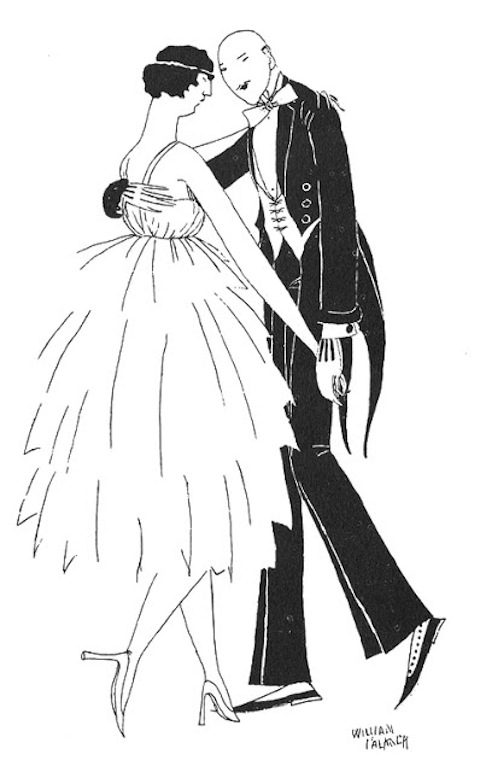
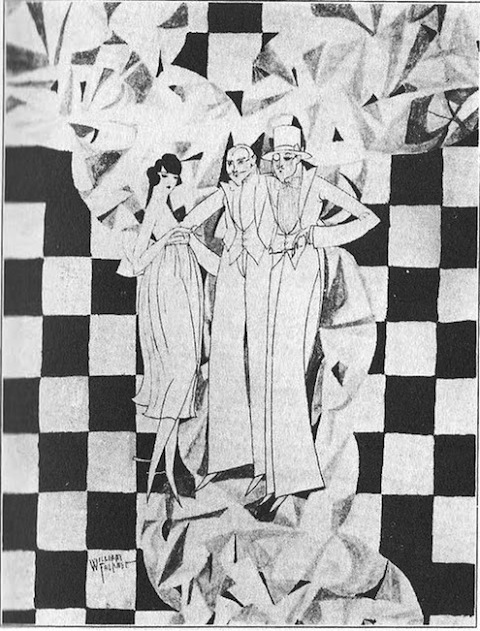
Between 1916 and 1925, the University of Mississippi—which Faulkner attended for three semesters before dropping out in 1920—paid him for drawings published in the university newspaper Ole Miss and its humor magazine The Scream. The drawings, like that of a dancing couple at the top, show the influence of jazz-age art-deco graphic illustration as well as that of English illustrator and aesthete Aubrey Beardsley (who gets a name-check in Faulkner’s 1936 novel Absalom, Absalom!). Beardsley’s influence seems especially evident in the drawing above, from a 1917–18 edition of Ole Miss.
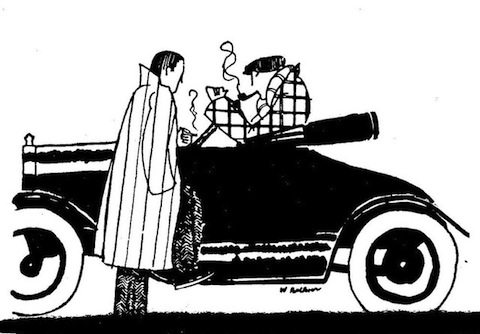
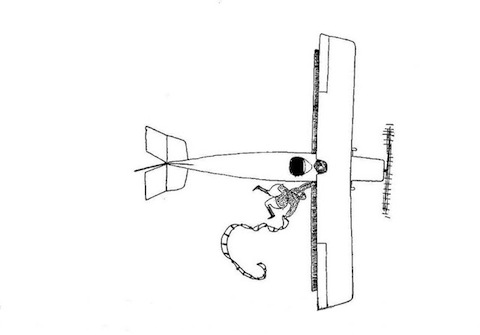
Many of Faulkner’s illustrations are much simpler cartoons, particularly those he did for The Scream, such as the 1925 drawing above of two men and a car. Even simpler, the line drawing of an airplane below recalls the author’s fascination with aviation, manifested in his failed attempt to join the U.S. Air Force, his successful acceptance into the R.A.F., and his non-Mississippi 1935 novel Pylon, about a rowdy crew of barnstormers in a fictionalized New Orleans called “New Valois.” You can see more of Faulkner’s drawings here and read his early prose and poetry in an out-of-print collection housed online at the Internet Archive, which has been now added to our collection of Free eBooks.
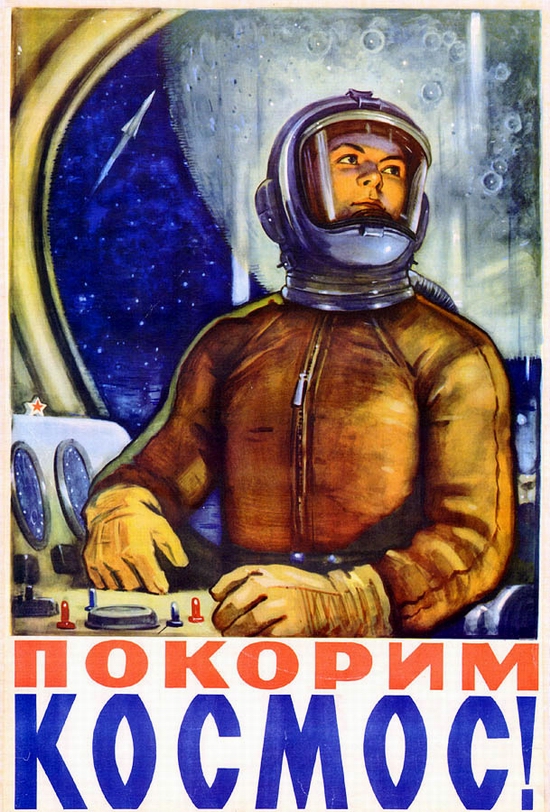
Walking around L.A. just yesterday, I noticed new banners emblazoned with illustrations touting subway stations now under construction. In bold, bright colors, they deliver clear, ambitious imagery of a bright future ahead: dedicated builders, focused students, noble working commuters, surging trains. Why, I thought, those look a bit like Soviet propaganda! I had no political comparisons in mind, only aesthetic ones, and this Retronaut post shows off many perfect examples of the Cold War-era Russian posters the Los Angeles Metro’s brought to my mind. They capture the imagination by exuding even more intense scientific, technological, educational, and social optimism — and doing so in even more visual detail — than I’d remembered.
And boy, speaking of ambition: “From student’s models to spaceships!” “To the Sun! To the stars!” “Glory to the conquerors of the universe!” Children inclined to accept these glorious slogans and the rapturous imagery they accompany could not possibly fail to believe that, thoroughly educated by their country, their generation would go on to usher in a new galaxy-spanning order of peace, prosperity, and socialism. Yet we in the rest of the world now know of the boredom, cynicism, and oppression that attended many Soviet citizens’ everyday lives. A Cold War-specialist college history professor of mine liked to tell a story about a trip to Moscow he took in the sixties, on which he kept seeing adolescents with nothing more productive to do than openly chugging vodka on street corners. Yet, seeing posters like these, you simply want to believe, just like I want to believe in the extension of Los Angeles’ subway — which, at times, seems about as plausible as the conquering of outer space.
“From student’s models to spaceships!”
“Glory to the workers of Soviet science and technology!”
“I am happy — this is my work joining the work of my republic”
“In the 20th century the rockets race to the stars”
My kids used to beg their dad to help out with their impromptu puppet shows. He complied by having our daughter’s favorite baby doll deliver an interminable curtain speech, hectoring the audience (me) to become subscribers and make donations via the small envelope they’d find tucked in their programs.
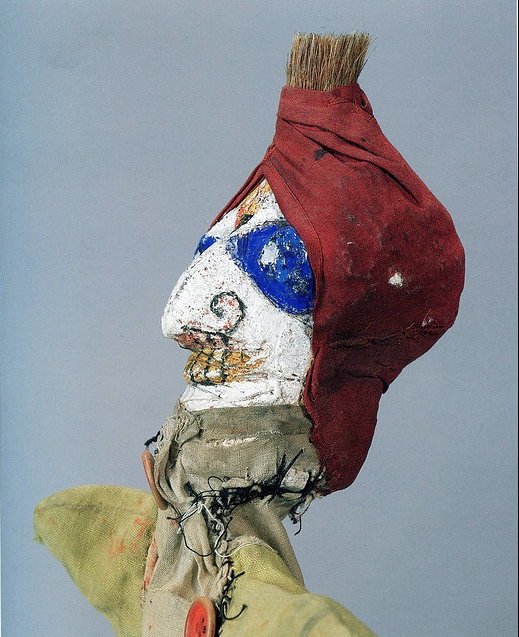
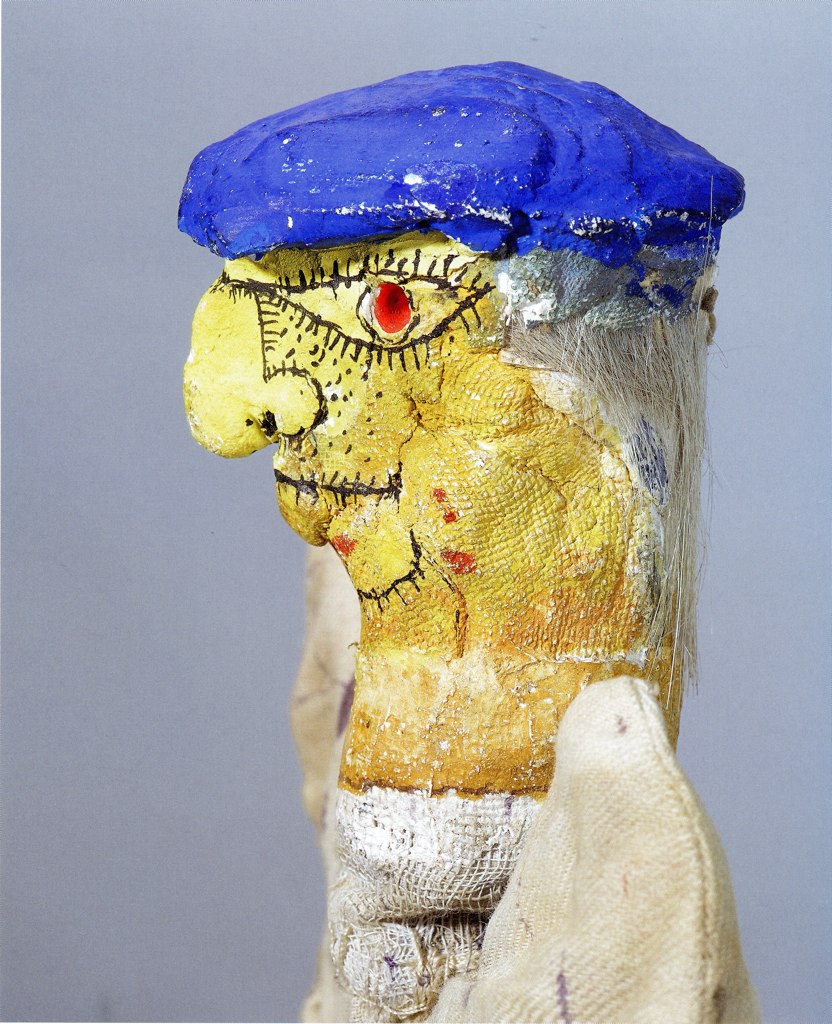
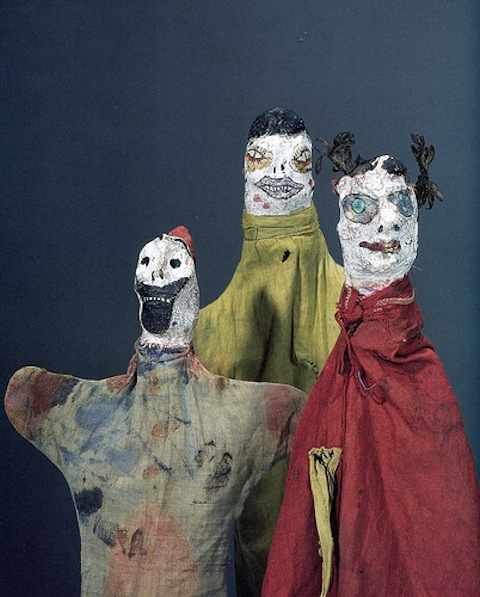
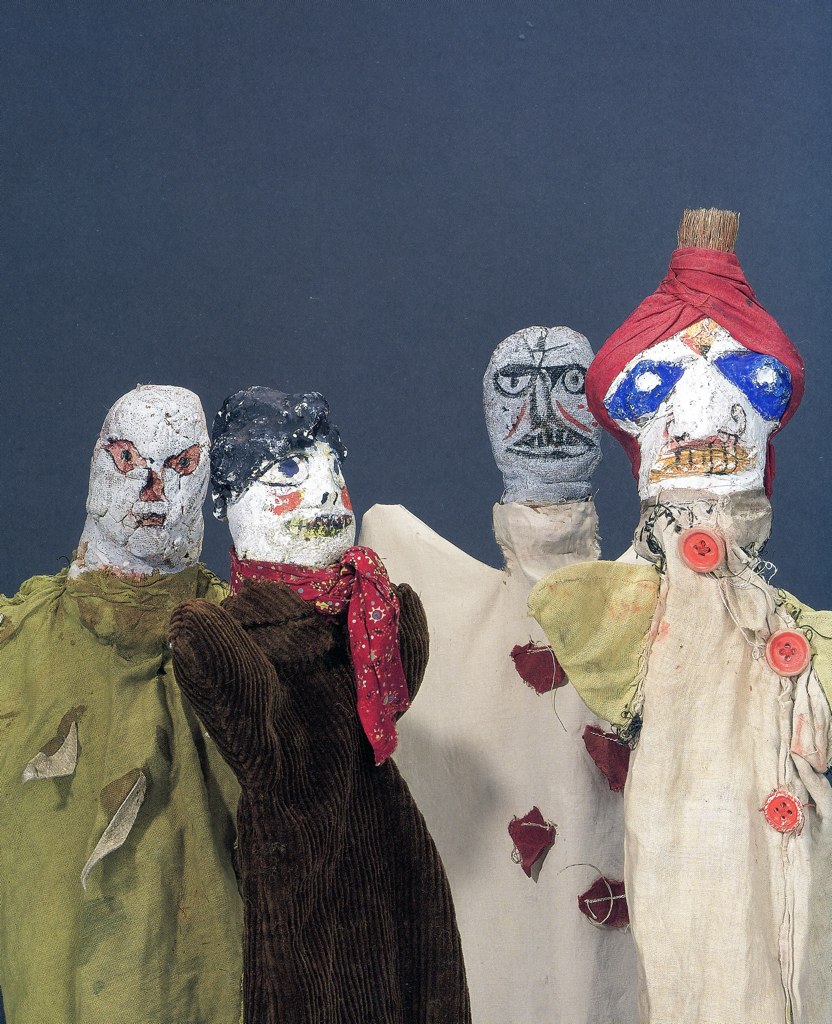
Like my husband, artist Paul Klee (1879–1940) loomed large in his child’s early puppet work. To mark his son Felix’s ninth birthday, Klee fashioned eight hand puppets based on stock characters from Kasperl and Gretl — Germany’s answer to Punch and Judy. The boy took to them so enthusiastically that his dad kept going, creating something in the neighborhood of fifty puppets between 1916 and 1925. The cast soon expanded to include cartoonish political figures, a self-portrait, and less recognizable characters with a decidedly Dada-ist bent. Klee also fixed Felix up with a flea market frame that served as the proscenium for the shows he put on in a doorway of the family’s tiny apartment.
When Felix set out into the world at the age of eighteen, he packed his favorite childhood puppets, while his dad hung onto the ones born of his years on the faculty of the Bauhaus. Felix’s portion of the collection was almost entirely destroyed during the bombing of Wurzburg in World War II. Dr. Death was the only member of the original eight to escape unscathed.
If you would like to support the mission of Open Culture, consider making a donation to our site. It’s hard to rely 100% on ads, and your contributions will help us continue providing the best free cultural and educational materials to learners everywhere. You can contribute through PayPal, Patreon, and Venmo (@openculture). Thanks!
The poet Charles Bukowski has appeared often on Open Culture lately, and I have no objection. Not only do I savor writing about a literary figure thoroughly representative of Los Angeles, where I live, but about one who, even nineteen years after his death, keeps producing interesting things. Or at least we keep finding them.
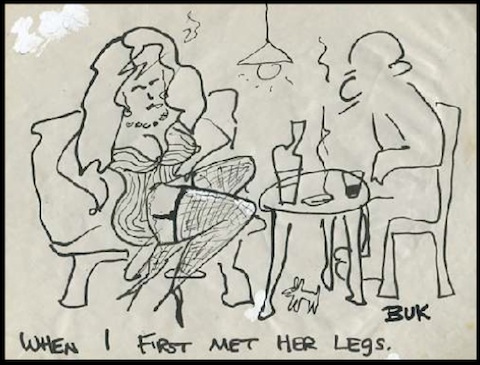
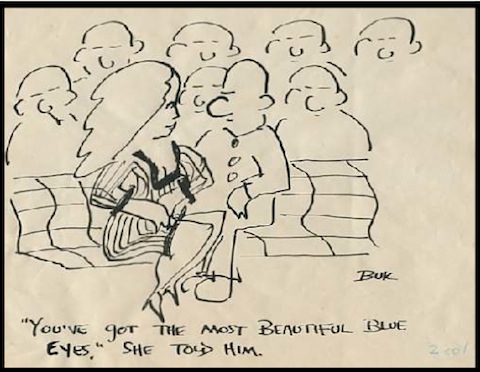
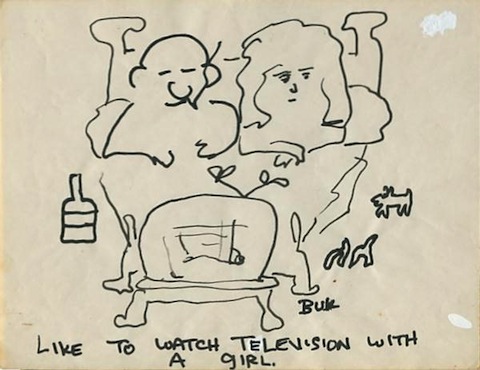
A case in point comes from this post by Stephen J. Gertz of Booktryst about evidence rediscovered earlier this year of Bukowski’s efforts as a cartoonist: “Nineteen long-lost original drawings by Charles Bukowski, America’s poet laureate of the depths, surfaced at the 46th California International Antiquarian Book Fair February 15–17, 2013, offered by ReadInk of Los Angeles. Sixteen of them appeared as accompaniment to Bukowski’s classic column in the Los Angeles Free Press (The Freep), ‘Notes of a Dirty Old Man’. The remaining three originally appeared in Sunset Palms Hotel, Issue #4 (1974).”
Less comics per se than drawn windows into Bukowski’s worldview, these panels show, in a shaky yet bold line, the poet’s views on drinking, smoking, staying in bed, and conducting relations with the fairer sex. “Until its termination in 1976,” Gertz continues, “Bukowski’s ‘Notes of a Dirty Old Man’ was probably the single biggest contributing factor to both the spread of his literary fame and his local notoriety as a hard-living, hard-drinking L.A. character.” The very idea of Bukowski as a regular columnist may strike some familiar with his poetry as incongruous, but you can get an idea of how the gig formed his literary persona by reading the 1969 collection Notes of a Dirty Old Man and the 2011 More Notes of a Dirty Old Man: The Uncollected Columns. Neither, however, contain Bukowski’s illustrations, but now you can appreciate them on the internet. They almost make you believe the man could have published a cartoon or two in the New Yorker, but no — wrong coast. (And wrong sensibility, certainly.)
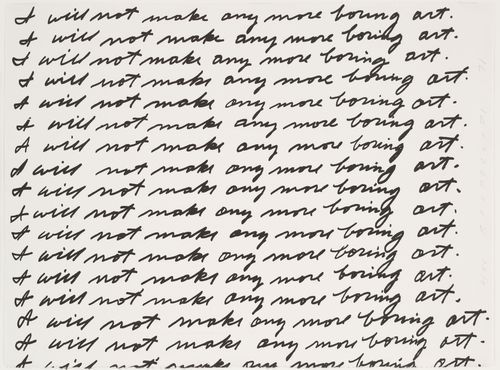
If you’re on the fence about the merits of Conceptual Art, you may be swayed to learn the history of the piece documented above. The year before its creation, John Baldessari incinerated his oeuvre, an act he referred to as The Cremation Project. Shortly thereafter, he responded to Nova Scotia College of Art and Design’s invitation to exhibit with a letter instructing students to be his surrogates in a punishment piece:
The piece is this, from floor to ceiling should be written by one or more people, one sentence under another, the following statement: I will not make any more bad art. At least one column of the sentence should be done floor to ceiling before the exhibit opens and the writing of the sentence should continue everyday, if possible, for the length of the exhibit. I would appreciate it if you could tell me how many times the sentence has been written after the exhibit closes. It should be hand written, clearly written with correct spelling….
Once the students had punished themselves to his specifications, the artist permitted the school to publish a fundraising lithograph, modeled on his handwriting.
It’s not a stretch to imagine that writing this sentence over and over could have changed more than a few participants’ lives, or at least rerouted the path their careers would take. What will happen if you take 13 minutes—the length of the video above—to try it yourself.
It seems to me that Georgia O’Keeffe tends to get pegged as a regional Southwestern painter or as the woman who painted close-ups of flowers that look suspiciously like female anatomy, or both—a casualty of marketing for the dorm-room set. As in many a stereotype, there’s some truth in both over-simplifications, but O’Keeffe was, of course, much more, as she was more than the passionate younger wife and frequent subject of Alfred Stieglitz, though that is also a true and lovely story. Like any artist—like any human being, perhaps—Georgia O’Keeffe does not reduce into a single portrait.
But amid all the simplistic popularizations of O’Keeffe, it’s nice to encounter her afresh as just herself, speaking directly to the camera about her life and work. In the documentary clip at the top, we’re treated to several minutes of vintage footage of O’Keeffe in her New Mexico surroundings, intercut with interviews with the much older artist reminiscing. The interview was shot in 1977, when O’Keeffe was nearly 90, and for some reason, this image of her—as an aged, white-haired woman—also seems inscribed in the popular imagination. Perhaps this is because she only became famous somewhat later in life, and her fame only increased as she grew older.
In the clip above, see O’Keeffe discuss another rarely-discussed aspect of her career: her paintings of New York City, where she lived on and off for over two decades and where she fell in love with Stieglitz and joined his modernist inner circle. One reason that O’Keeffe’s New York paintings get neglected is, perhaps, that the most recognizable NYC scenes tend to look a bit dated and generic, while the best of them do what all of her best work does—simplify the subject, eliminate superfluous detail, turn the moment into timeless form and color. Perhaps another reason O’Keeffe gets pigeonholed as an artist of local color or veiled femininity is one that she suggests herself. She is said to have remarked, “The men liked to put me down as the best woman painter. I think I’m one of the best painters.”
Unfortunately, the full O’Keeffe documentary is not available online, but these clips provide ample insight into the reclusive artist’s mind and method. For more face-time with Georgia O’Keeffe, check out this short film of the 92-year-old artist showing off her beloved New Mexico landscapes.
We're hoping to rely on loyal readers, rather than erratic ads. Please click the Donate button and support Open Culture. You can use Paypal, Venmo, Patreon, even Crypto! We thank you!
Open Culture scours the web for the best educational media. We find the free courses and audio books you need, the language lessons & educational videos you want, and plenty of enlightenment in between.