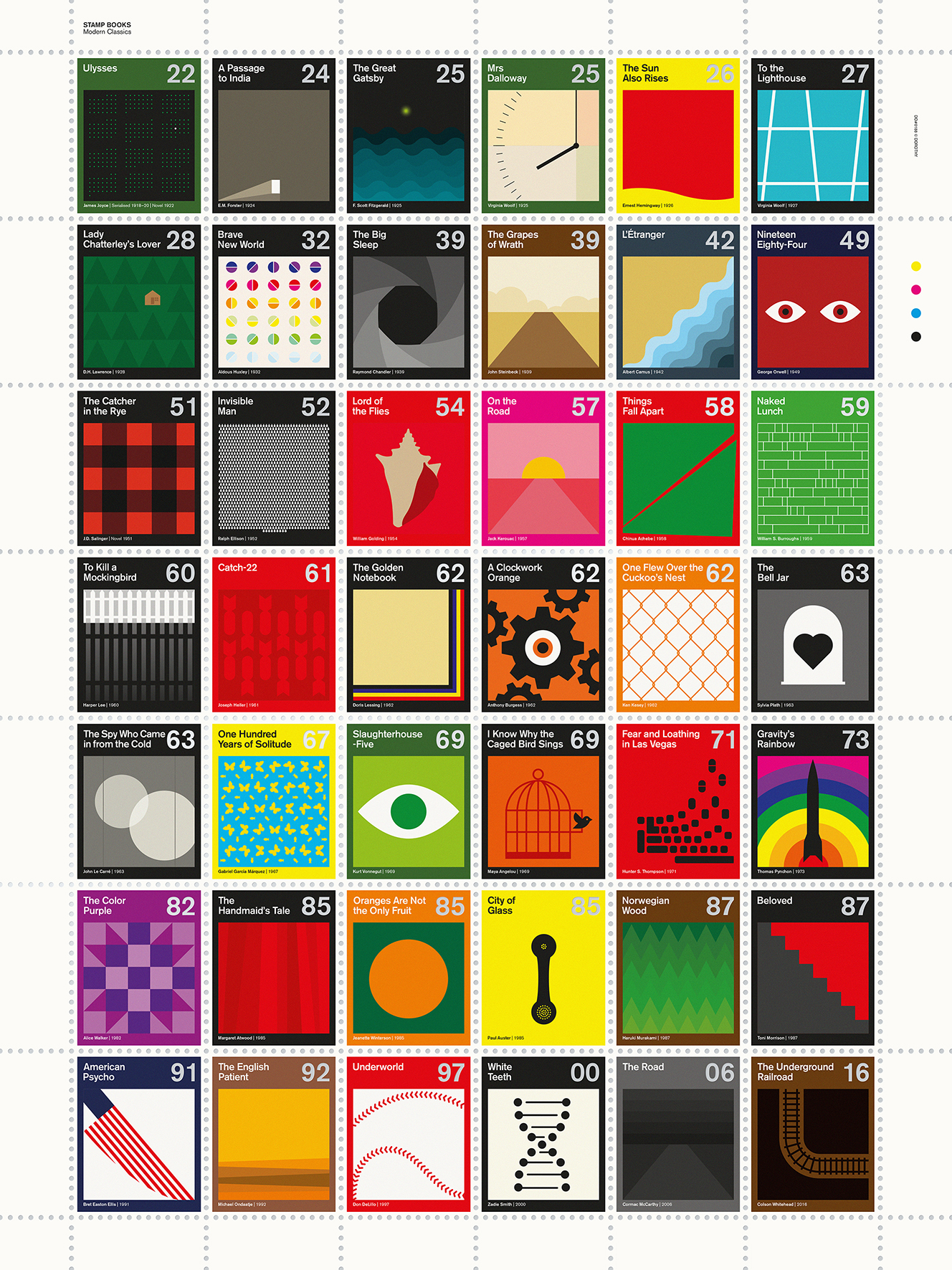
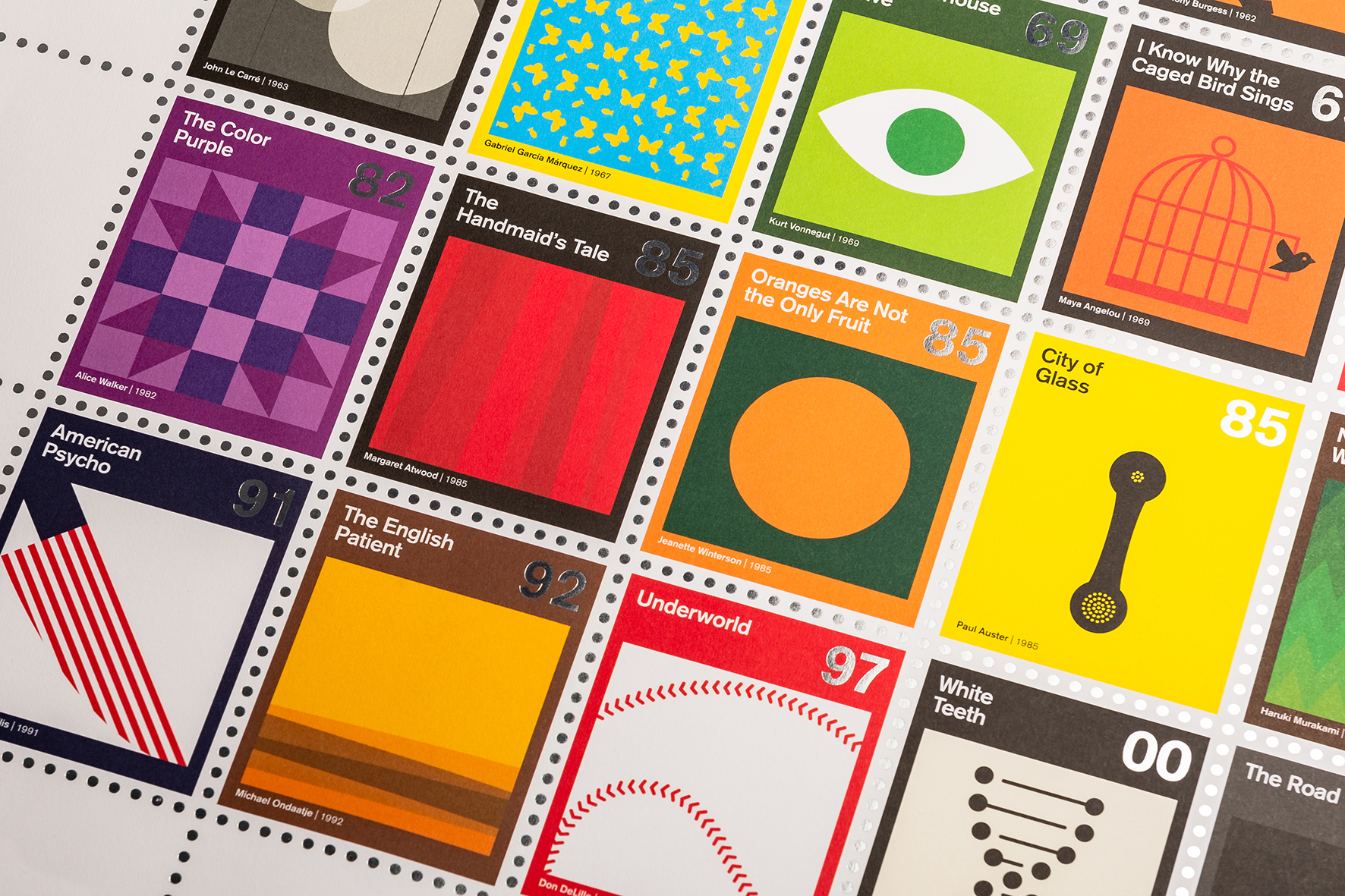
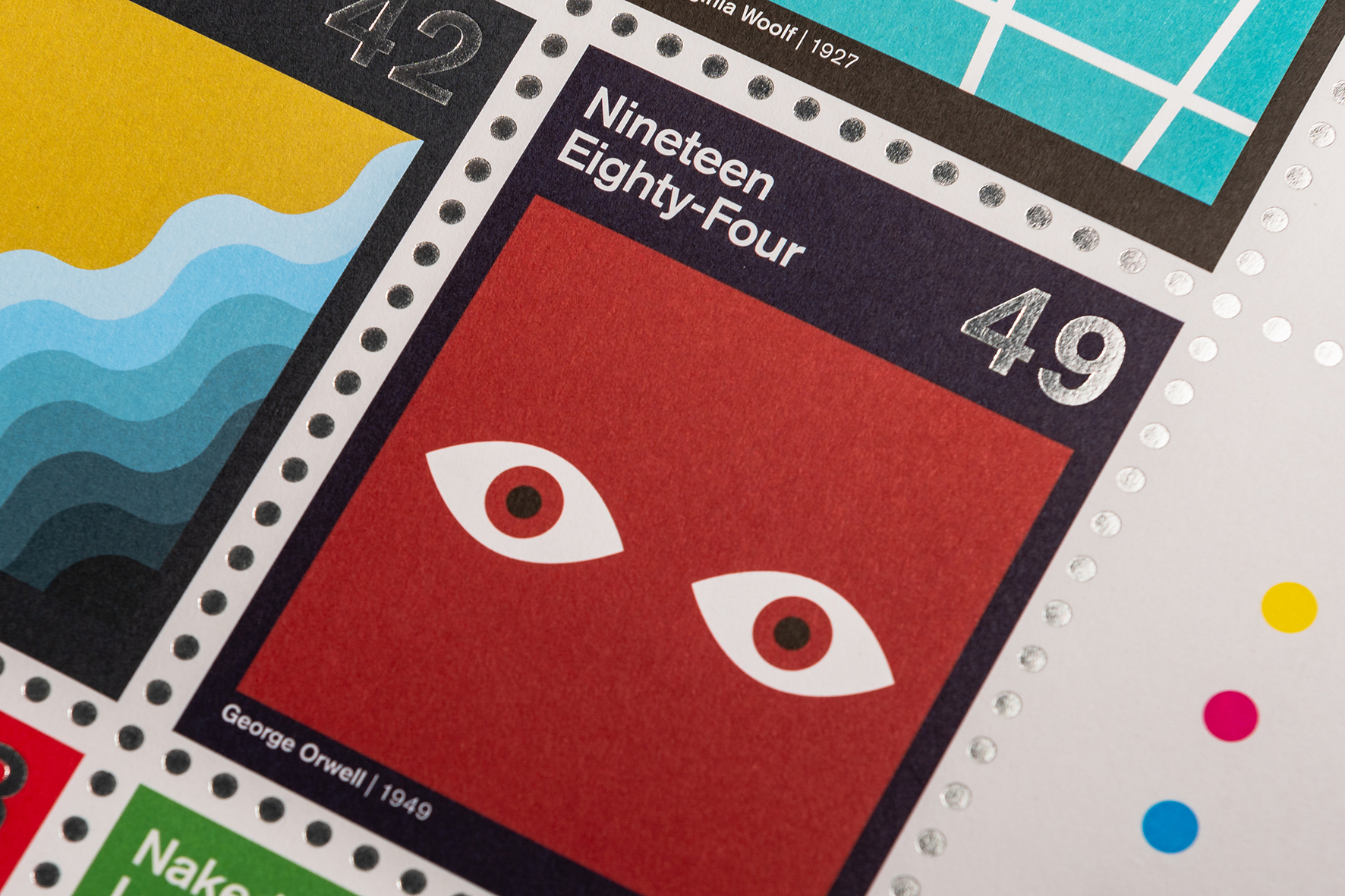
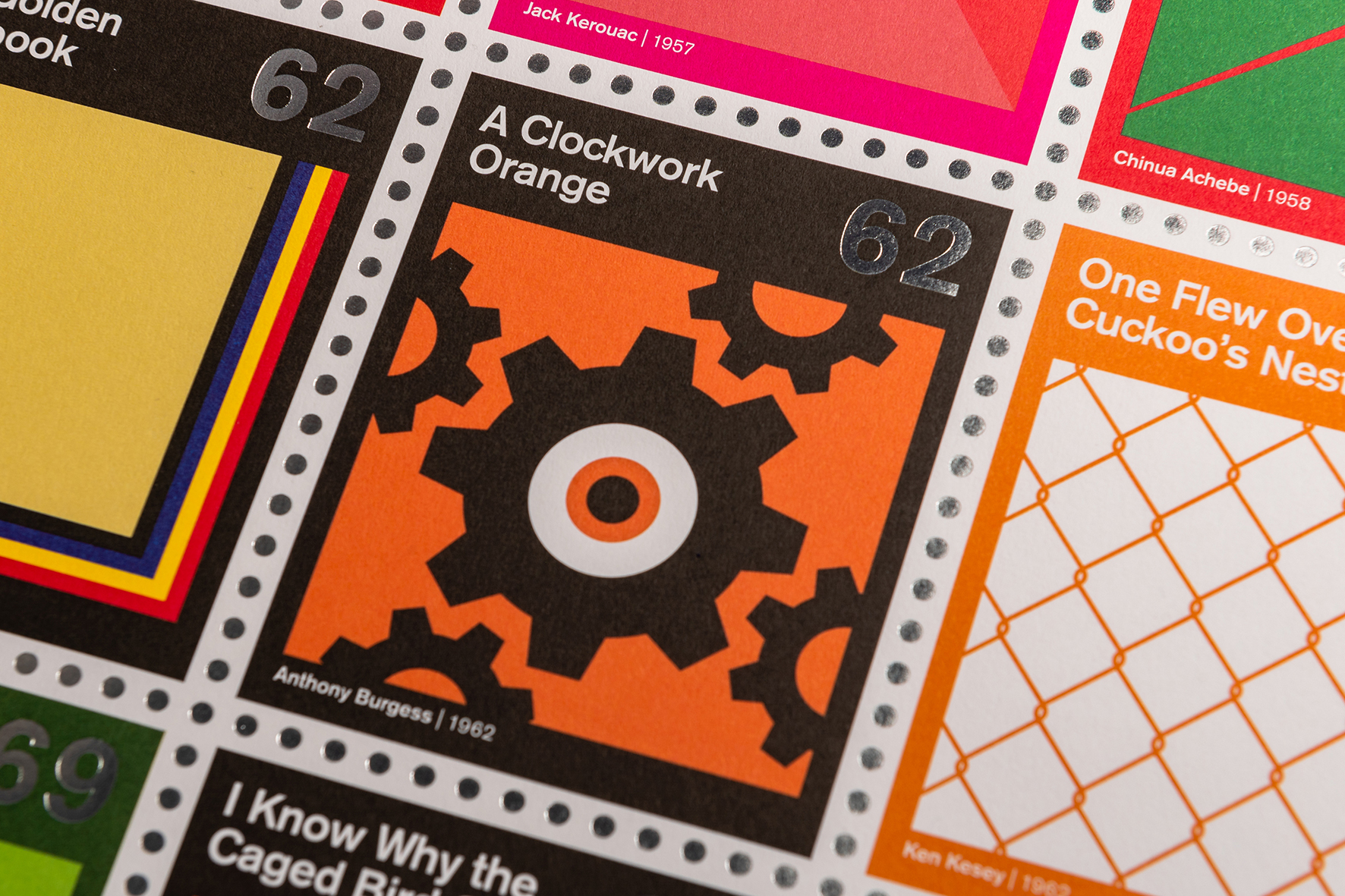
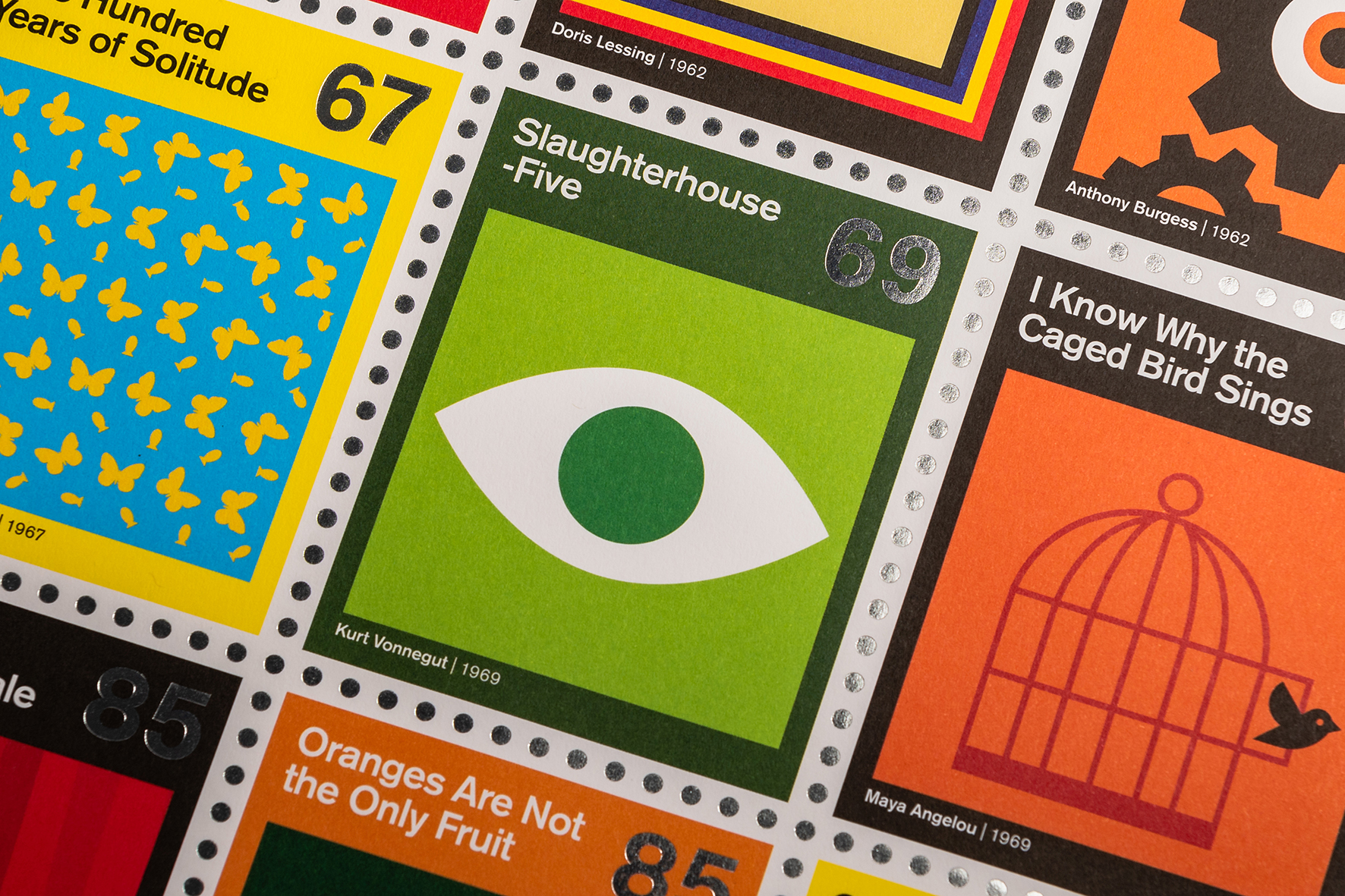
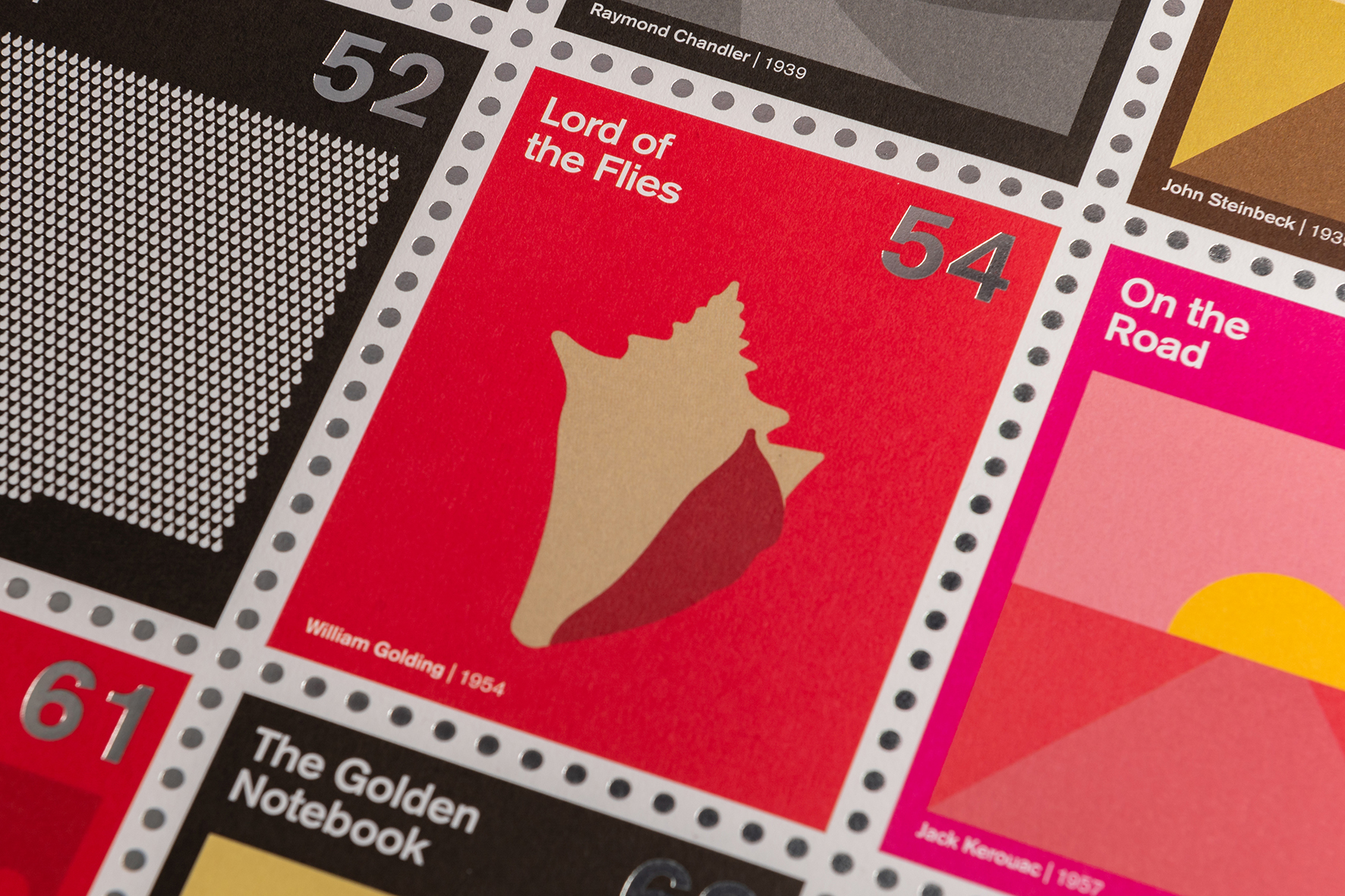
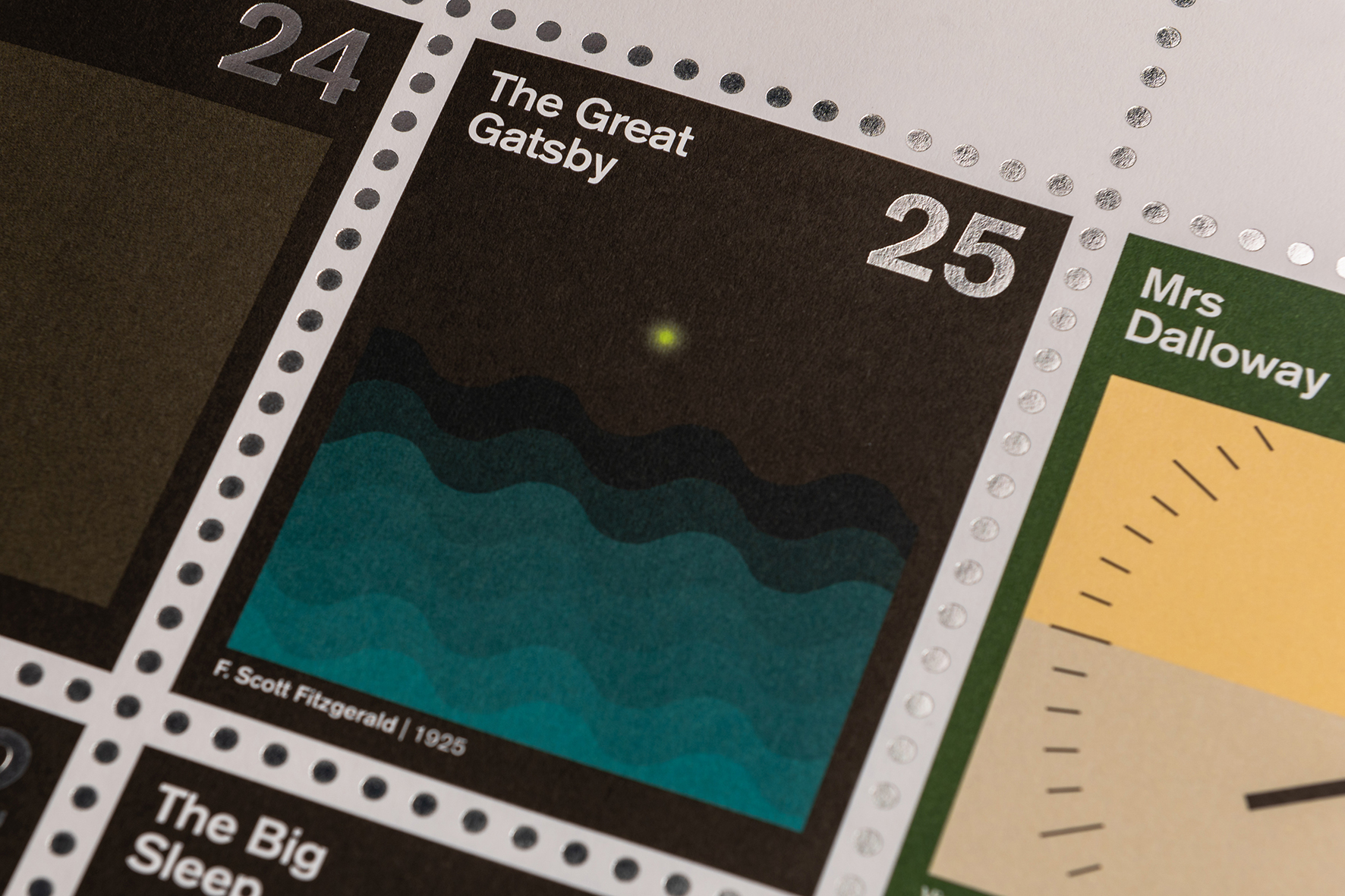
Ali Johnson and Jim Quail of Liverpool-based design studio Dorothy had a hit with their music-based graphics, which recast seminal alternative, psychedelic, electronic, and post-punk albums as oversized postage stamps.
Now, they’ve turned their attention and knack for highly condensed visual responses to the realms of literature.
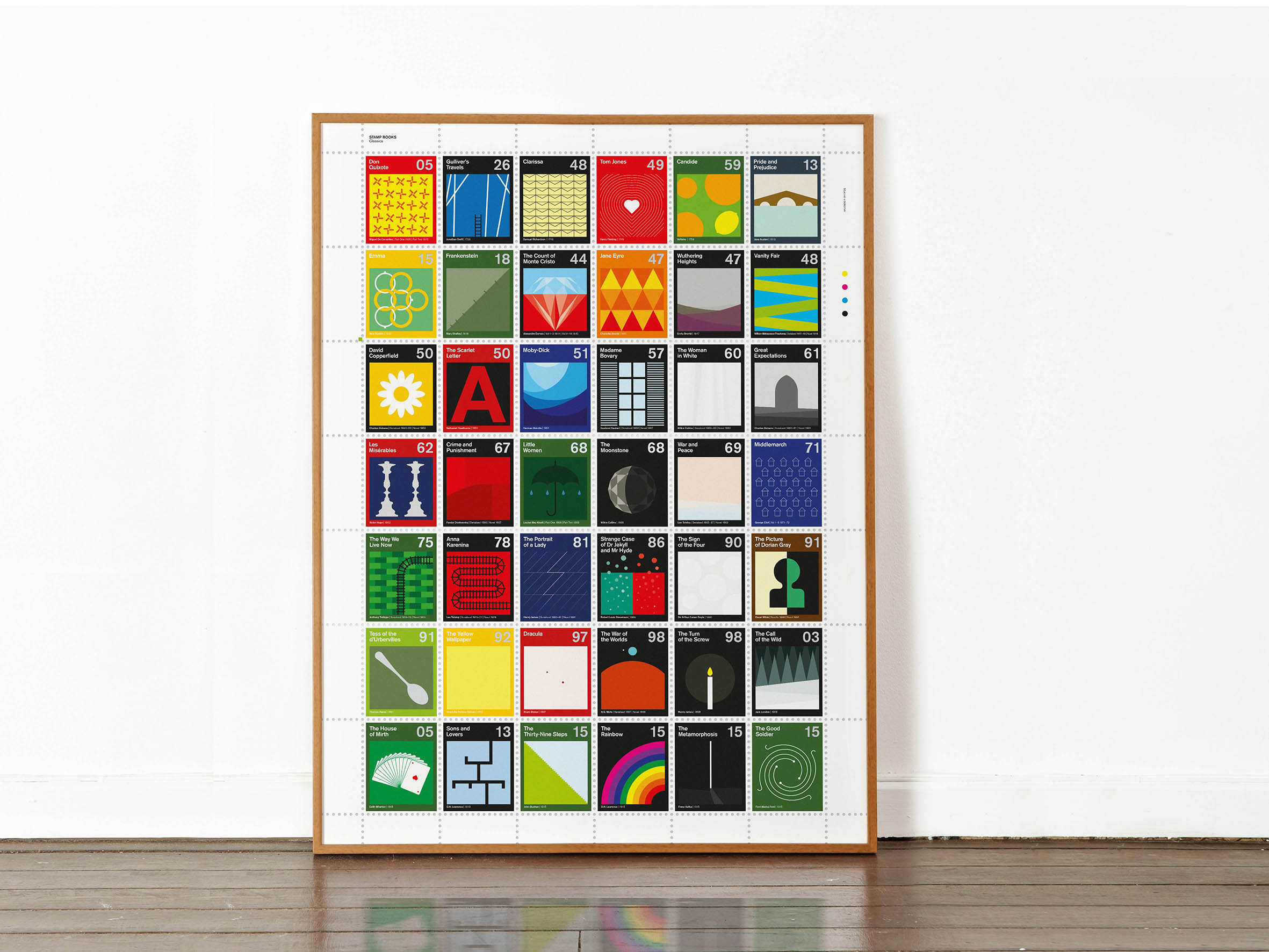
Their Modern Classics collection, above, synthesizes 42 titles into something emblematic and essential.
How many have you read?
How many would you be able to identify based on image alone?
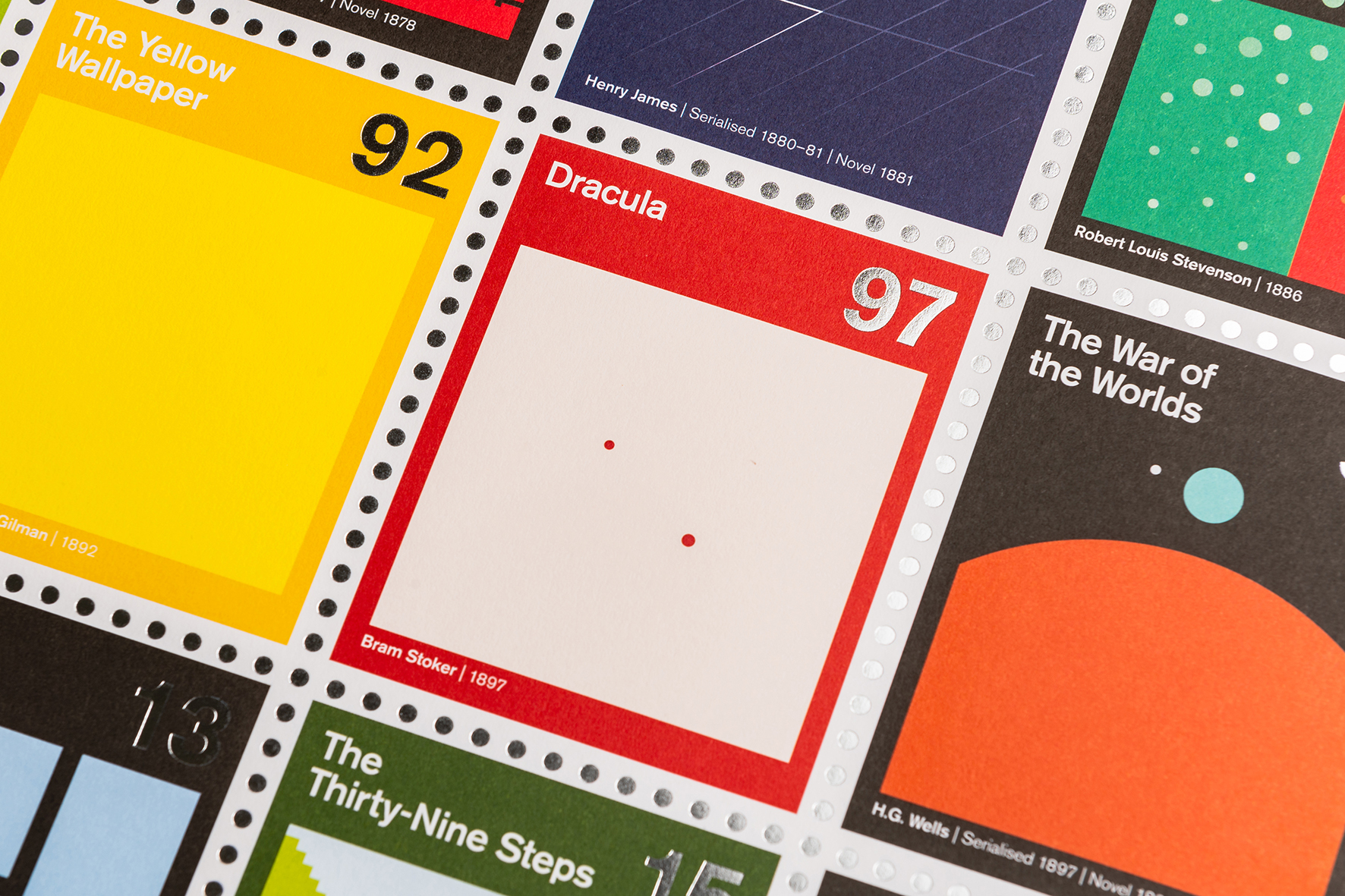
Students are far less likely to be conversant in the 42 earlier works comprising Dorothy’s literary Classics stamps, though musical and movie adaptations of Little Women, Dracula, and Les Miserables should provide a toehold.
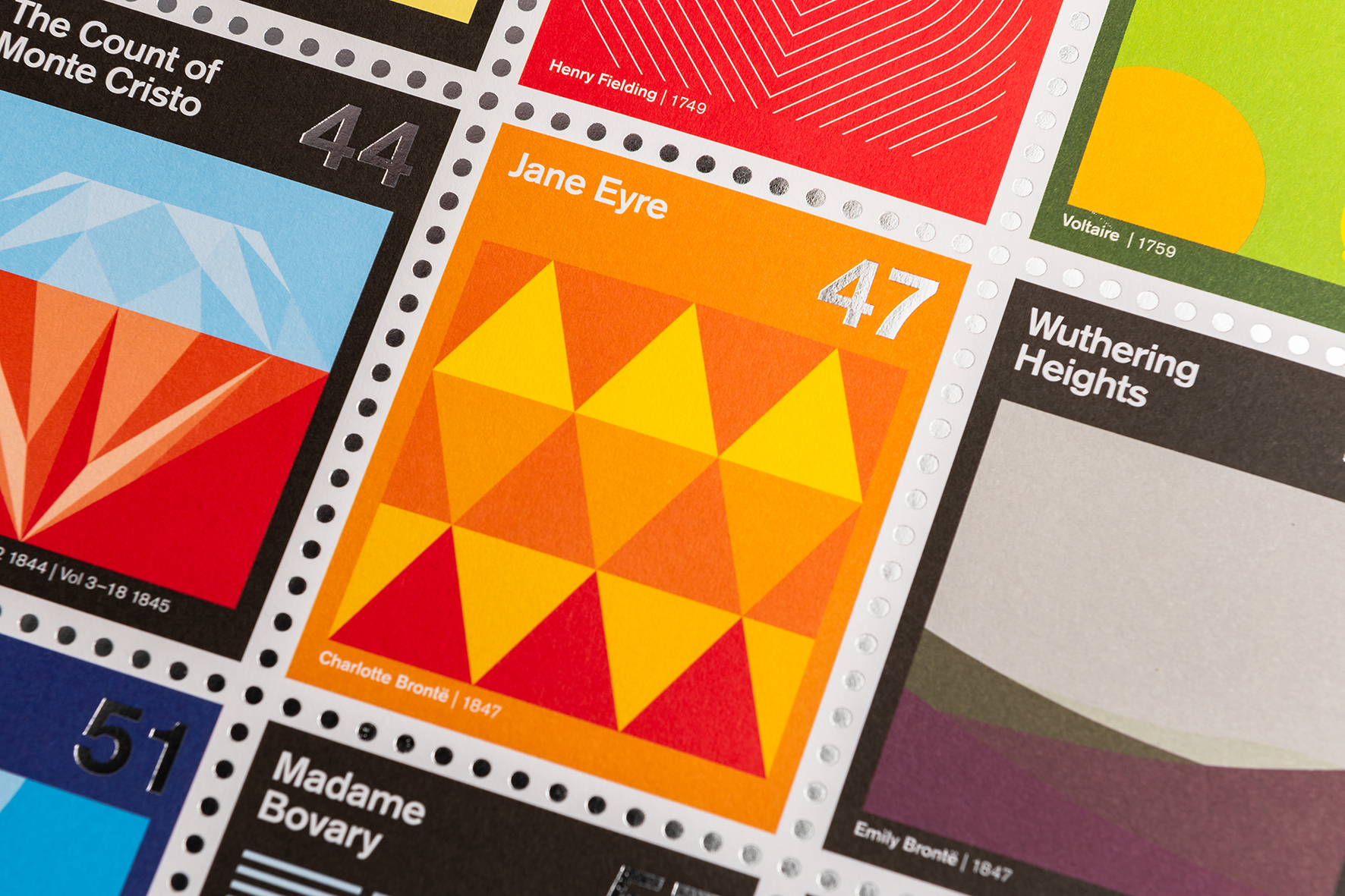
Our ignorance is such, we may need to reread Tess of the d’Urbervilles and Jane Eyre … or at least Google the significance of a spoon and all those orange and red triangles.
(Back in our pre-digital youth, Cliff’s Notes were the preferred Philistine option…)
Dorothy’s stamp prints of Classics and Modern Classics are available for purchase on their website.
Its related poems will almost certainly strike those of us whose understanding of feline attitude has been shaped by LOLCats, Grumpy Cat, the existential Henri, Talking Kitty Cat’s acerbic Sylvester, and the mordant 1970s TV spokescat Morris as sweet to the point of sickly. But it boasts six hundred vocabulary words, a rhyme structure that promotes reading aloud, and a note to teachers with suggestions for classroom activities.
Grover explained how her feline cast of characters would win over even the most reluctant reader, inspiring “much the same delight to the little reader of juvenile fiction, as do adventure and romance to the grown-up reader”:
In one respect kittens take precedence over dolls. They are alive. They must be treated kindly. They will not bear the abuse and neglect given to many beautiful dolls. They demand attention and companionship, and they return a real devotion in return for kindness and care. Therefore we love them and especially do our children love them and delight in stories of them.
The loosely structured story concerns a grand party thrown by the Queen of the Cats. Following some breathless preparations, the guests take turns introducing themselves to her majesty, though unlike T.S. Eliot’s Old Possum’s Book of Practical Cats (1939), there’s not much that could be cobbled into a hit musical.
One lace-bonneted character is reminiscent of Tom Kitten’s mother, Mrs. Tabitha Twitchit, and her unsuccessful attempts to wrangle her rambunctious offspring into clothing fit for “fine company,” though the wit falls somewhat short of Beatrix Potter’s.
Headgear abounds, as do restrictive buntings that must’ve been a great help when dealing with uncooperative models and long exposures.
Although the photographer is uncredited, the images are likely the work of Harry Whittier Frees, a “pioneer of the anthropomorphic kitten photograph genre” as per the New York Daily News. In his introduction to his far more ambitiously posed 1915 work, The Little Folks of Animal Land, Frees alluded to his process:
The difficulties of posing kittens and puppies for pictures of this kind have been overcome only by the exercise of great patience and invariable kindness. My little models receive no especial training, and after their daily performance before the camera they enjoy nothing more than a good frolic about the studio.
That’s a pleasant thought, though historian and postcard collector Mary L. Weigley tells a somewhat different tale in an article for Pennsylvania Heritage, describing how only 3/10 of his negatives could be published, and his work was so “challenging, time-consuming and nerve-wracking” that he took 9 months out of every year to recuperate.
Cats!
Download a free copy of Eulalie Osgood Grover’s Kittens and Catshere.
A painting? “Moving. Spiritually enriching. Sublime. ‘High’ art.” The comic strip? “Vapid. Juvenile. Commercial hack work. ‘Low’ art.” A painting of a comic strip panel? “Sophisticated irony. Philosophically challenging. ‘High’ art.” So says Calvin of Bill Watterson’s Calvin and Hobbes, whose ten-year run constitutes one of the greatest artistic achievements in the history of the newspaper comic strip. The larger medium of comics goes well beyond the funny pages, as any number of trend pieces have told us, but as an art form it remains less than perfectly understood. Perhaps, as elsewhere, one must learn by doing: hence “How to Make Comics,” a “four-part journey through the art of comics” from the Museum of Modern Art.
Created by comics scholar and writer Chris Gavaler, this educational series begins with the broadest possible question: “What Are Comics?” That section offers two answers, the first being that comics are “cartoons in the funnies sections of newspapers and the pages of comic books” telling stories “about superheroes or talking animals” — or they’re longer-format “graphic novels,” which “can be more serious and include personal memoirs.”
The second, broader answer conceives of comics as nothing more specific than “juxtaposed images. Any work of art that divides into two or more side-by-side parts is formally a comic. So if an artist creates two images and places them next to each other, they’re working in the comics form.”
That second definition of comics includes, say, Andy Warhol’s Jacqueline Kennedy III — a work of art that conveniently happens to be owned by MoMA. The museum’s visual resources figure heavily into the whole “How to Make Comics,” in which Gavaler explains not just the process of creating comics but the relationship between comics and other (often longer institutionally approved) forms of art. And to whatever degree they juxtapose images, the works of art in MoMA’s online collection — rich as so many of them are with action, character, narrative, humor, and even words — offer inspiration to comic artists budding and experienced alike. The better part of two centuries into its development, this thoroughly modern medium has the power to incorporate ideas from any other art form; the high-and-low distinctions can take care of themselves. Enter “How to Make Comics” here.
Based in Seoul, Colin Marshall writes and broadcasts on cities, language, and culture. His projects include the Substack newsletterBooks on Cities, the book The Stateless City: a Walk through 21st-Century Los Angeles and the video series The City in Cinema. Follow him on Twitter at @colinmarshall or on Facebook.

During the pandemic, Google launched a series of Career Certificates that will “prepare learners for an entry-level role in under six months.” The new career initiative includes certificates concentrating on Project Management and UX Design. And now also Data Analytics, a burgeoning field that focuses on “the collection, transformation, and organization of data in order to draw conclusions, make predictions, and drive informed decision making.”
Offered on the Coursera platform, the Data Analytics Professional Certificate consists of eight courses, including “Foundations: Data, Data, Everywhere,” “Prepare Data for Exploration,” “Data Analysis with R Programming,” and “Share Data Through the Art of Visualization.” Overall this program “includes over 180 hours of instruction and hundreds of practice-based assessments, which will help you simulate real-world data analytics scenarios that are critical for success in the workplace. The content is highly interactive and exclusively developed by Google employees with decades of experience in data analytics.”
Upon completion, students–even those who haven’t pursued a college degree–can directly apply for jobs (e.g., junior or associate data analyst, database administrator, etc.) with Google and over 130 U.S. employers, including Walmart, Best Buy, and Astreya. You can start a 7‑day free trial and explore the courses here. If you continue beyond the free trial, Google/Coursera will charge $39 USD per month. That translates to about $235 after 6 months, the time estimated to complete the certificate.
Note: Open Culture has a partnership with Coursera. If readers enroll in certain Coursera courses and programs, it helps support Open Culture.
In fiction the inspirational high-school English teacher is a cliché, despite (or indeed due to) the fact that so many of us have had at least one of them in real life. For generations of students who passed through San Francisco’s prestigious Lowell High School, that teacher was Flossie Lewis. Long after her retirement, she went surprisingly viral in a 2016 PBS interview clip about her thoughts on aging. It seemed she retained her power to inspire, not just for her more than seven million online viewers, but also for the PBS producers who later reunited her with her former students in the very same classroom where she once taught them.
You can see this reunion take place in the video above, which also includes Flossie telling her own story of having fled Brooklyn spinsterhood on a Greyhound bus headed west. “I could command the attention of a class,” she says of the source of her power as a teacher. “I had a voice. I had that kind of personality that did not seem teacherly, but was provocative.”
Onetime student Daniel Handler, better known as the novelist Lemony Snicket, credits Flossie with an “ability to startle.” Another, now an architect, remembers “gravitas” — and his having been “intimidated by her name. Flossie is a very unusual name.” Or at least it is today, its popularity (driven, it seems, by the Bobbsey Twins books) having peaked in the early 20th century.
Flossie is also representative of her generation in another way: not particularly caring for the music of Bob Dylan. Though she can’t have been thrilled with that guitar-playing (relative) youngster’s 2016 Nobel Prize for Literature, she’s willing to hear her students out on the subject. “The trivial task before us is to decide whether Bobby Dylan is worth the laureate,” she declares to the group of Lowell alumni gathered in her old classroom. Now all middle-aged, her former students include Dylan defenders and Dylan deniers alike, but what unites them are their undimmed memories of their teacher’s mixture of rigor, compassion, and sheer eccentricity. As one of them recalls, “You read us a sonnet from Shakespeare and said, ‘It’s no good.’ ” Whatever his generational relevance, the poet from Hibbing may never have stood a chance.
Based in Seoul, Colin Marshall writes and broadcasts on cities, language, and culture. His projects include the Substack newsletterBooks on Cities, the book The Stateless City: a Walk through 21st-Century Los Angeles and the video series The City in Cinema. Follow him on Twitter at @colinmarshall or on Facebook.
Those who grew up with the BBC sci-fi series Doctor Who watched from “behind the sofa,” a popular phrase associated with the show for the rubbery, bug-eyed monsters it held in store each week for loyal viewers. Although it may be hard for those who didn’t experience it in their formative years to understand, Doctor Who has frequently been voted the scariest TV show of all time, over grislier, big-budget series like The Walking Dead, and has done so without losing its sense of humor, a testament to the conceit of “regeneration” keeping things fresh by updating the Doctor and his companions every few years.
Space monsters, Daleks, Cybermen, and a revolving cast, however, were not part of Doctor Who’s original remit. The show began as an educational program on the BBC, and this explains many of its integral parts, which have remained throughout its first run from 1963 to 1989 and its revival from 2005 to the present. These elements include the TARDIS, companions of various ages, the Coal Hill School, and the Doctor himself, a Time Lord from the planet Gallifrey with interstellar technology and a dodgy memory.
We find the core premise in the show’s pilot episode and original 4‑part series, An Unearthly Child, which introduced William Hartnell as the Doctor, Carole Ann Ford as his granddaughter, Susan Foreman (originally named Barbara, or “Biddy”), and Jaqueline Hill and William Russell as school teachers Barbara Wright and Ian Chesterton. BBC drama head Sydney Newman had tasked writers with creating a family educational show to meet the network’s public service mandate, and came up with the idea of a science fiction show as a way to have characters visit historical periods and talk about science in an entertaining way.
“Doctor Who’s early historical stories emphasize education by downplaying the programme’s fantasy with minimal science-fiction elements,” writes Tom Steward at Deletion. The idea of a time machine bigger on the inside than the outside came from Newman. Writer Anthony Coburn turned it into a police box after a note from Newman asking for a “tangible” symbol. Newman “instructed writers to ‘get across the basis of teaching of educational experience.’ ” When they came back with a story about Daleks, he balked: “No bug-eyed monsters,” he wrote, no alien baddies, no actors in rubber suits. This was to be a serious show about serious educational subjects. Script changes and technical challenges meant months of setback and delays.
It was difficult for some critics to take the resulting four episode arc particularly seriously. The first episode showed Barbara and Ian discovering the TARDIS in a London junkyard. Then they are all transported to the prehistoric past, where they observe (and escape) a power struggle among prehistoric cave people. (Guardian critic Mary Crozier lamented that the “wigs and furry pelts and clubs were all ludicrous.”) The show’s debut was also inauspicious: November 23, 1963, the day after John F. Kennedy’s assassination. The BBC reran the first episode the next week and picked up another 2 million viewers.
Still, it had become clear after the first series that in order to survive, Doctor Who would have “to give the public what they wanted,” Steward writes, “rather than what was good for them.” Thus, the Daleks debuted in the second season, and by the mid-60s, historical stories were replaced with “fantasies in historical costume featuring anachronistic villains or monsters.” The show became a weekly creature feature and introduced terrifying villains like Davros, the Daleks’ creator, a cross between a Strangelove-like Nazi scientist and Star Wars’ clone-happy Emperor Palpatine (Davros came first).
The costumes may look silly in hindsight, but as childhood Who fan Charlie Jane Anders writes at io9, “those of us who are adults now didn’t have huge screen HD televisions when we were kids.” (And those of us who remember it, remember being terrified by equally goofy costuming in The Land of the Lost.) Look past the low-budget effects and Doctor Who becomes pure horror, exploring very dark territory with only a sonic screwdriver, a few friends, and a quirky sense of humor — or 13 quirky senses of humor, including Jodie Whittaker’s as the current Doctor and first woman to fill the role.
As you can see from the clips of the first episode above, Doctor Who established its weird air of existential dread from the start with Delia Derbyshire’s otherworldly theme and some avant-garde camera effects in lieu of bigger-budget spectacles. The show did not retain much from its educational beginnings aside from the key characters and the look and feel of the TARDIS. It was “seen to have failed as pedagogy,” writes Steward, but as a body of science fiction lore that continues to stay relevant, it has all sorts of lessons to teach about courage, companionship, and the value of the right tool for the right job.
The name B.F. Skinner often provokes darkly humorous references to such bizarre ideas as “Skinner boxes,” which put babies in cage-like cribs, and put the cribs in windows as if they were air-conditioners, leaving the poor infants to raise themselves. Skinner was hardly alone in conducting experiments that flouted, if not flagrantly ignored, the ethical concerns now central to experimentation on humans. The code of conduct on torture and abuse that ostensibly governs members of the American Psychological Association did not exist. Radical behaviorists like Skinner were redefining the field. His work has come to stand for some of its worst abuses.
But Skinner has been mischaracterized in the popularization of his ideas — a popularization, it’s true, in which he enthusiastically took part. The actual “Skinner box” was cruel enough — an electrified cage for animal experimentation — but it was not the infant window box that often goes by the name. This was, instead, called an “aircrib” or “baby-tender,” and it was loaded with creature comforts like climate control and a complement of toys. “In our compartment,” Skinner wrote in a 1945 Ladies Home Journal article, “the waking hours are invariably active and happy ones.” Describing his first test subject, his own child, he wrote, “our baby acquitted an amusing, almost apelike skill in the use of her feet.”
Skinner was not a soulless monster who put babies in cages, but he also did not understand mammalian babies’ need for physical touch. Likewise, when it came to education, Skinner had ideas that can seem contrary to what we know works best, namely a variety of methods that honor different learning styles and abilities. Educators in the 1950s embraced far more regimented practices, and Skinner believed humans could be trained just like other animals. He treated an early experiment in classroom technology just like an experiment teaching pigeons to play ping-pong. It was, in fact, “the foundation for his education technology,” says education journalist Audrey Watters, “that we’ll build machines and they’ll give students — just like pigeons — positive reinforcement and students — just like pigeons — will learn new skills.”
The teaching machine was composed of mainly a program, which was a system of combined teaching and test items that carried the student gradually through the material to be learned. The “machine” was composed of a fill-in-the-blank method on either a workbook or on a computer. If the student was correct, he/she got reinforcement and moved on to the next question. If the answer was incorrect, the student studied the correct answer to increasing the chances of getting reinforced next time.
Consisting of a wooden box, a metal lid with cutouts, and various paper discs with questions and answers written on them, the machine did adjust for different students’ needs, in a way. Skinner “noted that the learning process should be divided into a large number of very small steps and reinforcement must be dependent upon the completion of each step. He believed this was the best possible arrangement for learning because it took into account the rate of learning for each individual student.” He was again inspired by his own children, coming up with the machine after visiting his daughter’s school and deciding he could improve on things.
The method and means of learning, as you’ll see in the demonstration films above, were not individualized. “There was very, very little freedom in Skinner’s vision,” says Watters. “Indeed Skinner wrote a very well-known book, Beyond Freedom and Dignity in the early 1970s, in which he said freedom doesn’t exist.” While Skinner’s machine didn’t itself become widely used, his ideas about education, and education technology, are still very much with us. We see Skinner’s machine “taking new forms with adaptive teaching and e‑learning,” writes Solanki.
And we see the darker side of his design in classroom technology, says Watters, in an industry that profits from alienating, one-size-fits all ed-tech solutions. But she also sees “students who are resisting and communities who are building practices that serve their needs rather than serving the needs of engineers.” Skinner’s theories of conditioning were and are incredibly persuasive, but his reductive views of human nature seem to leave out more than they explain. Learn more about the history of teaching machines in Watters’ new book, Teaching Machines: The History of Personalized Learning.
British character actor Bob Hoskins has been remembered for “playing Americans better than Americans,” as USA Today wrote when Hoskins passed away in 2014. Characters like Who Framed Roger Rabbit?’s Eddie Valiant, Nixon’s J. Edgar Hoover, and The Cotton Club’s Owney Madden stand out as some of his best performances in Hollywood. But he began his career in British film and television, playing cops and gangsters. Helen Mirren, who starred opposite him in his first major role, The Long Good Friday, and onstage in The Duchess of Malfi, penned a glowing tribute for The Guardian. “London,” she wrote, “will miss one of her best and most loving sons, and Britain will miss a man to be proud of.”
Mirren’s sentiments were echoed by British actors everywhere. Shane Meadows called him “the most generous actor I have ever worked with.” Stephen Woolley described Hoskins as a working-class hero. “With his talent, Bob gatecrashed the world of celebrity, and made all of us ordinary people feel a little better about ourselves.” It was a role he was seemingly born to play, despite his range. Hoskins was “a great actor,” writes Woolley, “yet unlike many actors he was first and foremost a courteous, sweet and caring human being. He could make monsters human and wring a smile out of any situation without a whisker of embarrassment.”
Those are the very qualities that endeared viewers to Hoskins’ first breakout character, Alf Hunt, a furniture removal man who struggled with reading and writing in On the Move, a kind of “Sesame Street for adults” that ran in 1976 on the BBC. The 10-minute shorts ran on Sunday afternoons “as part of the BBC’s adult education remit,” Mark Lawson writes at The Guardian. Hoskins’ performance brought to life for viewers “a proud man who has desperately disguised his learning difficulties.” It met a serious need among the nation’s populace.
“The show attracted 17 million viewers a week, (way beyond the size of its target audience),” notes a MetaFilter user. On the Move “helped make Hoskins famous. It was also responsible for persuading 70,000 people to sign up for adult literacy programmes.” Hoskins treasured the letters he received from viewers who decided to change their lives after seeing the show. They may well have done so because he gave his all to the character, as Lawson writes:
Handed a working-class stereotype (not for the last time in his career), Hoskins gave Alf a vulnerability and poignancy far beyond the requirements of a public information short. Apart from its intended audience of adults struggling with reading and writing, On the Move gained a large secondary following among literate viewers because, even then, Hoskins’ expressive face and growly voice made you want to watch and listen.
In each episode, Alf revealed his struggles to his friend Bert, played by Donald Gee. The show also featured inspiring interviews with adults who had taken adult literacy classes and appearances by special guest stars like Patricia Hayes and Martin Shaw (who both appear in the episode at the top). While other famous actors may disown early television work, Hoskins never did. On the Move “shared the qualities of his best stuff. Whereas most footage in Before They Were Famous type shows is calculated to be bathetic or embarrassing,” Hoskins’ earliest work does quite the opposite, explaining why he “went on to become the star he did.”
On the Move may also have earned Hoskins another title, one he might have cherished as much as any acting plaudit. George Auckland, who later directed the BBC’s adult education program, called him “the best educator Britain has produced” because of his wide reach among adults struggling with literacy in 1970s Britain. See an episode of On the Move at the top of the post and hear what commenters call “the catchiest theme song ever” just above.
We're hoping to rely on loyal readers, rather than erratic ads. Please click the Donate button and support Open Culture. You can use Paypal, Venmo, Patreon, even Crypto! We thank you!
Open Culture scours the web for the best educational media. We find the free courses and audio books you need, the language lessons & educational videos you want, and plenty of enlightenment in between.