Here’s the context to a sobering newly-released video from The New York Times:
In the video above, Alexander Stockton, a producer on the Opinion Video team, explores two of the main reasons the number of Covid cases is soaring once again in the United States: vaccine hesitancy and refusal.
“It’s hard to watch the pandemic drag on as Americans refuse the vaccine in the name of freedom,” he says.
Seeking understanding, Mr. Stockton travels to Mountain Home, Ark., in the Ozarks, a region with galloping contagion and — not unrelated — abysmal vaccination rates.
He finds that a range of feelings and beliefs underpins the low rates — including fear, skepticism and a libertarian strain of defiance.
This doubt even extends to the staff at a regional hospital, where about half of the medical personnel are not vaccinated — even while the intensive care unit is crowded with unvaccinated Covid patients fighting for their lives.
Mountain Home — like the United States as a whole — is caught in a tug of war between private liberty and public health. But Mr. Stockton suggests that unless government upholds its duty to protect Americans, keeping the common good in mind, this may be a battle with no end.
The Emmy-nominated HBO Documentary Films series on obesity, The Weight of the Nation, premiered in May 2012. And it’s now free to watch online.
Boilerplate human interest stories about the habits of particularly spry centenarians just don’t cut it anymore. Living a long, healthy, and happy life, we know, involves more than making the right individual choices. It means living in societies that make good choices readily available and support the individuals making them. Nutrition research has borne this out — just scan the latest popular food book titles for the word “Mediterranean,” for example, or input the same search term in an academic database, and you’ll pull up hundreds of results. Even fad diets have shifted from promoting individual celebrities to celebrating whole regions.
Scientists have identified a handful of places around the world, in fact, where diet and other ordinary lifestyle and social factors have led to the outcomes governments spend billions trying, and failing, to achieve. One of these regions is — yes — squarely in the Mediterranean, the Greek island of Ikaria, “named one of the healthiest places on earth,” writes Greek City Times, “a spot of exceptional longevity. Here, there are more healthy people over 90 than any other place on the planet.” Ikaria is just one of five so-called “Blue Zones” — which also include Sardinia, Italy, Okinawa, Japan, Nicoya, Costa Rica, and Loma Linda, California — where inhabitants regularly live healthy lives into their 90s and beyond.
In the Vice video above, you can meet some of the residents of Ikaria, where 1 in 3 people live past 90, and learn about some of the factors that contribute to long life in blue zones, and in Ikaria in particular. Great weather doesn’t hurt. Most important, however, is local, fresh food, and lots of it. “The most important thing is the food,” says an Ikarian cook as she prepares a batch of fresh-caught fish. “Because you live with it. You eat the right way, everything works the right way.” This is a much better way of saying “you are what you eat.” As Max Fisher points out in a bulleted list of the Greek Island’s “secrets to long life,” things “working the right way” plays a huge role in longevity.
Not only do older people in Ikaria walk everywhere and continue working into their elderly years – happily but not under duress – they also report very healthy sex lives, part of a network of habits that socially reinforce each other, Fisher writes. Hear Ikarian residents above contrast their lives on the island with their lives in fast-paced modern cities where they traded health and wellbeing for more money. Read Fisher’s full list (excerpted below) at The Washington Post.
From Chris Goto-Jones–now Dean of Humanities and Professor of Philosophy at the University of Victoria–comes a free course which was named ‘one of the best online courses of all time’ in 2020. The course description for De-Mystifying Mindfulness reads:
Interest in meditation, mindfulness, and contemplation has grown exponentially in recent years. Rather than being seen as mystical practices from ancient Buddhism or esoteric philosophy, they are increasingly seen as technologies rooted in evidence from psychology and neuroscience. Mindfulness has become the basis for numerous therapeutic interventions, both as a treatment in healthcare and as a means of enhancing well-being and happiness. For millions around the world, mindfulness has become a life-style choice, enhancing and enriching everyday experience. Mindfulness is big business.
But, what actually is mindfulness? Is it really good for you? Can anyone learn it? How can you recognize charlatans? Would you want to live in a mindful society, and would it smell like sandalwood? What does it feel like to be mindful? Are you mindful already, and how would you know?
Evolving from the popular Honours Academy course at Leiden University [in the Netherlands], this innovative course combines conventional scholarly inquiry from multiple disciplines (ranging from psychology, through philosophy, to politics) with experiential learning (including specially designed ‘meditation labs,’ in which you’ll get chance to practice and analyze mindfulness on yourself). In the end, the course aims to provide a responsible, comprehensive, and inclusive education about (and in) mindfulness as a contemporary phenomenon.
You can take De-Mystifying Mindfulness for free by selecting the audit option upon enrolling. If you want to take the course for a certificate, you will need to pay a fee.
Napping is serious business, despite the fact that when some of us think of naps, we think about preschool. We’ve been taught to think of naps as something to outgrow. Yet as we age into adulthood, so many of us find it hard to get enough sleep. Millions currently suffer from sleep deprivation, whose effects range from memory loss to, well… death, if we credit the dire warnings of neuroscientist Matthew Walker. “Sleep,” Walker says, “is a non-negotiable biological necessity.”
In light of the latest research, napping begins to seem more like urgent preventive care than an indulgence. In fact, sleep expert Sara Mednick says, naps are a “miracle drug” that “increases alertness, boosts creativity, reduces stress, improves perception, stamina, motor skills, and accuracy, enhances your sex life,” helps you lose weight, feel happier, and so on, all without “dangerous side effects” and with a cost of nothing but time.
If this sounds like hype, consider the quality of the source – Dr. Sara Mednick, a professor of Cognitive Science at the University of California, Irvine (UCI) and a fellow at the Center for the Neurobiology of Learning and Memory. Mednick runs a “seven-bedroom sleep lab at UCI,” notes her site, that works “literally around-the-clock to discover methods for boosting cognition through a range of different interventions, including napping.”
Maybe you’re sold on the benefits and simple pleasures of a nap — but maybe it’s been a few years since you’ve scheduled one. How long, exactly, should a grown-up nap last? The animated TED-Ed lesson above, scripted by Mednick, answers that question with a short course on sleep cycles: how we move through different stages as we snore, reaching the deepest sleep at stage 3 and concluding a cycle with R.E.M. The length of the nap we take can depend on the kinds of tasks we need to perform, and whether we need to wake up quickly and get on to other things.
Mednick expands substantially on her evidence-based advocacy for naps in her book Take a Nap! Change Your Life. (See her discuss her research on sleep and memory in the short video just above.) In the book’s introduction, she tells the story of her “journey from skeptic to nap advocate.” Here, she uses uses a different metaphor. Naps, she says, are a “secret weapon” — one she reached for just minutes before she stood up at the Salk Institute to present research on naps. “I never imagined,” she writes of her journey into napping, “that a healthy solution to facing life’s multiple challenges could be as simple and attainable as a short nap.” Given how much sleep we’re all losing lately, maybe it’s not so surprising after all.
Yoga as an athletic series of postures for physical health came into being only about 100 years ago, part of a wave of gymnastics and calisthenics that spread around the Western world in the 1920s and made its way to India, combining with classical Indian spirituality and asanas, a word which translates to “seat.” Yoga, of course, had existed as a classical spiritual discipline in India for thousands of years. (The word is first found in the Rig Veda), but it had little to do with fitness, as yoga scholar Mark Singleton found when he delved into the roots of yoga as we know it.
Asana practice was often marginal, even scorned by some 19th century Indian teachers of high caste as the domain of “fakirs” and mendicant beggars. “The first wave of ‘export yogis,’” writes Singleton, “headed by Swami Vivekananda, largely ignored asana and tended to focus instead on pranayama [breath practice], meditation, and positive thinking…. Vivekananda publicly rejected hatha yoga in general and asana in particular.”
In the 20th century, yoga became associated with Indian nationalism and anti-colonial resistance, and imported Western poses were combined with asanas for a program of intense physical training.
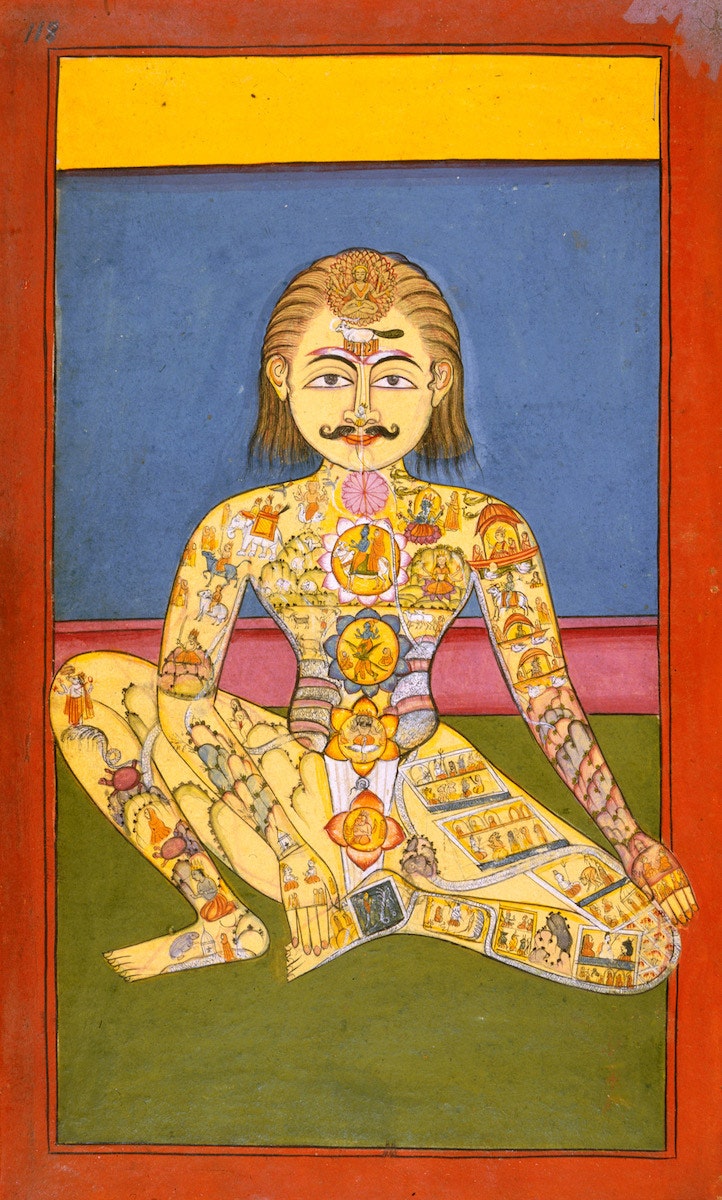
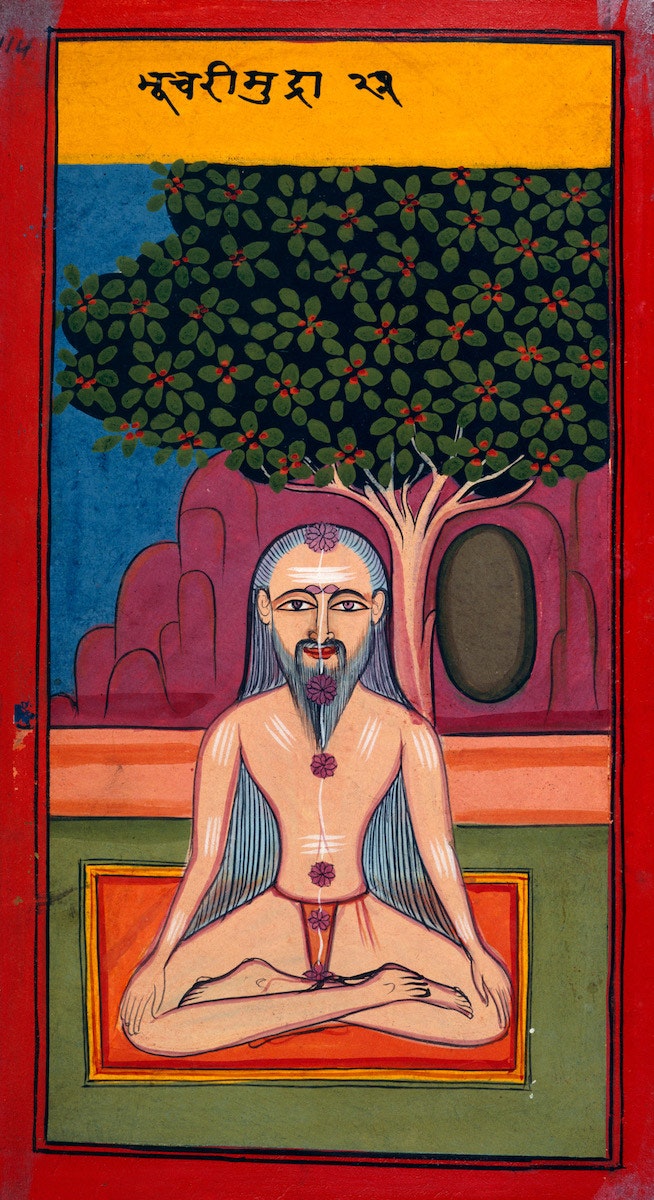
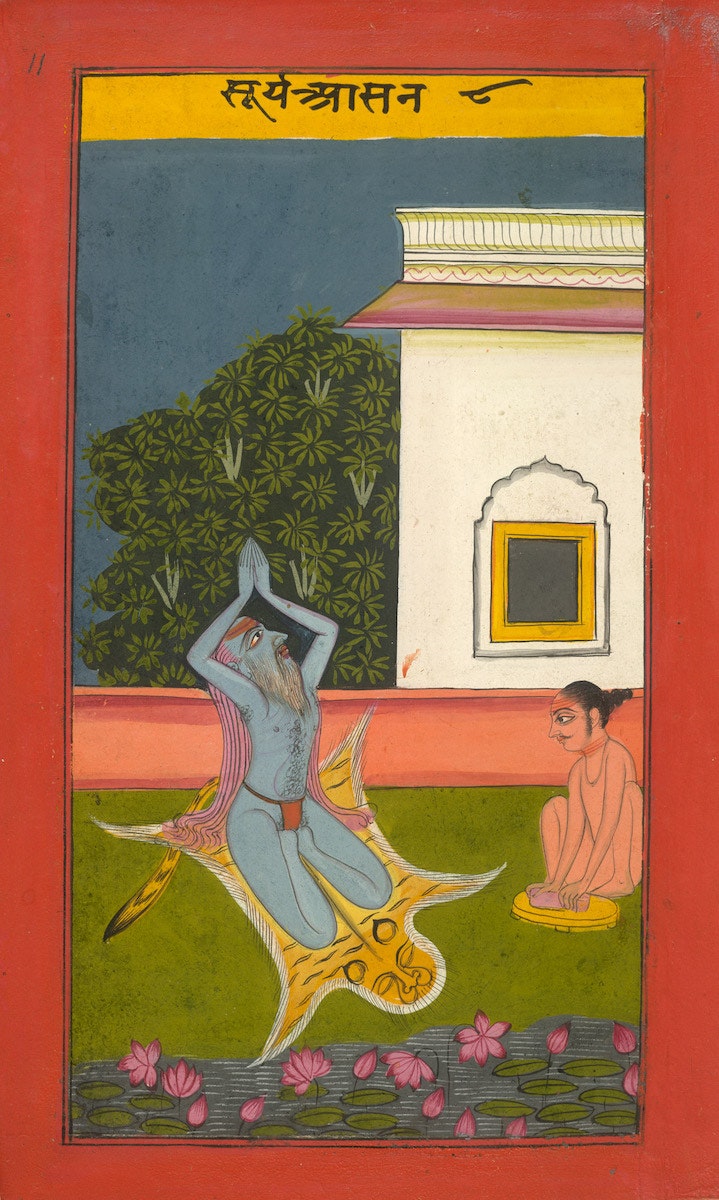
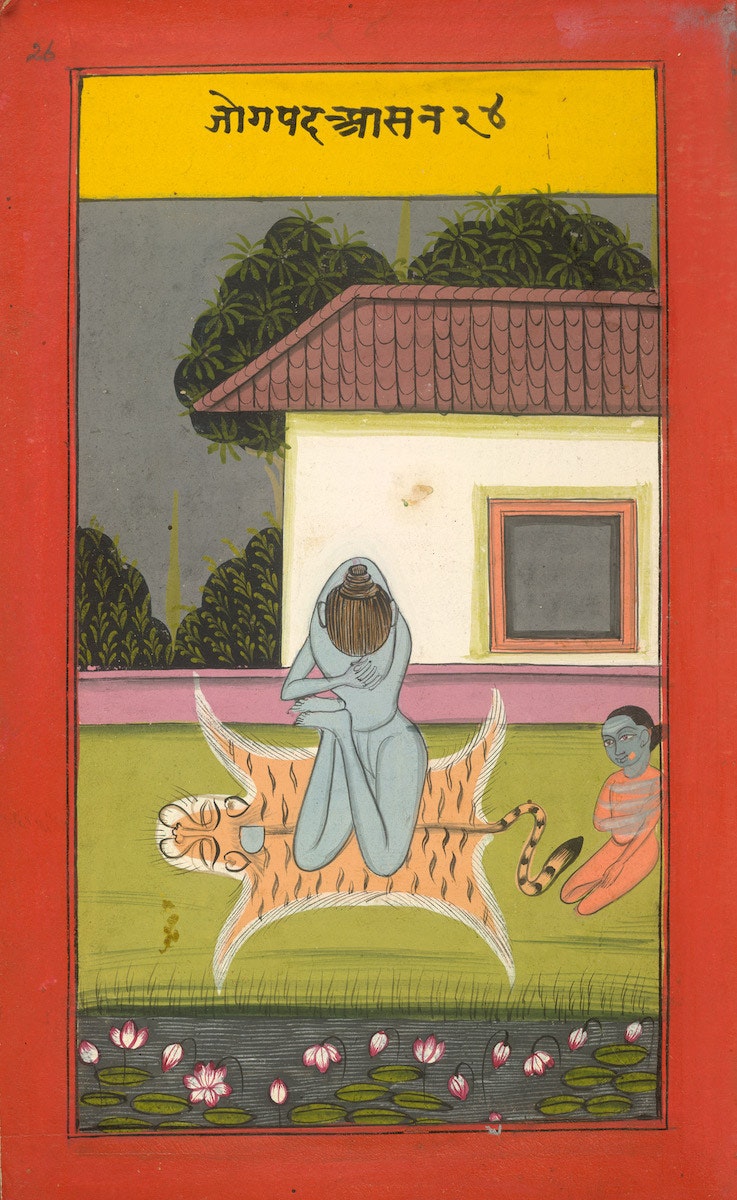
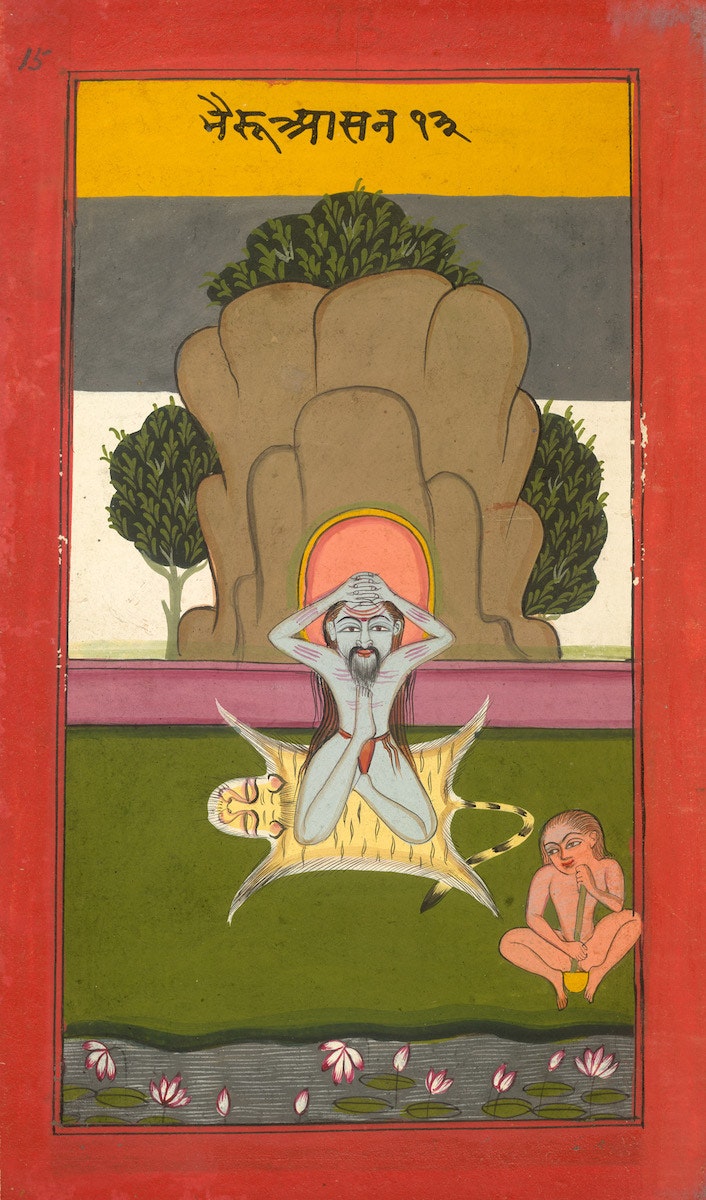
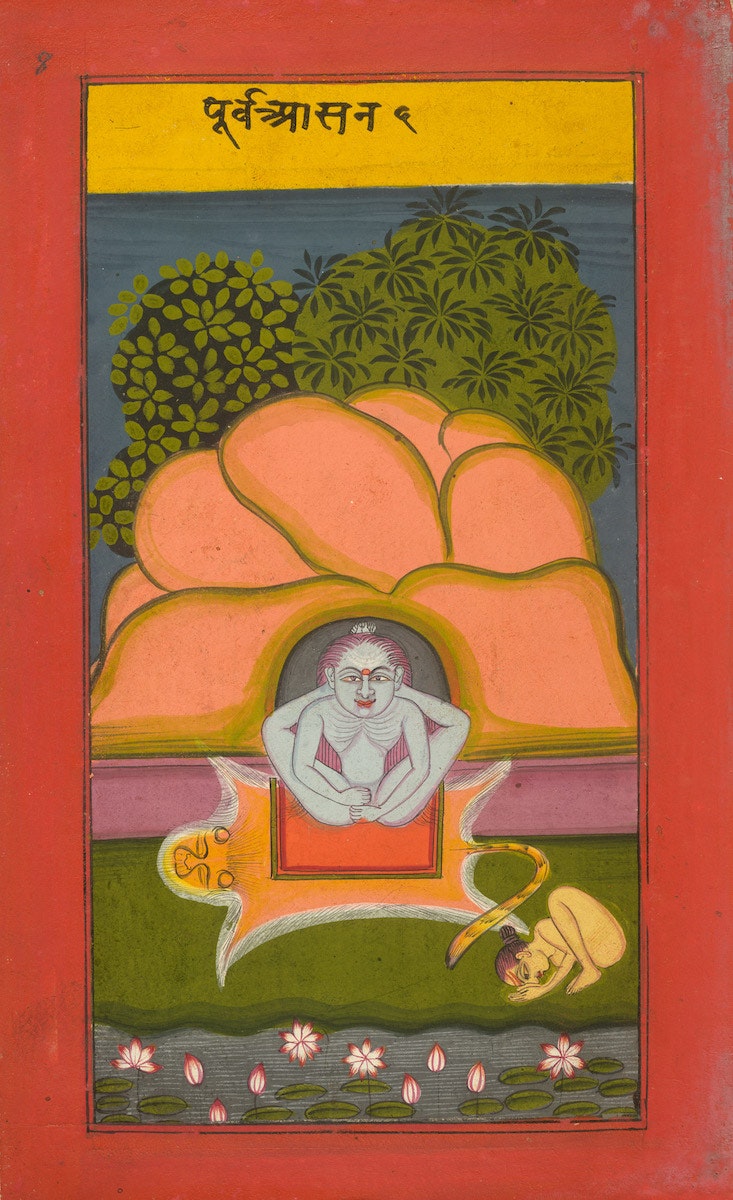
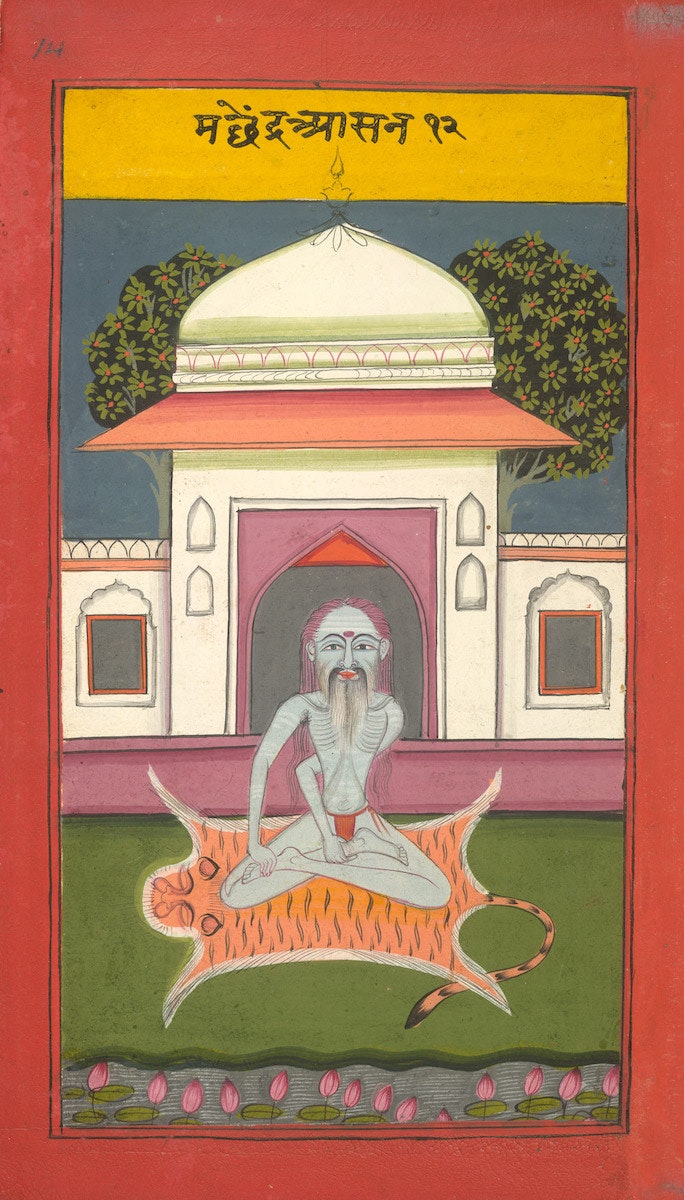
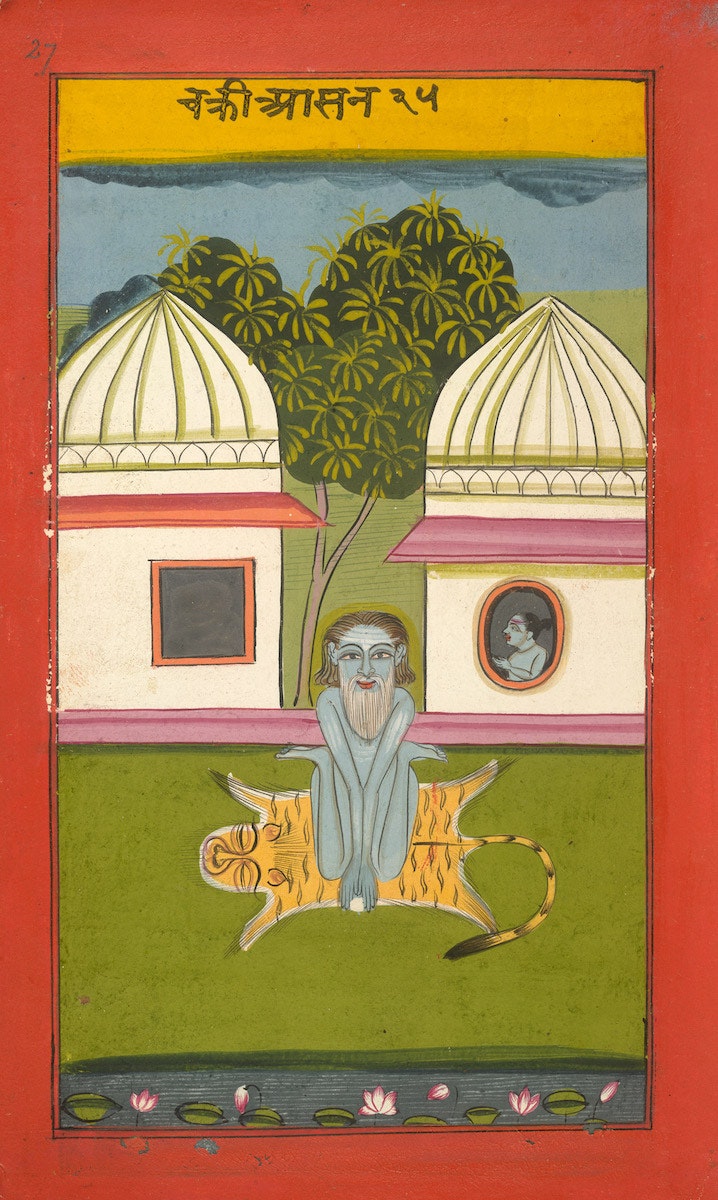
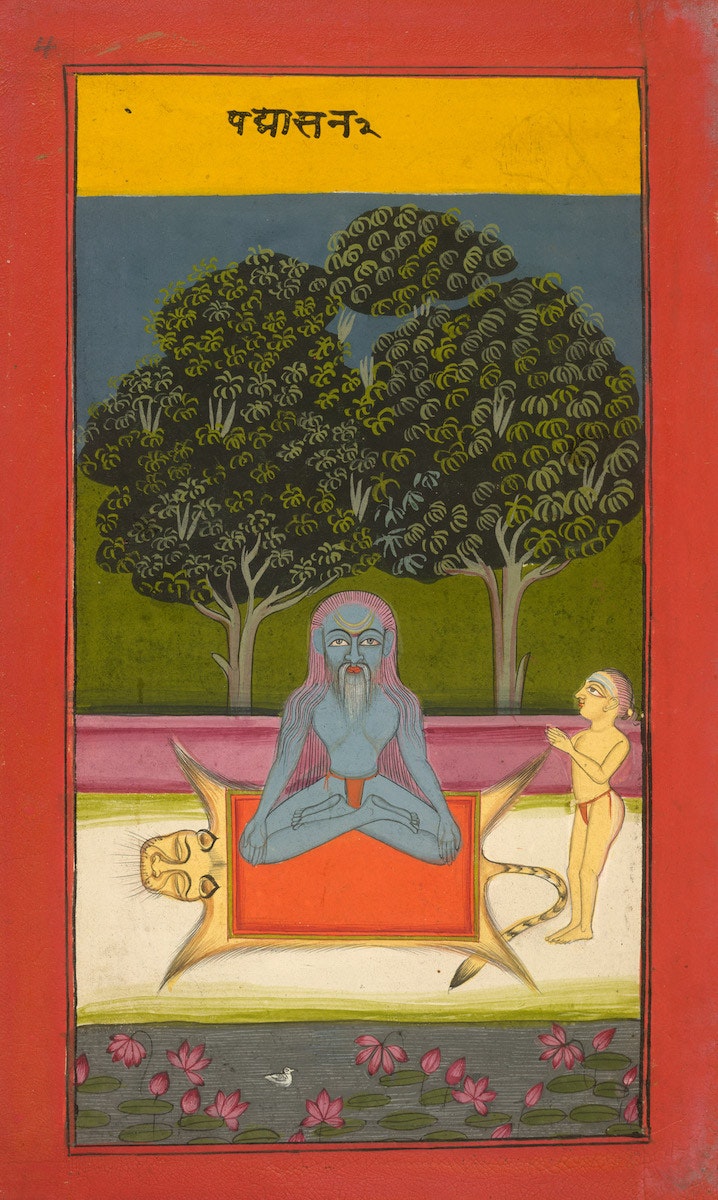
Westernized yoga has obscured other traditions around the world that developed over hundreds or thousands of years. For his book with James Mallinson, Roots of Yoga, Singleton consulted “yogic texts from Tibetan, Arabic, Persian, Bengali, Tamil, Pali, Kashmiri, Old Marathi, Avadhi, Braj Bhasha, and English,” notes the Public Domain Review, who bring our attention to this early 19th-century series of images from a text called the Joga Pradīpikā, made before classical yoga became known in the west by adventurous thinkers like Henry David Thoreau.
A few millennia before it was the provenance of lycra-clad teachers in boutique studios, asana practice combined rigorous, often quite painful-looking, meditative postures with mudras (“seals”), hand gestures whose origins “remain obscure,” though yoga historian Georg Feuerstein argues “they are undoubtedly the products of intensive meditation practice during [which] the body spontaneously assumes certain static as well as dynamic poses.” The collection of drawings in the 118-page book depicts 84 asanas and 24 mudras, “with explanatory notes in Braja-Bhasha verse,” notes the British Library, and one image (top) related to Kundalini yoga.
Whatever the various practices of yogic schools in both the Eastern and Western world, “the methods and lifestyles developed by the Indian philosophical and spiritual geniuses over a period of at least five millennia all have one and the same purpose,” writes Feuerstein in his seminal study, The Yoga Tradition: “to help us break through the habit patterns of our ordinary consciousness and to realize our identity (or at least union) with the perennial Reality. India’s great traditions of psychospiritual growth understand themselves as paths of liberation. Their goal is to liberate us from our conventional conditioning and hence also free us from suffering.”
Under a broad umbrella, yoga has flourished as an incredible wealth of traditions, philosophies, religious practices, and scholarship whose strands weave loosely together in what most of us know as yoga in a synthesis of East and West. Learn more at the Public Domain Review, and have a look at their new book of historic images, Affinities, here, a curated journey through visual culture.
Folk medicine is, or should be, antithetical to capitalism, meaning it should not be possible to trademark, copyright, or otherwise own and sell plants and natural remedies to which everyone has access. The entire reason such practices developed over the course of millennia was to help communities of close affiliation survive and thrive, not to foster market competition between companies and individuals. The impulse to profit from suffering has distorted what we think of as healing, such that a strictly allopathic, or “Western,” approach to medicine relies on ethics of exclusion, exploitation, and outright harm.
What we tend to think of as modern medicine, the Archive of Healing writes, “is object-oriented (pharmaceuticals, technologically driven) and structured by historical injustice against women and people of color.” The Archive, a new digital project from the University of California, Los Angeles, offers “one of the most comprehensive databases of medicinal folklore in the world,” Valentina Di Liscia writes at Hyperallergic. “The interactive, searchable website boasts hundreds of thousands of entries describing cures, rituals, and healing methods spanning more than 200 years and seven continents.”
In countries like the United States, where healthcare is treated as a scarce commodity millions of people cannot afford, access to knowledge about effective, age-old natural wisdom has become critical. There may be no treatments for COVID-19 in the database, but there are likely traditional remedies, rituals, practices, treatments, ointments, etc. for just about every other illness one might encounter. The archive was curated over a period of more than thirty years by “a team of researchers at UCLA, working under the direction of Dr. Wayland Hand and then Dr. Michael Owen Jones,” the site notes in its brief history.
The material from the collection, which was originally called the “archive of traditional medicine,” came from “data on healing from over 3,200 publications, six university archives, as well as first-hand and second-hand information from anthropological and folkloric fieldnotes.” In 2016, when Dr. Delgado Shorter took over as director of the program, he “reorganized it with an eye to social sharing and allowing for users to submit new data and comment on existing data,” notes UCLA’s School of the Arts and Architecture in an interview with Shorter, who describes the project’s aims thus:
The whole goal here is to democratize what we think of as healing and knowledge about healing and take it across cultures in a way that’s respectful and gives attention to intellectual property rights.
This may seem like a delicate balancing act, between the scholarly, the folkloric, and the realms of rights, remuneration, and social power. The Archive strikes it with an ambitious set of tenets you can read here, including an emphasis on offering traditional and Indigenous healing practices “outside of often expensive allopathic and pharmaceutical approaches, and not as alternatives but as complementary modalities.”
The archive states as one of its theoretical bases that health should be treated “as a social goal with social methods that affirm relationality and kinship.” Those wishing to get involved with the Archive as partners or advisory board members can learn how at their About page, which also features the following disclaimer: “Statements made on this website have not been evaluated by the Food and Drug Administration. The information contained herein is not intended to diagnose, treat, cure or prevent any disease.” Use the information wisely, at your own risk, in other words.
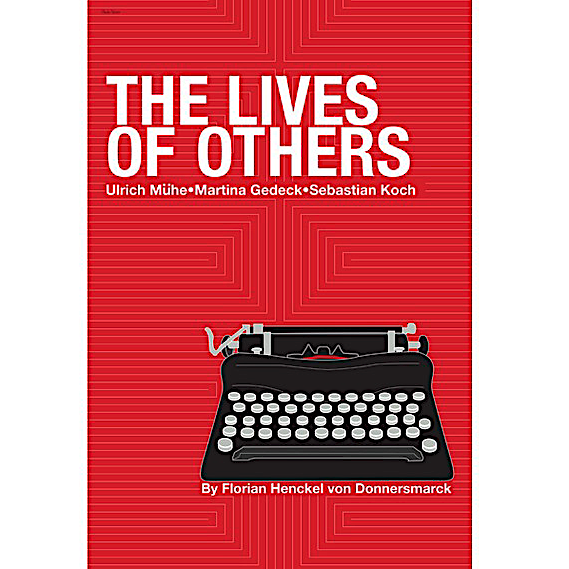
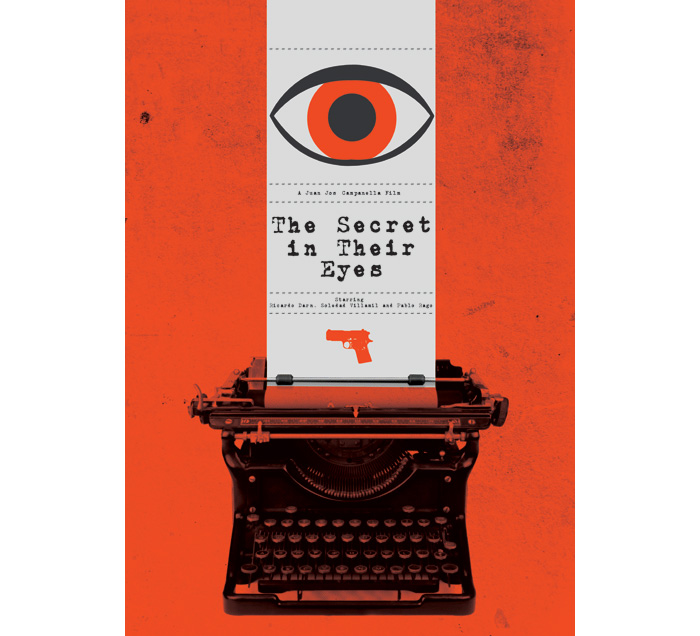
This collector’s top 10 list gives extra consideration to scripts that “place typewriters at the heart of the story.” First and second place feature typewriters on their posters.
An IBM Selectric III in Avissar’s supercut caused one viewer to reminisce about the anachronistic use of Selectric IIs in Mad Men’s first season secretarial pool. Creator Matthew Weiner admits the choice was deliberate. The first Selectric model is period appropriate, but much more difficult to find and challenging to maintain, plus their manual carriage returns would have created a headache for sound editors.
Avissar’s round up also serves to remind us of a particularly modern problem—the ongoing quest to portray texts and social media messages effectively on big and small screens. This dilemma didn’t exist back when typewriters were the primary text-based devices. A close up of whatever page was rolled onto the platen got the job done with a minimum of fuss.
Two of the most celebrated typewriter sequences in film history did not make the cut, possibly because neither features actual working typewriters: the NSFW anthropomorphic typewriter-bug in David Cronenberg’s adaptation of William S. Burrough’s Naked Lunch and Jerry Lewis’ inspired pantomime in Who’s Minding the Store, performed, like Avissar’s supercut, to the tune of composer Leroy Anderson’s The Typewriter.
We're hoping to rely on loyal readers, rather than erratic ads. Please click the Donate button and support Open Culture. You can use Paypal, Venmo, Patreon, even Crypto! We thank you!
Open Culture scours the web for the best educational media. We find the free courses and audio books you need, the language lessons & educational videos you want, and plenty of enlightenment in between.