If you would like to support the mission of Open Culture, consider making a donation to our site. It’s hard to rely 100% on ads, and your contributions will help us continue providing the best free cultural and educational materials to learners everywhere. You can contribute through PayPal, Patreon, and Venmo (@openculture). Thanks!
Take two of the most prominent English cultural properties of the past several decades, bring them together, and what have you got? You’ve got Patrick Troughton, better known as the Second Doctor in TV’s Doctor Who, in a 1965 BBC Radio adaptation of George Orwell’s 1984. Troughton was not yet the Doctor; the honor would not fall to him until the following year when he replaced William Hartnell (with the latter’s full approval, it seems). But he was a well-known character actor, the first to play Robin Hood on television (in a 1953 BBC mini-series), and a figure who inspired a good deal of respect in the British entertainment industry. Troughton was also a decorated World War II veteran (who, when the year 1984 finally arrived, suffered his second major heart attack).
Troughton brings to the role of everyman Winston Smith a gravitas shared by a number of actors who have inherited the role since the very first radio adaptation in 1949, starring David Niven. Of course Orwell’s story is not an ongoing series like Doctor Who, but it has remained remarkably relevant to every generation post-World War II, and like the Doctor’s character, has been constantly re-imagined in adaptations on radio, film, and television. The conditions of government repression, censorship, and mass surveillance Orwell foresaw have seemed imminent, if not fully realized, in the decades following the novel’s 1948 publication, though the adjective “Orwellian” and many of the novel’s coinages have suffered a good deal through overuse and misapplication.
Just as the first radio play of 1984 warned of a “disturbing broadcast,” this 1965 version begins, “The following play is not suitable for those of a nervous disposition.” It’s interesting that even this long after the novel’s publication, and in the midst of the swinging sixties, Orwell’s dystopian fable still had the power to shock. Or at least the producers of this broadcast thought so. Perhaps we’ve been so thoroughly inured to the prospects Orwell warned of that revelations of the NSA’s massive data collection, or of the global expropriation disclosed by the Panama Papers, or of any number of nefarious government dealings often elicit a cynical shrug from the average person. Those who do express alarm at such documented abuses are often branded… well, alarmists.
But then again, we keep returning to Orwell.
Continuing in the tradition begun by David Niven and carried forward by Patrick Troughton (and on film by Edmond O’Brien and John Hurt), another respected British actor recently took on the role of Winston Smith in a BBC 4 radio adaptation three years ago. This time the actor was Christopher Eccleston, who also, it turns out, once played Doctor Who.
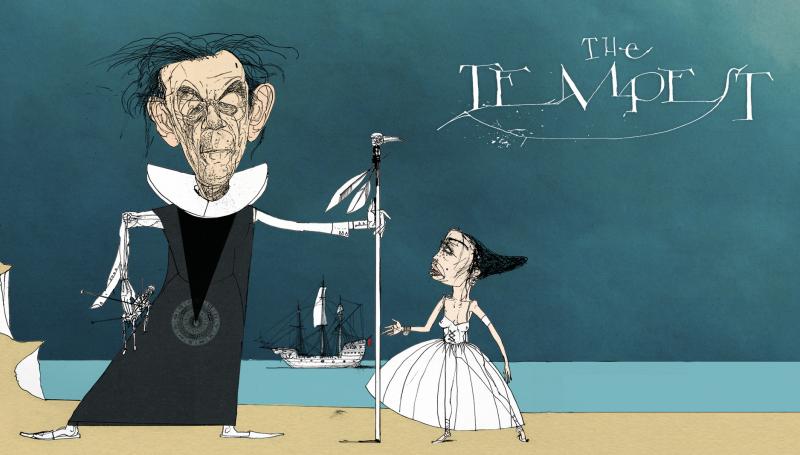
FYI: Ian McKellen, who first made his reputation performing at the Royal Shakespeare Company in the 1970s and 80s, has just released the first of a series of iPad apps meant to make Shakespeare’s plays more accessible, especially for high school and college students.
As McKellen explains above, Shakespeare’s plays were originally meant to be seen performed live in a theatre, not read as books. And so these apps feature actors performing dramatic scenes from the plays, while text scrolls by. They’ve just launched the first of 37 apps. It’s devoted to The Tempest, runs $5.99 on iTunes, and frankly seems well worth the price. Benedict Cumberbatch likes it. See below.
The full text of The Tempest as published in the First Folio.
A full digital version of Arden Shakespeare The Tempest.
The ability to switch between three different levels of notes depending on the level of reader’s needs.
A full breakdown and explanation of every character and all of their lines across every scene.
A linked historical time line of Shakespeare’s life, his plays, his theatres, and contemporary context to put it all into perspective.
Video explanations and discussions by both Sir Ian McKellen and Professor Sir Jonathan Bate on characters, themes, and the meaning of the play.
A full “play at a glance” with illustrations and summaries to explain the play’s plot with key quotes and events.
A history of all the major productions of The Tempest from the 17th century to the present day.
The option to make notes, copy and highlight text that can be collected, correlated and exported for later use.
The option to search the play’s full text and essays.
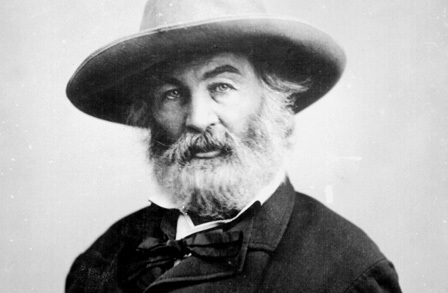
The idea of “the author,” wrote Roland Barthes, “rules in manuals of literary history, in biographies of writers, in magazine interviews, and even in the awareness of literary men, anxious to unite, by their private journals, their person and their work.” We see this anxiety of authorship in much of Walt Whitman’s personal correspondence. The poet, “could be surprisingly anxious about his own disappearance,” writes Zachary Turpin in the introduction to a recently re-discovered series of Whitman essays called “Manly Health and Training.”
Whitman, however, was just as often anxious to disassociate his person from his work, whether juvenile short stories or his copious amount of journalism and occasional pieces. Originally published in the New York Atlas between 1858 and 1860, “Manly Health and Training”—“part guest editorial, part self-help column”—may indeed represent some of the work Whitman wished would disappear in his late-in-life attempts at “careerist revisionism.” As it happens, reports The New York Times, these articles did just that until Turpin, a graduate student in English at the University of Houston, found the essays last summer while browsing articles written under various journalistic pseudonyms Whitman used.
The work in question appeared under the name “Mose Velsor,” and it’s worth asking, as Barthes might, whether we should consider it by the poetic figure we call “Whitman” at all. Though we encounter in these occasionally “eyebrow-raising” essays the “more-than-typically self-contradictory Whitman,” Turpin comments, “these contradictions display little of the poetic dialecticism of Leaves of Grass”—first published, without the author’s name, in 1855.
The essays are piecemeal distillations of “a huge range of topics” of general interest to male readers of the time—in some respects, a 19th century equivalent of Men’s Health magazine. And yet, argues Ed Folsom, editor of The Walt Whitman Quarterly—which has published the nearly 47,000 word series of essays online—“One of Whitman’s core beliefs was that the body was the basis of democracy. The series is a hymn to the male body, as well as a guide to taking care of what he saw as the most vital unit of democratic living.” These themes are manifest along with the robust homoeroticism of Whitman’s poetry:
We shall speak by and by of health as being the foundation of all real manly beauty. Perhaps, too, it has more to do than is generally supposed, with the capacity of being agreeable as a companion, a social visitor, always welcome—and with the divine joys of friendship. In these particulars (and they surely include a good part of the best blessings of existence), there is that subtle virtue in a sound body, with all its functions perfect, which nothing else can make up for, and which will itself make up for many other deficiencies, as of education, refinement, and the like.
David Reynolds, professor of English at the Graduate Center of the City University of New York, concurs: “there’s a kind of health-nut thing about ‘Leaves of Grass’ already. This series sort of codifies it and expands on it, giving us a real regimen.” To that end, two of “Mose Velsor”’s prominent topics are diet and exercise, and whether we consider “Manly Health and Training” a prose addendum to Whitman’s first book or mostly work-for-hire on a range of topics in his general purview, some of the advice, like the poetry, can often sound particularly modern, while at the same time preserving the quaintness of its age.
Anticipating the Paleo craze, for example, Whitman writes, “let the main part of the diet be meat, to the exclusion of all else.” His diet advice is far from systematic from essay to essay, yet he continually insists upon lean meat as the foundation of every meal and refers to beef and lamb as “strengthening materials.” The “simplest and most natural diet,” consists of eating mainly meat, Whitman asserts as he casts aspersions on “a vegetarian or water-gruel diet.” Whitman issues many of his dietary recommendations in the service of vocal training, recommending that his readers “gain serviceable hints from the ancients” in order to “give strength and clearness to their vocalizations.”
Aspirants to manliness should also attend to the ancients’ habit of frequenting “gymnasiums, in order to acquire muscular energy and pliancy of limbs.” Many of Whitman’s training regimens conjure images from The Road to Wellville or of stereotypical 19th-century strong men with handlebar mustaches and funny-looking leotards. But he does intuit the modern identification of a sedentary lifestyle with ill health and premature death, addressing especially “students, clerks, and those in sedentary or mental employments.” He exhorts proto-cubical jockeys and couch potatoes alike: “to you, clerk, literary man, sedentary person, man of fortune, idler, the same advice. Up!”
Whitman’s “warnings about the dangers of inactivity,” writes The New York Times, “could have been issued from a 19th-century standing desk,” a not unlikely scenario, given the many authors from the past who wrote on their feet. But should we picture Whitman himself issuing these proclamations on “Health and Training”? No image of the man himself, with cocked elbow and cocked hat, is affixed to the essays. The pseudonymous byline may be no more than a convention, or it may be a desire to inhabit another persona, and to distance the words far from those of “Walt Whitman.”
Did Whitman consider the essays hackwork—populist pabulum of the kind struggling writers today often crank out anonymously as “sponsored content”? The series, Turpin writes “is un-Whitmanian, even unpoetic,” its function “fundamentally utilitarian, a physiological and political document rooted in the (pseudo)sciences of the era.” Not the sort of thing one imagines the highly self-conscious poet would have wanted to claim. “During his lifetime,” Whitman “wasted no time reminding anyone of this series,” likely hoping it would be forgotten.
And yet, it’s interesting nonetheless to compare the exaggerated masculinity of “Manly Health and Training” with much of the belittling personal criticism Whitman received in his lifetime, represented perfectly by one Thomas Wentworth Higginson. This critic and harsh reviewer included Whitman’s “priapism,” his serving as a nurse during the Civil War rather than “going into the army,” and his “not looking… in really good condition for athletic work” as reasons why the poet “never seemed to me a thoroughly wholesome or manly man.”
In addition to thinly veiled homophobia, many of Higginson’s comments suggested, write Robert Nelson and Kenneth Price, that “as a social group, working-class men did not and could not possess the qualities of true manliness.” Perhaps we can read these early Whitman editorials, pseudonymous or not, as democratic instructions for using masculine health as a great social leveler and means to “make up for many other deficiencies, as of education, refinement, and the like.” Or perhaps “Manly Health and Training” was just another assignment—a way to pay the bills by peddling popular male wish-fulfillment while the poet waited for the rest of the world to catch up with his literary genius.
The most beloved fables have survived for ages, passed down from generation to generation in one form or another since time immemorial. It speaks to the genius of Oscar Wilde that his children’s story “The Happy Prince” has attained that status despite having existed for less than 130 years. In that time it has captivated readers, listeners, and viewers (including the likes of Patti Smith) in the original text as well as in a variety of adaptations, including an orchestral performance, an animated film, a reading by Stephen Fry, and a rock opera. It also provided material for a number of radio broadcasts in the 1930s and 40s, including the one above, a reading by Orson Welles, Bing Crosby, and Lurene Tuttle.
Welles takes the Wildean role of the narrator. Crosby plays the titular prince immortalized in statue form without having ever, ironically, experienced happiness in life. Tuttle, a prolific actress of not just radio but vaudeville, film, and television, gives voice to the swallow who, left behind when his flock migrates to Egypt for the winter, alights on the prince’s shoulder. In their shared lonesomeness, the bird and the statue become friends, and the prince asks the sparrow to distribute his decorations to the people of the impoverished town around them. What comes of these selfless deeds? The answer resides, with the rest of the story, in the hallowed realm of myth.
Welles, Crosby, and Tuttle’s performance of “The Happy Prince” debuted on the Philco Radio Hall of Fame on Christmas Eve 1944. It proved popular enough that two years later, Decca commissioned the actors for another performance of the story and put it out as a record album. In becoming something of a holiday tradition, Wilde’s immaculately crafted tale of companionship, sacrifice, and redemption has surely turned a few generations on to the work of one of the sharpest wits in western history. The prince and the swallow may come to an unfortunate end on Earth, but they enjoy the recognition their deeds have earned them in the kingdom of heaven. Wilde’s own short life closed with a series of difficult chapters, but now we all recognize the preciousness of what he left behind.
Franz Kafka — he wrote that story about the guy who turns into a bug, and lot of stuff about complex and implacable bureaucracy, right? What more do you need to know? Well, given the enduring use (and abuse) of the adjective “Kafkaesque,” the man’s work must tap into some deeper reality of the human condition than our fears of waking up transformed into something gross and inhuman or getting trapped in the purgatory of vast, soulless, and irrational systems. Here to explain a little bit more about that deeper reality, we have this explanatory animated video above from Alain de Botton’s School of Life.
Kafka, says de Botton, “was a great Czech writer who has come to own a part of the human emotional spectrum which we can now call the ‘Kafkaesque,’ and which, thanks to him, we’re able better to recognize and to gain a measure of perspective over and relief from.” We find ourselves in Kafka’s world whenever “we feel powerless in front of authority: judges, aristocrats, industrialists, politicians, and most of all, fathers. When we feel that our destiny is out of our control. When we’re bullied, humiliated, and mocked by society, and especially by our own families. We’re in Kafka’s orbit when we’re ashamed of our bodies, of our sexual urges, and feel that the best thing for us might be to be killed or squashed without mercy, as if we were an inconvenient and rather disgusting bedbug.”
You might expect any writer who takes those as his themes to have led a troubled life, and this video gets into detail about Kafka’s: the self-hatred of his youth, his unsuccessful relationships with women, the agonizing disease that kept him in pain, and everything else that shaped his writing of not just The Metamorphosis but the novels The Trial, The Castle, and Amerika, all left unfinished, to his own mind, in his short lifetime. But in a way, his dreary life story ends well: “Within a few years of his death, his reputation began. By the second World War, he was recognized as one of the greatest writers of the age.”
Acknowledging the Kafkaesque in our world has become important to many of us, but according to this video’s view of Kafka, you can’t fully understand it unless you understand the writer’s relationship with his “terrifyingly psychologically abusive” father. “Any boy who has ever felt inadequate in front of or unloved by a powerful father will at once relate to what Kafka went through in his childhood,” says de Botton, who has himself spoken publicly about growing up in the similarly dark shadow of his own “cruel tyrant” banker father. But even if you didn’t suffer in the same way, you’ll find something to at least crack the frozen sea within you in the work of this writer who stands as “a monument in German literary history,” and at the same time “a sad, ashamed, terrified part of us all.”
Where did you first hear the voice of William S. Burroughs? Weary yet vigorous, flat yet powerful, wry yet haunting, it has, to a good-sized segment of several generations now, defined a cadence for the counterculture. Many of those enthusiasts (most of whom would have come to know the grand old man of the Beat Generation’s postmodernist wing through his writing, like the novels Naked Lunch and Junky) had their first genuine Burroughs listening experience through the record album Call Me Burroughs, first released in 1965, and more recently re-issued by Superior Viaduct.
In these sessions, recorded in the basement of The English Bookshop in Paris, Burroughs reads from Naked Lunch as well as Nova Express, the third book in the “Nova Trilogy” that the author considered a “mathematical continuation” of his best-known work. Both emerged as the fruits of the “cut-up” technique of literary composition Burroughs developed with artist Brion Gysin, creating new texts out of decontextualized and reassembled pieces of existing text found in the mass media.
“Burroughs believed that language and image were viral and that the mass-dissemination of information was part of an arch-conspiracy that restricted the full potential of the human mind,” writes Glenn O’Brian at Electronic Beats. “With cut-up, Burroughs found a means of escape; an antidote to the sickness of ‘control’ messages that mutated their original content. If mass media already functioned as an enormous barrage of cut-up material, the cut-up method was a way for the artist to fight back using its same tactics.”
Call Me Burroughs, which at one point became a deep-out-of-print collector’s item, has now come available free on Spotify. (You can download its free software here.) You can also stream it on Youtube. Counterculture chronicler Barry Miles notes that the Beatles all had copies (and Paul McCartney, particularly impressed with it, went on to hire its producer himself), and “art dealer Robert Fraser bought ten copies to give to friends such as Brian Jones and Mick Jagger. Marianne Faithful and Keith Richards’ dealer had copies, as did numerous painters and writers.” So whatever inspiration you draw from this “talisman of cool in Greenwich Village in the mid-1960s,” as Greil Marcus once called it, you’ll certainly join a long line of distinguished listeners.
Can there ever be such a thing as too much Sherlock Holmes? Since Sir Arthur Conan Doyle’s creation of the character in 1887, he’s never gone out of style; there are often several adaptations of Sherlock Holmes—in film, television, and otherwise—running simultaneously, and I never hear anyone complain about Holmes overload. In fact, Holmes holds the Guinness World Record for the most-portrayed literary character ever, with over 70 actors (but alas, no actresses, yet) playing the brilliant detective in 254 screen adaptations. And that’s not even to mention the thousands of detectives and detective-like characters inspired by Holmes, or his many cameo appearances in other fictional universes.
Comments sections may quibble and snipe, but it seems to me that we’ll never run out of opportunities to make more Sherlock Holmes films, television shows, video games, fully immersive holographic virtual reality simulations…. But there’s one medium that seems to have slowed when it comes to adapting Holmes—and everything else literary: Radio. (Though several podcasts have picked up the slack.) And as much as we love to see the arch looks on Holmes actors’ faces as they astonish and perplex their various Watsons—radio is a medium well suited to the dialogue-driven drama of Conan Doyle’s stories. One classic demonstration of this is a series of Holmes radio plays that ran from 1939 to 1947 and starred for a time perhaps the quintessential screen interpreters of Holmes and Watson, Basil Rathbone and Nigel Bruce.
The New Adventures of Sherlock Holmes, as it was called, took a lighthearted approach to the characters and, as one reviewer puts it, could feel “quite rushed,” with the actors given little time to rehearse. Although the original series has many merits, in the ‘50s, NBC decided to improve upon it, taking the radio transcriptions of the Conan Doyle stories and re-recording them with new actors. Which actors? In many episodes, two of the finest British stage actors of their generation: Sir John Gielgud as Holmes and Ralph Richardson as Watson. And in one episode, an adaptation of “The Final Problem,” the producers found to play their Professor Moriarty an actor whose voice dominated some of the most popular radio broadcasts of the age: Orson Welles.
You can listen to “The Final Problem” with Gielgud, Richardson, and Welles at the top of the post; hear all of the 1950’s New Adventures of Sherlock Holmes episodes (125 in all) just above, and download them at the Internet Archive. And, further up, hear thirty-two broadcasts of the original New Adventures starring Rathbone and Bruce. Like all commercial media then and now, each episode features its share of… well, commercials. But they also feature some very fine voice acting and excellent music and sound design. Most importantly, they feature the genius of Sherlock Holmes, who will live forever, it seems, in our imaginative media, whatever form it happens to take.
We're hoping to rely on loyal readers, rather than erratic ads. Please click the Donate button and support Open Culture. You can use Paypal, Venmo, Patreon, even Crypto! We thank you!
Open Culture scours the web for the best educational media. We find the free courses and audio books you need, the language lessons & educational videos you want, and plenty of enlightenment in between.