The popular image of the medieval suit of armor looks formidable enough that any of us could be forgiven for assuming that, with its steel-plated protection, we’d emerge from even the most harrowing battle without a scratch. Yet if we really found ourselves transported to, say, the French side in the Battle of Agincourt, we’d probably feel a keen sense of just where those English arrows could nevertheless land a fatal hit. This is the matter investigated in detail in the video above, a production of Tod’s Workshop, a British maker of “accurate and detailed historical reproduction crossbows, sword scabbards, swords, daggers and other medieval weapons, and artifacts.”
This isn’t some backyard target-practice session for Medieval Times habitués, but a gathering of experts in a variety of relevant fields. Tod’s Workshop proprietor Tod Todeschini brings on both the company’s armorer and fletcher (that is, maker of arrows), as well as arms-and-armor historian Toby Capwell and a highly skilled archer named Joe.
It is Joe’s task to shoot a great many of the workshop’s faithfully crafted early-fifteenth-century arrows at its faithfully crafted early-fifteenth-century suit of armor in order to provide a visual — and, in slow motion, visceral — demonstration of just how well it could really hold up against the mighty English longbow.
In some respects, the suit acquits itself nicely: many of Joe’s arrows simply bounce off plate armor, sometimes snapping in the process. But whenever a shot hits something other than a plate, things get considerably dicier. The layers of chainmail in the gaps between helmet and breastplate or breastplate and pauldron (which covers the shoulder) turn out to be more vulnerable than they look, and as for the wholly un-plated groin area, the less said the better. The year 1415, the hosts explain, was before the development of the head-to-toe suit of armor that comes to mind today when we think of medieval knights — a development no doubt inspired in part by the fate of the numerous but hopelessly outgunned French army at Agincourt.
Based in Seoul, Colin Marshall writes and broadcasts on cities, language, and culture. His projects include the Substack newsletterBooks on Cities and the book The Stateless City: a Walk through 21st-Century Los Angeles. Follow him on Twitter at @colinmarshall or on Facebook.
Say you were a fan of Steven Spielberg’s moving coming-of-age drama Empire of the Sun, set in a Japanese internment camp during World War II and starring a young Christian Bale. Say you read the autobiographical novel on which that film is based, written by one J.G. Ballard. Say you enjoyed it so much, you decided to read more of the author’s work, like, say, 1973’s Crash, a novel about people who develop a sexual fetish around wounds sustained in staged automobile accidents. Or you pick up its predecessor, The Atrocity Exhibition, a book William S. Burroughs described as stirring “sexual depths untouched by the hardest-core illustrated porn.” Or perhaps you stumble upon Concrete Island, a warped take on Defoe that strands a wealthy architect and his Jaguar on a highway intersection.
You may experience some dissonance. Who was this Ballard? A realist chronicler of 20th century horrors; perverse explorer of—in Burroughs’ words—“the nonsexual roots of sexuality”; sci-fi satirist of the bleak post-industrial wastelands of modernity? He was all of these, and more. Ballard was a brilliant futurist and his dystopian novels and short stories anticipated the 80s cyberpunk of William Gibson, exploring with a twisted sense of humor what Jean Lyotard famously dubbed in 1979 The Postmodern Condition: a state of ideological, scientific, personal, and social disintegration under the reign of a technocratic, hypercapitalist, “computerized society.” Ballard had his own term for it: “media landscape,” and his dark visions of the future often correspond to the virtual world we inhabit today.
In addition to his fictional creations, Ballard made several disturbingly accurate predictions in interviews he gave over the decades (collected in a book titled Extreme Metaphors). In 1987, with the film adaptation of Empire of the Sun just on the horizon and “his most extreme work Crash re-released in the USA to warmer reaction,” he gave an interview to I‑D magazine in which he predicted the internet as “invisible streams of data pulsing down lines to produce an invisible loom of world commerce and information.” This may not seem especially prescient (see, for example, E.M. Forster’s 1909 “The Machine Stops” for a chilling futuristic scenario much further ahead of its time). But Ballard went on to describe in detail the rise of the Youtube celebrity:
Every home will be transformed into its own TV studio. We’ll all be simultaneously actor, director and screenwriter in our own soap opera. People will start screening themselves. They will become their own TV programmes.
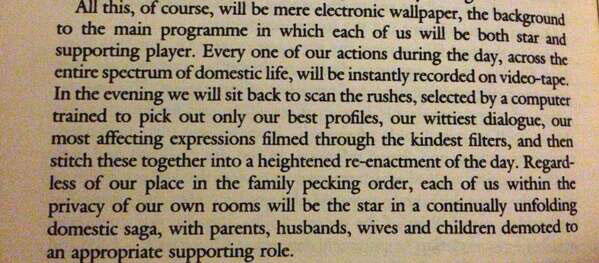
The themes of celebrity obsession and technologically constructed realities resonate in almost all of Ballard’s work and thought, and ten years earlier, in an essay for Vogue, he described in detail the spread of social media and its totalizing effects on our lives. In the technological future, he wrote, “each of us will be both star and supporting player.”
Every one of our actions during the day, across the entire spectrum of domestic life, will be instantly recorded on video-tape. In the evening we will sit back to scan the rushes, selected by a computer trained to pick out only our best profiles, our wittiest dialogue, our most affecting expressions filmed through the kindest filters, and then stitch these together into a heightened re-enactment of the day. Regardless of our place in the family pecking order, each of us within the privacy of our own rooms will be the star in a continually unfolding domestic saga, with parents, husbands, wives and children demoted to an appropriate supporting role.
Though Ballard thought in terms of film and television—and though we ourselves play the role of the selecting computer in his scenario—this description almost perfectly captures the behavior of the average user of Facebook, Instagram, etc. (See Ballard in the interview clip above discuss further “the possibilities of genuinely interactive virtual reality” and his theory of the 50s as the “blueprint” of modern technological culture and the “suburbanization” of reality.) In addition to the Vogue essay, Ballard wrote a 1977 short story called “The Intensive Care Unit,” in which—writes the site Ballardian—“ordinances are in place to prevent people from meeting in person. All interaction is mediated through personal cameras and TV screens.”
So what did Ballard, who died in 2009, think of the post-internet world he lived to see and experience? He discussed the subject in 2003 in an interview with radical publisher V. Vale (who re-issued The Atrocity Exhibition). “Now everybody can document themselves in a way that was inconceivable 30, 40, 50 years ago,” Ballard notes, “I think this reflects a tremendous hunger among people for ‘reality’—for ordinary reality. It’s very difficult to find the ‘real,’ because the environment is totally manufactured.” Like Jean Baudrillard, another prescient theorist of postmodernity, Ballard saw this loss of the “real” coming many decades ago. As he told I‑D in 1987, “in the media landscape it’s almost impossible to separate fact from fiction.”
By now, it’s widely known that the Central Intelligence Agency ran a decades-long program of experiments involving LSD and other psychoactive drugs called MKUltra from the nineteen-fifties to the seventies. As one might suspect, that wasn’t the only research project into the manipulation of human consciousness the CIA had going on in the twentieth century. Another, a study of something called the Gateway Process, has more recently come to wide attention through an unlikely channel. The relevant documents “had been declassified for decades — but a new, younger audience was introduced to the Gateway when TikTok caught on in 2021.”
So writes Elle’s Hannah Summerhill, a self-described “longtime seeker” receptive to the Gateway Process’ concept of harnessing not drugs but sound to “the art of becoming more conscious of one’s particular inner resources, inner abilities, and, most of all, one’s inner guidance.” The documentation breaks down the levels of focus thus theoretically achievable into a series of levels: Focus 10 is “a meditative state conducive to healing, psychic abilities, and remote viewing (the ability to ‘see’ objects in real time from a distance). In the deeper Focus 12 state, participants report meeting their higher selves; in Focus 15, they can manipulate time and channel a ‘strong and guiding’ God-like figure.”
All this was originally conceived by former radio executive Robert Monroe, whose self-experimentation with the effect of sound on human consciousness — the same phenomena exploited by study-and meditation-assisting “binaural beats” — led to his founding the Monroe Institute. “In the late stages of the Cold War, convinced that the Soviets were researching psychic abilities for espionage, the CIA tapped the Monroe Institute to explore these methods for themselves,” writes Summerhill. You can read Lieutenant Colonel Wayne McDonnell’s declassified July 1983 report on Monroe’s techniques here, as well as Thobey Campion’s breakdown of its main points at VICEhere.
“A project like Gateway that marries science with the human yearning for meaning seemed awfully promising,” writes Popular Mechanics’ Susan Lahey. “But, as it turned out, the process was not a gateway between materialistic science and experiential consciousness; it was more like an effort to write a technical manual for the ineffable.” Even if it sounds plausible to you that a binaural beat-like sound recording “syncs the hemispheres of the brain into a single, powerful stream of energy, like a laser,” you may feel less confident when the report posits “a giant cosmic egg with a nucleus in the middle where the Absolute spews matter from a white hole into one side of the ovoid-shaped universe.” It seems that the CIA never did figure out a way to reliably engage in time travel, remote viewing or communication with the divine, but maybe the TikTokers will figure it out.
Based in Seoul, Colin Marshall writes and broadcasts on cities, language, and culture. His projects include the Substack newsletterBooks on Cities and the book The Stateless City: a Walk through 21st-Century Los Angeles. Follow him on Twitter at @colinmarshall or on Facebook.
The beautiful bonsai tree pictured above–let’s call it the Yamaki Pine Bonsai–began its journey through the world back in 1625. That’s when the Yamaki family first began to train the tree, working patiently, generation after generation, to prune the tree into the majestic thing it is today.
No doubt, over the centuries, the ancient bonsai witnessed many good and bad days in Japan–some highs and some lows. But nothing as low as what happened on August 6, 1945, when the United States dropped an atomic bomb on Hiroshima, devastating the city and leaving 140,000 civilians dead. The bomb exploded less than two miles from the Yamaki’s home. But defying the odds, the Yamaki Pine survived the blast. (It was protected by a wall surrounding the Yamaki’s bonsai nursery.) The family survived the blast too, suffering only minor cuts from flying glass.
Three decades later, in a rather remarkable act of forgiveness, the Yamaki family gifted the pine (along with 52 other cherished trees) to the United States, during the bicentennial celebration of 1976. Never did they say anything, however, about the traumas the tree survived. Only in 2001, when a younger generation of Yamakis visited Washington, did the caretakers at the United States National Arboretum learn the full story about the tree’s resilience. The tree survived the worst mankind could throw at it. And kept its beauty intact. Surely you can do the same when life sends lesser challenges your way.
You can get a closer look at the Yamaki pine in the video below.
If you would like to support the mission of Open Culture, consider making a donation to our site. It’s hard to rely 100% on ads, and your contributions will help us continue providing the best free cultural and educational materials to learners everywhere. You can contribute through PayPal, Patreon, and Venmo (@openculture). Thanks!
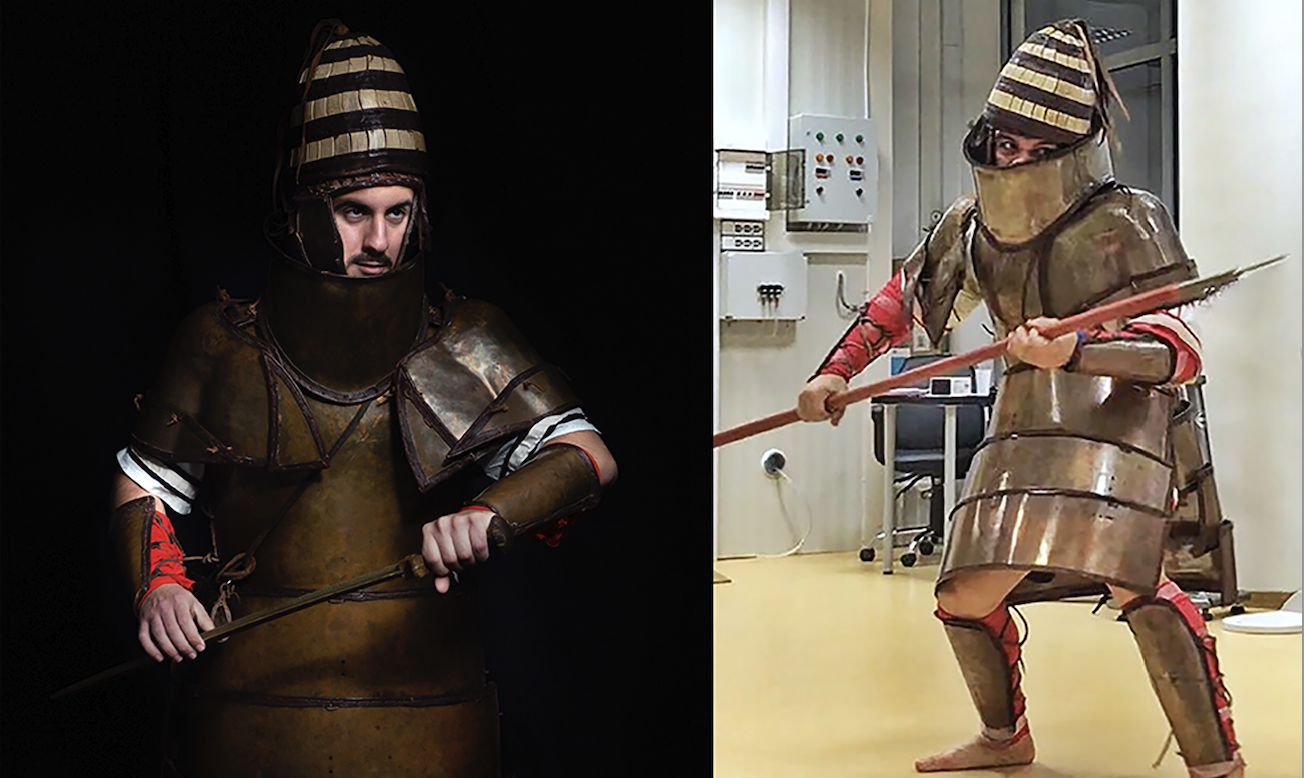
By Greek law, every male citizen over the age of eighteen must spend from nine months to a year in the Hellenic Armed Forces. As in every country with such a policy of mandatory conscription, this is surely not a prospect relished by most conscripts-to-be. But then, it can’t be all bad, at least for those enthusiasts of Mediterranean military history who happened to be serving when researchers from the University of Thessaly came by offering the chance to don a suit of armor from the fifteenth century BC and have a very — and faithfully — old-fashioned battle.
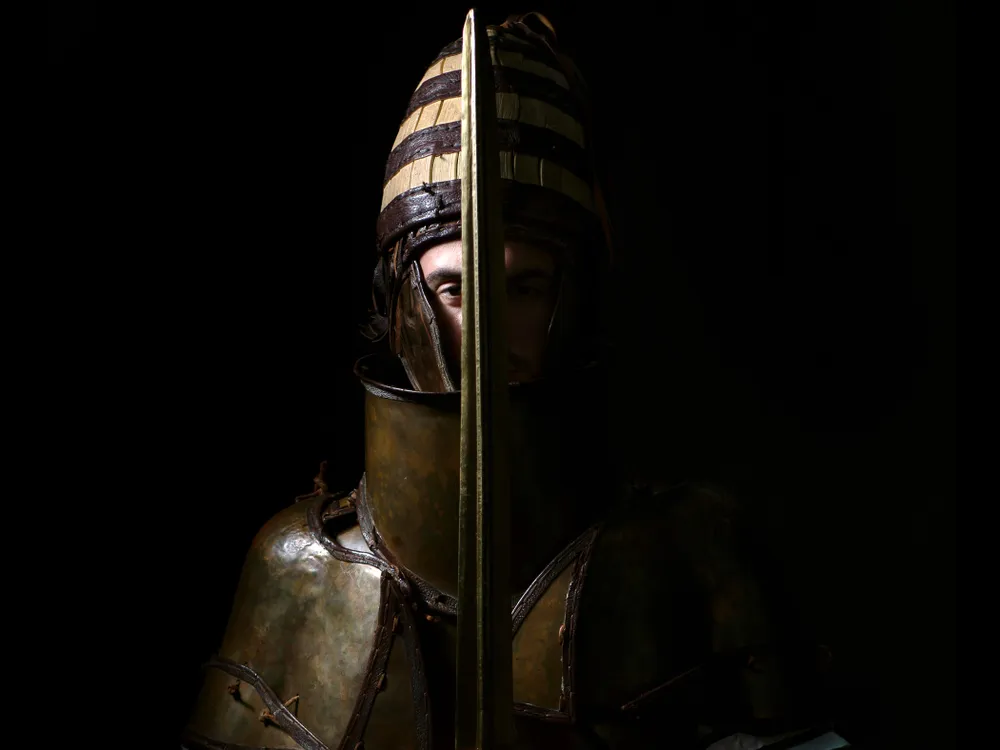
The replica was modeled on an example from the late-Bronze-age Mycenaean civilization “discovered in the southern Greek village of Dendra in 1960,” writes Smithsonian.com’s Sonja Anderson, describing it as “one of the oldest complete suits of European armor in existence.”
Composed of fifteen “copper-alloy sheets held together with leather, which covered the wearer from neck to knees,” the suit is “complete with arm and leg guards and a helmet decorated with pieces of boar tusk.” Clunky though it may look, it stands as evidence that, as the researchers put it in their paper, the “Mycenaeans had such a powerful impact in Eastern Mediterranean at least partly as a result of their armor technology.”
But first, they had to put the armor itself to the test. “They gathered volunteers from the 32nd Marines Brigade of the Hellenic Army,” Anderson writes, “fed them the pre-battle meal of a Mycenaean soldier: bread, beef, goat cheese, green olives, onions and red wine. The marines were outfitted in replicas of the Mycenaean suit, given replicas of Mycenaean cruciform swords, and placed in a temperature-controlled room set to a geographically accurate 64 to 68 degrees Fahrenheit.” There commenced eleven hours of simulated battle, all “choreographed based on descriptions of the Trojan War from Homer’s Iliad, which was fought a few centuries after the Dendra armor was made.”
“We now understand, despite its cumbersome appearance at first sight, that it is not only flexible enough to permit almost every movement of a warrior on foot but also resilient enough to protect the wearer from most blows,” the researchers write in their conclusion. And though their research subjects “showed a high level of fatigue, sore upper body due to the weight of the armor, and foot pain due to walking, running, riding a chariot, and fighting barefoot,” it must have been a more stimulating experience than the average day in the Hellenic Armed Forces — especially if there was any post-battle goat cheese and wine available.
Based in Seoul, Colin Marshall writes and broadcasts on cities, language, and culture. His projects include the Substack newsletterBooks on Cities and the book The Stateless City: a Walk through 21st-Century Los Angeles. Follow him on Twitter at @colinmarshall or on Facebook.
In 1963, Philip K. Dick won the coveted Hugo Award for his novel The Man in the High Castle, beating out such sci-fi luminaries as Marion Zimmer Bradley and Arthur C. Clarke. Of the novel, The Guardian writes, “Nothing in the book is as it seems. Most characters are not what they say they are, most objects are fake.” The plot—an alternate history in which the Axis Powers have won World War II—turns on a popular but contraband novel called The Grasshopper Lies Heavy. Written by the titular character, the book describes the world of an Allied victory, and—in the vein of his worlds-within-worlds thematic—Dick’s novel suggests that this book-within-a-book may in fact describe the “real” world of the novel, or one glimpsed through the novel’s reality as at least highly possible.
The Man in the High Castle may be Dick’s most straightforwardly compelling illustration of the experience of alternate realities, but it is only one among very many. In an interview Dick gave while at the high profile Metz science fiction conference in France in 1977, he said that like David Hume’s description of the “intuitive type of person,” he lived “in terms of possibilities rather than in terms of actualities.” Dick also tells a parable of an ancient, complicated, and temperamental automated record player called the “Capard,” which reverted to varying states of destructive chaos. “This Capard,” Dick says, “epitomized an inscrutable ultra-sophisticated universe which was in the habit of doing unexpected things.”
In the interview, Dick roams over so many of his personal theories about what these “unexpected things” signify that it’s difficult to keep track. However, at that same conference, he delivered a talk titled “If You Find This World Bad, You Should See Some of the Others” (in edited form above), that settles on one particular theory—that the universe is a highly-advanced computer simulation. (The talk has circulated on the internet as “Did Philip K. Dick disclose the real Matrix in 1977?”).
The subject of this speech is a topic which has been discovered recently, and which may not exist all. I may be talking about something that does not exist. Therefore I’m free to say everything and nothing. I in my stories and novels sometimes write about counterfeit worlds. Semi-real worlds as well as deranged private worlds, inhabited often by just one person…. At no time did I have a theoretical or conscious explanation for my preoccupation with these pluriform pseudo-worlds, but now I think I understand. What I was sensing was the manifold of partially actualized realities lying tangent to what evidently is the most actualized one—the one that the majority of us, by consensus gentium, agree on.
Dick goes on to describe the visionary, mystical experiences he had in 1974 after dental surgery, which he chronicled in his extensive journal entries (published in abridged form as The Exegesis of Philip K. Dick) and in works like VALIS and The Divine Invasion. As a result of his visions, Dick came to believe that “some of my fictional works were in a literal sense true,” citing in particular The Man in the High Castle and Flow My Tears, The Policeman Said, a 1974 novel about the U.S. as a police state—both novels written, he says, “based on fragmentary, residual memories of such a horrid slave state world.” He claims to remember not past lives but a “different, very different, present life.”
Finally, Dick makes his Matrix point, and makes it very clearly: “we are living in a computer-programmed reality, and the only clue we have to it is when some variable is changed, and some alteration in our reality occurs.” These alterations feel just like déjà vu, says Dick, a sensation that proves that “a variable has been changed” (by whom—note the passive voice—he does not say) and “an alternative world branched off.”
Dick, who had the capacity for a very oblique kind of humor, assures his audience several times that he is deadly serious. (The looks on many of their faces betray incredulity at the very least.) And yet, maybe Dick’s crazy hypothesis has been validated after all, and not simply by the success of the PKD-esque The Matrix and the ubiquity of Matrix analogies. For several years now, theoretical physicists and philosophers have entertained the theory that we do in fact live in a computer-generated simulation and, what’s more, that “we may even be able to detect it.”
If we ask which philosophy professor has made the greatest impact in this decade, there’s a solid case to be made for the late Michael Sugrue. Yet in the nearly four-decade-long career that followed his studies at the University of Chicago under Allan Bloom (author of The Closing of the American Mind, later immortalized in Saul Bellow’s Ravelstein), he never published a book, nor took a tenured position. His last place of employment as a lecturer was Ave Maria University, a small Catholic institution founded by the man behind Domino’s Pizza. After his death earlier this year, his work might have lived on only in the memories of the students with whom he shared classrooms.
That would have been the case, at least, if Sugrue’s daughter hadn’t uploaded his lectures to Youtube during the COVID pandemic, when viewers the world over were more than ready for a dose of philosophical wisdom. “The lectures were recorded as part of the Great Minds of the Western Intellectual Tradition series,” writes John Hirschauer in a 2021 American Conservative profile, “a collection of talks on the West’s greatest authors and thinkers” published by The Teaching Company in 1992. “Sugrue’s first lecture in the series is on Plato, the last on critical theory. His remarkable oratory skill is on display throughout.” What’s more, “he does not carry a note card or read from a prompter. There is hardly a stutter in 37 hours of footage.”
Sugrue was diagnosed with cancer in the early twenty-tens, and “doctors at the time gave him five years to live. He said the thought of Marcus Aurelius had taken on new meaning since his diagnosis.” Indeed, Sugrue’s lecture on the Roman emperor and Stoic icon is the most popular of his videos, with over one and a half million views at the time of this writing. Over the years, we’ve featured differentintroductions to Stoicism here on Open Culture, as well as the work of other Stoics like the statesman-dramatist Seneca the Younger. But Sugrue’s 42-minute exegesis on Marcus Aurelius — not just “the most interesting of the Stoics,” but also “the one example of an absolute ruler who behaves himself in such a way as not to disgrace himself” — has resonated unusually far and wide.
Then, as now, Marcus Aurelius serves as “a standing reproach to our self-indulgence, a standing reproach to the idea that we are unable to deal with the circumstances of human life.” He fully internalized the central Stoic insight that there are “only two kinds of things: there are the things you can control and the things you can’t.” Everything falls into the latter group except “your intentions, your behavior, your actions.” And indeed, just as Sugrue kept looking to the example of Marcus Aurelius — returning to his text Meditations as recently as a webinar he gave two years ago — students of philosophy yet unborn will no doubt find their way to the philosophical guidance that he himself has left behind.
Based in Seoul, Colin Marshall writes and broadcasts on cities, language, and culture. His projects include the Substack newsletterBooks on Cities and the book The Stateless City: a Walk through 21st-Century Los Angeles. Follow him on Twitter at @colinmarshall or on Facebook.
I have heard the biographers of Harry S. Truman, Catherine the Great, etc., etc., say they would give anything if their subjects were alive so they could ask them some questions. I, on the other hand, would give anything if my subject were dead.
He should be. Oh, yes. Look at his daily routine:
3:00 p.m. rise
3:05 Chivas Regal with the morning papers, Dunhills
3:45 cocaine
3:50 another glass of Chivas, Dunhill
4:05 first cup of coffee, Dunhill
4:15 cocaine
4:16 orange juice, Dunhill
4:30 cocaine
4:54 cocaine
5:05 cocaine
5:11 coffee, Dunhills
5:30 more ice in the Chivas
5:45 cocaine, etc., etc.
6:00 grass to take the edge off the day
7:05 Woody Creek Tavern for lunch-Heineken, two margaritas, coleslaw, a taco salad, a double order of fried onion rings, carrot cake, ice cream, a bean fritter, Dunhills, another Heineken, cocaine, and for the ride home, a snow cone (a glass of shredded ice over which is poured three or four jiggers of Chivas.)
9:00 starts snorting cocaine seriously
10:00 drops acid
11:00 Chartreuse, cocaine, grass
11:30 cocaine, etc, etc.
12:00 midnight, Hunter S. Thompson is ready to write
6:00 the hot tub-champagne, Dove Bars, fettuccine Alfredo
8:00 Halcyon
8:20 sleep
Ms. Carroll, you have my attention, I do declare. But when I get a grip on myself, I wonder: How did she get ahold of this list? Did Thompson map it all out for her? Did he note it in a diary, or jot it all down on a napkin? Or did Carroll observe him following this routine while visiting his 7,000-acre estate in Woody Creek, Colorado? And, if the latter, you have to wonder whether Thompson always lived this hard? Or was this a bit of schtick, the nurturing of a Gonzo persona now decades in the making? It’s hard to know what’s true, or what’s not.
Meanwhile, if you want to delve more deeply into Thompson’s daily routine, you can explore HST’s ideal breakfast. It consists of “four Bloody Marys, two grapefruits, a pot of coffee, Rangoon crêpes, a half-pound of either sausage, bacon, or corned-beef hash with diced chilies, a Spanish omelette or eggs Benedict, a quart of milk, a chopped lemon for random seasoning, and something like a slice of key lime pie, two margaritas and six lines of the best cocaine for dessert.” All eaten naked and alone. Naturally.
If you would like to support the mission of Open Culture, consider making a donation to our site. It’s hard to rely 100% on ads, and your contributions will help us continue providing the best free cultural and educational materials to learners everywhere. You can contribute through PayPal, Patreon, and Venmo (@openculture). Thanks!
Robert Waldinger works as a part-time professor of psychiatry at Harvard Medical School, but he also describes himself as a “Zen master.” This may strike some listeners as a presumptuous claim, but he has indeed been officially accepted as a rōshi in two different Zen lineages in the West. With one foot in psychiatry and the other in Buddhism, Waldinger (previously featured here on Open Culture for his work on happiness and loneliness) is well-placed to explain the latter in terms amenable to the former. In the Big Think video above, he breaks the ancient religion — or mindset, or way of being, or whatever one prefers to call it — into six distinct concepts: impermanence, noble truths, mindfulness, attachment, loving kindness, and beginner’s mind.
If you’ve felt any curiosity about Zen Buddhism and pursued it online in recent years, the term mindfulness will be familiar to the point of cliché. Waldinger personally defines it as “paying attention in the present moment without judgment.” You can work on your mindfulness right now, he explains, “by simply paying attention to whatever stimuli are reaching you. It might be your heartbeat, it might be your breath, it might be the sound of the fan in the room — anything — and simply letting yourself be open and receive whatever is here right now.” This can help us put into perspective the next concept, attachment, or our feeling “that the world be a certain way,” which causes no amount of our dissatisfaction and even suffering.
All of these ideas are much expanded on in primary and secondary Buddhist texts, which any enthusiast can spend a lifetime reading. My own interest was first piqued by a popular 1970 volume called Zen Mind, Beginner’s Mind, a compilation of talks by a famous rōshi called Shunryū Suzuki Waldinger references Suzuki’s work in the final section of this video, and specifically his observation that “in the beginner’s mind, there are many possibilities. In the expert’s mind, there are few.” In Waldinger’s own experience, “the older I get, and the more people call me an expert, the more aware I am of how little I know.” True mastery lies in the awareness not of the knowledge we have, but the knowledge we don’t.
Based in Seoul, Colin Marshall writes and broadcasts on cities, language, and culture. His projects include the Substack newsletterBooks on Cities and the book The Stateless City: a Walk through 21st-Century Los Angeles. Follow him on Twitter at @colinmarshall or on Facebook.
There’s something unusually exciting about finding a hidden or discreetly placed element in a well-known painting. I can only imagine the thrill of the physician who first noticed the curious presence of a human brain in Michelangelo’sThe Creation of Adam: God, his retinue of angels, and their cloak map neatly onto some of the main neural structures, including the major sulci in the cerebellum, the pituitary gland, the frontal lobe, and the optic chiasm. It’s hard to gauge Michelangelo’s motivation for doing so, but considering his documented interest in dissection and physiology, the find is not particularly surprising.
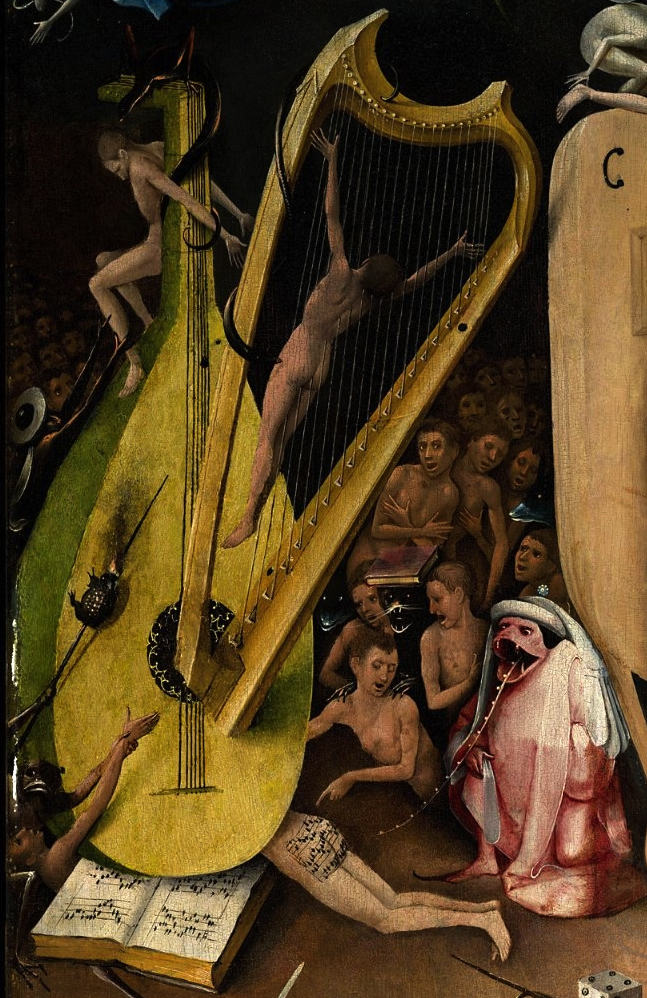
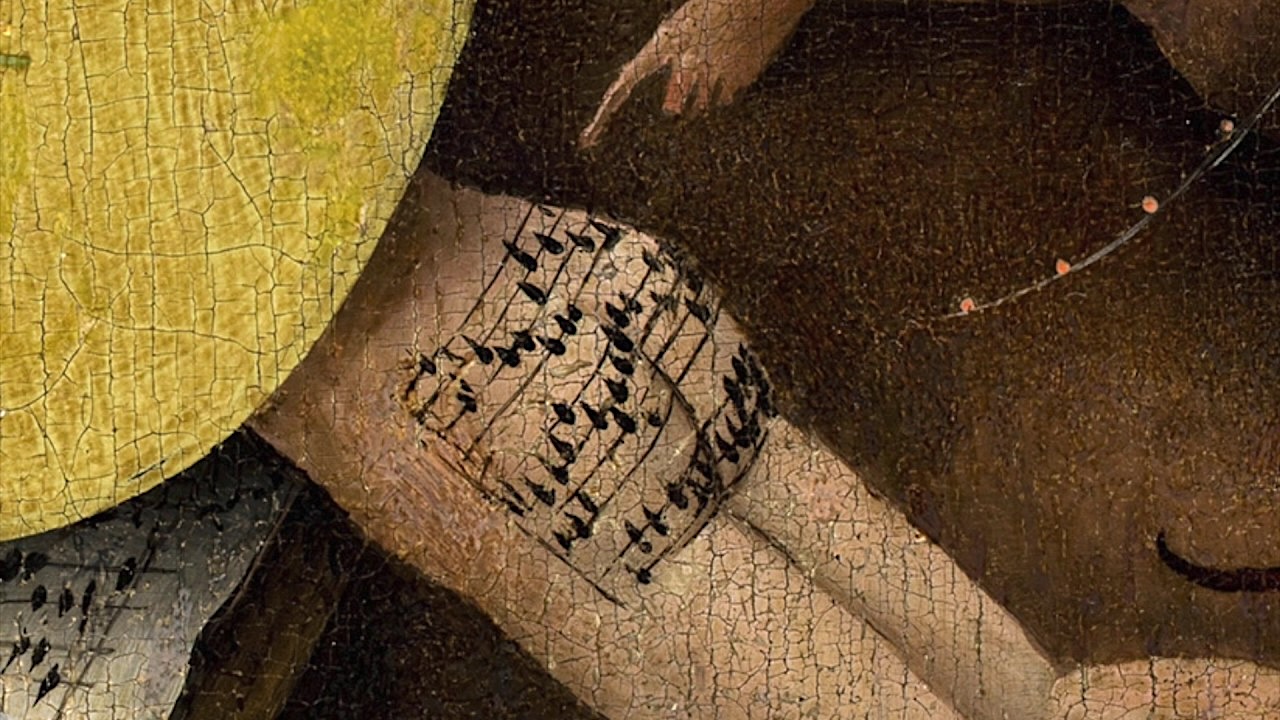
And then there’s another find. Several years ago, the Internet became excited when an enterprising blogger named Amelia transcribed, recorded, and uploaded a musical score straight out of Hieronymus Bosch’s The Garden of Earthly Delights, painted between 1490 and 1510. The kicker? Amelia found the score written on a suffering sinner’s butt.
The poor, musically-branded soul can be seen in the bottom left-hand corner of the painting’s third and final panel (below), wherein Bosch depicts the various torture methods of hell. The unfortunate hell-dweller lies prostrate atop an open music book, crushed by a gigantic lute, while a toad-like demon stretches his tongue towards his tuneful buttocks. Another inhabitant is strung up on a harp above the scene.
The piece can be heard in the video above. It is… unusual. Although we can’t ascertain why Bosch decided to write out this particular melody, since scant biographical information about the painter survives, it’s possible that he decided to include music in his depiction of the inferno because it was viewed as a sign of sinful pleasure. For those who haven’t yet had a chance to hear it, listen to Medieval-era butt music here.
Artificial intelligence seems to have become, as Michael Lewis labeled a previous chapter in the recent history of technology, the new new thing. But human anxieties about it are, if not an old old thing, then at least part of a tradition longer than we may expect. For vivid evidence, look no further than Fritz Lang’s Metropolis, which brought the very first cinematic depiction of artificial intelligence to theaters in 1927. It “imagines a future cleaved in two, where the affluent from lofty skyscrapers rule over a subterranean caste of laborers,” writes Synapse Analytics’ Omar Abo Mosallam. “The class tension is so palpable that the invention of a Maschinenmensch (a robot capable of work) upends the social order.”
The sheer tirelessness of the Maschinenmensch “sows havoc in the city”; later, after it takes on the form of a young woman called Maria — a transformation you can watch in the clip above — it “incites workers to rise up and destroy the machines that keep the city functioning. Here, there is a suggestion to associate this new invention with an unraveling of the social order.” This robot, which Guardian film critic Peter Bradshaw describes as “a brilliant eroticization and fetishization of modern technology,” has long been Metropolis’ signature figure, more iconic than HAL, Data, and WALL‑E put together.
Still, those characters all rate mentions of their own in the articles reviewing the history of AI in the movies recently published by the BFI, RTÉ, Pictory, and other outlets besides. The Day the Earth Stood Still, Alien, Blade Runner (and even more so its sequel Blade Runner 2049), Ghost in the Shell, The Matrix, and Ex Machina. Not all of these pictures present their artificially intelligent characters primarily as existential threats to the existing order; the BFI’s Georgina Guthrie highlights video essayist-turned-auteur Kogonada’s After Yang as an example that treats the role of AI could assume in society as a much more complex — indeed, much more human — matter.
From Metropolis to After Yang, as RTÉ’s Alan Smeaton points out, “AI is usually portrayed in movies in a robotic or humanoid-like fashion, presumably because we can easily relate to humanoid and robotic forms.” But as the public has come to understand over the past few years, we can perceive a technology as potentially or actually intelligent even it doesn’t resemble a human being. Perhaps the age of the fearsome mechanical Art Deco gynoid will never come to pass, but we now feel more keenly than ever both the seductiveness and the threat of Metropolis’ Maschinenmensch — or, as it was named in the original on which the film was based, Futura.
Based in Seoul, Colin Marshall writes and broadcasts on cities, language, and culture. His projects include the Substack newsletterBooks on Cities, the book The Stateless City: a Walk through 21st-Century Los Angeles and the video series The City in Cinema. Follow him on Twitter at @colinmarshall or on Facebook.
We're hoping to rely on loyal readers, rather than erratic ads. Please click the Donate button and support Open Culture. You can use Paypal, Venmo, Patreon, even Crypto! We thank you!
Open Culture scours the web for the best educational media. We find the free courses and audio books you need, the language lessons & educational videos you want, and plenty of enlightenment in between.







.jpg)