Explore the Largest Online Archive Exploring the Genius of Leonard da Vinci
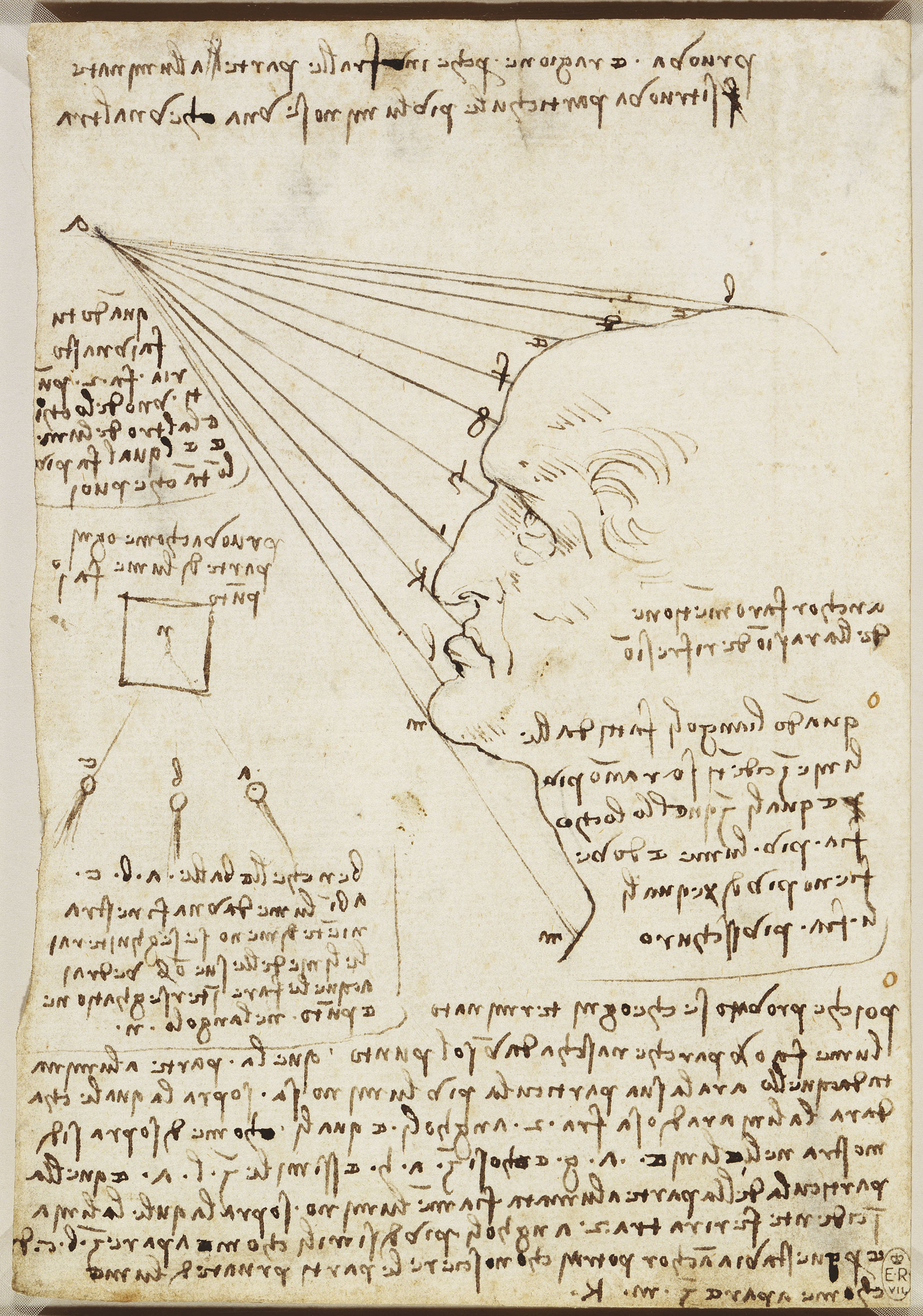
We dare not speculate as to what Leonardo DaVinci would make of artificial intelligence.
We are, however, fairly confident that he would love the Internet.
The Renaissance-era genius applied his sophisticated understanding of the human body and the natural world to other types of systems, including plans for civil engineering projects, military projectiles, and flying machines.
Google Arts & Culture’s new initiative Inside a Genius Mind offers an interactive experience of the codices in which Da Vinci made his sketches, diagrams, and notes.
It’s also a curatorial collaboration between a human — Oxford art history professor Martin Kemp — and artificial intelligence.
Professor Kemp, author of Living with Leonardo: Fifty Years of Sanity and Insanity in the Art World and Beyond, brings a lifetime of rigorous study and passion for the subject.
His non-human counterpart used machine learning to delve into the notebooks’ contents, investigating some 1040 pages from 6 volumes and “drawing thematic connections across time and subject matter to reflect Leonardo’s spirit of interdisciplinary imagination, innovation and the profound unity at the heart of his apparently diverse pursuits.”
Upon launching the experiment, you bushwhack your way through the individual codices by clicking on the sketches floating toward you like elements in a classic space-themed video game, or choose to enjoy one of five curated stories.
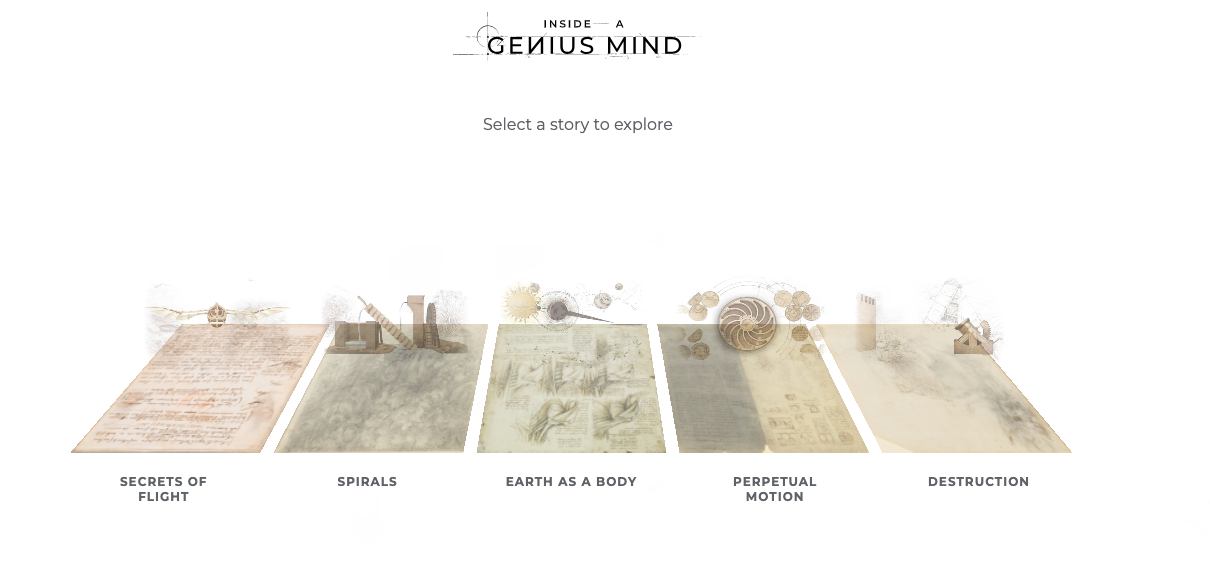
We went with Earth as Body, which gathers seven pages from the UK’s Royal Collection Trust’s Codex Windsor, and one from the Codex Leicester, which inspired an animated model that should surely please its current owner, Bill Gates.

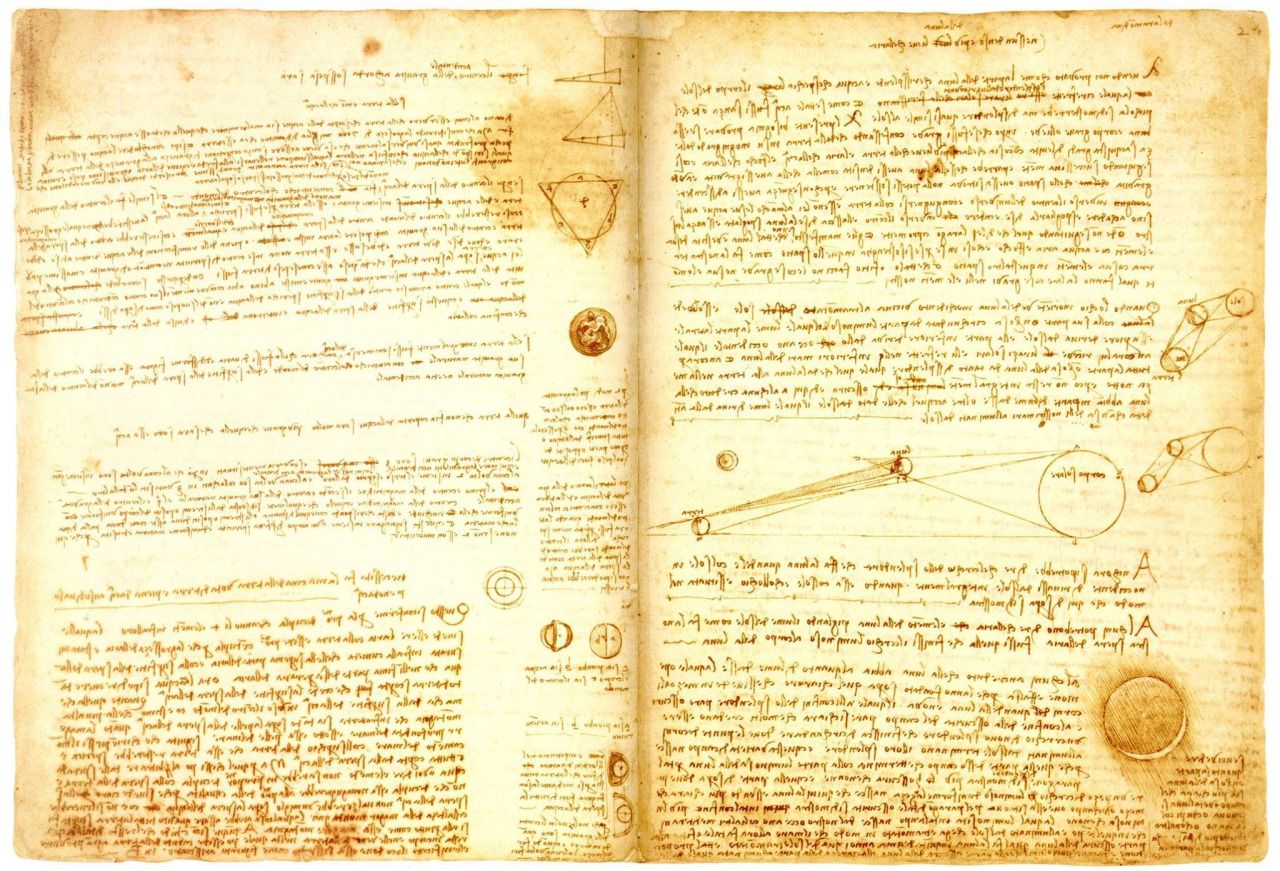
Using a discreet and somewhat fiddly navigation bar on the left side of the screen, we toured Leonardo’s renderings of the flayed muscles of the upper spine, the vessels and nerves of the neck and liver, the Arno valley with the route of a proposed canal that would run from Florence to Pisa, a view of the Alps from Milan, the fall of light on a face, studies of optics and men in action, and observations of the moon and earthshine.
How are these things related?
“Leonardo believed that the human body represented the whole natural world in miniature” and the selections do offer food for thought that Leonardo’s passion for the underlying laws of nature is the common thread running through his research and art.
Each image is accompanied a button inviting you to “explore” the work further. Click it for information about dimensions, provenance, and media, as well as some tantalizing biographical tidbits, such as this, adapted from the catalogue for the 2019 exhibit Leonardo da Vinci: A Life in Drawing:
Leonardo had first studied anatomy in the late 1480s. By the end of his life he claimed to have performed 30 human dissections, intending to publish an illustrated treatise on the subject, but this was never completed, and Leonardo’s work thus had no discernible impact on the discipline. His only documented dissection was carried out in the winter of 1507–8, when he performed an autopsy on an old man whose death he had witnessed in a hospital in Florence. The studies on this page from Leonardo’s notebook are based on that dissection: on the verso Leonardo depicts the vessels of the liver; and in notes elsewhere in the notebook he gives the first known clinical description of cirrhosis of the liver.
Perhaps you’d like to circumvent the machine learning and use your own genius mind to make connections a la Da Vinci?
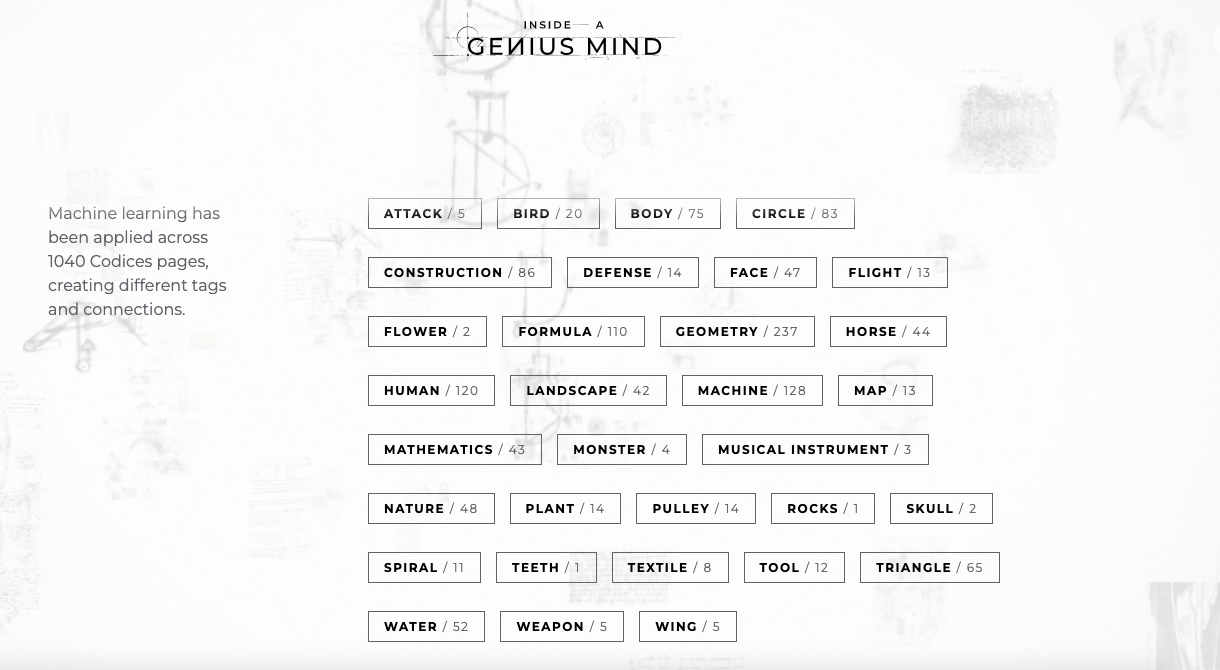
Try messing around with the AI tags. See what you can cobble together to forge a cohesive alliance between such elements as wing, horse, map, musical instruments, and spiral.
Or cleanse your palate by putting a mash-up of two codex sketches on a digital sticky with the help of Google AI, mindful that the master, who lived to the ripe old age of 67, was probably a bit more intentional with his time…
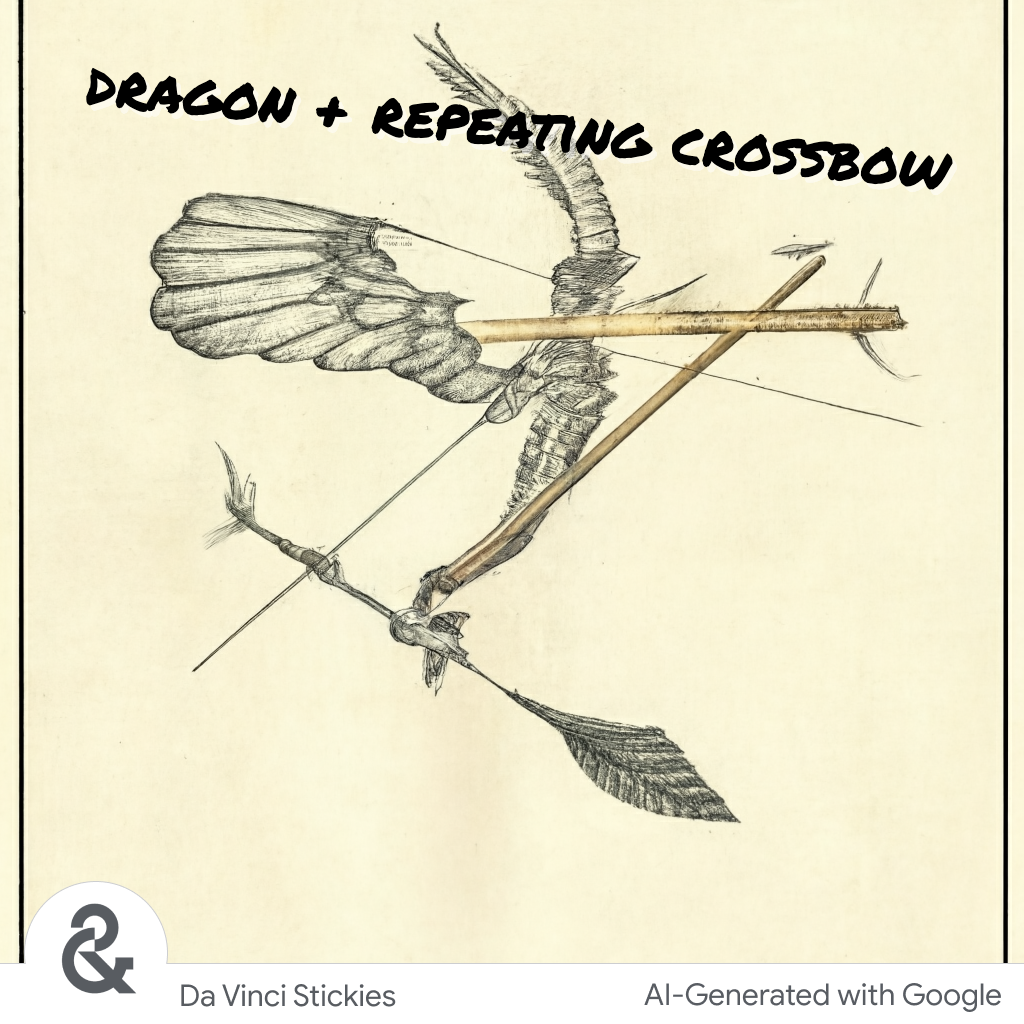
Begin your explorations of Google Arts & Culture’s Inside a Genius Mind here.
Related Content
The Ingenious Inventions of Leonardo da Vinci Recreated with 3D Animation
Leonardo Da Vinci’s To Do List (Circa 1490)
– Ayun Halliday is the Chief Primatologist of the East Village Inky zine and author, most recently, of Creative, Not Famous: The Small Potato Manifesto and Creative, Not Famous Activity Book. Follow her @AyunHalliday.
Read More...Can Modern-Day Italians Understand Latin? A YouTuber Puts It to the Test on the Streets of Rome
Of all the Romance languages, none is more Romantic than Italian, at least in the sense that it has changed the least in its long descent from Latin to its current form. Whether the Italian spoken in recent centuries has a particularly close resemblance to Latin is another question, and one American Youtuber Luke Ranieri investigates on the streets of Rome itself in the video above. In order to find out whether modern-day Italians can understand ancient Latin, he approaches unsuspecting Romans and asks them for directions in that language, speaking it fluently and just as their ancestors would have back in the first century.
So, can Romans understand Latin? “Yes,” Ranieri concludes, “but they don’t always enjoy it.” Most of the individuals he addresses claim that they can’t understand him at first. But as the conversation continues — in Latin on one side, Italian on the other — it becomes clear that they can indeed figure out what he wants to know.
“Italians are almost universally exposed only to the traditional Italian pronunciation of Latin (called the pronuncia scolastica), otherwise known as the Ecclesiastical Pronunciation,” Ranieri notes in a comment. But “in this video, I am using the Restored Classical Pronunciation of Latin as it was pronounced in Rome two thousand years ago.”
He may have had better luck at the Vatican and the Colosseum, but the Italians he meets in Rome do rise to this challenge, more or less, though few do it without hemming, hawing, and of course, attempting to use English. For the language of England has, one could argue, risen to play the same role in wide swaths of our world that Latin once played across the Roman Empire. This situation has its advantages, but in the heart of many a language-lover it also inspires some regrets. Though full of Latinate vocabulary, English arguably falls short of the beauty of the genuine Romance languages. And even the most obstinate Anglophone has to admit that, compared to Latin, English lacks something: a certain gravitas, let us say.
Related content:
Learn Latin, Old English, Sanskrit, Classical Greek & Other Ancient Languages in 10 Lessons
What Ancient Latin Sounded Like, And How We Know It
Based in Seoul, Colin Marshall writes and broadcasts on cities, language, and culture. His projects include the Substack newsletter Books on Cities, the book The Stateless City: a Walk through 21st-Century Los Angeles and the video series The City in Cinema. Follow him on Twitter at @colinmarshall or on Facebook.
Read More...How Much of What You See Is Actually a Hallucination?: An Animated TED-Ed Lesson
All of us have, at one time or another, been accused of not seeing what’s right in front of us. But as a close examination of our biological visual system reveals, none of us can see what’s right in front of us. “Our eyes have blind spots where the optic nerve blocks part of the retina,” says the narrator of the new animated TED-Ed video above. “When the visual cortex processes light into coherent images, it fills in these blind spots with information from the surrounding area. Occasionally we might notice a glitch, but most of the time, we’re none the wiser.” This absence of genuine information in the very center of our vision has long circulated in the standard set of fascinating facts.
What’s less well known is that these same neurological processes have made the blind see — or rather, they’ve induced in the blind an experience subjectively indistinguishable from seeing. It’s just that the things they “see” don’t exist in reality.
Take the case of an elderly woman named Rosalie, with which the video opens. On one otherwise normal day at the nursing home, “her room suddenly burst to life with twirling fabrics. Through the elaborate drapings, she could make out animals, children, and costumed characters,” even though she’d lost her sight long before. “Rosalie had developed a condition known as Charles Bonnet Syndrome, in which patients with either impaired vision or total blindness suddenly hallucinate whole scenes in vivid color.”
This leads us to the counterintuitive finding that you don’t need sight to experience visual hallucinations. (You do need to have once had sight, which gives the brain visual memories on which to draw later.) But “even in people with completely unimpaired senses, the brain constructs the world we perceive from incomplete information.” Take that gap in the middle of our visual field, which the brain fills with, in effect, a hallucination, albeit not one of the elaborate, sometimes overwhelming kinds induced by “recreational and therapeutic drugs, conditions like epilepsy and narcolepsy, and psychiatric disorders like schizophrenia.” At the end of the lesson, the narrator suggests that interested viewers seek out the work of neurologist-writer Oliver Sacks, which deals extensively with what opens gaps between reality and our perceptions — and which we here at Open Culture are always prepared to recommend.
Related content:
A Beautiful 1870 Visualization of the Hallucinations That Come Before a Migraine
This is What Oliver Sacks Learned on LSD and Amphetamines
Based in Seoul, Colin Marshall writes and broadcasts on cities, language, and culture. His projects include the Substack newsletter Books on Cities, the book The Stateless City: a Walk through 21st-Century Los Angeles and the video series The City in Cinema. Follow him on Twitter at @colinmarshall or on Facebook.
Read More...How Stanley Kubrick Adapted Stephen King’s The Shining into a Cinematic Masterpiece
For most of us, the title The Shining first calls to mind the Stanley Kubrick film, not the Stephen King novel from which it was adapted. Though it would be an exaggeration to say that the former has entirely eclipsed the latter, the enormous difference between the works’ relative cultural impact speaks for itself — as does the resentment King occasionally airs about Kubrick’s extensive reworking of his original story. At the center of both versions of The Shining is a winter caretaker at a mountain resort who goes insane and tries to murder his own family, but in most other respects, the experience of the two works could hardly be more different.
How King’s The Shining became Kubrick’s The Shining is the subject of the video essay above from Tyler Knudsen, better known as CinemaTyler, previously featured here on Open Culture for his videos on such auteurs as Robert Wiene, Jean Renoir, and Andrei Tarkovsky (as well as a seven-part series on Kubrick’s own 2001: A Space Odyssey). It begins with Kubrick’s search for a new idea after completing Barry Lyndon, which involved opening book after book at random and tossing against the wall any and all that proved unable to hold his attention. When it became clear that The Shining, the young King’s third novel, wouldn’t go flying, Kubrick enlisted the more experienced novelist Diane Johnson to collaborate with him on an adaptation for the screen.
Almost all of Kubrick’s films are based on books. As Knudsen explains it, “Kubrick felt that there aren’t many original screenwriters who are a high enough caliber as some of the greatest novelists,” and that starting with an already-written work “allowed him to see the story more objectively.” In determining the qualities that resonated with him, personally, “he could get at the core of what was good about the story, strip away the clutter, and enhance the most brilliant aspects with a profound sense of hindsight.” In no case do the transformative effects of this process come through more clearly than The Shining: Kubrick and Johnson reduced King’s almost 450 dialogue- and flashback-filled pages to a resonantly stark two and a half hours of film that has haunted viewers for four decades now.
“I don’t think the audience is likely to miss the many and self-consciously ‘heavy’ pages King devotes to things like Jack’s father’s drinking problem or Wendy’s mother,” Kubrick once said. Still, anyone can hack a story down: the hard part is knowing what to keep, and even more so what to intensify for maximum effect. Knudsen lists off a host of choices Kubrick and Johnson considered (including showing more Native American imagery, which should please fans of Bill Blakemore’s analysis in “The Family of Man”) but ultimately rejected. The result is a film with an abundance of visual detail, but only enough narrative and character detail to facilitate Kubrick’s aim of “using the audience’s own imagination against them,” letting them fill in the gaps with fears of their own. While his version of The Shining evades nearly all clichés, it does demonstrate the truth of one: less is more.
Related content:
How Stanley Kubrick Made 2001: A Space Odyssey: A Seven-Part Video Essay
Stanley Kubrick’s The Shining Reimagined as Wes Anderson and David Lynch Movies
The Shining and Other Complex Stanley Kubrick Films Recut as Simple Hollywood Movies
Based in Seoul, Colin Marshall writes and broadcasts on cities, language, and culture. His projects include the Substack newsletter Books on Cities, the book The Stateless City: a Walk through 21st-Century Los Angeles and the video series The City in Cinema. Follow him on Twitter at @colinmarshall or on Facebook.
Read More...How Wes Anderson Uses Miniatures to Create His Aesthetic: A Primer from His Model Maker & Prop Painter
If you haven’t yet seen Wes Anderson’s new movie Asteroid City, I recommend doing so not just in the theater, but in a seat as close to the screen as you can handle. You’ll feel more enveloped by the desert landscapes (the Spanish desert, standing in for Arizona), but you’ll also be better placed to appreciate the detail of all the miniatures that fill it. Over his past two and a half decades of feature films, Anderson’s signature aesthetic has become ever more Andersonian. This has many aspects, one of them being an intensive use of models: real, physical models, as opposed to digital visuals created entirely by computer. In the new Vox video above, model maker and prop painter Simon Weisse, veteran also of Isle of Dogs and The French Dispatch, explains the how and the why behind it
Asteroid City opens with a train crossing a vast, parched expanse, passing alongside (or through) the occasional rock formation. Any viewer would assume the train is a miniature, though not every viewer would immediately think — as revealed in this video’s behind-the-scenes shots — that the same is true of the rocks.
In both cases, the “miniatures” are only so miniature: the relatively large scale offers a canvas for an abundance of painted detail, which as Weisse explains goes a long way to making them believable onscreen. And even if they don’t quite look “real,” per se, they conjure up a reality of their own, an increasingly central task of Anderson’s cinematic project, in a way that pure CGI — which once seemed to have displaced the art of miniatures entirely — so often fails to do.
The video quotes Anderson as saying that audiences pick up on artificiality in all its forms, whether digital or physical; the filmmaker must commit to his own artificiality, accepting its shortcomings and exploiting its strengths. “The particular brand of artificiality that I like to use is an old-fashioned one,” he adds (but needs not, given his undisputed reputation as the auteur of the retro). Christopher Nolan, a director of the same generation who has an entirely different sensibility from Anderson, also goes in for large, detailed miniatures: mostly buildings that blow up, it seems, but his choices still show an understanding of the kind of physicality that even the most advanced digital effects have never replicated. If he’s seen the alien spaceship that descends on Asteroid City (the mention of which no longer seems to count as a spoiler), he must have felt at least a touch of envy.
Related content:
Wes Anderson Movie Sets Recreated in Cute, Miniature Dioramas
An Architect Breaks Down the Design Details of Wes Anderson’s The Grand Budapest Hotel
Why Do Wes Anderson Movies Look Like That?
Blade Runner’s Miniature Props Revealed in 142 Behind-the-Scenes Photos
Based in Seoul, Colin Marshall writes and broadcasts on cities, language, and culture. His projects include the Substack newsletter Books on Cities, the book The Stateless City: a Walk through 21st-Century Los Angeles and the video series The City in Cinema. Follow him on Twitter at @colinmarshall or on Facebook.
Read More...A Stand-Up Comedy Routine Discovered in a Medieval Manuscript: Monty Python Before Monty Python (1480)
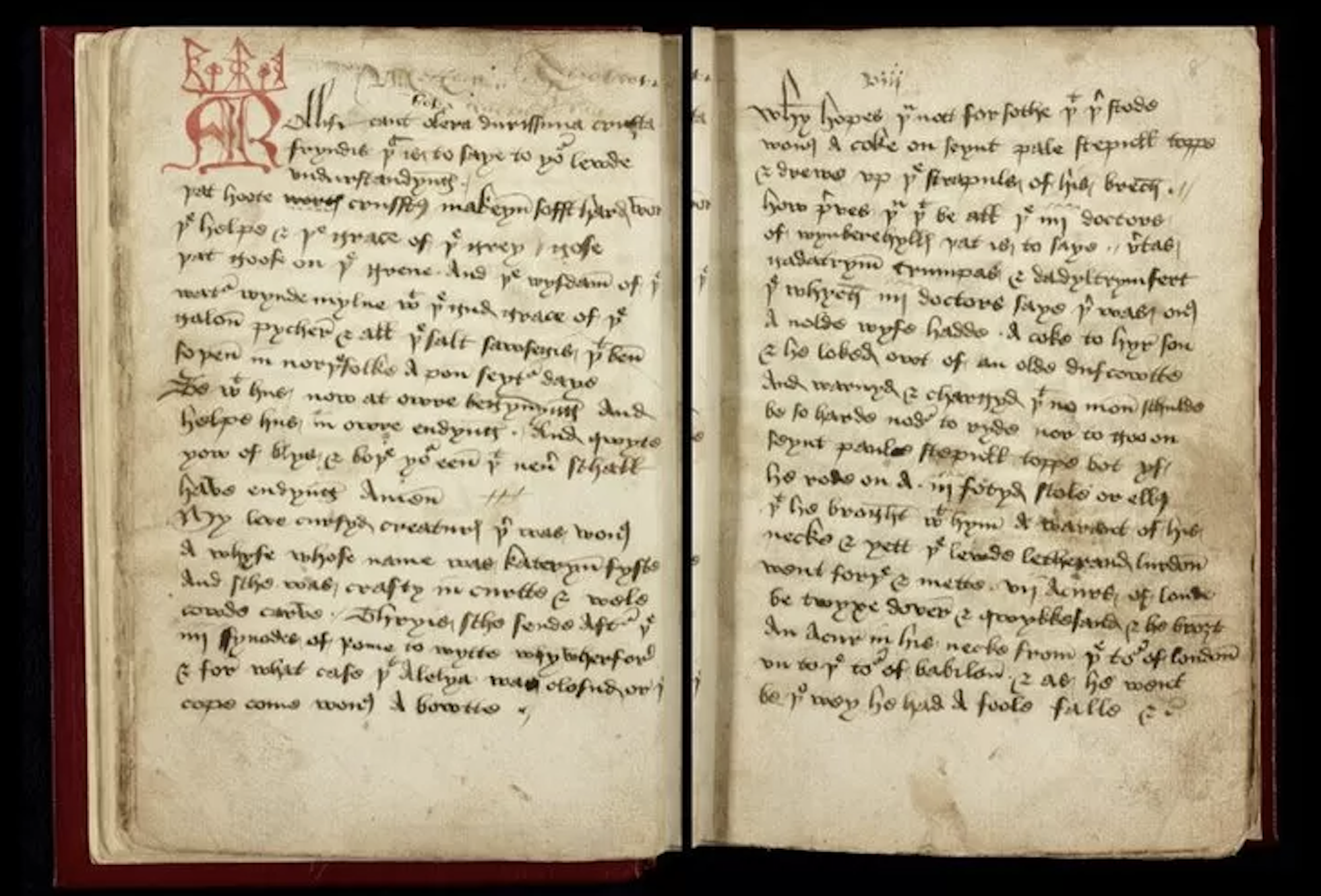
A funny thing happened on the way to the 15th century…
Dr. James Wade, a specialist in early English literature at the University of Cambridge, was doing research at the National Library of Scotland when he noticed something extraordinary about the first of the nine miscellaneous booklets comprising the Heege Manuscript.
Most surviving medieval manuscripts are the stuff of high art. The first part of the Heege Manuscript is funny.
The usual tales of romance and heroism, allusions to ancient Rome, lofty poetry and dramatic interludes… even the dashing adventures of Robin Hood are conspicuously absent.
Instead it’s awash with the staples of contemporary stand up comedy — topical observations, humorous oversharing, roasting eminent public figures, razzing the audience, flattering the audience by busting on the denizens of nearby communities, shaggy dog tales, absurdities and non-sequiturs.
Repeated references to passing the cup conjure an open mic type scenario.
The manuscript was created by cleric Richard Heege and entered into the collection of his employers, the wealthy Sherbrooke family.
Other scholars have concentrated on the manuscript’s physical construction, mostly refraining from comment on the nature of its contents.
Dr. Wade suspects that the first booklet is the result of Heege having paid close attention to an anonymous traveling minstrel’s performance, perhaps going so far as to consult the performer’s own notes.
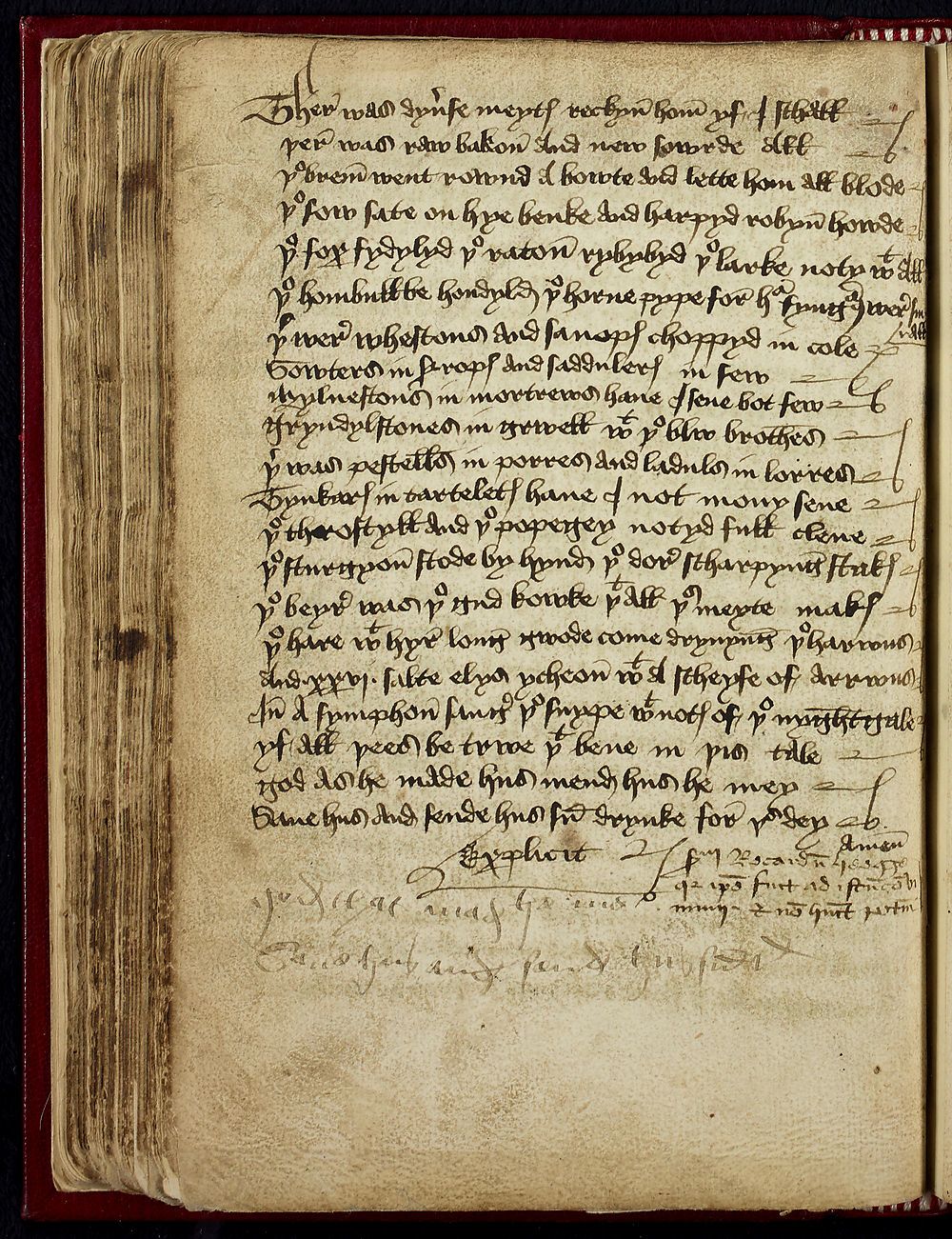
Heege quipped that he was the author owing to the fact that he “was at that feast and did not have a drink” — meaning he was the only one sober enough to retain the minstrel’s jokes and inventive plotlines.
Dr. Wade describes how the comic portion of the Heege Manuscript is broken down into three parts, the first of which is sure to gratify fans of Monty Python and the Holy Grail:
…it’s a narrative account of a bunch of peasants who try to hunt a hare, and it all ends disastrously, where they beat each other up and the wives have to come with wheelbarrows and hold them home.
That hare turns out to be one fierce bad rabbit, so much so that the tale’s proletarian hero, the prosaically named Jack Wade, worries she could rip out his throat.
Dr. Wade learned that Sir Walter Scott, author of Ivanhoe, was aware of The Hunting of the Hare, viewing it as a sturdy spoof of high minded romance, “studiously filled with grotesque, absurd, and extravagant characters.”
The killer bunny yarn is followed by a mock sermon - If thou have a great black bowl in thy hand and it be full of good ale and thou leave anything therein, thou puttest thy soul into greater pain — and a nonsense poem about a feast where everyone gets hammered and chaos ensues.
Crowd-pleasing material in 1480.
With a few 21st-century tweaks, an enterprising young comedian might wring laughs from it yet.
(Paging Tyler Gunther, of Greedy Peasant fame…)
As to the true author of these routines, Dr. Wade speculates that he may have been a “professional traveling minstrel or a local amateur performer.” Possibly even both:
A ‘professional’ minstrel might have a day job and go gigging at night, and so be, in a sense, semi-professional, just as a ‘travelling’ minstrel may well be also ‘local’, working a beat of nearby villages and generally known in the area. On balance, the texts in this booklet suggest a minstrel of this variety: someone whose material includes several local place-names, but also whose material is made to travel, with the lack of determinacy designed to comically engage audiences regardless of specific locale.
Learn more about the Heege Manuscript in Dr. Wade’s article, Entertainments from a Medieval Minstrel’s Repertoire Book in The Review of English Studies.
Leaf through a digital facsimile of the Heege Manuscript here.
Related Content
A List of 1,065 Medieval Dog Names: Nosewise, Garlik, Havegoodday & More
Why Knights Fought Snails in Illuminated Medieval Manuscripts
– Ayun Halliday is the Chief Primatologist of the East Village Inky zine and author, most recently, of Creative, Not Famous: The Small Potato Manifesto and Creative, Not Famous Activity Book. Follow her @AyunHalliday.
Read More...An Animated Introduction to the Avant-Garde Music of John Cage
We all know music when we hear it — or at least we think we do — but how, exactly, do we define it? “Imagine you’re in a jazz club, listening to the rhythmic honking of horns,” says the narrator of the animated TED-Ed video above. “Most people would agree that this is music. But if you were on the highway, hearing the same thing, many would call it noise.” Yet the closer we get to the boundary between music and noise, the less clear it gets. The composer John Cage, to whose work this video provides an introduction, spent his long career in those very borderlands: he “gleefully dared listeners to question the boundaries between music and noise, as well as sound and silence.”
The best-known example of this larger endeavor is “4’33”,” Cage’s 1952 “solo piano piece consisting of nothing but musical rests for four minutes and thirty-three seconds.” Though known as a “silent” composition, it actually makes its listeners focus on all the incidental sounds around them: “Could the opening and closing of a piano lid be music? What about the click of a stopwatch? The rustling, and perhaps even the complaining, of a crowd?”
A few years later, he implicitly asked similar questions about what does and does not count as music to television viewers across America by performing “Water Walk” — whose instruments included “a bathtub, ice cubes, a toy fish, a pressure cooker, a rubber duck, and several radios” — on CBS’ I’ve Got a Secret.
Many who watched that broadcast in 1960 would have asked the same question: “Is this even music?” This may have well have been the outcome for which Cage himself hoped. “Like the white canvases of his painting peers” in that same era, his work “asked the audience to question their expectations about what music was.” As he explored more and more deeply into the territory of unconventional methods of instrumentation, notation, and performance, he drifted farther and farther from the composer’s traditional task: “to organize sound in time for a specific intentional purpose.” Seven decades after “4’33”,” some still insist that John Cage’s work isn’t music — but then, some say the same about Kenny G.
Related content:
Watch John Cage Play His “Silent” 4’33” in Harvard Square, Presented by Nam June Paik (1973)
The Music of Avant-Garde Composer John Cage Now Available in a Free Online Archive
John Cage Performs “Water Walk” on US Game Show I’ve Got a Secret (1960)
An Impressive Audio Archive of John Cage Lectures & Interviews: Hear Recordings from 1963–1991
How to Get Started: John Cage’s Approach to Starting the Difficult Creative Process
Based in Seoul, Colin Marshall writes and broadcasts on cities, language, and culture. His projects include the Substack newsletter Books on Cities, the book The Stateless City: a Walk through 21st-Century Los Angeles and the video series The City in Cinema. Follow him on Twitter at @colinmarshall or on Facebook.
Read More...When David Bowie Starred in The Elephant Man on Broadway (1980)
Joseph Merrick, one of the most severely deformed individuals recorded in medical history, would hardly seem like the role David Bowie was born to play. The latter looked and acted as if destined for nineteen-seventies rock stardom; the former so horrified his fellow Victorians that he was exhibited under the name “The Elephant Man.” But whatever their outward differences, these Englishmen did both know fame, a condition Bowie rued alongside John Lennon in 1975. Yet in the following years he continued to expand his public profile, not least by turning to acting, and even came off as a viable movie star in Nicolas Roeg’s The Man Who Fell to Earth — not that playing a fragile but magnetic visitor from another world would have been much of a stretch.
In fact, it was The Man Who Fell to Earth that convinced theater director Jack Hofsiss to offer Bowie the lead in The Elephant Man, Bernard Pomerance’s play about the life of Joseph Merrick (referred to, in the script, as John Merrick). Hofsiss suspected that Bowie “would understand Merrick’s sense of otherness and alienation,” writes Louder’s Bill DeMain; he may or may not have known that Bowie’s experience studying mime, of which he made plenty of use in his concerts, would place him well to evoke the character’s misshapen body.
The Elephant Man explicitly calls for no prosthetic makeup; beginning with David Schofield, who starred in its first productions, all the actors playing Joseph Merrick have had to embody him with their acting skills alone.
You can see how Bowie did it in clips above. “I got a call within two weeks of having to go over and start rehearsal,” his web site quotes him as saying. “So I went to the London Hospital and went to the museum there. Found the plaster casts of the bits of Merrick’s body that were interesting to the medical profession and the little church that he’d made, and his cap and his cloak.” These artifacts gave him enough sufficient sense of “the general atmosphere” of Merrick’s life and times to make the role his own by the time of his first performances in Denver and Chicago in the summer of 1980. “Advance word on Bowie’s performance was encouraging, with box office records broken at the theaters in both cities,” writes DeMain; The Elephant Man soon made it to Broadway, opening at the Booth Theatre in the fall.
It was there, in December of 1980, that Mark David Chapman saw Bowie play Merrick, just two nights before he assassinated Lennon — and he also had another ticket, in the front row, for the very next night’s show. “John and Yoko were supposed to sit front-row for that show too,” said Bowie, “so the night after John was killed there were three empty seats in the front row. I can’t tell you how difficult it was to go on. I almost didn’t make it through the performance.” Having been number two on Chapman’s hit list surely did its part to inspire Bowie’s decision to recuse himself from live performance — to stop displaying himself for a living, as the character of Joseph Merrick would have put it — for the next few years. But it was only the early eighties, and Bowie could hardly have known that his real heights of fame, for better or worse, were yet to come.
Related content:
Watch David Bowie Star in His First Film Role, a Short Horror Flick Called The Image (1967)
David Bowie’s Mystical Appearances in David Lynch’s Twin Peaks
The Thin White Duke: A Close Study of David Bowie’s Darkest Character
How Nicolas Roeg (RIP) Used David Bowie, Mick Jagger & Art Garfunkel in His Mind-Bending Films
Based in Seoul, Colin Marshall writes and broadcasts on cities, language, and culture. His projects include the Substack newsletter Books on Cities, the book The Stateless City: a Walk through 21st-Century Los Angeles and the video series The City in Cinema. Follow him on Twitter at @colinmarshall or on Facebook.
Read More...Behold a 19th-Century Atlas of the United States, Designed for Blind Students (1837)
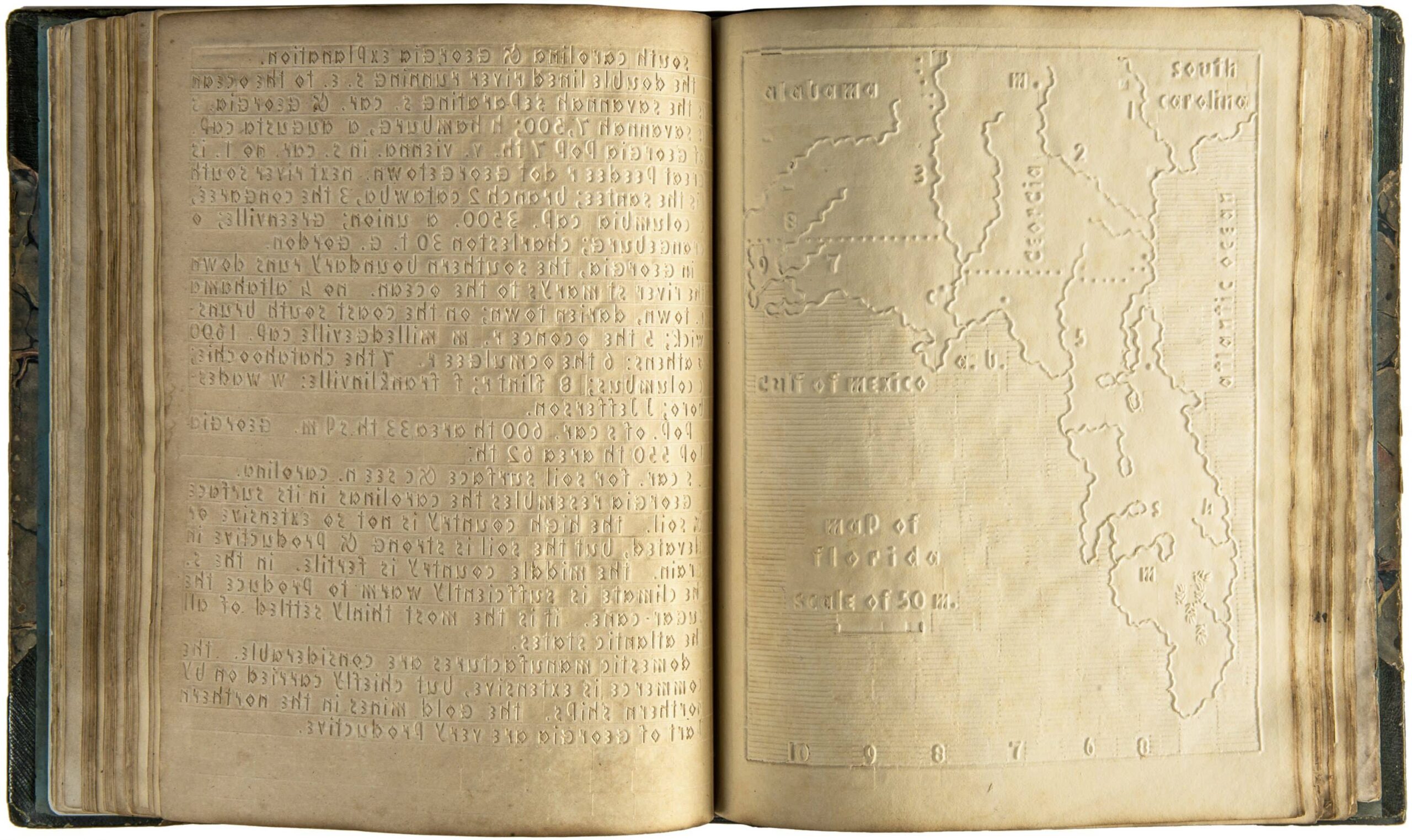
In 1835, the New England Institution for Education of the Blind (now known as Perkins School for the Blind) acquired a printing press.
Under the leadership of its first director, Samuel Gridley Howe, the press was customized in order to print in raised text that allowed blind and visually impaired people to read unassisted.
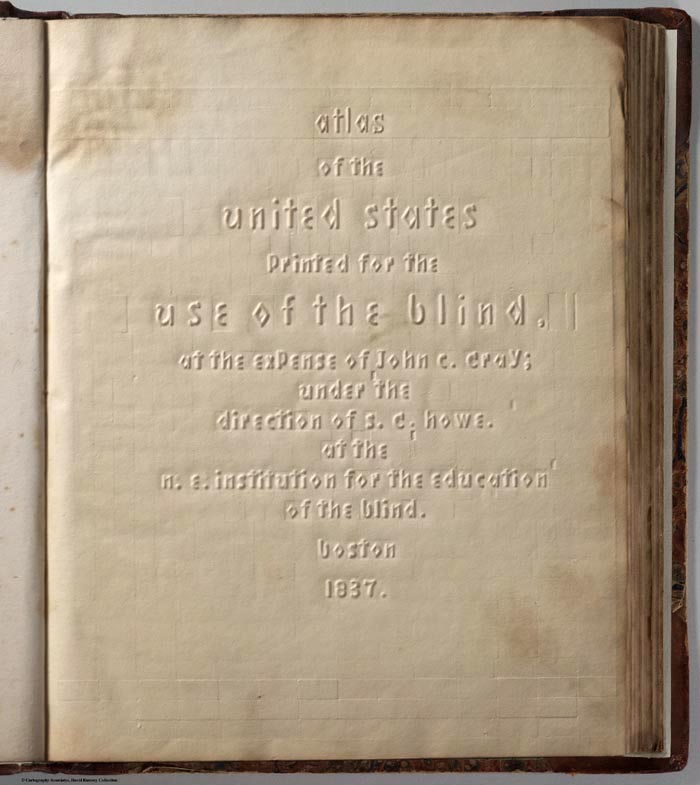
Inclusivity was a prime motivator for Howe, who strove to make sure his students would not be “doomed to inequality” or regarded as “mere objects of pity.”
After investigating European tactile printing systems, he developed Boston Line Type, an embossed Roman alphabet that could be read with the fingers.
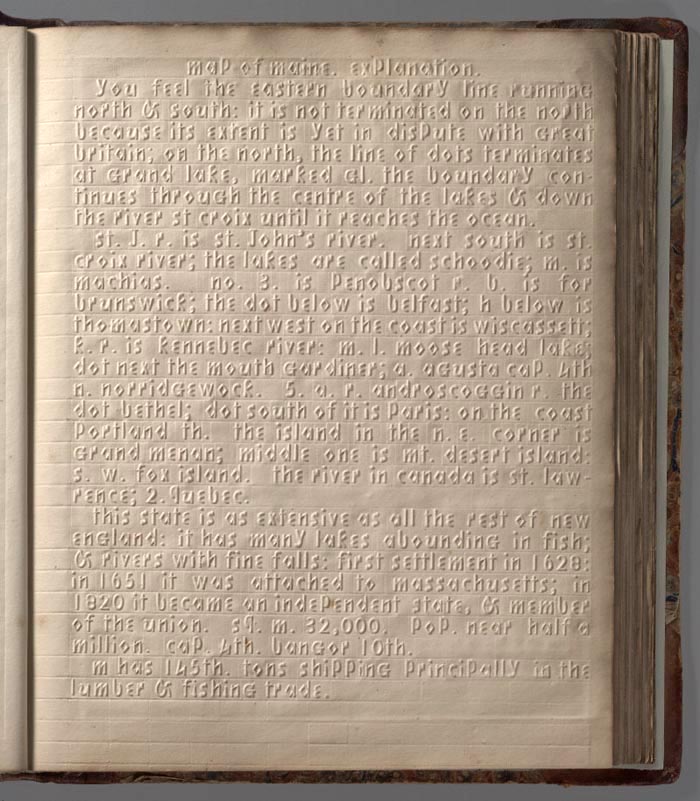
It eschewed flourishes and capital letters, but reading it required a lot of training and even then, was likely to be slow going. Howe estimated that reading it would take three times as long as a sighted person would take to read an equivalent amount of traditionally printed text.
Ultimately it proved far less user-friendly than braille.
Text accompanying the exhibition Touch This Page! Making Sense of the Ways We Read, notes that braille had been in use in Great Britain and France for decades before being widely adopted in the US:
The amount of time and money that Perkins and other American schools had invested into Boston Line Type made them resistant to adopting a new system. Boston Line Type was, however, much harder to learn than braille, and only braille allowed individuals with visual impairments to read and write tactilely.
The school used its Boston Line Type press to publish history, grammar, and spelling books, as well as the New Testament, and a complete Bible.
After a visit to the school, Charles Dickens paid to have 250 Boston Line Type copies of his novel The Old Curiosity Shop printed for distribution to blind Americans.
In light of Touch This Page!’s assertion that Boston Line Type’s print forms were “designed to be universally accessible rather than in those [print forms] most accessible to the touch”, we suspect that the school’s 1837 Atlas of the United States offered its readers the best value.
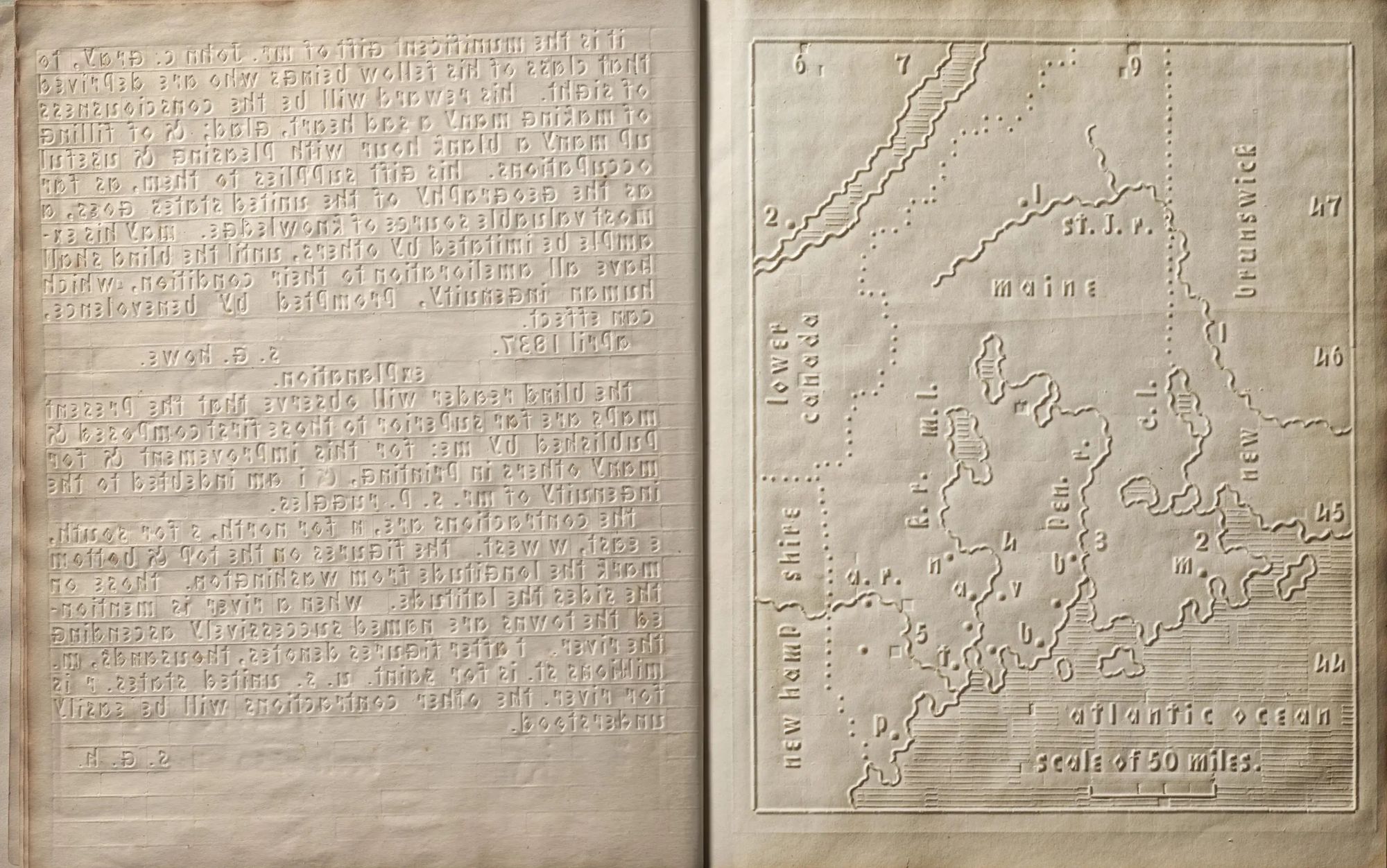
While there were many dense descriptive passages in Boston Line Type to wade through, it also boasted embossed maps to orient geography students with raised outlines of each state.
Rivers were charted as solid raised lines, while oceans were indicated with parallel lines. Sets of triangles represented mountains.
Longitudes, latitudes, and city locations were also noted, but the presence of negative space gave blind and low vision students the opportunity to grasp information quickly.
50 copies were printed, of which four survive.
Explore the Atlas of the United States Printed for the Use of the Blind here.
Related Content
Please Touch the Art: Watch a Blind Man Experience His Own Portrait for the First Time
Helen Keller Had Impeccable Handwriting: See a Collection of Her Childhood Letters
– Ayun Halliday is the Chief Primatologist of the East Village Inky zine and author, most recently, of Creative, Not Famous: The Small Potato Manifesto and Creative, Not Famous Activity Book. Follow her @AyunHalliday.
Read More...What Is Gender Theory? Berkeley Professor Judith Butler Explains
Nobody who keeps up with current discourse could fail to notice that gender has become a fraught topic in recent years. This condition can hardly have gone unforeseen by the theorist Judith Butler, who published the now-well-known volume Gender Trouble: Feminism and the Subversion of Identity back in 1990. “Everybody has a theory of gender,” Butler says in the new Big Think video above. “Everybody has certain assumptions going about what gender is or should be. And at a certain point in life, we ask ourselves, ‘Wow, where’d that assumption come from?’ ” Butler’s career has, in part, focused on the search for the roots of these very assumptions.
This experience places Butler well to comment on the heated arguments about gender being stoked even now in the political realm, on social media, and elsewhere besides. “We have a whole range of differences, biological in nature, so I don’t deny them, but I don’t think they determine who we are in some sort of final way.”
As with many controversies — not least philosophical ones — a core problem has to do with differing definitions of words and concepts. At issue here in particular is “the distinction between sex and gender,” achieving a full understanding of which, to Butler’s mind, requires delving into all the relevant history, including the work of theorists like Gayle Rubin, Juliet Mitchell, and Simone de Beauvoir.
According to Butler, the “basic point” of de Beauvoir’s The Second Sex is that “one is not born a woman, but rather becomes one, that the body is not a fact.” This possibility opened by de Beauvoir — that of “a difference between the sex you’re assigned and the sex you become” — has been much explored since the book’s publication nearly three quarters of a century ago. Some of those explorations have involved the idea of the “performative.” “We do enact who we are,” Butler says. “There are performances that we do in our lives that are not mere performance; they’re not fake.” Following on that, “what if we were to say that, in acting our lives as a particular gender, we are actually realizing that gender anew?” For many readers of gender theory, this raises a host of thrilling new possibilities, but behind it lies perhaps the oldest philosophical question of all: what, now, will you do?
Related content:
An Animated Introduction to the Feminist Philosophy of Simone de Beauvoir
Based in Seoul, Colin Marshall writes and broadcasts on cities, language, and culture. His projects include the Substack newsletter Books on Cities, the book The Stateless City: a Walk through 21st-Century Los Angeles and the video series The City in Cinema. Follow him on Twitter at @colinmarshall or on Facebook.
Read More...
Support Us
We're hoping to rely on loyal readers, rather than erratic ads. Please click the Donate button and support Open Culture. You can use Paypal, Venmo, Patreon, even Crypto! We thank you!

About Us

Open Culture scours the web for the best educational media. We find the free courses and audio books you need, the language lessons & educational videos you want, and plenty of enlightenment in between.
Advertise With Us
FREE UPDATES!
GET OUR DAILY EMAIL
Get the best cultural and educational resources on the web curated for you in a daily email. We never spam. Unsubscribe at any time.
FOLLOW ON SOCIAL MEDIA
Open Culture editor Dan Colman scours the web for the best educational media. He finds the free courses and audio books you need, the language lessons & movies you want, and plenty of enlightenment in between.
Advertise With Us

