An Introduction to the World-Renowned Architect Zaha Hadid, “the Queen of the Curve”
Zaha Hadid won the Pritzker Prize, architecture’s most prestigious award, in 2004. She was then in her early fifties — practically a schoolgirl by the standards of her profession — and had only completed four buildings. Yet the Pritzker committee already suspected that she saw possibilities in the built environment, and perhaps entire dimensions, that others did not. Indeed, she would spend her remaining dozen years proving them right, as evidenced by the legacy of impressive structures she left all across the world, from the Contemporary Arts Center in Cincinnati and the BMW Central Building in Leipzig to the London Aquatics Center and the Guangzhou Opera House.
Living in Seoul, I myself have occasion every so often to pass through a Hadid building: the Dongdaemun Design Plaza, which opened in 2013. Essentially a collection of shops and exhibition spaces, it has become best known as a quasi-public gathering place full of backdrops suitable for Instagram photography.
In its size, shape, and aesthetic, the DDP stands well apart from its urban context, looking like a spaceship sent by an advanced alien civilization to colonize an old downtown garment district. In that respect it’s representative of Hadid’s work, which realizes the kind of irregular, unrelentingly curvilinear forms practically unknown in architecture before her rise to its highest level of stardom.
“In her buildings, walls are never quite vertical, floors seldom remain flat for long, and the twain meet not in ninety-degree angles but, rather, in the kinds of curves one finds in skateboard parks,” writes the New Yorker’s John Seabrook, profiling Hadid in 2009. “There is no single Hadid style, although one can detect a watermark in her buildings’ futuristic smoothness. Certain themes carry through her use of materials (glass, steel, concrete), her lines (corridors often trace flowing arabesque shapes, while roof struts make sharp Z‑shaped angles), her structures (she favors column-free spaces), and her sculptural interiors and asymmetric façades.”
Such distinctive designs — of buildings as well as of furniture, jewelry, and other consumer objects — earned Hadid the informal title of “queen of the curve.” You can learn more about her reign and its lasting influence in these two video essays, one from Curious Muse and the other from The B1M. Like all the most innovative architects, Hadid had visions realizable only with, and simultaneously influenced by, the technology of her time. “The idea is not to have any 90-degree angles,” she once said, and the development of advanced computer-aided design tools in the nineteen-nineties made that idea a reality. In pursuing that idea to its very limits, she took the most concrete of all art forms and, improbably, made it abstract.
Related content:
Why Do People Hate Modern Architecture?: A Video Essay
Based in Seoul, Colin Marshall writes and broadcasts on cities, language, and culture. His projects include the Substack newsletter Books on Cities, the book The Stateless City: a Walk through 21st-Century Los Angeles and the video series The City in Cinema. Follow him on Twitter at @colinmarshall or on Facebook.
Read More...LEGO Releases the Most Elaborate Lord of the Rings Set: A 6,167-Piece Rivendell

Many of us built our first LEGO models in childhood and, a few years thereafter in adolescence, read our first Lord of the Rings novel. We continue to look fondly back on such formative cultural experiences in adulthood, and indeed, some of us retain a genuine appreciation for the artifacts themselves well into middle age.

It is toward that very intersection of enthusiasm and means that LEGO has targeted its latest and largest Lord of the Rings-themed set: a 6,167-piece model of the Rivendell, the sanctuary located in the eponymous Elvish valley, which is set to retail for $500 USD.
This new LEGO Rivendell has room “for the entire Fellowship to debate The One Ring, and the shards of a particularly noteworthy sword,” writes The Verge’s Sean Hollister, and it includes “tiled rooftops, imaginative arches, and enough distinct spaces to recreate multiple scenes from the movies.”

This marks a considerable improvement on the sets that came out at the time of Peter Jackson’s Lord of the Rings movies in the early 2000s: Andrew Liszewski at Gizmodo notes that “the largest one was a 1,300+-piece recreation of the Battle of Helm’s Deep that, by today’s LEGO standards, was relatively small. The collection also included a tiny 243-piece recreation of the Council of Elrond, which, understandably, left LOTR fans disappointed.”
You can see an in-depth review of the new Rivendell set in the video just above from LEGO Youtuber Bricksie. He has a great deal of praise for the details of its components, yet whatever resources LEGO can put toward an official consumer product, they can hardly match the power of sheer fan obsession.

If you want to experience a truly faithful re-creation of Rivendell in the medium of LEGO, you’ll have to attend a convention with Alice Finch and David Frank, builders of an elaborate model that includes no fewer than 200,000 bricks: a sprawling monument to the kind of quasi-religious (and sometimes lifelong) devotion inspired by both the imagination of Tolkien and the possibilities of LEGO.

Related content:
The Lord of the Rings Mythology Explained in 10 Minutes, in Two Illustrated Videos
Hokusai’s Iconic Print The Great Wave off Kanagawa Recreated with 50,000 LEGO Bricks
Cambridge University to Create a LEGO Professorship
Why Did LEGO Become a Media Empire? Pretty Much Pop: A Culture Podcast #37
Based in Seoul, Colin Marshall writes and broadcasts on cities, language, and culture. His projects include the Substack newsletter Books on Cities, the book The Stateless City: a Walk through 21st-Century Los Angeles and the video series The City in Cinema. Follow him on Twitter at @colinmarshall or on Facebook.
Read More...YouTube & Arizona State University Team Up to Offer Online Courses for Real College Credits
A recent Pew Research Center survey found that nearly one in five American teenagers is on Youtube “almost constantly.” Ten years ago, the figure surely wouldn’t have been that high, and twenty years ago, of course, Youtube didn’t exist at all. But today, no enterprise directed at teenagers can afford to ignore it: that goes for pop music and fashion, of course, but also for education. Most kids just starting college are on Youtube, but so are those about to start college, those taking time off from college, and those unsure of whether they’re willing or able to go to college at all. Hence College Foundation, a new extension of Youtube channel Study Hall, the product of a partnership between Arizona State University, YouTube and Crash Course.
Crash Course has long produced video series that, both entertainingly and at length, cover subjects taught in school from history to literature to philosophy and beyond. The College Foundation’s program will make it possible not just to learn on Study Hall, but to earn real college credits as well.
“Students who are interested in formal coursework beyond watching the videos may pay a $25 fee to enroll in an ASU online course that includes interacting with other students and instructors,” writes Inside Higher Education’s Susan D’Agostino. Upon completion of the course, “the student can decide whether they would like to pay $400 to record the grade and receive ASU credit.”
Enrollment is now open for the first four College Foundations courses, English Composition, College Math, U.S. History and Human Communication, all of which begin on March 7th. (Those who sign up before that start date will receive a $50 discount.) “Once you’re in a course, you can contact a success coach via email to get help with assignments,” writes TechCrunch’s Aisha Malik. “You can complete your coursework when it’s convenient for you, but you will have weekly due dates for most of the courses. If you want to access additional support, some instructors hold optional office hours.” This sort of learning experience could become a bridge to Youtube life and college life — the latter being the subject addressed, with characteristic Youtube directness, in the existing Study Hall course “How to College.”
Related content:
1,700 Free Online Courses from Top Universities
A Crash Course in World History
A Crash Course on Psychology: A 30-Part Video Series from Hank Green
Crash Course Big History: John Green Teaches Life, the Universe & Everything
Based in Seoul, Colin Marshall writes and broadcasts on cities, language, and culture. His projects include the Substack newsletter Books on Cities, the book The Stateless City: a Walk through 21st-Century Los Angeles and the video series The City in Cinema. Follow him on Twitter at @colinmarshall or on Facebook.
Read More...Adapting the Unfilmable Story of Pinnochio — Pretty Much Pop: A Culture Podcast #143

Your Pretty Much Pop A‑Team Mark Linsenmayer, Lawrence Ware, Sarahlyn Bruck, and Al Baker discuss the original 1883 freaky children’s story by Carlo Collodi and consider the recent rush of film versions, from a new Disney/Robert Zemikis CGI take to Guillermo del Toro’s stop-motion passion project to a heavily costumed Italian version by Matteo Garrone, which is the second to feature Oscar winner Roberto Benigni in a lead role. Benigni’s previous try was a 2002 version that is the most true to the beats of the original story and maybe because of this has a 0% on Rotten Tomatoes. Why do people keep remaking this story, and how has the original moral of “be a good boy and obey” changed over the years?
Read the original story. Some articles going through the film versions include:
- “The twisted history of Pinocchio on screen” by Cindy White
- “Pinocchio: Top 10 Best Movie And TV Adaptations, Ranked by IMDb” by Olivia Hayward
- “Pinocchios, Ranked” by Barry Levitt
- “The Transformations of Pinocchio” by Joan Acocella
- “Pinocchio: The scariest children’s story ever written” by Nicholas Barber
Follow us @law_writes, @sarahlynbruck, @ixisnox, @MarkLinsenmayer.
Hear more Pretty Much Pop. Support the show and hear bonus talking for this and nearly every other episode at patreon.com/prettymuchpop or by choosing a paid subscription through Apple Podcasts. This podcast is part of the Partially Examined Life podcast network.
Pretty Much Pop: A Culture Podcast is the first podcast curated by Open Culture. Browse all Pretty Much Pop posts.
Read More...Medieval Mixed-Gender Fight Club: Behold Images from a 15th-Century Fighting Manual
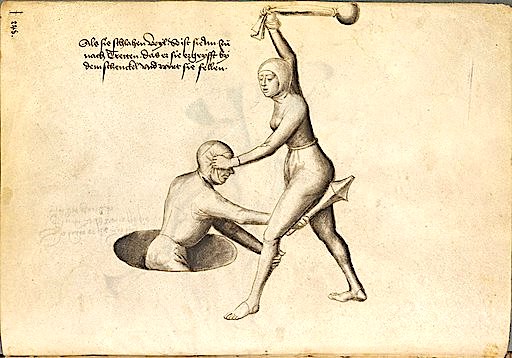
Welcome to Medieval Mixed-Gender Fight Club.
The first rule of Medieval Mixed-Gender Fight Club is: you do not talk about Medieval Mixed-Gender Fight Club.
The second rule of Medieval Mixed-Gender Fight Club is: you DO NOT talk about Medieval Mixed-Gender Fight Club!
Why?
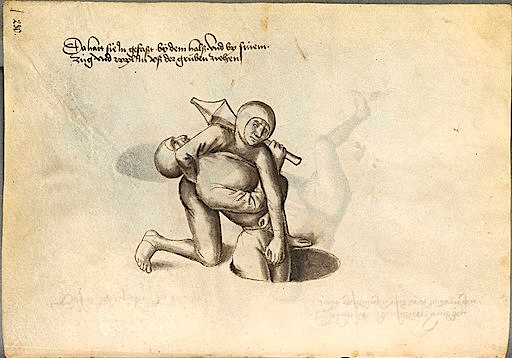
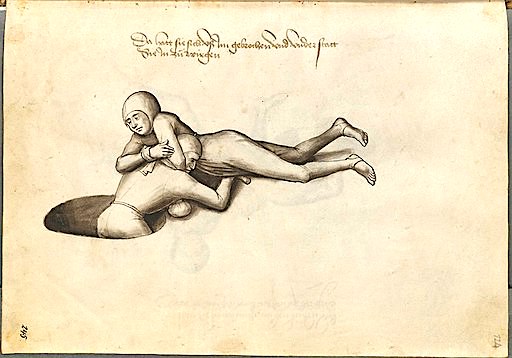
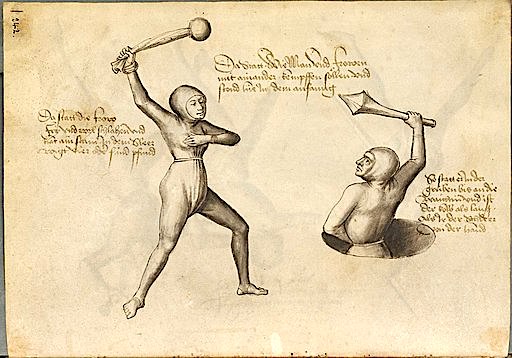
The Public Domain Review’s managing editor, Hunter Dukes, wisely argues that it’s because we have so little to go on, beyond these startling images of “judicial duels” between men and women in German fencing master Hans Talhoffer’s illustrated 15th-century “fight books.”
The male combatant, armed with a wooden mace, starts out in a waist-deep hole.
The female, armed with a rock wrapped in a length of cloth, stands above, feet planted to the ground.
Their matching unisex garments wouldn’t look out of place at the Met Gala, and provide for maximum movement as evidenced by the acrobatic, and seriously painful-looking paces Talhoffer puts them through.
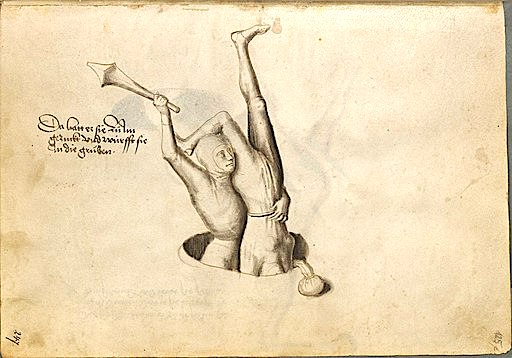
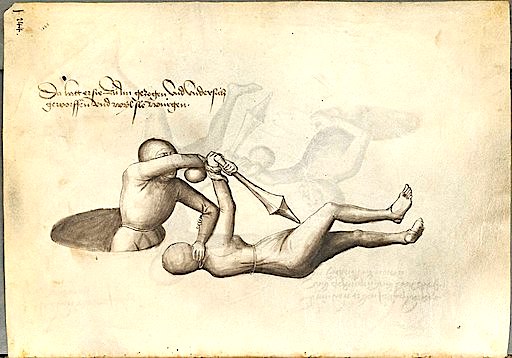
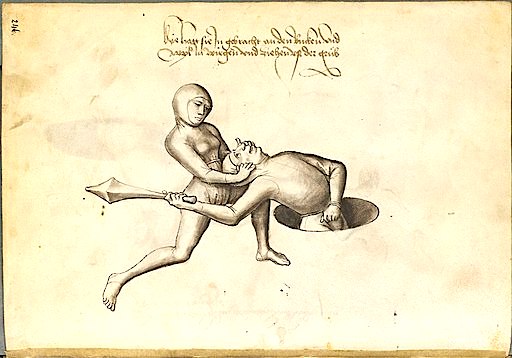
Dukes is not alone in wondering what’s going on here, and he doesn’t mince words when calling bullshit on those responsible for “hastily researched articles” eagerly pronouncing them to be action shots of divorce-by-combat.
Such brutal methods of formal uncoupling had been rendered obsolete centuries before Talhoffer began work on his instructional manuals.
In a 1985 article in Source: Notes in the History of Art, Allison Coudert, a professor of Religious Studies at UC Davis, posits that Talhoffer might have been drawing on the past in these pages:
I would suggest that no records of judicial duels between husbands and wives exists after 1200 because of both changes in the reality and the ideal of what a woman could be and do. Before 1200, women may well have battled their husbands. Women understood and defended the importance of their economic and administrative roles in the household. After the twelfth century, however, law, custom and religion made marital duels all but unthinkable.
Why would Talhoffer bother including archaic material if the focus of his Fechtbuchs was giving less experienced fighters concrete information for their betterment?
We like the notion that he might have been seeking to inject his manuscripts with a bit of an erotic charge, but concede that scholars like Coudert, who have PhDs, research chops, and actual expertise in the subject, are probably warmer when reckoning that he was just covering his historical bases.
For now, let us enjoy these images as art, and possible sources of inspiration for avant-garde circus acts, Halloween couples costumes, and Valentines.
Explore more images from the 15th-century Fechtbuchs of Hans Talhoffer here and here.
Related Content
What It’s Like to Actually Fight in Medieval Armor
How to Get Dressed & Fight in 14th Century Armor: A Reenactment
The Medieval Masterpiece, the Book of Kells, Is Now Digitized & Put Online
- Ayun Halliday is the Chief Primatologist of the East Village Inky zine and author, most recently, of Creative, Not Famous: The Small Potato Manifesto and Creative, Not Famous Activity Book. Follow her @AyunHalliday.
Read More...When Leonard Bernstein Turned Voltaire’s Candide into an Opera (with Help from Lillian Hellman, Dorothy Parker & Stephen Sondheim)
The seventeen-fifties found Western civilization in the middle of its Age of Enlightenment. That long era introduced on a large scale the notion that, through the use of rationality and scientific knowledge, humanity could make progress. For the Enlightenment’s true believers, it would have eventually become quite easy indeed to assume that we had nowhere to go but up, and would sooner or later attain a state of perfection. No such fantasies, of course, for Jean-Marie Arouet, better known as Voltaire. Despite being an Enlightenment icon, he pulled no punches in attacking what he saw as its delusions, most lastingly in his 1759 satirical novel Candide, ou l’Optimisme.
Two centuries later, Western civilization, and especially the freshly formed civilization of the United States of America, had entered a new age of reason. Or rather, it had entered an age of technical, industrial, and organizational “know-how.”
The conviction that America could be perfected through engineered systems played its part in generating a degree of prosperity the world had never known (and would have scarcely been imaginable in Voltaire’s day). But it also had grimmer manifestations, such as McCarthyism and the House Un-American Activities Committee, whose procedures ground away at the core of the anti-Communist “red scare.”
In Candide, Voltaire takes to task a variety of not just beliefs but institutions, including the Portuguese Inquisition. The playwright Lillian Hellman, who’d been blacklisted after appearing before the HUAC in 1947, “observed a sinister parallel between the Inquisition’s church-sponsored purges and the ‘Washington Witch Trials,’ fueled by anti-Communist hysteria.” So says the web site of Leonard Bernstein, Hellman’s collaborator on what would become a comic-operetta adaptation of Candide. With contributions from lyricist John LaTouche, poet Richard Wilbur, and Algonquin Round Table wit Dorothy Parker, their production was ready to open in the fall of 1956.
Stripped in the eleventh hour of Hellman’s most direct topical attacks, and even then criticized for over-seriousness, the original Broadway production of Candide ended after 73 performances. (Recordings of the original production can be purchased online.) Nevertheless, there was cause for optimism about its future: the show would be revived in London with a revised book two years later, with further new versions to follow in the nineteen-seventies and eighties, its lyrics supplemented by no less a Broadway master than Stephen Sondheim. The two-and-a-half hour video above combines highlights of two consecutive performances in 1989, conducted by Bernstein himself in the year before his death. “Like its hero, Candide is perhaps destined never to find its perfect form and function,” notes Bernstein’s site. “In the final analysis, however, that may prove philosophically appropriate.”
Related content:
An Animated Introduction to Voltaire: Enlightenment Philosopher of Pluralism & Tolerance
Based in Seoul, Colin Marshall writes and broadcasts on cities, language, and culture. His projects include the Substack newsletter Books on Cities, the book The Stateless City: a Walk through 21st-Century Los Angeles and the video series The City in Cinema. Follow him on Twitter at @colinmarshall or on Facebook.
Read More...The Two Fridas: An Introduction to Frida Kahlo’s Famous Large-Scale Painting (1939)
One can appreciate the art of Frida Kahlo while knowing nothing of the art of her onetime husband, the Mexican muralist Diego Rivera. But the experience of certain of her paintings can be greatly enriched by some knowledge of their relationship, the clearest example being The Two Fridas, which Kahlo painted in 1939 after their divorce. The largest of her numerous self-portraits, it presents the artist as a set of doppelgängers set apart by their attire: one wears a European dress, and the other a traditional Mexican one. The resulting tableau could, on one level, reflect her dual heritage; it also, as Kahlo herself put it, shows “the Frida Diego loved, and the one he didn’t.”
The Two Fridas is the subject of the video essay above from Great Art Explained. “The darker-skinned Frida on the right is the indigenous Mexican Frida that was adored by her husband,” explains its host, gallerist James Payne.
“The lighter-skinned Frida on the left is the European Frida that he rejected.” Presenting herself in the former fashion “sent a clear message of cultural identity, nationalism, and feminism” — but it also concealed the “broken body” that resulted from a bus crash in her youth as well as various other physical disorders later in life. This portrait, however, exposes the heart of “Mexican Frida” in order to show that it “remains intact, sustained by the small portrait of Diego” in her hand.
The heart of “European Frida,” however, is rendered as “disconnected from her beloved Diego,” and it “bleeds profusely onto her dress, a Victorian lace dress similar to the one her mother wore.” The two Fridas are connected through their exposed hearts by a single artery, one connected to the portrait of Rivera. Payne points out the particular symbolic power of a bleeding heart, a “fundamental symbol of Catholicism” that “can also be seen as symbolic of Aztec ritual sacrifice,” in the case of a culturally conflicted artist such as Kahlo. In retrospect, The Two Fridas also seems to express the inevitability of Kahlo and Rivera’s remarriage, which would come the following year. They had “one of the most obsessive and tumultuous relationships in art history,” as Payne puts it, but while both lived, they knew they couldn’t do without each other.
Related content:
Frida Kahlo: The Life of an Artist
A Brief Animated Introduction to the Life and Work of Frida Kahlo
The Intimacy of Frida Kahlo’s Self-Portraits: A Video Essay
Home Movies of Frida Kahlo (and a Side Order of Romantic Entanglements)
Based in Seoul, Colin Marshall writes and broadcasts on cities, language, and culture. His projects include the Substack newsletter Books on Cities, the book The Stateless City: a Walk through 21st-Century Los Angeles and the video series The City in Cinema. Follow him on Twitter at @colinmarshall or on Facebook.
Read More...Stream 385,000 Vintage 78 RPM Records at the Internet Archive: Louis Armstrong, Glenn Miller, Billie Holiday & More
We may have yet to develop the technology of time travel, but recorded music comes pretty close. Those who listen to it have experienced how a song or an album can, in some sense, transport them right back to the time they first heard it. But older records also have the much stranger power to conjure up eras we never experienced. You can musically send yourself as far back as the nineteen-twenties with the above Youtube playlist of digitized 78 RPM records from the George Blood collection.
George Blood is the head of the audio-visual digitization company George Blood Audio, which has been participating in the Internet Archive’s Great 78 Project. “The brainchild of the Archive’s founder, Brewster Kahle, the project is dedicated to the preservation and discovery of 78rpm records,” writes The Vinyl Factory’s Will Pritchard.
The piece quotes Blood himself as saying that his company has been digitizing five to six thousand records per month with the ambitious goal of creating a “reference collection of sound recordings from the period of approximately 1880 to 1960.” He said that five years ago. Today, the Internet Archive’s George Blood collection contains more than 385,000 records free to stream and download.
The 78 having been the most popular recorded-music format in the first few decades of the twentieth century, George Blood L.P. and the Great 78 Project as a whole have had plenty of material to work with. In the large archive built up so far you’ll find plenty of obscurities — the Youtube playlist at the top of the post can get you acquainted with the likes of Eric Whitley and the Green Sisters, Tin Ear Tanner and His Back Room Boys, and Douglas Venable and His Bar X Ranch Hands — but also the work of musicians who remain beloved today. For the 78 was the medium through which many listeners enjoyed the big-band hit of Glenn Miller, or discovered jazz as performed by legends like Louis Armstrong and Billie Holiday. To know their music most intimately, one would perhaps have needed to hear them in the actual nineteen-thirties, but this is surely the next best thing.
Related content:
200,000+ Vintage Records Being Digitized & Put Online by the Boston Public Library
Rare Arabic 78 RPM Records Enter the Public Domain
Based in Seoul, Colin Marshall writes and broadcasts on cities, language, and culture. His projects include the Substack newsletter Books on Cities, the book The Stateless City: a Walk through 21st-Century Los Angeles and the video series The City in Cinema. Follow him on Twitter at @colinmarshall or on Facebook.
Read More...The Only Footage of Mark Twain: The Original & Digitally Restored Films Shot by Thomas Edison
We know what Mark Twain looked like, and we think we know what he sounded like. Just above see what he looked like in motion, strolling around Stormfield, his house in Redding, Connecticut—signature white suit draped loosely around his frame, signature cigar puffing white smoke between his fingers. After Twain’s leisurely walk along the house’s façade, we see him with his daughters, Clara and Jean, seated indoors. Below you can see the original murky version, featured on our site way back in 2010. A digital restoration (top) does wonders for the watchability of this priceless silent artifact, so vividly capturing the writer/contrarian/raconteur’s essence that you’ll find yourself reaching to turn the volume up, expecting to hear that familiar curmudgeonly drawl.
Shot by Thomas Edison in 1909, the short film is most likely the only moving image of Twain in existence. We might assume that Edison also recorded Twain’s voice, since we seem to know it so well, from portrayals of the great American humorist in pop cultural touchstones like Star Trek: The Next Generation and parodies by Alec Baldwin and Val Kilmer.
Kilmer’s surprisingly funny in the role, but he doesn’t come near the pitch perfect impersonation Hal Holbrook had given us for the better part of sixty years in his masterful Mark Twain Tonight. Holbrook’s vocal mannerisms have become a definitive model for actors playing Twain on stage and screen.
Given the number of Twain vocal impersonations out there, and Edison’s interest in documenting the author, we might be surprised to learn that no original recordings of his voice exist. Twain, we find out in the short film below, experimented with audio recording technology, but abandoned his efforts. It seems that none of the wax cylinders he worked with have survived—perhaps he destroyed them himself.
As narrator Rod Rawlings—himself a Twain impersonator and aficionado—informs us, what we do have is a recording made in 1934 by actor and playwright William Gillette, an able mimic of Twain, his patron and longtime neighbor. Like Holbrook, Gillette spent a good part of his career traveling from town to town playing Mark Twain. Below, you’ll hear Gillette address a class of students at Harvard, first in his own voice, then in the voice of the author, reading from “The Celebrated Jumping Frog of Calaveras County.” Gillette’s performance is likely the closest we’ll ever come to hearing the voice of the real Twain, whose major works appear in our collection of Free Audio Books and Free eBooks.
Related Content:
Mark Twain Wrote the First Book Ever Written With a Typewriter
Mark Twain’s Viciously Funny Marginalia Took Aim at Some Literary Greats
Josh Jones is a writer and musician based in Durham, NC. Follow him at @jdmagness.
Read More...Contribute a Song to WNYC’s Public Song Project & Use Your Creativity to Explore the Public Domain

We recognize that Open Culture readers are a creative bunch.
As proof, we point to your Getty Museum Challenge entries and the fact that one of your number won Yale University Press’s Kafka Caption Contest.
We’ve identified another opportunity to show off your creative streak, compliments of All Of It with Alison Stewart, a daily live culture program on WNYC, New York City’s public radio station.
You have until February 13 to write and record an original song inspired by a work in the public domain, and submit it to The All Of It Public Song Project.
Amateurs are welcome to take a crack at it and any genre is cricket, including rap, spoken word, and instrumentals.
Even if you limit yourself to the works that entered the public domain on January 1 of this year, the possibilities are almost endless.
Should you be inclined toward a faithful cover, we encourage you to consider one of 1927’s deep cuts, like Fats Waller’s “Soothin’ Syrup Stomp” or Jelly Roll Morton’s “Hyena Stomp,” though we understand the attraction of Irving Berlin’s enduringly popular “Puttin’ on the Ritz”.
Apologies to Emily Joy, the accomplished young classical pianist, above — participation is limited to entrants aged 18 or older.
The rest of us are free to invent new lyrics for an existing composition, or a brand new tune for existing lyrics.
You might musicalize a poem or speech, some dialogue from a film, or a page from a book.
A bluegrass spin on Fritz Lang’s Metropolis, perhaps?
A death metal re-envisioning of Buttercup Days from A.A. Milne’s Now We Are Six?
How about a sissy bounce take on these lines from “The Adventure of the Mazarin Stone,” the first short story in Arthur Conan Doyle’s collection, The Case-Book of Sherlock Holmes:
“Billy, you will see a large and ugly gentleman outside the front door. Ask him to come up.”
“If he won’t come, sir?”
“No violence, Billy. Don’t be rough with him. If you tell him that Count Sylvius wants him he will certainly come.”
“What are you going to do now?” asked the Count as Billy disappeared.
“My friend Watson was with me just now. I told him that I had a shark and a gudgeon in my net; now I am drawing the net and up they come together.”
The Count had risen from his chair, and his hand was behind his back. Holmes held something half protruding from the pocket of his dressing-gown.
“You won’t die in your bed, Holmes.”
Okay, we’re being silly, but only because we don’t want to put ideas in your head!
You could even concoct something entirely new — perhaps a ballad from the POV of To the Lighthouse’s young James Ramsay, or a ditty apologizing to Virginia Woolf for reading the Cliffs Notes instead of the actual novel when it was assigned in your college Women’s Literature class.
…we’re doing it again, aren’t we?
All right, we’ll leave you to it, with a reminder that anything outside of your public domain source material must be wholly original — no borrowing a catchy tune from Lennon and McCartney, capisci?
Winners will get a chance to discuss their works on WNYC and all qualifying entries will be posted at contest’s end for the public’s listening pleasure.
Contest rules and information on how to submit to The All Of It Public Song Project can be found here.
Good luck! We can’t wait to hear what you come up with.
Related Content
A Search Engine for Finding Free, Public Domain Images from World-Class Museums
400,000+ Sound Recordings Made Before 1923 Have Entered the Public Domain
- Ayun Halliday is the Chief Primatologist of the East Village Inky zine and author, most recently, of Creative, Not Famous: The Small Potato Manifesto and Creative, Not Famous Activity Book. Follow her @AyunHalliday.
Read More...Support Us
We're hoping to rely on loyal readers, rather than erratic ads. Please click the Donate button and support Open Culture. You can use Paypal, Venmo, Patreon, even Crypto! We thank you!

About Us

Open Culture scours the web for the best educational media. We find the free courses and audio books you need, the language lessons & educational videos you want, and plenty of enlightenment in between.
Advertise With Us
FREE UPDATES!
GET OUR DAILY EMAIL
Get the best cultural and educational resources on the web curated for you in a daily email. We never spam. Unsubscribe at any time.
FOLLOW ON SOCIAL MEDIA
Open Culture editor Dan Colman scours the web for the best educational media. He finds the free courses and audio books you need, the language lessons & movies you want, and plenty of enlightenment in between.
Advertise With Us

