Hear the Oldest Song in the World: A Sumerian Hymn Written 3,400 Years Ago
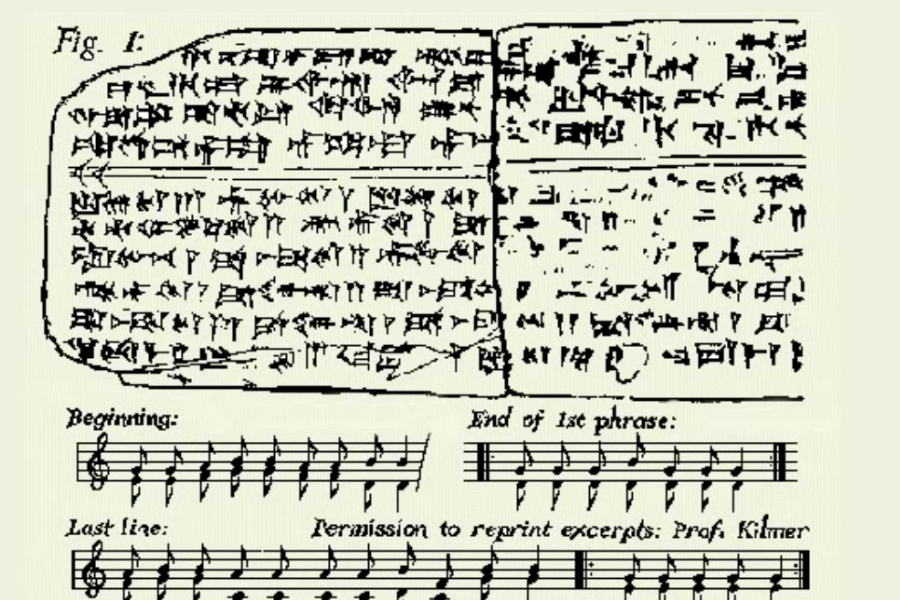
In the early 1950s, archaeologists unearthed several clay tablets from the 14th century BCE. Found, WFMU tells us, “in the ancient Syrian city of Ugarit,” these tablets “contained cuneiform signs in the hurrian language,” which turned out to be the oldest known piece of music ever discovered, a 3,400 year-old cult hymn. Anne Draffkorn Kilmer, professor of Assyriology at the University of California, produced the interpretation below in 1972. (She describes how she arrived at the musical notation—in some technical detail—in this interview.) Since her initial publications in the 60s on the ancient Sumerian tablets and the musical theory found within, other scholars of the ancient world have published their own versions.
The piece, writes Richard Fink in a 1988 Archeologia Musicalis article, confirms a theory that “the 7‑note diatonic scale as well as harmony existed 3,400 years ago.” This, Fink tells us, “flies in the face of most musicologists’ views that ancient harmony was virtually non-existent (or even impossible) and the scale only about as old as the Ancient Greeks.”
Kilmer’s colleague Richard Crocker claimed that the discovery “revolutionized the whole concept of the origin of western music.” So, academic debates aside, what does the oldest song in the world sound like? Listen to a midi version below and hear it for yourself. Doubtless, the midi keyboard was not the Sumerians instrument of choice, but it suffices to give us a sense of this strange composition, though the rhythm of the piece is only a guess.
Kilmer and Crocker published an audio book on vinyl (now on CD) called Sounds From Silence in which they narrate information about ancient Near Eastern music, and, in an accompanying booklet, present photographs and translations of the tablets from which the song above comes. They also give listeners an interpretation of the song, titled “A Hurrian Cult Song from Ancient Ugarit,” performed on a lyre, an instrument likely much closer to what the song’s first audiences heard. Unfortunately, for that version, you’ll have to make a purchase, but you can hear a different lyre interpretation of the song by Michael Levy below, as transcribed by its original discoverer Dr. Richard Dumbrill.
Note: An earlier version of this post appeared on our site in 2014. It’s old but gold. So we hope you enjoy revisiting it again.
If you would like to support the mission of Open Culture, consider making a donation to our site. It’s hard to rely 100% on ads, and your contributions will help us continue providing the best free cultural and educational materials to learners everywhere. You can contribute through PayPal, Patreon, and Venmo (@openculture). Thanks!
Related Content:
What Ancient Greek Music Sounded Like: Hear a Reconstruction That is ‘100% Accurate’
Hear The Epic of Gilgamesh Read in the Original Akkadian and Enjoy the Sounds of Mesopotamia
An Architect Breaks Down the Design of New York City Subway Stations, from the Oldest to Newest
With 26 lines and 472 stations, the New York City subway system is practically a living organism, and way too big a topic to tackle in a short video.
Architect Michael Wyetzner may not have time to touch on rats, crime track fires, flooding, night and weekend service disruptions, or the adults-in-a-Peanuts-special sound quality of the announcements in the above episode of Architectural Digest’s Blueprints web series, but he gives an excellent overview of its evolving design, from the stations themselves to sidewalk entrances to the platform signage.
First stop, the old City Hall station, whose chandeliers, skylights, and Guastavino tile arching in an alternating colors herringbone pattern made it the star attraction of the just-opened system in 1904.
(It’s been closed since 1945, but savvy transit buffs know that they can catch a glimpse by ignoring the conductor’s announcement to exit the downtown 6 train at its last stop, then looking out the window as it makes a U‑turn, passing through the abandoned station to begin its trip back uptown. The New York Transit Museum also hosts popular thrice yearly tours.)
Express tracks have been a feature of New York’s subway system since the beginning, when Interborough Rapid Transit Company enhanced its existing elevated line with an underground route capable of carrying passengers from City Hall to Harlem for a nickel fare.
Wyetzner efficiently sketches the open excavation design of the early IRT stations — “cut and cover” trenches less than 20’ deep, with room for four tracks, platforms, and no frills support columns that are nearly as ubiquitous white subway tiles.

For the most part, New Yorkers take the subway for granted, and are always prepared to beef about the fare to service ration, but this was not the case on New Year’s Day, 2017, when riders went out of their way to take the Q train.
Following years of delays, aggravating construction noise and traffic congestion, everyone wanted to be among the first to inspect Phase 1 of the Second Avenue Subway project, which extended the line by three impressively modern, airy column-free stations.
(The massive drills used to create tunnels and stations at a far greater depth than the IRT line, were left where they wound up, in preparation for Phase 2, which is slated to push the line up to 125th St by 2029. (Don’t hold your breath…)
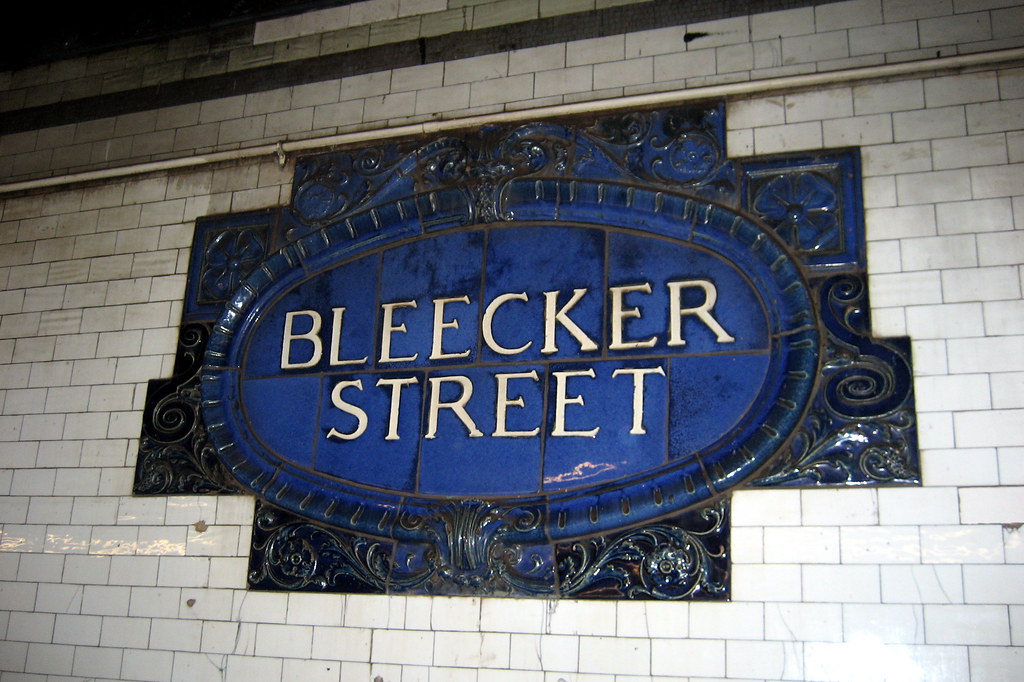
The designers of the subway placed a premium on aesthetics, as evidenced by the domed Art Nouveau IRT entrance kiosks and beautiful permanent platform signs.
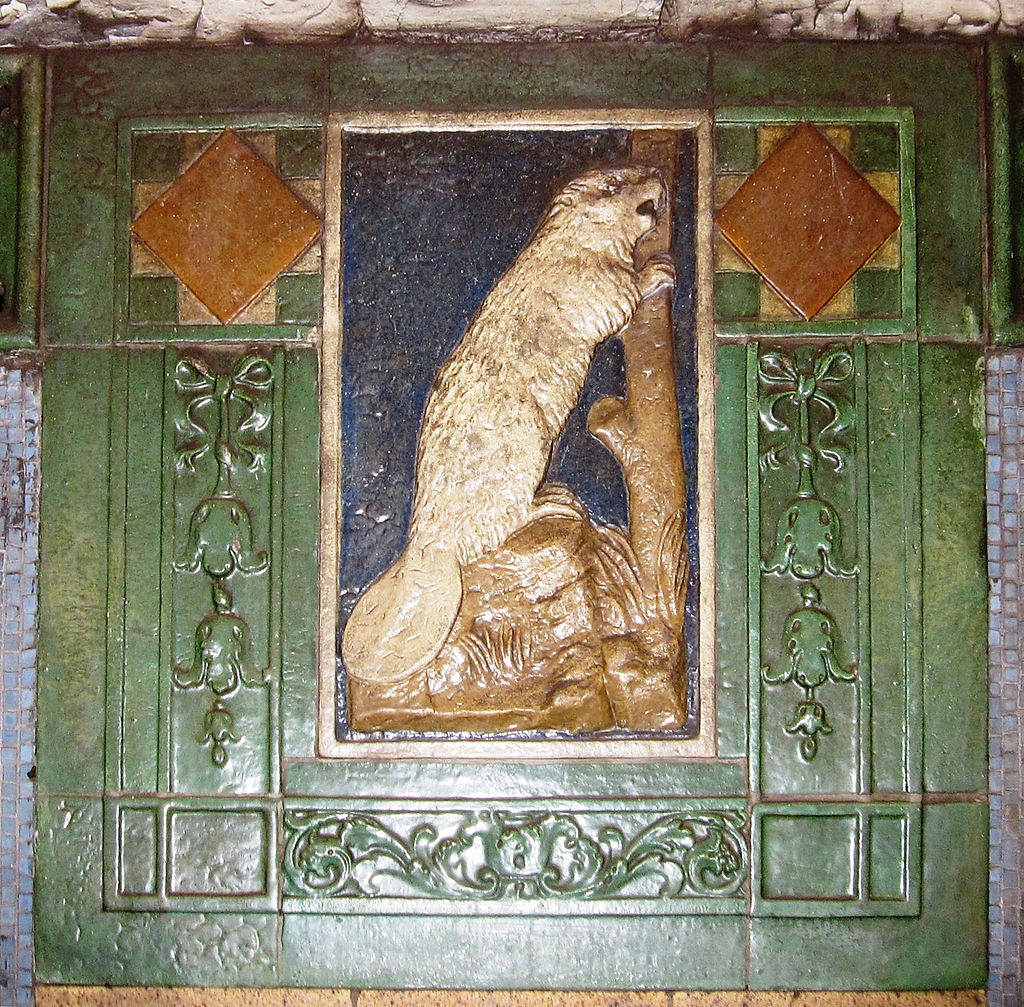
From the original mosaics to Beaux Arts bas relief plaques like the ones paying tribute to the fortune John Jacob Astor amassed in the fur trade, there’s lots of history hiding in plain sight.


The mid-80s initiative to bring public art underground has filled stations and passageways with work by some marquee names, like Vik Muniz, Chuck Close, William Wegman, Nick Cave, Tom Otterness, Roy Lichtenstein and Yoko Ono.
Wyetzner also name checks graphic designer Massimo Vignelli who was brought aboard in 1966 to standardize the informational signage.
The white-on-black sans serif font directing us to our desired connections and exits now seems like part of the subway’s DNA.
Perhaps 21st-century innovations like countdown clocks and digital screens listing real-time service changes and alternative routes will too, one of these days.
If Wyetzner is open to filming the follow-up viewers are clamoring for in the comments, perhaps he’ll weigh in on the new A‑train cars that debuted last week, which boast security cameras, flip-up seating to accommodate riders with disabilities, and wider door openings to promote quicker boarding.
(Yes, they’re still the quickest way to get to Harlem…)
Related Content
A Subway Ride Through New York City: Watch Vintage Footage from 1905
Designer Massimo Vignelli Revisits and Defends His Iconic 1972 New York City Subway Map
– Ayun Halliday is the Chief Primatologist of the East Village Inky zine and author, most recently, of Creative, Not Famous: The Small Potato Manifesto and Creative, Not Famous Activity Book. Follow her @AyunHalliday.
Read More...A New Dutch Reality TV Show Challenges Contestants to Paint Like Vermeer–and It’s a Hit!
Jokes about “reality television” being a contradiction in terms go as far back in pop-culture history as the format itself. But the fact remains that, deliberately or otherwise, its programs do reflect certain characteristics of the societies that produce them. Before turning into one of the most globally successful franchises of this century’s reality-TV boom, the once-controversial strangers-in-a-house show Big Brother premiered in the Netherlands. It will be left as an exercise to the reader what that says about the Dutch, who have been tuning in to a very different kind of reality programming in the past month: De Nieuwe Vermeer, or The New Vermeer.
Aired in conjunction with the Rijksmuseum’s largest Vermeer exhibition ever staged, the show invites “two professional painters and dozens of amateur artists to compete to reinvent the lost works of the 17th-century master,” writes the New York Times’ Nina Siegal.
“The results are judged by Vermeer experts from the Rijksmuseum, the Dutch national museum in Amsterdam, and from the Mauritshuis, a collection of old masters in The Hague.” The professionals face such tasks as faithfully reconstructing Vermeer’s lost works, whether they vanished centuries ago or in the Isabella Stewart Gardner Museum theft of 1990. The amateurs work in their own media, including “stained glass, printmaking and even Lego.”
All this has made The New Vermeer “an instant sensation in the Netherlands, with 1.3 million viewers (in a country of 17 million) tuning in for the first episode.” Like any successful reality TV show these days, it has also inspired a wealth of supplementary content, including a podcast and an online gallery showing all the artwork created by the contestants. “You can’t currently watch the series in the U.S., writes Artnet’s Sarah Cascone, “but the network is streaming a weekly YouTube ‘Masterclass’ ” offering “step-by-step instructions on how to create your own Vermeer canvas.” At the moment, those videos are available only in Dutch, presumably on the assumption that The New Vermeer won’t travel well outside the Netherlands. But if, by some slim chance, it turned into a Big Brother-scale phenomenon, imagine the golden age of reality TV that would lie ahead.
Related content:
A Guided Tour Through All of Vermeer’s Famous Paintings, Narrated by Stephen Fry
What Makes Vermeer’s The Milkmaid a Masterpiece?: A Video Introduction
Master of Light: A Close Look at the Paintings of Johannes Vermeer Narrated by Meryl Streep
Meet Notorious Art Forger Han Van Meegeren, Who Fooled the Nazis with His Counterfeit Vermeers
Based in Seoul, Colin Marshall writes and broadcasts on cities, language, and culture. His projects include the Substack newsletter Books on Cities, the book The Stateless City: a Walk through 21st-Century Los Angeles and the video series The City in Cinema. Follow him on Twitter at @colinmarshall or on Facebook.
Read More...Bored at Work? Here’s What Your Brain Is Trying to Tell You
That we spend much, if not most, of our lives working is, in itself, not necessarily a bad thing — unless, that is, we’re bored doing it. In the Big Think video above, London Business School Professor of Organizational Behavior Dan Cable cites Gallup polls showing that “about 70 percent of people are not engaged in what they do all day long, and about eighteen percent of people are repulsed.” This may sound normal enough, but Cable calls these perceptions of work as “a thing that we have to get through on the way to the weekend” a “humanistic sickness”: a bad condition for people, of course, but also for the “organizations who get lackluster performance.”
Cable traces the civilizational roots of this at-work boredom back to the decades after the Industrial Revolution. In the mid-nineteenth century, a shoe-shopper would go to the local cobbler. “Each of the people in the store would watch the customer walk in, and then they’d make a shoe for that customer.” But toward the end of the century, “we got this different idea, as a species, where we should not sell two pairs of shoes each day, but two million.”
This vast increase of productivity entailed “breaking the work into extremely small tasks, where most of the people don’t meet the customer. Most of the people don’t invent the shoe. Most of the people don’t actually see the shoe made from beginning to end.”
It entailed, in other words, “removing the meaning from work” in the name of ever-greater scale and efficiency. The nature of the tasks that result don’t sit well with a part of our brain called the ventral striatum. Always “urging us to explore the boundaries of what we know, urging us to be curious,” it sends our minds right out of jobs that no longer offer us the chance to learn anything new. One solution is to work for smaller organizations, whose members tend to play multiple roles in closer proximity to the customer; another is to engage in big-picture thinking by staying aware of what Cable calls “the why of the work,” its larger impact on the world, as well as how it fits in with your own purpose. But then, boredom at work isn’t all bad: a bout of it may well, after all, have led you to read this post in the first place.
Related content:
The Benefits of Boredom: How to Stop Distracting Yourself and Get Creative Ideas Again
The Philosophy of “Optimistic Nihilism,” Or How to Find Purpose in a Meaningless Universe
How to Take Advantage of Boredom, the Secret Ingredient of Creativity
Based in Seoul, Colin Marshall writes and broadcasts on cities, language, and culture. His projects include the Substack newsletter Books on Cities, the book The Stateless City: a Walk through 21st-Century Los Angeles and the video series The City in Cinema. Follow him on Twitter at @colinmarshall or on Facebook.
Read More...Kurt Vonnegut Diagrams the Shape of All Stories: From Kafka’s “Metamorphosis” to “Cinderella”
Few American novelists of the twentieth century looked as professorial as Kurt Vonnegut, at least in a rumpled-fixture-of-the-English-department way. But though he did rack up some teaching experience, not least at the Iowa Writers’ Workshop, he could hardly have been a conventional lecturer. This is evidenced by the 2004 clip above, in which he explains his ideas about the “shapes” taken by all stories — an idea he first formally presented as his master’s thesis in anthropology at the University of Chicago. Though the thesis itself was rejected (a quarter-century later, the university accepted Cat’s Cradle in its stead), its ideas proved powerful enough to entertain Vonnegut’s audiences up until the end of his life.
On his chalkboard, Vonnegut draws a vertical and a horizontal axis: the former charts the protagonist’s fortune, good or ill, and the latter represents time (from B to E: “beginning, entropy”). He then plots the curve of an especially simple and reliable story form, “man in a hole,” which involves someone getting into trouble — downward turns the slope — then getting back out again.
But the protagonist should end up a bit higher on the scale of fortune than he began, because “the reader thinks, ‘Well, by God, I’m a human being too. I must have that much in reserve if I get into trouble.” Then come the stories of other shapes, including such popular favorites as “Cinderella” and Kafka’s Metamorphosis.
“This rise and fall,” Vonnegut warns us, “is, in fact, artificial. It pretends that we know more about life than we really do.” When he attempts to describe the shape of Hamlet, he ends up coming across one reason the play is regarded as a work of genius: “we are so seldom told the truth,” but Shakespeare tells us the truth that “we don’t know enough about life to know what the good news is and what the bad news is.” Rather, “all we do is echo the feelings of people around us.” As Vonnegut’s readers know, a dimmer view of human nature than his would be hard to come by. But if he didn’t have faith the ability of stories to teach us good from bad, he did have faith in their ability to teach us that we aren’t about to figure it out for ourselves.
Related content:
Kurt Vonnegut Diagrams the Shape of All Stories in a Master’s Thesis Rejected by U. Chicago
Why Should We Read Kurt Vonnegut? An Animated Video Makes the Case
Based in Seoul, Colin Marshall writes and broadcasts on cities, language, and culture. His projects include the Substack newsletter Books on Cities, the book The Stateless City: a Walk through 21st-Century Los Angeles and the video series The City in Cinema. Follow him on Twitter at @colinmarshall or on Facebook.
Read More...A Retired Math Teacher Helps Students Learn Geometry Through Quilting
Some real talk from retired geometry teacher Wendy Lichtman, above, the author of several math-themed YA novels:
Not many 15-year-olds care that two parallel lines are crossed by a transversal.
“But right here are two parallel lines,” she continues, pointing to a pink and orange quilt. “and these are transversals, and they are at a 90º angle and it feels real. You’ve gotta get it to look right.”
The teenaged participants in the Oakland, California program she founded to demystify geometry through hands-on quiltmaking get it to look right by plotting their designs on graph paper, carefully measuring and cutting shapes from bright calico of their own choosing. (Licthman has committed to buttoning her lip if their favored print is not to her taste.)
Lichtman came up with this creative approach to help a bright student who was in danger of not graduating, having flunked geometry three times.
She details their journey in How to Make a Geometric Quilt, an essay formatted as step-by-step instructions…not for quiltmaking but rather how those in the teaching profession can lead with humility and determination, while maintaining good boundaries.
Some highlights:
6. Sometime after the sewing has begun, and the math notebook is ignored for weeks, begin to worry that your student is not really learning geometry. She’s learning sewing and she’s learning to fix a broken bobbin, but really, geometry?
7. Remind yourself that this kid needs a quilt as much as she needs geometry.
8. Remember, also, the very, very old woman who taught you hat-making one night long ago. She had gone to school only through 5th grade because, she said, she was a Black child in the deep south and that’s how it was back then. Think about how she explained to the hat-making class that to figure out the length of the hat’s brim, you needed to measure from the center to the edge with a string and then do “three of those and a little bit more,” and remember how you sat in awe, because three radii and a little bit more is the definition of pi, and this hat-maker had evidently discovered for herself the formula for circumference.
As the two become better acquainted, the student let her guard down, revealing more about her situation while they swapped stories of their mothers.
But this was no easy A.
In addition to expecting regular, punctual attendance, Lictman stipulated that in order to pass, the student could not give the fruits of her labor away.
(Solid advice for creators of any craft project this ambitious. As Debbie Stoller, author of Stitch ‘n Bitch: The Knitter’s Handbook counsels:
…those who have never knit something have no idea how much time it took. If you give someone a sweater, they may think that you made that in an evening when you were watching a half-hour sitcom. It’s only when people actually attempt to knit that they finally get this realization, this light bulb goes on over their heads, and they realize that, “Wow, this actually takes some skill and some time. I’ve got newfound respect for my grandma.”)
Ultimately, Lichtman concludes that the five credits she awarded her student could not be reduced to something as simple as geometry or quilt-making;
You are giving her credit for something less tangible. Something like pride. Five credit hours for feeling she can accomplish something hard that, okay, is slightly related to geometry.
Examples of the current cohort’s work can be seen on Rock Paper Scissors Collective’s Instagram.
Once completed, these quilts will be donated to Bay Area foster children and pediatric patients at the local Children’s Hospital.
Related Content
Via Boing Boing
– Ayun Halliday is the Chief Primatologist of the East Village Inky zine and author, most recently, of Creative, Not Famous: The Small Potato Manifesto and Creative, Not Famous Activity Book. Follow her @AyunHalliday.
Read More...Why Maya Angelou’s Memoir I Know Why The Caged Bird Sings Became One of the Most Banned Books of All Time
Some good news: Maya Angelou’s 1969 memoir I Know Why The Caged Bird Sings, a recounting of her first 17 years, including a rape at the age of 7 or 8 by her mother’s boyfriend, and her subsequent emotional trauma, no longer leads the American Library Association’s Office for Intellectual Freedom’s list of banned and challenged books.
The bad news: there will always be titles assigned to high schoolers that vividly depict young people’s actual experience, that parents and community groups will target on similar grounds.
New African listed some of the verbatim objections that have been leveled against I Know Why the Caged Bird Sings - that it encouraged “profanity”, was filled with “descriptions of drug abuse, sexually explicit conduct and torture”, preached “bitterness and hatred against whites”, was “likely to corrupt minors” and contained “inappropriately explicit sexual scenes.”
Angelou, who accused the book’s detractors of not reading more than two words of it, bridled that anyone would “act as if their children are not faced with the same threats.”
Mollie Godfrey’s TED-Ed lesson, animated by Laura White. above, points out how radical Angelou’s I Know Why The Caged Bird Sings was for a work of its time:
Her autobiography was one of the first to speak openly about child sexual abuse and especially groundbreaking to do so from the perspective of the abused child. For centuries Black women writers have been limited by stereotypes characterizing them as hypersexual. Afraid of reinforcing these stereotypes, few were willing to write about their sexuality at all but Angelou refused to be constrained. She publicly explored her most personal experience without apology or shame.
Robert P. Doyle, vice-president of the Freedom to Read Foundation, revealed that the ALA was inspired to launch Banned Books Week in 1982, when the American Booksellers Association displayed I Know Why the Caged Bird Sings and other works in a cage outside the entrance to their annual conference:
The display generated a lot of press attention. And the book community realized that we have not only an opportunity, but a responsibility to engage the American public in a conversation about the First Amendment as it relates to books and literature. A coalition was formed immediately with the authors, publishers, and major distribution centers (bookstores and libraries) in the U.S. to draw attention to the importance of the freedom to read, to publicize threats to that freedom, and to provide information to combat the lack of awareness.
Many of the book’s high profile defenders discovered it at a formative age, including rapper Common, who decided to become a writer after encountering it as a 5th grader, and Oprah Winfrey, who was blown away to learn that another young Black girl had also endured sexual abuse:
I read those words and thought, “Somebody knows who I am.”
No less moving is a comment on Godfrey’s TED-Ed lesson left by a teacher in Texas:
Caged Bird helped saved my life. Thankful for the day my 11th grade English teacher at a conservative Christian school handed it to me and said, “read this, sweet pea”…I still encourage my students at a conservative Christian school in TX to read it.”
“I am glad you got the help you needed,” another viewer responded. “I live in Florida, and that teacher who helped you would be charged with a felony here. I’m dead serious.”
Listen to Maya Angelou discuss I Know Why the Caged Bird Sings in this 1970 interview with Studs Terkel.
Related Content
The Brooklyn Public Library Gives Every Teenager in the U.S. Free Access to Censored Books
Texas School Board Bans Illustrated Edition of The Diary of Anne Frank
The 850 Books a Texas Lawmaker Wants to Ban Because They Could Make Students Feel Uncomfortable
Umberto Eco Makes a List of the 14 Common Features of Fascism
– Ayun Halliday is the Chief Primatologist of the East Village Inky zine and author, most recently, of Creative, Not Famous: The Small Potato Manifesto and Creative, Not Famous Activity Book. Follow her @AyunHalliday.
Read More...Turning the Pages of an Illuminated Medieval Manuscript: An ASMR Museum Experience
Page turning is to ASMR as the electric bass is to rock.
The Victoria and Albert Museum’s popular Autonomous Sensory Meridian Response video series (find it here) has seen episodes devoted to iconic Second Wave feminist magazines and a couple of late 20th-century pop up artist’s books, but the parchment pages of this medieval antiphonary — or choirbook — make for some truly legendary sounds.
Audio designer and performance-maker Julie Rose Bower deserves a portion of the credit for heightening the aural experience for her use of the ambisonics format.
Kudos too to National Art Library Special Collections curator Catherine Yvard…if she ever wants a break from medieval manuscript illumination and Gothic ivory sculpture, she could specialize in extremely soothing voiceover narration.
It’s rare to find such pleasurably tingly ASMR sensations paired with allusions to the somewhat barbarous process of making parchment from animal skins, but that’s what illuminator Francesco dai Libri, and his son Girolamo were working with in 1492 Verona.
Our ears may not be able to detect much difference between the skin sides and flesh sides of these remarkably well preserved pages, but Bower does due diligence, as Yvard slowly drags her fingers across them.
No need to fear that Yvard’s bare hands could cause harm to this 530-year-old object.
Experts at the British Library have decreed that the modern practice of donning white gloves to handle antique manuscripts decreases manual dexterity, while heightening the possibility of transferred dirt or dislodged pigments.
The sturdy parchment of this particular antiphonary has seen far worse than the careful hands of a professional curator.
Pages 7, 8, 9 have been singed along the bottom margins, and elsewhere, the gothic hand lettering has been scraped away, presumably with a knife, in preparation for a liturgical update that never got entered.
If your brain is crying out for more after spending 15 and a half intimate minutes with these medieval pages, we leave you with the snap crackle and pop of other items in the V&A’s collection:
Treat your ears to Victoria and Albert’s full ASMR at the Museum playlist here.
– Ayun Halliday is the Chief Primatologist of the East Village Inky zine and author, most recently, of Creative, Not Famous: The Small Potato Manifesto and Creative, Not Famous Activity Book. Follow her @AyunHalliday.
Read More...How to Silence the Negative Chatter in Our Heads: Psychology Professor Ethan Kross Explains
A couple of weeks ago, the New York Times published an article headlined “How to Stop Ruminating.” If your social media feeds are anything like mine, you’ve seen it pop up with some frequency since then. “Perhaps you spend hours replaying a tense conversation you had with your boss over and over in your head,” writes its author Hannah Seo. “Maybe you can’t stop thinking about where things went wrong with an ex during the weeks and months after a breakup.” The piece’s popularity speaks to the commonness of these tendencies.
But if “your thoughts are so excessive and overwhelming that you can’t seem to stop them,” leading to distraction and disorganization at work and at home, “you’re probably experiencing rumination.” For this broader phenomenon University of Michigan psychology professor Ethan Kross has a more evocative name: chatter.
“Your inner voice is your ability to silently use language to reflect on your life,” he explains in the Big Think video above. “Chatter refers to the dark side of the inner voice. When we turn our attention inward to make sense of our problems, we don’t end up finding solutions. We end up ruminating, worrying, catastrophizing.”
Despite being an invaluable tool for planning, memory, and self-control, our inner voice also has a way of turning against us. “It makes it incredibly hard for us to focus,” Kross says, and it can also have “severe negative physical health effects” when it keeps us perpetually stressing out over long-passed events. “We experience a stressor in our life. It then ends, but in our minds, our chatter perpetuates it. We keep thinking about that event over and over again.” When you’re inside them, such mental loops can feel infinite, and they could result in perpetually dire consequences in our personal and professional lives. To those in need of a way to break free, Kross emphasizes the power of rituals.
“When you experience chatter, you often feel like your thoughts are in control of you,” he says. But “we can compensate for this feeling out of control by creating order around us. Rituals are one way to do that.” Performing certain actions exactly the same way every single time gives you “a sense of order and control that can feel really good when you’re mired in chatter.” Kross goes into greater depth on the range of chatter-controlling tools available to us (“distanced-self talk,” for example, which involves perceiving and addressing the self as if it were someone) in his book Chatter: The Voice in Our Head, Why It Matters, and How to Harness It. His interview with Chase Jarvis above offers a preview of its content — and a reminder that, as means of silencing chatter go, sometimes a podcast works as well as anything.
Related content:
Why You Do Your Best Thinking In The Shower: Creativity & the “Incubation Period”
Based in Seoul, Colin Marshall writes and broadcasts on cities, language, and culture. His projects include the Substack newsletter Books on Cities, the book The Stateless City: a Walk through 21st-Century Los Angeles and the video series The City in Cinema. Follow him on Twitter at @colinmarshall or on Facebook.
Read More...Archaeologists May Have Discovered a Secret Language in Lascaux & Chauvet Cave Paintings, Perhaps Revealing a 20,000-Year-Old “Proto-Writing” System
Care to take a guess what your smart phone has in common with Paleolithic cave paintings of Lascaux, Chauvet and Altamira?
Both can be used to track fertility.
Admittedly, you’re probably not using your phone to stay atop the reproductive cycles of reindeer, salmon, and birds, but such information was of critical interest to our hunter-gatherer ancestors.
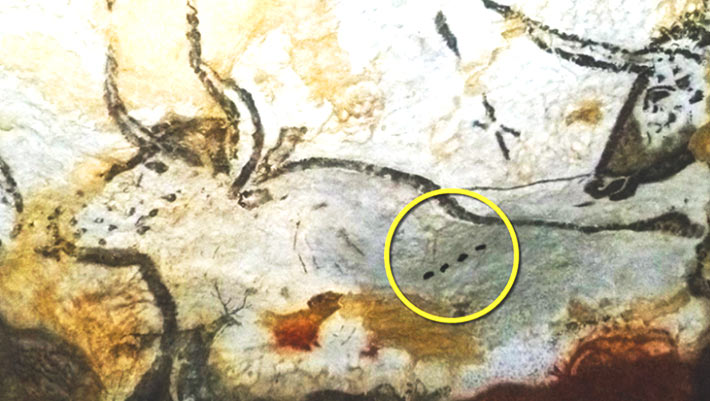
Knowing how crucial an understanding of animal behavior would have been to early humans led London-based furniture conservator Ben Bacon to reconsider what purpose might have been served by non-figurative markings — slashes, dots, and Y‑shapes — on the cave walls’ 20,000-year-old images.
Their meaning had long eluded esteemed professionals. The marks seemed likely to be numeric, but to what end?
Bacon put forward that they documented animal lives, using a lunar calendar.
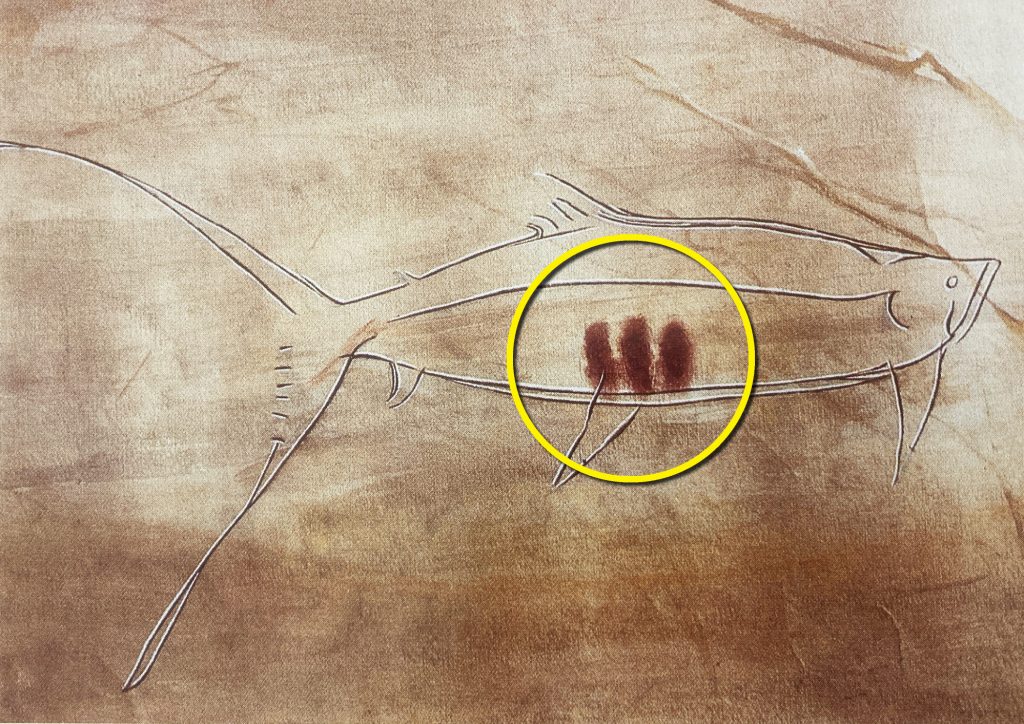
The amateur researcher assembled a team that included experts from the fields of mathematics, archeology, and psychology, who analyzed the data, compared it to the seasonal behaviors of modern animals, and agreed that the numbers represented by the dots and slashes are not cardinal, but rather an ordinal representation of months.
As Bacon told All Things Considered his fellow self-taught anthropological researcher, science journalist Alexander Marshack, came close to cracking the code in the 1970s:
… but he wasn’t actually able to demonstrate the system because he thought that these individual lines were days. What we did is we said, actually, they’re months because a hunter-gatherer doesn’t need to know what day a reindeer migrates. They need to know what month the reindeer migrates. And once you use these months units, this whole system responds very, very well to that.
As to the frequently occurring symbol that resembles a Y, it indicates the months in which various female animal birthed their young. Bacon and his team theorize in the Cambridge Archeological Journal that this mark may even constitute “the first known example of an ‘action‘ word, i.e. a verb (‘to give birth’).
Taken together, the cave paintings and non-figurative markings tell an age-old circular tale of the migration, birthing and mating of aurochs, birds, bison, caprids, cervids, fish, horses, mammoths, and rhinos … and like snakes and wolverines, too, though they were excluded from the study on basis of “exceptionally low numbers.”
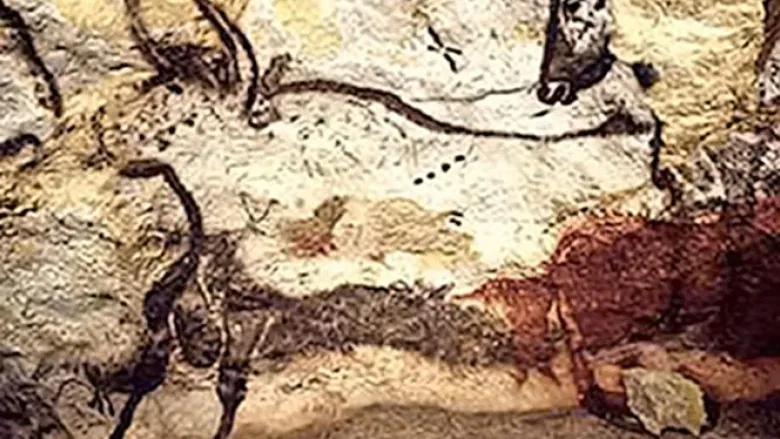
Early humans were able to log months by observing the moon, but how could they tell when a new year had begun, essential information for anyone seeking to arrange their lives around their prey’s previously documented activities?
Bacon and his peers, like so many poets and farmers, look to the rites of spring:
The obvious event is the so-called ‘bonne saison’, a French zooarchaeological term for the time at the end of winter when rivers unfreeze, the snow melts, and the landscape begins to green.
Read the conclusions of their study here.
Related Content
Algerian Cave Paintings Suggest Humans Did Magic Mushrooms 9,000 Years Ago
Was a 32,000-Year-Old Cave Painting the Earliest Form of Cinema?
40,000-Year-Old Symbols Found in Caves Worldwide May Be the Earliest Written Language
- Ayun Halliday is the Chief Primatologist of the East Village Inky zine and author, most recently, of Creative, Not Famous: The Small Potato Manifesto and Creative, Not Famous Activity Book. Follow her @AyunHalliday.
Read More...
Support Us
We're hoping to rely on loyal readers, rather than erratic ads. Please click the Donate button and support Open Culture. You can use Paypal, Venmo, Patreon, even Crypto! We thank you!

About Us

Open Culture scours the web for the best educational media. We find the free courses and audio books you need, the language lessons & educational videos you want, and plenty of enlightenment in between.
Advertise With Us
FREE UPDATES!
GET OUR DAILY EMAIL
Get the best cultural and educational resources on the web curated for you in a daily email. We never spam. Unsubscribe at any time.
FOLLOW ON SOCIAL MEDIA
Open Culture editor Dan Colman scours the web for the best educational media. He finds the free courses and audio books you need, the language lessons & movies you want, and plenty of enlightenment in between.
Advertise With Us

