Jazz Drummer Larnell Lewis Hears Metallica’s “Enter Sandman” for the Very First Time, Then Plays It Near-Perfectly
Even if you don’t think you know “Enter Sandman,” you know “Enter Sandman.” For more than thirty years it’s been the signature song of Metallica, the best-known heavy metal band in the world, and as such practically unavoidable — unavoidable, that is, unless you’re jazz drummer Larnell Lewis. Previously featured here on Open Culture for his demonstration of the thirteen levels of drumming difficulty, Lewis is most closely associated with the fusion band Snarky Puppy, and has, fair to say, spent his professional life outside the realm of metal. Hence the intrigue of the challenge he takes on in the video above: can he play through “Enter Sandman” after hearing it just once?
Metallica die-hards know how formidable a task this is. Recording the song in the first place took the band’s drummer Lars Ulrich more than one take — in fact, it took him nearly fifty takes, in each of which he played just one section of the song, never the whole thing straight through.
The final mix edits together all of the most precise and intense pieces of his performance into one seemingly impossible-to-replicate whole. But for Lewis, learning a song by ear and then playing it perfectly is all in a day’s work, a process he demonstrates in the earlier video just below, talking his listeners through his mental process of active listening to a percussion-free song, then coming up with all the drum parts on the fly.
Watching Lewis actively listen to “Enter Sandman” has the appeal of those viral videos in which Youtubers hear hit songs for the first time — but even more so, since Lewis knows his craft backwards and forwards, and doesn’t hesitate to express his own reactions and perceptions. He notes a few tricky shifts into half time, and even one especially dramatic shot that he foresees missing when he tries his own hand at the song. Apart from that, however, he then plays the song himself with an accuracy that astonishes even the Metallica fans in the comments. As one says, it’s hard to say which is more unbelievable: Lewis’ extraordinary talent or the fact that he’d never heard ‘Enter Sandman’ before. The man must never have set foot in a gym — but then, he probably gets more than enough of a workout at the drum kit.
Related content:
Metallica’s “Enter Sandman” Sung in the Style of David Bowie
A Bluegrass Version of Metallica’s Heavy Metal Hit, “Enter Sandman”
Metallica Playing “Enter Sandman” on Classroom Toy Instruments
The Neuroscience of Drumming: Researchers Discover the Secrets of Drumming & The Human Brain
Based in Seoul, Colin Marshall writes and broadcasts on cities, language, and culture. His projects include the Substack newsletter Books on Cities, the book The Stateless City: a Walk through 21st-Century Los Angeles and the video series The City in Cinema. Follow him on Twitter at @colinmarshall or on Facebook.
Read More...Wes Anderson Re-Creates The Truman Show, Armageddon & Out of Sight as Stage Plays Performed by the Cast of Rushmore (1999)
Nominees of the 1999 MTV Movie Awards included Adam Sandler, Liv Tyler, Chris Tucker, and Jennifer Love Hewitt to mention just a few of the names in a veritable who’s-who of turn-of-the-millennium American pop culture. But for the teenage cinephiles watching that night, the highlight of the broadcast was surely a set of brief skits performed by “the Max Fischer Players.” Directed by Wes Anderson, who had been named Best New Filmmaker during the ceremony of three years before, they present low-budget but high-spirited interpretations of three of the motion pictures up for honors: Out of Sight, The Truman Show, and Armageddon.
Having been a teenage cinephile myself at the time, I can tell you that none of those movies made as much an impact on me as Anderson’s own Rushmore, which introduced the hyper-ambitious young slacker Max Fischer to the world. In it, Max and his players adapt Sidney Lumet’s Serpico, and later put on an elaborate (and explosive) pastiche of various Vietnam War pictures.
Twenty-five years ago, few of us had identified in the painstakingly ramshackle look and feel of these productions the seed of what would grow into Anderson’s signature aesthetic. But it was clear that, if the Max Fischer Players method were applied to the Hollywood blockbusters of the day, amusing incongruity would result.
These skits prominently feature Mason Gamble and Sara Tanaka, both of whom retired from acting a few years after giving their memorable performances in Rushmore. But Jason Schwartzman, who will no doubt forever be identified with Max Fischer, has remained an active member of Anderson’s own group of players, and even plays a starring role once again in Anderson’s new film Asteroid City, which comes out this summer. The Max Fisher Players’ parodies were included on the DVD of Rushmore released by the Criterion Collection — an honor still denied, one might add, to the recipient of the 1999 MTV Movie Award for Best Movie, There’s Something About Mary. (But not to Armageddon, which just goes to show how unpredictable the favor of cinephilia can be.)
Related content:
Wes Anderson’s Shorts Films & Commercials: A Playlist of 8 Short Andersonian Works
Wes Anderson Goes Sci-Fi in 1950s America: Watch the Trailer for His New Film Asteroid City
Why Do Wes Anderson Movies Look Like That?
Watch the First Two Hours of MTV’s Inaugural Broadcast (August 1, 1981)
Based in Seoul, Colin Marshall writes and broadcasts on cities, language, and culture. His projects include the Substack newsletter Books on Cities, the book The Stateless City: a Walk through 21st-Century Los Angeles and the video series The City in Cinema. Follow him on Twitter at @colinmarshall or on Facebook.
Read More...Horrifying 1906 Illustrations of H.G. Wells’ War of the Worlds
H.G. Wells’ War of the Worlds has terrified and fascinated readers and writers for decades since its 1898 publication and has inspired numerous adaptations. The most notorious use of Wells’ book was by Orson Welles, whom the author called “my little namesake,” and whose 1938 War of the Worlds Halloween radio play caused public alarm (though not actually a national panic). After the occurrence, reports Phil Klass, the actor remarked, “I’m extremely surprised to learn that a story, which has become familiar to children through the medium of comic strips and many succeeding and adventure stories, should have had such an immediate and profound effect upon radio listeners.”
Surely Welles knew that is precisely why the broadcast had the effect it did, especially in such an anxious pre-war climate. The 1898 novel also startled its first readers with its verisimilitude, playing on a late Victorian sense of apocalyptic doom as the turn-of-the-century approached.
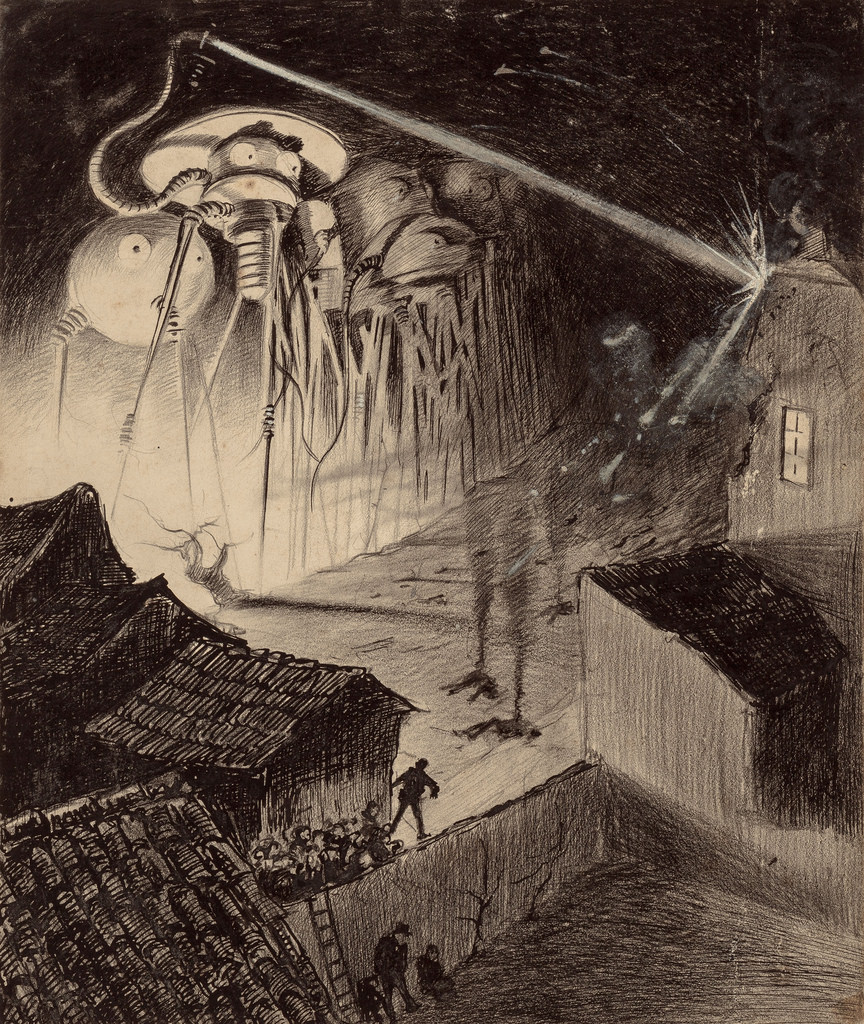
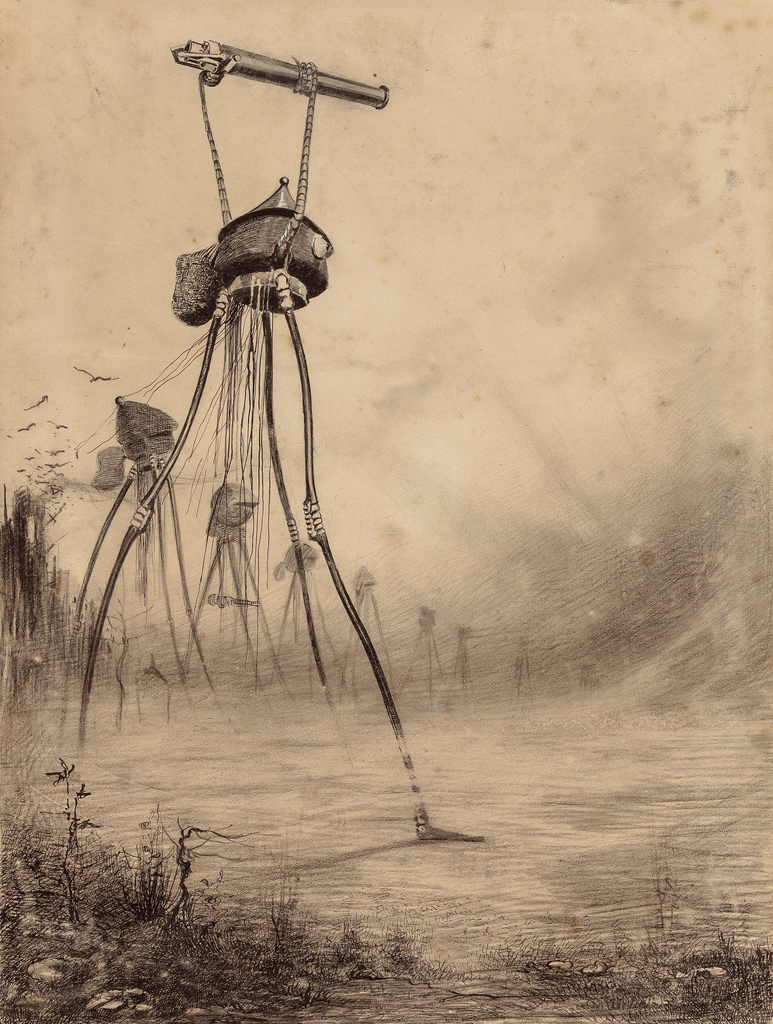
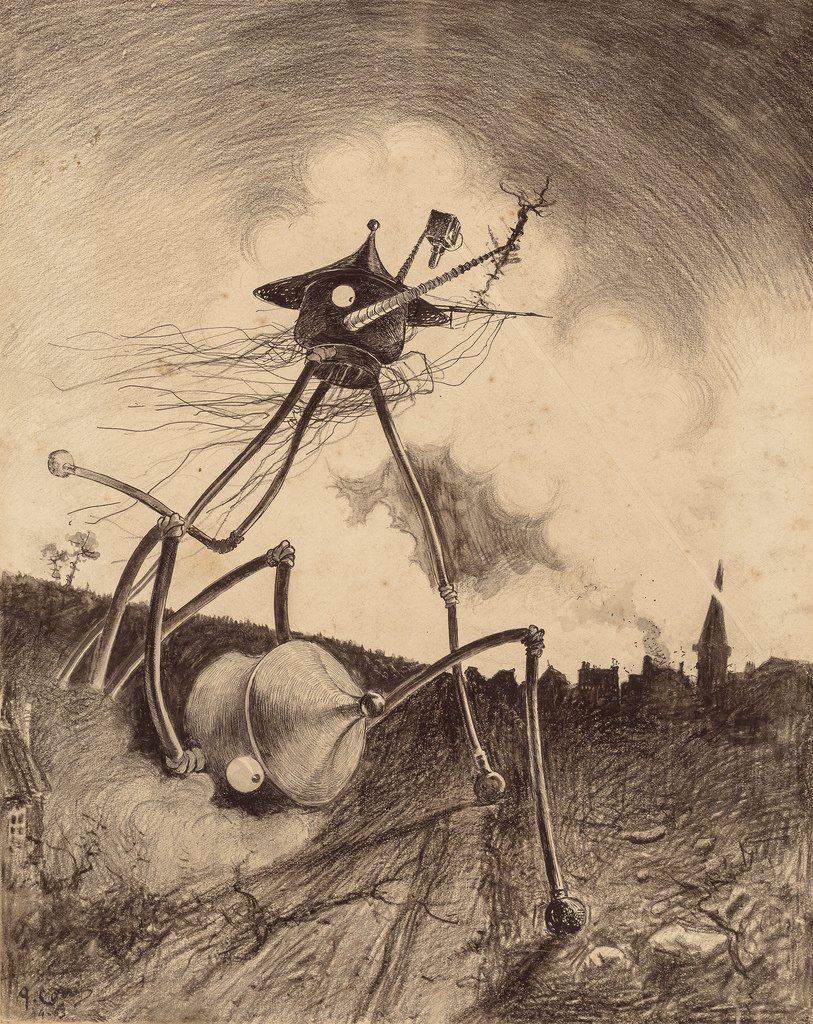
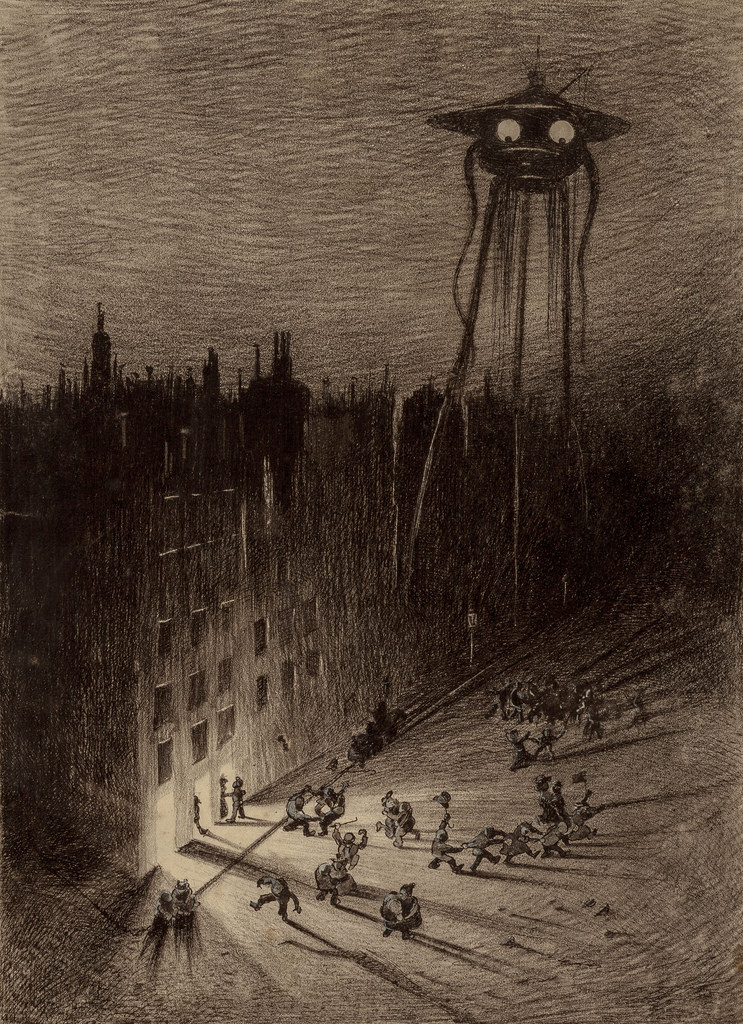
But what contemporary circumstances eight years later, we might wonder, fueled the imagination of Henrique Alvim Corrêa, whose 1906 illustrations of the novel you can see here? Wells himself approved of these incredible drawings, praising them before their publication and saying, “Alvim Corrêa did more for my work with his brush than I with my pen.”
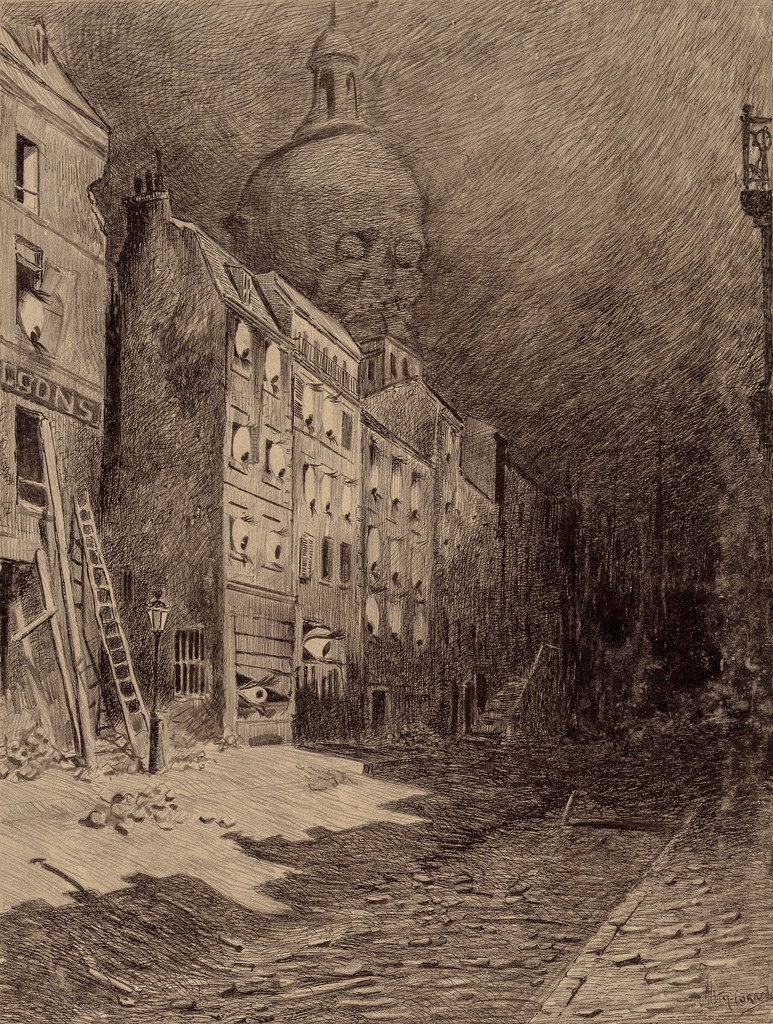
Indeed they capture the novel’s uncanny dread. Martian tripods loom, ghastly and cartoonish, above blasted realist landscapes and scenes of panic. In one illustration, a grotesque, tentacled Martian ravishes a nude woman. In a surrealist drawing of an abandoned London above, eyes protrude from the buildings, and a skeletal head appears above them. The alien technology often appears clumsy and unsophisticated, which contributes to the generally terrifying absurdity that emanates from these finely rendered plates.
Alvim Corrêa was a Brazilian artist living in Brussels and struggling for recognition in the European art world. His break seemed to come when the War of the Worlds illustrations were printed in a large-format, limited French edition of the book, with each of the 500 copies signed by the artist himself.

Unfortunately, Corrêa’s tuberculosis killed him four years later. His War of the Worlds drawings did not bring him fame in his lifetime or after, but his work has been cherished since by a devoted cult following. The original prints you see here remained with the artist’s family until a sale of 31 of them in 1990. (They went up for sale again recently, it seems.) You can see many more, as well as scans from the book and a poster announcing the publication, at Monster Brains and the British Library site.
Note: An earlier version of this post appeared on our site in 2015.
If you would like to support the mission of Open Culture, consider making a donation to our site. It’s hard to rely 100% on ads, and your contributions will help us continue providing the best free cultural and educational materials to learners everywhere. You can contribute through PayPal, Patreon, and Venmo (@openculture). Thanks!
Related Content:
The Very First Illustrations of H.G. Wells’ The War of the Worlds (1897)
Edward Gorey Illustrates H.G. Wells’ The War of the Worlds in His Inimitable Gothic Style (1960)
The War of the Worlds: Orson Welles’ 1938 Radio Drama That Petrified a Nation
Josh Jones is a writer and musician based in Durham, NC. Follow him at @jdmagness
Read More...How to Spot a Communist by Using Literary Criticism: A 1955 Manual from the U.S. Military
In 1955, the United States was entering the final stages of McCarthyism or the Second Red Scare. During this low point in American history, the US government looked high and low for Communist spies. Entertainers, educators, government employees and union members were often viewed with suspicion, and many careers and lives were destroyed by the flimsiest of allegations. Congress, the FBI, and the US military, they all fueled the 20th century version of the Salem Witch trials, partly by encouraging Americans to look for Communists in unsuspecting places.
In the short Armed Forces Information Film above, you can see the dynamic at work. Some Communists were out in the open; however, others “worked more silently.” So how to find those hidden communists?
Not to worry, the US military had that covered. In 1955, the U.S. First Army Headquarters prepared a manual called How to Spot a Communist. Later published in popular American magazines, the propaganda piece warned readers, “there is no fool-proof system in spotting a Communist.” “U.S. Communists come from all walks of life, profess all faiths, and exercise all trades and professions. In addition, the Communist Party, USA, has made concerted efforts to go underground for the purpose of infiltration.” And yet the pamphlet adds, letting readers breathe a sigh of relief, “there are, fortunately, indications that may give him away. These indications are often subtle but always present, for the Communist, by reason of his “faith” must act and talk along certain lines.” In short, you’ll know a Communist not by how he walks, but how he talks. Asking citizens to become literary critics for the sake of national security, the publication told readers to watch out for the following:
While a preference for long sentences is common to most Communist writing, a distinct vocabulary provides the more easily recognized feature of the “Communist Language.” Even a superficial reading of an article written by a Communist or a conversation with one will probably reveal the use of some of the following expressions: integrative thinking, vanguard, comrade, hootenanny, chauvinism, book-burning, syncretistic faith, bourgeois-nationalism, jingoism, colonialism, hooliganism, ruling class, progressive, demagogy, dialectical, witch-hunt, reactionary, exploitation, oppressive, materialist.
This list, selected at random, could be extended almost indefinitely. While all of the above expressions are part of the English language, their use by Communists is infinitely more frequent than by the general public…
Rather chillingly, the pamphlet also warned that Communists revealed themselves if and when they talked about “McCarthyism,” “violation of civil rights,” “racial or religious discrimination” or “peace.” In other words, they were guilty if they suggested that the government was overstepping its bounds.
According to Corliss Lamont’s book, Freedom Is As Freedom Does, the First Army withdrew the pamphlet after Murray Kempton slammed it in The New York Post and The New York Times wrote its own scathing op-ed. In 1955, the press could take those risks. The year before, Joseph Welch had faced up to Joe McCarthy, asking with his immortal words, “Have you no sense of decency, sir? At long last, have you left no sense of decency?
Note: An earlier version of this post appeared our site in 2013.
If you would like to support the mission of Open Culture, consider making a donation to our site. It’s hard to rely 100% on ads, and your contributions will help us continue providing the best free cultural and educational materials to learners everywhere. You can contribute through PayPal, Patreon, and Venmo (@openculture). Thanks!
Related Content:
Bertolt Brecht Testifies Before the House Un-American Activities Committee (1947)
How the CIA Secretly Funded Abstract Expressionism During the Cold War
Read More...
The Smithsonian Puts 4.5 Million High-Res Images Online and Into the Public Domain, Making Them Free to Use

That vast repository of American history that is the Smithsonian Institution evolved from an organization founded in 1816 called the Columbian Institute for the Promotion of Arts and Sciences. Its mandate, the collection and dissemination of useful knowledge, now sounds very much of the nineteenth century — but then, so does its name. Columbia, the goddess-like symbolic personification of the United States of America, is seldom directly referenced today, having been superseded by Lady Liberty. Traits of both figures appear in the depiction on the nineteenth-century fireman’s hat above, about which you can learn more at Smithsonian Open Access, a digital archive that now contains some 4.5 million images.
“Anyone can download, reuse, and remix these images at any time — for free under the Creative Commons Zero (CC0) license,” write My Modern Met’s Jessica Stewart and Madeleine Muzdakis. “A dive into the 3D records shows everything from CAD models of the Apollo 11 command module to Horatio Greenough’s 1840 sculpture of George Washington.”
The 2D artifacts of interest include “a portrait of Pocahontas in the National Portrait Gallery, an image of the 1903 Wright Flyer from the National Air and Space Museum, and boxing headgear worn by Muhammad Ali from the National Museum of African American History and Culture.”

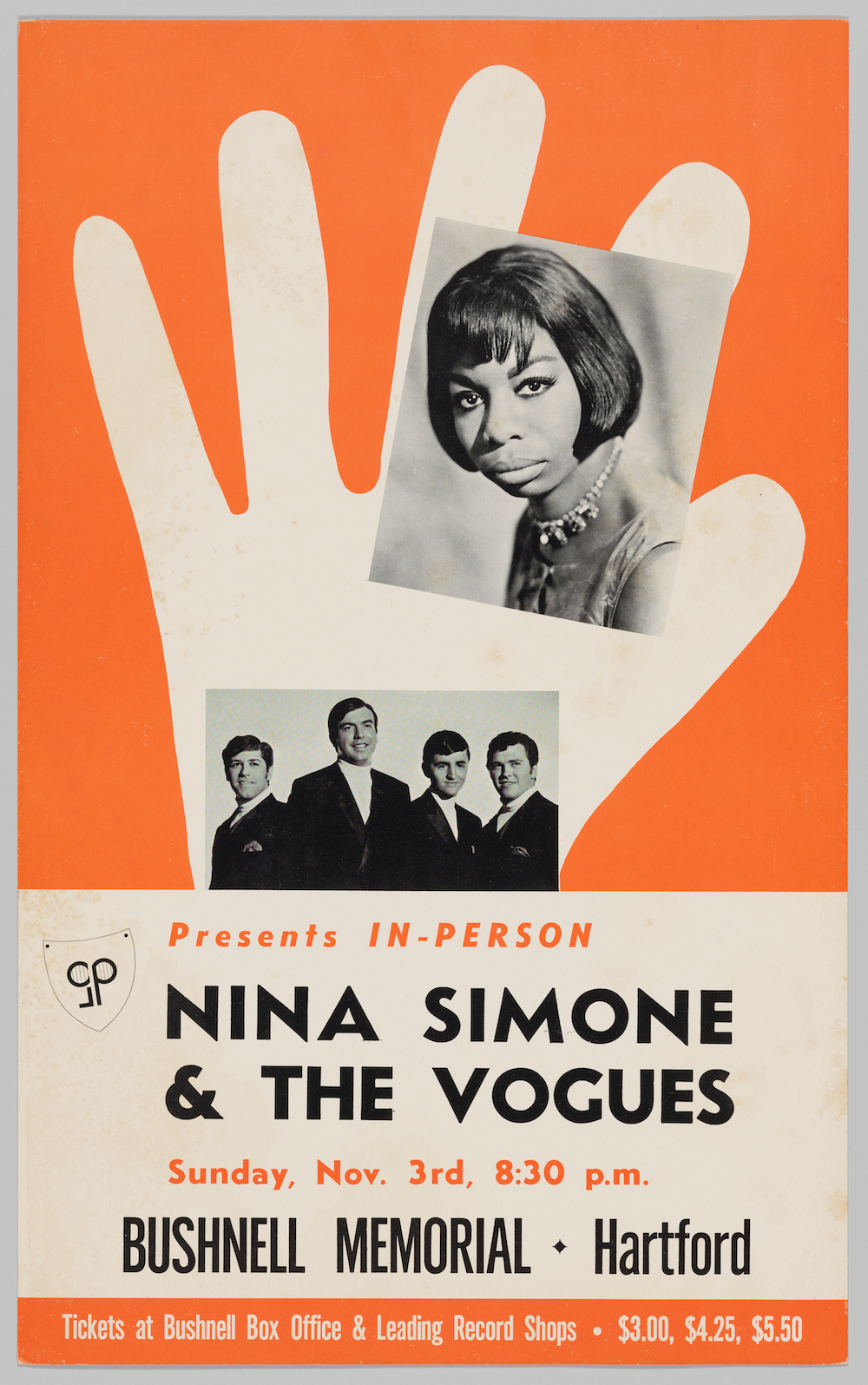
The NMAAHC in particular has provided a great many items relevant to twentieth-century American culture, like James Baldwin’s inkwell, Chuck Berry’s guitar Maybellene, Public Enemy’s boombox, and the poster for a 1968 Nina Simone concert. The more obscure object just above, a Native American kachina figure with the head of Mickey Mouse, comes from the Smithsonian American Art Museum. “When Disney Studios put a mouse hero on the silver screen in the 1930s,” explain the accompanying notes, “Hopi artists saw in Mickey Mouse a celebration of Tusan Homichi, the legendary mouse warrior who defeated a chicken-stealing hawk” — and were thus themselves inspired, it seems, to sum up a wide swath of American history in a single object.

More items are being added to Smithsonian Open Access all the time, each with its own story to tell — and all accessible not just to Americans, but internet users the world over. In that sense it feels a bit like the Chicago World’s Fair of 1893, better known as the World’s Columbian Exposition, with its mission of revealing America’s scientific, technological, and artistic genius to the whole of human civilization. You can see a great many photos and other artifacts of this landmark event at Smithsonian Open Access, or, if you prefer, you can click the “just browsing” link and behold all the historical, cultural, and formal variety available in the Smithsonian’s digital collections, where the spirit of Columbia lives on.
Related content:
Why 99% Of Smithsonian’s Specimens Are Hidden In High Security
John Green’s Crash Course in U.S. History: From Colonialism to Obama in 47 Videos
Based in Seoul, Colin Marshall writes and broadcasts on cities, language, and culture. His projects include the Substack newsletter Books on Cities, the book The Stateless City: a Walk through 21st-Century Los Angeles and the video series The City in Cinema. Follow him on Twitter at @colinmarshall or on Facebook.
Read More...16-Year-Old Dave Grohl Demonstrates His Emerging Drumming Talent, Playing in His Punk Band “Mission Impossible” (1985)
Before Foo Fighters, before Nirvana, before even Dain Bramage, Scream and other bands, Dave Grohl played in the Springfield, Virginia punk band Mission Impossible. Above, we have footage of Grohl, only 16 years old, giving us a preview of performances to come. The camera puts Grohl center stage around the 1:30 mark.
This July 1985 footage was captured by Sohrab Habibion, who documented shows from the 1980s DC punk scene. His recordings now reside at the Punk Archive at the DC Public Library. Likewise, you can stream them on his YouTube channel. Among other things, you can watch vintage performances by Fugazi, GWAR, the Lemonheads, Dain Bramage (another Grohl band) & more. Stream them online.
If you would like to support the mission of Open Culture, consider making a donation to our site. It’s hard to rely 100% on ads, and your contributions will help us continue providing the best free cultural and educational materials to learners everywhere. You can contribute through PayPal, Patreon, and Venmo (@openculture). Thanks!
Related Content
Read More...Watch a Transfixing Demonstration of Kumihimo, the Ancient Japanese Artform of Making Braids & Cords
It’s easy to see why kumihimo, the ancient Japanese art of silk braiding, is described as a meditative act.
The weaver achieves an intricate design by getting into a rhythmic groove, overlapping hand-dyed silken threads on a circular or rectangle wooden loom, from which up to 50 weighted-wooden bobbins dangle.
If the mind wanders too far from the task, the weaver risks screwing up the pattern or the uniformity of the threads’ tension. The word kumihimo translates to “gathering threads” — one mustn’t let them get snarled by a lack of attention.
While simple braids of tree bark or plant fiber have been found in Japanese burial sites dating back six thousand years, the Golden Age of kumihimo occurred during the Heian period (794‑1185), when exquisitely detailed cords began to be incorporated into the nobility’s garments, decorative furnishings, musical instruments, religious implements, and, most famously, samurai arms and armor.
Anime fans may recall how kumihimo shows up and serves as a major metaphor in Makoto Shinkai’s hit animated feature, Your Name - the braided cords representing the threads of time and the strength of the lovers’ bond.
Kumihimo is still in use today in jewelry and decorative souvenirs, and fastening obi to formal kimono, though 95% of obijime are now machine-made.
There are plenty of online tutorials for novices interested in making simple kumihimo friendship bracelets on a lightweight foam disk, but to appreciate the beauty inherent in every step of traditional kumihimo creation, watch Japan House’s above video, released in celebration of their recent exhibit, KUMIHIMO: The Art of Japanese Silk Braiding by DOMYO.
ASMR fans, prepare to be riveted by the sounds of the silken threads being swished through a dye bath, the gentle clack tama bobbins, and the tapping of the bamboo hera as it snugs the threads of the growing braid suspended from the rectangular stand, or takadai.
The circular loom, or marudai, seen later in the video produces a rounded cord via a central hole, an engineering feat that takes us back to our childhood passion for finger knitting.
Japan House reports that the industrial sector has taken inspiration from kumihimo for braiding carbon fiber and fiber-reinforced plastic:
The continuity of the kumihimo braid structure as well as the variability of the fiber orientation angle and the rigidity of the braids help produce extremely strong cords that can be used in products as diverse as aircraft, golf clubs, and artificial limbs.
Meanwhile several schools in Japan are keeping kumihimo alive as a traditional art, as is the American Kumihimo Society, in the West.
via Colossal
Related Content
20 Mesmerizing Videos of Japanese Artisans Creating Traditional Handicrafts
– Ayun Halliday is the Chief Primatologist of the East Village Inky zine and author, most recently, of Creative, Not Famous: The Small Potato Manifesto and Creative, Not Famous Activity Book. Follow her @AyunHalliday.
Read More...Ryuichi Sakamoto, RIP: Watch Him Create Groundbreaking Electronic Music in 1984
Ryuichi Sakamoto was born and raised in Japan. He rose to prominence as a member of Yellow Magic Orchestra, the most influential Japanese band in pop-music history. Last week, he died in Japan. But he also claimed not to consider himself Japanese. That reflects the dedication of his life’s work as a composer and performer to cross-cultural inspiration, collaboration, and synthesis. How fitting that the announcement of his death this past weekend should elicit an outpouring of tributes from fans and colleagues around the world, sharing his work from a variety of different stylistic and technological periods in a variety of different languages.
Fitting, as well, that the first documentary made about Sakamoto as a solo artist should have been directed by a Frenchwoman, the photographer Elizabeth Lennard. Shot in 1984, Tokyo melody: un film sur Ryuichi Sakamoto captures not only Sakamoto himself on the rise as an international cultural figure, but also a Japan that had recently become the red-hot center — at least in the global imagination — of wealth, technology, and even forward-looking imagination. It was in the Japanese capital that Sakamoto recorded Ongaku Zukan, or Illustrated Musical Encyclopedia, the album that showed the listening public, in Japan and elsewhere, what it really sounded like to make music not just in but of the late twentieth century.
Or perhaps it was music for the End of History. “Japan has become the leading capitalist country,” Sakamoto says in Tokyo Melody. “I don’t know if it’s good or bad. The season of politics is over. People don’t think of rebelling. On the other hand they have a real hunger for culture.” Then comes the footage of wax model food and obsessively ersatz nineteen-fifties-style greasers: clichéd representations of urban Japan at the time, yes, but also genuine reflections of the somehow refined mix-and-match retro-kitsch sensibility that had come to prevail there. “Mainstream culture has lost its authority,” Sakamoto adds. “There is a floating notion of values. Technology is progressing by itself. The gears move more and more efficiently. We feel possibilities appearing that exceed our imagination and our horizons.”
For nearly forty years therafter, Sakamoto would continue to explore this range of possibilities — sublime, bizarre, or even threatening — through his music, whether on his own releases, his projects with other artists, or his many film soundtracks for a range of auteurs including Nagisa Ōshima (for whom he also acted, alongside David Bowie, in Merry Christmas, Mr. Lawrence), Brian De Palma, Bernardo Bertolucci, and Alejandro Iñarritu. In Tokyo Melody he reveals one secret of his success: “When I work with Japanese, I become Japanese. When I work with Westerners, I try to be like them.” Hence the way, no matter the artistic or cultural context, Sakamoto’s music was never identifiable as either Japanese or Western, but always identifiable as his own.
Related Content:
Hear the Greatest Hits of Isao Tomita (RIP), the Father of Japanese Electronic Music
Brian Eno on Creating Music and Art As Imaginary Landscapes (1989)
Discover the Ambient Music of Hiroshi Yoshimura, the Pioneering Japanese Composer
Based in Seoul, Colin Marshall writes and broadcasts on cities, language, and culture. His projects include the Substack newsletter Books on Cities, the book The Stateless City: a Walk through 21st-Century Los Angeles and the video series The City in Cinema. Follow him on Twitter at @colinmarshall or on Facebook.
Read More...Beethoven’s Genome Has Been Sequenced for the First Time, Revealing Clues About the Great Composer’s Health & Family History
Ludwig van Beethoven died in 1827, a bit early to be subjected to the kinds of DNA analysis that have become so prevalent today. Luckily, the German-speaking world of the early nineteenth century still adhered to the custom of saving locks of hair from the deceased — particularly lucky for an archaeology student named Tristan Begg and his collaborators in the study “Genomic analyses of hair from Ludwig van Beethoven,” published just this month in Current Biology. In the video from Cambridge University just above, Begg introduces the research project and describes what new information it reveals about the composer whose life and work have been so intensively studied for so long.
“Working with an international team of scientists, I identified five genetically matching, authentic locks of hair and used them to sequence Beethoven’s genome,” Begg says. “We discovered significant genetic risk factors for liver disease and evidence that Beethoven contracted the Hepatitis B virus in, at the latest, the months before his final illness.”
And “while we couldn’t pinpoint the cause of Beethoven’s deafness or gastrointestinal problems, we did find modest genetic risk for Systemic Lupus Erythematosus,” an autoimmune disease. History remembers Beethoven as a not particularly healthy man; now we have a clearer idea of which conditions he could have suffered.
But this study’s most revelatory discoveries concern not what has to do with Beethoven, but what doesn’t. The famous lock of hair “once believed to have been cut from the dead composer’s head by the fifteen-year-old musician Ferdinand Hiller” turns out to have come from a woman. Nor was Beethoven himself “descended from the main Flemish Beethoven lineage,” which is shown by genetic evidence that “an extramarital relationship resulted in the birth of a child in Beethoven’s direct paternal line at some point between 1572 and 1770.” This news came as a shock to “the five people in Belgium whose last name is van Beethoven and who provided DNA for the study,” writes the New York Times’ Gina Kolata. But then, Beethoven’s music still belongs to them — just as it belongs to us all.
Related content:
Stream the Complete Works of Bach & Beethoven: 250 Free Hours of Music
The Story of How Beethoven Helped Make It So That CDs Could Play 74 Minutes of Music
Based in Seoul, Colin Marshall writes and broadcasts on cities, language, and culture. His projects include the Substack newsletter Books on Cities, the book The Stateless City: a Walk through 21st-Century Los Angeles and the video series The City in Cinema. Follow him on Twitter at @colinmarshall or on Facebook.
Read More...Listen to Patti Smith’s Glorious Three Hour Farewell to CBGB’s on Its Final Night
CBGB is a state of mind — Patti Smith
All good things must come to an end, but it hurt when CBGB’s, New York City’s celebrated — and famously filthy — music club shuttered for good on October 15th, 2006, a victim of skyrocketing Lower East Side rents.
While plenty of punk and New Wave luminaries cut their teeth on the legendary venue’s stage — Talking Heads, The Ramones, Blondie — final honors went to Patti Smith, a CBGB’s habitué, whose seven-week residency in 1975 earned her a major record deal.
In her National Book Award-winning memoir, Just Kids, Smith described her first impressions of the place, when she and her guitarist Lenny Kaye headed downtown to catch their friend Richard Hell’s band, Television, following the premiere of the concert film, Ladies & Gentlemen, the Rolling Stones at the Ziegfeld:
CBGB was a deep and narrow room along the right side, lit by overhanging neon signs advertising various brands of beer. The stage was low, on the left-hand side, flanked by photographic murals of turn-of-the-century bathing belles. Past the stage was a pool table, and in back was a greasy kitchen and a room where the owner, Hilly Krystal, worked and slept with his saluki, Jonathan…
It was a world away from the Ziegfeld. The absence of glamour made it seem all the more familiar, a place that we could call our own. As the band played on, you could hear the whack of the pool cue hitting the balls, the saluki barking, bottles clinking, the sounds of a scene emerging. Though no one knew it, the stars were aligning, the angels were calling.
Some 30 years later, Kaye prepared to bid CBGB goodbye, telling the New York Times, “It’s like it’s grown its own barnacles:”
You couldn’t replicate the décor in a million years, and dismantling all those layers of archaeology of music in the club is a daunting task.
The Village Voice observed that it was “a crazy, emotional night for everyone in the crowd and for everyone on the stage,” and the New York Times reported how Smith documented the club’s awning with a Polaroid, explaining, “I’m sentimental…”
But Smith, who actively encouraged young fans to resist worshiping at the altar of the club’s reputation when they could be starting scenes of their own, also pushed back against sentimentality, telling the crowd, “It’s not a fucking temple — it is what it is.”
That may be, but her three-and-a-half-hour performance, above, was still one for the history books, from the opening reading of Piss Factory (I’m gonna be somebody, I’m gonna get on that train, go to New York City /I’m gonna be so bad I’m gonna be a big star and I will never return) to the closing in memoriam recitation (Joe Strummer…Johnny Thunders…Stiv Bators…Johnny, Joey, and Dee Dee Ramone…)
Smith took care that other artists who helped make the scene were represented in her below set lists, from Blondie and Lou Reed to Television and the Dead Boys:
Piss Factory 0:22
Kimberly/Tide is High 12:40
Pale Blue Eyes 20:30
Lou (Reed) had a gift of taking very simple lines, ‘Linger on, your pale blue eyes,’ and make it so they magnify on their own. That song has always haunted me. (The Associated Press)
Marquee Moon/We Three 29:02
Television will help wipe out media. They are not theatre. Neither were the early Stones or the Yardbirds. They are strong images procduce from pain and speed and the fanatic desire to make it. They are also inspired enough below the belt to prove that SEX is not dead in rock ’n’ roll. (Rock Scene)
Distant Fingers 38:48
Without Chains 47:50
We had emotional duties, and I respected that. But I also thought it was important to do a song like that. (Rolling Stone)
Ghost Dance 55:30
Birdland 1:00:08
Sonic Reducer 1:11:52
Redondo Beach 1:16:00
Free Money 1:20:44
Pissing in a River 1:28:27
Gimme Shelter 1:33:50
I was thinking about the words to that: “War, children, it’s just a shot away.” To me, a song like that is more meaningful than ever. (Rolling Stone)
Space Monkey 1:43
Blitzkrieg Bop / Beat on the Brat / Do You Remember Rock ‘N’ Roll Radio? / Sheena Is a Punk Rocker 1:48:30
Ain’t It Strange 1:55:20
So You Want to Be a Rock ‘n’ Roll Star 2:02:11
Babelogue/Rock n Roll N — - — - — - 2:10:17
Happy Birthday to Flea 2:21:38
For Your Love 2:22:15
My Generation 2:27:22
Land/Gloria 2:36:51
Even though I wrote the poem at the beginning of “Gloria” in 1970, it took all those years to evolve, to merge into “Gloria.” And that was pretty much done at CBGB. We recorded Horses in 1975, and did all the groundwork at CBGB. (Rolling Stone)
Elegie 2:55:57
As I was reading that little list, those people seemed in that moment — because of the intense emotional energy in that room — to be alive. Everyone in the room knew or heard of or loved one of those people. That collective love and sorrow and recognition made those people seem as alive as any of us. (Rolling Stone)
Related Content
Patti Smith’s 40 Favorite Books
– Ayun Halliday is the Chief Primatologist of the East Village Inky zine and author, most recently, of Creative, Not Famous: The Small Potato Manifesto and Creative, Not Famous Activity Book. Follow her @AyunHalliday.
Read More...Support Us
We're hoping to rely on loyal readers, rather than erratic ads. Please click the Donate button and support Open Culture. You can use Paypal, Venmo, Patreon, even Crypto! We thank you!

About Us

Open Culture scours the web for the best educational media. We find the free courses and audio books you need, the language lessons & educational videos you want, and plenty of enlightenment in between.
Advertise With Us
FREE UPDATES!
GET OUR DAILY EMAIL
Get the best cultural and educational resources on the web curated for you in a daily email. We never spam. Unsubscribe at any time.
FOLLOW ON SOCIAL MEDIA
Open Culture editor Dan Colman scours the web for the best educational media. He finds the free courses and audio books you need, the language lessons & movies you want, and plenty of enlightenment in between.
Advertise With Us

