Leonard Bernstein & Opera Star Christa Ludwig Get Into a Vigorous Creative Disagreement Over the Tempo of Mahler (1972)
In his role as a kind of classical music professor to the television audiences of America, Leonard Bernstein came across as supremely genial and patient. But that doesn’t mean he dedicated his own career as a conductor to agreeableness above all. Here on Open Culture, we’ve previously featured the occasion in 1962 when he conducted Glenn Gould’s performance of Brahm’s First Piano Concerto, but not before officially declaring his lack of “total agreement with Mr. Gould’s conception” of the piece. Another notable moment of discord arose a decade later, between Bernstein and the late mezzo-soprano Christa Ludwig, and it, too, has been preserved for all time.
It happened during rehearsals for Mahler’s Das Lied von der Erde. “Ludwig, seen in this clip in her first rehearsal, begins to sing a verse from the fiendish fourth section, ‘Von der Schönheit’ (Of Beauty), but struggles to fit in all the words at Bernstein’s breakneck tempo,” writes Classic FM’s Maddy Shaw Roberts.
“She shakes her head and walks over to his stand, telling the maestro: ‘I can’t keep up.’ The pair then launch into a delightfully awkward, bilingual disagreement. ‘This is so much slower than I ever do it,’ Bernstein retorts. They try one more time, but Ludwig is still forced to stop as she runs out of breath.”
Whatever difficulties arose in the preparation, Bernstein and Ludwig more than acquitted themselves in the final performance, which you can see in full in the video just above. (The key moment comes at the 26:15 minute mark.) And according to Ludwig, their artistic relationship was far from difficult. “With Bernstein it was true love, I must confess,” she told the Italian magazine Musica. “When singing with Lenny there seemed to be an electric current coming from the orchestra, the conductor and the singers on the stage which went out into the public, forming a circle in which love, sensuality and eroticism became mixed. Bernstein didn’t just conduct the music but he seemed to live it physically as though he was composing it at that moment.” It could hardly be much of a stretch to suppose that, on the deepest level, she agreed with him that there are times — as in Das Lied von der Erde — when clarity must give way to passion.
Related Content:
Leonard Bernstein: The Greatest 5 Minutes in Music Education
Leonard Bernstein Demystifies the Rock Revolution for Curious (if Square) Grown-Ups in 1967
Based in Seoul, Colin Marshall writes and broadcasts on cities, language, and culture. His projects include the Substack newsletter Books on Cities, the book The Stateless City: a Walk through 21st-Century Los Angeles and the video series The City in Cinema. Follow him on Twitter at @colinmarshall or on Facebook.
Read More...David Bowie Performs “Life on Mars?” and “Ashes to Ashes” on Johnny Carson’s “Tonight Show” (1980)
On September 5, 1980, David Bowie performed for a delighted studio audience on The Tonight Show Starring Johnny Carson. First came “Life on Mars?”, and then his newly-released song, “Ashes to Ashes.” As his website (DavidBowie.com) describes it, the musician cobbled together a one-off band for the performance, ran through several rehearsals, and then taped the show at NBC Studios in LA. All of this came days before the release of his 14th studio album Scary Monsters (and Super Creeps), and Bowie’s triumphant debut in The Elephant Man on Broadway. Enjoy!
Related Content
David Bowie Talks and Sings on The Dick Cavett Show (1974)
8 Hours of David Bowie’s Historic 1980 Floor Show: Complete & Uncut Footage
A 17-Year-Old David Bowie Defends “Long-Haired Men” in His First TV Interview (1964)
Read More...Behold Shakespeare’s First Folio, the First Published Collection of Shakespeare’s Plays, Published 400 Year Ago (1623)
Summer’s lease may have all too short a date, but every year, it’s time enough for dozens, nay, hundreds of free Shakespeare productions to pop up in the parks and parking lots.
We owe these pleasures in part to the First Folio, a fat collection of Shakespeare’s plays, compiled in 1623, seven years after his death.
As Elizabeth James, senior librarian at the National Art Library in London, and Harriet Reed, contemporary performance curator at the Victoria and Albert Museum point out in the show-and-tell above, 18 previously-unpublished plays would have sunk into oblivion had they not been truffled up and preserved here by John Heminge and Henry Condell, listed in the Folio as among the ‘Principall Actors’ of his work.
You may be able to imagine a world without Cymbeline or Timon of Athens, but what about Macbeth or The Tempest?
Hemings and Condell’s desire to create an accurate compendium of Shakespeare’s work for posterity led them to scour prompt books, authorial fair copy, and working drafts referred to as “foul papers” — a term rife for revival, in our opinion — for the texts of the unpublished works.
Their labors yielded some 750 copies of a luxurious, high-priced volume, which positioned Shakespeare as someone of such consequence, his words were to be accorded the same reverence as that of classical authors’.
They categorized the plays as comedies, tragedies, or histories, forever cementing our conceptions of the individual works.
The now familiar portrait of the author also contributed to the perceived weightiness of the tome.
Of the 230-some First Folios that survive, the bulk are in library or university collections — with the Folger Shakespeare Library, Tokyo’s Meisei University, the New York Public Library, the British Library the University of Cambridge, the University of Oxford, the University of Texas at Austin and Princeton among those holding multiple copies.
Some retain the handwritten annotations of their original owners, a meticulous record of plays seen or read. How many would you be able to check off as something read or seen?
All’s Well That Ends Well,
Antony and Cleopatra
As You Like It
The Comedy of Errors
Coriolanus
Cymbeline
Henry VI, Part 1
Henry VII
Julius Caesar
King John,
Macbeth
Measure for Measure
The Taming of the Shrew
The Tempest
Timon of Athens
Twelfth Night
The Two Gentlemen of Verona
The Winter’s Tale.
An online version of the First Folio can be viewed here.
Related Content
The Only Surviving Script Written by Shakespeare Is Now Online
Take a Virtual Tour of Shakespeare’s Globe Theatre in London
– Ayun Halliday is the Chief Primatologist of the East Village Inky zine and author, most recently, of Creative, Not Famous: The Small Potato Manifesto and Creative, Not Famous Activity Book. Follow her @AyunHalliday.
Read More...Take Virtual Tours of Every Star Trek Enterprise Bridge: A New Interactive Web Portal Created by The Roddenberry Archive
It’s a rare young Star Trek fan indeed who doesn’t fantasize about sitting on the bridge of the starship Enterprise. That has gone for every generation of fan, every Star Trek series, and every Enterprise, whose bridges you can see in the new video above from the Roddenberry Archive. It begins, naturally, with the original Star Trek, the show with which creator Gene Roddenberry started it all — and for which art director Matt Jefferies designed a bridge that would become a model not just for all subsequent Enterprises, but real-life command centers as well. As the narrator says, “Jefferies’ bridge made such an impression that engineers from NASA, the U.S. Navy, and private industry have studied it as a model for an advanced, efficient control room.”
That narrator happens to be John de Lancie, whom viewers of Star Trek: The Next Generation and subsequent series will know as the all-powerful extra-dimensional being Q. He’s not the only familiar performer to participate in this retrospective project: in the video above appears a certain William Shatner, who as James Tiberius Kirk occupied the captain’s chair of the very first Enterprise.
Even those who prefer the later, more complex Star Treks have surely wondered what that position would feel like, and now they can get a virtual sense of it at the Roddenbery Archive’s web site, which is now offering virtual tours of the bridge of every series’ central ship.

“The site features 360-degree, 3D models of the various versions of the Enterprise, as well as a timeline of the ship’s evolution throughout the franchise’s history,” writes Smithsonian.com’s Sarah Kuta. “Fans of the show can also read detailed information about each version of the ship’s design, its significance to the Star Trek storyline and its production backstory.” All this comes online to mark the end of Star Trek: Picard, the recent series built around Patrick Stewart’s Enterprise captain from The Next Generation, whose final episode went up last month on the streaming service Paramount+. For that grand finale, production designer Dave Blass “recreated the bridge of the Enterprise D,” and “Picard’s triumphant return to his beloved ship brought nostalgic tears to the eyes of more than a few fans,” no doubt regardless of generation. Take the virtual tours here.
via Smithsonian
Related content:
Watch Star Trek: New Voyages: The Original Fan-Made Sequel to the 1960s TV Series
How Isaac Asimov Went from Star Trek Critic to Star Trek Fan & Advisor
William Shatner Narrates Space Shuttle Documentary
The Encyclopedia of Science Fiction: 17,500 Entries on All Things Sci-Fi Are Now Free Online
Star Trek: World-Building Over Generations — Pretty Much Pop: A Culture Podcast #42
Based in Seoul, Colin Marshall writes and broadcasts on cities, language, and culture. His projects include the Substack newsletter Books on Cities, the book The Stateless City: a Walk through 21st-Century Los Angeles and the video series The City in Cinema. Follow him on Twitter at @colinmarshall or on Facebook.
Read More...The Pioneering Data Visualizations of William Playfair, Who Invented the Line, Bar, and Pie Charts (Circa 1786)
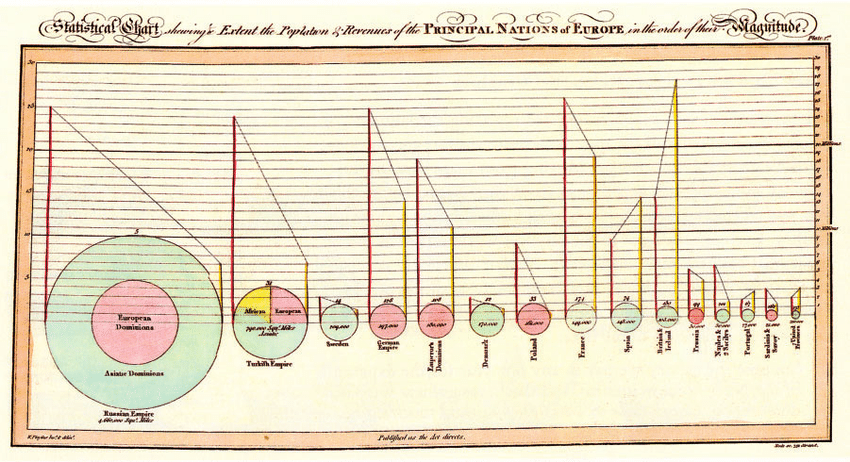
“If you see a pie chart projected twelve feet high in front of you, you know you’re in the hands of an idiot.” These words have stuck with me since I heard them spoken by Edward Tufte, one of the most respected living authorities on data visualization. The latter-day sins of pie-chart-makers (especially those who make them in PowerPoint) are many and varied, but the original sin of the pie chart itself is that of fundamentally misrepresenting one-dimensional information — a company budget, a city’s population demographics — in two-dimensional form.
Yet the pie chart was created by a master, indeed the first master, of information design, the late-eighteenth- and early-nineteenth-century Scottish economist William Playfair. Tufte includes Playfair’s first pie chart, an illustration of the land holdings of various nations and empires circa 1800, in his book The Visual Display of Quantitative Information.
“The circle represents the area of each country,” Tufte explains. “The line on the left, the population in millions read on the vertical scales; the line on the right, the revenue (taxes) collected in millions of pounds sterling read also on the vertical scale.” The dotted lines between them show, in Playfair’s words, whether “the country is burdened with heavy taxes or otherwise” in proportion to its population.
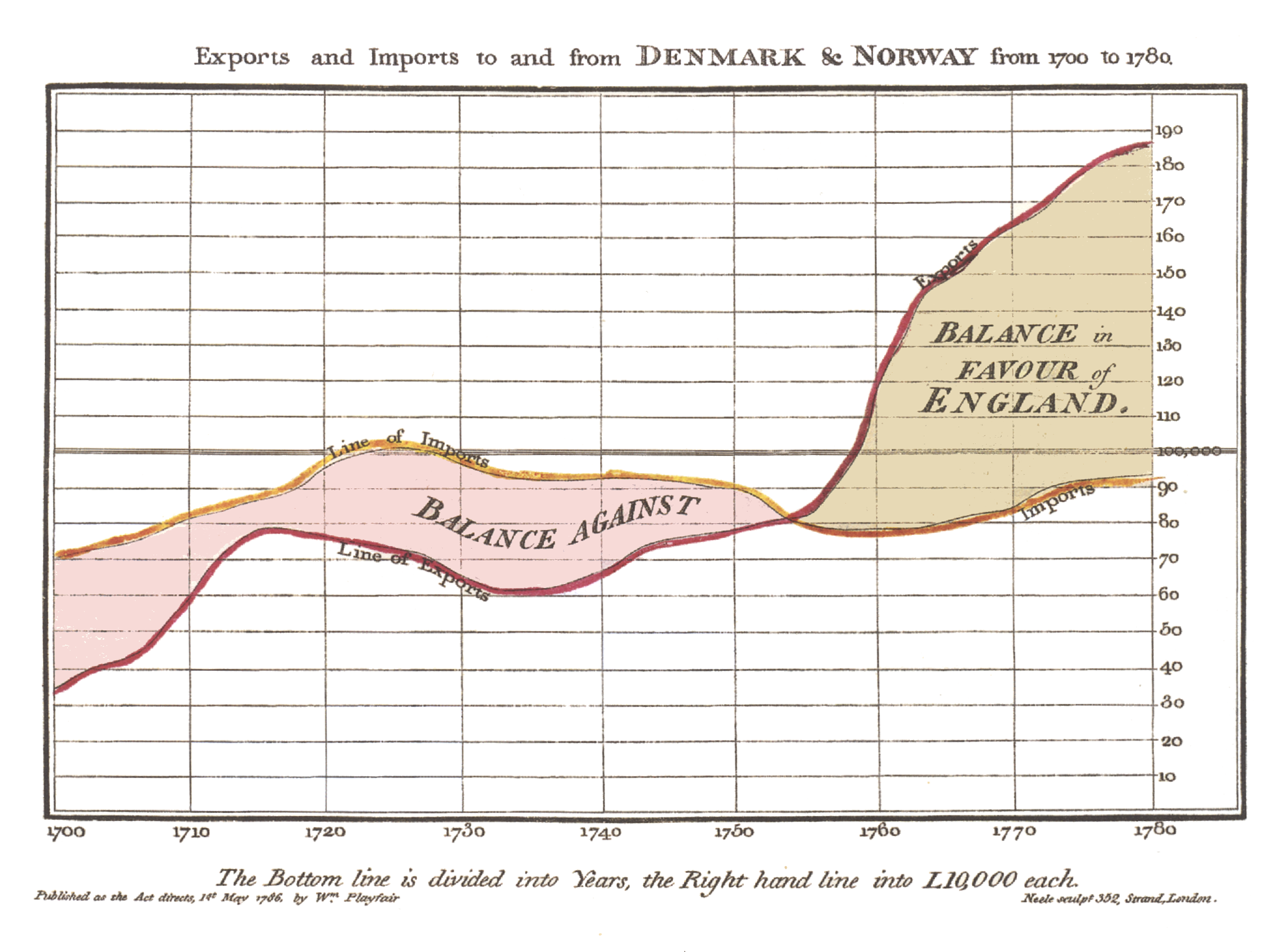
Playfair was experimenting with data visualization long before his invention of the pie chart. He also came up with the more truthful bar chart, history’s first example of which appeared in his Commercial and Political Atlas of 1786. That same book also contains the striking graph above, of England’s “exports and imports to and from Denmark and Norway from 1700 to 1780,” whose lines create fields that make the balance of trade legible at a glance. A much later example of the line graph, another form Playfair is credited with inventing, appears just below, “exhibiting the revenues, expenditure, debt, price of stocks and bread from 1770 to 1824,” a period spanning the American and French Revolutions as well as the Napoleonic Wars.
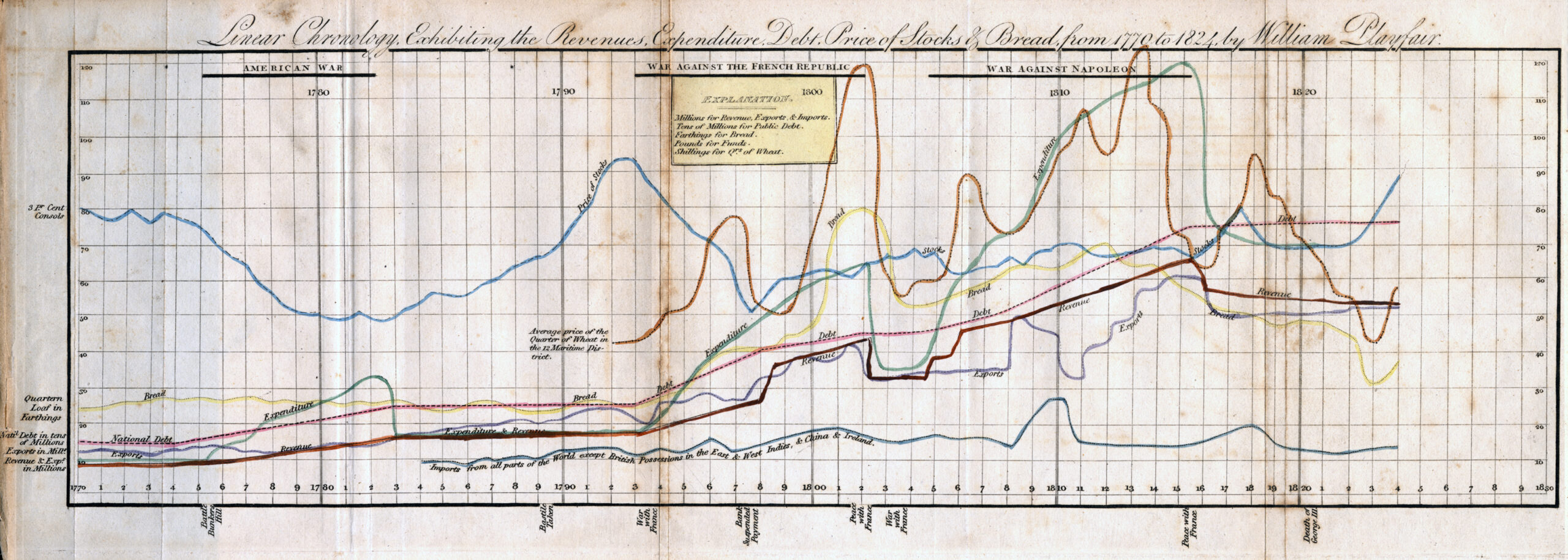
It’s safe to say that Playfair lived in interesting times, and even within that context lived an unusually interesting life. During Great Britain’s wars with France, he served his country as a secret agent, even coming up with a plan to counterfeit assignats, a French currency at the time, in order to destabilize the enemy’s economy. “Their assignats are their money,” he wrote in 1793, “and it is better to destroy this paper founded upon an iniquitous extortion and a villainous deception than to shed the blood of men.” Two years after the plan went into effect, the assignat was worthless and France’s ship of state had more or less run aground. Playfair’s measures may seem extreme, but then, you don’t win a war with pie charts.
Related content:
The Art of Data Visualization: How to Tell Complex Stories Through Smart Design
Based in Seoul, Colin Marshall writes and broadcasts on cities, language, and culture. His projects include the Substack newsletter Books on Cities, the book The Stateless City: a Walk through 21st-Century Los Angeles and the video series The City in Cinema. Follow him on Twitter at @colinmarshall or on Facebook.
Read More...Plan Your Trip Across the Roads of the Roman Empire, Using Modern Web Mapping Technology
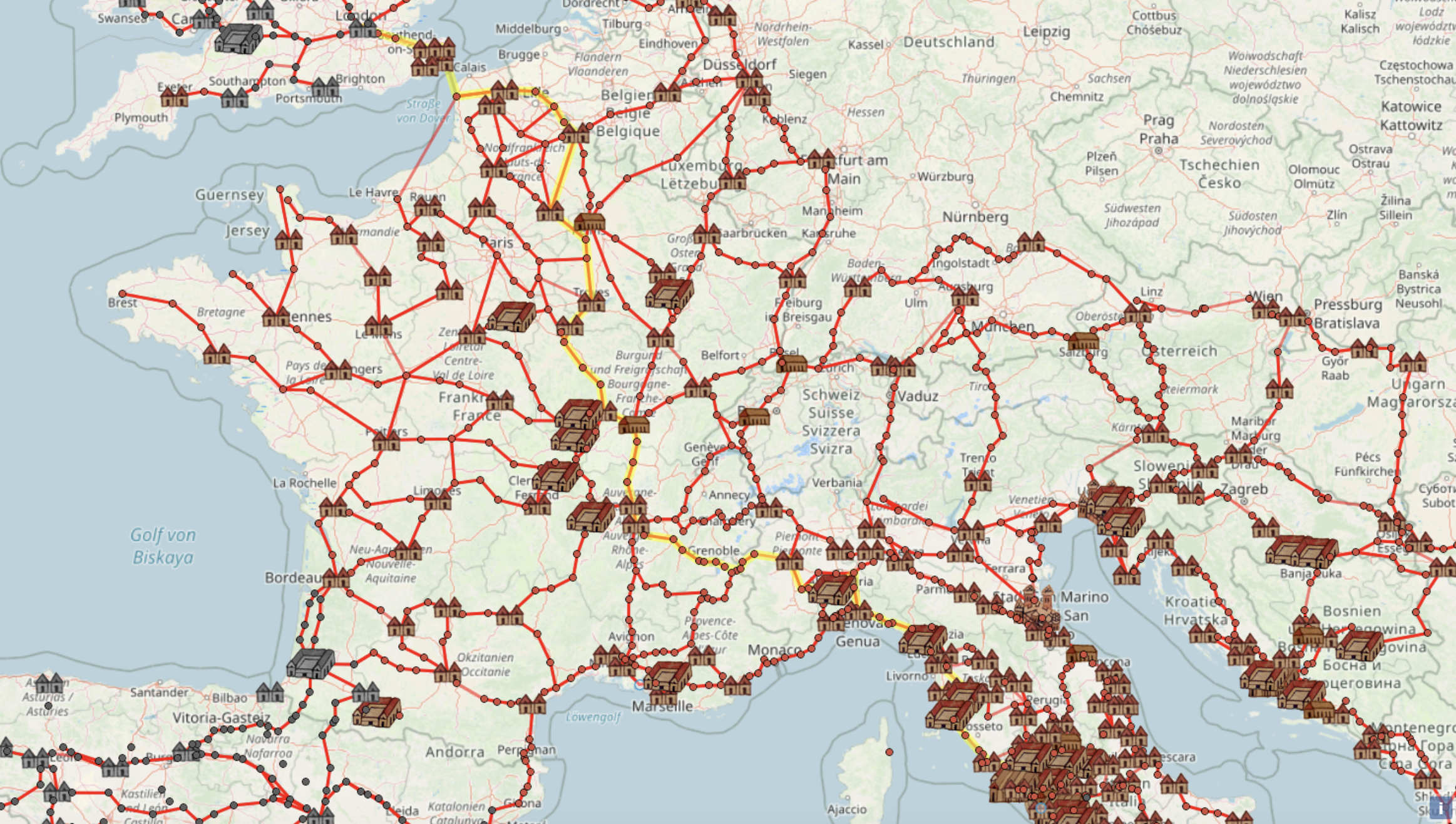
At the moment, I happen to be planning some time in France, with a side trip to Belgium included. Modern intra-European train travel makes arranging the latter quite convenient: Thalys, the high-speed rail service connecting those two countries, can get you from Paris to Brussels in about an hour and half. This stands in contrast to the time of the Roman Empire, which despite its political power lacked high-speed rail, and indeed lacked rail of any kind. But it did have an expansive network of roads, some of which you can still walk today, imagining what it would have been like to travel Europe two millennia ago. And now, using the website OmnesViae, you can get historically accurate directions as well.
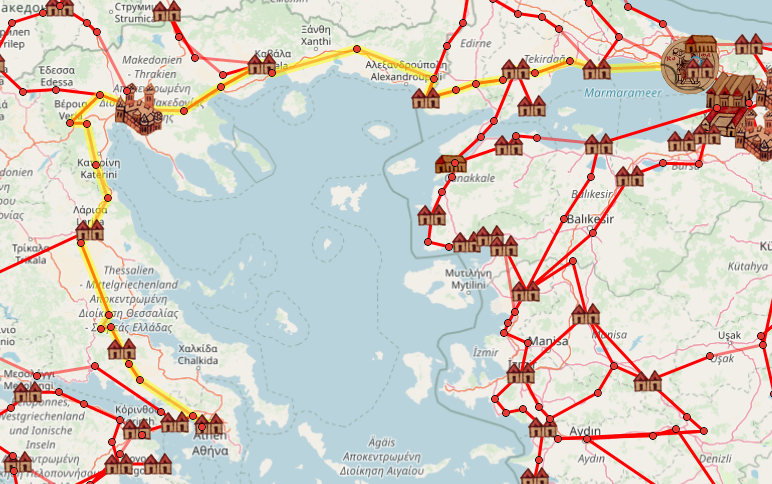
Big Think’s Frank Jacobs describes OmnesViae as “the online route planner the Romans never knew they needed.” It “leans heavily on the Tabula Peutingeriana” — also known as the Peutinger Map, and previously featured here on Open Culture — “the closest thing we have to a genuine itinerarium (‘road map’) of the Roman Empire.”
Though not quite geographically accurate, it does offer a detailed view of which cities in the empire were connected and how. “Geolocating thousands of points from Peutinger, OmnesViae reformats the roads and destinations on the scroll onto a more familiarly landscaped map. The shortest route between two (ancient) points is calculated using the distances traveled over Roman rather than modern roads, also taking into account the rivers and mountains the network must cross.”
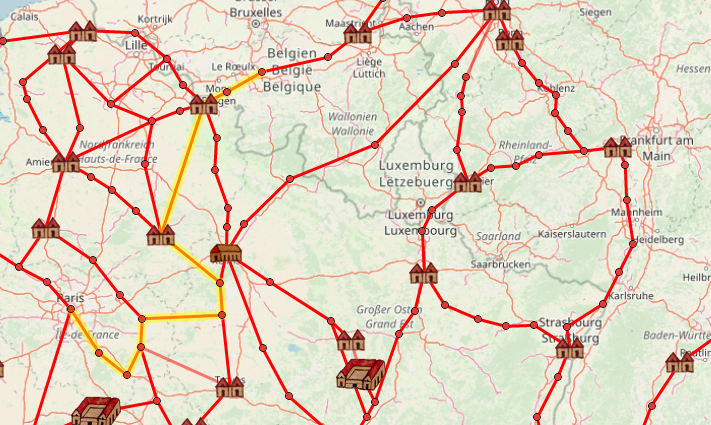
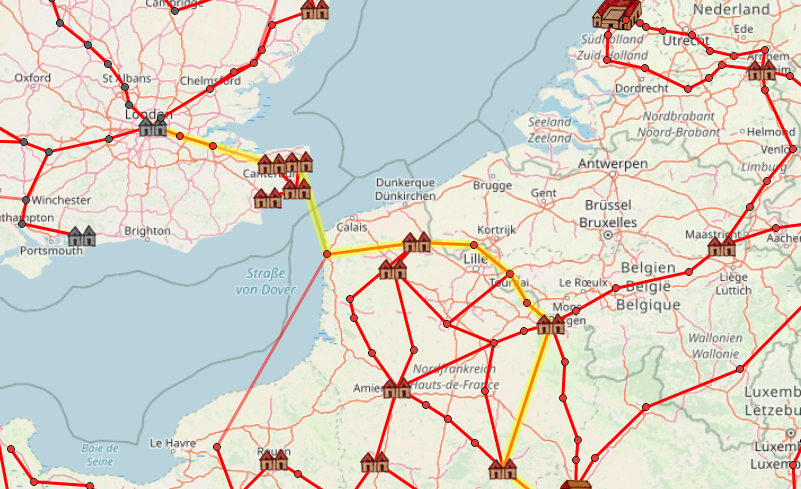
You can use OmnesViae just like any other way-finding application, except you enter your origin and destination into fields labeled “ab” and “ad” rather than “from” and “to.” And though “for some cities current day names are understood,” as the instructions note, it works better — and feels so much more authentic — if you type in cities like “Roma” and “Londinio.” The resulting journey between those two great capitals looks arduous indeed, passing at least three mountainous areas, thirteen rivers, and countless smaller settlements. And according to OmnesViae, no roads led to Brussels: the closest an ancient traveler could get to the location of the modern-day seat of the European Union was the Walloon village of Liberchies — which, as the birthplace of Django Reinhardt, remains an important stop for the jazz-loving traveler of Europe today.
via Big Think
Related content:
The Roads of Ancient Rome Visualized in the Style of Modern Subway Maps
How the Ancient Romans Built Their Roads, the Lifelines of Their Vast Empire
The Roman Roads and Bridges You Can Still Travel Today
How to Make Roman Concrete, One of Human Civilization’s Longest-Lasting Building Materials
Based in Seoul, Colin Marshall writes and broadcasts on cities, language, and culture. His projects include the Substack newsletter Books on Cities, the book The Stateless City: a Walk through 21st-Century Los Angeles and the video series The City in Cinema. Follow him on Twitter at @colinmarshall or on Facebook.
Read More...The Five Graphs That Changed the World: See Groundbreaking Data Visualizations by Florence Nightingale, W. E. B. DuBois & Beyond
Almost two and a half centuries after its first publication, Adam Smith’s An Inquiry into the Nature and Causes of the Wealth of Nations is much better known as simply The Wealth of Nations. Had he written it today, the text itself, which runs between a formidable 500–700 pages in most editions, would also be considerably shorter. It’s not just that writers in Smith’s day went in for length per se (though many now read as if they did), but that graphs hadn’t been invented yet. Much of what he’d discovered about the nature of economics could have been expressed more concisely — and much more clearly — in pictures rather than words.
As it happens, the kind of informational graphs we know best today would be invented by Smith’s fellow Scot William Playfair in 1786, just a decade after The Wealth of Nations came out. “Data visualization is everywhere today, but when Playfair first created them over 200 years ago, using shapes to represent numbers was largely sneered at,” says Adam Rutherford in the Royal Society video above.
“How could drawings truly represent solid scientific data? But now, data visualization has become an art form of its own.” There follow “five graphs that changed the world,” beginning with the map of water pumps that physician John Snow used to determine the cause of a cholera epidemic in 1850s London, previously featured here on Open Culture.
We’ve also posted W. E. B. Du Bois’ “handmade charts showcasing the educational, social, and business accomplishments of black Americans in the 35 years since slavery had been officially abolished.” The other world-changing graphs here include Florence Nightingale’s “coxcomb” that showed how unsanitary hospital conditions killed more soldiers during the Crimean War than did actual fighting; the so-called Kallikak Family Tree, a fraudulent visual case for removing the “feeble-minded” from society; and Ed Hawkins’ more recent red-and-blue “warming stripes” designed to present the effects of climate change to a non-scientific audience. Using just blocks of color, with neither numbers nor text, Hawkins’ bold graph harks back to an earlier golden era of data visualization: after Playfair, but before PowerPoint.
Related content:
The Art of Data Visualization: How to Tell Complex Stories Through Smart Design
A Proportional Visualization of the World’s Most Popular Languages
The History of Philosophy Visualized
Based in Seoul, Colin Marshall writes and broadcasts on cities, language, and culture. His projects include the Substack newsletter Books on Cities, the book The Stateless City: a Walk through 21st-Century Los Angeles and the video series The City in Cinema. Follow him on Twitter at @colinmarshall or on Facebook.
Read More...Pussy Riot Sends a Powerful Message to Vladimir Putin: “You Have Already Lost. You Know It.”
Speaking at TED, Nadya Tolokonnikova, founding member of Pussy Riot, has a powerful message for Russians today: Resisting the authority of Vladimir Putin is an option. It’s a choice. Of that, Tolokonnikova has already provided ample proof. For more than a decade, the members of Pussy Riot have staged high-profile protests in Russia … and paid the price, with time served in prison. As she puts it, “Courage is an ability to act in the face of fear. And some of us have chosen to live courageously.” That example is what makes her a threat:
The reason why I became a threat to the system, not because of any actual physical power that I have, but because courage is contagious. And any act of speaking the truth can cause incalculable transformations in social consciousness. And we all have this power. It’s a moral act to use this power. You may or may not achieve the results that you wanted, but there is eternal beauty in trying to find truth, in risking everything you’ve got for what’s right…
As always, she saves choice words for Putin: “Vladimir Vladimirovich, the Kremlin walls became your prison walls. You have already lost. You know it. That’s why you’re so afraid. You lost in spirit.” Now we just need Russians at home, and Ukrainians on the battlefield, to make the implicit explicit.
If you would like to support the mission of Open Culture, consider making a donation to our site. It’s hard to rely 100% on ads, and your contributions will help us continue providing the best free cultural and educational materials to learners everywhere. You can contribute through PayPal, Patreon, and Venmo (@openculture). Thanks!
Related Content
A History of Pussy Riot: Watch the Band’s Early Performances/Protests Against the Putin Regime
Read More...Watch Iggy Pop Perform Dylan Thomas’ “Do Not Go Gentle Into That Good Night”
Of the original members of the Stooges, only Iggy Pop still lives. He has by now survived a great many other cultural figures who came up from the underground and into prominence through rock music in the nineteen-seventies. And not only is he still alive, he’s still putting out albums: his most recent, Every Loser, came out just this past January. It followed Free, from 2019, which includes his reading of Dylan Thomas’ “Do Not Go Gentle Into That Good Night” — an idea, Amanda Petrusich notes in a contemporary New Yorker profile, that came “after an advertising agency asked him to read the poem for a commercial voice-over.”
“At first, I resisted,” Pop says to Petrusich. “I’m not in junior high.” Indeed, as a vehicle for the expression of one’s own worldview, “Do Not Go Gentle Into That Good Night” feels about one rung up from “The Road Not Taken.”
Petrusich acknowledges that “the poem has grown increasingly meaningless over time, having been repeated and adapted to so many inane circumstances. Yet if you can shake off its familiarity the central idea — that a person should live vigorously, unapologetically — remains germane.” Pop’s distinctive Midwestern voice, made haggard but resonant by decade after decade of punk-rock rigors, also imbues it with an unexpected vitality.
It may surprise those who know Pop mainly through his brazen onstage antics of half a century ago that it would occur to him to read a poem at all. In fact, he’s a man of many and varied literary interests, having also performed the work of Walt Whitman and Edgar Allan Poe, written about Edward Gibbon’s The Decline and Fall of the Roman Empire, and made a film with Michel Houellebecq (whose novels inspired Pop’s 2009 album Préliminaires). All of this while he has kept on showing us, both on records and in live performances, how properly to rage, rage — against the dying of the light, and much else besides.
Related content:
Hear Dylan Thomas Recite His Classic Poem, “Do Not Go Gentle Into That Good Night”
Sir Anthony Hopkins Reads Dylan Thomas’ “Do Not Go Gentle Into That Good Night”
Iggy Pop Reads Edgar Allan Poe’s Classic Horror Story “The Tell-Tale Heart”
Dylan Thomas Sketches a Caricature of a Drunken Dylan Thomas
Based in Seoul, Colin Marshall writes and broadcasts on cities, language, and culture. His projects include the Substack newsletter Books on Cities, the book The Stateless City: a Walk through 21st-Century Los Angeles and the video series The City in Cinema. Follow him on Twitter at @colinmarshall or on Facebook.
Read More...Succession Star Brian Cox Tells the Entire Histories of Ancient Greece and Rome in 20 Minutes Each
Spoiler alert: The death of Logan Roy the weekend before last marked the end of an era. Or at the very least, it was notable for occasioning, in the Los Angeles Times, perhaps the first newspaper obituary of a fictional character. Roy was the mogul-patriarch at the center of the hit black comedy-drama Succession, which is now approaching the end of its fourth and final season on HBO. Brian Cox’s performance in that role had much to do with the success of Succession, so to speak, not least because he clearly understood that, for all its of-the-moment references, the series’ narrative is deeply rooted in concepts like dynasty and empire, which themselves extend way back to antiquity.
Antiquity happens to be the subject of two videos Cox narrated, just before the premiere of Succession, for the Youtube channel Arzamas. “Ancient Greece in 18 Minutes” and “Ancient Rome in 20 Minutes” deliver just what their titles promise, brief but clear and well-informed primers on the classical civilizations that modern Westerners have long thought of as the precursors to their own.
Of course, there were no single, continuous political or geographical entities called “Ancient Greece” and “Ancient Rome”; rather, those names refer to large regions of the world in which city-states rise and fell — as their very nature and relationships with one another changed dramatically — over a period of centuries upon centuries.
To these acclaimed videos Cox brings his signature irreverence-laced gravitas. At the very end of “Ancient Greece in 18 Minutes,” he tells of the Byzantine Empire, “which extended the life of Greek culture another thousand years — leaving us the weird Russian alphabet, for instance.” This line is funnier if you know that Arzamas is a Russian channel that has also put up videos on Russian history and culture: the one on the country’s twentieth-century art just above, for instance, which Cox also narrates. Russia has inherited elements of the ancient Greek and Roman civilizations, as have other distant lands like the United States of America. And wherever we live, we can laugh at Cox’s observation that “if an ancient Greek were to see modern democracy, he would say just one word: oligarchy” — a form of rule Logan Roy knew all about.
Related Content:
Introduction to Ancient Greek History: A Free Online Course from Yale
A Virtual Tour of Ancient Athens: Fly Over Classical Greek Civilization in All Its Glory
An 8‑Minute Animated Flight Over Ancient Rome
An Archive of Animations/Cartoons of Ancient Greece & Rome: From the 1920s Through Today
Based in Seoul, Colin Marshall writes and broadcasts on cities, language, and culture. His projects include the Substack newsletter Books on Cities, the book The Stateless City: a Walk through 21st-Century Los Angeles and the video series The City in Cinema. Follow him on Twitter at @colinmarshall or on Facebook.
Read More...Support Us
We're hoping to rely on loyal readers, rather than erratic ads. Please click the Donate button and support Open Culture. You can use Paypal, Venmo, Patreon, even Crypto! We thank you!

About Us

Open Culture scours the web for the best educational media. We find the free courses and audio books you need, the language lessons & educational videos you want, and plenty of enlightenment in between.
Advertise With Us
FREE UPDATES!
GET OUR DAILY EMAIL
Get the best cultural and educational resources on the web curated for you in a daily email. We never spam. Unsubscribe at any time.
FOLLOW ON SOCIAL MEDIA
Open Culture editor Dan Colman scours the web for the best educational media. He finds the free courses and audio books you need, the language lessons & movies you want, and plenty of enlightenment in between.
Advertise With Us

