Watch 11-Year-Old Billy Preston Duet with Nat King Cole: A Star is Born (1957)
The Beatles aren’t the only fab talents causing a stir in the recently released Beatles documentary, Get Back.
As has been widely noted, soul singer Billy Preston lights up every scene he’s in.
One of the 60’s finest session keyboardists, Preston contributed to the Beatles’ Let It Be and Abbey Road albums, and joined them for their famous final gig on the roof of Apple Records.
He also served as a leveling influence when tensions within the band frequently exploded into fits of temper.
“It’s interesting to see how nicely people behave when you bring a guest in,” George Harrison observed.
In addition to his successful solo career, with a number of funk and R&B hits, Preston gigged for a host of all time greats: Ray Charles, Little Richard, Sam Cooke, Miles Davis, Aretha Franklin, the Rolling Stones…the list goes on.
A childhood prodigy who never took a music lesson, by 10, he was backing gospel luminaries like Mahalia Jackson, James Cleveland, and Andraé Crouch.
A year later, he entered America’s living rooms, when he appeared on The Nat King Cole Show, above, to duet with TV’s first national Black variety show host on “Blueberry Hill,” a 40s tune Fats Domino had popularized earlier in the decade.
“You have a very excellent career ahead of you,” Cole predicts, following their performance.
Daughter Natalie Cole later enthused that the celebrated crooner “lets this kid have all the glory,” though the self-possessed pre-teen holds his own ably, alternating between organ and his own impressive pipes.
Within the year, Cole and Preston shared the big screen, and a memorable part, when they were cast as “The Father Of The Blues” W.C. Handy, as a child and adult, in the 1958 movie St Louis Blues.
As an adult, Preston’s star was tarnished by addiction, arrests and self-sabotaging behavior that his manager, Joyce Moore, and half-sister Lettie, said was most deeply rooted in his mother’s refusal to believe that he was being sexually abused by the pianist of a summer touring company, and later a local pastor.
It’s part of a lurid, longer tale, calling to mind other promising, oft-prodigious young talents who never managed to get out from under damage inflicted by adults when they were children.
He was 9.
Related Content:
Watch Paul McCartney Compose The Beatles Classic “Get Back” Out of Thin Air (1969)
Ayun Halliday is the Chief Primaologist of the East Village Inky zine and author, most recently, of Creative, Not Famous: The Small Potato Manifesto. Follow her @AyunHalliday.
Read More...Albertus Seba’s Cabinet of Natural Curiosities: Discover One of the Most Prized Natural History Books of All Time (1734–1765)

In the eighteenth century, a European could know the world in great detail without ever leaving his homeland. Or he could, at least, if he got into the right industry. So it was with Albertus Seba, a Dutch pharmacist who opened up shop in Amsterdam just as the eighteenth century began. Given the city’s prominence as a hub of international trade, which in those days was mostly conducted over water, Seba could acquire from the crew members of arriving ships all manner of plant and animal specimens from distant lands. In this manner he amassed a veritable private museum of the natural world.
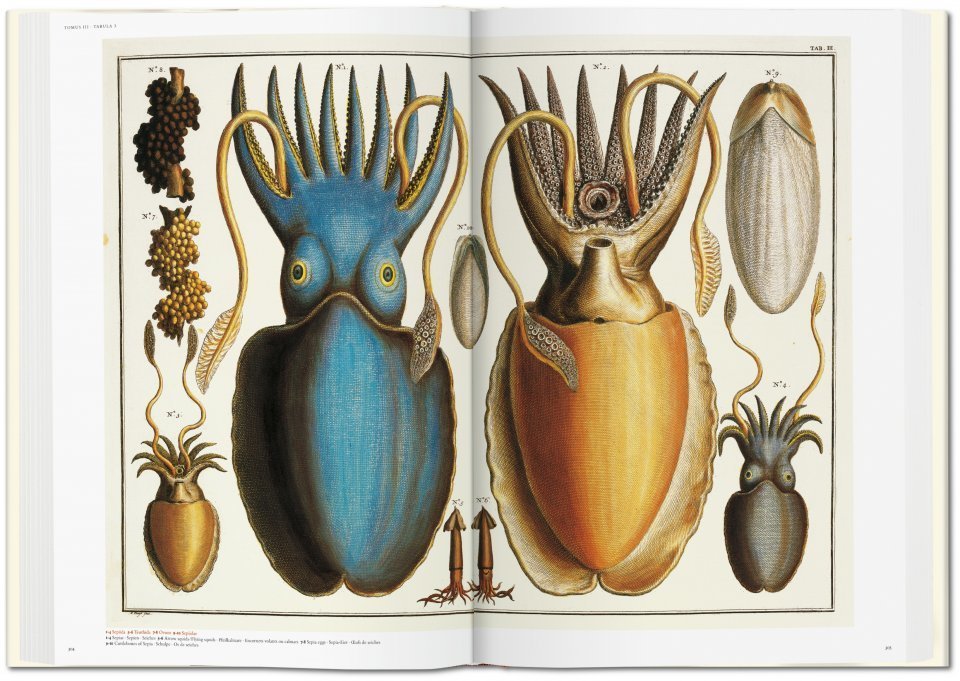
The “cabinets of curiosities” Seba put together — as collectors of wonders did in those days — ranked among the largest on the continent. But when he died in 1736, his magnificent collection did not survive him. He’d already sold much of it twenty years earlier to Peter the Great, who used it as the basis for Russia’s first museum, the Kunstkammer in St. Petersburg.
What remained had to be auctioned off in order to fund one of Seba’s own projects: the Locupletissimi rerum naturalium thesauri accurata descriptio, or “Accurate description of the very rich thesaurus of the principal and rarest natural objects,” pages of which you can view at the Public Domain Review and the Metropolitan Museum of Art.
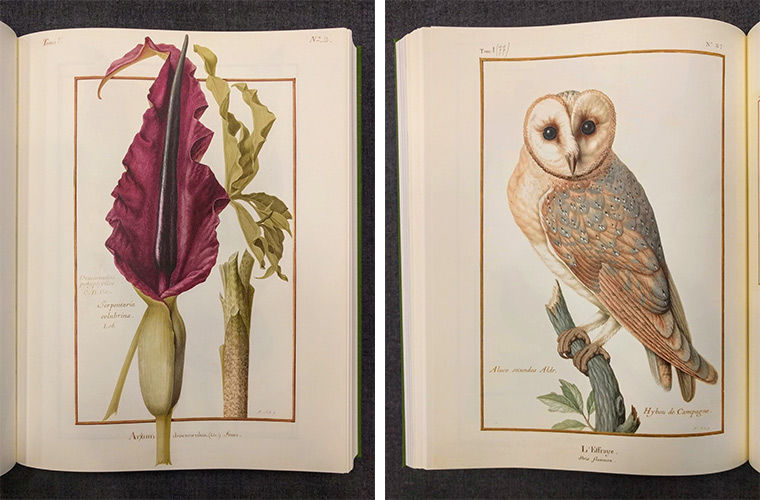
This four-volume set of books constituted an attempt to catalog the variety of living things on Earth, a formidable endeavor that Seba was nevertheless well-placed to undertake, rendering each one in engravings made lifelike by their depth of color and detail. The lavish production of the Thesaurus (more recently replicated in the condensed form of Taschen’s Cabinet of Natural Curiosities) presented a host of challenges both physical and economic. But there was also the intellectual problem of how, exactly, to organize all its textual and visual information. As originally published, it groups its specimens by physical similarities, in a manner vaguely similar to the much more influential system published by Swedish scientist Carl Linnaeus in 1735.
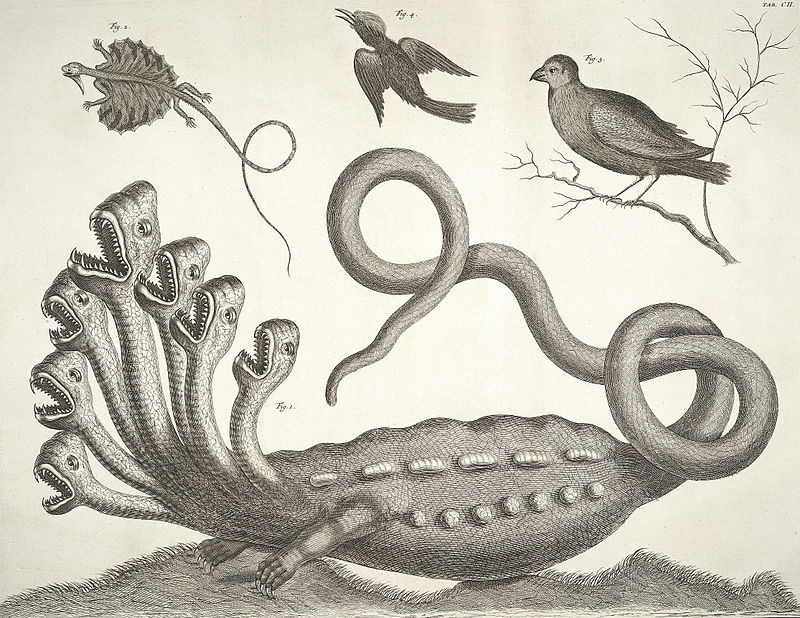
Linnaeus, as it happens, twice visited Seba to examine the latter’s famous collection. It surely had an influence on his thinking on how to name everything in the biological realm: not just the likes of trees, owls, snakes, and jellyfish, but also the “paraxoda,” creatures whose existence was suspected but not confirmed. These included not only the hydra and the phoenix, but also the rhinoceros and the pelican.

Eighteenth-century Europeans possessed much more information about the world than did their ancestors, but facts were still more than occasionally intermixed with fantasy. Given the strangeness of what had recently been documented, no one dared put limits on the strangeness of what hadn’t.
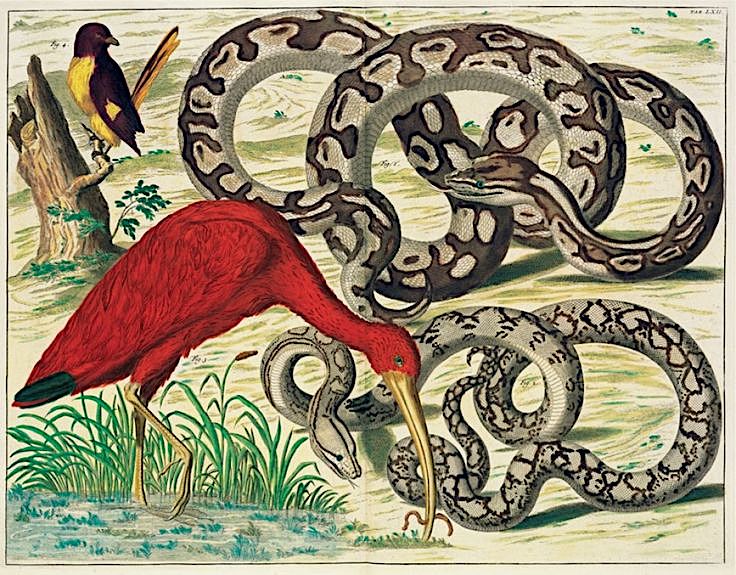
Note: A number of the vibrant images on this page come from the Taschen edition.
Related Content:
Based in Seoul, Colin Marshall writes and broadcasts on cities and culture. His projects include the book The Stateless City: a Walk through 21st-Century Los Angeles and the video series The City in Cinema. Follow him on Twitter at @colinmarshall or on Facebook.
Read More...Punks, Goths, and Mods on TV (1983)
The Rivethead preoccupation with fashion is inescapably related to their anxiety over being confused for subcultures they profess to hate: Goths, Punks, Metalheads, Death Rockers… The fact that so many subcultures claim black as their color of choice contributes to the confusion.
There are two points upon which theorists of post-industrial British subcultures generally agree: 1) No matter the music or the fashion, the boundaries between one subculture and another were rigorously, even violently, enforced (hence the wars between the mods and rockers), and; 2) The music and fashions of every subculture were subject to cooptation by the machinery of capitalism, to be mass produced, packaged, and sold as off-the-rack commodity, a phenomenon that occurred almost as soon as punks, mods, rockers, goths, teddy boys, skinheads, New Romantics, etc. began appearing on television — as in the post-Grundy Irish TV appearance of four young individuals above from 1983.
The interviewer introduces these punks, goths, and mods by referring first to their employment — or lack of employment — status, and then to the number of children in their family. Comments dripping with class disdain sit alongside a characterization of various subcultures as “gangs” — the Hell’s Angels thrown in among them just to drive the point home. Of course, there’s more to say about the denizens of early-80s UK subcultural street corners — more than these four representatives have to say themselves. It is communicated through performance rather than verbal exposition, through the affiliations of clothing, music, and pose — as in the mini-historical slideshow of late-20th century British subcultures below, from the 50s to the 80s.
In 1979, British theorist Dick Hebdige published what many considered the definitive analysis of these working-class scenes, which frequently centered around forms of racial and cultural exchange — as with mods who loved jazz or punks who loved ska and dub reggae; or racial and cultural exclusion — as with fascist skinheads and chauvinist teddy boys who glorified the past, while other subcultural ideologies looked to the future (or, as the case may be, no future).
Hebdige’s Subculture: the Meaning of Style begins with a story about French writer Jean Genet, humiliated in prison by homophobic guards over his possession of a tube of Vaseline:
Like Genet, we are interested in subculture – in the expressive forms and rituals of those subordinate groups – the teddy boys and mods and rockers, the skinheads and the punks – who are alternately dismissed, denounced and canonized; treated at different times as threats to public order and as harmless buffoons.
The irony of subcultures is that they identify with social outsiders, while re-enforcing boundaries that create exclusivity (cf. the quote at the top, from Hebdige-inspired Subcultures List). When the novelty and shock recedes, they become ripe fodder for commercial cooptation, even luxury branding.
What we usually don’t get from tame retrospectives, or from patronizing mass media of the time, are deviant outsiders like Genet who cannot be reabsorbed into the system because their very existence poses a threat to the social order as so construed. So much of the fashion and music of post-war Britain was directly created or inspired by West Indian migrants of the Windrush generation, for example. In too many popular representations of postwar British subcultures, that essential part of the working class UK subculture story has been entirely left out.
Related Content:
A History of Punk from 1976–78: A Free Online Course from the University of Reading
The History of Punk Rock in 300 Tracks: A 13-Hour Playlist Takes You From 1965 to Present
Josh Jones is a writer and musician based in Durham, NC. Follow him at @jdmagness
Read More...How Well Can You Move in Medieval Armor?: Medievalist Daniel Jaquet Gives It a Try in Real Life
If you’ve ever run a marathon in costume, or for that matter, boarded public transportation with a large musical instrument or a bulky bag of athletic equipment, you know that gear can be a burden best shed.
But what if that gear is your first, nay, best line of defense against a fellow knight fixing to smite you in the name of their liege?
Such gear is non-optional.
Curious about the degree to which 15th-century knights were encumbered by their protective plating, medievalist Daniel Jaquet commissioned a top armor specialist from the Czech Republic to make a suit specific to his own personal measurements. The result is based on a 15th century specimen in Vienna that has been studied by the Wallace Collection’s archaeometallurgist Alan Williams. As Jaquet recalled in Sciences et Avenir:
We had to make compromises in the copying process, of course, because what interested me above all was to be able to do a behavioral study, to see how one moved with this equipment on the back rather than attaching myself to the number of exact rivets…we knew the composition and the hardness of the parts that we could compare to our replica.
The accomplished martial artist tested his mobility in the suit with a variety of highly public, modern activities: reaching for items on the highest supermarket shelves, jogging in the park, scaling a wall at a climbing gym, taking the Metro …
It may look like showboating, but these movements helped him assess how he’d perform in combat, as well as lower stress activities involving sitting down or standing up.
Out of his metal suit, Jaquet has been known to amuse himself by analyzing the verisimilitude of Game of Thrones’ combat scenes. (Conclusion: some liberties were taken, armor-wise, in that gruesome face off between the Mountain and the Viper.)
An invitation to travel to New York City to present at the Metropolitan Museum of Art offered an unexpected testing opportunity, compliments of the airline’s baggage restrictions:
For reasons of weight, space and cost, the solution to wear the armor over me was considered the best.
(The TSA officers at Newark were not amused...)

His armored experience sheds light on those of early 15th-century knight Jean le Maingre, aka Boucicaut, whose impressive career was cut short in 1415, when he was captured by the English at the Battle of Agincourt.
Boucicaut kept himself in tip top physical condition with a regular armored fitness regimen. His chivalric biography details gearing up for exercises that include running, chopping wood, vaulting onto a horse, and working his way up a ladder from the underside, without using his feet.
Jaquet duplicates them all in the above video.
(Reminder to those who would try this at home, make sure you’re capable of performing these exercises in lightweight shorts and t‑shirt before attempting to do them in armor.)
Like Boucicault’s, Jaquet’s armor is bespoke. Those who’ve struggled to lift their arms in an off-the-rack jacket will appreciate the trade off. It’s worth spending more to ensure sufficient range of movement.
In Boucicault’s day, ready-made pieces of lesser quality could be procured at markets, trading fairs, and shops in populous areas. You could also try your luck after battle, by stripping the captive and the dead of theirs. Size was always an issue. Too small and your movement would be restricted. Too big, and you’d be hauling around unnecessary weight.
Jaquet describes his load as being on par with the weight 21st-century soldiers are required to carry. Body armor is a lifesaver, according to a 2018 study by the Center for a New American Security, but it also reduces mobility, increases fatigue, and reduces mission performance.
Gizmodo’s Jennifer Ouellette finds that medieval knights faced similar challenges:
The legs alone were carrying an extra 15 to 18 pounds, so the muscles had to work that much harder to overcome inertia to set the legs in motion. There is also evidence that the thin slits in the face mask, and tight chest plate, restricted oxygen flow even further.
Read a detailed, scholarly account of Jaquet’s armor experiment in Historical Methods: A Journal of Quantitative and Interdisciplinary History.
For those looking for a lighter read, here is Jaquet’s account of taking a commercial flight in armor (and some best practice tips for those attempting the same.)
- Ayun Halliday is the Chief Primatologist of the East Village Inky zine and author, most recently, of Creative, Not Famous: The Small Potato Manifesto. Follow her @AyunHalliday.
Related Content
What It’s Like to Actually Fight in Medieval Armor
How to Make and Wear Medieval Armor: An In-Depth Primer
Read More...Pink Floyd’s Entire Studio Discography is Now on YouTube: Stream the Studio & Live Albums
Approached with little prior knowledge, Pink Floyd is an enigma. A stadium rock band renowned for massive laser light shows and a pioneering use of quadraphonic and holophonic sound, they are also best appreciated at home — alone or with a few true fans — on a pair of high fidelity stereo speakers or headphones, under the hazy purplish-greenish glow of a blacklight poster. The experience of their classic albums is paradoxically one of “shared solitary contemplation”; their live shows are an expansion of the home listening environment, where fans first received an “education from cousins and older brothers of friends as to the seriousness (and stoner sacrament) of The Dark Side of the Moon,” as Martin Popoff writes in Pink Floyd: Album by Album. Both enormously popular and daringly experimental, it’s hard to place them comfortably in one camp or another.
Listeners who came to the band during their 1970s heyday, “in the years between The Dark Side of the Moon and The Final Cut,” Bill Kopp writes, “were largely unaware of what the band had done before the period….. The fact highlights a remarkable feature of Pink Floyd’s popularity: casual fans knew of the band’s work from The Dark Side of the Moon onward; more serious students of the group were familiar with the band’s 1967 debut, The Piper at the Gates of Dawn, made when Pink Floyd was led by its founder, Roger Keith ‘Syd’ Barrett.”
The split is curious because the 70s space rock version of the band who made the third best-selling album of all time owed so much to its psychedelic founder, who slipped completely from view as he slipped away from the music industry.
As Andy Mabbett writes in his book Pink Floyd: The Music and the Mystery:
Barrett’s withdrawal from music had long ago become a source of intrigue, one of the most mystifying sagas in rock, but his contribution to the group as their first singer, guitarist and songwriter was crucial to there ever being a Pink Floyd in the first place. Syd might not have played much of a role in the classic recordings Pink Floyd produced in the Seventies, but everyone — not least the group themselves — long ago realized that all this might never have happened were it not for Syd’s initial inspiration.
At their best, during the golden years of Dark Side and Wish You Were Here, the band remembered their history while expanding their early avant-blues rock into the outer reaches of space. Dark Side contained their first hit singles since their 1967 debut and introduced new fans to Barrett indirectly via the lyrics of “Brain Damage” (originally called “Lunatic”) and the “Shine on You Crazy Diamond” suite. The cynicism and sense of doom that seemed to take over as Roger Waters became the band’s primary songwriter found its foil in Barrett’s continued influence — in his absence — on the band during the early 70s.
But in the 70s one had to work particularly hard to get caught up on the early mythos of Pink Floyd, tracking down LPs of albums like Meddle, Atom Heart Mother, and Ummagumma. As early albums were reissued on tape and CD, it became a little easier to familiarize oneself with Pink Floyd’s many historical phases — from experimental psych-rock pioneers to stadium-filling prog-rock superstars. These days, that experience can be had in an afternoon on YouTube. The band has put their studio discography and three live performances online and you can find links below (with a few choice cuts above).
Studio
The Piper at the Gates of Dawn
Live
Is There Anybody Out There? The Wall Live 1980–81
Does the ridiculous ease of finding this music now clear up the enigma of Pink Floyd? Maybe. Or maybe no amount of streaming convenience will dispel “the mystery,” Mabbett writes, “that grew around their reluctance to be photographed or interviewed for much of the Seventies, the lack of singles during the same crucial period, the imaginative album packaging, the crisp live sound, the spectacular theatrical shows — and, of course, a special magic that cannot be copied no matter how much money or equipment is available.”
Related Content:
A Live Studio Cover of Pink Floyd’s The Dark Side of the Moon, Played from Start to Finish
Josh Jones is a writer and musician based in Durham, NC. Follow him at @jdmagness
Read More...The Quirky Self-Portraits of 18th Century Painter Joseph Ducreux
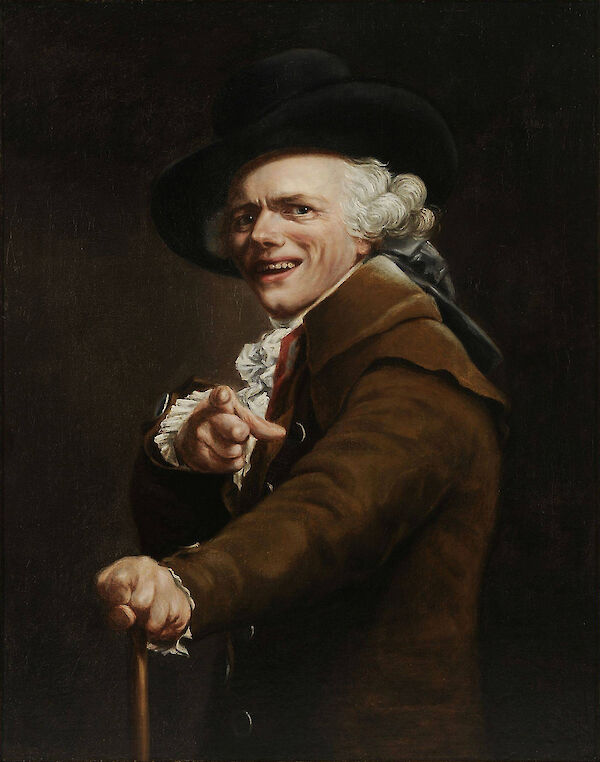
We all know him, the dapper cross between a smarmy office bro and smug, pull-my-finger uncle; leaning on his walking stick, hat pushed back at a rakish angle, pointing at the viewer with a leer.… The 18th-century painting, titled Self-Portrait in the Guise of a Mocker, enjoyed a brief but rich second life for a couple years as a 21st century meme, first appearing online in a 2009 image macro with the caption “Disregard Females, Acquire Currency,” an overly stuffy, thus hilarious, rephrasing of Notorious B.I.G.’s “Get Money” lyrics. Thousands of imitations followed. Within a couple years, Steve Buscemi’s face got photoshopped in place of the grinning bon vivant, and the meme began its decline.
But whose face was it, pre-Buscemi, giving us that toothy grin and point, “like a man catching sight of an old friend across a crowded room,” the Public Domain Review writes, “or a politician trying to charm a voter.” The gentleman in question, in fact, happened to be the artist, Joseph Ducreux, a highly skilled oil painter whose miniature of Marie Antoinette in 1769 won him a baronetcy and the title of primer peintre de la reine (First Painter to the Queen).
This was an honor not given to any old slouch. Ducreux worked alongside such masters as Élisabeth Vigée Le Brun and Jacques-Louis David, despite the fact that he was not a member of the Royal Academy of Painting and Sculpture, unheard of at the time for a court painter.
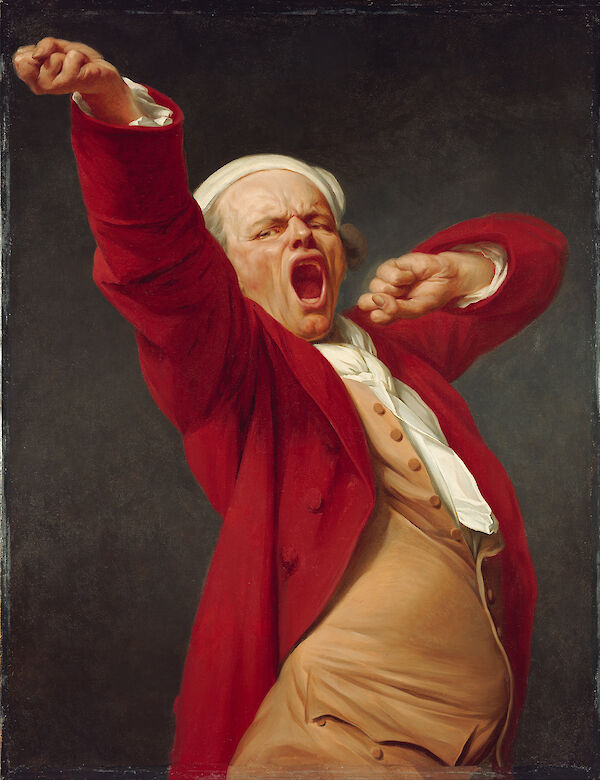
During the French Revolution, Ducreux hid out in London, where he made the last portrait of Louis XVI before the king’s beheading. Afterward, he returned and, through his friendship with David, resumed his career as a portrait painter, as well as an eccentric self-portraitist, an avocation he’d taken up in the 1780s and 90s to satisfy his curiosity about the theory of physiognomy, a pseudoscience that attempted to divine a person’s character and personality from their facial expressions and bodily postures.
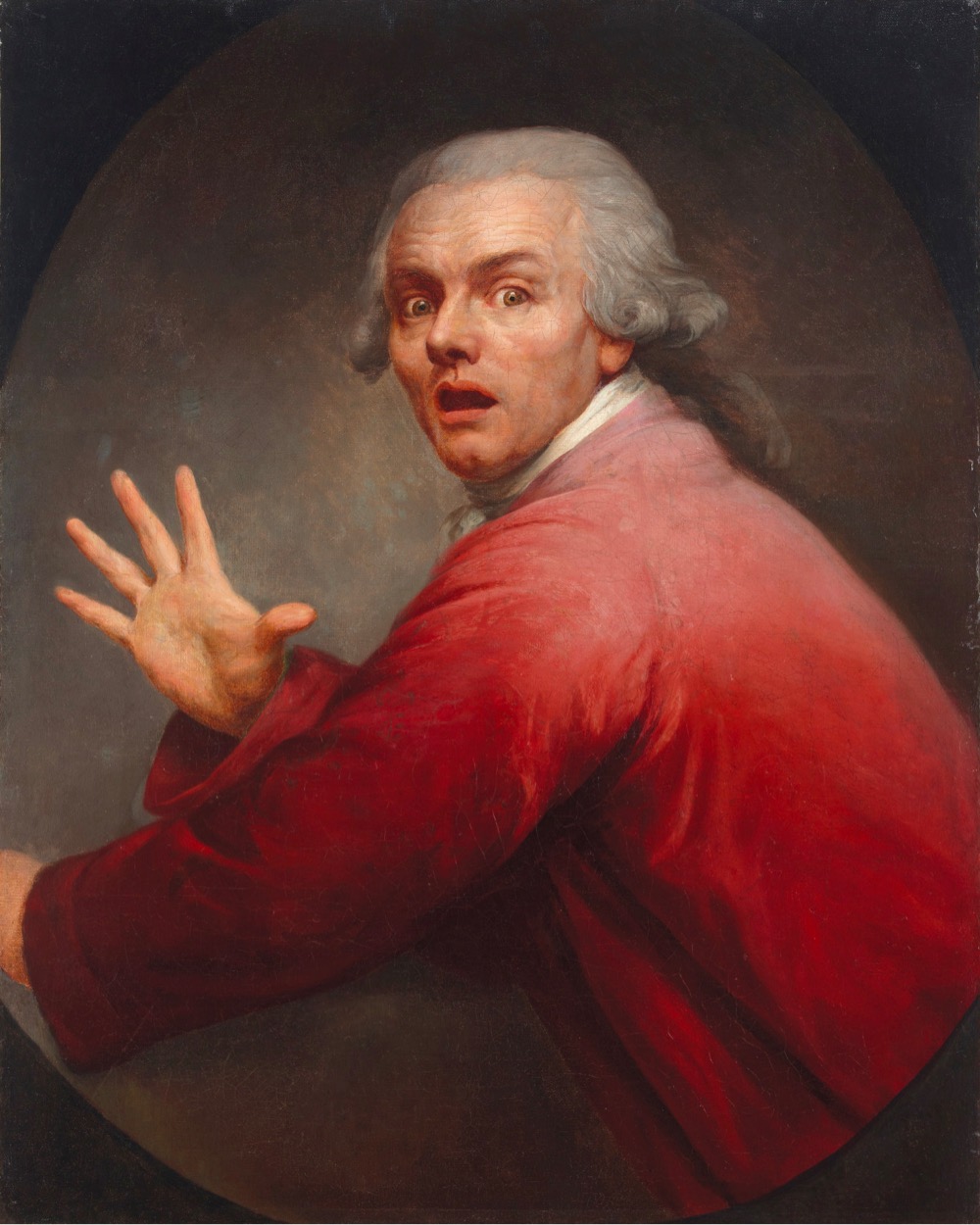
These were remarkable paintings for their time, but they were not made with Tumblr or Twitter in mind. Given that they were made before the age of photography and painted on large canvases in oils, the process of creating these goofy selfies would have been painstaking and time-consuming — hardly the kind of effort a working artist applies to a joke.

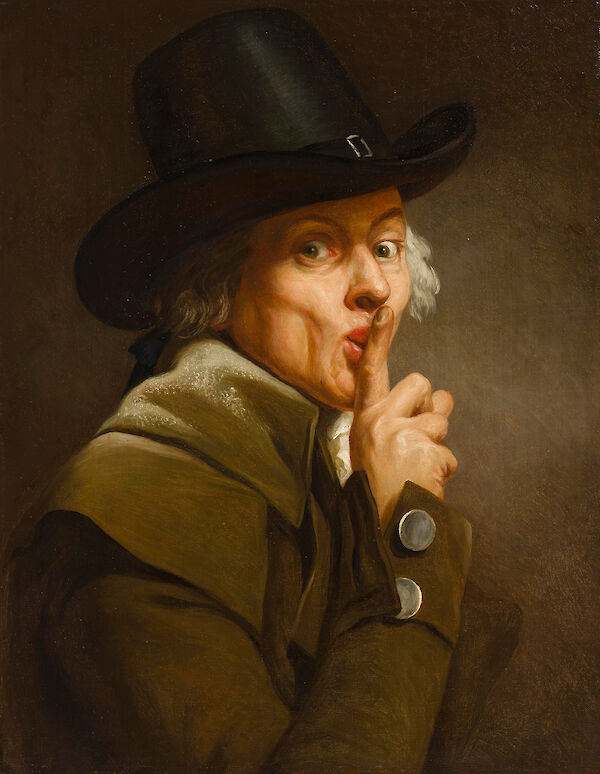
Humorous as they are, and no doubt Ducreux had a healthy sense of humor, the portraits were also meant to serve a scientific purpose of a sort, and they show an artist pushing past the conservative traditions of portraiture in his day, chafing at the sedate royal postures and placid expressions that were supposed to telegraph the aristocracy’s inner nobility. We might suspect that throughout his career as a court painter, Ducreux himself had reasons to suspect otherwise about his subjects. But he only had permission to practice his theories on himself.
Related Content:
The Intimacy of Frida Kahlo’s Self-Portraits: A Video Essay
Vincent Van Gogh’s Self Portraits: Explore & Download a Collection of 17 Paintings Free Online
Josh Jones is a writer and musician based in Durham, NC. Follow him at @jdmagness
Read More...Browse a Huge Collection of Prison Newspapers: 1800–2020
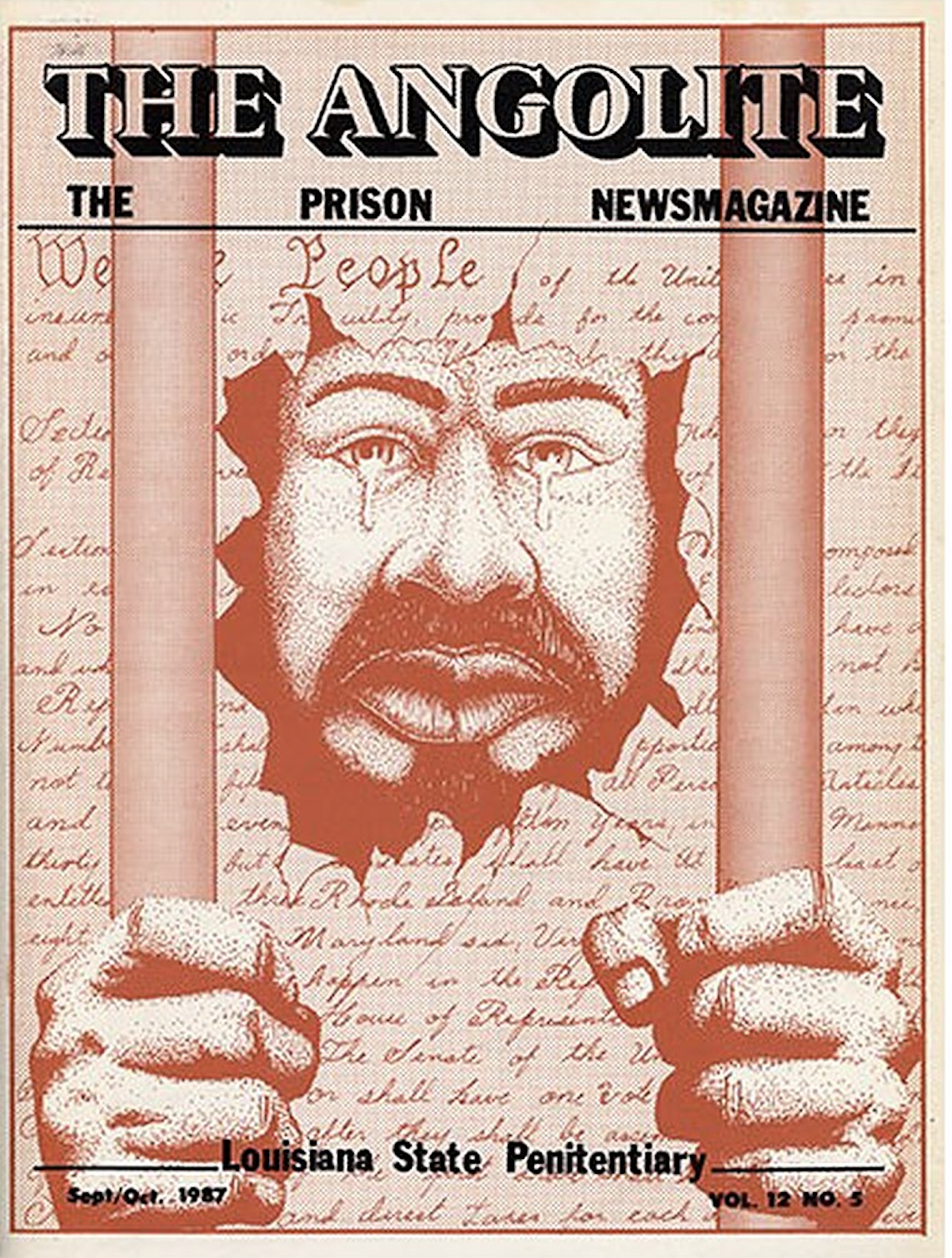
“By the end of the eighteenth and the beginning of the nineteenth century, the gloomy festival of punishment was dying out… Punishment, then, will tend to become the most hidden part of the penal process.” — Michel Foucault
The study of crime in the late 1800s began with racist pseudoscience like craniometry and phrenology, both of which have made a disturbing comeback in recent years. In his 1876 book, Criminal Man, the “father of criminology,” Cesare Lombrosco, defined “the criminal” as “an atavistic being who reproduces in his person the ferocious instincts of primitive humanity and the inferior of animals.” Lombrosco believed that certain cranial and facial features correspond to a “love of orgies and the irresistible craving for evil for its own sake, the desire not only to extinguish life in the victim, but to mutilate the corpse, tear its flesh, and drink its blood.” That such descriptions preceded Bram Stoker’s Dracula by several years may be no coincidence at all.
No such thing as a natural criminal type exists, but this has not stopped 19th century prejudices from embedding themselves in law enforcement, the prison system and the culture at large in the United States. Outside of the most sensationalist cases, however, we rarely hear from incarcerated people themselves, though they’ve had plenty say about their humanity in print since the turn of the 19th century, when the first prison newspaper, Forlorn Hope, was published in New York City on March 24, 1800.
“In the intervening 200 years,” notes JSTOR, “over 500 prison newspapers have been published from U.S. prisons.” A new collection, American Prison Newspapers: 1800–2020 — Voices from the Inside, “will bring together hundreds of these periodicals from across the country into one collection that will represent penal institutions of all kinds, with special attention paid to women-only institutions.”
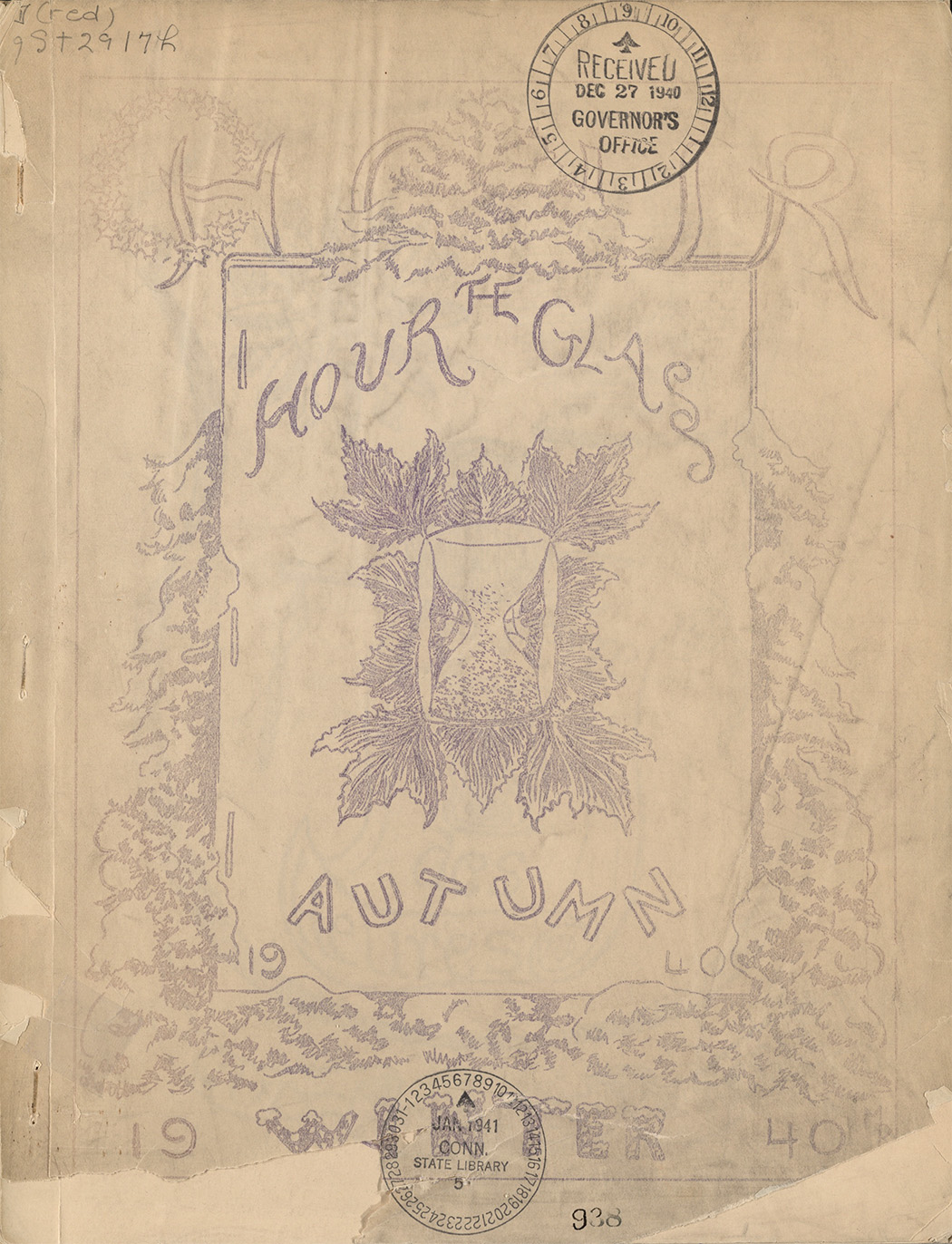
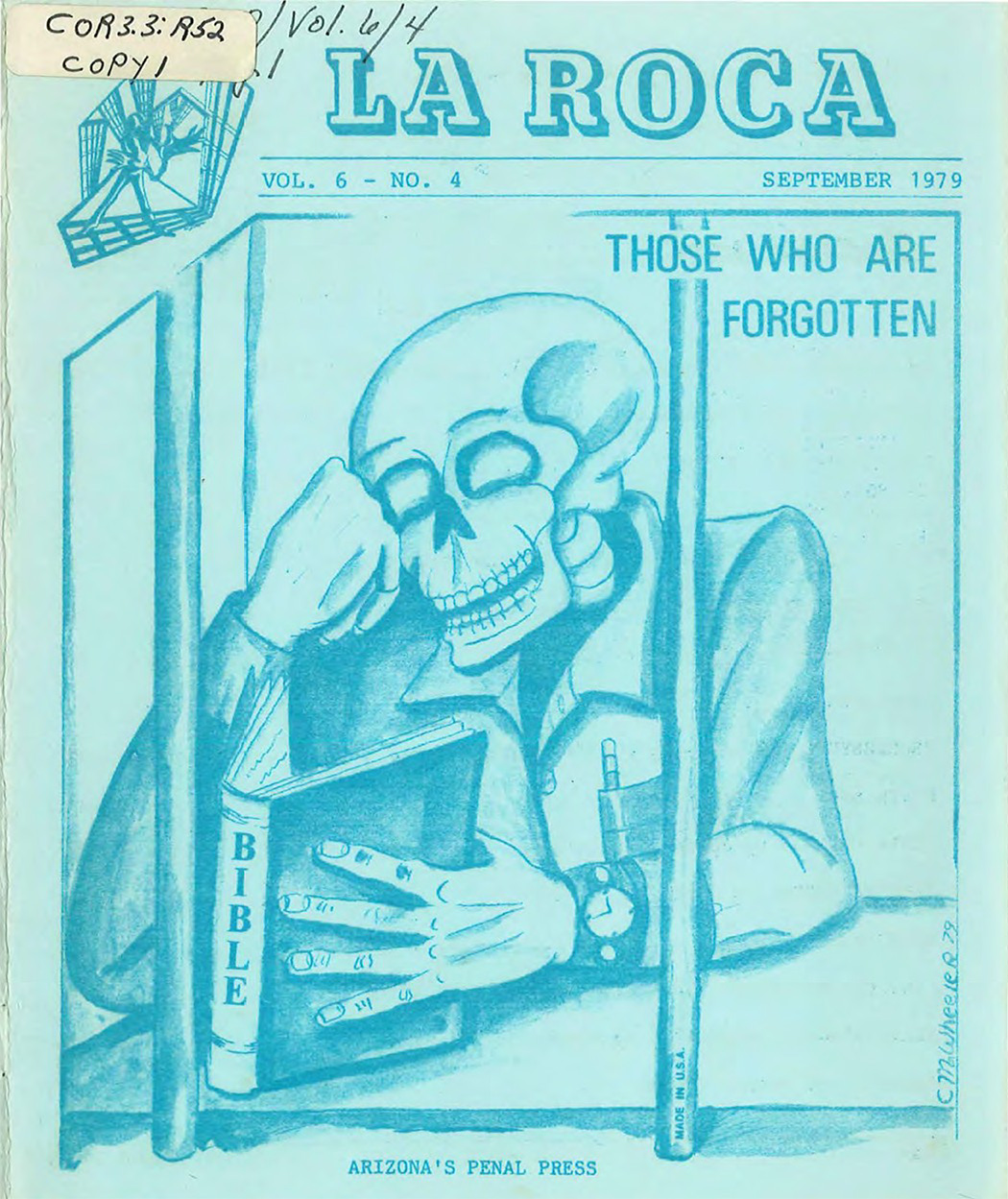
The U.S. incarcerates “over 2 million as of 2019” — and has produced some of the world’s most moving jail and prison literature, from Thoreau’s “Civil Disobedience” to Martin Luther King, Jr.‘s “Letter from a Birmingham Jail.” The newspapers in this collection do not often feature a similar level of literary bravura, but many show a high degree of professionalism and artistic quality. “Next to the faded, home-spun pages of The Hour Glass, published at the Farm for Women in Connecticut in the 1930s,” writes JSTOR Daily’s Kate McQueen, “readers will find polished staples of the 1970s like newspaper The Kentucky Inter-Prison Press and Arizona State Prison’s magazine La Roca.”
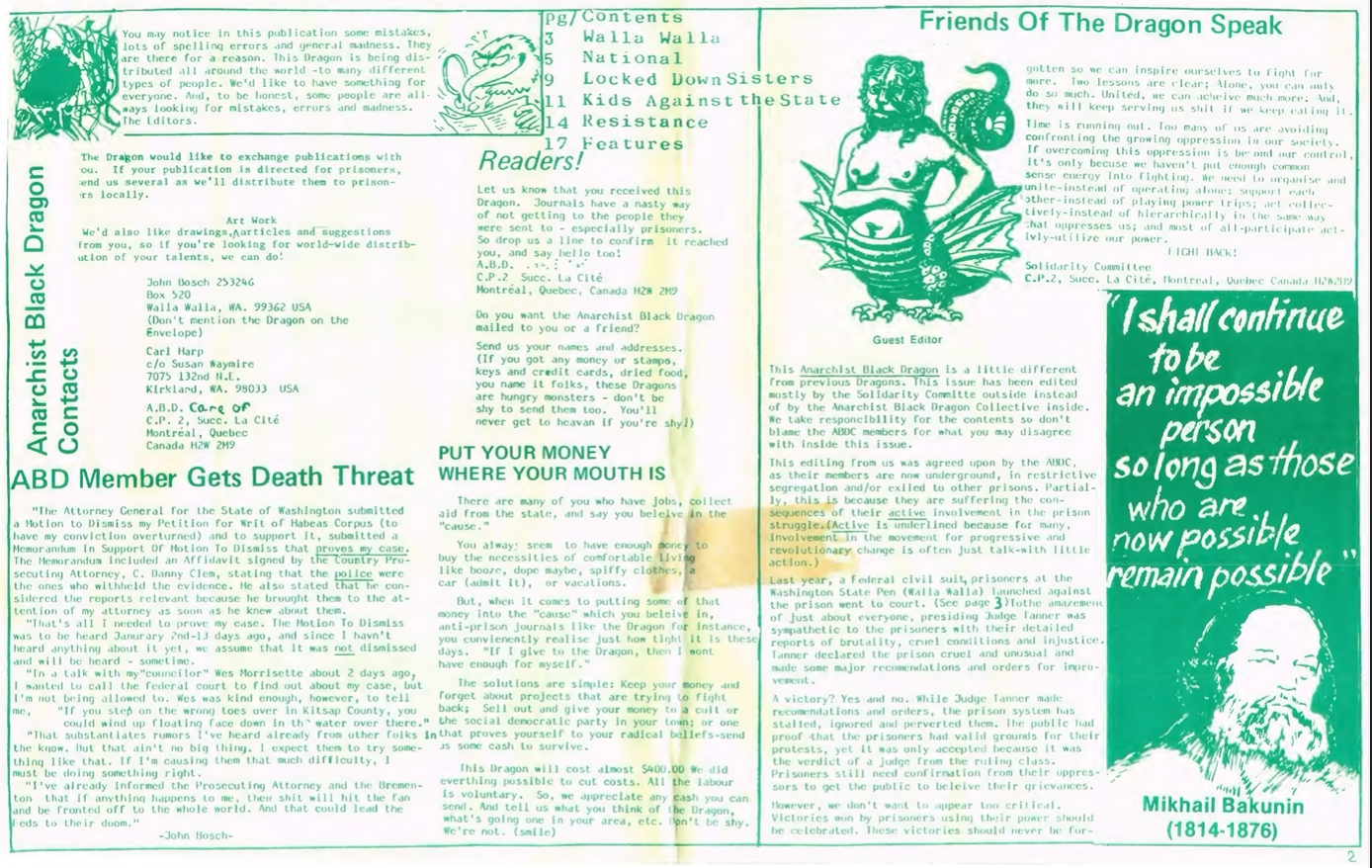
Many, if not most, of these publications were published with official sanction, and these “cover similar ground. They report on prison programing, profile locals of interest, and offer commentary on topics like parole and education” under the watchful gaze of the warden, whose photograph might appear on the masthead. “Incarcerated journalists walk a tightrope between oversight by administrations — even censorship — and seeking to report accurately on their experiences inside,” the collection points out. Prison newspapers gave inmates opportunities to share creative work and hone newly acquired literacy, literary, and legal skills. Those periodicals that circulated underground without the authorities’ permission had no need to equivocate about their politics. Washington State Penitentiary’s Anarchist Black Dragon, for example, took a fiercely radical stance on every page. Nowhere on the masthead will one find the names of correctional officers, or even a list of editors and contributors, or even a masthead.
Whether official, unofficial, or occupying a grey area, prison periodicals all hoped in some degree to “poke holes in the wall,” as Tom Runyon, editor of Iowa State Penitentiary’s Presidio wrote — reaching audiences outside the prison to refute criminological thinking. Arizona State Prison’s The Desert Press, led its January 1934 issue with the pressing headline “Are Convicts People?” (likely after Alice Duer Miller’s satirical 1904 “book of rhymes for suffrage times,” Are Women People?) Lawrence Snow, editor of Kentucky State Penitentiary’s Castle on the Cumberland, picked up the question with more formality in a 1964 column, asking, “How shall [a prison publication] go about its principal job of convincing the casual reader that convicts, although they have divorced themselves temporarily from society, still belong to the human race?” Given that the United States imprisons more people than any other nation in the world, the question seems more pertinent — urgent even — than ever before. Enter the American Prison Newspapers collection here.
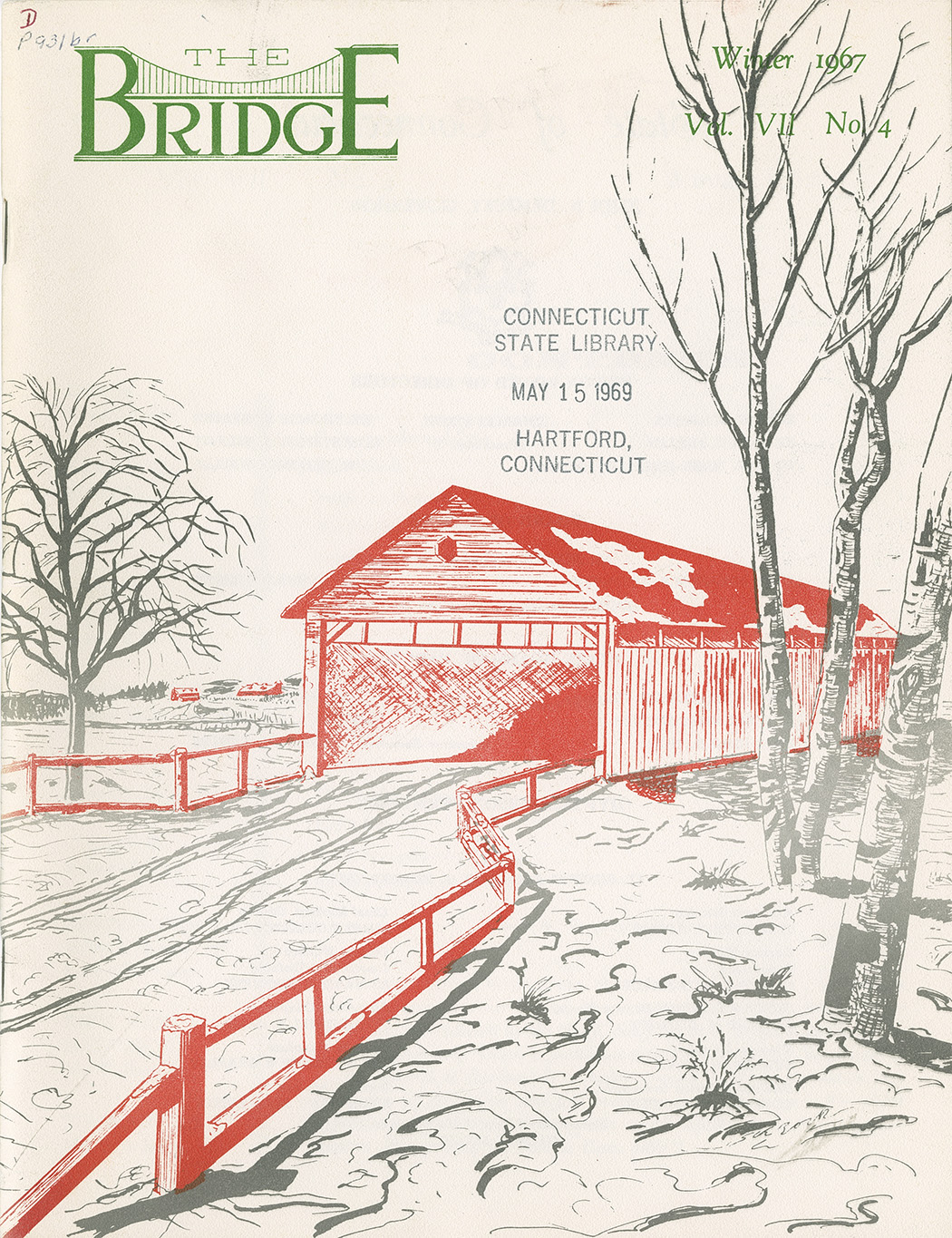
via Kottke
Related Content:
On the Power of Teaching Philosophy in Prisons
Prisons Around the U.S. Are Banning and Restricting Access to Books
Bertrand Russell’s Prison Letters Are Now Digitized & Put Online (1918 – 1961)
Patti Smith Reads from Oscar Wilde’s De Profundis, the Love Letter He Wrote From Prison (1897)
Josh Jones is a writer and musician based in Durham, NC. Follow him at @jdmagness
Read More...How Drummer Moe Tucker Defined the Sound of the Velvet Underground
A high school girl from Levittown, New York, the country’s first suburb, Maureen “Moe” Tucker hardly fit the profile of a rock star in one of the most influential bands of the 1960s. Then again, neither did any of the members of the Velvet Underground. Lou Reed, John Cale, Sterling Morrison, and Tucker had barely begun before Andy Warhol introduced them to Nico and billed them as the Exploding Plastic Inevitable, and it was Warhol who helped turn them into cult heroes. But Tucker made them sound like no one else. “Her style of drumming, that she invented” Reed once remarked, “is amazing. I’ve tried to get a drummer to do what she did and it’s impossible.” Her approach to Reed’s songs was a “mix of African trance rhythms and Ringo-like arrangement genius,” Adam Budofsky writes at Modern Drummer. “Her playing style was hugely responsible for the Velvet’s singular personality.”
Listen, for example, to 1970’s Loaded – which Tucker sat out due to pregnancy — next to The Velvet Underground & Nico, White Light/White Heat, or The Velvet Underground. Loaded, the only Velvet Underground album never to go out of print, may be called by some a “near-perfect rock album,” but it’s also the least experimental and least interesting of the band’s four studio releases, the sound of the band without Cale and Tucker, reaching for radio hits. The Velvet Underground with Moe Tucker, on the other hand, was the sound of a band that was constantly falling apart while rooting down into a primal rock and roll that would outlast them. It’s sublime, and Tucker deserves her reputation as “one of the head hypnotists,” in the words of Jonathan Richman.
Her contribution was as much youthful enthusiasm and nerve as raw talent. Compelled to play the drums by a love for the Rolling Stones, the Beatles, and Nigerian drummer Babatunde Olatunji, she might have banged away in unremarkable Long Island cover bands in her youth, becoming a more traditional player, had not Reed, who knew her brother, given her the chance to play the first paying VU gig at Summit High School in New Jersey. As she remembers it in the punk oral history project Please Kill Me:
I was a nervous wreck when we played that show. We were allowed to play three songs and we had practiced them at John Cale’s loft. We played, “Waiting For the Man,” “Heroin,” and I think the third one was “Venus In Furs.”
Our set was only about 15 minutes at the most and in each song something of mine broke. All my stuff was falling apart! The foot pedal broke in one song, the leg of the floor tom started going loose. I thought, Oh shit, I’m going to ruin this!
Instead of ruin, what followed were more gigs and a period of experimentation in which Tucker, who started with only a snare, tried out different configurations of the drum kit in long jam sessions at Warhol’s Factory: playing her bass drum with mallets on the floor, then on chairs while standing up, eschewing cymbals altogether, making judicious use of tom toms and tambourines, playing a few memorable shows with trashcans when her drums were stolen.… She had no training, no one in the band told her she was doing it wrong, and so she was free to reinvent the drums her way.
As you’ll see in the thorough documentary above, Foundation Velvet, by Cam Forrester, Tucker’s way was exactly what the Velvets needed to recreate rock and roll in their image. She had a “discipline with regards to playing the song, and not the instrument,” Forrester says. You’ll also see him recreate Tucker’s instrumentation. In the timestamps below, click on the demonstrations to see her drum setup for each track on the band’s first three albums.
Quotes/Introduction — 0:00
Background & musical beginnings — 3:50
“Tucker’s sister plays drums?” — 6:14
Andy Warhol, ‘The Factory’, and Nico — 9:07
The ‘Exploding Plastic Inevitable’ Shows — 12:46
A female drummer? — 15:09
‘The Velvet Underground & Nico’ Sessions — 17:38
DRUM DEMONSTRATIONS — 21:22
Goodbye to Nico & Andy…hello to VOLUME! — 25:02
‘White Light/White Heat’ & DRUMMING DEMONSTRATIONS — 28:18
John Cale leaves, and Doug Yule joins — 34:35
The third album & DRUMMING DEMONSTRATIONS — 37:07
‘Loaded’, band breakup, and solo career — 43:09
Moe’s heroic return to the drums — 45:58
Retirement from the music business — 53:48
Influence & legacy — 54:28
“A natural drummer…” — 57:03
One can approximate Tucker’s style and reconstruct her influences, as Forrester has done here brilliantly, but there will never be another drummer like her.
Related Content:
Josh Jones is a writer and musician based in Durham, NC. Follow him at @jdmagness
Read More...What Movies Teach Us About Mozart: Exploring the Cinematic Uses of His Famous Lacrimosa
In the annals of surprisingly impressive IMDb pages, few can surpass that of Wolfgang Amadeus Mozart. Despite having died a century before the birth of cinema, he has racked up and continues to rack up more composer credits each and every year. Many of these owe to the use of one piece, indeed one movement, in particular: the Lacrimosa from his Requiem, which contains the very last notes he ever wrote. “We should probably expect some of these uses to have a somber, funereal quality, and they do,” says Evan Puschak, better known as the Nerdwriter, in the new video essay above. In Amadeus, Miloš Forman’s film about the composer himself, the piece accompanies a sequence showing “Mozart’s dead body being unceremoniously transported and dumped into a mass grave.”
The shortcomings of Mozart’s burial have surely been compensated for by the glories of his legacy. But that legacy includes all manner of uses of the Lacrimosa in film and television, both glorious and inglorious. Given its “sense of both suspense and inevitability, which is a unique and potent combo,” it typically scores scenes of violence and villainy.
“The repeated association of Lacrimosa with evil conditions us to think of evil when we hear it, to the point that filmmakers choose it as a kind of shorthand, drawing on our memories of its past uses.” Eventually this hardened into cinematic convention, ultimately becoming “such a trope that it works brilliantly for parody and satire too,” as in The Big Lebowski’s meeting of its two titular figures. (Note that the music becomes muffled when the Dude leaves the room, implying that Lebowski had actually put it on himself.)
Elsewhere, the Lacrimosa has been marshaled to evoke such emotions as loneliness, desperation, and reckoning — and even, in one of Puschak’s more recent examples, “the immense, unruly power of the social internet.” If such a phenomenon would be difficult to explain to Mozart himself, imagine showing him the television series The Good Fight, where “Lacrimosa amplifies the comedy of a scene in which the lawyers get their hands on Donald Trump’s alleged ‘pee tape.’ ” But Mozart obviously understood full well the underlying artistic principles at work: Amadeus also depicts him composing the Dies Irae, another of the Requiem’s movements, whose melody he adapts from a thirteenth-century Gregorian funeral mass. Even in his time, the music of the past offered a means of heightening the feelings of the present.
Related Content:
Hear All of Mozart in a Free 127-Hour Playlist
Based in Seoul, Colin Marshall writes and broadcasts on cities and culture. His projects include the book The Stateless City: a Walk through 21st-Century Los Angeles and the video series The City in Cinema. Follow him on Twitter at @colinmarshall or on Facebook.
Read More...Watch Paul McCartney Compose The Beatles Classic “Get Back” Out of Thin Air (1969)
In its nearly eight-hour runtime Peter Jackson’s new documentary series The Beatles: Get Back offers numerous minor revelations about the world’s favorite band. Among the filmmaker’s avowed aims was to show that, even on the verge of acrimonious dissolution, John, Paul, George, and Ringo enjoyed stretches of productiveness and conviviality. Much else comes out besides, including that the catering at Apple Corps headquarters was miserable (amounting most days to toast and digestive biscuits) and that, even amid the excesses of the late 1960s, the Beatles dressed more or less respectably (apart, that is, from George’s occasionally outlandish choices of outer- and footwear). But it also lays bare exactly how they created a song.
The Beatles went into these sessions with little material prepared. All they knew for sure was that they had to come up with a set of songs to be recorded live, without overdubs, in order to “get back” to the simplicity that had characterized their process before such aesthetically and technically convoluted albums as Revolver and Sgt. Pepper’s Lonely Hearts Club Band. These they would then perform in a concert film. The whole project was undertaken with what Rolling Stone’s Rob Sheffield calls a “magnificent arrogance. In a way, that’s what helped keep them together, through all their ups and downs. Without that level of arrogance, there’s no way an adventure as admirably daft as Get Back could happen in the first place.”
Somehow, to the very end, that arrogance always proved justified. For much of Jackson’s Get Back, the Beatles appear to be just screwing around, cracking jokes, drinking tea and beer, and launching into abortive performances in cartoon voices. And that’s when everyone shows up. “Lennon’s late again,” says Paul in the clip above. “I’m thinking of getting rid of him.” But instead of nursing resentment for his unpredictable musical partner, he sits down and starts playing. His first chords will sound familiar to any Beatles fan, though they belong to a song that doesn’t yet exist. Paul then adds to his strumming a bit of mostly non-verbal vocalization, which soon coheres into a melodic line: we (and a yawning George) are witness to the birth of “Get Back.”
During the lifetime of the Beatles, Paul seems to have been the most productive member. Even since the band’s end half a century ago, music has continued to flow unimpeded from his mind, shaped as if by pure instinct. In that time it has become ever more well-documented that he motivated the group to work, especially after the death of their manager Brian Epstein in 1967. While Get Back attests to a certain overbearing quality in his attitude toward the other Beatles, it also shows how McCartney’s hardworking-yet-freewheeling example encouraged each of them to express his own particular genius. When George gets stuck on the end of a lyric, for example, he, too, simply sings whatever comes to mind. Hence the temporary line “Something in the way she moves / Attracts me like a pomegranate” — and we all know how that tune eventually turned out.
Related Content:
Chaos & Creation at Abbey Road: Paul McCartney Revisits The Beatles’ Fabled Recording Studio
Based in Seoul, Colin Marshall writes and broadcasts on cities and culture. His projects include the book The Stateless City: a Walk through 21st-Century Los Angeles and the video series The City in Cinema. Follow him on Twitter at @colinmarshall or on Facebook.
Read More...Support Us
We're hoping to rely on loyal readers, rather than erratic ads. Please click the Donate button and support Open Culture. You can use Paypal, Venmo, Patreon, even Crypto! We thank you!

About Us

Open Culture scours the web for the best educational media. We find the free courses and audio books you need, the language lessons & educational videos you want, and plenty of enlightenment in between.
Advertise With Us
FREE UPDATES!
GET OUR DAILY EMAIL
Get the best cultural and educational resources on the web curated for you in a daily email. We never spam. Unsubscribe at any time.
FOLLOW ON SOCIAL MEDIA
Open Culture editor Dan Colman scours the web for the best educational media. He finds the free courses and audio books you need, the language lessons & movies you want, and plenty of enlightenment in between.
Advertise With Us

