The 17th Century Japanese Samurai Who Sailed to Europe, Met the Pope & Became a Roman Citizen
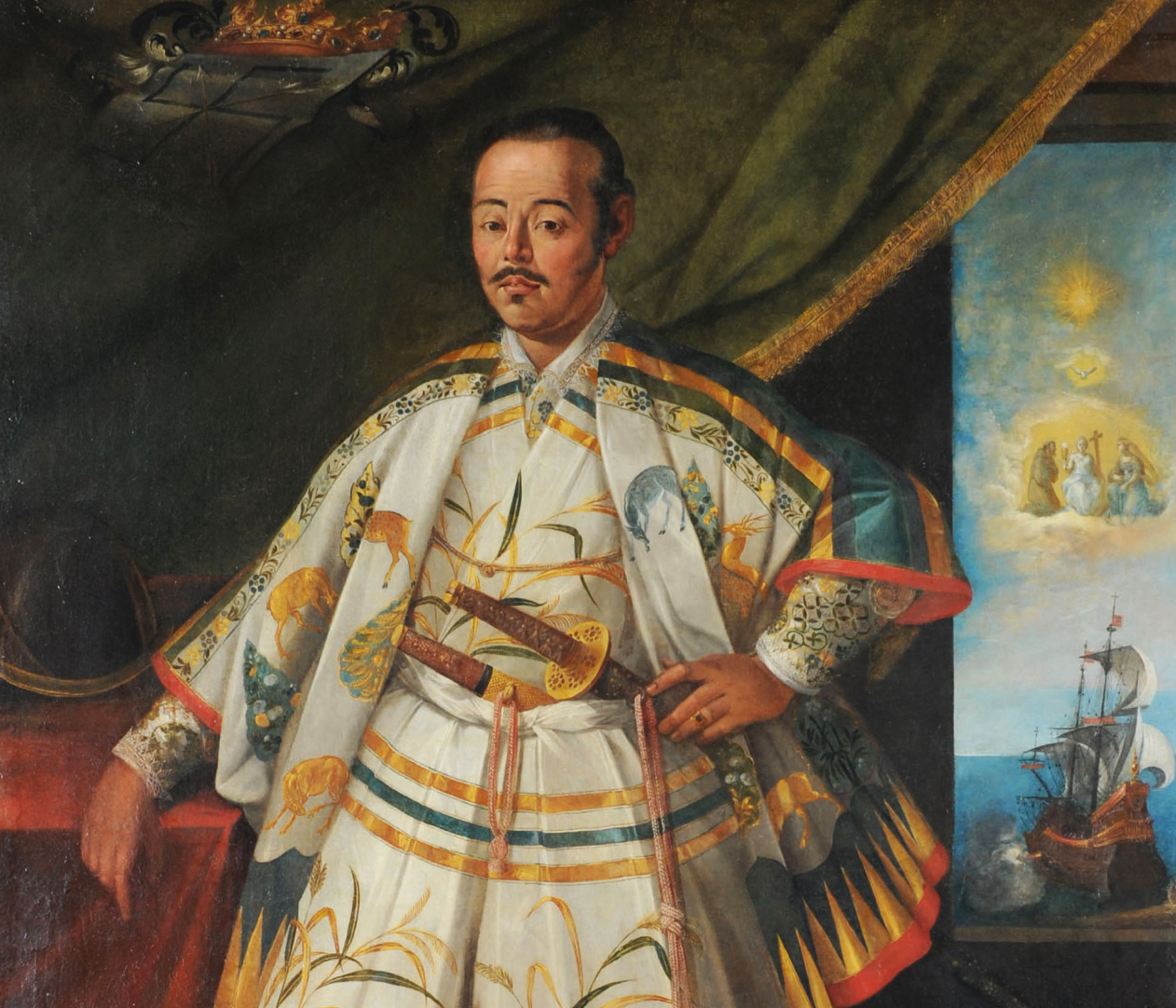
Image via Wikimedia Commons
We learn about intrepid Europeans who sought, and sometimes even found, trade and missionary routes to China and Japan during the centuries of exploration and empire. Rarely, if ever, do we hear about visitors from the East to the West, especially those as well-traveled as 17th-century samurai Hasekura Tsunenaga. Sent on a mission to Europe and America by his feudal lord, Date Masumune, Hasekura “set off on a quest to earn riches and spiritual guidance,” Andrew Milne writes at All that’s Interesting. “He circumnavigated the globe, became part of the first Japanese group in Cuba, met the Pope, helped begin a branch of Japanese settlers in Spain (still thriving today), and even became a Roman citizen.”
Hasekura was a battle-tested samurai who had acted on the daimyo’s behalf on many occasions. His mission to the West, however, was first and foremost a chance to redeem his honor and save his life. In 1612, Hasekura’s father was made to commit seppuku after an indictment for corruption. Stripped of lands and title, Hasekura could only avoid the same fate by going West, and so he did, just a few years before the period of sakoku, or national isolation, began in Japan. Traveling with Spanish missionary Luis Sotelo, Hasekura embarked from the small Japanese port of Tsukinoura in 1613 and first reached Cape Mendocino in California, then part of New Spain.
“Seven years before the Mayflower headed to the New World,” Marcel Theroux writes at The Guardian, Hasekura “crossed the Pacific, traveled overland through Mexico, then sailed all the way to Europe. He was accompanied by about 20 fellow countrymen — in all likelihood, the first Japanese to cross The Atlantic.” They set sail on a Japanese-built galleon — called Date Maru, then later San Juan Bautista by the Spanish. “The expedition spent seven years traveling one-third of the globe,” notes PBS in a description of “A Samurai in the Vatican,” an episode of Secrets of the Dead.
Sotelo and Hasekura made formal requests for more missionaries in Japan, delivering letters from from Hasekura’s lord, the daimyo of Sendai, to the King of Spain and Pope Paul V. But the samurai’s most pressing purpose was the establishment of trade links between Japan, New Spain (Mexico), and Europe. In his 1982 novel, The Samurai, Shusaku Endo dramatized the exchange the Spanish missionaries made for such introductions, having a priest say: “In order to spread God’s teaching in Japan… there is only one possible method. We must cajole them into it. Espana must offer to share its profits from trade on the Pacific with the Japanese in return for sweeping proselytizing privileges. The Japanese will sacrifice anything else for the sake of profits.” This was not to be, of course.
The Spanish gambled on trade opening up Japan for the kind of missionary colonization they had achieved elsewhere, using Hasekura’s mission as a proxy. Hasekura gambled on a Christian mission to save his life. Though his own accounts are lost, it seems he came to genuinely embrace the faith, becoming a confirmed Catholic under the name Philip Francis Faxecura. During his mission, however, the Shogun, Tokugawa Ieyasu, banned Christianity in Japan on penalty of death, in advance of the expulsion of the Spanish and Portuguese by his grandson, Tokugawa Iemitsu, in 1623. What became of the explorer samurai when he returned to Japan in 1620 is unknown, but his decedents were executed for practicing his newfound faith. He would be the last visitor to the West from Japan until the Tokugawa Shogunate sent the so-called “First Japanese Embassy to Europe” in 1862, over 200 years later.
Related Content:
Meet Yasuke, Japan’s First Black Samurai Warrior
Discover Japan’s Oldest Surviving Cookbook Ryori Monogatari (1643)
Josh Jones is a writer and musician based in Durham, NC. Follow him at @jdmagness
Read More...Watch John Cage’s 4′33″ Played by Musicians Around the World
Make sure to watch the video above with the sound on. In it musicians from around the world all play a well-known composition: 4′33″ by John Cage. “I spent weeks asking strangers on the internet to send me their radically different interpretations, and boy did they deliver,” writes the video’s creator Sam Vladimirsky. “My inbox filled with adaptations by an Austrian death metal band, a marimba player, a bunny rabbit, the Museum of Musical Instruments in Phoenix, a middle school music teacher, a version played on Guitar Hero and over Zoom.” Though originally composed for piano, 4′33″ is easily transposed to all these instruments and others, calling as it does for their players to do the very same thing: nothing.
“Inspired by Zen Buddhism, the Dada movement and Cage’s strong distaste for the ubiquitous muzak of the time,” says Aeon, “its score instructs performers not to play their instruments for the piece’s four-minute, thirty-three-second duration.” The result is not silence but “the unique ambient soundscape of the environment in which it’s performed, reflecting Cage’s belief that music is ever-present.”
Here the submitted performances take place in such environments as a classroom, a bedroom, a courtyard, a driveway, a bus, and a subway station. Vladimirsky pairs the videos, allowing us to enjoy not just parallel viewing experiences but a layered listening experience of these ambient soundscapes.
“Stuck inside,” writes Vladimirsky, “professional musicians, dedicated amateurs, awkward teens and college students found 4′33″ to be the music of our moment.” If the Rolling Stones could play “You Can’t Always Get What You Want” in lockdown, each from his separate home, then who’s to say this isn’t the next logical step? Each performance of 4′33″ reflects not just its immediate setting but its cultural period: compare the clip just above, in which Cage himself plays it in Harvard Square in 1973. Most of us haven’t seen the inside of a concert hall in quite some time, let alone heard the ambient sounds produced within it in the absence of proper music. But each of us can, at least, perform 4′33″ for ourselves whenever and wherever we like — one way of doing it being simply to play the video at the top of the post with the sound off.
Related Content:
Watch John Cage Play His “Silent” 4’33” in Harvard Square, Presented by Nam June Paik (1973)
The Curious Score for John Cage’s “Silent” Zen Composition 4’33”
John Cage’s Silent, Avant-Garde Piece 4’33” Gets Covered by a Death Metal Band
The 4’33” App Lets You Create Your Own Version of John Cage’s Classic Work
The Virtual Choir: Watch a Choir Conductor Digitally Unite 3500 Singers from Around the World
How to Find Silence in a Noisy World
Based in Seoul, Colin Marshall writes and broadcasts on cities and culture. His projects include the book The Stateless City: a Walk through 21st-Century Los Angeles and the video series The City in Cinema. Follow him on Twitter at @colinmarshall or on Facebook.
Read More...Watch Hilarious Spoofs of Classic Film Genres: Film Noir, Spaghetti Westerns, Scandinavian Crime Dramas, Time Travel Films & More
Comedian Alasdair Beckett-King has a keen ear for entertainment tropes and subscribes to the belief that “putting too much effort into things makes them funnier.”
The result is a series of one-minute videos in which he spoofs the conventions of a particular genre or long running series, with perfect visuals, meta dialogue, and faithfully rendered performance styles.
Beckett-King put his London Film School training to use with this project during lockdown, spending “absolutely ages putting together something very tiny.”
Witness his take on every episode of Star Trek: The Next Generation, in which the captain of the ship, a Patrick Stewart doppelgänger and “vegetarian space socialist who is always right” negotiates with a “representative of a kind of iffy alien race not necessarily based on a specific human ethnicity.” As Beckett-King told Eric Johnson, host of Follow Friday podcast:
That one was very, very hard work because I had to do a CGI bald cap for myself because I have long, long flowing hair. I had to try and do an impression of Captain Picard of the Starship Enterprise… it’s not that good. There’s so much work that went into it.
Before I posted it, I was convinced I’d wasted my time. Then luckily it did quite well and people really liked it. People kept saying, “When are you doing Captain Picard again?” I’m like, “I’m not! because it took ages to do the bald head, and you’ve seen it now.” I think what’s nice about it though, is you get to try something, commit to it and then see if it’s funny afterwards. It’s quite like doing live standup.
(Beckett-King’s partner Rachel Anne Smith gets credits for the non-CGI costumes.)
Some other favorites:
Every Single Scandinavian Crime Drama: The killer could be anyone in Helgasund. That’s over seven people.
Every Single Spooky Podcast: The frozen soil was littered with what appeared to be discarded Casper mattresses and Bombas socks.
Every Single Spaghetti Western: Yeah, well your lips don’t synch…
Every Haunted House Movie: It’s the perfect place for me to quit drinking, finish my novel, and really come to terms with that deer we hit on the way over.
Every Episode of Popular Time Travel Show: Help us, Doctor. The intransigent Implacablons are poised to destroy us.
How Every Film Noir Ends: Talk your way out of a snub nosed pistol held at waist height.
Should you find yourself at loose ends, waiting for the next Beckett-King “every single…” episode to drop, try biding your time with his Art House Movie Spoilers and North East of England spin on Jaws.
Buy a Coffee for Alasdair Beckett-King here.
Related Content:
Download a Complete, Cover-to-Cover Parody of The New Yorker: 80 Pages of Fine Satire
The Time When National Lampoon Parodied Mad Magazine: A Satire of Satire (1971)
Ayun Halliday is the Chief Primaologist of the East Village Inky zine and author, most recently, of Creative, Not Famous: The Small Potato Manifesto. Follow her @AyunHalliday.
Read More...Dueling as a Film Trope: Pretty Much Pop #109 Considers The Last Duel and Its Genre

In light of the release of The Last Duel (which you needn’t have watched), we talk about the trope of the honor-resolving duel in movies and TV. Mark and guest co-host Dylan Casey of The Partially Examined Life are joined by Clif Mark, host of the Good in Theory podcast who wrote his political thesis and a 2018 Aeon article on the history and logic of dueling.
Since we’re all philosophy podcasters on this one (our entertainment podcaster guest dropped out at the last minute), we bring in philosophers like Hegel and Nietzsche in as needed, the circle of ethical concern (who gets moral status and so is worthy to duel?), and of course the relevant class and gender critiques.
We also touch on The Duelists (incidentally, Ridley Scott’s directing debut, where The Last Duel is his latest), The Duelist and The Duel (two 2016 films), A Knight’s Tale, The Princess Bride, Dune, Hamilton, Bridgerton, The Karate Kid, and more.
For more information on the specter of dueling in politics, read about Justin Trudeau and Trump/Biden.
Some articles that fed our discussion (in addition to Clif’s “What Is Offensive”) include:
- “The Last Duel: Cinema’s 11 Best Showdowns” by Nicholas Barber
- “‘The Last Duel’ Is More Than Just Unsuccessful Oscar Bait” by Adam Nayman
- “The True History Behind ‘The Last Duel’” by Meilan Solly
- “Duelling Films” by Howard G. Brown
Follow Clif @Clifton_Mark.
This episode includes bonus discussion you can access by supporting the podcast at patreon.com/prettymuchpop or by choosing a paid subscription through Apple Podcasts. This podcast is part of the Partially Examined Life podcast network.
Pretty Much Pop: A Culture Podcast is the first podcast curated by Open Culture. Browse all Pretty Much Pop posts.
Read More...Elvis Costello’s Musician Father (and Doppelgänger) Performing in 1963
If you were an English boy growing up in the 1960s, and your dad met the Queen mum, you’d come away with some pretty heavy duty bragging rights.
What if your dad didn’t just meet her, but commanded her attention for a full three minutes… an event you witnessed on the telly, along with 21.2 million others?
That’s what happened to young Declan Patrick McManus, or Elvis Costello as he’s more commonly known these days.
Unfortunately, his musician father Ross’s calypso-inflected, Trini Lopez-inspired rendition of Pete Seeger’s “If I Had a Hammer” at the Queen’s annual Royal Variety Performance was overshadowed by another act in the evening’s line up: The Beatles.
This was the performance where John Lennon famously solicited the audience’s participation on “Twist and Shout”:
For our last number, I’d like to ask your help. The people in the cheaper seats, clap your hands. And the rest of you, if you’d just rattle your jewelry.
https://vimeo.com/151903948?embedded=true&source=video_title&owner=47853706
So, Ross McManus played for the Queen Mum (and Princess Margaret) and all little Declan got was a great anecdote for his 2016 memoir Unfaithful Music & Disappearing Ink and a thoughtful souvenir:
Eventually I couldn’t pretend that I really cared whether he’d… shaken hands with the Queen Mum. I blurted out:
“Did you actually meet The Beatles?”
It had obviously been a long night or an early morning, as my Dad wasn’t that talkative. He mumbled something about them being very nice lads. Then he reached into a jacket slung over the back of his chair and pulled out a sheet of thin airmail paper and handed it to me.
I unfolded it, and there were the signatures of all four of The Beatles on one page. I’d seen reproductions of their signatures in enough magazines and fan club literature to know that these appeared to be the real thing.
The ink seemed barely dry.
What I did next will bring tears to the eyes of those who make a fetish of such objects, but I had only a small autograph book and the paper was too large to be mounted in it.
I carefully, if not so very carefully, cut around each of the signatures, lopping off the e of the “The” in “The Beatles” and pasting the four irregular scraps of paper into my album.
McManus the Elder took another crack at “If I Had a Hammer” when he and other members of the Joe Loss Orchestra were invited to reprise their royal performance in the 1965 short The Mood Man, excerpted at the top of this page.
Clearly, the acorn didn’t fall far from this tree!
Father and son seem more like twins here:
the horn-rimmed specs…
The vibrato…
That vintage style!
(Speaking of which, Costello confides that his father was obliged to wear long johns under his off-white suit “after the television director claimed that his flesh could be detected through the thin material … under the television lights, which would be bound to scandalize the royal party.”)
The two also shared a willingness to experiment with assumed names. Ross McManus found success in Australia with a cover of The Beatles’ “The Long and Winding Road” as “Day Costello” — surname compliments of his grandmother’s maiden name. (Other handles include “Hal Prince” and “Frank Bacon and the Baconeers.”)
Elvis Costello spent enough time in his old man’s orbit to recognize the disembodied hands playing the conga drums in the opening shot shot of McManus’s “If I Had a Hammer“ — Bill Brown’s, taking a bit of a busman’s holiday from the baritone saxophone.
And he acknowledges his own persona’s debt to his dad, citing the section where he “lip-synchs the hell out of the number, miming ‘hammer of justice’ for all it’s worth”:
The close-ups that come on the repeated line, “It’s a song about love between my brothers and my sisters” are eerie to behold for the similarity of our facial expression at about this age, and especially when singing particular words.
Where my Dad holds the advantage over me is in his dance moves.
Those are steps that I am yet to master.
Costello also notes that his father gave him a bit of a professional leg up in 1973, when he got him hired for backing vocals on a musical ad for R. Whites Lemonade:
For some reason, the producer asked my Dad to deliver the song in a mock Elvis Presley voice, while for the background part, they wanted “R. Whites” punched out so that it sounded like the “All right” on a Swinging Blue Jeans record. I suppose the advertising people thought the kids would dig it… given that my Dad and I could easily approximate a suitably nasal Mersey sound, we cut the parts in a couple of takes. It wasn’t exactly the big time, but there was still a thrill to hearing your voice come back off the tape, even if you were singing something farcical.
The ad made a lasting impression. If there’s a club for British people who watched TV in the 70’s “secret lemonade drinker” may well be the password. (Costello, understandably, was not pleased when a tabloid’s brass decided it made a fitting headline for his talented, well-known father’s obituary: “Secret Lemonade Drinker Dies.”)
The first Secret Lemonade Drinker ad’s popularity justified various sequels over the years, particularly when fans got hip to the 19-year-old Costello’s involvement.
He was, in fact, more involved than many would realize.
As he recalls in his memoir, the original recording session turned into an impromptu casting session for an alternate, albeit far harder to find online, take:
The ad men took a look around the studio and decided to cast this second version of the commercial from the musicians on the session. The drummer and hippie guitar player certainly looked the part, but the pianist and bass player were older more conservatively dressed and didn’t really fit the bill. Given our then more fashionable hairstyles, my Dad and I were recruited to mime the keyboard and bass parts, and we spent the day taking and retaking the thirty second clip, lip-synching the “R. Whites / All right” background part with as much animation as we could manage by take forty six.
Behold!
Costello’s relationship with his father — also the only son of a musician — is a prime topic of his 688-page memoir.
It’s not only easy, but worthwhile, to truffle up online evidence of Ross’s recording career. There’s even a rare, early 80s duet between father and son…
For some intel on Costello’s mother Lilian’s influence, read his moving tribute from earlier this year, written shortly after her death.
h/t to reader Greg Kotis.
Related Content:
See the First Ever Video of Elvis Costello Performing, Summer 1974
The Stunt That Got Elvis Costello Banned From Saturday Night Live (1977)
Elvis Costello’s List of 500 Albums That Will Improve Your Life
Ayun Halliday is the Chief Primaologist of the East Village Inky zine and author, most recently, of Creative, Not Famous: The Small Potato Manifesto. Follow her @AyunHalliday.
Read More...The Gift: The Journey of Johnny Cash
YouTube Originals presents The Gift: The Journey of Johnny Cash:
Johnny Cash stands among the giants of 20th century American life. But his story remains tangled in mystery and myth. This documentary, created with the full cooperation of the Cash estate and rich in recently discovered archival materials, brings Cash the man out from behind the legend. Taking the remarkable Folsom Prison recording as a central motif and featuring interviews with family and celebrated collaborators, the film explores the artistic victories, the personal tragedies, the struggles with addiction, and the spiritual pursuits that colored Johnny Cash’s life.
The Gift: The Journey of Johnny Cash will be added to our list of Free Documentaries, a subset of our collection, 4,000+ Free Movies Online: Great Classics, Indies, Noir, Westerns, Documentaries & More. Enjoy!
If you would like to support the mission of Open Culture, consider making a donation to our site. It’s hard to rely 100% on ads, and your contributions will help us continue providing the best free cultural and educational materials to learners everywhere. You can contribute through PayPal, Patreon, and Venmo (@openculture). Thanks!
Related Content
Johnny Cash’s Short and Personal To-Do List
Tom Petty, Somewhere You Feel Free – The Making of Wildflowers Is Streaming Free on YouTube
Johnny Cash Stars as a Menacing, Musical Gangster in 1961 Film Five Minutes to Live
Read More...8 Hours of David Bowie’s Historic 1980 Floor Show: Complete & Uncut Footage
Bowie completists rejoice. Eight hours of footage from his 1973 television program “The 1980 Floor Show,” have found their way to YouTube, including, Boing Boing notes, “uncut footage… multiple takes, backstage moments, and all of the dance rehearsals.” The show — actually an episode of the NBC series The Midnight Special curated by Bowie — lived up to its title (itself a pun on “1984,” the opening song of the broadcast), with elaborate dance numbers, major costume changes, and several guest performers: The Troggs, Amanda Lear, Carmen, and — most importantly — Marianne Faithfull, in career free-fall at the time but also in top form for this cabaret-style variety show.
When Midnight Special producer Burt Sugarman approached Bowie about doing the hour-long show, the singer agreed on the condition that he could have complete creative control. He chose to hold rehearsals and performances at London’s Marquee Club. The audience consisted of 200 young fans drawn from the Bowie fan club. Faithfull was “actually invited as one of the reserve acts,” notes Jack Whatley at Far Out, “ready to be called upon should someone else drop out.”
“The show was heavily advertised in the US press in the run up to the broadcast,” noted Bowie 75 in 2018, “but has never been shown outside the US or officially released,” though bootlegs circulated for years. Shooting took place over three days in late October, just a few months after Bowie played his final show as Ziggy Stardust at the Hammersmith Odeon Theatre, cryptically announcing at the end, “not only is it the last show of the tour, it’s the last show we’ll ever do.” Bowie then went on to release Aladdin Sane and his covers record Pin-Ups the following year, dropping the Ziggy character entirely.
But Bowie brought Ziggy back, at least in costume, for one last gig in “The 1980 Floor Show,” wearing some of the outfits Kansai Yamamoto designed for the Ziggy Stardust tours and still sporting the signature spiked red mullet he would continue to wear as his dystopian Halloween Jack persona on 1974’s Diamond Dogs. “The 1980 Floor Show” promoted songs from Aladdin Sane and Pin-Ups while visually representing the transition from Bowie’s space alien visitor persona to a different kind of outsider — an alien in exile, just like the character he played a few years later in Nicholas Roeg’s The Man Who Fell to Earth. As Maria Matheos writes at Hasta:
Ziggy no longer played guitar: Bowie had metamorphosed into Aladdin Sane. Parading across the stage in red platform boots and a patent-leather black and white balloon leg jumpsuit, referred to by designer Yamamoto as the ‘Tokyo pop’ jumpsuit, Bowie sought to assault the senses of his audience. Completely over the top? Yes. Verging on a parody of excess? Possibly. Would he have wanted us to take him seriously? He certainly did not (take himself seriously).
With Aladdin Sane, Bowie gave us a hyperbolic extension of his prior alien doppelganger; adding that his character, a pun on ‘A Lad Insane’, represented “Ziggy under the influence of America.”
See how Bowie constructed that new, and short-lived, persona from the materials of his former glam superstar character, and see the revelation that was Marianne Faithfull. The singer performed her 1964 hit, written by The Rolling Stones, “As Tears Go By,” solo. But the highlight of the show, and of her mid-seventies period, was the duet of Sonny & Cher’s “I Got You Babe” with which she and Bowie closed the show. “The costumes of the pair are magical.” Whatley writes,” with Bowie “in full Ziggy attire… aka his ‘Angel of Death’ costume—while Faithfull has on a nun’s habit that was open at the back.”
Bowie reportedly introduced the song with the tossed-off line, “This isn’t anything serious, it’s just a bit of fun. We’ve hardly even rehearsed it.” You can scroll through the 8 hours of footage at the top to see those rehearsals, and so many more previously unavailable Bowie moments caught on film.
via Boing Boing
Related Content:
Bowie’s Bookshelf: A New Essay Collection on The 100 Books That Changed David Bowie’s Life
David Bowie Became Ziggy Stardust 48 Years Ago This Week: Watch Original Footage
David Bowie’s Final Gig as Ziggy Stardust Documented in 1973 Concert Film
David Bowie on Why It’s Crazy to Make Art–and We Do It Anyway (1998)
Josh Jones is a writer and musician based in Durham, NC. Follow him at @jdmagness
Read More...
The Mystery of Who Played Bass on The White Album’s “While My Guitar Gently Weeps”
George Harrison, the quiet Beatle, was the first to break out on his own in 1970 with his glorious triple album All Things Must Pass. “Garbo talks! — Harrison is free!” wrote Melody Maker’s Richard Williams in a review, a reference to the reclusive silent film star who, like the Beatles’ guitarist, kept her mystique and star power even after fans first heard her voice. Harrison’s revelation couldn’t have been as dramatic as all that.
Surely, no fan of “Taxman,” “Within You Without You,” “Here Comes the Sun,” “Something” — and especially The White Album’s stunning “While My Guitar Gently Sleeps” — doubted that George had it in him all along. But the other Beatles would only humor him during The White Album sessions. That is, until he brought Eric Clapton into the studio. “That then made everyone act better,” Harrison remembers in Anthology. “Paul got on the piano and played a nice intro and they all took it more seriously.”
The question in the You Can’t Unhear This video above is whether Paul played bass on the final studio recording and, if not, who did? It’s an integral part of the song’s feel — the gritty, restrained growl, slowly growing in intensity until it sounds like it might give Harrison’s guitar something else to weep about. The mystery of the aggressive-yet-muted part “has perplexed scholars and Beatles fans for decades.” If you’ve remained unperplexed, you might find yourself questioning assumptions about this most beloved of Beatles’ tunes.
Sessions for the song began in late July of 1968, then picked up again in August, but Harrison decided to scrap everything and start over in September once Ringo returned from a “self-imposed exile” in the Mediterranean. The band seemed refreshed: “the quality of the performances on the new September version seemed to reflect that renewed spirit.” Sessions for the track wrapped on September 24. “For many years it was believed that this was the recording session in which Eric Clapton overdubbed his lead guitar solo,” writes the Beatles Bible. Not so — Clapton sat in on all of the live takes recorded with the band. Ah, but who played bass? See the mystery take shape above and post your theories below.
Related Content:
Hear the Beautiful Isolated Vocal Harmonies from the Beatles’ “Something”
Josh Jones is a writer and musician based in Durham, NC. Follow him at @jdmagness
Read More...What Is Sun Tzu’s The Art of War About?: A Short Introduction
After wars in Japan and Vietnam, the U.S. military became quite keen on a slim volume of ancient Chinese literature known as The Art of War by a supposedly historical general named Sun Tzu. This book became required reading at military academies and a favorite of law enforcement, and has formed a basis for strategy in modern wartime — as in the so-called “Shock and Awe” campaigns in Iraq. But some have argued that the Western adoption of this text — widely read across East Asia for centuries — neglects the crucial context of the culture that produced it.
Despite historical claims that Sun Tzu served as a general during the Spring and Autumn period, scholars have mostly doubted this history and date the composition of the book to the Warring States period (circa 475–221 B.C.E.) that preceded the first empire, a time in which a few rapacious states gobbled up their smaller neighbors and constantly fought each other.
“Occasionally the rulers managed to arrange recesses from the endemic wars,” translator Samuel B. Griffith notes. Nonetheless, “it is extremely unlikely that many generals died in bed during the hundred and fifty years between 450 and 300 B.C.”
The author of The Art of War was possibly a general, or one of the many military strategists for hire at the time, or as some scholars believe, a compiler of an older oral tradition. In any case, constant warfare was the norm at the time of the book’s composition. This tactical guide differs from other such guides, and from those that came before it. Rather than counseling divination or the study of ancient authorities, Sun Tzu’s advice is purely practical and of-the-moment, requiring a thorough knowledge of the situation, the enemy, and oneself. Such knowledge is not easily acquired. Without it, defeat or disaster are nearly certain:
If you know the enemy and know yourself, you need not fear the result of a hundred battles. If you know yourself but not the enemy, for every victory gained you will also suffer a defeat. If you know neither the enemy nor yourself, you will succumb in every battle.
The kind of knowledge Sun Tzu recommends is practical intelligence about troop deployments, food supplies, etcetera. It is also knowledge of the Tao — in this case, the general moral principle and its realization through the sovereign. In a time of Warring States, Sun Tzu recognized that knowledge of warfare was “a matter of vital importance”; and that states should undertake it as little as possible.
“To subdue the enemy without fighting is the acme of skill,” The Art of War famously advises. Diplomacy, deception, and indirection are all preferable to the material waste and loss of life in war, not to mention the high odds of defeat if one goes into battle unprepared. “The ideal strategy of restraint, of winning without fighting… is characteristic of Taoism,” writes Rochelle Kaplan. “Both The Art of War and the Tao Te Ching were designed to help rulers and their assistants achieve victory and clarity,” and “each of them may be viewed as anti-war tracts.”
Read a full translation of The Art of War by Lionel Giles, in several formats online here, and just above, hear the same translation read aloud.
Related Content:
Life-Changing Books: Your Picks
“The Philosophy of “Flow”: A Brief Introduction to Taoism
When Sci-Fi Legend Ursula K. Le Guin Translated the Chinese Classic, the Tao Te Ching
Josh Jones is a writer and musician based in Durham, NC. Follow him at @jdmagness
Read More...Life Magazine Predicts in 1914 How People Would Dress in the 1950s
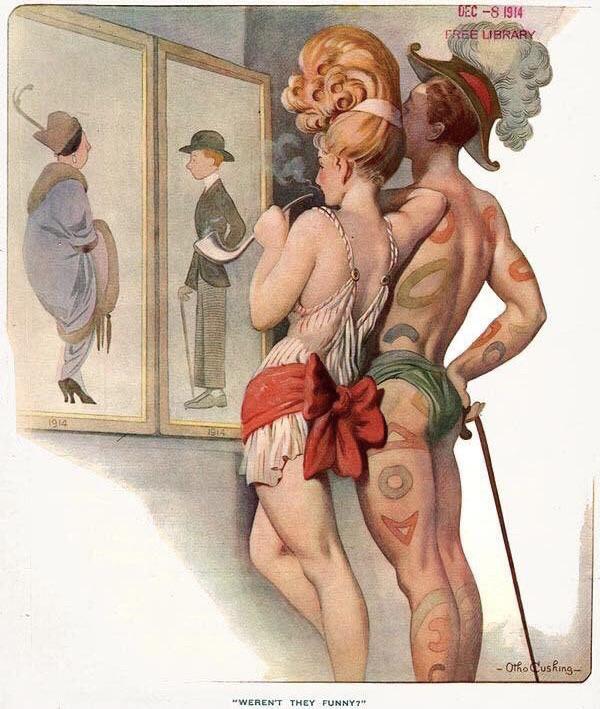
Though still just within living memory, 1950 now seems as if it belongs not just to the past but to a wholly bygone reality. Yet that year once stood for the future: that is to say, a time both distant enough to fire up the imagination and near enough to instill a sense of trepidation. It must have felt that way, at least, to the subscribers of Life magazine in December of 1914, when they opened an issue of that magazine dedicated in part to predicting the state of humanity 36 years hence. Its bold cover depicts a man and woman of the 1950s amusedly regarding pictures of a man and woman in 1914: the latter wear buttoned-up European street clothing, while the former have on almost nothing at all.
As rendered by illustrator Otho Cushing, the thoroughly modern 1950s female wears a kind of slip, something like a garment from ancient Greece updated by abbreviation. Her male counterpart takes his inspiration from an even earlier stage of civilization, his loincloth covering as few as possible of the abstract patterns painted or tattooed all over his body. (About his choice to top it all off with a plumed helmet, an entire PhD thesis could surely be written.)
Any credible vision of the future must draw inspiration from the past, and Cushing’s interests equipped him well for the task: 28 years later, his New York Times obituary would refer to his early specialization in depicting “handsome young men and women in Greek or modern costumes.”
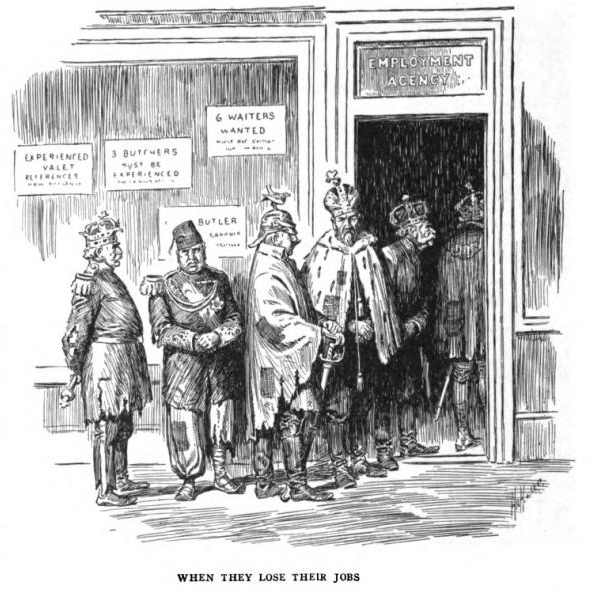
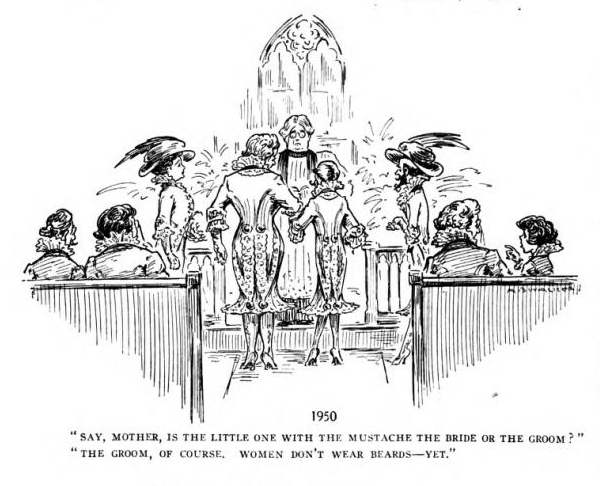
Even though fashions have yet to make a return to antiquity, how many outfits on the street of any major city today would scandalize the average Life reader of 1914? Of course, the cover is essentially a gag, as is much of the ostensible prognostication inside. As circulated again not long ago in a tweet thread by Andy Machals, it foresees monarchs in the unemployment line, boys’ jobs taken by girls, women acquiring harems of men, and the near-extinction of marriage. But some predictions, like 30 miles per hour becoming a slow enough driving speed to be ticketable, have come true. Another piece imagines people of the 1950s hiring musicians to accompany them throughout each phase of the day. Few of us do that even in the 2020s, but living our digitally soundtracked lives, we may still wonder how our early 20th-century ancestors managed: “Between meals they listened to almost absolutely nothing.”
via Messy Nessy
Related Content:
Author Imagines in 1893 the Fashions That Would Appear Over the Next 100 Years
Fashion Designers in 1939 Predict How People Would Dress in the Year 2000
In 1900, Ladies’ Home Journal Publishes 28 Predictions for the Year 2000
How French Artists in 1899 Envisioned Life in the Year 2000: Drawing the Future
Based in Seoul, Colin Marshall writes and broadcasts on cities, language, and culture. His projects include the Substack newsletter Books on Cities, the book The Stateless City: a Walk through 21st-Century Los Angeles and the video series The City in Cinema. Follow him on Twitter at @colinmarshall or on Facebook.
Read More...Support Us
We're hoping to rely on loyal readers, rather than erratic ads. Please click the Donate button and support Open Culture. You can use Paypal, Venmo, Patreon, even Crypto! We thank you!

About Us

Open Culture scours the web for the best educational media. We find the free courses and audio books you need, the language lessons & educational videos you want, and plenty of enlightenment in between.
Advertise With Us
FREE UPDATES!
GET OUR DAILY EMAIL
Get the best cultural and educational resources on the web curated for you in a daily email. We never spam. Unsubscribe at any time.
FOLLOW ON SOCIAL MEDIA
Open Culture editor Dan Colman scours the web for the best educational media. He finds the free courses and audio books you need, the language lessons & movies you want, and plenty of enlightenment in between.
Advertise With Us


