Watch a 106-Year-Old Wizard of Oz Book Get Magically Restored … By Cutting the Book’s Spine, Washing Pages & Recoloring Illustrations
Author, educator and book restoration expert Sophia Bogle is in a constant race against time. Her mission: to rescue and restore ill-treated books before their lamentable conditions can consign them to the landfill.
To the untrained eye, many of these volumes appear beyond repair, but Bogle has nerves of steel, preternatural patience, surgical precision, and over thirty years of experience.
In the Wired video above, she uses a 106-year-old first edition of Frank L. Baum’s The Lost Princess of Oz to demonstrate some of the steps of her craft — from cutting open an old book’s spine and washing dirty pages to repairing tears and recoloring illustrations.
Prior to taking the final step, she scrawls a hidden message on the backing material of the spine:
I do love the fact that there’s the story in the book, there’s the story of the restoration of the book, there’s the story of who has owned the book and now, I’m just in there just a little bit more.
This playful bit of hard-won license is a far cry from some shady restoration practices she mentions in an interview on the Welcome to Literary Ashland blog, in an attempt to arm the general public with tools for spotting potential fraud:
I am not sure that there is anything in the world that cannot be twisted with evil intent…Swapping out pages with publishers information in order to make the book appear to be a more valuable edition. Scratching out/removing numbers or words for the same purpose. And lastly, swapping out pages to insert the author’s signature. None of those things can be done without intent to defraud and it is the intent that matters most.
Bogle plies her trade using all sorts of specialized professional equipment — two sewing frames, a job backer, a gold finishing stove, a nipping press, a Kwikprint stamping machine and drawers full of stamps and dies — but she also offers free and low-cost virtual book repair courses to those whose binderies have yet to be established.
One reward for Kickstarter backers who helped her publish Book Restoration Unveiled: An Essential Guide for Bibliophiles was a bind-it-yourself printable pdf of the book.
Reattaching a paperback’s cover or deodorizing a musty old book may represent the extent of your hands on impulse.
Book lovers who have both the time and the temperament for bookbinding, as well as Bogle’s passion for preserving culture one book at a time, might consider applying for a Save Your Books scholarship.
See more of Sophia Bogle’s book restorations on her Save Your Books YouTube channel.
Related Content
How to Rescue a Wet, Damaged Book: A Handy Visual Primer
How Obsessive Artists Colorize Old Photographs & Restore the True Colors of the Past
The Art of Restoring a 400-Year-Old Painting: A Five-Minute Primer
Watch the Painstaking and Nerve-Racking Process of Restoring a Drawing by Michelangelo
– Ayun Halliday is the Chief Primatologist of the East Village Inky zine and author, most recently, of Creative, Not Famous: The Small Potato Manifesto and Creative, Not Famous Activity Book. Follow her @AyunHalliday.
Read More...Hear the Dying Whistled Language of Laos, Featured in a New Short Film, “Birdsong”
Even by the standards of southeast Asia, Laos is a linguistically interesting place. As a former French colony, it remains part of la Francophonie, yet ironically, French is not its lingua franca; that would be Lao, spoken natively by just over half the population (as well, in another dialect, by many more Thais on the other side of the western border). And that doesn’t even get into the 90 other tongues spoken in the various regions of Laos, many of which sound nothing like the major languages in use. Venture far from Vientiane, up into the country’s northern highlands, and you’ll even hear a language composed entirely of whistles.
You’ll hear it if you’re lucky, anyway. As conveyed in Omi Zola Gupta and Sparsh Ahuja’s short documentary Birdsong, this language has precious few remaining native speakers — or, in the case of one artisan who communicates through a kind of traditional bamboo bagpipe called the qeej, players. They hail from Long Lan, a village inhabited by the Hmong people (who in the United States became known as an immigrant group thanks to Clint Eastwood’s film Gran Torino).
“Hmong people are romantics because we live in the mountains, surrounded by the sounds of the birds and the rodents, the winds and meadows of flowers,” says one of them. “The insects and birds are still singing in the forest,” adds another, “but we don’t hear them in the city anymore. And without the birds, how can we tell the seasons?”
Like other whistled languages (including the Oaxacan, Turkish, and Canarian ones we’ve previously featured here on Open Culture), that used by the villagers of Long Lan does not belong to the urban world. As Laura Spinney writes in the Guardian, some 80 such languages still exist in total, “on every inhabited continent, usually where traditional rural lifestyles persist, and in places where the terrain makes long-distance communication both difficult and necessary — high mountains, for example, or dense forest.” Though all of them are now endangered, “whistled languages have come into their own in surprising ways in the past. They have often flourished when there has been a need for secrecy,” as when Papua New Guineans used theirs to evade Japanese surveillance in World War II — or, as one of Birdsong’s interviewees remembers, when he had things to say meant for his girlfriend’s ears alone.
Related content:
Speaking in Whistles: The Whistled Language of Oaxaca, Mexico
Discover the Disappearing Turkish Language That is Whistled, Not Spoken
How Languages Evolve: Explained in a Winning TED-Ed Animation
The Rarest Sounds Across All Human Languages: Learn What They Are, and How to Say Them
Based in Seoul, Colin Marshall writes and broadcasts on cities, language, and culture. His projects include the Substack newsletter Books on Cities, the book The Stateless City: a Walk through 21st-Century Los Angeles and the video series The City in Cinema. Follow him on Twitter at @colinmarshall or on Facebook.
Read More...Why Caspar David Friedrich’s Painting Wanderer Above the Sea of Fog (1818) Is a Romantic Masterpiece, Evoking the Power of the Sublime
When Caspar David Friedrich completed Der Wanderer über dem Nebelmeer, or Wanderer Above the Sea of Fog, in 1818, it “was not well received.” So says gallerist-Youtuber James Payne in his new Great Art Explained video above, which focuses on Friedrich’s most famous painting. In the artist’s lifetime, the Wanderer in fact “marked the gradual decline of Friedrich’s fortunes.” He withdrew from society, and in 1835, “he suffered a stroke that left the left side of his body effectively paralyzed, effectively ending his career.” How, over the centuries since, did this once-ill-fated painting become so iconic that many of us now see it referenced every few weeks?
Friedrich had known popular and critical scorn before. His first major commission, painted in 1808, was “an altarpiece which shows a cross in profile at the top of a mountain, alone and surrounded by pine trees. Hard for us to understand now, but it caused a huge scandal.” This owed in part to the lack of traditional perspective in its composition, which presaged the feeling of boundlessness — overlaid with “rolling mists and fogs” — that would characterize his later work. But more to the point, “landscape had never been considered a suitable genre for overtly religious themes. And of course, normally the crucifixion is shown as a human narrative populated by human figures, not Christ dying alone.”
It’s fair to say that Friedrich did not do things normally, both philosophically — breaking away, with his fellow Romanticists, from the mechanistic Enlightenment consensus about the world — and aesthetically. The Wanderer (further analyzed in the Nerdwriter video just below) presents a Weltanschauung in which “landscape was a representation of a divine world order, and man was an individual who watches, contemplates, and feels much more than he calculates and thinks.” To achieve his desired effect, Friedrich assembles an imagined vista out of various elements seen around Dresden, presenting it in a manner that combines characteristics of both landscapes and portraits to “create a powerful sense of space” while directing our attention to the lone unidentified figure right in the center.
The “curious combination of loneliness and empowerment” that results is key to understanding not just the priorities of the Romantics, but the very nature of the aesthetic sublime they reverently expressed. To be sublime is not just to be beautiful or pleasurable, but also to exude a kind of intimidating, even fearsome vastness; how it feels to enter the presence of the sublime can never be fully replicated, let alone explained, but as Friedrich demonstrates, it can effectively be evoked. Hence, as Payne points out, the tendency of current media like movie posters to crib from the Wanderer, in service of the likes of Dunkirk, Oblivion, Into Darkness, and After Earth. Determining whether those pictures live up to the ambitions evident in Friedrich’s artistic legacy is an exercise left to the reader.
Related content:
An Introduction to the Painting of Caspar David Friedrich, Romanticism & the Sublime
The Otherworldly Art of William Blake: An Introduction to the Visionary Poet and Painter
How the Avant-Garde Art of Gustav Klimt Got Perversely Appropriated by the Nazis
Brian Eno on Creating Music and Art As Imaginary Landscapes (1989)
Based in Seoul, Colin Marshall writes and broadcasts on cities, language, and culture. His projects include the Substack newsletter Books on Cities, the book The Stateless City: a Walk through 21st-Century Los Angeles and the video series The City in Cinema. Follow him on Twitter at @colinmarshall or on Facebook.
Read More...How This Chicago Skyscraper Barely Touches the Ground
The very first skyscraper went up in 1885 in Chicago. It’s only natural that such a brazenly ambitious form of building would spring forth (or rather, up) from not just the United States of America, but from that most aesthetically American of all metropolises. And though nearly every world city now has high-rises on its skyline (some of them only grudgingly tolerated) the art of the skyscraper has continued to advance in the capital of the Midwest. Take 150 North Riverside, featured in the video above from Chicago-based architecture Youtuber Stewart Hicks. Since its completion in 2017, that 54-story tower has not just received critical acclaim, but also the awe of onlookers to whom it seems like it shouldn’t be able to stand at all.
“At its base, it’s almost like the tower’s been eaten away, leaving its core behind,” Hicks says of its unusual shape. “You might think that this would make the entire building structurally unstable — and you’d be right, if this feature wasn’t compensated for in the design and construction process.” The engineering involves making the arms of the Y‑shaped lower levels “entirely out of steel. These elements precariously spring out of the concrete core and transfer all of the loads of the outside floors above. The forces are so great, these steel members are the largest I‑beams ever made,” specially designed and manufactured for this project.
On the other end sits a “tuned mass damper, which, fundamentally, is just a giant concrete water tank at the top of the building.” When wind blows against the tower, causing it to bend slightly, the water sloshes around in response. “But the water moves slower than the building does, so its weight is back over the original center of gravity,” which keeps the structure from bending too far. Though I’ve never visited 150 North Riverside, I’ve seen a similar mechanism at work at the top of Taipei 101, the Taiwanese capital’s star skyscraper, whose own tuned mass damper — enormous, spherical, and pendulum-like — has become a favorite photo spot among tourists.
Hicks’ video also brought back an even earlier memory: that of Rainier Tower, a nineteen-seventies office building in Seattle whose tapering base impressed me in childhood. Architect Minoru Yamasaki (designer, earlier that decade, of the World Trade Center) used it in order “to maintain as much free space at the base as possible,” though it does tend to channel winds with a Chicago-like intensity. As for 150 North Riverside, its perilously tiny-looking footprint resulted from its lot, which offered a mere 35-foot-wide buildable space hemmed in by train tracks on one side and the Chicago River on the other. 150 North Riverside stands, desirably, at the confluence of the river’s north and south branches — but also at the confluence of architectural ingenuity and the Chicagoan moneymaking spirit.
Related content:
Why the Leaning Tower of Pisa Still Hasn’t Fallen Over, Even After 650 Years
The Story of the Flatiron Building, “New York’s Strangest Tower”
Goodbye to the Nakagin Capsule Tower, Tokyo’s Strangest and Most Utopian Apartment Building
Amazing Aerial Photographs of Great American Cities Circa 1906
10-Story High Mural of Muddy Waters Goes Up in Chicago
Based in Seoul, Colin Marshall writes and broadcasts on cities, language, and culture. His projects include the Substack newsletter Books on Cities, the book The Stateless City: a Walk through 21st-Century Los Angeles and the video series The City in Cinema. Follow him on Twitter at @colinmarshall or on Facebook.
Read More...Hortus Eystettensis: The Beautifully Illustrated Book of Plants That Changed Botanical Art Overnight (1613)
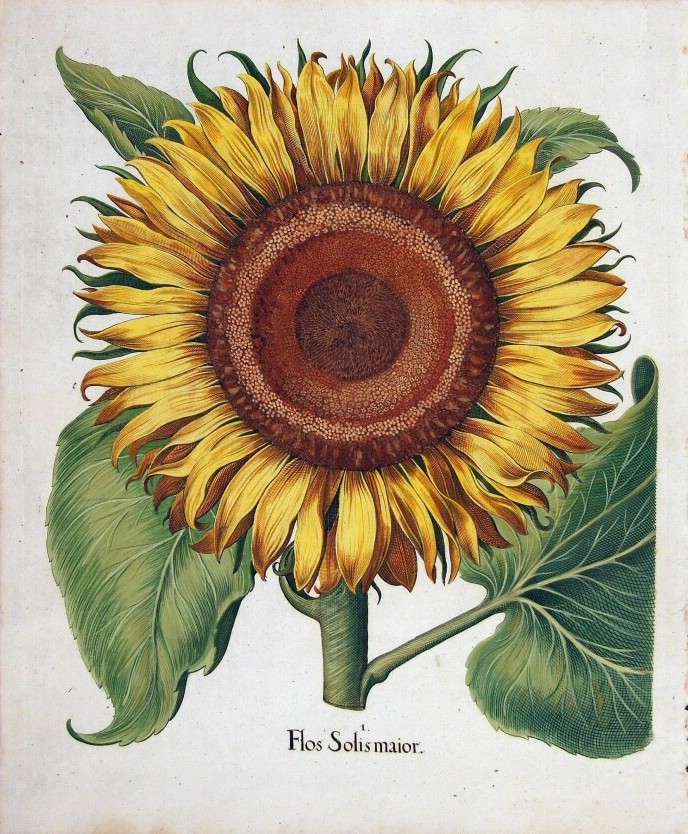
If you made it big in seventeenth-century Bavaria, you showed it by creating a garden with all the plants in the known world. That’s what Johann Konrad von Gemmingen, Prince-Bishop of Eichstätt did, anyway, and he wasn’t about to let his botanical wonderland die with him. To that end, he engaged a specialist by the name of Basilius Besler to document the whole thing, and with a lavishness never before seen in books in its category.
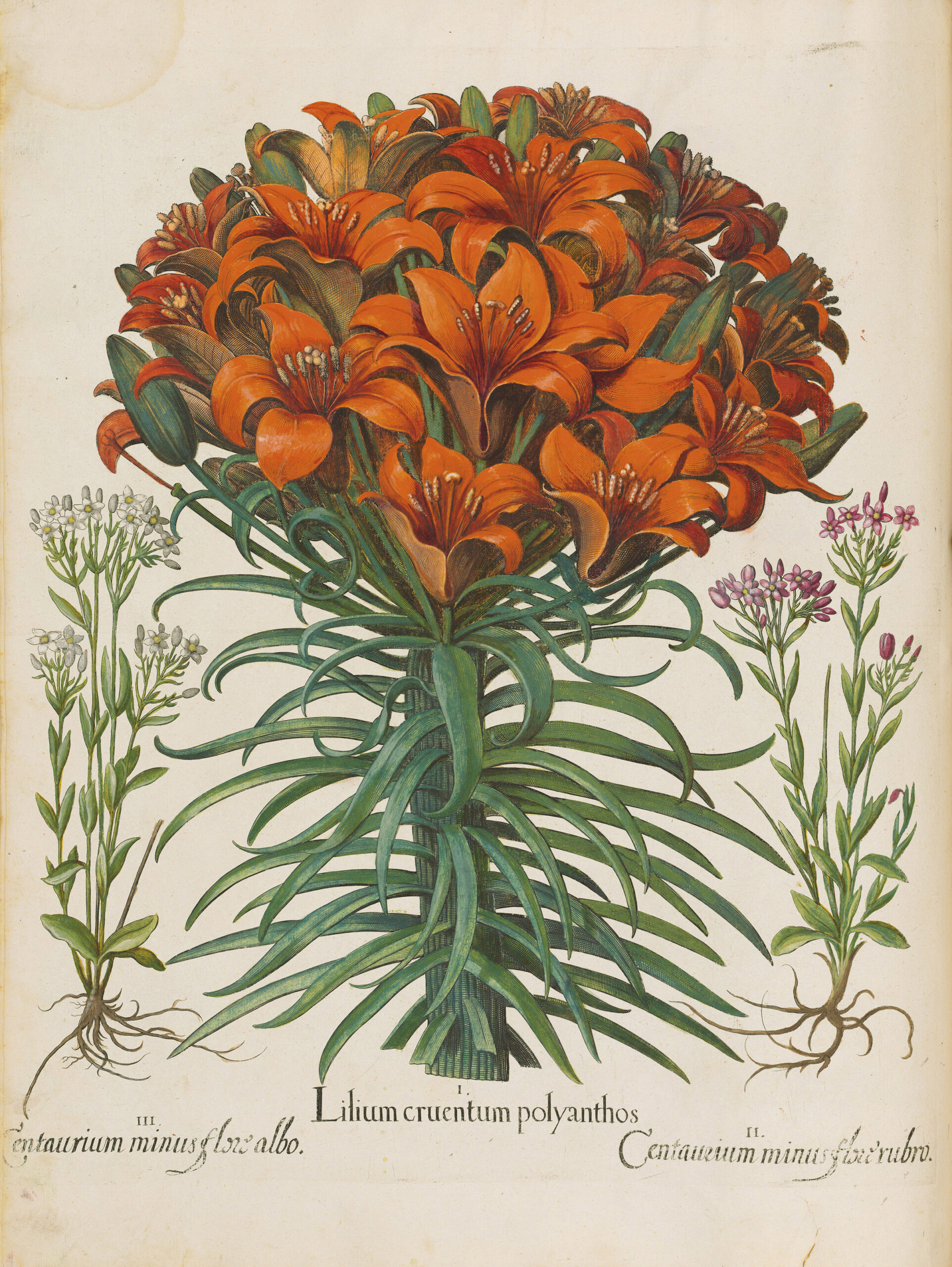
The medieval and Renaissance world had its “herbals” (as previously featured here on Open Culture), many of which tended toward the utilitarian, focusing on the culinary or medical properties of plants; Hortus Eystettensis would take the form at once to new artistic and scientific heights.
When the book came out in 1613, after sixteen years of research and production, von Gemmingen was already dead. But it proved successful enough as a product that Besler made sufficient money to set himself up with a house in a fashionable part of Nuremberg for the price of just five copies — five copies of the extravagant (and extravagantly expensive) hand-colored edition, at least.

Hortus Eystettensis “changed botanical art almost overnight,” writes David Marsh in a detailed blog post on the book’s creation and legacy at The Gardens Trust. “Now, suddenly plants were being portrayed as beautiful objects in their own right,” with depictions that could attain life size, all categorized in a systematic manner anticipating classification systems to come. Marsh sees the project as exemplifying a couple major cultural ideas of its time: one was “the collector’s cabinet of curiosities or wunderkammer, which helped reveal a gentleman’s interest and knowledge of the world around him.” Another was the concept of the perfect garden, which “should, if at all possible, represent Eden and contain as wide a range of plants and other features as possible.”

This level of ambition has always had its costs, to the consumer as well as the producer: Marsh notes that a 2006 replica of Hortus Eystettensis had a price tag of $10,000, though a more affordable edition has since been made available from Taschen, the major publisher most likely to understand Besler’s uncompromising aesthetic sensibility in the craft of books. But you can also read it for free online at an edition digitized by Teylers Museum in the Netherlands, which, in a sense, brings von Gemmingen’s project full-circle: he sought to encompass the whole world in his garden, and now his garden — in Besler’s richly detailed rendering — is open to the whole world.
Related content:
Based in Seoul, Colin Marshall writes and broadcasts on cities, language, and culture. His projects include the Substack newsletter Books on Cities, the book The Stateless City: a Walk through 21st-Century Los Angeles and the video series The City in Cinema. Follow him on Twitter at @colinmarshall or on Facebook.
Read More...Dance Like David Byrne! An Easy-to-Follow Instructional Video Shows You How
This dance is serious. This dance is necessary. Do you feel that change? — David Byrne
Everyone can dance, though some of us need a push from an enthusiastic, encouraging instructor…like singer-songwriter David Byrne.
Movement has long been a hallmark of the former Talking Heads frontman’s performances, when he was a palpably nervous 23-year-old soldiering through one of the band’s first New York City gigs.
Byrne drove the dancing in Talking Heads 1984 concert film, Stop Making Sense and has collaborated with several notable choreographers over the course of his long and varied career.
In 1981, Twyla Tharp commissioned him to write the score for her physically demanding, experimental ballet, The Catherine Wheel.
In 1999, he provided the soundtrack for In Spite of Wishing and Wanting, a 2‑hour work choreographer Wim Vandekeybus created for the men in his company, Ultima Vez.
His most fruitful collaboration has been with Big Dance Theater’s Annie‑B Parson, who choreographed Byrne’s 2012 Love this Giant world tour with St. Vincent, as well as Here Lies Love, his 2013 immersive rock musical about former First Lady of the Philippines Imelda Marcos. Most recently, the pair worked together to adapt Byrne’s American Utopia tour for Broadway.
In an interview with Vulture, Parson recalled questioning why someone with Byrne’s naturally cool physical instincts would seek an outside party to handle the dancing:
I was like, Huh, you’re my favorite choreographer, what are you doing!? Being able to make movement for yourself and being a choreographer are quite different, and he’s not interested in making movement for other people. He is a dancer. Some of the stuff he does in the show he totally made up for himself.
No question about it. The man has moves.
Here’s Parson’s favorite:
He does this thing where he slaps his hands while crossing the stage in Slippery People that’s so amusing to watch. He goes down on the ground at one point in Once in a Lifetime and I asked him what he was doing, and he was like, “Um, I’m going down to the water in the ground.” He’s imagining things and feeling the music. “Loose” wouldn’t be the word because neither of us are loose at all. He’s incredible as an artist in the way he thinks and acts on things. I’ve always felt that I have a huge amount of freedom.
Feel the Byrne next time you hit the dance floor by heading back up to the top of this post and following along with his instructional video for the socially distanced participatory dance experience he co-hosted for two weeks in New York City’s Park Avenue Armory’s 55,000-square-foot Drill Hall.
If only every dance teacher showed up in such a buoyant mood (not to mention a utility kilt and English sand shoes…)
Shake your hips!
Puppet legs!
Hold the traffic!
Vibrating arms!
Those lucky enough to score one of the nightly-assigned dancing spots that ensured SOCIAL! would be, as advertised, a socially distanced dance club, executed these, and other dance moves, that Byrne’s pre-recorded voice called for over the powerful P.A. system.
The New Yorker gave a feel for the proceedings:
Some parts were instructions for line dances; others were more abstract (“Let me see you move like you’re in a new world”) or historical (“This song is by the first interracial band to play Carnegie Hall”); some were idiosyncratic Byrnisms (“C’mon, baby, let’s think about your tendons”).
Reporters for Vanity Fair and the New York Times (who felt reassured that Byrne is “himself an invitingly imperfect dancer”) listed some of the steps they’d attempted at Byrne’s behest:
Hand-sanitizing (“You’ve got too much! Flick it front, flick it behind!”)
Threaded through crowds on a New York City sidewalk (“Don’t step on that pizza!”)
Move like a zombie
Double-dutch
Backstroke
Reach for the rafters (“Maybe you’re raising your hand in praise or to feel the light or to represent—or because you have a question. Is anybody answering your question? So much uncertainty these days.”)
Presumably, they, like Late Show host Stephen Colbert, below, also learned to “polish the plates.”
I Dance Like This by David Byrne
I’m working on my dancing
This is the best I can do
I’m tentatively shaking
You don’t have to look
Can’t say I’m sorry
I can’t say I’m ashamed
Can’t think of tomorrow
When it seems so far away
We dance like this
Because it feels so damn good
If we could dance better
Well you know that we would
For even more inspiration, check out the Instagram account Daily David Byrne Dances.
Related Content
Watch a Very Nervous, 23-Year-Old David Byrne and Talking Heads Performing Live in NYC (1976)
- Ayun Halliday is the Chief Primatologist of the East Village Inky zine and author, most recently, of Creative, Not Famous: The Small Potato Manifesto. Follow her @AyunHalliday.
Read More...How Londinium Became London, Lutetia Became Paris, and Other Roman Cities Got Their Modern Names
They Might Be Giants achieved pop-cultural immortality when they covered Jimmy Kennedy and music by Nat Simon’s novelty song “Istanbul (Not Constantinople)” in 1990. Key to the the lyrics’ humor is their simultaneous fixation on and apparent disinterest in the reason for the re-naming of the Turkish metropolis. As often as you hear the song — and we’ve all heard it countless times over the past few decades — you’ll learn only that Constantinople became Istanbul, not why. In his new video above, on how the cities of the Roman Empire got their modern names, ancient history YouTuber Garrett Ryan, creator of Youtube channel Told in Stone, provides a little more detail.
“Istanbul seems to be a Turkish rendering of the Greek phrase eis ten polin, ‘into the city,” Ryan says. Other of that country’s urban settlements have names that would be more recognizable to an ancient Roman citizen: “Bursa is Prusa, Smyrna is Izmir, Attaleia is Antalya, Iconium is Konya, and Ancyra is Ankara.”
Iznik was originally called Nicaea, but so was Nice, France (though only the former has the historical distinction of having produced the Nicene Creed). “The French towns Aix and Dax are descendants of the Latin aquae, springs. The same word, literally translated, is behind Baden Baden, Germany, and Bath, England.”
For some cities, the transition from a Roman to post-Roman name didn’t happen in one simple step. It’s well known that, in the days of the Roman Empire, London was called Londinium; what’s less well known is that it also took on the names Lundenwic and Lundenburg in the eras between. And “although the classical name of Paris was Lutetia” — as previously featured here on Open Culture — “the city was already known by the name of a local tribe, the Parisii, by late antiquity.” If you can guess the current names of Forum Traiani, Igilgili, or, Borbetomagus, you’ve got a keener sense of ancient history than most. Modern Western civilization may descend from the Roman Empire, but that legacy comes through much more clearly in some places than others.
Related content:
A 3D Animation Reveals What Paris Looked Like When It Was a Roman Town
A Data Visualization of Every Italian City & Town Founded in the BC Era
The Roads of Ancient Rome Visualized in the Style of Modern Subway Maps
Based in Seoul, Colin Marshall writes and broadcasts on cities, language, and culture. His projects include the Substack newsletter Books on Cities, the book The Stateless City: a Walk through 21st-Century Los Angeles and the video series The City in Cinema. Follow him on Twitter at @colinmarshall or on Facebook.
Read More...
The Surprising Map of Plants: A New Animation Shows How All the Different Plants Relate to Each Other
Are pinecones related to pineapples? This was the unexpected question with which my wife confronted me as we woke up this morning. As luck would have it, Dominic Walliman has given us an entertaining way to check: just a few days ago he released his Map of Plants, through which he gives a guided tour in the video from his Youtube channel Domain of Science. Here on Open Culture, we’ve previously featured Walliman’s maps of biology, chemistry, medicine, quantum physics, quantum computing, and doom, all of which may seem more complex and daunting than the relatively familiar plant kingdom.
But if you compare the Map of Plants to Walliman’s previous creations, downloadable from his Flickr account, you’ll find that it takes quite a different shape — and, unsurprisingly, a more organic one.
It’s a help to anyone’s understanding that Walliman shot sections of his explanatory video at the Royal Botanic Gardens, Kew, which affords him the ability to illustrate the species involved with not just his drawings, but also real-life specimens, starting at the bottom of the “evolutionary tree” with humble algae. From there on, he works his way up to land plants and bryophytes (mostly mosses), vascular plants and ferns, and then seed plants and gymnosperms (like conifers and Ginkgo).
It is in this section, about six and a half minutes in, that Walliman comes to pinecones, mentioning — among other notable characteristics — that they come in both male and female varieties. But he only reaches pineapples six or so minutes thereafter, having passed through fungi, lichens, angiosperms, and flowers. Belonging to the monocots (or monocotyledons), a group that also includes lilies, orchids, and bananas, the pineapple sits just about on the exact opposite end of the Map of Plants from the pinecone. The similarity of their names stems from seventeenth-century colonists in the new world encountering pineapples for the first time and regarding them as very large pinecones — an association visibly refuted by Walliman’s map, but forever preserved in the language nevertheless.
Related content:
1,100 Delicate Drawings of Root Systems Reveals the Hidden World of Plants
Based in Seoul, Colin Marshall writes and broadcasts on cities, language, and culture. His projects include the Substack newsletter Books on Cities, the book The Stateless City: a Walk through 21st-Century Los Angeles and the video series The City in Cinema. Follow him on Twitter at @colinmarshall or on Facebook.
Read More...What’s Entering the Public Domain in 2024: Enjoy Classic Works by Virginia Woolf, Charlie Chaplin, Buster Keaton, D. H. Lawrence, Bertolt Brecht & More
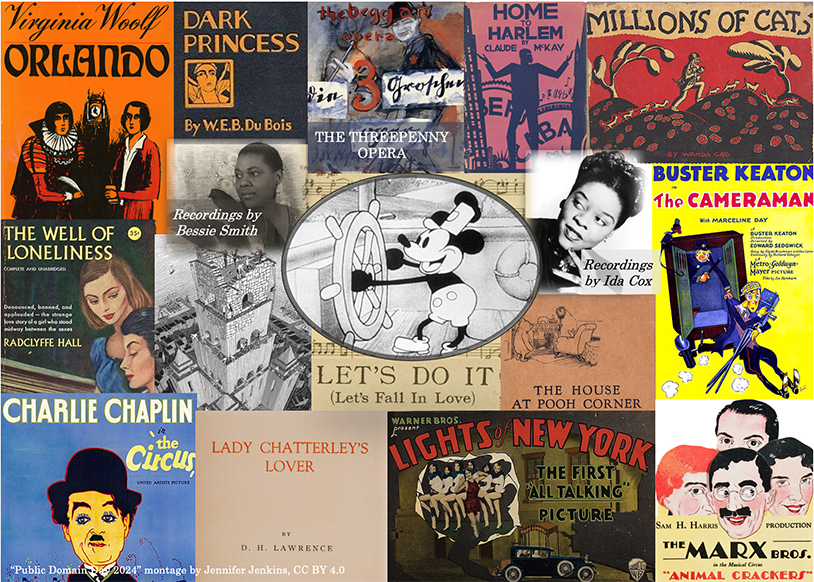
More than thirty years after it was first privately published in 1928, Lady Chatterley’s Lover became the subject of the most famous obscenity trial in English history. Though the ultimate decision of R v Penguin Books Ltd in favor of the publisher opened a cultural floodgate in that country, the novel was also subject to bans elsewhere, including the United States and Japan. Nearly a century after D. H. Lawrence wrote Lady Chatterley’s Lover — and a world apart as regards attitudes about public morality — it can be somewhat difficult to understand what all the fuss was about. But now that the book has entered the public domain in the United States, it could potentially be made artistically and socially dangerous again.
The same could be said of a number of other notable works of literature, from Virginia Woolf’s sex-switching satire Orlando to Bertolt Brecht’s piece of revolutionary theater Die Dreigroschenoper (known in translation as The Threepenny Opera) to a cultural phenomenon-spawning story like J. M. Barrie’s Peter Pan; or the Boy Who Wouldn’t Grow Up.
These and others are named on this year’s Public Domain Day post by Jennifer Jenkins, director of the Duke Center for the Study of the Public Domain. If not for multiple extensions of copyright law, she notes, all of them would have originally gone public domain in 1984, and we would now have almost four decades’ worth of additional creations reinterpreting, re-imagining, and re-using them. Still, “better late than never!”
At this point in history, the artifacts freed for anyone’s use aren’t just written works, but also films, musical compositions, and even actual sound recordings. These include classic Disney cartoons Steamboat Willie and Plane Crazy, which introduced the world to a certain Mickey Mouse; live-action movies from major filmmakers, like Charlie Chaplin’s The Circus and Carl Theodor Dreyer’s The Passion of Joan of Arc; and such songs with broad cultural footprints as “Yes! We Have No Bananas,” “When You’re Smiling,” and “Mack the Knife” — or rather “Die Moritat von Mackie Messer,” in the original German from Die Dreigroschenoper. Alas, those of us who want to do our own thing with Bobby Darin’s version will have to wait until February of 2067.
Related Content:
An Early Version of Mickey Mouse Enters the Public Domain on January 1, 2024
The Disney Cartoon That Introduced Mickey Mouse & Animation with Sound (1928)
John Waters Reads Steamy Scene from Lady Chatterley’s Lover for Banned Books Week (NSFW)
The British Library Digitizes Its Collection of Obscene Books (1658–1940)
Bertolt Brecht Sings ‘Mack the Knife’ From The Threepenny Opera (1929)
Watch Online: The Passion of Joan of Arc by Carl Theodor Dreyer (1928)
Based in Seoul, Colin Marshall writes and broadcasts on cities, language, and culture. His projects include the Substack newsletter Books on Cities, the book The Stateless City: a Walk through 21st-Century Los Angeles and the video series The City in Cinema. Follow him on Twitter at @colinmarshall or on Facebook.
Read More...An Early Version of Mickey Mouse Enters the Public Domain on January 1, 2024
Happy New Year!
We can now “do to Disney what Disney did to the great works of the public domain before him,” according to Harvard law professor and public domain expert, Lawrence Lessig, hailed by The New Yorker as “the most important thinker on intellectual property in the Internet era.”
On January 1, Mickey Mouse and his consort, Minnie, wriggled free of their creator’s iron fist for the first time in corporate history, as their debut performance in Steamboat Willie entered the public domain along with thousands of other 1928 works — Lady Chatterley’s Lover, All Quiet on the Western Front, and The House at Pooh Corner to name but a starry few.
Disney has been notoriously protective of its control over its spokesmouse, successfully pushing Congress to adopt the Sonny Bono Copyright Extension Act of 1998, which kept the public’s mitts off of Steamboat Willie, and, more to the point, Mickey Mouse, for 25 years beyond the terms of the Copyright Act of 1976.
But now our day has come…
Don’t be shy!
Dig in!
Disney always did.
As Lessig remarked in a 2003 lecture at Princeton University:
Walt Disney embraced the freedom to take, change and return ideas from our popular culture. The rip, mix and burn culture of the Internet is Disney-familiar.
Cinderella, Snow White, Pinocchio — Uncle Walt knew how to take liberties and make money with captivating source material, a tradition that continued through such later cartoon blockbusters as The Little Mermaid and Disney’s Snow Queen update, Frozen.
Steamboat Willie wasn’t conjured from thin air either. Its plot and title character were inspired by Buster Keaton’s Steamboat Bill, released two months before Disney’s animated short went into production.
A few caveats for those eager to take a crack at the Mouse…
Steamboat Willie’s newfound public domain status doesn’t give you carte blanche to mess around with Mickey and Minnie in all their many forms.
Stick to the music-loving black-and-white trickster with rubberhose arms, button-trimmed short-shorts, and the distinctly rodent-like tail that went by the wayside for Mickey’s appearance in 1941’s The Little Whirlwind.
Nor can Steamboat Willie-era Mickey become your new logo. Plop the character down in new narratives, yes. Use him in a recognizable way for purposes of advertising unrelated products, no.
Mislead viewers into thinking your mash up is Disney-approved at your own risk. A Disney spokesperson told CNN:
We will, of course, continue to protect our rights in the more modern versions of Mickey Mouse and other works that remain subject to copyright, and we will work to safeguard against consumer confusion caused by unauthorized uses of Mickey and our other iconic characters.
Don’t think they don’t mean it.
Author Robert Thompson, the founding director of Syracuse University’s Bleier Center for Television and Popular Culture told The Guardian that even though “the original Mickey isn’t the one we all think of and have on our T‑shirts or pillowcases up in the attic someplace,” the company is hypervigilant about protecting its assets:
Symbolically of course, copyright is important to Disney and it has been very careful about their copyrights to the extent that laws have changed to protect them. This is the only place I know that some obscure high school in the middle of nowhere can put on The Lion King and the Disney copyright people show up.
Perhaps your best bet is to make sure your work skews toward satire or parody, a la the infamous horror film Winnie the Pooh: Blood and Honey, which capitalized on author A.A. Milne’s 1926 book, Winnie the Pooh’s entrance into the public domain, while trafficking in some familiar character design. Disney ultimately let it slide.
Fumi Games is already poised to take a similar gamble with MOUSE, a blood-soaked, “gritty, jazz-fueled shooter” set to drop in 2025:
If you’re not yet ready to take the plunge, Mickey’s pals Pluto and Donald Duck will join him in the public domain later this decade, so don your thinking caps and mark your calendars.
For a more in-depth look at the ways you can — and cannot — use Steamboat Willie-era Mickey Mouse in your own work, Duke University’s Center for the Study of the Public Domain supplies a very thorough guide here.
Related Content
The Disney Cartoon That Introduced Mickey Mouse & Animation with Sound (1928)
“Evil Mickey Mouse” Invades Japan in a 1934 Japanese Anime Propaganda Film
– Ayun Halliday is the Chief Primatologist of the East Village Inky zine and author of Creative, Not Famous: The Small Potato Manifesto. Her variety show, Necromancers of the Public Domain, returns to New York City on February 29, 2024. Follow her @AyunHalliday.
Read More...Support Us
We're hoping to rely on loyal readers, rather than erratic ads. Please click the Donate button and support Open Culture. You can use Paypal, Venmo, Patreon, even Crypto! We thank you!

About Us

Open Culture scours the web for the best educational media. We find the free courses and audio books you need, the language lessons & educational videos you want, and plenty of enlightenment in between.
Advertise With Us
FREE UPDATES!
GET OUR DAILY EMAIL
Get the best cultural and educational resources on the web curated for you in a daily email. We never spam. Unsubscribe at any time.
FOLLOW ON SOCIAL MEDIA
Open Culture editor Dan Colman scours the web for the best educational media. He finds the free courses and audio books you need, the language lessons & movies you want, and plenty of enlightenment in between.
Advertise With Us

