A Collection of Hokusai’s Drawings Are Being Carved Onto Woodblocks & Printed for the First Time Ever
If you know anything about the ukiyo‑e masters of eighteenth- and nineteenth-century Japan like Kitagawa Utamaro, Utagawa Hiroshige, and Katsushika Hokusai, you know that they became renowned through woodblock prints. But in almost all cases, a woodblock print begins in another medium: the medium of the drawing, where the artist works out the image before committing (or having it committed) to a block of wood for printing. This process, as Tokyo-based Canadian printmaker David Bull explains in the video above, entailed the destruction of the original drawing — or at least it did a couple of centuries ago, before the advent of copy machines, let alone high-resolution digital scanners.
Our time has not only these technologically advanced tools, but also, as previously featured here on Open Culture, a wealth of rediscovered drawings by Hokusai himself. “The existence of these exquisite small drawings had been forgotten,” says the site of the British Museum. “Last publicly recorded at a Parisian auction in 1948, they are said to have been in a private collection in France before resurfacing in 2019.”
Having acquired the 103 images that constitute this Great Picture Book of Everything, the British Museum has entered into a collaboration with Bull, whose workshop Mokuhankan is taking a selection of these drawings — never printed in Hokusai’s day — and carving them into woodblocks for the first time ever.
You can enjoy this project, called Hokusai Reborn, by following its progress on Bull’s Youtube channel; the first two episodes of the series appear just above. You can also purchase a subscription to receive copies of the actual prints now being made from Hokusai’s drawings at Mokuhankan. “The prints will be 13.5 x 18.5 cm in format (slightly larger than 5 x 7 inches),” says the page at the studio’s site with more information on that, “and will be made on a thin version of our usual hosho washi, made in the workshop of Iwano Ichibei,” one of Japan’s officially designated Living National Treasures. This sales model is in keeping with the commercial model of ukiyo‑e in the Edo period of the seventeenth through the nineteenth century, when a burgeoning merchant class formed a robust customer base for its artisans. Here we have an unexpected opportunity to become one of those customers — and, perhaps, to own the next Great Wave Off Kanagawa.
via Metafilter
Related content:
View 103 Discovered Drawings by Famed Japanese Woodcut Artist Katsushika Hokusai
Based in Seoul, Colin Marshall writes and broadcasts on cities, language, and culture. His projects include the Substack newsletter Books on Cities, the book The Stateless City: a Walk through 21st-Century Los Angeles and the video series The City in Cinema. Follow him on Twitter at @colinmarshall or on Facebook.
Read More...Home Taping Is Killing Music: When the Music Industry Waged War on the Cassette Tape During the 1980s, and Punk Bands Fought Back

The first time I saw the infamous Skullcassette-and-Bones logo was on holiday in the UK and purchased the very un-punky Chariots of Fire soundtrack. It was on the inner sleeve. “Home Taping Is Killing Music” it proclaimed. It was? I asked myself. “And it’s illegal” a subhead added. It is? I also asked myself. (Ironically, this was a few months before I came into possession of my first combination turntable-cassette deck.)
Ten years and racks and racks of homemade cassette dubs on my shelves later, music seemed to be doing very well. (Later, by going digital, the music industry killed itself, and I had absolutely nothing to do with it.)
British record collectors will no doubt remember this campaign that started in 1981, another business-backed “moral” panic. And funnily enough it had nothing to do with dubbing vinyl.
Instead, the British Phonographic Industry (BPI) were taking aim at people who were recording songs off the radio instead of purchasing records. With the rise of the cassette tape in popularity, the BPI saw pounds and pence leaving their pockets.
Now, figuring out lost profits from home taping could be a fools’ errand, but let’s focus on the “illegal” part. Technically, this is true. Radio stations pay licensing fees to play music, so a consumer taping that song off the radio is infringing on the song’s copyright. Britain has very different “fair use” laws than America. In addition, digital radio and clearer signals have complicated matters over the years.
In practice, however, the whole thing was bunkum. Radio recordings are historic. Mixtapes are culture. I have my tapes of John Peel’s BBC shows, which I recorded for the music. Now, I listen to them for Peel’s intros and outros.
Seriously, the Napalm Death Peel Sessions *only* make sense with his commentary. Whoever taped this is an unknown legend:
The post-punk crowd knew the campaign was bunkum too. Malcolm McLaren, always the provocateur, released Bow Wow Wow’s cassette-only-single C‑30 C‑60 C‑90 Go with a blank B‑side that urged consumers to record their own music. EMI quickly dropped the band.
The Dead Kennedys also repeated the black b‑side gimmick with In God We Trust, Inc. (I would be interested in anybody who picks up a copy used of either to see what *is* on the b‑side).
And then there were the parodies. The metal group Venom used “Home Taping Is Killing Music; So Are Venom” on an album; Peter Principle offered “Home Taping Is Making Music”: Billy Bragg kept it Marxist: “Capitalism is killing music — pay no more than £4.99 for this record”. For the industry, music was the product; for the regular folks, music was communication, it was art, it was a language.
The campaign never did much damage. Attempts to levy a tax on blank cassettes didn’t get traction in the UK. And BPI’s director general John Deacon was frustrated that record companies didn’t want to splash the Jolly Roger on inner sleeves. The logo lives on, however, as part of torrent site Pirate Bay’s sails:
Just after the hysteria died down, compact discs began their rise, planting the seeds for the digital revolution, the mp3, file sharing, and now streaming.
(Wait, is it possible to record internet streams? Why, yes.)
If you have any stories about how you helped “kill music” by recording your favorite DJs, confess your crimes in the comments.
Note: An earlier version of this post appeared on our site in 2019.
If you would like to support the mission of Open Culture, consider making a donation to our site. It’s hard to rely 100% on ads, and your contributions will help us continue providing the best free cultural and educational materials to learners everywhere. You can contribute through PayPal, Patreon, and Venmo (@openculture). Thanks!
Related Content:
Ted Mills is a freelance writer on the arts who currently hosts the artist interview-based FunkZone Podcast and is the producer of KCRW’s Curious Coast. You can also follow him on Twitter at @tedmills, read his other arts writing at tedmills.com and/or watch his films here.
Read More...How Streaming Led to the TV Writers Strike: Four TV Writers Explain the Logic of the Strike
Though it’s too early to know what will turn out to be the defining cultural experience of the twenty-twenties, I’d put my money on first hearing of an acclaimed television show from one of its devoted fans only after it’s already been on the air for months or even years, if not after its lamented cancellation. Part of this has to do with a change in quantity, laid out by television writer Warren Leight in the Vox video above: “There used to be 80 shows in a year. Now you’re up to 500, 550 shows in a year,” many of them created not for traditional broadcast networks but for newer, content-hungrier online streaming platforms. “For writers, it was good because it gave people entry.”
Writing for streaming, Leight explains, “you didn’t have to worry about commercial breaks” and their dramatic disruptions. Instead, “you get to write a different structure. Maybe it’s just an organic three-act structure to an hour.” And in shorter streaming seasons, “you could arc a story across eight episodes. You can go a little darker, you can go a little deeper.”
But “as the episode orders have shrunk,” says Leight’s colleague Julia Yorks, “what used to be 40 weeks of the year that you were working is now 20 weeks,” with an at-least-concomitant reduction in paychecks. Whatever its artistic shortcomings, the old “network model” guaranteed a certain degree of stability for those who wrote its shows — a stability disrupted by the age of streaming.
Hence the ongoing Writers Guild of America strike, and the centrality to the WGA’s demands of improved residuals (that is, payments made for a production after its initial run) from streaming media. But the professionals interviewed for this video also express concerns about what happens to the shows themselves when their writing gets separated from their production, which has become increasingly common in recent years. On the likes of Law and Order or Friends, says Yorks, “your show was being filmed concurrently when you were in the writers’ room,” creating natural opportunities for continuous cross-disciplinary interaction and collaboration. We may live in a “golden age of television,” but left unchecked, the strain of this fragmentation, as well as the financial difficulties imposed on writers, could very well take the shine off of it.
Related content:
Harlan Ellison’s Wonderful Rant on Why Writers Should Always Get Paid
Raymond Chandler: There’s No Art of the Screenplay in Hollywood
How Breaking Bad Crafted the Perfect TV Pilot: A Video Essay
10 Tips From Billy Wilder on How to Write a Good Screenplay
Based in Seoul, Colin Marshall writes and broadcasts on cities, language, and culture. His projects include the Substack newsletter Books on Cities, the book The Stateless City: a Walk through 21st-Century Los Angeles and the video series The City in Cinema. Follow him on Twitter at @colinmarshall or on Facebook.
Read More...The Ancient World Comes to Life in an Animation Featuring Istanbul’s Islamic, Ottoman, Greek & Byzantine Art
Travel for travel’s sake can be wonderful but nothing beats traveling with a purpose.
Syrian German filmmaker Waref Abu Quba was so taken with Istanbul’s timeless beauty on his first visit in 2021 that he resolved to photograph as many examples of it as possible.
Having amassed some 2,900 photos, he set about animating them using a flash cut technique, rapidly toggling between similar images to bring life and movement to fixed architectural and decorative elements.
(Warning: the resulting content could trigger seizures in viewers with epilepsy or photosensitivity.)
Takrar – Arabic for ‘repetition’ — took two years to complete, condensing the sense of wonder Quba experienced on his travels into four astonishing minutes.
His collaboration with composer Alex Story and percussionist Robbe Kieckens brings added vitality to these ancient patterns on stone, wood, ceramic, and tile.
Among the forms Quba infuses with life are 140 unique columns from Hagia Sophia, each carved with the emperor’s monogram and their land of origin’s capital.
The domed ceilings of Istanbul’s magnificent mosques achieve a kaleidoscopic effect.
The three institutions that comprise the Istanbul Archaeological Museums proved a rich source of material, from Assyrian sculptures and mosaics from Mesopotamia, to ornaments decorating the 4th century BCE Alexander Sarcophagus, to the Hellenistic Sarcophagus of Crying Women, whose titular mourners now shimmy in a ritualistic dance.
Even doorknobs manage to captivate, while a cobalt blue Iznik charger plate from the Museum Of Turkish and Islamic Arts possesses true star quality.
Watch more of Waref Abu Quba’s films here.
Related Content
An Introduction to Hagia Sophia: After 85 Years as a Museum, It’s Set to Become a Mosque Again
Hear the Sound of the Hagia Sophia Recreated in Authentic Byzantine Chant
– Ayun Halliday is the Chief Primatologist of the East Village Inky zine and author, most recently, of Creative, Not Famous: The Small Potato Manifesto and Creative, Not Famous Activity Book. Follow her @AyunHalliday.
Read More...Exquisite 2300-Year-Old Scythian Woman’s Boot Preserved in the Frozen Ground of Siberia
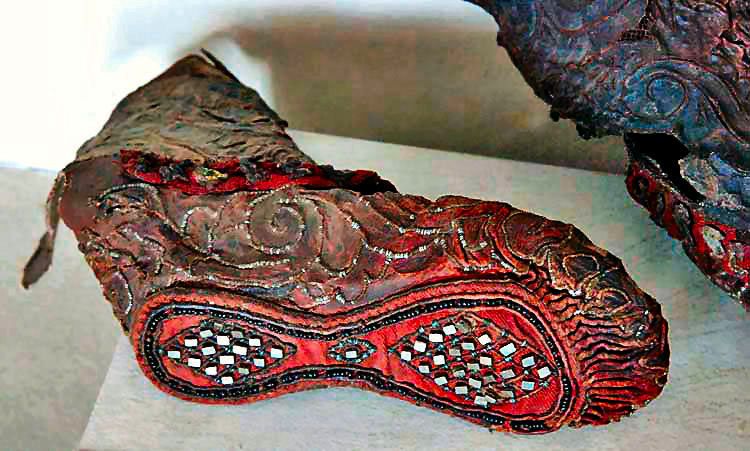
Shoes and boots, show where your feet have gone. —Guy Sebeus, 10 New Scythian Tales
In the age of fast fashion, when planned obsolescence, cheap materials, and shoddy construction have become the norm, how startling to encounter a stylish women’s boot that’s truly built to last…
…like, for 2300 years.
It helps to have landed in a Scythian burial mound in Siberia’s Altai Mountains, where the above boot was discovered along with a number of nomadic afterlife essentials—jewelry, food, weapons, and clothing.
These artifacts (and their mummified owners) were well preserved thanks to permafrost and the painstaking attention the Scythians paid to their dead.
As curators at the British Museum wrote in advance of the 2017 exhibition Scythians: Warriors of Ancient Siberia:
Nomads do not leave many traces, but when the Scythians buried their dead they took care to equip the corpse with the essentials they thought they needed for the perpetual rides of the afterlife. They usually dug a deep hole and built a wooden structure at the bottom. For important people these resembled log cabins that were lined and floored with dark felt – the roofs were covered with layers of larch, birch bark and moss. Within the tomb chamber, the body was placed in a log trunk coffin, accompanied by some of their prized possessions and other objects. Outside the tomb chamber but still inside the grave shaft, they placed slaughtered horses, facing east.
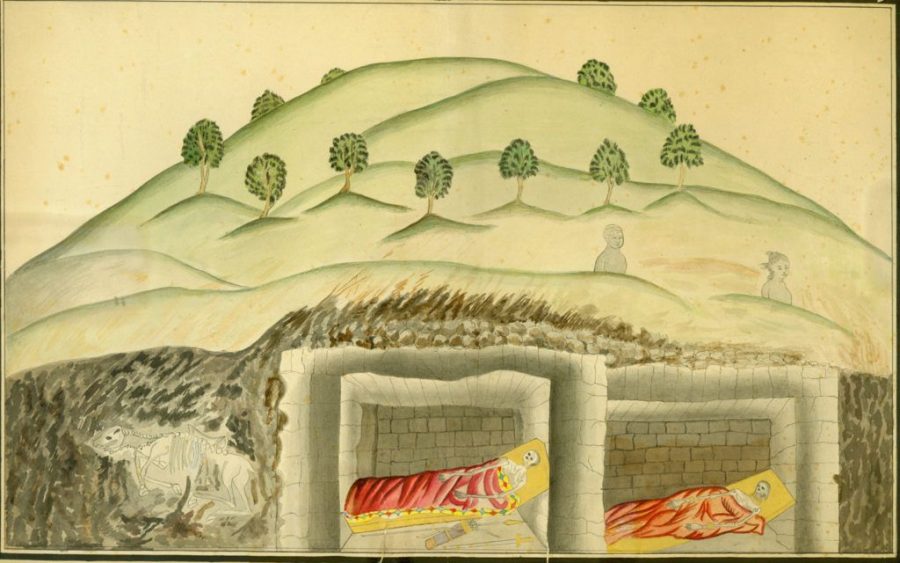
18th-century watercolor illustration of a Scythian burial mound. Archive of the Institute of Archaeology of the Russian Academy of Sciences, St Petersburg
The red cloth-wrapped leather bootie, now part of the State Hermitage Museum’s collection, is a stunner, trimmed in tin, pyrite crystals, gold foil and glass beads secured with sinew. Fanciful shapes—ducklings, maybe?—decorate the seams. But the true mindblower is the remarkable condition of its sole.
Speculation is rampant on Reddit, as to this bottom layer’s pristine condition:
Maybe the boot belonged to a high-ranking woman who wouldn’t have walked much…
Or Scythians spent so much time on horseback, their shoe leather was spared…
Or perhaps it’s a high quality funeral garment, reserved for exclusively post-mortem use…
The British Museum curators’ explanation is that Scythians seated themselves on the ground around a communal fire, subjecting their soles to their neighbors’ scrutiny.
Become better acquainted with Scythian boots by making a pair, as ancient Persian empire reenactor Dan D’Silva did, documenting the process in a 3‑part series on his blog. How you bedazzle the soles is up to you.
Note: An earlier version of this post appeared on our site in 2020.
If you would like to support the mission of Open Culture, consider making a donation to our site. It’s hard to rely 100% on ads, and your contributions will help us continue providing the best free cultural and educational materials to learners everywhere. You can contribute through PayPal, Patreon, and Venmo (@openculture). Thanks!
Related Content:
Stylish 2,000-Year-Old Roman Shoe Found in a Well
Ayun Halliday is an author, illustrator, theater maker and Chief Primatologist of the East Village Inky zine. Follow her @AyunHalliday.
Read More...Kids’ Films, Adult Messages — Pretty Much Pop: A Culture Podcast #153

Today’s Pretty Much Pop features panel of parents: your host Mark Linsenmayer, NY Times Entertainment Writer and Philosophy Professor Lawrence Ware, educator Michelle Parrinello-Cason and pop-culture philosopher Chris Sunami. We take on the mass of largely animated films by Disney, Pixar, Dreamworks, Illumination, etc. We’ve all watched them with our kids, and many adults devour them even in preference to other types of films.
So what’s the underlying ideology of this kind of media? What messages are they conveying, and are these substantial or even coherent? What elements in these films can adults relate to?
We touch on Puss in Boots, Turning Red, Soul, Trolls, Enola Holmes, The Polar Express, toddler edutainment, things we watched as kids, and stories by Roald Dahl, Lewis Carroll and L. Frank Baum. Our hosts recommended The Babysitter’s Club, The Mysterious Benedict Society, the studio Ghibli films, and the Series of Unfortunate Events books.
Follow us @law_writes, @DaylaLearning (Michelle), @PopCultPhil (Chris), and @MarkLinsenmayer.
Hear more Pretty Much Pop. If you’re not subscribed to the podcast, you’re missing lots of good episodes, such as our recent post-mortems on Succession and Ted Lasso. Support the show and hear bonus talking for this and nearly every other episode at patreon.com/prettymuchpop or by choosing a paid subscription through Apple Podcasts. This podcast is part of the Partially Examined Life podcast network.
Pretty Much Pop: A Culture Podcast is the first podcast curated by Open Culture. Browse all Pretty Much Pop posts.
Read More...Does Einstein’s Theory of Special Relativity Suggest That There Is an Afterlife?: A Theoretical Physicist Explains
“Let’s talk about the physics of dead grandmothers.” Thus does theoretical physicist Sabine Hossenfelder start off the Big Think video above, which soon gets into Einstein’s theory of special relativity. The question of how Hossenfelder manages to connect the former to the latter should raise in anyone curiosity enough to give these ten minutes a watch, but she also addresses a certain common category of misconception. It all began, she says, when a young man posed to her the following question: “A shaman told me that my grandmother is still alive because of quantum mechanics. Is this right?”
Upon reflection, Hossenfelder arrived at the conclusion that “it’s not entirely wrong.” For decades now, “quantum mechanics” has been hauled out over and over again to provide vague support to a range of beliefs all along the spectrum of plausibility. But in the dead-grandmother case, at least, it’s not the applicable area of physics. “It’s actually got something to do with Einstein’s theory of special relativity,” she says. With that particular achievement, Einstein changed the way we think about space and time, proving that “everything that you experience, everything that you see, you see as it was a tiny, little amount of time in the past. So how do you know that anything exists right now?”
In Einstein’s description of physical reality, “there is no unambiguous notion to define what happens now; it depends on the observer.” And “if you follow this logic to its conclusion, then the outcome is that every moment could be now for someone. And that includes all moments in your past, and it also includes all moments in your future.” Einstein posits space and time as not two separate concepts, but aspects of a single entity called spacetime, in which “the present moment has no fundamental significance”; in the resulting “block universe,” past, present, and future coexist simultaneously, and no information is ever destroyed, just continually rearranged.
“So if someone you knew dies, then, of course, we all know that you can no longer communicate with this person. That’s because the information that made up their personality disperses into very subtle correlations in the remains of their body, which become entangled with all the particles around them, and slowly, slowly, they spread into radiation that disperses throughout the solar system, and eventually, throughout the entire universe.” But one day could bring “some cosmic consciousnesses which will also be spread out, and this information will be accessible again” — in about a billion years, anyway, which will at least give grandma’s reassembled intelligence plenty to catch up on.

Related content:
Elie Wiesel (RIP) Talks About What Happens When We Die
Is There an Afterlife? Christopher Hitchens Speculates in an Animated Video
Albert Einstein On God: “Nothing More Than the Expression and Product of Human Weakness”
Based in Seoul, Colin Marshall writes and broadcasts on cities, language, and culture. His projects include the Substack newsletter Books on Cities, the book The Stateless City: a Walk through 21st-Century Los Angeles and the video series The City in Cinema. Follow him on Twitter at @colinmarshall or on Facebook.
Read More...Take a High Def, Guided Tour of Pompeii
“If you want to understand ancient Rome, its architecture, its history, the sprawl of the Roman Empire, you’ve got to go Rome.” So says archaeologist Darius Arya in the video above, making a fair, if obvious, point. “But you also have to go to the Vesuvian cities”: that is, the settlements located near the volcano Mount Vesuvius on the Gulf of Naples. “You have to go to Herculaneum. You must go to Pompeii. Not just because they’re famous, but because of the level of preservation.” This preservation was a side effect of the explosion of Vesuvius in 79 AD, which destroyed all life in Herculaneum and Pompeii, but also kept the basic structures of both cities intact; visiting either one today allows us to “get immersed in the world of the Romans.”
It is in Pompeii that the video’s creator Manuel Bravo (previously featured here on Open Culture for his explanations of the Great Pyramids of Giza and Filippo Brunelleschi’s dome in Florence) immerses not just himself but also us in that world.
He does so with high-resolution travel footage, but also with his explanations of the city’s architecture and urban planning, breaking down the details of everything from its grand Forum (“anticipating modern practice by almost 2,000 years” as a “pedestrian-only precinct”) to its complexes of baths, to its thermopolia (“essentially ancient fast-food restaurants”). Even more revealing are its humbler features, such as the stepping-stones across streets that allowed citizens to avoid “the rainwater, sewage, and animal waste that would accumulate there.”
“Almost every building in Pompeii has interior wall paintings, from private residences to public spaces such as baths and markets,” says Bravo, and these omnipresent works of art “offer valuable insights into the everyday life and cultural values of ancient Roman society.” (And indeed, they’re still offering new ones: just last month, a rediscovered Pompeiian fresco showed the world an ancient precursor to pizza.) They also evidence the surprising popularity of trompe-l’œil, where artists create the illusion of walls constructed from solid marble, or even lush outdoor spaces. Even the already-grand Domus Romana, the form of housing of choice for affluent Pompeiians, incorporated paintings to look grander still. Even once you make it, as the ancients clearly knew, you’ve still got to fake it.
Related content:
Pompeii Rebuilt: A Tour of the Ancient City Before It Was Entombed by Mount Vesuvius
A Drone’s Eye View of the Ruins of Pompeii
A Newly Discovered Fresco in Pompeii Reveals a Precursor to Pizza
Based in Seoul, Colin Marshall writes and broadcasts on cities, language, and culture. His projects include the Substack newsletter Books on Cities, the book The Stateless City: a Walk through 21st-Century Los Angeles and the video series The City in Cinema. Follow him on Twitter at @colinmarshall or on Facebook.
Read More...Behold the Unique Beauty of Japan’s Artistic Manhole Covers
Visitors to Japan can’t help but be struck by the beauty of its temples, its scenic views, its zen gardens, its manhole covers…
You read that right.
What started as a scheme to get taxpayers on board with pricey rural sewer projects in the 1980s has grown into a countrywide tourist attraction and a matter of civic pride.
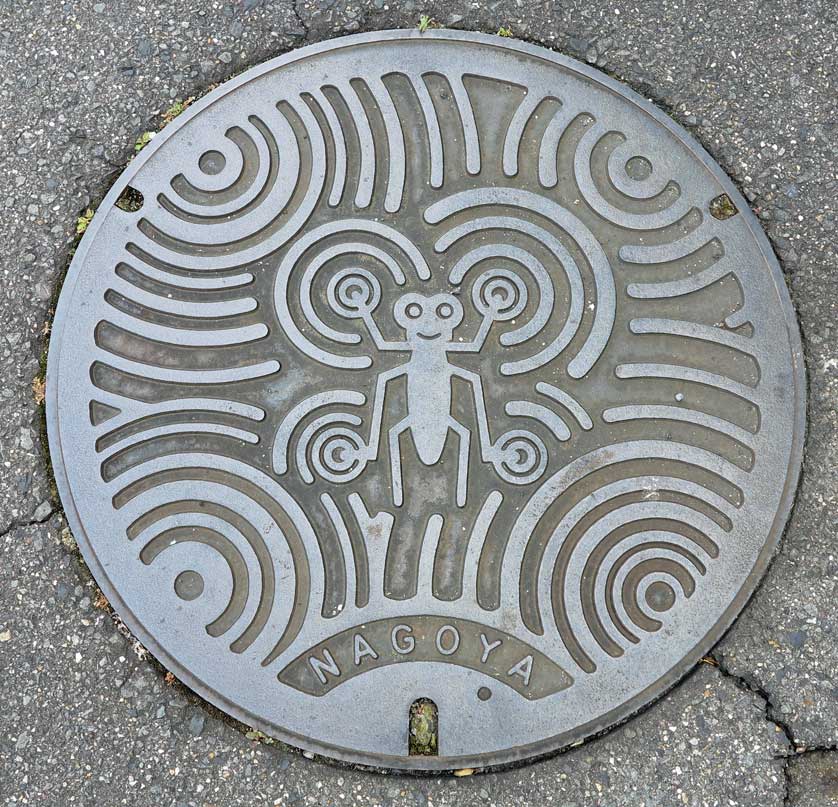
Each municipality boasts its own unique manhole cover designs, inspired by specific regional elements.
A community might opt to rep its local floral or fauna, a famous local landmark or festival, an historic event or bit of folklore.



Matsumoto City highlights one of its popular folk craft souvenirs, the colorful silk temari balls that once served as toys for female children and bridal gifts.
Nagoya touts the purity of its water with a water strider — an insect that requires the most pristine conditions to survive.
Hiroshima pays tribute to its baseball team.
Osaka offers a view of its castle surrounded by cherry blossoms.
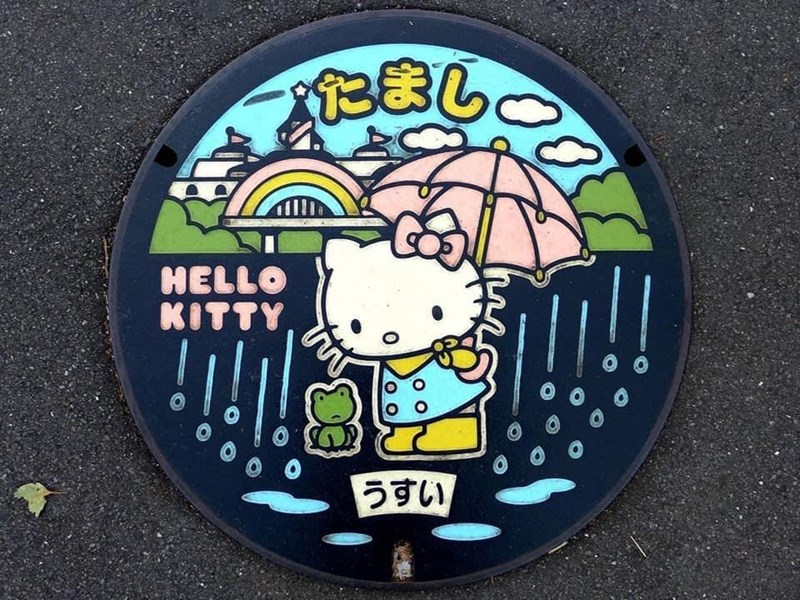
The proximity of the Sanrio Puroland theme park allows Tama City to lay claim to Hello Kitty and Pokémon-themed lids have sprung up like mushrooms from Tokyo to Okinawa.
Most of Japan’s 15 million artistic manhole covers are monochromatic steel which makes spotting one of the vibrantly colored models even more exciting.
In the fifty some years since their introduction, an entire subculture has emerged. Veteran enthusiast Shoji Morimoto coined the term “manholer” to describe hobbyists participating in this “treasure hunt for adults.”
Remo Camerota documents his obsession in Drainspotting: Japanese Manhole Covers and American traveler Carrie McNinch shares the joy of stumbling across previously unspotted ones in her autobiographical comic series You Don’t Get There From Here.

The ongoing popularity of this officially sanctioned street art is evidenced by the Japanese Society of Manhole Lovers, an annual manhole summit, and tons of collectible trading cards.
Explore a crowdsourced gallery of Japanese manhole covers here.
Related Content
Discover Edo, the Historic Green/Sustainable City of Japan
The Making of Japanese Handmade Paper: A Short Film Documents an 800-Year-Old Tradition
Download Classic Japanese Wave and Ripple Designs: A Go-to Guide for Japanese Artists from 1903
Ayun Halliday is the Chief Primatologist of The East Village Inky zine and nine books, including, most recently Creative, Not Famous. Follow her @Ayun-Halliday
Read More...How to Spot Bullshit: A Manual by Princeton Philosopher Harry Frankfurt (RIP)
Note: Over the weekend, the Princeton philosopher Harry Frankfurt passed away at the age of 94. After a long career, he became the author of the surprise bestselling book, On Bullshit, which we featured in 2016. Please revisit our original post below.
We live in an age of truthiness. Comedian Stephen Colbert coined the word to describe the Bush administration’s tendency to fudge the facts in its favor.
Ten years after the American Dialect Society named it Word of the Year, former president Bush’s calendar is packed with such leisure activities as golf and painting portraits of world leaders, but “truthiness” remains on active duty.
It’s particularly germane in this election year, though politicians are far from its only practitioners.
Take global warming. NASA makes a pretty rock solid case for both its existence and our role in it:
97 percent or more of actively publishing climate scientists agree: Climate-warming trends over the past century are extremely likely due to human activities. In addition, most of the leading scientific organizations worldwide have issued public statements endorsing this position.
In view of such numbers, it’s understandable that a suburban Joe with a freezer full of factory-farmed beef and multiple SUVs in his garage would cling to the position that global warming is a lie. It’s his last resort, really.
But such self-rationalizations are not truth. They are truthiness.
Or to use the old-fashioned word favored by philosopher Harry Frankfurt, above: bullshit!
Frankfurt–a philosopher at Princeton and the author of On Bullshit–allows that bullshit artists are often charming, or at their very least, colorful. They have to be. Achieving their ends involves engaging others long enough to persuade them that they know what they’re talking about, when in fact, that’s the opposite of the truth.
Speaking of opposites, Frankfurt maintains that bullshit is a different beast from an out-and-out lie. The liar makes a specific attempt to conceal the truth by swapping it out for a lie.
The bullshit artist’s approach is far more vague. It’s about creating a general impression.
There are times when I admit to welcoming this sort of manure. As a maker of low budget theater, your honest opinion of any show I have Little Red Hen’ed into existence is the last thing I want to hear upon emerging from the cramped dressing room, unless you truly loved it.
I’d also encourage you to choose your words carefully when dashing a child’s dreams.
But when it comes to matters of public policy, and the public good, yes, transparency is best.
It’s interesting to me that filmmakers James Nee and Christian Britten transformed a portion of their learned subject’s thoughts into voiceover narration for a lightning fast stock footage montage. It’s diverting and funny, featuring such ominous characters as Nosferatu, Bill Clinton, Charlie Chaplin’s Great Dictator, and Donald Trump, but isn’t it also the sort of misdirection sleight of hand at which true bullshitters excel?
Frankfurt expands upon his thoughts on bullshit in his aptly titled bestselling book, On Bullshit and its followup On Truth.
Related Content:
Noam Chomsky Schools 9/11 Truther; Explains the Science of Making Credible Claims
Ayun Halliday is an author, illustrator, and Chief Primatologist of the East Village Inky zine. Follow her @AyunHalliday
Read More...Support Us
We're hoping to rely on loyal readers, rather than erratic ads. Please click the Donate button and support Open Culture. You can use Paypal, Venmo, Patreon, even Crypto! We thank you!

About Us

Open Culture scours the web for the best educational media. We find the free courses and audio books you need, the language lessons & educational videos you want, and plenty of enlightenment in between.
Advertise With Us
FREE UPDATES!
GET OUR DAILY EMAIL
Get the best cultural and educational resources on the web curated for you in a daily email. We never spam. Unsubscribe at any time.
FOLLOW ON SOCIAL MEDIA
Open Culture editor Dan Colman scours the web for the best educational media. He finds the free courses and audio books you need, the language lessons & movies you want, and plenty of enlightenment in between.
Advertise With Us

