A Special New, Two-Volume Collection of Philip K. Dick Stories Comes Illustrated by 24 Different Artists
Philip K. Dick’s multiple worlds have appeared in increasingly better editions since the author passed away in 1982. In the 21st century, respectable hardbacks and quality paper have fully replaced yellowed, pulpy pages. Maybe no edition yet is more attractive than the Folio Society of London’s two-volume hardback set of Dick’s selected short stories, illustrated by 24 different artists and including tales that have survived film adaptations, for better and worse, like “Paycheck,” “The Minority Report,” and “We Can Remember It for You Wholesale.” The books will set you back $125, but that’s a small sum compared to the price of an earlier, four-volume Complete Short Stories, published in a limited edition of 750, day-glo, hand-numbered copies. These sold out in less than 48 hours and now go for $2,500 in rare online sales.
In death Dick has achieved what he sought in his writing life: success as literary author. He thought he would eventually publish his realist fiction to earn the reputation, vowing in 1960 that he would “take twenty to thirty years to succeed as a literary writer.” Instead, he’s famous for great fiction that just happens to use the idiom of sci-fi to ask, as he wrote in an undelivered 1978 speech: “What is reality?” and “What constitutes an authentic human being?”
We tend to associate these existential, pre-post-modernist questions with novels and novellas from the 60s and 70s that communicate Dick’s paranoid worldview — works nominated for a Nebula Award, for example, like Do Androids Dream of Electric Sheep?, the source for the best of the film adaptations, Blade Runner.
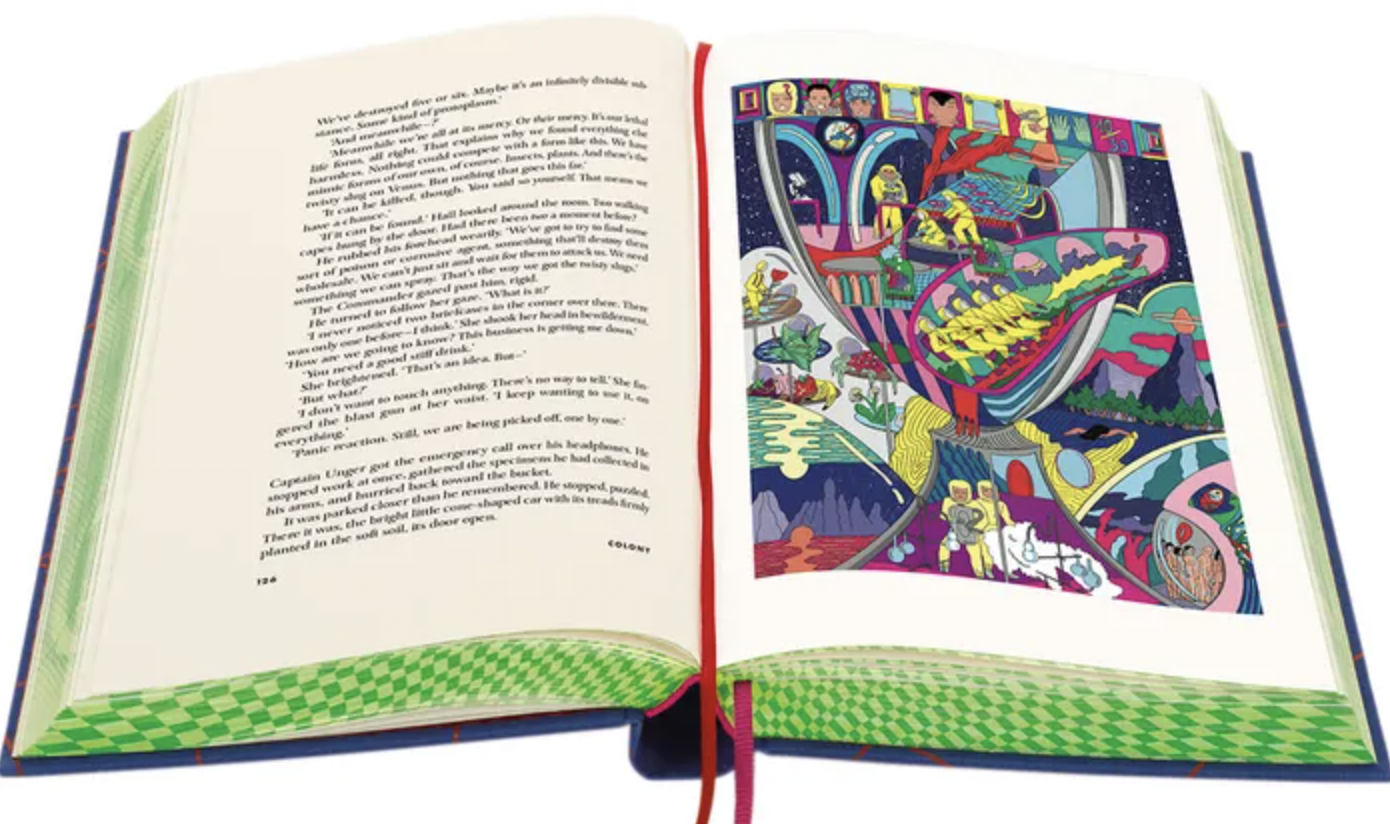
Dick first won fame in 1963 when he was given the Hugo Award for The Man in the High Castle, a book that exceeds the boundaries of genre to become, unmistakably, a PKD original. His earlier stories, on the other hand, written throughout the 1950s when the author was in his twenties, tend to follow the conventions of the hard sci-fi of the time, with the same themes of space travel, robotics, and other futuristic technology that predominate in Robert Heinlein and Isaac Asimov. Superficially, there might seem little to distinguish Dick’s early stories from other writing of the time published in pulps like Science Fiction Quarterly, Galaxy Science Fiction, and IF.
But the early stories show the unmistakable touch of the later novelist. There are the flashes of humor, absurdity, deep insight into the human psyche, and the warmth and empathy Dick’s narrative voice never lost even in his most bizarre fugues. In his first published story, “Roog,” sold in 1951, Dick imagines a dog who believes the garbage men come to steal the family’s food, leaving only the empty metal storage can behind. “Certainly, I decided,” he writes, “that dog sees the world quite differently than I do, or any humans. And then I began to think, maybe each human being lives in a unique world, a private world, a world different from those inhabited and experienced by all other humans.”
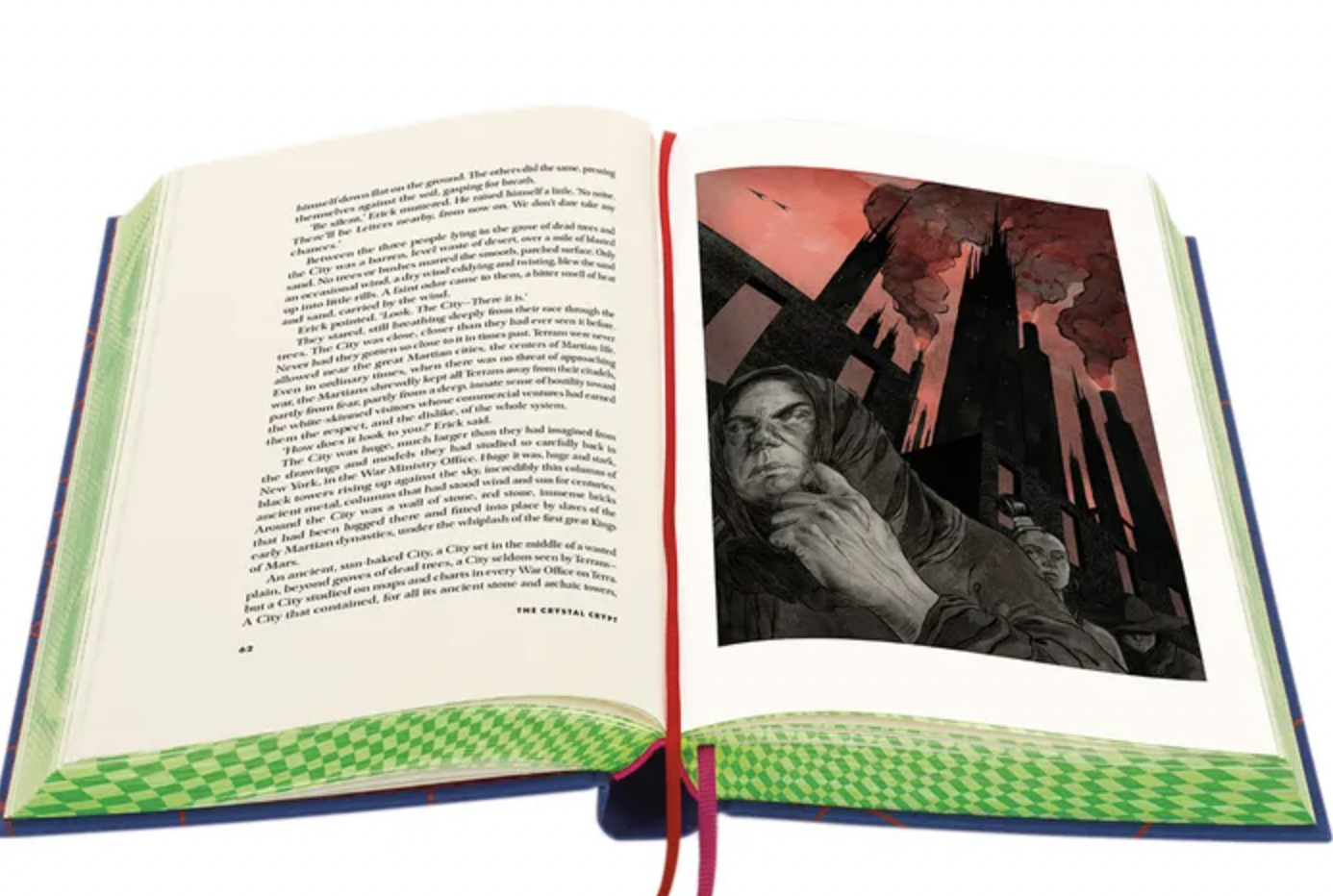
It’s a short leap from these thoughts to the idea that there might be no singular reality at all to fight over. Back then, he says, “I had no idea that such fundamental issues could be pursued in the science fiction field. I began to pursue them unconsciously.” His unconscious led him, in 1954’s “Adjustment Team” — the source of a less-than-great film — to imagine another dog, one who talks and interferes in human affairs (a detail omitted, thankfully, from The Adjustment Bureau). Dick’s early stories often featured comical animals — such as the Okja-like Martian pig in “Beyond Likes the Wub,” a highly-intelligent creature capable of telepathy and deep feeling. While he would turn his attention from animals and aliens to androids, alternate realities, and altered states of consciousness, Dick always had the ability to turn the genre of science fiction into a literary tool for the most daring of philosophical investigations.
Learn more about the two-volume Folio Society Selected Stories of Philip K. Dick here.
Related Content:
33 Sci-Fi Stories by Philip K. Dick as Free Audio Books & Free eBooks
Hear 6 Classic Philip K. Dick Stories Adapted as Vintage Radio Plays
Josh Jones is a writer and musician based in Durham, NC. Follow him at @jdmagness
Read More...Danny Boyle’s New Sex Pistols Series Tells the Story of Punk Rock in the UK
“I am creating a revolution here! I don’t want musicians, I want saboteurs, I want assassins, I want shock troops!” — Malcolm McLaren in FX’s Pistol
“People are trying to make it out as a bit of a joke, but it’s not a joke. It’s not political anarchy either; it’s musical anarchy, which is a different thing.” — John Lydon (Johnny Rotten), Interview with Mary Harron, 1976
“What do you think of Steve [Jones]?” says Malcolm McLaren (Thomas Brodie-Sangster) to his partner Vivienne Westwood (Talulah Riley) before telling her his plans to manage the future Sex Pistols in Oscar-winning director Danny Boyle’s FX mini-series Pistol. “Very damaged,” says Westwood, “but that’s quite good.” This sits well with budding impresario McLaren, who sees then-lead singer Jones as exactly the bomb he needs to throw at the establishment. “He’s got nothing else to live for,” says McLaren coldly.
The kids in the UK punk scene McLaren and Westwood stage-managed may have been outcasts, but many also came from staid suburban backgrounds, as did many of the punks in the downtown New York scene. When McLaren calls Jones (Toby Wallace) “the real deal,” he means the angry, drunken teenage face of a working class with little left to lose. Boyle’s series sets Jones up as representative of what made British punk so angry and “edgy” (to use one of Jones’ favorite words). The very first scene recreates his famous theft of David Bowie’s instruments to start the band. Genius stealing from genius.
Jones not only steals famous musicians’ gear, but he joyrides in stolen cars, and tries to steal leather pants from SEX, McLaren and Westwood’s S&M‑themed boutique. There, future Pretenders frontwoman Chrissie Hynde (Sydney Chandler) works the counter, and threatens to beat him with a cricket bat. The focus on Jones almost exclusively in the first episode suggests that he is the singular “Pistol” of the title.
Other characters show up eventually — frontman Johnny Rotten (Anson Boon) makes his appearance in the second episode (or “Track”) to bump Jones from vocals to guitar. The penultimate episode is titled “Nancy and Sid” in homage to Alex Cox’s cult biopic Sid and Nancy. But in the beginning, when the band was called “The Swankers,” it was all Steve Jones’ show, Boyle’s series suggests, from procuring the gear, to writing the first songs, to landing McLaren as manager.
Why release a biographical series on the Sex Pistols in 2022? The story has been told, in interviews, memoirs, and films, by the band, their entourage, hangers-on, and fans, and their manager, stylists, roadies, journalists, and photographers. It has been told so many times, so many ways, it makes the multiple perspectives of Kurosawa’s Rashomon seem easy to reconcile. (See comparisons between Boyle’s show and other documents above.) What could one more telling, streaming on a network once owned by Rupert Murdoch and now owned by the Disney Corporation, add to the living memory of 1970’s British Punk™?
We can hear some answers from series co-creator Boyle in the interview clip just above with the BBC. He describes what the band meant to him when he was a university student reading the news of the underground London in NME. “It’s only when you create true chaos,” he says, “that something new can emerge.” Does Pistol bring something new? The series is entertaining, recreating events familiar to us from any of the multiple histories of the Sex Pistols and doing so in a streamlined, hardly chaotic, narrative style.
Keeping the focus squarely on the handsome, charismatic Jones in the first episode (and to a lesser extent dapper original bassist Glen Matlock and boyish drummer Paul Cook) softens the band’s usual portrait. Maybe they seem more palatable at first to the very establishment McLaren tried to detonate in his revolution. But as Lydon, who happily took over as their spokesman, told Mary Harron in a 1976 interview, the idea that the Sex Pistols should be thought of as “socially significant” never appealed to him. “We want to be AMATEURS,” he sneered.
They wrote scathing nihilist protest songs like “EMI” and “God Save the Queen” (which they played on the Thames on the Queen’s Silver Jubilee in 1977, above). But the Pistols were not actually anti-corporate anarchists. They were antisocial shock-rock theater. It is bewildering, nonetheless — because of the weight of their influence on politically-charged punk rock — to see them turned into fictionalized heroes in corporate media. And it is jarring to hear Lydon praise Trump, Nigel Farage, and the far right, without a trace of irony, as the real inheritors of punk. Never one to withhold an opinion, he’s made his views on the show clear (below): “It’s dead against everything we stood for.”
Ironically, Matlock, who is credited with writing ten of the twelve tracks on Never Mind the Bollocks, Here’s the Sex Pistols, once said exactly the same thing about Johnny Rotten. So, what did the Sex Pistols stand for? Pissing people off, becoming absolutely hated, and getting rich? Only the last part of McLaren’s plot failed when he lost control of his monster. For all his revolutionary fervor, even McLaren was initially shocked (then delighted, then horrified and disgusted) by the band’s bad manners. Maybe writer and underground punk cartoonist John Holmstrom said it best: “It’s unbelievable that a rock group that played no more than one hundred live performances… and existed for only twenty-seven months, could become as internationally disliked as the Sex Pistols.” It’s even more unbelievable that they’ve become so internationally beloved.
Related Content:
Watch the Sex Pistols’ Very Last Concert (San Francisco, 1978)
The Sex Pistols’ Sid Vicious Sings Frank Sinatra’s “My Way”: Is Nothing Sacred?
Josh Jones is a writer and musician based in Durham, NC. Follow him at @jdmagness
Read More...Revisit Vintage Issues of Astounding Stories, the 1930s Magazine that Gave Rise to Science Fiction as We Know It
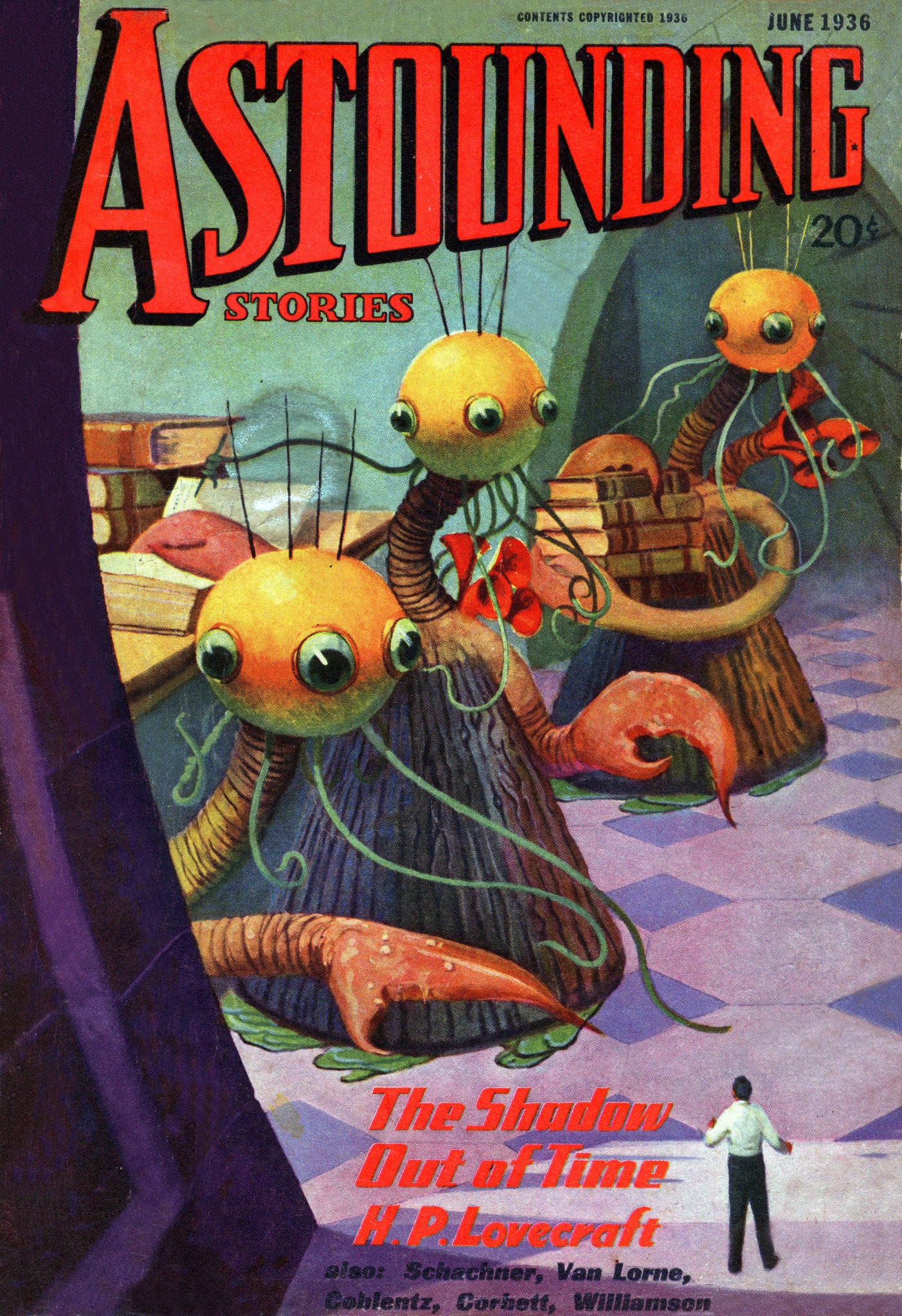
Having been putting out issues for 92 years now, Analog Science Fiction and Fact stands as the longest continuously published magazine of its genre. It also lays claim to having developed or at least popularized that genre in the form we know it today. When it originally launched in December of 1929, it did so under the much more whiz-bang title of Astounding Stories of Super-Science. But only three years later, after a change of ownership and the installation as editor of F. Orlin Tremaine, did the magazine begin publishing work by writers remembered today as the defining minds of science fiction.
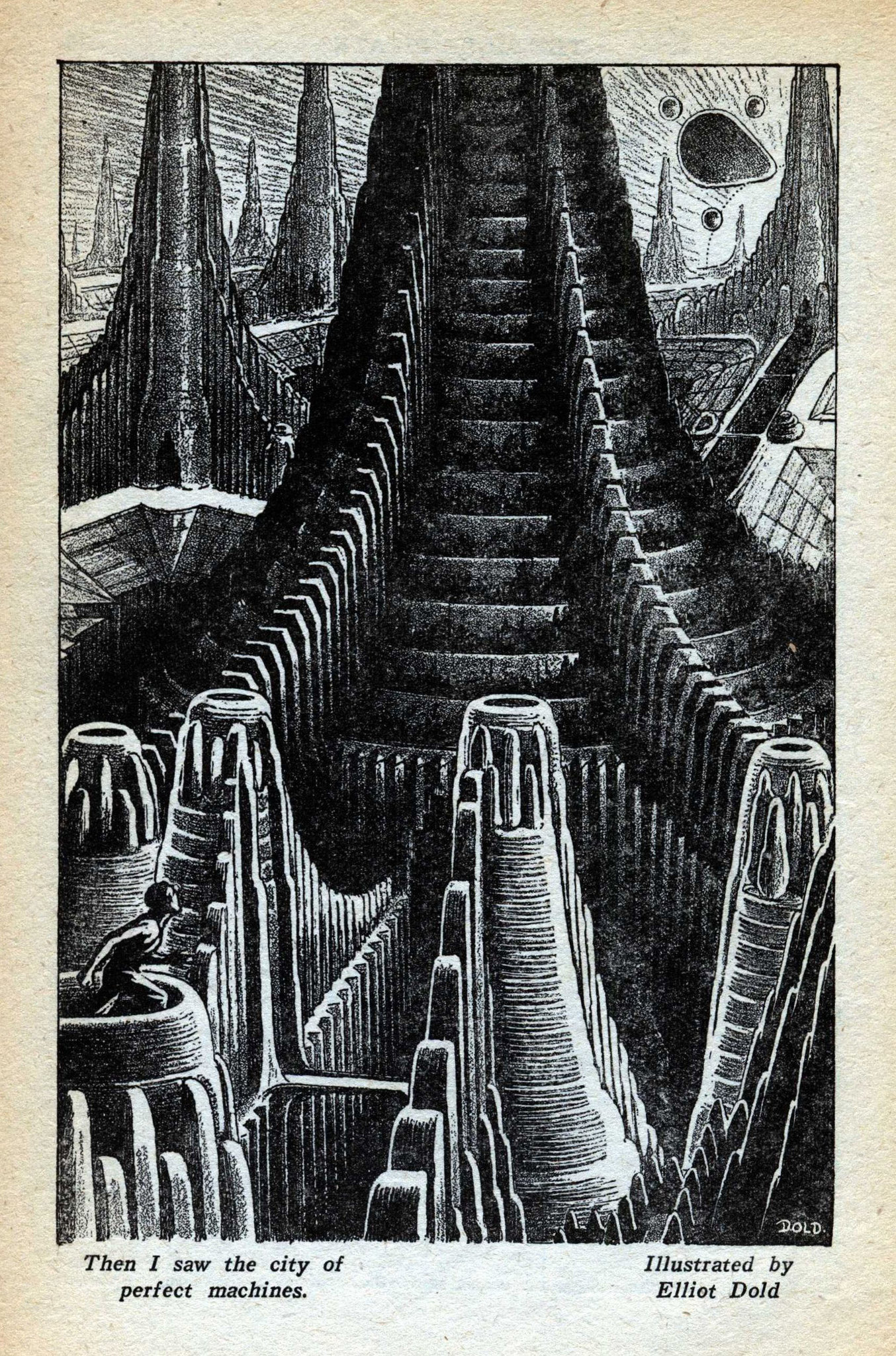
Under Tremaine’s editorship, Astounding Stories pulled itself above its pulp-fiction origins with stories like Jack Williamson’s “Legion of Space” and John W. Campbell’s “Twilight.” The latter inspired the striking illustration above by artist Elliott Dold. “Dold’s work was deeply influenced by Art Deco, which lends its geometric forms to the city of machines in ‘Twilight,’ ” writes the New York Times’ Alec Nevala-Lee, which “inaugurated the modern era of science fiction.”
In the case of a golden-age science-fiction magazine like Astounding Stories, Nevala-Lee argues, “its most immediate impact came through its illustrations,” which “may turn out to be the genre’s most lasting contribution to our collective vision of the future.”
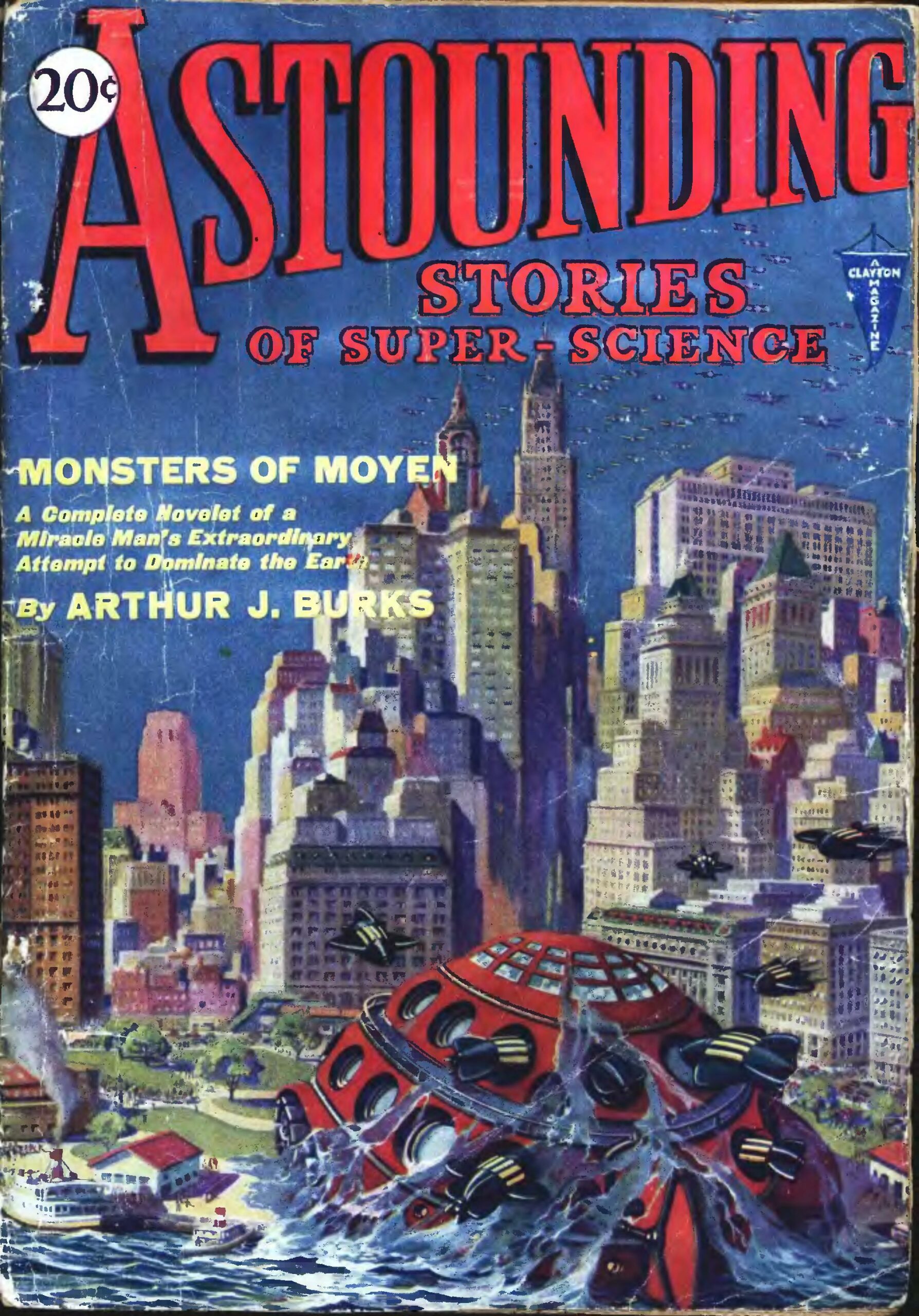
None of the imagery printed inside Astounding Stories was as striking as its covers, full-color productions on which “artists could let their imaginations run wild.” Sometimes they adhered closely to the visual descriptions in a story’s text — perhaps too closely, in the case the June 1936’s issue with H. P. Lovecraft’s “The Shadow Out of Time” — and sometimes they departed from and even competed with the magazine’s actual content. But after Campbell took over as editor in 1937, that content became even stronger: featured writers included Robert Heinlein, A. E. van Vogt, and Isaac Asimov.
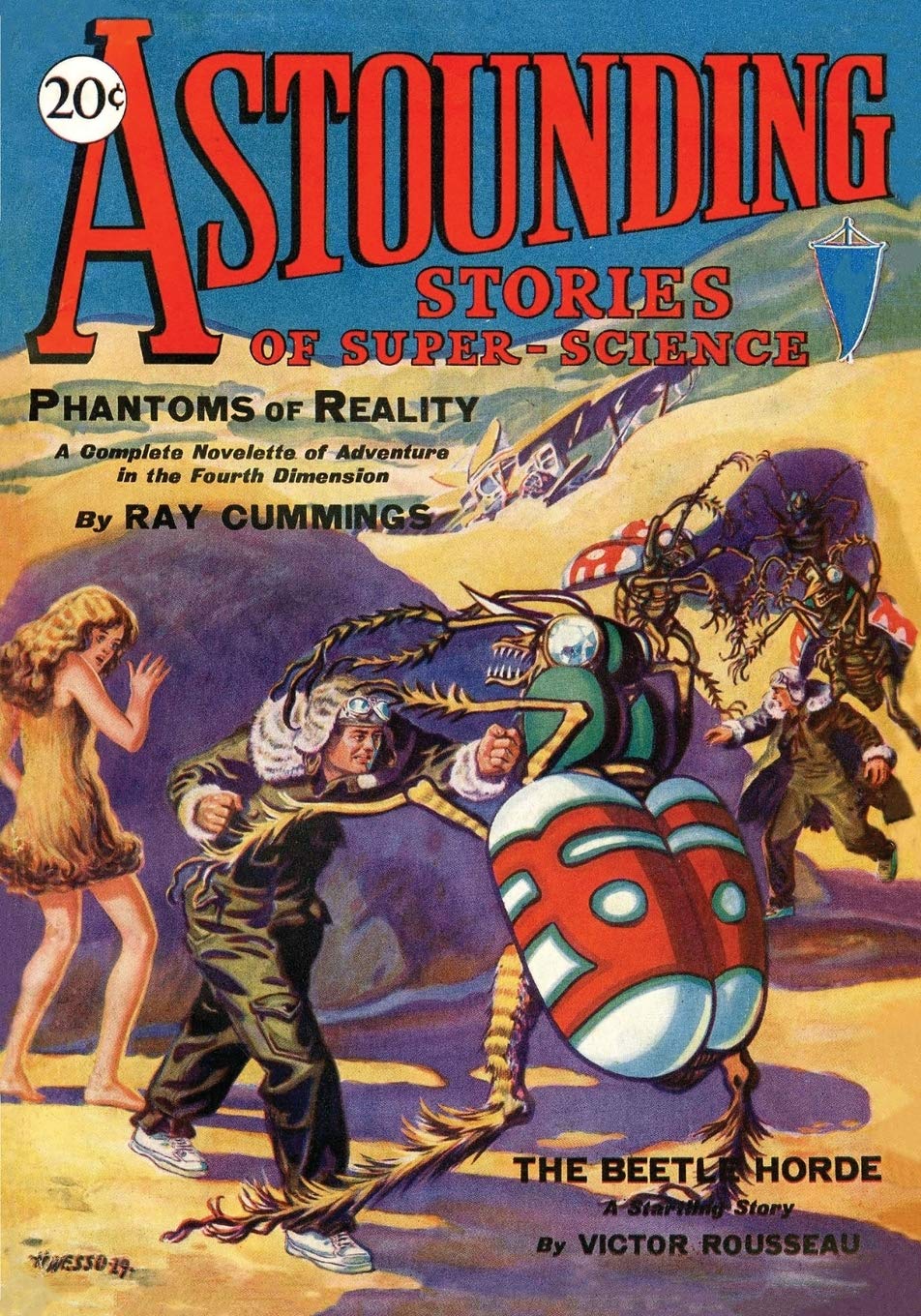
Now, here in the once science-fictional-sounding twenty-first century, you can not only behold the covers but read the pages of hundreds of issues of Astounding Stories from the thirties, forties, and fifties online. The earliest volumes are available to download at the University of Pennsylvania’s web site, by way of Project Gutenberg, and there are even more of them free to read at the Internet Archive. Though it may not always have faithfully reflected the material within, Astounding Stories’ cover imagery did represent the publication as a whole. It could be thought-provoking and haunting, but it also delivered no small amount of cheap thrills — and the golden age of science fiction still shows us how thin a line really separates the two.
Related content:
Free: 355 Issues of Galaxy, the Groundbreaking 1950s Science Fiction Magazine
The Encyclopedia of Science Fiction: 17,500 Entries on All Things Sci-Fi Are Now Free Online
Based in Seoul, Colin Marshall writes and broadcasts on cities, language, and culture. His projects include the Substack newsletter Books on Cities, the book The Stateless City: a Walk through 21st-Century Los Angeles and the video series The City in Cinema. Follow him on Twitter at @colinmarshall, on Facebook, or on Instagram.
Read More...Watch Two Courses by Beloved Yale Historian John Merriman (RIP): “France Since 1871” and “European Civilization, 1648 to 1945”
On May 22, historian John Merriman died at the age of 75. A professor at Yale since 1973, Merriman became an “early practitioner of the history ‘from the ground up, that swept academic study in the 1970s,” notes an obituary in Yale News. There, historian Alice Kaplan adds: “John Merriman became our greatest historian of the French left and its repression, of the Communards, the Anarchists, and the French police, whose experiences he brought to life in books and lectures informed by his work in archives in every region of France…”
The New York Times remembers him as “a rumpled figure who used his storytelling gifts to animate his lectures on French and European history.” And they recall how author Ta-Nehisi Coates “watched some of Professor Merriman’s recorded lectures online and described him … as a ‘kind of freestyle rapper’ who riffed off his material — anecdotes, quotes and observations — and ‘had this weird ability to inhabit the history.’ ”
You, too, can watch his lectures online. A number of years ago, Merriman made two of his beloved courses, “France Since 1871” (top) and “European Civilization, 1648 to 1945” (below) available on Yale Open Courses. If you click on the preceding links, you can find the syllabus and books for each course. These courses are permanently listed in our collection of Free Online History Courses, a subset of our collection, 1,700 Free Online Courses from Top Universities.
Related Content
14,000 Free Images from the French Revolution Now Available Online
A Free Yale Course on Medieval History: 700 Years in 22 Lectures
French in Action: Cult Classic French Lessons from Yale (52 Episodes) Available Online
Read More...Julia Child Shows Fred Rogers How to Make a Quick & Delicious Pasta Dish (1974)
Julia Child and Fred Rogers were titans of public television, celebrated for their natural warmth, the ease with which they delivered important lessons to home viewers, and, for a certain sector of the viewing public, how readily their personalities lent themself to parody.
Child’s cooking program, The French Chef, debuted in 1963, and Roger’s much beloved children’s show, Mister Rogers Neighborhood, followed five years later.
Rogers occasionally invited accomplished celebrities to join him for segments wherein they demonstrated their particular talents:
With our guest’s help, I have been able to show a wide diversity of self-expression, the extraordinary range of human potential. I want children and their families to know that there are many constructive ways to express who they are and how they feel.
In 1974, Child paid a call to the neighborhood bakery presided over by “Chef” Don Brockett (whose later credits included a cameo as a “Friendly Psychopath” in Silence of the Lambs…)
The easy-to-prepare pasta dish she teaches Rogers — and, by extension, his “television friend” — to make takes a surprisingly optimistic view of the average pre-school palate.
Red sauce gets a hard pass, in favor of a more sophisticated blend of flavors stemming from tuna, black olives, and pimentos.
Brockett provides an assist with both the cooking and, more importantly, the child safety rules that aren’t always front and center with this celebrity guest.
Child, who had no offspring, comes off as a high-spirited, loosey-goosey, fun aunt, encouraging child viewers to toss the cooked spaghetti “fairly high” after adding butter and oil “because it’s dramatic” and talking as if they’ll be hitting the supermarket solo, a flattering notion to any tot whose refrain is “I do it mySELF!”
She wisely reframes tasks assigned to bigger, more experienced hand — boiling water, knife work — as less exciting than “the fancy business at the end”, and makes it stick by suggesting that the kids “order the grown ups to do what you want done,” a verb choice the ever-respectful Rogers likely would have avoided.
As with The French Chef, her off-the-cuff remarks are a major source of delight.
Watching his guest wipe a wooden cutting board with olive oil, Rogers observes that some of his friends “could do this very well,” to which she replies:
It’s also good for your hands ‘coz it keeps ‘em nice and soft, so rub any excess into your hands.
She shares a bit of stage set scuttlebutt regarding a letter from “some woman” who complained that the off-camera wastebasket made it appear that Child was discarding peels and stems onto the floor.
She said, “Do you think this is a nice way to show young people how to cook, to throw things on the floor!?” And I said, “Well, I have a self cleaning floor! …The self cleaning is me.”
(Rogers appears both amused and relieved when the ultimate punchline steers things back to the realm of good manners and personal responsibility.)
Transferring the slippery pre-cooked noodles from pot to serving bowl, Child reminisces about a wonderful old movie in which someone — “Charlie Chaplin or was it, I guess it was, uh, it wasn’t Mickey Rooney, maybe it was…” — eats spaghetti through a funnel.
If only the Internet had existed in 1974 so intrigued parents could have Googled their way to the Noodle Break at the Bull Pup Cafe sequence from 1918’s The Cook, starring Roscoe “Fatty” Arbuckle and Buster Keaton!
The funnel is but one of many inspired silent spaghetti gags in this surefire don’t‑try-this-at-home kid-pleaser.
We learn that Child named her dish Spaghetti Marco Polo in a nod to a widely circulated theory that pasta originated in China and was introduced to Italy by the explorer, a bit of lore food writer Tori Avey of The History Kitchen finds difficult to swallow:
A common belief about pasta is that it was brought to Italy from China by Marco Polo during the 13th century. In his book, The Travels of Marco Polo, there is a passage that briefly mentions his introduction to a plant that produced flour (possibly a breadfruit tree). The Chinese used this plant to create a meal similar to barley flour. The barley-like meal Polo mentioned was used to make several pasta-like dishes, including one described as lagana (lasagna). Since Polo’s original text no longer exists, the book relies heavily on retellings by various authors and experts. This, combined with the fact that pasta was already gaining popularity in other areas of Italy during the 13th-century, makes it very unlikely that Marco Polo was the first to introduce pasta to Italy.
Ah well.
We’re glad Child went with the China theory as it provides an excuse to eat spaghetti with chopsticks.
Nothing is more day-making than seeing Julia Child pop a small bundle of spaghetti directly into Fred Rogers’ mouth from the tips of her chopsticks…though after using the same implements to feed some to Chef Brockett too, she realizes that this wasn’t the best lesson in food hygiene.
In 2021, this sort of boo-boo would result in an automatic reshoot.
In the wilder, woolier 70s, a more pressing concern, at least as far as public television was concerned, was expanding little Americans’ worldview, in part by showing them how to get a commanding grip on their chopsticks. It’s never too late to learn.
Bon appétit!
JULIA CHILD’S SPAGHETTI MARCO POLO
There are a number of variations online, but this recipe, from Food.com, hews closely to Child’s original, while providing measurements for her eyeballed amounts.
Serves 4–6
INGREDIENTS
1 lb spaghetti
2 tablespoons butter
2 tablespoons olive oil
1 teaspoon salt black pepper
1 6‑ounce can tuna packed in oil, flaked, undrained
2 tablespoons pimiento, diced or 2 tablespoons roasted red peppers, sliced into strips
2 tablespoons green onions with tops, sliced
2 tablespoons black olives, sliced
2 tablespoons walnuts, chopped
1 cup Swiss cheese, shredded
2 tablespoons fresh parsley or 2 tablespoons cilantro, chopped
Cook pasta according to package directions.
Drain pasta and return to pot, stirring in butter, olive oil, and salt and pepper.
Toss with remaining ingredients and serve, garnished with parsley or cilantro.
Related Content
Julia Child Shows David Letterman How to Cook Meat with a Blow Torch
Watch Anthony Bourdain’s First Food-and-Travel Series A Cook’s Tour Free Online (2002–03)
Science & Cooking: Harvard’s Free Course on Making Cakes, Paella & Other Delicious Food
MIT Teaches You How to Speak Italian & Cook Italian Food All at Once (Free Online Course)
- Ayun Halliday is the Chief Primatologist of the East Village Inky zine and author, most recently, of Creative, Not Famous: The Small Potato Manifesto. Follow her @AyunHalliday.
Read More...Sun Tzu’s The Art of War: An Animated Chapter-by-Chapter Breakdown of the Ancient Chinese Treatise
Though not a long book, The Art of War is nevertheless an intimidating one. Composed in the China of the fifth century BC, it comes down to us as perhaps the definitive analysis of military strategy, applicable equally to East, West, antiquity, and modernity alike. Hence the minor but still-productive industry that puts forth adaptations, extensions, and reinterpretations of The Art of War for non-military settings, transposing its lessons into law, business, sports, and other realms besides. But if you want a handle on what its author, the general and strategist Sun Tzu, actually wrote, watch the illustrated video above.
A production of Youtube channel Eudaimonia, previously featured here on Open Culture for a similarly animated exegesis of Machiavelli’s The Prince, it runs more than two and a half hours in full. Far though it exceeds the length of the average explainer video, it does reflect the tendency of Sun Tzu’s succinct observations to expand, when seriously considered, into much wider and more complex discussions. To each of the original text’s chapters the Eudaimonia video devotes a ten-to-fifteen-minute section, conveying not just the content of its lessons but also their relevance to the history of human conflict in the roughly two and a half millennia since they were written.
In chapter two, on waging war, Sun Tzu writes that “in order to kill the enemy, our men must be roused to anger.” It was in this spirit that, during the Second World War, the United Kingdom’s Ministry of Information launched a media “anger campaign” meant to “increase resolve against the Germans, as until then, the British had little sense of real hostility towards the average German.” In the chapter on weaknesses and strengths, Sun Tzu recommends “the divine art of subtlety and secrecy” as a means of becoming invisible and inaudible to the enemy — much as Julius Caesar did in the Gallic Wars, when he sent scouting ships “painted in Venetian blue, which was a similar color to that of the sea.”
Other examples come from diverse chapters of history. These include the American Civil War, Gandhi’s negotiation of Indian independence, the Napoleonic Wars, the British defeat in Zululand, Joan of Arc’s siege of Orléans, the revolt against the Turkish led by T. E. Lawrence (better known as Lawrence of Arabia), and even Steve Jobs’ turnaround of a nearly bankrupt Apple. Most of us will never find ourselves in situations of quite these stakes. But given that none of us can entirely avoid dealing with conflict, we’d could do worse than to keep the guidance of Sun Tzu on our side.
Related content:
Machiavelli’s The Prince Explained in an Illustrated Film
10 Reasons Why Hannibal’s Military Genius Still Captures Our Imagination Today
Hear an Ancient Chinese Historian Describe The Roman Empire (and Other Voices of the Past)
How Many U.S. Marines Could Bring Down the Roman Empire?
Based in Seoul, Colin Marshall writes and broadcasts on cities, language, and culture. His projects include the Substack newsletter Books on Cities, the book The Stateless City: a Walk through 21st-Century Los Angeles and the video series The City in Cinema. Follow him on Twitter at @colinmarshall, on Facebook, or on Instagram.
Read More...Enter the Franz Kafka Caption Contest for a Chance to Win a New Book of the Author’s Drawings (Until June 13)
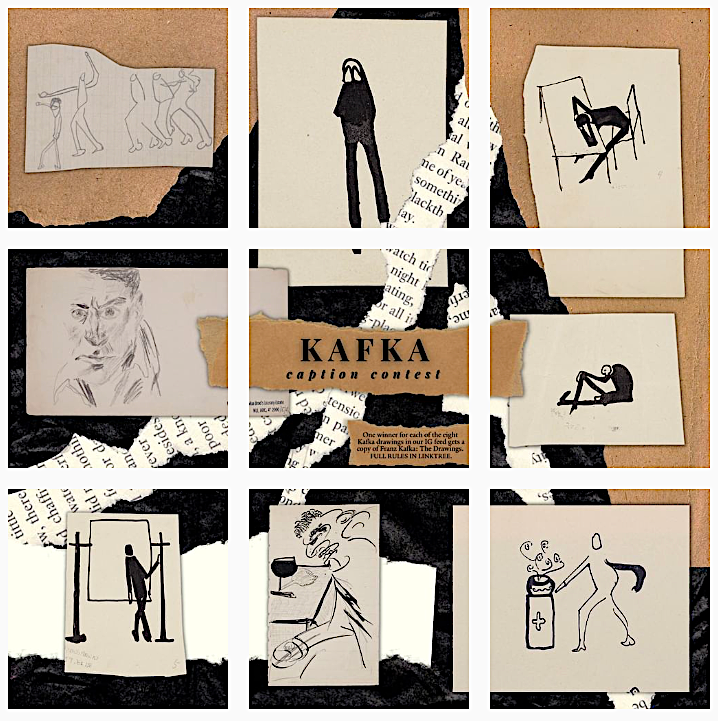
Imagine if Franz Kafka were charged with picking the winning entries in The New Yorker’s weekly cartoon caption contest.
The punchlines might become a little more obscure.
If that idea fills you with perverse pleasure, perhaps you should toddle over to Yale University Press’s Instagram to contribute some possible captions for eight of the inky drawings the tortured author made in a black notebook between 1901 and 1907.
The intended meaning of these images, included in the new book, Franz Kafka: The Drawings, are as up for grabs as any uncaptioned cartoon on the back page of The New Yorker.
In Conversations with Kafka, author Gustav Janouch recalled how their significance proved elusive even to their creator, and also the frustration his friend expressed regarding his artistic abilities:
I should so like to be able to draw. As a matter of fact, I am always trying to. But nothing comes of it. My drawings are purely personal picture writing, whose meaning even I cannot discover after a time.
Kafka seems to have gone easier on himself in a 1913 letter to fiancée Felice Bauer:
I was once a great draftsman, you know… These drawings gave me greater satisfaction in those days—it’s years ago—than anything else.
Artist Philip Hartigan, who referenced the drawings in a journal and sketchbook class for writing students nails it when he describes how Kafka’s “quick minimum movements … convey the typical despairing mood of his fiction in just a few lines.”
You have until June 13 to make explicit what Kafka did not by leaving your proposed caption for each drawing as a comment on Yale University Press’s Instagram, along the hashtag #KafkaCaptionContest.
Winners will receive a copy of Franz Kafka: The Drawings. Entries will be judged by editor Andreas Kilcher of and theorist Judith Butler, who contributed an essay that you might consider mining for material:
Was it a muffled death? Or perhaps it was no death at all, just a tumbling of intercourse, a sexual flurry?
Yes, that might go nicely with Kafka’s drawing of a seated figure collapsed over a table, below.
https://images.app.goo.gl/mGfZzLcpRXuyqqU68
Some alternate proposals from contest hopefuls:
I needed to bathe my battered knuckles with my tears.
He studied his newly acquired rare stamp with a powerful loupe.
How can I make sure that all my letters and papers will be destroyed after my death? I know — I’ll ask my closest friend to take care of it!
This last is a reference to Kafka’s literary executor, Max Brod, who defied Kafka’s explicit wish that all of his work be burned upon his death, save The Metamorphosis, and five short stories: The Judgment, The Stoker, In the Penal Colony, A Country Doctor and A Hunger Artist.
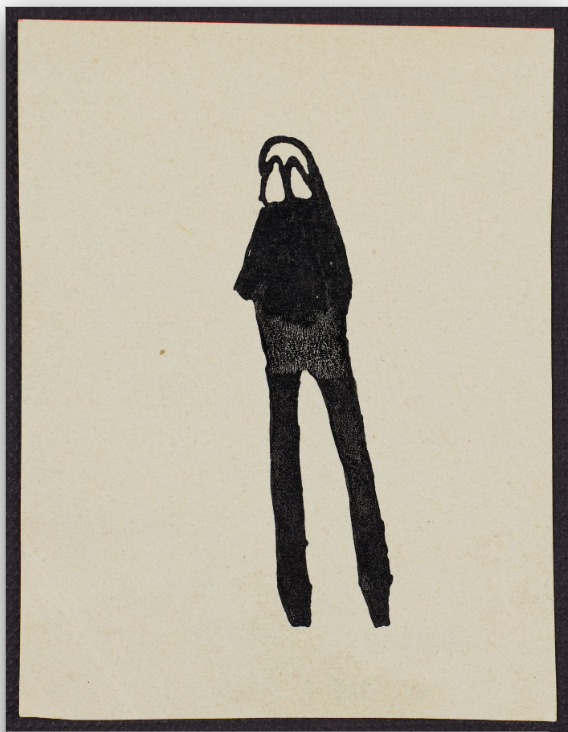
Brod cut Kafka’s drawing of the standing figure, above, from his sketchbook and kept in an envelope with a few others. Some of the current caption suggestions for this haunting, never before seen image:
my face is an umbrella to my tears
I couldn’t face myself.
I am the Walrus goo goo g’joob
https://images.app.goo.gl/e6v8xbuRin3qWcS56
Of the eight drawings in the caption contest, Drinker, may offer the most narrative possibilities. A representative sampling of the inventiveness that’s come over the transom thusfar:
I, period
Angered by the impudence of the cabernet, i had only the courage to berate its shadow
Waiter! There’s a roach in my wine.
Enter Yale University Press’ Kafka Caption Contest (or get a feel for the competition) here. Entries will be accepted through June 13. Full contest rules are here. Good luck!
Explore the drawings and other contents of Franz Kafka’s black notebook here.
Purchase Franz Kafka: The Drawings, the first book to publish the entirety of the author’s graphic output, here.
- Ayun Halliday is the Chief Primatologist of the East Village Inky zine and author, most recently, of Creative, Not Famous: The Small Potato Manifesto. Follow her @AyunHalliday.
Read More...Werner Herzog’s New Novel, The Twilight World, Tells the Story of the WWII Japanese Soldier Who Famously Refused to Surrender
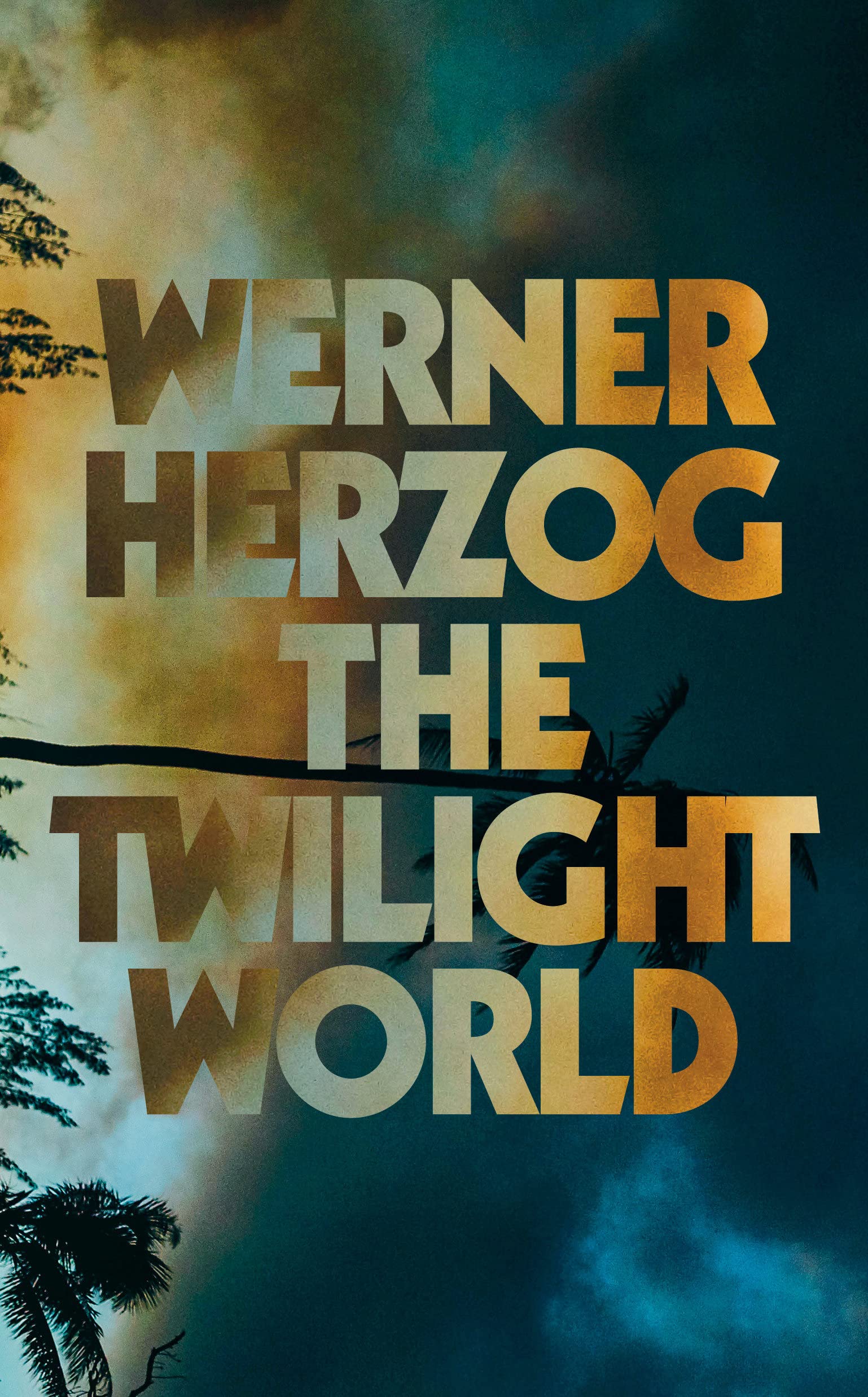
As everyone knows, Japan conceded defeat in the Second World War on August 15, 1945. But as many also know, certain individual Japanese soldiers refused to surrender, each continuing to fight the war for decades in his own way. The most famous was Lieutenant Onoda Hiroo, who hid out in the Philippines mounting guerrilla attacks — at first with a few fellow soldiers, and finally alone — until 1974. Onoda became a celebrity upon retuning to his homeland, and his admirers weren’t only Japanese. In Tokyo to direct an opera in 1997, Werner Herzog requested an introduction to one man only: the soldier who’d fought the war for 30 years.
Now Onoda has become the subject of one of Herzog’s latest projects: not a film, but a novel called The Twilight World. In his native German (brought into English by translator-critic Michael Hofmann), Herzog has written of not just his own meeting with Onoda but narrated Onoda’s own long experience in the Philippines.
“Onoda’s war is of no meaning for the cosmos, for history, for the course of the war,” goes one passage quoted by A. O. Scott in The Atlantic. “Onoda’s war is formed from the union of an imaginary nothing and a dream, but Onoda’s war, sired by nothing, is nevertheless overwhelming, an event extorted from eternity.”
One thinks of the protagonists of Herzog’s films, both imagined and real: the steamship-dragging rubber baron Brian Sweeney Fitzgerald, the downed Navy pilot Dieter Dengler, the deluded conquistador Lope de Aguirre, the ill-fated wildlife activist Timothy Treadwell. In Onoda’s case as well, Scott writes, “Herzog declines to treat him as a joke. He is clearly fascinated by the absurdity of this hero’s situation, and also determined to defend the dignity of a man who had no choice but to persevere in an impossible mission.” Anyone familiar with Herzog’s career, full of harrowing encounters and unpredictable turns but clearly operating by an iron logic all its own, can imagine why he saw in Onoda a kindred spirit.
Eight years after his death at the age of 91, Onoda remains a figure of general fascination, the subject of history videos viewed by millions as well as last year’s Onoda: 10,000 Nights of the Jungle, a feature by French director Arthur Harari. Of course, “the guy who stays in the field long after the war is over is, to modern eyes, a comical, cautionary figure, an avatar of patriotism carried to ridiculous extremes,” writes Scott. “We rarely pause to look for motives other than blind obedience, or to imagine what those years of phantom combat in the wilderness must have felt like.” Perhaps we twenty-first century Westerners simply lack the imaginative power necessary to do so — all of us, that, is except Werner Herzog. You can pre-order his novel, The Twilight World, now. It hits the shelves next week, on June 14th.
Related content:
Werner Herzog Offers 24 Pieces of Filmmaking and Life Advice
Werner Herzog Discovers the Ecstasy of Skateboarding: “That’s Kind of My People”
Based in Seoul, Colin Marshall writes and broadcasts on cities, language, and culture. His projects include the Substack newsletter Books on Cities, the book The Stateless City: a Walk through 21st-Century Los Angeles and the video series The City in Cinema. Follow him on Twitter at @colinmarshall, on Facebook, or on Instagram.
Read More...What Happened to the Missing Half of the Roman Colosseum?
What happened to the missing half of the Colosseum? It may be a question about ancient Rome you were afraid to ask in school, as the title of Dr. Garret Ryan’s video above suggests. Or maybe, after seeing the massive ancient ruin’s jagged profile all your life on pizza boxes and softball t‑shirts sponsored by your local Italian eatery, you never thought much of the Colosseum’ shape at all. You could spend hundreds of dollars and build a LEGO Colosseum, hundreds more and visit it yourself, or drive past it every day on your commute, and never think much about it.
Despite currently hosting more visitors per year than Trevi Fountain and the Sistine Chapel combined, the monument to bread and circus imperial Rome suffered from severe neglect in the millennia and a‑half after it was used as a gladiator arena – “some 1,500 years of neglect and haphazard construction projects,” Tom Mueller writes at Smithsonian, “layered one upon another.” Used as a quarry after the 6th century, for most of its long, decaying life, the amphitheater and its “hypogeum” (the intricate system of tunnels and earthworks underneath) went fully to seed.
For most of its history, that is to say, humans mostly ignored the Colosseum. But curiosity about its history pays:
Down through the centuries, people filled the hypogeum with dirt and rubble, planted vegetable gardens, stored hay and dumped animal dung. In the amphitheater above, the enormous vaulted passages sheltered cobblers, blacksmiths, priests, glue-makers and money-changers, not to mention a fortress of the Frangipane, 12th-century warlords. By then, local legends and pilgrim guidebooks described the crumbling ring of the amphitheater’s walls as a former temple to the sun. Necromancers went there at night to summon demons.
In the late 16th century — before popes paraded through the arena to honor Christians fed to wild beasts — “Pope Sixtus V, the builder of Renaissance Rome, tried to transform the Colosseum into a wool factory.” The venture failed, and soon after the huge variety of wild plant life began to attract botanists, who catalogued some 337 different species. The hypogeum, the architectural mechanism that once powered spectacles on the floor above, was only cleared in the 1930s by Benito Mussolini in his glorification of classical Rome.
Restoration on the Colosseum did not begin until the 1990s and visitors have only been allowed to see the ruin’s inner workings since 2011, almost 2000 years since it was first constructed between 72 and 80 AD. Originally called the Flavian Amphitheatre, the building’s name was changed to reflect its proximity to the Colossus of Nero, a monument to imperial hubris that has itself long disappeared. So, what about that missing half? “The short answer,” writes Dr. Ryan, “is: earthquakes and popes, in that order.”
The longer answer, as you might imagine, is far more colorful, and far bloodier, involving events like the Emperor Trajan’s 123-day celebration of his victory in Dacia, “in the course of which 5,000 pairs of gladiators fought and 11,000 animals were killed.” After around 500 years of this kind of bloodsport (and other amusements) and another 1,500 years of deterioration, I’d say the Colosseum has held up remarkably well, a tribute to Roman architectural engineering, the one thing the Roman Empire seemed to love more than violent death.
Related Content:
When the Colosseum in Rome Became the Home of Hundreds of Exotic Plant Species
An 8‑Minute Animated Flight Over Ancient Rome
The History of Ancient Rome in 20 Quick Minutes: A Primer Narrated by Brian Cox
Josh Jones is a writer and musician based in Durham, NC. Follow him at @jdmagness
Read More...When David Bowie & Brian Eno Made a Twin Peaks-Inspired Album, Outside (1995)
By any measure, David Bowie was a superstar. He first rose to fame in the nineteen-seventies, a process galvanized by his creation and assumption of the rocker-from-Mars persona Ziggy Stardust. In the following decade came Let’s Dance, on the back of which he sold out stadiums and dominated the still-new MTV. Yet through it all, and indeed up until his death in 2016, he kept at least one foot outside the mainstream. It was in the nineties, after his aesthetically cleansing stint with guitar-rock outfit Tin Machine, that Bowie made use of his stardom to explore his full spectrum of interests, which ranged from the basic to the bizarre, the mundane to the macabre.
This suggests a good deal in common between Bowie and another high-profile David of his generation: David Lynch, long one of the most famous film directors alive. “There are many obvious, surface connections and intersections between Lynch and Bowie,” write film critics Cristina Álvarez López and Adrian Martin. “Both have dabbled in film and music, as well as painting, theatre and performance art. Both are actors — Bowie slightly more conventionally so than Lynch.” Lynch would no doubt agree with Bowie’s insistence that “my interpretation of my work is really immaterial,” that “it’s the interpretation of the listener, or the viewer, which is all-important.”
These words appear in López and Martin’s analysis of Twin Peaks, the television series Lynch created in collaboration with Mark Frost, and Outside, the album Bowie created in collaboration with Brian Eno. When it premiered on ABC in the spring of 1990, Twin Peaks became a minor sensation by conjuring a familiar yet deeply strange atmosphere such as no one had never seen on television before. It also pioneered what López and Adrian Martin call “the Dead Girl/Woman genre, which traces out a labyrinthine mystery from the discovery of a young female corpse.” What brings Special Agent Dale Cooper to Twin Peaks, Washington, we recall, is the murder of homecoming queen Laura Palmer.
What brings Nathan Adler, a detective in the Art Crimes unit, to Oxford Town, New Jersey is the murder of the fourteen-year-old Baby Grace Blue. Thus begins the Twin Peaks-inspired storyline of Outside, Bowie’s own 1995 entry into the genre of the Dead Girl/Woman. Like Lynch and Frost’s show, Bowie’s album has a cast of eccentrics: Adler and Baby Grace, but also the likes of criminal “outsider” Leon Blank; Algeria Touchshriek, dealer in “art-drugs and DNA prints”; and a sinister figure known as both the Artist and the Minotaur. All are played by Bowie himself, who makes use of various accents (a technique practiced with his appearance in the 1992 Twin Peaks movie Fire Walk with Me) and voice-processing techniques.
At the time this 75-minute “non-linear Gothic Drama Hyper-Cycle,” as Bowie labeled it, gave his listeners a lot to take in, to say nothing of the major media outlets attempting to publicize it. “This new project is all about sex, violence, and death,” says the CBC’s Laurie Brown in a typical piece of television coverage. But it also deals with the merging of those human eternals with art and popular culture, a process that fascinated Bowie more and more as the nineties progressed — as did “the re-emergence of Neo-Paganism, ritual body art, and the fragmentation of society,” as he puts it in Outside’s official making-of video.
Bowie and Eno intended Outside (officially 1. Outside) as the first in a series that would ultimately constitute “a diary in music and in texture of what it felt like to be around at the end of the Millennium.” In one press conference, Bowie hinted that “the narrative might fall by the wayside,” much as Lynch and Frost originally intended to leave Laura Palmer’s death unsolved. That the second volume never appeared only underscores the tantalizing incompleteness of Outside, which López and Martin highlight as another similarity to Twin Peaks: “Both works are serial and multiple, existing in various official and unofficial forms, in spin-offs, outtakes” — not least the never-properly-released “Leon suites” Bowie and Eno recorded before the album itself — “and in numerous fan commentaries.”
A kind of circle closed in 1997 when Outside’s “I’m Deranged” soundtracked the opening credits of Lynch’s Lost Highway. But the work continued to hold out possibilities until the end of Bowie’s life: “We both liked that album a lot and felt that it had fallen through the cracks,” Eno said. “We talked about revisiting it, taking it somewhere new.” Despite his Lynchian resistance to interpretation, Bowie did acknowledge even in 1995 the thematic importance of mortality itself. Outside’s first single was called “The Heart’s Filthy Lesson,” and “the filthy lesson in question is the fact that life is finite.” For him, “knowing that I’ve got a finite time in life on Earth actually clarifies things and makes me feel quite buoyant.” Bowie knew — or learned — that life is too short not to follow your fascinations to their limits.
Related content:
Watch an Epic, 4‑Hour Video Essay on the Making & Mythology of David Lynch’s Twin Peaks
The Story of Ziggy Stardust: How David Bowie Created the Character that Made Him Famous
David Bowie & Brian Eno’s Collaboration on “Warszawa” Reimagined in a Comic Animation
Based in Seoul, Colin Marshall writes and broadcasts on cities, language, and culture. His projects include the Substack newsletter Books on Cities, the book The Stateless City: a Walk through 21st-Century Los Angeles and the video series The City in Cinema. Follow him on Twitter at @colinmarshall, on Facebook, or on Instagram.
Read More...Support Us
We're hoping to rely on loyal readers, rather than erratic ads. Please click the Donate button and support Open Culture. You can use Paypal, Venmo, Patreon, even Crypto! We thank you!

About Us

Open Culture scours the web for the best educational media. We find the free courses and audio books you need, the language lessons & educational videos you want, and plenty of enlightenment in between.
Advertise With Us
FREE UPDATES!
GET OUR DAILY EMAIL
Get the best cultural and educational resources on the web curated for you in a daily email. We never spam. Unsubscribe at any time.
FOLLOW ON SOCIAL MEDIA
Open Culture editor Dan Colman scours the web for the best educational media. He finds the free courses and audio books you need, the language lessons & movies you want, and plenty of enlightenment in between.
Advertise With Us

