The Oldest House in New York City: Meet the Wyckoff House (1652)
Most 21st-century Brooklyn public elementary schoolers have taken or will take a field trip to the Wyckoff House, a modest wooden cabin surrounded by tire shops and fast food outlets.
The oldest building in NYC by a longshot, it was also the first structure in the five boroughs to achieve historic landmark status.
Primary sources place the original occupants, Pieter Claesen Wyckoff and his wife, Grietje Van Ness-Wyckoff, in the original part of the house around 1652. A single room with a packed earth floor, unglazed windows, a large open hearth, and doors at either end, it would have been pretty tight quarters for a family of 13, as host Thijs Roes of the history series New Netherland Now notes, during his above tour of the premises.
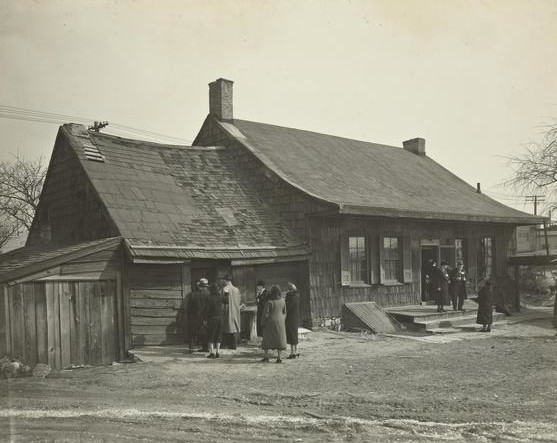
Two parlors were added in the 18th-century, and three bedrooms in the early 19th. Typical Dutch Colonial features include an H frame structure, shingled walls, split Dutch doors, and deep, flared “spring” eaves.
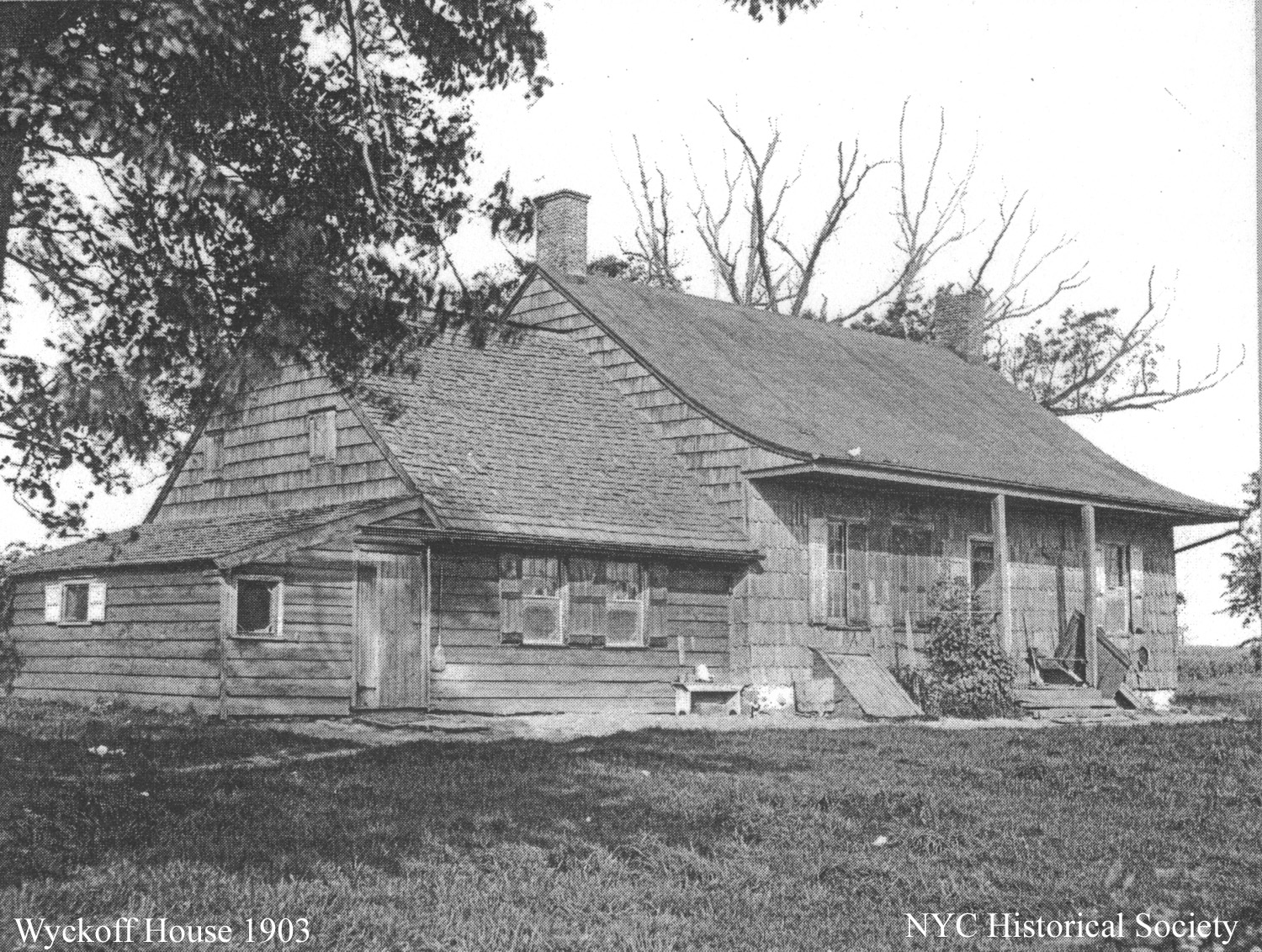
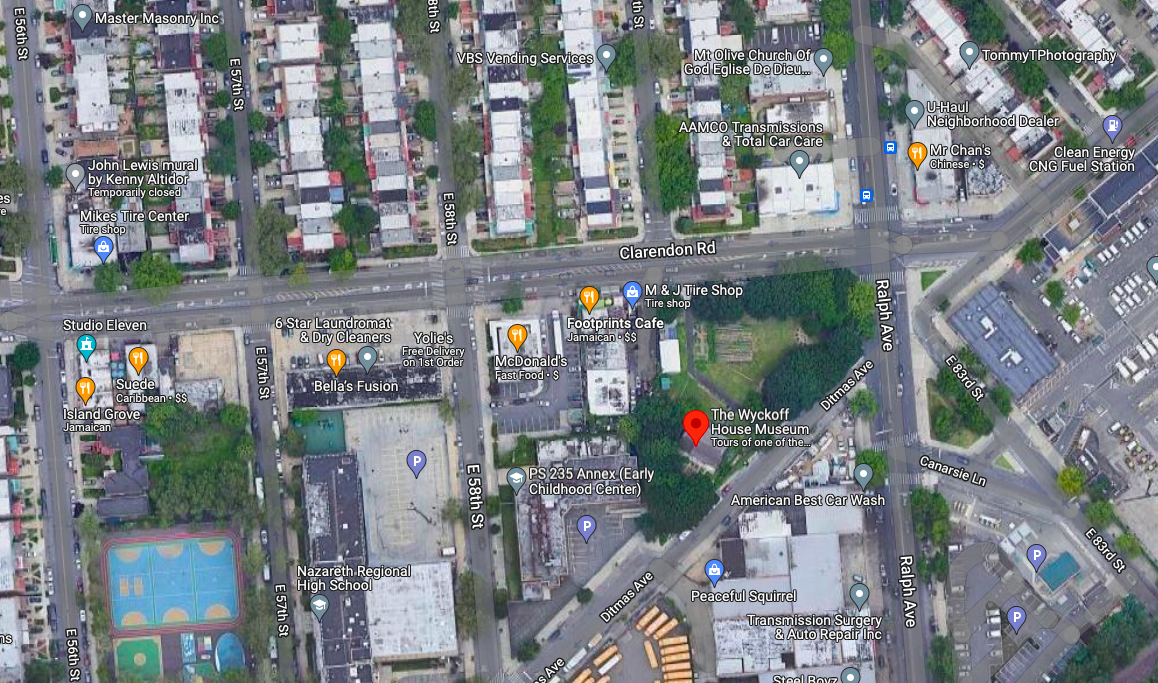
Its survival is a miracle in a metropolis known for its constant flux.
In the early 20th-century, descendants of Pieter and Grietje partnered with community activists to save the home from demolition, eventually donating it to the New York City Parks Department.
A late 70s fire (possibly not the first) necessitated major renovations. (And last year, flooding from Hurricane Ida clobbered its HVAC and electrical system, putting a temporary kibosh on public visits to the interior.)
Back in 2015, Roes’ companion, architectural historian Heleen Westerhuijs, was invited to inspect the attic, where she discovered impressive original beams alongside 20th-century reinforcements.
While the directors of the homestead actively recognize the community that now surrounds it with events like an upcoming celebration of Haitian culture and Vodou, and hands on activities include urban farming and composting, the original settlers of New Netherland (aka New Amsterdam, aka New York City) remain a major focus.
Any American or Canadian with the surname Wyckoff (or one of its more than 50 variants) can and should consider it their ancestral home, as they are almost certainly descended from Pieter and Grietje. While many thousands now bear the name, Pieter was the first. Volunteer genealogist Lynn Wyckoff explains:
After the English assumed control of New Netherland, residents practicing patronymics (a naming system that utilized one’s father’s name in place of a surname) were required to adopt, or freeze, surnames that could be passed down each generation. Pieter Claesen chose the name Wykhof, which most of his descendants have spelled Wyckoff. Despite many unfounded claims over the years regarding both Pieter’s ancestry and choice of surname, there is no record of Pieter’s parentage; but there is substantial evidence that he chose the name Wykhof in recognition of a farm by the same name outside of Marienhafe, Germany where his family were likely tenants.
A handful of Wyckoff family members left comments on the New Netherland Now video, including Donald, who wrote of his visit:
It was an odd feeling to touch the hand-hewn surface of a supporting beam cut and installed by my ancestor, hundreds of years ago. Since I am a Wyckoff, I was allowed to see some of the “off tour” bits of the house. I live over 3k miles away, so my feet will probably never touch the ground there again. But I’m glad NY and a lot of wonderful people have maintained my ancestral home so well and for so many years. Hopefully it has many hundreds of years of life remaining so that people can recall a time when Flatbush was more of a farm than a city.
If you are a Wyckoff (or one of its variants), you’re invited to keep the Wyckoff Association’s family tree up to date by sending word of births, deaths, marriages, and any pertinent genealogical details such as education, military service, profession, places of residence and the like.
Explore a collection of educational activities, lessons, and color pages related to the Wyckoff House here.
Related Content
Immaculately Restored Film Lets You Revisit Life in New York City in 1911
New York City: A Social History (A Free Online Course from N.Y.U
- Ayun Halliday is the author, most recently, of Creative, Not Famous: The Small Potato Manifesto. Her family’s trips to the Wyckoff House were included in the latest, NYC museum-themed issue of her zine, the East Village Inky. Follow her @AyunHalliday.
Read More...Rapper Post Malone Performs a 15-Song Set of Nirvana Songs, Paying Tribute to Kurt Cobain
Nirvana’s cultural staying power is a testament to the cross-generational magic that happened when Kurt Cobain, Krist Novoselić, and Dave Grohl played together for only a handful of years in the 90s. Their influence goes far deeper than 90s nostalgia for a grunge trend or the celebrity status of the late Cobain. Now almost 30 years after the frontman’s 1994 suicide, we see that influence on a generation born too late to see him live — one influenced more by hip hop than guitar rock and far less interested in challenging the capitalist status quo.
For artists like rapper Post Malone, born July 4, 1995, Cobain is a major songwriting influence, even if Post Malone’s music sounds little like Nirvana. “I loved Kurt so much,” says Malone, “and he’s been such an inspiration to me, musically.” To prove his love, he’s tattooed Cobain on “two different parts of his body,” Sheldon Pearce writes at The New Yorker, though Cobain might not have “reciprocated the love — the rapper’s stint shilling for Bud Light probably wouldn’t fly, and Cobain once said white artists should leave rap to Black artists because ‘the white man ripped off the Black man long enough.’ ”
But that’s the thing about idols: once they’re gone, they no longer get a say in who worships them and how. Last year, Post delivered a Nirvana tribute to benefit the UN’s COVID-19 Solidarity Response Fund for the World Health Organization. He did so respectfully. Backed by Travis Barker on drums, Brian Lee on bass, and Nic Mack on guitar, he honored Cobain by donning a flower print dress, and by asking his daughter, Francis Bean Cobain, for permission to do the 15-song set. “I could never want to offend anybody,” he told Howard Stern, “by trying to show support, so I just wanted to make sure that everything was okay — and it was okay, and we raised money for a good cause, and we got to play some of the most f*cking epic songs ever.”
Courtney Love expressed support, writing, “Goosebumps… Go have a margarita Post Malone. Nothing but love from here.” Grohl and Novoselić also gave Malone their full approval. The former Nirvana bassist wrote that he was “holding emotions back the whole show.” In a later interview, Grohl commented, “Even the die-hard Nirvana people that I know were like, ‘dude, he’s kind of killing it right now.’ ” And they were right. Above, see the one-off band play “Francis Farmer Will Have Her Revenge on Seattle,” “Come As You Are,” “About a Girl,” “Heart-Shaped Box,” and more classic Nirvana songs. The livestream raised $500,000 (including matching funds from Google) to help fight COVID-19 around the world.
Related Content:
The Recording Secrets of Nirvana’s Nevermind Revealed by Producer Butch Vig
Josh Jones is a writer and musician based in Durham, NC. Follow him at @jdmagness
Read More...Computer Scientist Andrew Ng Presents a New Series of Machine Learning Courses–an Updated Version of the Popular Course Taken by 5 Million Students

Back in 2017, Coursera co-founder and former Stanford computer science professor Andrew Ng launched a five-part series of courses on “Deep Learning” on the edtech platform, a series meant to “help you master Deep Learning, apply it effectively, and build a career in AI.” These courses extended his initial Machine Learning course, which has attracted almost 5 million students since 2012, in an effort, he said, to build “a new AI-powered society.”
Ng’s goals are ambitious, to “teach millions of people to use these AI tools so they can go and invent the things that no large company, or company I could build, could do.” His new Machine Learning Specialization at Coursera takes him several steps further in that direction with an “updated version of [his] pioneering Machine Learning course,” notes Coursera’s description, providing “a broad introduction to modern machine learning.” The specialization’s three courses include 1) Supervised Machine Learning: Regression and Classification, 2) Advanced Learning Algorithms, and 3) Unsupervised Learning, Recommenders, Reinforcement Learning. Collectively, the courses in the specialization will teach you to:
- Build machine learning models in Python using popular machine learning libraries NumPy and scikit-learn.
- Build and train supervised machine learning models for prediction and binary classification tasks, including linear regression and logistic regression.
- Build and train a neural network with TensorFlow to perform multi-class classification.
- Apply best practices for machine learning development so that your models generalize to data and tasks in the real world.
- Build and use decision trees and tree ensemble methods, including random forests and boosted trees.
- Use unsupervised learning techniques for unsupervised learning: including clustering and anomaly detection.
- Build recommender systems with a collaborative filtering approach and a content-based deep learning method.
- Build a deep reinforcement learning model.
The skills students learn in Ng’s specialization will bring them closer to careers in big data, machine learning, and AI engineering. Enroll in Ng’s Specialization here free for 7 days and explore the materials in all three courses. If you’re convinced the specialization is for you, you’ll pay $49 per month until you complete the three-course specialization, and you’ll earn a certificate upon completion of a hands-on project using all of your new machine learning skills. You can sign up for the Machine Learning Specialization here.
Note: Open Culture has a partnership with Coursera. If readers enroll in certain Coursera courses and programs, it helps support Open Culture.
Related Content:
Josh Jones is a writer and musician based in Durham, NC. Follow him at @jdmagness
Read More...The Otherworldly Art of William Blake: An Introduction to the Visionary Poet and Painter
Given his achievements in the realms of both poetry and painting, to say nothing of his compulsions to religious and philosophical inquiry, it’s tempting to call William Blake a “Renaissance man.” But he lived in the England of the mid-eighteenth century to the near mid-nineteenth, making him a Romantic Age man — and in fact, according to the current historical view, one of that era’s defining figures. “Today he is recognized as the most spiritual of artists,” say the narrator of the video introduction above, “and an important poet in English literature.” And whether realized on canvas or in verse, his visions have retained their power over the centuries.
That power, however, went practically unacknowledged in Blake’s lifetime. Most who knew him regarded him as something between an eccentric and a madman, a perception his grandly mystical ideas and vigorous rejection of both institutions and conventions did little to dispel.
Blake didn’t believe that the world is as we see it. Rather, he sought to access much stranger underlying truths using his formidable imagination, exercised both in his art and in his dreams. Cultivating this capacity allows us to “see a World in a Grain of Sand / And a Heaven in a Wild Flower / Hold Infinity in the palm of your hand / And Eternity in an hour.”
Those words come from one of Blake’s “Auguries of Innocence.” Despite being one of his best-known poems, it merely hints at the depth and breadth of his worldview — indeed, his view of all existence. His entire corpus, written, painted, and printed, constitutes a kind of atlas of this richly imagined territory to which “The Otherworldly Art of William Blake” provides an overview. Though very much a product of the time and place in which he lived, Blake clearly drew less inspiration from the world around him than from the world inside him. Reality, for him, was to be cultivated — and richly — within his own being. Still today, the chimerical conviction of his work dares us to cultivate the reality within ourselves.
Related content:
William Blake’s Paintings Come to Life in Two Animations
William Blake’s Masterpiece Illustrations of the Book of Job (1793–1827)
William Blake’s Hallucinatory Illustrations of John Milton’s Paradise Lost
William Blake: The Remarkable Printing Process of the English Poet, Artist & Visionary
Based in Seoul, Colin Marshall writes and broadcasts on cities, language, and culture. His projects include the Substack newsletter Books on Cities, the book The Stateless City: a Walk through 21st-Century Los Angeles and the video series The City in Cinema. Follow him on Twitter at @colinmarshall, on Facebook, or on Instagram.
Read More...What Is the House of the Rising Sun?: An Introduction to the Origins of the Classic Song
Everyone knows the song, a warning from a man or woman returning to the place that will destroy them. Yet they cannot turn back. The tragedy of “House of the Rising Sun” lies in its inevitability. “The narrator seems to have lost his free will,” writes Jim Beviglia, caught, perhaps, in the grip of an unbeatable addiction. As soon as we hear those first few notes, we know the story will end in ruin. But what kind of ruin takes place there? Is the House of the Rising Sun a brothel or a gambling den, or both? Was it a real place in New Orleans? Maybe a pub in England? Or a place in the anonymous songwriter’s imagination?
Eric Burdon and the Animals, who popularized the song worldwide when they recorded and released it in 1964, didn’t know. Even Alan Lomax couldn’t suss out the song’s origin, though he tried, and suspected it may have originated with an English farm worker named Harry Cox who sang a song called “She Was a Rum One” with a similar opening line.
Dave Van Ronk and Bob Dylan played “House of the Rising Sun” in coffeehouses. Burdon himself picked the song up from the English folk scene, and the Animals first covered the slow, sinister tune when they opened for Chuck Berry because they knew they “couldn’t outrock” the guitar great.
“House of the Rising Sun” has been recorded by Lead Belly, Woody Guthrie, Nina Simone, Dolly Parton, and virtually every other artist concerned with American roots music. “It’s so deep in the heart of this culture,” says New Orleans guitarist Reid Netterville, who finds that people from all over the world know the lyrics when he plays the song on street corners. Since the Animals’ recording, it has become “one of the single most performed songs in music history,” notes Polyphonic in the video at the top, “with renditions in every genre you can think of, from metal to reggae to disco.”
Maybe audiences around the world connect with this tale of ruin and despair because its setting is so mysterious and yet so perfectly placed. Burdon himself, who visits New Orleans often, gets invited to all sorts of strange places in the city, he says, purporting to be the titular “House”: “I’d go to women’s prisons, coke dealers’ houses, insane asylums, mens’ prisons, private parties. They just wanted to get me there.” The ambiguity between the real and the symbolic makes the song adaptable to any number of different kinds of voices. “It’s been described as an abstract metaphor but also a reference to real historical places,” notes Polyphonic, and it’s gone from the lament of a “ruined” female narrator to a dissolute male voice with only a change in pronouns.
While there may be a handful of spurious claimants to the title of real House of the Rising Sun, the origin of the song remains unknown. But its allure is not a mystery. The house is “a place of vice, a place of darkness and foreboding” — a place that we both can’t seem to resist and that we’d do best to stay clear of. We’ll always have curiosity about the dark corners of the world; the warning of “House of the Rising Sun” will always be pertinent, and mothers, often tragically to no avail, will always tell their children about it, wherever and whatever that den of sin may be.…
Related Content:
B.B. King Explains in an Animated Video Whether You Need to Endure Hardship to Play the Blues
Josh Jones is a writer and musician based in Durham, NC. Follow him at @jdmagness
Read More...Hear a Neuroscientist-Curated 712-Track Playlist of Music that Causes Frisson, or Musical Chills

This Spotify playlist (play below) contains music by Prince and the Grateful Dead, Weezer and Billie Holliday, Kanye West and Johannes Brahms, Hans Zimmer and David Bowie, Wolfgang Amadeus Mozart and Radiohead. Perhaps you’d expect such a range from a 712-track playlist that runs nearly 66 hours. Yet what you’ll hear if you listen to it isn’t just the collection of a modern-day “eclectic” music-lover, but a neuroscientist-curated arrangement of pieces that all cause us to experience the same sensation: frisson.
As usual, it takes a French word to evoke a condition or experience that other terms simply don’t encompass. Quoting one definition that calls frisson “a sudden feeling or sensation of excitement, emotion or thrill,” Big Think’s Sam Gilbert also cites a recent study suggesting that “one can experience frisson when staring at a brilliant sunset or a beautiful painting; when realizing a deep insight or truth; when reading a particularly resonant line of poetry; or when watching the climax of a film.”
Gilbert notes that frisson has also been described as a “piloerection” or “skin orgasm,” about which researchers have noted similar “biological and psychological components to sexual orgasm.” As for what triggers it, he points to an argument made by musicologist David Huron: “If we initially feel bad, and then we feel good, the good feeling tends to be stronger than if the good experience occurred without the preceding bad feeling.” When music induces two sufficiently different kinds of emotions, each is heightened by the contrast between them.
Contrast plays a part in artistic power across media: not just music but film, literature, drama, painting, and much else besides. But to achieve maximum effect, the artist must make use of it in a way that, as Gilbert finds argued in a Frontiers in Psychology article, causes “violated expectation.” A frisson-rich song primes us to expect one thing and then delivers another, ideally in a way that produces a strong emotional contrast. No matter your degree of musicophilia, some of the 712 tracks on this playlist will be new to you, allowing you to experience their version of this phenomenon for the first time. Others will be deeply familiar — yet somehow, after all these years or even decades of listening, still able to bring the frisson.
via Big Think
Related content:
Music That Helps You Write: A Free Spotify Playlist of Your Selections
Based in Seoul, Colin Marshall writes and broadcasts on cities, language, and culture. His projects include the Substack newsletter Books on Cities, the book The Stateless City: a Walk through 21st-Century Los Angeles and the video series The City in Cinema. Follow him on Twitter at @colinmarshall, on Facebook, or on Instagram.
Read More...An Introduction to Stanislaw Lem, the Great Polish Sci-Fi Writer, by Jonathan Lethem
Who was Stanislaw Lem? The Polish science fiction writer, novelist, essayist, and polymath may best be known for his 1961 novel Solaris (adapted for the screen by Andrei Tarkosvky in 1972 and again by Steven Soderbergh in 2014). Lem’s science fiction appealed broadly outside of SF fandom, attracting the likes of John Updike, who called his stories “marvelous” and Lem a poet of “scientific terminology” for readers “whose hearts beat faster when the Scientific American arrives each month.”
Updike’s characterization is but one version of Lem. There are several more, writes Jonathan Lethem in an essay for the London Review of Books, penned for Lem’s 100th anniversary – at least five different Lems with five different literary personalities. Only the first is a “hard science fiction writer,” the genre originating not with Mary Shelley’s Frankenstein, but “in H.G. Wells’ technological prognostications.”
Represented best in the pages of Astounding Stories and other sci-fi pulps, hard sci-fi “advertises consumer goods like personal robots and flying cars. It valorizes space travel that culminates in successful, if difficult, contact with the alien life assumed to be strewn throughout the galaxies.” The genre also became tied to “American exceptionalist ideology, technocratic triumphalism, manifest destiny” and “libertarian survivalist bullshit,” says Lethem.
Lem had no use for these attitudes. In his guise as a critic and reviewer he wrote, “the scientific ignorance of most American science-fiction writers was as inexplicable as the abominable literary quality of their output.” He admired the English H.G. Wells, comparing him to the inventor of chess, and American Philip K. Dick, whom he called a “visionary among charlatans.” But Lem hated most hard sci-fi, though he himself, says Lethem, was a hard sci-fi writer “with visionary gifts and inexhaustible diligence when it came to the task of extrapolation.”
Much of Lem’s work was of another kind, as Lethem explains in the short film above, a condensed version of his essay. The second Lem “wrote fairy tales and folk tales of the future.” The third, “wrote just two novels, yet he could easily be, on the right day, one’s favorite.” Lem number four “is the pure post-modernist, who unified his essayistic and fictional selves with a Borgesian or Nabokovian gesture.” This Lem, for example, wrote the very Borgesian A Perfect Vacuum: Perfect Reviews of Nonexistent Books.
Lem number five, says Lethem, is “another major figure,” this one a prolific literary essayist, critic, reviewer, and non-fiction writer whose breadth is staggering. Rather than confining him with the label “futurist,” Lethem calls him an “anythingist,” a point Lem proved with his 1964 Summa Technologiae, a “masterwork of non-fiction,” Simon Ings writes at New Scientist, with the ambition and scope of the 13th-century Aquinas work for which it’s named.
This fifth and final Lem “will be a fabulous shock to those who know only his science fiction,” writes Ings. Only translated into English in 2014, his Summa presages search engines, virtual reality, and technological singularity. It attempts an “all encompassing… discourse on evolution,” commented biophysicist Peter Butko, “not only… of science and technology… but also evolution of life, humanity, consciousness, culture, and civilization.”
The last Lem makes for heady reading, but he imbues this work with the same wit and wickedly satirical voice we find in the first four. He operated, after all, as Lethem writes in his essay celebrating the Polish author at 100, “in the spirit of other Iron Curtain figures who slipped below the censor’s radar by using forms regarded as unserious.” Yet few have taken the form of science fiction more seriously.
via Aeon
Related Content:
“Auteur in Space”: A Video Essay on How Andrei Tarkovsky’s Solaris Transcends Science Fiction
The Encyclopedia of Science Fiction: 17,500 Entries on All Things Sci-Fi Are Now Free Online
Josh Jones is a writer and musician based in Durham, NC. Follow him at @jdmagness
Read More...The Revolutionary Paintings of Jean-Michel Basquiat: A Video Essay
“The idea of the unrecognized genius slaving away in a garret is a deliciously foolish one,” says artist and critic Rene Ricard, as portrayed by Michael Wincott, in Julian Schnabel’s Basquiat. “We must credit the life of Vincent Van Gogh for really sending this myth into orbit.” And “no one wants to be part of a generation that ignores another Van Gogh. In this town, one is at the mercy of the recognition factor.” The town to which he refers is, of course, New York, in which the titular Jean-Michel Basquiat lived the entirety of his short life — and created the body of work that has continued not just to appreciate enormously in value, but to command the attention of all who so much as glimpse it.
As a film Basquiat has much to recommend it, not least David Bowie’s appearance as Andy Warhol. But as one would expect from a biopic about an artist directed by one of his contemporaries, it takes a subjective view of Basquiat’s life and career. “The Revolutionary Paintings of Jean-Michel Basquiat,” the video essay by Youtube Blind Dweller above, adheres more closely to the historical record, telling the story of how his wild imagination spurred him on to become the hottest phenomenon on the New York art scene of the nineteen-eighties. By the middle of that decade, the young Brooklynite who’d once lived on the street after dropping out of school found himself making over a million dollars per year with his art.
At that time Basquiat “had collectors knocking on his door nearly every day demanding art from him, yet simultaneously asking for specific colors or imagery to match their furniture,” which resulted in “him slamming the door in a lot of collectors’ faces.” He refused to produce art to order, consumed as he was with his own interests — the law, sainthood, African culture, black American history, the built environment of New York City — and their incorporation into his work. He also possessed a keen sense of how to maintain a tantalizing distance between himself and his public, for instance by deliberately crossing out text in his paintings on the theory that “when a word is more obscured, the more likely an observer will be drawn to it.”
This would have been evident to Warhol, himself no incompetent when it came to audience management. His association with Basquiat secured both of their places in the zeitgeist of eighties America, but his death in 1987 marked, for his young protégé, the beginning of the end. “He began dissociating himself from his downtown past, attending more parties reserved for the super-rich, and becoming increasingly obsessed with the idea of being accepted by certain crowds,” says Blind Dweller, and his final heroin overdose occurred the very next year. Basquiat is remembered as both beneficiary and victim of the phenomenon to which we refer (now almost always positively) as hype — countless cycles of which have since done nothing to diminish the vitality exuded by his most striking paintings.
Related content:
The Story of Jean-Michel Basquiat’s Rise in the 1980s Art World Gets Told in a New Graphic Novel
The Odd Couple: Jean-Michel Basquiat and Andy Warhol, 1986
When Glenn O’Brien’s TV Party Brought Klaus Nomi, Blondie & Basquiat to Public Access TV (1978–82)
When David Bowie Played Andy Warhol in Julian Schnabel’s Film, Basquiat
Based in Seoul, Colin Marshall writes and broadcasts on cities, language, and culture. His projects include the Substack newsletter Books on Cities, the book The Stateless City: a Walk through 21st-Century Los Angeles and the video series The City in Cinema. Follow him on Twitter at @colinmarshall, on Facebook, or on Instagram.
Read More...Discover DALL‑E, the Artificial Intelligence Artist That Lets You Create Surreal Artwork

DALL‑E, an artificial intelligence system that generates viable-looking art in a variety of styles in response to user supplied text prompts, has been garnering a lot of interest since it debuted this spring.
It has yet to be released to the general public, but while we’re waiting, you could have a go at DALL‑E Mini, an open source AI model that generates a grid of images inspired by any phrase you care to type into its search box.
Co-creator Boris Dayma explains how DALL‑E Mini learns by viewing millions of captioned online images:
Some of the concepts are learnt (sic) from memory as it may have seen similar images. However, it can also learn how to create unique images that don’t exist such as “the Eiffel tower is landing on the moon” by combining multiple concepts together.
Several models are combined together to achieve these results:
• an image encoder that turns raw images into a sequence of numbers with its associated decoder
• a model that turns a text prompt into an encoded image
• a model that judges the quality of the images generated for better filtering

My first attempt to generate some art using DALL‑E mini failed to yield the hoped for weirdness. I blame the blandness of my search term — “tomato soup.”
Perhaps I’d have better luck “Andy Warhol eating a bowl of tomato soup as a child in Pittsburgh.”
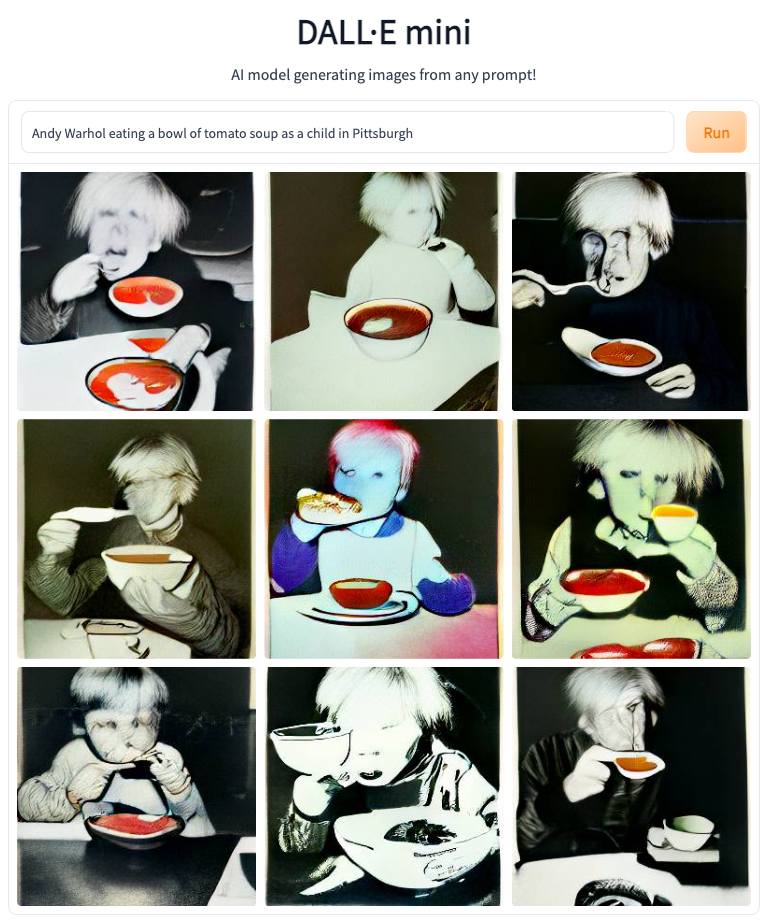
Ah, there we go!
I was curious to know how DALL‑E Mini would riff on its namesake artist’s handle (an honor Dali shares with the titular AI hero of Pixar’s 2018 animated feature, WALL‑E.)
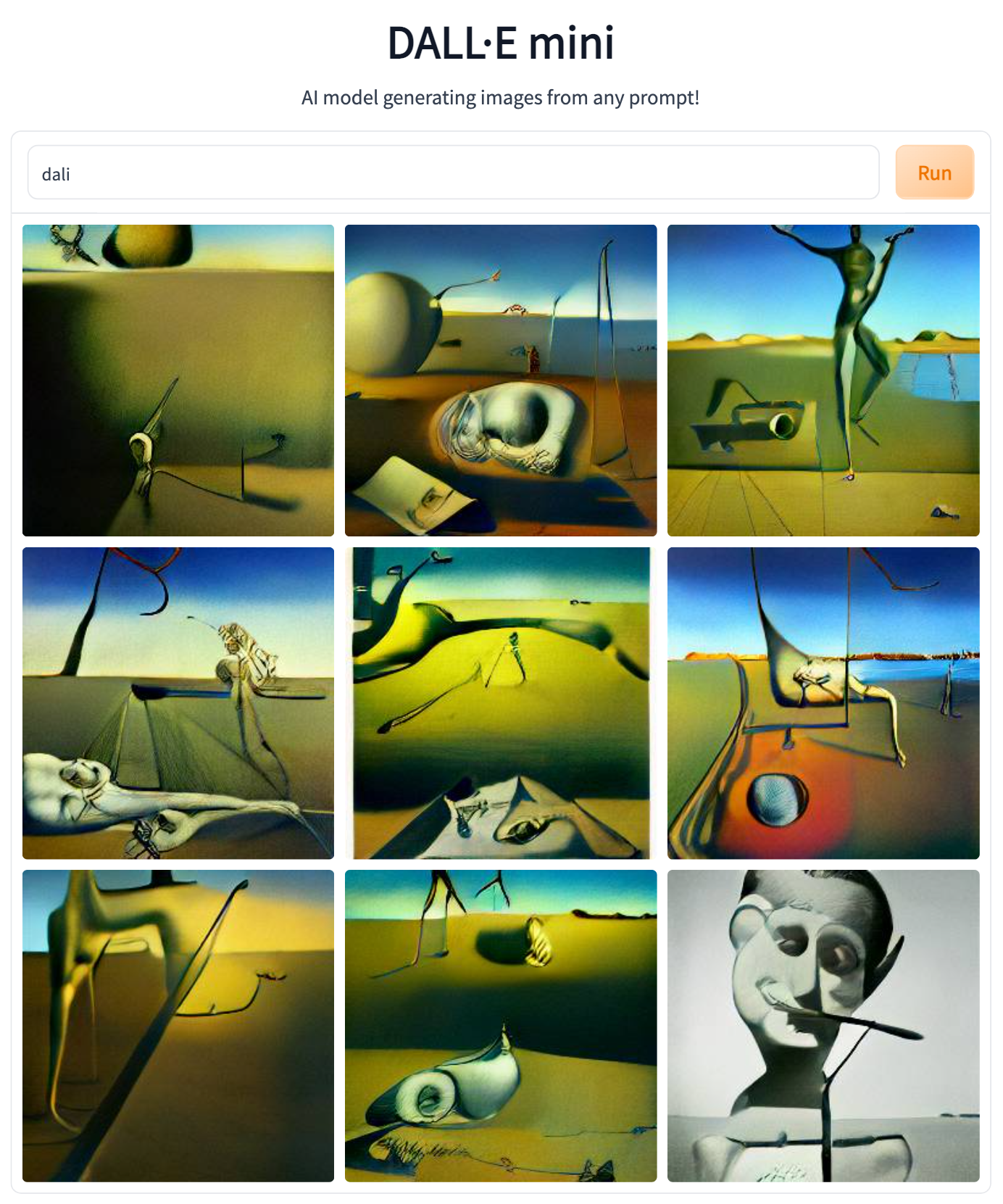
Hmm… seems like we’re backsliding a bit.
Let me try “Andy Warhol eating a bowl of tomato soup as a child in Pittsburgh with Salvador Dali.”
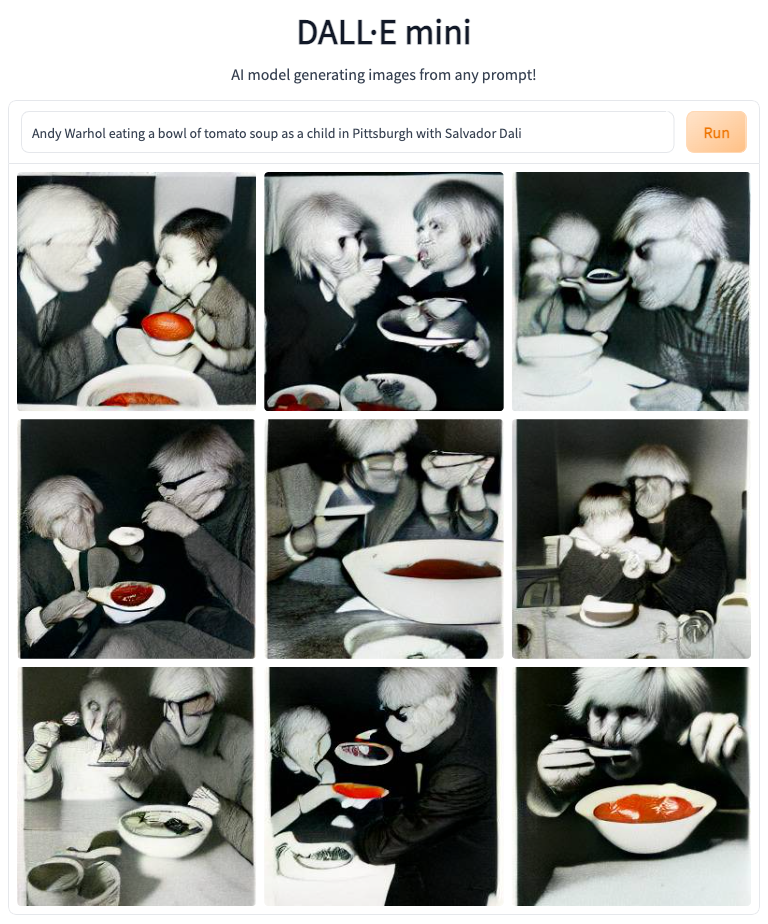
Ye gods! That’s the stuff of nightmares, but it also strikes me as pretty legit modern art. Love the sparing use of red. Well done, DALL‑E mini.
At this point, vanity got the better of me and I did the AI art-generating equivalent of googling my own name, adding “in a tutu” because who among us hasn’t dreamed of being a ballerina at some point?
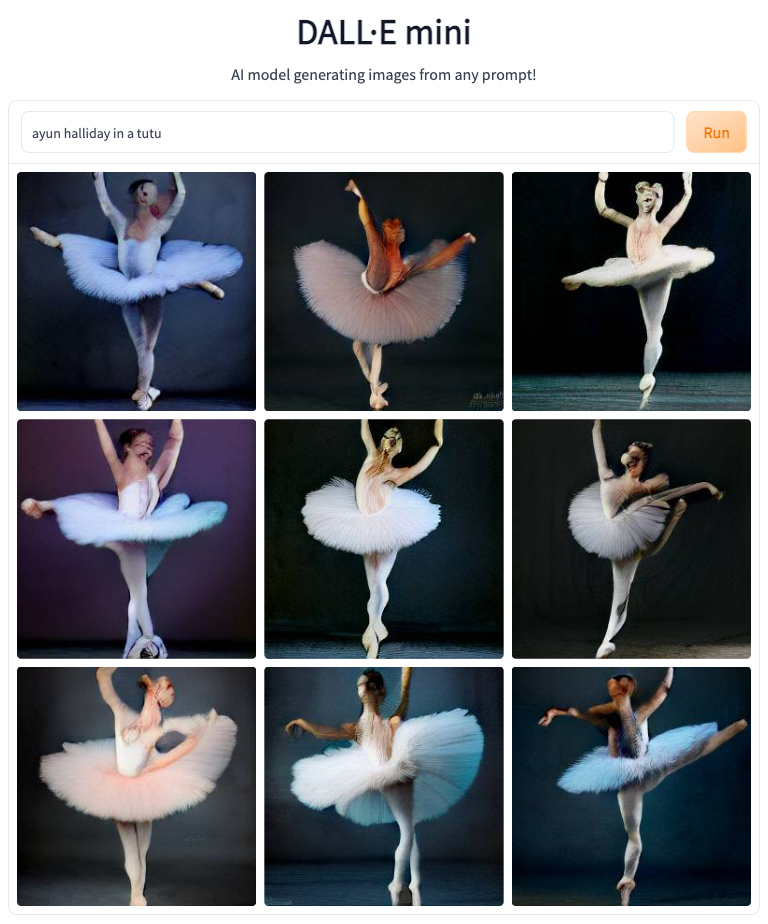
Let that be a lesson to you, Pandora…
Hopefully we’re all planning to use this playful open AI tool for good, not evil.
Hyperallergic’s Sarah Rose Sharp raised some valid concerns in relation to the original, more sophisticated DALL‑E:
It’s all fun and games when you’re generating “robot playing chess” in the style of Matisse, but dropping machine-generated imagery on a public that seems less capable than ever of distinguishing fact from fiction feels like a dangerous trend.
Additionally, DALL‑E’s neural network can yield sexist and racist images, a recurring issue with AI technology. For instance, a reporter at Vice found that prompts including search terms like “CEO” exclusively generated images of White men in business attire. The company acknowledges that DALL‑E “inherits various biases from its training data, and its outputs sometimes reinforce societal stereotypes.”
Co-creator Dayma does not duck the troubling implications and biases his baby could unleash:
While the capabilities of image generation models are impressive, they may also reinforce or exacerbate societal biases. While the extent and nature of the biases of the DALL·E mini model have yet to be fully documented, given the fact that the model was trained on unfiltered data from the Internet, it may generate images that contain stereotypes against minority groups. Work to analyze the nature and extent of these limitations is ongoing, and will be documented in more detail in the DALL·E mini model card.
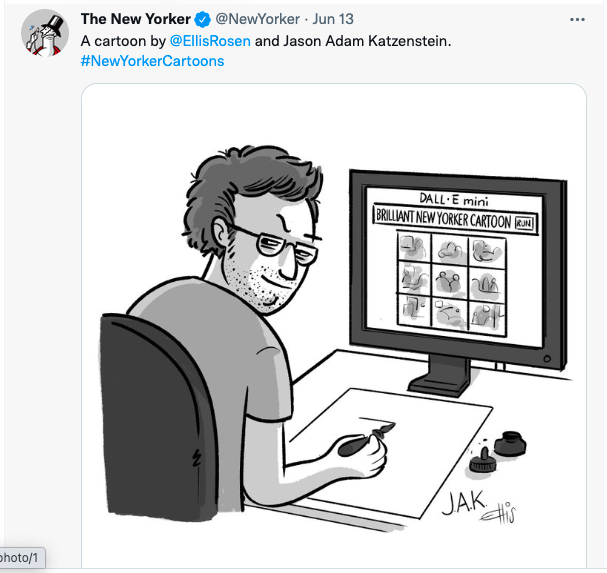
The New Yorker cartoonists Ellis Rosen and Jason Adam Katzenstein conjure another way in which DALL‑E mini could break with the social contract:
And a Twitter user who goes by St. Rev. Dr. Rev blows minds and opens multiple cans of worms, using panels from cartoonist Joshua Barkman’s beloved webcomic, False Knees:
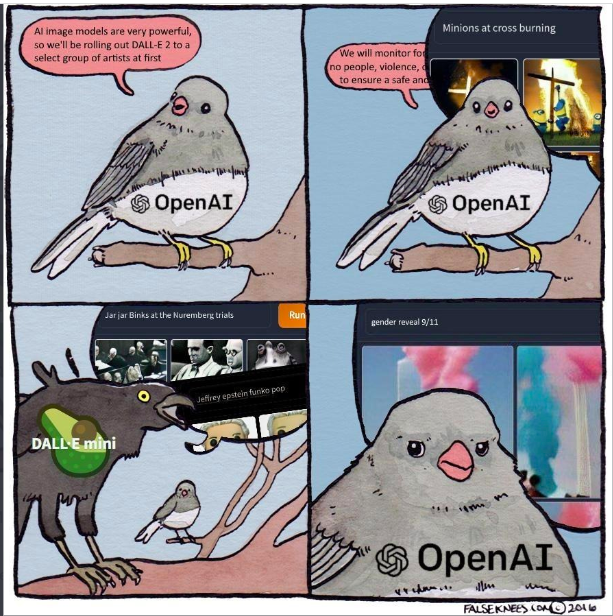
Proceed with caution, and play around with DALL‑E mini here.
Get on the waitlist for original flavor DALL‑E access here.
Related Content
- Ayun Halliday is the Chief Primatologist of the East Village Inky zine and author, most recently, of Creative, Not Famous: The Small Potato Manifesto. Follow her @AyunHalliday.
Read More...Ziggy Stardust Turns 50: Celebrate David Bowie’s Signature Character with a Newly Released Version of “Starman”
David Bowie’s fans have now been enjoying the character of Ziggy Stardust for a full five decades. That’s hardly a bad run, given that the opening track of The Rise and Fall of Ziggy Stardust and the Spiders from Mars announces that the end of the world will come in just five years. Released on June 16th, 1972, that album gave the public its introduction to the title character, an androgynous rock star from a distant star who one day arrives, messiah-like, on the dying Earth. But as the musical story goes, the resulting fame proves too much for him: the hapless Ziggy ends up in shambles, victimized by Earthly desires in all their manifestations.
One could read into all this certain aspirations and fears on the part of Ziggy Stardust’s creator-performer, the young David Bowie. Broad critical consensus holds that it was on the previous year’s Hunky Dory that Bowie first showed his true artistic potential.
Though that album, his fourth, boasted signature-songs-to-be like “Changes” and “Life on Mars?”, Bowie declared (no doubt to the label’s frustration) that he wouldn’t bother promoting it, since he was just about to change his image. This turned out to be a shrewd move, since his subsequent transformation into Ziggy Stardust launched him out of the realm of the respected niche singer-songwriter and into the stratosphere of the bona fide rock star.
Why did Ziggy Stardust drive so many listeners to near-maniac appreciation half a century ago? In Bowie’s native England, many cite his July 1972 performance of “Starman” the BBC’s Top of the Pops as the turning point. Though only mildly psychedelic, the segment celebrated the colorfully askew glamour of Bowie-as-Ziggy and his band the Spiders from Mars just when it was desperately needed. As music critic Simon Reynolds writes, “It is hard to reconstruct the drabness, the visual depletion of Britain in 1972, which filtered into the music papers to form the grey and grubby backdrop to Bowie’s physical and sartorial splendor.” Today you can hear a newly released 2022 mix of “Starman” constructed from the tracks recorded for Top of the Pops those 50 years ago.
Imagine the impact on a young English pop-music fan in 1972 who happened to be watching on color (or rather, colour) television, itself introduced only a few years earlier. Though Bowie may have chosen just the right historical moment to debut the first of his musical personae, he didn’t create Ziggy Stardust ex nihilo. Elements of the character have clear precedents earlier in Bowie’s career, not least in the promotional film for 1968’s “Space Oddity,” the 2001-inspired single that first associated him with the realms beyond our planet. But Ziggy was Bowie’s first genuine alter ego, a character perfectly suited to the era of “glam rock” who could conveniently be retired when that era passed. Glam rock may be long gone, but Ziggy Stardust still looks and sounds as if he’d only just landed on Earth.
Related content:
David Bowie Recalls the Strange Experience of Inventing the Character Ziggy Stardust (1977)
The Story of Ziggy Stardust: How David Bowie Created the Character that Made Him Famous
David Bowie Became Ziggy Stardust 48 Years Ago This Week: Watch Original Footage
Hear Demo Recordings of David Bowie’s “Ziggy Stardust,” “Space Oddity” & “Changes”
David Bowie Remembers His Ziggy Stardust Days in Animated Video
Based in Seoul, Colin Marshall writes and broadcasts on cities, language, and culture. His projects include the Substack newsletter Books on Cities, the book The Stateless City: a Walk through 21st-Century Los Angeles and the video series The City in Cinema. Follow him on Twitter at @colinmarshall, on Facebook, or on Instagram.
Read More...Support Us
We're hoping to rely on loyal readers, rather than erratic ads. Please click the Donate button and support Open Culture. You can use Paypal, Venmo, Patreon, even Crypto! We thank you!

About Us

Open Culture scours the web for the best educational media. We find the free courses and audio books you need, the language lessons & educational videos you want, and plenty of enlightenment in between.
Advertise With Us
FREE UPDATES!
GET OUR DAILY EMAIL
Get the best cultural and educational resources on the web curated for you in a daily email. We never spam. Unsubscribe at any time.
FOLLOW ON SOCIAL MEDIA
Open Culture editor Dan Colman scours the web for the best educational media. He finds the free courses and audio books you need, the language lessons & movies you want, and plenty of enlightenment in between.
Advertise With Us


