Hayao Miyazaki’s My Neighbor Totoro Is Getting Adapted for the Stage by The Royal Shakespeare Company & Jim Henson’s Creature Shop

The films of Hayao Miyazaki’s Studio Ghibli have won immense worldwide acclaim, in large part because they so fully inhabit their medium. Their characters, their stories, their worlds: all can come fully to life only in animation. Still, it’s true that some of their material did originate in other forms. The pre-Ghibli breakout feature Nausicaä of the Valley of the Wind, for instance, began as a comic book written and drawn by Miyazaki (who at first laid down the condition that it not be adapted for the screen). Four years later, by the time of My Neighbor Totoro, the nature of Ghibli’s visions had become inseparable from that of animation itself.
Now, almost three and a half decades after Totoro’s original release, the production of a stage version is well underway. Playbill’s Raven Brunner reports that the show “will open in London’s West End at The Barbican theatre for a 15-week engagement October 8‑January 21, 2023.
The production will be presented by the Royal Shakespeare Company and executive producer Joe Hisaishi.” Japan’s most famous film composer, Hisaishi scored Totoro as well as all of Miyazaki’s other Ghibli films so far, including Porco Rosso, Princess Mononoke, and Spirited Away (itself adapted for the stage in Japan earlier this year).
As you can see in the video just above, the RSC production of Totoro also involves Jim Henson’s Creature Shop. “The puppets being built at Creature Shop are based on designs created by Basil Twist, one of the UK’s most innovative puppeteers,” writes Deadline’s Baz Bamigboye, and they’ll be supplemented by the work of another master, “Mervyn Millar, of Britain’s cutting-edge Significant Object puppet studio.” Even such an assembly of puppet-making expertise will find it a formidable challenge to re-create the denizens of the enchanted countryside in which Totoro’s young protagonists find themselves — to say nothing of the titular wood spirit himself, with all his mass, mischief, and overall benevolence. As for how they’re rigging up the cat bus, Ghibli fans will have to wait until next year to find out.
Related content:
Studio Ghibli Producer Toshio Suzuki Teaches You How to Draw Totoro in Two Minutes
Jim Henson Teaches You How to Make Puppets in Vintage Primer From 1969
Based in Seoul, Colin Marshall writes and broadcasts on cities, language, and culture. His projects include the Substack newsletter Books on Cities, the book The Stateless City: a Walk through 21st-Century Los Angeles and the video series The City in Cinema. Follow him on Twitter at @colinmarshall, on Facebook, or on Instagram.
Read More...Take Graphic Design Courses to Launch Your Career as a Graphic Designer, Video Game Designer, UI Designer & More

What can you do with graphic design skills? More and more, it seems, as emerging technologies drive new apps, software, and games. New design challenges are everywhere, from human-machine interfaces, to 3D modeling in video games and animated films, to re-imagining classic designs in print and on screen. In addition to traditional jobs like art director, graphic designer, production artist, and animator, the past few years have seen a sharp rise in demand for User Experience (UX) and User Interface (UI) designers, roles that require a variety of different creative and technical skill sets.
You could get a four-year degree in design to work in one of these fields, or you could take a Coursera Specialization and be one step closer. Coursera has met the demand for new job skills and tech education by partnering with top arts institutions and universities to offer online courses at low cost. All of these courses grant certificates that show potential employers you’re ready to put your learning to use. If careers in art and contemporary design, graphic design, web user experience and interface design, or video game design appeal to you, you can learn those skills in the five certificate-granting Specialization programs below.
- Graphic Design Specialization (5 courses offered by California Institute of the Arts)
- UI / UX Design Specialization (4 courses offered by California Institute of the Arts)
- Modern and Contemporary Art and Design Specialization (4 courses Museum of Modern Art)
- Game Design: Art and Concepts Specialization (4 courses offered by California Institute of the Arts)
- Graphic Design Elements for Non-Designers Specialization (4 courses offered by University of Colorado Boulder)
Graphic designers can choose to be as specialized or generalized as they like, but as in all creative fields, they need a thorough understanding of the basics. A Coursera Specialization is a series of courses intended to lead students to mastery, building on the history and foundations of the field. You can enroll for free and try out any of the Specializations for 7 days. After that, you’ll be charged between $39-$49 per month until you complete the courses in a Specialization. (Financial aid is available).
The exciting Specializations from CALARTS and the Museum of Modern Art will bring you many steps closer to a new career, or maybe even a new personal passion project.
Note: Open Culture has a partnership with Coursera. If readers enroll in certain Coursera courses and programs, it helps support Open Culture.
Related Content:
Josh Jones is a writer and musician based in Durham, NC. Follow him at @jdmagness
Read More...Bars, Beer & Wine in Ancient Rome: An Introduction to Roman Nightlife and Spirits
When they finally get those kinks worked out of the time machine and we can take a tourist trip back to Rome—having signed the non-intervention paperwork, of course—we’re going to need someone to guide us. I propose that should be Garrett Ryan, host of the Told In Stone YouTube channel, PhD in Greek and Roman History, and author of Naked Statues, Fat Gladiators, and War Elephants: Frequently Asked Questions about the Ancient Greeks and Romans. He has made it his job to answer the everyday questions about these two ancient cultures that most historians pass over. But these are the questions we’re going to need as tourists if we think we’re going to go party in Ancient Rome.
Because invariably somebody in our tourist group is going to ask “where’s the bars and nightclubs?” Fair question. Ryan has the answers, all told in the video above.
Much like Las Vegas or Dubai, the real partying is happening at the elite levels, among the idle rich who could afford day long banquets, extravagant activities such as live lion hunts, and import dancers from as far away as Spain. In Ryan’s reconstruction of a debauched night out he follows a typical nouveau riche who goes slumming in the grimier parts of the city, picks fights that his bodyguards sort out, and then lies his way into a party at a mansion by claiming to know a friend inside. (He also bribes the guards). And then it’s on and on until the break of dawn.
For the majority of Romans though, the cities weren’t bustling at night. Most people rose at dawn and slept at dusk. Bars and eateries did exist, however. After the dinner hour, these weren’t family-friendly establishments. There was gambling and drinking, and harried waitresses who didn’t have time for dummies, and the beer and wine was cheap and exceptionally low quality, and…wait, what exactly has changed? Not much, it seems.
Ryan’s other videos offer quick histories on the beer and wine selections you might find in Rome and in the larger empire. Although the upper classes looked down their Roman noses at beer, a majority of future Europe preferred it, including Gaul, also known as modern day France. Tacitus considered beer (from Germany) as bad as spoiled wine. And indeed a lot of it was sour, improved with the addition of sweeteners. The physician Dioscorides didn’t like beer because it caused excessive gas. And while that might be true, it’s not like Roman wine would win any gold medals these days.
Both the Greeks and the Romans preferred their wine heavily watered down, which might have been necessary for its strong taste. Sweeteners like honey would also be added to improve the taste. And most wine, fermented in vats, only lasted up to a year before turning to vinegar.
There’s so much more to learn at these videos, you should just dive in. But when the time travel trip comes, please keep your 21st century opinions to yourself until we’re safely home.
Related Content:
An 8‑Minute Animated Flight Over Ancient Rome
The History of Ancient Rome in 20 Quick Minutes: A Primer Narrated by Brian Cox
The Changing Landscape of Ancient Rome: A Free Online Course from Sapienza University of Rome
Ted Mills is a freelance writer on the arts who currently hosts the Notes from the Shed podcast and is the producer of KCRW’s Curious Coast. You can also follow him on Twitter at @tedmills, and/or watch his films here.
Read More...Free Online: Watch Stalker, Solaris, Mirror, and Other Masterworks by Soviet Auteur Andrei Tarkovsky
Andrei Tarkovsky understood cinema in a way no filmmaker had before — and, quite possibly, in a way no filmmaker has since. That impression is reinforced by any of his films, five of which are available to watch free on Youtube. You’ll find them on the Youtube channel of Mosfilm, which was once the Soviet Union’s biggest film studio. It was for Mosfilm that Tarkovsky directed his debut feature Ivan’s Childhood in 1962. Based on a folkloric war story by Soviet writer Vladimir Bogomolov, the film had already been made by another young director but rejected by the studio. Tarkovsky’s version both satisfied the higher-ups and, with its international success, introduced the world to his own distinctive cinematic vision.
“My discovery of Tarkovsky’s first film was like a miracle. Suddenly, I found myself standing at the door of a room the keys of which had, until then, never been given to me.” These are the words of Ingmar Bergman, to whom Tarkovsky would much later pay tribute with his final film, The Sacrifice, produced in Bergman’s homeland of Sweden.
But in between these films would come five others, each widely considered a masterwork in its own way. Andrei Rublev offers a Tarkovskian view of the fifteenth-century Russia inhabited by the eponymous icon painter. Solaris adapts Stanislaw Lem’s science-fiction novel of a sentient planet and its psychological manipulation of cosmonauts onboard a nearby space station.
It was with 1975’s Mirror that Tarkovsky turned inward. Drawing as deeply as possible from the artistic potential of his medium, he created a cinematic experience rich with memory, history, reality, and dreams — a kind of “poetry” in cinema, as one often hears his work described. The resulting break with many of the conventions and expectations attached to motion pictures at the time polarized critical and popular reaction. But the intervening 47 years have venerated Tarkovsky’s artistic brazenness: in Sight & Sound’s most recent 100 Greatest Films of All Time poll, Mirror came in at number nineteen, seven places higher than Andrei Rublev.
Despite having come in three spots below Andrei Rublev on the Sight & Sound poll, 1979’s Stalker is to many Tarkovsky fans far and away the auteur’s greatest achievement. Its apparently linear, vaguely science-fictional narrative presents a journey into “the Zone,” a mysterious region containing a room that grants the wishes of all who enter it. This simplistic-sounding premise belies a film of infinite depth: “I’ve seen Stalker more times than any film except The Great Escape,” writes Geoff Dyer (who once devoted an entire book to the former). “It’s never quite as I remember. Like the Zone, it’s always changing.” We watch Stalker — or indeed, anything in Tarkovsky oeuvre — not to see a movie, but to see “the reason cinema was invented.”
Related content:
Andrei Tarkovsky’s Very First Films: Three Student Films, 1956–1960
The Story of Stalker, Andrei Tarkovsky’s Troubled (and Even Deadly) Sci-Fi Masterpiece
Andrei Tarkovsky’s Solaris Shot by Shot: A 22-Minute Breakdown of the Director’s Filmmaking
The Poetic Harmony of Andrei Tarkovsky’s Filmmaking: A Video Essay
Slavoj Žižek Explains the Artistry of Andrei Tarkovsky’s Films: Solaris, Stalker & More
Based in Seoul, Colin Marshall writes and broadcasts on cities, language, and culture. His projects include the Substack newsletter Books on Cities, the book The Stateless City: a Walk through 21st-Century Los Angeles and the video series The City in Cinema. Follow him on Twitter at @colinmarshall, on Facebook, or on Instagram.
Read More...What Makes Vermeer’s The Milkmaid a Masterpiece?: A Video Introduction
Johannes (or Jan) Vermeer’s tranquil domestic scenes draw larger crowds than nearly any other European painter; he, like Rembrandt, is synonymous with the phrase “Dutch Master.” But for much of its existence, his work lay in near-obscurity. After his death, some of his most-renowned paintings passed through the hands of patrons and collectors for next to nothing. In 1881, for example, Girl with a Pearl Earring sold for two guilders, thirty cents, or about $26.
While other Vermeer masterpieces languished, one painting never lost its value. The Milkmaid – “probably purchased from the artist by his Delft patron Pieter van Ruijven,” who owned twenty-one of the artist’s works, notes the Met — was described at its 1696 auction as “exceptionally good.” It fetched the second highest price of Vermeer’s works (next to View of Delft). In 1719, “The famous milkmaid, by Vermeer of Delft” (described as “artful”) began its journey through a series of significant Amsterdam collections.
The Milkmaid eventually landed in the hands of “one of the great woman collectors of Dutch art, Lucretia Johanna van Winter,” who married into the wealthy Six family of art collectors. Finally, in 1908, the Rijksmuseum purchased the painting from her sons with help from the Dutch government. The Milkmaid, that is to say, has remained part of the cultural heritage of the Netherlands from its beginnings. In the Great Art Explained video above, you can learn what makes this early work, painted between 1657–58, so special.
The Baroque art that preceded Vermeer’s generation “came from conflict,” namely the religious wars of the Reformation and Counter-Reformation. “The art being produced in Catholic countries had become a powerful tool of propaganda, characterized by a heightened sense of drama, movement and theatricality that had never been seen before.” We see the dramatic transition in Dutch art in the movement from Peter Paul Rubens to Vermeer, as “simple domestic interiors of middle-class life” became dominant: “secular works that contain stories of real human relationships.” Those works arose in a Calvinist culture that banned religious imagery and stressed “simplicity in both worship and decorative style.”
The Dutch break with Catholic tradition meant a total reinvention of Dutch art; thus came the realist tradition, produced not for the church but the wealthy merchant class, with Vermeer as one of its early masters because of his near-photographic rendering of natural light and naturalistic composition. Vermeer epitomized the new Dutch art, despite the fact that he was a Catholic convert through marriage. After his marriage, he spent his life “in the same town, the same house, slowly producing paintings in the same room… at a rate of two or three a year.” His output, perhaps 60 paintings — 36 of which survive — pales in comparison to that of his peers. But of all the artists producing domestic scenes, “there were none quite like Vermeer.”
These scenes hardly seem radical to viewers today. They are prized for everything they are not — they are not Rubens: wild, fleshy, passionate, lascivious, exuberant… but that does not mean they are devoid of eroticism. There are obvious signifiers, such as a tile showing Cupid “brandishing his bow.” (Reminding us of a once-hidden Cupid in another famous Vermeer.) There are signs much less obvious to us, such as the foot warmer, employed to “frequently suggest feminine desire in Dutch genre paintings,” the Met writes. And then there is the resemblance of Vermeer’s “milkmaid” — with her downcast eyes, white bonnet, and yellow blouse — to a figure in The Procuress, painted the year previous, a work composed almost entirely of leers and gropes (and said to feature the only self-portrait of the artist himself.)
Vermeer’s Milkmaid “exudes a very earthy appeal,” a quality that comes through not only in its sexual undertones but also in its ideal depiction of Dutch “domestic virtue.” Both are suggested at once by the pitcher and the milk, common symbols of female sexuality. But it is a painting that transcends the genre, which often enough shaped itself for the gaze of male employers in a society that “acknowledged and accepted that maids engaged in love affairs with their masters,” Giordana Goretti writes,” with consent or without it.” The “earthiness” of Vermeer’s middle-class domestic paintings — perhaps most profoundly in The Milkmaid as you’ll learn above — comes from a triumph of painterly technique and perspective, creating scenes so seemingly real that they resist objectification.
Related Content:
A 10 Billion Pixel Scan of Vermeer’s Masterpiece Girl with a Pearl Earring: Explore It Online
A Restored Vermeer Painting Reveals a Portrait of a Cupid Hidden for Over 350 Years
Josh Jones is a writer and musician based in Durham, NC. Follow him at @jdmagness
Read More...Why 99% Of Smithsonian’s Specimens Are Hidden In High-Security
Museums are the memory of our culture and they’re the memory of our planet. — Dr. Kirk Johnson, Director, Smithsonian National Museum of Natural History
For many of us natural history museums are emblematic of school field trips, or rainy day outings with (or as) children.
There’s always something to be gleaned from the reconstructed dinosaur skeletons, dazzling minerals, and 100-year-old specimens on display.
The educational prospects are even greater for research scientists.
The above entry in Business Insider’s Big Business series takes us behind the scenes of the Smithsonian Natural History Museum, a federally-funded institution where more than 99% of its vast collection is housed in the basement, on upper floors and employees-only wings of exhibition floors, or at an offsite facility in neighboring Maryland.
The latter is poised to provide safe space for more of these treasures as climate change-related flooding poses an increasingly dire threat. The museum’s National Mall location, which draws more than 6 million visitors annually, is now virtually at sea level, and Congress is moving at a pace formerly known as glacial to approve the expensive but necessary structural improvements that would safeguard these precious collections.
The museum currently boasts some 147 million specimens, and is continually adding more, by means of field collections, donations, and purchases made with endowments, though as a non-profit institution, it’s rarely able to outbid deep-pocketed private collectors at auctions of hot-ticket items like large dinosaur bones.
The Division of Birds’ daily mail brings samples of “snarge” — whatever’s left over when a bird makes impact with an aircraft.
Upon arrival at the Smithsonian, whatever its size or market value, every item is subjected to a process of inspection known as “accessioning”.
After that, it is meticulously cleaned.
Beetles in an offsite Osteo Prep Lab get to work on residual organic materials like skin and tissue.
Human experts use a handheld air scrape tool to incrementally separate fossils from the rocky matrix in which they were discovered
The goal is permanent storage state.
Geological specimens are classified according to Dana’s System of Mineralogy and stored in drawers. High-value items are assigned to the Blue Room or the Gem Vault.
Bones that are looking to spend the better part of eternity on a shelf are fitted for custom fiberglass and plastic cradles to protect against pests, moisture, and gravity-related stress fractures.
The Department of Entomology dries and pins incoming insects, arachnids, and myriapods, and stores them in hydraulic carriages.
Mammals, reptiles, fish and birds are stuffed or pickled in alcohol.
Many items in the museum’s collection date back to the early 20th century.
These days, staff strive to preserve as much as they can, using every tool and scientific advancement at their disposal. As ornithologist and feather identification specialist Carla Dove, states, “It’s our responsibility to do as much as we can with the specimen if we’re going to take it from the wild for research.”
These careful preparations ensure that the world’s largest natural history collection can continue to serve as a living library for thousands of visiting scientists…climate change permitting.
Access to the Museum of Natural History’s collections and databases result in the publication of hundreds of research papers and the identification of hundreds of new species every year.
In addition to providing valuable intelligence for research initiatives on such topics as disease transmission, volcanic activity, and of course, the effects of bird strikes on airplanes, museum staff is working toward a goal of preserving each item with a digital scan — 9 million and counting…
Related Content
The Smithsonian Puts 2.8 Million High-Res Images Online and Into the Public Domain
Smithsonian Digitizes & Lets You Download 40,000 Works of Asian and American Art
The Smithsonian Picks “101 Objects That Made America”
- Ayun Halliday is the Chief Primatologist of the East Village Inky zine and author, most recently, of Creative, Not Famous: The Small Potato Manifesto. Follow her @AyunHalliday.
Read More...Free: Watch Battleship Potemkin and Other Films by Sergei Eisenstein, the Revolutionary Soviet Filmmaker
When it launched fifteen years ago, the movie podcast Battleship Pretension took its name from two well-known sources: an attitude popularly associated with cinephiles, and a 1925 motion picture by Sergei Eisenstein. To some, merely referencing a silent film made by a Soviet auteur in 1925 constitutes sufficient evidence of pretension in and of itself. But most, even those who’ve never seen a frame of Eisenstein’s work, do recognize that Battleship Potemkin has an important place in cinema history — and if they actually watch the movie, which is embedded just above, they’ll find that it looks and feels more familiar than they’d expected.
Like any work of wide and deep influence, Battleship Potemkin has often been parodied over its nearly 100 years of existence. But none of its scenes has been paid as much homage, tongue in cheek or elsewhere, than the massacre on the Odessa Steps, the symbolic entryway to that city in what’s now Ukraine.
“Czarist troops march down a long flight of steps, firing on the citizens who flee before them in a terrified tide,” as Roger Ebert describes it. “Countless innocents are killed, and the massacre is summed up in the image of a woman shot dead trying to protect her baby in a carriage — which then bounces down the steps, out of control.”
The content of this sequence is as harrowing as its form is revolutionary. That’s true in the propagandistic sense, but even more so in the artistic one: the Odessa Steps massacre, like the whole of Battleship Potemkin, functions as a proof-of-concept for Eisenstein’s theories of montage. Today we take for granted — and in some cases have even come to resent — that movies so expertly juxtapose their images so as to provoke the most intense emotional response possible within us. That wasn’t so much the case a century ago, when most examples of the still-novel art form of cinema used their visuals simply to make their narratives legible.
Eisenstein, however, understood cinema’s true potential. He explored it in a range of pictures that also included Ten Days That Shook the World, a dramatization of the 1917 October Revolution; Alexander Nevsky, on the repulsion of invaders by the eponymous thirteenth-century prince; and the epic historical drama Ivan the Terrible, the story of the first tsar of all Russia (and idol of Stalin, who commissioned the project).
You can watch these films, as well as Eisenstein’s unfinished tribute to the Mexican Revolution ¡Que viva México!, free on the Youtube channel of Mosfilm, the preeminent studio in the Soviet era. That Eisenstein’s techniques have survived not just him but the Soviet Union itself underscores a truth he might have suspected, but never admitted: cinema is more powerful than politics.
Related content:
Sergei Eisenstein’s Ten Days That Shook the World (1928)
A Visual Introduction to Soviet Montage Theory: A Revolution in Filmmaking
Sergei Eisenstein’s Seminal Battleship Potemkin Gets a Soundtrack by Pet Shop Boys
101 Free Silent Films: The Great Classics
Based in Seoul, Colin Marshall writes and broadcasts on cities, language, and culture. His projects include the Substack newsletter Books on Cities, the book The Stateless City: a Walk through 21st-Century Los Angeles and the video series The City in Cinema. Follow him on Twitter at @colinmarshall, on Facebook, or on Instagram.
Read More...Marie Curie’s Ph.D. Thesis on Radioactivity–Which Made Her the First Woman in France to Receive a Doctoral Degree in Physics
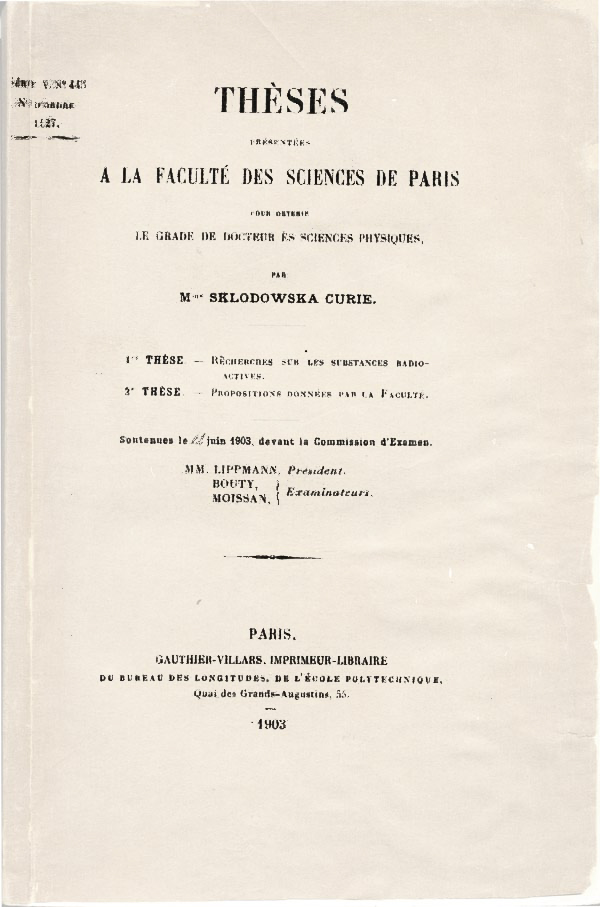
For her groundbreaking research on radioactivity, Marie Curie won the Nobel Prize. Or rather, she won two, one for physics and another for chemistry, making her the only Nobel Laureate in more than one science. What’s more, her first Nobel came in 1903, the very same year she completed her PhD thesis at the Sorbonne. In Recherches sur les substances radioactives (or Research on Radioactive Substances), Curie “talks about the discovery of the new elements radium and polonium, and also describes how she gained one of the first understandings of the new physical phenomenon of radioactivity.”
So says science Youtuber Toby Hendy in the introduction below to Curie’s thesis–a thesis that made her the first woman in France to receive a doctoral degree in physics. “Following on from the discovery of X‑rays by Wilhelm Roentgen in 1895 and Henri Becquerel’s discovery that uranium salts emitted similar penetration properties,” says The Document Centre, Curie “investigated uranium rays as a starting point, but in the process discovered that the air around uranium rays is made to conduct electricity.”
Her deduction that “the process was caused by properties of the atoms themselves” — a revolutionary finding that overturned previously held notions in physics — led her eventually to discover radium and polonium, which would get her that second Nobel in 1911.
Unlike her Nobel Prize in physics, which she shared with her husband Pierre and the physicist Henri Becquerel, Marie Curie won her Nobel Prize in chemistry alone. By 1911 Pierre had been dead for half a decade, but Marie’s scientific genius couldn’t be stopped from continuing their pioneering research as far as she could take it in her own lifetime. She clearly knew how vast a field her work, with and without her husband, had opened up: “Our researches upon the new radio-active bodies have given rise to a scientific movement,” she writes at the end of Recherches sur les substances radioactives. That movement continues to make discoveries more than a century later — and her original thesis itself remains radioactive.
Related content:
An Animated Introduction to the Life & Work of Marie Curie, the First Female Nobel Laureate
Marie Curie Invented Mobile X‑Ray Units to Help Save Wounded Soldiers in World War I
Marie Curie’s Research Papers Are Still Radioactive 100+ Years Later
Based in Seoul, Colin Marshall writes and broadcasts on cities, language, and culture. His projects include the Substack newsletter Books on Cities, the book The Stateless City: a Walk through 21st-Century Los Angeles and the video series The City in Cinema. Follow him on Twitter at @colinmarshall, on Facebook, or on Instagram.
Read More...Lou Reed Album With Demos of Velvet Underground Classics Getting Released: Hear an Early Version of “I’m Waiting for the Man”
In 1965, Lou Reed was a 23-year-old graduate stalled in a music and art career he wasn’t sure would take off. A few years earlier a doo-wop single recorded with high school friends had been released to no avail. More recently, a parody of dance-craze singles “Do the Ostrich”, created by Reed and performed by a pick-up band of musicians, had also made its way onto wax and then right out of people’s memories. However, John Cale was in that pick-up band, and soon the two were fast friends. It was Cale who helped record Reed’s demo tape of songs that year. And it was Reed who took the tape and mailed it back to himself as a “poor man’s copyright.”
That demo tape has now been unsealed and these never-before heard recordings are heading to LP and CD and streaming. Above you can hear a very early version of “I’m Waiting for the Man,” that would get radically reworked for the Velvet Underground’s debut album.
Over rudimentary guitar plucking, Reed’s demo is slower, has harmonies, and a more decided folk bent. Reed acts out the various parts, including the “Pardon me sir, it’s the furthest from my mind” line in a faux-Brit accent. There’s even a Dylan-esque harmonica solo.
The demo tape contains other future Velvet Underground classics like “Heroin” and “Pale Blue Eyes,” but also songs that would turn up on Berlin (“Men of Good Fortune”) and a favorite cover “Wrap Your Troubles in Dreams” that would pop up in Velvets sets. But there’s also songs that were never released in any format: “Stockpile,” “Buzz Buzz Buzz,” and “Buttercup Song.”
Reed had been influenced by poet Delmore Schwartz, who he’d studied under at Syracuse University. Schwartz had instilled in Reed the idea that the simplest words could have the maximum effect in the right hands. Reed’s style of street documentary and repetition came out of his relationship with Schwartz, whom Reed paid tribute to on the first Velvets album with “European Son.”
The album, all nicely remastered, will be available in the usual formats on August 26, including a bonus ep of earlier demos, including 1963 home recordings and a 1958 rehearsal. For now enjoy this glimpse into the mind of an artist about to find his place in the world, and he doesn’t even know it yet.
Related Content
Teenage Lou Reed Sings Doo-Wop Music (1958–1962)
How Drummer Moe Tucker Defined the Sound of the Velvet Underground
Ted Mills is a freelance writer on the arts who currently hosts the Notes from the Shed podcast and is the producer of KCRW’s Curious Coast. You can also follow him on Twitter at @tedmills, and/or watch his films here.
Read More...The Only Surviving Manuscript of John Milton’s Paradise Lost Gets Published in Book Form for the First Time
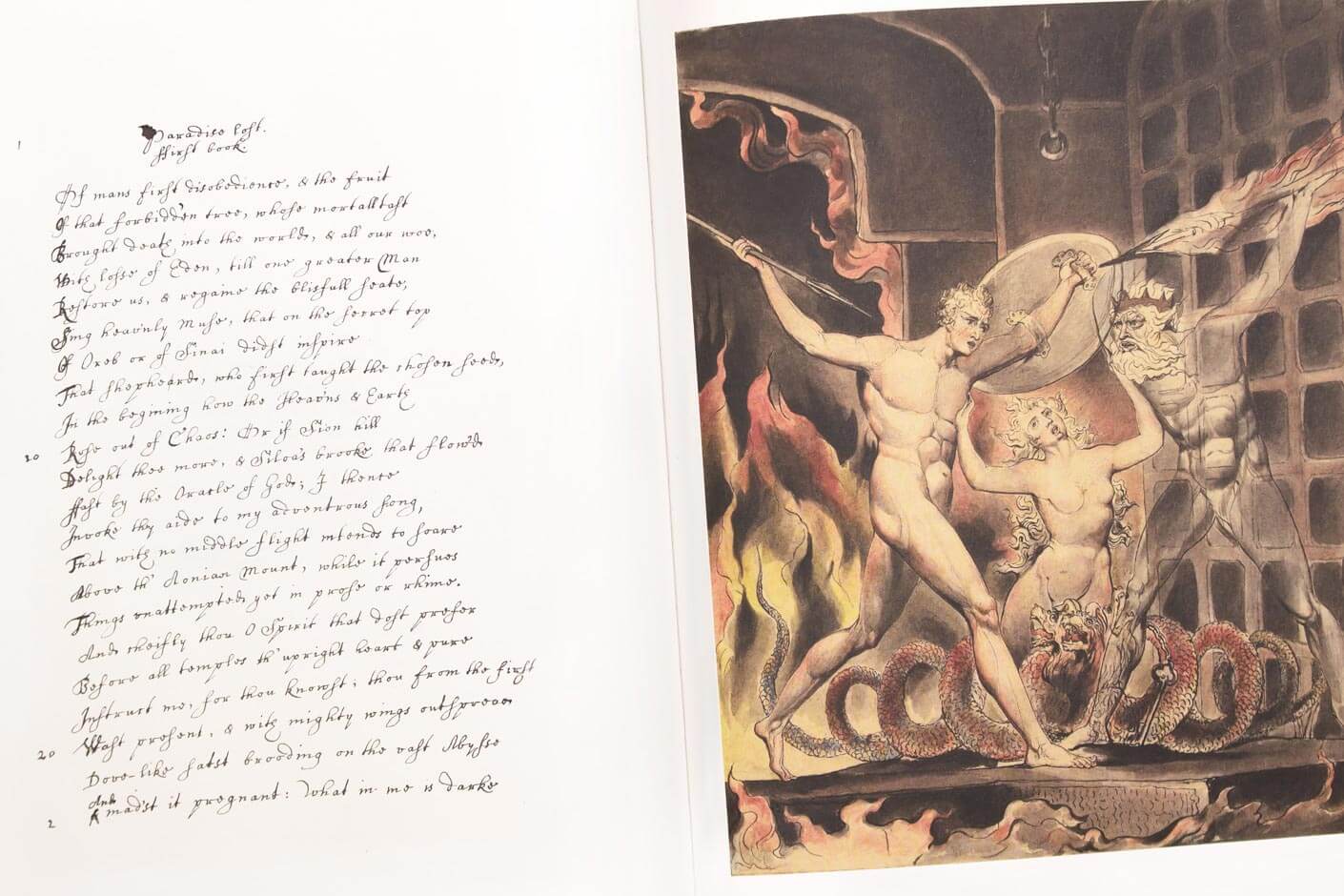
In The Marriage of Heaven and Hell, William Blake adds a note to the text that became a famous adage about John Milton’s Paradise Lost: the 10,000-line, 17th century blank verse epic about the war between heaven and hell and the failed testing of God’s premium product, human beings. Milton “wrote in fetters when he wrote of Angels & God, and at liberty when he wrote Devils & Hell,” Blake declared, “because he was a true Poet and of the Devil’s party without knowing it.” The statement inspired “other Romantic and Gothic writers to view Satan as a hero,” the British Library writes.
Blake himself illustrated Paradise Lost in three separate commissions over the course of his career as an engraver and printer. His deep admiration for the poem helped it become a “Bible of the Romantic movement,” writes the manuscript publisher SP Books in their introduction to a rare new book publication of the only surviving manuscript of the work.
Only 1,000 numbered, large format copies of this printing are available. (We do hope a subsequent edition will appear, maybe with a transcription and annotations. But it will not be as beautiful as this sky-blue cloth-covered book with Blake’s full-color illustrations.)
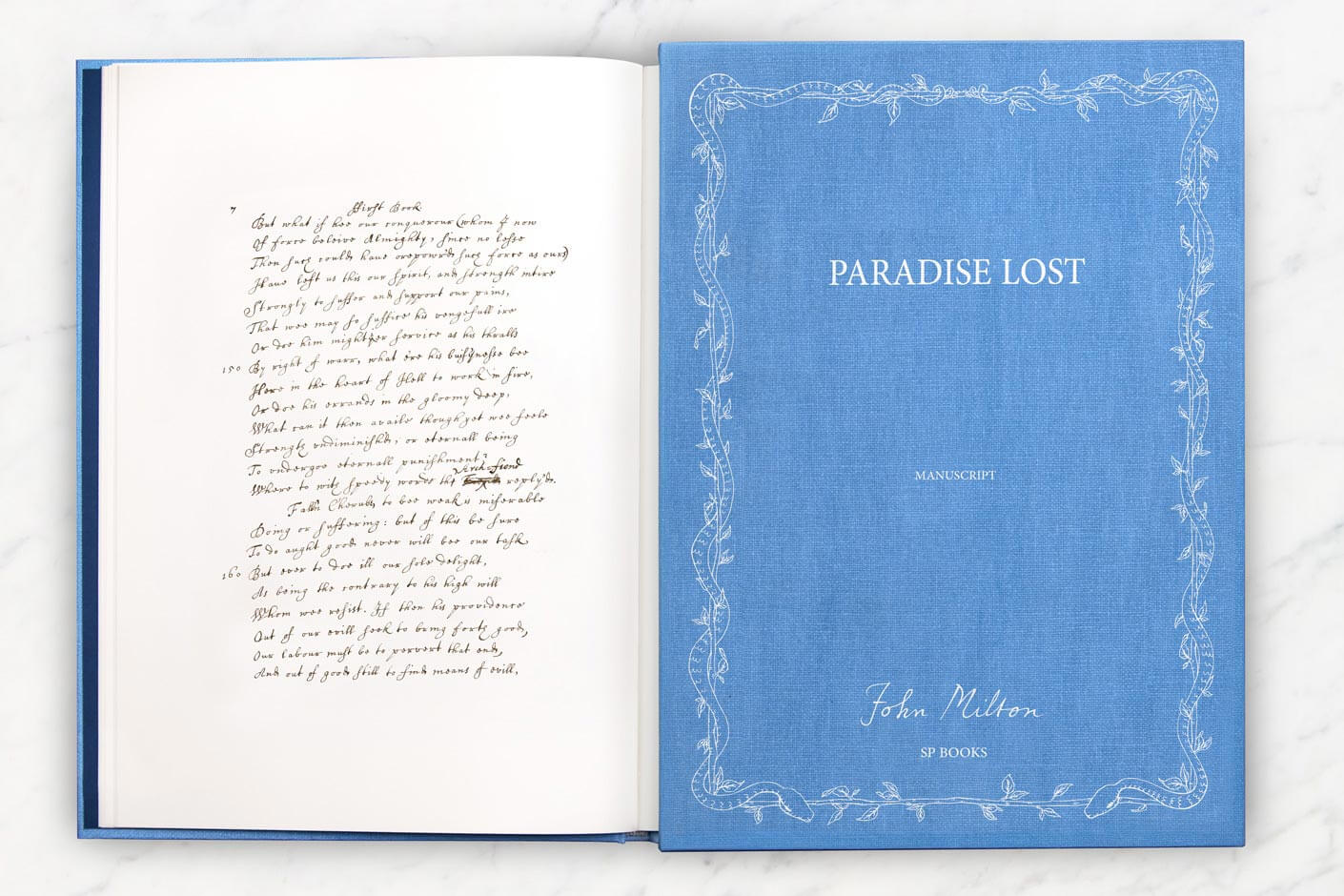
The book preserves the only part of the poem that survives in manuscript: 798 lines from Book One of Paradise Lost. These are not in Milton’s hand — he had been blind since 1652, and the poem was first published in 1667. He conceived the epic in his 50s, his career in government over after the English Civil Wars and the brief period of the Cromwells’ Protectorate ended in the Restoration of Charles II. “Milton composed ‘Paradise Lost’ aloud, in bed or (per witnesses) ‘leaning backwards obliquely in an easy chair,’ ” Lauren Christensen writes at The New York Times, “memorizing the stanzas to be transcribed in another’s hand.”
These first few hundred lines show why Satan seems so noble to Milton’s readers; speeches by and about him portray his doomed campaign as a righteous assault on heavenly tyranny. The Romantics’ use of Paradise Lost reflects their own preoccupations, while also echoing contemporary suspicions of the poem. “The authorities were concerned,” for example, Tom Paulin notes at The London Review of Books, by an image in Book One describing Satan:
as when the sun new ris’n
Looks through the horizontal misty air
Shorn of his beams, or from behind the moon
In dim eclipse disastrous twilight sheds
On half the nations, and with fear of changePerplexes monarchs.
“According to Milton’s early biographer, the Irish republican John Toland, Charles II’s Licenser for the Press regarded these lines as subversive,” Paulin points out, “and wanted to suppress the whole poem.” It’s surprising he was able to publish at all. Milton had vociferously supported the Puritan revolutionaries who overthrew the king’s father, Charles I, and removed his head. Milton later published several pamphlets in defense of regicide. In 1660, when Richard Cromwell’s Protectorate fell apart and Charles II returned, Milton’s works were banned by royal decree and the poet went into hiding until a general pardon.
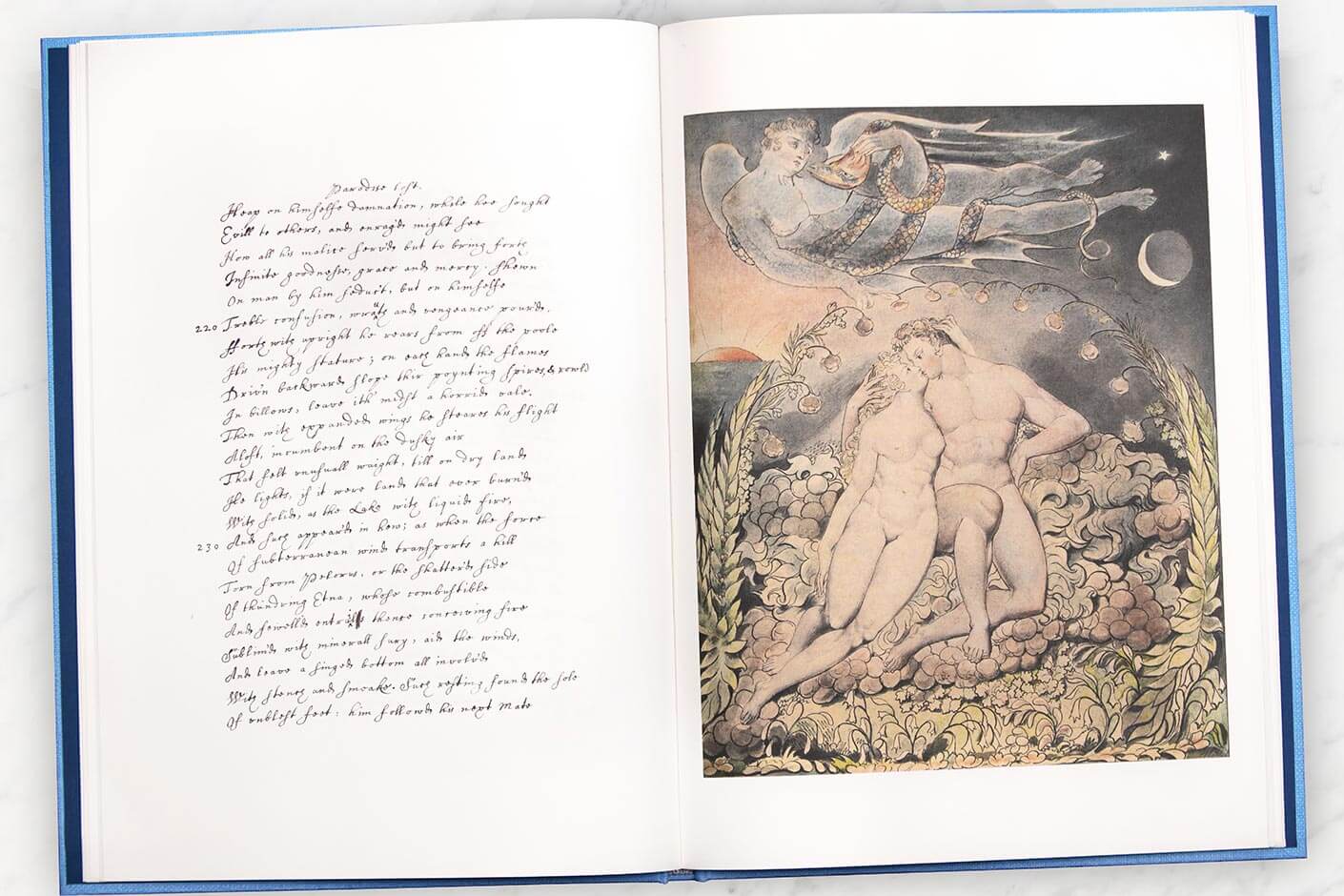
Later critics have pointed to Milton’s political writings as evidence that he knew exactly whose party he was of. California State University’s Michael Bryson has gone so far as to argue that Milton was a secret atheist. In any case, he was a passionate believer in the overthrow of kings and the establishment of republics (for which he has become a libertarian hero). Paulin sums up the critical case for Paradise Lost as an allegory for the “lost cause” of the revolution:
Milton knew that the poem he was dictating to his amaneuensis would be scrutinized by the recently restored monarch’s Licenser of the Press, so he coded the English people’s formation of a republic as the creation of the “heavens and earth.” The idea passed the censor by, just as it has passed by many readers, but it was nonetheless Milton’s founding intention in composing his epic.
The charge that Milton made Satan a hero is hard to ignore when, reading Book One, we find the poet giving the Chief of Fallen Angels the best lines, as anyone who’s read Paradise Lost will remember. If you haven’t, just see the classic example below.
The mind is its own place, and in itself
Can make a Heav’n of Hell, a Hell of Heav’n.
What matter where, if I be still the same,
And what I should be, all but less than he
Whom Thunder hath made greater? Here at least
We shall be free; th’Almighty hath not built
Here for his envy, will not drive us hence:
Here we may reign secure, and in my choice
To reign is worth ambition though in Hell:
Better to reign in Hell, than serve in Heav’n.
Learn more about this rare manuscript edition at The New York Times’ review and purchase one (if one remains) at SP Books.
Related Content:
The Otherworldly Art of William Blake: An Introduction to the Visionary Poet and Painter
Spenser and Milton (Free Course)
Josh Jones is a writer and musician based in Durham, NC. Follow him at @jdmagness
Read More...Support Us
We're hoping to rely on loyal readers, rather than erratic ads. Please click the Donate button and support Open Culture. You can use Paypal, Venmo, Patreon, even Crypto! We thank you!

About Us

Open Culture scours the web for the best educational media. We find the free courses and audio books you need, the language lessons & educational videos you want, and plenty of enlightenment in between.
Advertise With Us
FREE UPDATES!
GET OUR DAILY EMAIL
Get the best cultural and educational resources on the web curated for you in a daily email. We never spam. Unsubscribe at any time.
FOLLOW ON SOCIAL MEDIA
Open Culture editor Dan Colman scours the web for the best educational media. He finds the free courses and audio books you need, the language lessons & movies you want, and plenty of enlightenment in between.
Advertise With Us


