The First Photographs Taken by the Webb Telescope: See Faraway Galaxies & Nebulae in Unprecedented Detail
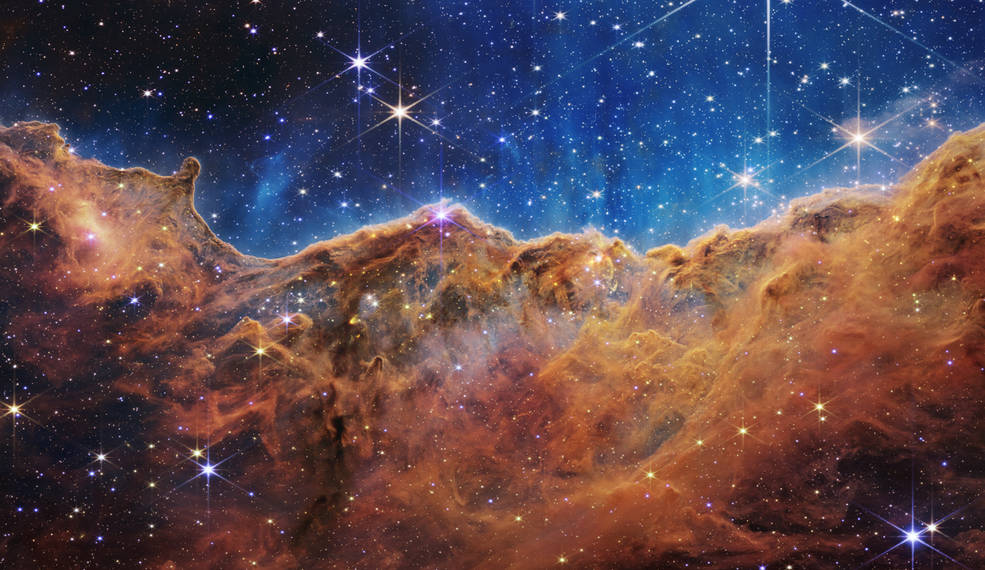
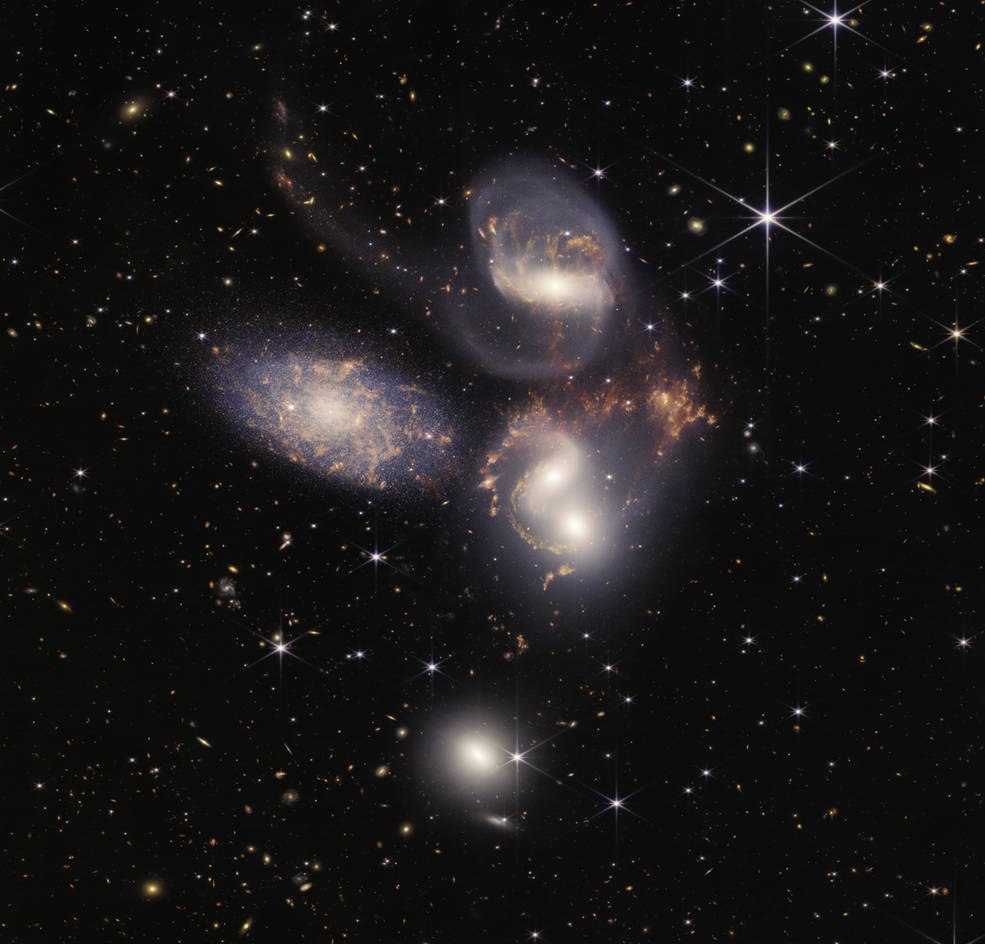
Late last year we featured the amazing engineering of the James Webb Space Telescope, which is now the largest optical telescope in space. Capable of registering phenomena older, more distant, and further off the visible spectrum than any previous device, it will no doubt show us a great many things we’ve never seen before. In fact, it’s already begun: earlier this week, NASA’s Goddard Space Flight Center released the first photographs taken through the Webb telescope, which “represent the first wave of full-color scientific images and spectra the observatory has gathered, and the official beginning of Webb’s general science operations.”
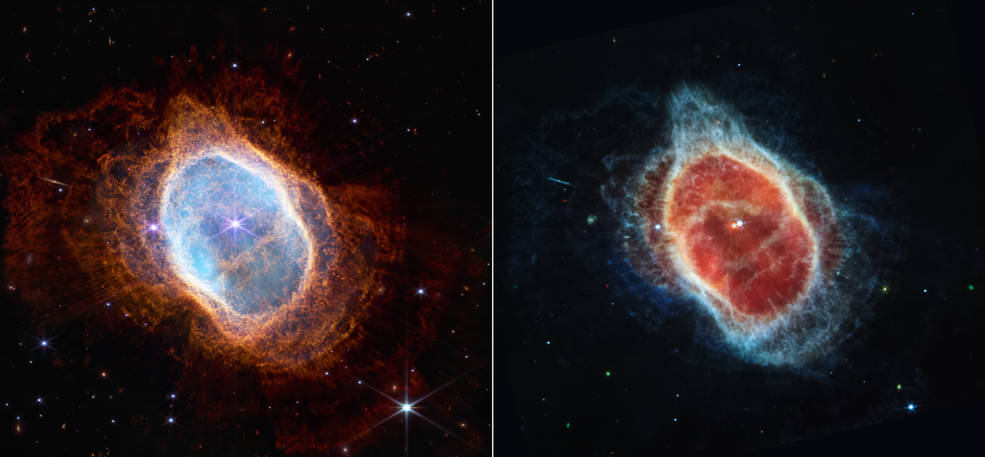
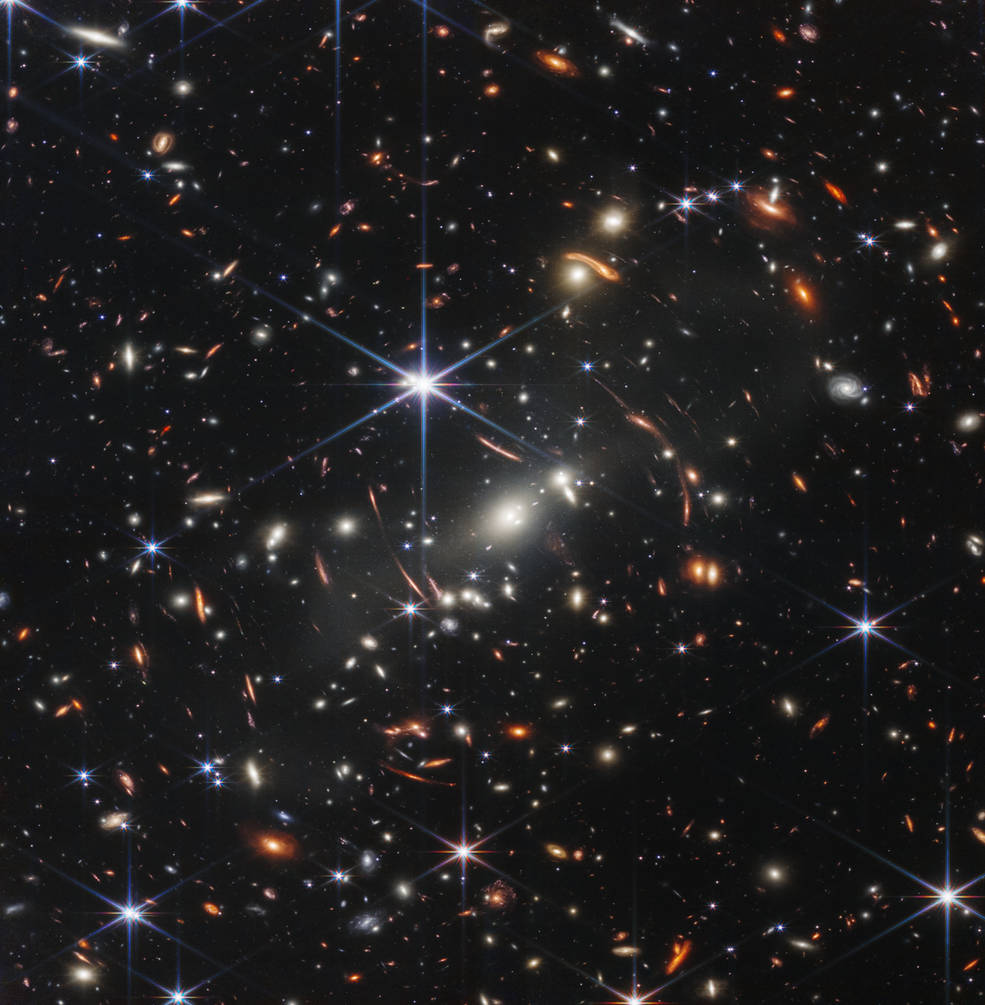
The areas of outer space depicted in unprecedented detail by these photos include the Carina Nebula (top), the Southern Ring Nebula (2nd image on this page), and the galaxy clusters known as Stephan’s Quintet (the home of the angels in It’s a Wonderful Life) and SMACS 0723 (bottom).
That last, notes Petapixel’s Jaron Schneider, “is the highest resolution photo of deep space that has ever been taken,” and the light it captures “has traveled for more than 13 billion years.” What this composite image shows us, as NASA explains, is SMACS 0723 “as it appeared 4.6 billion years ago” — and its “slice of the vast universe covers a patch of sky approximately the size of a grain of sand held at arm’s length by someone on the ground.”
All this can be a bit difficult to get one’s head around, at least if one is professionally involved with neither astronomy nor cosmology. But few imaginations could go un-captured by the richness of the images themselves. Sharp, rich in color, varied in texture — and in the case of the Carina Nebula or “Cosmic Cliffs,” NASA adds, “seemingly three-dimensional” — they could have come straight from a state-of-the-art science-fiction movie. In fact they outdo even the most advanced sci-fi visions, as NASA’s Earthrise outdid even the uncannily realistic-in-retrospect views of the Earth from space imagined by Stanley Kubrick and his collaborators in 2001: A Space Odyssey.
But these photos are the fruits of a real-life journey toward the final frontier, one you can follow in real time on NASA’s “Where Is Webb?” tracker. “Webb was designed to spend the next decade in space,” writes Colossal’s Grace Ebert. “However, a successful launch preserved substantial fuel, and NASA now anticipates a trove of insights about the universe for the next twenty years.” That’s quite a long run by the current standards of space exploration — but then, by the scale of space and time the Webb telescope has newly opened up, even 100 millennia is the blink of an eye.
Related content:
The Amazing Engineering of James Webb Telescope
How Scientists Colorize Those Beautiful Space Photos Taken By the Hubble Space Telescope
The Very First Picture of the Far Side of the Moon, Taken 60 Years Ago
The First Images and Video Footage from Outer Space, 1946–1959
The Beauty of Space Photography
Based in Seoul, Colin Marshall writes and broadcasts on cities, language, and culture. His projects include the Substack newsletter Books on Cities, the book The Stateless City: a Walk through 21st-Century Los Angeles and the video series The City in Cinema. Follow him on Twitter at @colinmarshall, on Facebook, or on Instagram.
Read More...Listen to Earth.fm, a Free Archive of Natural Soundscapes That Can Re-Connect You with Nature & Improve Your Wellbeing
“Just listen. Silence is the poetics of space. What it means to be in a place…. Silence isn’t the absence of something, but the presence of everything.” – acoustic ecologist Gordon Hempton
The study of acoustic ecology doesn’t get much mainstream attention. But if you’ve been a reader of Open Culture, you’ve likely come across a post about preserving natural sounds by streaming recordings of the world’s many environments. These projects all, in one way or another, contribute to goals articulated by Canadian composer and writer R. Murray Schafer, the “self-declared father” of acoustic ecology, which involves the study, conservation, and appreciation of environmental sound.
As Neil Clarke notes at Earth.fm, Schaffer’s complex discipline can seem difficult to grasp, as it “straddles ‘acoustics, architecture, linguistics, music, psychology, sociology and urban planning.’ ” Maybe all we need to know to appreciate the goals of Earth.fm — another excellent entry in a growing list of natural-sound streaming sites – comes through in Clarke’s description of Schaffer’s World Soundscape Project (WSP):
It was hoped that, eventually, the WSP would be able to create a balance “between the human community and its sonic environment.” To this end, listening and “ear-cleaning” practices, including “soundwalks” – a walking meditation where a high sonic awareness is maintained – were designed to increase individuals’ consciousness of the sounds around them. By prompting engagement with the realities of contemporary soundscapes, listeners were intended to gain awareness of their part in these soundscapes’ creation, and therefore appreciate their responsibility towards them.
Schaffer began recording soundscapes (a word he coined) in Vancouver in the early 70s. Since then, his work has inspired and complemented that of other field recordists/acoustic theorists/sound archivists like Bernie Krauss and Gordon Hempton. Although the early acoustic ecologists could not have foreseen streaming media, it has without a doubt become for many of us a dominant vehicle for sound in our daily lives, including sounds of the natural world.
Without an appreciation for the sounds of natural silence (which we know, since John Cage, does not mean absolute quiet), our understanding of rainforests, deserts, and oceans as living, breathing realities can become dulled, just as much as we lose touch with the green spaces outside our windows. Reconnecting through sound has the dual effect of calming our inner states and attuning us more closely to the outer world as it is, without the distractions of recorded music and video laid overtop.
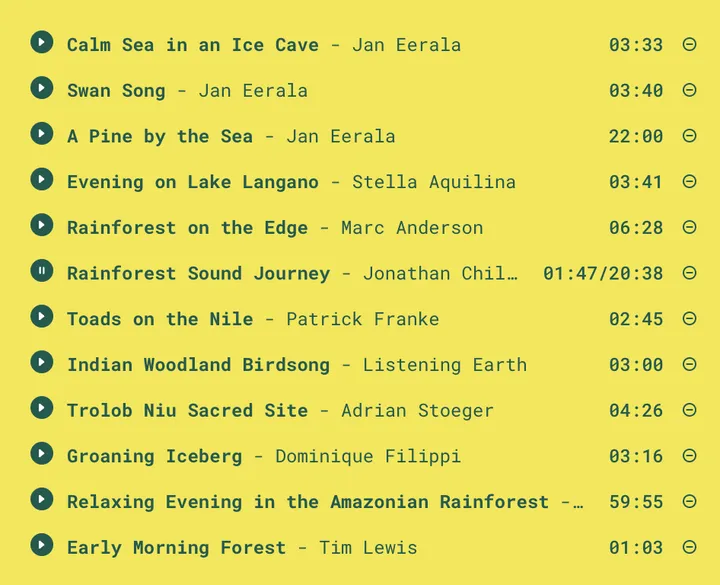
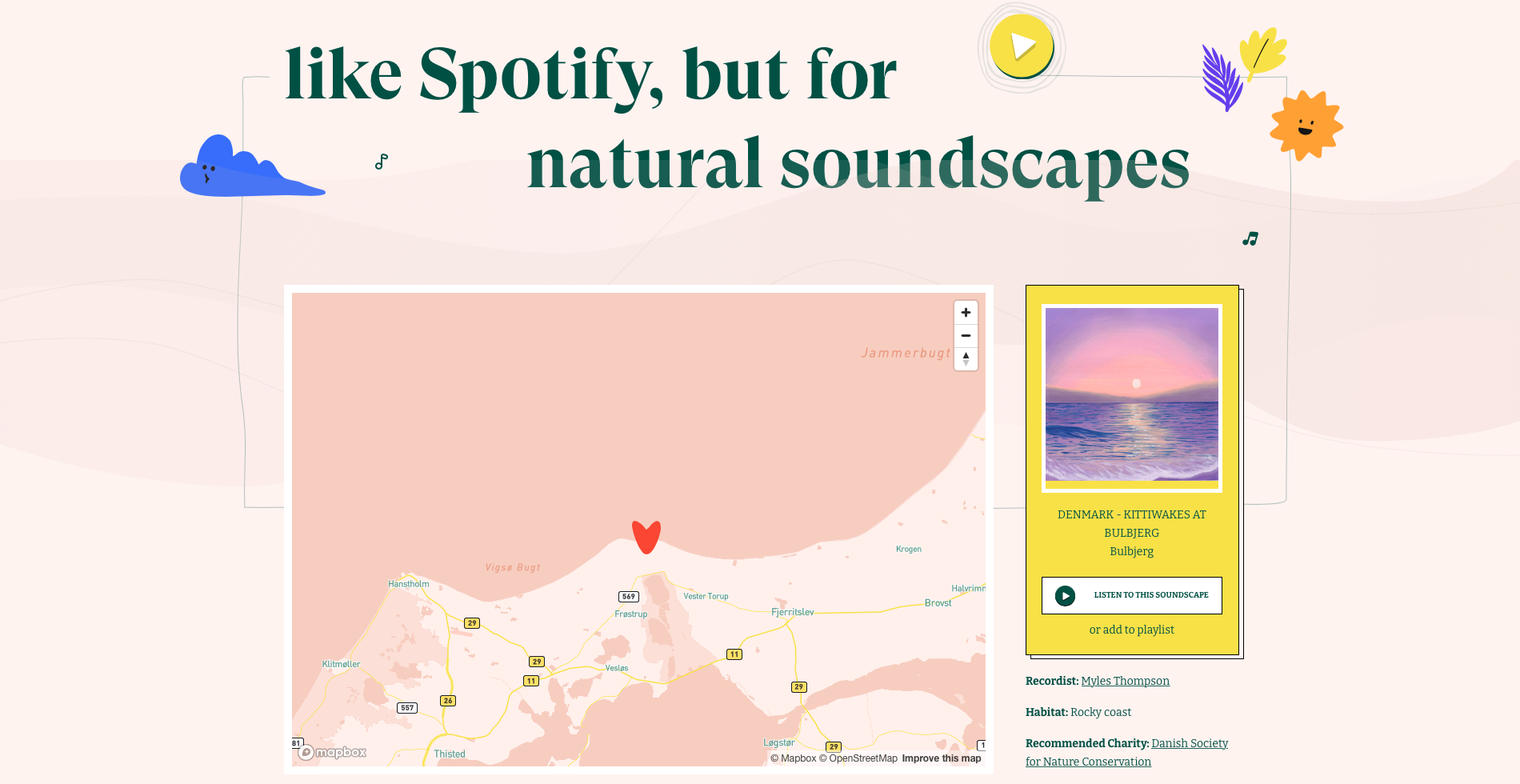
Billing itself as “like Spotify, but for natural soundscapes,” Earth.fm, offers not a rival streaming service, but an alternative in which users can make their own playlists, The Verge explains, “zipping from Brazil to Egypt in a matter of minutes.” New sounds are added every three days. “You can listen to bird species in Malaysia or India or forest sounds in Ghana. The sounds are gathered from numerous contributors who have experience recording the natural world in places including Brazil, Spain, Norway, New Zealand, and the United Kingdom.”
We can intuit Earth.fm’s mission not only as therapeutic and preservationist but also as an ethical attempt to approach the crisis streaming media has introduced in the arts. Human-made sounds (or “anthropophy”) are just as much a part of our environment as those made by frogs, rivers, and antelope. Our constant, often mindless streaming, however — made possible by infinite digital repositories and cheap (for now) energy — can be seen as a form of noise pollution, and a significant contributor to energy overconsumption.
The ethics of streaming must account for the impact on the beings (in this case, us) who make these sounds. Big Tech commodification of music requires a “vast conversation,” argues an essay on the Earth.fm site, that includes “the format’s impact on those at the heart of this whole undertaking: those who create music.” By implication, Earth.fm and other sites that stream acoustic recordings of natural sounds (like those in the links below), offer an ethical alternative to music streaming — one that reconnects us, Elizabeth Waddington writes on the site, to “the music of a changing world.” Learn more about Earth.fm’s activities here.
Related Content:
Free: Download the Sublime Sights & Sounds of Yellowstone National Park
Sounds of the Forest: A Free Audio Archive Gathers the Sounds of Forests from All Over the World
Josh Jones is a writer and musician based in Durham, NC. Follow him at @jdmagness
Read More...Benedict Cumberbatch Reads Nick Cave’s Beautiful Letter About Grief
We would rather not grieve. Because we avoid it, death can leave us numb, and we may not know how to talk about it without turning loss into a lesson. “Even when it’s expected, death or loss still comes as a surprise,” writes psychotherapist Megan Devine in her book on grieving, It’s OK That You’re Not OK. And in grief, it can so happen that “otherwise intelligent people have started spouting slogans and platitudes, trying to cheer you up. Trying to take away your pain.” Everything happens for a reason, they’re in a better place, they’d want you to be happy, this will make you stronger….! However well-intentioned, “platitudes and cheerleading solve nothing.”
Is loss a problem to be solved? Can we avoid grief without shutting out the intimacy of love? There are many sage answers to these questions. Few, for example, have written as elegantly or agonized as publicly about love and loss as singer Nick Cave of The Birthday Party and The Bad Seeds. These are subjects to which he returns on album after album and in entries of his cult-favorite blog The Red Hand Files, where Cave publishes answers to an assortment of fan questions.
Musing in 2019 on whether artificial intelligence will ever produce a great song, for example, Cave states one of his major themes plainly: “A sense of awe is almost exclusively predicated on our limitations as human beings. It is entirely to do with our audacity as humans to reach beyond our potential.” From this capacity come our greatest imaginative feats, Cave writes: our ability to conjure “bright phantoms” in our deepest grief.
Cave wrote these last words in 2018 to a fan named Cynthia who told him about her family’s losses and asked the singer if he and his wife Susie communicated with their son Arthur, who died tragically in 2015. In answer, Cave avoids the cliches that Devine says do nothing for us. He neither denies the reality of Cynthia’s pain, nor does he leave her without hope for “change and growth and redemption.”
Dear Cynthia,
This is a very beautiful question and I am grateful that you have asked it. It seems to me, that if we love, we grieve. That’s the deal. That’s the pact. Grief and love are forever intertwined. Grief is the terrible reminder of the depths of our love and, like love, grief is non-negotiable. There is a vastness to grief that overwhelms our minuscule selves. We are tiny, trembling clusters of atoms subsumed within grief’s awesome presence. It occupies the core of our being and extends through our fingers to the limits of the universe. Within that whirling gyre all manner of madnesses exist; ghosts and spirits and dream visitations, and everything else that we, in our anguish, will into existence. These are precious gifts that are as valid and as real as we need them to be. They are the spirit guides that lead us out of the darkness.
I feel the presence of my son, all around, but he may not be there. I hear him talk to me, parent me, guide me, though he may not be there. He visits Susie in her sleep regularly, speaks to her, comforts her, but he may not be there. Dread grief trails bright phantoms in its wake. These spirits are ideas, essentially. They are our stunned imaginations reawakening after the calamity. Like ideas, these spirits speak of possibility. Follow your ideas, because on the other side of the idea is change and growth and redemption. Create your spirits. Call to them. Will them alive. Speak to them. It is their impossible and ghostly hands that draw us back to the world from which we were jettisoned; better now and unimaginably changed.
With love, Nick
Cave’s full letter, above, is as eloquent a piece of writing on grief and loss, in its way, as John Donne’s famous meditation (a poet for whom Nick Cave has a “soft spot,” he writes in another entry). At the top, you can hear a very moving reading of the text by Benedict Cumberbatch for Letters Live. Read more of Cave’s brief-but-deep meditations and lyrical replies at The Red Hand Files.
Related Content:
Josh Jones is a writer and musician based in Durham, NC. Follow him at @jdmagness
Read More...An Introduction to the Voynich Manuscript, the World’s Most Mysterious Book
“The Voynich manuscript is a real medieval book, and has been carbon-dated to the early 1400s.” No modern hoax, this notoriously bizarre text has in fact “passed through the hands of many over the years,” including “scientists, emperors, and collectors.” Though “we still don’t know who actually wrote it, the illustrations hint at the book’s original purpose,” having “much in common with medieval herbals, astrology guides, and bathing manuals.” Hence the likelihood of the Voynich manuscript being “some sort of medical textbook, although a very strange one by any measure. Then there’s the writing.”
This summary of the known history and nature of the most mysterious manuscript in existence comes from the Youtube video above, “Secrets of the Voynich Manuscript.” Its channel Hochelaga has previously been featured here on Open Culture for episodes on medieval monsters, a guide to supernatural phenomena from renaissance Germany, Hokusai’s ghost art, and the Biblical apocalypse.
In short, the Voynich manuscript could hardly find a more accommodating wheelhouse. And as in Hochelaga’s other videos, the subject is approached not with total credulity, but rather a clear and straightforward discussion of why generation after generation of enthusiasts have kept trying to figure it out.
No aspect of the Voynich manuscript fascinates as much as its having been “written in a mystery language with a unique alphabet and grammatical rules.” It could be an existing language rendered in code; it could be one created entirely and only for this book. Though attempts are made with some frequency, “no one has been able to definitively solve the Voynich manuscript’s language.” It could, of course, be that “we’ve fallen for one big medieval prank,” but the video’s creator doesn’t buy that explanation. Even in its incomprehensibility, the text appears to possess great complexity. If it were to be decoded, “would the magic and mystery disappear? Or would we uncover a whole new set of questions and embark on another journey entirely?”
Related content:
Based in Seoul, Colin Marshall writes and broadcasts on cities, language, and culture. His projects include the Substack newsletter Books on Cities, the book The Stateless City: a Walk through 21st-Century Los Angeles and the video series The City in Cinema. Follow him on Twitter at @colinmarshall, on Facebook, or on Instagram.
Read More...Titanic Survivor Interviews: What It Was Like to Flee the Sinking Luxury Liner
Millvinia Dean, the last surviving passenger of the RMS Titanic, died in 2009. She’d lived a full life of 97 years, but that meant that she’d been only two months old when the famously luxurious and innovative ship hit the iceberg that sent it to the bottom of the Atlantic in the middle of its maiden voyage. Despite being humanity’s last direct link to the Titanic, she would have retained no memory of the ship or its sinking. That’s very much not the case with the survivors interviewed in the 1970 British Pathé documentary footage above. One of them, Edith Russell, remembers the Titanic as having been “so very formal.” The “coziness” of other ocean liners, the “get-together feeling — it didn’t exist.”
A celebrity stylist and Paris correspondent for Women’s Wear Daily, Russell was traveling first-class: one stateroom for her, and another for her luggage. Not so Gurshon Cohen, who’d been “sleeping six in a bunk” down below. Unlike many of the Titanic’s third-class passengers, prohibited as they were from entering the upper decks, Cohen managed to find a place on a lifeboat (after jumping ship first).
Whatever the differences in their situations, Russell and Cohen had congruent memories of the disaster, especially as regards the popular notion that the ship’s band continued performing until the bitter end. As Russell puts it, “when people say that music played as the ship went down, that is a ghastly, horrible lie.”
Eva Hart, interviewed in 1993, does recall hearing music — specifically, a rendition of “Near My God to Thee” — right up until her escape. The vivid images she retained from the lifeboat also included the ship’s breaking in half, an event widely denied until it was proven decades thereafter. You can hear more stories of how the Titanic really went down, as it were, from the 1956 and 1970 BBC interviews with Kate Gilnagh Manning, Maude Louise Slocombe, and Frank Prentice (the latter two of whom were working on the ship) just above. They all remember the incongruously “slight bump” of the impact, the “dead calm” of the sea, the perilous sight of lifeboats dangling 70 feet above the water — and the feeling of impossibility that the “unsinkable” Titanic could really have met its end.
Related content:
Watch the Titanic Sink in Real Time in a New 2‑Hour, 40 Minute Animation
The Titanic: Rare Footage of the Ship Before Disaster Strikes
How the Titanic Sank: James Cameron’s New CGI Animation
Real Interviews with People Who Lived in the 1800s
Watch 85,000 Historic Newsreel Films from British Pathé Free Online (1910–2008)
Based in Seoul, Colin Marshall writes and broadcasts on cities, language, and culture. His projects include the Substack newsletter Books on Cities, the book The Stateless City: a Walk through 21st-Century Los Angeles and the video series The City in Cinema. Follow him on Twitter at @colinmarshall, on Facebook, or on Instagram.
Read More...Why You Should Read The Handmaid’s Tale: A Timely Animated Introduction
Prophecies are really about now. In science fiction it’s always about now. What else could it be about? There is no future. There are many possibilities, but we do not know which one we are going to have.
There is no need to explain why Margaret Atwood’s The Handmaid’s Tale has gone from reading like a warning of the near-future to an allegory of the present after the U.S. Supreme Court’s ruling in Dobbs v. Jackson Women’s Health Organization. Atwood’s story revolves around the fictional Republic of Gilead, which takes over the U.S. after a fertility crisis decimates the population. Overnight, the fundamentalist Christian theocracy divides women into two broad classes – Handmaids: chattel who perform the labor of forced birth through forced conception; and the infertile who prop up the patriarchal ruling class as wives, overseers, or slave labor in the polluted “colonies.”
It’s a bleak tale, a story far less about heroism than the TV series based on the book would have viewers–who haven’t read it–believe. (The 5th season, slated for this July, seems to have been delayed until September without explanation.) Why should we read The Handmaid’s Tale? Because it is not only a work of dystopian futurism, but also a narrativized account of what has already happened to women around the world throughout history to the present. The novel is a prism through which to view the ways women have been oppressed through reproductive slavery without the sci-fi scenario of a precipitous loss of human fertility.
As Atwood has explained, “when I wrote The Handmaid’s Tale, nothing went into it that had not happened in real life somewhere at some time.” Some of the worst offenses were not well-known. “Female genital mutilation was taking place,” says Atwood, “but if I had put it in 1985 [when the novel was written] probably people wouldn’t have known what I was talking about. They do now.” But we can still choose to overlook the information. “Ignoring isn’t the same as ignorance,” Atwood says in the novel, “you have to work at it.” The quote opens the 2018 TED-Ed lesson by Naomi Mercer above on Atwood’s book, walking us through its sources in history.
The Handmaid’s Tale, the lesson points out, is an example of “Speculative Fiction,” a form of writing concerned with “possible futures.” This theme unites both utopian and dystopian novels. Atwood’s books trade in the latter, but any reader of the genre will tell you how quickly a more perfect fictional union becomes a nightmare. The Canadian writer has offered this literary inevitability as an explanation for the multiple crises of American democracy:
The real reason people expect so much of America in modern times is that it set out to be a utopia. That didn’t last very long. Nathaniel Hawthorne nailed it when he said the first thing they did when they got to America was build a scaffold and a prison.
What Atwood doesn’t mention, as many critics have pointed out, are the slave pens and auction houses, or the fact that Gilead closely resembles the slave-holding American South in its theocratic patriarchal Christian hierarchy and ultimate control of women’s bodies. And yet, the novel completely sidesteps race by having the Republic of Gilead ship all of the country’s Black people to the Midwest (presumably for forced labor). They are never heard from again by the reader.
This tactic has seemed irresponsible to many critics, as has the show’s sidestepping through colorblind casting, and the wearing of red cloaks and white bonnets in imitation of the book and show as a means of protest. “When we rely too heavily on ‘The Handmaid’s Tale,’ which ignores the presence of race and racism,” says activist Alicia Sanchez Gill, “it really dehumanizes and dismisses our collective experiences of reproductive trauma.” Atwood’s “possible future” pillages slavery’s past and conveniently gets rid of its descendants.
The trauma Gill references includes rape and forced birth, as well as the forced sterilizations of the eugenics movement, carried out with the imprimatur of the Supreme Court (and continuing in recent cases). Kelli Midgley, who founded Handmaids Army DC, offers one explanation for using The Handmaid’s Tale as a protest symbol. Though she agrees to leave the costumes at home if asked by organizers, she says “we are trying to reach a broader audience for people who need this message. We don’t need to tell Black women that their rights are endangered. They always have been.”
Maybe a new message after Dobbs v. Jackson Women’s Health Organization is that an assault on anyone’s rights threatens everyone. Or as Atwood wrote in a Canadian Globe and Mail op-ed in 2018, “depriving women of contraceptive information, reproductive rights, a living wage, and prenatal and maternal care – as some states in the US want to do – is practically a death sentence, and is a contravention of basic human rights. But Gilead, being totalitarian, does not respect universal human rights.”
Related Content:
Pretty Much Pop #10 Examines Margaret Atwood’s Nightmare Vision: The Handmaid’s Tale
Hear Margaret Atwood’s Story “Stone Mattress,” Read by Author A. M. Homes
Josh Jones is a writer and musician based in Durham, NC. Follow him at @jdmagness
Read More...When Frank Lloyd Wright Designed a Doghouse, His Smallest Architectural Creation (1956)
On your first day in architecture school, you have to design a doghouse. Having never set foot inside an architecture school, I concede that the previous sentence may well be false, but you have to admit that it sounds plausible. As the simplest form of shelter in common use across the world, the humble doghouse presents to an aspiring architect the most basic possible test. If you can’t build one, what business do you have building anything else? Yet it was with characteristic idiosyncrasy that Frank Lloyd Wright, that most famous of all American architects, took on the project of a doghouse only toward the end of his long life and career.
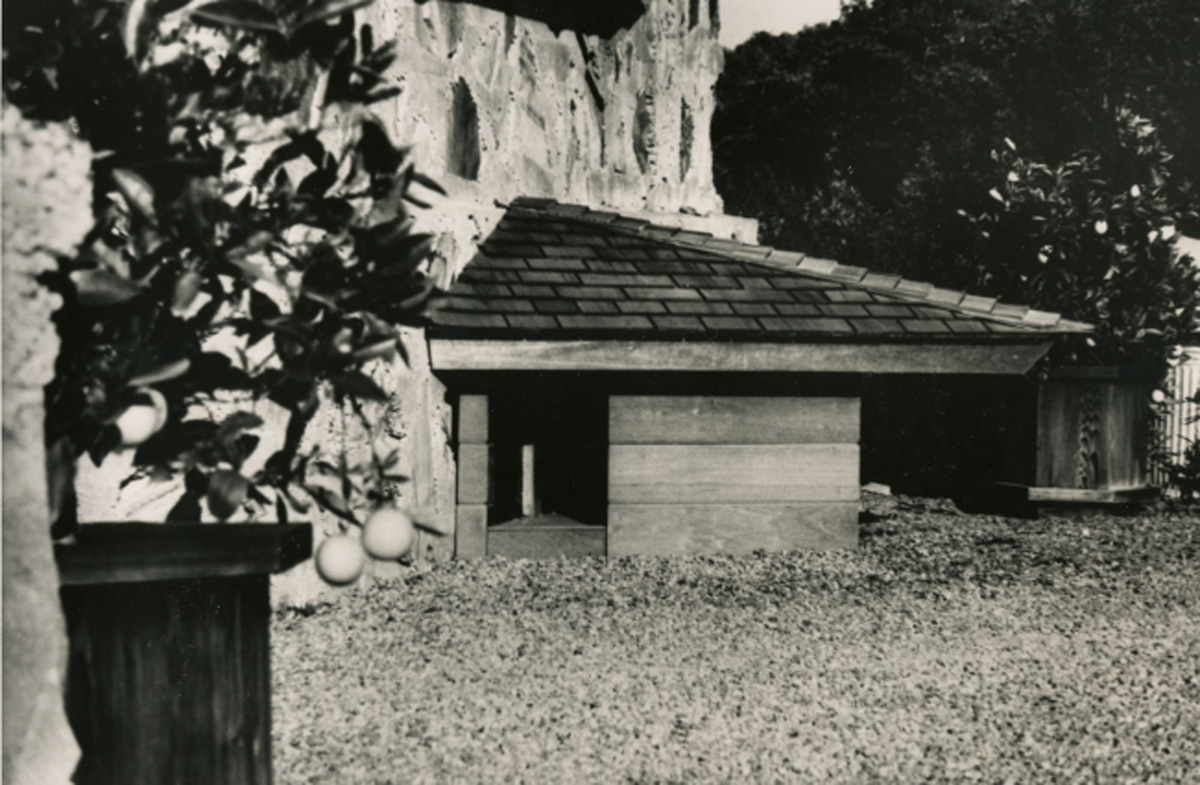
Images courtesy of the Marin County Civic Center
“ ‘Eddie’s House’ is a doghouse designed gratis by Wright in 1956 to complement a Usonian-style house he built on commission for Robert and Gloria Berger between 1950 and 1951, in the Marin County town of San Anselmo, California,” writes Hyperallergic’s Sarah Rose Sharp. The commission, such as it was, came from the Bergers’ twelve-year-old son Jim. “I would appreciate it if you would design me a doghouse, which would be easy to build, but would go with our house,” he wrote to Wright, specifying Eddie’s dimensions and offering compensation in the form of his paper-route money.
“A house for Eddie is an opportunity,” replied the architect, and the following year — after finishing up the previous project that had delayed him, the Solomon R. Guggenheim Museum — he sent Jim a literal back-of-the-envelope diagram. As explained in the brief video from Marin County’s Youtube channel above, that was standard Wright practice: the architect’s rough drawings were then converted into proper plans by his staff at Taliesin. “I wanted it to be easy,” says the grown-up Berger. “It wasn’t. It was a nightmare, so my dad built it.” And as for Eddie, he never actually slept in it.
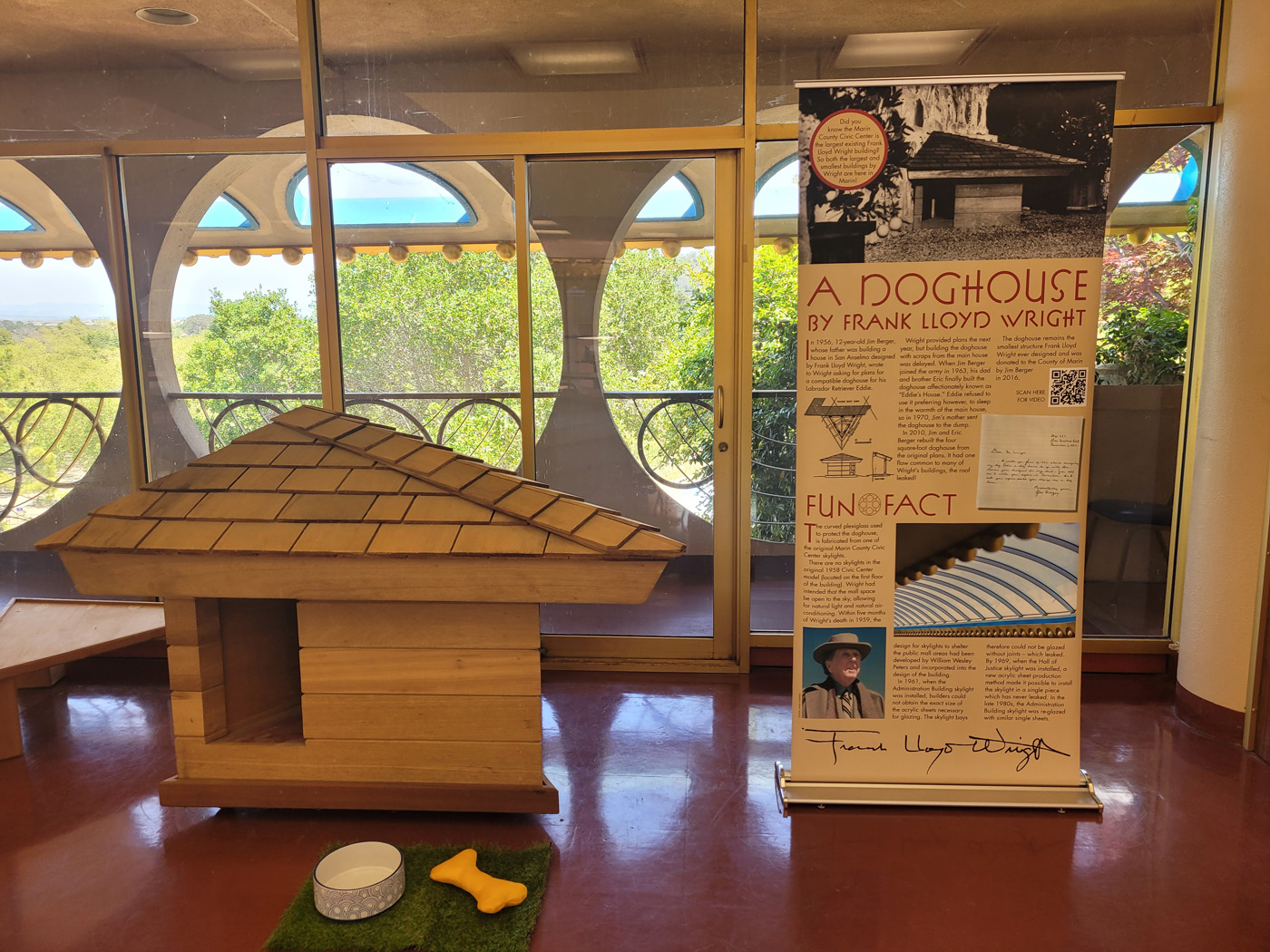
The Bergers’ golden retriever “certainly wouldn’t be the first of Wright’s clients to be disappointed by some of the architect’s shortcomings,” writes Sharp. “Apparently, as with many of Wright’s designs, the roof to Eddie’s House leaked.” Nevertheless, it’s become a beloved addition to the Wright canon since Berger rebuilt it for Michael Miner’s Romanza: A Frank Lloyd Wright Documentary and subsequently donated it to the county. To this day, the replica of Wright’s smallest work remains on display inside his largest one: the Marin Civic Center, a slightly later and much more ambitious building, but one not entirely lacking in family resemblance to Eddie’s House.
via Hyperallergic
Related content:
How Frank Lloyd Wright’s Son Invented Lincoln Logs, “America’s National Toy” (1916)
The Modernist Gas Stations of Frank Lloyd Wright and Mies van der Rohe
Steve Martin Performs Stand-Up Comedy for Dogs (1973)
Based in Seoul, Colin Marshall writes and broadcasts on cities, language, and culture. His projects include the Substack newsletter Books on Cities, the book The Stateless City: a Walk through 21st-Century Los Angeles and the video series The City in Cinema. Follow him on Twitter at @colinmarshall, on Facebook, or on Instagram.
Read More...Watch the Hugely-Ambitious Soviet Film Adaptation of War and Peace Free Online (1966–67)
On the question of whether novels can successfully be turned into films, the cinephile jury remains out. In the best cases a filmmaker takes a literary work and reinvents it almost entirely in accordance with his own vision, which usually requires a book of modest or unrealized ambitions. This method wouldn’t do, in other words, for War and Peace. Yet Tolstoy’s epic novel, whose sheer historical, dramatic, and philosophical scope has made it one of the most acclaimed works in the history of literature, has been adapted over and over again: for radio, for the stage, as a 22-minute Yes song, and at least four times for the screen.
The first War and Peace film, directed by and starring the pioneering Russian filmmaker Vladimir Gardin, appeared in 1915. Japanese activist filmmaker Fumio Kamei came out with his own version just over three decades later. Only in the nineteen-fifties, with large-scale literary adaptation still in vogue, did the mighty hand of Hollywood take up the book. The project went back to 1941, when producer Alexander Korda tried to put it together under the direction of Orson Welles, fresh off Citizen Kane.
For better or worse, Welles’ version would surely have proven more memorable than the one that opened in 1956: King Vidor’s War and Peace expediently hacked out great swathes of Tolstoy’s novel, resulting in a lush but essentially unfaithful adaptation. This was still early in the Cold War, a struggle conducted through the amassing of soft power as well as hard. “It is a matter of honor for the Soviet cinema industry,” declared an open letter published in dthe Soviet press, “to produce a picture which will surpass the American-Italian one in its artistic merit and authenticity.”
The gears of the Soviet Ministry of Culture were already turning to get a superior War and Peace film into production — superior in scale, but far superior in fealty to Tolstoy’s words. This put a formidable challenge in front of Sergei Bondarchuk, who was selected as its director and who, like Gardin before him, eventually cast himself in the starring role of Count Pyotr “Pierre” Kirillovich Bezukhov. As a production of Mosfilm, national studio of the Soviet Union, War and Peace could marshal an unheard-of volume of resources to put early nineteenth-century Russia onscreen. Its furniture, fixtures, and other objects came from more than forty museums, and its thousands of uniforms and pieces of military hardware from the Napoleonic Wars were recreated by hand.
The most expensive production ever made in the Soviet Union, War and Peace was also rumored to be the most expensive production in the history of world cinema to date. With a total runtime exceeding seven hours, it was released in four parts throughout 1966 an 1967. Now, thanks to Mosfilm’s Youtube channel, you can watch them all free on Youtube. 55 years later, its production values still radiate from each and every frame, something you can appreciate even if you know nothing more of War and Peace than that — as a non-Russian filmmaker of comparatively modest production sensibilities once said — it’s about Russia.
Related content:
Why Should We Read Tolstoy’s War and Peace (and Finish It)? A TED-Ed Animation Makes the Case
The Art of Leo Tolstoy: See His Drawings in the War & Peace Manuscript & Other Literary Texts
Free Online: Watch Stalker, Mirror, and Other Masterworks by Soviet Auteur Andrei Tarkovsky
Based in Seoul, Colin Marshall writes and broadcasts on cities, language, and culture. His projects include the Substack newsletter Books on Cities, the book The Stateless City: a Walk through 21st-Century Los Angeles and the video series The City in Cinema. Follow him on Twitter at @colinmarshall, on Facebook, or on Instagram.
Read More...Mama Cass and John Denver Sing a Lovely Duet of “Leaving On a Jet Plane” (1972)
My issue is that it’s all very well to sit back and complain but when it’s your country you have a responsibility. — Cass Elliot
What could be more heavenly than Cass Elliot of The Mamas & The Papas and singer-songwriter John Denver harmonizing on Denver’s “Leaving on a Jet Plane,” a tune many conceived of as a protest to the Vietnam War, owing largely to folk trio Peter, Paul and Mary’s cover version.
Maybe some voter registration added to the mix?
Before breaking into their duet on the late night TV musical variety show The Midnight Special, Denver invited Mama Cass to share a few words on her efforts to get out the vote in a presidential election year:
I’ve been traveling around the country for the past year or so, talking on a lot of college campuses and trying to find out exactly what people are thinking, and the thing that’s impressed me the most is, there is still in this country, believe it or not, after all the talk, a tremendous amount of apathy on the part of people who maybe don’t like the way things are going and maybe want to change it, but don’t do anything about it, y’know?
It was August 19, 1972. The war in Vietnam and the upcoming contest between President Richard Nixon and his Democratic challenger George McGovern were the top stories. June’s Watergate break in was a mounting concern.
Earlier in the day, the New York Times reported that “Senator George McGovern expects (South Vietnamese) President Nguyễn Văn Thiệu and his “cohorts” to flee Saigon into exile and a Communist-dominated coalition to take control of South Vietnam if Mr. McGovern is elected President of the United States on Nov. 7.”
Cass Elliot, a McGovern supporter, had become much more vocal about her political activism following the 1968 break up of The Mamas & The Papas, as in this interview with Rolling Stone:
I think everybody who has a brain should get involved in politics. Working within. Not criticizing it from the outside. Become an active participant, no matter how feeble you think the effort is. I saw in the Democratic Convention in Chicago that there were more people interested in what I was interested in than I believed possible. It made me want to work. It made me feel my opinion and ideas were not futile, that there would be room in an organized movement of politics for me to voice myself.
She remained diplomatic on the Midnight Special, telling viewers that “I don’t think it’s so important who you vote for, you vote for who you believe in, but the important thing is to vote,” though it’s hard to imagine that anyone tuning in from home would mistake her for a Nixon gal.
Earlier in the year she had ushered at the Four For McGovern fundraising concert at the LA Forum, was in the audience at Madison Square Warren Beatty’s Together for McGovern concert Garden, and attended a party Americans Abroad for McGovern held in London.
Shortly after the election (SPOILER: Her man lost), during an appearance on The Mike Douglas Show, above, she intimated that she might be open to a career shift:
I think I would like to be a Senator or something in twenty years. I don’t think I really know enough yet. I’m just 30 now and I wouldn’t even be eligible to run for office for another five years. But I have a lot of feelings about things. I know the way I would like to see things for this country and in my travels, when I talk to people, everybody wants pretty much the same thing: peace, enough jobs, no poverty and good education. And I’ve learned a lot. It’s funny. So many people in show business go into politics, and I used to say ‘What the heck do they know about it?’ But when you travel around, you really do get to feel–not to be cliche–the pulse of the country and what people want. I’m concerned and it’s not good to be unconcerned and just sit there.
Listening to her discuss Watergate during her final visit to The Mike Douglas Show, shortly before her 1974 death, really makes us wish she was still here with us.
What we wouldn’t give to hear this outspoken political observer’s take on the situation our country now finds itself in, especially with another five decades of experience under her belt.
Perhaps there’s an alternate universe in which Cass Elliot is President.
If you haven’t yet registered to vote, now would be a great time to do so. It may not be too late to participate in your state’s primary elections. You know that’s what Cass would have wanted.
Related Content
Janis Joplin & Tom Jones Bring the House Down in an Unlikely Duet of “Raise Your Hand” (1969)
- Ayun Halliday is the Chief Primatologist of the East Village Inky zine and author, most recently, of Creative, Not Famous: The Small Potato Manifesto. Follow her @AyunHalliday.
Read More...The Young Punk Rockers The Linda Lindas Play a Tiny Desk Concert Gig (at the Public Library)
The last we checked in with teenage girl power-punk band The Linda Lindas, they were tearing up the Los Angeles Public Library (Cypress Park branch) with their lockdown-hit “Racist, Sexist Boy.” After eleven-year-old drummer Mila de Garza recounted the xenophobic encounter that led to the song, the band unleashed some true noisy angst befitting a group twice their age. It was the song of rage we needed at the time, the clip went viral, and they soon got a record deal. Along the way, they’ve appeared in Amy Poehler’s documentary, contributed to a track by Best Coast, opened for Bikini Kill, played Jimmy Kimmel Live, and received accolades from Thurston Moore and Tom Morello of Rage Against the Machine.
Just over a year later, and The Linda Lindas are back in the library as part of NPR’s Tiny Desk concert series. Usually Tiny Desk gigs features an artist playing in the very cramped offices of the radio station, but as things are still not 100% safe, The Linda Lindas opted for the place they know well, this time playing at the Los Angeles Central Library branch.
This band is no one-off. The de Garza sisters, along with their cousin Eloise Wong and friend Bela Salazar, formed in 2018 and have been playing ever since. Compare the step up in confidence and band interplay on this newer version of “Racist, Sexist Boy,” with which they close the set.
Before that The Linda Lindas perform songs from their new album Growing Up, including the poppy Spanish ballad “Cuántas Veces”, the pop-punk “Talking to Myself,” and the title track. The band’s lyrics are honest, absent pretension, and while many of the concerns are universal, the album is definitely born out of COVID-era anxiety. If you’re wondering how these years are affecting those coming of age at this time, the album is essential.
And, hey kids, there’s still available (not on the live playlist but as a single on bandcamp) “Nino,” a harmony-filled ode to their pet cat.
By the way, there aren’t many other rock bands playing in libraries, but we did find one while searching the intertubes: it’s The Clash’s Mick Jones playing a solo electric set of his hits. It’s just one more reminder to support your local library—you never know who might turn up.
Related Content:
How the Riot Grrrl Movement Created a Revolution in Rock & Punk
Fear of a Female Planet: Kim Gordon (Sonic Youth) on Why Russia and the US Need a Pussy Riot
Ted Mills is a freelance writer on the arts who currently hosts the Notes from the Shed podcast and is the producer of KCRW’s Curious Coast. You can also follow him on Twitter at @tedmills, and/or watch his films here.
Read More...Support Us
We're hoping to rely on loyal readers, rather than erratic ads. Please click the Donate button and support Open Culture. You can use Paypal, Venmo, Patreon, even Crypto! We thank you!

About Us

Open Culture scours the web for the best educational media. We find the free courses and audio books you need, the language lessons & educational videos you want, and plenty of enlightenment in between.
Advertise With Us
FREE UPDATES!
GET OUR DAILY EMAIL
Get the best cultural and educational resources on the web curated for you in a daily email. We never spam. Unsubscribe at any time.
FOLLOW ON SOCIAL MEDIA
Open Culture editor Dan Colman scours the web for the best educational media. He finds the free courses and audio books you need, the language lessons & movies you want, and plenty of enlightenment in between.
Advertise With Us


