The Birdsong Project Features 220 Musicians, Actors, Artists & Writers Paying Tribute to Birds: Watch Performances by Yo-Yo Ma, Elvis Costello and Beck
Birds are the original musicians. This, at least, is a premise of the Audubon Society’s Birdsong Project, “a movement inspiring bird conservation through art.” There could thus be no more natural art form in which to celebrate our fine feathered (and in many cases, now endangered) friends than music, which the Birdsong Project has commissioned for its first release, and in no small quantity. They’ve so far put out the first two volumes of For the Birds, which in its totality will involve “more than 220 music artists, actors, literary figures, and visual artists, all coming together to celebrate the joy birds bring to our lives” — and remind us of “the environmental threats we all face.”
Those contributors include Yo‑Yo Ma, Elvis Costello, and Beck, whose work on For the Birds you can hear in the videos in this post. And in the case of Yo-Yo Ma, who performs a piece called “In the Gale” (by composer Anna Clyne), you can see him play not in a concert hall but out in the midst of genuine nature.
This underscores what’s heard brightly and clearly on the recording: that Ma and Clyne were just two of many collaborators on the track, the others being what sound like a forest full of birds. Other artists take different approaches: Beck’s “Archangel” is a lush studio soundscape, and Costello combines his own “The Birds Will Still Be Singing” with “And Your Bird Can Sing,” the most appropriate Beatles cover imaginable (apart from “Blackbird,” at least).
Organized by Randall Poster, by day a music supervisor for filmmakers like Wes Anderson and Martin Scorsese, For the Birds also features music from, Jarvis Cocker, The Flaming Lips, Kaoru Watanabe, Stephin Merritt, and Seu Jorge. And those are just the contributors known primarily for their music: others involved in the project include Jeff Goldblum, Tilda Swinton, and Jonathan Franzen. You can now stream the first two volumes on most major services, and pre-order the full 20-LP box set that will contain the material musical and literary from all five volumes, the last of which is scheduled to come out this September. Give it a listen, and afterward you’ll perhaps find yourself that much more able to appreciate the avian symphony conducted all around us.
Related content:
Hear the Sound Of Endangered Birds Get Turned Into Electronic Music
What Kind of Bird Is That?: A Free App From Cornell Will Give You the Answer
BirdCast: You Can Now Forecast the Migration of Birds Across the U.S. Just Like the Weather
Based in Seoul, Colin Marshall writes and broadcasts on cities, language, and culture. His projects include the Substack newsletter Books on Cities, the book The Stateless City: a Walk through 21st-Century Los Angeles and the video series The City in Cinema. Follow him on Twitter at @colinmarshall, on Facebook, or on Instagram.
Read More...A Virtual Tour of Frank Lloyd Wright’s Lost Japanese Masterpiece, the Imperial Hotel in Tokyo
Tokyo once had a hotel by Frank Lloyd Wright. Such an architectural asset, one might assume, would be preserved at all costs, yet this one was demolished in 1967. But the fact that Wright’s Imperial Hotel stood for only 45 years won’t surprise anyone familiar with Japanese building culture, nor will the fact that it was only one of a series of Imperial Hotels that have occupied the same site. As evidenced by the Ise Grand Shrine, which has been demolished and rebuilt every twenty years since the eighth century, a structure’s value in Japan has nothing to do with its longevity. Still, this explanation may not satisfy Wright enthusiasts, the great majority of whom have only been able to see the master’s most famous Japanese building in photographs, diagrams, and postcards.
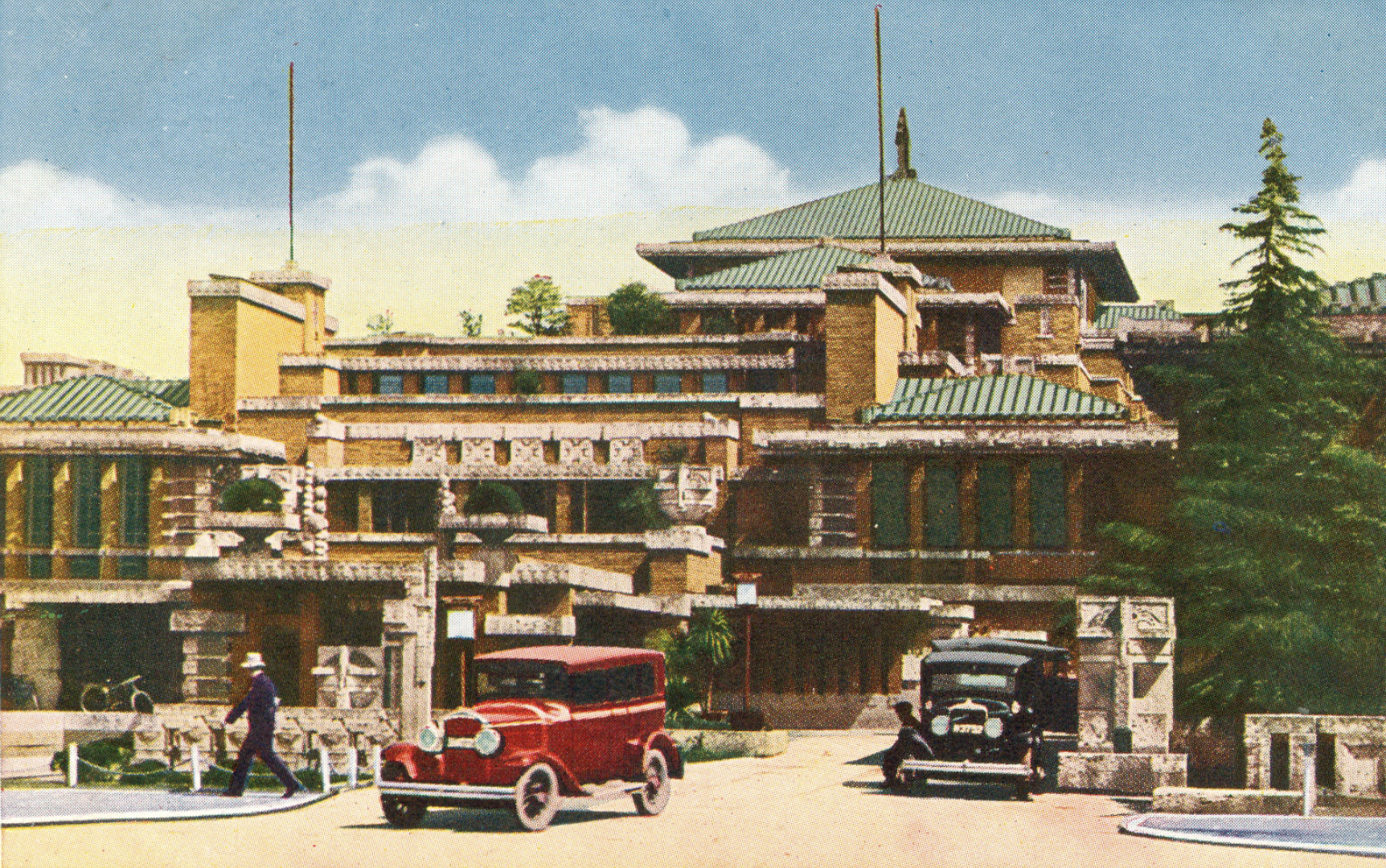
Just this year, the Frank Lloyd Trust has given us a way to experience it as nobody could in its heyday: a virtual tour video “shot” from the perspective of a flying drone. (Watch above.) It comes as an entry in Frank Lloyd Wright: The Lost Works, which “brings Wright’s demolished and unrealized structures to life through immersive digital animations reconstructed from Wright’s original plans and drawings, along with archival photographs.”
Here we have Wright’s East-meets-West masterpiece reconstructed just as it must have looked when it opened on September 1st, 1923 — the same day, coincidentally, as the Great Kantō earthquake that devastated Tokyo. The Imperial Hotel took some damage, but came through intact.
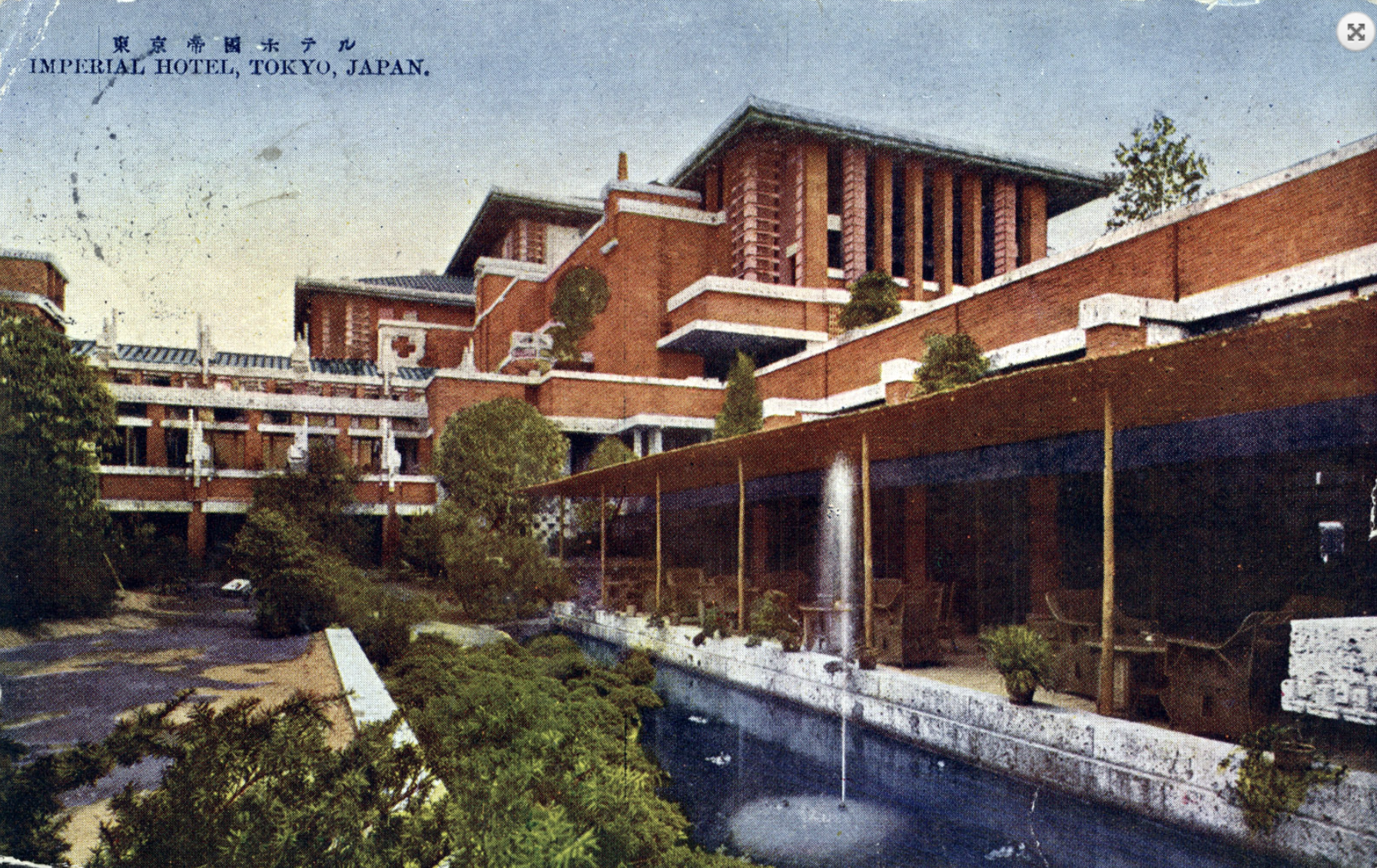
A lesser earthquake had already struck the previous year, but it left the hotel unharmed despite its still being under construction. (The same can’t be said of the fragile remains of the original Imperial Hotel, built in 1890 and gutted by fire in 1922, that Wright had been commissioned to replace.) But over subsequent decades, time took its toll in other ways: “the Wright-designed Imperial would eventually be considered by the post-war traveler to be dark and musty,” writes Steve Sundberg at Old Tokyo, “and its un-air-conditioned rooms too small. The hotel’s foundation, too, had by then settled unevenly into the soft subsoil; its long hallways and corridors came to have a wavy, rubbery appearance about them.”
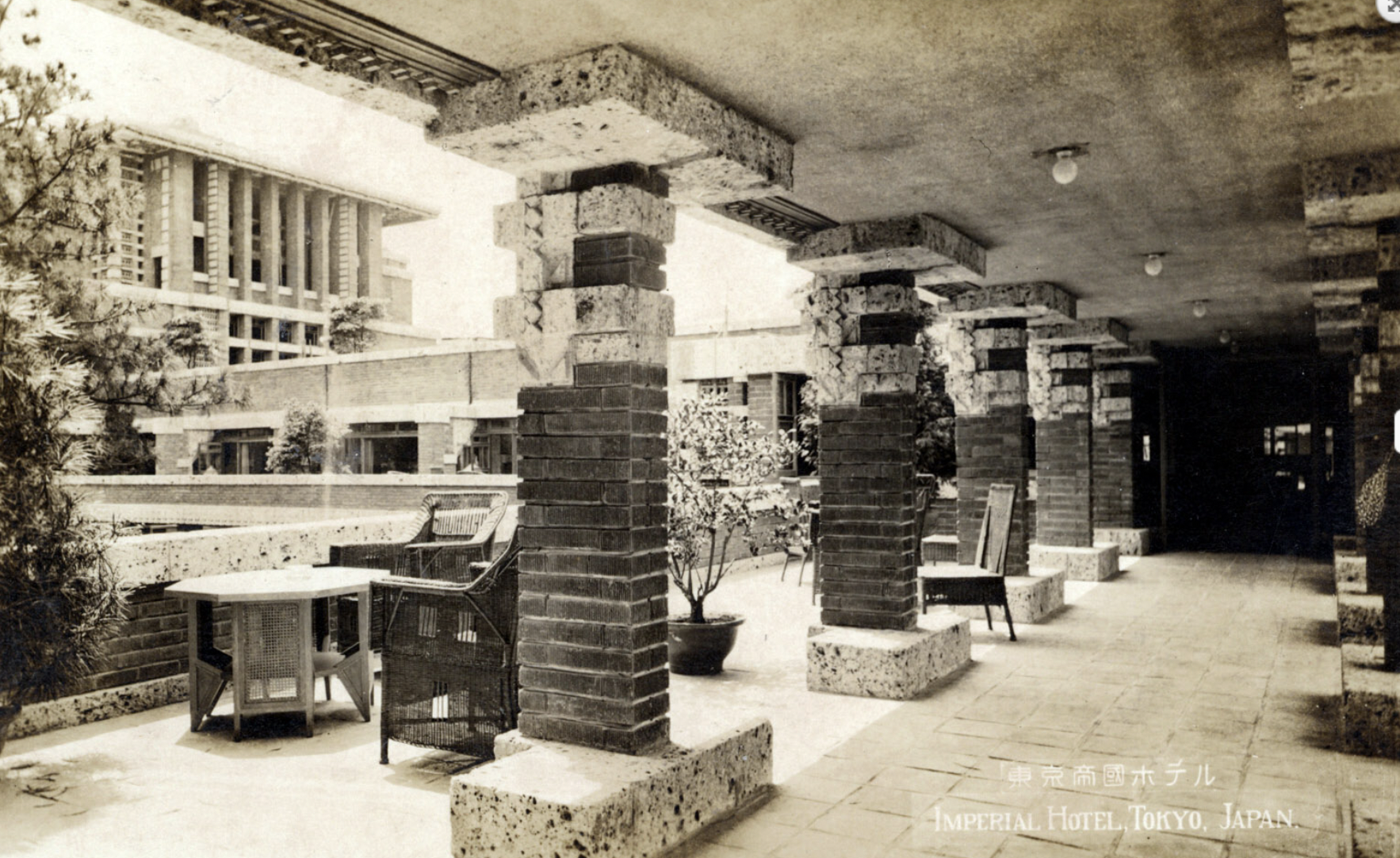
Even when new, the Imperial Hotel had its discomforts: Sundberg quotes a 1925 Far Eastern Review article calling it “a hundred years ahead of the age in its architectural features and fifty years behind in many things which make for the comfort of its patrons.” Wright “sacrificed everything to his art, raising a monument to his genius and bequeathing to the Japanese the difficult task of making it a financial success.” It was financial exigencies, in part, that motivated its demolition and replacement with a third, high-rise Imperial Hotel in 1967 — whose own impending demolition and replacement was announced just last year. France-based Japanese architect Tsuyoshi Tane has produced a design for the fourth Imperial Hotel; what tribute, if any, it pays Wright’s legacy we’ll only find out when it opens in 2036.
Related content:
Take a 360° Virtual Tour of Taliesin, Frank Lloyd Wright’s Personal Home & Studio
That Far Corner: Frank Lloyd Wright in Los Angeles – A Free Online Documentary
Why Japan Has the Oldest Businesses in the World? Hōshi, a 1300-Year-Old Hotel, Offers Clues
Wabi-Sabi: A Short Film on the Beauty of Traditional Japan
Based in Seoul, Colin Marshall writes and broadcasts on cities, language, and culture. His projects include the Substack newsletter Books on Cities, the book The Stateless City: a Walk through 21st-Century Los Angeles and the video series The City in Cinema. Follow him on Twitter at @colinmarshall, on Facebook, or on Instagram.
Read More...Hear a 19-Year-Old Prince Crushing It on Every Instrument in an Early Jam Session (1977)
It’s nearly impossible to communicate musicianship in words, though there are rare, successful literary attempts by greats like James Baldwin, Jack Kerouac, and jazz critic Ira Gitler, whose phrase “sheets of sound” so well captured the experience of Coltrane’s improvisational style in the late 50s. Maybe the free movements of jazz are easier to write about than other forms.…
When it comes to recently departed funk/pop/rock/R&B great Prince, it feels like there’s enough written about his prodigious talent that it begins to sound like overpraise. The most interesting tributes come from fellow musicians. Yet even their comments seem exaggerated.
Prince “played everything,” said Stevie Wonder soon after the Purple One’s sudden death – every style, every instrument – which seems like an impossible feat until you read the notes for his debut album and realize that, yes, he did play everything, before he hit 20… and listen to the full range of his output to see that, yes, he “could play classical music if he wanted to,” as Wonder said. “He could play jazz if he wanted to….”
Prince’s drummer Hannah Welton, who joined him in 2012, had similarly overblow-sounding praise, saying in a recent drum instruction video, “I don’t know that I ever heard an off note.” Everyone has an off day sometime, right? Too little sleep, a head cold, too much to drink… or whatever…. No musician could always be a hundred percent on, could they?
Listening to the funk/jazz jam sessions above recorded in 1977, when Prince was only 19 and on the threshold of releasing his first studio album, I’m inclined to cast off any remaining doubt that he was as untouchably disciplined and talented a musician as they say all of the time, even in behind-the-scenes rehearsals and jam sessions when, as Welton jokes, he seemed more interested in playing ping pong. If anyone embodied genius…
But there is a problem with that word (a word legendary music teacher Nadia Boulanger and onetime Quincy Jones mentor disliked). Prince might agree. Musical greats come out of great musical communities. Prince may have been the most proficient multi-instrumentalist of his time, but he consistently played with those who had no trouble keeping up with him, including early bass player André Cymone and longtime Revolution drummer Bobby Z.
Cymone and Z joined Prince in the Loring Park rehearsal room of Owen Husney, Prince’s first manager, to record these impromptu sessions. They are indeed “a must-listen for any fan!,” as Live for Live Music writes, and anyone else. “These eight instrumental tracks sound more like well-crafted compositions rather than the improvised jams that they are.” Prince, of course, switches up instruments, playing keys, guitar and bass and drums at times.
That it’s hard to tell when he’s playing what speaks not only to his own prowess but to that of his fellow musicians. As Bobby Z says in an interview for the Grammys, the biggest misunderstanding about Prince is “that he wasn’t human. That he was this mythical, immortal character. In the early days, he was a band member. He was the leader, of course, but he had to be in a band.” He was vocal in interviews about how playing with the hottest musicians in Minneapolis as a teenager gave him his early training.
Prince learned as much from others as they learned from him, says Z, soaking up everything he heard. “He was a fan. He loved being impressed by songs. He loved music. He loved other people’s talent.” But at the same time, he was still Prince, a rare talent without real equal. The Loring Park sessions may feature “instrumentals only,” notes Okayplayer, glancing at Prince’s compositional brilliance and showing off none of his vocal chops. Nonetheless, “it’s an intimate and terribly funky lens into P’s proficiency on damn-near every instrument,” before he’d even begun “his path to bonafide stardom.”
Related Content:
The Little Prince: Footage Gets Unearthed Of the Pop Star at Age 11
Josh Jones is a writer and musician based in Durham, NC. Follow him at @jdmagness
Read More...Japanese Restaurants Show You How to Make Traditional Dishes in Meditative Videos: Soba, Tempura, Udon & More
Despite having recently begun to admit tour groups, Japan remains inaccessible to most of the world’s travelers. Having closed its gates during the onset of the COVID-19 pandemic, the country has shown little inclination to open them up again too quickly or widely. The longer this remains the case, of course, the more intense everyone’s desire to visit Japan becomes. Though different travelers have different interests to pursue in the Land of the Rising sun — temples and shrines, trains and cafés, anime and manga — all of them are surely united by one appreciation in particular: that of Japanese food.
Wherever in the world we happen to live, most of us have a decent Japanese restaurant or two in our vicinity. Alas, as anyone with experience in Japan has felt, the experience of eating its cuisine anywhere else doesn’t quite measure up; a ramen meal can taste good in a California strip mall, not the same as it would taste in a Tokyo subway station.
At least the twenty-first century affords us one convenient means of enjoying audiovisual evocations of genuine Japanese eateries: Youtube videos. The channel Japanese Noodles Udon Soba Kyoto Hyōgo, for instance, has captivated large audiences simply by showing what goes on in the humble kitchens of western Japan’s Kyoto and Hyōgo prefectures.
Hyōgo contains the coastal city of Kobe as well as Himeji Castle, which dates back to the fourteenth century. The prefecture of Kyoto, and especially the onetime capital of Japan within it, needs no introduction, such is its worldwide renown as a site of cultural and historical richness. Right up until the pandemic, many were the foreigners who journeyed to Kyoto in search of the “real Japan.” Whether such a thing truly exists remains an open question, but if it does, I would locate it — in Kyoto, Hyōgo, or any other region of the country — in the modest restaurants of its back alleys and shotengai market complexes, the ones that have been serving up bowls of noodles and plates of curry for decade upon decade.
Ideally the décor never changes at these establishments, nor do the proprietors. The video at the top of the post visits a “good old diner” in Kobe to show the skills of a “hard working old lady” with the status of a “veteran cook chosen by God.” In another such neighborhood restaurant, located near the main train station in the city of Amagasaki, a “super mom” prepares her signature udon noodles. But even she looks like a newcomer compared to the lady who’s been making udon over in Kyoto for 58 years at a diner in existence for a century. Soba, tonkatsu, oyakodon, tempura, okonomiyaki: whichever Japanese dish you’ve been craving for the past couple of years, you can watch a video on its preparation — and make your long-term travel plans accordingly.
Related content:
How to Make Sushi: Free Video Lessons from a Master Sushi Chef
Cookpad, the Largest Recipe Site in Japan, Launches New Site in English
How Soy Sauce Has Been Made in Japan for Over 220 Years: An Inside View
The Proper Way to Eat Ramen: A Meditation from the Classic Japanese Comedy Tampopo (1985)
Based in Seoul, Colin Marshall writes and broadcasts on cities, language, and culture. His projects include the Substack newsletter Books on Cities, the book The Stateless City: a Walk through 21st-Century Los Angeles and the video series The City in Cinema. Follow him on Twitter at @colinmarshall, on Facebook, or on Instagram.
Read More...Brian Eno’s Ambient Album Music for Airports Performed by Musicians in an Airport
Ambient Music must be able to accommodate many levels of listening attention without enforcing one in particular; it must be as ignorable as it is interesting.
In the original liner notes to Brian Eno’s founding document of Ambient music — 1978’s Ambient 1: Music for Airports — the artist explains that he named his genre after “an atmosphere, or a surrounding influence: a tint. My intention is to produce original pieces ostensibly (but not exclusively) for particular times and situations with a view to building up a small but versatile catalogue of environmental music suited to a wide variety of moods and atmospheres.”
In defining “environmental music,” Eno takes great pains to distinguish his new work from the makers of Muzak. Rather than recreating the familiar with instrumental schmaltz, and “stripping away all sense of doubt and uncertainty,” Ambient should stimulate listeners’ minds without disturbing or distracting them, inducing “calm and a space to think.” Rolling Stone at the time coined the derisive, but not wholly inaccurate, phrase “aesthetic white noise.”
Reverb Machine painstakingly shows in a deconstruction how Eno himself introduced as much uncertainty into the compositional process as possible. Music for Airports is not, that is to say, a composition, but layers of tape loops with snippets of recorded music. These loops he set running and “let them configure in whichever way they wanted to.” Acting as initial selector of sounds and engineer, Eno’s role as composer and player of the piece involved “hardly interfering at all,” he’s said.
How could such a composition translate to a traditional performance setting, in which musicians, elevated on a stage, play instruments for audience members who face them, listening intently? The situation seems antithetical to Eno’s design. And yet, somehow, the musicians who make up the Bang on a Can All Stars ensemble have made it work beautifully, performing Music for Airports’s first track, the nondescriptly named “1/1,” in an arrangement by the group’s Michael Gordon, above, for an appreciative audience at the San Diego Airport Terminal.
Bang on a Can is a group committed, like Eno, to “making music new.” Since 1987, they have (unlike Eno) done so in a live performance-based way, holding 12-hour marathon concerts, for example. These performances have included their rendition of Music for Airports in full. The Village Voice described a 2007 performance in New York City for hundreds of attentive fans as “beautiful,” a word that often gets applied to Eno’s masterwork of randomness. Eno himself described the results as “very, very nice,” and he’s maybe the last person to be surprised that a live performance of the first so-called Ambient record works so well.
“The interesting thing is that it doesn’t sound at all mechanical as you would imagine,” he wrote of these early tape loop experiments. “It sounds like some guy is sitting there playing the piano with quite intense feeling. The spacing and dynamics of ‘his’ playing sound very well organized.” See a quintet of “guys” just above — on cello, bass, keyboard, percussion, and guitar — recreate the mildly disjointed mood of standing around in the liminal space of an airport, for a crowd of people who, presumably, came there for the express purpose of hearing background music.
Related Content:
Brian Eno Explains the Origins of Ambient Music
A Six-Hour Time-Stretched Version of Brian Eno’s Music For Airports: Meditate, Relax, Study
Discover the Ambient Music of Hiroshi Yoshimura, the Pioneering Japanese Composer
Josh Jones is a writer and musician based in Durham, NC. Follow him at @jdmagness.
Read More...30,000 Photographs of Black History & Culture Are Available Online in a New Getty Images Archive
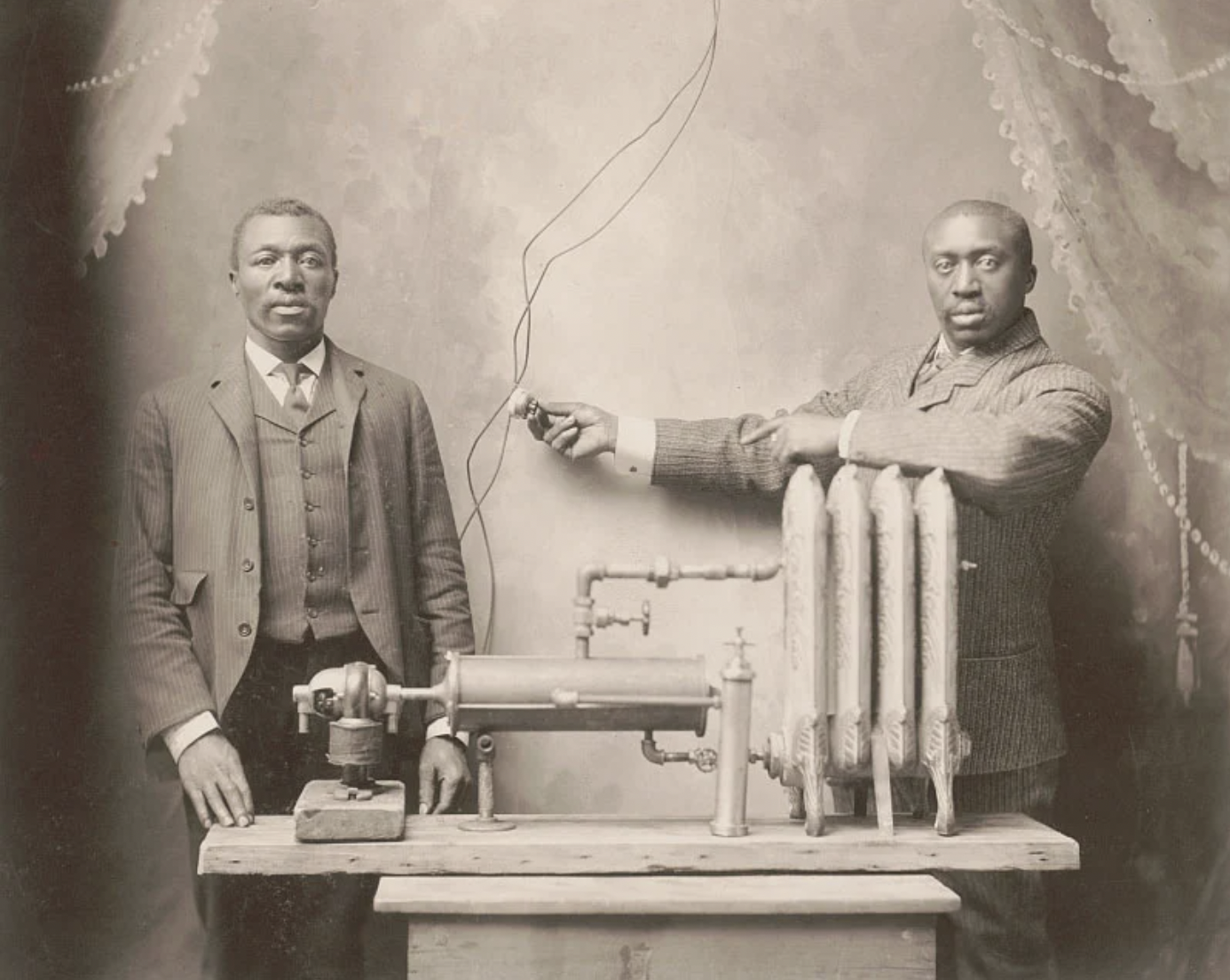
Image of Charles S.L. Baker with his Superheating Demonstration
Black History Month is February in the United States and Canada, and October in the United Kingdom and Europe. It may be July right now, but if you’re interested in a subject, there’s no reason not to get more deeply into it all year round. This is underscored by the opening, this month, of Getty Images’ Black History and Culture Collection. As Petapixel’s Matt Growcoot writes, it contains “30,000 rarely seen images of the Black diaspora in the United Kingdom and the United States that date back to the 19th century,” drawing from the domains of “politics, sport, music, culture, military, and celebrity.”
In the Black History and Culture Collection you’ll find pictures of cultural figures like Duke Ellington and Jay‑Z, Jack Johnson, Venus and Serena Williams, Sojourner Truth, and Bernardine Evaristo. These names only hint at the range of the archive, which you can also browse by category tags: “civil rights,” “governance,” and “sports,” to name a few examples, but also “families,” “fashion,” and “hair.”
There are, of course, an enormous number of photos filed under “American Culture,” which would itself be unimaginable without the contributions of the people documented. But the same could be said of the other side of the pond; hence the inclusion of a “Black British Culture” label as well.
Creating the Black History and Culture Collection involved more than just tagging photos. You can learn more about what went into it in the short video above, which includes the voices of collaborators like NYU Tisch School of the Arts’ Deborah Willis and the University of Pennsylvania’s Tukufu Zuberi. The artist Renata Cherlise speaks of the value of the images of famous people, but also those of everyday life as it was lived in places and times like Harlem’s Savoy Ballroom in the nineteen-forties. Whether or not your own heritage is tied into this history, you stand to learn a great deal from it. As Zuberi put sit, “Black culture is the original human culture, so there is no culture that is alien to black culture. The future of black culture is the future of human culture. Let’s go.”
via Petapixel/Colossal
Related content:
The Black Film Archive: A New Site Highlights 200+ Noteworthy Black Films Made Between 1915–1979
Based in Seoul, Colin Marshall writes and broadcasts on cities, language, and culture. His projects include the Substack newsletter Books on Cities, the book The Stateless City: a Walk through 21st-Century Los Angeles and the video series The City in Cinema. Follow him on Twitter at @colinmarshall, on Facebook, or on Instagram.
Read More...The Metropolitan Museum of Art Restores the Original Colors to Ancient Statues

The idea that the human species can be neatly bracketed into racial groups based on superficial characteristics like skin, hair, and eye color only developed in the 18th century, and mainly took root as a pseudo-scientific justification for slavery and colonialism. Central to that idea was the Classical Ideal of Beauty, a standard supposedly set by Greek and Roman statuary from antiquity. As beliefs in regional supremacy in Western Europe transformed in the modern era into “White” supremacy, the stark whiteness of antique statuary became a specific point of pride. But ancient people did not think in terms of race, and ancient sculptors never intended their creations to stand around in public without color. “For the ancient Greeks and Romans,” Elaine Velie writes at Hyperallergic, “white marble was not considered the final product, but rather a blank canvas.”
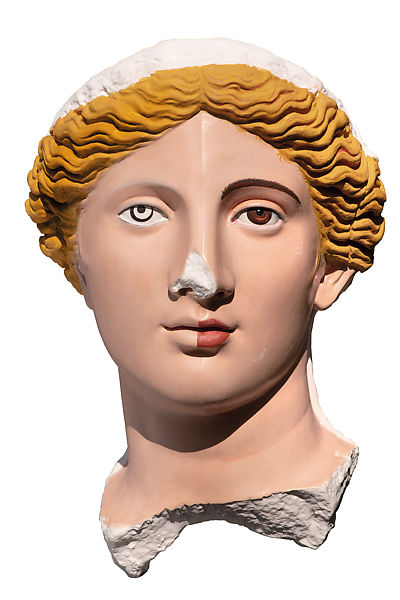
As Metropolitan Museum of Art curator Seán Hemingway says, “White supremacists have latched onto this idea of white sculpture — it’s not true but it serves their purposes.” Art historians and conservators have known for decades that statues from antiquity were once covered in paint, silver and gilding, a process known as polychromy. Over time, the colors dulled, faded, then disappeared, leaving behind only the faintest traces.
Husband-and-wife research team Vinzenz Brinkmann and Ulrich Koch-Brinkmann have spent over 40 years studying polychromy and reconstructing ancient sculptures as they would have appeared to their first viewers. “Their Gods in Color exhibition has been touring since 2003,” Velie writes, “and their replicas have been included in museums around the world.”
Now fourteen of those reconstructions, as well as a couple dozen more created by Met conservators, scientists, and curators, are scattered throughout the Met’s sculpture halls, with a small upstairs gallery dedicated to an exhibit. The exhibition explains how researchers determined the statues’ colors, “the result of a wide array of analytical techniques, including 3D imaging and rigorous art historical research,” writes the Met. As Artnet notes, the “richly colored version of the Met’s Archaic-period Sphinx finial,” which you can see at the top of the post, “serves as the centerpiece of the show” – one of the only pieces placed adjacent to its original so that visitors can compare the two (using an Augmented Reality app to do so; see video above).

Chroma: Ancient Sculpture in Color, which opened on July 5th, disabuses us of old ideas about the blank whiteness of antiquity, but that’s hardly its only intent. As it does today, color “helped convey meaning in antiquity.” The colors of ancient statues were not simply decorative surfaces – they were integral to the presentation of these works. Now, color can again be part of how we understand and appreciate classical statuary. And the full acceptance of polychromy in major collections like the Met can begin to put to rest false notions about a classical devotion to whiteness as some ideal of perfection. Learn more about the 40 reconstructions in the exhibition at the Met here, and learn more about polychromy and ancient uses of color at the links below.
via Hyperallergic
Related Content:
Roman Statues Weren’t White; They Were Once Painted in Vivid, Bright Colors
How Ancient Greek Statues Really Looked: Research Reveals Their Bold, Bright Colors and Patterns
Josh Jones is a writer and musician based in Durham, NC. Follow him at @jdmagness
Read More...The Homes of 2020 Imagined in 1989: Wireless Audio Systems, Smart Heating, Windows That Turn Into TVs & More
Many trends in architecture and home design have come and gone over the past thirty years, and some have not spread as far as they might have. The green architectural movement in much of Asia, for example, in which skyscrapers practically drip with growing things, hasn’t caught on in congested cities in the West, and perhaps it never will. Granted, few urban areas have such concerns about air quality as cities in China where green buildings have taken hold recently — where 2/3rds of the population is slated to live in cities by 2050; and where a massive population boom in the last twenty years has required four to five million new buildings. But even if we don’t live in a burgeoning city with an urgent mandate to reduce carbon emissions for basic public health, it’s time for brand-new building standards everywhere.
The creators of the 1989 BBC episode of Tomorrow’s World had a sense of environmental urgency, though it wasn’t first on their list of home improvements for the buildings of 2020. After casually wondering whether the homes of the future will “protect the environment,” presenter Judith Hann turns things over to Christine McNulty of the Applied Futures project, who surveyed people to learn “what people would want from their homes.” What will they want? “All the benefits of modern technology” with few of the drawbacks, such as the unwieldy boxes and tangled wires that constituted audio systems of yore (archaic-looking here even by 1989 standards).
We got what we wanted: audio/visual systems can integrate seamlessly into our homes, with bluetooth and wireless and unobtrusive components. We are living in a golden age of consumer entertainment. We are also living in a glorious time of home automation, which co-host Howard Stableford introduces in the next segment. Stableford shows how we will be able to walk from room to room and have lights turn off and on as we go, technology currently available at your local big box store. Later, David Button of Pilkington Glass introduces futuristic tech that could change windows or walls into a TV, something we do not see in homes today and for which few consumers seem to clamor.
Finally, in the last two segments, we get to projections about energy management and smart heating. “Homes are going to have to change,” says Stableford, to meet what McNulty calls “enormous pressure to cut down on our burning of fossil fuels.” Hann introduces building materials that could “bring heating bills down to zero.” Stableford returns to the idea of automation for energy efficient “smart heating.” There is no mention of the need for cooling homes in a rapidly warming world, especially in parts reaching average temperatures inhospitable to human life. 1989 had a pretty good read on what we would want in our individual homes, but it could not foresee how those desires would overrun care for the one home we share.
Related Content:
Josh Jones is a writer and musician based in Durham, NC. Follow him at @jdmagness
Read More...“Downton Abbey” and the Allure of Historical Drama — Pretty Much Pop: A Culture Podcast #127

We discuss the appeal of this Julian-Fellowes-penned British historical drama in light of the new film. Is this really “a new era” or just more of the same, and is that bad?
Your Pretty Much Pop host Mark Linsenmayer is joined by returning guest Jon Lamoreaux (host of The Hustle music podcast), plus a couple: former newscaster Corrinne MacLeod (whom Mark SCANDOLOUSLY went on one date with at age 12) and her husband, the photographer Michael MacLeod.
We talk about the excellent casting and how such a big cast gets juggled, the appeal of this particular historical setting, revolutions against the class system in the show, and the soapy plots. How can a film give us enough of such a big cast? We also touch on The Gilded Age, Bridgerton, Howard’s End, Gosford Park, The Great, Poldark, and more.
A few relevant articles we looked at include:
- “Downton Abbey: How the Period Franchise Has Remained Popular” by Jessica Brajer
- “Downton Abbey: A New Era Is Really the Same Old Downton Abbey” by Jen Chaney
- “‘Downton Abbey’ reminds us what ‘conservatism’ really means” by Max Boot
- “‘Downton Abbey’ 602: What Are This Show’s Politics, Anyway?” By Meghan O’Keefe
- “How Downton Abbey went from great to awful to pretty good again” by Constance Grady
- “Thomas Barrow, Iconic Chaotic Gay, Gets Bland but Happy Ending in ‘Downton Abbey: A New Era’—Happy Pride Month” by Princess Weekes
Hear more Pretty Much Pop, including recent episodes on Jackass, This Is Us, and The Expanse. Support the show at patreon.com/prettymuchpop or by choosing a paid subscription through Apple Podcasts. This podcast is part of the Partially Examined Life podcast network.
Pretty Much Pop: A Culture Podcast is the first podcast curated by Open Culture. Browse all Pretty Much Pop posts.
Read More...John Waters’ Comical & Inspiring Commencement Speech: “You Too Can Fail Upwards” (2022)
John Waters hasn’t made a movie in quite some time, but that doesn’t mean he’s gone quiet. In fact he’s remained as visible a cultural figure as ever by working in other forms: writing a new novel, acting on television, delivering commencement addresses. His dedication to that last pursuit is such that he even kept it up in 2020, at the height of the COVID-19 pandemic. That year he delivered his commencement speech for New York’s School of Visual Arts not at Radio City Music Hall, as scheduled, but in front of a green screen in Baltimore — which, of course, only enriched the Watersesque sensibility of the proceedings.
Having been forced into the role of “virtual keynote speaker,” Waters made up for it this year by delivering, in person, a make-up commencement address for the SVA classes of both 2020 and 2021. And he did it onstage at Radio City, a venue “known for family movies and the Rockettes. What the hell am I doing here?” As usual in this phase of his career, Waters expresses surprise to find himself in the role of elder statesman.
“In 2020, the School of Visual Arts gave me an honorary degree for, I guess, causing trouble,” he says. “This year, the National Film Registry — yes, that’s part of the Library of Congress, the U.S. Government, for god’s sake — selected my film Pink Flamingos, which New York magazine once called ‘beyond pornography,’ to its annual list of 25 culturally historic films.”
Safe to say that, half a century after its release, Waters’ most notorious motion picture doesn’t repel the establishment as it once did. And indeed, here in the 2020s, how can an artist get transgressive at all? Waters has much encouragement and advice for young people in search of new boundaries to violate. “Outsider old master paintings, narrative abstract expressionism, impenetrable pop, decorative minimalism, non-conceptualism, video folk art, appropriated NFT”: these are just a few of the artistic ventures not yet attempted that could turn their popularizers into cultural phenomena. “You too can fail upwards, if you try,” Waters insists, but you’ve got to do it with a sense of humor. “Mock yourself first. Then you can be as crazily righteous as you want.”
Related content:
John Waters’ RISD Graduation Speech: Real Wealth Is Life Without A*Holes
An Anti, Anti-Smoking Announcement from John Waters
David Lynch Gives Unconventional Advice to Graduates in an Unusual Commencement Address
John Waters Talks About His Books and Role Models in a Whimsical Animated Video
Based in Seoul, Colin Marshall writes and broadcasts on cities, language, and culture. His projects include the Substack newsletter Books on Cities, the book The Stateless City: a Walk through 21st-Century Los Angeles and the video series The City in Cinema. Follow him on Twitter at @colinmarshall, on Facebook, or on Instagram.
Read More...Support Us
We're hoping to rely on loyal readers, rather than erratic ads. Please click the Donate button and support Open Culture. You can use Paypal, Venmo, Patreon, even Crypto! We thank you!

About Us

Open Culture scours the web for the best educational media. We find the free courses and audio books you need, the language lessons & educational videos you want, and plenty of enlightenment in between.
Advertise With Us
FREE UPDATES!
GET OUR DAILY EMAIL
Get the best cultural and educational resources on the web curated for you in a daily email. We never spam. Unsubscribe at any time.
FOLLOW ON SOCIAL MEDIA
Open Culture editor Dan Colman scours the web for the best educational media. He finds the free courses and audio books you need, the language lessons & movies you want, and plenty of enlightenment in between.
Advertise With Us

