Behold! A Medieval Graphic Novel Carved on an 14th Century Ivory Box
The Châtelaine de Vergy, a courtly romance that was wildly popular in the mid-13th century, would’ve made a crowd pleasing graphic novel adaptation. It’s got sex, treachery, a trio of violent deaths, and a cute pup in a supporting role.
Seeing as how the form had yet to be invented, medieval audiences got the next best thing — a Gothic ivory casket on which the story is rendered as a series of carved pictures that start on the lid and wrap around the sides.
In an earlier video for the British Museum’s Curator’s Corner series, Late Medieval Collections Curator Naomi Speakman admitted that the purpose of such deluxe caskets is difficult to pin down. Were they tokens from one lover to another? Wedding gifts? Jewelry boxes? Document cases?
Unclear, but the intricate carvings’ narrative has definitely been identified as that of The Châtelaine de Vergy, a steamy secular alternative to the religious scenes whose depiction consumed a fair number of medieval elephant tusks.
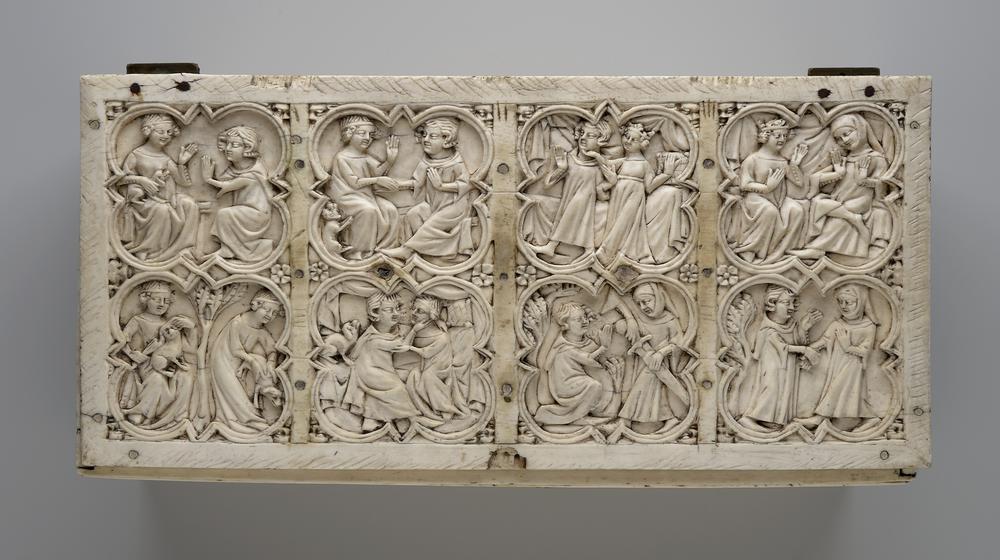
In addition to the early-14th century example in the British Museum’s collection, the Courtauld Institute of Art’s Gothic Ivories database catalogues a number of other medieval caskets and casket fragments depicting The Châtelaine de Vergi, currently housed in museums in Milan, Florence, Paris, Vienna, New York City and Kansas.
A very graphic novelesque conceit Speakman points to in the British Museum’s casket finds the Duke of Burgundy breaking the frame (to use comics terminology), reaching behind the gutter to help himself to the sword the Châtelaine’s knightly lover has just plunged into his own breast.
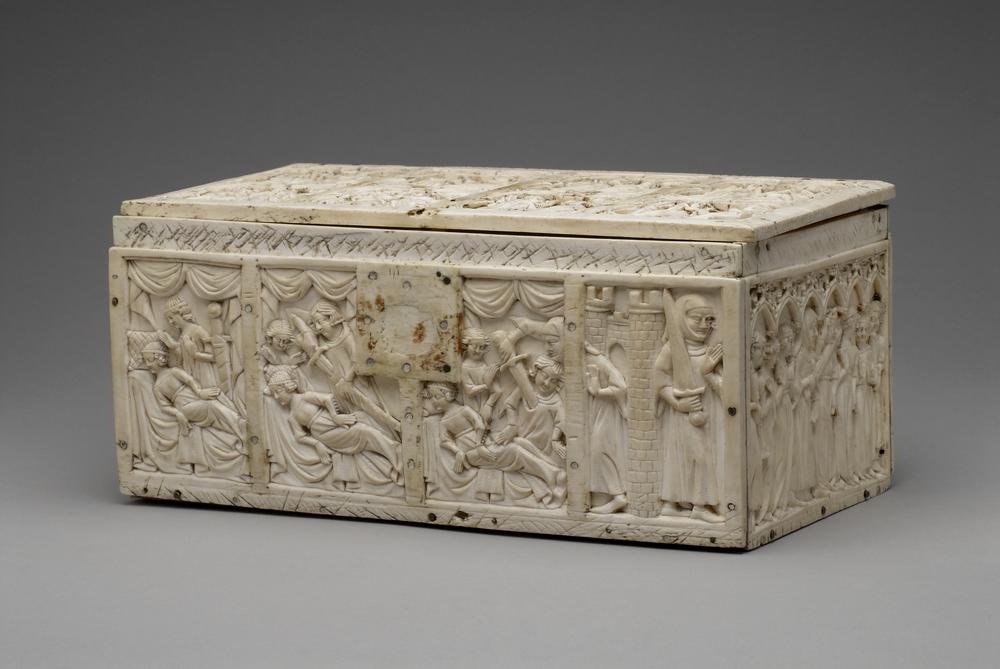
Peer around to the far side of the casket to find out what the Duke intends to do with that sword. It’s a shocker that silences the trumpets, quiets the dancing ladies, and might even have laid ground for a sequel: Chatelaine: The Duke’s Wrath.
Read Eugene Mason’s early 20th century translation of The Chatelaine of Vergi here.
Watch more episodes of the British Museum’s Curator’s Corner here.
Related Content
The Book of St Albans, One of the Finest Medieval Manuscripts, Gets Digitized and Put Online
A Medieval Book That Opens Six Different Ways, Revealing Six Different Books in One
Behold Medieval Snowball Fights: A Timeless Way of Having Fun
- Ayun Halliday is the Chief Primatologist of the East Village Inky zine and author, most recently, of Creative, Not Famous: The Small Potato Manifesto. Follow her @AyunHalliday.
Read More...Watch Hundreds of Polish Films Free Online: Feature Films, Documentaries, Animations & More
The Polish film industry has produced a few internationally-known auteurs, including Andrzej Wajda, Krzysztof Kieślowski, and Roman Polanski, but a handful of critically-lauded directors cannot represent the scope of any national cinema. Without a wider appreciation of Poland’s film history, we lack crucial context for understanding its most famous artists. Now, a new archive called 35mm.online gives us hundreds of films and animations by Polish filmmakers, a unique opportunity to immerse oneself in the country’s cinematic art like never before.
Polish film history can broadly be divided into films made before WWII and those made after, when the country came under strict Communist control. The first period includes a silent film industry that began with the origins of cinema itself and made a star of actress Pola Negri, whose films were screened in Berlin with German-language title cards. Many movies made in the sound era took direction, no pun intended, from filmmaker Aleksander Ford, a champion of Communist aesthetic theory. “Cinema cannot be a cabaret,” he once told the Soviet Kino magazine, “it must be a school.” Ford made realist films about social issues and propaganda films during the war.
In 1945, Ford took control of the Polish film industry as director of the nationalized state production company, Film Polski. The company had a monopoly on production, distribution, and exhibition, and in Poland, as in most Eastern Bloc nations in the Cold War, the challenge of evading censors put far more pressure on filmmakers than market demands. “Under the Communist regime,” Dark Kuzma writes at Movie Maker, “Polish authorities waged war on moviemakers.… Any critique of the Soviet Union or the Polish People’s Republic was silenced,” beginning with a 1945 film titled 2x2=4, by Antoni Bohdziewicz.
Ford didn’t last long as an administrator, though he returned in the 50s to help advise and oversee productions. Film Polski became the Central Office of Cinematography in 1951, and enforced even stricter controls on Polish filmmakers. But as control of the film industry centralized, academic bureaucrats took over for savvy filmmakers like Ford. “Polish censors,” Kuzma notes, “were highly literary, capable of deciphering even the most sophisticated ‘subversions’ in books, newspapers and other written forms — but they were quite impotent when it came to evaluating images.”
Polish filmmakers could not make any overt narrative critiques and “were forced to learn how to say something without saying it directly, how to depict a reality that did not officially exist,” says Oscar-nominated Polish cinematographer Ryszard Lenczewski. Necessity led to a creative symbolic language viewers had to decode:
This was a responsibility we all felt: to create layered images, images with double meanings that dared viewers to interpret them differently. It was all in the details — like using wider lenses to show things you would not be able to show any other way. Something may be occurring in the background, slightly blurred. Sometimes all the film needs was to not include something or someone in the frame.
The need for clandestine cinematic methods became fully apparent in 1982, when a commission met and determined even stricter rules for Polish film, partially in reaction to the filmmaker Ryszard Bugajski’s Interrogation, an unsparing depiction of “Stalin-era political life.” (See an excerpted scene at the top). A transcript of the proceedings, which included Bugajski, made their way out of the country in secret and was reported on in The New York Times. Bugajski feared his film would not see release, and he was right, though Interrogation circulated in samizdat VHS form for years, attaining cult status. It was eventually released years later and would become one of the most popular films of the time.
After Interrogation, Polish filmmakers began to employ even more distinctive symbolic vocabularies, from sci-fi satire in 1984’s hugely popular Sexmission (trailer above), to the use of heavily saturated colors, a feature so many Polish films of the 1980s and 90s share and which characterizes the work of Kieślowski, one of the most revered of Polish directors among Polish and non-Polish cinephiles alike. Best known for his early 90s trilogy Three Colors: Blue, Red and White, the director began using specific colors to convey meaning earlier in his career.
Camera operator Sławomir Idziak, who worked on Kieślowski’s 1988 A Short Film About Killing (see trailer above), remembers, “I shot the film in this hideous yellow-greenish color to subtly hint at the director’s idea that the country could be a killer, just like the main character. I remember one reviewer in Cannes writing that because the screen assumes the color of urine, it encapsulates the reality of Communist Poland. That was beautiful.”
Filmmaker Barbara Sass went on to make several films in which specific color plays significant roles, starting with her 1980, festival-winning debut, Without Love. She surrounds her yellow-haired main character, played by Dorota Stalińska, with a sickly hospital yellow, then immerses her in the dim red light of a photographic darkroom. Her many later films employed bold uses of color to similar effect. These films represent only a tiny sampling of the nearly 4,000 Polish films hosted on 35mm.online, a joint project of the Polish Film Institute and “one of Poland’s oldest film studios, Wytwόrnia Filmόw Dokumentalnych i Fabularnych (WFDiF), (Documentary and Feature Film Studios),” notes The first News.
The collection includes 160 features, 71 documentaries 474 animated short films, and 10 animated features. We’ve barely scratched the surface of Polish cinema history and there are hundreds of animations yet to watch (read some of their grim descriptions at MetaFilter). So get to watching at 35mm.online.
Note: To enable English subtitles, click the “Enable Subtitles” button beneath each film. (The first button.) Then go to the “Setttings” button and choose English subtiles.
via MetaFilter
Related Content:
50 Film Posters From Poland: From The Empire Strikes Back to Raiders of the Lost Ark
An Introduction to Stanislaw Lem, the Great Polish Sci-Fi Writer, by Jonathan Lethem
Free Online: Watch Stalker, Mirror, and Other Masterworks by Soviet Auteur Andrei Tarkovsky
Josh Jones is a writer and musician based in Durham, NC. Follow him at @jdmagness.
Read More...The Book of St Albans, One of the Finest Medieval Manuscripts, Gets Digitized and Put Online
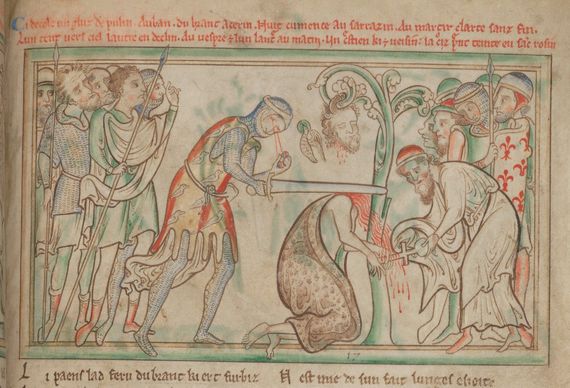
This past month, on the eve of the June 22nd feast of St Alban, the library of Trinity College Dublin announced that it had digitized the “13th century masterpiece” the Book of St Alban, a richly illustrated manuscript that “features 54 individual works of medieval art and has fascinated readers across the centuries, from royalty to renaissance scholars.”
Created by the Benedictine monk Matthew Paris, the manuscript “chronicles the life of St Alban,” notes The Irish Times, “and also outlines the construction of St Alban’s Cathedral in Hertfordshire.” The text and illustrations explain the origins of a cult of St. Alban, the first English martyr, that began to spring up after his 4th century death.
According to the Venerable Bede, the English monk who wrote the Ecclesiastical History of the English People, the martyrdom of Alban involved a few miraculous events. Sentenced to die for his refusal to renounce Christianity, Alban supposedly petitioned God to dry up the River Ver so he could more quickly reach the place of his execution.
This miracle caused Alban’s Roman executioner to fall to his feet, spontaneously convert, and refuse to kill the saint. A second executioner stepped in to behead them both, whereupon this man’s eyes popped out of his head. “He who gave the wicked stroke,” writes Bede, “was not permitted to rejoice over the deceased; for his eyes dropped upon the ground together with the blessed martyr’s head.”
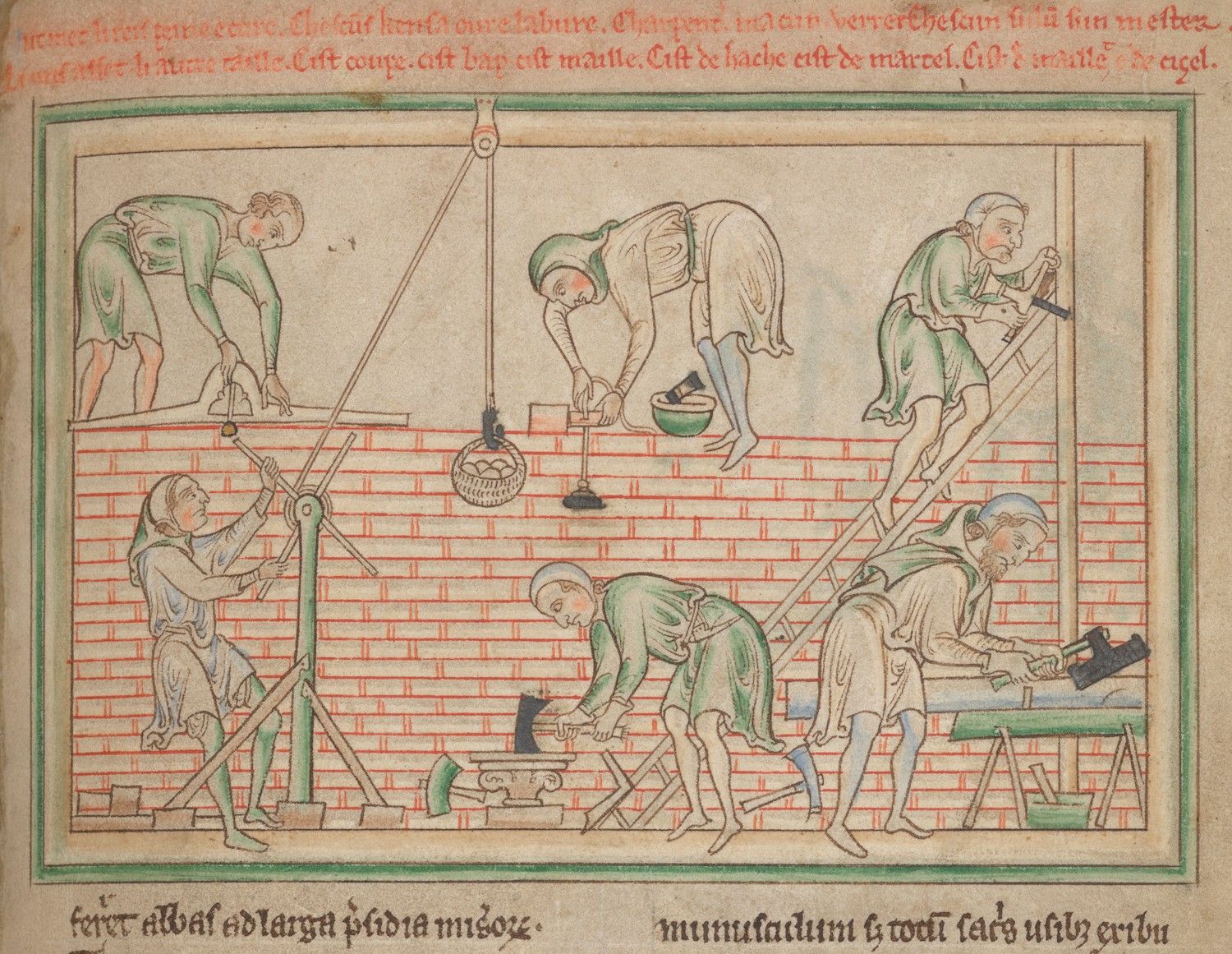
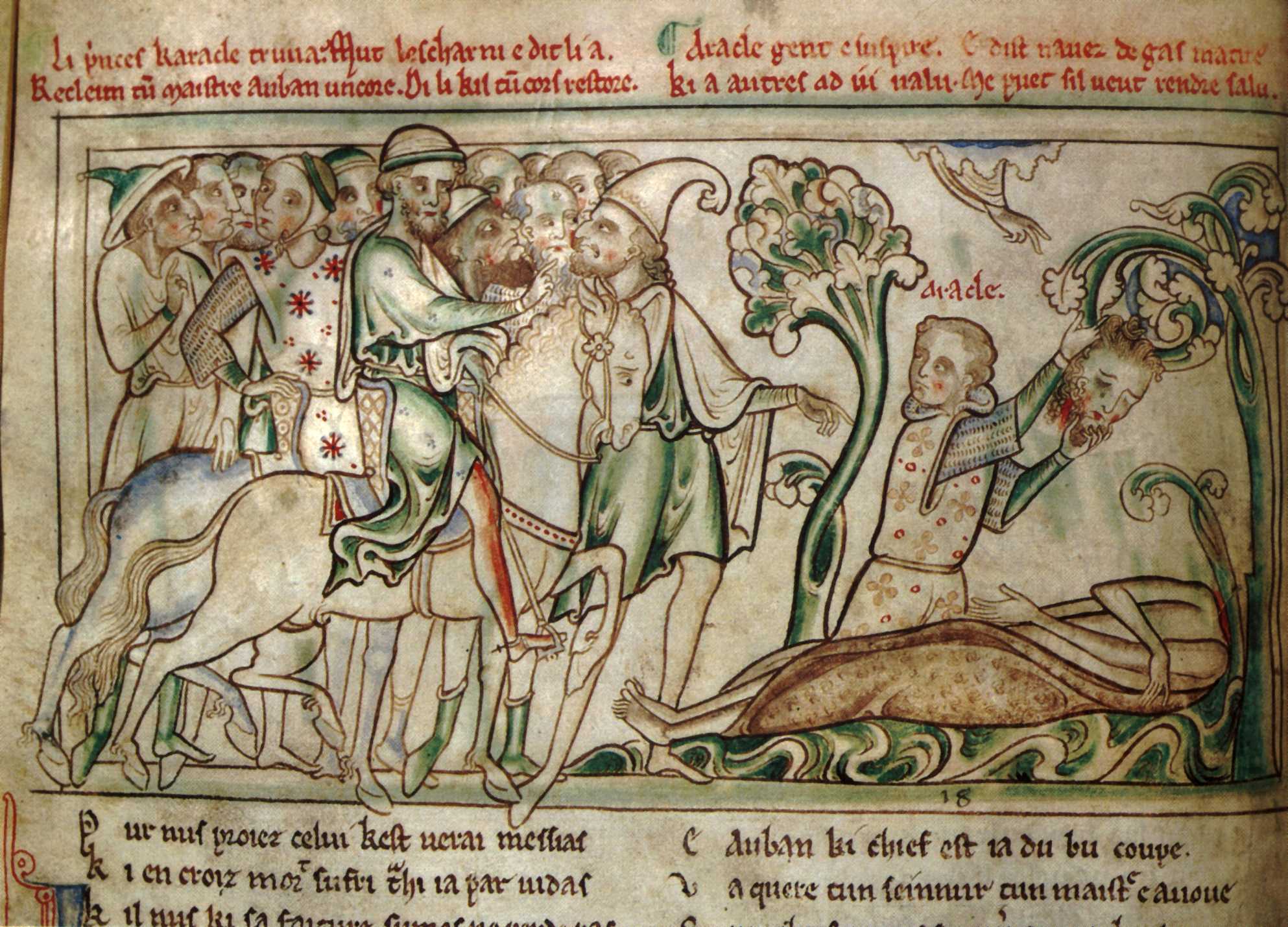
In the illustration of this grisly story (top) from the manuscript, we see the executioner holding his eyes in his hand, and Alban’s head appears to have been caught by the hair on a tree branch above. Another illustration, further up, shows a character named Heraclius making off with Alban’s head.
In a later legend, Alban’s head rolled to the bottom of Holywell Hill, and a well sprang from where it came to rest. On the supposed site of Alban’s execution now stands St Albans Cathedral, once St Albans Abbey, where the Book of St Albans remained for 300 years until Henry VIII dissolved Britain’s monasteries in 1539.
The book is written in both Latin and Anglo-Norman French, “which made it accessible to a wider secular audience including educated noble women,” Trinity College’s Caoimhe Ni Lochlainn writes. “It was borrowed by noble ladies of the period, including the King’s sister-in-law Countess of Cornwall, Sanchia of Provence, and others.”
The manuscript eventually made its way to Trinity College Dublin in 1661, where it has remained ever since, and where its “mostly framed narrative scenes” have been admired by a select few. Now everyone can access the book and its illustrations, made with a “tinted drawing technique,” Lochlainn notes, “where outlined drawings are highlighted with colored washes from a limited palette. This technique was distinctly English, dating back to the Anglo Saxon art of the 10th century.”
See all the grisly details of this fascinating artifact at Trinity College Dublin’s Digital Collections, and learn more about the manuscript in the video just above.
Related Content:
The Medieval Masterpiece, the Book of Kells, Has Been Digitized and Put Online
Josh Jones is a writer and musician based in Durham, NC. Follow him at @jdmagness
Read More...Joni Mitchell Sings “Both Sides Now” at the Newport Folk Festival: Watch Clips from Her First Full Concert Since 2002
This weekend, the Newport Folk Festival made headlines when it brought out of retirement two music legends. Paul Simon returned to the stage and performed “Graceland,” “The Boxer” and “other classics.” But Joni Mitchell stole the show when she performed (with a little help from Brandi Carlile) “Both Sides Now,” “Big Yellow Taxi,” “Just Like This Train” and 10 other songs. Mitchell suffered a brain aneurysm in 2015, and hadn’t performed a full concert since 2002. Hence why the show was a big deal.
Get the full backstory on the Newport performance over at NPR.
Just Like This Train
Summertime
Circle Game
If you would like to support the mission of Open Culture, consider making a donation to our site. It’s hard to rely 100% on ads, and your contributions will help us continue providing the best free cultural and educational materials to learners everywhere. You can contribute through PayPal, Patreon, and Venmo (@openculture). Thanks!
Related Content
Joni Mitchell Publishes a Book of Her Rarely Seen Paintings & Poetry
Songs by Joni Mitchell Re-Imagined as Pulp Fiction Book Covers & Vintage Movie Posters
Read More...When Erik Satie Took a Picture of Debussy & Stravinsky (June 1910)
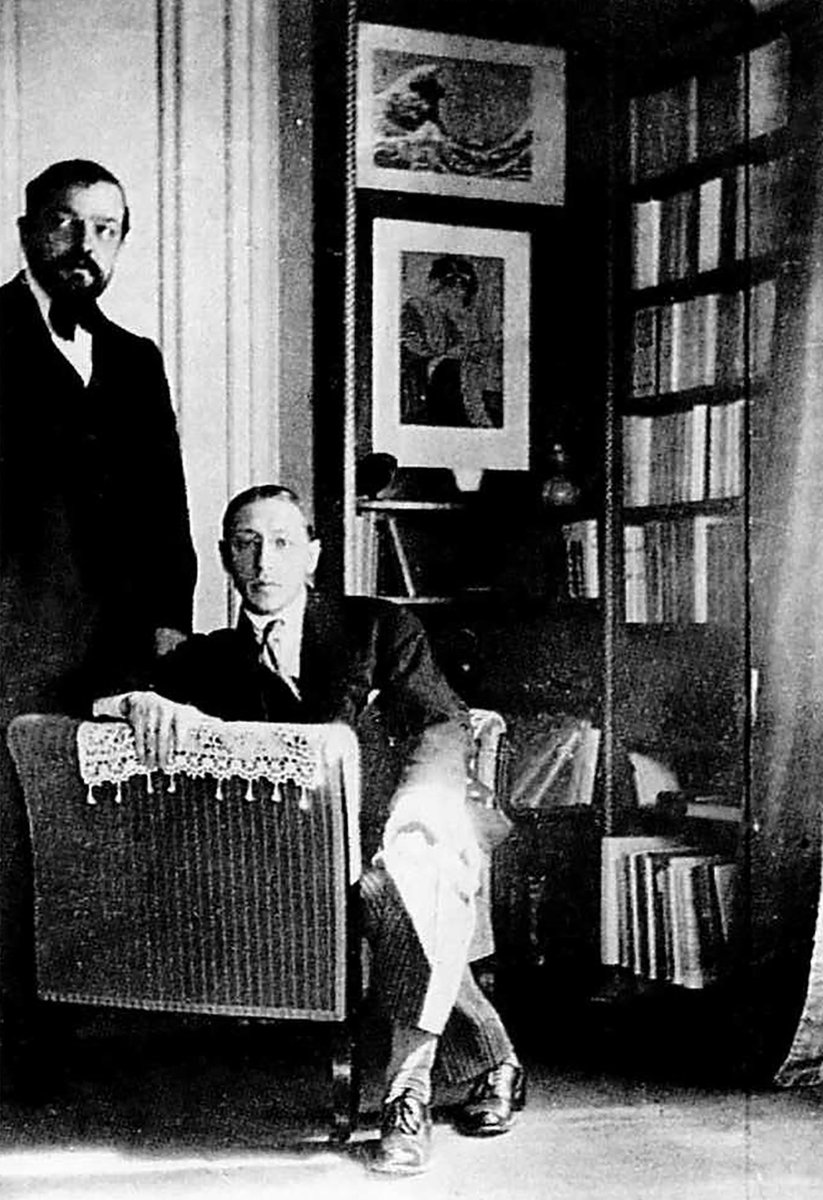
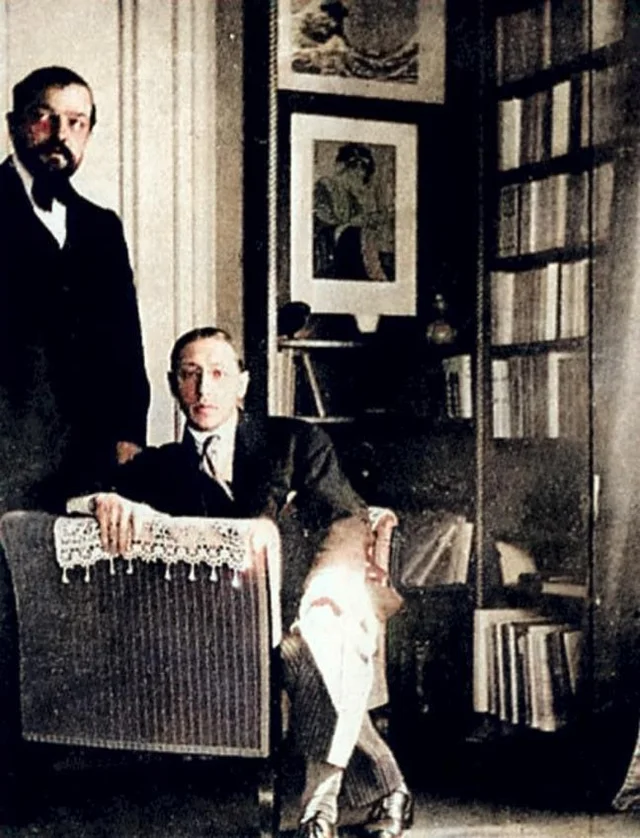
Erik Satie knew his way around not just the piano but the camera as well. This is evidenced by the image above, a 1911 portrait of Claude Debussy and Igor Stravinsky. Described by Christie’s as “an outstanding photograph of the two composers in the library at Debussy’s home,” it was taken by Satie at the time when Serge Diaghilev’s Ballets Russes were performing Debussy’s Jeux and Stravinsky’s The Rite of Spring. In the background appears what looks like Katsushika Hokusai’s The Great Wave Off Kanagawa, a work of art “used by Debussy on the front cover of the first edition of his symphonic sketches La mer.”
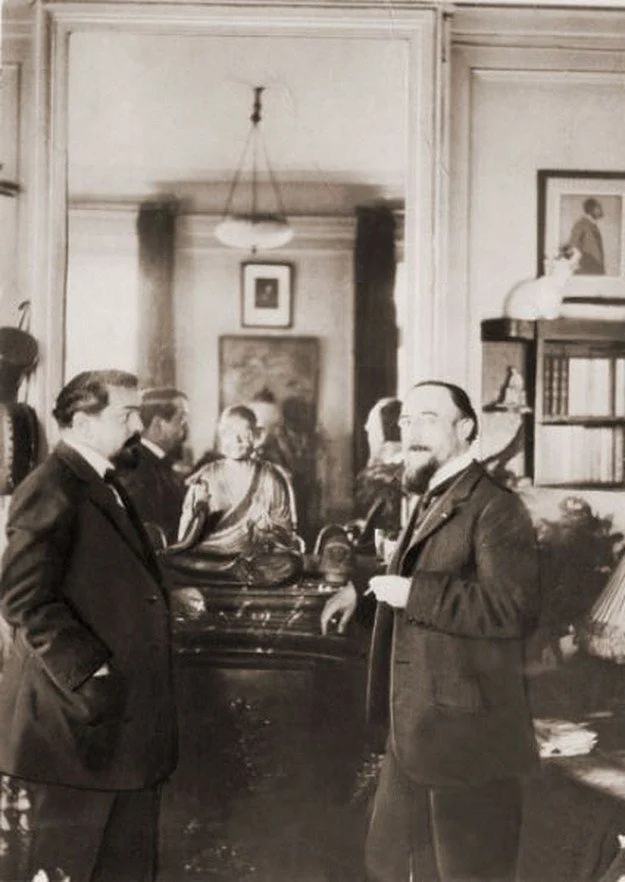
Just above appears another picture captured in Debussy’s home, this one of Debussy and Satie. “The photo was taken by Stravinsky, if my memory didn’t go wrong,” says one commenter on the r/classicalmusic subreddit. Another expresses confusion about the subjects themselves: “I thought they didn’t like each other?”
One responder explains that “they were friends at first, for quite some time, but later their relationship got worse.” Debussy’s orchestration of Satie’s Gymnopedies brought those pieces to prominence, but, Satie ultimately came to feel that Debussy had been stingy with the fruits of his great success.
Or so, at any rate, goes one interpretation of the dissolution of Debussy and Satie’s friendship. Different Redditors contribute different details: one that “every time they met, Satie would praise Ravel’s music to annoy Debussy,” another that “Debussy kept a bottle of the cheapest table wine for Satie for when he came over.” It can hardly have been easy, even in the best of times, for two of the strongest innovators in early-twentieth-century music to occupy the same social space for long stretches of time, let alone in company that included the likes of Ravel and Stravinsky. More than a century later, their artistic legacies could hardly be more assured — as, one faintly senses when looking at these photos, they knew would be the case.
Related content:
Hear Debussy Play Debussy’s Most Famous Piece, “Clair de lune” (1913)
Hear the Very First Pieces of Ambient Music, Erik Satie’s Furniture Music (Circa 1917)
The Night When Charlie Parker Played for Igor Stravinsky (1951)
Based in Seoul, Colin Marshall writes and broadcasts on cities, language, and culture. His projects include the Substack newsletter Books on Cities, the book The Stateless City: a Walk through 21st-Century Los Angeles and the video series The City in Cinema. Follow him on Twitter at @colinmarshall, on Facebook, or on Instagram.
Read More...Watch Restored Video of the Smashing Pumpkins’ First Televised Performance (1988)
For Gen X’ers who spent their twenties scouting the cities young people go to retire, and Millennials who spent their youth dancing to N’Sync, TLC, and the Spice Girls, nostalgia for simpler times just makes psychological sense. The 1990s was the last decade in which we had a shared set of references, “before the internet splintered mass culture,” Sadie Dingfelder writes at The Washington Post. “In the 90s, everyone listened to the same one or two radio stations in their city that played all the Top 40 hits, spanning all kinds of genres,” says DJ Matt Bailer.
This means that everyone who heard “No Scrubs” enough times to sing each note also heard the Smashing Pumpkins’ biggest hits, and learned to love them equally. It means that we could love the music of Billy Corgan without being subjected to the terrible opinions of Billy Corgan. As the baby-faced singer/songwriter aged, he has become, in his own words, a “bitter contrarian,” “carnival barker,” and “class‑A heel,” he says, referencing his later career in professional wrestling.
The assessment may seem mild considering Corgan’s appearances on Alex Jones’ Infowars and his embrace of conspiracy theories. Behavior he calls schtick has actual consequences in the world. Has it hurt his career? “If I kept my mouth shut,” he admits in discussing the band’s 2018 reunion, “we’d be playing a lot bigger venues and we would be a lot more successful, and we’d be in somebody’s Rock & Roll Hall of Fame.” Love or hate Corgan, Smashing Pumpkins as a unit earned their place in rock and roll history.
The Pumpkins exuded mystery from the start, with their sublime, fuzzed-out psychedelic melodies and huge, distorted choruses. Later came the dreamlike videos and opaque, impassive rock star egos. They didn’t just make it big in the 90s, they were essential to its sound, one they invented even before the decade dawned. See a young, cherubic Corgan and band debut above on The Pulse, a Chicago public access music show, in 1988, in a video and audio upscaling and remaster.
It was their first televised appearance, drummer Jimmy Chamberlain had just joined, and they were booked for a segment for local bands called “The Basement Jam” after sending in their demo tape. The show’s producer Lou Hinkhouse introduces the TV gig, summing up his feelings at that time: “None of us that day really knew for sure, but we knew they were on to something.… they’re about to define a new sound for a new generation.” How right he was. See the tracklist for the mostly-unfamiliar songs in the set just below.
1. There lt Goes 1:54 2. She-7:37 3. Under Your Spell -11:47 4. My Eternity -17:06 5. Bleed 26:44 6. Nothing And Everything — 32:10 7. Jennifer Ever 42:14 8. Death Of A Mind (Sun) — 49:03 9. Spiteface — 55:44
via Boing Boing
Related Content:
Billy Corgan Performs an 8+ Hour Ambient Interpretation of Herman Hesse’s Siddhartha
Josh Jones is a writer and musician based in Durham, NC. Follow him at @jdmagness
Read More...Is There Life After Death?: Michio Kaku, Bill Nye, Sam Harris & More Explore One of Life’s Biggest Questions
We should probably not look to science to have cherished beliefs confirmed. As scientific understanding of the world has progressed over the centuries, it has brought on a loss of humans’ status as privileged beings at the center of the universe whose task is to subdue and conquer nature. (The stubborn persistence of those attitudes among the powerful has not served the species well.) We are not special, but we are still responsible, we have learned — maybe totally responsible for our lives on this planet. The methods of science do not lend themselves to soothing existential anxiety.
But what about the most cherished, and likely ancient, of human beliefs: faith in an afterlife? Ideas of an underworld, or heaven, or hell have animated human culture since its earliest origins. There is no society in the world where we will not find some belief in an afterlife existing comfortably alongside life’s most mundane events. Is it a harmful idea? Is there any real evidence to support it? And which version of an afterlife — if such a thing existed — should we believe?
Such questions stack up. Answers in forms science can reconcile seem diminishingly few. Nonetheless, as we see in the Big Think video above, scientists, science communicators, and science enthusiasts are willing to discuss the possibility, or impossibility, of continuing after death. We begin with NASA astronomer Michelle Thaller, who references Einstein’s theory of the universe as fully complete, “so every point in the past and every point in the future are just as real as the point of time you feel yourself in right now.” Time spreads out in a landscape, each moment already mapped and surveyed.
When a close friend died, Einstein wrote a letter to his friend’s wife explaining, “Your husband, my friend, is just over the next hill. He’s still there” — in a theoretical sense. It may not have been the comfort she was looking for. The hope of an afterlife is that we’ll see our loved ones again, something Einstein’s solution does not allow. Sam Harris — who has leaned into the mystical practice of meditation while pulling it from its religious context — admits that death is a “dark mystery.” When people die, “there’s just the sheer not knowing what happened to them. And into this void, religion comes rushing with a very consoling story, saying nothing happened them; they’re in a better place and you’re going to meet up with them after.”
The story isn’t always so consoling, depending on how punitive the religion, but it does offer an explanation and sense of certainty in the face of “sheer not knowing.” The human mind does not tolerate uncertainty particularly well. Death feels like the greatest unknown of all. (Harris’ argument parallels that of anthropologist Pascal Boyer on the origin of all religions.) But the phenomenon of death is not unknown to us. We are surrounded by it daily, from the plants and animals we consume to the pets we sadly let go when their lifespans end. Do we keep ourselves up wondering what happened to these beings? Maybe our spiritual or religious beliefs aren’t always about death.…
“In the Old Testament there isn’t really any sort of view of the afterlife,” says Rob Bell, a spiritual teacher (and the only talking head here not aligned with a scientific institution or rationalist movement). “This idea that the whole thing is about when you die is not really the way that lots of people have thought about it.” For many religious practitioners, the idea of eternal life means “living in harmony with the divine right now.” For many, this “right now” — this very moment and each one we experience after it — is eternal. See more views of the afterlife above from science educators like Bill Nye and scientists like Michio Kaku, who says the kind of afterlives we’ve only seen in science fiction — “digital and genetic immortality” — “are within reach.”
Related Content:
Benedict Cumberbatch Reads Nick Cave’s Beautiful Letter About Grief
Richard Feynman on Religion, Science, the Search for Truth & Our Willingness to Live with Doubt
Philosopher Sam Harris Leads You Through a 26-Minute Guided Meditation
Josh Jones is a writer and musician based in Durham, NC. Follow him at @jdmagness.
Read More...Free Documentaries from Spain Let You Watch the Traditional Making of Wine, Cheese, Churros, Honey & More
The Spanish filmmaker Eugenio Monesma has dedicated his life to capturing the traditions of his homeland and its surrounding areas. He began his career by first taking up a Super‑8 camera at age 25 back in the nineteen-seventies, and in the decades since, his mission has taken him to the furthest corners of Spain and beyond in search of ever-older ways to preserve in detail. This places his work in the tradition of the anthropological or ethnographic documentary. But in a still-unconventional move in his field, he’s united the old with the new by creating his own Youtube channel on which to make his documentaries free to watch around the world.
Launched in 2020, Monesma’s channel has become a surprising hit. At the top of the post you can watch its most popular video, his short 1997 documentary on the making of combs from animal horns — which, as of this writing, has racked up nearly 8.5 million views. This happens to be one of the productions that took him beyond Spain’s borders, if only just: to the French village of Lesparrou, specifically, which maintained its small horn comb factories until the end of the twentieth century.
Their process is narrated in the immaculate Spanish diction of Monesma himself, but you can also take your pick of subtitles in more than a dozen other languages. Other of his documentaries that have become popular on Youtube include documentaries on the traditional making of cheese, silk, wine, pottery, honey and wax, knives, and leather.
Many of these videos run under twenty minutes; some reach nearly feature length. All of them satisfy a desire, which now seems widely felt among viewers of Youtube, to witness thoroughly analog processes that have been in use, changing and evolving only gradually, for long stretches of history.
And the fact that the things made so often look delicious certainly doesn’t make Monesma’s work less compelling: take, for example, the artisanal churros of Pamplona’s Churrería de la Mañueta, whose appeal is surely universal. In Korea, where I live, the past decade has a fad for churros elaborately coated and topped with colors and flavors unknown to tradition, and I’d be lying if I said I wasn’t curious what Monesma would have to say about it.
Related content:
20 Mesmerizing Videos of Japanese Artisans Creating Traditional Handicrafts
Based in Seoul, Colin Marshall writes and broadcasts on cities, language, and culture. His projects include the Substack newsletter Books on Cities, the book The Stateless City: a Walk through 21st-Century Los Angeles and the video series The City in Cinema. Follow him on Twitter at @colinmarshall, on Facebook, or on Instagram.
Read More...Give Duke Ellington the Pulitzer Prize He Was Denied in 1965
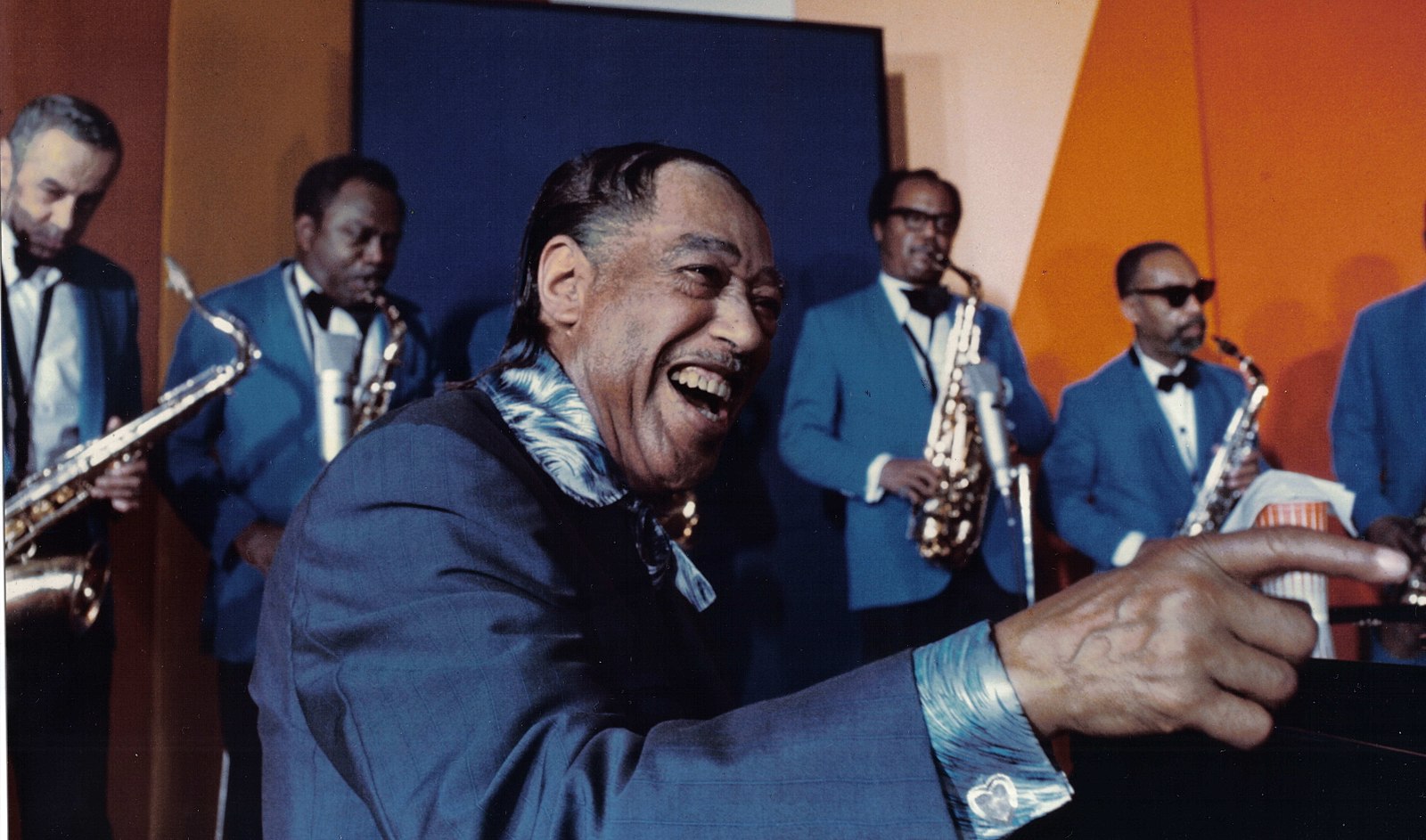
Image by Louis Panassié, via Wikimedia Commons
Duke Ellington has been commemorated in a variety of forms: statues, murals, schools, and even United States commemorative stamps and coins. In his lifetime he received a star on the Hollywood Walk of Fame, a Grammy Lifetime Achievement, a Presidential Medal of Freedom, and a Légion d’honneur. His posthumous honors even include a Special Pulitzer Prize awarded in 1999, the centennial year of his birth. 34 years earlier, in 1965, he’d been named for–but ultimately denied–a regular Pulitzer Prize for Music, a decision his appreciators are now trying to reverse.
“The jury that judged the entrants that year decided to do something different,” writes jazz critic Ted Gioia. “They recommended giving the honor to Duke Ellington for the ‘vitality and originality of his total productivity’ over the course of more than forty years.” This broke from tradition in that the Pulitzer Prize for Music usually honors a single work: in 1945 it went to Aaron Copland for his ballet Appalachian Spring; in 1958 it went to Samuel Barber for his opera Vanessa; in 1960 it went to Elliott Carter for his Second String Quartet.
Alas, “the Pulitzer Board refused to accept the decision of the jury, and decided it would be better to give out no award, rather than honor Duke Ellington. Two members of the three-person judging panel, Winthrop Sargeant and Robert Eyer, resigned in the aftermath.” Ellington, for his part, reacted to this unfortunate development with characteristic equanimity: “Fate is being kind to me,” he told the press. “Fate doesn’t want me to be famous too young” — to which Gioia adds that “he was 66 years old at the time, and in the final decade of his life.”
In an effort to retroactively award Ellington his Pulitzer Prize for Music, Gioia has has launched an online petition. If you sign it, you’ll join the likes of John Adams, Michael Dirda, Steve Reich, and Gene Weingarten, all Pulitzer winners themselves, as well as other luminaries and enthusiasts who’ve voiced their support — nearly 9,000 of them as of this writing. “We assume that Pulitzers are awarded to work that qualifies as for the ages, that pushes the envelope, that suggests not just cleverness but genius,” writes the New York Times’ John McWhorter. “There can be no doubt that Ellington’s corpus fits that definition.”
Reversing the committee decision of 1965, Gioia writes, would enhance “the prestige and legitimacy of the Pulitzer — and every award needs that nowadays, when many have grown skeptical about our leading prizes.” What’s more, “it’s the proper thing for the music — because every time genuine artistry is recognized it sets an example for the present generation, and lays a foundation for the future.” In recent decades, the aesthetic range of Pulitzer-honored music has widened considerably: McWhorter points as an example to 2018’s winner, Kendrick Lamar’s album Damn. It could be that, as far as Ellington is concerned, it’s taken the rest of us 57 years to catch up with him. Sign the petition here.
Related content:
Such Sweet Thunder: Duke Ellington & Billy Strayhorn’s Musical Tribute to Shakespeare (1957)
How Old School Records Were Made, From Start to Finish: A 1937 Video Featuring Duke Ellington
Based in Seoul, Colin Marshall writes and broadcasts on cities, language, and culture. His projects include the Substack newsletter Books on Cities, the book The Stateless City: a Walk through 21st-Century Los Angeles and the video series The City in Cinema. Follow him on Twitter at @colinmarshall, on Facebook, or on Instagram.
Read More...The First Surviving Photograph of the Moon (1840)
Everyone has been agog over the first photos from the James Webb telescope, and for good reason. “These images,” Rivka Galchin writes at The New Yorker, “carry news about the early universe, the birth and death of stars, the collision of galaxies, and the atmosphere of exoplanets.” They’re also “very, very pretty,” she writes, comparing them to Vermeer.
The clarity and levels of detailed information about the earliest galaxies have even astonished astronomers, whose work has advanced rapidly alongside the growth of the photographic medium. It was an astronomer, in fact – Johann Heinrich von Madler – who first coined the word “photography” in 1839. “Astronomers quickly embraced the use of photographic plates because of their good resolution and the ability to make much larger images,” APS Physics News notes.
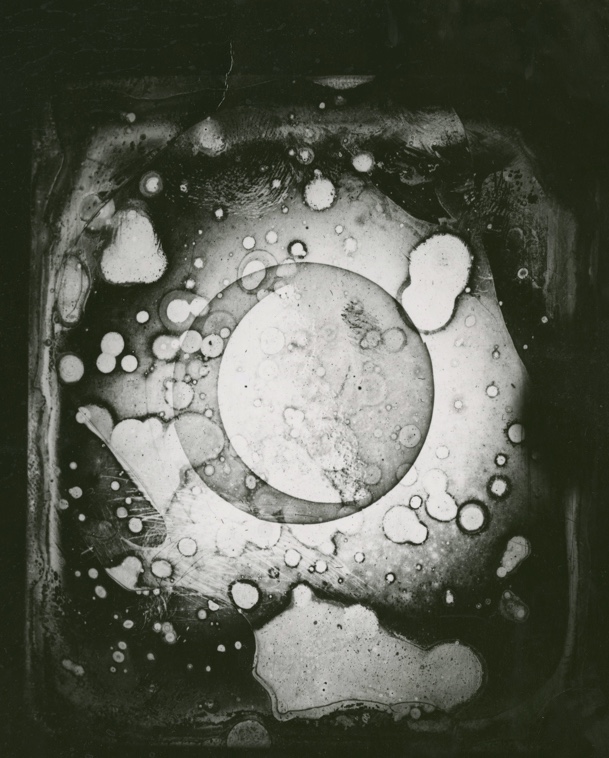
Astrophotography properly began in 1840, when John William Draper, a British-born chemist and doctor, took the image above from the roof of the New York University observatory, credited as the first daguerreotype of the Moon. Daguerre himself might have taken an 1839 image, but it was likely destroyed in a fire, as were Draper’s attempts of the previous year, which burned up in a NYU blaze in 1865.
By all accounts, however, these earlier attempts at Moon photography were blurry and unfocused, showing little detail of the Earth’s satellite. Draper’s lunar “portrait,” from 1840, at the top, is largely considered “the world’s first true astrophoto,” writes Jason Major at Lights in the Dark, for its levels of detail and high contrast, comparatively speaking. As Scott Walker writes:
Draper set out to try and improve on Daguerre’s breakthrough by increasing plate sensitivity and reducing exposure times.… His advancement in the technique allowed visualization of craters, mountains and valleys on the moon’s surface which previously couldn’t be captured.
Splotched, spotted, and heavily degraded, the image may not look like much now, but a contemporary of Draper described it then as “the first time that anything like a distinct representation of the moon’s surface has been obtained.”
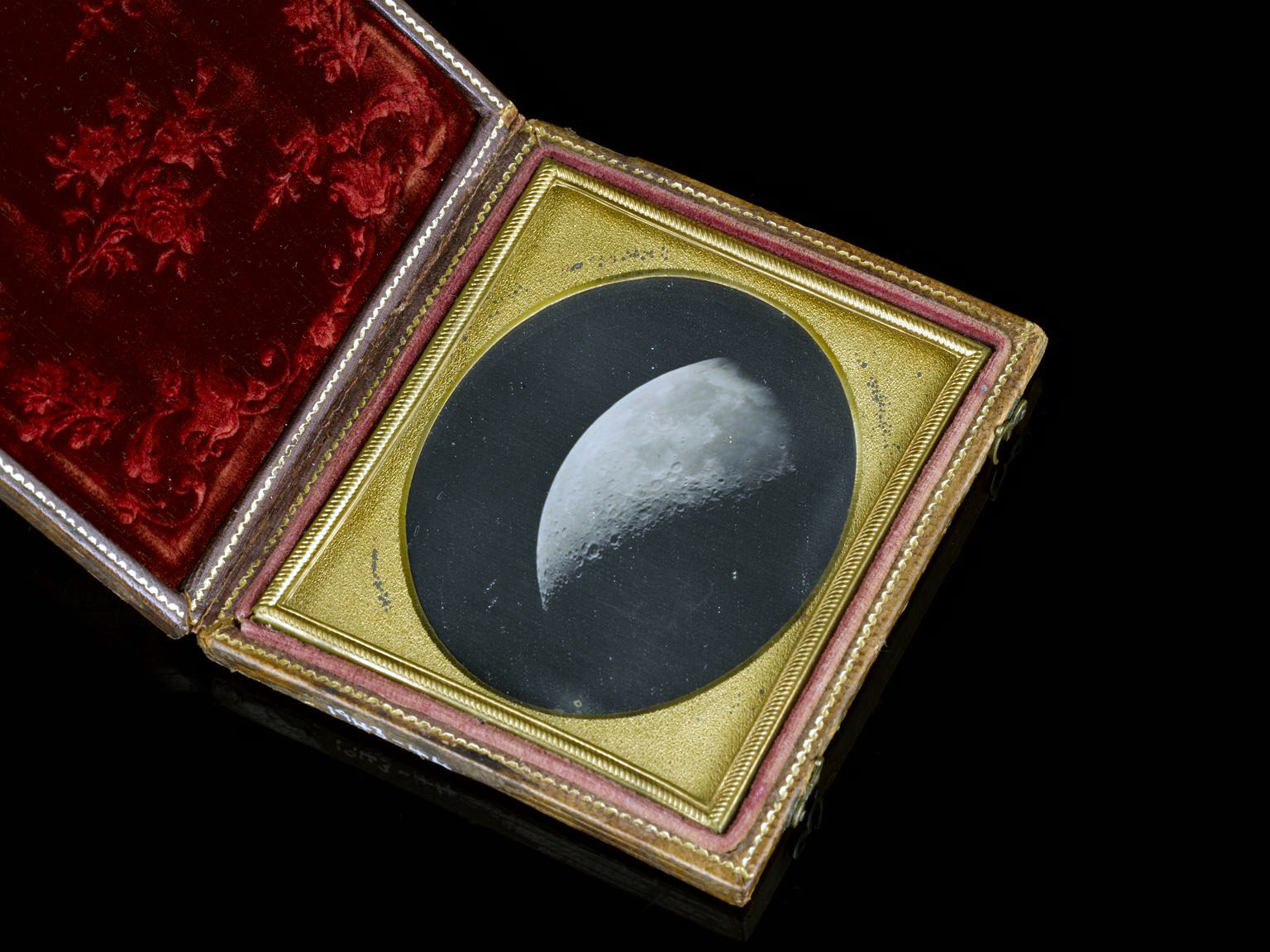
The achievement was inspirational, and many better attempts soon followed in rapid succession as the medium evolved. In 1851, photographer John Whipple and father-and-son astronomers William and George Bond improved on Draper’s process and made the Moon daguerreotype further up through the Great Refractor Equatorial Mount Telescope at the Harvard College Observatory. (The year previous, Draper himself collaborated with Bond père to make an image of the star Vega). The image caused a “veritable furor,” Smart History notes, at the Great Exhibition of 1851.
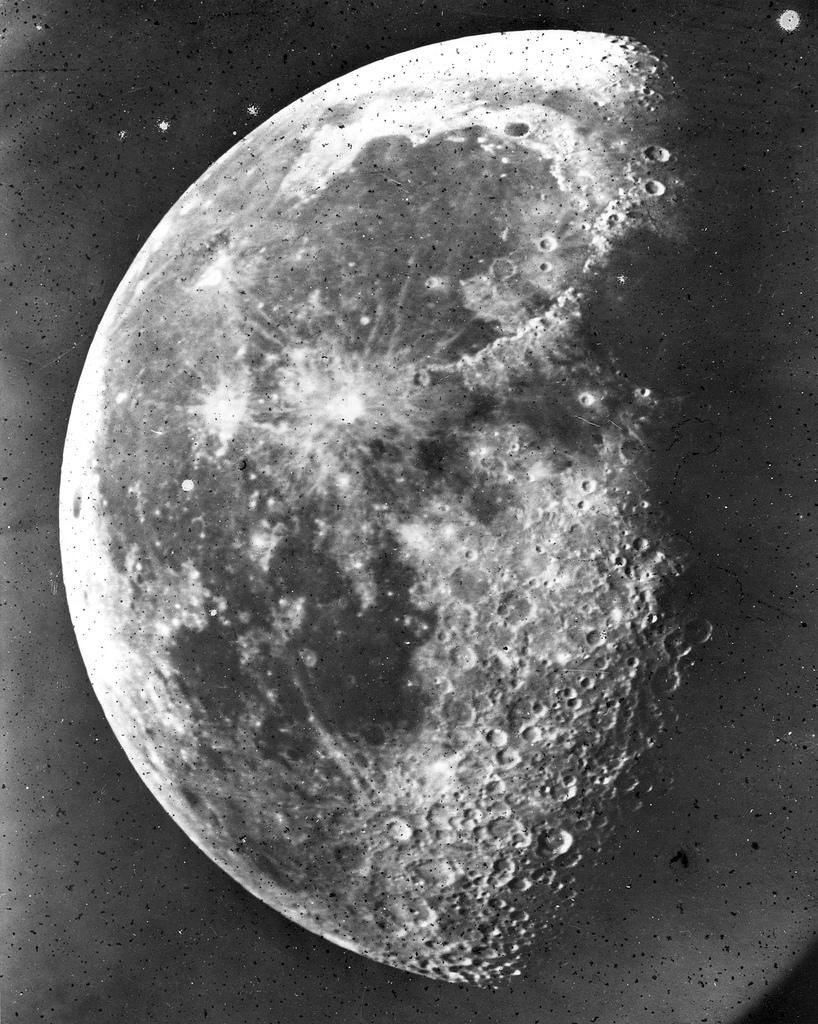
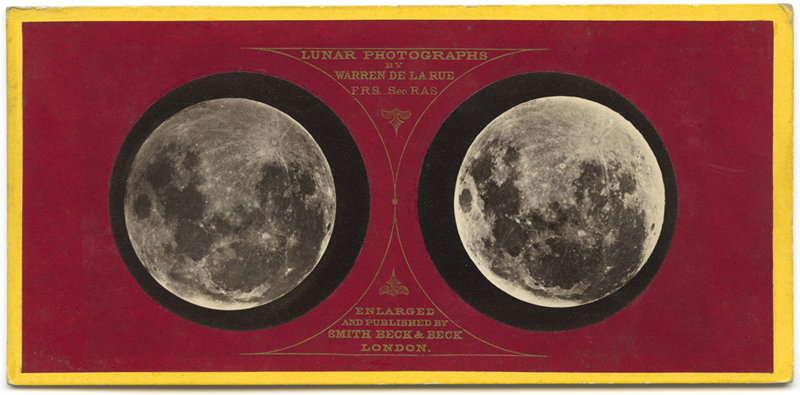
Between 1857 and 1862, astrophotographer and amateur astronomer Warren De La Rue made a series of stereoscopic Moon images (lovingly preserved online by astrophysicist and Queen guitarist Brian May), one of which you can see further up. De La Rue had seen Whipple’s daguerreotype at the Great Exhibition and began innovating his own process for creating stereoscopic astrophotographs. At the same time, Draper’s son, Henry, “an accomplished astrophotographer and one of the most famous American astronomers of his day,” Kiona Smith writes at Forbes, had taken over his father’s Moon photography project. See an 1863 image taken by the younger Draper just above.
“Before the invention of photography,” notes APS News, “astronomers had to sketch what they saw in their telescopes by hand, often missing crucial details.” Daguerre and Draper’s innovations, and those that came soon afterward, “showed them a far superior method was possible.” It is astonishing that these results could be achieved only a few decades after the first photograph, taken in 1826 by Nicéphore Niépce. It is maybe even more astonishing that only a century and a half or so later — a meaningless drop in the cosmic timescale — astrophotography would look beyond the moon to the very origins of the universe itself.
via Smart History
Related Content:
The First Photograph Ever Taken (1826)
The Full Rotation of the Moon: A Beautiful, High Resolution Time Lapse Film
Josh Jones is a writer and musician based in Durham, NC. Follow him at @jdmagness
Read More...Support Us
We're hoping to rely on loyal readers, rather than erratic ads. Please click the Donate button and support Open Culture. You can use Paypal, Venmo, Patreon, even Crypto! We thank you!

About Us

Open Culture scours the web for the best educational media. We find the free courses and audio books you need, the language lessons & educational videos you want, and plenty of enlightenment in between.
Advertise With Us
FREE UPDATES!
GET OUR DAILY EMAIL
Get the best cultural and educational resources on the web curated for you in a daily email. We never spam. Unsubscribe at any time.
FOLLOW ON SOCIAL MEDIA
Open Culture editor Dan Colman scours the web for the best educational media. He finds the free courses and audio books you need, the language lessons & movies you want, and plenty of enlightenment in between.
Advertise With Us


