How Much Would It Cost to Build the Colosseum Today?
Last year we told you about the plan to install a retractable floor in the Colosseum, thus restoring a feature it boasted in its ancient glory days. Though the state pledged €10 million, the budget of an ambitious renovation will surely come to many times that — but still, we may imagine, only a fraction of the money it took to build the Colosseum in the first place. In fact we have to imagine it, since we have no records of what that icon of Rome actually cost. In the video above, history Youtuber Garrett Ryan, creator of the channel Told in Stone, does so by not just marshaling all his knowledge of the ancient world but also crowdsourcing others’ knowledge of modern construction techniques and expenses.
First, Ryan must reckon the cost of the Colosseum in sestertii, the “big brass coins” common in Rome of the first century AD. “At the time the Colosseum was built,” he says, “one sestertius could buy two loaves of bread, four cups of cheap wine, or a single cup of good wine.”
The average unskilled laborer could expect to earn around four sestertii per day, and this project needed thousands of such laborers to excavate its foundation trench alone. Then came the laying of the foundation itself, followed by the building of the superstructure, which remains formidable even in the ruined state we know today. Its materials included 100,000 cubic meters of travertine — “roughly one-fiftieth, incidentally, of all travertine ever quarried by the Romans.”
A good deal of travertine also went into the Getty Center, perhaps the closest thing to a Colosseum-scale construction project in modern-day America. The Getty’s total cost came to $733 million, a price tag befitting the wealth synonymous with its name. But it still came cheaper than the Colosseum by Ryan’s estimate, or at least by most of the estimates at which he arrives. Consulting with several of his viewers experienced in architecture and construction, he calculates that building an exact replica of the Colosseum in today’s United States — taking into account the much greater efficiency of current tools, as well as the much greater cost of labor — roughly equivalent to $150,000,000 to more than $1 billion. That amount of money obviously exists in our world; whether we possess the necessary ambition is less clear. Then again, ancient Rome didn’t have Lego.
Related content:
Building The Colosseum: The Icon of Rome
When the Colosseum in Rome Became the Home of Hundreds of Exotic Plant Species
Rome’s Colosseum Will Get a New Retractable Floor by 2023 — Just as It Had in Ancient Times
Based in Seoul, Colin Marshall writes and broadcasts on cities, language, and culture. His projects include the Substack newsletter Books on Cities, the book The Stateless City: a Walk through 21st-Century Los Angeles and the video series The City in Cinema. Follow him on Twitter at @colinmarshall, on Facebook, or on Instagram.
Read More...How Korean Things Are Made: Watch Mesmerizing Videos Showing the Making of Traditional Clothes, Teapots, Buddhist Instruments & More
It would be awfully clichéd to call Seoul, where I live, a place of contrasts between old and new. And yet that texture really does manifest everywhere in Korean life, most palpably on the streets of the capital. In my favorite neighborhoods, one passes through a variety of different eras walking down a single alley. “Third-wave” coffee shops and “newtro” bars coexist with family restaurants unchanged for decades and even small industrial workshops. Those workshops produce clothing, plumbing fixtures, printed matter, electronics, and much else besides, in many cases late into the night. For all its reputation as a high-tech “Asian Tiger,” this remains, clearly and presently, a country that makes things.
You can see just how Korea makes things on the Youtube channel All Process of World, which has drawn tens of millions of views with its videos of factories: factories making forks, bricks, sliced tuna, sheepskin jackets, bowling balls, humanoid robots. The scale of these Korean industrial operations ranges from the massive to the artisanal; some products are unique to twenty-first century life, and others have been in use for centuries.
On the traditional side, All Process of World has provided close-up views of the making of ceramic teapots, wooden window frames (as you would see in a classical Korean hanok), handheld percussive moktak to aid Buddhist monks in their chants, and even jeogori, the distinctive jackets worn with hanbok dresses.
Judging by the comments, All Process of World’s many viewers hail from around the globe. This shouldn’t come as a surprise, given Korea’s newfound worldwide popularity. But that so-called “Korean wave” owes less to the appeal of Korea’s traditional culture than its modern one, less to its rustic yet elegant pottery and brilliantly colorful formalwear than to BTS and “Gangnam Style,” Parasite and Squid Game — whose “robot girl” appears on a rug made in one All Process of World video. Another shows us the production of an equally modern item, the face masks seen everywhere in Korea during the past two years. Just a few weeks ago, the government gave us the okay to take those masks off outdoors. While hoping for the arrival of fully post-COVID era, we’d do well to keep in mind how the past always seems to find its way into the present.
Related content:
Watch a Korean Master Craftsman Make a Kimchi Pot by Hand, All According to Ancient Tradition
How Japanese Things Are Made in 309 Videos: Bamboo Tea Whisks, Hina Dolls, Steel Balls & More
Modern Artists Show How the Ancient Greeks & Romans Made Coins, Vases & Artisanal Glass
Based in Seoul, Colin Marshall writes and broadcasts on cities, language, and culture. His projects include the Substack newsletter Books on Cities, the book The Stateless City: a Walk through 21st-Century Los Angeles and the video series The City in Cinema. Follow him on Twitter at @colinmarshall, on Facebook, or on Instagram.
Read More...Behold the Augsburg Book of Miracles, a Brilliantly-Illuminated Manuscript of Supernatural Phenomena from Renaissance Germany
When we speak of a “lost art,” we do not always mean that humans have forgotten certain production methods. Modern craftspeople can recover or reasonably approximate old techniques and materials, and produce artifacts that can be passed off as authentic by the unscrupulous. The spirit of the thing, however, can never be recovered. Try as they might, scholars and conservators will never be able to enter the mind of a Medieval scribe or manuscript illuminator. Their social world has disappeared into a distant mist; we can only dimly guess at what their lives were like.
Thus, for many years, the reception of Hieronymus Bosch — the bizarre fantasist from the Netherlands whose visions of Earth, Heaven, and Hell have amused and terrified viewers — stressed the proto-Surrealism of his work, assuming he must have had other intentions than proselytizing.
Most recent interpretation, however, has pulled in the other direction, stressing the degree to which Bosch and his contemporaries believed in a universe that was exactly as weird as he depicted it, no exaggeration necessary; emphasizing how Bosch felt an urgent need to spare viewers of his work from the fates he showed in his art.
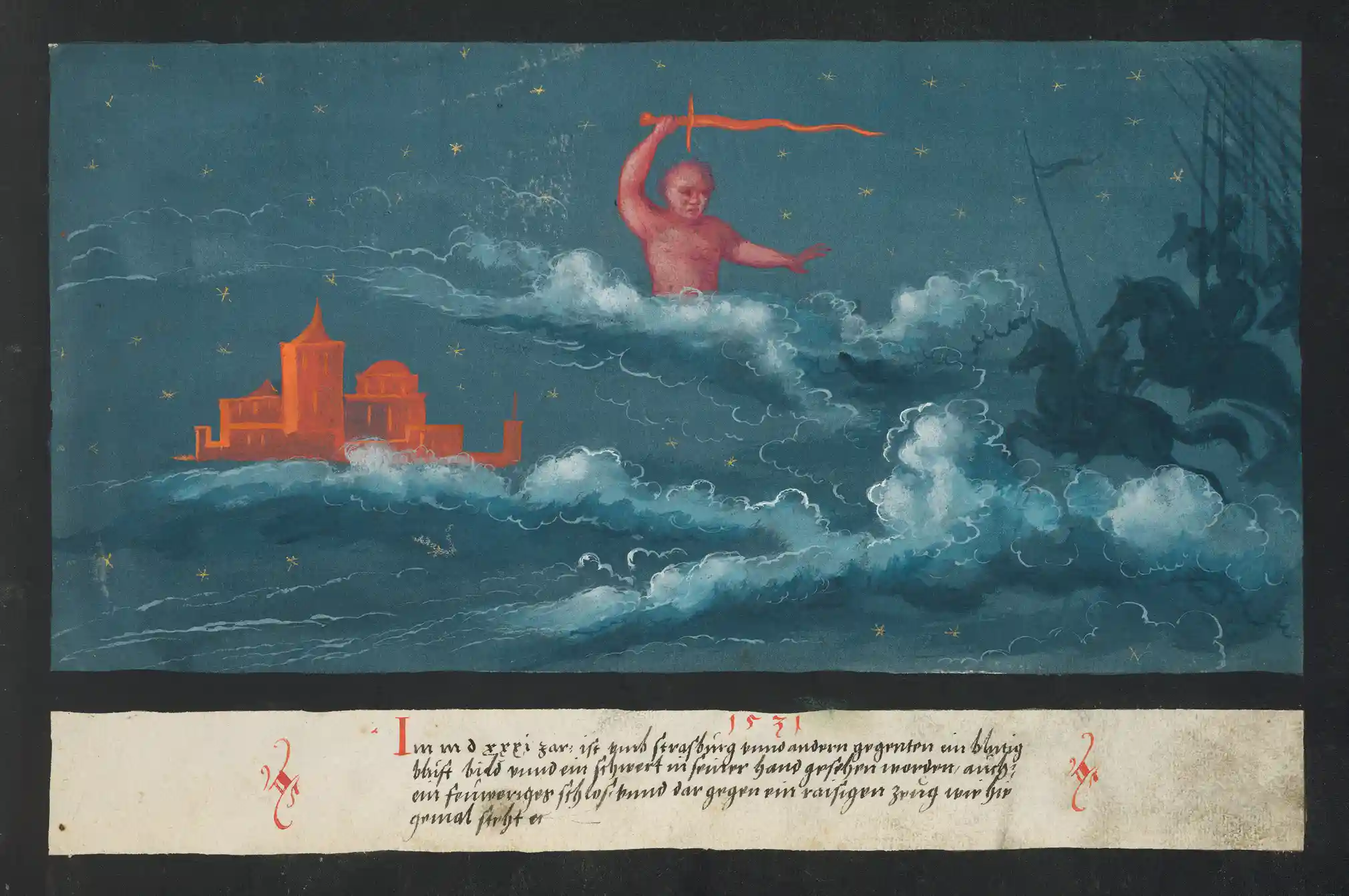
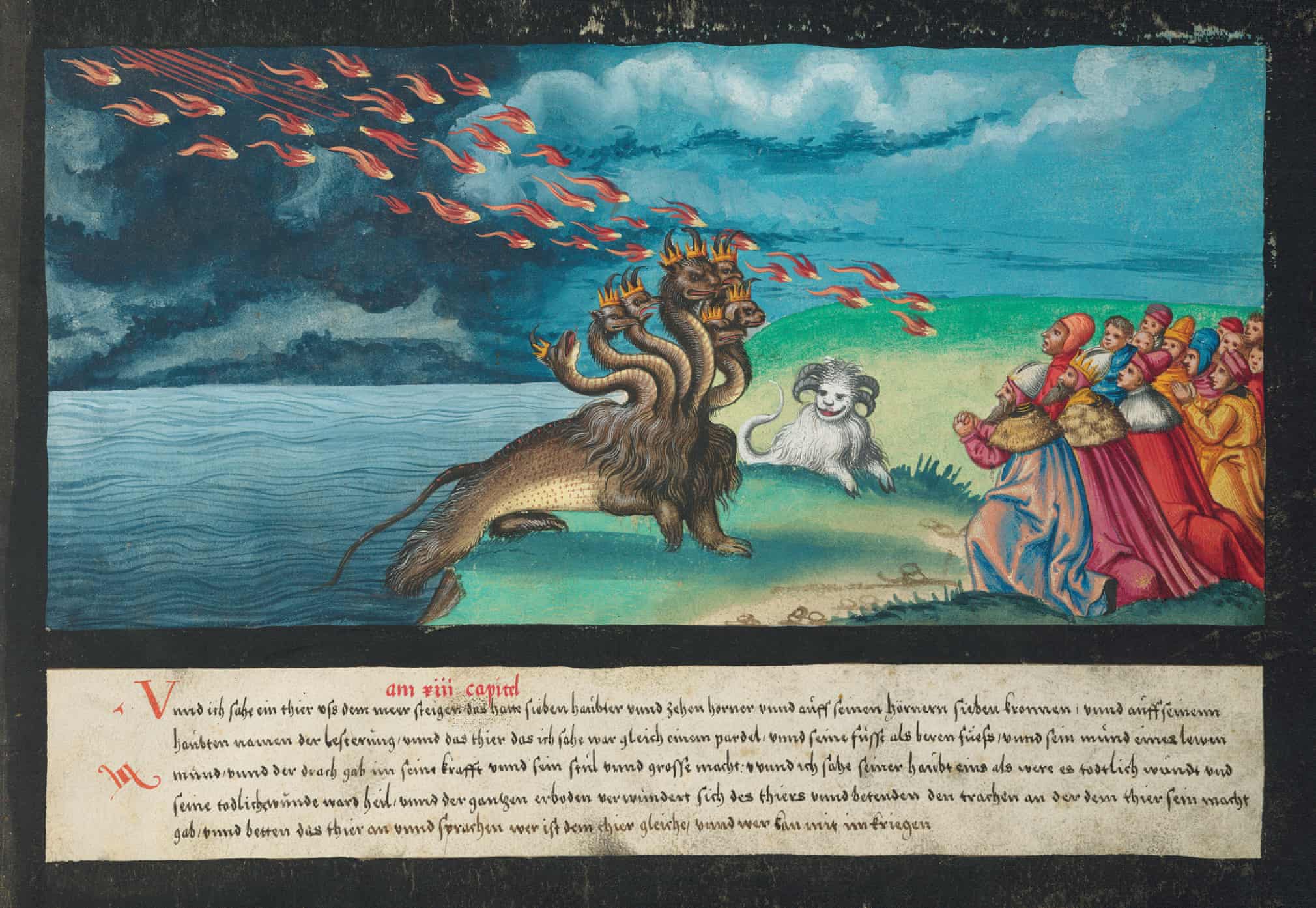
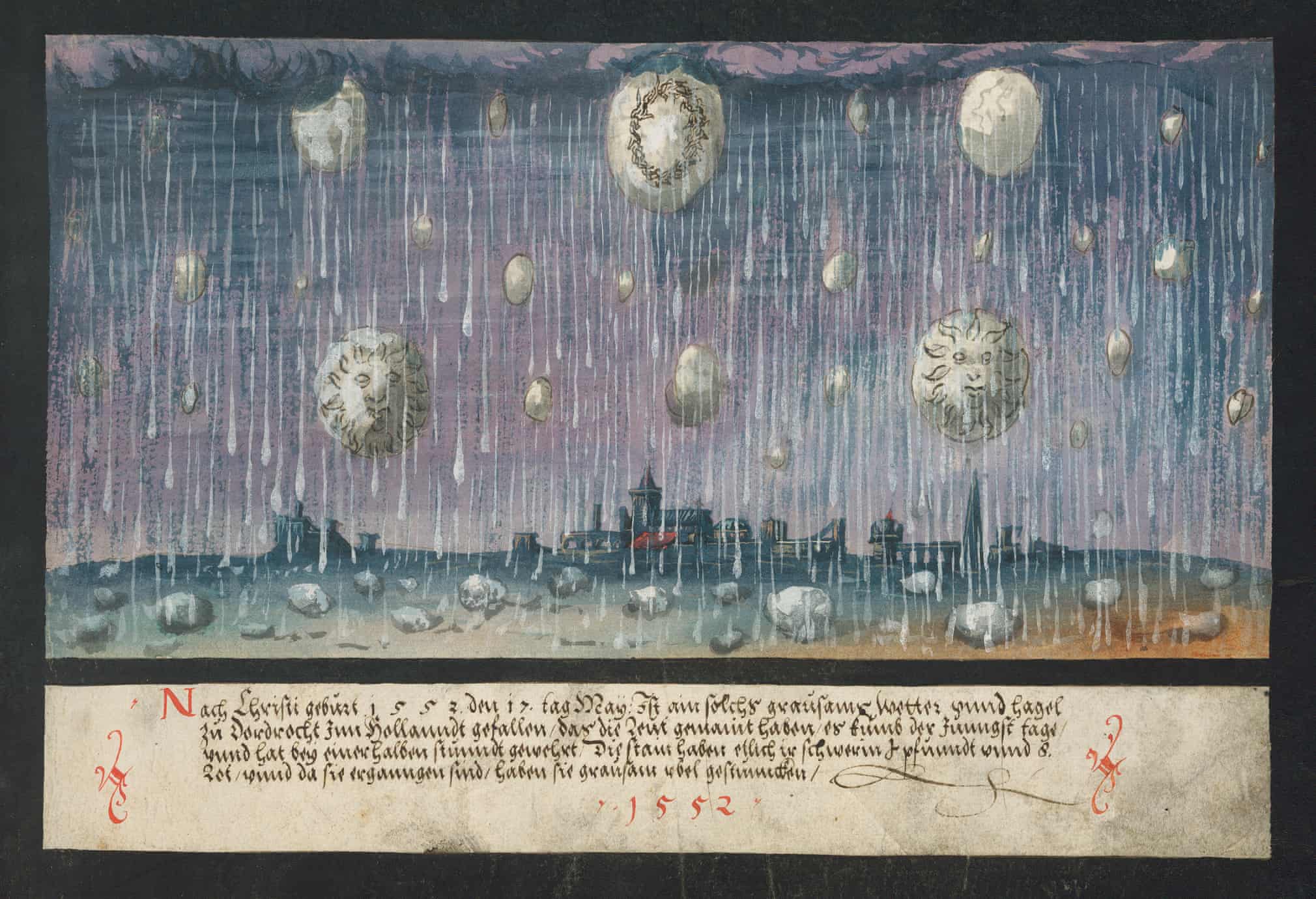
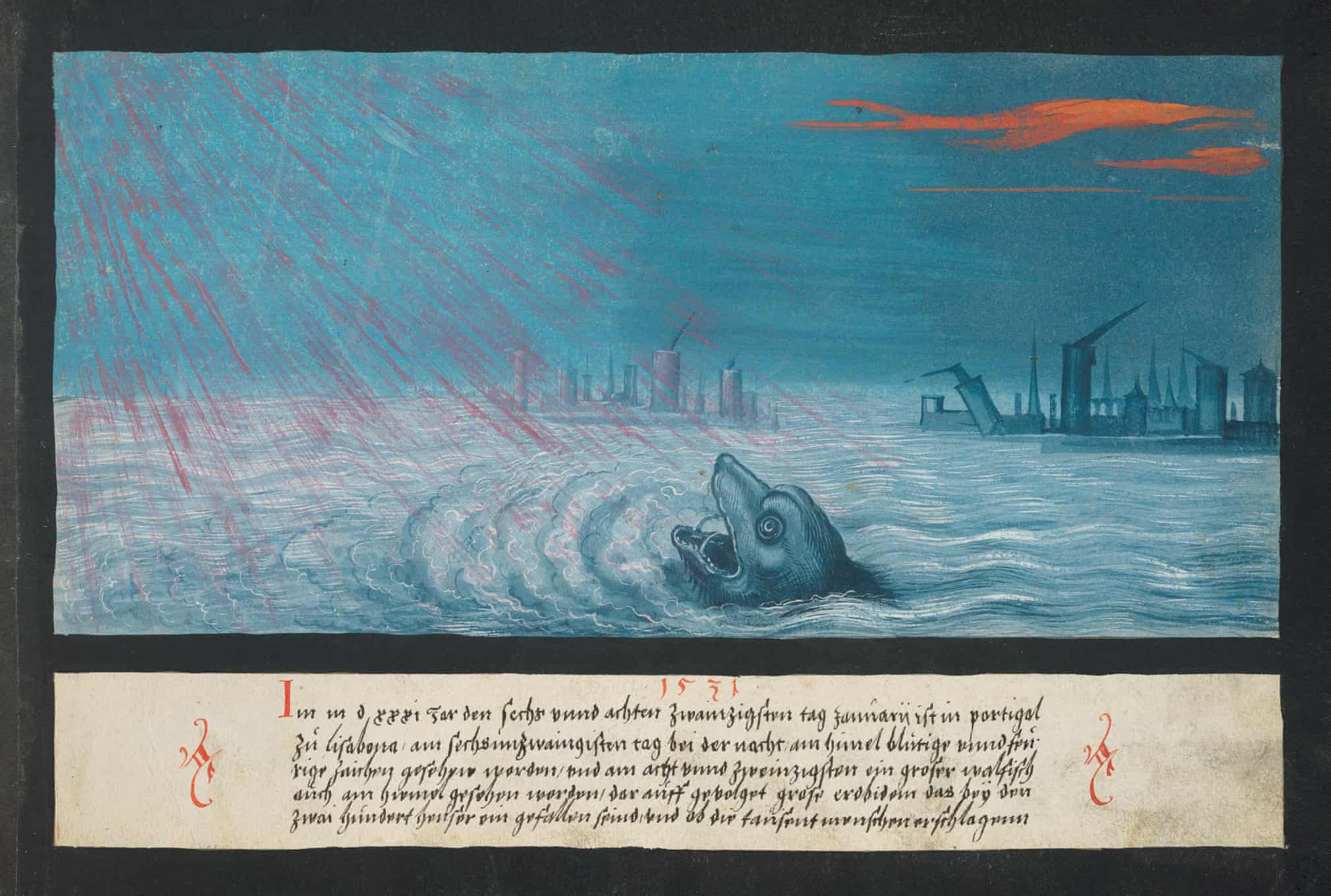
What passed through the mind of the illuminator of the manuscript shown here, the Augsburg Book of Miraculous Signs? We can never know. At best, scholars have settled on a name — artist and printmaker Hans Burgkmair the Younger — though little is known about him And we have a date, 1552, when this “curious and lavishly illustrated manuscript appeared in the Swabian Imperial Free city of Augsburg, then a part of the Holy Roman Empire, located in present-day Germany,” Maria Popova writes at the Marginalian. In the video at the top from Hochelaga, you can learn more about the “bizarre text” and the “meaning behind its unique contents” and “scenes of calamity and chaos.”

The strange book presents “in remarkable detail and wildly imaginative artwork, Medieval Europe’s growing obsessions with signs sent from ‘God,’ ” Popova writes, “a testament to the basic human propensity for magical thinking.” More specifically, The Book of Miracles recounts a host of Biblical signs and wonders in chronological order: from the first book of the Old Testament to the spectacular end of the New. In-between are “hallucinatory accounts of classical and contemporary celestial phenomena,” Tim Smith-Laing writes at Apollo. “The manuscript comprises nothing less than a picture chronicle of the world’s past, present and future, in 192 miracles.”

While Protestant Christianity condemned Medieval magic, “the recurrence of miracles in the Bible meant that the Protestant reformers of the sixteenth century could not reject such wonders as superstitions in the way they scorned Catholic beliefs,” Marina Warner writes at The New York Review of Books. German reformers were on high alert for the miraculous and ominous: “The sixteenth-century Zwinglian clergyman Johann Jakob Wick filled twenty-four albums with reports of such wonders in broadsheets and pamphlets,” seeing signs in the birth of a two-headed calf or “an unfortunate, flipper-handed infant.”

All of which is to say that we have little reason to doubt that the creator of The Book of Miracles meant the work as an earnest warning to its readers, although its wondrous images might look to us like proto-fantasy or sci-fi illustration. The book illustrates 1533 reports of flying dragons in Bohemia, an event, notes The Guardian, that “went on for several days, with over four hundred of them, both big and small, flying together.” It shows a comet appearing in 1506, one that stayed for several days and nights “and turned its tail towards Spain.” Thereby followed “a lot of fruit,” which was then “completely destroyed by caterpillars or rats,” then a violent earthquake in Constantinople.
The very tenuous connection between disparate natural phenomena, the hearsay reports of magical happenings, you can read about all of these signs and wonders in a republished version by Taschen, in English, French, and German. It is, Popova writes, “a singular shrine to some of the most eternal of human hopes and fears, and, above all, our immutable longing for grace, for mercy, for the miraculous.” See more images from The Book of Miracles at The Guardian.
Related Content:
A Digital Archive of Hieronymus Bosch’s Complete Works: Zoom In & Explore His Surreal Art
The Medieval Masterpiece, the Book of Kells, Has Been Digitized and Put Online
160,000+ Medieval Manuscripts Online: Where to Find Them
Josh Jones is a writer and musician based in Durham, NC. Follow him at @jdmagness
Read More...Martin Scorsese Foundation Launches Virtual Screening Room, Letting You Watch Restored Classic Films for Free
Since 1990, Martin Scorsese has devoted the non-filmmaking part of his career to film preservation, whether that means the classics of Hollywood or world cinema. The over 900 restorations that he’s helped fund through the Film Foundation non-profit have been the subject of Criterion Collection box sets, special anniversary screenings and festival showings, and now a special monthly online screening room will give viewers a chance to see some familiar and not-so-familiar films that have been saved from destruction.
According to the welcome message at the Restoration Screening Room, “Presentations will take place within a 24-hour window on the second Monday of each month, along with Special Features about the films and their restoration process. Monthly programming will encompass a broad array of restorations, including classic and independent films, documentaries, and silent films from around the world.’”
As of this writing, the window has closed for its inaugural film, Powell and Pressburger’s 1945 I Know Where I’m Going! but you can still click through to see the extras that come with the film: an Introduction by Scorsese; an interview with Scorsese’s long-time editor Thelma Schoonmaker (who was also Powell’s spouse for six years until 1990 and who worked on the restoration); Kent Jones interviewing Kevin Macdonald, the grandson of Pressburger and his biographer; the Film Foundation’s Margaret Bodde interviewing Tilda Swinton, a huge fan of the film; directors Joanna Hogg and Scorsese talking about the film; a before and after look at the restoration; an image gallery; and finally a links page called “explore” that is quite overwhelming in its thoroughness.
The 4K restoration’s next stop is the Criterion Channel, so if you subscribe to that paid service, find it there. But the Film Foundation’s premieres are completely free and feature a live chat on the screening night.
In the coming months look forward to Fellini’s La Strada (June 13), Govindan Aravindan’s Kummatty (July 11), a double feature of The Chase (d. Arthur Ripley) and Detour (d. Edgar G. Ulmer) (August 8); Sarah Maldoror’s Sambizanga (Sep. 12), Marlon Brando’s One Eyed Jacks (October 10); John Huston’s Moulin Rouge (November 14); and Jonas Mekas’ Lost Lost Lost on December 12.
The site has no trailers, but we’ve got you covered:
Related Content:
The Art of Restoring Classic Films: Criterion Shows You How It Refreshed Two Hitchcock Movies
Ted Mills is a freelance writer on the arts who currently hosts the Notes from the Shed podcast and is the producer of KCRW’s Curious Coast. You can also follow him on Twitter at @tedmills, and/or watch his films here.
Read More...The Scream Explained: What’s Really Happening in Edvard Munch’s World-Famous Painting
The Scream is not screaming. “One of the famous in the images of art,” Edvard Munch’s most widely seen painting “has become, for us, a universal symbol of angst and anxiety.” Munch painted it in 1893, when “Europe was at the birth of the modern era, and the image reflects the anxieties that troubled the world.” However many fin-de-siècle Europeans felt like screaming for one reason or another, the central figure of The Scream isn’t one of them: “rather, it is holding its hands over its ears, to block out the scream.” So gallerist and Youtuber James Payne reveals on the latest episode of his series Great Art Explained, which doesn’t just examine Munch’s iconic work of art, but places it in the context of his career and his time.
During most of Munch’s life, “European cities were going through truly exceptional changes. Industrialization and economic shifts brought fear, obsessions, diseases, political unrest, and radicalism. Questions were being raised about society, and the changing role of man within it: about our psyche, our social responsibilities, and most radical of all, about the existence of God.” It was hardly the most suitable time or place for the mentally troubled, but then, Munch seems to have possessed more psychological fortitude than he let the public know. A savvy self-promoter, he understood the value of living like someone whose terrible perceptions keep him on the brink of total breakdown.
But then, Munch never did have it easy. “His mother and his sister both died of tuberculosis. His father and grandfather suffered from depression, and another sister, Laura, from pneumonia. His only brother would later die of pneumonia.” He found solace in art, a pursuit strongly opposed by his religious father, and eventually joined the bohemian world, a milieu that encouraged him to let his inner world shape his aesthetic. Drawing inspiration from the French Impressionists and the drama of August Strindberg, Munch eventually found his way to starting a cycle of paintings called The Frieze of Life.
It was during his work on The Frieze of Life that, according to a diary entry of January 22nd, 1892, Munch found himself walking along a fjord. “I felt tired and ill. I stopped and looked out over the fjord — the sun was setting, and the clouds turning blood red. I sensed a scream passing through nature; it seemed to me that I heard the scream. I painted this picture, painted the clouds as actual blood. The color shrieked.” The fjord was on the way back from the asylum to which his beloved younger sister had recently been confined; Payne imagines that her “screams of terror must have haunted him as he walked away.” From these grim origins, The Scream emerged to become an oft-referenced and highly relatable image — even to those who see in it nothing more than their own frustration at receiving too much e‑mail.
Related content:
How Edvard Munch Signaled His Bohemian Rebellion with Cigarettes (1895): A Video Essay
Explore 7,600 Works of Art by Edvard Munch: They’re Now Digitized and Free Online
The Life & Work of Edvard Munch, Explored by Patti Smith and Charlotte Gainsbourg
Edvard Munch’s Famous Painting “The Scream” Animated to Pink Floyd’s Primal Music
The Edvard Munch Scream Action Figure
Based in Seoul, Colin Marshall writes and broadcasts on cities, language, and culture. His projects include the Substack newsletter Books on Cities, the book The Stateless City: a Walk through 21st-Century Los Angeles and the video series The City in Cinema. Follow him on Twitter at @colinmarshall, on Facebook, or on Instagram.
Read More...R.I.P. Vangelis: The Composer Who Created the Future Noir Soundtrack for Blade Runner Dies at 79
It would be difficult to overstate the prominence, in the late twentieth century, of the theme from Hugh Hudson’s Chariots of Fire. Most anyone under the age of 60 will have heard it many times as parody before ever seeing it in its original, Academy Award-winning context. Unfortunately, encountering the piece in nearly every humorous slow-motion running scene for two or three decades straight has a way of dampening its impact. But back in 1981, to score a nineteen-twenties period drama with brand-new digital synthesizers marked a brazen departure from convention, as well as the beginning of a trend of musical anachronism in cinema (which would manifest even in the likes of Dirty Dancing).
The Chariots of Fire theme has surely returned to many of our playlists after the death this week of its composer, Vangelis. Even before that film, he’d collaborated with Hudson on documentaries and commercials; immediately thereafter, he found himself in great demand as a composer for features.
The very next year, in fact, saw Vangelis crafting a score that has, perhaps, remained even more respected over time than the one he did for Chariots of Fire. Set in the far-flung year of 2019, Ridley Scott’s Blade Runner needed a high-tech sound that also reflected its “future noir” sensibility. This neatly suited Vangelis’ proven ability to combine cutting-edge electronic instruments with traditional acoustic ones in a highly evocative fashion.
Blade Runner’s formidable influence owes primarily to its visuals, to the “look and feel” of its imagined future. But I defy fans of the film to remember any of its most striking images — the infernal skyline of 2019 Los Angeles, the cars flying between video-illuminated skyscrapers, Deckard’s first meeting with Rachael — without also hearing Vangelis’ music in their heads. Though it took audiences decades to catch up with Blade Runner, it’s now more or less settled that each element of the film complements all the others in creating a dystopian vision still, in many ways, unsurpassable. Vangelis’ own experiences across genres and technologies, which you can learn more about in the documentary Vangelis and the Journey to Ithaka, placed him ideally to imbue that vision with musical life.
Related content:
How Blade Runner Captured the Imagination of a Generation of Electronic Musicians
Stream 72 Hours of Ambient Sounds from Blade Runner: Relax, Go to Sleep in a Dystopian Future
Sean Connery (RIP) Reads C.P. Cavafy’s Epic Poem “Ithaca,” Set to the Music of Vangelis
Based in Seoul, Colin Marshall writes and broadcasts on cities, language, and culture. His projects include the Substack newsletter Books on Cities, the book The Stateless City: a Walk through 21st-Century Los Angeles and the video series The City in Cinema. Follow him on Twitter at @colinmarshall, on Facebook, or on Instagram.
Read More...Jean-Paul Sartre & Albert Camus: Their Friendship and the Bitter Feud That Ended It
At the end of World War II, as Europe lay in ruins, so too did its “intellectual landscape,” notes the Living Philosophy video above. In the midst of this “intellectual crater” a number of great thinkers debated “the blueprint for the future.” Feminist philosopher and novelist Simone de Beauvoir put it bluntly: “We were to provide the postwar era with its ideology.” Two names — De Beauvoir’s partner Jean-Paul Sartre and his friend Albert Camus — came to define that ideology in the philosophy broadly known as Existentialism.
The two first met in Paris in 1943 during the Nazi occupation. They were already “deeply acquainted” with one another’s work and shared a mutual respect and admiration as critics and reviewers of each other and as fellow resistance members. Both “intellectual giants” were targeted by the FBI, and both would go on to win the Nobel Prize in Literature (though Sartre rejected his). Their fame would continue into the postwar years, despite Camus’ retreat from philosophical writing after the publication of The Rebel.
While we’ve previously brought you stories of their friendship, and its bitter end, the video above digs deeper into the Sartre-Camus rivalry, with critical historical context for their thinking. Their initial falling out took place over The Rebel, which championed an ethical individualism and critiqued the morality of revolutionary violence. Instead of exploring suicide, as he had done in The Myth of Sisyphus, here Camus explores the problem of murder, concluding that — outside of extreme circumstances like a Nazi invasion — violent political means do not justify their ends.
The book provoked Sartre, a doctrinaire Marxist, who had issued what Camus considered feeble defenses for Joseph Stalin’s purges and gulags. A series of scathing reviews and angry ripostes followed. The personal tone of these attacks chilled what little warmth remained between them. When the Algerian war for independence erupted a few years later, the staunchly anti-colonialist Sartre took the side of Algeria’s National Liberation Front (FLN), excusing acts of violence against civilians and rival factions as justified by French oppression. Such events “were beyond justification in the mind of Camus.”
While Sartre belittled Camus as “a crook,” the “acuteness of the situation was all the stronger for Camus since Algeria was his homeland. He could not see it in the ideological warped black and white of Sartre’s circle or the conservative French government.” The statement might sum up all of Camus’ thought. As Sartre finally conceded in a posthumous tribute; he “represented in our time the latest example of that long line of moralistes whose works constitute perhaps the most original element in French letters.… he reaffirmed… against the Machiavellians and against the Idol of realism, the existence of the moral issue,” in all its complex ambiguity and uncertainty.
Related Content:
Josh Jones is a writer and musician based in Durham, NC. Follow him at @jdmagness
Read More...Meet the Variophone, the Early Soviet Synthesizer that Made Music with a Film Projector (1932)
The early days of electronic instruments lacked commonly accepted ideas about what an electronic instrument was, much less how it should be used. No one associated electronics with techno or new wave or hip hop or pop, given that none of these existed. Every sound made by experiments in synthesis in the early 20th century was by its nature experimental, and most electronic instruments were one of a kind. It did not even seem obvious that electronic instruments had to be machines that were purpose built for sound.
In 1930, at the very dawn of sound on film, Evgeny Sholpo invented the Variophone — or “Automated Paper Sound with soundtracks in both transversal and intensive form.” It was, in simpler terms, a photoelectric audio synthesizer that made use of a film projector and spinning cardboard discs with sound waves cut into them in various patterns. When amplified, the device could turn the patterns into sounds. It also created “abstract spiral animation,” notes Boing Boing. Both “were way ahead of their time.”
If you’re thinking such a machine might be used to make film soundtracks, it was. But it was also “a continuation of research that Sholpo had been conducting since the 1910s,” the blog Beyond the Coda writes, “when he was working on performerless music.”
Sholpo wanted a device that would replace musicians and allow composers to turn complex musical ideas into recorded sounds themselves. He was aided in the endeavor by Georgy Rimsky-Korsakov (grandson of Russian composer Nikolai Rimsky-Korsakov), who helped him build the prototype at Lenfilm Studios in 1931.
The two produced their first film soundtrack for the propaganda film The Year 1905 in Bourgeoisie Satire, in 1931, and then the following year created “a synthesized soundtrack for A Symphony of Peace and many other soundtracks for films and cartoons throughout the thirties,” notes 120 Years of Electronic Music. The Variophone was destroyed during the Siege of Leningrad, but Sholpo built two more, continuing to record soundtracks through the forties. Unlike the first monophonic analogue synthesizers built a couple of decades later, the Variophone could create and replicate polyphonic compositions, since tones could be layered atop each other, as in multitrack recording.
You can hear several examples of the Variophone here, and see it synched to animation — both from its own sound waves and from hand-drawn films like “The Dance of the Crow,” below. What does it sound like? The tones and timbres vary somewhat among recordings. There’s clearly been some degradation in quality over time, and the technology of recording sound on film was only in its infancy at the time, in any case. But, in certain moments, the Variophone can sound like the early Moog that Wendy Carlos used to synthesize classical music and record film scores almost 40 years after Sholpo patented his machine.
via Boing Boing
Related Content:
How an 18th-Century Monk Invented the First Electronic Instrument
Josh Jones is a writer and musician based in Durham, NC. Follow him at @jdmagness
Read More...David Cronenberg Visits a Video Store & Talks About His Favorite Movies
The excitement over Crimes of the Future, set to premiere next week at the Cannes Film Festival, suggests that David Cronenberg retains a strong fan base more than half a century into his filmmaking career. But many of us who consider ourselves part of that fan base didn’t discover his work in the theater, much less at Cannes. Rather, we found it at the video store, ideally one that devoted a section specifically to his work — or at least to his signature genre of “body horror,” which his films would in any case have dominated. Fitting, then, that the new Cronenberg interview above takes place among shelves packed with, if not the VHS tapes and Laserdiscs we grew up with, then at least DVDs and Blu-Rays.
This video comes from Konbini, a French Youtube channel whose Video Club series has brought such auteurs as Claire Denis, Hirokazu Kore-eda, and Terry Gilliam into the hallowed halls of Paris’ JM Vidéo.
“They have 50,000 movies, I think,” says the interviewer. “That’s too many,” replies Cronenberg, “so you need to give me a few.” The director of Videodrome, The Fly, and Crash turns out to have no trouble spotting and discussing movies of interest, and the list of his picks from the stock at JM Vidéo is as follows:
- Federico Fellini, La Strada (“the beginning of my entrancement with moviemaking”)
- Ingmar Bergman, The Hour of the Wolf (“a beautiful movie; very much a nightmare”)
- Roger Vadim, And God Created Woman (Brigitte Bardot “was incredibly sexual, beautiful — I was totally in love with her”)
- Jean-Pierre and Luc Dardenne, Rosetta (which the Cronenberg-led 1999 Cannes jury selected in “the fastest vote for the Palme d’Or ever in the history of Cannes”)
- Ridley Scott, Alien (some of whose elements “are exactly like my very low-budget film Shivers”)
- Paul Verhoeven, Total Recall (a project for which he wrote twelve screenplay drafts, rejected for being “the Philip K. Dick version” rather than “Raiders of the Lost Ark go to Mars”)
- Ken Russell, Altered States (which “combined a strange group of people who, normally, you wouldn’t think would make a science-fiction movie”)
- Abdellatif Kechiche, Blue Is the Warmest Color (“a beautiful, sexy, interesting, intense movie with young actresses who are really very good, and giving everything,” including Crimes of the Future’s own Léa Seydoux)
- Olivier Assayas, Personal Shopper (“one of the movies that convinced me to ask Kristen Stewart to be in Crimes of the Future”)
- Matthieu Kassovitz, La Haine (his introduction to the “fantastic emotional depth” and “intellect” of Vincent Cassel)
- Julia Ducournau, Titane (a “very dangerous” genre picture that nevertheless won a Palme d’Or)
- Richard Marquand, Return of the Jedi (when asked to direct it, he said, “ ‘Well, I don’t usually direct other people’s material,’ and they said, ‘Goodbye‘”)
- Brandon Cronenberg, Possessor (“my son’s movie,” the product of “a struggle that reminded me of all the difficulties I ever had making a movie”)
- Ed Emshwiller, Relativity (the kind of film that showed him “you didn’t have to go to film school, which I never did, you didn’t have to work in the film industry, you could make a movie yourself just because you wanted to make a movie”)
- Kathryn Bigelow, Strange Days (“one of the movies that convinced me I should work with Ralph Fiennes”)
- Nicolas Roeg, Don’t Look Now (“a very, very strong movie, very strange, very much about death, but at first you’re not aware that that’s really the subject matter”)
As not just a film fan but a filmmaker, Cronenberg has plenty of related stories to tell about his own professional experiences in cinema. Not all of them have to do with the pictures that inspired him when he was coming of age in the nineteen-fifties and nineteen-sixties. In fact, even as he approaches his ninth decade, he clearly continues to find new ideas and collaborators in the work of emerging directors. Perhaps that’s one reason he seems uncannily undiminished here, much like this survivor of a video store whose shelves he browses. Vive JM Vidéo, et vive Cronenberg.
Related content:
A Celebration of Typewriters in Film & Television: A Supercut
Based in Seoul, Colin Marshall writes and broadcasts on cities, language, and culture. His projects include the Substack newsletter Books on Cities, the book The Stateless City: a Walk through 21st-Century Los Angeles and the video series The City in Cinema. Follow him on Twitter at @colinmarshall, on Facebook, or on Instagram.
Read More...Hans Zimmer Was in the First-Ever Video Aired on MTV, The Buggles’ “Video Killed the Radio Star”
More than four decades after its release, The Buggles’ “Video Killed the Radio Star” is usually credited with more pop-cultural importance than musical influence. Perhaps that befits the song whose video was the first-ever aired on MTV. But if you listen closely to the song itself in The Buggles’ recording (as opposed to the concurrently produced version by Bruce Woolley and the Camera Club, which also has its champions), you’ll hear an unexpected degree of both compositional and instrumental complexity. You’ll also have a sense of a fairly wide variety of inspirations, one that Buggles co-founder Trevor Horn has since described as including not just other music but literature as well.
“I’d read J. G. Ballard and had this vision of the future where record companies would have computers in the basement and manufacture artists,” said Horn in a 2018 Guardian interview. “I’d heard Kraftwerk’s The Man-Machine and video was coming. You could feel things changing.” The Buggles, Horn and collaborator Geoff Downes employed all the technology they could marshal. And by his reckoning, “Video Killed the Radio Star” would take 26 players to re-create live. Paying proper homage to Kraftwerk requires not just using machinery, but getting at least a little Teutonic; hence, perhaps, the brief appearance of Hans Zimmer at 2:50 in the song’s video.
“‘Hey, I like this idea of combining visuals and music,” Zimmer recently recalled having thought at the time. “This is going to be where I want to go.” And so he did: today, of course, we know Zimmer as perhaps the most famous film composer alive, sought after by some of the preeminent filmmakers of our time. He and Horn would actually collaborate again in the early nineteen-nineties on the soundtrack to Barry Levinson’s Toys (whose other contributors included no less an eighties video icon than Thomas Dolby, who’d played keyboards on the Bruce Woolley “Video Killed the Radio Star”). By that time Horn had put performing behind him and turned super-producer for artists like Yes, Seal, and the Pet Shop Boys. The Buggles burnt out quickly, but one doubts that Horn or Zimmer lose much sleep over it today.
Related content:
Watch the First Two Hours of MTV’s Inaugural Broadcast (August 1, 1981)
How Hans Zimmer Created the Otherworldly Soundtrack for Dune
Based in Seoul, Colin Marshall writes and broadcasts on cities, language, and culture. His projects include the Substack newsletter Books on Cities, the book The Stateless City: a Walk through 21st-Century Los Angeles and the video series The City in Cinema. Follow him on Twitter at @colinmarshall, on Facebook, or on Instagram.
Read More...Support Us
We're hoping to rely on loyal readers, rather than erratic ads. Please click the Donate button and support Open Culture. You can use Paypal, Venmo, Patreon, even Crypto! We thank you!

About Us

Open Culture scours the web for the best educational media. We find the free courses and audio books you need, the language lessons & educational videos you want, and plenty of enlightenment in between.
Advertise With Us
FREE UPDATES!
GET OUR DAILY EMAIL
Get the best cultural and educational resources on the web curated for you in a daily email. We never spam. Unsubscribe at any time.
FOLLOW ON SOCIAL MEDIA
Open Culture editor Dan Colman scours the web for the best educational media. He finds the free courses and audio books you need, the language lessons & movies you want, and plenty of enlightenment in between.
Advertise With Us

