Discover Khipu, the Ancient Incan Record & Writing System Made Entirely of Knots
Khipus, the portable information archives created by the Inca, may stir up memories of 1970s macrame with their long strands of intricately knotted, earth-toned fibers, but their function more closely resembled that of a densely plotted computerized spreadsheet.
As Cecilia Pardo-Grau, lead curator of the British Museum’s current exhibition Peru: a journey in time explains in the above Curators Corner episode, khipus were used to keep track of everything from inventories and census to historical narratives, using a system that assigned meaning to the type and position of knot, spaces between knots, cord length, fiber color, etc.
Much of the information preserved within khipus has yet to be deciphered by modern scholars, though the Open Khipu Repository — computational anthropologist Jon Clindaniel’s open-source database — makes it possible to compare the patterns of hundreds of khipus residing in museum and university collections.
Even in the Incan Empire, few were equipped to make sense of a khipu. This task fell to quipucamayocs, high born administrative officials trained since childhood in the creation and interpretation of these organic spreadsheets.
Fleet messengers known as chaskis transported khipus on foot between administrative centers, creating an information superhighway that predates the Internet by some five centuries. Khipus’ sturdy organic cotton or native camelid fibers were well suited to withstanding both the rigors of time and the road.
A 500-year-old composite khipu that found its way to British Museum organics conservator Nicole Rode prior to the exhibition was intact, but severely tangled, with a brittleness that betrayed its age. Below, she describes falling under the khipu’s spell, during the painstaking process of restoring it to a condition whereby researchers could attempt to glean some of its secrets.
Visit Museo Chileno de Arte Precolombino’s website to learn more about khipu in a series of fascinating short articles that accompanied their groundbreaking 2003 exhibit QUIPU: counting with knots in the Inka Empire.
via Aeon.
Related Content:
Take a Virtual Tour of Machu Picchu, One of the New 7 Wonders of the World
Ayun Halliday is the Chief Primatologist of the East Village Inky zine and author, most recently, of Creative, Not Famous: The Small Potato Manifesto. Follow her @AyunHalliday.
Read More...How Pulp Fiction Uses the Socratic Method, the Philosophical Method from Ancient Greece
No sooner did Pulp Fiction open in theaters than its director, a young former video-store clerk named Quentin Tarantino, became the new auteur to beat. Drawing from a variety of cinematic traditions both high and low, Tarantino’s breakout film showed mainstream audiences things they’d never seen before, or at least in combinations they’d never seen before. Its dialogue in particular was often cited as an example of Tarantino’s sheer filmmaking vitality. And so it remains: recall how many times, over the past few decades, you’ve heard lines quoted just from the conversation early in Pulp Fiction between John Travolta and Samuel L. Jackson’s black-suited hit men Vincent Vega and Jules Winnfield.
It’s thanks to this passage of Tarantino’s script that even Americans know the name of the French equivalent of McDonald’s Quarter Pounder. But a bit later, and with a bit more subtlety, it also demonstrated to viewers what’s known as the Socratic method. Such is the premise, anyway, of the Practicable video at the top of the post.
Named for its first practitioner, the peripatetic Greek of the fifth-century B.C. who has since lived in on dialogues composed by his student Plato, the Socratic method has come to be regarded as an effective means of getting to the truth through conversation, either with others or with oneself — or rather, as an effective means of getting away with falsehoods: false opinions, false convictions, false beliefs.
Socrates, says Practicable’s narrator, “would start off asking people for a definition of a term like wisdom, courage, or justice, and through repeatedly pointing out contradictions in their definition, and then the contradictions in their adjustments to their original definition, they would eventually reach a state of admitted ignorance.” Such a process occurs in Pulp Fiction when Vincent and Jules discuss their gangster boss Marsellus Wallace’s recent killing of a man who dared to give his wife a foot massage. “Jules believes Marsellus overreacted, and Vincent believes that Antoine Roccamora got what was coming to him. At this point, we see Vincent try to get to the root of why Jules thinks it was an overreaction.”
Consciously or unconsciously, Vincent does so using the Socratic method, which requires first establishing an argument, then raising an exception or contradiction, then re-formulating the argument, and repeating those steps as truth is approached or falsehood escaped. At issue is the inherently sexual nature of foot massages. By bringing out contradictions in Jules’ own beliefs about them — he gives them to his mother, he argues, though he also takes pride in his advanced technique, which he’s never applied to the feet of a man — Vincent “can finally establish that Marsellus’ use of violence was, in fact, justified.” The dialogue could continue, but Tarantino leaves it there, with Jules in the state of internal contradiction Socrates called aporia. After all, like most of Tarantino’s talkative characters, they’ve got a a job to do.
Related Content:
Allan Bloom’s Lectures on Socrates (Boston College, 1983)
Socrates on TV, Courtesy of Alain de Botton (2000)
44 Essential Movies for the Student of Philosophy
Based in Seoul, Colin Marshall writes and broadcasts on cities and culture. His projects include the book The Stateless City: a Walk through 21st-Century Los Angeles and the video series The City in Cinema. Follow him on Twitter at @colinmarshall or on Facebook.
Read More...The “West Side Story” Story — Pretty Much Pop: A Culture Podcast #114
Did it make sense for Steven Spielberg to remake one of our nation’s most beloved musicals (with music by Bernstein and Sondheim!), attempting to fix the parts that did not age well politically? Is the new version a modern classic or a doomed Frankenstein?
Your host Mark Linsenmayer is joined by Broadway scholar, theater critic, and actor Ron Fassler; Remakes, Reboots, and Revivals co-host Nicole Pometti; and Broadway actor and long-time PEL friend BIll Youmans.
Ron regales us with facts about the original 1957 musical and the 1961 acclaimed film version. We consider the choices for the new film in filming, choreography, casting, and how the script was completely rewritten by playwright Tony Kushner with lots of consultation with the Puerto Rican community to ensure that the representational mistakes of the older versions were corrected. Also, why is this not doing so well at the box office, and what does this mean?
We also touch on other recent movie musicals including In the Heights and Cats, and think about in general how genres and tropes popular in the past are faring today.
Some of the articles we considered in preparing for this episode included:
- “Down With West Side Story” by Odie Henderson
- “What’s New in the New West Side Story?” by Ed Morales
- “How ‘West Side Story’s’ First-Class Music Team Preserved the Authenticity of Leonard Bernstein’s Score” by Jon Burlingame
- “A Puerto Rican filmmaker on ‘West Side Story’’” by Rachel Hatzipanagos (interviewing Frances Negrón-Muntaner)
This episode includes bonus discussion you can access by supporting the podcast at patreon.com/prettymuchpop or by choosing a paid subscription through Apple Podcasts. This podcast is part of the Partially Examined Life podcast network.
Pretty Much Pop: A Culture Podcast is the first podcast curated by Open Culture. Browse all Pretty Much Pop posts.
Read More...
Bob Dylan’s Famous Televised Press Conference After He Went Electric (1965)
I don’t think I’m tangible to myself. I mean, I think one thing today and I think another thing tomorrow. I change during the course of a day. I wake and I’m one person, and when I go to sleep I know for certain I’m somebody else. I don’t know who I am most of the time. It doesn’t even matter to me. – Bob Dylan, 1997 Newsweek interview
A too-cool-for-school rock star emerged from seemingly nowhere when Bob Dylan went electric at Newport with his touring band, the Band — a Dylan unrecognizable to the earnest folkies who followed Bob Dylan the Greenwich Village troubadour and protest singer. Where did the real Dylan go — the Dylan every singer/songwriter with an acoustic guitar tried to become, until the coffee shop scene sagged with thousands of Dylan-wannabees? Dont Look Back, warned D.A. Pennebaker’s 1967 documentary on Dylan in his mid-sixties heyday.
“Don’t look back. Something might be gaining on you,” said Satchel Paige, giving Pennebaker his title and Dylan a career outlook. Those who stay stuck in the past — even the very recent past — would never get it, like Mr. Jones in “Ballad of a Thin Man,” a song critic Andy Gill described as “a furious, sneering, dressing-down of a hapless bourgeois intruder into the hipster world of freaks and weirdoes which Dylan now inhabited.” Those who looked for answers found them blowing in the wind, even when they went straight to the source.
Just above, see the only fully televised press conference Dylan ever gave, for KQED, the educational TV station in San Francisco. In attendance were members of the local and national press, reporters from several high school papers, Dylan’s entourage, and famous friends like Allen Ginsberg and promoter Bill Graham. It’s as much a performance as the next night’s show at the Berkeley Community Theater would be. “The questions,” notes Jonathan Cott, editor of The Essential Interviews, “ranged from standard straight press and TV reporters’ questions to teenage fan club questions to in-group personal queries and put ons, to questions by those who really had listened to Dylan’s songs.”
Dylan’s demeanor during the interview was perfectly captured by Cate Blanchett’s Oscar-nominated performance of a character named “Jude Quinn” in Todd Haynes’ 2007 art-house biopic, I’m Not There. In scenes inspired by the KQED press conference, Blanchett-as-Quinn toys with the press, just as Dylan threw labels like “folk rock” back at them and refused to get drawn into discussions of philosophy or politics. “I think of myself more as a song and dance man, y’know,” he says in mock self-effacement, his gaze impenetrable behind Ray-Bans and clouds of cigarette smoke.
Dylan liked I’m Not There, a film that tells his story through six fictional characters, played by six different actors. (“Do you think that the director was worried that people would understand it or not?” he said. “I don’t think he cared one bit.”) Unlike “Jude Quinn,” his post-folk manifestation in the mid-sixties did not burn out and die in a motorcycle accident, and he didn’t sneer at every question, though he did say he wrote “Ballad of a Thin Man” as a “response to people who ask me questions all the time. You just get tired of that every once in a while.… I figure a person’s life speaks for itself, right?”
But precisely what we do not find in Dylan’s music is biography. He keeps his interviewers (including Ginsberg, at 33:00 and Graham, at 25:31 ) guessing, often grasping after a soundbite that will sum up the new sound and image. Perhaps the most truthful one he gives them comes in response to the question, “What are you thinking about right now?” Dylan stares down at his cigarette, and the now-Nobel-prize-winning singer/songwriter says, “I’m thinking about this ash… the ash is creeping up on me somewhere — I’ve lost — lost touch with myself so I can’t tell where exactly it is.”
Read a full transcript of the press conference here.
Related Content:
Tangled Up in Blue: Deciphering a Bob Dylan Masterpiece
Josh Jones is a writer based in Durham, NC. Follow him at @jdmagness
Read More...Why the U.S. Photographed Its Own World War II Concentration Camps (and Commissioned Photographs by Dorothea Lange)
During World War II, the United States put thousands and thousands of its own citizens into concentration camps. The wartime internment of Japanese Americans is a well-known historical event, and also an unusually well-documented one — not just in the sense of having been documented copiously, but also with exceptional power and artistry. Much of that owes to the astute photographic observer of early 20th-century America Dorothea Lange, who had already won acclaim for her Great Depression-symbolizing Migrant Mother.
Published in 1936, Migrant Mother was taken under the auspices of the U.S. Resettlement Administration and Farm Security Administration. In 1941, Lange abandoned a Guggenheim Fellowship to throw in with another government organization, the War Relocation Authority, and turn her lens on the interned. “After Japan’s bombing of the U.S. navy base at Pearl Harbor, a surprise attack that left over 2,000 Americans dead, Japanese Americans became targets of violence and increased suspicion,” says the narrator of the Vox Darkroom video above. Fearing the emergence of a “fifth column,” the government arranged the relocation of 120,000 Japanese Americans who had been living on the west coast into remote camps.
“The Roosevelt administration wanted to frame the removal as orderly, humane, and above all, necessary.” Hence the creation of the WRA, a department charged with handling the removal, “and more importantly, documenting it, through propaganda films, pamphlets and news photographs.” The project could hardly have made a more prestigious hire than Lange, who proceeded to photograph “the rapid changes happening in Japanese American communities, including Japanese-owned farms and businesses shutting down.” Her work (see various examples here) captured the final days, even hours, of an established multi-generational society about to be dismantled by the mass evacuation.
The Army disapproved of the narrative created by Lange’s candid photos, many of which were seized and impounded. The offending images depicted armed U.S. soldiers overseeing the removal process, “temporary prisons used while the concentration camps were built,” food lines at the assembly centers, and Japanese Americans in U.S. military uniform. Releasing Lange from the program after just four months, the WRA kept most of her photos out of the public eye. They stayed out of it until a series of exhibitions in the 1970s, which revealed the true nature of the concentration camps. That term is most associated with the Holocaust, to whose sheer destruction of humanity the Japanese American internment cannot, of course, be compared. But as Lange’s photographs show, just having the moral high ground over Nazi Germany is nothing to brag about.
Related Content:
478 Dorothea Lange Photographs Poignantly Document the Internment of the Japanese During WWII
How Dorothea Lange Shot Migrant Mother, Perhaps the Most Iconic Photo in American History
Dr. Seuss Draws Anti-Japanese Cartoons During WWII, Then Atones with Horton Hears a Who!
Based in Seoul, Colin Marshall writes and broadcasts on cities and culture. His projects include the book The Stateless City: a Walk through 21st-Century Los Angeles and the video series The City in Cinema. Follow him on Twitter at @colinmarshall or on Facebook.
Read More...Toni Morrison Lists the 10 Steps That Lead Countries to Fascism (1995)
Note: Toni Morrison’s speech begins around the 38:30 mark.
The term fascism gets thrown around a great deal these days, not always with high regard to consistency of meaning. Much like Orwellian, it now seems often to function primarily as a label for whichever political developments the speaker doesn’t like. Even back in the 1940s, Orwell himself took to the Tribune in an attempt to pin down what had already become a “much-abused word.” Half a century later, the question of what fascism actually is and how exactly it works was addressed by another novelist, and one of a seemingly quite different sensibility: Toni Morrison, author of The Bluest Eye and Beloved.
Fascism tends to come along with evocation of Nazi Germany. In her 1995 Charter Day address at Howard University, Morrison, too, brought out the specter of Hitler and his “final solution.” But “let us be reminded that before there is a final solution, there must be a first solution, a second one, even a third. The move toward a final solution is not a jump. It takes one step, then another, then another.” She proceeded to lay out a haunting hypothetical series of such steps as follows:
- Construct an internal enemy, as both focus and diversion.
- Isolate and demonize that enemy by unleashing and protecting the utterance of overt and coded name-calling and verbal abuse. Employ ad hominem attacks as legitimate charges against that enemy.
- Enlist and create sources and distributors of information who are willing to reinforce the demonizing process because it is profitable, because it grants power and because it works.
- Palisade all art forms; monitor, discredit or expel those that challenge or destabilize processes of demonization and deification.
- Subvert and malign all representatives of and sympathizers with this constructed enemy.
- Solicit, from among the enemy, collaborators who agree with and can sanitize the dispossession process.
- Pathologize the enemy in scholarly and popular mediums; recycle, for example, scientific racism and the myths of racial superiority in order to naturalize the pathology.
- Criminalize the enemy. Then prepare, budget for and rationalize the building of holding arenas for the enemy-especially its males and absolutely its children.
- Reward mindlessness and apathy with monumentalized entertainments and with little pleasures, tiny seductions, a few minutes on television, a few lines in the press, a little pseudo-success, the illusion of power and influence, a little fun, a little style, a little consequence.
- Maintain, at all costs, silence.
Like any good storyteller, Morrison stokes our imagination while turning us toward an examination of our own condition. Over the past quarter-century, many of the tendencies she describes have arguably become more pronounced in political and media environments around the world. A 21st-century reader may be given particular pause by step number nine. Since the 1990s, and especially in Morrison’s homeland of the United States of America, most entertainments have only grown more monumental, and most pleasures have only shrunk.
Later in her speech, Morrison foresees a time ahead “when our fears have all been serialized, our creativity censured, our ideas ‘market-placed,’ our rights sold, our intelligence sloganized, our strength downsized, our privacy auctioned; when the theatricality, the entertainment value, the marketing of life is complete.” Few of us here in 2022, whatever our political persuasion, could argue that her predictions were entirely unfounded. Fewer still have a clear answer to the question what to do when we “find ourselves living not in a nation but in a consortium of industries, and wholly unintelligible to ourselves except for what we see as through a screen darkly.”
via Kottke
Related Content:
Umberto Eco Makes a List of the 14 Common Features of Fascism
Why Should You Read Toni Morrison’s Beloved? An Animated Video Makes the Case
Based in Seoul, Colin Marshall writes and broadcasts on cities and culture. His projects include the book The Stateless City: a Walk through 21st-Century Los Angeles and the video series The City in Cinema. Follow him on Twitter at @colinmarshall or on Facebook.
Read More...Maya Angelou Becomes the First Black Woman Featured on a U.S. Quarter

The US Mint announced that it has “begun shipping the first coins in the American Women Quarters (AWQ) Program.” And it all starts with the outstretched arms of poet Maya Angelou gracing the reverse of the quarter. The Mint writes:
A writer, poet, performer, social activist, and teacher, Angelou rose to international prominence as an author after the publication of her groundbreaking autobiography, “I Know Why the Caged Bird Sings.” Angelou’s published works of verse, non-fiction, and fiction include more than 30 bestselling titles. Her remarkable career encompasses dance, theater, journalism, and social activism. The recipient of more than 30 honorary degrees, Angelou read “On the Pulse of Morning” at the 1992 inauguration of President Bill Clinton. Angelou’s reading marked the first time an African American woman wrote and presented a poem at a Presidential inauguration. In 2010, President Barack Obama awarded Angelou the Presidential Medal of Freedom, and she was the 2013 recipient of the Literarian Award, an honorary National Book Award for contributions to the literary community.
According to NPR, other honorees in the series will include “astronaut Sally Ride; actress Anna May Wong; suffragist and politician Nina Otero-Warren; and Wilma Mankiller, the first female principal chief of the Cherokee Nation. The coins featuring the other honorees will be shipped out this year through 2025.”
Related Content
Ursula K. Le Guin Stamp Getting Released by the US Postal Service
Flannery O’Connor to Grace New U.S. Postage Stamp
New Stamp Collection Celebrates Six Novels by Jane Austen
Read More...How to Ride a Pterosaur, According to Science
From the BBC: “During the Late Cretaceous, winged prehistoric creatures called pterosaurs dominated the air. They were the first vertebrates to master flight. They were not dinosaurs but closely related. Some were tiny, but some were the biggest creatures ever to have flown. We ask a question you’ve all been wondering, could we ride one, and if so, how?” In the animation above, science producer Pierangelo Pirak explores some ideas Dr. Liz Martin-Silverstone, a palaeontologist with a keen interest in biomechanics. She runs the Palaeobiology Laboratories, including the XTM Imaging Facility for microCT scanning and imaging analysis, at the University of Bristol.
If you would like to support the mission of Open Culture, consider making a donation to our site. It’s hard to rely 100% on ads, and your contributions will help us continue providing the best free cultural and educational materials to learners everywhere. You can contribute through PayPal, Patreon, and Venmo (@openculture). Thanks!
Related Content
Gertie the Dinosaur: The Mother of all Cartoon Characters (1914)
40,000-Year-Old Symbols Found in Caves Worldwide May Be the Earliest Written Language
Read More...Behold Medieval Snowball Fights: A Timeless Way of Having Fun
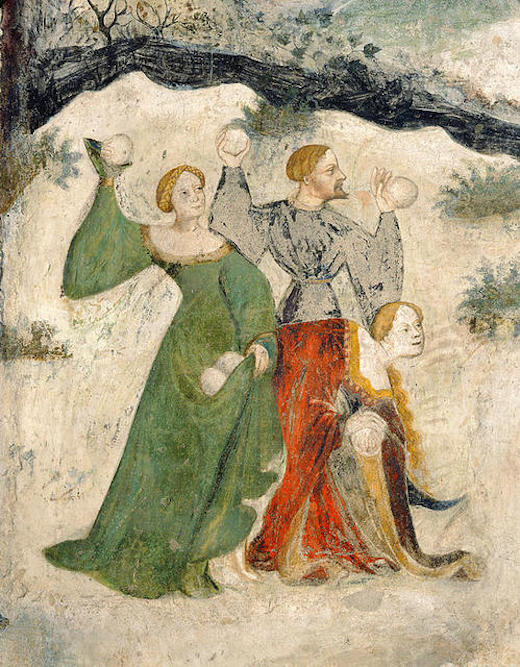
You can’t get too much winter in the winter
– Robert Frost, “Snow”
Snowy winter then responded with a voice severe:
May the cuckoo not come, let it sleep in dark hollows.
He is accustomed to bring hunger with him.– Anonymous poem in Medieval Latin, translated by Heather Williams
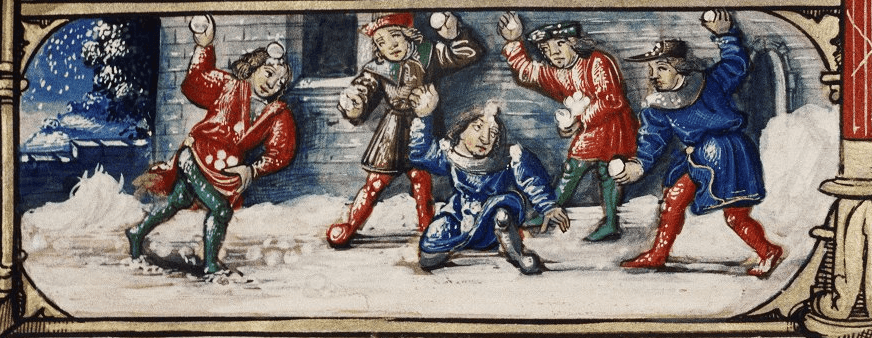
Winter may starve and freeze, but in each place where snow accumulates, we also find depictions of informal holidays — snow days — and one of their most exuberant pursuits. “Few seasonal activities are as universal — across time, place, or culture — as the snowball fight,” writes Public Domain Review. Some have even made it “into the annals of history.… According to what might be more fable than history, the teenage Napoleon Bonaparte famously organized a ten day snowball fight at his military school, complete with trenches, regimens, and rules of engagement.”
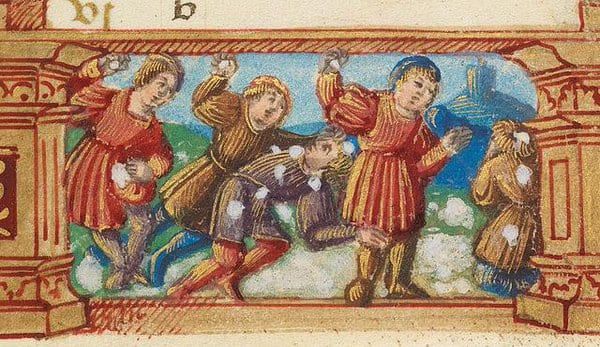
Snowball fights weren’t “confined to children either,” Arendse Lund writes. In the pages of illuminated Medieval manuscripts, “people of all ages, men and women, can be seen hefting an icy ball.” Such images defy a “conventional topos” — “the threat of winter” found in Old English poetry.
In one calendar poem, The Menologium, for example, “winter comes in like an invading warrior,” notes A Clerk of Oxford, “and puts autumn in chains, and the green fields which decorate the earth are permitted to stay with us no longer.… There are many, many examples of winter as danger and sorrow” in Medieval poetry.
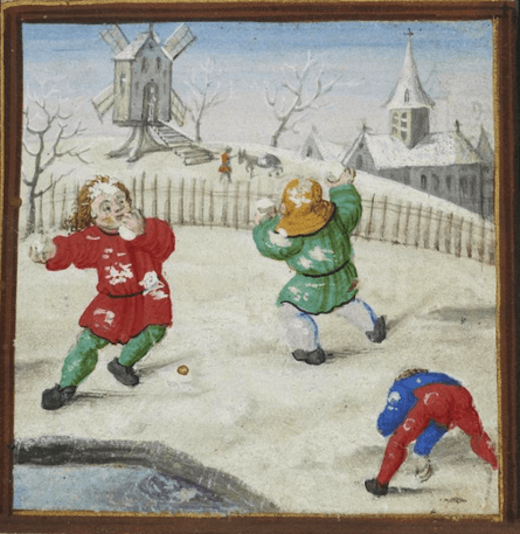
The tradition of winter as a martial invader continues in modern verse. In Robert Frost, snow forms “soft bombs.” Even when one is safe and warm at home, snow banked high around the walls outside, winter threatens: the house is “frozen, brittle, all except this room you sit in.” But alongside these literary scenes of unbearable cold, we have the playfulness and sublimity of winter, its ability to elevate the ordinary, break up monotony, put a temporary end to daily drudgery. Winter brings its own form of beauty, and its own fun: the soft bomb of the snow ball.
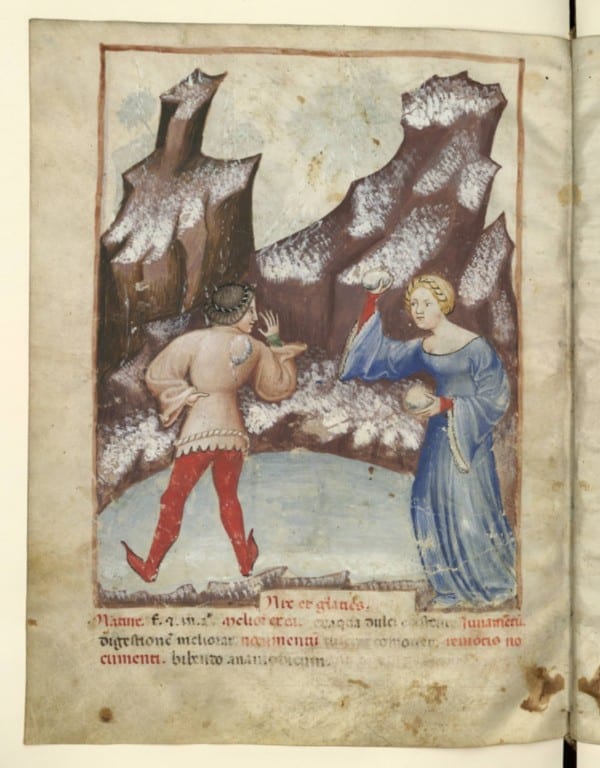
In one Middle English poem by Nicolas Bacon, titled “Of a Snow balle,” spring has nothing on winter even when it comes to love; the snowball fight becomes a pretext for a romantic encounter:
A wanton wenche vppon a colde daye
With Snowe balles prouoked me to playe:
But theis snowe balles soe hette my desyer
That I maye calle them balles of wylde fyer.
In the delightful images here, culled from a number of illuminated manuscripts (and one fresco, at the top), see Medieval Europeans play, flirt, and scoff at winter’s warning in lighthearted snowball fights of yore.
Related Content:
Josh Jones is a writer and musician based in Durham, NC. Follow him at @jdmagness
Read More...An Introduction to the Painting of Caspar David Friedrich, Romanticism & the Sublime
When Denis Villeneuve was announced as the director of the latest cinematic adaptation of Dune, few could have objected on aesthetic grounds. The blasted sand planet of Arrakis, with its storms and worms, demands a sense of the sublime; to a unique degree among filmmakers working today, the auteur behind Arrival and Blade Runner 2049 seemed to possess it. Though long since vulgarized to mean little more than “highly enjoyable,” sublime has historically denoted a richer, more complex set of qualities. The sublime can be beautiful, but it must also be in some way fearsome, possessed of “a greatness beyond all possibility of calculation, measurement, or imitation.”
That quote comes straight from the Wikipedia page on “Sublime (philosophy),” which also prominently features Caspar David Friedrich’s painting Der Wanderer über dem Nebelmeer, or Wanderer above the Sea of Fog. Completed around 1818, it has become a familiar image even to those who know nothing of Friedrich’s work — work to which they can receive an introduction from the new video above by Evan Puschak, better known as the Nerdwriter.
Friedrich, he explains, was “associated with German Romanticism, a rising intellectual and artistic movement” of the late 18th and early 19th centuries “that sought to reconnect humanity with feeling and spirituality” after the Enlightenment so destabilized humanity’s Weltanschauung.
Friedrich’s landscapes, realistically painted if not necessarily faithful to real places, “represent the pinnacle of this movement.” They do this by conveying “the feeling he has in the presence of the landscape, the staggering encounter with the divinity he sees in it. This is the essence of the sublime,” which took on special urgency in an era “when secularism was threatening the core of Christianity.” More than religion, the Romantics thus began to regard nature as awesome (in the original sense), humbling themselves before the greatness of landscapes real and imagined. The wanderer looming above the sea of fog is actually an exception in Friedrich’s work, most of whose human figures are small enough to emphasize “the vastness of the terrain” — a sublime-evoking technique that we can still feel working two centuries later, Puschak points out, in Villeneuve’s Dune.
You can pre-order Nerdwriter’s upcoming book Escape into Meaning: Essays on Superman, Public Benches, and Other Obsessions here.
Related Content:
How Andrew Wyeth Made a Painting: A Journey Into His Best-Known Work Christina’s World
Why Leonardo da Vinci’s Greatest Painting is Not the Mona Lisa
Brian Eno on Creating Music and Art As Imaginary Landscapes (1989)
Based in Seoul, Colin Marshall writes and broadcasts on cities and culture. His projects include the book The Stateless City: a Walk through 21st-Century Los Angeles and the video series The City in Cinema. Follow him on Twitter at @colinmarshall or on Facebook.
Read More...Support Us
We're hoping to rely on loyal readers, rather than erratic ads. Please click the Donate button and support Open Culture. You can use Paypal, Venmo, Patreon, even Crypto! We thank you!

About Us

Open Culture scours the web for the best educational media. We find the free courses and audio books you need, the language lessons & educational videos you want, and plenty of enlightenment in between.
Advertise With Us
FREE UPDATES!
GET OUR DAILY EMAIL
Get the best cultural and educational resources on the web curated for you in a daily email. We never spam. Unsubscribe at any time.
FOLLOW ON SOCIAL MEDIA
Open Culture editor Dan Colman scours the web for the best educational media. He finds the free courses and audio books you need, the language lessons & movies you want, and plenty of enlightenment in between.
Advertise With Us

