How Fritz Lang’s Metropolis Created the Blueprint for Modern Science Fiction (1927)
A vast, miserable proletariat squanders its days in meaningless toil. Society is under the control of ultra-wealthy business magnates. In order to pacify the underclass, the ruling class pins its hopes on a technological solution: artificial intelligence. Welcome to the year 2026, as envisioned in Fritz Lang’s Metropolis. When the film premiered, not long after 1926 had come to an end, that date would have seemed arbitrarily futuristic. Now, of course, it’s the present, though our world may nowhere look quite as stylish as the Art Deco dystopia crafted at great expense and an unprecedented scale of production by Lang and company. Yet when we watch Metropolis today, the elements that now seem prescient stand out more than the fantastical ones.
The new short documentary from DW above examines the making and legacy of Metropolis, paying special attention to its considerable influence on much of the science-fiction and dystopian cinema since. 2001: A Space Odyssey, Star Wars, Blade Runner, Terminator 2, Madonna’s “Express Yourself” video: these are just a few of the productions that take no great pains to hide — and in some cases, even emphasize — their debt to Lang’s vision.
Vertiginous, intensively illuminated, infrastructure-webbed skyscraper canyons and laborers at once manipulating and being manipulated by oversized clockwork are only the most obvious images that have come down through decades of popular culture. For the origin of the wild-haired “mad scientist” surrounded by tubes and coils, look no further than Metropolis’ Rotwang.
Much could also be written — and indeed, much already has been written — about the legacy of Rotwang’s invention, the robot woman who takes on the likeness of a working-class heroine. Beyond the groundbreaking nature of its design, Metropolis has also retained attention after nearly a century thanks to the folkloric, even mythical resonances of its story. It may be technically implausible, at least from our point of view, to imagine large-scale automation coexisting with large-scale employment, however dire the jobs, but age-old narrative undercurrents allow even modern audiences to suspend disbelief (a phenomenon that hasn’t gone unnoticed by the makers of more recent sci-fi and fantasy blockbusters). We may not live in quite the 2026 that Metropolis puts onscreen, but in some sense, we do inhabit the world it made.
Related Content:
Fritz Lang Invents the Video Phone in Metropolis (1927)
Read the Original 32-Page Program for Fritz Lang’s Metropolis (1927)
How Movies Created Their Special Effects Before CGI: Metropolis, 2001: A Space Odyssey & More
H. G. Wells Pans Fritz Lang’s Metropolis in a 1927 Movie Review: It’s “the Silliest Film”
Based in Seoul, Colin Marshall writes and broadcasts on cities, language, and culture. He’s the author of the newsletter Books on Cities as well as the books 한국 요약 금지 (No Summarizing Korea) and Korean Newtro. Follow him on the social network formerly known as Twitter at @colinmarshall.
Read More...How Medieval Cathedrals Were Built Without Science, or Even Mathematics
Science and engineering may be conflated to some degree in the public mind, but anyone who’s spent much time in an academic department belonging to one or the other of those branches of endeavor knows how insistently distinctions can be drawn between them. Bill Hammack, a professor of engineering at the University of Illinois Urbana-Champaign who’s been there since he was a master’s student in 1986, surely has his own thoughts on the subject. The video above from his popular YouTube channel Engineerguy explains how cathedrals were designed in the Middle Ages, using the example of Sainte-Chapelle in Paris. Specifically, it gets into how such a building’s arches and supporting walls could have been engineered without the aid of science at all, or even the use of mathematics.
Compared to today, the scope of knowledge humanity commanded back in medieval times may have been impossibly narrow — to say nothing of the knowledge possessed by any given human, especially outside the literate elite. Yet what was then known proved more than sufficient to build structures that still stand, and indeed impress, many centuries (and in some cases, more than a millennium) later.
Hammack explains that, in the place of making calculations, their builders would perform actions. For instance, a medieval mason would have made a life-size chalk drawing of the arch, laid a rope along its form, and cut the rope’s length to match that of the arch. He could then use the rope to determine just how thick the wall would need to be, between a fourth and a fifth of the arch’s span, without a number ever being involved.
Hammack notes that the Romans, too, understood this necessary proportion for arch construction. “The proportional rule doesn’t come from some scientific analysis of stone and its properties,” he says. “It comes from centuries of experience, from trial and error.” Such heuristics, or rules of thumb, constitute “an imprecise method used as a shortcut to find a solution to a problem, often by narrowing the range of possible solutions.” They’re also employed in the engineering method to “cause the best change in a poorly understood situation using available resources.” Its thoroughgoing practicality would seem to have little to do with the different sort of rigors that apply in science, where establishing truth, or at least the absence of falseness, is all. Belief in the engineering approach to problems like this doesn’t require faith in the religious sense, but if you like, you can find proof of its effectiveness in houses of worship from Sainte-Chapelle to the Pantheon to Hagia Sophia — or at least in their arches.
Related Content:
Göbekli Tepe: The 12,000-Year-Old Ruins That Rewrite the Story of Civilization
The Creation & Restoration of Notre-Dame Cathedral, Animated
Based in Seoul, Colin Marshall writes and broadcasts on cities, language, and culture. He’s the author of the newsletter Books on Cities as well as the books 한국 요약 금지 (No Summarizing Korea) and Korean Newtro. Follow him on the social network formerly known as Twitter at @colinmarshall.
Read More...What Did the Instruments in Hieronymus Bosch’s Garden of Earthly Delights Sound Like? Oxford Scholars Recreate Them
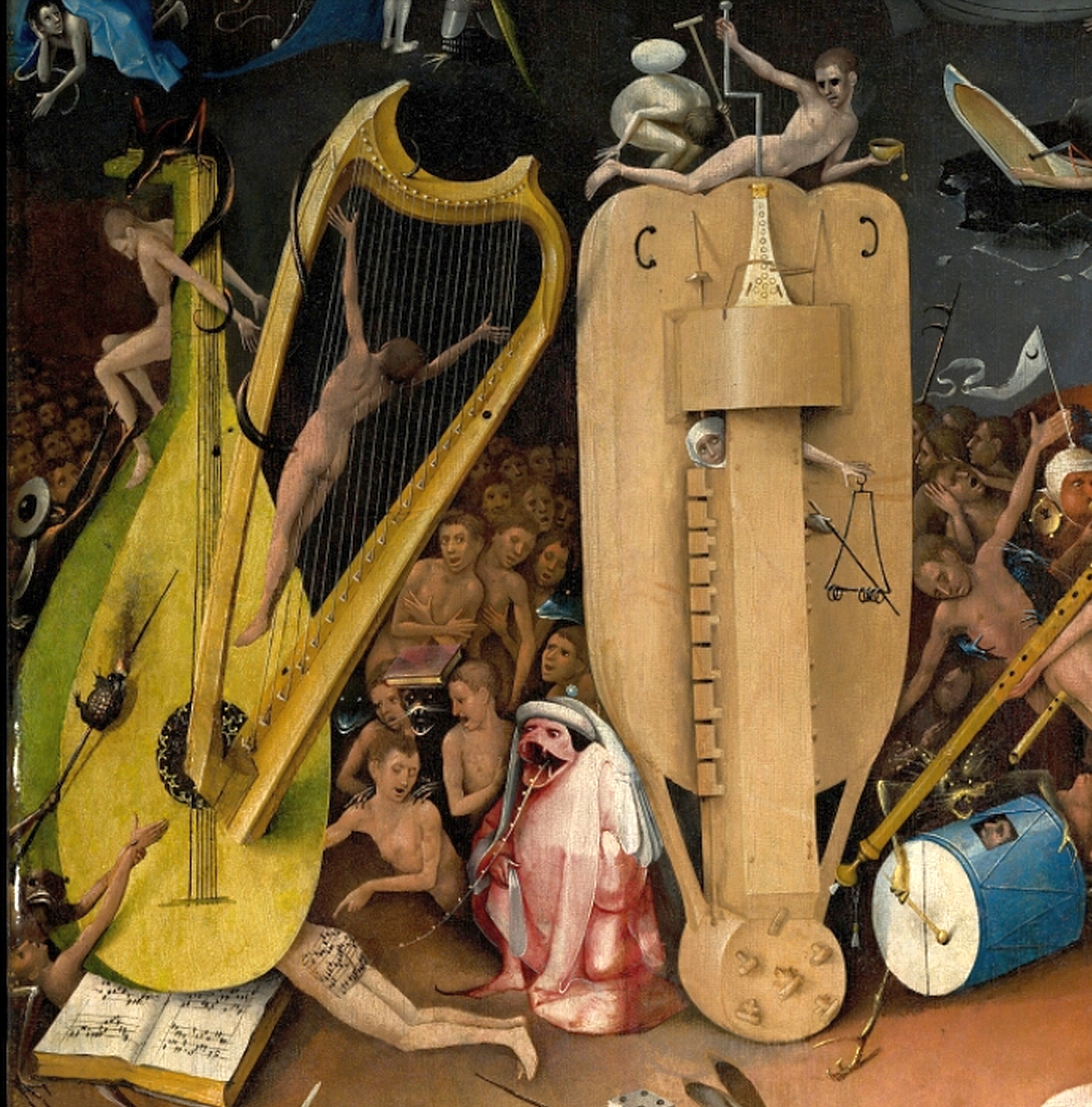
Welcome to The Garden of Earthly Delights.
You’ll find no angelic strings here.
Those are reserved for first-class citizens whose virtuous lives earned them passage to the uppermost heights.
Down below, stringed instruments produce the most hellish sort of cacophony, a fitting accompaniment for the horn whose bell is befouled with the arm of a tortured soul.
How do we know that’s what they sounded like?
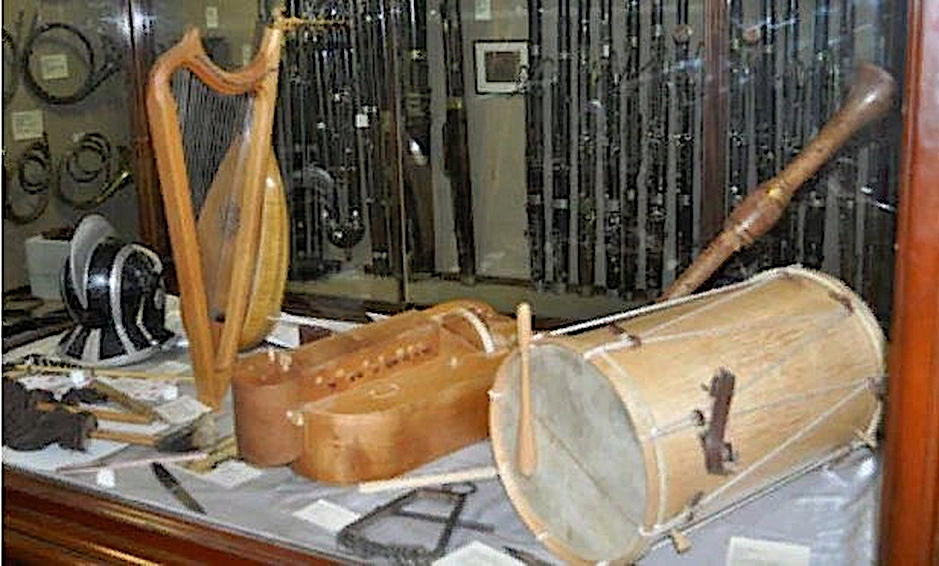
A group of musicologists, craftspeople and academics from the Bate Collection of Musical Instruments at the University of Oxford, took it upon themselves to actually build the instruments depicted in Hieronymus Bosch’s action-packed triptych—the hell harp, the violated lute, the grossly oversized hurdy-gurdy…
…And then they played them.
Let us hope they stopped shy of shoving flutes up their bums. (Such a placement might produce a sound, but not from the flute’s golden throat).
The Bosch experiment added ten more instruments to the museum’s already impressive, over 1000-strong collection of woodwinds, percussion, and brass, many from the studios of esteemed makers, some dating all the way back to the Renaissance.
Unfortunately, the new additions don’t sound very good. “Horrible” and “painful” are among the adjectives the Bate Collection manager Andrew Lamb uses to describe the aural fruits of his team’s months-long labors.
Might we assume Bosch would have wanted it that way?
Brandon McWilliams, the wag behind Bosch’s wildly enthusiastic, f‑bomb-laced review of thrash metal band Slayer’s 1986 Reign in Blood album, would surely say yes, as would Alden and Cali Hackmann, North American hurdy-gurdy makers, who note that Bosch’s painterly desecrations were not limited to their personal favorite instrument:
Bosch and his contemporaries viewed music as sinful, associating it with other sins of the flesh and spirit. A number of other instruments are also depicted: a harp, a drum, a shawm, a recorder, and the metal triangle being played by the woman (a nun, perhaps) who is apparently imprisoned in the keybox of the instrument. The hurdy-gurdy was also associated with beggars, who were often blind. The man turning the crank is holding a begging bowl in his other hand. Hanging from the bowl is a metal seal on a ribbon, called a “gaberlunzie.” This was a license to beg in a particular town on a particular day, granted by the nobility. Soldiers who were blinded or maimed in their lord’s service might be given a gaberlunzie in recompense.
To the best of our knowledge, no gaberlunzies were granted, nor any sinners eternally damned, in the Bate Collection’s caper. According to manager Lamb, expanding the boundaries of music education was recompense enough, well worth the temporary affront to tender ears.
Note: An earlier version of this post appeared on our site in 2019.
Related Content:
The Meaning of Hieronymus Bosch’s The Garden of Earthly Delights Explained
The Hieronymus Bosch Demon Bird Was Spotted Riding the New York City Subway the Other Day…
Ayun Halliday is an author, illustrator, theater maker and Chief Primatologist of the East Village Inky zine.
Read More...The Ingenious Engineering of Silk: How the 2,000-Year-Old Pattern Loom Powered the Silk Road and the Wealth of Ancient China
The Silk Road’s long period of high activity spanned the second century BC and the fifteenth century AD, but its name wasn’t coined until more than 400 years after that. Scholars have argued it practically ever since, given that the referent wasn’t just one road but a vast and ever-changing network of them, and that silk was hardly the only commodity carried by its traders. Yet the name persists, and not only due to Marco Polo-type romanticism. Silk may not have been the highest-volume item on its eponymous road — more business was surely done in everyday textiles, to say nothing of spices, grains, or dyes — but it was perhaps the most visible, and surely the most glamorous. From the perspective of Chinese civilization, it can also look like the most important.
In the new Primal Space video above, you can hear the story of “the machine that made China rich”: the pattern loom, that is, a model of which was unearthed in 2017 during subway construction in the city of Chengdu. At somewhere between 2,100 and 2,200 years old, they represent the earliest known evidence of pattern loom technology, of which China made highly productive use during the time of its three-millennium monopoly on silk.
As far away as the Roman Empire, those who had the means couldn’t get enough of the stuff, especially when it came in designs never before seen in human history. Hence the high priority China placed on keeping knowledge of its harvesting and weaving proprietary — at least until a couple of Roman monks managed to smuggle silkworm larvae back to Europe in the middle of the sixth century.
Yet even having lost its status as the only land capable of producing silk, China retained a great advantage in the form of its sheer manufacturing capacity. (This story rings somewhat familiar about a millennium and a half later, when none of us can dispute which country holds the title of “the world’s factory.”) Its silk industry could achieve that scale thanks to the relative ease of use of the pattern loom, which required no special skills to operate. The most complex aspect would have been “programming” the patterns to be formed by the strands, which, though an entirely analog process, has its basic similarities with the digital computer programming we know today. China’s trade networks have greatly multiplied since the days of Marco Polo, and the technology it uses has developed to a previously unimaginable degree. Yet somehow, the “Electric Vehicle Road” doesn’t have quite the same ring, does it?
Related Content:
Discover the World’s First Earthquake Detector, Invented in China 2,000 Years Ago
How the Ornate Tapestries from the Age of Louis XIV Were Made (and Are Still Made Today)
Based in Seoul, Colin Marshall writes and broadcasts on cities, language, and culture. He’s the author of the newsletter Books on Cities as well as the books 한국 요약 금지 (No Summarizing Korea) and Korean Newtro. Follow him on the social network formerly known as Twitter at @colinmarshall.
Read More...Hear Aldous Huxley Read Brave New World. Plus 84 Classic Radio Dramas from CBS Radio Workshop (1956–57)
We seem to be living through yet another major moment for podcasting. Over the past two decades, the medium has gone from niche experiment to mainstream habit, becoming a regular part of how we learn, entertain ourselves, and pass the time. The popularity of podcasts—in an age of ubiquitous screens and perpetual distractions—speaks to something deep within us. Oral storytelling, as old as human speech, never really disappears. The medium evolves, platforms shift, distribution changes—but the basic appeal remains constant.
But the differences between this golden age of podcasting and the golden age of radio are still significant. Where the podcast is often off-the-cuff, and often very intimate and personal—sometimes seen as “too personal”—radio programs were almost always carefully scripted and featured professional talent. Even those programs with man-on-the street features or interviews with ordinary folks were carefully orchestrated and mediated by producers, actors, and presenters. And the business of scoring music and sound effects for radio programs was a very serious one indeed. All of these formalities—in addition to the limited frequency range of old analog recording technology—contribute to what we immediately recognize as the sound of “old time radio.” It is a quaint sound, but also one with a certain gravitas, an echo of a bygone age.
That golden age waned as television came into its own in the mid-fifties, but near its end, some broadcast companies made every effort to put together the highest quality radio programming they could in order to retain their audience. One such program, the CBS Radio Workshop, which ran from January, 1956 to September, 1957, may have been “too little too late”—as radio preservationist site Digital Deli writes—but it nonetheless was “every bit as innovative and cutting edge” as the programs that came before it.
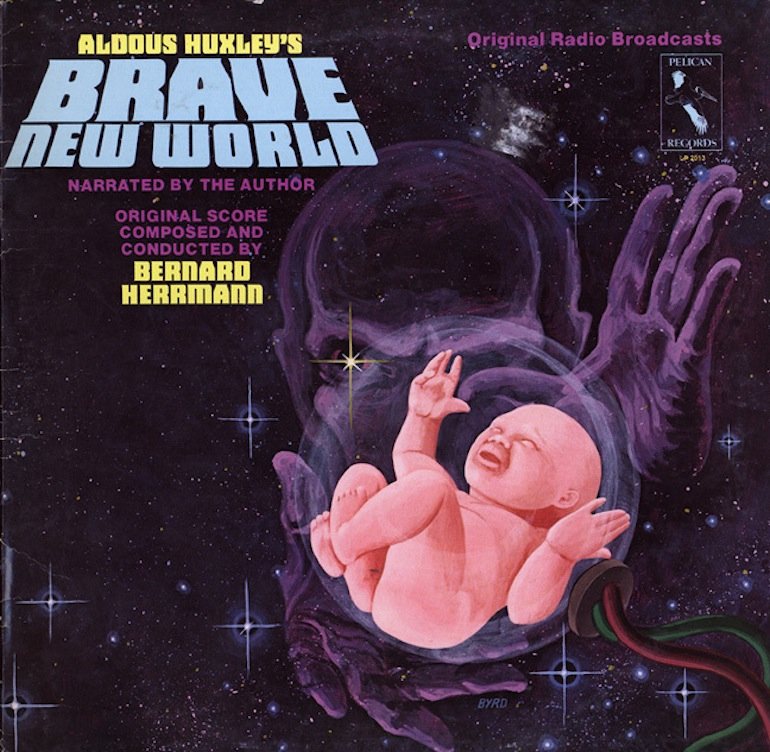
The first two episodes, right below, were dramatizations of Aldous Huxley’s Brave New World, read by the author himself. The series’ remaining 84 programs drew from the work of Antoine de Saint-Exupéry, James Thurber, H.L. Mencken, Mark Twain, Robert Heinlein, Eugene O’Neill, Balzac, Carl Sandburg, and so many more. It also featured original comedy, drama, music, and This American Life-style profiles and storytelling.
Huxley returned in program #12, with a story called “Jacob’s Hands,” written in collaboration with and read by Christopher Isherwood. The great Ray Bradbury made an appearance, in program #4, introducing his stories “Season of Disbelief” and “Hail and Farewell,” read by John Dehner and Stacy Harris, and scored by future film and TV composer Jerry Goldsmith. Other programs, like #10, “The Exurbanites,” narrated by famous war correspondent Eric Sevareid, conducted probing investigations of modern life—in this case the growth of suburbia and its relationship to the advertising industry. The above is but a tiny sampling of the wealth of quality programming the CBS Radio Workshop produced, and you can hear all of it—all 86 episodes—courtesy of the Internet Archive.
Sample streaming episodes in the player above, or download individual programs as MP3s and enjoy them at your leisure, almost like, well, a podcast. See Digital Deli for a complete rundown of each program’s content and cast, as well as an extensive history of the series. This is the swan song of golden age radio, which, it seems, maybe never really left, given the incredible number of listening experiences we still have at our disposal. Yes, someday our podcasts will sound quaint and curious to the ears of more advanced listeners, but even then, I’d bet, people will still be telling and recording stories, and the sound of human voices will continue to captivate us as it always has.
Note: An earlier version of this post appeared on our site in 2014.
Related Content:
X Minus One: Hear Classic Sci-Fi Radio Stories from Asimov, Heinlein, Bradbury & Dick
Hear 90+ Episodes of Suspense, the Iconic Golden Age Radio Show Launched by Alfred Hitchcock
Hear 149 Vintage Halloween Radio Shows from the Golden Age of Radio
Josh Jones is a writer and musician based in Durham, NC.
Read More...How to Carve Hieroglyphs Just Like the Ancient Egyptians Did
In ancient Egypt, writing hieroglyphs was a highly specialized skill, one commanded by only a small fraction of the population. The fact that there were more than 1,000 characters to memorize probably had something to do with that, but the variety of surfaces on which hieroglyphs were written couldn’t have made it any easier. Depending on the occasion, ancient Egyptians used papyrus, wood, metal, and pottery shards as writing surfaces. The most monumental or religiously important texts, however, got carved into stone, thus ensuring the words a kind of eternal life — a particular concern in the cases of tomb walls and sarcophagi.
There may be little call to write hieroglyphs today, but the techniques to do so haven’t been lost. In the new video above from the Victoria and Albert Museum, sculptor and stone carver Miriam Johnson demonstrates how to carve into stone the name of Pharaoh Khufu, who built the Great Pyramid (and indeed, was buried in it).
The first step is to write that name, surrounded by its cartouche, on a sheet of carbon paper. This isn’t the brush and ink that the ancient Egyptians would have used, granted, but for the rest of the project, Johnson sticks to the old-fashioned ways. With the image transferred, and using nothing more than a mallet and a chisel, she carves the hieroglyphs into the stone not just once but twice.
The first time, Johnson carves in “sunken relief,” a technique that involves cutting the image out of the surface of the stone. The second time, she renders Pharaoh Khufu’s name in “raised relief,” which requires cutting out everything but the image, creating the effect of the hieroglyphs rising out of the stone. With the former “you see more of the shadows”; with the latter, “you’ve got more opportunity of putting more texture into the characters.” Seen in a state of completion — by a layman, at least — Johnson’s carvings wouldn’t look out of place in a museum exhibit on ancient Egypt. Even if tools manufactured in the twenty-first century produce a few subtle differences from the real thing, give these stones a millennium or two to age, and they’ll surely look even more convincing.
Related content:
How to Read Ancient Egyptian Hieroglyphs: A British Museum Curator Explains
What Ancient Egyptian Sounded Like & How We Know It
You Could Soon Be Able to Text with 2,000 Ancient Egyptian Hieroglyphs
Watch a Masterpiece Emerge from a Solid Block of Stone
Based in Seoul, Colin Marshall writes and broadcasts on cities, language, and culture. He’s the author of the newsletter Books on Cities as well as the books 한국 요약 금지 (No Summarizing Korea) and Korean Newtro. Follow him on the social network formerly known as Twitter at @colinmarshall.
Read More...How to Make Coffee in the Bialetti Moka Pot: The “Ultimate Techique”
In Italy, roughly 70% of households have a Bialetti Moka Pot. And chances are you have one too. But are you using it the right way? Probably not, says James Hoffmann, the author of The World Atlas of Coffee. Above, he sets the record straight, demonstrating the best technique for making a great cup of coffee. Enjoy this public service announcement and use it well.
If you would like to support the mission of Open Culture, consider making a donation to our site. It’s hard to rely 100% on ads, and your contributions will help us continue providing the best free cultural and educational materials to learners everywhere. You can contribute through PayPal, Patreon, and Venmo (@openculture). Thanks!
Related Content
Deep Fried Coffee: A Very Disturbing Discovery
Life and Death of an Espresso Shot in Super Slow Motion
The Birth of Espresso: How the Coffee Shots The Fuel Our Modern Life Were Invented
Philosophers Drinking Coffee: The Excessive Habits of Kant, Voltaire & Kierkegaard
Read More...An Introduction to the Codex Seraphinianus, the Strangest Book Ever Published
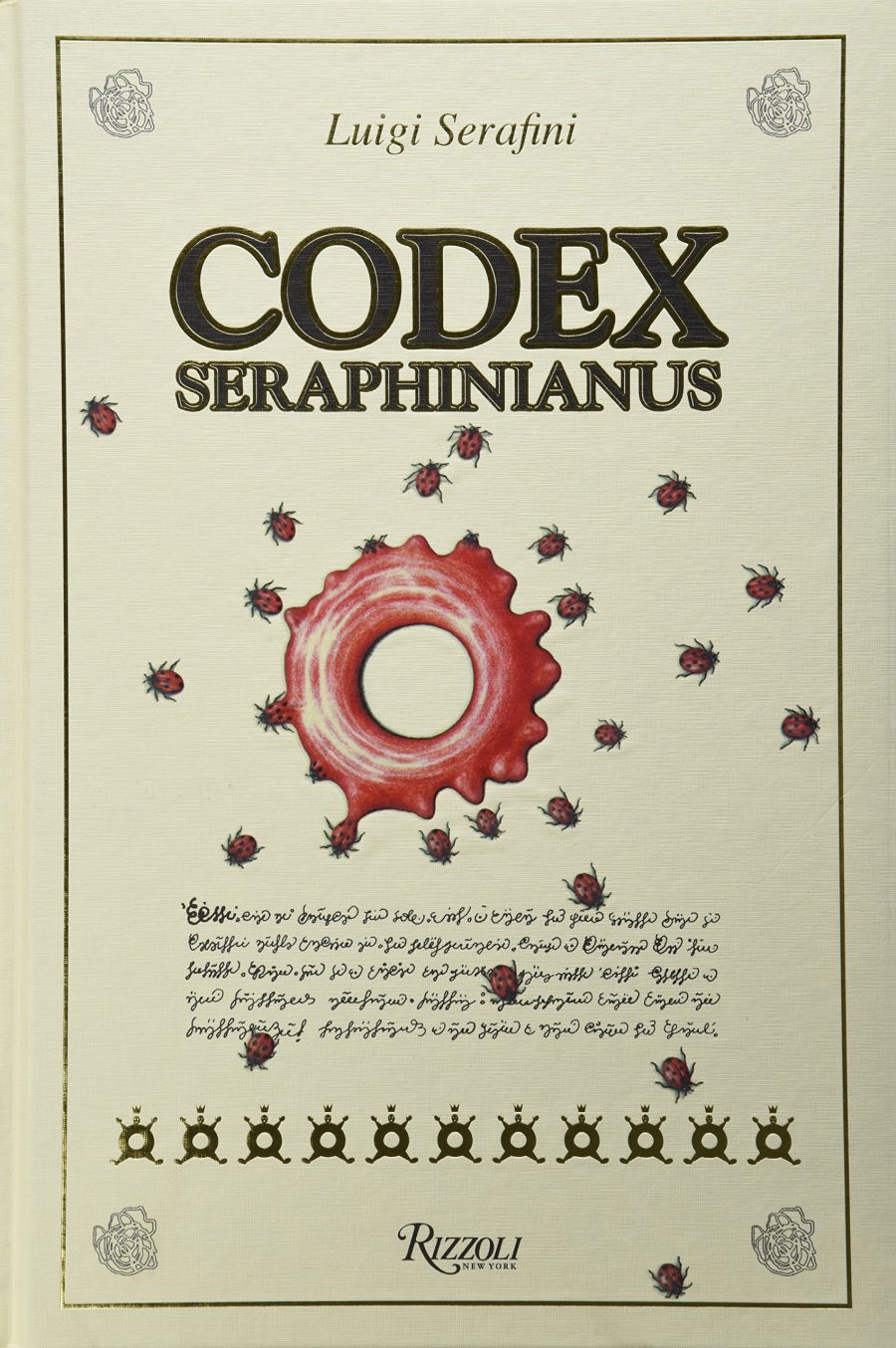
Imagine you could talk to Hieronymus Bosch, the authors of the Book of Revelation, or of the Voynich Manuscript—a bizarre 15th century text written in an uncrackable code; that you could solve centuries-old mysteries by asking them, “what were you thinking?” You might be disappointed to hear them say, as does Luigi Serafini, author and illustrator of the Codex Seraphinianus, “At the end of the day [it’s] similar to the Rorschach inkblot test. You see what you want to see. You might think it’s speaking to you, but it’s just your imagination.”
If you were a longtime devotee of an intensely symbolic, mythic text, you might refuse to believe this. It must mean something, fans of the Codex have insisted since the book’s appearance in 1981.
It shares many similarities with the Voynich Manuscript, save its relatively recent vintage and living author: both the Seraphinianus and the Voynich seem to be compendiums of an otherworldly natural science and art, and both are written in a wholly invented language.
Serafini tells Wired he thinks Voynich is a fake. “The Holy Roman Emperor Rudolf II loved ancient manuscripts; somebody swindled him and spread the rumor that it was original. The idea of made-up languages is not new at all.” As for his own made-up language in the Codex, he avers, “I always said that there is no meaning behind the script; it’s just a game.” But it is not a hoax. Though he hasn’t minded the money from the book’s cult popularity, he created the book, he says, “trying to reach out to my fellow people, just like bloggers do.” It is, he says, “the product of a generation that chose to connect and create a network, rather than kill each other in wars like their fathers did.”
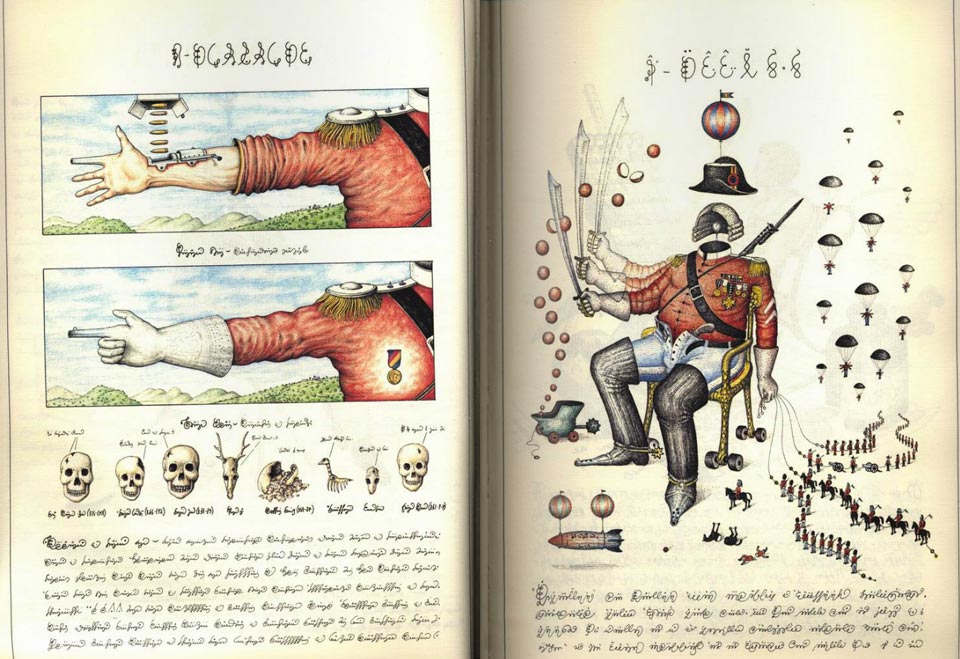
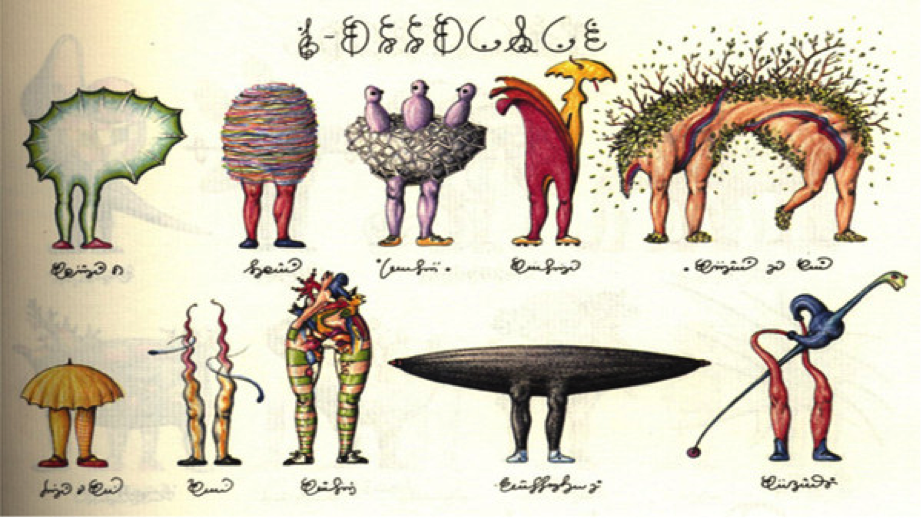
The Codex, writes Abe Books, who made the short video review above, is “essentially an encyclopedia about an alien world that clearly reflects our own, each chapter appears to deal with key facets of this surreal place, including flora, fauna, science, machines, games and architecture.” That’s only a guess given the unintelligible language.
The illustrations seem to draw from Bosch, Leonardo da Vinci, and the medieval travelogue as much as from the surrealism of contemporary European artists like Fantastic Planet animator René Laloux.
Serafini has been delighted to see an extensive internet community coalesce around the book, and has had his fun with it. He “now states,” writes Dangerous Minds, “that a stray white cat that joined him while he created the Codex in Rome in the 1970s was actually the real author, telepathically guiding Serafini as he drew and ‘wrote.’” You can now, thanks to a recent, relatively affordable edition published by Rizzoli, purchase your copy of the Codex. Buy now, I’d say. First editions of the book now fetch upwards of $6000, and its popularity shows no sign of slowing.
Note: An earlier version of this post appeared on our site in 2017.
Related Content:
A Digital Archive of Hieronymus Bosch’s Complete Works: Zoom In & Explore His Surreal Art
Explore a Digitized Edition of the Voynich Manuscript, “the World’s Most Mysterious Book”
Carl Jung’s Hand-Drawn, Rarely-Seen Manuscript The Red Book
The Foot-Licking Demons & Other Strange Things in a 1921 Illustrated Manuscript from Iran
Josh Jones is a writer and musician based in Durham, NC.
Read More...A Tour Inside the Chelsea Hotel: Once Home to Bob Dylan, Patti Smith, Leonard Cohen & More
We’ve all stayed at the Chelsea Hotel, though most of us have done so only in our minds, through such cultural artifacts as Leonard Cohen’s “Chelsea Hotel No. 2,” Bob Dylan’s “Sara,” Nico’s “Chelsea Girls,” Andy Warhol’s eponymous film that includes the Nico song, or Patti Smith’s Just Kids, which tells of the time she spent there with Robert Mapplethorpe. Enthusiasts of the work of everyone from Janis Joplin to Arthur C. Clarke to Miloš Forman to Dylan Thomas to Mark Twain may not know that they, too, thereby enjoy an indirect connection to that New York institution, which has stood on West 23rd Street since its construction in 1884.
At that time, it also stood quite tall, looming over every other apartment building in the city, and indeed over most of the rest of Manhattan. Nowadays, however, the cultural profile of the Chelsea Hotel (officially, and less coolly, the Hotel Chelsea) is higher than its physical one ever was.
Its reputation as a refuge for artists dates to the management of Stanley Bard, who inherited the business from his father in 1964. Already, a degree of dilapidation in the building itself, as well as the surrounding neighborhood, kept rents low enough to attract impecunious creative types. Bard displayed enough generosity to artists that, before long, Andy Warhol’s factory had more or less moved in.
The Chelsea’s latest transformation began in the mid-two-thousands with a series of takeovers and renovations not necessarily welcomed by the existing long-term residents, who appreciated the hotel precisely for its seeming imperviousness to gentrification. In the new Architectural Digest video above, current owner Sean MacPherson gives a tour of the luxurious Chelsea of the twenty-twenties, all of whose spaces have been meticulously curated to evoke its storied past. In its bar (with cigarette burns carefully preserved) guests can order a cocktail called the Two Dylans, named in homage to both Bob and Thomas; in the basement, they can choose from the largest selection of Japanese whiskey at a new restaurant named after former resident Teruko Yokoi. The experience of a nineteen-sixties New York bohemian is now available to all of us — or at least those of us who can come up with $500 per night.
If you want to revisit the hotel during its pre-restoration heyday, you can watch the 1981 documentary below. It will let you get glimpses of Andy Warhol, William S. Burroughs, Nico, and more.
Related content:
New York’s Famous Chelsea Hotel and Its Creative Residents Revisited in a 1981 Documentary
Nico Sings “Chelsea Girls” in the Famous Chelsea Hotel
Thanksgiving Menu at the Plaza Hotel in New York City (1899)
Watch Iggy Pop Perform Dylan Thomas’ “Do Not Go Gentle Into That Good Night”
Architect Breaks Down Five of the Most Iconic New York City Apartments
Based in Seoul, Colin Marshall writes and broadcasts on cities, language, and culture. He’s the author of the newsletter Books on Cities as well as the books 한국 요약 금지 (No Summarizing Korea) and Korean Newtro. Follow him on the social network formerly known as Twitter at @colinmarshall.
Read More...How the Golden Gate Bridge Was Built: A 3D Animated Introduction
Built during the depths of the Great Depression (from 1933 to 1937), the Golden Gate Bridge became the longest and tallest suspension bridge in the world. During its construction, workers battled harsh conditions — strong winds, thick fog, and the risk of plunging into the San Francisco Bay. 11 souls perished. Likewise, the engineer Joseph Strauss had to work through complicated design challenges to anchor the structure in the deep waters, then spin massive cables and tension them across the 4,000-foot span. Created by the YouTube channel Animagraffs, the 3D animated video above takes viewers on a technical tour of the Golden Gate Bridge’s construction, deconstructing the engineering that makes the bridge both beautiful and enduring.
Note: If you visit this post in our archive, you can see vintage footage that shows the bridge under construction and then opening to traffic in 1937.
If you would like to support the mission of Open Culture, consider making a donation to our site. It’s hard to rely 100% on ads, and your contributions will help us continue providing the best free cultural and educational materials to learners everywhere. You can contribute through PayPal, Patreon, and Venmo (@openculture). Thanks!
Related Content
Built to Last: How Ancient Roman Bridges Can Still Withstand the Weight of Modern Cars & Trucks
Building the Golden Gate Bridge: A Retro Film Featuring Original Archival Footage
Read More...
Support Us
We're hoping to rely on loyal readers, rather than erratic ads. Please click the Donate button and support Open Culture. You can use Paypal, Venmo, Patreon, even Crypto! We thank you!

About Us

Open Culture scours the web for the best educational media. We find the free courses and audio books you need, the language lessons & educational videos you want, and plenty of enlightenment in between.
Advertise With Us

FREE UPDATES!
GET OUR DAILY EMAIL
Get the best cultural and educational resources on the web curated for you in a daily email. We never spam. Unsubscribe at any time.
FOLLOW ON SOCIAL MEDIA

Open Culture editor Dan Colman scours the web for the best educational media. He finds the free courses and audio books you need, the language lessons & movies you want, and plenty of enlightenment in between.
Advertise With Us

