The Decay of Cinema: Susan Sontag, Martin Scorsese & Their Lamentations on the Decline of Cinema Explored in a New Video Essay
This deep into the coronavirus pandemic, how many cinephiles haven’t yet got word of the bankruptcy or shuttering of a favorite movie theater? Though the coronavirus hasn’t quite killed filmgoing dead — at least not everywhere in the world — the culture of cinema itself had been showing signs of ill health long before any of us had heard the words “social distancing.” The previous plague, in the view of Martin Scorsese, was the Hollywood superhero-franchise blockbuster. “That’s not cinema,” the auteur-cinephile told Empire magazine in 2019. “Honestly, the closest I can think of them, as well made as they are, with actors doing the best they can under the circumstances, is theme parks.”
This past March, Scorsese published an essay in Harper’s called “Il Maestro.” Ostensibly a reflection on the work of Federico Fellini, it also pays tribute to Fellini’s heyday, when on any given night in New York a young movie fan could find himself torn between screenings of the likes of La Dolce Vita, François Truffaut’s Shoot the Piano Player, Andrzej Wajda’s Ashes and Diamonds, John Cassavetes’ Shadows, and the work of other masters besides. This was early in the time when, as New Yorker critic Anthony Lane puts it, “adventurous moviegoing was part of the agreed cultural duty, when the duty itself was more of a trip than a drag, and when a reviewer could, in the interests of cross-reference, mention the names ‘Dreyer’ or ‘Vigo’ without being accused of simply dropping them for show.”
Alas, writes Scorsese, today the art of cinema today is “systematically devalued, sidelined, demeaned, and reduced to its lowest common denominator, ‘content.’ ” Video essayist Daniel Simpson of Eyebrow Cinema calls this lament “more than an artist railing against a businessman’s terminology, but a yearning for a time when movies used to be special in and of themselves, not just as an extension of a streaming service.” In “The Decay of Cinema,” Simpson connects this cri de cinephilic coeur by the man who directed Taxi Driver and GoodFellas to a 25-year-old New York Times opinion piece by Susan Sontag. A midcentury-style film devotee if ever there was one, Sontag mourns “the conviction that cinema was an art unlike any other: quintessentially modern; distinctively accessible; poetic and mysterious and erotic and moral — all at the same time.”
Some may object to Sontag’s claim that truly great films had become “violations of the norms and practices that now govern movie making everywhere.” Just two weeks after her piece ran, Simpson points out, the Coen brothers’ Fargo opened; soon to come were acclaimed pictures by Mike Leigh and Lars von Trier, and the next few years would see the emergence of Wes Anderson and Paul Thomas Anderson both. But what of today’s masterpieces, like Chung Mong-hong’s A Sun? Though released before the havoc of COVID-19, it has nevertheless — “without a franchise, rock-star celebrities, or an elevator-pitch high concept” — languished on Netflix. And as for an event of such seemingly enormous cinematic import as the completion of Orson Welles’ The Other Side of the Wind three decades after his death, the result wound up “simply dumped on the platform with everything else.”
In a time like this, when the many stuck at home have few options besides streaming services, one hesitates to accuse Netflix of killing either cinema or cinephilia. And yet Simpson sees a considerable difference between being a cinephile and being a “user,” a label that suggests “a customer to be satiated” (if not an addict to be granted a fix of his habit-forming commodity). “There’s only one problem with home cinema,” writes Lane. “It doesn’t exist.” Choice “pretty much defines our status as consumers, and has long been an unquestioned tenet of the capitalist feast, but in fact carte blanche is no way to run a cultural life (or any kind of life, for that matter).” If we continue to do our viewing in algorithm-padded isolation, we surrender what Simpson describes as “the human connection to the film experience” — one of the things that, when all the social distancing ends, even formerly casual moviegoers may find themselves desperately craving.
Related Content:
Susan Sontag’s 50 Favorite Films (and Her Own Cinematic Creations)
Martin Scorsese Explains the Difference Between Cinema and Movies
Based in Seoul, Colin Marshall writes and broadcasts on cities, language, and culture. His projects include the Substack newsletter Books on Cities, the book The Stateless City: a Walk through 21st-Century Los Angeles and the video series The City in Cinema. Follow him on Twitter at @colinmarshall or on Facebook.
Read More...Buckminster Fuller, Isaac Asimov & Other Futurists Make Predictions About the 21st Century in 1967: What They Got Right & Wrong
Why bother with reason and evidence to make predictions when you can put your faith in a chance roll of the dice? These two methods could be said to represent the vastly divergent ways of science and superstition, two realms that rarely intersect except, perhaps, when it comes to fortune-telling — or, in the argot of the 20th century’s soothsayers, “Futurism,” where predictions seem to rely as much on wishful thinking as they do on intuition and intellect.
In the 1967 short documentary film, The Futurists, above, scientists and visionaries quite literally combine the scientific method with random chance operation to make predictions about the 21st century. Host Walter Cronkite explains:
A panel of experts has studied a list of possible 21st century developments, from personality controlled drugs to household robots. They have estimated the numerical probability of each, from zero to 100 percent. The twenty sided dice are then rolled to simulate these probabilities. A use of random numbers known as the Monte Carlo technique, often used in thinktank games. All of this is highly speculative.
Indeed. The glimpse we get of the future — of our present, as it were — is very optimistic, “and so very, very wrong,” writes Billy Ingram at TV Party — at least in some respects. “Sadly, those past futurists forgot to factor in human greed and the refashioning of Americans’ way to be less communal and more self-centered.” The very medium on which the documentary appeared helped to center selfishness as a cardinal American virtue.
Yet in 1967, the federal government still required major networks to run educational content, even if “network executives understood these programs would end up at the bottom of the Nielsen ratings.” Hence, The Futurists, which aired on primetime on CBS “when the 3 networks would occasionally preempt popular programs with a news feature/documentary.” Despite low expectations at the time, the short film now proves to be a fascinating document.
The rolls of the dice with which it opens are not, it turns out, a “crap game,” but a “serious game at the University of Pittsburgh,” Cronkite tells us before introducing the august panel of experts. We see a number of scenarios predicted for the coming century. These include the vague “increased importance of human concerns,” sci-fi “teaching by direct recording on the brain,” and ominous “tactical behavior control devices.”
Buckminster Fuller even predicts bodily teleportation by radio waves, something like the technology then featured in a brand-new TV show, Star Trek, but not scientifically probable in any sense, either then or now. Nonetheless, there is surprising prescience in The Futurists, as its opening panel of futuristic experts announces their conclusions:
We wind up with a world which has the following features: fertility control, 100-year lifespan, controlled thermal nuclear power, continued automation, genetic control, man-machine symbiosis, household robots, wideband communications, opinion control, and continued organization.
Apparently, in 1967, all the Futurists worth talking to — or so it seemed to the film’s producer McGraw Hill — were men. Theirs was the only perspective offered to home viewers and to the students who saw this film in schools across the country. Those men include not only Fuller, who gives his full interview at 14:30, but also frequent maker of accurate futuristic predictions Isaac Asimov, who appears at the 20:50 mark. Aside from the exclusion of 50% of the population’s perspective, and an overly rosy view of human nature, however, The Futurists is often an uncannily accurate vision of life as we now know it — or at least one far more accurate than most 21st century futurisms of the past.
Related Content:
Octavia Butler’s Four Rules for Predicting the Future
Josh Jones is a writer and musician based in Durham, NC. Follow him at @jdmagness
Read More...The Evolution of Dance from 1950 to 2019: A 7‑Decade Joy Ride in 6 Minutes
I see Michael Jackson as a dance style, okay? — Ricardo Walker
Ricardo Walker and his Crew’s The Evolution of Dance, 1950 to 2019 will make you regret every minute spent hugging the wall in middle school.
The breakneck, 6‑minute romp led by dancer, choreographer, and Michael Jackson impersonator Ricardo Walker, not only showcases the all-male Brazilian crew’s talent, it makes a strong case for throwing yourself into some serious dance floor silliness.
The Crew, formed by a mutual passion for the King of Pop’s moves, is plenty cool, but their willingness to ham their way through “Flashdance…What a Feeling,” the “Macarena,” and Dirty Dancing’s “Time of My Life” suggest that the joys of dance are available to ordinary mortals such as ourselves.
They cavort in sagging early 90s-style Hammer Pants for “U Can’t Touch This” and don Western wear for Lil Nas X’s “Old Town Road,” the most recent number on this musical tour.
Troupe members Gabriel Zaidan and Alexandre “Lelê” Mayrink seem unhampered by vanity, tossing their enviable locks into the 35 costume changes’ goofiest styles.
The Crew took 16 hours to get the video in the can on a day when one of their number felt under the weather, and they had to be out of the studio by 7pm. (Our compliments to the editor!)
While such hits as Chubby Checker’s “Let’s Twist Again,” Jackson’s “Billie Jean,” Madonna’s “Vogue,” Beyoncé’s “Single Ladies,” and — who could forget? — “Gangnam Style” instantly summon a period, the 90s placement of Tom Jones’ signature tune, “It’s Not Unusual,” is throwing viewers for a loop.
How did that old chestnut wind up between Madonna and Backstreet Boys?
By virtue of its first studio version, released in 1995 as part of the compilation album The Legendary Tom Jones — 30th Anniversary Album, that’s how.
Prior to their virtuoso turn in the Evolution of Dance, 1950 to 2019, the group guided viewers through the Evolution of Michael Jackson’s Dance. (Jackson’s influence is also evident throughout the former, earning him 4 nods.)
For those whose feet have begun to itch, choreographer Walker teaches a Master Class in Michael Jackson’s dance moves for $100.
Songs used in The Evolution of Dance — 1950 to 2019 — by Ricardo Walker’s Crew
00:03 — 00:13 — Singin’in the Rain — Gene Kelly
00:13 — 00:23 — Hound Dog — Elvis Presley
00:23 — 00:30 — Tutti Frutti — Little Richard
00:30 — 00:35 — Let’s Twist Again — Chubby Checker switch to color
00:35 — 00:45 — I feel good — James Brown
00:45 — 00:57 — I Want You Back — The Jackson Five
00:57 — 01:09 — Stayin’ Alive — Bee Gees
01:09 — 01:16 — Dancing Machine — The Jacksons
01:16 — 01:20 — Shake your Body — The Jacksons
01:20 — 01:24 — You’re the one that I want — John Travolta, Olivia Newton-John
01:24 — 01:31 — Time of My Life — Bill Medley, Jennifer Warnes
01:31 — 01:46 — Billie Jean — Michael Jackson
01:46 — 01:55 — Rhythm Nation — Janet Jackson
01:55 — 02:03 — FootLoose — Kenny Loggins
02:03 — 02:13 — Thriller — Michael Jackson
02:13 — 02:18 — What a feeling — Irene Cara
02:18 — 02:22 — U can’t touch this — MC Hammer
02:22 — 02:31 — Black or White — Michael Jackson
02:31 — 02:42 — Vogue — Madonna
02:42 — 02:51 — It’s not unusual — Tom Jones
02:51 — 03:02 — Everybody — Backstreet Boys
03:02 — 03:13 — Macarena — Los Del Río
03:13 — 03:26 — Crank That — Soulja Boy
03:26 — 03:33 — Single Ladies — Beyonce
03:33 — 03:46 — Bye Bye Bye — NSYNC
03:46 — 03:54 — Ragatanga — Rouge
03:54 — 04:04 — Gangnam Style — PSY
04:04 — 04:15 — Despacito — Luis Fonsi
04:15 — 04:25 — Uptown Funk — Mark Ronson , Bruno Mars
04:25 — 04:34 — Party Rock Anthem — LMFAO
04:34 — 04:43 — Can’t Stop The Feeling — Justin Timberlake
04:43 — 04:51 — Watch Me — Silentó
04:51 — 05:03 — Swish Swish — Katy Perry
Related Content:
The Dance Theatre of Harlem Dances Through the Streets of NYC: A Sight to Behold
Twerking, Moonwalking AI Robots–They’re Now Here
Ayun Halliday is an author, illustrator, theater maker and Chief Primatologist of the East Village Inky zine. Follow her @AyunHalliday.
Read More...The Ingenious Inventions of Leonardo da Vinci Recreated with 3D Animation
We revere Leonardo da Vinci for his industry, but even more so for his imagination. Most of us would envision ourselves, had we lived in the late 15th or early 16th century, being perfectly content with having painted the Mona Lisa. But Leonardo had designs on a host of other domains as well, most of them not strictly artistic. His ventures into science and engineering made him the archetypal polymath “Renaissance man,” but he was also a man before his time: most of the inventions he came up with and documented in his writings couldn’t have been built when he lived.
Over the past six centuries, however technological developments have turned more and more of Leonardo’s machines possible — or at least conceivable to the non-visionary. Take, for instance, the bridge only put successfully to the test when MIT researchers 3D-printed it in 2019.
Alas, however advanced our materials in the 21st century, they have yet to prove equal to the ornithopter, a rig meant to bestow upon man the power of flight by giving him a pair of birdlike wings. But you can see it in action in the short video at the top of this post, the first in a series called “Da Vinci Reborn.”
Produced by the 3D software-maker Dassault Systèmes, these videos reveal the inner workings of Leonardo’s inventions, built and unbuilt. Apart from his fanciful ornithopter, they realistically render his odometer, self-centering drill, aerial screw, and self-supporting bridge (which, as we’ve previously featured here on Open Culture, you can actually build yourself). It’s one thing to see these machines diagrammed and hear them explained, but quite another to witness them put into computer-generated action.
Even as these videos help us understand how Leonardo’s ingenious creations worked, they remind us that Leonardo himself had to invent them without the benefit of computer-aided design — with little more, in fact, than pen, paper, and the Renaissance-era tools at hand. For him, when the self-centering drill bored straight through a log or the aerial screw took to the air, they did so only in his imagination. It was only there that he could test, refine, and reassemble the mechanisms that together constituted many of the inventions that still impress us today.
It must be something like stepping into Leonardo’s mind, then, to experience the Dassault-designed Da Vinci Castle playground, which virtually places these inventions and others on the lawn in front of the Château du Clos Lucé. It was there that the great Renaissance man came to the end of his life in 1619, having entered the service of King Francis I’s service after the French monarch recaptured Milan four years earlier. Leonardo himself would surely appreciate this geographical touch — and even more so, the fact that humanity is still bringing such high technology to bear on the project of understanding his work.
Related Content:
Leonardo da Vinci Draws Designs of Future War Machines: Tanks, Machine Guns & More
Based in Seoul, Colin Marshall writes and broadcasts on cities, language, and culture. His projects include the Substack newsletter Books on Cities, the book The Stateless City: a Walk through 21st-Century Los Angeles and the video series The City in Cinema. Follow him on Twitter at @colinmarshall or on Facebook.
Read More...Hear the First Song Recorded on the Yazh, a 2,000 Year-Old Indian Instrument
In ancient Hindu mythology, the Yali appears as a chimera, part lion, part horse, part elephant. It was carved into stone pillars to guard temples, and its form adorned an instrument called the yazh, whose sound “once filled the halls and temples of southern India,” Livia Gershon writes at Smithsonian. “Over time, however, the Tamil musical tradition all but vanished,” along with the royalty who filled those ancient halls.
“A distant cousin of the harp,” notes Atlas Obscura, the yazh was said to make “the sweetest sound,” but it’s a sound no one has heard until now. By studying ancient literary references, luthier Tharun Sekar was able to recreate the instrument, taking “some liberties with the design,” Gershon writes, like “replacing jackfruit with red cedar,” a lighter wood, and replacing the traditional Yali with a peacock.
References to the yazh go back around 2,000 years in Tamil literature from the time known as the Sangam, the earliest period of South Indian history, typically dated between 600 BCE to 300 CE., when the yazh had its heyday. Carved from a single block of wood and strung with either 7 or 14 strings, each modern yazh takes Sekar about six months to complete. He’s been building them in his Chennai workshop since 2019.
Sekar tells Atlas Obscura how he chose the yazh as the first instrument for his company Uru, which specializes in redesigning folk instruments: “Today, while there are replicas of the yazh available in museums, they are neither original nor playable. I wasn’t also able to find any recorded sound samples or videos of the instrument. So, this created a curiosity in me.”
Now, there is both a song and video, “the world’s first,” Sekar tells DT Next, in the form of “Azhagi,” above. A collaboration between Sekar, rapper Syan Saheer, and singer Sivasubramanian, who wrote the song about “a girl with superpowers from the Sangam era,” Sekar says. “We thought the context was very much relatable to yazh.” The only instrument in the song is the yazh, and Sekar hopes the video will begin to popularize the instrument. He’s already started receiving orders from interested musicians from around the world.
Learn more how Sekar creates a yazh in his workshop, and how he learned to recreate sounds no one could record 2,000 years ago, in his interview at Atlas Obscura.
Related Content:
Visit an Online Collection of 61,761 Musical Instruments from Across the World
What Did Ancient Greek Music Sound Like?: Listen to a Reconstruction That’s ‘100% Accurate’
Hear 10 of Bach’s Pieces Played on Original Baroque Instruments
Josh Jones is a writer and musician based in Durham, NC. Follow him at @jdmagness
Read More...Requiem for the American Dream: Noam Chomsky on the 10 Principles That Have Led to Unprecedented Inequality in the US
Note: This film only streams free in the United States.
Writes IMDB, in this 2015 documentary, “Renowned academic and author Noam Chomsky elucidates 10 principles of concentration of wealth and power that have led to unprecedented inequality and the hollowing out of the American middle class.”
REQUIEM FOR THE AMERICAN DREAM is the definitive discourse with Noam Chomsky, widely regarded as the most important intellectual alive, on the defining characteristic of our time — the deliberate concentration of wealth and power in the hands of a select few. Through interviews filmed over four years, Chomsky unpacks the principles that have brought us to the crossroads of historically unprecedented inequality — tracing a half-century of policies designed to favor the most wealthy at the expense of the majority — while also looking back on his own life of activism and political participation. Profoundly personal and thought provoking, Chomsky provides penetrating insight into what may well be the lasting legacy of our time — the death of the middle class and swan song of functioning democracy. A potent reminder that power ultimately rests in the hands of the governed, REQUIEM is required viewing for all who maintain hope in a shared stake in the future.
The documentary will be added to our collection, 4,000+ Free Movies Online: Great Classics, Indies, Noir, Westerns, Documentaries & More.
If you would like to support the mission of Open Culture, consider making a donation to our site. It’s hard to rely 100% on ads, and your contributions will help us continue providing the best free cultural and educational materials to learners everywhere. You can contribute through PayPal, Patreon, and Venmo (@openculture). Thanks!
Read More...The Ductumentary: A Short Film on Surfer Joel Tudor
Watch above, The Ductumentary, a short film that explores surfer Joel Tudor’s “life as a surfer, his ultimate decision to leave competitive surfing and the vision that inspired him to create the unique Duct Tape contests.”
You can find the film added to our collection, 4,000+ Free Movies Online: Great Classics, Indies, Noir, Westerns, Documentaries & More.
If you would like to support the mission of Open Culture, consider making a donation to our site. It’s hard to rely 100% on ads, and your contributions will help us continue providing the best free cultural and educational materials to learners everywhere. You can contribute through PayPal, Patreon, and Venmo (@openculture). Thanks!
Read More...A World of Art: The Metropolitan Museum of Art
About this documentary, Great Museums Television writes:
Founded in 1870, the Metropolitan Museum of Art was built on the shoulders of capitalism: J.P. Morgan, Havemeyer, Lehman, Rockefeller, and Annenberg are just a few of the names behind the Met’s collections. Today, the Met remains dedicated to the on-going pursuit of the greatest treasures of mankind.
In this episode: Egypt; China; Renaissance Europe; Arms & Armor; American; Impressionism; collectors J.P. Morgan and Louisine Havemeyer; connoisseurship and critical evaluation; Greece and Rome; Asian India; Costume Institute; early Italian Renaissance; Northern Renaissance; American portraiture from Copley to Sully to Sargent; Van Gogh; Africa, Oceania and Meso-America.
You can watch A World of Art: The Metropolitan Museum of Art above.
Read More...A 4,000-Year-Old Student ‘Writing Board’ from Ancient Egypt (with Teacher’s Corrections in Red)
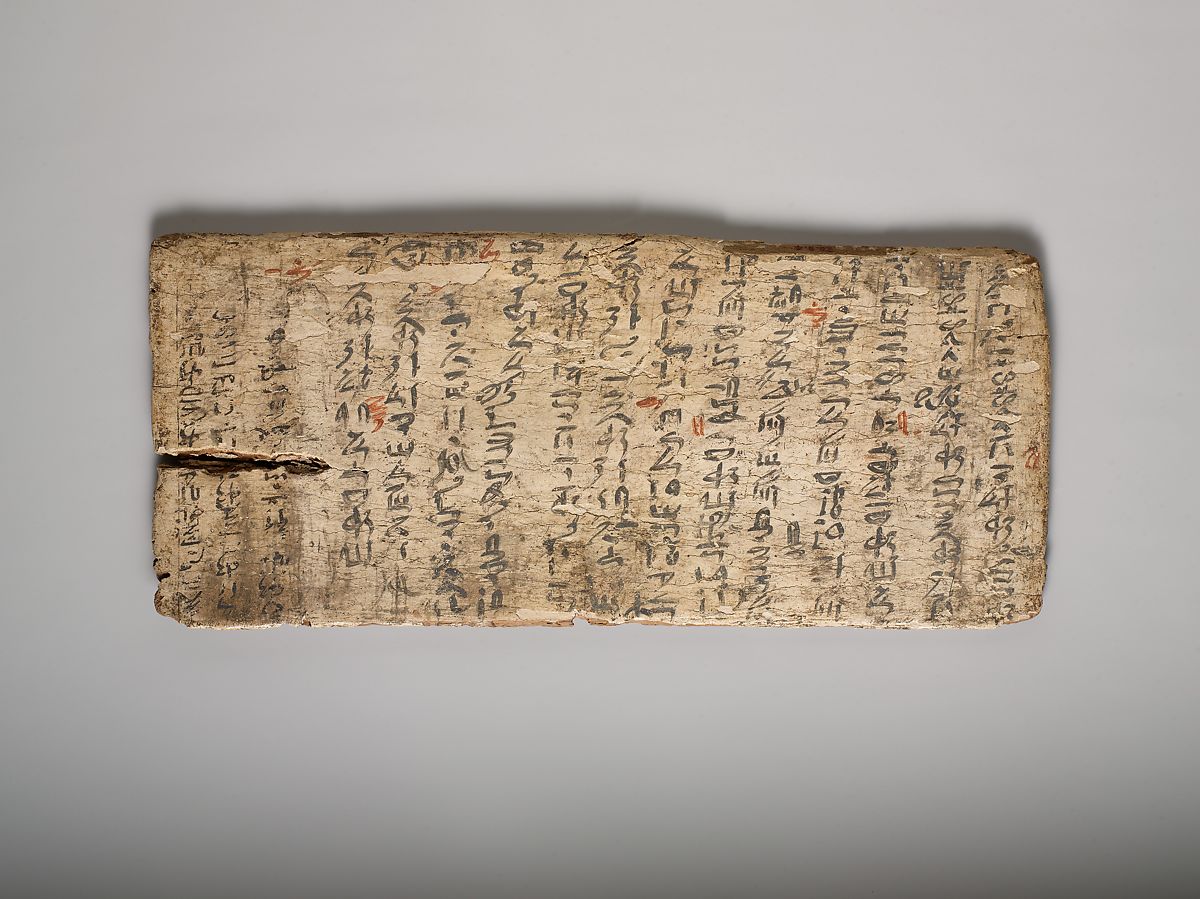
Americans raised on Laura Ingalls Wilder’s Little House books tend to associate slates with one room schoolhouses and rote exercises involving reading, writing and ‘rithmetic.
Had we been reared along the banks of the Nile, would our minds go to ancient gessoed boards like the 4000-year-old Middle Kingdom example above?
Like our familiar tablet-sized blackboards, this paper — or should we say papyrus? — saver was designed to be used again and again, with whitewash serving as a form of eraser.
As Egyptologist William C. Hayes, former Curator of Egyptian Art at the Metropolitan Museum wrote in The Scepter of Egypt: A Background for the Study of the Egyptian Antiquities in The Metropolitan Museum of Art. Vol. 1, From the Earliest Times to the End of the Middle Kingdom, the writing board at the top of the page:
…bears parts of two model letters of the very formal and ultra-poite variety addressed to a superior official. The writers consistently refer to themselves as “this servant” and to their addressees as “the Master (may he live, prosper, and be well.)” The longer letter was composed and written by a young man named Iny-su, son of Sekhsekh, who calls himself a “Servant of the Estate” and who, probably in jest, has used the name of his own brother, Peh-ny-su, as that of the distinguished addressee. Following a long-winded preamble, in which the gods of Thebes and adjacent towns are invoked in behalf of the recipient, we get down to the text of the letter and find that it concerns the delivery of various parts of a ship, probably a sacred barque. In spite of its formality and fine phraseology, the letter is riddled with misspellings and other mistakes which have been corrected in red ink, probably by the master scribe in charge of the class.
Iny-su would also have been expected to memorize the text he had copied out, a practice that carried forward to our one-room-schoolhouses, where children droned their way through texts from McGuffey’s Eclectic Readers.
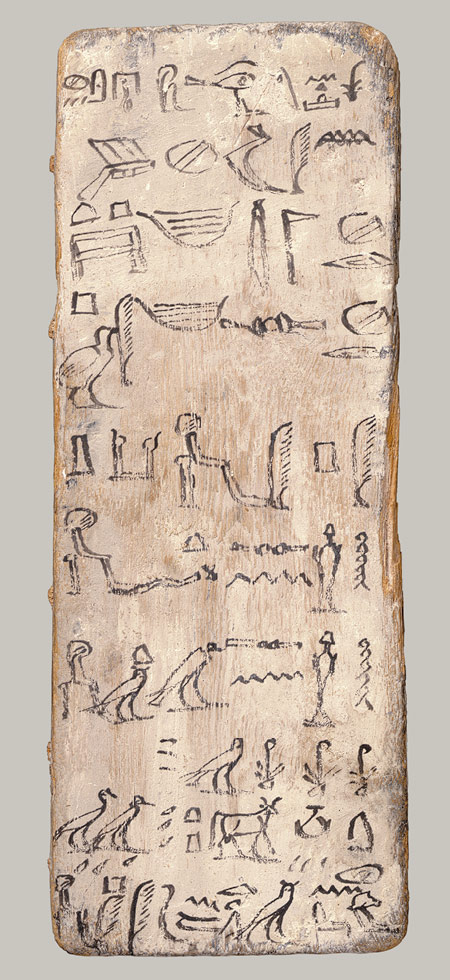
Another ancient Egyptian writing board in the Met’s collection finds an apprentice scribe fumbling with imperfectly formed, unevenly spaced hieroglyphs.
Fetch the whitewash and say it with me, class — practice makes perfect.
The first tablet inspired some lively discussion and more than a few punchlines on Reddit, where commenter The-Lord-Moccasin mused:
I remember reading somewhere that Egyptian students were taught to write by transcribing stories of the awful lives of the average peasants, to motivate and make them appreciate their education. Like “the farmer toils all day in the burning field, and prays he doesn’t feed the lions; the fisherman sits in fear on his boat as the crocodile lurks below.”
Always thought it sounded effective as hell.
We can’t verify it, but we second that emotion.
Note: The red markings on the image up top indicate where spelling mistakes were corrected by a teacher.
via @ddoniolvalcroze
Related Content:
What Ancient Egyptian Sounded Like & How We Know It
Ayun Halliday is an author, illustrator, theater maker and Chief Primatologist of the East Village Inky zine. Follow her @AyunHalliday.
Read More...Watch Preciously Rare Footage of Paul McCartney Recording “Blackbird” at Abbey Road Studios (1968)
Paul McCartney’s “Blackbird” competes with Lennon’s “Julia” as the most tender song on the Beatles’ White Album and maybe in the band’s entire catalogue. Inspired by a Bach piece that McCartney and George Harrison learned to play when they were young, its finger-picked acoustic guitar has the sound of a folk lullaby. But the song’s shifting time signatures and delicate melody make it something of a tricky one: recording sessions at Abbey Road involved a series of 32 takes, most of them false starts and only 11 complete. The version we hear on the album is the final take, finished while Lennon worked on “Revolution 9” in the studio next door.
You can see 1:33 of that session in the footage above, captured on 16mm by a film crew from Apple Records directed by Tony Bramwell, part of a 10-minute promo that also included footage of McCartney recording “Helter Skelter” and “various other scenes from inside the studio, in the Apple Boutique, Apple Tailoring, McCartney’s garden and other locations,” the Beatles Bible notes. It’s an ephemeral document of time passing peaceably during the grueling 5‑month White Album sessions, which for all their legendary tension and rancor, included many moments like these.
The three-day ordeal that was the recording of “Ob-La-Di, Ob-La-Da” (after which engineer Geoff Emerick quit) provides stark contrast, and maybe confirmation that the Beatles were at their best when they worked separately in 1968. The brief film above also confirms a more technical recording concern: the ticking we hear in the studio track is not a metronome, but Paul’s feet alternately tapping on the wood studio floor to measure out the bars of the complex song, which shifts between 3/4, 4/4, and 2/4 time. “Part of its structure is a particular harmonic thing between the melody and the bass line which intrigued me,” he remembered, and we see him striving to get it right.
After the Beatles, McCartney made “Blackbird” a regular part of his set, playing it at nearly every concert from 1975 on. It wasn’t only the beauty of the song that has moved him all these years, but its inspiration, the Civil Rights movement, which “all of us cared passionately about,” he said. “Blackbird” is “symbolic, so you could apply it to your particular problem,” but the song’s intended message, he said, was “from me to a black woman, experiencing these problems in the States: ‘Let me encourage you to keep trying, to keep your faith, there is hope.’”
Below you can watch McCartney talk about the story behind “Blackbird” in a 2005 production called Chaos & Creation at Abbey Road.
via Boing Boing
Related Content:
When the Beatles Refused to Play Before Segregated Audiences on Their First U.S. Tour (1964)
How “Strawberry Fields Forever” Contains “the Craziest Edit” in Beatles History
Hear the Beautiful Isolated Vocal Harmonies from the Beatles’ “Something”
Josh Jones is a writer and musician based in Durham, NC. Follow him at @jdmagness
Read More...Support Us
We're hoping to rely on loyal readers, rather than erratic ads. Please click the Donate button and support Open Culture. You can use Paypal, Venmo, Patreon, even Crypto! We thank you!

About Us

Open Culture scours the web for the best educational media. We find the free courses and audio books you need, the language lessons & educational videos you want, and plenty of enlightenment in between.
Advertise With Us
FREE UPDATES!
GET OUR DAILY EMAIL
Get the best cultural and educational resources on the web curated for you in a daily email. We never spam. Unsubscribe at any time.
FOLLOW ON SOCIAL MEDIA
Open Culture editor Dan Colman scours the web for the best educational media. He finds the free courses and audio books you need, the language lessons & movies you want, and plenty of enlightenment in between.
Advertise With Us

