Watch a Master Japanese Printmaker at Work: Two Unintentionally Relaxing ASMR Videos
Today we can appreciate Japanese woodblock prints from sizable online archives whenever we like, and even download them for ourselves. Before the internet, how many chances would we have had even to encounter such works of art in the course of life? Very few of us, certainly, would ever have beheld a Japanese printmaker at work, but here in the age of streaming video, we all can. In the Smithsonian video above, printmaker Keiji Shinohara demonstrates a suite of traditional techniques (and more specialized ones in a follow-up below) for creating ukiyo‑e, the “pictures of the floating world” whose style originally developed to capture Japanese life and landscapes of the 17th, 18th, and 19th centuries.
“So uh,” asks one commenter below this video of Shinohara at work, “anyone else come from unintentional ASMR?” That abbreviation, which stands for “autonomous sensory meridian response,” labels a genre of Youtube video that exploded in popularity in recent years.
Attempts have been made to define the underlying phenomenon scientifically, but suffice it to say that ASMR involves a set of distinctively pleasurable sounds that happens to coincide with those made by the tools of printmakers and other highly analog craftsmen. When ASMR enthusiasts discovered Youtube art conservator Julian Baumgartner, previously featured here on Open Culture, he created special sonically enhanced versions of his videos just for them.
In the case of Shinohara, the Best Unintentional ASMR channel has done it for him. Its version of his videos greatly emphasize the sounds of brushes rubbed against paper, inks spread onto wood, and droplets of water falling into the rinsing bowl. Of course, the original king of unintentional ASMR in art is universally acknowledged to be Bob Ross, host of The Joy of Painting, whose soft-spoken industriousness seems now to inhabit the person of David Bull, an English-Canadian ukiyo‑e printmaker living in Tokyo. In a sense, Bull is the Western counterpart to the Osaka-born Shinohara, who after a decade’s apprenticeship in Kyoto crossed the Pacific Ocean in the other direction to make his home in the United States. But however traditional their art, they both belong, now to the floating world of the internet. You can listen to non-ASMR versions of the videos above here and here.
Related Content:
Enter a Digital Archive of 213,000+ Beautiful Japanese Woodblock Prints
Download 2,500 Beautiful Woodblock Prints and Drawings by Japanese Masters (1600–1915)
Watch a Japanese Craftsman Lovingly Bring a Tattered Old Book Back to Near Mint Condition
Based in Seoul, Colin Marshall writes and broadcasts on cities, language, and culture. His projects include the Substack newsletter Books on Cities, the book The Stateless City: a Walk through 21st-Century Los Angeles and the video series The City in Cinema. Follow him on Twitter at @colinmarshall or on Facebook.
Read More...Indie Animation in a Corporate World: A Conversation with Animator Benjamin Goldman on Pretty Much Pop: A Culture Podcast #88
In the perennial conflict between art and our corporate entertainment machine, animation seems designed to be mechanized, given how labor-intensive it is, and yes, most of our animation comes aimed at children (or naughty adults) from a few behemoths (like, say, Disney).
Your hosts Mark Linsenmayer, Erica Spyres, and Brian Hirt are joined by Benjamin Goldman to discuss doing animation on your own, with only faint hope of “the cavalry” (e.g. Netfilx money or the Pixar fleet of animators) coming to help you realize (and distribute and generate revenue from) your vision. As an adult viewer, what are we looking for from this medium?
We talk about what exactly constitutes “indie,” shorts vs. features, how the image relates to the narration, realism or its avoidance, and more. Watch Benjamin’s film with Daniel Gamburg, “Eight Nights.”
Some of our other examples include Jérémy Clapin’s I Lost My Body and Skhizein, World of Tomorrow, If Anything Happens I Love You, The Opposites Game, Windup, Fritz the Cat, Spike & Mike’s Sick and Twisted Festival of Animation, and Image Union.
Hear a few lists and comments about this independent animation:
- Some history from Wikipedia
- “How Independent European Animation Is Taking on the US Studios” by Geoffrey Macnab
- “The 20 Best Indie Animation Features of the 2010s” by Vassilis Kroustallis
- “Oscars Predictions: Best Animated Short – Netflix’s Look at the Aftermath of School Shootings is the One to Beat” by Clayton Davis
- “Oscars Predictions: Best Animated Feature – Can Anything Beat ‘Soul’ at the Oscars?” by Clayton Davis
Follow Benjamin on Instagram @bgpictures. Here’s something he did for a major film studio that you might recognize, from the film version of A Series of Unfortunate Events:
Hear more of this podcast at prettymuchpop.com. This episode includes bonus discussion that you can access by supporting the podcast at patreon.com/prettymuchpop. This podcast is part of the Partially Examined Life podcast network.
Pretty Much Pop: A Culture Podcast is the first podcast curated by Open Culture. Browse all Pretty Much Pop posts.
Read More...The Story of Stalker, Andrei Tarkovsky’s Troubled (and Even Deadly) Sci-Fi Masterpiece
Andrei Tarkovsky is a popular filmmaker. This will come as a surprise to those who know the Soviet master mostly by his reputation as a maker of movies so poetic, serious, and deliberate of pace that they alter their viewers’ relationship to time itself. Yet Stalker, which ranks among his very most poetic, serious, and deliberate works, was, as of the recording of the video essay above by Youtuber CinemaTyler, the most streamed movie on the Criterion Channel. Not only that, but the essay itself, “Stalker (1979): The Sci-Fi Masterpiece That Killed Its Director,” has as of this writing racked up more than 1.6 million views.
As CinemaTyler’s most-seen episode, this Stalker exegesis outranks in popularity his analyses of classics like Blade Runner, North by Northwest, and Monty Python and the Holy Grail. It has also drawn more viewers than his many videos on the work of Stanley Kubrick, from The Shining and 2001: A Space Odyssey to Barry Lyndon and A Clockwork Orange. But for an auteur enthusiast of his kind, one can hardly begin discussing Kubrick without bringing up Tarkovsky, and vice versa. Some points of comparison are more obvious than others: CinemaTyler mentions Tarkovsky’s low opinion of 2001, which played a part in shaping the starkly different look and feel of his own first science-fiction picture Solaris.
There’s also a reference to “Kubrick/Tarkovsky,” a video essay previously featured here on Open Culture that catalogs the subtler visual resonances between their films. “Kubrick is one side of the brain,” as CinemaTyler puts it, “and Tarkovsky the other.” As much as they have in common on a deeper level, on the surface Kubrick and Tarkovsky’s oeuvres both oppose and complement each other. While Kubrick worked only in genres, Tarkovsky mostly eschewed them: Stalker, which came out seven years after Solaris, pulls sci-fi almost unrecognizably far into his own aesthetic territory.
This thrust Tarkovsky and his collaborators into their most arduous filmmaking effort yet: they had to execute complicated setups in real industrial wastelands, make several changes of cinematographer, and even shoot the entire movie twice after problems with the initial film stock. CinemaTyler recounts these difficulties and others, not ignoring the widely held suspicion that these poisonous locations ultimately caused the deaths of several of its creators, including Tarkovsky himself. Kubrick’s shoots were also notoriously difficult, of course, but none demanded quite the sacrifice Stalker did — and arguably, none produced quite an inexplicably compelling a cinematic experience.
You can pick up a copy of Stalker on Blu-ray.
Related Content:
Slavoj Žižek Explains the Artistry of Andrei Tarkovsky’s Films: Solaris, Stalker & More
Andrei Tarkovsky’s Masterpiece Stalker Gets Adapted into a Video Game
Tarkovsky’s Advice to Young Filmmakers: Sacrifice Yourself for Cinema
Based in Seoul, Colin Marshall writes and broadcasts on cities, language, and culture. His projects include the Substack newsletter Books on Cities, the book The Stateless City: a Walk through 21st-Century Los Angeles and the video series The City in Cinema. Follow him on Twitter at @colinmarshall or on Facebook.
Read More...The Letterform Archive Launches a New Online Archive of Graphic Design, Featuring 9,000 Hi-Fi Images
An online design museum made by and for designers? The concept seems obvious, but has taken decades in internet years for the reality to fully emerge in the Letterform Archive. Now that it has, we can see why. Good design may look simple, but no one should be fooled into thinking it’s easy. “After years of development and months of feedback,” write the creators of the Letterform Archive online design museum, “we’re opening up the Online Archive to everyone. This project is a labor of love from everyone on our staff, and many generous volunteers, and we hope it provides a source of beautiful distraction and inspiration to all who love letters.”
That’s letters as in fonts, not epistles, and there are thousands of them in the archive. But there are also thousands of photographs, lithographs, silkscreens, etc. representing the height of modern simplicity. This and other unifying threads run through the collection of the Letterform Archive, which offers “unprecedented access… with nearly 1,500 objects and 9,000 hi-fi images.”
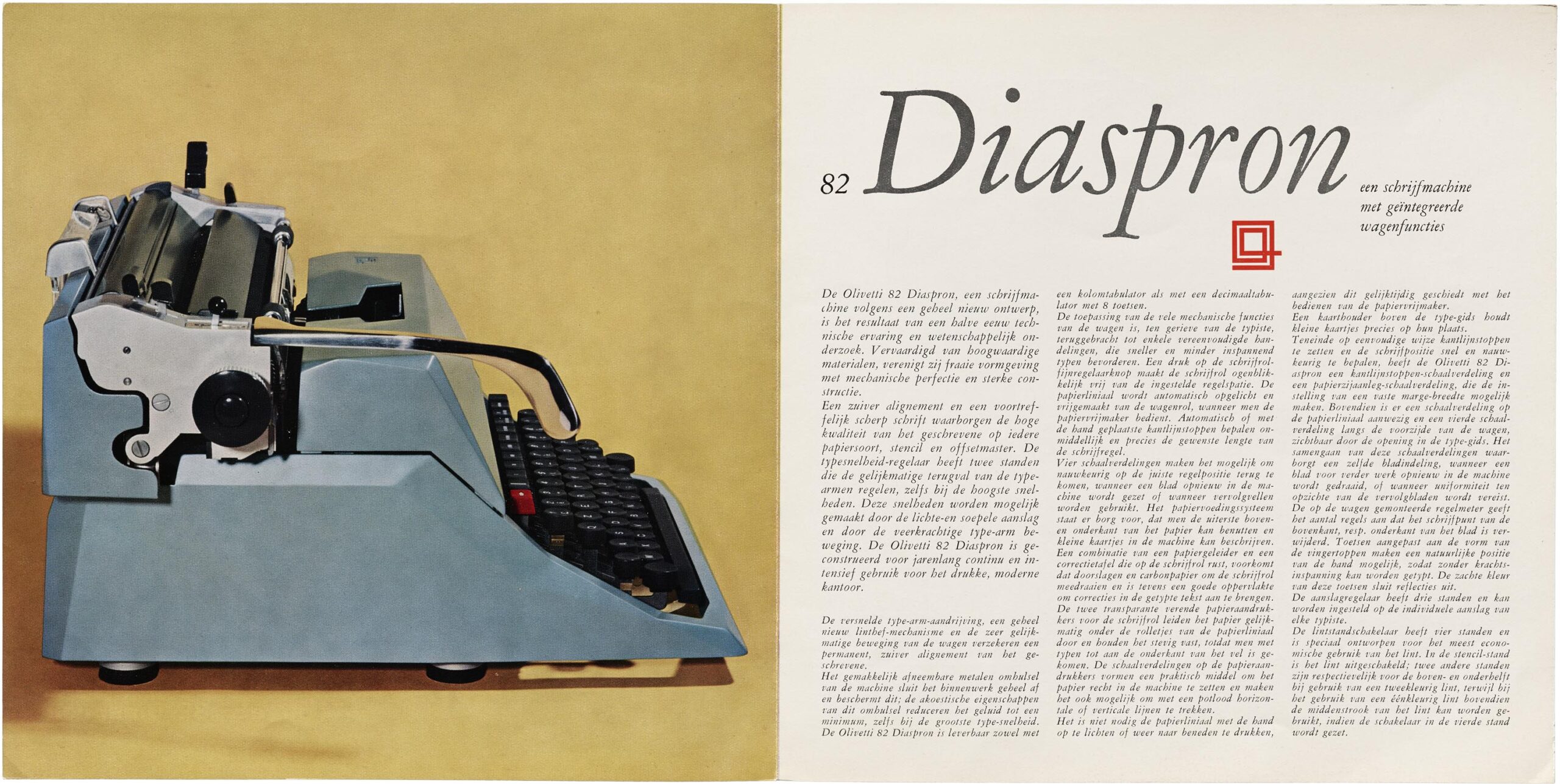
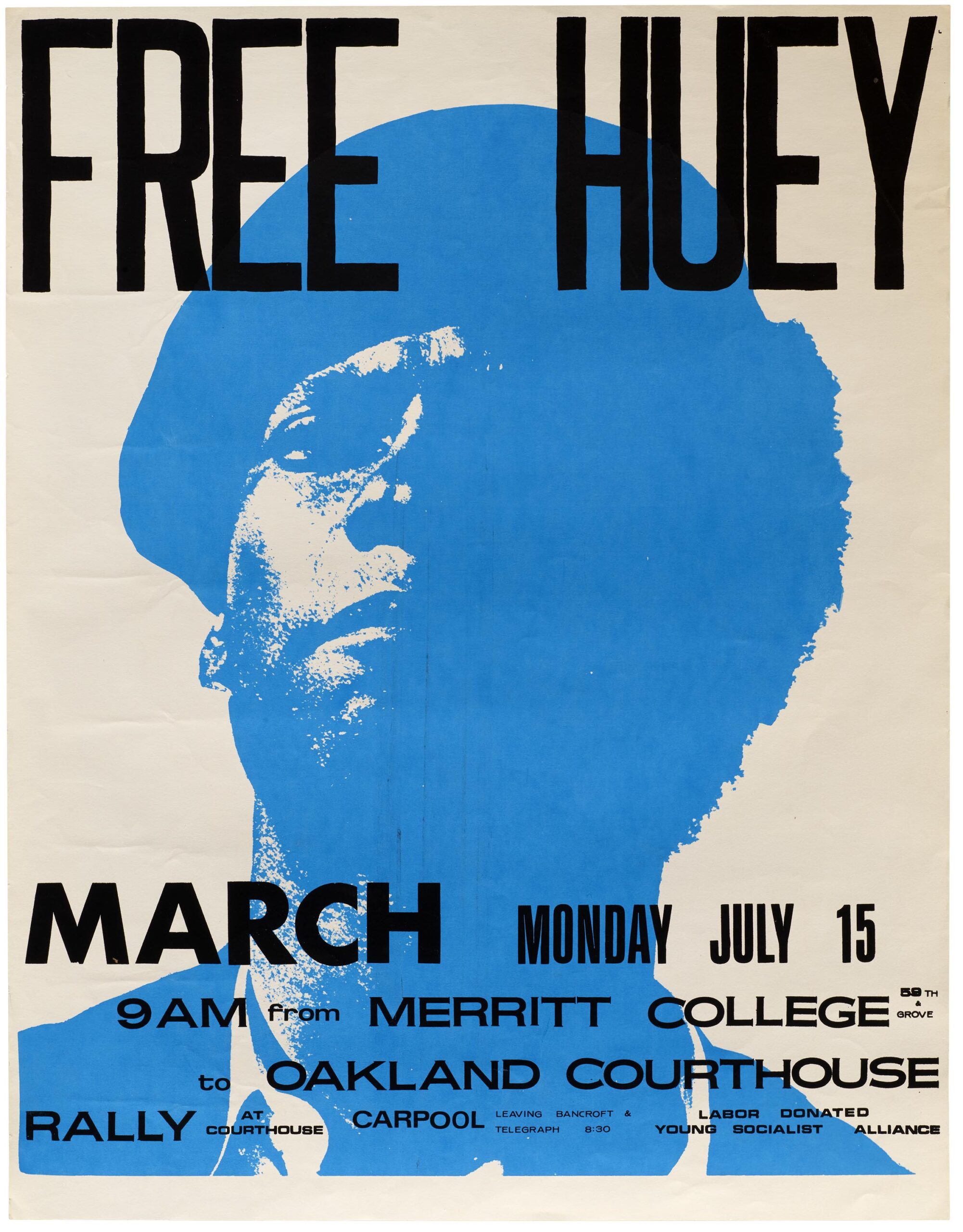
You’ll find in the Archive the sleek elegance of 1960s Olivetti catalogs, the iconic militancy of Emory Douglas’ designs for The Black Panther newspaper, and the eerily stark militancy of the “SILENCE=DEATH” t‑shirt from the 1980s AIDS crisis.

The site was built around the ideal of “radical accessibility,” with the aim of capturing “a sense of what it’s like to visit the Archive” (which lives permanently in San Francisco). But the focus is not on the casual onlooker — Letterform Archive online caters specifically to graphic designers, which makes its interface even simpler, more elegant, and easier to use for everyone, coincidentally (or not).
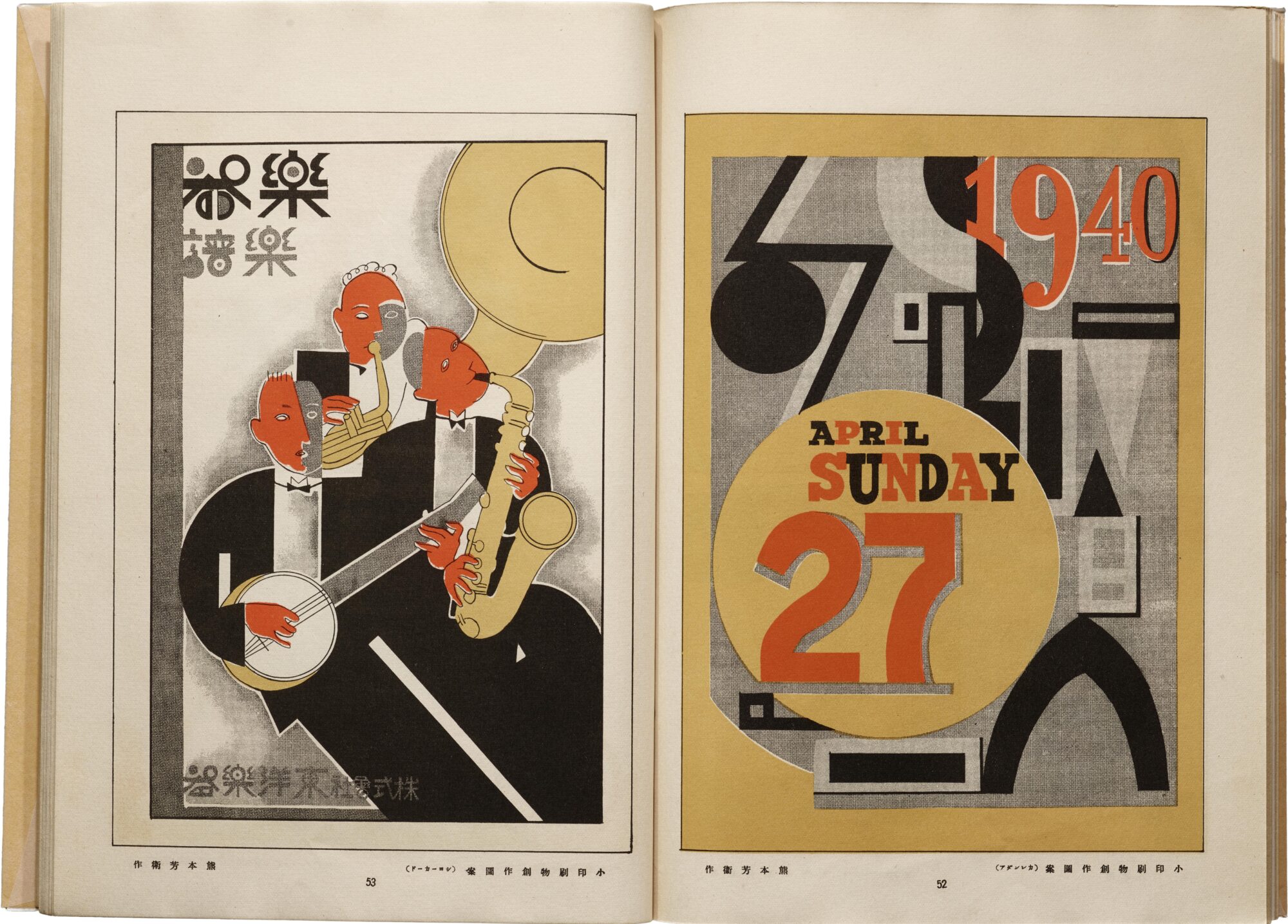
The graphic design focus also means there are functions specific to the discipline that designers won’t find in other online image libraries: “we encourage you to use the search filters: click on each category to explore disciplines like lettering, and formats like type specimens, or combine filters like decades and countries to narrow your view to a specific time and place.”
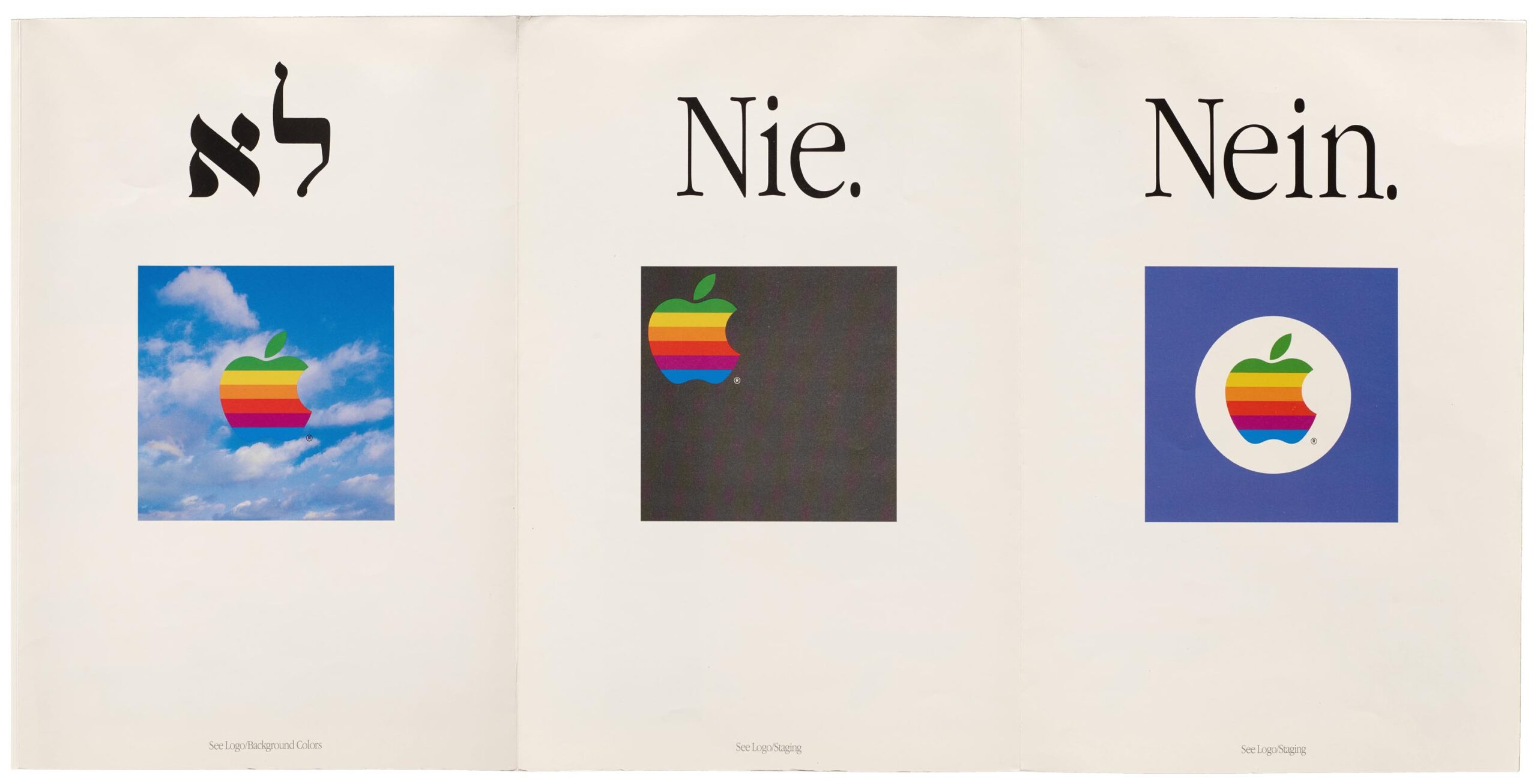
From the radical typography of Dada to the radical 60s zine scene to the sleek designs (and Neins) found in a 1987 Apple Logo Standards pamphlet, the museum has something for everyone interested in recent graphic design history and typology. But it’s not all sleek simplicity. There are also rare artifacts of elaborately intricate design, like the Persian Yusef and Zulaikha manuscript, below, dating from between 1880 and 1910. You’ll find dozens more such treasures in the Letterform Archive here.

Related Content:
Josh Jones is a writer and musician based in Durham, NC. Follow him at @jdmagness
Read More...A Long-Lost Soviet Adaptation of The Lord of the Rings Resurfaces on YouTube–and Tolkien Fans Rejoice (1991)
When Peter Jackson’s The Fellowship of the Ring came out in 2001, it heralded a cinematic adaptation of J.R.R. Tolkien’s Lord of the Rings trilogy that would, at long last, possess scale, production value, and sheer ambition enough to do justice to the original novels. This set it somewhat apart from the version of The Fellowship of the Ring that had aired just ten years before on Leningrad Television — and hasn’t been seen since, at least until its recent upload (in two parts) to Youtube. An unofficial adaptation, Khraniteli tells a story every single Tolkien reader around the world will recognize, even if they don’t understand unsubtitled Russian. The production’s appeal lies in any case not in its dialogue, but what we’ll call its look and feel.
“Featuring a score by Andrei Romanov of the rock band Akvarium and some incredibly cheap production design, no one is going to confuse this Lord of the Rings with Jackson’s films,” writes /Film’s Chris Evangelista. “The sets look like, well, sets, and the special effects — if you can call them that — are delightfully hokey. This appears to have had almost no budget, and that only lends to the charm.”
Despite its cheapness, Khraniteli displays exuberance on multiple levels, including its often-theatrical performances as well as visual effects, executed with the still-new video technology of the time, that oscillate between the hokily traditional and the nearly avant-garde. Some scenes, in fact, look not entirely dissimilar to those of Prospero’s Books, Peter Greenaway’s high-tech vision of Shakespeare that also premiered in 1991.
That year was the Soviet Union’s last, and the prolonged political shakeup that ensued could partially explain why Khraniteli went unseen for so long. Until now, obscurity-hunters have had to make do with The Fairytale Journey of Mr. Bilbo Baggins, The Hobbit (previously featured here on Open Culture), Leningrad Television’s earlier adaptation of Tolkien’s pre-Lord of the Rings children’s novel. It was the now long-gone Leningrad Television’s successor entity 5TV that just put the Soviet Fellowship of the Ring online — and in seemingly pristine condition at that — to the delight of global Tolkien enthusiasts who’d known only rumors of its existence. And as many of them have already found, for all the shortcomings, Khraniteli still has Tom Bombadil, for whose omission from his sprawling blockbusters Jackson will surely never hear the end.
Related Content:
The 1985 Soviet TV Adaptation of The Hobbit: Cheap and Yet Strangely Charming
Illustrations of The Lord of the Rings in Russian Iconography Style (1993)
Soviet-Era Illustrations Of J. R. R. Tolkien’s The Hobbit (1976)
The Lord of the Rings Mythology Explained in 10 Minutes, in Two Illustrated Videos
Based in Seoul, Colin Marshall writes and broadcasts on cities, language, and culture. His projects include the Substack newsletter Books on Cities, the book The Stateless City: a Walk through 21st-Century Los Angeles and the video series The City in Cinema. Follow him on Twitter at @colinmarshall or on Facebook.
Read More...AI Software Creates “New” Nirvana, Jimi Hendrix, Doors & Amy Winehouse Songs: Hear Tracks from the “Lost Tapes of the 27 Club”
What would pop music sound like now if the musicians of the 27 club had lived into maturity? Can we know where Amy Winehouse would have gone, musically, if she had taken another path? What if Hendrix’s influence over guitar heroics (and less obvious styles) came not only from his sixties playing but from an unimaginable late-career cosmic blues? Whether questions like these can ever be given real flesh and blood, so to speak, by artificial intelligence may still be very much undecided.
Of course, it may not be for us to decide. “The charts of 2046,” Mark Beaumont predicts at NME, “will be full of 12G code-pop songs, baffling to the human brain, written by banks of composerbots purely for the Spotify algorithm to recommend to its colonies of ÆPhone listening farms.” Seems as likely as any other future music scenario at this point. In the meantime, we still get to judge the successes, such as they are, of AI songwriters on human merits.
The Beatles-esque “Daddy’s Car,” the most notable computer-generated tribute song to date, was “composed by AI… capable of learning to mimic a band’s style from its entire database of songs.” The program produced a competent pastiche that nonetheless sounds like “cold computer psychedelia — eerie stuff.” What do we, as humans, make of Lost Tapes of the 27 Club, a compilation of songs composed in the style of musicians who infamously perished by suicide or overdose at the tender age of 27?
The “tapes” include four tracks designed to sound like lost songs from Hendrix, Winehouse, Nirvana, and the Doors. Highlighting a handful of artists who left us too soon in order to address “music’s mental health crisis,” the project used Magenta, the same Google AI as “Daddy’s Car,” to analyze the artists’ repertoires, as Rolling Stone explains:
For the Lost Tapes project, Magenta analyzed the artists’ songs as MIDI files, which works similarly to a player-piano scroll by translating pitch and rhythm into a digital code that can be fed through a synthesizer to recreate a song. After examining each artist’s note choices, rhythmic quirks, and preferences for harmony in the MIDI file, the computer creates new music that the staff could pore over to pick the best moments.
There is significant human input, such as the curation of 20 or 30 songs fed to the computer, broken down separately into different parts of the arrangement. Things did not always go smoothly. Kurt Cobain’s “loose and aggressive guitar playing gave Magenta some trouble,” writes Endgadget, “with the AI mostly outputting a wall of distortion instead of something akin to his signature melodies.”
Judge the end results for yourself in “Drowned by the Sun,” above. The music for all four songs is synthesized with MIDI files. “An artificial neural network was then used to generate the lyrics,” Eddie Fu writes at Consequence of Sound, “while the vocals were recorded by Eric Hogan, frontman of an Atlanta Nirvana tribute band.” Other songs feature different sound-alike vocalists (more or less). In no ways does the project claim that MIDI-generated computer files can replace actual musicians.
They’re affectionate tributes, made by players without hearts, but they don’t really tell us anything about what, say, Jim Morrison would have done if he hadn’t died at 27. Yet the cause is a noble one: a rejection of the romantic idea at the heart of the “27 Club” narrative — that mental illness, substance abuse, etc. should be glamorized in any way. “Lost Tapes of the 27 Club is the work of Over the Bridge,” notes Fu, “a Toronto organization that helps members of the music industry struggling with mental illness.” Learn more about the project here and about Over the Bridge’s programs here.
Related Content:
Artificial Intelligence Program Tries to Write a Beatles Song: Listen to “Daddy’s Car”
Josh Jones is a writer and musician based in Durham, NC. Follow him at @jdmagness
Read More...How Filippo Brunelleschi, Untrained in Architecture or Engineering, Built the World’s Largest Dome at the Dawn of the Renaissance
Sent back in time 600 years and tasked with building the world’s largest dome, how would most of us fare? Most of us, of course, are not trained architects or engineers, but then, neither was Filippo Brunelleschi. Known at the time as a goldsmith, Brunelleschi ended up winning the commission to build just such a colossal dome atop Florence’s Cattedrale di Santa Maria del Fiore, which itself had already been under construction for well over a century. The year was 1418, the dawn of the Italian Renaissance, but a break with medieval building styles had already been made, not least in the rejection of the kind of flying buttresses that had held up the stone ceilings of previous cathedrals. Brunelleschi had thus not just to build an unprecedentedly large dome, in accordance with a design drawn up 122 years earlier, but also to come up with the technology required to do so.
“He invented an ox-driven hoist that brought the tremendously heavy stones up to the level of construction,” architect David Wildman tells HowStuffWorks. Noticing that “marble for the project was being damaged as it was unloaded off of boats,” he also “invented an amphibious boat that could be used on land to transport the large pieces of marble to the cathedral.”
These and other new devices were employed in service of an ingenious structure using not just one dome but two, the smaller inner one reinforced with hoops of stone and chain. Built in brick — the formula for the concrete used in the Pantheon having been lost, like so much ancient Roman knowledge — the dome took sixteen years in total, which constituted the final stage of the Cattedrale di Santa Maria del Fiore’s generations-long construction.
Brunelleschi’s masterpiece, still the largest masonry dome in the world, has yet to quite yield all of its secrets: “There is still some mystery as to how all of the components of the dome connect with each other,” as Wildman puts it, thanks to Brunelleschi’s vigilance about concealing the nature of his techniques throughout the project. But you can see some of the current theories visualized (and, in a shamelessly fake Italian accent, hear them explained) in the National Geographic video at the top of the post. However he did it, Brunelleschi ensured that every part of his structure fit together perfectly — and that it would hold up six centuries later, when we can look at it and see not just an impressive church, but the beginning of the Renaissance itself.
To learn more, you can read Ross King’s 2013 book, Brunelleschi’s Dome: How a Renaissance Genius Reinvented Architecture.
Related Content:
The Life & Times of Buckminster Fuller’s Geodesic Dome: A Documentary
The History of Western Architecture: A Free Course Moving from Ancient Greece to Rococo
Free Course: An Introduction to the Art of the Italian Renaissance
The Wine Windows of Renaissance Florence Dispense Wine Safely Again During COVID-19
Based in Seoul, Colin Marshall writes and broadcasts on cities, language, and culture. His projects include the Substack newsletter Books on Cities, the book The Stateless City: a Walk through 21st-Century Los Angeles and the video series The City in Cinema. Follow him on Twitter at @colinmarshall or on Facebook.
Read More...Artist Makes Micro-Miniature Sculptures So Small They Fit on the Head of a Pin
The jury remains out as to the number of angels that can dance on a pin, but self-taught artist Flor Carvajal is amassing some data regarding the number of itty bitty sculptures that can be installed on the tips of matchsticks, pencil points, and — thanks to a rude encounter with a local reporter — in the eye of a needle.
According to Tucson’s Mini Time Machine Museum of Miniatures, where her work is on display through June, The Vanguardia Liberal was considering running an interview in conjunction with an exhibit of her Christmas-themed miniatures. When she wouldn’t go on record as to whether any of the itty-bitty nativity scenes she’d been crafting for over a decade could be described as the world’s smallest, the reporter hung up on her.
Rather than stew, she immediately started experimenting, switching from Styrofoam to synthetic resin in the pursuit of increasingly miniscule manger scenes.
By sunrise, she’d managed to place the Holy Family atop a lentil, a grain of rice, the head of a nail, and the head of a pin.

These days, most of her micro-miniature sculptures require between 2 and 14 days of work, though she has been laboring on a model of Apollo 11 for over a year, using only a magnifying glass and a needle, which doubles as brush and carving tool.
In a virtual artist’s chat last month, she emphasizes that a calm mind, steady hands, and breath control are important things to bring to her workbench.
Open windows can lead to natural disaster. The odds of recovering a work-in-progress that’s been knocked to the floor are close to nil, when said piece is rendered in 1/4” scale or smaller.
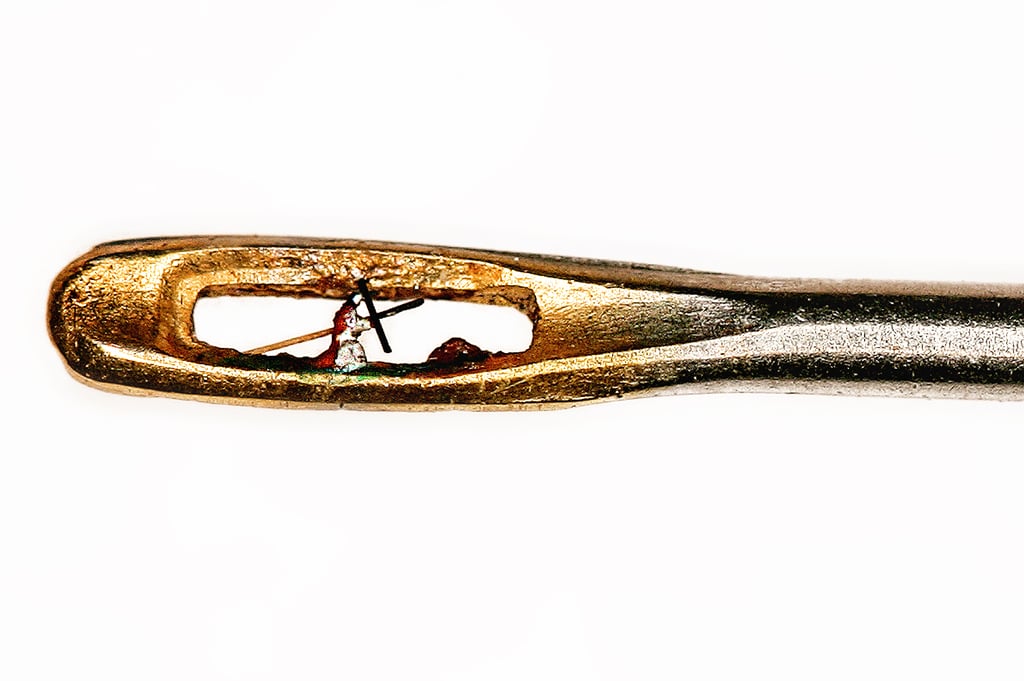
Religious themes provide ongoing inspiration — a recent achievement is a 26 x 20 millimeter recreation of Leonardo da Vinci’s Last Supper — but she’s also drawn to subjects relating to her native Columbia, like Goranchacha, the son the Muisca Civilization’s Sun God, and Juan Valdez, the fictional representative of the national coffee growers federation.

See more of Flor Carvajal’s micro-miniatures on her Instagram.
Related Content:
Cooking with Wool: Watch Mouthwatering Tiny Woolen Food Animations
The Gruesome Dollhouse Death Scenes That Reinvented Murder Investigations
Ayun Halliday is an author, illustrator, theater maker and Chief Primatologist of the East Village Inky zine. Follow her @AyunHalliday.
Read More...The World of Wong Kar-Wai: How the Films of Hong Kong’s Most Acclaimed Auteur Have Stayed Thrilling
I’ve just seen the future of cinema.” So declared the American film critic Peter Brunette after stumbling, “still dazed,” from a screening at the 1995 Toronto International Film festival. “Oh,” replied TIFF Cinémathèque programmer (and respected authority on Asian cinema) James Quandt. “You’re just coming from the Wong Kar-wai film?” Brunette includes this story in his monograph on Wong’s work, which was published in 2005. At that point, his pictures like Days of Being Wild, Chungking Express, and In the Mood for Love had already torn through global film culture, inspiring cinephiles and filmmakers alike to believe that an intoxicating range of cinematic possibilities still lay unexplored.
What’s more, they seemed to do it all of a sudden, having come out of nowhere. Of course, they came out of somewhere: Hong Kong, to be precise, a small but densely populated and economically mighty soon-to-be-former-colony whose distinctive cultural and industrial mixture produced a kind of modernity at once familiar and alien to beholders around the world.
Or at least it felt that way to those beholding it through Wong Kar-wai movies, which created their very own aesthetic world within the context of Hong Kong. That “neon-drenched” world in which “lonely souls drift around, desperately trying to make a meaningful connection, no matter how fleeting,” is the subject of the new BFI video essay at the top of the post.
As a part of Hong Kong’s “second new wave,” Wong found his cinematic voice by telling “highly atmospheric stories of restrained passion, using dazzling visuals, memorable songs, and unconventional narratives,” all the while “pushing the boundaries of Hong Kong genre cinema to create something fresh and inventive.” The West got its first big dose of it in 1994 through Chungking Express, whose worldwide release owed in part to the enthusiasm of Quentin Tarantino. In the clip above Tarantino does some enthusing about it and the rest of Wong’s oeuvre up to that point, which “has all that same energy that Hong Kong tends to bring to its cinema, but he’s also taking a cue from the French New Wave” — and especially Jean-Luc Godard, who showed how to “take genre pieces and break the rules.”
None of Wong’s films has made as much of an impact as 2000’s In the Mood for Love, the tale of a man and woman brought together — though not all the way together — by the fact that their spouses are cheating on them with each other. Evan Puschak, better known as the Nerdwriter, analyzes the movie’s power in the video essay “Frames within Frames.” Watching it, he says, “you can’t help but feel that you’re in the hands of somebody in complete control.” By restricting his cinematic language, Wong “echoes the restriction of action that plagues Mr. Chow and Mrs. Chan in 1960s Hong Kong.” The recent 20th-anniversary restoration of In the Mood for Love and those of Wong’s other work are even now being screened around the globe. Having caught one such screening just last night, I feel like I’ve seen the future of cinema again.
Note: The Criterion Collection now offers a Wong Kar-wai box set that features seven blu-rays, including 4k digital restorations of Chungking Express, In the Mood for Love, Happy Together and more. Find it here.
Related Content:
The Best 100 Movies of the 21st Century (So Far) Named by 177 Film Critics
Quentin Tarantino Picks the 12 Best Films of All Time; Watch Two of His Favorites Free Online
Based in Seoul, Colin Marshall writes and broadcasts on cities, language, and culture. His projects include the Substack newsletter Books on Cities, the book The Stateless City: a Walk through 21st-Century Los Angeles and the video series The City in Cinema. Follow him on Twitter at @colinmarshall or on Facebook.
Read More...Tina Turner Delivers a Blistering Live Performance of “Proud Mary” on Italian TV (1971)
John Fogerty once said that he conceived the opening bars of “Proud Mary” in imitation of Beethoven’s Fifth symphony. It’s an unusual association for a song about a steamboat, but it works as a classic blues rock hook. Most people would say, however, that the song didn’t truly come into its own until Tina Turner began covering it in 1969.
“Proud Mary” helped Turner come back after a suicide attempt the previous year. Her version, released as a single in January 1971, “planted the seeds of her liberation as both an artist and a woman,” Jason Heller writes at The Atlantic, bringing Ike and Tina major crossover success. Their version of the CCR song “rose to No.4 on Billboard’s pop chart, sold more than 1 million copies, and earned Turner the first of her 12 Grammy Awards.” See her, Ike, and the Ikettes perform it live on Italian TV, above.
It’s a sadly ironic part of her story that the success of “Proud Mary” also helped keep Turner in an abusive relationship with her musical partner and husband Ike for another five years until she finally left him in 1976. She spent the next several decades telling her story as she rose to international fame as a solo artist, in memoirs, interviews, and in the biopic What’s Love Got to Do With It.
The new HBO documentary, Tina, tells the story again but also includes Turner’s weary response to it. Asked in 1993 why she did not go see What’s Love Got to Do With It, Turner replied, “the story was actually written so that I would no longer have to discuss the issue. I don’t love that it’s always talked about… this constant reminder, it’s not so good. I’m not so happy about it.”
Like all musicians, Turner liked to talk about the music. “Proud Mary,” the second single from Ike and Tina’s Workin’ Together, came about when they heard an audition tape of the song, which they’d been covering on stage. “Ike said, ‘You know, I forgot all about that tune.’ And I said let’s do it, but let’s change it. So in the car Ike plays the guitar, we just sort of jam. And we just sort of broke into the black version of it.”
She may have given Ike credit for the idea, but the execution was all Tina (and the extraordinary Ikettes), and the song became a staple of her solo act for decades. Now, with Tina, it seems she may be leaving public life for good. “When do you stop being proud? How do you bow out slowly — just go away?” she says.
It’s a question she’s been asking with “Proud Mary” for half a century — onstage working day and night — a song, she said last year, that could be summed up in a single word, “Freedom.”
Related Content:
How Aretha Franklin Turned Otis Redding’s “Respect” Into a Civil Rights and Feminist Anthem
Watch the Earliest Known Footage of the Jimi Hendrix Experience (February, 1967)
Josh Jones is a writer and musician based in Durham, NC. Follow him at @jdmagness
Read More...Support Us
We're hoping to rely on loyal readers, rather than erratic ads. Please click the Donate button and support Open Culture. You can use Paypal, Venmo, Patreon, even Crypto! We thank you!

About Us

Open Culture scours the web for the best educational media. We find the free courses and audio books you need, the language lessons & educational videos you want, and plenty of enlightenment in between.
Advertise With Us
FREE UPDATES!
GET OUR DAILY EMAIL
Get the best cultural and educational resources on the web curated for you in a daily email. We never spam. Unsubscribe at any time.
FOLLOW ON SOCIAL MEDIA
Open Culture editor Dan Colman scours the web for the best educational media. He finds the free courses and audio books you need, the language lessons & movies you want, and plenty of enlightenment in between.
Advertise With Us

