David Chase Talks Sopranos for 90 Minutes on the Talking Sopranos Podcast
During the early days of the pandemic, the Talking Sopranos podcast (previously discussed on OC here) got underway. Hosted by Michael Imperioli (Christopher Moltisanti) and Steve Schirripa (Bobby Bacala), the podcast revisits every episode of HBO’s groundbreaking TV series. It starts naturally with the 1999 pilot and then moves forward sequentially. And each installment features a guest (usually an actor, writer, or director who contributed to the show), followed by a scene-by-scene breakdown of a complete Sopranos episode. (They covered the celebrated “Pine Barrens” episode a few weeks back.) Past guests have included Edie Falco, Aida Turturro, Steve Buscemi, Lorraine Bracco and more.
Now almost halfway through the entire series, Imperioli and Schirripa spent 90 minutes this week with Sopranos’ creator David Chase. In a rare interview (watch above), Chase talks about his creative ambitions for the show, the real people (friends and acquaintances) he modeled characters on, his sometimes friction-filled relationship with James Gandolfini, and the upcoming Sopranos film.
You can listen to Talking Sopranos on Apple, Spotify and Google, or watch all episodes on YouTube. And if you’d like to supplement all of this with more detail, get a copy of Matt Zoller Seitz and Alan Sepinwall’s book The Sopranos Sessions. It’s highly recommended.
If you would like to support the mission of Open Culture, consider making a donation to our site. It’s hard to rely 100% on ads, and your contributions will help us continue providing the best free cultural and educational materials to learners everywhere. You can contribute through PayPal, Patreon, and Venmo (@openculture). Thanks!
Related Content
How David Chase Breathed Life into the The Sopranos
David Chase Reveals the Philosophical Meaning of The Sopranos’ Final Scene
Read More...Carl Sagan on the Importance of Choosing Wisely What You Read (Even If You Read a Book a Week)
More than a few of us have a reading goal for 2021: a book a week, say. Some of us may have had the idea planted in our heads long ago by Carl Sagan, in his capacity as creator and host of the PBS series Cosmos: A Personal Voyage. “If I were to read a book a week for my entire adult lifetime,” he says in the clip above, “I would have read maybe a few thousand books. No more.” This is part of a longer monologue set in a library, a background that provides Sagan an ideal visual reference for how many volumes that is. Even seen as a portion of just the shelf space he stands by, it doesn’t look like a terribly impressive amount. Indeed, it makes up “only tenth of a percent or so of the total number of books in the library.”
The trick, Sagan adds, “is to know which books to read.” He himself got started addressing this question rather early, having drawn up an ambitious reading list previously featured here on Open Culture while still an undergraduate at the University of Chicago.
Sagan included (see the list here) everything from the Bible and Plato’s Republic to André Gide’s The Immoralist and Aldous Huxley’s Young Archimedes to Communication Circuit Fundamentals and Thermodynamics: An Advanced Treatment — those last being course readings, but impressive ones nevertheless. Though Sagan lived an abbreviated life, dying at the age of 62, we can rest assured that he nevertheless got his few thousand books in. Can we do the same?
To gear up for your reading year to come, consider watching this short documentary on the world’s most beautiful bookstores, which recommends daily reading habits that add up to surprisingly many books over a lifetime. But if you choose your books without discernment, as Sagan implies, it doesn’t matter how many you read. Before drawing up your own reading list, have a look at the ones other serious readers, writers, and thinkers have used before: Charles Darwin, for instance, or the many names in our personal reading-list roundup including Neil DeGrasse Tyson, Jorge Luis Borges, Patti Smith, Bill Gates, and David Bowie. Mark Twain also composed a reading list for kids and adults alike, but whatever we take from it, we should enter the new year with one of his famous aphorisms in mind: “The man who does not read good books has no advantage over the man who can’t read them.”
Related Content:
7 Tips for Reading More Books in a Year
100 Books to Read in a Lifetime
Based in Seoul, Colin Marshall writes and broadcasts on cities, language, and culture. His projects include the Substack newsletter Books on Cities, the book The Stateless City: a Walk through 21st-Century Los Angeles and the video series The City in Cinema. Follow him on Twitter at @colinmarshall, on Facebook, or on Instagram.
Read More...Octavia Butler’s Four Rules for Predicting the Future
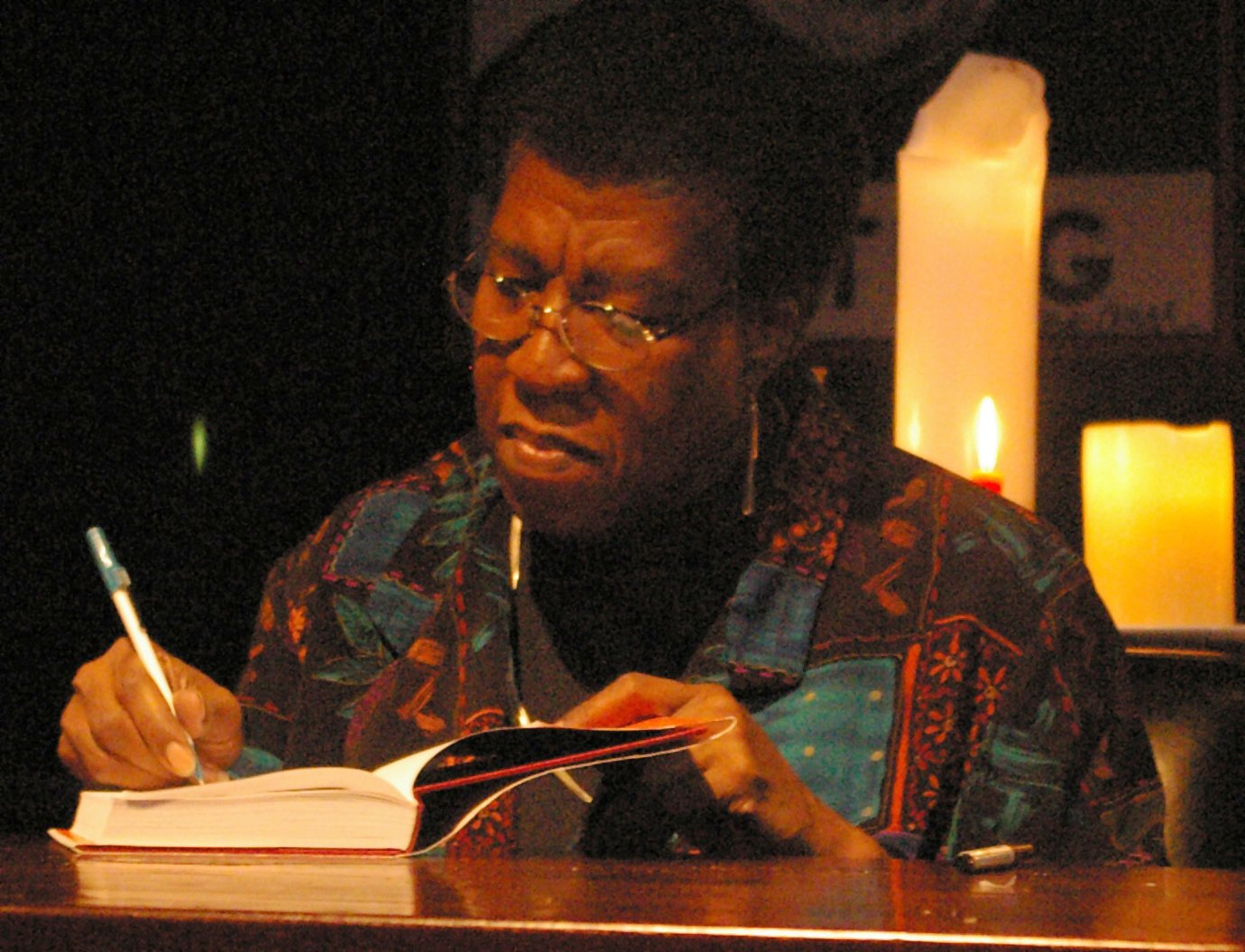
Image by Nikolas Coukouma, via Wikimedia Commons
If you, like me, often turn to science fiction to get more clarity about the present, past, and future, then you know you’re in good company with multiple-award-winning sci-fi author Octavia Butler. The novelist cast her gaze over it all, looking into the dark corners of American life and human behavior and drawing out stories that feel both shockingly new and familiar and true.
Sometimes Butler’s truths are hard to hear, especially when we’re living in the midst of a time she foresaw with such seeming accuracy thirty years ago in her Parable novels, two books meant to be the first parts of a trilogy about America’s greed, cruelty, and racism swallowing up its good intentions and inflated self-image.
Parable of the Sower and Parable of the Talents are, as Butler described them, “novels that take place in a near future of increasing drug addiction and illiteracy, marked by the popularity of prisons and the unpopularity of public schools, the vast and growing gap between the rich and everyone else, and the whole nasty family of problems brought on by global warming.”
These problems include the return of debt slavery, a particularly nasty strain of Christian nationalism, and a vague but devastating environmental collapse from which there is no return. But these are also novels about hope: about survival and adaptation and empathy. Butler may have invented the plots of her post-apocalyptic future, but “I didn’t make up the problems,” she once told a student.
Science fiction writers aren’t clairvoyant, they’re just better at making observations and speculations. “All I did was look around at the problems we’re neglecting now and give them about 30 years to grow into full-fledged disasters,” said Butler. A perspective that doesn’t also include the whole of human history is bound to miss the mark, she suggested:
Writing novels about the future doesn’t give me any special ability to foretell the future. But it does encourage me to use our past and present behaviors as guides to the kind of world we seem to be creating. The past, for example, is filled with repeating cycles of strength and weakness, wisdom and stupidity, empire and ashes. To study history is to study humanity. And to try to foretell the future without studying history is like trying to learn to read without bothering to learn the alphabet.
Butler goes on to discuss her method for predicting the future—so to speak—which anyone can learn to do with enough study and insight (that’s the hard part). Thom Dunn at Boing Boing has helpfully broken down her essay’s main points into four concise rules:
- Learn from the past
- Respect the law of consequences
- Be aware of your perspective
- Count on the surprises
You can read the full essay here and get to work on your own forecasting abilities. But in order to fully understand Butler’s project, it is essential never to despair. “The one thing that I and my main characters never do when contemplating the future is give up hope,” she writes. In answer to her student’s anguished question, if things are going to get so bad “what’s the answer?” Butler sagely replied, “there isn’t one…. There’s no magic bullet. Instead there are thousands of answers—at least. You can be one of them if you choose to be.”
via Boing Boing
Related Content:
Behold Octavia Butler’s Motivational Notes to Self
Why Should We Read Pioneering Sci-Fi Writer Octavia Butler? An Animated Video Makes the Case
Josh Jones is a writer and musician based in Durham, NC. Follow him at @jdmagness
Read More...Tune Into Tree.fm: An Online Radio Station That Streams the Soothing Sounds of Forests from Around the World

Image by Snežana Trifunović, via Wikimedia Commons
Walk into a forest. Stand perfectly still. Close your eyes. What do you hear? The sounds of birds, the rustling leaves, yes, yes…. But what’s that? And that? The forest is full of sounds you can’t identify! Curious sounds, far-away sounds, soothing sounds, sounds that are not the churning anxious wheels inside your head when you try to relax….
Experiencing ourselves around trees has several demonstrable benefits, as the science of forest bathing has taught us. Many of these have to do with visual, olfactory, and tactile pleasures. But we must not neglect the natural acoustic system all around us: an immersive experience in full 360-degree sound. Trees’ “vibratory energies reveal humanity’s many connections with forests,” writes David George Haskell at Scientific American.
Forests “are full of song.”
That’s all very well for people who can go outside. But if you’re locked down in a major city, say, or the office, or an ill-advised holiday gathering, and you feel cortisol levels rising, we’ve got you covered. Back in September, we featured Sounds of the Forest, a crowdsourced audio archive gathering sounds from forests all over the world. Now, these clips are streaming at Tree.fm, an online radio station for tree songs in stereo.
Streams rill, frogs hoot, birds caw and squawk in chorus. And then there are the trees, each species possessed of its own voice, Haskell writes:
Gusts of wind sonify plant diversity. Oak’s voice is coarse-grained, throaty; maple’s is sandy and light. These differences have their origins in plant evolution and adaptation. Drought-resistant oak leaves are thicker, tougher than the water-hungry maple. The different sounds of trees on a dry mountain ridge and in a moist forested hollow speak to the particularities of the ecology of each place. Ponderosa pine sings sweetly in the winds of California, its long needles were, John Muir wrote, “finest music” and a “free, wing-like hum”. But in Colorado, pines have evolved shorter, stiffer needles to cope with heavy loads of snow and ice. There, the trees wail as their wiry needles harrow the wind.
Tree.fm “is a tool that gives you instant access to the sounds of the world’s forests,” Beth Skwarecki writes at Lifehacker. Many of those sounds, like the forests that produced them, are endangered, not only from the usual suspects but also the noise pollution of highways and housing developments. Listen to forest songs on repeat or hit “listen to a random forest” and be “transported to Madagascar to listen to some lemurs, or to Ghana to hear some peacefully rushing water, or to Russia, where a bird I’ve never heard of puts on a vocal performance.” This is good medicine. Discover the forest songs that best soothe your nervous system or delight ears at Tree.fm.
Related Content:
Sounds of the Forest: A Free Audio Archive Gathers the Sounds of Forests from All Over the World
Free: Download the Sublime Sights & Sounds of Yellowstone National Park
How to Find Silence in a Noisy World
Josh Jones is a writer and musician based in Durham, NC. Follow him at @jdmagness
Read More...What Has the Internet Done to Comedy? A Pretty Much Pop Culture Podcast Discussion (#74)
Does removing gatekeepers mean a more distributed comic landscape, or does it inevitably end with a small number of comics dominating the world? The Internet means that people can and do judge comics based on very short clips, but also makes it easy to follow the activities of someone you discover that you like.
Tiffany comes not from stand-up but from music theater, and is active in creating character-based comedy and novelty songs for Instagram, YouTube, etc. She joins your hosts Erica Spyres, Mark Linsenmayer, and Brian Hirt to explore the types of short-form humor and viewing habits that grow out of video created for TikTok, Snapchat, and other platforms. What’s the creator’s relation to the audience? Social media blurs the line between constructed bits and extemporized commentary. It’s often reacting to current events, yet stays posted long after. “Going viral” is not typically the result of mere organic sharing or chance, and some comics (and their consultants) have really studied the medium to find out what appeals and how to get the word out.
We touch on Carmen Lynch, Sarah Cooper, Eva Victor, Bowen Yang, Coincidance, Miranda Sings, LockPickingLawyer, Jimmy Slonina, AskChickie, and more.
Watch Tiffany’s Fragile White Sadness. And her ode to Disney Plus. Our Long November has passed, thank goodness.
Tiffany also recommends Jen Tullock, Josh Ruben, Jordan Firstman, Megan Stalter, Cole Escola, Crawford Millham Horton, Benito Skinner, Inappropriate Patti, Advent Carolendar, and Marc Rebillet.
Read: “These Comedians Are Using TikTok to Create Some of the Internet’s Funniest (And Wokest) Content)” by Kat Curtis.
Hear more of this podcast at prettymuchpop.com. This episode includes bonus discussion you can access by supporting the podcast at patreon.com/prettymuchpop. This podcast is part of the Partially Examined Life podcast network.
Pretty Much Pop: A Culture Podcast is the first podcast curated by Open Culture. Browse all Pretty Much Pop posts.
Read More...Robert Fripp & Toyah Willcox Sing the Sex Pistols’ “Anarchy in the UK” While Dressed as Santa and Elf
Yes, 2020 sucked. But not completely, entirely and thoroughly. Enjoy this brief sunny moment, courtesy of Robert Fripp and Toyah Willcox.
If you visit their Sunday Lunch playlist, you can watch them have fun with other classics by Nirvana, Bowie, Alice Cooper, The Kinks and more. Enjoy.
If you would like to support the mission of Open Culture, consider making a donation to our site. It’s hard to rely 100% on ads, and your contributions will help us continue providing the best free cultural and educational materials to learners everywhere. You can contribute through PayPal, Patreon, and Venmo (@openculture). Thanks!
Related Content:
Derek Jarman’s Jubilee: “It’s the Best Film about Punk” (1978)
Read More...Bill Gates Picks 5 Good Books for a Lousy Year
2020 has been a terrible year. But that hasn’t stopped Bill Gates (as is his custom) from choosing, he says, “five books that I enjoyed—some because they helped me go deeper on a tough issue, others because they offered a welcome change of pace.”
Below, you can read, in his own words, the selections he published here.
Range: Why Generalists Triumph in a Specialized World, by David Epstein. I started following Epstein’s work after watching his fantastic 2014 TED talk on sports performance. In this fascinating book, he argues that although the world seems to demand more and more specialization—in your career, for example—what we actually need is more people “who start broad and embrace diverse experiences and perspectives while they progress.” His examples run from Roger Federer to Charles Darwin to Cold War-era experts on Soviet affairs. I think his ideas even help explain some of Microsoft’s success, because we hired people who had real breadth within their field and across domains. If you’re a generalist who has ever felt overshadowed by your specialist colleagues, this book is for you. More on the book here.
The New Jim Crow: Mass Incarceration in the Age of Colorblindness, by Michelle Alexander. Like many white people, I’ve tried to deepen my understanding of systemic racism in recent months. Alexander’s book offers an eye-opening look into how the criminal justice system unfairly targets communities of color, and especially Black communities. It’s especially good at explaining the history and the numbers behind mass incarceration. I was familiar with some of the data, but Alexander really helps put it in context. I finished the book more convinced than ever that we need a more just approach to sentencing and more investment in communities of color. More on the book here.
The Splendid and the Vile: A Saga of Churchill, Family, and Defiance During the Blitz, by Erik Larson. Sometimes history books end up feeling more relevant than their authors could have imagined. That’s the case with this brilliant account of the years 1940 and 1941, when English citizens spent almost every night huddled in basements and Tube stations as Germany tried to bomb them into submission. The fear and anxiety they felt—while much more severe than what we’re experiencing with COVID-19—sounded familiar. Larson gives you a vivid sense of what life was like for average citizens during this awful period, and he does a great job profiling some of the British leaders who saw them through the crisis, including Winston Churchill and his close advisers. Its scope is too narrow to be the only book you ever read on World War II, but it’s a great addition to the literature focused on that tragic period. More on the book here.
The Spy and the Traitor: The Greatest Espionage Story of the Cold War, by Ben Macintyre. This nonfiction account focuses on Oleg Gordievsky, a KGB officer who became a double agent for the British, and Aldrich Ames, the American turncoat who likely betrayed him. Macintyre’s retelling of their stories comes not only from Western sources (including Gordievsky himself) but also from the Russian perspective. It’s every bit as exciting as my favorite spy novels. More on the book here.
Breath from Salt: A Deadly Genetic Disease, a New Era in Science, and the Patients and Families Who Changed Medicine, by Bijal P. Trivedi. This book is truly uplifting. It documents a story of remarkable scientific innovation and how it has improved the lives of almost all cystic fibrosis patients and their families. This story is especially meaningful to me because I know families who’ve benefited from the new medicines described in this book. I suspect we’ll see many more books like this in the coming years, as biomedical miracles emerge from labs at an ever-greater pace. More on the book here.
If you would like to support the mission of Open Culture, consider making a donation to our site. It’s hard to rely 100% on ads, and your contributions will help us continue providing the best free cultural and educational materials to learners everywhere. You can contribute through PayPal, Patreon, and Venmo (@openculture). Thanks!
Related Content:
Take Big History: A Free Short Course on 13.8 Billion Years of History, Funded by Bill Gates
Bill Gates Recommends 5 Thought-Provoking Books to Read This Summer
Bill Gates Names His New Favorite Book of All Time
Read More...Peter Jackson Gives Us an Enticing Glimpse of His Upcoming Beatles Documentary The Beatles: Get Back
The legendary acrimony of the Beatles’ break-up comes through in Michael Lindsay-Hogg’s 1970 film Let it Be, which documents the recording of their last studio album and their famous rooftop sendoff concert, joined by keyboardist Billy Preston. Things got so tense that George Harrison left the band during the sessions. He later called them “the low of all time.” Lennon went further: “hell… the most miserable sessions on earth.”
Though some of the worst moments of those sessions were cut in editing, there’s no doubt Lindsay-Hogg built the film around studio drama instead of “the monotonies, the lackluster workaday yawns, of four people who know each other too well,” wrote Jonathan Cot and David Dalton in a 1970 Rolling Stone review. “We only get a few moments because with 300 hours of footage, only the highlights, the more dramatic scenes, and the funnier dialogue are shown.”
In the film, the band ends their last performance together with “Get Back,” then Lennon famously jokes, “I hope we’ve passed the audition.” Let it Be, Cott and Dalton revealed, was originally titled Get Back, the name Peter Jackson—yes that Peter Jackson—has chosen for his upcoming Beatles film, which will finally see the light next year, after the COVID delays that have slowed down every production.
Building on the archival and restoration skills he refined during the making of They Shall Not Grow Old, Jackson and his team have combed through those hundreds of hours of film, cutting together 56 hours of “never-before-seen footage,” notes Brenna Ehrlich at Rolling Stone. “The film promises to be ‘the ultimate ‘fly on the wall’ experience that Beatles fans have long dreamt about,’” as Jackson says. “We get to sit in the studio watching these four friends make great music together.”
The film will also “present a much sunnier vision of the Beatles’ breakup” and has been made with the full permission of surviving members Paul McCartney and Ringo Starr as well as Yoko Ono and George Harrison’s wife Olivia. As Starr put it, “There were hours and hours of us just laughing and playing music, not at all like the version that came out. There was a lot of joy and I think Peter will show that. I think this version will be a lot more peace and loving, like we really were.”
As if to prove the point, McCartney, who just dropped his latest album, McCartney III, tweeted out the five-minute clip above yesterday, in which Jackson introduces what he calls a “montage” from the film’s editing process so far. The vivid lifelikeness of the images is a result of Jackson’s digital processing, and it does not seem intrusive. What stands out most of all is the joy the band clearly still took in each other’s company, “just laughing and playing music,” as Ringo remembered. Get Back is slated for release in theaters on August, 2021.
Related Content:
When the Beatles Refused to Play Before Segregated Audiences on Their First U.S. Tour (1964)
How “Strawberry Fields Forever” Contains “the Craziest Edit” in Beatles History
Josh Jones is a writer and musician based in Durham, NC. Follow him at @jdmagness
Read More...Why David Sedaris Hates “The Santaland Diaries,” the NPR Piece that Made Him Famous
This past fall David Sedaris published his first full-fledged anthology, The Best of Me. It includes “Six to Eight Black Men,” his story about bewildering encounters with European Christmas folktales, but not “The Santaland Diaries,” which launched him straight into popular culture when he read it aloud on National Public Radio’s Morning Edition in 1992. True to its title, that piece is drawn from entries in his diary (the rigorous keeping of which is the core of his writing process) made while employed as one of Santa’s elves at Macy’s Herald Square in New York. Not only was the subject seasonally appropriate, Sedaris captured the varieties of seething resentment felt at one time or another — not least around Christmas — by customer-service workers in America.
According to a Macy’s executive who worked at Herald Square at the time, Sedaris made an “outstanding elf.” (So the New Republic’s Alex Heard discovered when attempting to fact-check Sedaris’ work.) Whether or not he has fond memories of his time in “green velvet knickers, a forest-green velvet smock and a perky little hat decorated with spangles,” he holds “The Santaland Diaries” itself in no regard whatsoever. “I’m grateful that I wrote something that people enjoyed, but because it was my choice what went into this book, I was so happy to exclude it,” he says in an interview with WBUR about The Best of Me. “I wanted its feelings to be hurt.”
Over the past 28 years he has seized numerous opportunities to disparage the piece that made him famous.“I have no idea why that went over the way that it did,” Sedaris once admitted to Publisher’s Weekly. “There are about two early things I’ve written that I could go back and read again, and that’s not one of them.” And by the time of that first Morning Edition broadcast, he had already been keeping his diary every day for fifteen years. “When you first start writing, you’re going to suck,” he says in the Atlantic video just below. In his first years writing, he says, “I was sitting at the International House of Pancakes in Raleigh, North Carolina with a beret screwed to my head,” and the result was “the writing you would expect from that person.”
Since then Sedaris’ dress has become more eccentric, but his writing has improved immeasurably. “I want to be better at what I do,” said Sedaris in a recent interview with the Colorado Springs Independent. “It’s just something that I personally strive for. Which is silly, because most people can’t even recognize that. People will say, ‘Oh, I loved that Santaland thing.’ And that thing is so clunkily written. I mean, it’s just horribly written, and people can’t even see it.” Much of the audience may be “listening to the story, but they’re not paying attention to how it’s constructed, or they’re not paying attention to the words that you used. They’re not hearing the craft of it.” But if you listen to “The Santaland Diaries” today, you may well hear what Ira Glass did when he and Sedaris originally recorded it.
As a young freelance radio producer who had yet to create This American Life, Glass first saw the thoroughly non-famous Sedaris when he read from his diary onstage at a Chicago club. Glass knew instinctively that Sedaris’ distinctive voice as both writer and reader would play well on the radio, as would his even more distinctive sense of humor. But it wasn’t until a few years later, when he called on Sedaris to record a holiday-themed segment for Morning Edition, that Glass understood just what kind of talent he’d discovered. “I remember we got to the part where you sing like Billie Holiday,” Glass told Sedaris in an interview marking the 25th anniversary of “The Santaland Diaries.” “I was a pretty experienced radio producer at that point, and I was like, ‘This is a good one.’ ”
Related Content:
20 Free Essays & Stories by David Sedaris: A Sampling of His Inimitable Humor
David Sedaris Creates a List of His 10 Favorite Jazz Tracks: Stream Them Online
Why David Sedaris Hates America’s Favorite Word, “Awesome”
Based in Seoul, Colin Marshall writes and broadcasts on cities, language, and culture. His projects include the Substack newsletter Books on Cities, the book The Stateless City: a Walk through 21st-Century Los Angeles and the video series The City in Cinema. Follow him on Twitter at @colinmarshall, on Facebook, or on Instagram.
Read More...The UN’s World Happiness Report Ranks “Socialist Friendly” Countries like Finland, Norway, Denmark, Iceland & Sweden as Among the Happiest in the World
One of the most pernicious, “dangerous, anti-human and soul-crushing” myths in the business world, writes Liz Ryan at Forbes, is the “idiotic nostrum” that has also crept into government and charitable work: “If you can’t measure it, you can’t manage it.” The received wisdom is sometimes phrased more cynically as “if you can’t measure it, it didn’t happen,” or more positively as “if you can’t measure it, you can’t improve it.”
But “the important stuff can’t be measured,” says Ryan. Don’t we all want to believe that? “Can’t Buy Me Love” and so forth. Maybe it’s not that simple, either. Take happiness, for example. We might say we disagree about its relative importance, but we all go about the business of trying to buy happiness anyway. In our hearts of hearts, it’s a more or less an unquestionable good. So why does it seem so scarce and seem to cost so much? Maybe the problem is not that happiness can’t be measured but that it can’t be commodified.
Buddhist economies like Bhutan, for example, run on a GHI (Gross National Happiness) index instead of GDP, and pose the question of whether the issue of national happiness is one of priorities. In other words, “you get what you measure.” In March, Laura Begley Bloom cited the 20 happiest countries in the world at Forbes, using the UN’s 2020 World Happiness Report, “a landmark survey of the state of global happiness,” as the report’s website describes it, “that ranks 156 countries by how happy their citizens perceive themselves to be.”

Happiness is measured across urban and rural environments and according to environmental quality and sustainable development metrics. The report uses six rubrics to assess happiness—levels of GDP, life expectancy, generosity, social support, freedom and corruption, and income. Their assessment relied on self-reporting, to give “a direct voice to the population as opposed the more top-down approach of deciding ex-ante what ought to matter.” The last chapter attempts to account for the so-called “Nordic Exception,” or the puzzling fact that “Nordic countries are constantly among the happiest in the world.”
Maybe this fact is only puzzling if you begin with the assumption that wealthy capitalist economies promote happiness. But the top ten happiest countries are wealthy “socialist friendly” mixed economies, as Bill Maher jokes in the clip at the top, saying that in the U.S. “the right has a hard time understanding we don’t want long lines for bread socialism, we want that you don’t have to win the lotto to afford brain surgery socialism.” This is comedy, not trenchant geo-political analysis, but it alludes to another significant fact.
Most of the world’s unhappiest countries and cities are formerly colonized places whose economies, infrastructures, and supply chains have been destabilized by sanctions (which cause long bread lines), bombed out of existence by wealthier countries, and destroyed by climate catastrophes. The report does not fully explore the meaning of this data, focusing, understandably, on what makes populations happy. But an underlying theme is the suggestion that happiness is something we achieve in real, measurable economic relation with each other, not solely in the pursuit of individualist ideals.
Related Content:
How Much Money Do You Need to Be Happy? A New Study Gives Us Some Exact Figures
Josh Jones is a writer and musician based in Durham, NC. Follow him at @jdmagness
Read More...Support Us
We're hoping to rely on loyal readers, rather than erratic ads. Please click the Donate button and support Open Culture. You can use Paypal, Venmo, Patreon, even Crypto! We thank you!

About Us

Open Culture scours the web for the best educational media. We find the free courses and audio books you need, the language lessons & educational videos you want, and plenty of enlightenment in between.
Advertise With Us
FREE UPDATES!
GET OUR DAILY EMAIL
Get the best cultural and educational resources on the web curated for you in a daily email. We never spam. Unsubscribe at any time.
FOLLOW ON SOCIAL MEDIA
Open Culture editor Dan Colman scours the web for the best educational media. He finds the free courses and audio books you need, the language lessons & movies you want, and plenty of enlightenment in between.
Advertise With Us



