The Blob Opera Lets You Create Festive Music with Ease: An Interactive Experiment Powered by Machine Learning
Tis the season when we’re never more than one singalong Messiah away from wishing we had a better voice.
David Li’s interactive Blob Opera allows us to pretend.
The machine learning experiment takes its cues from four opera singers—soprano Olivia Doutney, mezzo-soprano Joanna Gamble, tenor Christian Joel, and bass Freddie Tong—who provided it with 16 hours of recorded material.
The result is truly an all-ages activity that’s much easier on the ears than most digital diversions.
Click and drag one of the gummy-bodied blobs up and down to change its pitch.
Pull them forwards and backwards to vary their vowel sounds.
Once all four are in position, the three you’re not actively controlling will harmonize like a heavenly host.
You can disable individual blobs’ audio to create solos, duets and trios within your composition.
Press record and you can share with the world.
The blobs don’t sing in any discernible language, but they can do legato, staccato, and shoot up to incredibly high notes with a minimum of effort. Their eyes pinwheel when they harmonize.
As Li describes to co-producer Google Arts & Culture below, it’s not the original singers’ voices we’re channeling, but rather the machine learning model’s understanding of the operatic sound.
Click the pine tree icon and the blobs will serenade you with the most-searched Christmas carols.
Begin your collaboration with Blob Opera here.
If you find yourself wanting more, have a go at the interactive Choir Li created for Adult Swim.
Related Content:
The Met Opera Streaming Free Operas Online to Get You Through COVID-19
The Opera Database: Find Scores, Libretti & Synopses for Thousands of Operas Free Online
Ayun Halliday is an author, illustrator, theater maker and Chief Primatologist of the East Village Inky zine. She most recently appeared as a French Canadian bear who travels to New York City in search of food and meaning in Greg Kotis’ short film, L’Ourse. Follow her @AyunHalliday.
Read More...Brian Cullman, Veteran NY Music Scenester/Journalist/Producer, Shares His Tunes and Musings About Death: Nakedly Examined Music Podcast #137
 Brian started as a teen music enthusiast and journalist as early as 1970, running into folks like Jim Morrison and Nico and making connections with every musician he could lay eyes on. He leveraged this effort into finding vehicles for his songs, first with OK Savant (ca. 1990), a band that frequented CBGBs and then broke up right as it was signed to a major label. After some false starts and life changes, he likewise used his network to support his creation of three and half solo albums starting in 2008. He has also been an active producer and collaborator for artists like Ollabelle, Lucinda Williams & Taj Mahal, and several international musicians.
Each episode of the Nakedly Examined Music podcast involves picking three recordings from an artist’s catalog to play in full and discuss in detail. Your host Mark Linsenmayer here engages Brian about “Killing The Dead” (and we listen to “Wrong Birthday” at the end; see the video below) from Winter Clothes (2020, written with now-deceased Ollabelle guitarist Jimi Zhivago), “And She Said” from The Opposite of Time (2016), and “The Promise” from All Fires The Fire (2008). Intro: “The Book of Sleep” by OK Savant, recorded live at CBGBs in 1990. For more, see briancullman.com.
Watch Brian live (with Jimi Zhivago and others) in 2016. Another new, colorfully animated video is for the bluesy “Walk the Dog Before I Sleep.” One from his previous album is “Everything That Rises.” Hear the full, remastered recording of “The Book of Sleep.” Hear the song he wrong for Nick Drake (whom he opened for in 1970). Hear one of the tunes he did for Rua Das Pretas.
The bass player on Brian’s albums is Byron Isaacs (also of Ollabelle), whom Nakedly Examined Music interviewed for episode #82.
This episode includes bonus discussion and another song, available to Nakedly Examined Music Patreon supporters.
Photo by Bill Flicker.
Nakedly Examined Music is a podcast hosted by Mark Linsenmayer, who also hosts The Partially Examined Life Philosophy Podcast and Pretty Much Pop: A Culture Podcast. He releases music under the name Mark Lint.
Read More...Hokusai’s Iconic Print, “The Great Wave off Kanagawa,” Recreated with 50,000 LEGO Bricks

For those with the time, skill, and drive, LEGO is the perfect medium for wildly impressive recreations of iconic structures, like the Taj Mahal, Eiffel Tower, the Titanic and now the Roman Colosseum.
But water? A wave?
And not just any wave, but Katsushika Hokusai’s celebrated 19th-century woodblock print, The Great Wave off Kanagawa.
As Open Culture’s Colin Marshall pointed out earlier, you might not know the title, but the image is instantly recognizable.
Artist Jumpei Mitsui, the world’s youngest LEGO Certified Professional, was undeterred by the thought of tackling such a dynamic and well known subject.

While other LEGO enthusiasts have created excellent facsimiles of famous artworks, doing justice to the curves and implied motion of The Great Wave seems a nearly impossible feat.
Having spent his childhood in a house by the sea, waves are a familiar presence to Mitsui. To get a better sense of how they work, he read several scientific papers and spent four hours studying wave videos on YouTube.
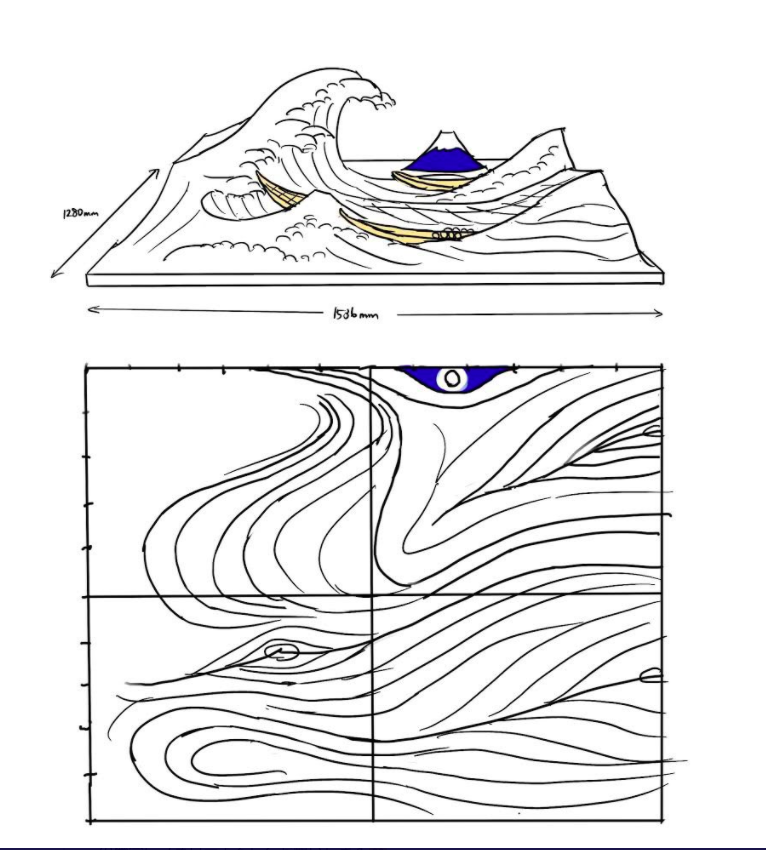
He made only one preparatory sketch before beginning the build, an effort that required 50,000 some LEGO pieces.
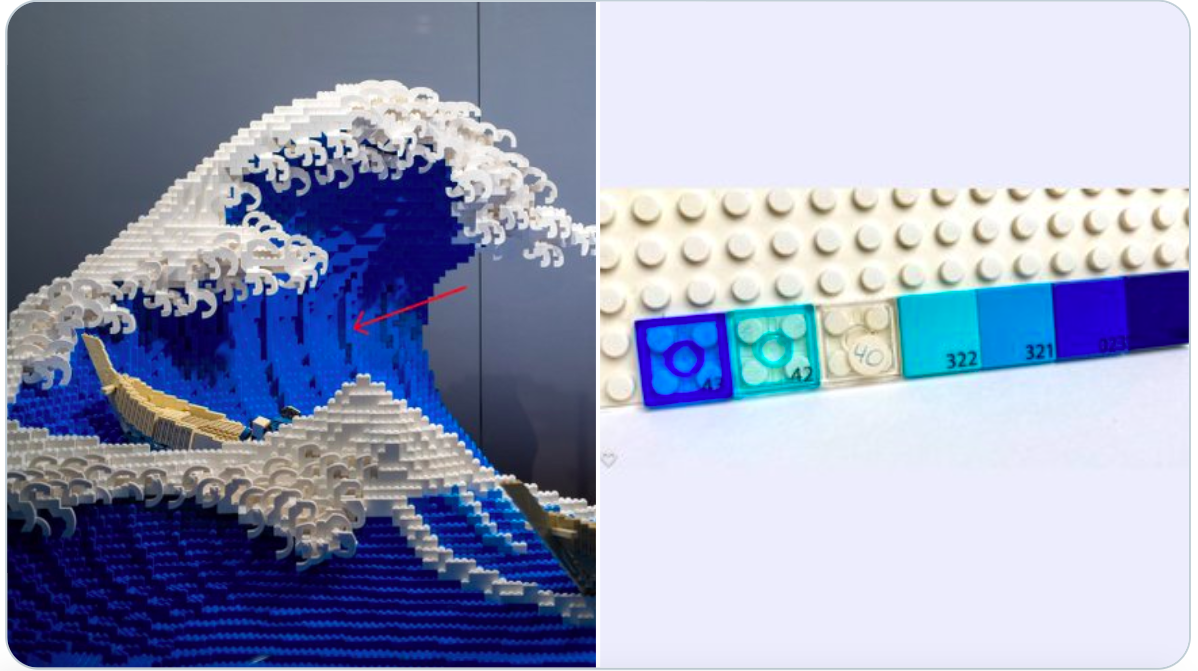
His biggest hurdle was choosing which color bricks to use in the area indicated by the red arrow in the photo below. Hokusai had taken advantage of the newly affordable Berlin blue pigment in the original.
Mitsui tweeted:
I tried a total of 7 colors including transparent parts, but in the end, I adopted the same blue color as the waves. If you use other colors, the lines will be overemphasized and unnatural, but if you use blue, the shade will be created just by adjusting the light, and the natural lines will appear nicely. It can be said that it was possible because it was made three-dimensional.
Jumpei Mitsui’s wave is now on permanent view at Osaka’s Hankyu Brick Museum.
via Spoon and Tamago and Colossal
Related Content:
The Frank Lloyd Wright Lego Set
With 9,036 Pieces, the Roman Colosseum Is the Largest Lego Set Ever
Why Did LEGO Become a Media Empire? Pretty Much Pop: A Culture Podcast #37
Ayun Halliday is an author, illustrator, theater maker and Chief Primatologist of the East Village Inky zine. She most recently appeared as a French Canadian bear who travels to New York City in search of food and meaning in Greg Kotis’ short film, L’Ourse. Follow her @AyunHalliday.
Read More...How Do Vaccines (Including the COVID-19 Vaccines) Work?: Watch Animated Introductions
The other day, I found myself reading about what life is like in countries that have successfully minimized the pandemic: worry free holidays, meeting friends and family without the danger of infection, a general air of normalcy thanks to a combination of rigorous public health efforts and public cooperation. I live in the U.S., where the political party currently in power (and desperate to keep it) convinced millions of my fellow citizens that the virus was a hoax, a scam, a political ploy. The reality of a virus-free existence seems like a fairy tale.
But perhaps, after a year of death, suffering, and lunacy, we will begin to see the tide turn once enough people get vaccinated… if we can overcome the massive wave of anti-science bias and disinformation about vaccines…. “The anti-vaccination movement is going to make Covid-19 more difficult to get under control,” says Scott Ratzan, distinguished lecturer at the CUNY Graduate School of Public Health and Health Policy.
Long before the vaccine arrived, Katherine O’Brien, a director at WHO, noted there was already a prominent “anti-vaccination voice” on social media. “We have to take this seriously,” she told The BMJ. “Vaccination isn’t just an individual choice; it protects those who can’t be vaccinated.” We’ve seen the term “herd immunity” misused a lot lately. What it essentially means is that a small number of people can be shielded from the virus if the vast majority get vaccinated. Or as WHO puts it, “herd immunity is achieved by protecting people from a virus, not by exposing them to it.”
All of this means there will likely never be a more critical moment to educate ourselves and others on the science of vaccines. We may not sway those faithful to a certain narrative, but it can help shift the conversation from fears of the unknown to the long history of the known when it comes to eradicating highly infectious, deadly diseases. A great way to start is with the basics, which you’ll find in the videos above from TED-Ed, Mechanisms of Medicine, and PBS. Watch them yourself, share them on social media, and keep the conversation about vaccines’ efficacy going.
In the TED-Ed lesson just above, we learn some more specific information about the key phases of developing a new vaccine: exploratory research, clinical testing, and manufacturing. You’ll find much more detailed information on the history of vaccines, spurious anti-vaccination claims, and the coronavirus vaccines now on the market and currently shipping around the world, at the award-winning site, The History of Vaccines, from the College of Physicians of Philadelphia.
The COVID-19 vaccine is a special kind of vaccine (mRNA) that works differently from most, and you can learn about how it works here. A quick primer on herd immunity appears at the bottom.
Related Content:
19th Century Maps Visualize Measles in America Before the Miracle of Vaccines
Josh Jones is a writer and musician based in Durham, NC. Follow him at @jdmagness.
Read More...When Martin Scorsese Directed Michael Jackson in the 18-Minute “Bad” Music Video & Paid Cinematic Tribute to West Side Story (1986)
In 1983, Michael Jackson’s Thriller was the biggest album in the world, and he was the biggest pop star. And then he was expected to top it. But could he? The mounting pressures of fame and money, his falling out with his family over the Jacksons tour, and his perfectionist status as a musician meant the follow-up album kept being pushed back further and further. He became more reclusive and strange-looking, and went from being a sex symbol to being the butt of jokes. And in the background of all that was his increasing addiction to pain killers, which had started after a malfunctioning pyrotechnic burned his scalp to the bone.
Meanwhile his closest competitor, Prince, had been releasing an album a year since 1999. And, in 1986, as this Spin profile mentions, the two met for an odd, mostly-silent “summit.” Whatever was said, it spurred Jackson to finally finish his next album.
Jackson had worked with John Landis on the “Thriller” video, and then with Francis Ford Coppola for Captain EO, but for the title track off of his comeback album, he hired Martin Scorsese to direct, working from a script by Richard Price. Scorsese and Price had just worked together on The Color of Money, and the latter’s script was originally about a private school kid who gets killed in a Harlem shootout. A lot of that is still there in the finished full video, although the murder is not. Instead, Jackson turns the “Bad” music video into something multilayered.
For Scorsese it allowed him to mix the street realism of his classic New York City tales, and to indulge in a musical number with its several nods to West Side Story. Scorsese’s original film clocks in at over 18 minutes and it takes until half-way for the music video to begin, when the black’n’white realism gives way to color, and typical NYC winter wear turns into b‑boy dance attire, including Jackson’s black buckle jacket. Choreographed by Jackson alongside Gregg Burge and Jeffrey Daniel, with input from Geron ‘Caszper’ Candidate, the team created a performance that is a collage of styles, from Jerome Robbins’ musical theater dance to moves from the days of Soul Train (Daniel and Burge had both been featured performers), to Jackson’s own idiosyncratic moves. Scorsese was there to capture it all with his always-moving camera.
Also of note is the debut of Wesley Snipes, playing the antagonist Mini Max. There are few actors who can take a secondary role in a music video and make it stand out, but Snipes’ performance was so powerful, audiences and casting directors took notice.
And while most broadcasts of the video end with the final line of the song, the original film ends with a most amazing sequence. Jackson sings a capella, while his backup dancers repeat his improvisation, a call and response straight out of gospel music, caught on three cameras in one take. This scene, even more than the surrounding video, is Jackson placing himself in the history of Black entertainment, calling up the power of James Brown and Mavis Staples (from whom he got “shamone”) and numerous other singers. It was the rawest he had even been, and you can see all the tension of those four previous years spill out. He wasn’t a freak show or an oddity—he was part of a tradition that reached back through the 20th century, a lineage that the documentary makes clear.
Related Content:
Ted Mills is a freelance writer on the arts who currently hosts the Notes from the Shed podcast and is the producer of KCRW’s Curious Coast. You can also follow him on Twitter at @tedmills, and/or watch his films here.
Read More...Three Amateur Cryptographers Finally Decrypted the Zodiac Killer’s Letters: A Look Inside How They Solved a Half Century-Old Mystery
If we envision serial killers as figures who taunt law enforcement with cryptic messages sent to the media, we do so in large part because of the Zodiac Killer, who terrorized northern California in the late 1960s and early 70s. Though he seems to have stopped killing more than half a century ago, he remains an object of great fascination (and even became the subject of David Fincher’s acclaimed film Zodiac in 2007). As thoroughly as the case has been investigated, much remains unknown — not least what he actually said in some of his coded letters. But just this month, a team of three cryptography enthusiasts managed to break one of the Zodiac’s ciphers, finally revealing the contents of a 51-year old letter.
The Zodiac wrote this particular communiqué in a transposition cipher, which, as Ars Technica’s Dan Goodin writes, uses “rules to rearrange the characters or groups of characters in the message.” In the case of the 340, named for the number of symbols, the content “was probably rearranged by manipulating triangular sections cut from messages written into rectangles.” For the past half-century, nobody could successfully return the text to its original arrangement, but in 2020, there’s an app for that. Or rather, a software engineer named David Oranchak, a mathematician named Sam Blake, and a programmer named Jarl Van Eycke made an app for that. Goodin quotes Oranchak as saying the three had been “working on and off on solving the 340 since 2006.”
You can see Oranchak explain how he and his collaborators finally cracked the 340’s cipher in the video at the top of the post, the final episode of his five-part series Let’s Crack the Zodiac. This wasn’t a matter of simply whipping up the right piece of artificial intelligence and letting it rip: they had to generate hundreds of thousands of permutations of the message as well as attempts at decryptions of those messages. And even when recognizable words and phrases began to emerge in the results — “TRYING TO CATCH ME,” “THE GAS CHAMBER” — quite a bit of trial, error, and thought, remained to be done. It helped that Oranchak knew his Zodiac history, such as that someone claiming to be the killer mentioned not wanting to be sent to the gas chamber when he called in to a local television show on October 20, 1969, two weeks before the 340 was received.
Was it really him? The 340, when finally decoded — a process complicated by the mistakes the Zodiac made, not just in spelling but in executing his laborious, fully analog encryption process — seems to provide the answer:
I HOPE YOU ARE HAVING LOTS OF FUN IN TRYING TO CATCH ME
THAT WASNT ME ON THE TV SHOW
WHICH BRINGS UP A POINT ABOUT ME
I AM NOT AFRAID OF THE GAS CHAMBER
BECAUSE IT WILL SEND ME TO PARADICE ALL THE SOONER
BECAUSE I NOW HAVE ENOUGH SLAVES TO WORK FOR ME
WHERE EVERYONE ELSE HAS NOTHING WHEN THEY REACH PARADICE
SO THEY ARE AFRAID OF DEATH
I AM NOT AFRAID BECAUSE I KNOW THAT MY NEW LIFE IS
LIFE WILL BE AN EASY ONE IN PARADICE DEATH
“The message doesn’t really say a whole lot,” admits Oranchak. “It’s more of the same attention-seeking junk from Zodiac. We were disappointed that he didn’t put any personally identifying information in the message, but we didn’t expect him to.” The Zodiac Killer remains unidentified, and indeed remains one of recent history’s more compelling villains, not just to those with an interest in true crime, but to those with an interest in cryptography as well. For two more messages still remain to be decoded, and in one of them he offers a short cipher that, he writes, contains his name — but then, if there’s any correspondent we shouldn’t rush to take at his word, it’s this one.
Related Content:
The Enigma Machine: How Alan Turing Helped Break the Unbreakable Nazi Code
How British Codebreakers Built the First Electronic Computer
The Serial Killer Who Loved Jazz: The Infamous Story of the Axeman of New Orleans (1919)
The Gruesome Dollhouse Death Scenes That Reinvented Murder Investigations
Based in Seoul, Colin Marshall writes and broadcasts on cities, language, and culture. His projects include the Substack newsletter Books on Cities, the book The Stateless City: a Walk through 21st-Century Los Angeles and the video series The City in Cinema. Follow him on Twitter at @colinmarshall, on Facebook, or on Instagram.
Read More...160,000+ Medieval Manuscripts Online: Where to Find Them
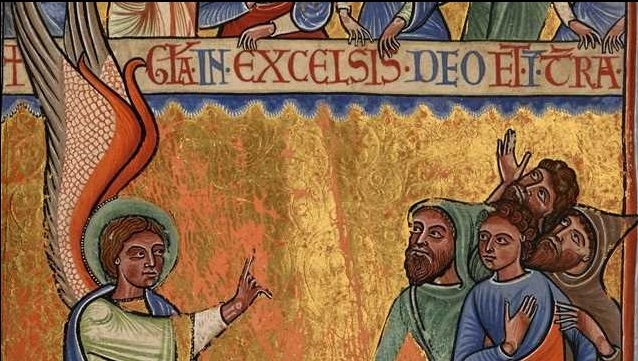
“Manuscripts are the most important medium writing has ever had,” declares the Centre for the Study of Manuscript Cultures at the Universität Hamburg. Under the influence of a certain presentist bias, this can be hard to believe. We are conditioned by what Marshall McLuhan described as The Gutenberg Galaxy: each of us is in some way what he called (in gendered language) a “Gutenberg Man.” From this point of view, “manuscript technology,” as he wrote in 1962, does “not have the intensity or power of extension to create publics on a national scale.” It seems quaint, archaic, too rarified to have much influence.
It may be the case, as McLuhan writes, that the printing press and the modern nation state arose together, but this is not necessarily an unqualified measure of progress. Print has had a few hundred years—however, “for thousands of years,” Universität Hamburg reminds us, “manuscripts have had a determining influence on all cultures that were shaped by them.” McLuhan himself was a distinguished scholar and a devoted Catholic who no doubt understood this very well. One suspects lesser writers might avoid the manuscript, in its incredible complexity, because it’s not only a different kind, it is a different species of media altogether.
Manuscript culture is its own field of study for good reason. We are generally talking about texts written on parchment or vellum, which are, after all, treated animal skins. Paper is easier to reproduce, but has a much shorter shelf life. No two manuscripts are the same, some differ from each other wildly: variants, interpolations, redactions, erasures, palimpsests, etc. are standard, requiring special training in editorial methods. Then there’s the languages and the handwriting…. It can be forbidding, but there are other, more surmountable reasons this field has been so hermetic until the recent past.
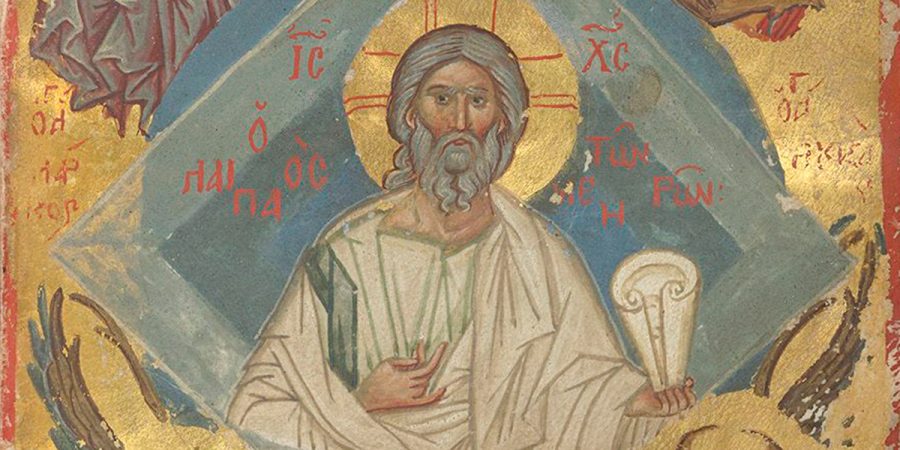
The primary sources have been inaccessible, hidden away in special collections, and the scholarship and pedagogy have been cloistered behind university walls. Open access digital publishing and free online courses and materials have changed the situation radically. And it is rapidly becoming the case that most manuscript libraries have major, and expanding, online collections, often scanned in high resolution, sometimes with transcriptions, and usually with additional resources explaining provenance and other such important details.
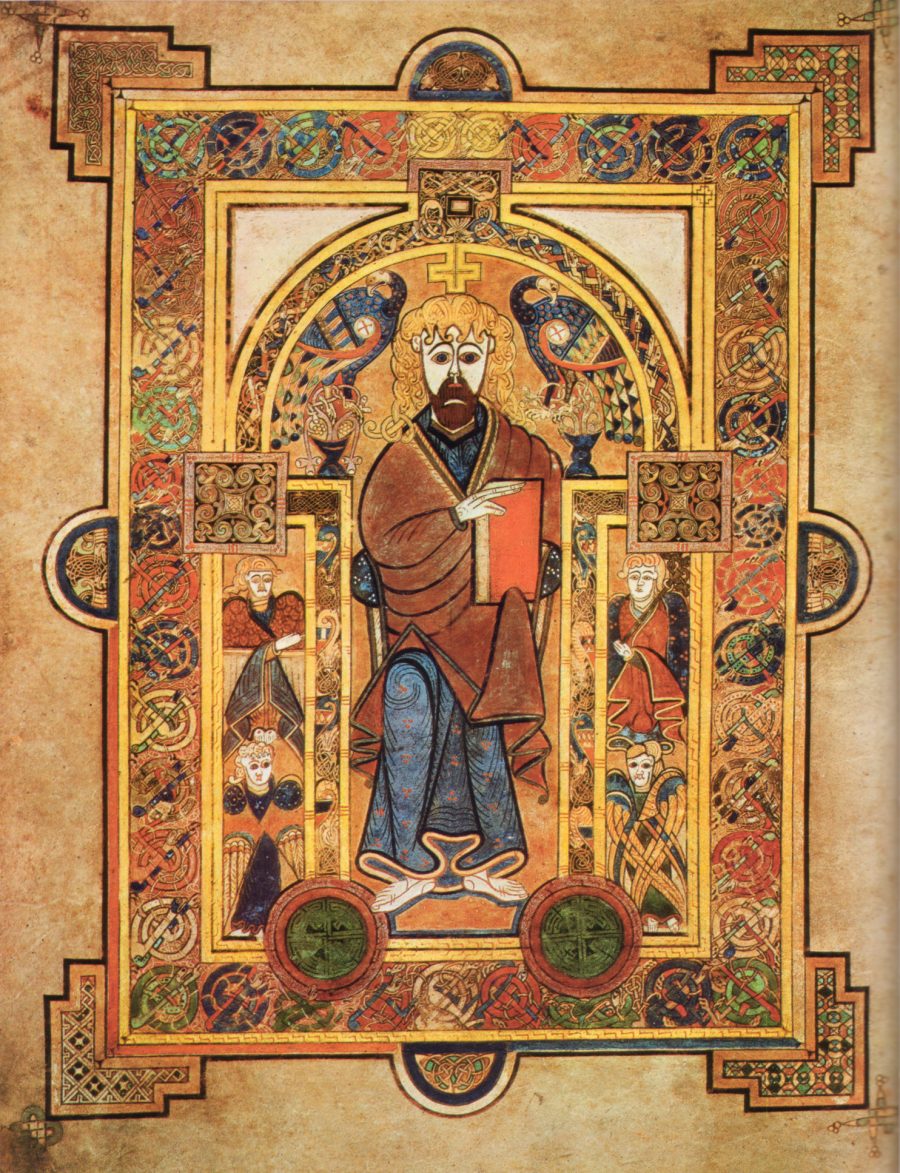
Indeed, there are thousands of manuscript pages online from well over a thousand years, and you’ll find them digitized at the links to several venerable institutions of preservation and higher learning below. There is, of course, no reason we cannot appreciate this long historical tradition for purely aesthetic reasons. So many Medieval manuscripts are works of art in their own right. But if we want to get into the gritty details, we can start by learning how such illuminated medieval manuscripts were made: a lost art, but not, thanks to the durability of parchment, a lost tradition.
- 160,000 Pages of Glorious Medieval Manuscripts Digitized: Visit the Bibliotheca Philadelphiensis
- 800 Illuminated Medieval Manuscripts Are Now Online: Browse & Download Them Courtesy of the British Library and Bibliothèque Nationale de France
- The Medieval Masterpiece, the Book of Kells, Is Now Digitized & Put Online
- 800+ Treasured Medieval Manuscripts to Be Digitized by Cambridge & Heidelberg Universities
- Behold 3,000 Digitized Manuscripts from the Bibliotheca Palatina: The Mother of All Medieval Libraries Is Getting Reconstructed Online
- Behold the Codex Gigas (aka “Devil’s Bible”), the Largest Medieval Manuscript in the World
- The Aberdeen Bestiary, One of the Great Medieval Illuminated Manuscripts, Now Digitized in High Resolution & Made Available Online
- New Digital Archive Will Bring Medieval Chants Back to Life: Project Amra Will Feature 300 Digitized Manuscripts and Many Audio Recordings
Learn even more at the links below.
Related Content:
How to Make a Medieval Manuscript: An Introduction in 7 Videos
How the Brilliant Colors of Medieval Illuminated Manuscripts Were Made with Alchemy
Josh Jones is a writer and musician based in Durham, NC. Follow him at @jdmagness
Read More...
Discover the Ambient Music of Hiroshi Yoshimura, the Pioneering Japanese Composer
The history of ambient music is a difficult story to tell in the same way we tell other histories, namely by reference to great men and women and the movements they inspired. When it comes to ambient music, there are few stars, and it can be difficult to lump artists together into categories. But what else would we expect from music designed to exist in the background?
The convenient origin point of the genre is Brian Eno’s 1978 Music for Airports, the first album released as an “Ambient” record and imagined as music made for a waiting room. Eno’s spiritual forefather, Erik Satie, famously called his minimalist compositions “furniture music” and also thought of them as accompaniment to mundane tasks.
Through these conceptual reductions of music to its most utilitarian function—creating a mildly pleasant atmosphere—ambient explores the space of daydreaming and the vague emotions associated with it. Few composers of ambient have pursued the genre’s ostensible purpose with as much practicality and direct application as in Japan, where “the influence of minimalist composers like Philip Glass and Terry Riley met a golden era for electronics” in the 1980s, Jack Needham writes at The Guardian.
Japanese composers adapted centuries of tradition to dizzying modernization:
Traditional Japanese music has mirrored its surroundings for centuries – the shakuhachi, a seventh-century bamboo flute, was designed to play all 12 tones of the western chromatic scale as a way to give voice to nature’s diversity. So in Japan’s 1980s economic boom, when cities like Tokyo were mutating at warp speed and Roland synthesisers replaced the classical instrument, ambient was reflecting these new, hyper-advanced landscapes.
The music they made was “unabashedly corporate,” becoming big business when Takashi Kokubo’s 1987 album Get at the Wave was “given away with Sanyo air conditioning units.” Andy Beta at Vulture details how Japanese ambient music became big in the U.S. through a compilation called Kankyō Ongaku: Japanese Environmental, Ambient & New Age Music 1980–1990. The title means “environmental music,” and it was also referred to as “background music,” or BGM by industry insiders (and Yellow Magic Orchestra). But whatever we call it, we cannot discuss Japanese ambient without reference to the pioneering work of Hiroshi Yoshimura.
Yoshimura’s Green “is an example of Japanese minimalism at its finest,” writes Vivian Yeung at Crack, “with the melding of natural sounds—via birds, running water and crickets—to the artificiality of arpeggiating synths and soft minimal notes deployed to poignant effect.” Wet Land, from 1993, deploys soft synths in minimalist melodies that recall Satie’s few, well-chosen notes. Yoshimura’s music has spread far beyond Japan through the same mechanism as the recent boom in Japanese “city pop”—through YouTube algorithms.
After discovering Yoshimura online, SPIN’s Andy Cush wrote, “Now, I listen to Yoshimura’s music almost every day, both because I find it tremendously moving and because YouTube won’t stop playing it.” But there’s far more to the recent popularity of Japanese ambient music than algorithms, Beta argues, noting that the “Satie boom” in postwar Japan led to a musical revolution that is perhaps particularly appealing to Western ears. In any case, as one of Yoshimura’s new “accidental fans” writes, his internet fame has far eclipsed his fame in life.
When he died in 2003, Yoshimura “was a footnote in music history…. His work mostly ended up as background noise in museums, galleries or show homes.” Beautiful background noise, however, was exactly the purpose of kankyō ongaku, and composers like Yoshimura did not exceed the brief. Instead, he perfected the form conceived by Eno as “ignorable as it is interesting,” music made to “induce calm and a space to think.” If you’re craving such an atmosphere, you may need to look no farther. You can sample Yoshimura’s key albums here, and find more of his works (where else?) on YouTube.
Related Content:
Hear the Very First Pieces of Ambient Music, Erik Satie’s Furniture Music (Circa 1917)
Josh Jones is a writer and musician based in Durham, NC. Follow him at @jdmagness.
Read More...Salman Rushdie and Jeff Koons Teach New Courses on Art, Creativity & Storytelling for MasterClass
If MasterClass comes calling, you know you’ve made it. In the five years since its launch, the online learning platform has brought on such instructors as Martin Scorsese, Helen Mirren, Steve Martin, Annie Leibovitz, and Malcolm Gladwell, all of whom bring not just knowledge and experience of a craft, but the glow of high-profile success as well. Though MasterClass’ lineup has expanded to include more writers, filmmakers, and performers (as well as chefs, designers, CEOs, and poker players) it’s long been light on visual artists. But it may signal a change that the site has just released a course taught by Jeff Koons, promoted by its trailer as the most original and controversial American artist — as well as the most expensive one.
Just last year, Koons’ sculpture Rabbit set a new record auction price for a work by a living artist: $91.1 million, which breaks the previous record of $58.4 million that happened to be held by another Koons, Balloon Dog (Orange). This came as the culmination of a career that began, writes critic Blake Gopnik, with “taking store-bought vacuum cleaners and presenting them as sculpture,” then creating “full-size replicas of rubber dinghies and aqualungs, cast in Old Master-ish bronze” and later “giant hard-core photos of himself having sex with his wife, the famous Italian porn star known as La Cicciolina (“Chubby Chick”)” and “simulacra of shiny blow-up toys and Christmas ornaments and gems, enlarged to monumental size in gleaming stainless steel.”
With such work, Gopnik argues, Koons has “rewritten all the rules of art — all the traditions and conventions that usually give art order and meaning”; his elevation of kitsch allows us to “see our world, and art, as profoundly other than it usually is.” Not that the artist himself puts it in quite those words. In his well-known manner — “like a space alien who has spent long years studying how to be the perfect, harmless Earthling, but can’t quite get it right” — Koons uses his MasterClass to tell the story of his artistic development, which began in the showroom of his father’s Pennsylvania furniture store and continued into a reverence for the avant-garde in general and Salvador Dalí in particular. From his life he draws lessons on turning everyday objects into art, using size and scale, and living life with “the confidence in yourself to follow your interests.”
Also new for this holiday season is a MasterClass on storytelling and writing taught by no less renowned a storyteller and writer than Salman Rushdie. The author of Midnight’s Children and The Satanic Verses thus joins on the site a group of novelists as varied as Neil Gaiman, Joyce Carol Oates, Dan Brown, Margaret Atwood, and Judy Blume, but he brings with him a much different body of work and life story. “I’ve been writing, now, for over 50 years,” he says in the course’s trailer just above. “There’s all this stuff about three-act structure, exactly how you must allow a story to unfold. My view is it’s all nonsense.” Indeed, by this point in his celebrated career, Rushdie has narrowed the rules of his craft down to just one: Be interesting.
Easier said than done, of course, which is why Rushdie’s MasterClass comes structured in nineteen practically themed lessons. In these he deals with such lessons as building a story’s structure, opening with powerful lines, drawing from old storytelling traditions, and rewriting — which, he argues, all writing is. To make these fiction-writing concepts concrete, Rushdie offers exercises for you, the student, to work through, and he also takes a critical look back at the failed work he produced in his early twenties. But though his techniques and process have greatly improved since then, his resolve to create, and to do so using his own distinctive sets of interests and experiences, has wavered no less than Koons’. At the moment you can learn from both of them (and MasterClass’ 100+ other instructors) if you take advantage of MasterClass’ holiday 2‑for‑1 deal. For $180, you can buy an annual subscription for yourself, and give one to a friend/family member for free. Sign up here.
Note: If you sign up for a MasterClass course by clicking on the affiliate links in this post, Open Culture will receive a small fee that helps support our operation.
Related Content:
A Short Documentary on Artist Jeff Koons, Narrated by Scarlett Johansson
Hear Salman Rushdie Read Donald Barthelme’s “Concerning the Bodyguard”
Salman Rushdie: Machiavelli’s Bad Rap
Neil Gaiman Teaches the Art of Storytelling in His New Online Course
Margaret Atwood Offers a New Online Class on Creative Writing
Based in Seoul, Colin Marshall writes and broadcasts on cities, language, and culture. His projects include the Substack newsletter Books on Cities, the book The Stateless City: a Walk through 21st-Century Los Angeles and the video series The City in Cinema. Follow him on Twitter at @colinmarshall, on Facebook, or on Instagram.
Read More...A Free Online Course from Yale University Explains How the World Lapsed into the Politics of Fear & Resentment
“How did we get from the huge euphoria that followed the fall of communism in the early 1990s to our present politics of fear and resentment, and what are the prospects going forward?” These questions and more get answered in Yale’s free course, “Power and Politics in Today’s World.” Taught by Professor of Political Science Ian Shapiro, the course “provides an examination of political dynamics and institutions over this past tumultuous quarter century, and the implications of these changes for what comes next. Among the topics covered are the decline of trade unions and the enlarged role of business as political forces, changing attitudes towards parties and other political institutions amidst the growth of inequality and middle-class insecurity, the emergence of new forms of authoritarianism, and the character and durability of the unipolar international order that replaced the Cold War.”
You can watch the lectures on Youtube, or stream them all above. The syllabus and reading list can be found here.
“Power and Politics in Today’s World” will be added to our meta collection, 1,700 Free Online Courses from Top Universities.
If you would like to support the mission of Open Culture, consider making a donation to our site. It’s hard to rely 100% on ads, and your contributions will help us continue providing the best free cultural and educational materials to learners everywhere. You can contribute through PayPal, Patreon, and Venmo (@openculture). Thanks!
Related Content:
Death: A Free Philosophy Course from Yale
Modern Poetry: A Free Course from Yale
Read More...Support Us
We're hoping to rely on loyal readers, rather than erratic ads. Please click the Donate button and support Open Culture. You can use Paypal, Venmo, Patreon, even Crypto! We thank you!

About Us

Open Culture scours the web for the best educational media. We find the free courses and audio books you need, the language lessons & educational videos you want, and plenty of enlightenment in between.
Advertise With Us
FREE UPDATES!
GET OUR DAILY EMAIL
Get the best cultural and educational resources on the web curated for you in a daily email. We never spam. Unsubscribe at any time.
FOLLOW ON SOCIAL MEDIA
Open Culture editor Dan Colman scours the web for the best educational media. He finds the free courses and audio books you need, the language lessons & movies you want, and plenty of enlightenment in between.
Advertise With Us

