Why Knights Fought Snails in Medieval Illuminated Manuscripts
The snail may leave a trail of slime behind him, but a little slime will do a man no harm… whilst if you dance with dragons, you must expect to burn.
- George R. R. Martin, The Mystery Knight
As any Game of Thrones fan knows, being a knight has its downsides. It isn’t all power, glory, advantageous marriages and gifts ranging from castles to bags of gold.
Sometimes you have to fight a truly formidable opponent.
We’re not talking about bunnies here, though there’s plenty of documentation to suggest medieval rabbits were tough customers.
As Vox Almanac’s Phil Edwards explains, above, the many snails littering the margins of 13th-century manuscripts were also fearsome foes.
Boars, lions, and bears we can understand, but … snails? Why?
Theories abound.
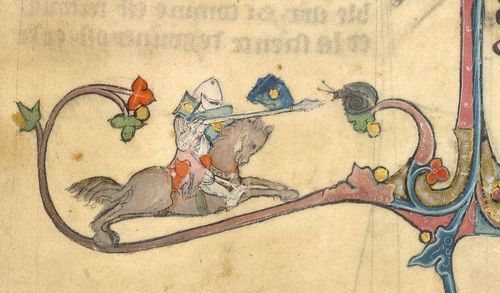
Detail from Brunetto Latini’s Li Livres dou Tresor
Edwards favors the one in medievalist Lilian M. C. Randall’s 1962 essay “The Snail in Gothic Marginal Warfare.”
Randall, who found some 70 instances of man-on-snail combat in 29 manuscripts dating from the late 1200s to early 1300s, believed that the tiny mollusks were stand ins for the Germanic Lombards who invaded Italy in the 8th century.
After Charlemagne trounced the Lombards in 772, declaring himself King of Lombardy, the vanquished turned to usury and pawnbroking, earning the enmity of the rest of the populace, even those who required their services.
Their profession conferred power of a sort, the kind that tends to get one labelled cowardly, greedy, malicious … and easy to put down.
Which rather begs the question why the knights going toe-to- …uh, facing off against them in the margins of these illuminated manuscripts look so damn intimidated.
(Conversely why was Rex Harrison’s Dr. Dolittle so unafraid of the Giant Pink Sea Snail?)
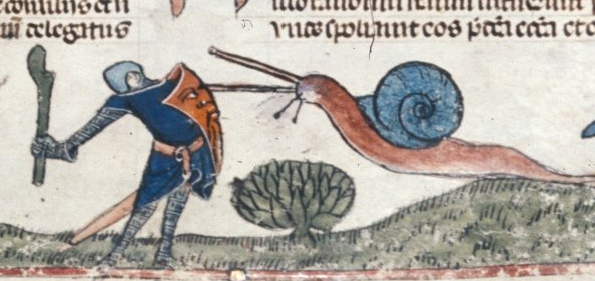
Detail from from MS. Royal 10 IV E (aka the Smithfield Decretals)
Let us remember that the doodles in medieval marginalia are editorial cartoons wrapped in enigmas, much as today’s memes would seem, 800 years from now. Whatever point—or joke—the scribe was making, it’s been obscured by the mists of time.
And these things have a way of evolving. The snail vs. knight motif disappeared in the 14th-century, only to resurface toward the end of the 15th, when any existing significance would very likely have been tailored to fit the times.
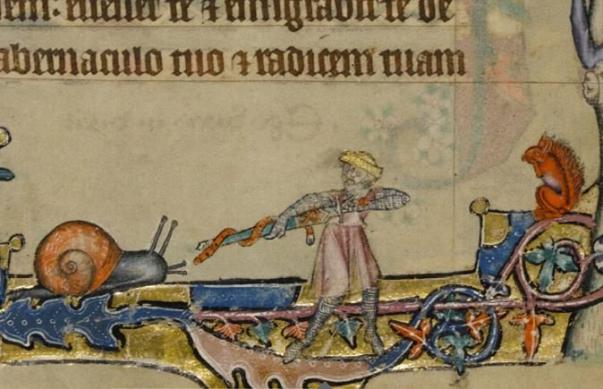
Detail from The Macclesfield Psalter
Other theories that scholars, art historians, bloggers, and armchair medievalists have floated with regard to the symbolism of these rough and ready snails haunting the margins:
The Resurrection
The high clergy, shrinking from problems of the church
The slowness of time
The insulation of the ruling class
The aristocracy’s oppression of the poor
A critique of social climbers
Female sexuality (isn’t everything?)
Virtuous humility, as opposed to knightly pride
The snail’s reign of terror in the garden (not so symbolic, perhaps…)
A practical-minded Reddit commenter offers the following commentary:
I like to imagine a monk drawing out his fantastical daydreams, the snail being his nemesis, leaving unsightly trails across the page and him building up in his head this great victory wherein he vanquishes them forever, never again to be plagued by the beastly buggers while creating his masterpieces.
Readers, any other ideas?

Detail from The Gorleston Psalter
Note: An earlier version of this post appeared on our site in 2019.
Related Content:
A Rabbit Rides a Chariot Pulled by Geese in an Ancient Roman Mosaic (2nd century AD)
Ayun Halliday is an author, illustrator, theater maker in New York City.
Read More...What Is Kabbalah? An Introduction to the Jewish Mystical Tradition
Though the pop-cultural moment that gave rise to the association has passed, when many of us hear about Kabbalah, we still think of Madonna. Her study of that Jewish-mystic school of thought in the nineteen-nineties has been credited, at least in part, with the sonic transformation that led to her hit album Ray of Light. A few years later, when she recorded the theme song for the 2002 James Bond movie Die Another Day, she managed to include in its music video such Kabbalistic imagery as the Hebrew letters lamed, aleph, and vav — which come, as Religion for Breakfast creator Andrew M. Henry says in the video above, from one of the 72 names of God according to Jewish tradition.
But what, exactly, is Kabbalah? That’s the question Henry takes it upon himself to answer, attempting to separate the real thing from the pop-cultural ephemera that’s come to surround it.
This entails first going back to the earliest Kabbalists, “Jewish teachers, theologians, and philosophers” among “the educated elite of medieval Europe, living in Spain and France, writing new and innovative studies on Jewish texts and concepts about mystical contemplation of the divine realms, the nature of God, the purpose of humanity, and the creation of the universe.” They searched, and their successors have continued to search, for secret divine wisdom originally vouchsafed to Moses at Mount Sinai.
The word kabbalah can be translated as “that which has been received,” but that may make the enterprise sound simpler than it is. Henry frames Kabbalah as a series of traditions “encompassing several modes of reading, a library of texts, a series of concepts, and a range of practices within Judaism that is concerned with mystical contemplation.” But whatever their differences, most Kabbalists revere concepts like Ein Sof, “an infinite impersonal god or supreme entity or supreme entity that we cannot describe with our own human faculties,” and vast works like the novelistic Zohar, or “The Book of Radiance,” in which “even the search for mystical knowledge becomes sexualized”: an aspect that, given the skill with which she’s crafted her provocative pop-icon image, Madonna could hardly fail to appreciate.
Related content:
The Talmud Is Finally Now Available Online
Walter Benjamin’s Philosophical Thought Presented by Two Experimental Films
The Ancient Greeks Who Converted to Buddhism
The Ark Before Noah: Discover the Ancient Flood Myths That Came Before the Bible
Based in Seoul, Colin Marshall writes and broadcasts on cities, language, and culture. His projects include the Substack newsletter Books on Cities and the book The Stateless City: a Walk through 21st-Century Los Angeles. Follow him on the social network formerly known as Twitter at @colinmarshall.
Read More...2,178 Occult Books Now Digitized & Put Online, Thanks to the Ritman Library and Da Vinci Code Author Dan Brown
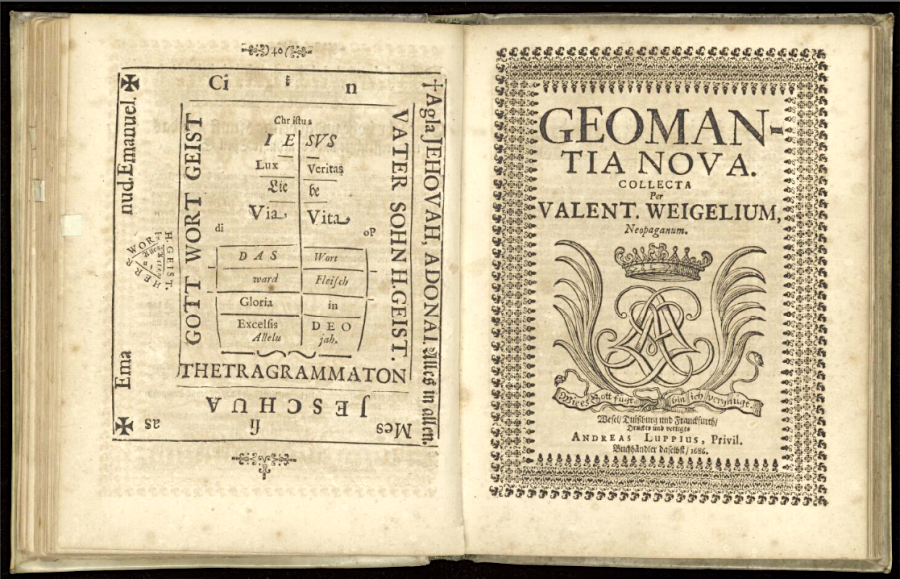
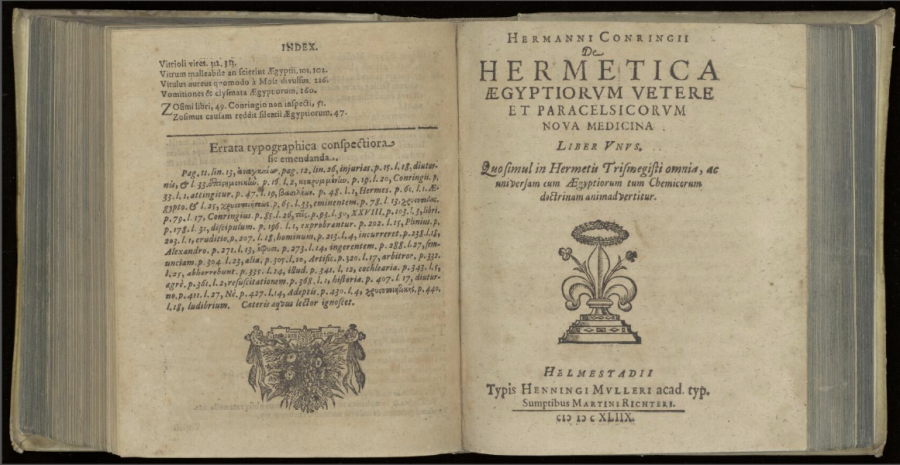
In 2018 we brought you some exciting news. Thanks to a generous donation from Da Vinci Code author Dan Brown, Amsterdam’s Ritman Library—a sizable collection of pre-1900 books on alchemy, astrology, magic, and other occult subjects—has been digitizing thousands of its rare texts under a digital education project cheekily called “Hermetically Open.” We are now pleased to report that the first 2,178 books from the Ritman project have come available in their online reading room.
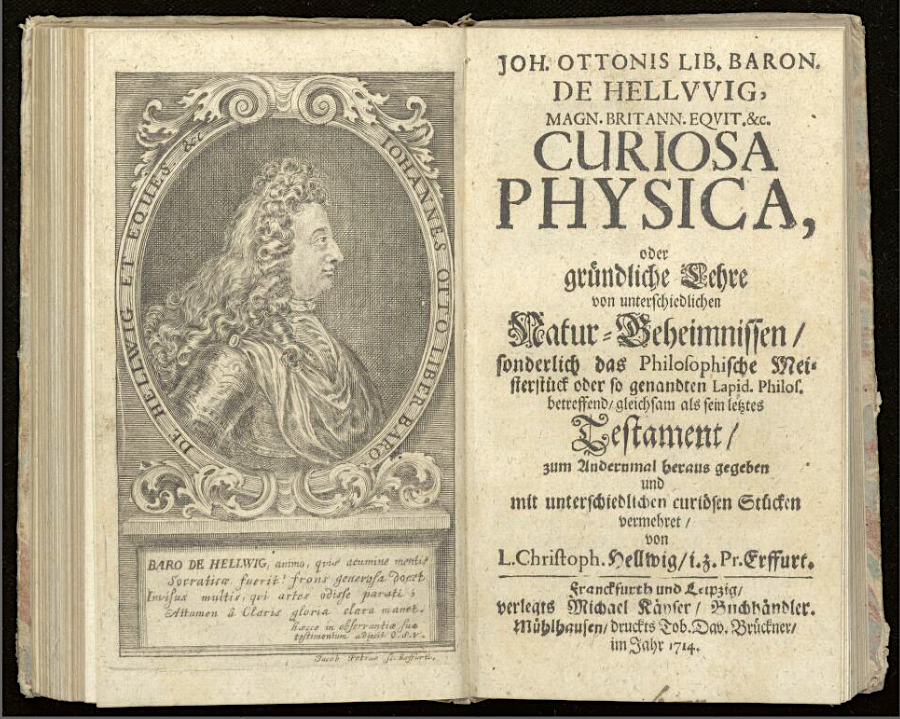
Visitors should be aware that these books are written in several different European languages. Latin, the scholarly language of Europe throughout the Medieval and Early Modern periods, predominates, and it’s a peculiar Latin at that, laden with jargon and alchemical terminology. Other books appear in German, Dutch, and French. Readers of some or all of these languages will of course have an easier time than monolingual English speakers, but there is still much to offer those visitors as well.
In addition to the pleasure of paging through an old rare book, even virtually, English speakers can quickly find a collection of readable books by clicking on the “Place of Publication” search filter and selecting Cambridge or London, from which come such notable works as The Man-Mouse Takin in a Trap, and tortur’d to death for gnawing the Margins of Eugenius Philalethes, by Thomas Vaughan, published in 1650.
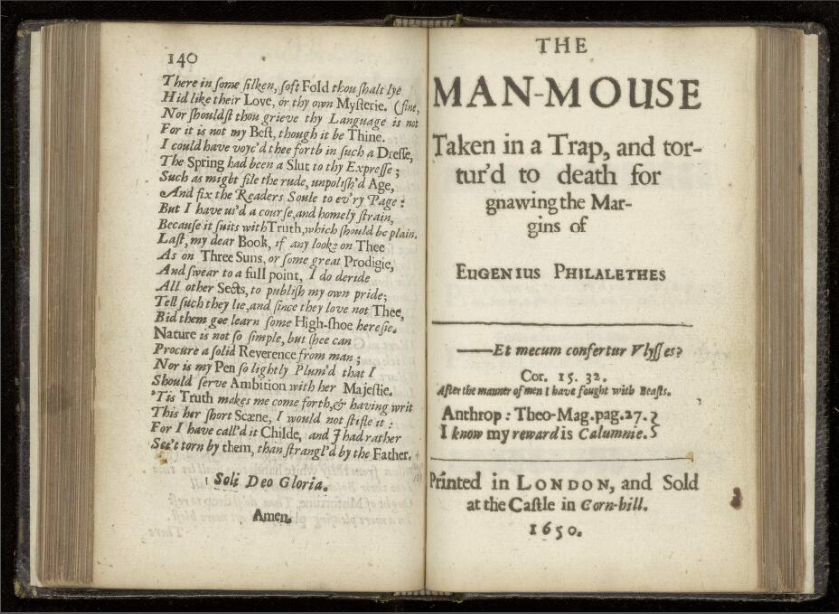
The language is archaic—full of quirky spellings and uses of the “long s”—and the content is bizarre. Those familiar with this type of writing, whether through historical study or the work of more recent interpreters like Aleister Crowley or Madame Blavatsky, will recognize the many formulas: The tracing of magical correspondences between flora, fauna, and astronomical phenomena; the careful parsing of names; astrology and lengthy linguistic etymologies; numerological discourses and philosophical poetry; early psychology and personality typing; cryptic, coded mythology and medical procedures. Although we’ve grown accustomed through popular media to thinking of magical books as cookbooks, full of recipes and incantations, the reality is far different.
Encountering the vast and strange treasures in the online library, one thinks of the type of the magician represented in Goethe’s Faust, holed up in his study,
Where even the welcome daylight strains
But duskily through the painted panes.
Hemmed in by many a toppling heap
Of books worm-eaten, gray with dust,
Which to the vaulted ceiling creep
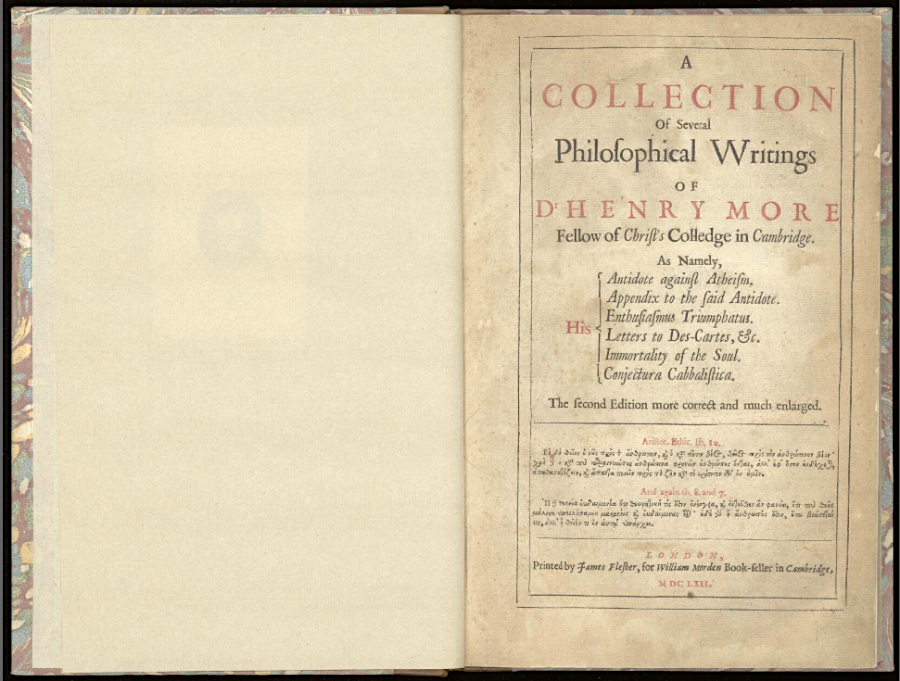
The library doesn’t only contain occult books. Like the weary scholar Faust, alchemists of old “studied now Philosophy / And Jurisprudence, Medicine,— / And even, alas! Theology.” Click on Cambridge as the place of publication and you’ll find the work above by Henry More, “one of the celebrated ‘Cambridge Platonists,’” the Linda Hall Library notes, “who flourished in mid-17th-century and did their best to reconcile Plato with Christianity and the mechanical philosophy that was beginning to make inroads into British natural philosophy.” Those who study European intellectual history know well that More’s presence in this collection is no anomaly. For a few hundred years, it was difficult, if not impossible, to separate the pursuits of theology, philosophy, medicine, and science (or “natural philosophy”) from those of alchemy and astrology. (Isaac Newton is a famous example of a mathematician/scientist/alchemist/believer in strange apocalyptic predictions.) Enter the Ritman’s new digital collection of occult texts here.
Note: An earlier version of this post appeared on our site in 2018.
Related Content:
Discover The Key of Hell, an Illustrated 18th-Century Guide to Black Magic (1775)
Aleister Crowley Reads Occult Poetry in the Only Known Recordings of His Voice (1920)
The Surreal Paintings of the Occult Magician, Writer & Mountaineer, Aleister Crowley
Josh Jones is a writer and musician based in Durham, NC.
Read More...The Stunt That Ended Buster Keaton’s Brilliant Career
Buster Keaton’s penchant and skill for comedic stunts made him one of the biggest stars of the silent-film era. Nobody at the time imagined that he would still be engaging in dangerous-looking pratfalls 40 years later in his seventies, especially since his career seemed to have come to an end in 1926. That was the year of his Civil War-set film The General, which, though now critically respected, left contemporary audiences cold. Flops are, perhaps, inevitable, but this one happened to incorporate into the picture the most expensive shot in cinema history to date. As a result, says the Ming video above, “Keaton was never given control over his films again.”
Ironically, unlike the cinematic images that had made him famous, the $42,000 shot in The General did not put its director-star in apparent mortal peril, depicting only a railroad bridge collapsing while a train crosses it. Though undoubtedly impressive, it wouldn’t have been what people went to a Buster Keaton movie to see.
Here was a man willing, after all, to fly from the back of a moving streetcar, dangle off the edge of a waterfall, risk being crushed by an entire wall of a house, and even break his neck — though he didn’t discover that he’d done so until eleven years later. Making these and all of Keaton’s other famous stunts involved considerable amounts of both calculated danger and movie magic.
Some of that movie magic was conceived by Keaton himself, the first filmmaker, in Quentin Tarantino’s words, to “use cinema itself to be the joke.” Few performers could have adapted so well to the medium of silent film, with its realms of silent comedy just waiting to be opened. And after sound had been around for a few decades, longtime moviegoers started to feel like cinema had lost some of the visual exuberance that it once possessed. By that time, luckily, Keaton had emerged from his long post-General period of hard-drinking malaise, ready to appear not just in the movies again, but also on television, delighting the generations who remembered his earlier work and fascinating those too young to recognize him. Even today, when we find ourselves laughing at a scene of elaborately orchestrated physical danger, we are, in some sense, witnessing Keaton’s legacy.
Related content:
Watch the Only Time Charlie Chaplin & Buster Keaton Performed Together On-Screen (1952)
A Supercut of Buster Keaton’s Most Amazing Stunts
101 Free Silent Films: The Great Classics
Based in Seoul, Colin Marshall writes and broadcasts on cities, language, and culture. His projects include the Substack newsletter Books on Cities and the book The Stateless City: a Walk through 21st-Century Los Angeles. Follow him on the social network formerly known as Twitter at @colinmarshall.
Read More...Tim Burton Visits a Paris Video Store & Talks About His Favorite Movies
Tim Burton grew up watching Japanese monster movies in Burbank, which must explain a good deal about his artistic sensibility. It seems to be for that reason, in any case, that the new Konbini “Vidéo Club” episode above takes him first to the Asian cinema section of JM Vidéo, one of Paris’ last two DVD rental shops. Early and repeated exposure to such kaiju classics as Honda Ishirō’s Godzilla and The War of the Gargantuas may have instilled him with an affection for poor English dubbing, but it didn’t rob him of his ability to appreciate more refined (if equally visceral) examples of Japanese film like Shindō Kaneto’s Onibaba and Kuroneko.
Burton describes those pictures as dreamlike, a quality he goes on to praise in other selections from a variety of different eras and cultures. Even cinephiles who don’t share his particular taste in viewing material — bound on one end, it seems, by The Passion of Joan of Arc and The Cabinet of Dr. Caligari, and on the other by I Was a Teenage Werewolf and The Brain That Wouldn’t Die, with the likes of Jason and the Argonauts and The Fly in between — have to admit that this indicates a deep understanding of cinema itself.
It may be the art form whose experience is most similar to dreaming, but only occasionally throughout its history have particular films attained the status of the truly oneiric. One suspects that Burton knows them all.
In fact, one of the twenty-first century’s most notable additions to the canon of the dreamlike won the Palme d’Or with Burton’s involvement. This video includes his brief reminiscences of being on the jury at the 2010 Cannes Film Festival, where Apichatpong Weerasethakul’s Uncle Boonmee Who Can Recall His Past Lives took the top prize. That same year saw the release of Burton’s own Alice in Wonderland, which he describes as “the most chaotic movie I’ve ever made.” In 2019, he directed his second live-action Disney adaptation Dumbo, which, though hardly a passion project, wasn’t without its autobiographical resonances: “At that point, I kind of felt like Dumbo,” he admits, “a weird creature trapped at Disney.” Perhaps that long on-and-off corporate association finally having come to an end, or so he suggests, means he’ll now be freer than ever to draw from the depths of his own cinematic subconsciousness.
Related content:
Tim Burton: A Look Inside His Visual Imagination
Watch Vincent, Tim Burton’s Animated Tribute to Vincent Price & Edgar Allan Poe (1982)
Tim Burton’s Hansel and Gretel Shot on 16mm Film with Amateur Japanese Actors (1983)
David Cronenberg Visits a Video Store & Talks About His Favorite Movies
Watch The Cabinet of Dr. Caligari, the Influential German Expressionist Horror Film (1920)
Based in Seoul, Colin Marshall writes and broadcasts on cities, language, and culture. His projects include the Substack newsletter Books on Cities and the book The Stateless City: a Walk through 21st-Century Los Angeles. Follow him on the social network formerly known as Twitter at @colinmarshall.
Read More...How Ancient Greek Technology Was Used to Sculpt Mount Rushmore
Designing their new republic, the Founding Fathers of the United States of America looked back to reference points in classical antiquity. That instinct continued to shape American endeavors long thereafter, and not just political ones. Take the example of Mount Rushmore, one of the country’s most popular tourist attractions. Originally conceived in the early nineteen-twenties as a mountain sculpture of America’s wild-west heroes, a means of raising the status of the fledgling state of South Dakota, it was soon changed into a stone tribute to four presidents: Founding Fathers George Washington and Thomas Jefferson as well as Abraham Lincoln and Theodore Roosevelt.
Mount Rushmore’s sculptor Gutzon Borglum suggested the switch from regional figures to national ones, and it wouldn’t be the last good idea he would bring to the table. As explained in the Primal Space video above, he also figured out how to replicate his initial sculpture of the four presidents, made at one-twelfth-scale, on a 500-foot-tall cliff edge.
Building all the necessary infrastructure on and around the mountain constituted a major project in and of itself. But when the workers got into their harnesses, how would they know where to direct their jackhammers into the rock? To guide them, Borglum adapted a mechanical technique used by ancient Greeks to copy statues, a “pointing machine” that could “measure specific points on a sculpture relative to a reference point,” making a three-dimensional shape transferable from one sculpture to another.
Borglum designed a large-scale pointing machine that could be installed atop the mountain and positioned to show workers where and how deep to drill. Though the system worked well, the team could only make progress so fast: after fourteen years, Mount Rushmore remained incomplete when Borglum’s death and World War II put a stop to it altogether. Yet enough had been finished to give it the iconic appearance that has made it recognizable the world over, if not always by name. When I recently gave a talk about American history to some young students in South Korea, where I live, one of them identified a photo of Mount Rushmore as Mount Olympus — and, in a civilizational sense, maybe she was on to something.
Related Content:
Behold Ancient Egyptian, Greek & Roman Sculptures in Their Original Color
The Metropolitan Museum of Art Restores the Original Colors to Ancient Statues
How Ancient Greek Statues Really Looked: Research Reveals Their Bold, Bright Colors and Patterns
How Monument Valley Became the Most Iconic Landscape of the American West
Based in Seoul, Colin Marshall writes and broadcasts on cities, language, and culture. His projects include the Substack newsletter Books on Cities and the book The Stateless City: a Walk through 21st-Century Los Angeles. Follow him on the social network formerly known as Twitter at @colinmarshall.
Read More...Why Ancient Romans Paid a Fortune for the Color Purple — More Than Even Silver
Purple may not be one of the most popular colors in the apparel of our age, but if you want it — as certain cultural figures have amply demonstrated — you can get as much of it as you like, even if you don’t belong to the aristocracy. That wasn’t the case in antiquity, as explained by ancient-history YouTuber Garrett Ryan in the new video from his channel Told in Stone above. Back then, long before the invention of synthetic dyes, humanity had to get all its colors from nature, and some of those natural sources were more abundant and accessible than others. To produce splendid “Tyrian purple” required the mucus of sea snails, and not just any sea snails: only three species, collectively referred to as murex, would do.
This particular purple, as Ryan explains, “was virtually immune to washing and weathering,” unlike the vegetable dyes commonly used in antiquity, and perhaps that strength inspired the legend that it was discovered by Hercules himself.
Though its recipe has never quite been replicated in modernity, it seems to have required a nearly Herculean labor to execute, with each batch of ten thousand snails producing a single gram of dye. Even ancient Roman senators got just one purple stripe each on their togas; full purple was reserved for triumphing generals and emperors. In some ages, under emperors like Nero, purple — at least in its most luxuriant shades — was forbidden to the common people.
Not that most of them could have afforded it anyway, in Rome or other ancient civilizations. “In classical Athens, a purple cloak cost three minas, or 300 drachmas, when a family of four could live comfortably for a year on 200,” Ryan explains. “The finest purple cloth was worth its weight in silver, and an especially rich garment could cost two talents: 12,000 drachmas.” During the reign of Augustus, when imperial legionaries earned 900 sestertii a year, “a cloak of second-rate purple” might sell for 10,000. Calculating from Diocletian’s Price Edict, you could theoretically trade a few pounds of purple silk for 75,000 pints of beer, 7,500 “succulent sow udders,” 750 pheasants, “a single first-class male lion,” and 150 lawsuits: the makings of quite a high time in Ancient Rome.
Related content:
How the Ancient Greeks & Romans Made Beautiful Purple Dye from Snail Glands
Behold Ancient Egyptian, Greek & Roman Sculptures in Their Original Color
Why Most Ancient Civilizations Had No Word for the Color Blue
Prince Gets an Official Purple Pantone Color
Based in Seoul, Colin Marshall writes and broadcasts on cities, language, and culture. His projects include the Substack newsletter Books on Cities and the book The Stateless City: a Walk through 21st-Century Los Angeles. Follow him on the social network formerly known as Twitter at @colinmarshall.
One-in-70-Trillion: An Evolutionary Biologist Explains the Mind-Bending Probability of Our Existence
At a 1998 conference on technology and life, The Hitchhiker’s Guide to the Galaxy author Douglas Adams once proposed the notion of a sentient puddle. Imagine it “waking up one morning and thinking, ‘This is an interesting world I find myself in — an interesting hole I find myself in — fits me rather neatly, doesn’t it? In fact, it fits me staggeringly well, must have been made to have me in it!’ ” No matter how much intelligence it may somehow have attained, this puddle doesn’t realize that its shape was dictated by its environment, not the other way around. Nor does it seem to realize on just how many factors its very existence is contingent; to its mind, this is a puddle’s world, and the rest of us are just living in it.
Of course, the rest of us are in just the same situation. In the 70-minute Big Think video above, evolutionary developmental biologist Sean B. Carroll puts our presence on Earth in perspective, beginning with the various factors that happened to converge to make complex life possible on this planet at all. “A huge number of things had to go right for our species to exist, and for each of us individually to exist,” he says, and that’s true on “the cosmological scale, the geological scale, and the biological scale.”
One important event is the asteroid impact that “reset” life on Earth 66 million years ago, which triggered a gradual cooling of the planet, and another was the tectonic movement that pushed together what we now know as Asia and the Indian subcontinent. A result of these and other unlikely occurrences was the “biosphere” in which we and all other extant species live today.
What about you and me in particular? Neither of us, as Carroll tells it here and in his book A Series of Fortunate Events: Chance and the Making of the Planet, Life, and You, should feel that our place was guaranteed. In human reproduction, when two parents get together and “that one lucky sperm makes it and combines with that one egg at that moment, that’s about a one-in-70-trillion event, genetically speaking.” This can be difficult to internalize, since our own existence is all we’ve ever known, in the manner of Adams’ sentient puddle. Even “as the sun rises in the sky and the air heats up and as, gradually, the puddle gets smaller and smaller,” it continues “frantically hanging on to the notion that everything’s going to be alright, because this world was meant to have him in it, was built to have him in it.” There’s a lesson for humanity in that story, and one that hasn’t become any less urgent in the past 27 years.
Related Content:
Big History: David Christian Covers 13.7 Billion Years of History in 18 Minutes
An Astronaut’s Guide to Life on Earth by Commander Chris Hadfield: The Viral Book Trailer
Based in Seoul, Colin Marshall writes and broadcasts on cities, language, and culture. His projects include the Substack newsletter Books on Cities and the book The Stateless City: a Walk through 21st-Century Los Angeles. Follow him on the social network formerly known as Twitter at @colinmarshall.
Read More...
Memento Mori: How Smiling Skeletons Have Reminded Us to Live Fully Since Ancient Times
The expression “YOLO” may now be just passé enough to require explanation. It stands, as only some of us would try to deny remembering, for “You only live once,” a sentiment that reflects an eternal truth. Some bodies of religious belief don’t strictly agree with it, of course, but that was also true 24 centuries ago, when an unknown artist created the so-called “YOLO mosaic” that was unearthed in Southern Turkey in the twenty-tens. That artifact, whose depiction of a wine-drinking skeleton living it up even in death has delighted thousands upon thousands of viewers on the internet, is at the center of the new Hochelaga video above.
To the side of that merry set of bones is the Greek text “ΕΥΦΡΟΣΥΝΟΣ,” often translated as “Be cheerful and live your life.” As Hochelaga creator Tommie Trelawny points out, that’s a somewhat loose interpretation, since the word “roughly means ‘joyful-minded,’ or simply ‘cheerful.’ ” A more important element not often taken into consideration is the mosaic’s context.
It was discovered during the excavation of a third-century BC Greco-Roman villa, where it constituted one end of a dining-room triptych. In the middle was a scene, a trope in comedies of the time, of a toga-clad young “gatecrasher” running in hopes of a free dinner. On the other end is a mostly destroyed image of a type of figure known as “the African fisherman.”
Taken together, this domestic artwork could reflect the Epicurean teaching that “life should be about pursuing happiness and enjoying the simple pleasures while you still can.” But if the “cheerful skeleton,” as Trelawny calls it, draws attention from the rest of the triptych, that speaks to its symbolic power across the ages. Common not only in ancient Rome, the symbolic figure also makes vivid appearances in medieval art (especially during the time of the Black Death), Renaissance portraiture, the Día de Muertos-ready drawings of José Guadalupe Posada, and even Disney cartoons like The Skeleton Dance. As long as death remains undefeated, each era needs its own memento mori, and the cheerful skeleton, in all its paradoxical appeal, will no doubt keep turning up to the job — sometimes with a drink in hand.
Related Content:
Celebrate The Day of the Dead with The Classic Skeleton Art of José Guadalupe Posada
The Skeleton Dance, Voted the 18th Best Cartoon of All Time, Is Now in the Public Domain (1929)
Based in Seoul, Colin Marshall writes and broadcasts on cities, language, and culture. His projects include the Substack newsletter Books on Cities and the book The Stateless City: a Walk through 21st-Century Los Angeles. Follow him on the social network formerly known as Twitter at @colinmarshall.
Read More...The Spinal Tap Sequel Arrives Next Month: Watch the Trailer and a Scene with Elton John & Paul McCartney
This Is Spinal Tap came out more than 40 years ago. At the time, says director Rob Reiner in a recent interview at San Diego Comic-Con, “nobody got it. I mean, they thought I’d made a movie about a real band that wasn’t very good, and why wouldn’t I make a movie about the Beatles or the Rolling Stones?” Indeed, stories circulated of people in the music industry (including the late Ozzy Osbourne) not realizing it was supposed to be a comedy, so close was its satire to their actual professional lives. Eventually, “the real word started creeping in”: the fictional band “played Glastonbury, they played Royal Albert Hall and Wembley Stadium.” Real-life rock and pop musicians also became fans of the film. “Every time I see it,” Reiner quotes Sting as saying, “I don’t know whether to laugh or cry.”
The boundaries between Spinal Tap’s world and the real one have remained porous enough that the production of the film’s upcoming sequel Spinal Tap II: The End Continues has involved a great many celebrities playing themselves, or at least versions thereof.
Take, for example, the newly released version of “Stonehenge,” whose music video features not just Elton John, but — to the delight of some fans, and perhaps the disappointment of others — a correctly scaled stage prop. The song will be included on the album of The End Continues, scheduled for release along with the film on September 12th, whose thirteen tracks bring in guest stars like Paul McCartney, Garth Brooks, and Trisha Yearwood.
It’s been about fifteen years since the last Spinal Tap album, a factor the sequel incorporates into its premise. “We created this whole idea that there’s bad blood, they’re not speaking to each other,” says Reiner, “but they now are forced together because of a contract” dictating that they must give one last performance, a prospect suddenly made viable when their song “Big Bottom” goes viral. As unrecognizable as both pop culture in general and the music industry in particular have become over the past four decades, Reiner assures us that David St. Hubbins, Nigel Tufnel, and Derek Smalls “have not grown emotionally, musically, or artistically. They are stuck in that heavy-metal world.” In a Hollywood movie, such a flagrant lack of character development would constitute a violation of storytelling laws; in rock, it’s unflinching realism.
Related content:
Ian Rubbish (aka Fred Armisen) Interviews the Clash in Spinal Tap-Inspired Mockumentary
The Spinal Tap Stonehenge Debacle
Watch The Nine Lives of Ozzy Osbourne: A Free Documentary on the Heavy Metal Pioneer (RIP)
Based in Seoul, Colin Marshall writes and broadcasts on cities, language, and culture. His projects include the Substack newsletter Books on Cities and the book The Stateless City: a Walk through 21st-Century Los Angeles. Follow him on the social network formerly known as Twitter at @colinmarshall.
Read More...Support Us
We're hoping to rely on loyal readers, rather than erratic ads. Please click the Donate button and support Open Culture. You can use Paypal, Venmo, Patreon, even Crypto! We thank you!

About Us

Open Culture scours the web for the best educational media. We find the free courses and audio books you need, the language lessons & educational videos you want, and plenty of enlightenment in between.
Advertise With Us

FREE UPDATES!
GET OUR DAILY EMAIL
Get the best cultural and educational resources on the web curated for you in a daily email. We never spam. Unsubscribe at any time.
FOLLOW ON SOCIAL MEDIA

Open Culture editor Dan Colman scours the web for the best educational media. He finds the free courses and audio books you need, the language lessons & movies you want, and plenty of enlightenment in between.
Advertise With Us


