Emma Willard, the First Female Mapmaker in America, Creates Pioneering Maps of Time to Teach Students about Democracy (Circa 1851)
We all know Marshall McLuhan’s pithy, endlessly quotable line “the medium is the message,” but rarely do we stop to ask which one comes first. The development of communication technologies may genuinely present us with a chicken or egg scenario. After all, only a culture that already prized constant visual stimuli but grossly undervalued physical movement would have invented and adopted television.
In Society of the Spectacle, Guy Debord ties the tendency toward passive visual consumption to “commodity fetishism, the domination of society by ‘intangible as well as tangible things,’ which reaches its absolute fulfillment in the spectacle, where the tangible world is replaced by a selection of images which exist above it, and which simultaneously impose themselves as the tangible par excellence.” It seems an apt description of a screen-addicted culture.
What can we say, then, of a culture addicted to charts and graphs? Earliest examples of the form were often more elaborate than we’re used to seeing, hand-drawn with care and attention. They were also not coy about their ambitions: to condense the vast dimensions of space and time into a two-dimensional, color-coded format. To tidily sum up all human and natural history in easy-to-read visual metaphors.
This was as much a religious project as it was a philosophical, scientific, historical, political, and pedagogical one. The domains are hopelessly entwined in the 18th and 19th centuries. We should not be surprised to see them freely mingle in the earliest infographics. The creators of such images were polymaths, and deeply devout. Joseph Priestley, English chemist, philosopher, theologian, political theorist and grammarian, made several visual chronologies representing “the lives of two thousand men between 1200 BC and 1750 AD” (conveying a clear message about the sole importance of men).
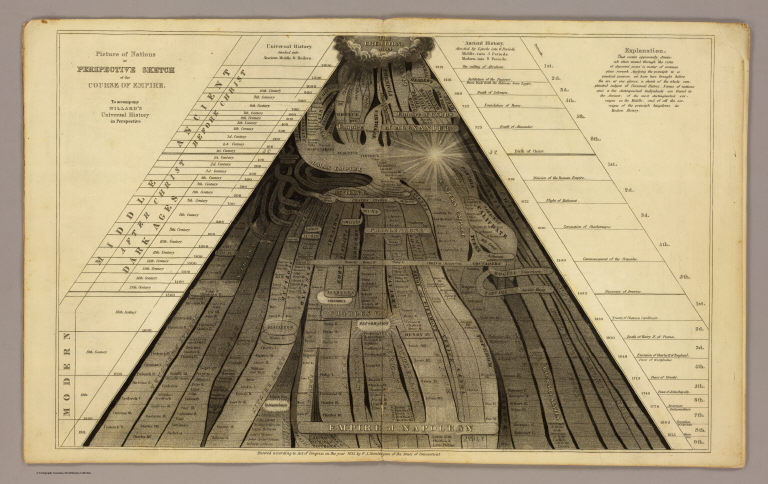
“After Priestley,” writes the Public Domain Review, “timelines flourished, but they generally lacked any sense of the dimensionality of time, representing the past as a uniform march from left to right.” Emma Willard, “one of the century’s most influential educators” set out to update the technology, “to invest chronology with a sense of perspective.” In her 1836 Picture of Nations; or Perspective Sketch of the Course of Empire, above (view and download high resolution images here), she presents “the biblical Creation as the apex of a triangle that then flowed forward in time and space toward the viewer.”
The perspective is also a forced point of view about origins and history. But that was exactly the point: these are didactic tools meant for textbooks and classrooms. Willard, “America’s first professional female mapmaker,” writes Maria Popova, was also a “pioneering educator,” who founded “the first women’s higher education institution in the United States when she was still in her thirties…. In her early forties, she set about composing and publishing a series of history textbooks that raised the standards and sensibilities of scholarship.”
Willard recognized that linear graphs of time did not accurately do justice to a three-dimensional experience of the world. Humans are “embodied creatures who yearn to locate themselves in space and time.” The illusion of space and time on the flat page was an essential feature of Willard’s underlying purpose: “laying out the ground-plan of the intellect, so far as the whole range of history is concerned.” A proper understanding of a Great Man (and at least one Great Woman, Hypatia) version of history—easily condensed, since there were only around 6,000 years from the creation of the universe—would lead to “enlightened and judicious supporters” of democracy.
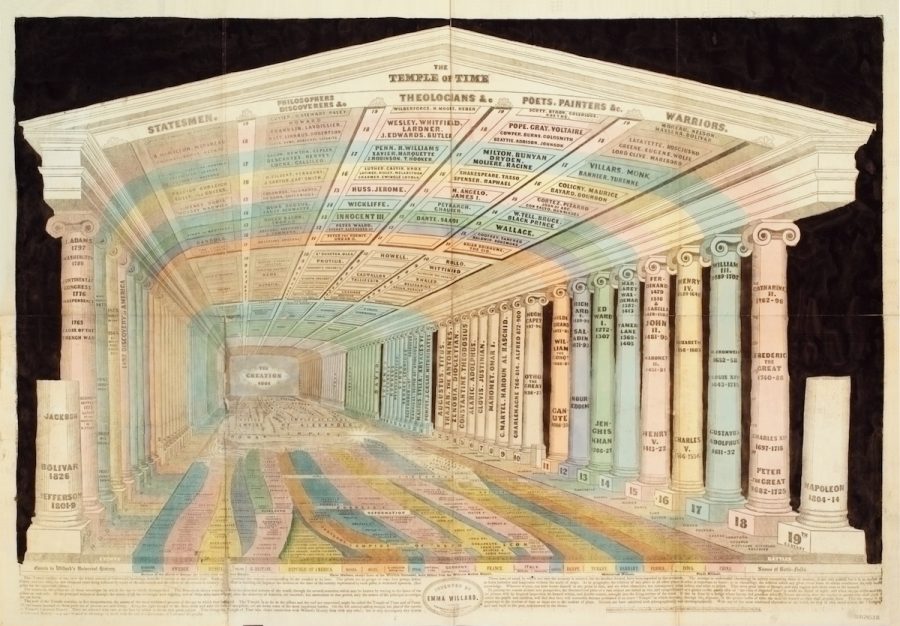
History is represented literally as a sacred space in Willard’s 1846 Temple of Time, its providential beginnings formally balanced in equal proportion to its every monumental stage. Willard’s intent was expressly patriotic, her trappings self-consciously classical. Her maps of time were ways of situating the nation as a natural successor to the empires of old, which flowed from the divine act of creation. They show a progressive widening of the world.
“Half a century before W.E.B. Du Bois… created his modernist data visualizations for the 1900 World’s Fair,” Popova writes, The Temple of Time “won a medal at the 1851 World’s Fair in London.” Willard accompanied the infographic with a statement of intent, articulating a media theory, over a hundred years before McLuhan, that sounds strangely anticipatory of his famous dictum.
The poetic idea of “the vista of departed years” is made an object of sight; and when the eye is the medium, the picture will, by frequent inspection, be formed within, and forever remain, wrought into the living texture of the mind.
Learn more about Emma Willard’s infographic revolution at the Public Domain Review and The Marginalian.
Note: An earlier version of this post appeared on our site in 2020.
Related Content:
The History of the World in One Beautiful, 5‑Foot-Long Chart (1931)
180,000 Years of Religion Charted on a “Histomap” in 1943
Josh Jones is a writer and musician based in Durham, NC.
Read More...When Medieval & Early Modern Europeans Cleansed with Poison: The Strange History of Antimony Cups and Pills
The history of medicine is, for the most part, a history of dubious cures. Some were even worse than dubious: for example, the ingestion of antimony, which we now know to be a highly toxic metal. Though it may not occupy an exalted (or, for students in chemistry class, particularly memorable) place on the periodic table today, antimony does have a fairly long cultural history. Its first known use took place in ancient Egypt when stibnite, one of its mineral forms, was ground into the strikingly dark eyeliner-like cosmetic kohl, which was thought to ward off bad spirits.
Ancient Greek civilization recognized antimony less for its effects on the spirit world than on the human one. The Greeks knew full well that the stuff was toxic, but also kept returning to it as a potential form of medicine.
Ancient Rome made its own practical use of antimony, not least in metallurgy, but also kept up certain lines of inquiry into its curative properties. As a substance, it was well-placed to capture imaginations more intensely in the medieval age of alchemy. By the late seventeenth century, people were drinking wine out of antimony cups, as unboxed in the video from the Victoria and Albert Museum above.
“The purpose of it is to try and make you vomit and have diarrhea and sweat a lot,” says Angus Patterson, the V&A’s senior curator of metalwork. In theory, this would re-balance the “humors” of which medieval medicine conceived of the body as being composed. Fancy cups like the one in the video, which was once owned by a lord, weren’t the only antimony objects used for this purpose: the metal was also forged into so-called “perpetual pills,” meant to be swallowed, retrieved from the excrement, then swallowed again when necessary — for multiple generations, in some cases, as a kind of family heirloom. “Not sure I’d fancy swallowing a pill that had been through my grandpa,” Patterson adds, “but needs must when you have a stomachache in 1750.”
via Aeon
Related content:
The Color that May Have Killed Napoleon: Scheele’s Green
1,000-Year-Old Illustrated Guide to the Medicinal Use of Plants Now Digitized & Put Online
Sir Isaac Newton’s Cure for the Plague: Powdered Toad Vomit Lozenges (1669)
Based in Seoul, Colin Marshall writes and broadcasts on cities, language, and culture. His projects include the Substack newsletter Books on Cities and the book The Stateless City: a Walk through 21st-Century Los Angeles. Follow him on the social network formerly known as Twitter at @colinmarshall.
Read More...A Live Studio Cover of Pink Floyd’s The Dark Side of the Moon, Played from Start to Finish
Pink Floyd’s Dark Side of the Moon is such a work of art that to split it up into nine tracks—like classic rock radio has done for years—always sounds nonsensical. How can you just end “Breathe” on that final chord and not follow it with the analog drones of “On the Run”? How can you play “Brain Damage” and not end with “Eclipse”? And how dare you fade the long coda of “Money” and segue into a car commercial?
You can’t, morally speaking, I’m telling you.
So that’s why I like the cut of the jib of the Martin Miller Session Band, who commit to covering the entirety of Dark Side of the Moon in this one long studio performance. According to Miller’s Patreon page, this is the only full album they’ve covered so far, and they pull through admirably.
And the thing that is refreshing here is that the band covers the album up to a point, but not slavishly. It’s not the Flaming Lips’ deconstruction or the surprisingly still listenable 8‑Bit version, but neither is it the kind of tribute band like Brit Floyd (below). When Miller solos, he’s not aping David Gilmour. The keyboardist Marius Leicht has his own knobs to twiddle, so to speak. And drummer Felix Lehrmann will never ever be confused for Nick Mason. (In fact, he gets a lot of grief in the comments for being too flash, but when you watch Miller’s other videos and see him giving Stewart Copeland a run for his money on their Police medley, you see where he’s coming from.)
Knowing what you’re in for, questions arise: are they going to include the various spoken samples sprinkled throughout (“I don’t know I was really drunk at the time,” “There is no dark side of the moon really…”). Answer: yes indeed, and funny they are too. Does a saxophonist turn up for “Money” and “Us and Them”? Answer: Yes, and it’s Michal Skulski. Who can possibly match Clare Torry’s pipes on “The Great Gig in the Sky”? Jenny Marsala does, thank you very much.
So I would settle in and try to unlearn your memory of every note and beat on the 1973 classic. By doing so, you’ll hear the album anew.
And after that, if you’re still hankering for that “even better than the real thing” vibe, enjoy this full concert, circular projection screen and all, by the aforementioned Brit Floyd, playing Liverpool in 2011.
Note: An earlier version of this post appeared on our site in 2020.
Related Content:
The Dark Side of the Moon Project: Watch an 8‑Part Video Essay on Pink Floyd’s Classic Album
Clare Torry’s Rare Live Performances of “Great Gig in the Sky” with Pink Floyd
Ted Mills is a freelance writer on the arts.
Read More...Watch Anémic Cinéma, Marcel Duchamp’s Whirling Avant-Garde Film (1926)
Marcel Duchamp (1887–1968) made some heady art. His whole goal was to “put art back in the service of the mind,” or to create what Jasper Johns once called the “field where language, thought and vision act on one another.” And that’s precisely what Duchamp’s 1926 avant-garde film Anémic Cinéma delivers. You can watch a restored version above.
Drawing on his inheritance, Duchamp shot Anémic Cinéma (almost a palindrome) in Man Ray’s studio with the help of cinematographer Marc Allégret. The Dada-inspired film features nine whirling optical illusions, known as Rotoreliefs, alternating with spiraling puns and complex word play. Vision acts on language and thought, indeed.
Anémic Cinéma appears in our collection, 4,000+ Free Movies Online: Great Classics, Indies, Noir, Westerns, Documentaries & More.
If you would like to support the mission of Open Culture, consider making a donation to our site. It’s hard to rely 100% on ads, and your contributions will help us continue providing the best free cultural and educational materials to learners everywhere. You can contribute through PayPal, Patreon, and Venmo (@openculture). Thanks!
Related Content
How Marcel Duchamp Signed a Urinal in 1917 & Redefined Art
Man Ray and the Cinéma Pur: Four Surrealist Films From the 1920s
Read More...
Hundreds of Medieval Medical Manuscripts with Strange Cures Get Digitized & Put Online: From Leeches to Crushed Weasel Testicles
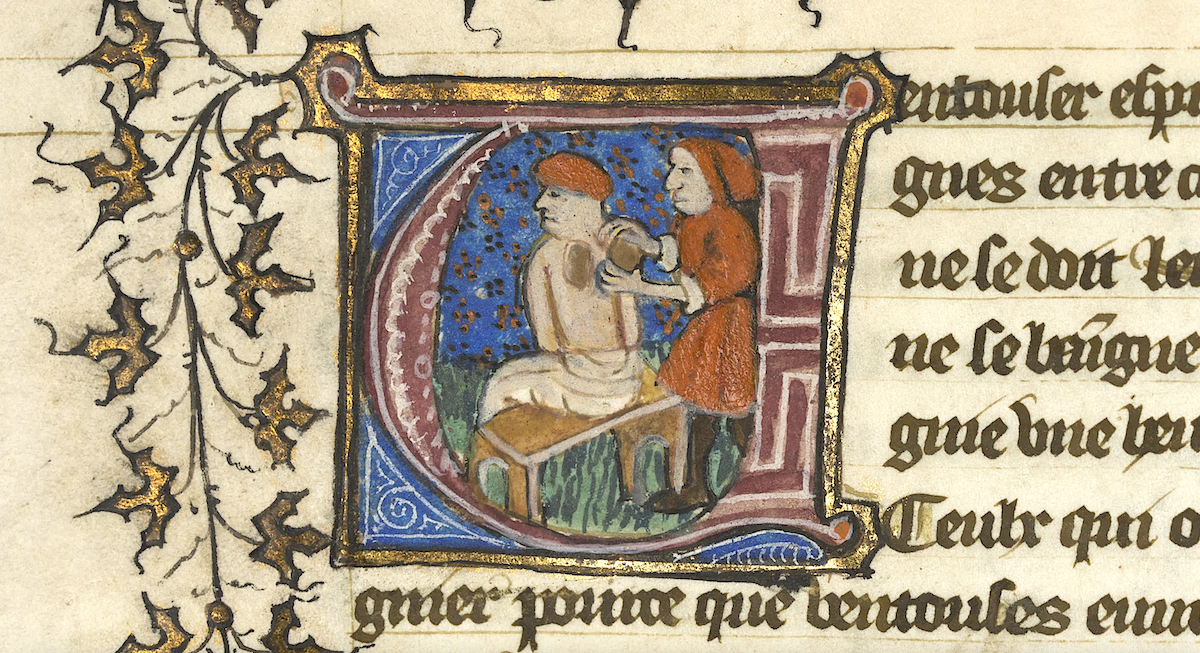
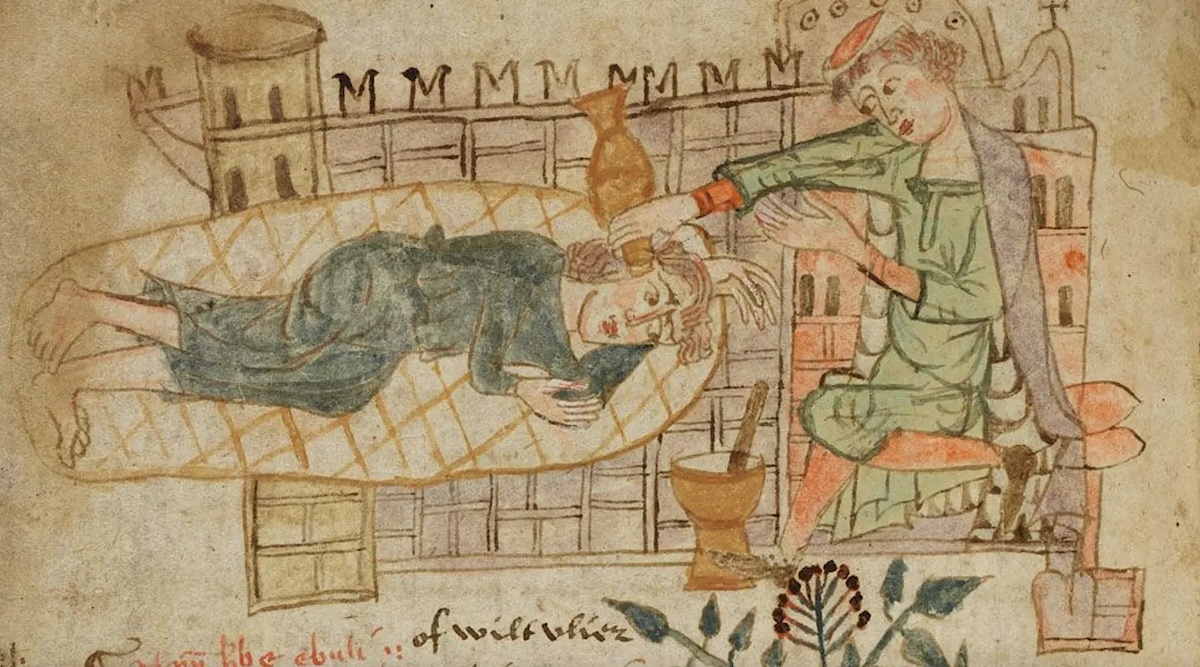
If any discussion of medieval medicine gets going, it’s only a matter of time before someone brings up leeches. And it turns out that the centrality of those squirming blood-suckers to the treatment of disease in the Middle Ages isn’t much overstated, at least judging by a look through Curious Cures. A Wellcome Research Resources Award-funded project of the University of Cambridge Libraries, it has recently finished conserving, digitizing, and making available online 190 manuscripts containing more than 7,000 pages of medieval medical recipes. These books contain a wealth of information even beyond the text on their pages: a multi-spectral imaging analysis of one of them, for example, revealed that it was once owned by a certain “Thomas Word, leche” — or leech, i.e., a healer who made intensive use of the tools you might imagine.
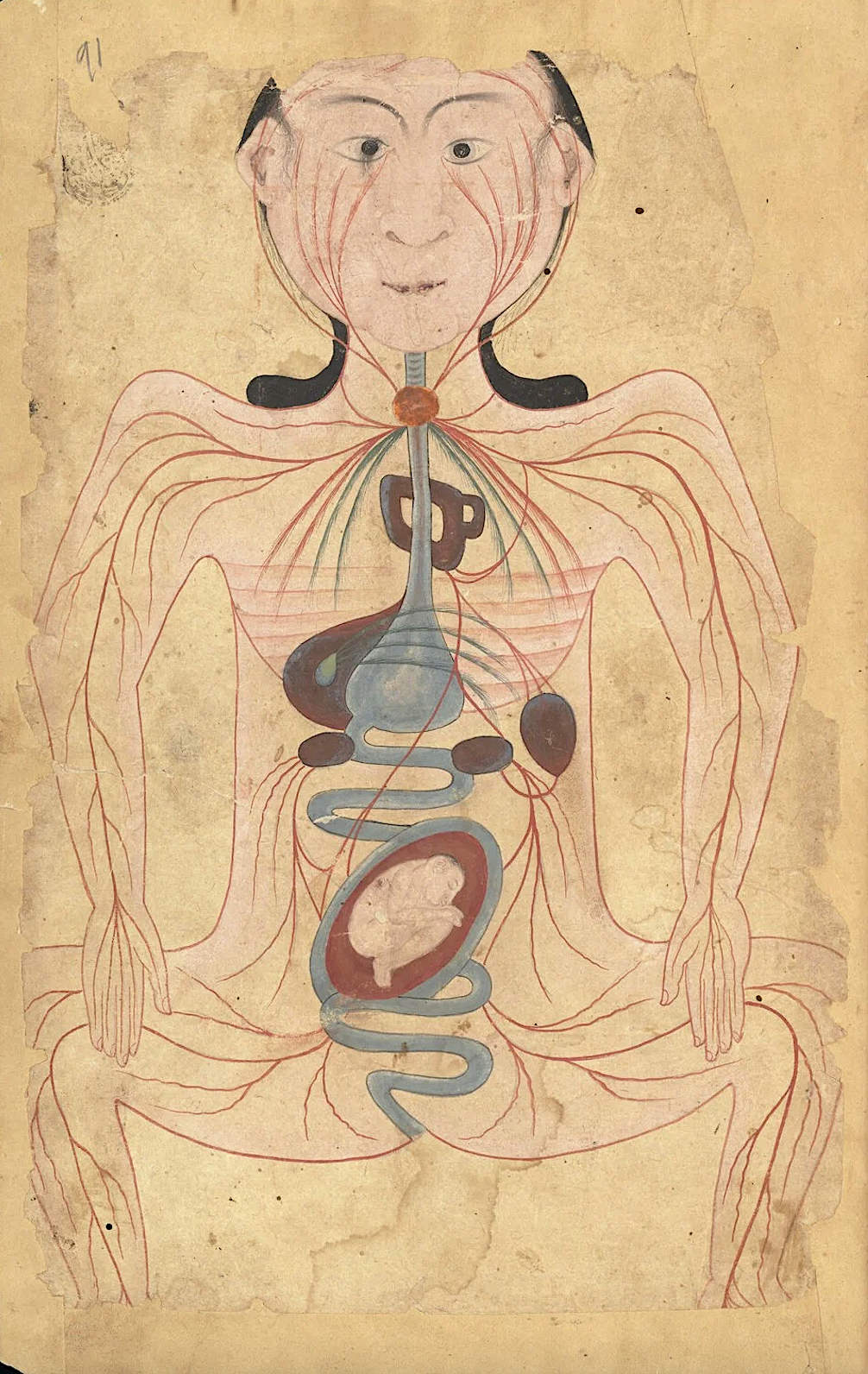
Not that the practice of medieval medicine came down to applying leeches and nothing more. In the manuscripts digitized by Curious Cures (which include not just strictly medical texts but also bibles, law texts, and books of hours), one finds a wonderland of dove feces, fox lungs, salted owl, eel grease, weasel testicles, quicksilver (i.e. mercury) — a wonderland for readers curious about medieval forms of knowledge, if not for the actual patients who had to undergo these dubious treatments.
But as any scholar of the subject would be quick to remind us, medical documents in the Middle Ages may have wantonly mixed folk and “official” knowledge, but they were hardly repositories of pure superstition: rather, they represent the best efforts of intelligent people to understand their own bodies and the world they inhabited, within the dominant worldview of their time and place.
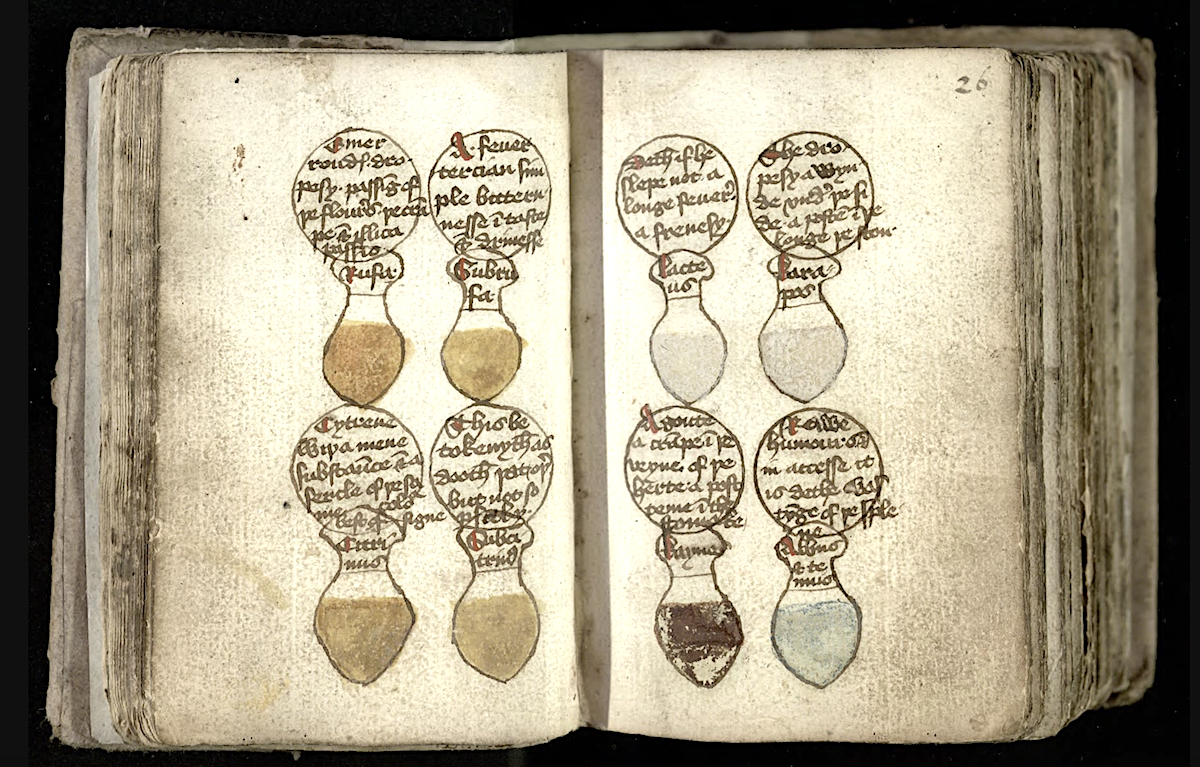
That was a time in which health was thought to be determined by the “four humors,” black bile, yellow bile, blood and phlegm; a time when certain parts of plants or animals were believed to be in “sympathetic” correspondence with certain parts of the human body; a time when repeatedly praying while clipping one’s fingernails, then burying those clippings in an elder tree, could plausibly cure a toothache. And now, it’s easier than ever to get a sense of what it must have been like, thanks to Curious Cures’ transcribed, translated, and searchable archive of all these manuscripts. The more outlandish remedies aside, what’s remarkable is how these books also acknowledge the importance of what we would now call a good night’s sleep, regular exercise, and a balanced, varied diet. Medievals may have understood their own health better than we imagine, but regardless, we’re probably not bringing back leechcraft anytime soon.
Related Content:
Based in Seoul, Colin Marshall writes and broadcasts on cities, language, and culture. His projects include the Substack newsletter Books on Cities and the book The Stateless City: a Walk through 21st-Century Los Angeles. Follow him on the social network formerly known as Twitter at @colinmarshall.
Read More...Curious Alice — The 1971 Anti-Drug Movie Based on Alice in Wonderland That Oddly Made Drugs Look Like Fun
The Reagan presidency was probably the golden age of anti-drug messaging. America’s school kids were told that a brain was like an egg and drugs were like a frying pan. The First Lady told America’s school kids simply to “Just Say No.” The message was stupefyingly simple. Drugs, like Communism and taxes, are bad.
During the early 1970s, however, that anti-drug message was much more confused. Take for example Curious Alice, a visually stunning, deeply odd movie about the perils of drug abuse that makes the stuff look like a lot of fun. Created by the National Institute of Mental Health in 1971, the film shows young Alice reading Lewis Carroll’s Alice in Wonderland in a sunny dappled meadow before nodding off.
She soon finds herself plunging down the rabbit hole and in a wonderland … of drugs. The King of Hearts is hawking heroin. The Mad Hatter is tripping on LSD. The hookah-smoking Caterpillar is stoned out of his gourd. The Dormouse is in a barbiturate-induced stupor and the March Hare, who looks like the Trix Bunny’s ne’er-do-well brother, is a fidgeting tweaker. “You oughta have some pep pills! Uppers!” he exclaims. “Amphetamines! Speed! You feel super good.”
The movie was reportedly intended for eight-year-olds. While it’s unlikely that your average third grader is going to absorb Alice’s moralizing about acid, they will almost certainly respond to the film’s trippy, Monty Pythonesque animation. The animators clearly had a blast making this movie, but their efforts didn’t exactly translate into an effective message. After the movie came out, the National Coordinating Council on Drug Education slammed the movie, calling it confusing and counterproductive. As an adult, however, the movie is a lot of fun. So check it out above.
Note: An earlier version of this post appeared on our site in 2014.
Related Content:
The First-Ever Film Version of Lewis Carroll’s Tale, Alice in Wonderland (1903)
Artist Draws Nine Portraits on LSD During 1950s Research Experiment
Jonathan Crow is a writer and filmmaker whose work has appeared in Yahoo!, The Hollywood Reporter, and other publications.
Read More...Man as Industrial Palace: Watch an Animation of the Famous 1926 Lithograph That Depicts the Human Body as a Modern Factory
In 1926, Fritz Kahn, a German gynecologist and anatomy textbook author, produced a lithograph called Der Mensch als Industriepalast (Man as Industrial Palace) that depicted the human body as a factory, a chemical plant of sorts. Kahn’s body came complete with mechanical lungs, a rock-sorting stomach, gears for a throat, and a switchboard for a brain, and it illustrated rather metaphorically the degree to which industrialization had taken over Western life, creating deep anxiety for some and curiosity for others.
More than 80 years later, Henning Lederer, a German artist, brought Kahn’s mechanical body to life with some gifted animation. To learn more about Lederer’s project, you will want to spend more time on IndustriePalast.com and particularly with this helpful PDF. Other animations by Lederer can be found on Vimeo.

An earlier version of this post originally appeared on our site in 2011.
If you would like to support the mission of Open Culture, consider making a donation to our site. It’s hard to rely 100% on ads, and your contributions will help us continue providing the best free cultural and educational materials to learners everywhere. You can contribute through PayPal, Patreon, and Venmo (@openculture). Thanks!
Related Content:
Download Hundreds of Issues of Jugend, Germany’s Pioneering Art Nouveau Magazine (1896–1940)
Extensive Archive of Avant-Garde & Modernist Magazines (1890–1939) Now Available Online
Read More...An Introduction to Aleister Crowley, History’s Most Infamous Occultist
“Do what thou wilt”: as the central principle of a worldview, it may not sound like much, but at least there are always a great many people ready and willing to hear it. So discovered Aleister Crowley, the early twentieth-century Occultist now remembered not just for his unconventional religious practices, but also for his knack for gathering cults around himself. It was in Liber AL vel Legis, or The Book of the Law, the central text of his religion Thelema, that he instructed his followers to act directly on their own desires, ideally with the aid of some ritualistic black magick.
You can learn more about the life and pursuits that eventually got Crowley dubbed “the wickedest man in the world” from the Hochelaga video above. After living most of his childhood under a Biblical-fundamentalist preacher father, who died when Crowley was eleven, he was sent away to various boarding schools, then turned troublemaker. At Cambridge, where he went to study English literature, he fell for the Romantics, then for the occult. After leaving without his degree, but with a considerable inheritance, he enjoyed the freedom to travel the world, climbing mountains and attempting to master the dark arts — not to mention taking drugs and having affairs.
As he went from country to country, Crowley never met an ancient religion he couldn’t adapt to his own ends. But no gods made as much of an impact on him as those of ancient Egypt, specifically Hoor-paar-kraat, or Harpocrates in the Greek; Crowley claimed to have been contacted by the voice of Hoor-paar-kraat’s messenger Aiwass, from whom he took the dictation that became Liber AL vel Legis. Styling himself as an Egyptian prophet, he preached one way for humanity to push through to a post-Christian age: “Whatever you feel like doing, go and do it, regardless of popular opinion or conventional morality.” After all, it seemed to work for Crowley himself, though the work of a notorious occultist certainly isn’t for everybody.
Nor could even the world’s wickedest man keep it up forever: “Eventually all the traveling, drug-taking, and libertinism had caught up with Crowley.” His inheritance dried up, and his addictions worsened. But he didn’t give up on Thelema, even going so far as to establish a commune in Sicily. Alas, the “responsibility-free lifestyle” advocated by the religion soon drove its headquarters to chaotic dilapidation. But just a couple of decades after his death in England in 1947, Crowley’s glowering visage popped up again, on the cover of Sgt. Pepper’s Lonely Hearts Club Band. He became the subject of pop-music reference not just by the Beatles, but also David Bowie, Iron Maiden, and the late Ozzy Osbourne. “Genius? Insane? Visionary? Fraud? Freethinker? Cult leader?” We might grant Aleister Crowley all these titles, and that of proto-rock star besides.
Related content:
Aleister Crowley Reads Occult Poetry in the Only Known Recordings of His Voice (1920)
The Thoth Tarot Deck Designed by Famed Occultist Aleister Crowley
The Surreal Paintings of the Occult Magician, Writer & Mountaineer, Aleister Crowley
Based in Seoul, Colin Marshall writes and broadcasts on cities, language, and culture. His projects include the Substack newsletter Books on Cities and the book The Stateless City: a Walk through 21st-Century Los Angeles. Follow him on the social network formerly known as Twitter at @colinmarshall.
Read More...W.H. Auden’s 1941 Syllabus Asked Students to Read 32 Great Literary Works, Totaling 6,000 Pages
Whether willed, involuntary, or a mix of both, the declining literacy of college students is by now so often lamented that reports of it should no longer come as a surprise. And yet, on some level, they still do: English majors in regional Kansas universities find the opening to Bleak House virtually unintelligible; even students at “highly selective, elite colleges” struggle to read, let alone comprehend, books in their entirety. Things were different in 1941, and very different indeed if you happened to be taking English 135 at the University of Michigan, a class titled “Fate and the Individual in European Literature.” The instructor: a certain W. H. Auden.
In his capacity as an educator, the poet threw down the gauntlet of an “infamously difficult” syllabus, as literary academic and YouTuber Adam Walker explains in his new video above, that “asked undergraduates to read about 6,000 pages of classic literature.”
Not that the course was out of touch with current events: in its historical moment, “Nazi Germany had invaded the Soviet Union and expanded into Eastern Europe. Systematic extermination begins with mass shootings, and the machinery of genocide is accelerating. It’s no accident that Auden takes an interest in fate and the individual in European literature” — a theme that, as he frames it, begins with Dante. After the entirety of The Divine Comedy, Auden’s students had their free choice between Aeschylus’ Agamemnon or Sophocles’ Antigone.

From there, the required reading plunged into Horace’s Odes and Augustine’s Confessions, four Shakespeare plays, Pascal’s Pensées, Goethe’s Faust (but only Part I), and Dostoevsky’s The Brothers Karamazov, to name just a few texts. Not everyone would consider Dostoevsky European, of course, but then, nobody would consider Herman Melville European, which for Auden was hardly a reason to leave Moby-Dick off the syllabus. Walker describes that novel as relevant to the course’s themes of “obsession and cosmic struggle,” evident in all these works and their treatments of “passion and historical forces, and how individuals navigate those forces”: ideas that transcend national and cultural boundaries by definition. Whether they would come across to the kind of twenty-first-century students who’d balk at being assigned even a full-length Auden poem is another question entirely.
View the syllabus in a larger format here.
Related content:
W. H. Auden Recites His 1937 Poem “As I Walked Out One Evening”
Discover Hannah Arendt’s Syllabus for Her 1974 Course on “Thinking”
David Foster Wallace’s 1994 Syllabus: How to Teach Serious Literature with Lightweight Books
Donald Barthelme’s Syllabus Highlights 81 Books Essential for a Literary Education
Carl Sagan’s Syllabus & Final Exam for His Course on Critical Thinking (Cornell, 1986)
Based in Seoul, Colin Marshall writes and broadcasts on cities, language, and culture. His projects include the Substack newsletter Books on Cities and the book The Stateless City: a Walk through 21st-Century Los Angeles. Follow him on the social network formerly known as Twitter at @colinmarshall.
Read More...Archaeologists Discover a 2,400-Year-Old Skeleton Mosaic That Urges People to “Be Cheerful and Live Your Life”
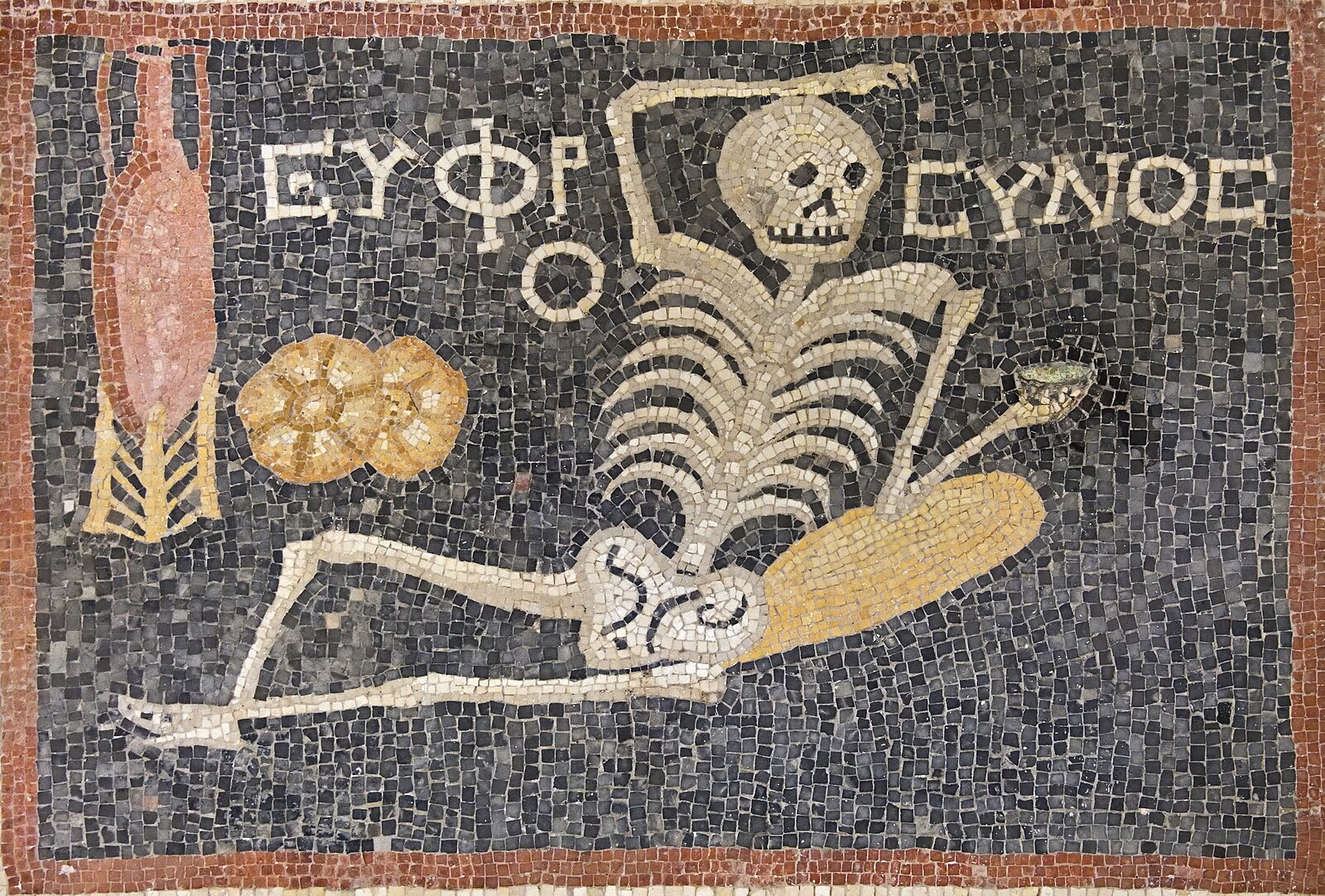
Image by Dosseman, via Wikimedia Commons
In 2012, archaeologists discovered in Southern Turkey a well-preserved mosaic featuring a skeleton savoring a loaf of bread and a pitcher of wine, surrounded by the Greek words “Be cheerful and live your life.” Dating back to the 3rd century BCE, the mosaic likely adorned the dining room of a wealthy villa in the ancient Greco-Roman city of Antioch. It’s a kind of memento mori, a reminder that life is short and you should enjoy it while you can. Or so that’s how many have interpreted the message of the mosaic.
If you would like to delve deeper, it’s worth reading the analysis and background information provided by The History Blog. Meanwhile, this separate post on Tumblr highlights other translations and interpretations of the mosaic’s key inscription.
If you would like to support the mission of Open Culture, consider making a donation to our site. It’s hard to rely 100% on ads, and your contributions will help us continue providing the best free cultural and educational materials to learners everywhere. You can contribute through PayPal, Patreon, and Venmo (@openculture). Thanks!
Related Content
A Rabbit Rides a Chariot Pulled by Geese in an Ancient Roman Mosaic (2nd century AD)
How to Make the 2000-Year-Old “Pizza” Discovered on a Pompeii Fresco
Read More...Support Us
We're hoping to rely on loyal readers, rather than erratic ads. Please click the Donate button and support Open Culture. You can use Paypal, Venmo, Patreon, even Crypto! We thank you!

About Us

Open Culture scours the web for the best educational media. We find the free courses and audio books you need, the language lessons & educational videos you want, and plenty of enlightenment in between.
Advertise With Us

FREE UPDATES!
GET OUR DAILY EMAIL
Get the best cultural and educational resources on the web curated for you in a daily email. We never spam. Unsubscribe at any time.
FOLLOW ON SOCIAL MEDIA

Open Culture editor Dan Colman scours the web for the best educational media. He finds the free courses and audio books you need, the language lessons & movies you want, and plenty of enlightenment in between.
Advertise With Us