Meet Jesse Welles, the Folk Singer Who Turns News into Folk Music, Writing Songs on Elections, Plane Crashes, Ozempic & More
At first glance, Jesse Welles resembles nothing so much as a time traveler from the year 1968. That’s how I would open a profile about him, but The New York Times’ David Peisner takes a different approach, describing him recording a song in his home studio. “Welles, a singer-songwriter with a shaggy, dirty-blond mane and a sandpapery voice, has risen to recent prominence posting videos to social media of himself alone in the woods near his home in northwest Arkansas, performing wryly funny, politically engaged folk songs,” Peisner continues. This practice has produced “viral hits on TikTok and Instagram, building an audience of more than 2 million followers on those platforms.”
Welles’ subjects have included “the war in Gaza, the rise of the weight-loss drug Ozempic, and the rapaciousness of United Healthcare’s business model.” You can hear his musical takes on these news-pegged subjects on his YouTube channel, along with such other much-viewed, ripped-from-the-headlines songs as “Fentanyl,” “Walmart,” “Whistle Boeing,” and “We’re All Gonna Die.”
For his younger listeners, his subject matter (and his perspective on it) have a kind of currency much intensified by life on social media; for his older listeners, his manner and musicianship recall a golden age of the protest singer that many would have assumed a wholly closed chapter of cultural history.
It will, perhaps, disappoint both relevant demographics that Welles’ forthcoming debut album Middle includes none of these viral hits, nor anything much like them. “The only filter placed on it was I wasn’t doing topical songs for this project,” Peisner quotes him as saying, later writing that the album “surfs between surrealistic fantasy worlds and Welles’s own inner life.” This counterintuitive move is understandable: given his obvious chops honed with the inspiration of Bob Dylan, Tom Petty, and John Prine, being pigeonholed as a singer of the news on TikTok has probably never been his ultimate goal. A couple of decades from now, music critics may declare that Oliver Anthony walked so that Jesse Welles could run.
Related content:
Tom Petty Takes You Inside His Songwriting Craft
The Acoustic Guitar Project Gives Songwriters Worldwide a Guitar and One Week to Write a Song
John Prine’s Last Song Was Also His First to Go No. 1: Watch Him Perform “I Remember Everything”
Based in Seoul, Colin Marshall writes and broadcasts on cities, language, and culture. His projects include the Substack newsletter Books on Cities and the book The Stateless City: a Walk through 21st-Century Los Angeles. Follow him on the social network formerly known as Twitter at @colinmarshall.
Read More...How the Fairlight CMI Synthesizer Revolutionized Music
In the credits of Phil Collins’ No Jacket Required appears the disclaimer that “there is no Fairlight on this record.” Cryptic though it may have appeared to most of that album’s many buyers, technology-minded musicians would’ve got it. In the half-decades since its introduction, the Fairlight Computer Musical Instrument, or CMI, had reshaped the sound of pop music — or at least the pop music created by acts who could afford one. The device may have cost as much as a house, but for those who understood the potential of playing and manipulating the sounds of real-life instruments (or of anything else besides) digitally, money was no object.
The history of the Fairlight CMI is told in the video above from the Sydney Morning Herald and The Age, incorporating interviews from its Australian inventors Peter Vogel and Kim Ryrie. According to Ryrie, No Jacket Required actually did use the Fairlight, in the sense that one of its musicians sampled a sound from the Fairlight’s library. To musicians, using the technology not yet widely known as digital sampling would have felt like magic; to listeners, it meant a whole range of sounds they’d never heard before, or at least never used in that way. Take the “orchestra hit” originally sampled from a record of Stravinsky’s The Firebird (and whose story is told in the Vox video just above), which soon became practically inescapable.
We might call the orchestra hit the Fairlight’s “killer app,” though its breathy, faintly vocal sample known as “ARR1” also saw a lot of action across genres. A desire for those particular effects brought a lot of musicians and producers onto the bandwagon throughout the eighties, but it was the early adopters who used the Fairlight most creatively. The earliest among them was Peter Gabriel, who appears in the clip from the French documentary above gathering sounds to sample, blowing wind through pipes and smashing up televisions in a junkyard. Kate Bush embraced the Fairlight with a special fervor, using not just its sampling capabilities but also its groundbreaking sequencing software (included from the Series II onward) to create her 1985 hit “Running Up That Hill,” which made a surprise return to popularity just a few years ago.
The Fairlight’s high-profile American users included Stevie Wonder, Todd Rundgren, and Herbie Hancock, who demonstrates his own model alongside the late Quincy Jones in the documentary clip above. With its green-on-black monitor, its gigantic floppy disks, and its futuristic-looking “light pen” (as natural a pointing device as any in an era when most of humanity had never laid eyes on a mouse), it resembles less a musical instrument than an early personal computer with a piano keyboard attached. It had its cumbersome qualities, and some leaned rather too heavily on its packed-in sounds, but as Hancock points out, a tool is a tool, and it’s all down to the human being in control to get pleasing results out of it: “It doesn’t plug itself in. It doesn’t program itself… yet.” To which the always-prescient Jones adds: “It’s on the way, though.”
Related content:
Watch Herbie Hancock Demo a Fairlight CMI Synthesizer on Sesame Street (1983)
How the Yamaha DX7 Digital Synthesizer Defined the Sound of 1980s Music
Thomas Dolby Explains How a Synthesizer Works on a Jim Henson Kids Show (1989)
How the Moog Synthesizer Changed the Sound of Music
Based in Seoul, Colin Marshall writes and broadcasts on cities, language, and culture. His projects include the Substack newsletter Books on Cities and the book The Stateless City: a Walk through 21st-Century Los Angeles. Follow him on the social network formerly known as Twitter at @colinmarshall.
Read More...Jane Austen Used Pins to Edit Her Manuscripts: Before the Word Processor & White-Out
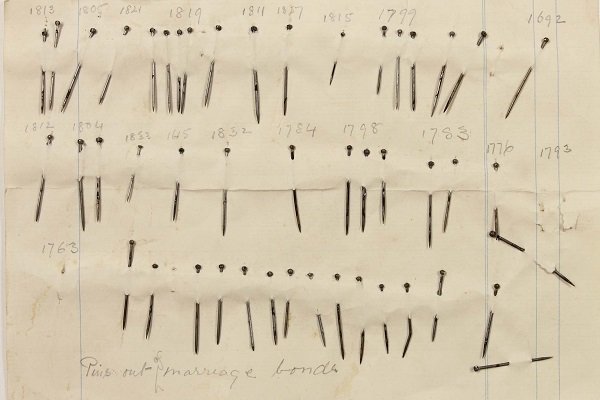
Before the word processor, before White-Out, before Post-It Notes, there were straight pins. Or, at least that’s what Jane Austen used to make edits in one of her rare manuscripts. In 2011, Oxford’s Bodleian Library acquired the manuscript of Austen’s abandoned novel, The Watsons. In announcing the acquisition, the Bodleian wrote:
The Watsons is Jane Austen’s first extant draft of a novel in process of development and one of the earliest examples of an English novel to survive in its formative state. Only seven manuscripts of fiction by Austen are known to survive. The Watsons manuscript is extensively revised and corrected throughout, with crossings out and interlinear additions.
Janeausten.ac.uk (the website where Austen’s manuscripts have been digitized) takes a deeper dive into the curious quality of The Watsons manuscript, noting:
The manuscript is written and corrected throughout in brown iron-gall ink. The pages are filled in a neat, even hand with signs of concurrent writing, erasure, and revision, interrupted by occasional passages of heavy interlinear correction.… The manuscript is without chapter divisions, though not without informal division by wider spacing and ruled lines. The full pages suggest that Jane Austen did not anticipate a protracted process of redrafting. With no calculated blank spaces and no obvious way of incorporating large revision or expansion she had to find other strategies – the three patches, small pieces of paper, each of which was filled closely and neatly with the new material, attached with straight pins to the precise spot where erased material was to be covered or where an insertion was required to expand the text.
According to Christopher Fletcher, Keeper of Special Collections at the Bodleian Library, this prickly method of editing wasn’t exactly new. Archivists at the library can trace pins being used as editing tools back to 1617.
You can find The Watsons online here:
- The Watsons, Morgan Library & Museum, New York — Facsimile
- The Watsons, Bodleian Library, Oxford — Facsimile
Note: An earlier version of this post appeared on our site in August, 2014.
If you would like to support the mission of Open Culture, consider making a donation to our site. It’s hard to rely 100% on ads, and your contributions will help us continue providing the best free cultural and educational materials to learners everywhere. You can contribute through PayPal, Patreon, and Venmo (@openculture). Thanks!
Related Content:
How Jane Austen Changed Fiction Forever
Take a Virtual Tour of Jane Austen’s Library
Jane Austen’s Music Collection, Now Digitized and Available Online
Read More...Watch 10 Great German Expressionist Films: Nosferatu, The Cabinet of Dr. Caligari & More
In 1913, Germany, flush with a new nation’s patriotic zeal, looked like it might become the dominant nation of Europe and a real rival to that global superpower Great Britain. Then it hit the buzzsaw of World War I. After the German government collapsed in 1918 from the economic and emotional toll of a half-decade of senseless carnage, the Allies forced it to accept draconian terms for surrender. The entire German culture was sent reeling, searching for answers to what happened and why.
German Expressionism came about to articulate these lacerating questions roiling in the nation’s collective unconscious. The first such film was The Cabinet of Dr. Caligari (1920), about a malevolent traveling magician who has his servant do his murderous bidding in the dark of the night. The storyline is all about the Freudian terror of hidden subconscious drives, but what really makes the movie memorable is its completely unhinged look. Marked by stylized acting, deep shadows painted onto the walls, and sets filled with twisted architectural impossibilities — there might not be a single right angle in the film – Caligari’s look perfectly meshes with the narrator’s demented state of mind.
Subsequent German Expressionist movies retreated from the extreme aesthetics of Caligari but were still filled with a mood of violence, frustration and unease. F. W. Murnau’s brilliantly depressing The Last Laugh (1924) is about a proud doorman at a high-end hotel who is unceremoniously stripped of his position and demoted to a lowly bathroom attendant. When he hands over his uniform, his posture collapses as if the jacket were his exoskeleton. You don’t need to be a semiotician to figure out that the doorman’s loss of status parallels Germany’s. Fritz Lang’s M (1931), a landmark of early sound film, is the first serial killer movie ever made. But what starts out as a police procedural turns into something even more unsettling when a gang of distinctly Nazi-like criminals decide to mete out some justice of their own.
German Expressionism ended in 1933 when the Nazis came to power. They weren’t interested in asking uncomfortable questions and viewed such dark tales of cinematic angst as unpatriotic. Instead, they preferred bright, cheerful tales of Aryan youths climbing mountains. By that time, the movement’s most talented directors — Fritz Lang and F.W. Murnau — had fled to America. And it was in America where German Expressionism found its biggest impact. Its stark lighting, grotesque shadows and bleak worldview would go on to profoundly influence film noir in the late 1940s after another horrific, disillusioning war. See our collection of Free Noir Films here.
You can watch 10 German Expressionist movies – including Caligari, Last Laugh and M — for free below.
- Nosferatu — Free — German Expressionist horror film directed by F. W. Murnau. An unauthorized adaptation of Bram Stoker’s Dracula. (1922)
- The Student of Prague — Free — A classic of German expressionist film. German writer Hanns Heinz Ewers and Danish director Stellan Rye bring to life a 19th-century horror story. Some call it the first indie film. (1913)
- Nerves — Free — Directed by Robert Reinert, Nerves tells of “the political disputes of an ultraconservative factory owner Herr Roloff and Teacher John, who feels a compulsive but secret love for Roloff’s sister, a left-wing radical.” (1919)
- The Cabinet of Dr. Caligari — Free — This silent film directed by Robert Wiene is considered one of the most influential German Expressionist films and perhaps one of the greatest horror movies of all time. (1920)
- Metropolis — Free — Fritz Lang’s fable of good and evil fighting it out in a futuristic urban dystopia. An important classic. (1927)
- The Golem: How He Came Into the World — Free — A follow-up to Paul Wegener’s earlier film, “The Golem,” about a monstrous creature brought to life by a learned rabbi to protect the Jews from persecution in medieval Prague. Based on the classic folk tale, and co-directed by Carl Boese. (1920)
- The Golem: How He Came Into the World — Free — The same film as the one listed immediately above, but this one has a score created by Pixies frontman Black Francis. (2008)
- The Last Laugh - Free — F.W. Murnau’s classic chamber drama about a hotel doorman who falls on hard times. A masterpiece of the silent era, the story is told almost entirely in pictures. (1924)
- Faust — Free - German expressionist filmmaker F.W. Murnau directs a film version of Goethe’s classic tale. This was Murnau’s last German movie. (1926)
- Sunrise: A Song of Two Humans — Free — Made by the German expressionist director F.W. Murnau. Voted in 2012, the 5th greatest film of all time. (1927)
- M — Free — Classic film directed by Fritz Lang, with Peter Lorre. About the search for a child murderer in Berlin. (1931)
For more classic films, peruse our larger collection, 4,000+ Free Movies Online: Great Classics, Indies, Noir, Westerns, Documentaries & More.
Note: An earlier version of this post appeared on our site in December, 2014.
If you would like to support the mission of Open Culture, consider making a donation to our site. It’s hard to rely 100% on ads, and your contributions will help us continue providing the best free cultural and educational materials to learners everywhere. You can contribute through PayPal, Patreon, and Venmo (@openculture). Thanks!
Related Content:
How German Expressionism Influenced Tim Burton: A Video Essay
When the Nazis Declared War on Expressionist Art (1937)
Jonathan Crow is a writer and filmmaker whose work has appeared in Yahoo!, The Hollywood Reporter, and other publications.
Read More...Horrifying 1906 Illustrations of H.G. Wells’ War of the Worlds: Discover the Art of Henrique Alvim Corrêa
H.G. Wells’ War of the Worlds has terrified and fascinated readers and writers for decades since its 1898 publication and has inspired numerous adaptations. The most notorious use of Wells’ book was by Orson Welles, whom the author called “my little namesake,” and whose 1938 War of the Worlds Halloween radio play caused public alarm (though not actually a national panic). After the occurrence, reports Phil Klass, the actor remarked, “I’m extremely surprised to learn that a story, which has become familiar to children through the medium of comic strips and many succeeding and adventure stories, should have had such an immediate and profound effect upon radio listeners.”
Surely Welles knew that is precisely why the broadcast had the effect it did, especially in such an anxious pre-war climate. The 1898 novel also startled its first readers with its verisimilitude, playing on a late Victorian sense of apocalyptic doom as the turn-of-the century approached.
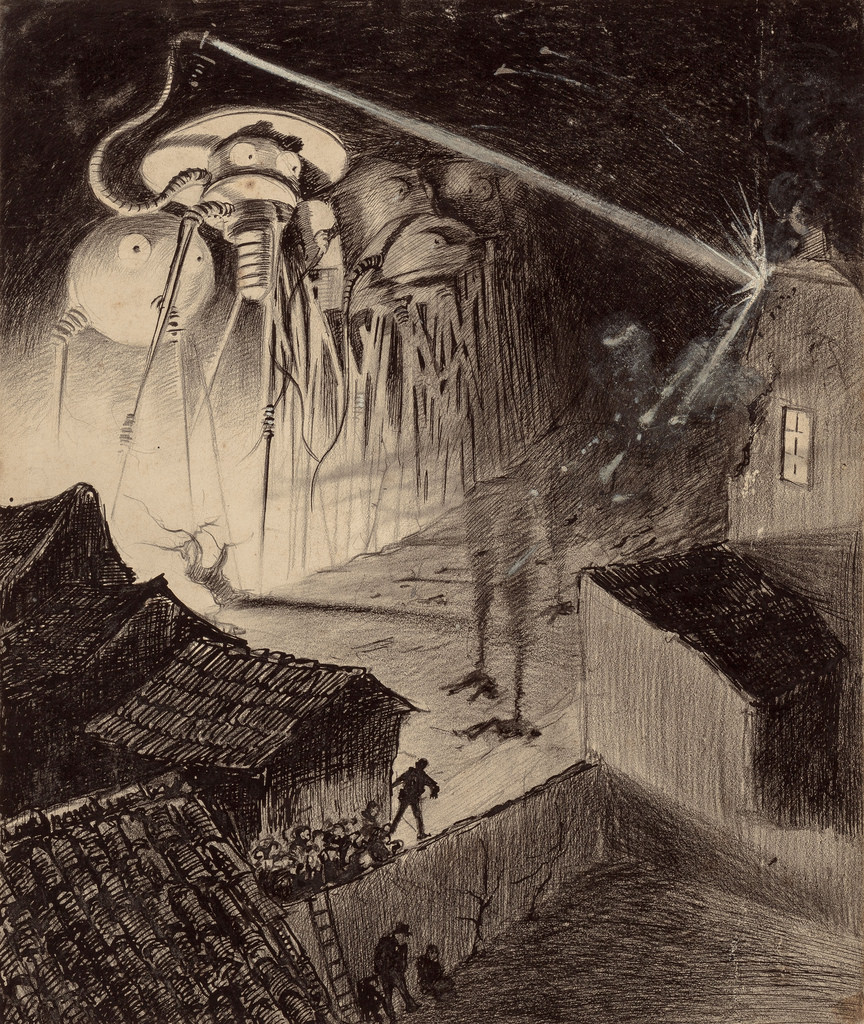
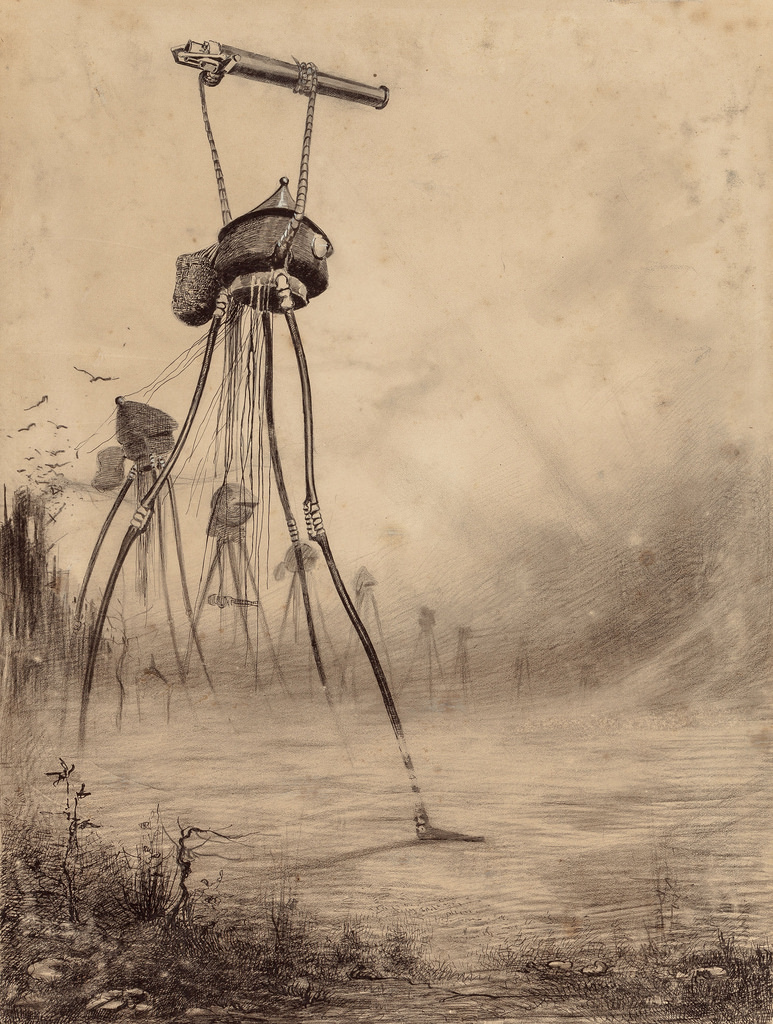
But what contemporary circumstances eight years later, we might wonder, fueled the imagination of Henrique Alvim Corrêa, whose 1906 illustrations of the novel you can see here? Wells himself approved of these incredible drawings, praising them before their publication and saying, “Alvim Corrêa did more for my work with his brush than I with my pen.”
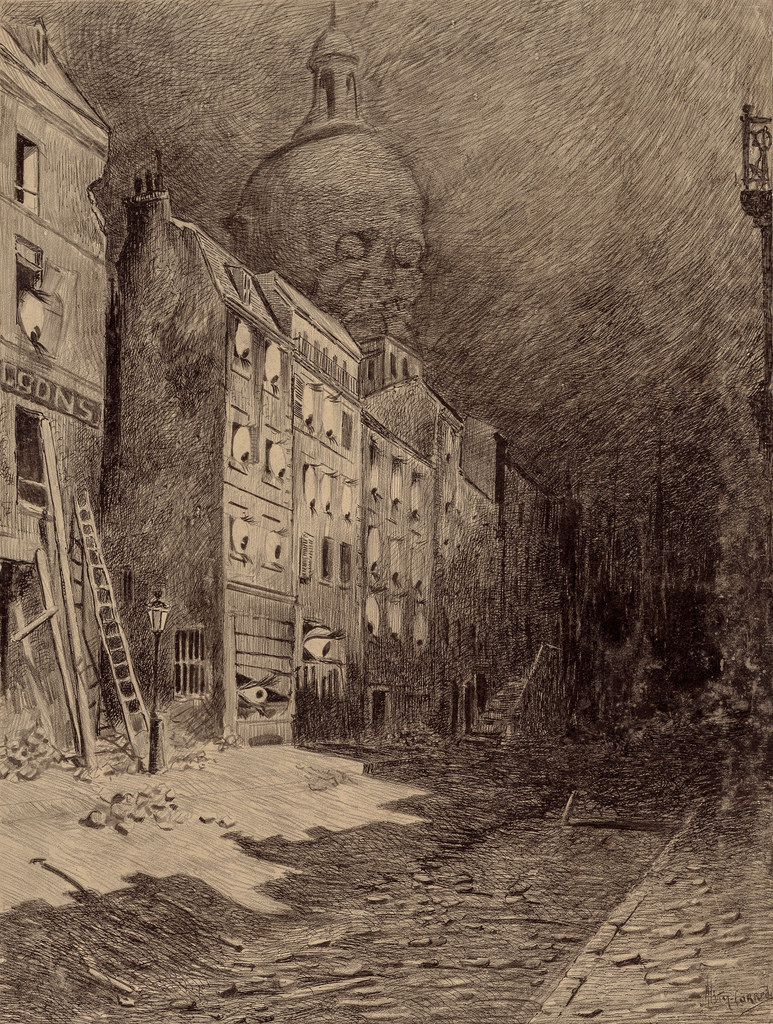
Indeed they capture the novel’s uncanny dread. Martian tripods loom, ghastly and cartoonish, above blasted realist landscapes and scenes of panic. In one illustration, a grotesque, tentacled Martian ravishes a nude woman. In a surrealist drawing of an abandoned London above, eyes protrude from the buildings, and a skeletal head appears above them. The alien technology often appears clumsy and unsophisticated, which contributes to the generally terrifying absurdity that emanates from these finely rendered plates.
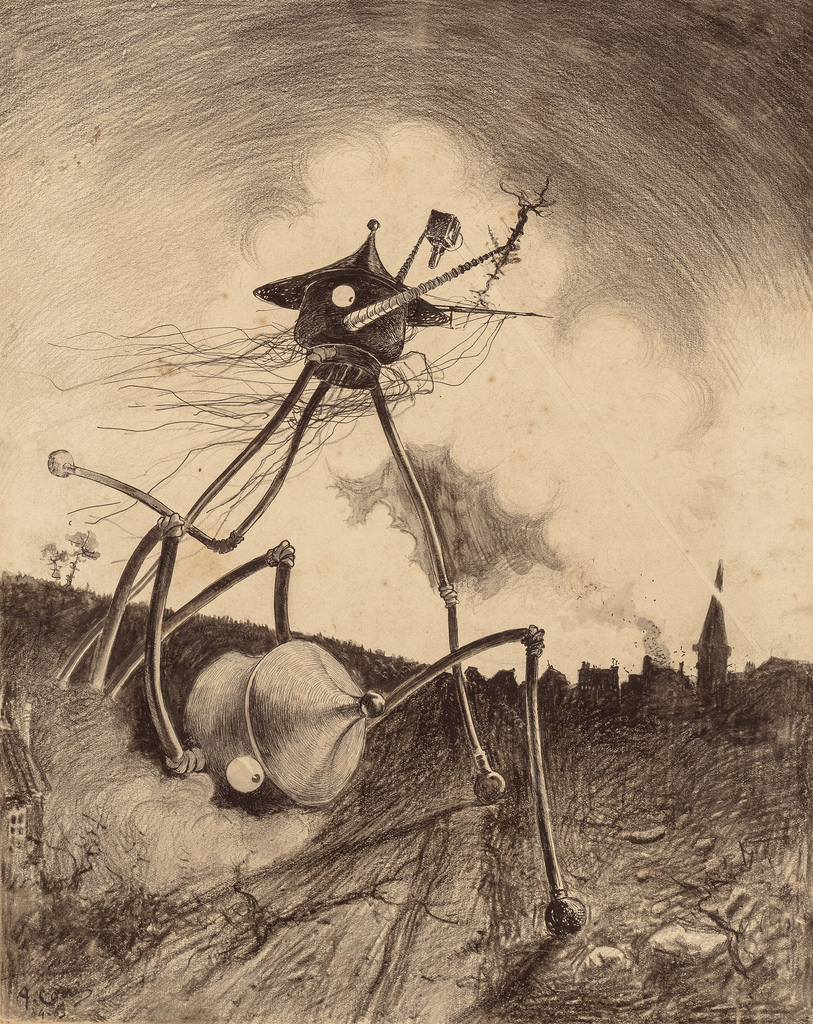
Alvim Corrêa was a Brazilian artist living in Brussels and struggling for recognition in the European art world. His break seemed to come when the War of the Worlds illustrations were printed in a large-format, limited French edition of the book, with each of the 500 copies signed by the artist himself.
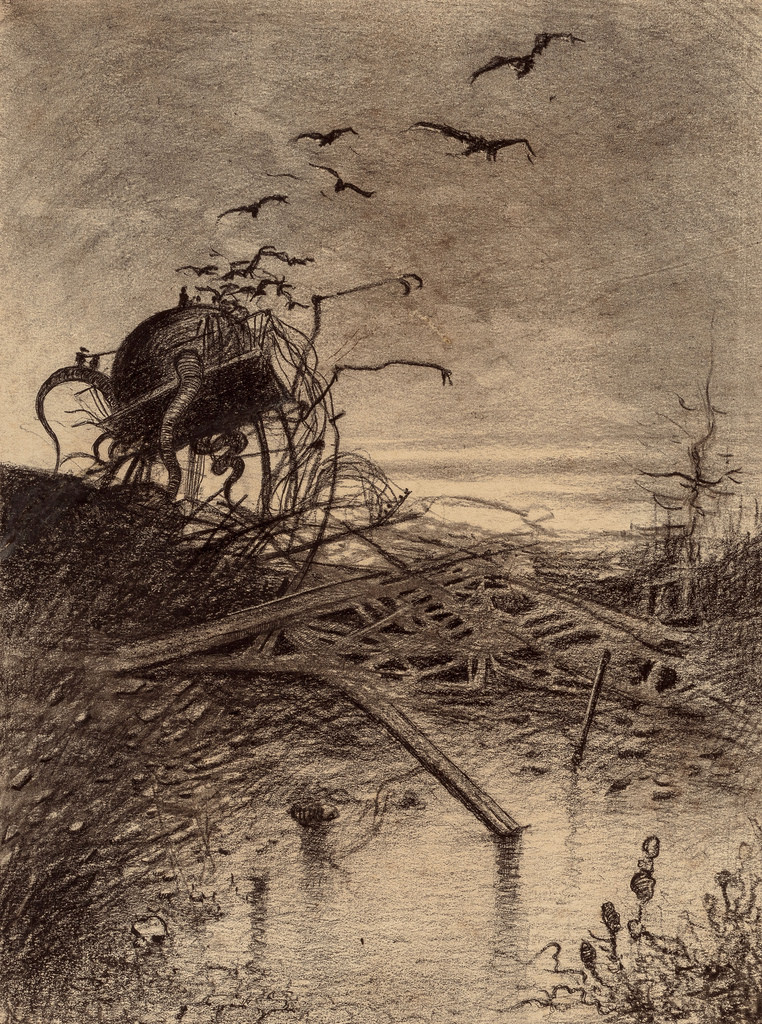
Unfortunately, Corrêa’s tuberculosis killed him four years later. His War of the Worlds drawings did not bring him fame in his lifetime or after, but his work has been cherished since by a devoted cult following. The original prints you see here remained with the artist’s family until a sale of 31 of them in 1990. You can see many more, as well as scans from the book and a poster announcing the publication, at The Public Domain Review and the Monster Brains site.
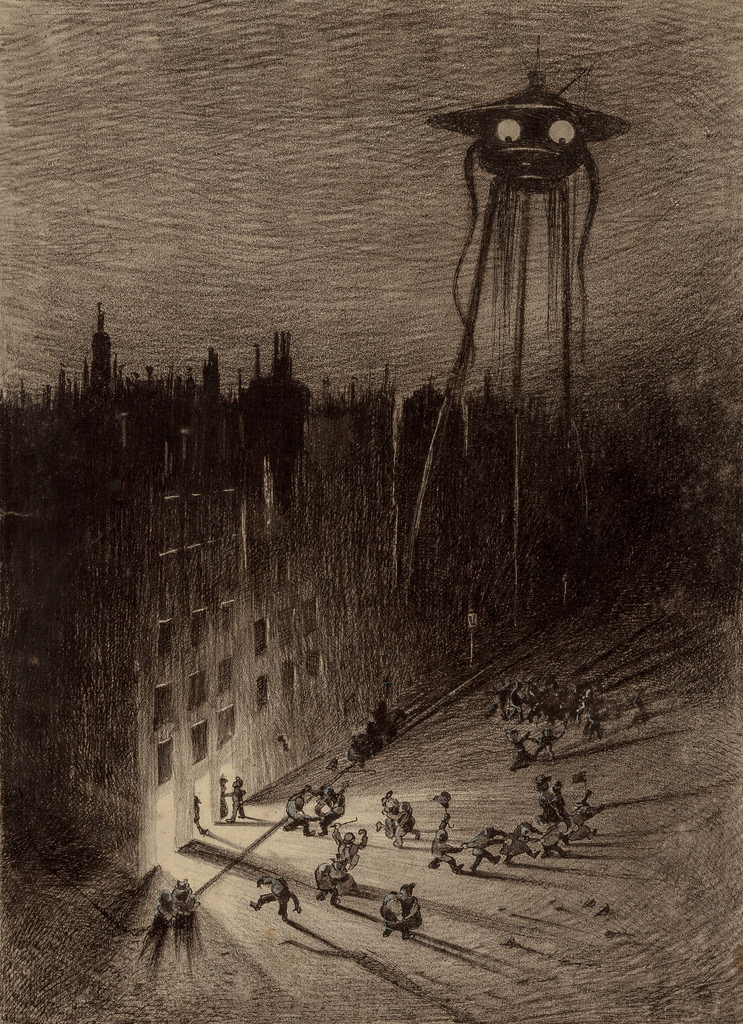
Note: An earlier version of this post appeared on our site in 2015.
Related Content:
The Very First Illustrations of H.G. Wells’ The War of the Worlds (1897)
Edward Gorey Illustrates H.G. Wells’ The War of the Worlds in His Inimitable Gothic Style (1960)
Josh Jones is a writer and musician based in Durham, NC. Follow him at @jdmagness
Read More...Tracing English Back to Its Oldest Known Ancestor: An Introduction to Proto-Indo-European
People understand evolution in all sorts of different ways. We’ve all heard a variety of folk explanations of that all-important phenomenon, from “survival of the fittest” to “humans come from monkeys,” that run the spectrum from broadly correct to badly mangled. One less often heard but more elegant way to put it is that all species, living or extinct, share a common ancestor. This is true of evolution as Darwin knew it, and it could well be true of other forms of “evolution” outside the biological realm as well. Take languages, which we know full well have changed and split into different varieties over time: do they, too, all share a single ancestor?
In the RobWords video above, language Youtuber Rob Watts starts with his native English and traces its roots back as far as possible. He ascends up the family tree past Low West German, past Proto-Germanic — “a language that was theoretically spoken by a single group of people who would eventually go on to become the Swedes, the Germans, the Dutch, the English, and more” — back to an ancestor of not just English and the Germanic languages, but almost all the European languages, as well as of Asian languages like Hindi, Pashtu, Kurdish, Farsi, and Bengali. Its name? Proto-Indo-European.
Watts quotes the eighteenth-century philologist Sir William Jones, who wrote that the ancient Asian language of Sanskrit has a structure “more perfect than the Greek, more copious than the Latin, and more exquisitely refined than either, yet bearing to both of them a stronger affinity, both in the roots of verbs and in the forms of grammar, than could possibly have been produced by accident.” As with such conspicuously shared traits observed in disparate species of plant or animal, no expert “could examine all three without believing them to have sprung from some common source, which, perhaps, no longer exists.”
The evidence is everywhere, if you pay attention to the sort of unexpected cognates and very-nearly-cognates Watts points out spanning geographically and temporally various languages. Take the English hundred, the Latin centum, the Ancient Greek hekaton, the Russian sto, and the Sanskrit Shatam; or the more deeply buried resemblances of English heart, the Latin cordis, the Russian serdce, and the sanskrit hrd. In some cases, linguists have actually used these commonalities to reverse-engineer Proto-Indo-European words, though always with the caveat that the whole thing “is a reconstructed language; it’s our best guess of what a common ancestral language could have been like.” Was there a still older language from which the non-Proto-Indo-European-descended languages also descended? That’s a question to push the linguistic imagination to its very limits.
Related content:
Was There a First Human Language?: Theories from the Enlightenment Through Noam Chomsky
How Languages Evolve: Explained in a Winning TED-Ed Animation
The Alphabet Explained: The Origin of Every Letter
The Tree of Languages Illustrated in a Big, Beautiful Infographic
Based in Seoul, Colin Marshall writes and broadcasts on cities, language, and culture. His projects include the Substack newsletter Books on Cities and the book The Stateless City: a Walk through 21st-Century Los Angeles. Follow him on the social network formerly known as Twitter at @colinmarshall.
Read More...Hear an AI Chatbot, Masquerading as a Clueless Grandmother, Waste the Time of an Internet Scam Artist
And now for a good use of AI. The UK-based telecom company O2 has developed a chatbot (“named Daisy”) that performs a noble task. Impersonating an elderly grandmother, the chatbot engages with internet fraudsters and then systematically frustrates them and wastes their time. As part of a demo, notes The Guardian, Daisy wasted a series of fraudsters’ time for up to 40 minutes each–“when they could otherwise have been scamming real people.” The AI system was trained on real scam calls–according to Virgin Media O2’s marketing director, Simon Valcarcel–so it “knows exactly the tactics to look out for, exactly the type of information to give to keep the scammers online and waste time.” If you have three minutes to spare, you can listen to Daisy clown a scam artist above.
Related Content
Read More...Warner Bros. Lets You Watch 31 Films Free Online: David Byrne’s True Stories, Christopher Guest’s Waiting for Guffman, Michel Gondry’s The Science of Sleep & More
It’s Friday, which means that tonight, many of us will sit down to watch a movie with our family, our friends, our significant other, or — for some cinephiles, best of all — by ourselves. If you haven’t yet lined up any home-cinematic experience in particular, consider taking a look at this playlist of 31 feature films just made available to stream by Warner Bros. You’ll know the name of that august Hollywood studio, of course, but did you know that it put out True Stories, the musical plunge into tabloid America directed by Talking Heads’ David Byrne? Or Waiting for Guffman, the first improvised movie by Christopher Guest and his troupe of crack comedic players like Eugene Levy, Fred Willard, Catherine O’Hara, and Parker Posey?
That may already strike many Open Culture readers as the makings of a fine double feature, though some may prefer to watch the early work of another kind of auteur: Michel Gondry’s The Science of Sleep, say, or Richard Linklater’s SubUrbia (a stage-play adaptation that could well be paired with Sidney Lumet’s Deathtrap).
If you’re in more of a mood for critically acclaimed historical drama, you have your pick of The Wind and the Lion, Mutiny on the Bounty, The Year of Living Dangerously, The Mission, and Michael Collins. And if you’d been meaning to get around to such nineteen-eighties literary adaptations as The Bonfire of the Vanities or The Accidental Tourist, well, your chance has finally come.
“It’s a fairly wild selection,” The Verge’s Jess Weatherbed writes of this playlist, pointing out its “dreadful flops like 2000’s Dungeons & Dragons movie, Bobcat Goldthwait’s Hot to Trot (1988), and Eddie Murphy’s The Adventures of Pluto Nash (2002).”
But if you’re just looking to have some fun, there’s no reason you couldn’t fire up the likes of Mr. Nice Guy, Jackie Chan’s first English-language picture. Should that prove too refined, Warner Bros. has also generously made available American Ninja V — a non-canonical entry in that series, we should note, starring not original American Ninja Michael Dudikoff, but direct-to-video martial-arts icon David Bradley. On Friday night, after all, any viewing goes.
Related content:
4,000+ Free Movies Online: Great Classics, Indies, Noir, Westerns, Documentaries & More
365 Free Movies Streaming on YouTube
How to Watch Hundreds of Free Movies on YouTube
Based in Seoul, Colin Marshall writes and broadcasts on cities, language, and culture. His projects include the Substack newsletter Books on Cities and the book The Stateless City: a Walk through 21st-Century Los Angeles. Follow him on the social network formerly known as Twitter at @colinmarshall.
Read More...See Vivaldi’s Four Seasons Visualized in Colorfully Animated Scores
Music is often described as the most abstract of all the arts, and arguably the least visual as well. But these qualities, which seem so basic to the nature of the form, have been challenged for at least three centuries, not least by composers themselves. Take Antonio Vivaldi, whose Le quattro stagioni, or The Four Seasons, of 1718–1720 evoke not just broad impressions of the eponymous parts of the year, but a variety of natural and human elements characteristic to them. In the course of less than an hour, its listeners — whether of the early eighteenth century or the early twenty-first — “see” spring, summer, autumn, and winter unfold vividly before their mind’s eye.
Now, composer Stephen Malinowski has visualized The Four Seasons in an entirely different way. As previously featured here on Open Culture, he uses his Music Animation Machine to create what we might call graphical scores, which abstractly represent the instrumental parts that make up widely loved classical compositions in time with the music itself.
On this page, you can watch four videos, with each one visualizing one of the piece’s concerti. Fans of the Music Animation Machine will notice that its formerly simple visuals have taken a big step forward, though what can look at first like a psychedelic light show also has a clear and legible order.
?si=xEQ3Twamh82m3Yhr
For “Spring” and “Autumn,” Malinowski animates performances by violinist Shunske Sato and musicians of the Netherlands Bach Society; for “Summer” and “Winter,” performances by Cynthia Miller Freivogel and early-music ensemble Voices of Music (previously featured here for their renditions of Bach’s Brandenburg Concertos and “Air on the G String,” Pachelbel’s Canon, and indeed The Four Seasons). Generally understandable at a glance — and in many ways, more illuminating than actually seeing the musicians play their instruments — these scores also use a system called “harmonic coloring,” which Malinkowski explains here. This may add up to a complete audiovisual experience, but if you’d also like a literary element, why not pull up The Four Seasons’ accompanying sonnets while you’re at it?
Related content:
Why We Love Vivaldi’s Four Seasons: An Animated Music Lesson
Watch All of Vivaldi’s Four Seasons Performed on Original Baroque Instruments
Vivaldi’s Four Seasons Brought to Life in Sand Animations by the Hungarian Artist Ferenc Cakó
Yes’ Rick Wakeman Explores Vivaldi’s Four Seasons, and Why It Was the First Concept Album
Based in Seoul, Colin Marshall writes and broadcasts on cities, language, and culture. His projects include the Substack newsletter Books on Cities and the book The Stateless City: a Walk through 21st-Century Los Angeles. Follow him on the social network formerly known as Twitter at @colinmarshall.
Read More...Behold Harry Clarke’s Hallucinatory Illustrations for Edgar Allan Poe’s Story Collection, Tales of Mystery and Imagination (1923)
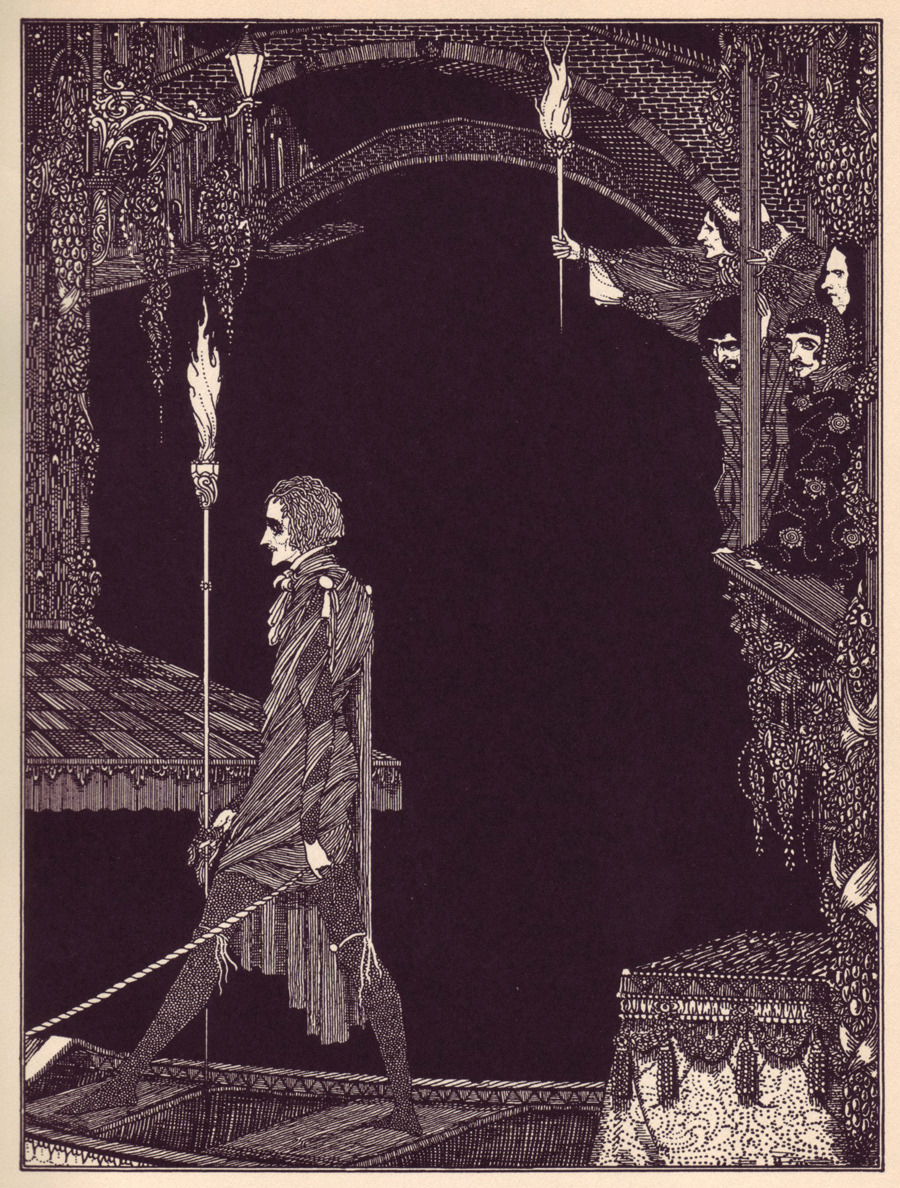
As you’ve probably noticed if you’re a regular reader of this site, we’re big fans of book illustration, particularly that from the form’s golden age—the late 18th and 19th century—before photography took over as the dominant visual medium. But while photographs largely supplanted illustrations in textbooks, magazines, and newspapers over the course of the 20th century, works of fiction, which had been routinely published in lavishly illustrated editions, suddenly became the featureless banks of words we know today. Though image-heavy graphic novels and comic books have thrived in recent decades, the illustrated literary text is a rarity indeed.
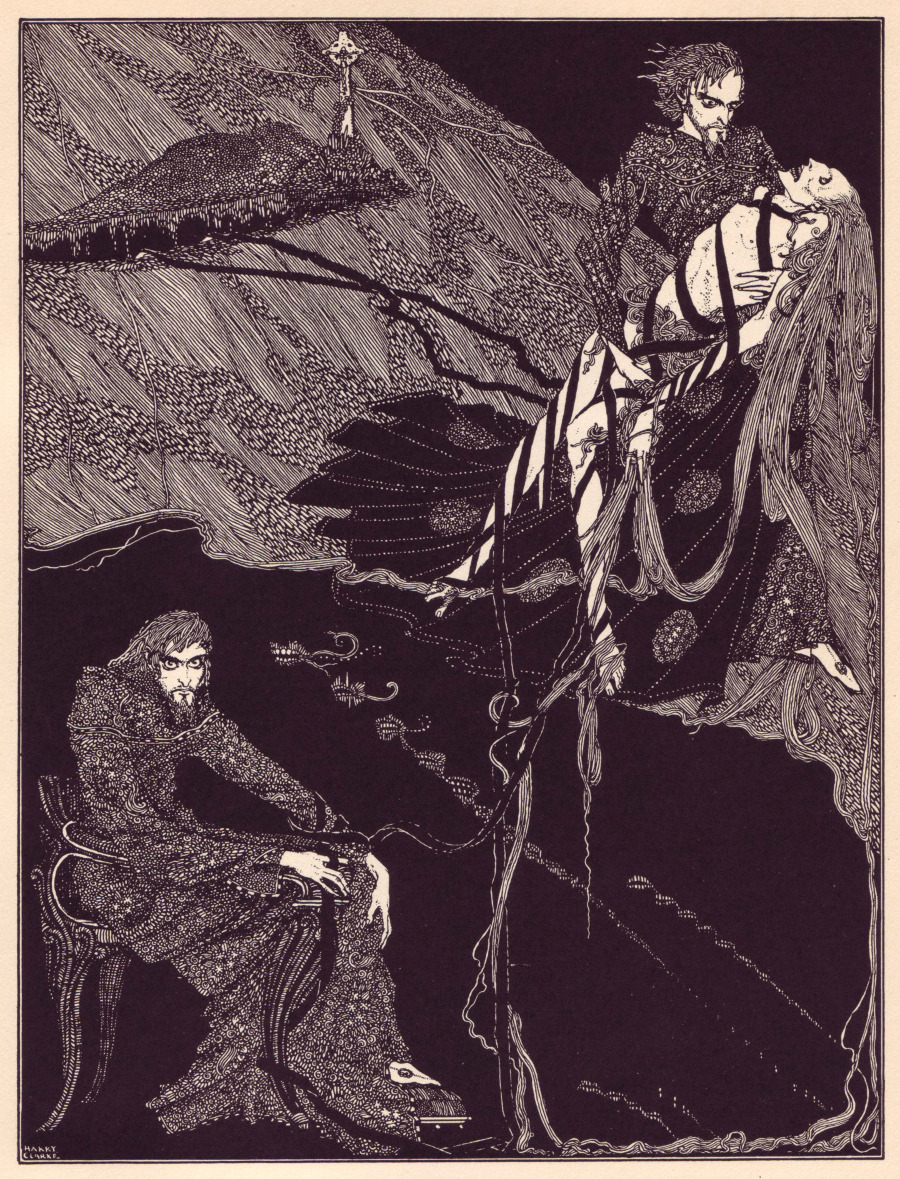
Why did this change come about? “I really don’t know,” writes Christopher Howse at The Telegraph, but he points out that the era of illustrated fiction for grown-ups ended “after the death of the big Victorian novelists,” like Dickens and Trollope. Before adult picture-books went out of style, several now-famous artists made careers as book illustrators. When we think of the big names from the period, we think of Aubrey Beardsley and Gustave Doré, both of whom we’ve covered heavily here. We tend not to think of Irish artist Harry Clarke—a relative latecomer—but we should. Of the many incredible illustrations from famous works of literature we’ve featured here, my favorite might be Clarke’s 1926 illustrations of Goethe’s Faust.
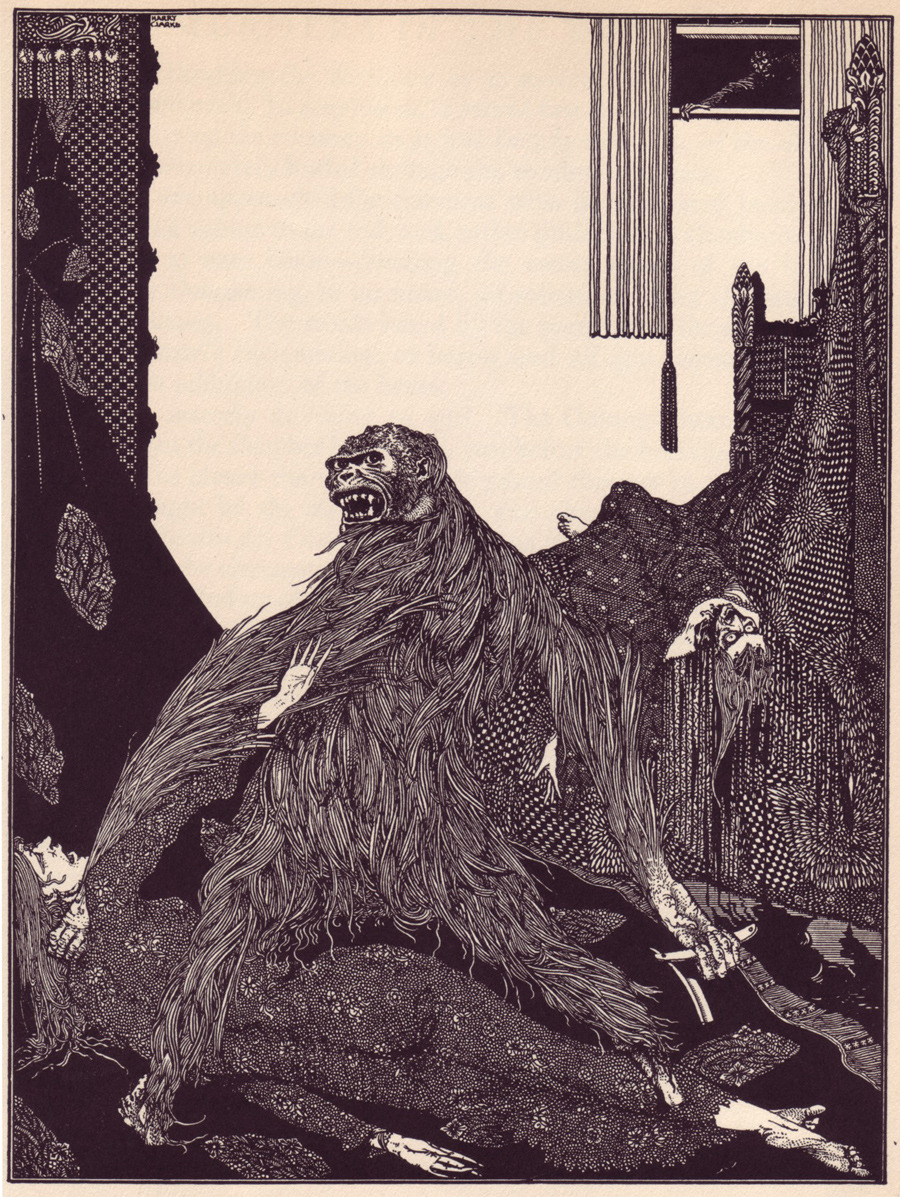
So out-there are some of his illustrations, so delightfully nightmarish and weird, one is tempted to fall back on that rather sophomoric explanation for art we find disturbing: maybe he was on drugs! Not that he’d need them to conjure up many of the images he did. His source material is bizarre enough (maybe Goethe was on drugs!). In any case, we can definitely call Clarke’s work hallucinatory, and that goes for his earlier, 1923 illustrations of Edgar Allan Poe’s Tales of Mystery and Imagination as well, of which you can see a few choice examples here.
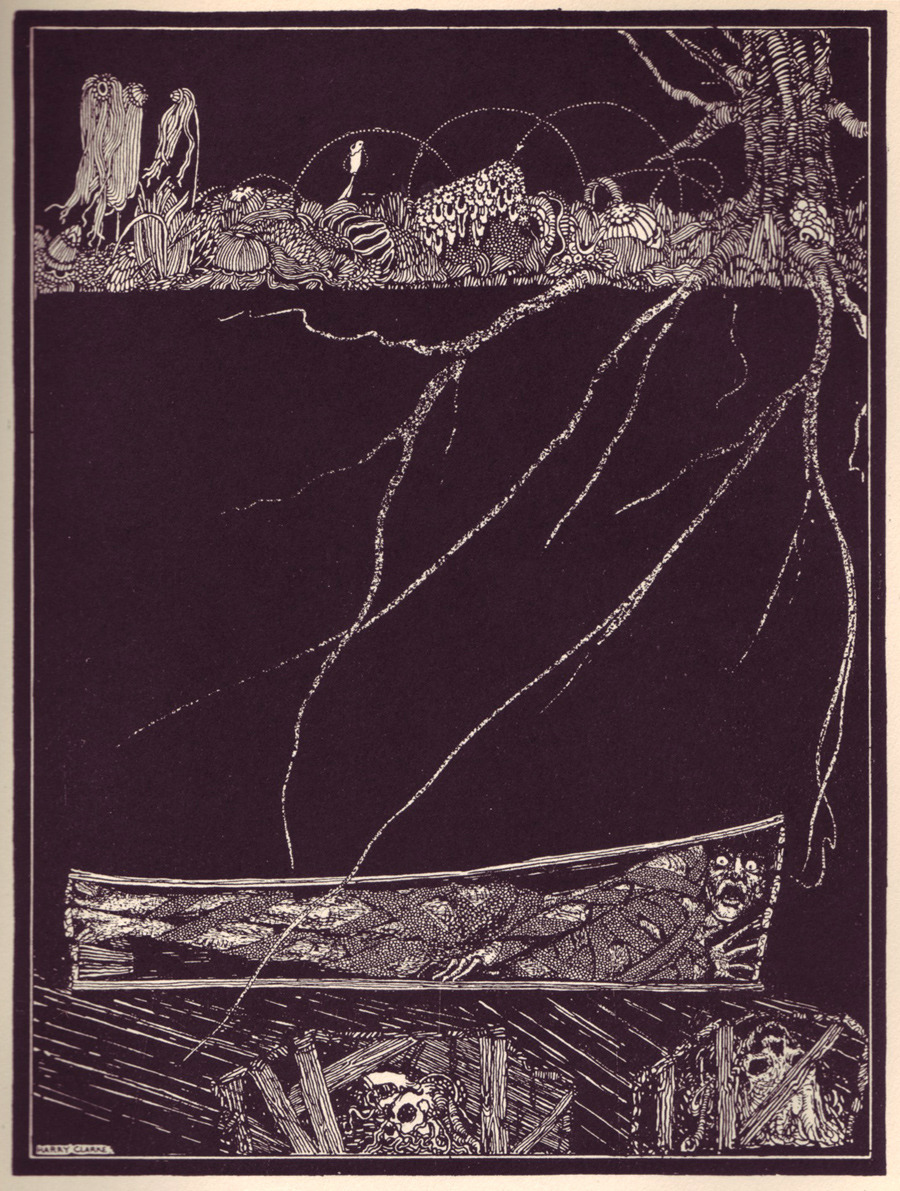
Dublin-born Clarke worked as a stained-glass artist as well as an illustrator, and drew his inspiration from the earlier art nouveau aesthetic of Beardsley and others, adding his own rococo flourishes to the elongated forms and decorative patterns favored by those artists. His glowering figures—including one who looks quite a bit like Poe himself, at the top—suit the feverish intensity of Poe’s world to perfection. And like Poe, Clarke’s art generally thrived in a seductively dark underworld filled with ghouls and fiends. Both of these proto-goths died young, Poe under mysterious circumstances at age 40, Clarke of tuberculosis at 42.
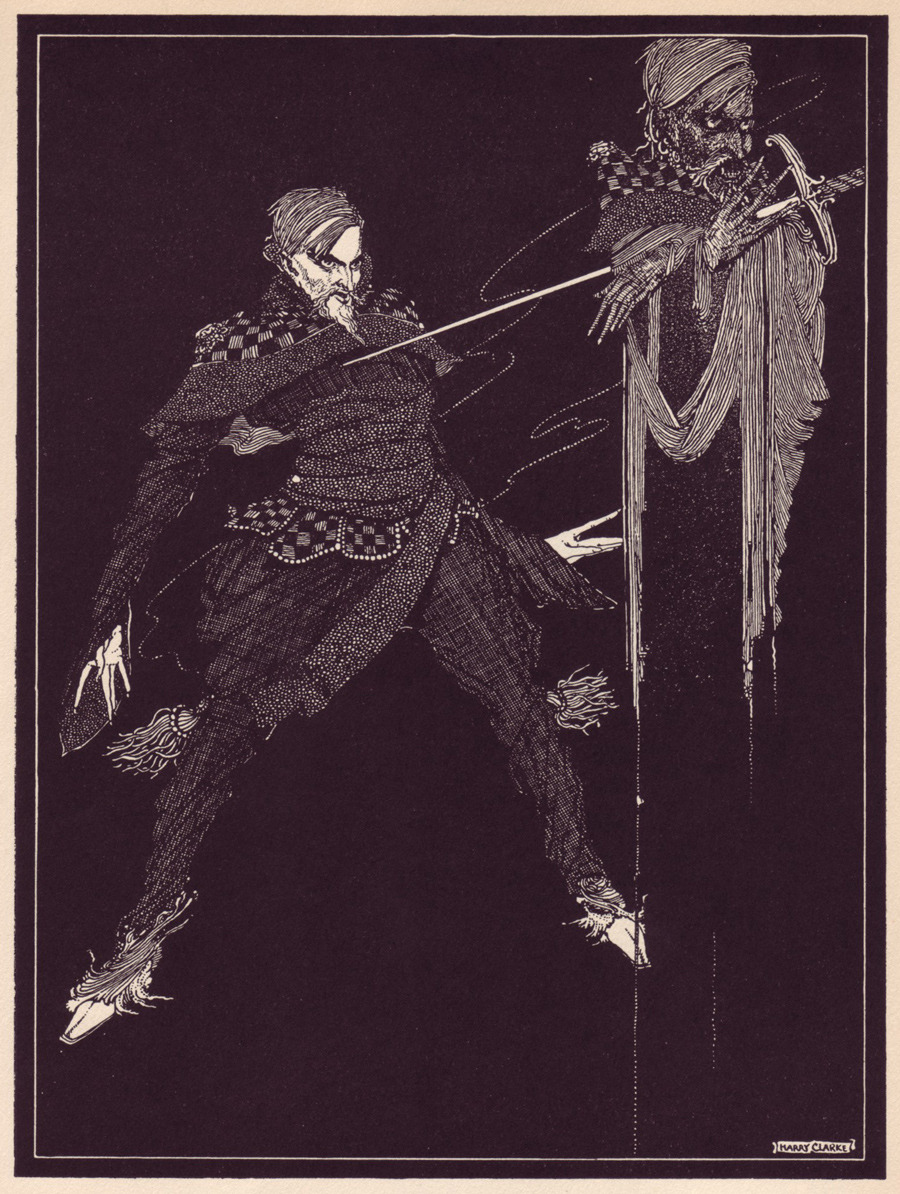
Clarke’s illustrated edition of Poe contained 8 full-color plates and 24 black and white illustrations. The Irish artist also notably illustrated editions of the fairy tales of Hans Christian Andersen and Charles Perrault, with images that—as you might imagine—are likely to terrify some sensitive children. You can purchase your own edition of the Clarke-illustrated Poe here, re-released in 2008 by Calla Press. And to see all 24 of Clarke’s black and white plates, head over to 50 Watts.
Note: An earlier version of this post appeared on our site in 2016.
Related Content:
Gustave Doré’s Macabre Illustrations of Edgar Allan Poe’s “The Raven” (1884)
Aubrey Beardsley’s Macabre Illustrations of Edgar Allan Poe’s Short Stories (1894)
Harry Clarke’s 1926 Illustrations of Goethe’s Faust: Art That Inspired the Psychedelic 60s
Josh Jones is a writer and musician based in Durham, NC. Follow him at @jdmagness
Read More...Support Us
We're hoping to rely on loyal readers, rather than erratic ads. Please click the Donate button and support Open Culture. You can use Paypal, Venmo, Patreon, even Crypto! We thank you!

About Us

Open Culture scours the web for the best educational media. We find the free courses and audio books you need, the language lessons & educational videos you want, and plenty of enlightenment in between.
Advertise With Us

FREE UPDATES!
GET OUR DAILY EMAIL
Get the best cultural and educational resources on the web curated for you in a daily email. We never spam. Unsubscribe at any time.
FOLLOW ON SOCIAL MEDIA

Open Culture editor Dan Colman scours the web for the best educational media. He finds the free courses and audio books you need, the language lessons & movies you want, and plenty of enlightenment in between.
Advertise With Us

