Read J. R. R. Tolkien’s “Letter From Father Christmas” To His Young Children (1925)
J.R.R. Tolkien is best known for the sweeping fantasy landscapes of Lord of The Rings and The Hobbit. Apart from being a celebrated author, the Oxford University professor of Anglo-Saxon was also a devoted father who doted on his children.
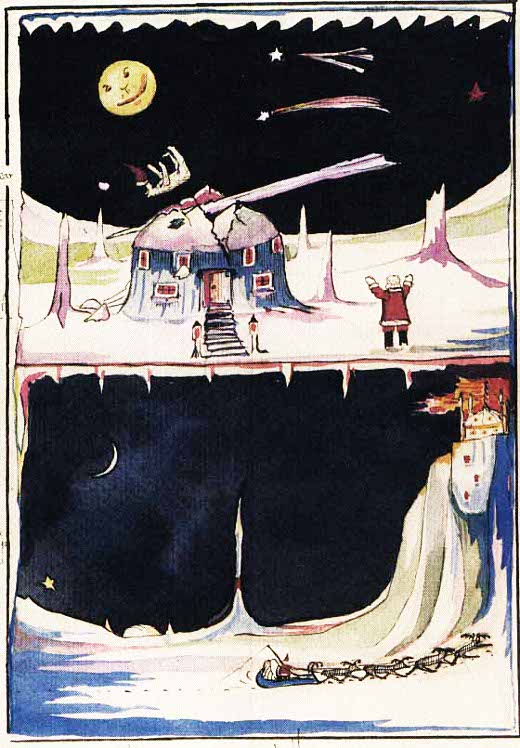
In 1920, a few short years after Tolkien returned from World War I, he began an endearing family Christmas tradition that would continue for the next 23 years. After the birth of his firstborn son, John, Tolkien began to write his four children letters from Father Christmas. These North Pole tales chiefly concern Father Christmas’ struggles against the north’s bat-riding goblins, as well as the mischievous hijinks of his helper, North Polar Bear. An adept illustrator whose original drawings accompanied many of his writings (see his book cover designs for Lord of the Rings), Tolkien included with many of his Christmas letters a set of charming pictures.
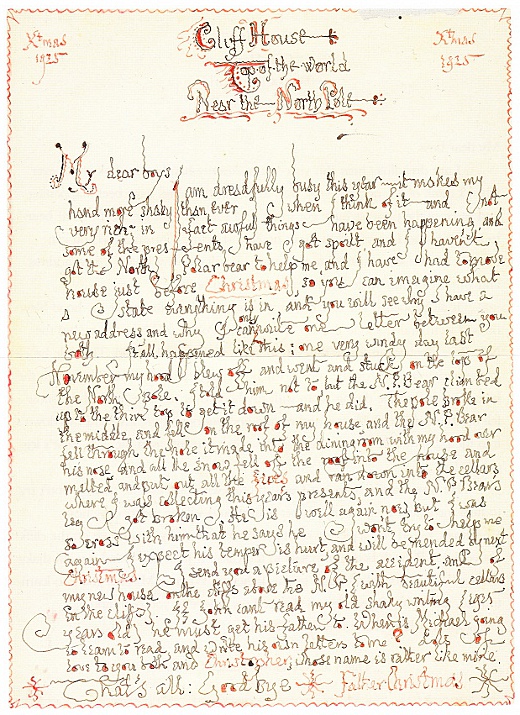
The many letters were eventually collected in a beautiful volume called Letters From Father Christmas. Thanks to the good work of Letters of Note, we bring to you a sample letter from 1925:
Cliff House
Top of the World
Near the North Pole
Xmas 1925
My dear boys,
I am dreadfully busy this year — it makes my hand more shaky than ever when I think of it — and not very rich. In fact, awful things have been happening, and some of the presents have got spoilt and I haven’t got the North Polar Bear to help me and I have had to move house just before Christmas, so you can imagine what a state everything is in, and you will see why I have a new address, and why I can only write one letter between you both. It all happened like this: one very windy day last November my hood blew off and went and stuck on the top of the North Pole. I told him not to, but the N.P.Bear climbed up to the thin top to get it down — and he did. The pole broke in the middle and fell on the roof of my house, and the N.P.Bear fell through the hole it made into the dining room with my hood over his nose, and all the snow fell off the roof into the house and melted and put out all the fires and ran down into the cellars where I was collecting this year’s presents, and the N.P.Bear’s leg got broken. He is well again now, but I was so cross with him that he says he won’t try to help me again. I expect his temper is hurt, and will be mended by next Christmas. I send you a picture of the accident, and of my new house on the cliffs above the N.P. (with beautiful cellars in the cliffs). If John can’t read my old shaky writing (1925 years old) he must get his father to. When is Michael going to learn to read, and write his own letters to me? Lots of love to you both and Christopher, whose name is rather like mine.
That’s all. Goodbye.
Father Christmas
via The Paris Review
Related Content:
110 Drawings and Paintings by J.R.R. Tolkien: Of Middle-Earth and Beyond
Explore Rarely-Seen Art by J. R. R. Tolkien in a New Web Site Created by the Tolkien Estate
Discover J.R.R. Tolkien’s Personal Book Cover Designs for The Lord of the Rings Trilogy
Soviet-Era Illustrations Of J. R. R. Tolkien’s The Hobbit (1976)
Map of Middle-Earth Annotated by Tolkien Found in a Copy of Lord of the Rings
Ilia Blinderman is a Montreal-based culture and science writer. Follow him at @iliablinderman.
Read More...The Story Behind the Making of the Iconic Surrealist Photograph, Dalí Atomicus (1948)
With his cane, his famous waxed mustache, and his habit of taking unusual animals for walks, Salvador Dalí would appear to have cultivated his own photographability. But taking a picture of the man who stood as a living definition of popular surrealism wasn’t a task to be approached casually — especially not for Philippe Halsman, who did it more than anyone else. Originally from what’s now Latvia, he led a turbulent life that eventually (after a couple of interventions by none other than Albert Einstein, of whom Halsman later made a famous portrait) brought him to the United States. It was in New York, in 1941, that he met Dalí, having been assigned to photograph one of his exhibitions in the city.
Halsman had more opportunities to photograph Dalí, and these jobs turned into decades of collaboration. Its many fruits include a book containing 36 views of the artist’s mustache alone, but also the more ambitious — and much more surreal — image Dalí Atomicus, from 1948. Inspired by the work-in-progress that would become Leda Atomica, a portrait of Dalí’s wife Gala influenced by both mythology and science, the photograph includes not just that painting, but also an arc of water and three flying cats. Or at least they look like they’re flying; in reality, they were thrown into the frame by a team of assistants including Halsman’s wife and his young daughter Irene.
Irene Halsman recalls the experience in the BBC Time Frame video above, including the now-widely known detail that Dalí’s own initial concept for the photo involved blowing up a duck with firecrackers. “Oh, no, no, you can’t do that,” she recalls her father responding. “You’re in America now. You don’t want to be put in jail for animal cruelty.” So flying cats it was, to be visually captured in mid-air along with the contents of a bucket of water. Leda Atomica and a chair were also made to appear as if levitating, and Dalí himself was instructed to jump, in an instance of the photographic practice Halsman called “jumpology” (whose other subjects included Audrey Hepburn, J. Robert Oppenheimer, Marilyn Monroe, and Richard Nixon).
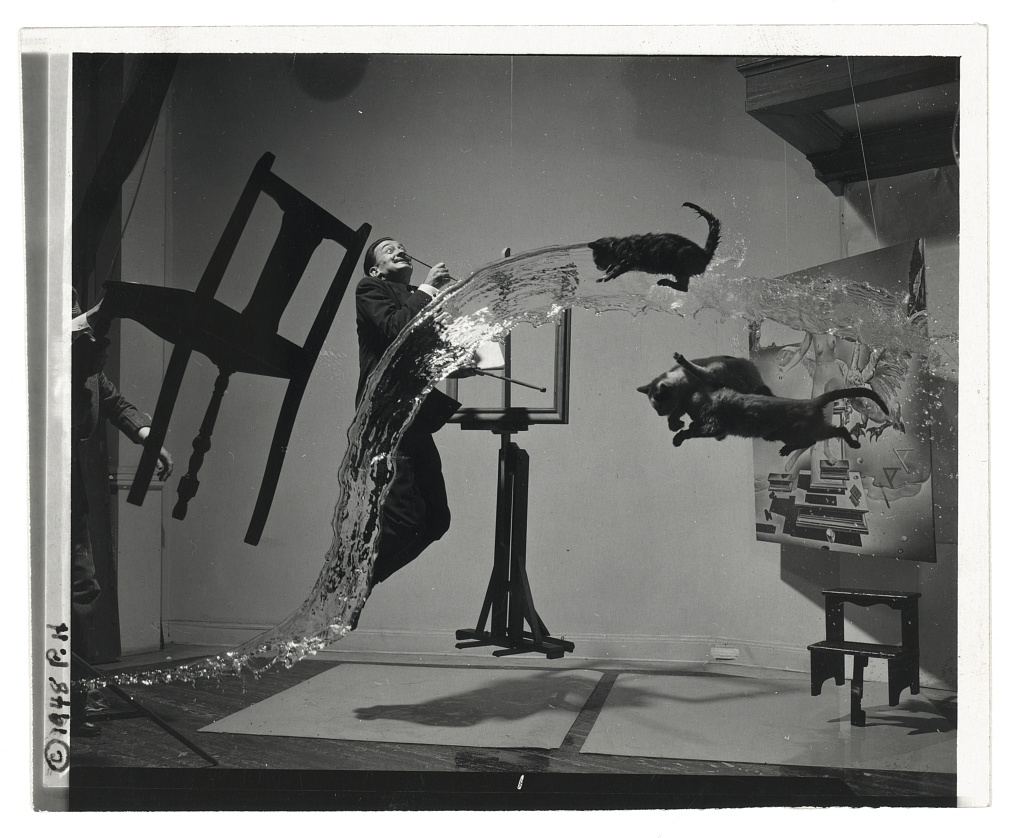
Image via Library of Congress
Dalí Atomicus was published in Life magazine, to which Halsman was a prolific contributor. The same issue included a few outtakes, which revealed some of what went into the five-to-six-hour-long process of nailing the shot. You can see a few such prints at Artsy, whose labeled faults include “water splashes Dalí instead of cat,” “Dalí jumps too late,” and “secretary gets into picture.” But it wasn’t all just about timing: the picture also required a degree of pre-Photoshop editing to perfect, and the empty canvas behind the jumping Dalí had to be filled in by the rush of the man himself, who opted to fill the non-existent painting with motifs drawn from the limbs of the cats. Now there was an artist who knew how to seize inspiration when it floated by.
Related Content:
A Soft Self-Portrait of Salvador Dali, Narrated by the Great Orson Welles
Salvador Dalí Explains Why He Was a “Bad Painter” and Contributed “Nothing” to Art (1986)
Salvador Dalí Takes His Anteater for a Stroll in Paris, 1969
When Salvador Dalí Created Christmas Cards That Were Too Avant Garde for Hallmark (1960)
Based in Seoul, Colin Marshall writes and broadcasts on cities, language, and culture. His projects include the Substack newsletter Books on Cities and the book The Stateless City: a Walk through 21st-Century Los Angeles. Follow him on the social network formerly known as Twitter at @colinmarshall.
Read More...The Junky’s Christmas: William S. Burrough’s Dark Claymation Christmas Film Produced by Francis Ford Coppola (1993)
Back in 1993, the Beat writer William S. Burroughs wrote and narrated a 21-minute claymation Christmas film oddly produced by Francis Ford Coppola. And, as you can well imagine, it’s not your normal happy Christmas flick. Nope, this film – The Junky’s Christmas – is all about Danny the Carwiper, a junkie, who spends Christmas Day trying to score a fix. Eventually he finds the Christmas spirit when he shares some morphine with a young man suffering from kidney stones, giving him the “immaculate fix.” There you have it. Happy holidays.…
If you would like to support the mission of Open Culture, consider making a donation to our site. It’s hard to rely 100% on ads, and your contributions will help us continue providing the best free cultural and educational materials to learners everywhere. You can contribute through PayPal, Patreon, and Venmo (@openculture). Thanks!
Related Content
The “Priest” They Called Him: A Dark Collaboration Between Kurt Cobain & William S. Burroughs
William S. Burroughs’ Scathing “Thanksgiving Prayer,” Shot by Gus Van Sant
William S. Burroughs Teaches a Free Course on Creative Reading and Writing (1979)
Read More...
Richard Feynman Enthusiastically Explains How to Think Like a Physicist in His Series Fun to Imagine (1983)
“It’s interesting that some people find science so easy, and others find it kind of dull and difficult,” says Richard Feynman at the beginning of his 1983 BBC series Fun to Imagine. “One of the things that makes it very difficult is that it takes a lot of imagination. It’s very hard to imagine all the crazy things that things really are like.” A true scientist accepts that nothing is as it seems, in that nothing, when you zoom in close enough or zoom out far enough, behaves in a way that accords with our everyday experience. Even the necessary scales — in which, for example, an atom is to an apple as an apple is to Earth itself — are difficult to conceive.
Despite his much-celebrated brilliance as a physicist, Feynman also admitted to finding the quantities with which he had to work unfathomable, at least when examined outside their particular contexts. At the atomic level, he explains, “you’re just thinking of small balls, but you don’t try to think of exactly how small they are too often, or you get kind of a bit nutty.”
In astronomy, “you have the same thing in reverse, because the distance to these stars is so enormous.” We all have an idea of what the term “light year” means — assuming we don’t misunderstand it as a unit of time — but who among us can really envision a galaxy 100,000 light years away, let alone a million?
Feynman discusses these matters with characteristic understanding and humor across Fun to Imagine’s nine segments, which cover physical phenomena from fire and magnets to rubber bands and train wheels. Those who know their physics will appreciate the vividness and concision with which he explains this material, apparently right off the top of his head, and anyone can sense the delight he feels in merely putting his mind to the behavior of matter and energy and their relationship to the world as we know it. And however much pleasure he derived from understanding, he also got a kick out of how much mystery remains: “Nature’s imagination is so much greater than man’s,” he says toward the end. “She’s never going to let us relax.”
Related content:
The Life & Work of Richard Feynman Explored in a Three-Part Freakonomics Radio Miniseries
What Made Richard Feynman One of the Most Admired Educators in the World
Richard Feynman’s “Lost Lecture:” An Animated Retelling
Watch a New Animation of Richard Feynman’s Ode to the Wonder of Life, with Music by Yo-Yo Ma
Based in Seoul, Colin Marshall writes and broadcasts on cities, language, and culture. His projects include the Substack newsletter Books on Cities and the book The Stateless City: a Walk through 21st-Century Los Angeles. Follow him on the social network formerly known as Twitter at @colinmarshall.
Hear Orson Welles’ War of the Worlds Radio Broadcast from 1938: The Original Tale of Mysterious Objects Flying Over New Jersey
A month ago, drones were spotted near Morris County, New Jersey. Since then, reports of further sightings in various locations in the region have been lodged on a daily basis, and anxieties about the origin and purpose of these unidentified flying objects have grown apace. “We have no evidence at this time that the reported drone sightings pose a national security or public safety threat or have a foreign nexus,” declared the FBI and the Department of Homeland Security in a joint statement. But the very lack of further information on the matter has stoked the public imagination; one New Jersey congressman spoke of the drones having come from an Iranian “mothership” off the coast.
If this real-life news story sounds familiar, consider the fact that Morris County lies only about an hour up the road from Grovers Mill, the famous site of the fictional Martian invasion dramatized in Orson Welles’ 1938 radio adaptation of H. G. Wells’ The War of the Worlds. Presented like a genuine emergency broadcast, it “fooled many who tuned in late and believed the events were really happening,” writes Space.com’s Elizabeth Fernandez.
The unsettled nature of American life in the late nineteen-thirties surely played a part, given that, “wedged between two World Wars, the nation was in the midst of the Great Depression and mass unemployment.” Some listeners assumed that the Martians were in fact Nazis, or that “the crash landing was tied to some other environmental catastrophe.”
In the 86 years since The War of the Worlds aired, the story of the nationwide panic it caused has come in for revision: not that many people were listening in the first place, many fewer took it as reality, and even then, drastic responses were uncommon. But as Welles himself recounts in the video above, he heard for decades thereafter from listeners recounting their own panic at the suddenly believable prospect of Mars attacking Earth.“In fact, we weren’t as innocent as we meant to be when we did the Martian broadcast,” he admits. “We were fed up with the way in which everything that came over this new, magic box — the radio — was being swallowed,” and thus inclined to make “an assault on the credibility of that machine.” What a relief that we here in the 21st century are, of course, far too sophisticated to accept everything new technology conveys to us.
Related content:
Edward Gorey Illustrates H. G. Wells’ The War of the Worlds in His Inimitable Gothic Style (1960)
Hear Orson Welles’ Radio Performances of 10 Shakespeare Plays (1936–1944)
Horrifying 1906 Illustrations of H. G. Wells’ War of the Worlds
Carl Jung’s Fascinating 1957 Letter on UFOs
Based in Seoul, Colin Marshall writes and broadcasts on cities, language, and culture. His projects include the Substack newsletter Books on Cities and the book The Stateless City: a Walk through 21st-Century Los Angeles. Follow him on the social network formerly known as Twitter at @colinmarshall.
Read More...Watch the Sex Pistols’ Christmas Party for Kids–Which Happened to Be Their Final Gig in the UK (1977)
I’m not sure the Sex Pistols had “available for children’s parties” on their press release, but on a cold and grim Christmas in 1977, that’s exactly what happened. While many Britons were settling in for a warm yuletide, the Pistols decided to host a party/benefit for the children of striking firemen and miners at a venue called Ivanhoe’s in Huddersfield, UK.
It turned out that this afternoon gig, along with an evening concert with full-grown punks in the audience, would be the Pistols’ final UK appearance. In a few weeks the band would fly to America for a set of ill-fated gigs and then break up. Soon after that Sid Vicious would be dead.
At the children’s concert John Lydon handed out t‑shirts, buttons, records, and posters. There was a pogo dancing competition with a skateboard as a prize, disco music on the sound system, and a gigantic cake with “Sex Pistols” written on it. (A food fight not only broke out, but was encouraged.)
Understand that by December 1977, the Pistols were pretty much banned from playing anywhere in Britain, so the announcement of this benefit show was a big deal, and what we would now call “community outreach” was the opposite of the monstrous image that the British gutter press had whipped up against the band.
But Lydon knew they weren’t monsters or any threat at all, except towards the establishment. And his memory of the day is nothing but sweet.
Fantastic. The ultimate reward. One of my all-time favourite gigs. Young kids, and we’re doing Bodies and they’re bursting out with laughter on the ‘f*ck this f*ck that’ verse. The correct response: not the shock horror ‘How dare you?’ Adults bring their own filthy minds into a thing. They don’t quite perceive it as a child does. Oh, Johnny’s used a naughty word. ‘Bodies’ was from two different points of view. You’ll find that theme runs through a lot of things I write like ‘Rise’ – “I could be wrong, I could be right”. I’m considering both sides of the argument, always.
Film director Julian Temple caught the entire gig on a “big old crappy U‑matic low-band camera” and while clips from the footage have been used in various docs beforehand, it was only in 2013 that the entire footage was shown on British television, along with reminiscences from the adults who were children at the time of the gig.
In the Guardian interview with Temple, he looked back at the footage and commented on the strangeness of a UK Christmas in 1977:
“In a way, the Pistols seem the only thing that’s connected with today. Everything else seems halfway into the Victorian period, whereas the Pistols seem very modern and aware of what’s going to happen. Hopefully, there’s resonance in the fuel bills and firemen’s strikes of today. Even though it’s a different planet, people face the same problems.
“The sound with just one camera is raw and searing. I hope kids watching it today will go: ‘Fuck me, bands like that just don’t exist.’ ”
via The Guardian
Related Content:
Watch the Sex Pistols’ Very Last Concert (San Francisco, 1978)
The Sex Pistols’ 1976 Manchester “Gig That Changed the World,” and the Day the Punk Era Began
Ted Mills is a freelance writer on the arts who currently hosts the artist interview-based FunkZone Podcast and is the producer of KCRW’s Curious Coast. You can also follow him on Twitter at @tedmills, read his other arts writing at tedmills.com and/or watch his films here.
Read More...The Ingenious Engineering of Leonardo da Vinci’s Self-Supporting Bridge, Explained with Animation
The video above from Sabins Civil Engineering promises to reveal “the MAGIC behind Da Vinci’s Self Supporting Bridge.” That sounds like a typical example of YouTube hyperbole, though on first glance, it isn’t at all obvious how the fragile-looking structure can stay up, much less support the weight of a crossing army. Not only does the design use no permanent joints, says the narrator, “the more weight on the bridge, the stronger it becomes.” The key is the distinctive manner in which the pieces interlock, and how it directs force to create a “friction lock” that ensures stability.
Remove just one piece of the bridge, however, and it all comes crashing down, which is more feature than bug: designed to facilitate troop movements, the structure could be dismantled to prevent use by the enemy even more easily than it was put up in the first place.
Just one of the various tools of war Leonardo came up with, this bridge was conceived under the patronage of the famous statesman Cesare Borgia (a chief inspiration for Niccolò Machiavelli’s The Prince), who employed him as an architect and military engineer in the early fifteen-hundreds.
Though Leonardo’s bridge designs have proven influential in the half-millennium since his death — think of him next time you cross the Galata Bridge in Istanbul — no evidence remains that he ever built one in his lifetime. But unlike most of his inventions, realized or theoretical, you can build it yourself today without much difficulty. The video presents an example large enough to walk across, which may make it feel rather less stable than it actually is. Luckily for students looking to understand the self-supporting bridge in a hands-on manner, the same engineering principles apply just as well on the more manageable scale of popsicle sticks — a modern building material at which Leonardo himself would surely have marveled.
Related content:
The Ingenious Inventions of Leonardo da Vinci Recreated with 3D Animation
Leonardo da Vinci Draws Designs of Future War Machines: Tanks, Machine Guns & More
Built to Last: How Ancient Roman Bridges Can Still Withstand the Weight of Modern Cars & Trucks
Based in Seoul, Colin Marshall writes and broadcasts on cities, language, and culture. His projects include the Substack newsletter Books on Cities and the book The Stateless City: a Walk through 21st-Century Los Angeles. Follow him on the social network formerly known as Twitter at @colinmarshall.
Read More...Watch The Insects’ Christmas from 1913: A Stop Motion Film Starring a Cast of Dead Bugs
Kind Reader,
Will you do us the honor of accepting our holiday invitation?
Carve five minutes from your holiday schedule to spend time celebrating The Insects’ Christmas, above.
In addition to offering brief respite from the chaos of consumerism and modern expectations, this simple stop-motion tale from 1913 is surprisingly effective at chasing away holiday blues.
Not bad for a short with a supporting cast of dead bugs.
Animator Ladislas Starevich began his cinematic manipulations of insect carcasses early in the 20th century while serving as Director of Kaunas, Lithuania’s Museum of Natural History. He continued the experiment after moving to Moscow, where he added such titles as Insects’ Aviation Week, Amusing Scenes from the Life of Insects and famously, The Cameraman’s Revenge, a racy tale of passion and infidelity in the insect world.
The Insects’ Christmas is far gentler.
Think Froggy Went a Courtin’, or Miss Spider’s Wedding with an old-time Christmas spin.
Shades too of Johnny Gruelle’s Raggedy Ann and other stories wherein toys wait for their human owners to retire, so they may spring to life—though Starevich’s sleepy doll seems to have more in common with the Christmas tree’s absent owners than the tiny Father Christmas ornament who clamors down to party al fresco with the insects.
Contemporary composer Tom Peters underscores the wholesome vintage action—skiing, skating, squabbling over a Christmas cracker—with a mix of traditional carols and original music performed on ukulele, drum, and a six-string electric bass with a 5‑octave range.
And the moment when Father Christmas conjures festive decorations for a Charlie Brown-ish tree is truly magical. See if your littlest Hayao Miyazaki fan doesn’t agree.
Enjoy more of Ladislas Starevich’s stop-motion ouevre on YouTube.
Related Content:
The Cameraman’s Revenge (1912): The Truly Weird Origin of Modern Stop-Motion Animation
The History of Stop-Motion Films: 39 Films, Spanning 116 Years, Revisited in a 3‑Minute Video
Ayun Halliday is an author, illustrator, theater maker and Chief Primatologist of the East Village Inky zine.
Read More...How Keith Jarrett Played on a Broken Piano & Turned a Potentially Disastrous Concert Into the Best-Selling Piano Album of All Time (1975)
Nearly fifty years ago, the celebrated young pianist Keith Jarrett arrived in the West German city of Köln (better known in English as Cologne). Having just come off a 500-mile-long road trip from Switzerland, where he’d played a concert the previous day, he was left with barely any time to recover before going onstage at the Köln Opera House that night — at 11:30 that night, to be precise, the only time that august cultural institution would give a jazz musician. Because the restaurant where he attempted to have dinner beforehand mixed up his order, he could barely eat a thing before showtime. And his back was acting up.
Yet all of those difficulties were as nothing against the miserable instrument awaiting Jarrett at the opera house. He’d requested a Bösendorfer 290 Imperial grand piano, but a series of errors led to the staff setting up a dilapidated, frail-sounding baby grand of the same make.
Unable to procure a replacement, the concert’s teenage organizer Vera Brandes called in a tuner to do his best to bring the piano up to playability and managed to persuade Jarrett to go on with the show. All the seats were sold, after all, and the recording engineers had their gear ready to roll; in the worst case scenario, he’d end up with another tape for the archives.
In the event, the concert was more of a best-case scenario. “What Keith Jarrett did so brilliantly was to take this broken piano and use it to play music that only that piano could have played,” says Youtuber David Hartley in the video above. “He didn’t hide away from the faults of the piano; instead, he embraced them and put them in the music. This is the very essence of improvisation.” A classical musician with a defined set of pieces could never have worked at all under these conditions, but Jarrett ended up putting on quite a successful show — and, with the recording, putting out a hugely successful album.
After it came out in November that same year, The Köln Concert went on to become both the best-selling solo jazz album and the best-selling piano album. For decades, it was easily found even in the record collections of those who owned no other releases from ECM, the German jazz and avant-garde label with which Jarrett has long been associated, and heard on the soundtracks of films by auteurs like Nicolas Roeg and Nanni Moretti. Still today, it stands in support of any number of proverbs about necessity being the mother of invention, playing the hand you’re dealt, and not waiting for ideal conditions. If we listen to it enough, we may even find ourselves waiting for terrible ones.
Related content:
The Brains of Jazz and Classical Musicians Work Differently, New Research Shows
The Piano Played with 16 Increasing Levels of Complexity: From Easy to Very Complex
The Universal Mind of Bill Evans: Advice on Learning to Play Jazz & The Creative Process
Hear the Experimental Piano Jazz Album by Comedian H. Jon Benjamin — Who Can’t Play Piano
Based in Seoul, Colin Marshall writes and broadcasts on cities, language, and culture. His projects include the Substack newsletter Books on Cities and the book The Stateless City: a Walk through 21st-Century Los Angeles. Follow him on the social network formerly known as Twitter at @colinmarshall.
Read More...How Medieval Islamic Engineering Brought Water to the Alhambra
Between 711 and 1492, much of the Iberian Peninsula, including modern-day Spain, was under Muslim rule. Not that it was easy to hold on to the place for that length of time: after the fall of Toledo in 1085, Al-Andalus, as the territory was called, continued to lose cities over the subsequent centuries. Córdoba and Seville were reconquered practically one right after the other, in 1236 and 1248, respectively, and you can see the invasion of the first city animated in the opening scene of the Primal Space video above. “All over the land, Muslim cities were being conquered and taken over by the Christians,” says the companion article at Primal Nebula. “But amidst all of this, one city remained unconquered, Granada.”
“Thanks to its strategic position and the enormous Alhambra Palace, the city was protected,” and there the Alhambra remains today. A “thirteenth-century palatial complex that’s one of the world’s most iconic examples of Moorish architecture,” writes BBC.com’s Esme Fox, it’s also a landmark feat of engineering, boasting “one of the most sophisticated hydraulic networks in the world, able to defy gravity and raise water from the river nearly a kilometer below.”
The jewel in the crown of these elaborate waterworks is a white marble fountain that “consists of a large dish held up by twelve white mythical lions. Each beast spurts water from its mouth, feeding four channels in the patio’s marble floor that represent the four rivers of paradise, and then running throughout the palace to cool the rooms.”
The fuente de los Leones also tells time: the number of lions currently indicates the hour. This works thanks to an ingenious design explained both verbally and visually in the video. Anyone visiting the Alhambra today can admire this and other examples of medieval opulence, but travelers with an engineer’s cast of mind will appreciate even more how the palace’s builders got the water there at all. “The hill was around 200 meters above Granada’s main river,” says the narrator, which entailed an ambitious project of damming and redirection, to say nothing of the pool above the palace designed to keep the whole hydraulic system pressurized. The Alhambra’s heated baths and well-irrigated gardens represent the luxurious height of Moorish civilization, but they also remind us that, then as now, beneath every luxury lies an impressive feat of technology.
Related content:
The Brilliant Engineering That Made Venice: How a City Was Built on Water
How Toilets Worked in Ancient Rome and Medieval England
The Amazing Engineering of Roman Baths
Historic Spain in Time Lapse Film
Based in Seoul, Colin Marshall writes and broadcasts on cities, language, and culture. His projects include the Substack newsletter Books on Cities and the book The Stateless City: a Walk through 21st-Century Los Angeles. Follow him on the social network formerly known as Twitter at @colinmarshall.
Read More...Support Us
We're hoping to rely on loyal readers, rather than erratic ads. Please click the Donate button and support Open Culture. You can use Paypal, Venmo, Patreon, even Crypto! We thank you!

About Us

Open Culture scours the web for the best educational media. We find the free courses and audio books you need, the language lessons & educational videos you want, and plenty of enlightenment in between.
Advertise With Us

FREE UPDATES!
GET OUR DAILY EMAIL
Get the best cultural and educational resources on the web curated for you in a daily email. We never spam. Unsubscribe at any time.
FOLLOW ON SOCIAL MEDIA

Open Culture editor Dan Colman scours the web for the best educational media. He finds the free courses and audio books you need, the language lessons & movies you want, and plenty of enlightenment in between.
Advertise With Us

