The Sinking of the Britannic: An Animated Introduction to the Titanic’s Forgotten Sister Ship
We all know about the Titanic. Less often do we hear about the Britannic—the sister passenger liner that the British turned into a hospital ship during World War I. Launched in 1914, two years after the Titanic sank in the North Atlantic Ocean, the Britannic featured a number of safety improvements. It had enhanced watertight compartments, an increased number of lifeboats, and improved ventilation and escape routes. Those refinements paid dividends when the Britannic struck a German naval mine in 1916, then sank near the Greek island of Kea. Of the 1,066 people on board, most managed to escape on lifeboats and only 30 people ultimately lost their lives. (An estimated 1,500 people died on the Titanic.) The animation above tells the tale of the Britannic in an hour, roughly the same time that the ship took to slip into the sea.
If you would like to support the mission of Open Culture, consider making a donation to our site. It’s hard to rely 100% on ads, and your contributions will help us continue providing the best free cultural and educational materials to learners everywhere. You can contribute through PayPal, Patreon, and Venmo (@openculture). Thanks!
Related Content
Watch the Titanic Sink in This Real-Time 3D Animation
Watch the Sinking of the Lusitania Animated in Real Time (1915)
See the First 8K Footage of the Titanic, the Highest-Quality Video of the Shipwreck Yet
Read More...Watch the Surrealist Glass Harmonica, the Only Animated Film Ever Banned by Soviet Censors (1968)
The Soviet Union’s repressive state censorship went to absurd lengths to control what its citizens read, viewed, and listened to, such as the almost comical removal of purged former comrades from photographs during Stalin’s reign. When it came to aesthetics, Stalinism mostly purged more avant-garde tendencies from the arts and literature in favor of didactic Socialist Realism. Even during the relatively loose period of the Khrushchev/Brezhnev Thaw in the 60s, several artists were subject to “severe censorship” by the Party, writes Keti Chukhrov at Red Thread, for their “’abuse’ of modernist, abstract and formalist methods.”
But one oft-experimental art form thrived throughout the existence of the Soviet Union and its varying degrees of state control: animation. “Despite censorship and pressure from the Communist government to adhere to certain Socialist ideals,” writes Polly Dela Rosa in a short history, “Russian animation is incredibly diverse and eloquent.”
Many animated Soviet films were expressly made for propaganda purposes—such as the very first Soviet animation, Dziga Vertov’s Soviet Toys, below, from 1924. But even these display a range of technical virtuosity combined with daring stylistic experiments, as you can see in this io9 compilation. Animated films also served “as a powerful tool for entertainment,” notes film scholar Birgit Beumers, with animators, “largely trained as designers and illustrators… drawn upon to compete with the Disney output.”
Throughout the 20th century, a wide range of films made it past the censors and reached large audiences on cinema and television screens, including many based on Western literature. All of them did so, in fact, but one, the only animated film in Soviet history to face a ban: Andrei Khrzhanovsky’s The Glass Harmonica, at the top, a 1968 “satire on bureaucracy.” At the time of its release, the Thaw had encouraged “a creative renaissance” in Russian animation, writes Dangerous Minds, and the film’s surrealist aesthetic—drawn from the paintings of De Chirico, Magritte, Grosz, Bruegel, and Bosch (and reaching “proto-Python-esque heights towards the end”)—testifies to that.
At first glance, one would think The Glass Harmonica would fit right into the long tradition of Soviet propaganda films begun by Vertov. As the opening titles state, it aims to show the “boundless greed, police terror, [and] the isolation and brutalization of humans in modern bourgeois society.” And yet, the film offended censors due to what the European Film Philharmonic Institute calls “its controversial portrayal of the relationship between governmental authority and the artist.” There’s more than a little irony in the fact that the only fully censored Soviet animation is a film itself about censorship.
The central character is a musician who incurs the displeasure of an expressionless man in black, ruler of the cold, gray world of the film. In addition to its “collage of various styles and a tribute to European painting”—which itself may have irked censors—the score by Alfred Schnittke “pushes sound to disturbing limits, demanding extreme range and technique from the instruments.” (Fans of surrealist animation may be reminded of 1973’s French sci-fi film, Fantastic Planet.) Although Khrzhanovsky’s film represents the effective beginning and end of surrealist animation in the Soviet Union, only released after perestroika, it stands, as you’ll see above, as a brilliantly realized example of the form.
The Glass Harmonica will be added to our list of Animations, a subset of our collection, 4,000+ Free Movies Online: Great Classics, Indies, Noir, Westerns, Documentaries & More.
Related Content:
Soviet Animations of Ray Bradbury Stories: ‘Here There Be Tygers’ & ‘There Will Come Soft Rain’
Watch Dziga Vertov’s Unsettling Soviet Toys: The First Soviet Animated Movie Ever (1924)
Josh Jones is a writer and musician based in Durham, NC. Follow him at @jdmagness
Read More...The Engineering of the Strandbeest: How the Magnificent Mechanical Creatures Have Technologically Evolved
Life evolves, but machines are invented: this dichotomy hardly conflicts with what most of us have learned about biology and technology. But certain specimens roaming around in the world can blur that line — and in the curious case of the Strandbeesten, they really are roaming around. First assembled in 1990 by the Dutch artist Theo Jansen, a Strandbeest (Dutch for “beach beast”) is a kind of wind-powered kinetic sculpture designed to “walk” around the seaside in an organic-looking fashion. Jansen has made them not just ever larger and more elaborate over the decades, but also more stable and more resilient, with an eye toward their eventually outliving him.
Improving the Strandbeest has been a long process of trial and error, as explained in the Veritasium video above. Jansen’s process especially resembles biological evolution in that the changes he makes to his creations tend to be retained or discarded in accordance with the degree to which they assist in adaptation to their sandy, watery environment.
Getting them to walk upright in the sand was hard enough, and ultimately required computer modeling to determine just the right angles at which to connect their joints. But the joints themselves have also demanded improvement, given that the rigors of a Strandbeest’s “life” necessitate both flexibility and durability.
We’ve featured Jansen and his Strandbeesten more than once here on Open Culture, but this new video reveals another dimension of his lifelong project: to keep them from walking into the sea. This challenge has led him to build “brains” that detect when a Strandbeest has drawn too close to the water. Constructed with simple mechanical valves, these systems are reminiscent of not just the neurons in our own heads, but also of the collections of binary switches that, assembled in much greater numbers, have technologically evolved into the basis of the digital devices that we use every day. While a computer can theoretically last forever, a living creature can’t — and nor, so far, can a Strandbeest. But now that Jansen has discovered their “genetic code,” inventors all over the world have already begun their own work propagating this diverse, captivating species worldwide.
Related content:
Behold the Strandbeest, the Mechanical Animals That Roam the Beaches of Holland
Existential Moments with Theo Jansen and His Amazing Kinetic Sculptures, the Strandbeests
Behold the Kinetic, 39-Ton Statue of Franz Kafka’s Head, Erected in Prague
Metropolis II: Discover the Amazing, Fritz Lang-Inspired Kinetic Sculpture by Chris Burden
Alexander Calder’s Archive Goes Online: Explore 1400 Works of Art by the Modernist Sculptor
Pendulum Waves as Kinetic Art
Based in Seoul, Colin Marshall writes and broadcasts on cities, language, and culture. His projects include the Substack newsletter Books on Cities and the book The Stateless City: a Walk through 21st-Century Los Angeles. Follow him on the social network formerly known as Twitter at @colinmarshall.
When Christmas Was Legally Banned for 22 Years by the Puritans in Colonial Massachusetts
Complaints about the commercial-age corruption of Christmas miss one critical fact: as a mass public celebration, the holiday is a rather recent invention. Whether we credit Charles Dickens, Bing Crosby, or Frank Capra—men not opposed to marketing—we must reckon with Christmas as a product of modernity. That includes the sacred ideas about family, piety, and gratitude we attach to the season.
The Puritans of the Massachusetts Bay Colony “despised Christmas,” notes Boing Boing. They associated it with debauchery: heavy drinking, gluttony, riots, “rowdiness and sinful behavior.” Not only that, but they “saw it as a false holiday with stronger ties to paganism than Christianity,” writes Rebecca Beatrice Brooks at the History of Massachusetts blog, and “they were correct, according to the book The Battle for Christmas.”
The History Dose video above informs us that in 1659, “the General Court of Massachusetts made it illegal to celebrate Christmas.” Feasting, or even taking off work on December 25th would result in a fine of five shillings. It seems extreme, but the holiday had a carnivalesque reputation at the time. Not only were revelers, at the end of a long year’s work, eager to enjoy the spoils of their labor, but their caroling might even turn into a kind of violent trick-or-treating.
“On some occasions the carolers would become rowdy and invade wealthy homes demanding food and drink,” Brooks writes. They “would vandalize the home if the owner refused.” The Puritans’ authoritarian streak, and respect for the sanctity of private property, made canceling Christmas the only seemingly logical thing to do, with a ban lasting 22 years. In any case, explicit ban or no, spurning Christmas was common practice for two hundred years of New England’s colonial history.
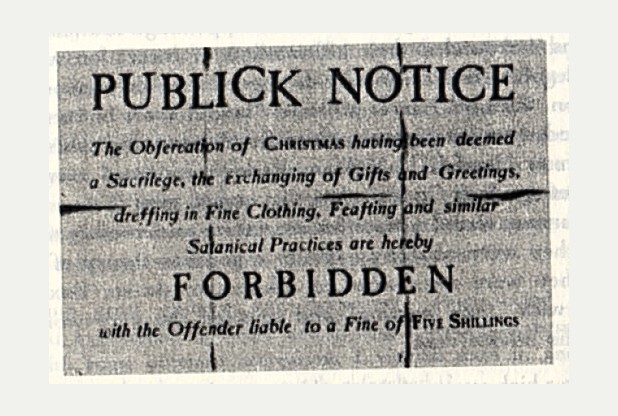
In the end, for all its supposed intrusions into the snow globe of Christmas purism, “we can partially thank commercialization for sustaining the domestic brand of Christmas we have today”—the brand, that is, that ensures we can’t stop talking about, reading about, and hearing about Christmas, whatever our beliefs, in the several weeks leading up to December 25th.
If you would like to support the mission of Open Culture, consider making a donation to our site. It’s hard to rely 100% on ads, and your contributions will help us continue providing the best free cultural and educational materials to learners everywhere. You can contribute through PayPal, Patreon, and Venmo (@openculture). Thanks!
Related Content:
Behold! The Very First Christmas Card (1843)
John Waters’ Hand-Made, Oddball Christmas Cards: 1964-Present
Watch Björk, Age 11, Read a Christmas Nativity Story on an Icelandic TV Special (1976)
Langston Hughes’ Homemade Christmas Cards From 1950
Josh Jones is a writer and musician based in Durham, NC. Follow him at @jdmagness.
Read More...Hear the Evolution of Electronic Music: A Sonic Journey from 1929 to 2019
It’s easy to get the impression that enthusiasts of electronic music listen to nothing else. (Not that it isn’t true for some of them, who tend to relegate themselves to smaller subgenres: consult Ishkur’s Guide to Electronic Music for a map of the sonic territory.) And it’s equally easy to believe that, if you aren’t explicitly into electronic music, then you don’t listen to it. But in fact, its history is one of long-term integration so thorough that many of us frequently listen to electronic music — or at any rate, electronic-adjacent music — without being conscious of that fact.
Watch the video above, a 24-minute journey through the evolution of electronic music from 1929 to 2019, and take note of how many songs you know after hearing them for only a few seconds. Early experiments by the likes of Olivier Messiaen, Halim El-Dabh, and Rune Lindblad may ring no bells (and to the uninitiated, may not sound like music at all). Doctor Who fans will perk up when the timeline reaches 1963, with the appearance of that show’s theme song — a recording by Delia Derbyshire, incidentally, whose pioneering work we’ve often featured here on Open Culture. The first piece of full-fledged pop music is Gershon Kingsley’s “Popcorn,” from 1969, one of those songs whose melody we all know even if we’d never be able to come up with the title.
In the mid-seventies, the names now widely associated with the development of modern electronic music start to emerge: Kraftwerk’s “Autobahn” in 1974, Tangerine Dream’s “Rubycon” in 1975, Jean-Michel Jarre’s “Oxygene” in 1976. But more important to the history of popular culture is the song that represents the following year: Donna Summer’s hit “I Feel Love,” which was co-produced by a certain Giorgio Moroder. Perhaps the defining figure of electronic music’s passage through the discos into the mainstream, Moroder made an even bigger impact in 1978 with his own instrumental composition “Chase,” which won him an Academy Award by being included in the film Midnight Express.
The movies did a great deal to sell the world on the fusion of electronic technology and pop music in the eighties. Who in the developed world — or indeed, in most of the developing world — could fail to recognize, for instance, Harold Faltermeyer’s “Axel F”? (And surely nobody who came of age at the time of A Night at the Roxbury can claim ignorance of Haddaway’s “What Is Love.”) As this video assembles its history, electronic music finds its way back to the dance floor in the nineties, and it more or less stays there through the twenty-tens; perhaps you would’ve had to spend a lot of time in the clubs in that decade to know such seemingly era-defining names as Marshmello, Armin van Buuren, Shapov, Major Lazer, and DJ Snake. But from an electronic-influenced hit like Ed Sheeran’s “Shape of You,” alas, there was no escape.
Related content:
The History of Electronic Music in 476 Tracks (1937–2001)
What is Electronic Music?: Pioneering Electronic Musician Daphne Oram Explains (1969)
Based in Seoul, Colin Marshall writes and broadcasts on cities, language, and culture. His projects include the Substack newsletter Books on Cities and the book The Stateless City: a Walk through 21st-Century Los Angeles. Follow him on the social network formerly known as Twitter at @colinmarshall.
Read More...99-Year-Old Dick Van Dyke Sings & Dances in a Touching New Coldplay Video, Directed by Spike Jonze
There’s one thing right with our world, and it’s Dick Van Dyke. Appearing in a new Coldplay music video, Mr. Van Dyke dances barefoot and sings knowingly a little off-key—before reflecting on a century of life on this planet. What is love? Is he afraid of dying? What does luck look like? He knows the answers. Mr. Van Dyke turns 99 this week. And we’ll be rooting him on when he turns 100 next year. Enjoy the director’s cut of the touching new music video, “All My Love,” directed by Spike Jonze.
If you would like to support the mission of Open Culture, consider making a donation to our site. It’s hard to rely 100% on ads, and your contributions will help us continue providing the best free cultural and educational materials to learners everywhere. You can contribute through PayPal, Patreon, and Venmo (@openculture). Thanks!
Related Content
Dick Van Dyke Still Dancing at 96!
Mary Tyler Moore Accidentally Nails a Perfect Pool Shot on The Dick Van Dyke Show (1962)
Spike Jonze Presents a Stop Motion Film for Book Lovers
Read More...Sci-Fi Writer Arthur C. Clarke Predicted the Rise of Artificial Intelligence & the Existential Questions We Would Need to Answer (1978)
We now live in the midst of an artificial-intelligence boom, but it’s hardly the first of its kind. In fact, the field has been subject to a boom-and-bust cycle since at least the early nineteen-fifties. Eventually, those busts — which occurred when realizable AI technology failed to live up to the hype of the boom — became so long and so thoroughgoing that each was declared an “AI winter” of scant research funding and public interest. Yet even deep into one such fallow season, AI could still inspire enough fascination to become the subject of the 1978 NOVA documentary “Mind Machines.”
The program includes interviews with figures now recognized as luminaries in the history of AI: John McCarthy, Marvin Minsky, Terry Winograd, ELIZA creator Joseph Weizenbaum. It also brings on no less a technological prophet than Arthur C. Clarke, who notes that the dubious attitudes toward the prospect of thinking machines expressed in the late seventies had much in common with those about the prospect of space travel during his youth in the thirties. In his view, we were already “creating our successors. We have seen the first, crude beginnings of artificial intelligence,” and we would “one day be able to design systems that can go on improving themselves.”
If computers were thereby to gain greater-than-human intelligence, it would, of course, “completely restructure society” — not that the society he already knew wouldn’t “collapse instantly” if its own relatively simple computers were taken away. Clarke not only asks the question now on many minds of what “the people who are only capable of low-grade computer-type work” will do when outstripped by AI, but more deeply underlying ones as well: “What is the purpose of life? What do we want to live for? That is a question which the intelligent computer will force us to pay attention to.”
Few viewers in 1978 would have spent much time pondering such matters before. But presented with footage of all this now-primitive proto-AI technology — the computer chess tournament, the simulated therapist, the medical-diagnosis assistant, the NASA Mars rover to be launched in the far-flung future of 1986 — they must at least have felt able to entertain the idea that they would live to see an age of machines that could not just think but, as the narrator puts it, possess “the most crucial aspect of common-sense intelligence: the ability to learn.” Perhaps another AI winter will forestall that age yet again — if it’s not already here.
Related content:
Before ChatGPT, There Was ELIZA: Watch the 1960s Chatbot in Action
A New Course Teaches You How to Tap the Powers of ChatGPT and Put It to Work for You
Generative AI for Everyone: A Free Course from AI Pioneer Andrew Ng
Based in Seoul, Colin Marshall writes and broadcasts on cities, language, and culture. His projects include the Substack newsletter Books on Cities and the book The Stateless City: a Walk through 21st-Century Los Angeles. Follow him on the social network formerly known as Twitter at @colinmarshall.
Read More...An Illustrator Creates a Kindle for Charles Dickens, Placing 40 Miniature Classics within a Large Portable Book
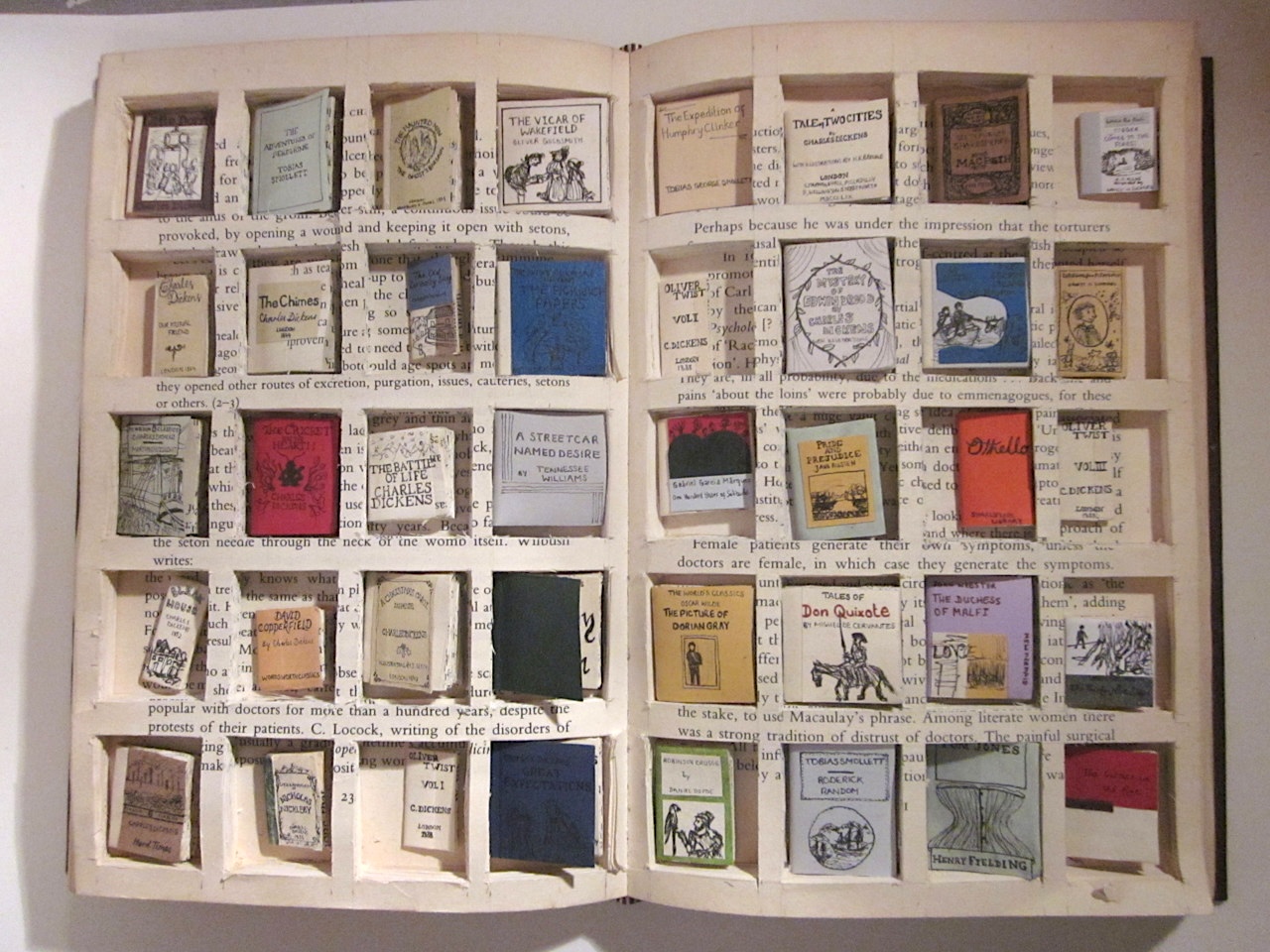
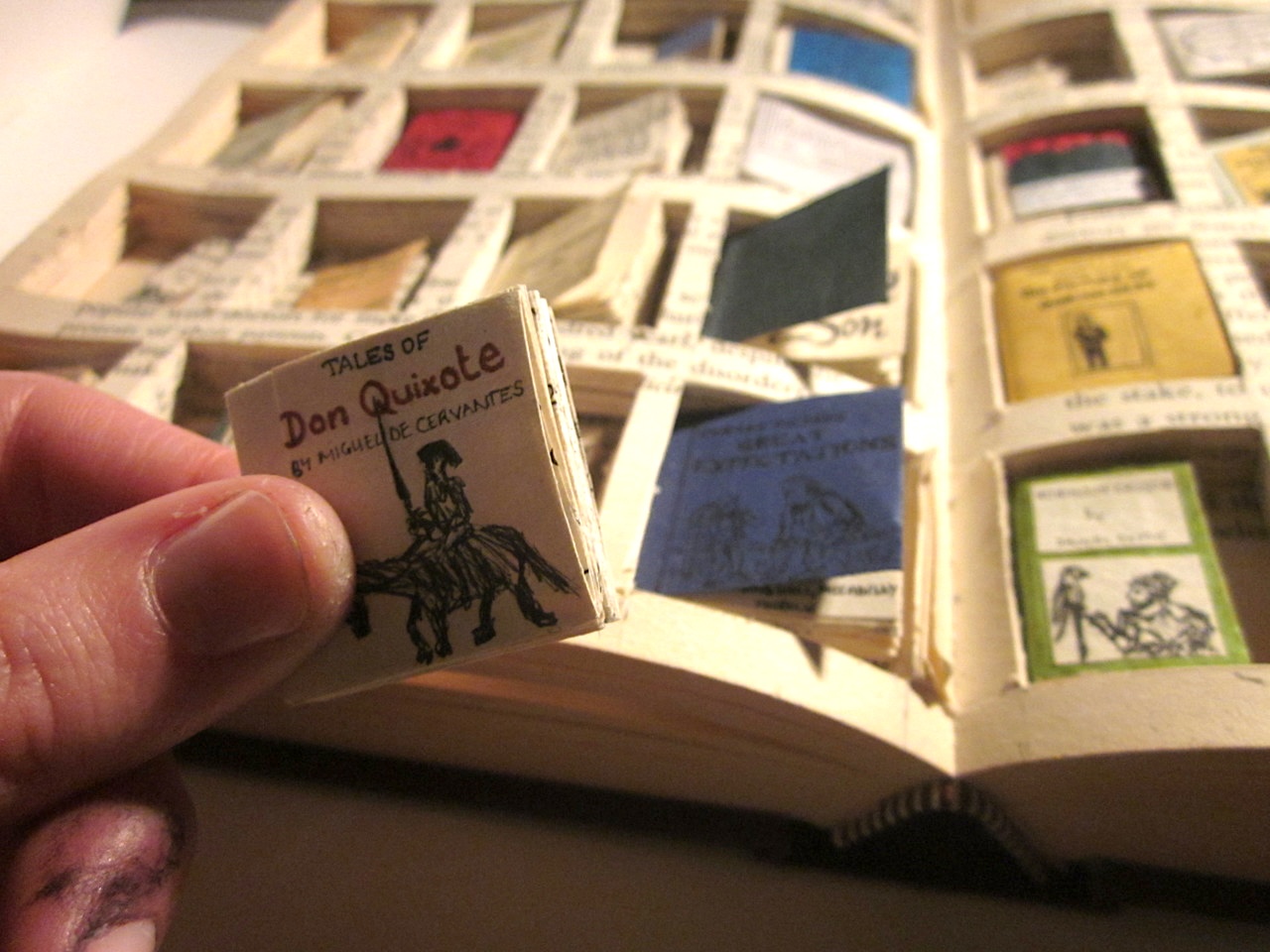
For a design class project, Rachel Walsh, a student at Cardiff School of Art and Design, set out to explain the concept of a Kindle to Charles Dickens. Recognizing that Dickens, a 19th-century author, wouldn’t understand modern terms like ebooks, downloads or the internet, she decided to take a metaphorical approach. She crafted a “book of books,” a large portable book that contained 40 miniature versions of classics that Dickens might have enjoyed. Among the texts, you will find Don Quixote, Pride and Prejudice, and Othello. Also some works by Dickens himself: for example, David Copperfield, Oliver Twist, and A Tale of Two Cities. And even some more modern selections—e.g., A Streetcar Named Desire and The Catcher in the Rye. You can find images of Walsh’s project on Tumblr. Enjoy!
If you would like to support the mission of Open Culture, consider making a donation to our site. It’s hard to rely 100% on ads, and your contributions will help us continue providing the best free cultural and educational materials to learners everywhere. You can contribute through PayPal, Patreon, and Venmo (@openculture). Thanks!
Related Content
Discover the Jacobean Traveling Library: The 17th Century Precursor to the Kindle
The Fiske Reading Machine: The 1920s Precursor to the Kindle
Read More...What Ancient Greek Music Sounded Like: Listen to a Reconstruction That’s “100% Accurate”
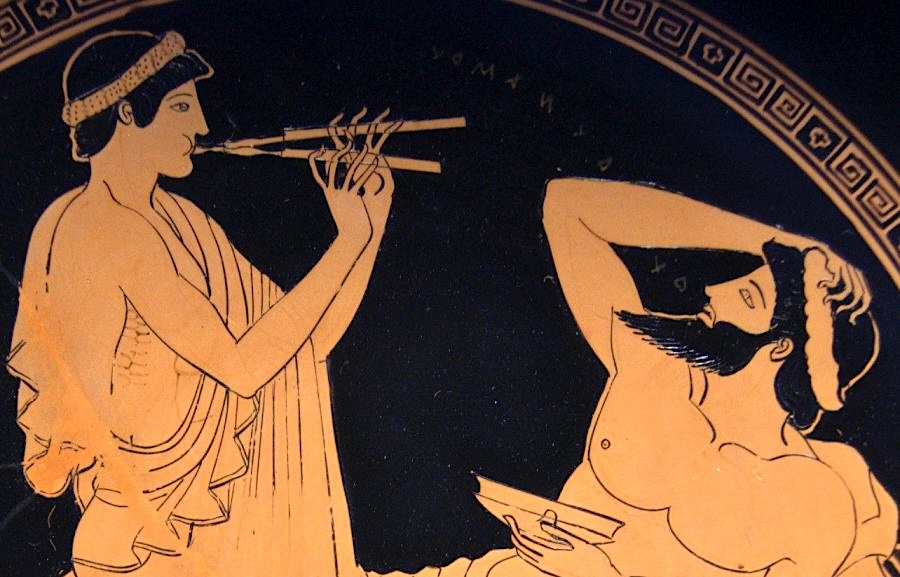
Between 750 BC and 400 BC, the Ancient Greeks composed songs meant to be accompanied by the lyre, reed-pipes, and various percussion instruments. More than 2,000 years later, modern scholars have finally figured out how to reconstruct and perform these songs with (it’s claimed) 100% accuracy.
Writing on the BBC website, Armand D’Angour, a musician and tutor in classics at Oxford University, notes:
[Ancient Greek] instruments are known from descriptions, paintings and archaeological remains, which allow us to establish the timbres and range of pitches they produced.
And now, new revelations about ancient Greek music have emerged from a few dozen ancient documents inscribed with a vocal notation devised around 450 BC, consisting of alphabetic letters and signs placed above the vowels of the Greek words.
The Greeks had worked out the mathematical ratios of musical intervals — an octave is 2:1, a fifth 3:2, a fourth 4:3, and so on.
The notation gives an accurate indication of relative pitch.
So what did Greek music sound like? Below you can listen to David Creese, a classicist from the University of Newcastle, playing “an ancient Greek song taken from stone inscriptions constructed on an eight-string ‘canon’ (a zither-like instrument) with movable bridges. “The tune is credited to Seikilos,” says Archaeology Magazine.
For more information on all of this, read D’Angour’s article over at the BBC.
Note: An earlier version of this post appeared on our site in October, 2013.
If you would like to support the mission of Open Culture, consider making a donation to our site. It’s hard to rely 100% on ads, and your contributions will help us continue providing the best free cultural and educational materials to learners everywhere. You can contribute through PayPal, Patreon, and Venmo (@openculture). Thanks!
Related Content:
Hear What Homer’s Odyssey Sounded Like When Sung in the Original Ancient Greek
Hear Homer’s Iliad Read in the Original Ancient Greek
Hear the Oldest Song in the World: A Sumerian Hymn Written 3,400 Years Ago
Hear The Epic of Gilgamesh Read in the Original Akkadian, the Language of Mesopotamia
Read More...The 63 Cuisines of China Explained in 40 Minutes: A Complete Primer
Wherever in the world you grew up, you probably grew up with an inaccurate idea of Chinese food. For Americans, it can come as a shock to hear that such familiar dishes as chop suey and General Tso’s chicken are unknown in China itself. By the same token, almost every country in the world has developed its own concept of “Chinese food” geared, sometimes outlandishly, to local tastes. But it could be said that the average Chinese person in China also has a skewed idea of their national cuisine, because they see it through the lens of their own regional cuisine — of which, according to the Chinese Cooking Demystified video above, there are at least 63.
In just 40 minutes, the channel’s co-host Chris Thomas broadly explains all of those cuisines, from the six eaten in Guangdong alone to the various fusions available in the vast-unto-itself region of Inner Mongolia.
Along the way, he highlights such representative dishes as beer fish, blood duck, “steamed double stinky,” lion’s head meatball, braised donkey sandwich, “ol’ buddy noodles,” lamp-shaped rice cake, hairy tofu, and “everybody’s favorite, penis fish.” Of course, quite a few of the items in between will seem more familiar to viewers who’ve never deliberately sought out “authentic” Chinese food: even Peking duck, it turns out, belongs in that category.
Still, the flavors of the Peking duck you can get in Beijing surely beat out those of the versions available in, say, Denver. If you want to taste them, as Thomas explains at the video’s end, “you should travel to mainland China. Is it the easiest place in the world to travel to? No. If you don’t know Chinese, the language barrier can get intense” (though you might consider starting to learn it with the resources we’ve rounded up here on Open Culture). But “if you want easy, go to Disneyland”; if you want to experience “mind-numbing culinary diversity,” it’s time to start planning your eating journey through the Middle Kingdom — and there are hundreds more Chinese Cooking Demystified videos available to make you hungry.
Note: Chinese Cooking Demystified has a related post on their Substack. Titled “63 Chinese Cuisines: the Complete Guide,” the post features helpful maps and commentary. It’s worth checking out.
Related content:
An Archive of 3,000 Vintage Cookbooks Lets You Travel Back Through Culinary Time
The First American Cookbook: Sample Recipes from American Cookery (1796)
Bob Dylan Potato Chips, Anyone?: What They’re Snacking on in China
Based in Seoul, Colin Marshall writes and broadcasts on cities, language, and culture. His projects include the Substack newsletter Books on Cities and the book The Stateless City: a Walk through 21st-Century Los Angeles. Follow him on the social network formerly known as Twitter at @colinmarshall.
Read More...Support Us
We're hoping to rely on loyal readers, rather than erratic ads. Please click the Donate button and support Open Culture. You can use Paypal, Venmo, Patreon, even Crypto! We thank you!

About Us

Open Culture scours the web for the best educational media. We find the free courses and audio books you need, the language lessons & educational videos you want, and plenty of enlightenment in between.
Advertise With Us

FREE UPDATES!
GET OUR DAILY EMAIL
Get the best cultural and educational resources on the web curated for you in a daily email. We never spam. Unsubscribe at any time.
FOLLOW ON SOCIAL MEDIA

Open Culture editor Dan Colman scours the web for the best educational media. He finds the free courses and audio books you need, the language lessons & movies you want, and plenty of enlightenment in between.
Advertise With Us

