Originally written by Sonny Curtis and released in 1970, “Love Is All Around”–otherwise known as the Mary Tyler Moore theme song–has been covered by many acts: Sammy Davis Jr, Hüsker Dü, and Joan Jett & the Blackhearts, to name a few. After releasing a studio version in 1996, Jett performed the song live on the Late Show with David Letterman that same year. If you’re old enough, this performance will give you a double dose of nostalgia. It lets you recall the spirit of 1970s second-wave-feminist television, and it recaptures the sheer playfulness of Letterman’s freewheeling 90s late night show. Enjoy!
Even those of us not particularly well-versed in art history have heard of a painting style called fauvism — and probably have never considered what it has to do with fauve, the French word for a wild beast. In fact, the two have everything to do with one another, at least in the sense of how certain critics regarded certain artists in the early twentieth century. One of the most notable of those artists was Henri Matisse, who since the end of the nineteenth century had been exploring the possibilities of his decision to “lean into the dramatic power of color,” as Evan “Nerdwriter” Puschak puts it in the new video above.
It was Matisse’s unconventional use of color, emotionally powerful but not strictly realistic, that eventually got him labeled a wild beast. Even before that, in his famous 1904 Luxe, Calme et Volupté, which has its origins in a stay in St. Tropez, you can “feel Matisse forging his own path. His colors are rebelling against their subjects. The painting is anarchic, fantastical. It’s pulsing with wild energy.” He continued this work on a trip to the southern fishing village of Collioure, “and even after more than a century, the paintings that resulted “still retain their defiant power; the colors still sing with the daring, the creative recklessness of that summer.”
In essence, what shocked about Matisse and the other fauvists’ art was its substitution of objectivity with subjectivity, most noticeably in its colors, but in subtler elements as well. As the years went on — with support coming from not the establishment but far-sighted collectors — Matisse “learned how to use color to define form itself,” creating paintings that “expressed deep, primal feelings and rhythms.” This evolution culminated in La Danse, whose “shocking scarlet” used to render “naked, dancing, leaping, spinning figures who are less like people than mythological satyrs” drew harsher opprobrium than anything he’d shown before.
But then, “you can’t expect the instantaneous acceptance of something radically new. If it was accepted, it wouldn’t be radical.” Today, “knowing the directions that modern art went in, we now can appreciate the full significance of Matisse’s work. We can be shocked at it without being scandalized.” And we can recognize that he discovered a universally resonant aesthetic that most of his contemporaries didn’t understand — or at least it seems that way to me, more than a century later and on the other side of the world, where his art now enjoys such a wide appeal that it adorns the iced-coffee bottles at convenience stores.
Based in Seoul, Colin Marshall writes and broadcasts on cities, language, and culture. His projects include the Substack newsletterBooks on Cities and the book The Stateless City: a Walk through 21st-Century Los Angeles. Follow him on Twitter at @colinmarshall or on Facebook.
MTV stands for Music Television, and when the network launched in 1981, its almost entirely music video-based programming was true to its name. Within a decade, however, its mandate had widened to the point that it had become the natural home for practically any exciting development in American youth culture. And for many MTV viewers in the early nineteen-nineties, youthful or otherwise, nothing was quite so exciting as Liquid Television, whose every broadcast constituted a veritable festival of animation that pushed the medium’s boundaries of possibility — as well, every so often, as its boundaries of taste.
Liquid Television’s original three-season run began in the summer of 1991 and ended in early 1995. All throughout, its format remained consistent, rounding up ten or so shorts, each created by different artists. Their themes could vary wildly, and so could their aesthetics: any given broadcast might contain more or less conventional-looking cartoons, but also stickmen, puppets, early computer graphics, subverted nineteen-fifties imagery (that mainstay of the Gen‑X sensibility), Japanese anime, and even live action, as in the recurring drag-show sitcom “Art School Girls of Doom” or the multi-part adaptation of Charles Burns’ Dogboy.
Burns’ is hardly the the only name associated with Liquid Television that comics and animation fans will recognize. Others who gained exposure through it include Bill Plympton, John R. Dilworth, Richard Sala, and Mike Judge, whose series Beavis and Butthead and feature film Office Space both began as shorts seen on Liquid Television.
The Tongal video above credits the show’s influence to the insight of the show’s creator Japhet Asher, who saw that “the attention span of your average TV viewer, particularly young people, was getting shorter and shorter.” Hence Liquid Television’s model: “If you didn’t like the current short, another one, which would be totally different, would be along in a few minutes. Furthermore, if a segment was so inexplicably bizarre and brain-tickling, perhaps an even more compelling one would come next.” At the time, this would have been taken by some observers — much like MTV itself — as a disturbing reflection of an addled, over-stimulated younger generation. But with Youtube still about a decade and a half away, it’s fair to say they hadn’t seen anything yet.
Based in Seoul, Colin Marshall writes and broadcasts on cities, language, and culture. His projects include the Substack newsletterBooks on Cities and the book The Stateless City: a Walk through 21st-Century Los Angeles. Follow him on Twitter at @colinmarshall or on Facebook.
There may be a few young people in Britain today who recognize the name Ludwig Koch, but in the nineteen-forties, he constituted something of a cultural phenomenon unto himself. He “started recording sounds and voices in the 1880s when he was still a child” in his native Germany, says the website of the BBC. After fleeing from the Nazis, he settled in England, which created the opportunity for the Beeb to acquire his collection of field recordings, using it to start building its own library of nature sounds. Soon, Koch “became a household name as a nature broadcaster,” and his “distinct German accent and eccentric location recordings became so well known that he was parodied by Peter Sellers.”
“These include clips made by the BBC Radiophonic workshop, recordings from the Blitz in London, special effects made for BBC TV and Radio productions, as well as 15,000 recordings from the Natural History Unit archive,” says its About page. “You can explore sounds from every continent — from the college bells ringing in Oxford to a Patagonian waterfall — or listen to a submarine klaxon or the sound of a 1969 Ford Cortina door slamming shut.”
The BBC has made all these recordings free for your own non-commercial use, as long as you credit where they came from. To put them into a commercial project, you can license them by clicking “Show details,” and then the “Buy sound” button that appears right below. The archive also offers a “mixer mode,” which lets you “layer, edit and re-order clips from the archive to create your own sounds,” potentially mashing up a wide variety of times and places into a single soundscape. A chacma baboon wielding a laser in a Belgian café, for instance, or a laughing woman brewing a kettle of water at a bullfight in Spain: hardly the sort of aural scenes that would be introduced by Ludwig Koch, granted, but here in the twenty-first century, the only limit is your imagination. Enter the BBC Sound Effects Archive here.
Based in Seoul, Colin Marshall writes and broadcasts on cities, language, and culture. His projects include the Substack newsletterBooks on Cities and the book The Stateless City: a Walk through 21st-Century Los Angeles. Follow him on Twitter at @colinmarshall or on Facebook.
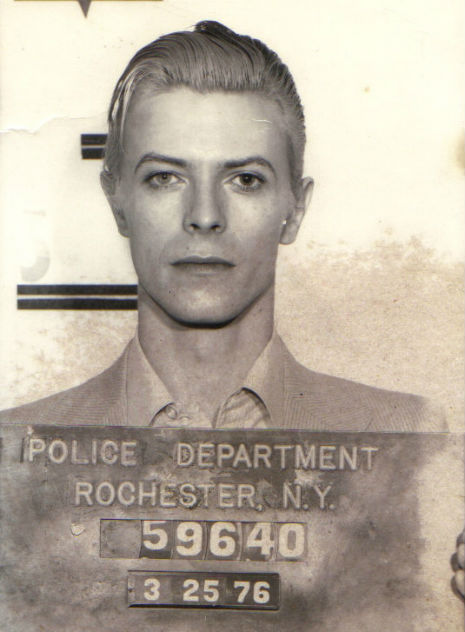
David Bowie always managed to look cool, even when he was being booked for a felony.
In early 1976, Bowie was on his “Isolar” tour, performing as the Thin White Duke, a persona he would describe as “a very Aryan fascist type — a would-be romantic with no emotions at all.” Bowie invited his friend and sometime creative collaborator Iggy Pop to travel with him.
In the early morning hours of March 21, after a concert at the Community War Memorial arena in Rochester, New York, four local vice squad detectives and a state police investigator searched Bowie’s three-room suite at the Americana Rochester Hotel. According to reports in the Rochester Democrat and Chronicle, the cops found 182 grams (a little over 6.4 ounces) of marijuana there. Bowie and three others — Pop, a bodyguard named Dwain Voughns, and a young Rochester woman named Chiwah Soo — were charged with fifth-degree criminal possession of marijuana, a class C felony, punishable by up to 15 years in prison.
Bowie and Pop were booked under their real names, David Jones and James Osterberg Jr. The group spent the rest of the night in the Monroe County Jail and were released at about 7 a.m. on $2,000 bond each. They were supposed to be arraigned the next day, but Bowie left town to go to his next concert in Springfield, Massachusetts. His lawyer appeared and asked for the court’s indulgence, explaining the heavy penalties for breaking concert engagements. He promised the judge that Bowie would appear the following morning, March 23.
Bowie showed up for his arraignment looking dapper in his Thin White Duke clothing. It was then that his mug shot was taken — so we’ll never actually know what Bowie looked like when he was unexpectedly dragged into jail at 3 a.m. The police escorted the rock star in and out of the courtroom mostly through back corridors, shielding him from a crowd of fans who showed up at the courthouse. Reporter John Stewart describes the scene in the next day’s Democrat and Chronicle:
Bowie and his group ignored reporters’ shouted questions and fans’ yells as he walked in — except for one teenager who got his autograph as he stepped off the escalator.
His biggest greeting was the screams of about a half-dozen suspected prostitutes awaiting arraignment in the rear of the corridor outside the courtroom.
Asked for a plea by City Court Judge Alphonse Cassetti to the charge of fifth-degree criminal possession of a controlled substance, Bowie said, “not guilty, sir.” The court used his real name — David Jones.
He stood demurely in front of the bench with his attorneys. He wore a gray three-piece leisure suit and a pale brown shirt. He was holding a matching hat. His two companions were arraigned on the same charge.
The defense lawyer told the judge that Bowie and the others had never been arrested before. The judge allowed them to remain free on bond until a grand jury convened. Bowie and his entourage went on with their tour, and the grand jury eventually decided not to indict anyone. The incident was largely forgotten until an auction house employee named Gary Hess stumbled on Bowie’s mug shot while sorting through the estate of a retired Rochester police officer. Hess rescued the photo from the trash bin, according to an article in Rochester Subway, and in late 2007 his brother sold it on eBay for $2,700.
We still occasionally speak of “Kodak moments,” making conscious or unconscious reference to the slogan of the Eastman Kodak Company in the nineteen-eighties. Even by that time, Kodak had already been a going concern for nearly a century, furnishing photographers around the world with the film they needed to capture images. Its very first slogan, unveiled in 1888, was “You Press the Button, We Do the Rest,” and it heralded the arrival of a new era: one in which, thanks to the company’s No. 1 box camera (loaded with the new medium of roll film), photographs could be “taken by people with little or no previous knowledge of photography.”
So says Vox’s Coleman Lowndes in the new video above, which explains how this invention changed the nature of photography itself. People began using Kodak cameras “to document their travels and their daily lives at home”; they “took portraits of each other, but also candid street scenes.” Such was the novelty of taking a picture so quickly and easily — and well outside a studio — that it demanded a new word, or rather, the adoption of a word from another domain: snapshot, which up until then had referred to “a quick shot with a gun, without aim, at a fast-moving target.” Before Kodak, a photographer simply had no way to capture the moment.
But it was only with the introduction of the inexpensive Brownie, “a simple box camera made of cardboard encased in faux leather,” that everyone — even a child — could become a photographer. “Take a Kodak with You,” suggested another of the company’s slogans in the early twentieth century, and millions took heed. Its position as both a corporate and cultural institution wasn’t seriously threatened until the end of that century, when Japan’s Fujifilm “had begun to eat away at the American photo giant’s market share,” and then digital photography destroyed wide swaths of the film business at a stroke.
Ironically, the first digital camera was invented in 1975 by a Kodak engineer, “but the company, which from the beginning had built itself on selling and processing film rather than manufacturing cameras, didn’t make the change soon enough.” After finally entering bankruptcy in 2012, Kodak reorganized to “focus on digital printing services rather than film development,” which has by now become “a somewhat niche market of dedicated hobbyists.” Also doing its part to keep the company afloat is its line of logo-emblazoned apparel, which holds out a retro appeal all across the world — even to youngsters quick enough on the draw with their camera phones that every moment might as well be a Kodak moment.
Based in Seoul, Colin Marshall writes and broadcasts on cities, language, and culture. His projects include the Substack newsletterBooks on Cities and the book The Stateless City: a Walk through 21st-Century Los Angeles. Follow him on Twitter at @colinmarshall or on Facebook.
If you’ve never tried your hand at filmmaking, you might assume that its hardest visual challenges are the creation of effects-laden spectacles: starships duking it out in space, monsters stomping through major cities, animals speaking and dancing like Broadway stars, that sort of thing. But consider the challenge posed by simply capturing a scene set in a bathroom. Almost all such spaces include a large mirror, meaning that most angles from which you could shoot will violate an important rule cited by Youtuber Paul E.T. in the video above: “Don’t show the camera in the shot.”
Yet we’ve all seen major motion pictures and television series with scenes not just in bathrooms but other mirror-equipped spaces, from rooms used for interrogating suspects to rooms used for preparing to come out on stage. What’s more, the camera often passes blithely before these mirrors with a vampire-like lack of a reflection. The techniques used to achieve such shots are now mature enough that we may not even notice that what we’re seeing doesn’t make visual sense. How they work is the subject of Paul E.T.‘s investigation, beginning with an episode of Criminal: United Kingdom in which a camera somehow floats around a room with a one-way mirror, never appearing in that mirror.
Another more familiar example comes from Contact, directed by the visual-effects maven Robert Zemeckis. In its early flashback sequence, an adolescent version of its astronomer protagonist runs toward the backward-tracking camera and reaches out to open what turns out to be a bathroom medicine cabinet, into whose mirror we must have — yet cannot possibly have — been looking into the whole time. What we’re seeing is actually a seamless fusion of two shots, with the “empty” (that is, blue-screen-filled) frame of the cabinet mirror superimposed on the end of the shot of the young actress running toward it. While not technically easy, it’s at least conceptually straightforward.
Paul E.T. finds another, more complicated mirror shot in no less a masterwork of cinema than Zack Snider’s Sucker Punch, which tracks all the way around from one side of a set of dressing-room mirrors to the other. “What you’re actually seeing when the camera moves is the transitioning from one side of a duplicated set to the other,” he explains, “with an invisible cut spliced in there” — which involves lookalike actresses literally trying to mirror each other’s movements. No such elaborate trickery for Ruben Östlund’s Force Majeure, which shoots straight-on into a bathroom mirror by building the camera into the wall, then digitally erasing it in post-production.
While we do live in an age of “fix it in post” (an instinct with an arguably regrettable effect on cinema), mirror shots, on the whole, still require some degree of foresight and inventiveness. Such was the case with that scene from Criminal: United Kingdom, which Paul E.T. simply couldn’t figure out on his own. His search for answers led him to e‑mail the episode’s B‑camera operator, who explained that the production involved neither a blue screen nor doubles, but “a combination of well-choreographed camera work and VFX.” The result: a shot that may look unremarkable at first, but on closer inspection, attests to the subtle power of movie magic — or TV magic, at any rate.
Based in Seoul, Colin Marshall writes and broadcasts on cities, language, and culture. His projects include the Substack newsletterBooks on Cities and the book The Stateless City: a Walk through 21st-Century Los Angeles. Follow him on Twitter at @colinmarshall or on Facebook.
If you know nothing else about medieval European illuminated manuscripts, you surely know the Book of Kells. “One of Ireland’s greatest cultural treasures” comments Medievalists.net, “it is set apart from other manuscripts of the same period by the quality of its artwork and the sheer number of illustrations that run throughout the 680 pages of the book.” The work not only attracts scholars, but almost a million visitors to Dublin every year. “You simply can’t travel to the capital of Ireland,” writes Book Riot’s Erika Harlitz-Kern, “without the Book of Kells being mentioned. And rightfully so.”
The ancient masterpiece is a stunning example of Hiberno-Saxon style, thought to have been composed on the Scottish island of Iona in 806, then transferred to the monastery of Kells in County Meath after a Viking raid (a story told in the marvelous animated film The Secret of Kells). Consisting mainly of copies of the four gospels, as well as indexes called “canon tables,” the manuscript is believed to have been made primarily for display, not reading aloud, which is why “the images are elaborate and detailed while the text is carelessly copied with entire words missing or long passages being repeated.”
Its exquisite illuminations mark it as a ceremonial object, and its “intricacies,” argue Trinity College Dublin professors Rachel Moss and Fáinche Ryan, “lead the mind along pathways of the imagination…. You haven’t been to Ireland unless you’ve seen the Book of Kells.” This may be so, but thankfully, in our digital age, you need not go to Dublin to see this fabulous historical artifact, or a digitization of it at least, entirely viewable at the online collections of the Trinity College Library. (When you click on the previous link, make sure you scroll down the page.) The pages, originally captured in 1990, “have recently been rescanned,” Trinity College Library writes, using state-of-the-art imaging technology. These new digital images offer the most accurate high-resolution images to date, providing an experience second only to viewing the book in person.”
What makes the Book of Kells so special, reproduced “in such varied places as Irish national coinage and tattoos?” asks Professors Moss and Ryan. “There is no one answer to these questions.” In their free online course on the manuscript, these two scholars of art history and theology, respectively, do not attempt to “provide definitive answers to the many questions that surround it.” Instead, they illuminate its history and many meanings to different communities of people, including, of course, the people of Ireland. “For Irish people,” they explain in the course trailer above, “it represents a sense of pride, a tangible link to a positive time in Ireland’s past, reflected through its unique art.”
But while the Book of Kells is still a modern “symbol of Irishness,” it was made with materials and techniques that fell out of use several hundred years ago, and that were once spread far and wide across Europe, the Middle East, and North Africa. In the video above, Trinity College Library conservator John Gillis shows us how the manuscript was made using methods that date back to the “development of the codex, or the book form.” This includes the use of parchment, in this case calf skin, a material that remembers the anatomical features of the animals from which it came, with markings where tails, spines, and legs used to be.
The Book of Kells has weathered the centuries fairly well, thanks to careful preservation, but it’s also had perhaps five rebindings in its lifetime. “In its original form,” notes Harlitz-Kern, the manuscript “was both thicker and larger. Thirty folios of the original manuscript have been lost through the centuries and the edges of the existing manuscript were severely trimmed during a rebinding in the nineteenth century.” It remains, nonetheless, one of the most impressive artifacts to come from the age of the illuminated manuscript, “described by some,” says Moss and Ryan, “as the most famous manuscript in the world.” Find out why by seeing it (virtually) for yourself and learning about it from the experts above.
For most musicians, a long-lost song written in their teenage years would be of interest only to serious fans — and even then, probably more for biographical reasons than as a standalone piece of work. But that’s hardly the case for Wolfgang Amadeus Mozart, who was composing advanced music at the age of five, and indeed completed the first act of his short life by adolescence. Hence the guaranteed appreciative audience for Serenade in C, a hitherto unknown piece recently discovered in the holdings of Germany’s Leipzig Municipal Libraries and first performed for the public just last week.
“Library researchers were compiling an edition of the Köchel catalog, a comprehensive archive of Mozart’s work, when they stumbled across a mysterious bound manuscript containing a handwritten composition in brown ink,” writes Smithsonian.com’s Sonja Anderson.
Composed in the mid-to-late 1760s, Serenade in C “consists of seven miniature movements for a string trio (two violins and a bass).” According to researchers, it “fits stylistically” the work of that period, “when Mozart was between the ages of 10 and 13”; a few years later, he’d outgrown (or transcended) this style of chamber music entirely.
You can see and hear Serenade in C in the video at the top of the post, performed earlier this month, not long after its premiere, on the steps of the Leipzig Opera by Vincent Geer, David Geer, and Elisabeth Zimmermann of the Leipzig School of Music’s youth symphony orchestra. Renamed Ganz kleine Nachtmusik, this “new” Mozart piece has been included in the latest Köchel catalog with the number K. 648. If you listen to it in the context of Mozart’s artistic evolution, you’ll also notice the ways in which it stands out in a period when he wrote mainly arias, symphonies, and piano music. As for the extent to which it prefigures things to come, it’s early enough that we should probably leave that question to the Mozartologists.
Based in Seoul, Colin Marshall writes and broadcasts on cities, language, and culture. His projects include the Substack newsletterBooks on Cities and the book The Stateless City: a Walk through 21st-Century Los Angeles. Follow him on Twitter at @colinmarshall or on Facebook.
Copies of Moby Dick can be found in our collection of Free eBooks. Meanwhile, this big reading will be added to our collection of Free Audio Books.
If you would like to support the mission of Open Culture, consider making a donation to our site. It’s hard to rely 100% on ads, and your contributions will help us continue providing the best free cultural and educational materials to learners everywhere. You can contribute through PayPal, Patreon, and Venmo (@openculture). Thanks!
Ted Mills is a freelance writer on the arts who currently hosts the artist interview-based FunkZone Podcast. You can also follow him on Twitter at @tedmills, read his other arts writing at tedmills.com and/or watch his films here.
George Clooney may be better regarded as an actor than as a director, but his occasional work in the latter capacity reveals an admirable interest in lesser-dramatized chapters of American history. His films have found their material in everything from the early years of the NFL to the racial strife in Levittown to even The Gong Show creator Chuck Barris’ dubious past as a CIA assassin. A decade ago, he directed The Monuments Men, whose ensemble cast – including Matt Damon, Bill Murray, John Goodman, and Clooney himself — play Allied soldiers tasked with recovering the many works of art stolen by the Nazis during World War II.
The Monuments Men is based, if loosely, on real events; hence the inclusion of a few of its clips in the new Great Art Explained video above. In it, gallerist-Youtuber James Payne gets into the subject of how the Nazis plundered Europe’s cultural treasures through one painting in particular: one of daring Expressionist Egon Schiele’s Boats Mirrored in the Water series, whose whereabouts remain unknown.
Before the war, it had been in the art collection of the Vienna cabaret star Franz Friedrich “Fritz” Grünbaum. Unlike Schiele’s portraits, none of the Boats Mirrored in the Water were sufficiently offensive to be labeled “degenerate art.” They were nonetheless subject to the organized theft that the regime called “Aryanization.”
In 1956, long after the Nazis had sent Grünbaum and his wife to their deaths, 80 percent of their collection came up for auction in Switzerland. How it got there, we don’t know, though it ended up dispersed far and wide, to both institutions and individuals. The Boats Mirrored in the Water in question was recorded as having been sold again, in 1990, to an unidentified private collector, and it hasn’t been seen since. That may not be a Hollywood ending, but the art-repatriating work of the real Monuments Men continues today; not so long ago, a German court even awarded a once-Aryanized portrait by Schiele’s idol Gustav Klimt to the son of its original owner. It’s not impossible that the missing boat Schiele painted in Trieste over a century ago will see the light of day once again.
Based in Seoul, Colin Marshall writes and broadcasts on cities, language, and culture. His projects include the Substack newsletterBooks on Cities and the book The Stateless City: a Walk through 21st-Century Los Angeles. Follow him on Twitter at @colinmarshall or on Facebook.
We're hoping to rely on loyal readers, rather than erratic ads. Please click the Donate button and support Open Culture. You can use Paypal, Venmo, Patreon, even Crypto! We thank you!
Open Culture scours the web for the best educational media. We find the free courses and audio books you need, the language lessons & educational videos you want, and plenty of enlightenment in between.