Jack Kerouac was born 100 years ago today (March 12, 1922). And to mark the occasion, you can hear him read from his 1957 Beat classic,On the Road. This 28-minute recitation was apparently recorded on an acetate disc in the 1950s but thought lost for decades. It re-surfaced during the late 1990s. Enjoy.
If you would like to sign up for Open Culture’s free email newsletter, please find it here. It’s a great way to see our new posts, all bundled in one email, each day.
If you would like to support the mission of Open Culture, consider making a donation to our site. It’s hard to rely 100% on ads, and your contributions will help us continue providing the best free cultural and educational materials to learners everywhere. You can contribute through PayPal, Patreon, and Venmo (@openculture). Thanks!
You can slide up, pull off and hammer like a beast, but be forewarned. It’s unlikely you’ll be able to keep pace with Heart’s Nancy Wilson, as she demonstrates how to play the introduction to 1975’s “Crazy On You,” one of the greatest — and trickiest — opening guitar solos in rock history.
“I really wanted people to know right up front what I could do,” Wilson revealed in a 1999 interview withAcoustic Guitar:
It was the same thing as sitting in the Bandwagon music store and playing (Paul Simon’s) Anji. It was like, “Check me out, I know some stuff.”
As hard rocking female musicians in the 70s and 80s, Wilson and her bandmate/sister, lead vocalist- and songwriter, Ann found themselves having to prove themselves constantly.
Back then, especially in the 70s, there was no filter on how women were sexualized – hyper-sexualized – in order to sell their images. Now at least it looks like women have control over their own filters. Back then, they didn’t. It was just like: “Hey, here’s a sexy chick. We know how we can sell her.”
Let’s all observe Women’s History Month by insisting that every bonehead who ever dismissed these pioneering women as a ‘chick band’ pay close attention to Nancy’s intricate “hybrid picking”.
“Crazy On You” finds her picking a rhythm on the A‑string while using her bare fingers to pull off notes on the B and G strings.
And by her own admission, she tends never to play it the same way twice (“which makes it real easy, right?”)
While we’re at it, how about we celebrate Heart’s 50th anniversary by introducing the next generation to “Crazy On You”?
The times have changed in significant ways, but the emotions that inspired the song will strike close to home for many young people, as per Ann’s description on the Professor of Rock’s YouTube channel:
I wrote the words about the state of the world, and the stress effect it was having on me. Back then, we thought the world was really messed up, right? Because the Vietnam War was going on and we were choosing to, but staying out of our own country…we were homesick. Crime was rising, gas was expensive, gas shortage, all this horrible stuff. We had no idea what was going to happen in later years so it seemed to be, at that time, y’know, this is the end of the world. This close to the apocalypse. It’s very very stressful when you’re in your 20’s and you don’t see a good future.
If you’re committed to learning Nancy Wilson’s guitar intro to “Crazy On You,” we recommend Shutup & Play’s video tutorial and tabs.
Before becoming a filmmaker, Jean-Pierre Grumbach participated in the French Resistance during World War II. It was then that he took the nom de guerre of Jean-Pierre Melville, under which he would later inspire the French New Wave. Just as he never made a film under another name, his work never quite abandoned the themes provided by his wartime experience in Nazi-occupied France, which comes through most clearly in his feature debut Le Silence de la mer. Released just four years after V‑E Day, it tells the story of a German lieutenant billeted in a French household, an admirer of French culture who holds forth nightly of his anticipation of the “marriage” of the German and French civilizations.
The day comes for the German to make a much-anticipated trip to Paris. After worshipfully taking in the sights of the capital — the Arc de Triomphe, Notre-Dame de Paris, the Monument à Jeanne d’Arc — he meets with his Nazi superiors. And so he discovers, to his great shock, that what the occupiers have planned is not a marriage but a demolition. “Do you think we’re so stupid as to allow France ever to rise again?” asks one of the other officers. “We have the opportunity to destroy France and we will do so,” says another. “Not only its might, but also its spirit,” which requires the complete extirpation of all “works of culture” — for “to conquer, violence is sufficient, but not to rule.”
81 years later, the events of Le Silence de la mer have returned to mind. “Russia’s war on Ukraine has been an all-round disaster,” writes the Guardian’s Luke Harding and Harriet Sherwood. “Its army has shelled densely populated cities, killing hundreds. More than 2 million refugees have fled abroad in Europe’s biggest exodus since the second world war.” Ukrainian cities have set about hiding what pieces they can of their cultural heritage: in Lviv, for example, these included “a precious wooden alter-piece showing Jesus, Mary and Mary Magdalene. It was removed from Lviv’s 14th century Armenian church and transported to a bunker. The sculpture was last removed from its courtyard spot shortly before the Nazis swept into the city in 1941.”
Such efforts are taking place in not just the physical realm, but the digital one as well. Saving Ukrainian Cultural Heritage Online (SUCHO) describe themselves as “a group of cultural heritage professionals – librarians, archivists, researchers, programmers – working together to identify and archive at-risk sites, digital content, and data in Ukrainian cultural heritage institutions while the country is under attack.” This project involves “a combination of technologies to crawl and archive sites and content, including the Internet Archive’s Wayback Machine, the Browsertrix crawler and the ArchiveWeb.page browser extension and app of the Webrecorder project,” and now has the help of more than a thousand volunteers.
If you’re reading this, you may possess the skill SUCHO needs. Though “we are currently at capacity for people to help with Wayback Machine / Internet Archive tasks or manual Webrecorder tasks,” says their site, “you can still help by submitting URLs” of sites containing Ukrainian cultural content. “If you can read Ukrainian or Russian, or if you can run the Browsertrix crawler (check out our Browsertrix documentation to see if it’s something you’d be up for trying), fill out the volunteer form.” (Even if not, have a look at their documentation of their workflow and orientation for new volunteers.) At some point, the violence of the invasion of Ukraine will come to an end. When it does, the more of the country’s culture survives, the less its invaders can rule.
Based in Seoul, Colin Marshall writes and broadcasts on cities, language, and culture. His projects include the Substack newsletterBooks on Cities, the book The Stateless City: a Walk through 21st-Century Los Angeles and the video series The City in Cinema. Follow him on Twitter at @colinmarshall or on Facebook.

110 years after its first and last voyage, we remember the RMS Titanic and its touted “unsinkability” as one of the resounding ironies of maritime history. But 1912 also saw the launch of another newly built yet ill-fated ship whose name proved all too apt: Endurance, as it was rechristened by Sir Ernest Shackleton when he purchased it to use on his Imperial Trans-Antarctic Expedition of 1914. In January of the following year, Endurance got stuck in the ice of the Weddell Sea off Antarctica, and over the following ten months that ice slowly crushed and ultimately sank the ship. But her whole crew survived, thanks to Shackleton’s leading them more than 800 miles over the open ocean to safety.
Shackleton and his men have been celebrated for their endurance; as for Endurance herself, it has spent more than a century unseen at the bottom of the ocean — unseen, that is, until now. “A team of adventurers, marine archaeologists and technicians located the wreck at the bottom of the Weddell Sea, east of the Antarctic Peninsula, using undersea drones,” writes the New York Times’ Henry Fountain. “Battling sea ice and freezing temperatures, the team had been searching for more than two weeks in a 150-square-mile area around where the ship went down in 1915.”
Time turns out to have been kind to Shackleton’s ship: “Endurance’s relatively pristine appearance was not unexpected, given the cold water and the lack of wood-eating marine organisms in the Weddell Sea that have ravaged shipwrecks elsewhere.” You can glimpse Endurance in her watery grave in the Marine Technology TV video at the top of the post. But you’ll also see a lot more of another impressive ship: Agulhas II, the South African icebreaker used by Endurance22, as the $10 million research expedition was called. Whatever the challenges posed by finally tracking down Endurance, their brunt wasn’t borne by that mighty vessel.
“Aside from a few technical glitches involving the two submersibles, and part of a day spent icebound when operations were suspended, the search proceeded relatively smoothly,” reports Fountain. The nature of this expedition, especially in its use of submersibles to observe the wreckage without disturbing it, may bring back to mind (for those of us of a certain age) the 1992 documentary Titanica, which astonished us with the first up-close, IMAX-sized views of the sunken Titanic. Considering the advancements in exploratory and photographic technology in the three decades since — and the condition of Endurance itself — the film that eventually results from Endurance22 should astonish us all over again.
Based in Seoul, Colin Marshall writes and broadcasts on cities, language, and culture. His projects include the Substack newsletterBooks on Cities, the book The Stateless City: a Walk through 21st-Century Los Angeles and the video series The City in Cinema. Follow him on Twitter at @colinmarshall or on Facebook.
Artist and music producer Brian Eno wrote one of my very favorite books: A Year with Swollen Appendices, which takes the form of his personal diary of the year 1995 with essayistic chapters (the “swollen appendices”) on topics like “edge culture,” generative music, new ways of , pretension, CD-ROMs (a relevant topic back then), and payment structures for recording artists (a relevant topic again today). It also includes a fair bit of Eno’s correspondence with Stewart Brand, once editor of the Whole Earth Catalog and now president of the Long Now Foundation, “a counterpoint to today’s accelerating culture” meant to “help make long-term thinking more common” and “creatively foster responsibility in the framework of the next 10,000 years.”
It so happens that Eno now sits on the Long Now Foundation’s board and has had a hand in some of its projects. Naturally, he contributed suggested reading material to the foundation’s Manual of Civilization, a collection of books humanity could use to rebuild civilization, should it need rebuilding. Eno’s full list, which spans history, politics, philosophy, sociology, architecture, design, nature, and literature, runs as follows:
If there’s a small silver lining in Putin’s assault on Ukraine, it’s that we’ve discovered the mediocrity of the Russian military. Russia expected a short and decisive war. Two weeks later, the invasion grinds on.
Already, Russia has lost 4,000 soldiers (the US lost 2,400 during its 20-year campaign in Afghanistan), while Ukraine still retains control of its major cities. Above, Wendover Productions breaks down a major factor behind Russia’s stumble–the failure of its logistics.
For more on this question, it’s worth listening to this interview with Retired Lt. General Mark Hertling, the former commanding general of U.S. Army Europe and 7th Army. Drawing on his own military experience, he elaborates on the major gaps in Russia’s strategic planning.
If you would like to sign up for Open Culture’s free email newsletter, please find it here. It’s a great way to see our new posts, all bundled in one email, each day.
If you would like to support the mission of Open Culture, consider making a donation to our site. It’s hard to rely 100% on ads, and your contributions will help us continue providing the best free cultural and educational materials to learners everywhere. You can contribute through PayPal, Patreon, and Venmo (@openculture). Thanks!
Late in life, Kingsley Amis declared that he would henceforth read only novels opening with the sentence “A shot rang out.” On one level, this would have sounded bizarre coming from one of Britain’s most prominent men of letters. But on another it aligned with his long-demonstrated appreciation of genre fiction, including not just stories of crime but also of high technology and space exploration. His lifelong interest in the latter inspired the Christian Gauss Lectures he delivered at Princeton in 1958, published soon thereafter as New Maps of Hell: A Survey of Science Fiction, a book that sees him trace the history of the genre well back beyond his own boyhood — about eighteen centuries beyond it.
“Histories of science fiction, as opposed to ‘imaginative literature,’ usually begin, not with Plato or The Birds of Aristophanes or the Odyssey, but with a work of the late Greek prose romancer Lucian of Samosata,” Amis writes. He refers to what scholars now know as A True Story (Ἀληθῆ διηγήματα), a novella-length fiction of the second century that has everything from space travel to interplanetary war to technology so advanced — as no less a sci-fi luminary than Arthur C. Clarke would put it much later — as to be indistinguishable from magic. At its core a work of fantastical satire, A True Story “deliberately piles extravagance upon extravagance for comic effect” in a rather un-science-fiction-like manner.
“Leaving aside the question whether there was enough science around in the second century to make science fiction feasible,” Amis writes, “I will merely remark that the sprightliness and sophistication of the True History” — as he knew the work — “make it read like a joke at the expense of nearly all early-modern science fiction, that written between, say, 1910 and 1940,” which he himself would have grown up reading.
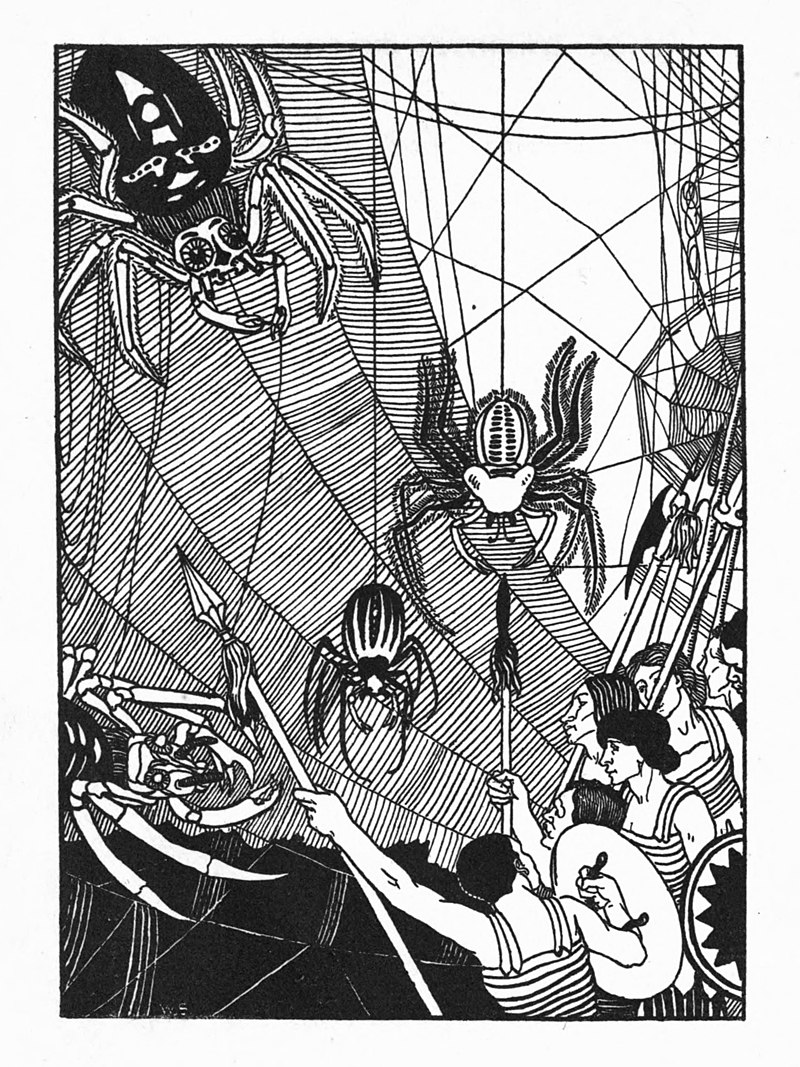
In the video by at the top of the post, filmmaker Gregory Austin McConnell summarizes Lucian’s entire travelogue, not neglecting to mention the river of wine, the tree-shaped women, the cities on the moon, the army of the sun, the battlefield-spinning space spiders, the dogs who ride on winged acorns, the floating sentient lamps, and the 187 and ½ mile-long whale.
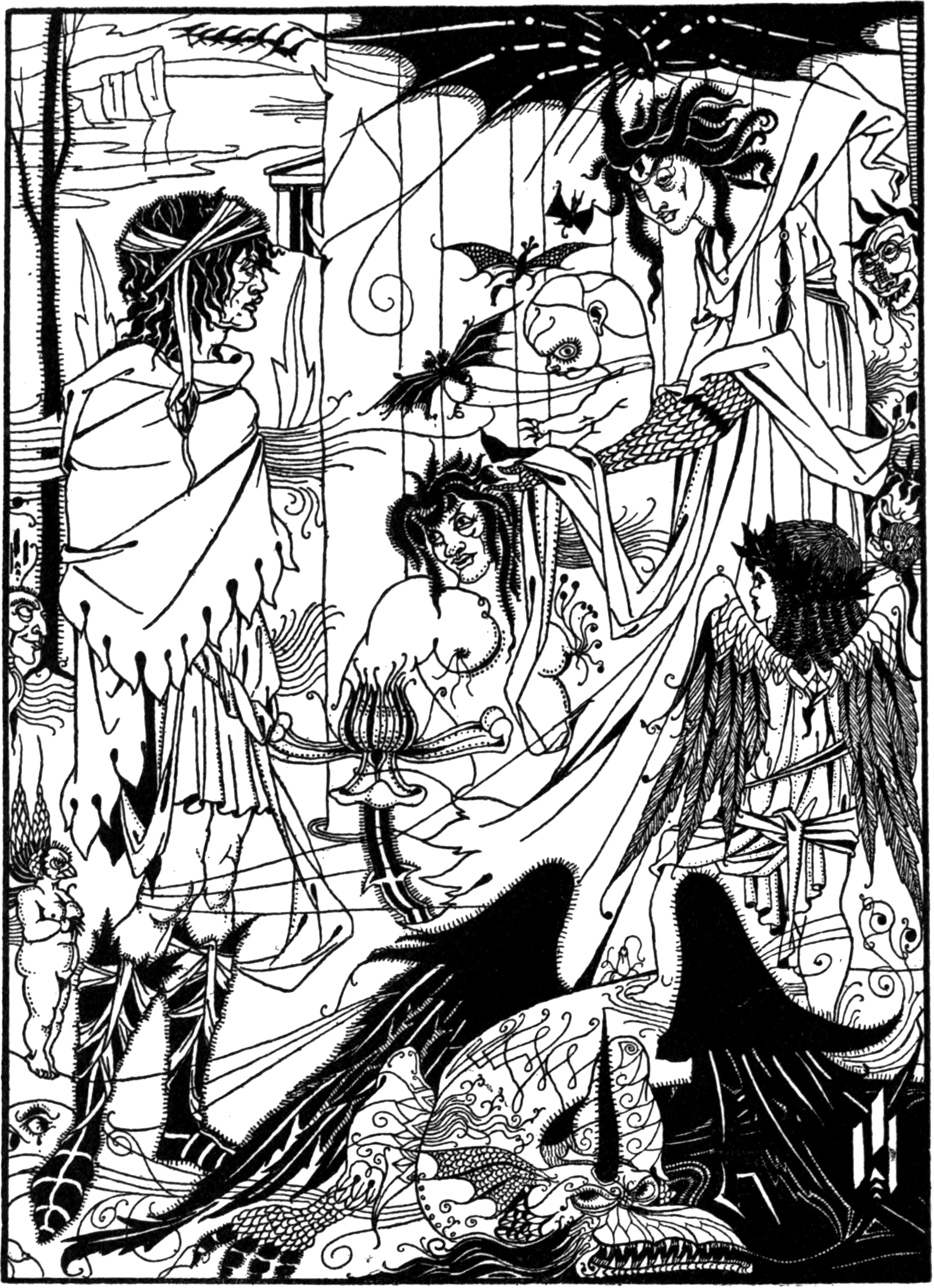
This clearly isn’t what we’d now call “hard” science fiction. So how, exactly, to label it? Such arguments erupt over every major work of genre fiction, even from antiquity. A True Story contains elements of what would become comedy sci-fi, military sci-fi, and even the fantasy-and-sci-fi-hybridizing “space opera” most popularly exemplified by Star Wars and its many sequels. Categorization quibbles aside, what matters about any work in the broader tradition of “speculative fiction” is whether it fires up the reader’s imagination, and Lucian’s work has done it for not just ancients but moderns like the 19th-century artists William Strang and Aubrey Beardsley, whose illustrations from 1894 editions of A True Story appear above. Now that “science fiction rules the cinematic landscape,” as McConnell puts it, who will adapt it for us postmoderns?
Based in Seoul, Colin Marshall writes and broadcasts on cities, language, and culture. His projects include the Substack newsletterBooks on Cities, the book The Stateless City: a Walk through 21st-Century Los Angeles and the video series The City in Cinema. Follow him on Twitter at @colinmarshall or on Facebook.

Anyone over 30 remembers a time when it was impossible to imagine home video without physical media. But anyone over 50 remembers a time when it was difficult to choose which kind of media to bet on. Just as the “computer zoo” of the early 1980s forced home-computing enthusiasts to choose between Apple, IBM, Commodore, Texas Instruments, and a host of other brands, each with its own technological specifications, the market for home-video hardware presented several different alternatives. You’ve heard of Sony’s Betamax, for example, which has been a punchline ever since it lost out to JVC’s VHS. But that was just the realm of video tape; have you ever watched a movie on a vinyl record?
Four decades ago, it was difficult for most consumers to imagine home video at all. “Get records that let you have John Travolta dancing on your floor, Gene Hackman driving though your living room, the Godfather staying at your house,” booms the narrator of the television commercial above.
How, you ask? By purchasing a SelectaVision player and compatible video discs, which allow you to “see the entertainment you really want, when you want, uninterrupted.” In our age of streaming-on-demand this sounds like a laughably pedestrian claim, but at the time it represented the culmination of seventeen years and $600 million of intensive research and development at the Radio Company of America, better known as RCA.
Radio, and even more so its successor television, made RCA an enormous (and enormously profitable) conglomerate in the first half of the twentieth century. By the 1960s, it commanded the resources to work seriously on such projects as a vinyl record that could contain not just music, but full motion pictures in color and stereo. This turned out to be even harder than it sounded: after numerous delays, RCA could only bring SelectaVision to market in the spring of 1981, four years after the internal target. By that time, after the company had been commissioning content for the better part of a decade (D. A. Pennebaker shot David Bowie’s final Ziggy Stardust concert in 1973 on commission from RCA, who’d intended to make a SelectaVision disc out of it), the format faced competition from not just VHS and Betamax but the cutting-edge LaserDisc as well.
SelectaVision lasted just three years. Its failure was perhaps overdetermined, and not just by the bad timing resulting from its troubled development. In the early 1980s, the idea of buying pre-recorded video media lacked the immediate appeal of “time-shifting” television, which had become possible only with video tape. Nor did RCA, whose marketing centered on the possibility of building a permanent home-video library in the manner of one’s music library, foresee the possibility of rental. And though CEDs were ultimately made functional, they remained cumbersome, able to hold just one hour of video per side and notoriously subject to jitters even on the first play. Yet as RCA’s ad campaigns emphasized, there really was a “magic” in being able to watch the movies you wanted at home, whenever you wanted to. In that sense, at least, we now live in a magical world indeed.
Based in Seoul, Colin Marshall writes and broadcasts on cities, language, and culture. His projects include the Substack newsletterBooks on Cities, the book The Stateless City: a Walk through 21st-Century Los Angeles and the video series The City in Cinema. Follow him on Twitter at @colinmarshall or on Facebook.
We're hoping to rely on loyal readers, rather than erratic ads. Please click the Donate button and support Open Culture. You can use Paypal, Venmo, Patreon, even Crypto! We thank you!
Open Culture scours the web for the best educational media. We find the free courses and audio books you need, the language lessons & educational videos you want, and plenty of enlightenment in between.