Andy Warhol’s Vibrant, Impractical, Illustrated Cookbook from 1959: A Feast for the Eyes


Gor­geous­ly illus­trat­ed cook­books fea­tur­ing sump­tu­ous images of fan­cy desserts and oth­er spe­cial occa­sion food can be quite an intim­i­dat­ing propo­si­tion to self-doubt­ing begin­ners.

The recipes them­selves are daunt­ing, and as every Great British Bak­ing Show view­er learns, watch­ing the top con­tes­tants squirm in advance of co-host Paul Hol­ly­wood’s icy judg­ment, fla­vor can’t save an edi­ble cre­ation that fails as art.

Andy Warhol’s approach to cook­ery appears rather more blithe.

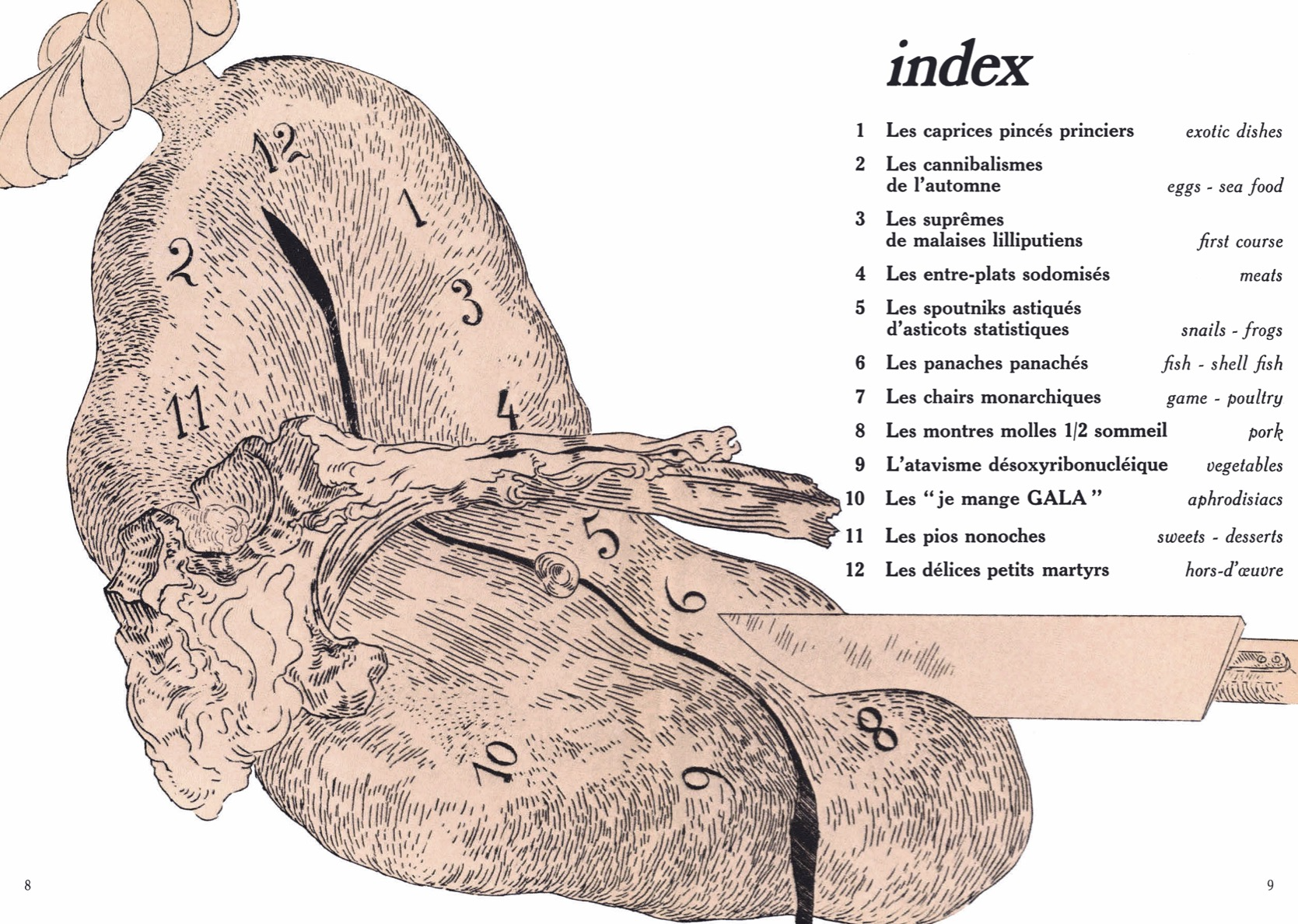
His 1959 cook­book, Wild Rasp­ber­ries — the title is a play on Ing­mar Bergman’s Wild Straw­ber­ries — dis­plays lit­tle inter­est in its read­ers’ cook­ing abil­i­ty… or, for that mat­ter, its authors.

Fan­ci­ful rep­re­sen­ta­tions of such del­i­ca­cies as Gar­doons a la Mous­se­line are pret­ty as a pic­ture… and stress free giv­en that no one is actu­al­ly expect­ed to make them.

Wild Rasp­ber­ries is all about atti­tude… and ambi­tion of a pure­ly social nature.

Warhol’s co-author, inte­ri­or dec­o­ra­tor and soci­ety host­ess Suzie Frank­furt, recalled hatch­ing the idea for this col­lab­o­ra­tion, short­ly after encoun­ter­ing the young artist at New York City’s fabled sweet spot, Serendip­i­ty: “We thought it would be a mas­ter­piece and we’d sell thou­sands. I think we sold 20.”

It’s pos­si­ble the endeav­or was a few decades ahead of its time. We can imag­ine Wild Rasp­ber­ries doing quite well as an impul­sive lifestyle type buy at Urban Out­fit­ters.

Sec­ond­hand copies of a 1997 reprint occa­sion­al­ly resur­face, as do auc­tion lots of the orig­i­nal 34 lith­o­graph sets, hand-col­ored by four school­boys who lived upstairs from Warhol, pri­or to hand-bind­ing by rab­bis on the Low­er East Side.

After con­sign­ing a few copies to Dou­ble­day and Riz­zoli book­stores, Warhol and Frank­furt gave the bulk of the first edi­tion away as Christ­mas presents to friends, who were no doubt well equipped to appre­ci­ate the tongue-in-cheek nature of its “recipes,” hand-let­tered by Warhol’s moth­er, Julia — whose spelling boo-boos were pur­pose­ful­ly allowed to stand.

The instruc­tions eschew crass men­tion of mea­sure­ments or cook­ing times… per­fect for any­one with hired staff, stand­ing reser­va­tions at Upper East Side hot spots, or a social X‑Ray diet reg­i­men.

Instead, read­ers are direct­ed to send the Cadil­lac round to Trad­er Vic’s tiki bar for a suck­ling pig of suf­fi­cient size for a par­ty of 15, or to gath­er morels should they find them­selves hol­i­day­ing in the vicin­i­ty of Nor­mandy.

Salade de Alf Lan­don, a bombe of lob­ster tails named for FDR’s oppo­nent in the 1936 Pres­i­den­tial elec­tion, crowned with aspara­gus tips and hard­boiled plover eggs, seems like it could dou­ble as a fetch­ing cha­peau, espe­cial­ly when paired with one of Warhol’s whim­si­cal fan­ta­sy  for footwear com­pa­ny I. Miller’s week­ly ads in The New York Times.

In fact, near­ly every­thing in this vibrant­ly hand col­ored “cook­book” makes for plau­si­ble mid-cen­tu­ry millinery, from Torte a la Dobosch to an imprac­ti­cal­ly ver­ti­cal arrange­ment of Hard Boiled Eggs.


Wild Rasp­ber­ries may have been a swipe at aspi­ra­tional, host­ess-ori­ent­ed late-50s cook­books, but Green­gages a la Warhol’s ref­er­ence to hyper­local pro­duce would fit right in with with Portlandia’s 21st cen­tu­ry food­ie spoofs.

High and low com­bine to great effect with wink­ing ref­er­ences to Gre­ta Gar­bo and gos­sip colum­nist Dorothy Kil­gallenLucky Whip dessert top­ping, a “Seared Roe­buck,” and store-bought super­mar­ket sponge cake (the lat­ter in Wild Rasp­ber­ries’ most legit-sound­ing recipe, some­thing of an upgrade from the recipe for “cake” Warhol shared in The Phi­los­o­phy of Andy Warhol — a choco­late bar served between slices of bread.

Relat­ed Con­tent: 

MoMA’s Artists’ Cook­book (1978) Reveals the Meals of Sal­vador Dalí, Willem de Koon­ing, Andy Warhol, Louise Bour­geois & More

300 Rarely-Seen, Risqué Draw­ings by Andy Warhol Pub­lished in the New Book, Andy Warhol: Love, Sex, and Desire. Draw­ings (1950–1962)

130,000 Pho­tographs by Andy Warhol Are Now Avail­able Online, Cour­tesy of Stan­ford Uni­ver­si­ty

Ayun Hal­l­i­day is an author, illus­tra­tor, the­ater mak­er and Chief Pri­ma­tol­o­gist of the East Vil­lage Inky zine.  Fol­low her @AyunHalliday.

A Gigantic Violin Floats Down Venice’s Grand Canal with a String Quartet on Top

It looks like some­thing out of a Felli­ni movie: a string quar­tet float­ing down the canals of Venice on a gigan­tic vio­lin. Not a boat mas­querad­ing as a vio­lin, like when you dress up your pet for Hal­loween and just slap some fun­ny ears and coat on it, but an actu­al 39-foot long vio­lin, made of sev­er­al kinds of wood and met­al by mas­ter boatbuilder/wood sculp­tor Liv­io De Marchi.

“Noah’s Vio­lin,” as it is called, did have a tiny motor inside to pro­pel it, and its trip down the Grand Canal was intend­ed as a por­tent of a post-COVID world. De Marchi told the New York Times that the vio­lin was a “sign of Venice restart­ing,” and like Noah’s Ark, would bring hope after the del­uge.

Musi­cians on board played works by Vival­di, who was also an inspi­ra­tion to the woodworker/boatmaker, and who was like­wise born in Venice. The sur­prise is not so much that a string quar­tet is play­ing on top of the vio­lin, but that it all seems so stur­dy and safe. There are no hand rails or life jack­ets to be seen. (Accord­ing to the Times, wind blew some of the score into the canal, where it was quick­ly res­cued).

De Marchi has made sev­er­al sur­re­al boats, start­ing with a large wood­en repli­ca of a paper ship, a float­ing origa­mi crane, a large high-heeled shoe, and recent­ly an all-wood recre­ation of a Fer­rari that put­tered up and and down the canal.

The vio­lin boat was fol­lowed by crowds in gon­do­las and oth­er tourist boats, float­ed about for an hour, and then was docked, where it was blessed by a priest. A muse­um in Chi­na and an Ital­ian com­pa­ny expressed inter­est in find­ing the vio­lin-boat a home.

Who knows what might hap­pen to it, but why not strap some power­boat motors on it, hire Apoc­a­lyp­ti­ca and let ‘er rip?

Relat­ed Con­tent:

How Venice Works: 124 Islands, 183 Canals & 438 Bridges

A Relax­ing 3‑Hour Tour of Venice’s Canals

The Authen­tic Vivaldi’s The Four Sea­sons: Watch a Per­for­mance Based on Orig­i­nal Man­u­scripts & Played with 18th-Cen­tu­ry Instru­ments

Ted Mills is a free­lance writer on the arts who cur­rent­ly hosts the Notes from the Shed pod­cast and is the pro­duc­er of KCR­W’s Curi­ous Coast. You can also fol­low him on Twit­ter at @tedmills, and/or watch his films here.

View 103 Discovered Drawings by Famed Japanese Woodcut Artist Katsushika Hokusai

When west­ern­ers first dis­cov­ered the work of Japan­ese wood­cut artist Kat­sushi­ka Hoku­sai, it was pri­mar­i­ly through his late-career print The Great Wave off Kana­gawa and the series from which it came, Thir­ty-Six Views of Mount Fuji, after the open­ing of Japan to inter­na­tion­al trade and the mass con­sump­tion of Japan­ese art in the late 19th cen­tu­ry. Impres­sion­ists like Claude Mon­et and Vin­cent van Gogh went wild for Japan­ese prints; Claude Debussy com­posed La mer; artists, arti­sans, and archi­tects on both sides of the Atlantic fell for all things Japon­isme.

Hoku­sai died in 1849 and did not live to see this new­found inter­na­tion­al admi­ra­tion. When he com­plet­ed The Great Wave, he was in his sev­en­ties — a mas­ter of his craft who had him­self absorbed sig­nif­i­cant influ­ence from west­ern painters.

Dur­ing his “for­ma­tive expe­ri­ence of Euro­pean art,” John-Paul Stonard writes at The Guardian, Hoku­sai “learnt from Euro­pean prints brought into Japan by Dutch traders.” He took these lessons in direc­tions all his own, how­ev­er. His Mount Fuji prints “could not have been fur­ther from any­thing being made in Europe at the time.”

Hoku­sai’s Euro­pean and Amer­i­can enthu­si­asts saw only the barest glimpse of his body of work, which we can now ful­ly appre­ci­ate in exhi­bi­tions in per­son and online. And we can now appre­ci­ate a series of draw­ings that have been hid­den away for over sev­en­ty years and were hard­ly seen at all in the 200 years since their cre­ation. Made for an unpub­lished ency­clo­pe­dia titled Ban­mot­su eon dais­es zu (The Great Pic­ture Book of Every­thing), “The draw­ings were long thought for­got­ten,” Valenti­na Di Lis­cia writes at Hyper­al­ler­gic, “last record­ed at an auc­tion in Paris in 1948 before they resur­faced in 2019.”

Made some­time between 1820 and the 1840s, “the metic­u­lous, post­card-sized works are known as hanshita‑e, a term for the final draw­ings used to carve the key blocks in Japan­ese wood­block print­ing.” These are usu­al­ly destroyed in the process, but since the prints were nev­er made, for rea­sons unknown, “the del­i­cate illus­tra­tions remained intact, mount­ed on cards and stored in a cus­tom-made wood­en box.” The draw­ings depict every­thing from “the typ­i­cal inhab­i­tants of lands in East, South­east, and Cen­tral Asian and beyond” to one of the 33 man­i­fes­ta­tions of the bod­hisatt­va Aval­okiteś­vara, “Drag­on head Kan­non.”

At the top, cura­tor Alfred Haft walks us through his favorite draw­ings from the set, and you can see all 103 of the diminu­tive illus­tra­tions online at the British Muse­um. For­mer­ly owned by the col­lec­tor and Art Nou­veau jew­el­er Hen­ri Vev­er, the prints could have inspired many a west­ern artist, but it seems they were hid­den away and have been seen by very few eyes. Dis­cov­er them your­self for the first time here.

Relat­ed Con­tent: 

The Great Wave Off Kana­gawa by Hoku­sai: An Intro­duc­tion to the Icon­ic Japan­ese Wood­block Print in 17 Min­utes

Thir­ty-Six Views of Mount Fuji: A Deluxe New Art Book Presents Hokusai’s Mas­ter­piece, Includ­ing “The Great Wave Off Kana­gawa”

The Evo­lu­tion of The Great Wave off Kana­gawa: See Four Ver­sions That Hoku­sai Paint­ed Over Near­ly 40 Years

Hokusai’s Icon­ic Print, “The Great Wave off Kana­gawa,” Recre­at­ed with 50,000 LEGO Bricks

Josh Jones is a writer and musi­cian based in Durham, NC. Fol­low him at @jdmagness

Behold the Newly-Discovered Sketch by Vincent van Gogh Sketch, “Study for Worn Out” (1882)

Hav­ing been dead for more than 130 years now, Vin­cent van Gogh sel­dom comes up with a new piece of work. But when he does, you can be sure it will draw the art world’s atten­tion as few works by liv­ing artists could. Such has been the case with the new­ly dis­cov­ered Study for Worn Out, an 1882 sketch that recent­ly came into pos­ses­sion of the Van Gogh Muse­um, accord­ing to Margheri­ta Cole at My Mod­ern Met, “when a Dutch fam­i­ly request­ed that spe­cial­ists take a look at their unsigned draw­ing.” The fig­ure in the draw­ing strong­ly resem­bles the one in van Gogh’s 1890 paint­ing At Eter­ni­ty’s Gate. But it took the experts at the muse­um to deter­mine that the artist was none oth­er than van Gogh him­self.

“Today and yes­ter­day I drew two fig­ures of an old man with his elbows on his knees and his head in his hands,” wrote the 29-year-old van Gogh to his broth­er in a let­ter from 1882. “What a fine sight an old work­ing man makes, in his patched bom­bazine suit with his bald head.” The imme­di­ate fruit of these labors was the pen­cil draw­ing Worn Out, for which “the artist employed one of his favorite mod­els, an elder­ly man named Adri­anus Jacobus Zuy­der­land who boast­ed dis­tinc­tive side­burns (and who appears in at least 40 of van Gogh’s sketch­es from this peri­od).” So writes Smithsonian.com’s Nora McGreevy, who adds that van Gogh revis­it­ed the work to adapt it as a paint­ing “just two months before his death” in an asy­lum near Saint-Rémy-de-Provence.

“In draw­ings like these,”  says the Van Gogh Muse­um, “the artist not only dis­played his sym­pa­thy for the social­ly dis­ad­van­taged — no way infe­ri­or in his eyes to the well-to-do bour­geoisie — he active­ly called atten­tion to them too.” Anoth­er aim with Worn Out, adds McGreevy, was “to seek employ­ment at a British pub­li­ca­tion, but he either failed to fol­low through on this idea or had his work reject­ed.” This would have count­ed as just anoth­er seem­ing instance of fail­ure, the likes of which char­ac­ter­ized the painter’s short life. Lit­tle could he, his cor­re­spon­dents, or his mod­els have imag­ined that his works would one day become some of the most famous in the world — and cer­tain­ly not that one of his sketch­es would go on to be enshrined well over a cen­tu­ry lat­er, as it has been since last Fri­day at the muse­um that bears his name.

via My Mod­ern Met

Relat­ed Con­tent:

1,000+ Art­works by Vin­cent Van Gogh Dig­i­tized & Put Online by Dutch Muse­ums: Enter Van Gogh World­wide

Down­load Hun­dreds of Van Gogh Paint­ings, Sketch­es & Let­ters in High Res­o­lu­tion

Rare Vin­cent van Gogh Paint­ing Goes on Pub­lic Dis­play for the First Time: Explore the 1887 Paint­ing Online

Expe­ri­ence the Van Gogh Muse­um in 4K Res­o­lu­tion: A Video Tour in Sev­en Parts

Based in Seoul, Col­in Mar­shall writes and broad­casts on cities, lan­guage, and cul­ture. His projects include the Sub­stack newslet­ter Books on Cities, the book The State­less City: a Walk through 21st-Cen­tu­ry Los Ange­les and the video series The City in Cin­e­ma. Fol­low him on Twit­ter at @colinmarshall or on Face­book.

What Makes Basquiat’s Untitled Great Art: One Painting Says Everything Basquiat Wanted to Say About America, Art & Being Black in Both Worlds

They wouldn’t have let Jean-Michel into a Tiffany’s if he want­ed to use the bath­room or if he went to buy an engage­ment ring and pulled a wad of cash out of his pock­et. 

– Stephen Tor­ton, Jean-Michel Basquiat’s stu­dio assis­tant

When Jean-Michel Basquiat’s Unti­tled (Skull) sold for $110.5 mil­lion in 2017 to Japan­ese bil­lion­aire Yusaku Mae­sawa, the artist joined the ranks of Da Vin­ci, De Koon­ing, and Picas­so as one of the top sell­ing painters in the world, sur­pass­ing a pre­vi­ous record set in 2013 by his men­tor Andy Warhol’s work. Unti­tled dates from 1982, dur­ing “the young Basquiat’s mer­cu­r­ial ear­ly years,” writes Ben Davis at Art­net, “even before his first gallery show at Anni­na Nosei, when he was still a Caribbean-Amer­i­can kid from Brook­lyn ener­get­i­cal­ly boot­strap­ping him­self into the lime­light of the down­town art scene.” It is this peri­od that most inter­ests col­lec­tors like Mae­sawa.

Basquiat’s tran­si­tion from graf­fi­ti artist to art world dar­ling was dra­mat­ic, cel­e­bra­to­ry, and self-destruc­tive, all char­ac­ter­is­tics of his work. But crit­i­cal prim­i­tivism reduced him to a token — an art world atti­tude saw Basquiats as objects to be stripped of con­text, turned into dec­o­ra­tive badges of authen­tic­i­ty and world­li­ness. “Maezawa’s head paint­ing pos­sess­es a loud, gnash­ing, and con­fi­dent aura,” Shan­non Lee writes at Art­sy. But the artist’s “use of skulls… is deeply root­ed in his iden­ti­ty as a Black artist in Amer­i­ca. They are strong­ly evoca­tive of African masks, which have been so fetishized by the art mar­ket since mod­ernists like Picas­so appro­pri­at­ed them from their native con­texts.”

But head/skull motifs in Basquiat’s work are not only state­ments of dias­poric Black iden­ti­ty — they emerge through his the­mat­ic play of human embod­i­ment, men­tal illness/health, the com­pe­ti­tions of the graf­fi­ti world and the headgames of the art world, which Basquiat both mas­tered and cri­tiqued as a can­ny out­sider. “No sub­ject is more pow­er­ful or more sought after in the oeu­vre of Jean-Michel Basquiat,” notes Christie’s New York, “than the sin­gu­lar skull.” Though maybe not the most repro­duced of Basquiat’s heads, 1982’s Unti­tled — argues the Great Art Explained video above — exem­pli­fies the themes.

At only 22 years old, Basquiat pro­duced “a sin­gle paint­ing” that said “every­thing he want­ed to say about Amer­i­ca, about art and about being black in both worlds.” So sin­gu­lar is Unti­tled that it became its own one-paint­ing show in 2018 when its new own­er sent it on a tour of the world, begin­ning in the artist’s home­town at the Brook­lyn Muse­um. Maesawa’s deci­sion to share the paint­ing presents a con­trast to the way Basquiat has been treat­ed dif­fer­ent­ly by oth­er own­ers of his work like Tiffany & Co., who explain their pur­chase and recent, con­tro­ver­sial com­mer­cial use of his Equals Pi by cit­ing his “affin­i­ty for the company’s state­ment blue col­or,” writes Tirhakah Love at Dai­ly Beast — a col­or they trade­marked ten years after Basquiat’s death.

The pro­pri­etary co-opta­tion of Basquiat’s life and work to sell sym­bols of colo­nial­ism like dia­monds, among oth­er lux­u­ry goods — and the turn­ing of his work into the ulti­mate lux­u­ry good — debas­es his pur­pos­es. Why show Equals Pi “as a prop to an ad?” asked his friend and for­mer room­mate Alex­is Adler. “Loan it out to a muse­um. In a time where there were very few Black artists rep­re­sent­ed in West­ern muse­ums, that was his goal: to get to a muse­um.” Find out in the Great Art Explained video how one of his most famous — and most expen­sive — works encap­su­lates that strug­gle through its vivid col­or and sym­bol­ic visu­al lan­guage.

Relat­ed Con­tent: 

Take a Close Look at Basquiat’s Rev­o­lu­tion­ary Art in a New 500-Page, 14-Pound, Large For­mat Book by Taschen

The Sto­ry of Jean-Michel Basquiat’s Rise in the 1980s Art World Gets Told in a New Graph­ic Nov­el

An Ani­mat­ed Intro­duc­tion to the Chaot­ic Bril­liance of Jean-Michel Basquiat: From Home­less Graf­fi­ti Artist to Inter­na­tion­al­ly Renowned Painter

Josh Jones is a writer and musi­cian based in Durham, NC. Fol­low him at @jdmagness


Zoom Into a Super High Resolution Photo of Van Gogh’s “The Starry Night”

“Just as we take the train to get to Taras­con or Rouen, we take death to reach a star,” Vin­cent Van Gogh wrote to his broth­er from Arles in the sum­mer of 1888:

What’s cer­tain­ly true in this argu­ment is that while alive, we can­not go to a star, any more than once dead we’d be able to take the train.

The fol­low­ing sum­mer, as a patient in the asy­lum of Saint-Paul-de-Mau­sole in Provence, he paint­ed what would become his best known work — The Star­ry Night.

The sum­mer after that, he was dead of a gun­shot wound to the abdomen, com­mon­ly believed to be self-inflict­ed.

Judg­ing from thoughts expressed in that same let­ter, Van Gogh may have con­ceived of such a death as a “celes­tial means of loco­mo­tion, just as steam­boats, omnibus­es and the rail­way are ter­res­tri­al ones”:

To die peace­ful­ly in old age would be to go there on foot.

Although his win­dow at the asy­lum afford­ed him a sun­rise view, and a pri­vate audi­ence with the promi­nent morn­ing star he men­tioned in anoth­er let­ter to Theo, Star­ry Night’s vista is “both an exer­cise in obser­va­tion and a clear depar­ture from it,” accord­ing to 2019’s MoMA High­lights: 375 Works from The Muse­um of Mod­ern Art:

The vision took place at night, yet the paint­ing, among hun­dreds of art­works van Gogh made that year, was cre­at­ed in sev­er­al ses­sions dur­ing the day, under entire­ly dif­fer­ent atmos­pher­ic con­di­tions. The pic­turesque vil­lage nes­tled below the hills was based on oth­er views—it could not be seen from his window—and the cypress at left appears much clos­er than it was. And although cer­tain fea­tures of the sky have been recon­struct­ed as observed, the artist altered celes­tial shapes and added a sense of glow.

Those who can’t vis­it MoMA to see The Star­ry Night in per­son may enjoy get­ting up close and per­son­al with Google Arts and Cul­ture’s zoomable, high res dig­i­tal repro­duc­tion. Keep click­ing into the image to see the paint­ing in greater detail.

Before or after for­mu­lat­ing your own thoughts on The Star­ry Night and the emo­tion­al state that con­tributed to its exe­cu­tion, get the per­spec­tive of singer-song­writer Mag­gie Rogers in the below episode of Art Zoom, in which pop­u­lar musi­cians share their thoughts while nav­i­gat­ing around a famous can­vas.

Bonus! Throw your­self into a free col­or­ing page of The Star­ry Night here.

Relat­ed Con­tent: 

A Gallery of 1,800 Gigapix­el Images of Clas­sic Paint­ings: See Vermeer’s Girl with the Pearl Ear­ring, Van Gogh’s Star­ry Night & Oth­er Mas­ter­pieces in Close Detail

Vin­cent Van Gogh’s “The Star­ry Night”: Why It’s a Great Paint­ing in 15 Min­utes

1,000+ Art­works by Vin­cent Van Gogh Dig­i­tized & Put Online by Dutch Muse­ums: Enter Van Gogh World­wide

Rare Vin­cent van Gogh Paint­ing Goes on Pub­lic Dis­play for the First Time: Explore the 1887 Paint­ing Online

Ayun Hal­l­i­day is an author, illus­tra­tor, the­ater mak­er and Chief Pri­ma­tol­o­gist of the East Vil­lage Inky zine.  Fol­low her @AyunHalliday.

Art History School: Learn About the Art & Lives of Toulouse-Lautrec, Gustav Klimt, Frances Bacon, Edvard Munch & Many More

Artist and video­g­ra­ph­er Paul Priest­ly is an enthu­si­as­tic and gen­er­ous sort of fel­low.

His free online draw­ing tuto­ri­als abound with encour­ag­ing words for begin­ners, and he clear­ly rel­ish­es lift­ing the cur­tain to reveal his home stu­dio set up and self designed cam­era rig.

But we here at Open Cul­ture think his great­est gift to home view­ers are his Art His­to­ry School pro­files of well-known artists like Hen­ri de Toulouse-Lautrec and Vin­cent Van Gogh.

An avid sto­ry­teller, he’s drawn to those with trag­ic his­to­ries — the deci­sion to piv­ot from imper­son­at­ing the artist, as he did with Van Gogh, to serv­ing as a reporter inter­est­ed in how such details as syphilis and alco­holism informed lives and careers is a wise one.

Priest­ly makes a con­vinc­ing case that Lautrec’s aris­to­crat­ic upbring­ing con­tributed to his mis­ery. His short stature was the result, not of dwarfism, but Pykn­odysos­to­sis (PYCD) a rare bone weak­en­ing dis­ease that sure­ly owed some­thing to his par­ents’ sta­tus as first cousins.

His appear­ance made him a sub­ject of life­long mock­ery, and ensured that the free­wheel­ing artist scene in Mont­martre would prove more wel­com­ing than the blue­blood milieu into which he’d been born.

Priest­ly makes a meal of that Demi-monde, intro­duc­ing view­ers to many of the play­ers.

He height­ens our appre­ci­a­tion for Lautrec’s mas­ter­piece, At the Moulin Rouge, by briefly ori­ent­ing us to who’s seat­ed around the table: writer and crit­ic Édouard Dujardin, dancer La Mac­arona, pho­tog­ra­ph­er Paul Secau, and “cham­pagne sales­man and debauchee” Mau­rice Guib­ert, who ear­li­er posed as a lech­er­ous patron in Lautrec’s At the Café La Mie.

Queen of the Can­can La Goulue hangs out in the back­ground with anoth­er dancer, the won­der­ful­ly named La Môme Fro­mage.

Lautrec places him­self square­ly in the mix, look­ing very much at home.

Con­sid­er that these names, like those of fre­quent Lautrec sub­jects acro­bat­ic dancer Jane Avril and chanteuse Yvette Guil­bert were as cel­e­brat­ed in Belle Epoque Mont­martre as many of the painters Lautrec rubbed shoul­ders with — Degas, Pis­sar­ro, Cézanne, Van Gogh and Manet.

In an arti­cle in The Smith­son­ian, Paul Tra­cht­man recounts how Lautrec dis­cov­ered the mod­el for Manet’s famous nude Olympia, Vic­torine Meurent, “liv­ing in abject pover­ty in a top-floor apart­ment down a Mont­martre alley. She was now an old, wrin­kled, bald­ing woman. Lautrec called on her often, and took his friends along, pre­sent­ing her with gifts of choco­late and flow­ers — as if court­ing death itself.”

Mean­while Degas sniffed that Lautrec’s stud­ies of women in a broth­el “stank of syphilis.”

Per­haps Priest­ly will delve into Degas for an upcom­ing Art His­to­ry School episode … there’s no short­age of mate­r­i­al there.

Above are three more of Paul Priestly’s Art His­to­ry School pro­files that we’ve enjoyed on Frances Bacon, Edvard Munch and Gus­tav Klimt. You can sub­scribe to his chan­nel here.

Relat­ed Con­tent: 

The Art His­to­ry Web Book

Art His­to­ri­an Pro­vides Hilar­i­ous & Sur­pris­ing­ly Effi­cient Art His­to­ry Lessons on Tik­Tok

Free Art & Art His­to­ry Cours­es 

Ayun Hal­l­i­day is an author, illus­tra­tor, the­ater mak­er and Chief Pri­ma­tol­o­gist of the East Vil­lage Inky zine.  Fol­low her @AyunHalliday.

The Evolution of Kandinsky’s Painting: A Journey from Realism to Vibrant Abstraction Over 46 Years

Like most renowned abstract painters, Wass­i­ly Kandin­sky could also paint real­is­ti­cal­ly. Unlike most renowned abstract painters, he only took up art in earnest after study­ing eco­nom­ics and law at the Uni­ver­si­ty of Moscow. He then found ear­ly suc­cess teach­ing those sub­jects, which seem to have proven too world­ly for his sen­si­bil­i­ties: at age 30 he enrolled in the Munich Acad­e­my to con­tin­ue the study of art that he’d left off while grow­ing up in Odessa. The sur­viv­ing paint­ings he pro­duced at the end of the 19th cen­tu­ry and the begin­ning of the 20th, dis­played on Wikipedi­a’s list of his works, include a vari­ety of land­scapes, most pre­sent­ing Ger­man and Russ­ian (or today Ukrain­ian) land­scapes undis­turbed by a sin­gle human fig­ure.

Kandin­sky made dra­mat­ic change come with 1903’s The Blue Rid­er (above). The pres­ence of the tit­u­lar fig­ure made for an obvi­ous dif­fer­ence from so many of the images he’d cre­at­ed over the pre­vi­ous half-decade; a shift in its very per­cep­tion of real­i­ty made for a less obvi­ous one.

This is not the world as we nor­mal­ly see it, and Kandin­sky’s track record of high­ly rep­re­sen­ta­tive paint­ings tells us that he must delib­er­ate­ly have cho­sen to paint it it that way. With fel­low artists like August Macke, Franz Marc, Albert Bloch, and Gabriele Mün­ter, he went on to form the Blue Rid­er Group, whose pub­li­ca­tions argued for abstract art’s capa­bil­i­ty to attain great spir­i­tu­al heights, espe­cial­ly through col­or.

“Grad­u­al­ly Kandin­sky makes depar­tures from the exter­nal ‘world as a mod­el’ into the world of ‘paint as a thing in itself,’ ” writes painter Markus Ray. “Still depict­ing ‘world­ly scenes,’ these paint­ings start to take on pur­er col­ors and shapes. He reduces vol­umes into sim­ple shapes, and col­ors into bright and vibrant hues. One can still make out the scene, but the shapes and col­ors begin to take on a life of their own.” This is espe­cial­ly true of the scenes Kandin­sky paint­ed in Bavaria, such as 1909’s Rail­way near Mur­nau above. The out­break of World War I five years lat­er sent him back to Rus­sia, where he con­tin­ued his pio­neer­ing jour­ney toward a visu­al art equal in expres­sive pow­er to music, which he called his “ulti­mate teacher.” But by the ear­ly 1920s it had become clear that his increas­ing­ly indi­vid­u­al­is­tic and non-rep­re­sen­ta­tive ten­den­cies would­n’t sit well with the Sovi­et cul­tur­al pow­ers that be.

A return to Ger­many was in order. “In 1921, at the age of 55, Kandin­sky moved to Weimar to teach mur­al paint­ing and intro­duc­to­ry ana­lyt­i­cal draw­ing at the new­ly found­ed Bauhaus school,” says Christie’s. “There he worked along­side the likes of Paul Klee, Lás­zló Moholy-Nagy and Josef Albers,” and also expand­ed on Goethes the­o­ries of col­or. A true believ­er in the Bauhaus’ “phi­los­o­phy of social improve­ment through art,” Kandin­sky also wound up among the artists whose work was exhib­it­ed in the Nazi Par­ty’s “Degen­er­ate Art Exhi­bi­tion” of 1937. By that time the Bauhaus was dis­solved and Kandin­sky had reset­tled in Paris, where until his death in 1944 (as evi­denced by Wikipedi­a’s list of his paint­ings) he kept push­ing fur­ther into abstrac­tion, seek­ing ever-pur­er expres­sions of the human soul until the very end.

Relat­ed Con­tent:

Time Trav­el Back to 1926 and Watch Wass­i­ly Kandin­sky Make Art in Some Rare Vin­tage Video

Helen Mir­ren Tells Us Why Wass­i­ly Kandin­sky Is Her Favorite Artist (And What Act­ing & Mod­ern Art Have in Com­mon)

Wass­i­ly Kandin­sky Syncs His Abstract Art to Mussorgsky’s Music in a His­toric Bauhaus The­atre Pro­duc­tion (1928)

An Inter­ac­tive Social Net­work of Abstract Artists: Kandin­sky, Picas­so, Bran­cusi & Many More

How to Paint Like Kandin­sky, Picas­so, Warhol & More: A Video Series from the Tate

The Guggen­heim Puts Online 1700 Great Works of Mod­ern Art from 625 Artists

Take a Jour­ney Through 933 Paint­ings by Sal­vador Dalí & Watch His Sig­na­ture Sur­re­al­ism Emerge

Based in Seoul, Col­in Mar­shall writes and broad­casts on cities, lan­guage, and cul­ture. His projects include the Sub­stack newslet­ter Books on Cities, the book The State­less City: a Walk through 21st-Cen­tu­ry Los Ange­les and the video series The City in Cin­e­ma. Fol­low him on Twit­ter at @colinmarshall or on Face­book.

« Go BackMore in this category... »
Quantcast