An Animated Introduction to the Antikythera Mechanism: The World’s First Analog Computer from Ancient Greece
From TED-Ed comes an animated introduction to the Antikythera Mechanism, an ancient Greek device that dates back to the 2nd century BCE. TED writes: “In 1900, Greek divers stumbled upon a 2,000-year-old shipwreck whose contents would shake our understanding of the ancient world. Among the remains were fragments of mangled wood and corroded metal, which archaeologists soon realized were parts of the oldest geared device ever discovered — and humankind’s first computer. So, how did it work?” Above, science journalist Max G. Levy explains the inner workings of the Antikythera Mechanism and how the Greeks put the device to use.
For those who want to take a deeper dive into this ancient analog computer (there’s a lot more to learn), we invite you to explore the titles in the Relateds section below. They’ll take you deeper into this marvel of ancient engineering.
If you would like to support the mission of Open Culture, consider making a donation to our site. It’s hard to rely 100% on ads, and your contributions will help us continue providing the best free cultural and educational materials to learners everywhere. You can contribute through PayPal, Patreon, and Venmo (@openculture). Thanks!
Related Content
Read More...The Genius Urban Design of Amsterdam: Canals, Dams & Leaning Houses
It’s common to hear it said that some particular city — usually one of the American metropolises that sprang into existence over the past couple of centuries — “shouldn’t exist.” And indeed, as urban planner M. Nolan Gray writes in a recent blog post, “no city should exist.” On the scale of human history, we’ve only just started building the things, and we don’t do so on pure instinct. “There isn’t supposed to be a city anywhere. They exist because we will them into existence.” And we often do so in unlikely contexts: “Half of Boston was dredged up from the ocean. St. Louis only exists because we tamed the greatest river on our continent. Supplying Philadelphia with drinking water is an engineering feat on the scale of the Los Angeles Aqueduct.”
Outside the United States, we see the same conditions surrounding “the greatest cities ever built: Tokyo and St. Petersburg required engineering feats on the scale of anything seen in the US. Amsterdam and Mexico City were literally built on top of water.” How that was managed in the particular case of the Dutch capital is explained in the new video from The Present Past at the top of the post, as well as in the OBF video below.
Amsterdam’s most striking feature, its canals, were created not to look picturesque; in fact, as The Present Past host Jochem Boodt puts it, their construction was “a matter of life and death.” Too soft for farming or home-building, the swampy ground beneath the city on the river Amstel had to be drained; when drained, it became subject to floods, which necessitated building dikes and a dam.
httv://www.youtube.com/watch?v=Mo3llzKdAD0
That thirteenth-century engineering project of damming the Amstel protected the city, and also gave it its name. The Amstel itself is, in fact, a huge canal, and the rapid expansion of the settlement around it necessitated digging more and more auxiliary canals to assist with drainage, which defined the space for islands on which to build new districts (Venice-style, atop hundreds of thousands of poles driven into the sea floor). As shown in the OBF video, this distinctive urban structure dictated the shapes of the city’s houses, with their universally narrow façades and their depths reflecting the wealth of the families within. Now, four centuries after it took its current shape — and having survived numerous crises inherent to its unusual situation and form — the center of Amsterdam is looked to as a paragon of urban planning, sometimes imitated, but without similarly “impossible” original conditions, never replicated.
Related content:
The Brilliant Engineering That Made Venice: How a City Was Built on Water
Travel from Rotterdam to Amsterdam in 10 Minutes by Boat: A 4K Timelapse
Why Europe Has So Few Skyscrapers
Based in Seoul, Colin Marshall writes and broadcasts on cities, language, and culture. His projects include the Substack newsletter Books on Cities and the book The Stateless City: a Walk through 21st-Century Los Angeles. Follow him on the social network formerly known as Twitter at @colinmarshall.
Read More...Carl Jung Psychoanalyzes Hitler: “He’s the Unconscious of 78 Million Germans.” “Without the German People He’d Be Nothing” (1938)
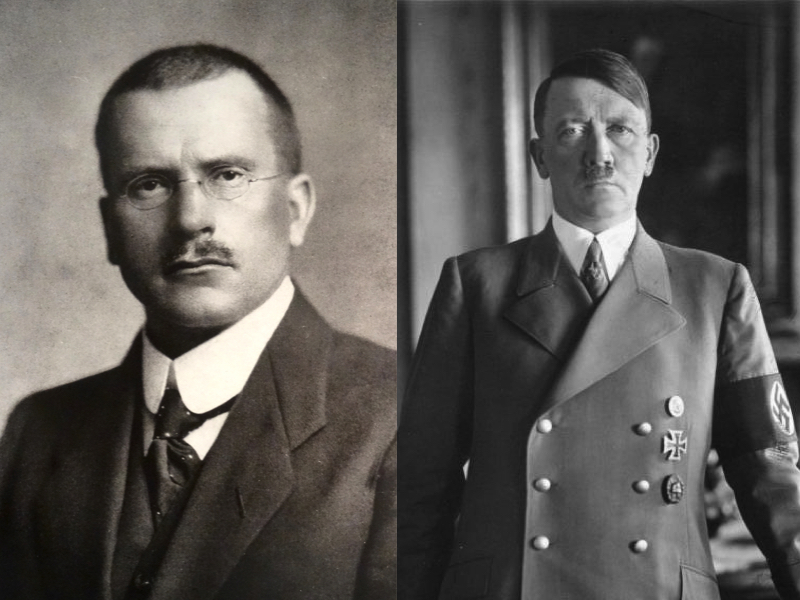
Were you to google “Carl Jung and Nazism”—and I’m not suggesting that you do—you would find yourself hip-deep in the charges that Jung was an anti-Semite and a Nazi sympathizer. Many sites condemn or exonerate him; many others celebrate him as a blood and soil Aryan hero. It can be nauseatingly difficult at times to tell these accounts apart. What to make of this controversy? What is the evidence brought against the famed Swiss psychiatrist and onetime close friend, student, and colleague of Sigmund Freud?
Truth be told, it does not look good for Jung. Unlike Nietzsche, whose work was deliberately bastardized by Nazis, beginning with his own sister, Jung need not be taken out of context to be read as anti-Semitic. There is no irony at work in his 1934 paper The State of Psychotherapy Today, in which he marvels at National Socialism as a “formidable phenomenon,” and writes, “the ‘Aryan’ unconscious has a higher potential than the Jewish.” This is only one of the least objectionable of such statements, as historian Andrew Samuels demonstrates.
One Jungian defender admits in an essay collection called Lingering Shadows that Jung had been “unconsciously infected by Nazi ideas.” In response, psychologist John Conger asks, “Why not then say that he was unconsciously infected by anti-Semitic ideas as well?”—well before the Nazis came to power. He had expressed such thoughts as far back as 1918. Like the philosopher Martin Heidegger, Jung was accused of trading on his professional associations during the 30s to maintain his status, and turning on his Jewish colleagues while they were purged.
Yet his biographer Deirdre Bair claims Jung’s name was used to endorse persecution without his consent. Jung was incensed, “not least,” Mark Vernon writes at The Guardian, “because he was actually fighting to keep German psychotherapy open to Jewish individuals.” Bair also reveals that Jung was “involved in two plots to oust Hitler, essentially by having a leading physician declare the Führer mad. Both came to nothing.” And unlike Heidegger, Jung strongly denounced anti-Semitic views during the war. He “protected Jewish analysts,” writes Conger, “and helped refugees.” He also worked for the OSS, precursor to the CIA, during the war.
His recruiter Allen Dulles wrote of Jung’s “deep antipathy to what Nazism and Fascism stood for.” Dulles also cryptically remarked, “Nobody will probably ever know how much Prof. Jung contributed to the allied cause during the war.” These contradictions in Jung’s words, character, and actions are puzzling, to say the least. I would not presume to draw any hard and fast conclusions from them. They do, however, serve as the necessary context for Jung’s observations of Adolf Hitler. Nazis of today who praise Jung most often do so for his supposed characterization of Hitler as “Wotan,” or Odin, a comparison that thrills neo-pagans who, like the Germans did, use ancient European belief systems as clothes hangers for modern racist nationalism.
In his 1936 essay, “Wotan,” Jung describes the old god as a force all its own, a “personification of psychic forces” that moved through the German people “towards the end of the Weimar Republic”—through the “thousands of unemployed,” who by 1933 “marched in their hundreds of thousands.” Wotan, Jung writes, “is the god of storm and frenzy, the unleasher of passions and the lust of battle; moreover he is a superlative magician and artist in illusion who is versed in all secrets of an occult nature.” In personifying the “German psyche” as a furious god, Jung goes so far as to write, “We who stand outside judge the Germans far too much as if they were responsible agents, but perhaps it would be nearer the truth to regard them also as victims.”
“One hopes,” writes Per Brask, “evidently against hope, that Jung did not intend” his statements “as an argument of redemption for the Germans.” Whatever his intentions, his mystical racialization of the unconscious in “Wotan” accorded perfectly well with the theories of Alfred Rosenberg, “Hitler’s chief ideologist.” Like everything about Jung, the situation is complicated. In a 1938 interview, published by Omnibook Magazine in 1942, Jung repeated many of these disturbing ideas, comparing the German worship of Hitler to the Jewish desire for a Messiah, a “characteristic of people with an inferiority complex.” He describes Hitler’s power as a form of “magic.” But that power only exists, he says, because “Hitler listens and obeys….”
His Voice is nothing other than his own unconscious, into which the German people have projected their own selves; that is, the unconscious of seventy-eight million Germans. That is what makes him powerful. Without the German people he would be nothing.
Jung’s observations are bombastic, but they are not flattering. The people may be possessed, but it is their will, he says, that the Nazi leader enacts, not his own. “The true leader,” says Jung, “is always led.” He goes on to paint an even darker picture, having closely observed Hitler and Mussolini together in Berlin:
In comparison with Mussolini, Hitler made upon me the impression of a sort of scaffolding of wood covered with cloth, an automaton with a mask, like a robot or a mask of a robot. During the whole performance he never laughed; it was as though he were in a bad humor, sulking. He showed no human sign.
His expression was that of an inhumanly single-minded purposiveness, with no sense of humor. He seemed as if he might be a double of a real person, and that Hitler the man might perhaps be hiding inside like an appendix, and deliberately so hiding in order not to disturb the mechanism.
With Hitler you do not feel that you are with a man. You are with a medicine man, a form of spiritual vessel, a demi-deity, or even better, a myth. With Hitler you are scared. You know you would never be able to talk to that man; because there is nobody there. He is not a man, but a collective. He is not an individual, but a whole nation. I take it to be literally true that he has no personal friend. How can you talk intimately with a nation?
Read the full interview here. Jung goes on to further discuss the German resurgence of the cult of Wotan, the “parallel between the Biblical triad… and the Third Reich,” and other peculiarly Jungian formulations. Of Jung’s analysis, interviewer H.R. Knickerbocker concludes, “this psychiatric explanation of the Nazi names and symbols may sound to a layman fantastic, but can anything be as fantastic as the bare facts about the Nazi Party and its Fuehrer? Be sure there is much more to be explained in them than can be explained by merely calling them gangsters.”
Note: An earlier version of this post appeared on our site in 2017.
Related Content:
George Orwell Reviews Mein Kampf: “He Envisages a Horrible Brainless Empire” (1940)
Carl Jung Offers an Introduction to His Psychological Thought in a 3‑Hour Interview (1957)
How Carl Jung Inspired the Creation of Alcoholics Anonymous
Josh Jones is a writer and musician based in Durham, NC. Follow him at @jdmagness
Read More...Learn Data Analytics & AI with Google, and Fast-Track Your Career
?si=azZbGLEr_9EFWypL
We’re living in the age of data and artificial intelligence (AI). Every second, vast amounts of data are being generated, processed, and analyzed. And increasingly AI plays a central role in how that data gets managed. For companies, governments, and individuals alike, understanding data is essential. This makes Data Analytics—especially when accompanied by AI skills—a valuable asset for most professionals.
Enter Google, which recently launched a professional certificate in Data Analytics–one that will “have you job-ready in less than 6 months.” Offered on the Coursera platform, the Data Analytics Professional Certificate consists of eight courses, including “Foundations: Data, Data, Everywhere,” “Prepare Data for Exploration,” “Data Analysis with R Programming,” and “Share Data Through the Art of Visualization.” And now the course sequence has incorporated videos exploring how to leverage artificial intelligence when working with data. Overall this program “includes over 180 hours of instruction and hundreds of practice-based assessments, which will help you simulate real-world data analytics scenarios that are critical for success in the workplace.”
Upon completion, students–even those who haven’t pursued a college degree–can directly apply for jobs (e.g., junior or associate data analyst, database administrator, etc.) with Google and over 150 U.S. employers, including Deloitte, Target, and Verizon. You can start a 7‑day free trial and explore the courses here. If you continue beyond the free trial, Google/Coursera will charge $49 per month. That translates to about $300 after 6 months, the time estimated to complete the certificate.
Finally, it’s worth mentioning that anyone who enrolls in this certificate before November 30, 2024 will get access to Google AI Essentials at no cost.
Explore the Data Analytics Certificate by watching the video above. Learn more about the overall Google career certificate initiative here. And find other Google professional certificates here.
Note: Open Culture has a partnership with Coursera. If readers enroll in certain Coursera courses and programs, it helps support Open Culture.
Read More...A New Analysis of Beethoven’s DNA Reveals That Lead Poisoning Could Have Caused His Deafness
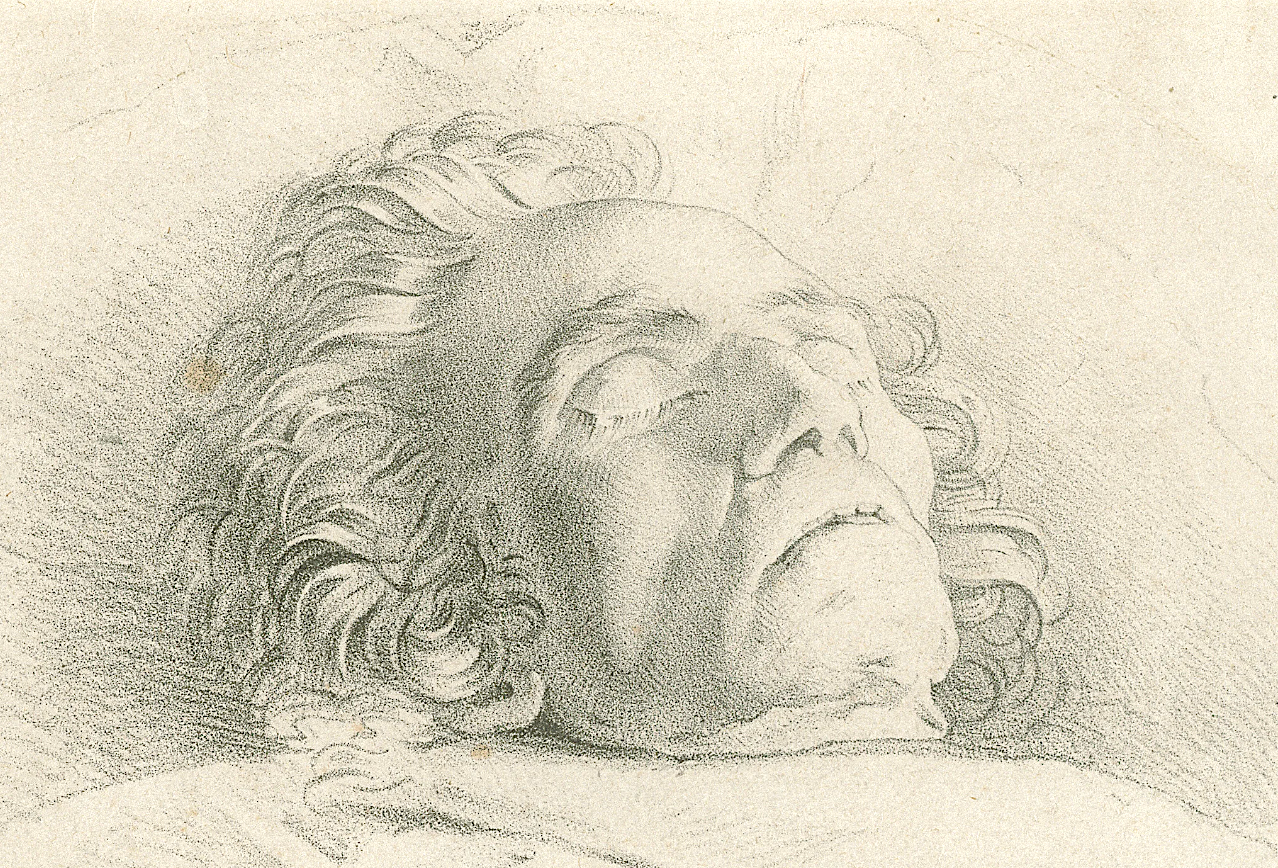
Despite the intense scrutiny paid to the life and work of Ludwig van Beethoven for a couple of centuries now, the revered composer still has certain mysteries about him. Some of them he surely never intended to clarify, like the identity of “Immortal Beloved”; others he explicitly requested be made public, like the cause of his death. The trouble is that, for generation after generation, nobody could quite figure out what that cause was. But recent genetic analysis of his hair, which we first featured last year here on Open Culture, has shed new light on the matter of what killed Beethoven — or rather, what increasingly ailed him up until he died at the age of 56.
This effort “began a few years ago, when researchers realized that DNA analysis had advanced enough to justify an examination of hair said to have been clipped from Beethoven’s head by anguished fans as he lay dying,” writes the New York Times’ Gina Kolata.
With the genuine samples separated from the frauds, a test for heavy metals revealed that “one of Beethoven’s locks had 258 micrograms of lead per gram of hair and the other had 380 micrograms”: 64 times and 95 times the normal amount, respectively. Chronic lead poisoning, possibly caused by Beethoven’s habit of drinking cheap wine sweetened with “lead sugar,” could have caused the “unrelenting abdominal cramps, flatulence and diarrhea” that plagued him in his lifetime.
It could also have hastened the deafness that had become nearly complete by age thirty. “Over the years, Beethoven consulted many doctors, trying treatment after treatment for his ailments and his deafness, but found no relief,” Kolata writes. “At one point, he was using ointments and taking 75 medicines, many of which most likely contained lead.” Alas, the true danger of lead poisoning, a condition that had been acknowledged since antiquity, wouldn’t be taken seriously until the late nineteenth century. According to the research so far, even this degree of lead exposure wouldn’t have been fatal by itself. But with a bit less of it, would Beethoven have completed his tenth symphony, or even continued on to an eleventh? Add that to the still-growing list of unanswerable questions about him.
Related content:
The Secrets of Beethoven’s Fifth, the World’s Most Famous Symphony
The Math Behind Beethoven’s Music
Read Beethoven’s Lengthy Love Letter to His Mysterious “Immortal Beloved” (1812)
Based in Seoul, Colin Marshall writes and broadcasts on cities, language, and culture. His projects include the Substack newsletter Books on Cities, the book The Stateless City: a Walk through 21st-Century Los Angeles and the video series The City in Cinema. Follow him on Twitter at @colinmarshall or on Facebook.
Read More...High-Tech Analysis of Ancient Scroll Reveals Plato’s Burial Site and Final Hours
Even if you can name only one ancient Greek, you can name Plato. You can also probably say at least a little about him, if only some of the things humanity has known since antiquity. Until recently, of course, that qualification would have been redundant. But now, thanks to an ongoing high-tech push to read heretofore inaccessible ancient documents, we’re witnessing the emergence of new knowledge about that most famous of all Greek philosophers — or at least one of the most famous Greek philosophers, matched in renown only by his teacher Socrates and his student Aristotle.
Up until now, we’ve only had a general idea of where Plato was interred after his death in 348 BC. But “thanks to an ancient text and specialized scanning technology,” writes Smithsonian.com’s Sonja Anderson, “researchers say they have solved the mystery of Plato’s burial place: The Greek philosopher was interred in the garden of his Athens academy, where he once tutored a young Aristotle.” This location was recorded about two millennia ago “on a papyrus scroll housed in the Roman city of Herculaneum,” which was entombed along with Pompeii by the explosion of Mount Vesuvius in 79 AD.
Like much else in those cities, this scroll was preserved for centuries under layers of ash. It was just one of many scrolls discovered in a villa, which may have belonged to Julius Caesar’s father-in-law, back in 1750. But for long thereafter, those scrolls were more or less unreadable, having been so thoroughly charred by the explosion of Mount Vesuvius that they crumbled to dust at any attempt to unroll them. But “recent breakthroughs have allowed researchers to read the fragile texts without touching them”: witness the projects involving particle accelerators and artificial intelligence previously featured here on Open Culture.
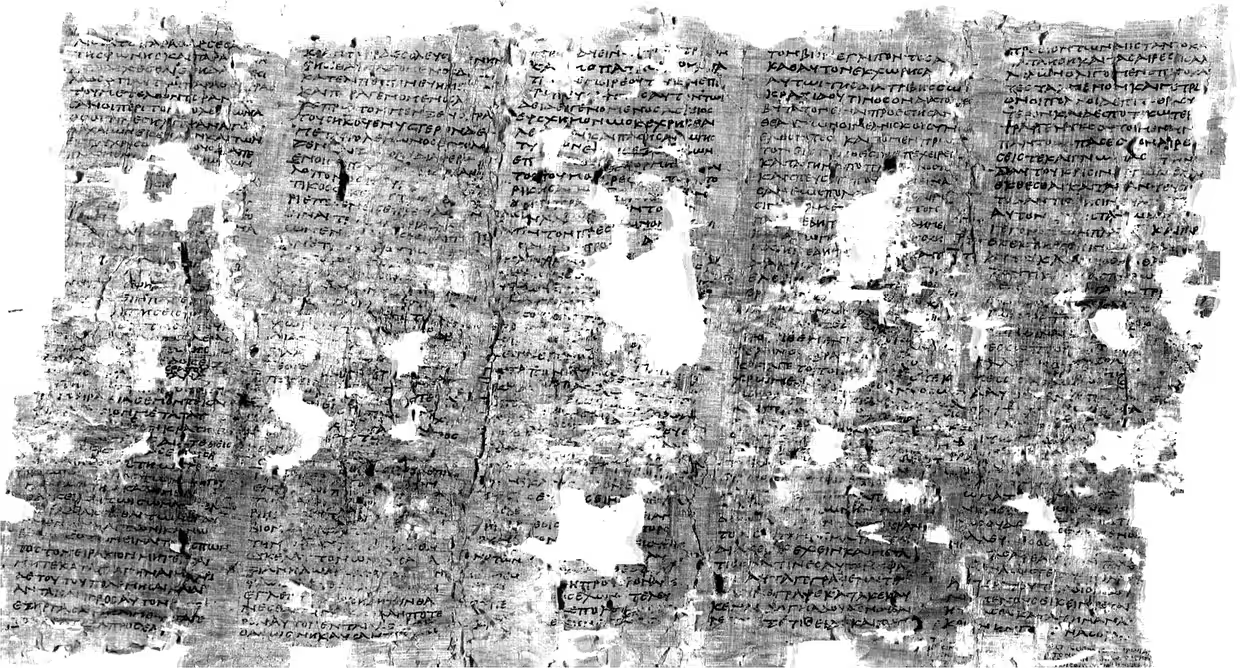
The research project that has deciphered part of this scroll, a text by the philosopher Philodemus called the History of the Academy — that is, Plato’s academy in Athens — is led by University of Pisa professor of papyrology Graziano Ranocchia. Using a “bionic eye” technique involving infrared and X‑ray scanners, he and his team have also discovered evidence that Plato didn’t much like the music played at his deathbed by a Thracian slave girl. “Despite battling a fever and being on the brink of death,” writes the Guardian’s Lorenzo Tondo, he “retained enough lucidity to critique the musician for her lack of rhythm.” Even if you know little about Plato, you’re probably not surprised to hear that he was pointing out the difference between the real and the ideal up until the very end.
Related content:
Researchers Use AI to Decode the First Word on an Ancient Scroll Burned by Vesuvius
Orson Welles Narrates an Animation of Plato’s Cave Allegory
Plato’s Dialogue Gorgias Gets Adapted into a Short Avant-Garde Film
How 99% of Ancient Literature Was Lost
Based in Seoul, Colin Marshall writes and broadcasts on cities, language, and culture. His projects include the Substack newsletter Books on Cities, the book The Stateless City: a Walk through 21st-Century Los Angeles and the video series The City in Cinema. Follow him on Twitter at @colinmarshall or on Facebook.
Read More...Learn to Become a Supply Chain Data Analyst with Unilever’s New Certificate Program

Supply chains—we never thought too much about them. That is, until the pandemic, when supply chains experienced severe disruptions worldwide, leaving us waiting for products for weeks, if not months. That’s when we started appreciating the importance of supply chains and their resilience.
Companies like Unilever rely on supply chains to manufacture their goods (e.g., Dove, Lipton, and Ben & Jerry’s) and then move them around the globe. For Unilever, it’s essential that their supply chains remain efficient and strong. Working in partnership with Coursera, the company has created a new Supply Chain Data Analyst Professional Certificate to help entry-level professionals learn more about using data to manage effective supply chains. Designed to be completed in roughly four months, the certificate consists of four courses: 1) Supply Chain Management and Analytics, 2) Using Data Analytics in Supply Chain, 3) Implementing Supply Chain Analytics, and 4) Supply Chain Software Tools.
As students move through the program, they will learn how to “achieve cost savings, reduce lead times, enhance customer satisfaction, and adapt to changing market conditions through data-driven insights and analytical approaches.” They will also learn key skills like demand forecasting and how to monitor supply chains for security risks.
Emphasizing real-world experience, students will “take on the role of an analyst for a fictitious consumer goods company specializing in organic farm to table consumer products. With over 20 unique assignments, [students will] use spreadsheets and visualization tools to analyze data and make recommendations.”
You can audit the four courses for free, or sign up to earn a shareable certificate for a fee. Students who select the latter option will be charged $49 per month. Coursera estimates that the certificate will take four months to complete, assuming you’re dedicating 10 hours per week. That amounts to about $200 in total. You can enroll here.
For those interested, Unilever has also recently released a new Digital Marketing Analyst Certificate, which you can find here.
In addition, until March 31, 2024, Coursera is offering $100 off of Coursera Plus, which will let you take 7,000 courses (including the ones above) and not pay for the certificates. If you plan to take a lot of courses, and want to earn certificates, it can be a cost effective approach.
Note: Open Culture has a partnership with Coursera. If readers enroll in certain Coursera courses and programs, it helps support Open Culture.
Related Content
Generative AI for Everyone: A Free Course from AI Pioneer Andrew Ng
Read More...Learn to Become a Digital Marketing Analyst with Unilever’s New Certificate Program
Unilever, the consumer goods company headquartered in London, owns over 400 brands. Dove, Lipton, Ben & Jerry’s, Hellmann’s and Knorr–you know and use many of Unilever’s products. The same goes for many people living across the globe. An estimated 3.4 billion people use Unilever products every day. How has Unilever established such vast reach? Through marketing. Like other consumer products companies, Unilever depends on marketing to build brand awareness for each product and to differentiate them from competitors. Marketing is part of the lifeblood of the organization, and digital marketing particularly allows the company to thrive here in the 21st century.
Happily, for any aspiring marketers out there, Unilever has just launched a new Digital Marketing Analyst certificate program. Offered on the Coursera platform, the program consists of four courses (each taking an estimated 20 hours to complete) that focus on helping students build job-ready skills in digital marketing analytics. The courses include:
- Customer Understanding and Digital Marketing Channels
- Measurement and Analysis
- Campaign Performance Reporting, Visualization, & Improvement
- Advanced Tools for Digital Marketing Analytics
As students move through the program, they will “learn in-demand skills like data analysis, customer segmentation, and SEO optimization.” They will also start “collecting and interpreting data to evaluate the performance of digital marketing efforts, improve strategies, and contribute to achieving marketing goals and objectives.”
Students can audit each course for free, or sign up to earn a shareable certificate. Students who select the latter option will be charged $49 per month. So, if you spend 10 hours per week, you can complete the 80-hour certificate program in two months, and pay about $100 in total.
Sign up for the Digital Marketing Analyst certificate program here.
Note: Open Culture has a partnership with Coursera. If readers enroll in certain Coursera courses and programs, it helps support Open Culture.
Related Content
Generative AI for Everyone: A Free Course from AI Pioneer Andrew Ng
Read More...A Deep, Track-by-Track Analysis of The Dark Side of the Moon, Pink Floyd’s Musical Journey Through the Stresses & Anxieties of Modern Existence
Pink Floyd’s The Dark Side of the Moon turned 50 earlier this year, which perhaps makes it seem easy to dismiss as an artifact of a bygone era. It belongs to a period in popular music history when musicians and bands were approaching their albums with ever-greater aesthetic and intellectual ambitions — what I’ve come to call the medium’s “heroic age” — whose products can strike twenty-first-century listeners as excessive, pretentious, and even unhinged. But in spite of the ambience of dorm-room THC haze that has long hung around it, The Dark Side of the Moon remains relevant today, dealing as it does with such eternal themes as youth, choice, mortality, and madness — to say nothing of time and money.
That’s how Polyphonic creator Noah Lefevre frames it in the video above, an hour-long track-by-track analysis of the Floyd’s best-known album. It’s actually a compilation of all eight episodes of a series originally released in 2020, which, much like The Dark Side of the Moon Itself, benefits from being experienced not in parts but as a whole.
Lefevre describes the album as “about the stresses and struggles that make human existence what it is. It’s about all the noise that constantly surrounds us, and about trying to cut through that noise to find truth, beauty, and meaning.” He also quotes Pink Floyd frontman Roger Waters ascribing to it the statement that “all the good things life can offer are there for us to grasp, but that the influence of some dark force in our natures prevents us from seizing them.”
The Dark Side of the Moon has endured not just by dealing with those themes, but also by doing so with a cinematic sonic richness. That owes much to the work of Alan Parsons, who engineered the recording, but most of the album’s long conception happened outside the studio. “It started out with a few weeks in a rehearsal space during which Pink Floyd wrote a rough outline for the piece,” says Lefevre. “Then the band took that on tour, even though it was far from completion. They performed sixteen dates in the UK, playing the album in full each night”; all the while, they “worked through the album, fine-tuning it and developing it.” This explains why the result — which, like all of Pink Floyd’s albums, you can hear free on Youtube — sounds painstakingly produced yet organic. Give The Dark Side of the Moon another listen today, and you’ll understand why it’s persisted like the condition of modern life itself.
Related content:
Pink Floyd’s Entire Studio Discography is Now on YouTube: Stream the Studio & Live Albums
Download Pink Floyd’s 1975 Comic Book Program for The Dark Side of the Moon Tour
A Live Studio Cover of Pink Floyd’s The Dark Side of the Moon, Played from Start to Finish
Based in Seoul, Colin Marshall writes and broadcasts on cities, language, and culture. His projects include the Substack newsletter Books on Cities, the book The Stateless City: a Walk through 21st-Century Los Angeles and the video series The City in Cinema. Follow him on Twitter at @colinmarshall or on Facebook.
Read More...Leonardo da Vinci Created the Design for the Miter Lock, Which Is Still Used in the Panama and Suez Canals
“A Man, a Plan, a Canal — Panama”: we all know the piece of infrastructure to which this famous palindrome refers. But who, exactly, is the man? Some might imagine President Theodore Roosevelt in the role, given his oversight of the project’s acquisition by the United States of America. But it’s more commonly thought to be George W. Goethals, the Roosevelt-appointed chief engineer who brought it to completion two years early. Then again, one could also make the case for French diplomat Ferdinand de Lesseps, who originally conceived of not only the Panama Canal but also the Suez Canal. And as long as we’re reaching back in history, how does Leonardo da Vinci strike you?
True, Leonardo died roughly four centuries before the Panama Canal broke ground. But that its mechanism works at all owes to one of his many inventions: the miter lock, documented in one of his notebooks from 1497. The design, as explained in the Lesics video above, involves “two V‑shaped wooden gates” attached with hinges to the sides of a river.
Given their shape, the water flowing through the river naturally forces the gates to close, one side forming a neat joint with the other. Inside, “as the water level rises, the pressure on the gate increases,” which seals it even more tightly. To facilitate re-opening the “perfect watertight lock” thus formed, Leonardo also specified a set of sluice valves in the gates that can be opened to even out the water levels again.
The twentieth-century builders of the Panama Canal benefited from technologies unavailable in Leonardo’s time: powerful motors, for instance, that could open and close the gates more efficiently than human muscle. And though it has undergone improvements over the past century (such as the replacement of the geared system attached to those motors with even more effective hydraulic cylinders), its structure and operation remain visibly derived from Leonardo’s elegant miter lock, as do those of the Suez Canal. About 80 ships pass through those two famous waterways each and every day, and ships of a size scarcely imaginable in the fifteenth century at that: not bad for a couple pieces of 500-year-old engineering.
Related content:
Explore the Largest Online Archive Exploring the Genius of Leonardo da Vinci
The Ingenious Inventions of Leonardo da Vinci Recreated with 3D Animation
Leonardo da Vinci Draws Designs of Future War Machines: Tanks, Machine Guns & More
Based in Seoul, Colin Marshall writes and broadcasts on cities, language, and culture. His projects include the Substack newsletter Books on Cities, the book The Stateless City: a Walk through 21st-Century Los Angeles and the video series The City in Cinema. Follow him on Twitter at @colinmarshall or on Facebook.
Read More...Support Us
We're hoping to rely on loyal readers, rather than erratic ads. Please click the Donate button and support Open Culture. You can use Paypal, Venmo, Patreon, even Crypto! We thank you!

About Us

Open Culture scours the web for the best educational media. We find the free courses and audio books you need, the language lessons & educational videos you want, and plenty of enlightenment in between.
Advertise With Us
FREE UPDATES!
GET OUR DAILY EMAIL
Get the best cultural and educational resources on the web curated for you in a daily email. We never spam. Unsubscribe at any time.
FOLLOW ON SOCIAL MEDIA
Open Culture editor Dan Colman scours the web for the best educational media. He finds the free courses and audio books you need, the language lessons & movies you want, and plenty of enlightenment in between.
Advertise With Us

