Discovered: Lost Johnny Cash Concert Recorded by the Grateful Dead’s LSD Chemist Owsley Stanley (1968)
On January 13, 1968, Johnny Cash recorded his famous live concerts within the walls of Folsom State Prison, California, a week into what would be one of his busiest years of touring. While Columbia Records worked on trimming down the two sets into one LP, Cash set off across the States, into Canada and back, playing almost every night, and returning to the West Coast for a final stop at the Carousel Ballroom in San Francisco.
Recording the gig that night was Owsley “Bear” Stanley, the Grateful Dead’s engineer and also the man responsible for creating the purest LSD on the West Coast. As Rolling Stone once asked, would there have been a Summer of Love if not for Stanley? Apparently, Stanley had *another* secret stash, and we are only now hearing a tiny fraction of it. This gig is one of over 1,300 the engineer recorded and kept in his private collection. Stanley died in 2011, and ten years later the Oswald Stanley Foundation is selectively releasing recordings from this treasure trove as a way to preserve the recordings and fund more releases. This Cash set was one of the first releases in the “Bear’s Sonic Journals” series, released in October of 2021.
Cash’s new bride June Carter Cash joined him onstage. It was on the Ontario stop of the aforementioned tour that Cash proposed to her live on stage, and they were married March 1 in Kentucky. You can hear his pride as he introduces her to the audience; the two immediately launch into “Jackson.” “We got married in a fever,” indeed. (The two remained married until her death in 2003.) June sings several numbers, including “Wabash Cannonball,” and Carl Perkins’ “Long Legged Guitar Pickin’ Man.”
The other artist figuring prominently in these recordings (as an influence) is Bob Dylan. The two had been circling each other in admiration for years, and here Cash covers “One Too Many Mornings” and then “Don’t Think Twice, It’s Alright.” The man owns it, turns it into what sounds like a Tennessee Three original. Dylan and Cash would finally record together in 1969, in sessions that would be bootlegged until a recent official release.
Stanley recorded these sets for himself, coming straight out of the soundboard. Where the Carousel Ballroom concert lacks in quality—-vocals, audience, and Cash’s guitar are on the left, the band to the right—-they make up for in history and excitement.
Currently, the label has released full concerts from Tim Buckley, Ali Akbar Khan, with Indranil Bhattacharya and Zakir Hussain, Commander Cody & His Lost Planet Airmen, New Riders of The Purple Sage, Jorma Kaukonen & Jack Casady, The Allman Brothers Band, and Doc and Merle Watson. As Stanley recorded for two decades of his career, the catalog promises untold delights.
The full playlist from the Carousel Ballroom gig is below:
Related Content:
Take a Trip to the LSD Museum, the Largest Collection of “Blotter Art” in the World
Johnny Cash’s Short and Personal To-Do List
Ted Mills is a freelance writer on the arts who currently hosts the Notes from the Shed podcast and is the producer of KCRW’s Curious Coast. You can also follow him on Twitter at @tedmills, and/or watch his films here.
Read More...Watch Nirvana Perform as an Opening Band, Two Years Before Their Breakout Album Nevermind (1989)
The story of Nirvana’s first album, first single, and first video launching the band to instant mega-stardom, and the story of their tragic crash back down to Earth, have been told too many times to count. Less well known are the years of the band’s early ascent through the local Pacific Northwest scene, opening for then-bigger acts like TAD (who got swept up, then left behind in grunge’s first wave). Nirvana first formed in 1987 in Aberdeen, WA and played as a few iterations with names like Fecal Matter and Skid Row, always as a three-piece with Kurt Cobain out front and Krist Novoselic on bass.
As they ironed out their image (avoiding a lawsuit from the Jersey hair metal band), Nirvana also moved through a couple different drummers behind the kit before lucking into Dave Grohl. “Aaron Burckhard was Nirvana’s first drummer,” writes the Museum of Pop Culture, “but he and the band ultimately parted ways. While the band searched for a replacement, Dale Crover helped Nirvana with their first demo and Dave Foster honored their live bookings. Chad Channing officially joined Nirvana in 1988, and the band began work on their debut album Bleach, which was officially released in June of 1989 followed by a short American tour and a lengthy UK tour.” Just above, you can see them open for TAD on December 1, 1989 at Fahrenheit, Issy-les-Moulineaux, France.
Signed to Seattle indie label Sub Pop at the time, the band was eager for success but hadn’t quite nailed down their sound. When Nevermind producer Butch Vig heard Bleach the following year, after Sub Pop recruited him to work with the band, he “thought it was pretty one-dimensional,” he writes, “except that one song, ‘About a Girl.’ ” Cobain would only say he wanted the band to sound like “Black Sabbath.” The label’s Jonathan Poneman assured Vig that Nirvana “would be as big as The Beatles,” but that wouldn’t happen until Channing left, or felt pushed out. As Vig remembers, there was considerable “tension between Kurt and Chad” during their first sessions in Madison, Wisconsin in 1990. “Kurt would sometimes go behind the drums and show Chad how to play.” Of course, that’s something the moody Cobain was also known to do to Channing’s replacement.
Musical tension did not result in long-term hard feelings, Channing says. “I found out what a really nice guy Dave is.” For his part, Grohl has pushed for recognition of Channing’s contributions, objecting to his exclusion from the Rock and Roll Hall of Fame in 2013. “Grohl took steps to rectify the injustice,” notes Far Out Magazine. “With Channing in attendance, Grohl publicly applauded and thanked Channing for his vital contributions to the band, and more critically, noted that some of Nirvana’s most iconic drum riffs from the period were, in fact, Channing’s.” Hear some of the evidence above in a setlist that includes several tracks from Bleach, including “About a Girl,” and “Polly” from the upcoming Nevermind. And stick around for TAD, forgotten stalwarts of the Seattle scene.
via Boing Boing
Related Content:
The Recording Secrets of Nirvana’s Nevermind Revealed by Producer Butch Vig
Josh Jones is a writer and musician based in Durham, NC. Follow him at @jdmagness
Read More...Explore the New 717-Gigapixel Scan of Rembrandt’s The Night Watch, the Most Detailed Photo Ever Taken of a Work of Art
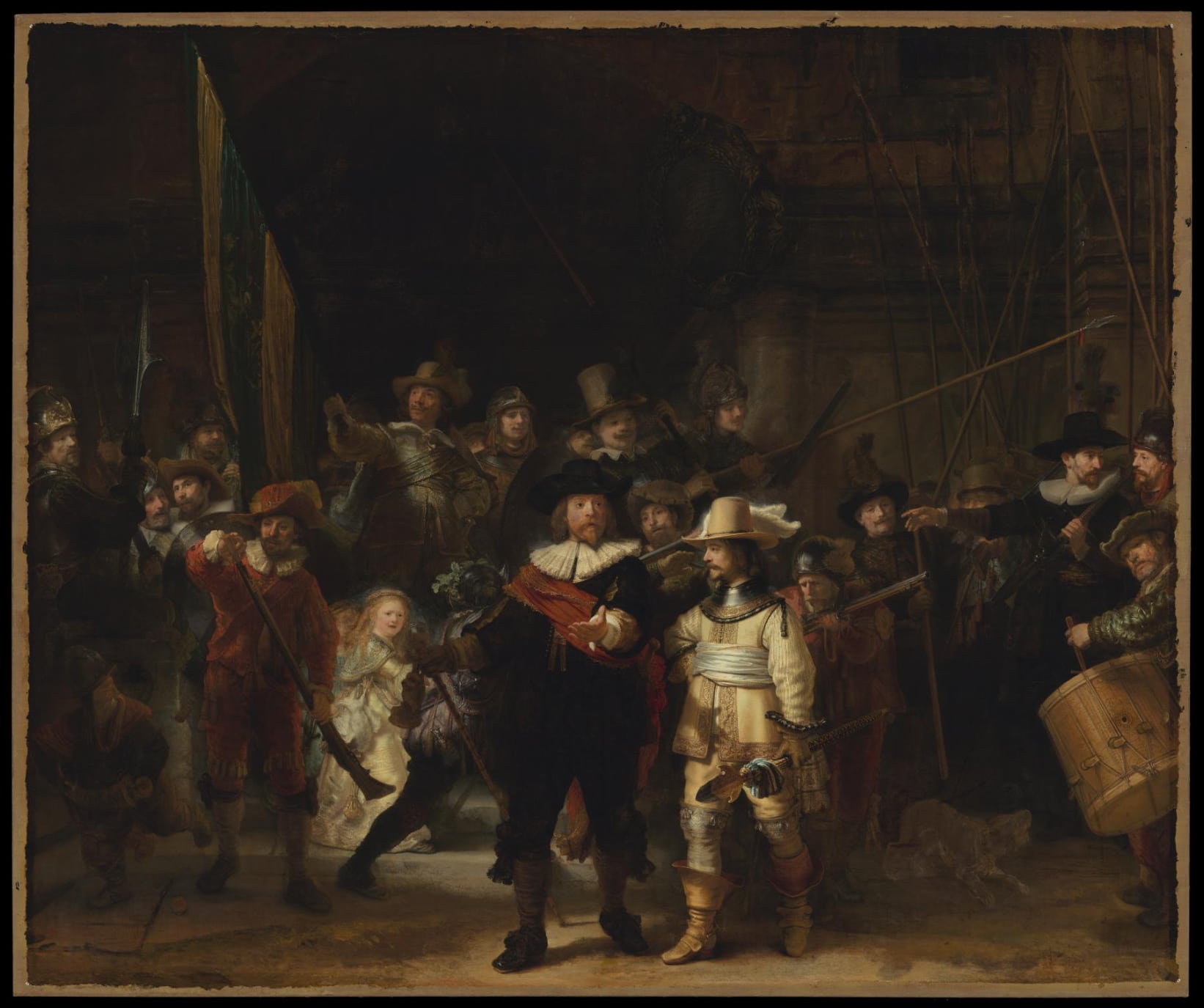
Filmmaker and serious Rembrandt enthusiast Peter Greenaway once called The Night Watch the most famous painting in the Western world, behind the Mona Lisa, The Last Supper, and the ceiling of the Sistine Chapel. But if the resources devoted to its scrutiny are anything to go by, the Dutch masterwork has been gaining on those other three in recent years. Can any work of Leonardo or Michelangelo, for example, boast of having been digitized at a resolution of 717 gigapixels, as the Rijksmuseum has just done with The Night Watch?

In fact, no other work of art in existence has ever been the subject of such a large and detailed photograph. Each of its 717,000,000,000 pixels, says the Rijksmuseum’s site, “is smaller than a human red blood cell.”
This necessitated the use of “a 00-megapixel Hasselblad H6D 400 MS-camera to make 8439 individual photos measuring 5.5cm x 4.1cm. Artificial intelligence was used to stitch these smaller photographs together to form the final large image, with a total file size of 5.6 terabytes.” You may remember artificial intelligence also having played a role in the reconstruction of the painting’s missing sections, previously featured here on Open Culture.
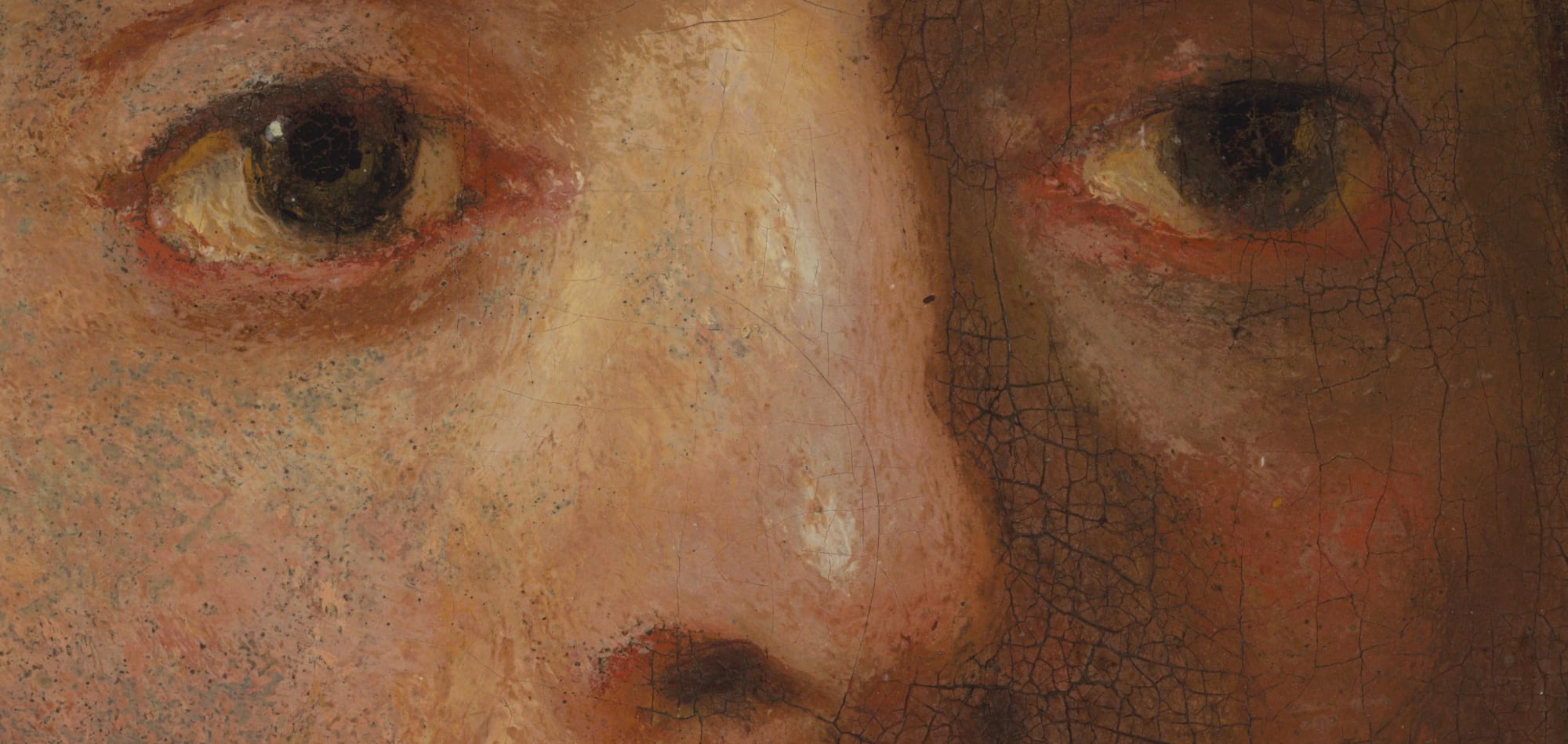
The result far surpasses the digital version of The Night Watch made available by the Rijksmuseum in 2020, itself high-resolution enough to allow viewers to zoom in to see the painting’s every individual brush stroke. (It even outdoes last year’s 10-billion-pixel scan of Girl with a Pearl Earring, the best-known work by Rembrandt’s fellow Dutch master Johannes Vermeer.) Now, writes Colossal’s Grace Ebert, you can see all the way down to “the cracked texture of the paint, brushstrokes, and slight pigment variations that wouldn’t be visible even if you were standing in front of the work itself.”
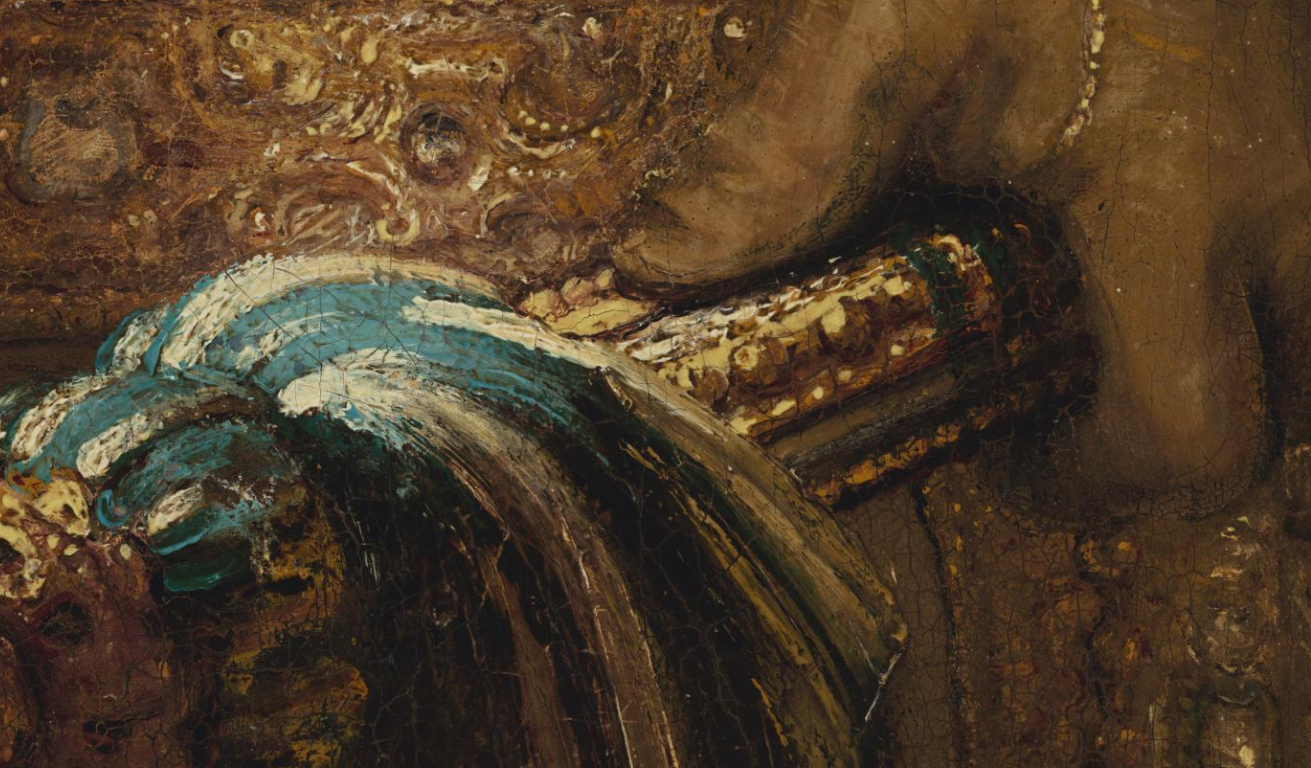
380 years after Rembrandt painted it, The Night Watch remains almost uniquely striking in its employment of contrasting shadow and light, all in service of a large-scale composition at once lifelike and somehow more vivid than reality. This digitization and the AI-assisted completion are both arts of “Operation Night Watch,” the thoroughgoing restoration project now underway at the Rijksmuseum, which will make all the elements of that composition more immediately visible than they’ve been in generations.
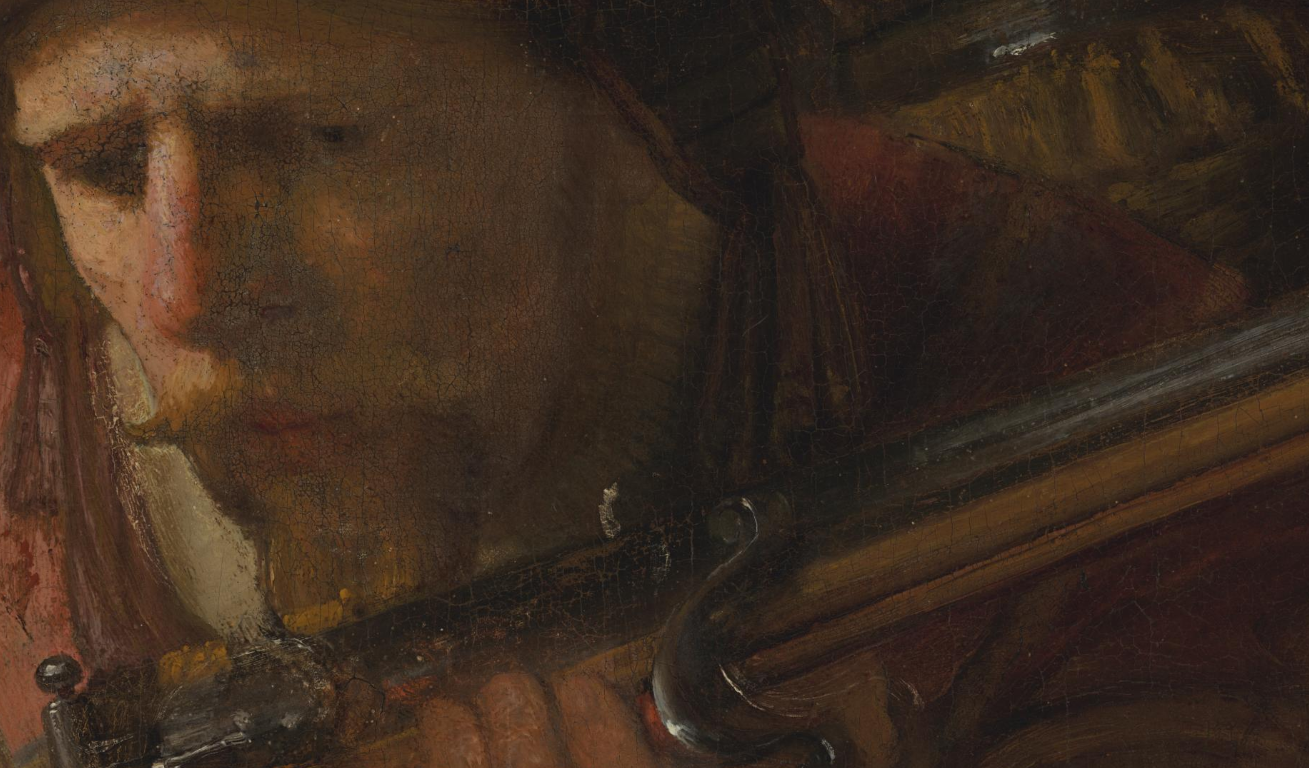
But the question of how, exactly, Rembrandt achieved such powerful effects can be answered only through rigorous examination of each and every detail, an activity open to all on the 717-gigapixel scan at the Rijksmuseum’s site.
Related Content:
What Makes The Night Watch Rembrandt’s Masterpiece
The Long-Lost Pieces of Rembrandt’s Night Watch Get Reconstructed with Artificial Intelligence
Late Rembrandts Come to Life: Watch Animations of Paintings Now on Display at the Rijksmuseum
A 10 Billion Pixel Scan of Vermeer’s Masterpiece Girl with a Pearl Earring: Explore It Online
Based in Seoul, Colin Marshall writes and broadcasts on cities and culture. His projects include the book The Stateless City: a Walk through 21st-Century Los Angeles and the video series The City in Cinema. Follow him on Twitter at @colinmarshall or on Facebook.
Read More...The Famous Downfall Scene Explained: What Really Happened in Hitler’s Bunker at the End?
Before his role as Hitler in the 2004 German film Downfall turned Swiss actor Bruno Ganz into a viral internet star, he was best known for playing an angel who comforts the dying in Wim Wenders’ 1987 Wings of Desire. “People really seemed to think of me as a guardian angel,” he told The Irish Times in 2005. “People would bring their children before me for a blessing or something.” Seventeen years later, the self-described introvert transformed his gentle, comforting face into the Nazi screen monster: “Nothing prepared me for what must be the most convincing screen Hitler yet,” wrote The Guardian’s Rob Mackie. “An old, bent, sick dictator with the shaking hands of someone with Parkinson’s, alternating between rage and despair in his last days in the bunker.”
This portrayal has never been surpassed, and perhaps it never will be. How many fictionalized film treatments of these events do we need? Especially since this one lives forever in meme form: Ganz endlessly spitting and gesticulating, while captions subtitle him ranting about “his pizza arriving late” – Gael Fashingbaeur Cooper writes at cnet – or “the Red Wedding scene on Game of Thrones, or finding out he wasn’t accepted into Harry Potter’s Hogwarts.” As Virginia Heffernan wrote at The New York Times in 2008 – maybe the height of the meme’s virality – “It seems that late-life Hitler can be made to speak for almost anyone in the midst of a crisis…. Something in the spectacle of an autocrat falling to pieces evidently has widespread appeal.”
Given the widespread preference for memes over facts, the ubiquity of the Downfall clip as viral spectacle, and the renewed relevance of murderous autocracy in the West, we might find ourselves wondering about the historical accuracy of Downfall’s portrayal. Did the dictator really lose it in the end? And why do we find this idea so satisfying? To begin to answer the first question, we might turn to the video above, “That Downfall Scene Explained,” from the makers of The Great War, billed as the “biggest ever crowdfunded history documentary.” Despite taking as their subject the First World War, the filmmakers also cover some of the events of WWII for fans.
First, we must remember that Downfall is an “artistic interpretation.” It condenses weeks into days, days into hours, and takes other such dramatic liberties with accounts gathered from eyewitnesses. So, “what is Hitler freaking out about” in the famous scene?, the subtitle asks. It is April 1945. The Red Army is 40 kilometers from Nazi headquarters in Berlin. The dictator’s Chief of the Army General Staff Hans Krebs explains the situation. Hitler remains in control, drawing possible lines of attack on the map, believing that SS commander Felix Steiner’s Panzer divisions will repel the Soviets.
Little does he know that Steiner’s divisions exist only on paper. In reality, the SS leader has refused to take to the field, convinced the battle cannot be won. Another General, Alfred Jodel, steps in and delivers the news. Hitler then clears the room of all but Jodl, Krebs, and two other high-ranking generals. Joseph Goebbels and Martin Bormann stay behind as well. Then (as played by Ganz, that is) Hitler has that famous screen meltdown. The outburst “shows just how he had centralized the chain of command,” and how it failed him.
This may have been so. Downfall presents us with a convincing, if highly condensed, portrait of the major personalities involved. But “the scene that spawned a thousand YouTube parodies,” writes Alex Ross at The New Yorker, “is based, in part, on problematic sources.” One of these, the so-called Hitler Book, was compiled from “testimony of two Hitler adjutants, Otto Günsche and Heinz Linge, who had been captured by the Red Army and interrogated at length…. The most curious thing about The Hitler Book is that it was intended for a single reader: Joseph Stalin.” The Soviet dictator wanted, and got, “a lavishly detailed chronicle of Hitler’s psychological implosion.” Other sources “convey a more complex picture.”
According to other accounts, Hitler was “generally composed” when learning about the Red Army attack on Berlin, even as he decided to give up and die in the bunker. According to Nazi stenographer, Gerhard Herrgesell, it was the generals who “violently opposed” surrender and spoke harshly to Hitler to persuade him to defend the city – a speech that had some effect during an April 22nd meeting. It did not, of course, prevent Hitler and his new bride Eva Braun’s eventual April 30 suicide. For Ross, however, this more complex historical picture shows “how cults of personality feed as much upon the aspirations of their members as upon the ambitions of their leaders.” The members of Hitler’s inner circle were as committed to the ideology as the leader himself.
There is more to the film’s title in German, Untergang, than its translation suggests, Ross writes: “It carries connotations of decline, dissolution, or destruction.” When we fix the end of Nazism to the suicidal death of one delusional, drug-addled madman, we lose sight of this wider meaning. In the viral spread of the Hitler meme, we see a kind of comically banal triumph. It is “the outcome,” Heffernan argues, that “Hitler, the historical figure sought….” A situation in which he becomes “not the author of the Holocaust” but “the brute voice of the everyman unconscious,” a proliferating grievance machine. From another perspective, imagining Hitler’s end may offer “comforting moral closure to a story of limitless horror,” writes Ross. But it has helped feed the myth that it could only happen there and then: “Now German historians are ending their books on Nazism with thinly veiled references to an American Untergang.”
Related Content:
Josh Jones is a writer and musician based in Durham, NC. Follow him at @jdmagness
Read More...Doreen Ketchens’ Astonishing Rendition of “The House of the Rising Sun”: A World-Class Clarinetist Busks on the Streets of New Orleans
Dirtiness has no description. It is a feeling. — music transcriber George Collier
You may be able to read music and play the clarinet, but it’s extremely unlikely you — or anyone — will be able to play along with Doreen Ketchens’ “dirty” solo on “The House of the Rising Sun,” above, despite an assist from Tom Pickles’ scrolling transcription.
Download the transcription for free and keep trying.
It’s what Ketchens, a world renowned clarinetist and music educator, who has played for four US presidents and busks regularly in the French Quarter, would advise.
“You have to practice and be ready to perform at the drop of a hat” she told The Clarinet’s Ben Redwine, when he asked if she had any advice for young musicians hoping to make it professionally.
She’s also a strong advocate of listening robustly, not throwing in the towel when someone else gets the job instead of you, and letting your personality come through in your playing:
You don’t want to sound like you’re playing an etude book. This is for all types of music – even classical. You want to move the audience, you want to touch them.
Trained as a classical clarinetist, Ketchens cozied up to jazz shortly after she cozied up to the tuba player who would become her husband. “All of the sudden, jazz wasn’t so bad,” she says:
I started to listen to jazz so I could learn the tunes and fit in with his band. I started listening to Louis Armstrong. He is my biggest influence. Some people call me Mrs. Satchmo, I guess because that concept is in my head. I’ll hear something he plays, which I’ve heard thousands of times, and I’ll think, “What? How did he do that?” Then, I listened to the clarinetists who played with him: Edmund Hall, Buster Bailey, Barney Bigard. Those cats were awesome too! Edmund Hall had this thing he could do, where it sounds like he was playing two tones at the same time. People today might hum while they play to achieve something similar, but I don’t think that was what he was doing. Buster Bailey had a similar background to me, starting out with classical music, then learning jazz. Early on, I emulated Jerry Fuller, clarinetist with the Dukes of Dixieland. I would steal so many of his solos just so I could keep up with my husband’s band. Eventually, I realized what he was doing, and it translated into me being able to improvise. I’d start out transcribing solos, then playing by ear, copying what those clarinetists were doing. I don’t remember those solos now, but I’m sure that I still play snippets of them that creep into my improvisations.
However she got there, she possesses a singular ability to make her instrument growl and her command of 32nd notes makes us feel a little lightheaded.
Clarinetists abound in New Orleans, and they probably all cover “The House of the Rising Sun,” but you’ll be hard pressed to find a more exciting rendition than Ketchens’ on the corner of St. Peter and Royal, with husband Lawrence on tuba and daughter Dorian on drums. Here’s the full versions, sans transcription.
You want an encore? Of course you do.
How about Ketchens’ magnificent solo on “Just a Closer Walk With Thee” for the Louisiana Philharmonic Orchestra?
Find more astonishing, transcribed solos and a heaping helping of Jacob Collier on George Collier’s (no relation) YouTube Channel.
His transcriptions, and those of collaborator Tom Pickles, are available for free download here, unless the artist sells their own transcription, in which case he encourages you to support the artist with your purchase.
If you’re a music nerd who would like to discuss transcriptions, give feedback on others’ attempts, and upload your own, join his community on Discord.
Related Content:
Women of Jazz: Stream a Playlist of 91 Recordings by Great Female Jazz Musicians
Jazz Virtuoso Oscar Peterson Gives Dick Cavett a Dazzling Piano Lesson (1979)
Little Kid Merrily Grooves to ZZ Top While Waiting for the Bus
Ayun Halliday is an author, theatermaker, and the Chief Primaologist of the East Village Inky zine. Her latest book, Creative, Not Famous: The Small Potato Manifesto, will be published in early 2022. Follow her @AyunHalliday.
Read More...George Harrison “My Sweet Lord” Gets an Official Music Video, Featuring Ringo Starr, Al Yankovic, Patton Oswalt & Many Others
To help celebrate the 50th anniversary of George Harrison’s classic solo album, All Things Must Pass, the classic track, “My Sweet Lord,” has now received an official music video. And it features a number of cameo appearances–from other former Beatles (Ringo Starr), to family members (Olivia Harrison and Dhani Harrison), to other guests (Mark Hamill, Fred Armisen, Al Yankovic, Rosanna Arquette). Enjoy.
Featuring In Order of Appearance:
Mark Hamill
Fred Armisen
Vanessa Bayer
Moshe Kasher
Natasha Leggero
Jeff Lynne
Reggie Watts
Darren Criss
Patton Oswalt
Al Yankovic
David Gborie
Sam Richardson
Atsuko Okatsuka
Rosanna Arquette
Brandon Wardell
Ringo Starr
Joe Walsh
Jon Hamm
Brett Metter
Anders Holm
Dhani Harrison
Rupert Friend
Angus Sampson
Taika Waititi
Eric Wareheim
Tim Heidecker
Kate Micucci
Riki Lindhome
Alyssa Stonoha
Mitra Jouhari
Sandy Honig
Olivia Harrison
Aimee Mullins
Courtney Pauroso
Natalie Palamides
Shepard Fairey
Claudia O’Doherty
Tom Scharpling
Paul Scheer
Sarah Baker
Related Content
George Harrison Explains Why Everyone Should Play the Ukulele
Watch George Harrison’s Final Interview and Performance (1997)
Read More...
George Orwell’s Nineteen Eighty-Four Will Be Retold from a Woman’s Point of View
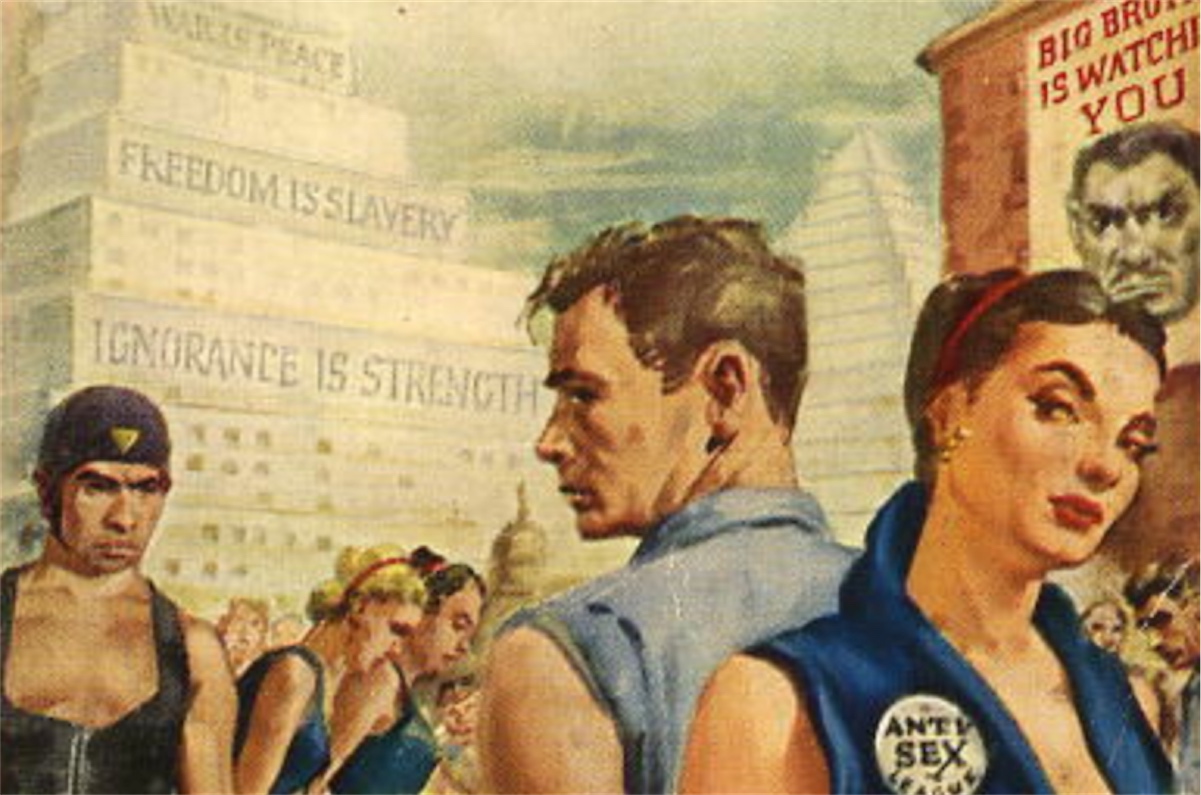
Nineteen Eighty-Four has been a byword for totalitarian dystopia longer than most of us have been reading books. But apart from its the title and certain words from its invented “newspeak” — doubleplusgood, unperson, thoughtcrime — how deeply is George Orwell’s best-known novel embedded into the culture? Most of us recognize the name Winston Smith, and many of us may even remember details of his job at the Ministry of Truth, where the facts of history are continually rewritten to suit ever-shifting political exigencies. But how much do we know about the other major character: Julia, Winston’s fellow ministry employee who becomes his clandestine co-dissident and forbidden lover?
“In some ways she was far more acute than Winston, and far less susceptible to Party propaganda,” writes Orwell in Nineteen Eighty-Four. “But she only questioned the teachings of the Party when they in some way touched upon her own life. Often she was ready to accept the official mythology, simply because the difference between truth and falsehood did not seem important to her.” Julia’s amorality throws the rigidity of Winston’s own attitudes into contrast, and also shows up their impracticality. Now, in the hands of novelist Sandra Newman, Julia will become not just star of the story but its narrator.
Or so it looks, at least, from the brief passage quoted in the Guardian’s announcement of Julia, a re-telling of Nineteen Eighty-Four approved by Orwell’s estate and to be published in time for the 75th anniversary of the original. Though it has no firm publication date yet, Julia will come out some time after Newman’s next book The Men, in which, as the Guardian’s Alison Flood puts it, “every single person with a Y chromosome vanishes from the world.” It will join an abundance of recent retellings from the woman’s point of view, including everything from “Pat Barker’s The Silence of the Girls, a version of the Iliad from the perspective of Briseis, to Maggie O’Farrell’s Hamnet, which centers on the life of Shakespeare’s wife.”
Entrusting a literary property to a writer of another era, culture, and sensibility is a tricky business, but there arguably has never been a more opportune time to put out a book like Julia. It seems the dystopia-hungry public has never been readier to identify the “Orwellian” in life, nor more responsive to re-interpretations and expansions of long-established bodies of popular myth. And what with women having conquered the world of fiction, there will naturally be great interest in Julia’s take on life under Big Brother — as well as in its inevitable television adaptation.
Related content:
George Orwell’s 1984 Staged as an Opera: Watch Scenes from the 2005 Production in London
Aldous Huxley to George Orwell: My Hellish Vision of the Future is Better Than Yours (1949)
George Orwell’s Final Warning: Don’t Let This Nightmare Situation Happen. It Depends on You!
Based in Seoul, Colin Marshall writes and broadcasts on cities and culture. His projects include the book The Stateless City: a Walk through 21st-Century Los Angeles and the video series The City in Cinema. Follow him on Twitter at @colinmarshall or on Facebook.
Read More...8 Hours of David Bowie’s Historic 1980 Floor Show: Complete & Uncut Footage
Bowie completists rejoice. Eight hours of footage from his 1973 television program “The 1980 Floor Show,” have found their way to YouTube, including, Boing Boing notes, “uncut footage… multiple takes, backstage moments, and all of the dance rehearsals.” The show — actually an episode of the NBC series The Midnight Special curated by Bowie — lived up to its title (itself a pun on “1984,” the opening song of the broadcast), with elaborate dance numbers, major costume changes, and several guest performers: The Troggs, Amanda Lear, Carmen, and — most importantly — Marianne Faithfull, in career free-fall at the time but also in top form for this cabaret-style variety show.
When Midnight Special producer Burt Sugarman approached Bowie about doing the hour-long show, the singer agreed on the condition that he could have complete creative control. He chose to hold rehearsals and performances at London’s Marquee Club. The audience consisted of 200 young fans drawn from the Bowie fan club. Faithfull was “actually invited as one of the reserve acts,” notes Jack Whatley at Far Out, “ready to be called upon should someone else drop out.”
“The show was heavily advertised in the US press in the run up to the broadcast,” noted Bowie 75 in 2018, “but has never been shown outside the US or officially released,” though bootlegs circulated for years. Shooting took place over three days in late October, just a few months after Bowie played his final show as Ziggy Stardust at the Hammersmith Odeon Theatre, cryptically announcing at the end, “not only is it the last show of the tour, it’s the last show we’ll ever do.” Bowie then went on to release Aladdin Sane and his covers record Pin-Ups the following year, dropping the Ziggy character entirely.
But Bowie brought Ziggy back, at least in costume, for one last gig in “The 1980 Floor Show,” wearing some of the outfits Kansai Yamamoto designed for the Ziggy Stardust tours and still sporting the signature spiked red mullet he would continue to wear as his dystopian Halloween Jack persona on 1974’s Diamond Dogs. “The 1980 Floor Show” promoted songs from Aladdin Sane and Pin-Ups while visually representing the transition from Bowie’s space alien visitor persona to a different kind of outsider — an alien in exile, just like the character he played a few years later in Nicholas Roeg’s The Man Who Fell to Earth. As Maria Matheos writes at Hasta:
Ziggy no longer played guitar: Bowie had metamorphosed into Aladdin Sane. Parading across the stage in red platform boots and a patent-leather black and white balloon leg jumpsuit, referred to by designer Yamamoto as the ‘Tokyo pop’ jumpsuit, Bowie sought to assault the senses of his audience. Completely over the top? Yes. Verging on a parody of excess? Possibly. Would he have wanted us to take him seriously? He certainly did not (take himself seriously).
With Aladdin Sane, Bowie gave us a hyperbolic extension of his prior alien doppelganger; adding that his character, a pun on ‘A Lad Insane’, represented “Ziggy under the influence of America.”
See how Bowie constructed that new, and short-lived, persona from the materials of his former glam superstar character, and see the revelation that was Marianne Faithfull. The singer performed her 1964 hit, written by The Rolling Stones, “As Tears Go By,” solo. But the highlight of the show, and of her mid-seventies period, was the duet of Sonny & Cher’s “I Got You Babe” with which she and Bowie closed the show. “The costumes of the pair are magical.” Whatley writes,” with Bowie “in full Ziggy attire… aka his ‘Angel of Death’ costume—while Faithfull has on a nun’s habit that was open at the back.”
Bowie reportedly introduced the song with the tossed-off line, “This isn’t anything serious, it’s just a bit of fun. We’ve hardly even rehearsed it.” You can scroll through the 8 hours of footage at the top to see those rehearsals, and so many more previously unavailable Bowie moments caught on film.
via Boing Boing
Related Content:
Bowie’s Bookshelf: A New Essay Collection on The 100 Books That Changed David Bowie’s Life
David Bowie Became Ziggy Stardust 48 Years Ago This Week: Watch Original Footage
David Bowie’s Final Gig as Ziggy Stardust Documented in 1973 Concert Film
David Bowie on Why It’s Crazy to Make Art–and We Do It Anyway (1998)
Josh Jones is a writer and musician based in Durham, NC. Follow him at @jdmagness
Read More...
Watch 30+ Exceptional Short Films for Free in The New Yorker’s Online Screening Room
For short films, finding an audience is an often uphill battle. Even major award winners struggle to reach viewers outside of the festival circuit.
Thank goodness for The Screening Room, The New Yorker’s online platform for sharing short films.
It’s a magnificent free buffet for those of us who’d like nothing better than to gorge ourselves on these little gems.
If you’re not yet a fan of the form, allow us to suggest that any one of the 30 fictional shorts posted in The Screening Room could function as a superb palate cleanser between binge watches of more regular fare.
Take co-directors Amina Sutton and Maya Tanaka’s hilarious The Price of Cheap Rent, clocking in at 6 1/2 minutes, above.
A community-supported project, starring Sutton and shot in Tanaka’s Brooklyn apartment, it’s a comedy of manners that brings fresh meaning to the semi-controversial phrase “Bed Stuy, Do or Die.”
Sutton plays a young Black artist with a masters from Yale, a gig behind the bar at Applebee’s, and a keen interest in positioning herself as an influencer, an ambition the filmmakers lampoon with glee.
When she discovers that her new apartment is haunted, she is “so freaked the f&ck out,” she spends a week sleeping in the park, before venturing back:
And it’s a studio, so it’s like living in a clown car of hell.
But once she discovers (or possibly just decides) that the majority of the ghosts are Black, she begins planning a podcast and makes her peace with staying put.
Pros: the rent’s a lot less than the 1‑bathroom dump she shared with five roommates, there’s laundry in the basement, and the ghosts, whom she now conceives of as ancestors, share many of her interests — history, the arts, and the 1995 live action/CGI adaptation of Casper the Friendly Ghost. (They give Ghostbusters a thumbs down.)
Cons: the ghost of an 18th-century Dutch Protestant settler whose white fragility manifests in irritating, but manageable ways.
Those with 18 minutes to spare should check out Joy Joy Nails, another very funny film hinging on identity.
Every day a group of salty, young Korean women await the van that will transport them from their cramped quarters in Flushing, Queens, to a nail salon in a ritzier — and, judging by the customers, far whiter — neighborhood.
Writer-director Joey Ally contrasts the salon’s aggressively pink decor and the employees’ chummy deference to their regular customers with the grubbiness of the break room and the transactional nature of the exchange.
“Anyone not fired with enthusiasm… will be!” threatens a yellowed notice taped in the employees only area.
Behind the register, the veil is lifted a bit, narrowing the upstairs/downstairs divide with realistically homemade signs:
“CASH! FOR TIP ONLY”
Like Sutton and Tanaka, Ally is versed in horror tropes, inspiring dread with close ups of pumice stones, emory boards, and cuticle trimmers at work.
When a more objective view is needed, she cuts to the black-and-white security feed under the reception counter.
When one of the customers calls to ask if her missing earring was left in the waxing room, the story takes a tragic turn, though for reasons more complex than one might assume.
Ally’s script punctures the all-too-common perception of nail salon employees as a monolithic immigrant mass to explore themes of dominance and bias between representatives of varied cultures, a point driven home by the subtitles, or absence thereof.
The 2017 film also tapped into its release year zeitgeist with a plot point involving the boss’ son.
On a tight schedule? You can still squeeze in Undiscovered, director Sara Litzenberger’s 3‑minute animation from 2014.
Identity factors in here, too, as a Sasquatch-like creature terrifies a string of camera wielding humans in its attempt to get a photograph that will show it as it wishes to be perceived.
It’s an easily digested delight, suitable for all ages.
Explore all 30+ fictional shorts in the Screening Room for free here or on The New Yorker’s YouTube playlist. You can find them all embedded and streamable below.
Related Content:
Watch the Oscar-Winning Animated Short “Hair Love”
Ayun Halliday is the Chief Primatologist of the East Village Inky zine and author, most recently, of Creative, Not Famous: The Small Potato Manifesto. Follow her @AyunHalliday.
Read More...Richard Pryor & George Carlin Appear Together on a Classic Episode of The Tonight Show Starring Johnny Carson
George Carlin and Richard Pryor never got to star in a film together, so this appearance of the two on this 1981 Tonight Show clip is a great, rare chance to see two giants together. Actually, make that three, because host Johnny Carson shows why he set the standard in that very American genre, the late night talk show. It’s also an opportunity to see how much has changed in the world of late night.
Late night talk shows are almost exclusively a political affair these days. For many Americans, this is the place to get their satirical take on the news in the opening monologue, possibly their only take. Some nights you can watch the three main networks and several premium cable/streaming channels and find the same news item, riffed on a dozen different ways.
The Tonight Show with Johnny Carson wasn’t a “simpler time,” but it was very different. More casual, definitely, and more personable. I think that’s what comes across in this clip. Carson knows both Carlin and Pryor and their particular talents.
Carlin’s routine is purely observational. Currently he is a meme on many a boomer’s feed, but always late-stage Carlin, the angry, nihilistic political comedian. (That’s not a bad thing, and interesting that he’s being claimed these days by both the Left and the Right). Here he’s still Class Clown Carlin, with an elastic face, delivering a version of his “stuff vs. crap” routine, capped off with an out-of-nowhere abortion joke. It’s political in the vaguest sense.
His sit down with Carson is more of a chance to riff on charity organization names, and Carson lets him at it.
Pryor is on to promote Bustin’ Loose, his oddly sentimental 1981 comedy. But all that’s on Carson’s and the audience’s mind is the aftermath of the freebasing incident, where he doused himself with rum and set himself on fire while high on cocaine. He nearly died.
The delicate interchange between Carson—who legitimately wants to know how Pryor is doing—and Pryor, who both mocks himself, admits too much, and retreats behind a wall of humor, makes this essential viewing. Pryor reminisces about his father and his time coming up through standup with Carlin at Greenwich Village’s Cafe au Go-Go. He even admits, because why not, to lifting his early jokes as a comic from Bill Cosby and Dick Gregory. The latter “used to have stuff in Jet Magazine, you know, and that’s how I started, reading his material. I’d do it on stage. And that was my first breakthrough. I got a lot of laughs with his material.”
Pryor rides that line between telling on yourself and telling a fib.
And that last fascinating shot: credits rolling over Carson, the guests, and Ed McMahon, standing around, having a chat, as if they’re waiting for the coat check attendant in the lobby.
Ramsey Ess, who wrote about the whole episode—including Carson’s decidedly non-political monologue— on Vulture in 2012, noted about the Pryor interview:
When Johnny asks Richard about his dreams, you forget about the audience, you forget about George Carlin sitting over there and you suddenly are brought into a place where this is an important question and you need to hear that answer, even though you never would have thought to wonder about such a thing on your own. This intimacy, for me, is what made Carson different.
If you would like to support the mission of Open Culture, consider making a donation to our site. It’s hard to rely 100% on ads, and your contributions will help us continue providing the best free cultural and educational materials to learners everywhere. You can contribute through PayPal, Patreon, and Venmo (@openculture). Thanks!
Related Content:
George Carlin’s “Modern Man” Rap
George Carlin Performs His “Seven Dirty Words” Routine: Historic and Completely NSFW
Ted Mills is a freelance writer on the arts who currently hosts the Notes from the Shed podcast and is the producer of KCRW’s Curious Coast. You can also follow him on Twitter at @tedmills, and/or watch his films here.
Read More...Support Us
We're hoping to rely on loyal readers, rather than erratic ads. Please click the Donate button and support Open Culture. You can use Paypal, Venmo, Patreon, even Crypto! We thank you!

About Us

Open Culture scours the web for the best educational media. We find the free courses and audio books you need, the language lessons & educational videos you want, and plenty of enlightenment in between.
Advertise With Us
FREE UPDATES!
GET OUR DAILY EMAIL
Get the best cultural and educational resources on the web curated for you in a daily email. We never spam. Unsubscribe at any time.
FOLLOW ON SOCIAL MEDIA
Open Culture editor Dan Colman scours the web for the best educational media. He finds the free courses and audio books you need, the language lessons & movies you want, and plenty of enlightenment in between.
Advertise With Us

