The New Enlightenment and the Fight to Free Knowledge: Part 2
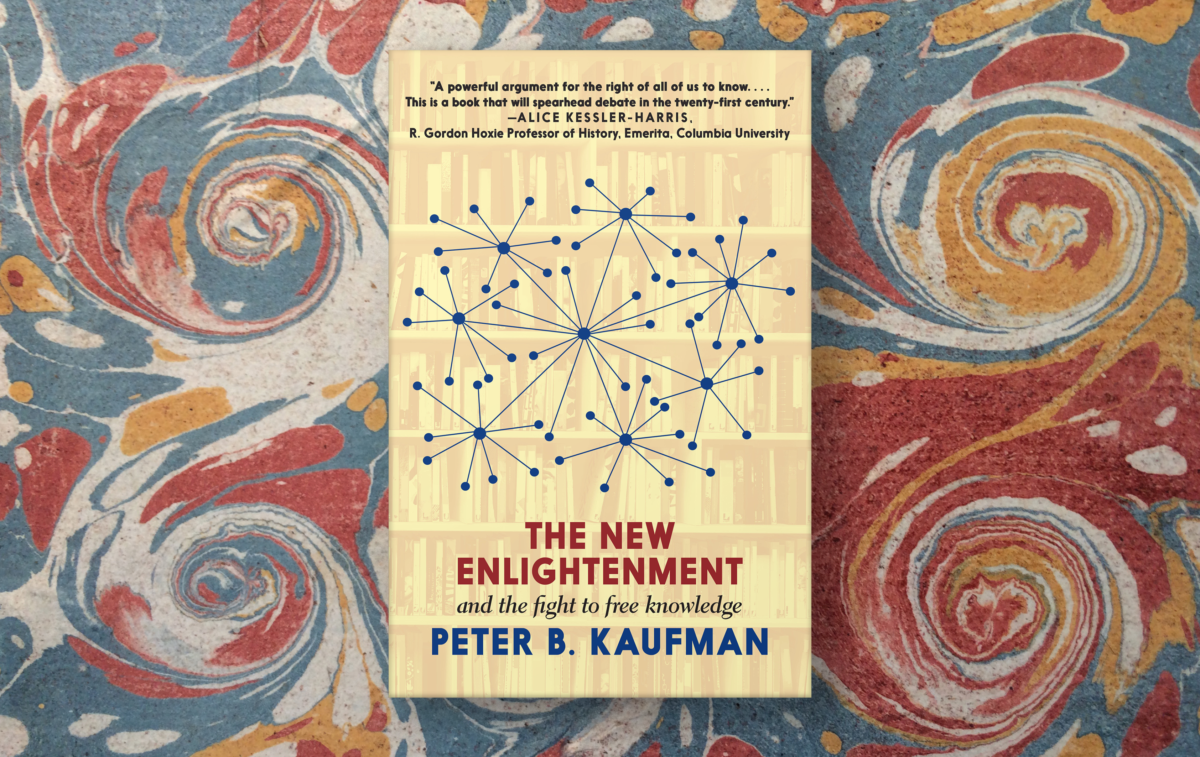
Editor’s Note: This month, MIT Open Learning’s Peter B. Kaufman has published The New Enlightenment and the Fight to Free Knowledge, a book that takes a historical look at the powerful forces that have purposely crippled our efforts to share knowledge widely and freely. His new work also maps out what we can do about it. In the coming days, Peter will be making his book available through Open Culture by publishing three short essays along with links to corresponding sections of his book. Today, you can read his second essay “On Wikipedia, the Encyclopédie, and the Verifiability of Information” (below), plus download the second chapter of his book here. Read his first essay, “The Monsterverse” here, and purchase the entire book online.
When the ideas that matter most to us – liberals, democrats, progressives, republicans, all in the original sense of the words – were first put forward in society in order to change society, they were advanced foremost in print. The new rules, new definitions, and new codicils of human and civil rights that undergird many of the freedoms we value today had as their heart text and its main delivery mechanism, the printing press.
In that sense the first Enlightenment was based upon the foundation of the printed word. And of the 18th century’s contributions to knowledge and society – Newton’s physics, Montesquieu’s laws, Linnaeus’s taxonomies, Rousseau’s political philosophy, the Declaration of Independence, the Declaration of the Rights of Man – there was perhaps no greater printed offering than the 22-million-word Encyclopédie that the French Enlightenment philosophers starting writing, compiling, and offering to the public in 1750.
The Encyclopédie was monumental. Not just from a content-assembly perspective – an effort to gather all the world’s knowledge and to print and publish it – but also from a sociopolitical one, given the powerful forces suppressing knowledge that such an effort would provoke. The Encyclopédie found the state and the church banning at one time or another almost every one of its 72,000 articles, 18,000 pages, and 28 volumes and invoking a hundred ways to forbid its distribution.
The encyclopedia’s entire approach to collecting and presenting knowledge was radical. The articles presented truths – some heretical, some blasphemous – that astonished contemporary readers. And its innovative approach to the verification its own content, to proving what could be proved, which was really its nuclear core, rocked the Western world.
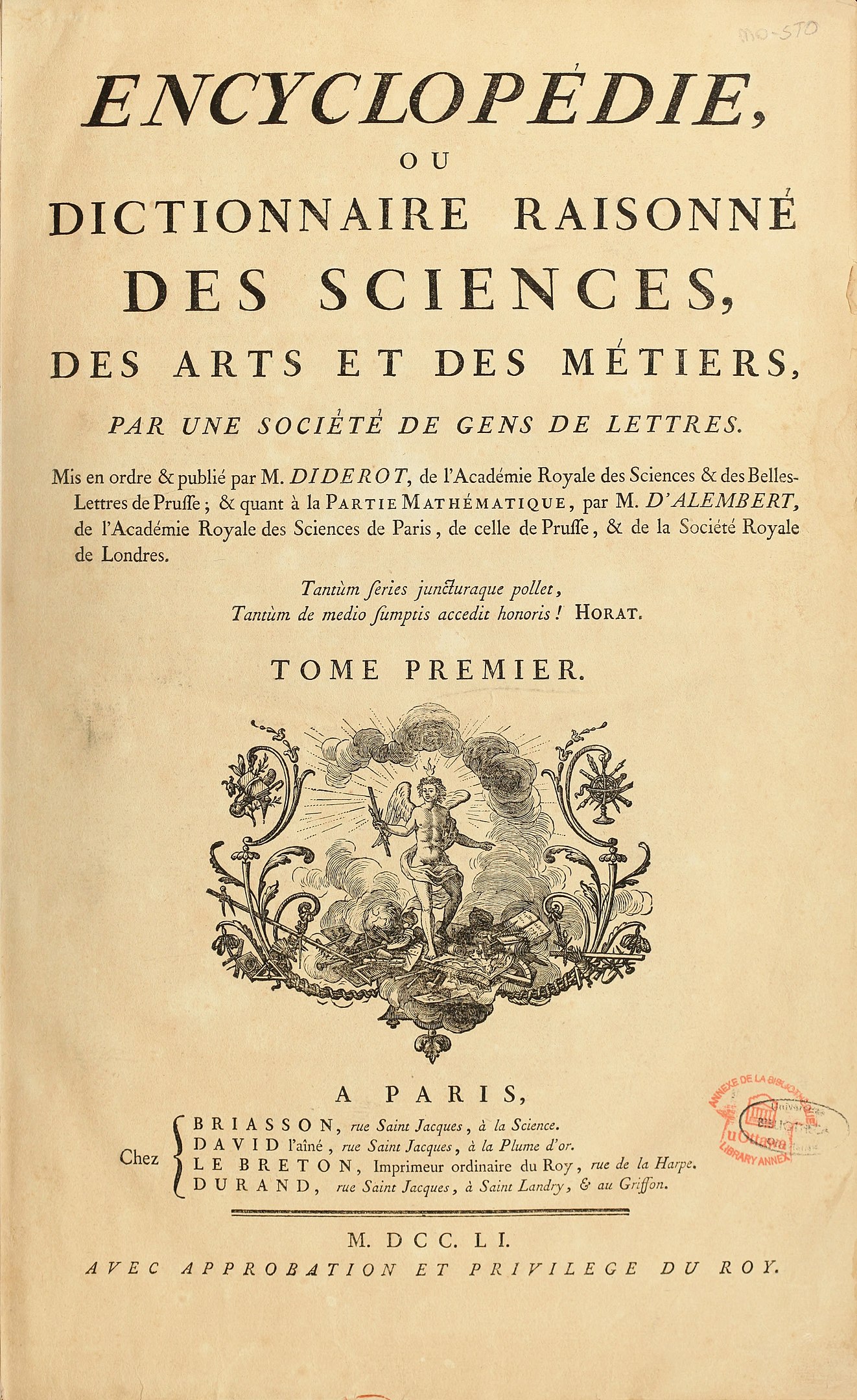
The Encyclopédie smote 18th-century orthodoxy with ink-and-paper sledgehammers. The article on “RAISON,” or “REASON,” for example, told every reader who for centuries had been steeped in church doctrine and the divine rights of royals that:
No proposition can be accepted as divine revelation if it contradicts what is known to us, either by immediate intuition, as in the case of self-evident propositions, or by obvious deductions of reason, as in demonstrations. It would be ridiculous to give preference to such revelations, because the evidence that causes us to adopt them cannot surpass the certainty of our intuitive or demonstrative knowledge…
Clerics and kings, needless to say, were not fans. Articles on religion, philosophy, and politics and society challenged the government and the church even as the censors watched. Direct swipes at the monarchy and the church appeared even where you might not expect – in articles on CONSCIENCE, LIBERTÉ DE; CROISADES; FANATISME; TOLÉRANCE; etc. The entry for FORTUNE spotlighted the gross inequalities of wealth already evident in 18th-century Europe. And a zinging condemnation of slavery in the article on the SLAVE TRADE made few friends among any who had a hand anywhere in the business.
Slave trade is the purchase of Negroes made by Europeans on the coasts of Africa, who then employ these unfortunate men as slaves in their colonies. This purchase of Negroes to reduce them into slavery […] violates all religion, morals, natural law, and human rights.
The Encyclopédistes announced from day one that this new work would be, as we would say today, fact-based. There would be an underlying and overarching commitment on the part of all contributors and the work as a whole to the verification of all of its source materials. Verification is potentially “a long and painful process,” Diderot wrote in his introduction to the whole enterprise – the famous “Preliminary Discourse” that these philosophers used to sell in the whole project:
We have tried as much as possible to avoid this inconvenience by citing directly, in the body of the articles, the authors on whose evidence we have relied and by quoting their own text when it is necessary.
We have everywhere compared opinions, weighed reasons, and proposed means of doubting or of escaping from doubt; at times we have even settled contested matters.… Facts are cited, experiments compared, and methods elaborated … in order to excite genius to open unknown routes, and to advance onward to new discoveries, using the place where great men have ended their careers as the first step.
What this meant in practice was revolutionary. There would be no accepted truths but for those that could be proven and cited. Fact-based versus faith- and belief-based: the start and spark of the Enlightenment. One of Diderot’s biographers explains that approximately 23,000 articles had at least one cross-reference to another article in one of the encyclopedia’s 28 volumes. “The total number of links – some articles had five or six – reached almost 62,000.” And all while retaining a sly sense of humor. The article on CANNIBALS ended with “the mischievous cross-reference,” as another historian would later describe it: “See Eucharist, Communion, Altar, etc.”
That commitment to reference citation continues in the Enlightenment’s most important successor project – Wikipedia, founded by Jimmy Wales and colleagues 20 years ago this year. It’s the foundation of what today’s Wikipedia terms verifiability, and in many key ways it’s the foundation for truth in knowledge and society today:
“Verifiability” … mean[s] that material added to Wikipedia must have been published previously by a reliable source. Editors may not add their own views to articles simply because they believe them to be correct, and may not remove sources’ views from articles simply because they disagree with them.
[V]erifiability is a necessary condition (a minimum requirement) for the inclusion of material, though it is not a sufficient condition (it may not be enough).
In 1999, free-software activist Richard M. Stallman called for this universal online encyclopedia covering all areas of knowledge, along with a complete library of instructional courses – and, equally important, a movement to develop it, “much as the Free Software Movement gave us the free operating system GNU/Linux.” That call (reproduced in full as the appendix in my book) is credited by Wikipedia as the origins of the work that is now the largest knowledge resource in history.
The free encyclopedia will provide an alternative to the restricted ones that media corporations will write.
Stallman published a list of what that the encyclopedia would need to do, what sort of freedoms it would need to give to the public, and how it could get started.
An encyclopedia located everywhere.
An encyclopedia open to anyone—but, most promisingly, to teachers and students.
An encyclopedia built of small steps.
An encyclopedia built on the long view: “If it takes twenty years to complete the free encyclopedia, that will be but an instant in the history of literature and civilization.”
An encyclopedia containing one or more articles for any topic you would expect to find in another encyclopedia – “for example, bird watchers might eventually contribute an article on each species of bird, along with pictures and recordings of its calls” – and “courses for all academic subjects.”
1999, and it sounds familiar. Wikipedia, of course, is one of the world’s most popular websites (the world’s most popular noncommercial one) now and an irreplaceable source of verifiable information – open to any and all. Its processes are transparent, and thanks to hackers affiliated with the project, you now can watch and listen to its edits live online:

Communities that work with Wikipedia are likely to benefit from this commitment to citation, and new collaborations that take effect around it are likely to benefit society. The Internet Archive is working with Wikipedia now, digitizing books so that links to sources in Wikipedia link all the way through to the books themselves – and render images and text on the cited pages. The reference link to a biography by Taylor Branch at the bottom of a Wikipedia article on Martin Luther King, Jr., for example, now hotlinks to the readable book online at Archive.org. That work is essential. “Only the use of footnotes and the research techniques associated with them” – as Princeton historian Anthony Grafton writes – “makes it possible to resist the efforts of modern governments, tyrannical and democratic alike, to conceal the compromises they have made, the deaths they have caused, the tortures they or their allies have inflicted.… Only the use of footnotes enables historians to make their texts not monologues but conversations, in which modern scholars, their predecessors, and their subjects all take part.”
Can we take verifiability further now, especially as our epistemic crisis deepens? Can we improve citation for the medium that’s beginning to overtake us all, which is video? Can we make resources on the web – also a new thing – verifiable? What is a citation like in a … podcast?
The great historian of the Encyclopédie, Robert Darnton, tells us in his new book, “When the printed word appeared in France in 1470, the state did not know what to make of it.” So, 700 years from now, what will tomorrow’s historians say about us? Further thoughts about how we can start more consciously collaborating with one another and producing – but immediately – for our burgeoning knowledge networks: next week.
Peter B. Kaufman works at MIT Open Learning and is the author of The New Enlightenment and the Fight to Free Knowledge. This is the second of three articles. You can find the first one in the Relateds below:
Related Content:
The New Enlightenment and the Fight to Free Knowledge: Part 1
An Animated Introduction to Voltaire: Enlightenment Philosopher of Pluralism & Tolerance
Social Media in the Age of Enlightenment and Revolution
Read More...Watch Cartoonist Lynda Barry’s Two-Hour Drawing Workshop
We know you’re Zoomed out, but might you make an exception for the pre-recorded drawing and writing session above with legendary cartoonist and illustrator Lynda Barry?
Under the auspices of Graphic Medicine’s participatory online series, Drawing Together, the notoriously playful Barry led participants through a series of exercises from her book, Making Comics, and seemed genuinely pleased to be back in teaching mode. (All of her in-person classes at the University of Wisconsin have been cancelled until further notice due to the Covid-19 pandemic, as has her usual summer stint at the Omega Institute.)
Barry endeavored to loosen her students up right away, brandishing toys and dancing to an amazing playlist in a friend’s borrowed attic, confiding that the wifi situation here was far superior to that in her old farmhouse.
Teacher divided the large group in half by birthdays, as a way to organize viewing each other’s work after each timed exercise.
This couldn’t quite replicate the experience of the live classroom, where students have the opportunity to handle each other’s work, and more time to take it in, but still fun to see the incredible diversity—and in the case of closed-eye exercises—thrilling similarities on display.
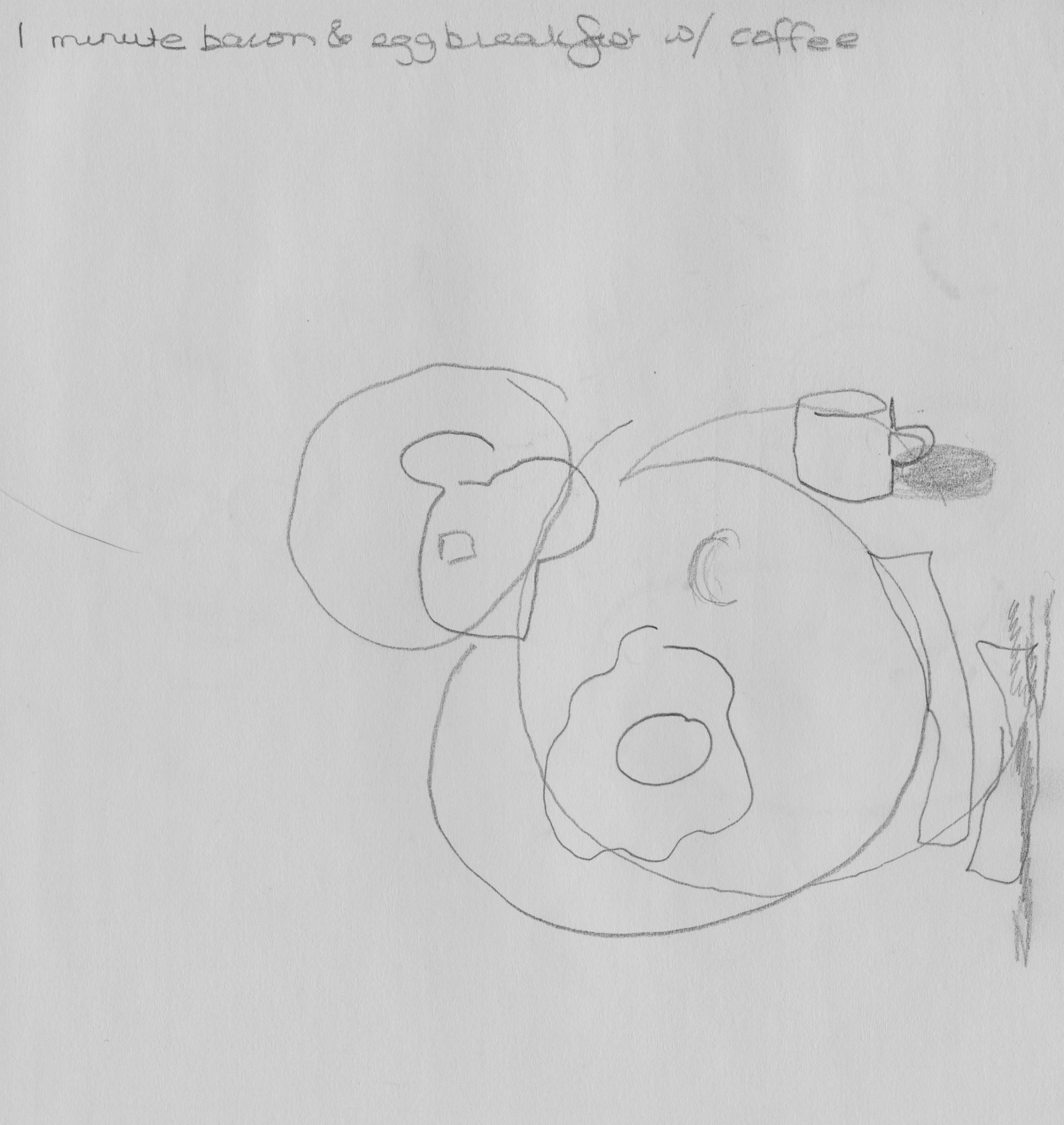
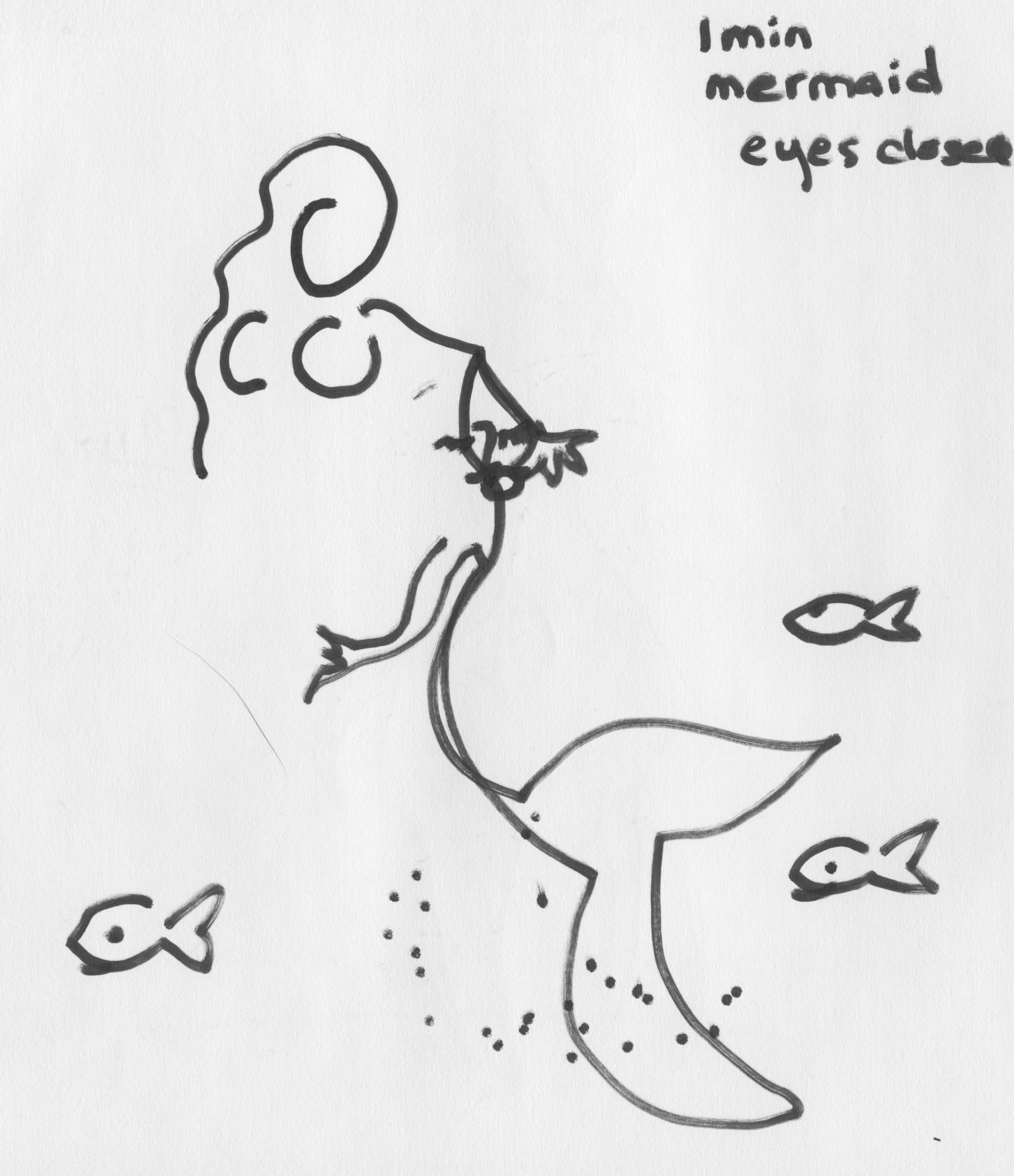
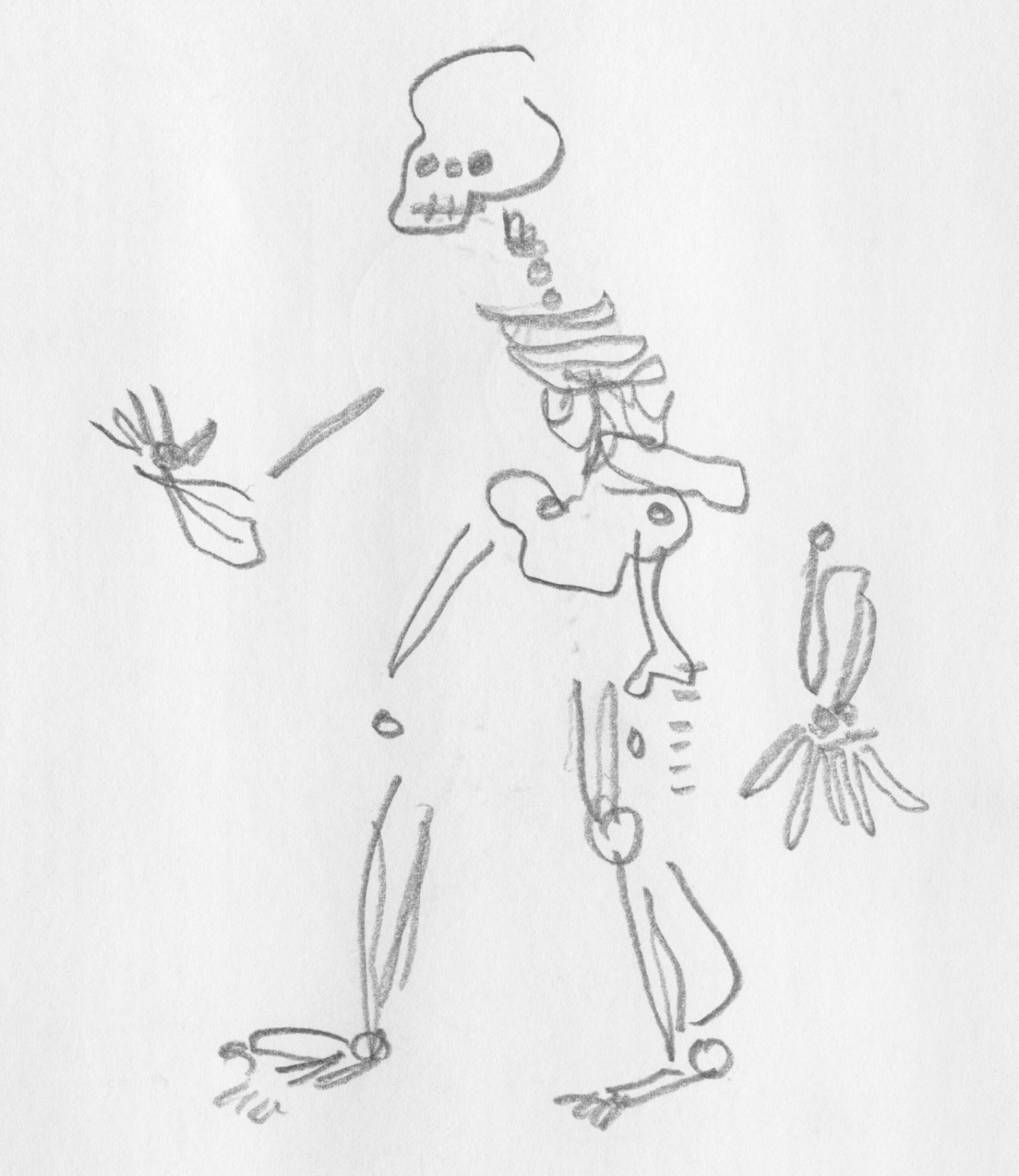
Barry’s delight extended beyond the confines of the page, imitating the way some students beam like swaying sunflowers throughout the 60-second closed eye sessions, while others knit their brows, lower their chins and power through.
A series of self-portraits followed, with prompts designed to tap into the sort of imaginative powers that frequently seep away in adolescence—draw yourself as an animal, an astronaut, a member of a marching band, any fruit that’s not a banana…
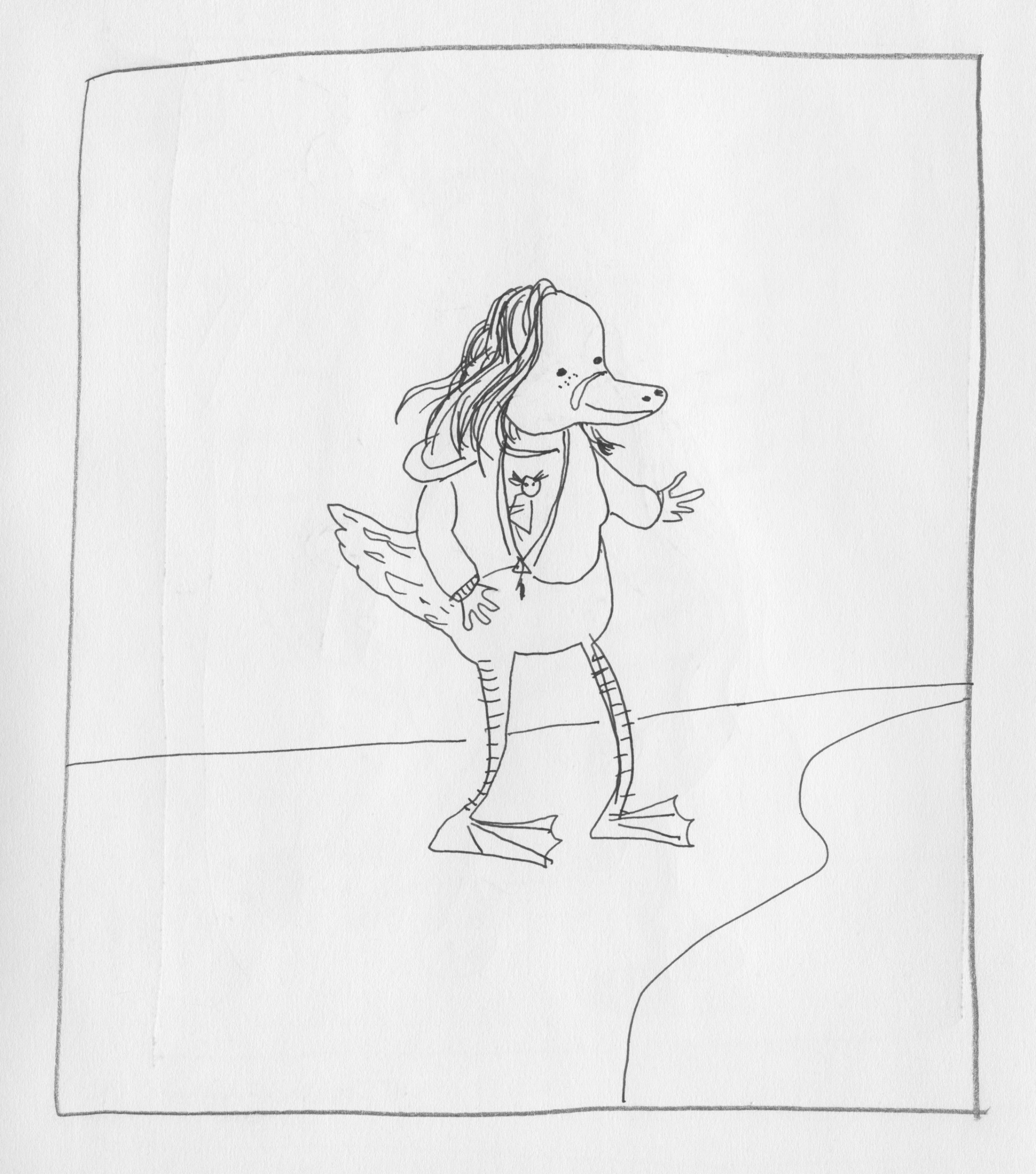
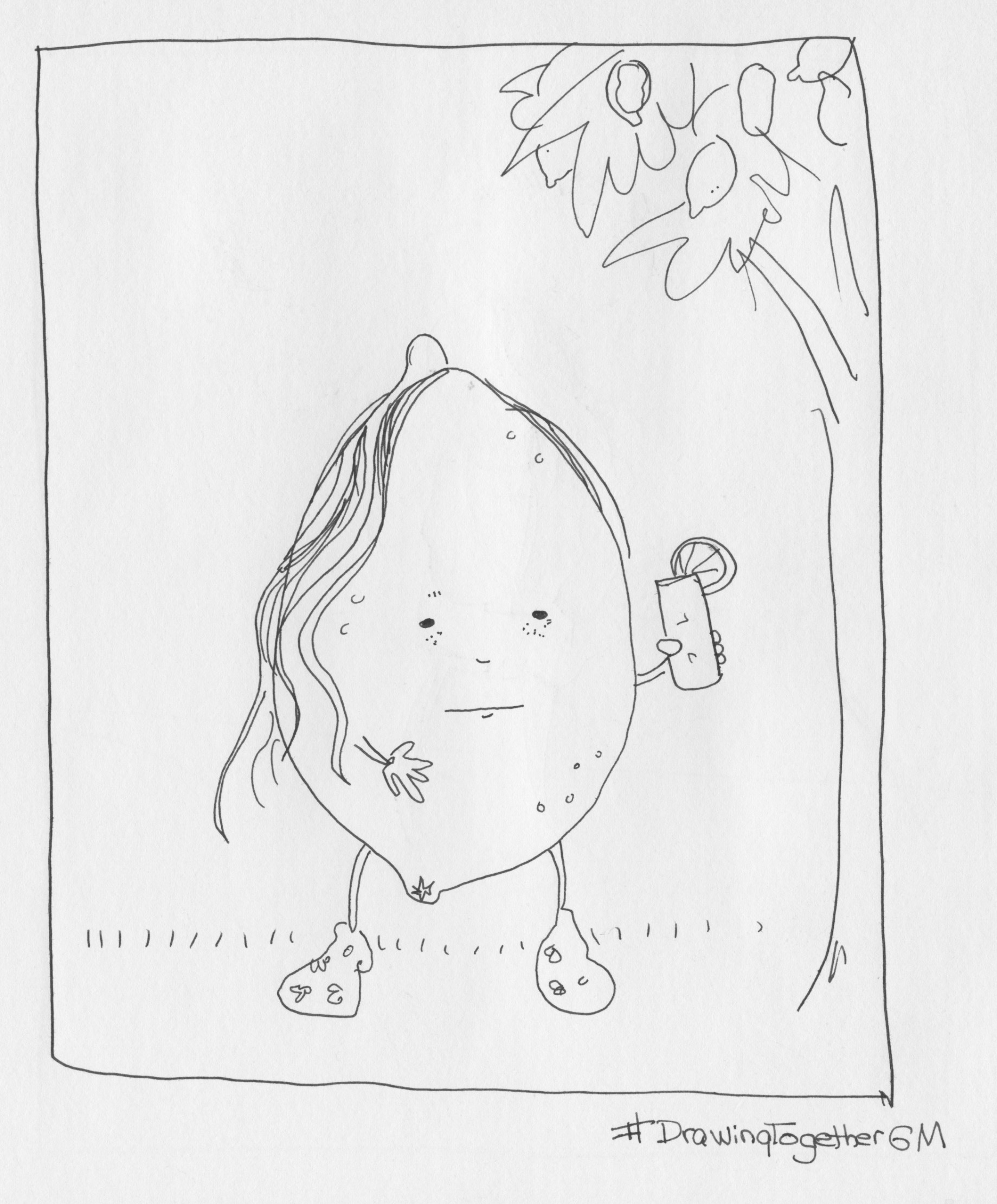
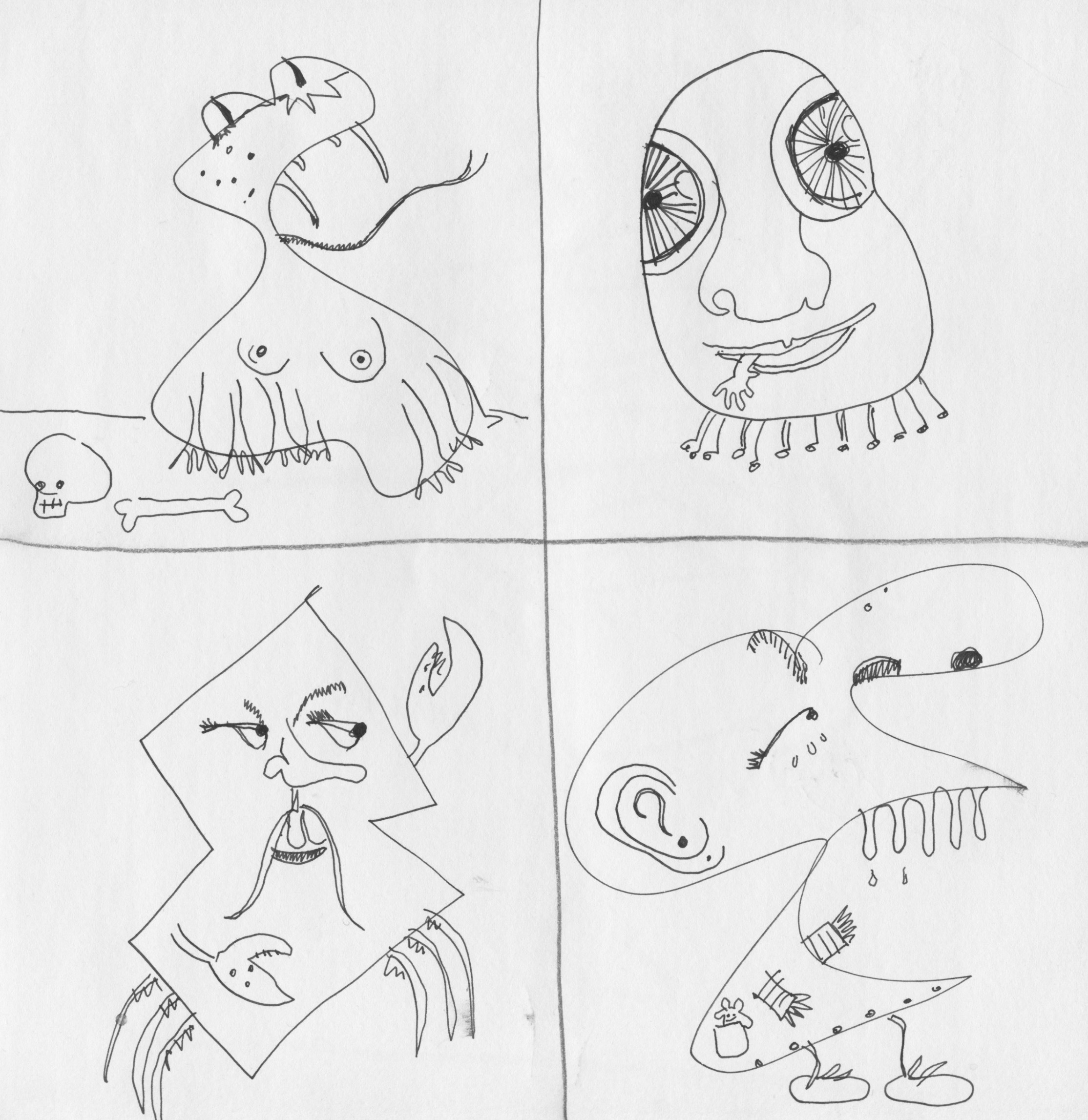
Longer exercises involved turning random squiggles into monsters, with an extra minute granted after the timer went off to add whatever missing things the artist felt each drawing needed, then choosing one of those monsters to star in a family album of sorts.
Barry, who has, over the course of her career, filled a number of panels with hilariously out-of-touch teachers making life a hell for child characters, is audibly appreciative of her students’ efforts, frequently congratulating them for bringing something into the world that didn’t exist a few minutes prior:
This is the thing about comics! They come intact, they come all together and the most important thing you need to do is just make time to draw them, the uninterrupted time, even if it’s just 2 minutes.
Truth!
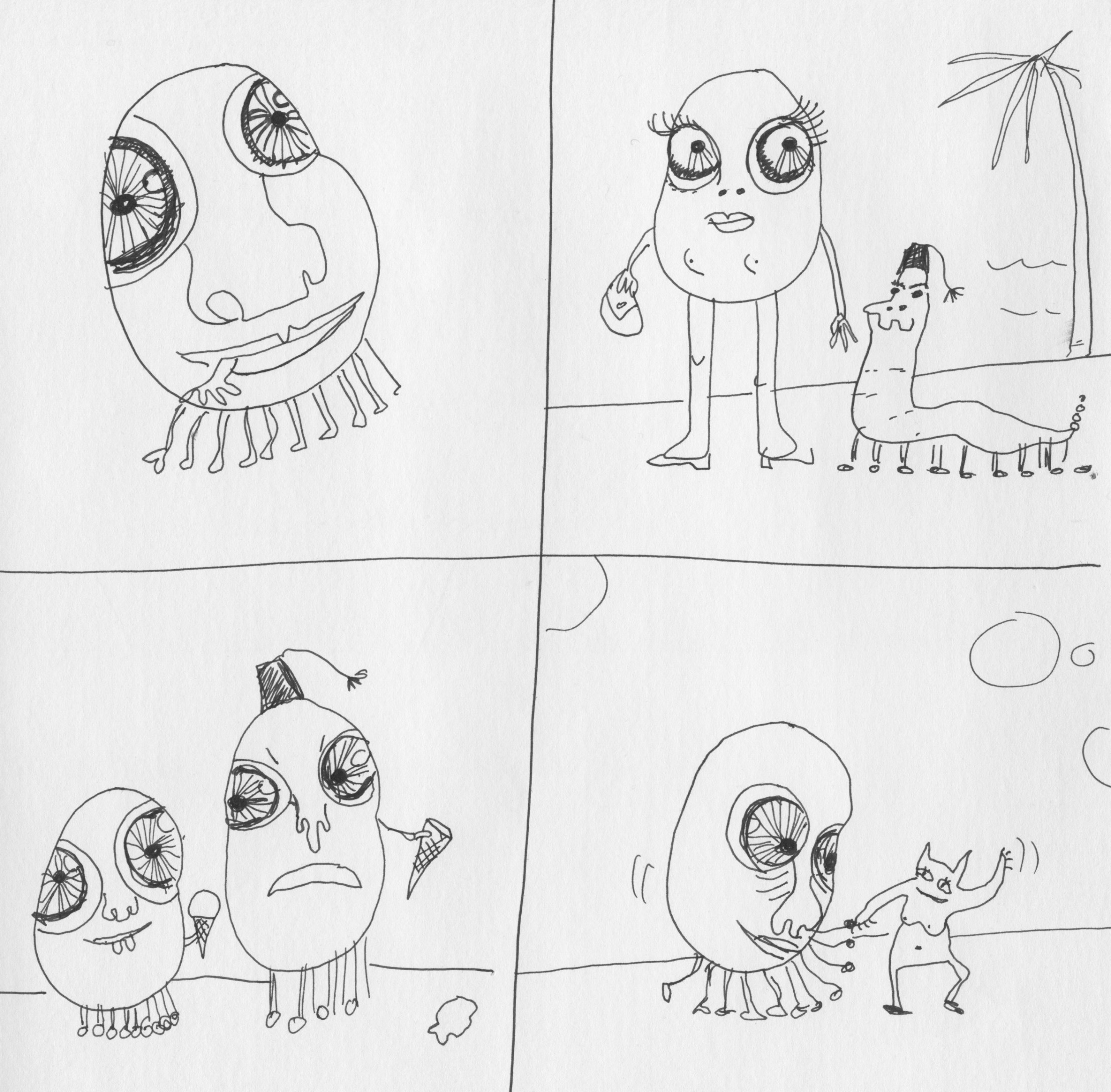
The final exercise of the day drew on some of the writing techniques Barry featured in Syllabus, with participants, quickly jotting down memories after a prompt, then choosing one to explore more deeply, with special attention devoted to sensory recall.
To play along from home after the fact, you’ll need a couple of hours, ten or so sheets of paper, a pencil or pen (Barry favors black felt tips), and your “original digital devices” (hint: they’re attached to the ends of your arms).
Find information on how to participate in upcoming free Drawing Together sessions here.
All drawings used with the permission of participant Ayun Halliday.
Related Content:
Lynda Barry’s New Book Offers a Master Class in Making Comics
Ayun Halliday is an author, illustrator, theater maker and Chief Primatologist of the East Village Inky zine. She most recently appeared as a French Canadian bear who travels to New York City in search of food and meaning in Greg Kotis’ short film, L’Ourse. Follow her @AyunHalliday.
Read More...How Looney Tunes & Other Classic Cartoons Helped Americans Become Musically Literate
Distance learning experiments on television long predate the medium’s use as a conduit for advertising and mass entertainment. “Before it became known as the ‘idiot box,’” writes Matt Novak at Smithsonian, “television was seen as the best hope for bringing enlightenment to the American people.” The federal government made way for educational programming during TV’s earliest years when the FCC reserved 242 noncommercial channels “to encourage educational programming.”
Funding did not materialize, but the nation’s spirit was willing, Life magazine maintained: “the hunger of our citizenry for culture and self-improvement has always been grossly underestimated.” Was this so? Perhaps. At the medium’s very beginnings as standard appliance in many American homes, there was Leonard Bernstein. His Omnibus series debuted in 1952, “the first commercial television outlet for experimentation in the arts,” notes Schuyler G. Chapin. Six years later, he debuted his Young People’s Concerts, spreading musical literacy on TV through the format for the next 14 years.
“It was to [Bernstein’s] — and our — good fortune that he and the American television grew to maturity together,” wrote critic Robert S. Clark in well-deserved tribute. Much the same could be said of some unlikely candidates for TV musical educators: Tex Avery, Chuck Jones, and other classic animators, who did as much, and maybe more, to familiarize American viewers with classical music as perhaps all of Bernstein’s formidable efforts combined.
A Mendelssohn piece that you hear constantly in classic cartoons, and even more recent ones like REN & STIMPY and SPONGEBOB, is “Frühlingslied (Spring Song),” which is used to denote peace and tranquility. This is my favorite instance, from the first Ralph Wolf-Sam Sheepdog film. pic.twitter.com/XJjup7nWU7
— Vincent Alexander (@NonsenseIsland) March 1, 2021
But Jones and his fellow animators have not been given their proper due, cartoonist and animator Vincent Alexander suggested in a recent Twitter thread. Aiming to rectify the situation, Alexander posted a wealth of examples from Bugs Bunny & company’s contributions to Americans’ musical literacy. Granted, many of these cartoons started as short films in theaters, but they spent many more decades on TV, entertaining millions of all ages while exposing them to a wide variety of classical compositions.
Franz von Suppé got quite a workout in classic cartoons. “The Poet and Peasant Overture” shows up in dozens of shorts. My favorite is Popeye conducting the “Spinach Overture” while giving Bluto a rhythmic beatdown perfectly in time with the music. pic.twitter.com/6dAr7cgHrC
— Vincent Alexander (@NonsenseIsland) March 1, 2021
Alexander points out how cartoons like the first Ralph Wolf and Sam Sheepdog (1953) set a precedent for using Mendelssohn’s “Frühlingslied (Spring Song)” in later animated favorites like Ren & Stimpy and Spongebob Squarepants. He gives obligatory nods to Disney and cites several other non-Looney Tunes examples like Popeye’s “Spinach Overture,” based on Franz von Suppé’s “The Poet and Peasant Overture.” But on the whole, the thread focuses on Warner Bros. classics, especially those in which Bugs Bunny demonstrates his talents as a conductor, pianist, and barber to the bald Elmer Fudd.
“I don’t know who can listen to the famous opera The Barber of Seville by Gioachino Rossini without thinking of Bugs Bunny,” writes Alexander. “The way director Chuck Jones synchronizes the slapstick action to the soundtrack is flat-out masterful.” There are fair questions to be asked here — and Bernstein would surely ask them: How many of those people can appreciate Rossini without the slapstick? How many have heard, and seen, a full performance of his work sans Fudd?
“Sobre las Olas (Over the Waves)” used to mis-attributed to Strauss, but it was actually the work of Mexican composer Juventino Rosas. It became the go-to cartoon theme for magic tricks and tight-wire acts. “Roota-voota-zoot!” pic.twitter.com/4izREAGKIl
— Vincent Alexander (@NonsenseIsland) March 1, 2021
Who can hear Wagner without wanting to sing at the top of their lungs, “Kill da wabbit, Kill da wabbit, Kill da wabbit!” Goodness knows, I can’t. Nonetheless, Chuck Jones’ What’s Opera, Doc? has been recognized for its major contributions to “American enlightenment” — deemed “culturally, historically or aesthetically significant” by the Library of Congress and preserved in the National Film Registry. This, Alexander suggests, is as it should be. (Just consider the opera singers Bugs inspired). We should honor animation’s major contributions to our culture literacy: a mass musical education by cartoon. See many more classic clips in Alexander’s Twitter thread here.
via Laughing Squid
Related Content:
Books Come to Life in Classic Cartoons from 1930s and 1940s
“The Ducktators”: Loony Tunes Turns Animation into Wartime Propaganda (1942)
Read More...
Alexander Calder’s Archive Goes Online: Explore 1400 Works of Art by the Modernist Sculptor
Like all great artists, Alexander Calder left his medium quite unlike he found it. Nearly 45 years after his death, Calder’s expansion of the realm of sculpture in new directions of form, color, and engineering remains a subject of voluminous discussion, including critic Jed Perl’s Calder: The Conquest of Time and Calder: The Conquest of Space, a two-part biography published in full last year. More recently, a wealth of material has come available that enables us to conduct Calderian investigations of our own: the Calder Foundation’s online research archive, which as Hyperallergic’s Valentina Di Liscia reports includes “over 1,300 Calder works across different media.”
But wait, there’s more: the archive also offers “1,000 photographs and archival documents,” “48 historic and recent texts by the artist, his contemporaries, and present-day scholars,” and “over 40 microsites exploring Calder’s exhibition history.” (This in addition to the Calder Foundation’s Vimeo channel, where you’ll find the films seen here.)
Pace Gallery, which represents Calder, highlights the “new interactive map feature called ‘Calder Around the World,’ which allows viewers to find public installations of his monumental sculpture in 20 states domestically and 21 countries internationally, including museums with important Calder holdings and permanent and temporary exhibitions dedicated to the artist.”
As that map reveals, much of Calder’s work currently resides in his homeland of the United States of America, primarily in the northeast where he spent most of his life, but also the California in which he did some growing up — not to mention the Paris where he lived for a time and met fellow artists like Marcel Duchamp and Fernand Léger, information about whom also appears in the online archive. You may locate a Calder near you, even if you live in another region of the world, entirely: living in Seoul as I do, I now see I’ll have to pay a visit to 1963’s Le Cèpe and 1971’s Grand Crinkly. Though this ever-more-extensive Calder Archive can help us understand this most optimistic of all Modernists, there’s nothing quite like being in the presence of one of his sculptures.
Related Content:
178 Beautifully-Illustrated Letters from Artists: Kahlo, Calder, Man Ray & More
The Guggenheim Puts 109 Free Modern Art Books Online
Based in Seoul, Colin Marshall writes and broadcasts on cities, language, and culture. His projects include the Substack newsletter Books on Cities, the book The Stateless City: a Walk through 21st-Century Los Angeles and the video series The City in Cinema. Follow him on Twitter at @colinmarshall or on Facebook.
Read More...B.B. King Plays “The Thrill is Gone” with Slash, Ron Wood & Other Legends
How many generations of guitarists have come and gone since B.B. King emerged on the Beale Street blues scene in the late 1940s?
60s blues-rock giants, 70s hard rockers, 80s metal shredders… at least two generations between B.B. and Slash, who is probably himself a guitar grandfather by now. Whether they know it or not, every rock and blues player descends from the Kings of the blues (B.B., Albert, Freddie, and guitarists who bore the title but not the surname). Slash knows it well.
We have three generations of guitar greats, and Simply Red’s Mick Hucknall, joining an 86-year-old King in the live performance above from 2011 at Royal Albert Hall with Derek Trucks and Susan Tedeschi, the Rolling Stones’ Ron Wood, and Slash, who sits next to the great man and lends him his top hat for a few bars.
The Guns n Roses lead guitarist named B.B. his favorite bluesman when King died in 2015 and put “The Thrill is Gone” in an ultimate guitar mix he compiled for Q magazine in 2004. At the live jam session above, he gets to play it with his hero, “the only hit I ever had,” says King by way of self-deprecating introduction.
Slash keeps a low profile, fitting himself into the mix of six guitars onstage (see the longer jam session further up). Another guitarist, John Mayer, maybe three generations of players removed from King, got to spread out a bit more in his jam with B.B. at the Guitar Center King of the Blues event in 2006. “It’s like stealing something from someone right in front of them,” he says. It’s a good joke, and it’s the truth.
Musicians have been following in B.B. King’s wake for over 60 years now. The best learn the same humbling lesson U2’s Bono did after his 1988 duet with King on “When Love Comes to Town” — “We had learned and absorbed, but the more we tried to be like B.B., the less convincing we were.” See more of King and Mayer just below.
Related Content:
B.B. King Plays Live at Sing Sing Prison in One of His Greatest Performances (1972)
B.B. King Explains in an Animated Video Whether You Need to Endure Hardship to Play the Blues
Josh Jones is a writer and musician based in Durham, NC. Follow him at @jdmagness
Read More...Metallica Plays Antarctica, Setting a World Record as the First Band to Play All 7 Continents: Watch the Full Concert Online
Unless they’ve got fans among penguins, there’s no practical reason for a band to make the journey to Antarctica to play. So why did Metallica do exactly that in 2013? Because they could, and because it made them the first musical act to play all seven continents — a Guinness World Record — doing it all in the same calendar year, no less. They’re also the only rock band to travel to Antarctica. (With the exception of Nunatak, an indie rock band made up of British climate scientists, who played a “sold-out” show to 17 people at the Rothera Research Station where they worked in 2007.)
If those aren’t reasons enough, the concert was a dream realized for the 120 fans in attendance, including research station scientists and Coca Cola contest winners from all over Latin America who were able to see Metallica in a transparent dome near the heliport of Argentina’s Carlini Base after a week-long cruise. “Due to the continent’s fragile environment,” notes Guinness, the band’s amps were placed in “isolation cabinets” and the audience heard everything through headphones, sort of like a silent rave. Called “Freeze ‘Em All,” the show was live-streamed and is now fully available online (see it above).
“The energy in the little dome was amazing!” the band writes on their Facebook page. “Words can not describe how happy everyone was.” But how cold were they? More sponsorship, in the form of outerwear from snowboard and ski giant Burton, kept the band bundled up throughout. Metallica has uploaded the audio of “Freeze ‘Em All” in MP3 and various high-end lossless formats at LiveMetallica.com. It’s a very cool idea, but is the concert video an hour-long Coke Zero ad? I don’t know.… I am a little curious about what might have happened if their amps had been at full blast in the Antarctic wild….
Here’s the full setlist, with timestamps, of the record-setting gig:
Creeping Death (1:25)
For Whom the Bell Tolls (7:47)
Sad But True (12:28)
Welcome Home (Sanitarium) (18:58)
Master of Puppets (25:58)
One (34:12)
Blackened (41:58)
Nothing Else Matters (50:01)
Enter Sandman (55:06)
Seek & Destroy (1:02:20)
You too, like many a commenting fan, may feel betrayed by the lack of “Trapped Under Ice” in the setlist. Maybe too on-the-nose, they thought, too cute. But surely a missed opportunity that won’t come again. Fill in the gap yourself with the live take below.
Related Content:
Metallica Is Putting Free Concerts Online: 6 Now Streaming, with More to Come
Buddhist Monk Covers Metallica’s ”Enter Sandman,” Then Meditates
Josh Jones is a writer and musician based in Durham, NC. Follow him at @jdmagness
Read More...A Short Biography of Keith Haring Told with Comic Book Illustrations & Music
Singer-songwriter-cartoonist Jeffrey Lewis is a worthy exemplar of NYC street cred.
Born, raised, and still residing on New York City’s Lower East Side, he draws comics under the “judgmental” gaze of The Art of Daniel Clowes: Modern Cartoonist and writes songs beneath a poster of The Terminator onto which he grafted the face of Lou Reed from a stolen Time Out New York promo.
Billing himself as “among NYC’s top slingers of folk / garagerock / antifolk,” Lewis pairs his songs with comics during live shows, projecting original illustrations or flipping the pages of a sketchbook large enough for the audience to see, a practice he refers to as “low budget films.”
He’s also an amateur historian, as evidenced by his eight-minute opus The History of Punk on the Lower East Side, 1950–1975 and a series of extremely “low budget films” for the History channel, on topics such as the French Revolution, Marco Polo, and the fall of the Soviet Union.
His latest effort is a 3‑minute biography of artist Keith Haring, above, for the Museum of Modern Art Magazine’s new Illustrated Lives series.
While Lewis isn’t a contemporary of Haring’s, they definitely breathed the same air:
While Haring was spending a couple of formative years involved with Club 57 and PS 122, there was little six-year-old me walking down the street, so I can remember and draw that early ’80s Lower East Side/East Village without much stretch. My whole brain is made out of fire escapes and fire hydrants and tenement cornices.
Lewis gives then-rising stars Jean-Michel Basquiat and performance artist Klaus Nomi cameo appearances, before escorting Haring down into the subway for a literal lightbulb moment.
In Haring’s own words:
…It seemed obvious to me when I saw the first empty subway panel that this was the perfect situation. The advertisements that fill every subway platform are changed periodically. When there aren’t enough new ads, a black paper panel is substituted. I remember noticing a panel in the Times Square station and immediately going aboveground and buying chalk. After the first drawing, things just fell into place. I began drawing in the subways as a hobby on my way to work. I had to ride the subways often and would do a drawing while waiting for a train. In a few weeks, I started to get responses from people who saw me doing it.
After a while, my subway drawings became more of a responsibility than a hobby. So many people wished me luck and told me to “keep it up” that it became difficult to stop. From the beginning, one of the main incentives was this contact with people. It became a rewarding experience to draw and to see the drawings being appreciated. The number of people passing one of these drawings in a week was phenomenal. Even if the drawing only remained up for only one day, enough people saw it to make it easily worth my effort.
Towards the end of his jam-packed, 22-page “low budget film,” Lewis wanders from his traditional approach to cartooning, revealing himself to be a keen student of Haring’s bold graphic style.
The final image, to the lyric, “Keith’s explosive short lifetime and generous heart speak like an infinite fountain from some deep wellspring of art,” is breathtaking.
Spend time with some other New York City icons that have cropped up in Jeffrey Lewis’ music, including the Chelsea Hotel, the subway, the bridges, and St. Mark’s Place.
Watch his low budget films for the History Channel here.
Related Content:
Keith Haring’s Eclectic Journal Entries Go Online
An Animated History of Dogs, Inspired by Keith Haring
The Story of Jean-Michel Basquiat’s Rise in the 1980s Art World Gets Told in a New Graphic Novel
Ayun Halliday is an author, illustrator, theater maker and Chief Primatologist of the East Village Inky zine. Follow her @AyunHalliday.
Read More...The Joy of Painting with Bob Ross & Banksy: Watch Banksy Paint a Mural on the Jail That Once Housed Oscar Wilde
It would be difficult to think of two artists who appear to have less in common than Bob Ross and Banksy. One of them creates art by pulling provocative stunts, often illegal, under the cover of anonymity; the other did it by painting innocuous landscapes on public television, spending a decade as one of its most recognizable personalities. But game recognize game, as they say, in popular art as in other fields of human endeavor. In the video above, Banksy pays tribute to Ross by layering narration from an episode of The Joy of Painting over the creation of his latest spray paint strike, Create Escape: an image of Oscar Wilde, typewriter and all, breaking out jail — on the actual exterior wall of the decommissioned HM Prison Reading.
“The expansive and unblemished prison wall was a daring and perfect spot for a Banksy piece,” writes Colossal’s Christopher Jobson. “It’s best known for its most famous inmate: Oscar Wilde served two years in the prison from 1895–1897 for the charge of ‘gross indecency’ for being gay.” This experience resulted in the poem The Ballad of Reading Gaol, which we’ve previously featured here on Open Culture as read by Wilde himself.
Where Wilde converted his misfortune into verbal art, Banksy references it to make a visual statement of characteristic brazenness and ambiguity. As with most of his recent pieces, Create Escape has clearly been designed to be seen not just by passersby in Reading, but by the whole world online, which The Joy of Painting with Bob Ross & Banksy should ensure.
“I thought we’d just do a very warm little scene that makes you feel good,” says Ross in voiceover. But what we see are the hands of a miner’s-helmeted Banksy, presumably, preparing his spray cans and putting up his stencil of Wilde in an inmate’s uniform. “Little bit of white,” says Ross as a streak of that color is applied to the prison wall. “That ought to lighten it just a little.” In fact, every sample of Ross’ narration reflects the action, as when he urges thought “about shape and form and how you want the limbs to look,” or when he tells us that “a nice light area between the darks, it separates, makes everything really stand out and look good.” With his signature high-contrast style, Banksy could hardly deny it, and he would seem also to share Ross’ feeling that in painting, “I can create the kind of world that I want to see, and that I want to be part of.”
Related Content:
Experience the Bob Ross Experience: A New Museum Open in the TV Painter’s Former Studio Home
Banksy Strikes Again in London & Urges Everyone to Wear Masks
Banksy Debuts His COVID-19 Art Project: Good to See That He Has TP at Home
Hear Oscar Wilde Recite a Section of The Ballad of Reading Gaol (1897)
Based in Seoul, Colin Marshall writes and broadcasts on cities, language, and culture. His projects include the Substack newsletter Books on Cities, the book The Stateless City: a Walk through 21st-Century Los Angeles and the video series The City in Cinema. Follow him on Twitter at @colinmarshall or on Facebook.
Read More...Watch 12 Seasons of the Dick Cavett Show, 18 Seasons of Johnny Carson & Many Other Classic Shows on Shout! Factory
Dick Cavett was sometimes called the “thinking man’s Johnny Carson,” and he came up in a similar fashion—a stand-up, a joke writer for hire— until he was given a chance to host a late night show. But compare a Cavett episode to any late night host today, and it feels like a very different time. Sure, stars were booked to talk about their upcoming movie or album or television show, but Cavett was so laid back, so chatty and conversant, that it often felt like you were eavesdropping. It’s a style you find more on podcasts these days than television—Cavett is genuinely inquisitive. He never got high ratings because of it, but he certainly got an impressive guest list.
We’ve been writing about some of the clips here on Open Culture, but Shout! Factory, the DVD company that has pivoted to streaming, offers full episodes of Dick Cavett’s show to watch for free. They sometimes have ads, but these days so do most YouTube channels we feature. (Of the episodes I let run, I didn’t really see any commercials so your mileage may vary as they say).
And what a cultural trove is there on their site: a selected history of Cavett’s show, arranged into themed “seasons” that stretch from 1969 to 1995. There’s “Rock Icons” (Sly Stone, Janis Joplin, John Lennon and Yoko Ono, George Harrison, David Bowie, Frank Zappa, etc.),
“Hollywood Greats” (Alfred Hitchcock, Groucho Marx, Betty Davis, et al), authors, sports icons, politicians, visionaries (from Jim Henson to Terry Gilliam), film directors (including Akira Kurosawa, Jean-Luc Godard, and Ingmar Bergman), and one called “Black History Month” although it’s from different months and different years, featuring interviews with Shirley Chisholm, Alice Walker, and James Earl Jones. (Let’s also mention that Cavett’s interview with John Cassavetes, Peter Falk, and Ben Gazzara is one of the most anarchic television interviews in history). Enter the Cavett collection here.
Along similar lines, Shout! Factory features 18 themed “seasons” of The Tonight Show with Johnny Carson, the man who refined the talk show template that late night has followed ever since. There’s “Animal Antics” with Carson encountering various zoo animals brought on by Joan Embery and Jim Fowler; a wide selection of stand-up comedians—The Tonight Show was considered the big break for any comedian (and sometimes future host); and a selection of Hollywood legends. (View the episodes here.)
In fact, the whole website is a fantastic time-suck of the first order: a huge assortment of Mystery Science Theater 3000, episodes of Ernie Kovacs, The Prisoner and its prequel of sorts Secret Agent, and much more.
And a special mention to hosting the first season of Soul! the 1968–69 performance/variety hour that exclusively focused on the African-American experience. In its heyday, Soul! was watched by nearly three-quarters of the Black population. And why not: guests included Muhammad Ali, James Baldwin, Bill Withers, Al Green, Gladys Knight, Harry Belafonte, Ruby Dee and Ossie Davis, and jazz legends Lee Morgan, Horace Silver, and Bobbi Humphrey.
Explore the entire Shout! Factory media collection.
Related Posts:
Carl Sagan Issues a Chilling Warning to America in His Final Interview (1996)
Ted Mills is a freelance writer on the arts who currently hosts the Notes from the Shed podcast and is the producer of KCRW’s Curious Coast. You can also follow him on Twitter at @tedmills, and/or watch his films here.
Read More...The New Enlightenment and the Fight to Free Knowledge: Part 1
Editor’s Note: This month, MIT Open Learning’s Peter B. Kaufman has published The New Enlightenment and the Fight to Free Knowledge, a book that takes a historical look at the powerful forces that have purposely crippled our efforts to share knowledge widely and freely. His new work also maps out what we can do about it. In the coming days, Peter will be making his book available through Open Culture by publishing three short essays along with links to corresponding sections of his book. Today, you can find his short essay “The Monsterverse” below, and meanwhile read/download the first chapter of his book here. You can purchase the entire book online.
The Monsterverse – what exactly is it? Like Sauron and his minions from Mordor in The Lord of the Rings, like Sheev Palpatine and the armies of the Galactic empire from Star Wars, like Lord Voldemort and his henchmen the Death Eaters in Harry Potter, it’s the collective force of evil, one that strives to shut down human progress, freedom, justice, the spread of knowledge –the dissemination of (let us just say it) open culture. It’s the subject of the first chapter of my book, The New Enlightenment and the Fight to Free Knowledge – and its incarnations have been with us for thousands of years.
In 1536, which is when the book begins, it found its embodiment in Jacobus Latomus, who oversaw the trial and execution – by strangling and burning at the stake – of a translator and a priest named William Tyndale. Latomus, who himself was overseen by Thomas More, who himself was overseen by Henry VIII (with Pope Clement VII in a supporting role), choreographed Tyndale’s formal degradation, such that a couple dozen apostolic inquisitors and theologians, university rectors and faculty, lawyers and privy councilors – “heresy-hunters,” as his biographer calls them – led him out of his prison cell in public and in his priestly raiment to a high platform outdoors where oils of anointment were scraped symbolically from his hands, the bread and wine of the Eucharist situated next to him and then just as quickly removed, and then his vestments “ceremonially stripped away,” so that he would find himself, and all would see him as, no longer a priest. Death came next. This scholar and polymath to whom, it is now known, we owe as much as we owe William Shakespeare for our language, this lone man sought and slain by church and king and holy Roman emperor – his initial strangling did not go well, so that when he was subsequently lit on fire, and the flames first lapped at his feet and up his legs, lashed tight to the stake, he came to, and, while burning alive in front of the crowd of religious leaders and so-called justices (some seventeen trial commissioners) who had so summarily sent Tyndale to his death and gathered to watch it, live, he cried out, less to the crowd, it would seem, than to Another: “Lord! Lord! Open the King of England’s eyes!”
What did Tyndale do? He believed that the structure of communication during his time was broken and unfair, and with a core, unwavering focus, he sought to make it so that the main body of knowledge in his day could be accessed and then shared again by every man alive. He engaged in an unparalleled act of coding (not for nothing do we speak of computer programming “languages”), working through the Latin, Greek, Hebrew, and Aramaic of the Bible’s Old, then New, Testaments to bring all of its good books – from Genesis 1 to Revelation 22—into English for everyday readers. He is reported to have said, in response to a question from a priest who had challenged his work, a priest who read the Bible only in Latin: “I will cause a boy that driveth the plough shall know more of the Scripture than thou dost.” And he worked with the distribution technologies of his time – the YouTubes, websites, and Twitters back then – by connecting personally with book designers, paper suppliers, printers, boat captains, and horsemen across sixteenth-century Europe to bring the knowledge and the book that contained it into the hands of the people.
It wasn’t easy. In Tyndale’s time, popes and kings had decreed, out of concern for keeping their power, that the Bible could exist and be read and distributed “only in the assembly of Latin translations” that had been completed by the monk Saint Jerome in approximately 400 CE. The penalties for challenging the law were among the most severe imaginable, for such violations represented a panoply of civil transgressions and an entire complexity of heresies. In taking on the church and the king – in his effort simply and solely to translate and then distribute the Bible in English – Tyndale confronted “the greatest power[s] in the Western world.” As he “was translating and printing his New Testament in Worms,” his leading biographer reminds us, “a young man in Norwich was burned alive for the crime of owning a piece of paper on which was written the Lord’s Prayer in English.” The Bible had been inaccessible in Latin for a thousand years, this biographer writes, and “to translate it for the people became heresy, punishable by a solitary lingering death as a heretic; or, as had happened to the Cathars in southern France, or the Hussites in Bohemia and Lollards in England, official and bloody attempts to exterminate the species.”
Yuckadoo, the Monsterverse, but very much still with us. The strangleholds are real. And Tyndale’s successors in the fight to free knowledge include many freedom fighters and revolutionaries – going up against the forces that seek to constrain our growth as a society. Were Tyndale alive today, he would wonder about the state of copyright law and its overreach; the pervasive estate of surveillance capitalism; the sweeping powers of government to see and interfere in our communication. And he would wonder why the seemingly progressive forces on the side of freedom today – universities, museums, libraries, archives – don’t fight more against information oppression. Tyndale would recognize that the health pandemic, the economic crisis, the political violence we face today, are all the result of an information disorder, one that relies on squelching knowledge and promoting the darkest forms of ignorance for its success. How we come to grips with that challenge is the number-one question for our time. Discovering new paths to defeating it – overcoming the Dark Lords, destroying the Horcruxes, finally harnessing the Force – is the subject of the next two articles, and of the rest of the book.
Peter B. Kaufman works at MIT Open Learning and is the author of The New Enlightenment and the Fight to Free Knowledge. This is the first of three articles.
Read More...Support Us
We're hoping to rely on loyal readers, rather than erratic ads. Please click the Donate button and support Open Culture. You can use Paypal, Venmo, Patreon, even Crypto! We thank you!

About Us

Open Culture scours the web for the best educational media. We find the free courses and audio books you need, the language lessons & educational videos you want, and plenty of enlightenment in between.
Advertise With Us
FREE UPDATES!
GET OUR DAILY EMAIL
Get the best cultural and educational resources on the web curated for you in a daily email. We never spam. Unsubscribe at any time.
FOLLOW ON SOCIAL MEDIA
Open Culture editor Dan Colman scours the web for the best educational media. He finds the free courses and audio books you need, the language lessons & movies you want, and plenty of enlightenment in between.
Advertise With Us


