The Last Interview Book Series Features the Final Words of Cultural Icons: Borges to Bowie, Philip K. Dick to Frida Kahlo
Where were you when you heard that Hunter S. Thompson had died? The uniquely addled, uniquely incisive taker of the strange trip that was 20th-century America checked out sixteen years ago last month, a span of time in which we’ve also lost a great many other influential figures cultural and countercultural. The departed include many of Thompson’s colleagues in letters: societal diagnosticians like David Foster Wallace and Christopher Hitchens; conjurers of the fantastical and the familiar like Ursula K. Le Guin and Gabriel García Márquez; and specialists in other fields — Oliver Sacks from neurology, Anthony Bourdain from the kitchen, Nora Ephron from Hollywood — who on the page entertained us as they shared their expertise.
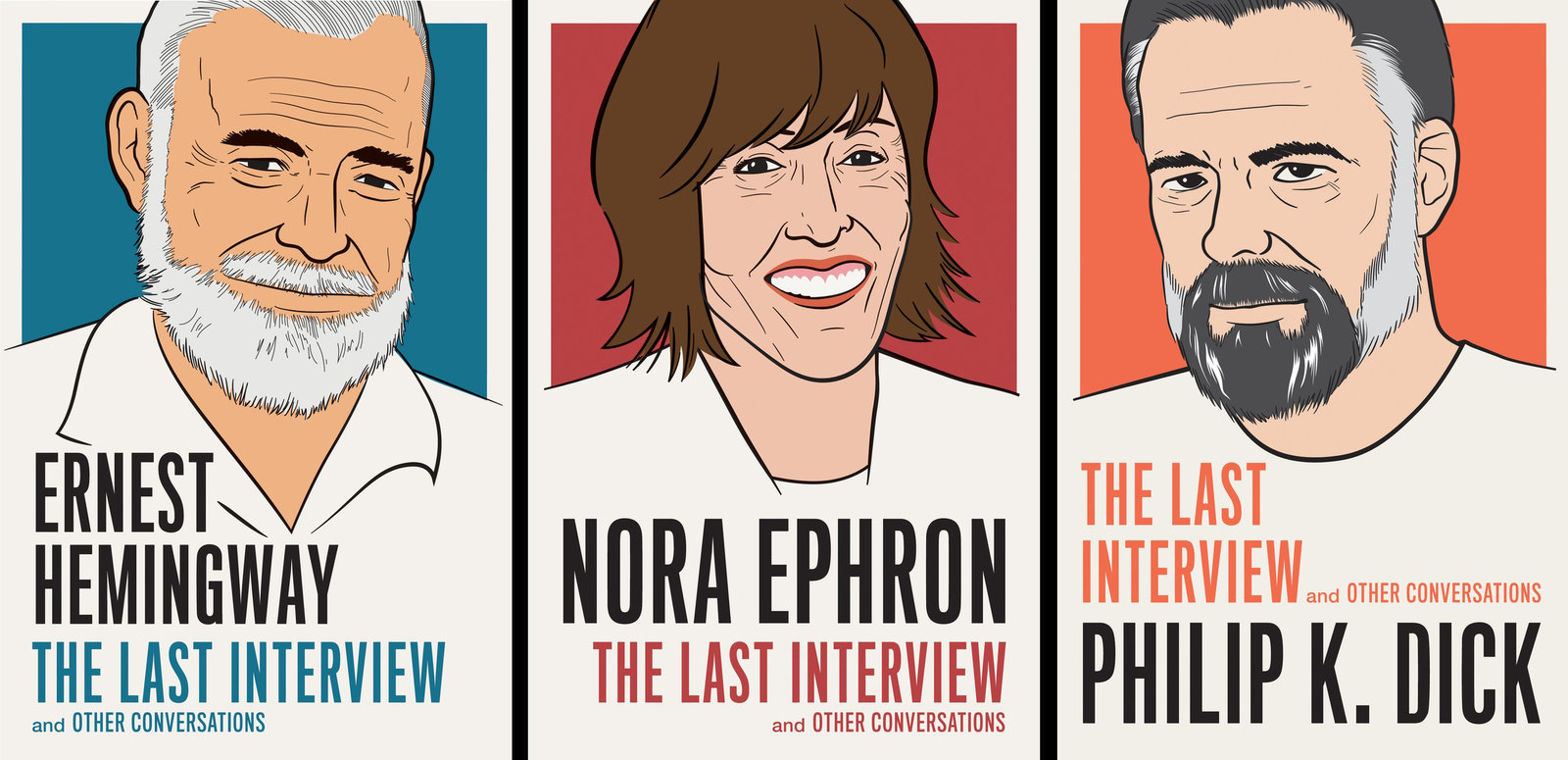
All of these writers have passed into esteemed company: not just that of luminaries from bygone eras, but of volumes in Melville House’s Last Interview series. “Can you think of three writers who, on the face of it, would have had less to say to each other at a dinner party?” asks NPR’s Maureen Corrigan, reviewing Last Interview volumes on Ephron, Ernest Hemingway, and Philip K. Dick.
“Hemingway would have knocked back the booze and gone all moody and silent; the notoriously paranoid Dick would have been under the table checking for bugging devices and Ephron would’ve channeled what she called ‘the truly life-saving technique’ taught to her by her Hollywood screenwriter parents to get through a rough time: the mantra, ‘Someday this will be a story!’ ”
With a range of deceased icons, including Marilyn Monroe and Martin Luther King, Jr., Julia Child and Jorge Luis Borges, Fred Rogers and Frida Kahlo, the Last Interview books cast a wide net for such an aesthetically and intellectually unified project. “Each volume offers, besides useful insights into its particular author’s work, what an old friend would call ‘civilized entertainment,’ ” writes Michael Dirda in The Washington Post. “Nearly all the titles actually contain several interviews, and some add introductions. For instance, the Roberto Bolaño opens with a 40-page critical essay.” In some cases the interviewers are as notable as the interviewees: “Two of Lou Reed’s questioners — the multi-talented novelists Neil Gaiman and Paul Auster — are now probably as well known as the legendary co-founder of the Velvet Underground.”
From the world of music the series includes not just Reed but David Bowie and Prince, two other one-man cultural forces who left us in the past decade, as well as their equally irreplaceable predecessors Johnny Cash and Billie Holiday. At the moment you can buy the entire Last Interview collection on Amazon (in Kindle format) for USD $344, which comes out to about $10 per book with 34 volumes in total. You may find this an economical solution, a way to explore the final thoughts of figures featured more than once here on Open Culture.
Related Content:
Orson Welles’ Last Interview and Final Moments Captured on Film
Hear Leonard Cohen’s Final Interview: Recorded by David Remnick of The New Yorker
Carl Sagan Issues a Chilling Warning to America in His Final Interview (1996)
Janis Joplin’s Last TV Performance & Interview: The Dick Cavett Show (1970)
Based in Seoul, Colin Marshall writes and broadcasts on cities, language, and culture. His projects include the Substack newsletter Books on Cities, the book The Stateless City: a Walk through 21st-Century Los Angeles and the video series The City in Cinema. Follow him on Twitter at @colinmarshall or on Facebook.
Read More...What Are the Real Causes of Zoom Fatigue? And What Are the Possible Solutions?: New Research from Stanford Offers Answers
The technology we put between ourselves and others tends to always create additional strains on communication, even as it enables near-constant, instant contact. When it comes to our now-primary mode of interacting — staring at each other as talking heads or Brady Bunch-style galleries — those stresses have been identified by communication experts as “Zoom fatigue,” now a subject of study among psychologists who want to understand our always-connected-but-mostly-isolated lives in the pandemic, and a topic for Today show segments like the one above.
As Stanford researcher Jeremy Bailenson vividly explains to Today, Zoom fatigue refers to the burnout we experience from interacting with dozens of people for hours a day, months on end, through pretty much any video conferencing platform. (But, let’s face it, mostly Zoom.) We may be familiar with the symptoms already if we spend some part of our day on video calls or lessons. Zoom fatigue combines the problems of overwork and technological overstimulation with unique forms of social exhaustion that do not plague us in the office or the classroom.
Bailenson, director of Stanford University’s Virtual Human Interaction Lab, refers to this kind of burnout as “Nonverbal Overload,” a collection of “psychological consequences” from prolonged periods of disembodied conversation. He has been studying virtual communication for two decades and began writing about the current problem in April of 2020 in a Wall Street Journal op-ed that warned, “software like Zoom was designed to do online work, and the tools that increase productivity weren’t meant to mimic normal social interaction.”
Now, in a new scholarly article published in the APA journal Technology, Mind, and Behavior, Bailenson elaborates on the argument with a focus on Zoom, not to “vilify the company,” he writes, but because “it has become the default platform for many in academia” (and everywhere else, perhaps its own form of exhaustion). The constituents of nonverbal overload include gazing into each others’ eyes at close proximity for long periods of time, even when we aren’t speaking to each other.
Anyone who speaks for a living understands the intensity of being stared at for hours at a time. Even when speakers see virtual faces instead of real ones, research has shown that being stared at while speaking causes physiological arousal (Takac et al., 2019). But Zoom’s interface design constantly beams faces to everyone, regardless of who is speaking. From a perceptual standpoint, Zoom effectively transforms listeners into speakers and smothers everyone with eye gaze.
On Zoom, we also have to expend much more energy to send and interpret nonverbal cues, and without the context of the room outside the screen, we are more apt to misinterpret them. Depending on the size of our screen, we may be staring at each other as larger-than-life talking heads, a disorienting experience for the brain and one that lends more impact to facial expressions than may be warranted, creating a false sense of intimacy and urgency. “When someone’s face is that close to ours in real life,” writes Vignesh Ramachandran at Stanford News, “our brains interpret it as an intense situation that is either going to lead to mating or to conflict.”
Unless we turn off the view of ourselves on the screen — which we generally don’t do because we’re conscious of being stared at — we are also essentially sitting in front of a mirror while trying to focus on others. The constant self-evaluation adds an additional layer of stress and taxes the brain’s resources. In face-to-face interactions, we can let our eyes wander, even move around the room and do other things while we talk to people. “There’s a growing research now that says when people are moving, they’re performing better cognitively,” says Bailenson. Zoom interactions, conversely, can inhibit movement for long periods of time.
“Zoom fatigue” may not be as dire as it sounds, but rather the inevitable trials of a transitional period, Bailenson suggests. He offers solutions we can implement now: using the “hide self-view” button, muting our video regularly, setting up the technology so that we can fidget, doodle, and get up and move around.… Not all of these are going to work for everyone — we are, after all, socialized to sit and stare at each other on Zoom; refusing to participate might send unintended messages we would have to expend more energy to correct. Bailenson further describes the phenomenon in the BBC Business Daily podcast interview above.
“Videoconferencing is here to stay,” Bailenson admits, and we’ll have to adapt. “As media psychologists it is our job,” he writes to his colleagues in the new article, to help “users develop better use practices” and help “technologists build better interfaces.” He mostly leaves it to the technologists to imagine what those are, though we ourselves have more control over the platform than we collectively acknowledge. Could we maybe admit, Bailenson writes, that “perhaps a driver of Zoom fatigue is simply that we are taking more meetings than we would be doing face-to-face”?
Read about the “Zoom Exhaustion & Fatigue Scale (ZEF Scale)” developed by Bailenson and his colleagues at Stanford and the University of Gothenburg here. Then take the survey yourself, and see where you rank in the ZEF categories of general fatigue, visual fatigue, social fatigue, motivational fatigue, and emotional fatigue.
Related Content:
How Information Overload Robs Us of Our Creativity: What the Scientific Research Shows
In 1896, a French Cartoonist Predicted Our Socially-Distanced Zoom Holiday Gatherings
Josh Jones is a writer and musician based in Durham, NC. Follow him at @jdmagness
Read More...Hear Brian Eno Reinvent Pachelbel’s Canon (1975)
Discreet Music came out in 1975, when most of its first listeners had never heard anything quite like it; there must have been some debate as to whether to call it “music” at all. Brian Eno’s fourth solo album, released on his own label Obscure Records, represented a departure from his own previous work, and even more so from that of his former band, the art-rock outfit Roxy Music. The recording that occupies the entire A side of Discreet Music features no vocals, and indeed no lyrics; no percussion, and no beat. Those qualities, of course, had plenty of precedent in music history, but the same can’t be said for its near-accidental compositional method, which involved a synthesizer, a tape-delay system, a graphic equalizer, an echo unit, and a couple of tape recorders, all connected in a loop: a series of devices, left to their own devices.
Some cite Discreet Music, which preceded Eno’s well-known Music for Airports by three years, as the origin point of ambient music as we know it today. Its inspiration goes a few years further back, as Eno himself tells it, to a period around about 1970 when he was convalescing after a car wreck. “A friend of mine came over to see me. I was confined to bed; I couldn’t move. But as she left she said, ‘Shall I put a record on?’ ”
The music “was much too quiet but I couldn’t reach to turn it up, and it was raining outside. It was a record of 18th-century harp music, I remember. I lay there at first kind of frustrated by this situation, but then I started listening to the rain and listening to these odd notes of the harp that were just loud enough to be heard above the rain.”
Today Eno counts this “a great musical experience for me, and I suddenly thought of this idea of making music that didn’t impose itself on your space in the same way, but created a sort of landscape you could belong to.” His story illuminates the emergence of not just a new music, but a new way of hearing old music. Discreet Music’s B side performs a reinterpretation of its own with variations on Johann Pachelbel’s Canon in D, “Fullness of Wind,” “French Catalogues,” and “Brutal Ardour.” On Eno’s instructions, the Cockpit Ensemble repeated parts of the score while gradually altering it, imbuing this familiar (not least from weddings) 17th-century piece with an otherworldly grandeur. Like their mistranslated-from-the French titles, these variations may in some sense be “mangled,” but they become all the more ambiguously evocative for it.
Related Content:
Hear Albums from Brian Eno’s 1970s Label, Obscure Records
The “True” Story Of How Brian Eno Invented Ambient Music
Pachelbel’s Canon Played by Train Horns
Based in Seoul, Colin Marshall writes and broadcasts on cities, language, and culture. His projects include the Substack newsletter Books on Cities, the book The Stateless City: a Walk through 21st-Century Los Angeles and the video series The City in Cinema. Follow him on Twitter at @colinmarshall or on Facebook.
Read More...Radiohead Ballets: Watch Ballets Choreographed Creatively to the Music of Radiohead
Since Radiohead’s last release, A Moon-Shaped Pool, members of the band have been absorbed in other projects. They’ve turned their band’s website into an archive for their discography and a library for rarities and ephemera — sending not-so-subtle signals their time together has reached a natural end, even if drummer Phil Selway said in 2020 “there are always conversations going on…. We’ll see. We’re talking.”
Two of the band’s most prominent members, guitarist Jonny Greenwood and frontman Thom Yorke, devoted their talents to film scores, a medium Greenwood has explored for many years: in the theatrical violence of There Will Be Blood, for example, the horrific aftermath of We Need to Talk about Kevin, and the almost balletic bloodiness of You Were Never Here. Yorke, meanwhile, scored Luca Guadagnino’s remake of Dario Argento’s Suspiria, a film in which ballet dancers’ bodies are broken and bloodied by black magic.
Greenwood, Yorke and company excel at conjuring atmospheres of dread, despair, and disorientation, traits that suit them well for arthouse film. They might not have seemed a natural fit, however, for ballet. And yet, Jason Kottke reports, the two are “together at last” — or at least as of 2016, when choreographer Robert Bondara toured Take Me With You, a piece scored to several Radiohead songs, including In Rainbows’ “Reckoner,” which you can see interpreted above by two dancers from the Polish National Ballet.
The performance is an athletic response to a kinetic track, in choreography not unlike pairs figure skating at times. It is not, however, the first time the band has inspired a ballet. In 2005, Romanian dancer and choreographer Edward Clug created a modern interpretation of Shakespeare set to songs from OK Computer and Kid A. Radio and Juliet debuted in Slovenia, toured the world, celebrated its hundredth performance in 2012, and was scheduled to open in Moscow in 2020.
Clug drew on a prior connection: OK Computer’s “Exit Music (For a Film)” was written for, but not used in, the 1996 Baz Luhrmann film adaptation of Shakespeare’s play. After Radio and Juliet, Clug once again drew inspiration from his favorite band (“They are the soundtrack to my other side; listening to them feels like I’m finding a self that I haven’t met yet.”) Clug’s piece “Proof” (preview above), set to “Feral” from The King of Limbs, debuted in 2017, his first for the Nederlands Dans Theater. If we are to have no more Radiohead, here’s hoping at least we’ll see more Radiohead ballets.
Related Content:
Radiohead’s Thom Yorke Performs Songs from His New Soundtrack for the Horror Film, Suspiria
Josh Jones is a writer and musician based in Durham, NC. Follow him at @jdmagness
Read More...Journey’s Road Crew Performs a Pretty Flawless Version of “Separate Ways”
You never know what the YouTube recommendation algorithm will serve up next. Above, we have Journey’s road crew performing “Separate Ways” as part of a concert soundcheck. And it turns out the crew has some real chops. At least according to the YouTube comments, the crew/band features Scott Appleton on guitar. (In recent years, he has served as the guitar tech for Rush’s Alex Lifeson.) And on drums, we seemingly have Jim Handley, a Nashville-based drummer who performs in the Journey tribute band, Resurrection. The actual performance starts around the 30 second mark. Enjoy.
If you would like to support the mission of Open Culture, consider making a donation to our site. It’s hard to rely 100% on ads, and your contributions will help us continue providing the best free cultural and educational materials to learners everywhere. You can contribute through PayPal, Patreon, and Venmo (@openculture). Thanks!
Related Content:
Quarantined Family Re-Creates Journey’s “Separate Ways” Video Shot-by-Shot
Read More...The 69 Pages of Writing Advice Denis Johnson Collected from Flannery O’Connor, Jack Kerouac, Stephen King, Hunter Thompson, Werner Herzog & Many Others
The internet is full of inspirational quotations about writing, many of them from accomplished and respectable writers. But what need could such writers have of inspirational quotations themselves? Surely true literary art flows from its authors without need of encouraging words, demand though it may sustained periods of labor, frustration, and even suffering. These days, more than a few who seek to create such art spend time studying not just its past masterworks but its living masters. “Some years ago,” the novelist Karan Mahajan recently tweeted, “I was lucky to take a class with Denis Johnson, who dressed like a card-shark, in flashy jackets and (unlike a card-shark) wept over sentences. He gave my class a 69-page list of writing quotes he returned to frequently.”
Johnson’s list, which you can see in PDF form here, shows that at least one of our era’s most celebrated writers swore by the kind of writing advice most of us scroll past every day. Though somewhat eccentrically formatted, it rounds up a great deal of valuable wisdom from novelists, poets, and playwrights — as well as philosophers, sculptors, filmmakers, and other figures besides — from different lands and different times.
In it you’ll find these reflections on the art, craft, and life of writing, among many others:
- “In genius we perceive our own rejected thoughts, returning to us with a kind of alienated majesty.” — Ralph Waldo Emerson
- Simplicity is not an end in art, but we usually arrive at simplicity as we approach the true sense of things.” — Constantin Brâncuși
- The first and most obvious characteristic of fiction is that it deals with reality through what can be seen, heard, smelt, tasted, and touched.” ― Flannery O’Connor
- “Writing, ideally, is recognizing your bad writing.” — August Wilson
- “One is always seeking the touchstone that will dissolve one’s deficiencies as a person and as a craftsman. And one is always bumping up against the fact that there is none except hard work, concentration, and continued application.” — Paul William Gallico
- “But what is art, really, but a good instinct for staying alive in your own alley?” — Hunter S. Thompson
- There is a microscopically thin line between being brilliantly creative and acting like the most gigantic idiot on earth. — Cynthia Heimel
- “A writer is a person for whom writing is more difficult than it is for other people.” — Thomas Mann
- “I learned never to empty the well of my writing, but always to stop when there was still something there in the deep part of the well, and let it refill at night from the springs that fed it.” — Ernest Hemingway
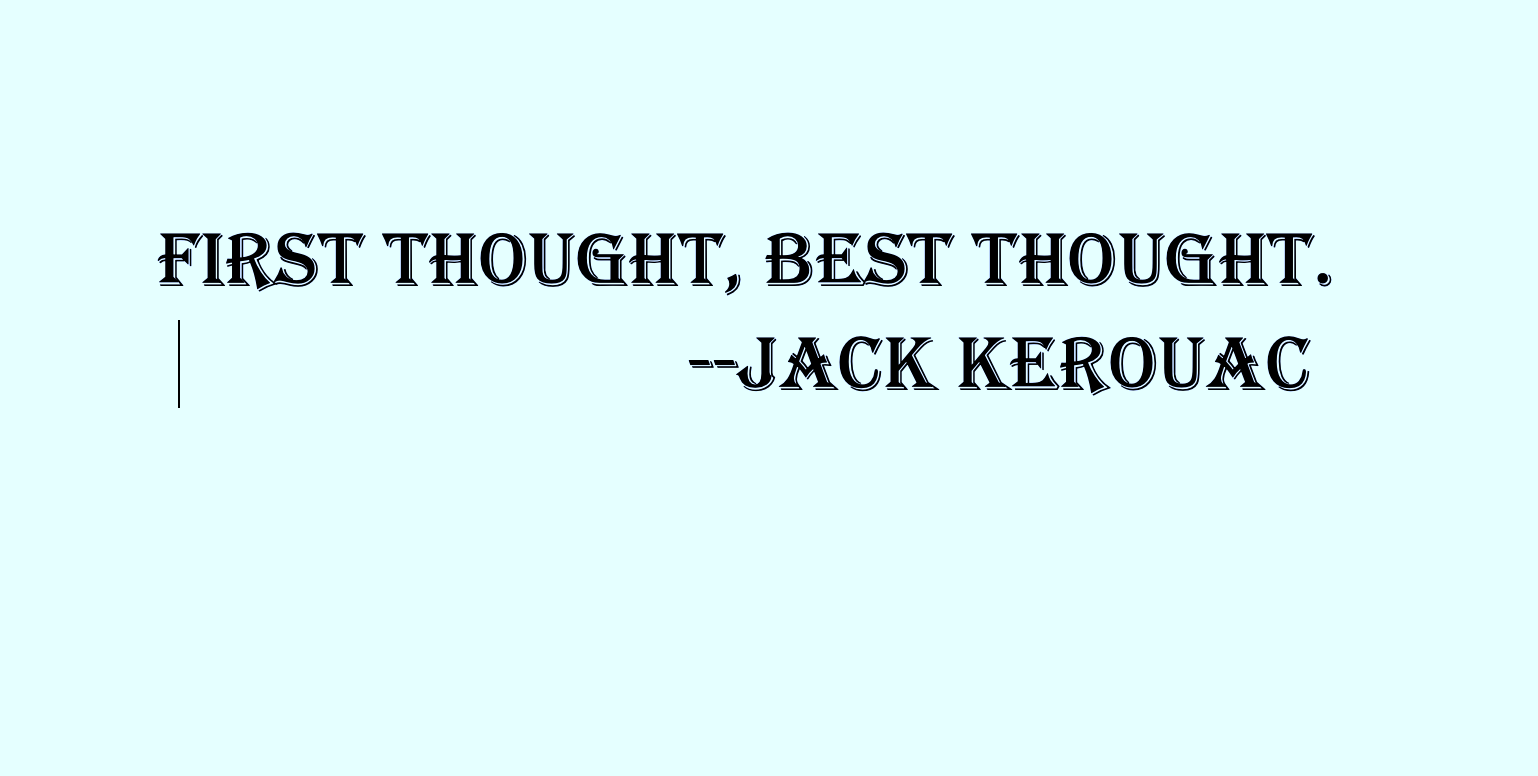
- “First thought best thought.” — Jack Kerouac
- “The job boils down to two things: paying attention to how the real people around you behave and then telling the truth about what you see.” — Stephen King
- “The important thing is that there should be a space of time, say four hours a day at least, when a professional writer doesn’t do anything else but write. He doesn’t have to write, and if he doesn’t feel like it, he shouldn’t try. He can look out of the window or stand on his head or writhe on the floor. But he is not to do any other positive thing, not read, write letters, glance at magazines, or write checks. Write or nothing.” — Raymond Chandler
- “I know this, with a sure and certain knowledge: a man’s work is nothing but this slow trek to rediscover, through the detours of art, those two or three great and simple images in whose presence his heart first opened.” — Albert Camus
- “Don’t look back.” – Bob Dylan
Over the course of these 69 pages, certain themes emerge: the importance of writing with one’s “blood,” the unimportance of critics, the value of simplicity, the danger of adjectives (and other excess description), the necessity of letting nothing block the flow of the first draft. While many of these quotations offer practical advice — much of it about consistently putting in the hours, both conscious and unconscious — some approach from a more oblique angle not just “writing” as a pursuit but the living of life itself. “To fail to embrace my dreams now would be a disgrace so great that sin itself could not find a name for it,” writes Werner Herzog in the diary he kept during the agonized making of Fitzcarraldo. If this inspired the author of Jesus’ Son and Tree of Smoke, it ought to inspire the rest of us as well.
Related Content:
19 Quotes on Writing by Gore Vidal. Some Witty, Some Acerbic, Many Spot On
Stephen King’s 20 Rules for Writers
Kurt Vonnegut’s Eight Tips on How to Write a Good Short Story
7 Tips From Ernest Hemingway on How to Write Fiction
Write Only 500 Words Per Day and Publish 50+ Books: Graham Greene’s Writing Method
Based in Seoul, Colin Marshall writes and broadcasts on cities, language, and culture. His projects include the Substack newsletter Books on Cities, the book The Stateless City: a Walk through 21st-Century Los Angeles and the video series The City in Cinema. Follow him on Twitter at @colinmarshall or on Facebook.
Read More...How the Internet Archive Digitizes 3,500 Books a Day–the Hard Way, One Page at a Time
Does turning the pages of an old book excite you? How about 3 million pages? That’s how many pages Eliza Zhang has scanned over her ten years with the Internet Archive, using Scribe, a specialized scanning machine invented by Archive engineers over 15 years ago. “Listening to 70s and 80s R&B while she works,” Wendy Hanamura writes at the Internet Archive blog, “Eliza spends a little time each day reading the dozens of books she handles. The most challenging part of her job? ‘Working with very old, fragile books.”
The fragile state and wide variety of the millions of books scanned by Zhang and the seventy-or-so other Scribe operators explains why this work has not been automated. “Clean, dry human hands are the best way to turn pages,” says Andrea Mills, one of the leaders of the digitization team. “Our goal is to handle the book once and to care for the original as we work with it.”
Raising the glass with a foot pedal, adjusting the two cameras, and shooting the page images are just the beginning of Eliza’s work. Some books, like the Bureau of Land Management publication featured in the video, have myriad fold-outs. Eliza must insert a slip of paper to remind her to go back and shoot each fold-out page, while at the same time inputting the page numbers into the item record. The job requires keen concentration.
If this experienced digitizer accidentally skips a page, or if an image is blurry, the publishing software created by our engineers will send her a message to return to the Scribe and scan it again.
It’s not a job for the easily bored; “It takes concentration and a love of books,” says Internet Archive founder Brewster Kahle. The painstaking process allows digitizers to preserve valuable books online while maintaining the integrity of physical copies. “We do not disbind the books,” says Kahle, a method that has allowed them to partner with hundreds of institutions around the world, digitizing 28 million texts over two decades. Many of those books are rare and valuable, and many have been deemed of little or no value. “Increasingly,” writes the Archive’s Chris Freeland, “the Archive is preserving many books that would otherwise be lost to history or the trash bin.”

In one example, Freeland cites The dictionary of costume, “one of the millions of titles that reached the end of its publishing lifecycle in the 20th century.” It is also a work cited in Wikipedia, a key source for “students of all ages… in our connected world.” The Internet Archive has preserved the only copy of the book available online, making sure Wikipedia editors can verify the citation and researchers can use the book in perpetuity. If looking up the definition of “petticoat” in an out-of-print reference work seems trivial, consider that the Archive digitizes about 3,500 books every day in its 18 digitization centers. (The dictionary of costume was identified as the Archive’s 2 millionth “modern book.”)
Libraries “have been vital in times of crisis,” writes Alistair Black, emeritus professor of Information Sciences at the University of Illinois, and “the coronavirus pandemic may prove to be a challenge that dwarfs the many episodes of anxiety and crisis through which the public library has lived in the past.” A huge part of our combined global crises involves access to reliable information, and book scanners at the Internet Archive are key agents in preserving knowledge. The collections they digitize “are critical to educating an informed populace at a time of massive disinformation and misinformation,” says Kahle. When asked what she liked best about her job, Zhang replied, “Everything! I find everything interesting…. Every collection is important to me.”
The Internet Archive offers over 20,000,000 freely downloadable books and texts. Enter the collection here.
Related Content:
Josh Jones is a writer and musician based in Durham, NC. Follow him at @jdmagness
Read More...Witness the Birth of Kermit the Frog in Jim Henson’s Live TV Show, Sam and Friends (1955)
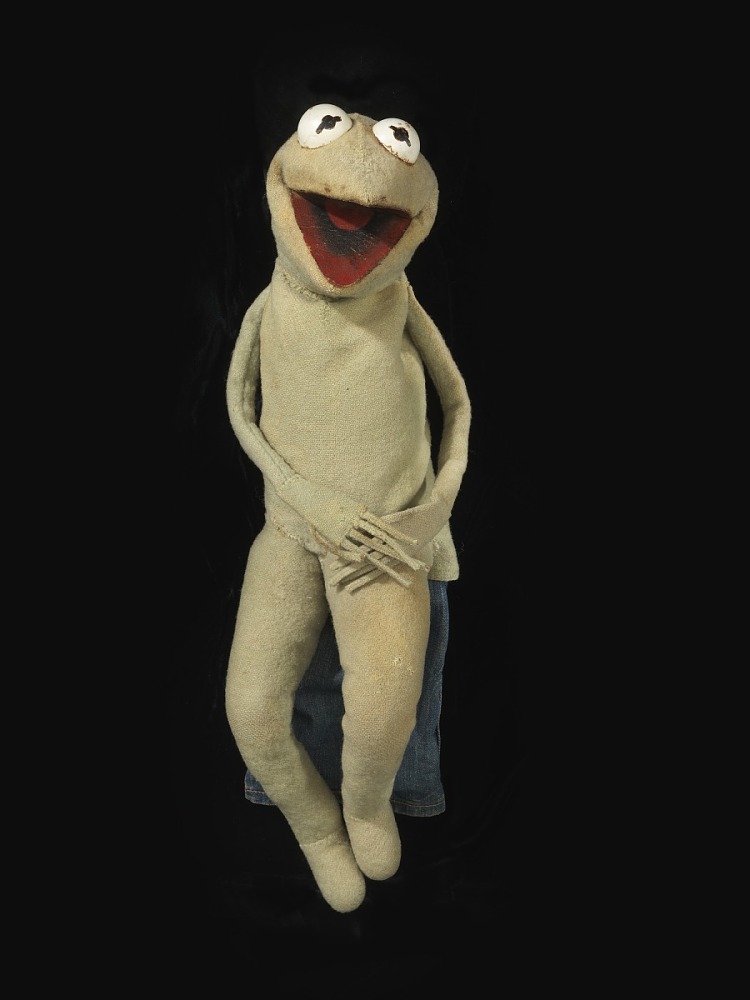
Long before “green” became synonymous with eco-friendly products and production, an 18-year-old Jim Henson created a puppet who would go on to become the color’s most celebrated face from his mother’s cast-off green felt coat and a single ping pong ball.
Kermit debuted in black and white in the spring of 1955 as an ensemble member of Sam and Friends, a live television show comprised of five-minute episodes that the talented Henson had been tapped to write and perform, following some earlier success as a teen puppeteer.
Airing on the Washington DC-area NBC affiliate between the evening news and The Tonight Show, Sam and Friends was an immediate hit with viewers, even if they ranked Kermit, originally more lizard than frog, fourth in terms of popularity. (Top spot went to a skull puppet named Yorick.)
Watching the surviving clips of Sam and Friends, it’s easy to catch glimpses of where both Kermit and Henson were headed.
While Henson voiced Sam and all of his puppet friends, Kermit wound up sounding the closest to Henson himself.
Kermit’s signature face-crumpling reactions were by design. Whereas other puppets of the period, like the titular Sam, had stiff heads with the occasional moving jaw, Kermit’s was as soft as a footless sock, allowing for far greater expressiveness.
Henson honed Kermit’s expressions by placing live feed monitors on the floor so he and his puppeteer bride-to-be Jane, could see the puppets from the audience perspective.
Unlike previously televised puppet performances, which preserved the existing prosceniums of the theaters to which the players had always been confined, Henson considered the TV set frame enough. Liberating the puppets thusly gave more of a sketch comedy feel to the proceedings, something that would carry over to Sesame Street and later, The Muppet Show.
By the 12th episode, Kermit has found a niche as wry straight man for wackier characters like jazz aficionado Harry the Hipster who introduced an element of musical notation to the animated letters and numbers that would become a Sesame Street staple.
And surely we’re not the only ones who think the Muppets’ recent appearance in a Super Bowl ad pales in comparison to Kermit and Harry’s live commercial for Sam and Friends’ sponsor, a regional brand of bacon and lunch meat.
Sam and Friends ran from 1955 to 1961, but Kermit’s first performance on The Tonight Show in 1956, lip syncing to Rosemary Clooney’s recording of “I’ve Grown Accustomed to Your Face” and mugging in a blonde braided wig, hinted that he and Henson would soon outgrow the local television pond.
Related Content:
Jim Henson Creates an Experimental Animation Explaining How We Get Ideas (1966)
The Creative Life of Jim Henson Explored in a Six-Part Documentary Series
Watch The Surreal 1960s Films and Commercials of Jim Henson
Jim Henson Teaches You How to Make Puppets in Vintage Primer From 1969
Ayun Halliday is an author, illustrator, theater maker and Chief Primatologist of the East Village Inky zine, current issue #63. Follow her @AyunHalliday.
Read More...The Open Syllabus Project Visualizes the 1,000,000+ Books Most Frequently Assigned in College Courses

The Prince, The Canterbury Tales, The Communist Manifesto, The Souls of Black Folk, The Elements of Style: we’ve read all these, of course. Or at least we’ve read most of them (one or two for sure), if our ever-dimmer memories of high school or college are to be trusted. But we can rest assured that students are reading — or in any case, being assigned — these very same works today, thanks to the Open Syllabus project, which as of this writing has assembled a database of 7,292,573 different college course syllabi. Greatly expanded since we previously featured it here on Open Culture, its “Galaxy” now visualizes the 1,138,841 most frequently assigned texts in that database, presenting them in a Google Maps-like interface for your intellectual exploration.
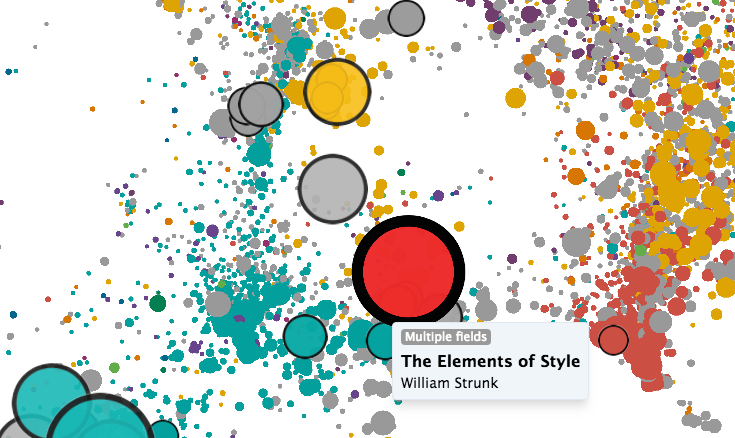
If you click on the search window in the upper-left corner of that interface, a scrollable ranking of the top 100 most frequently assigned texts opens immediately below. Number one, appearing on more than 15,000 of the syllabi collected so far, is Strunk and White’s classic writing-style guide.
Click on its title and you’ll find yourself in its corner of the map, and you’ll see highlighted other popular readings that tend to be assigned together with it: Diana Hacker’s A Writer’s Reference (at the moment the second-most assigned text), Aristotle’s Rhetoric, Martin Luther King Jr.‘s “Letter from the Birmingham Jail,” Jürgen Habermas’ The Structural Transformation of the Public Sphere.
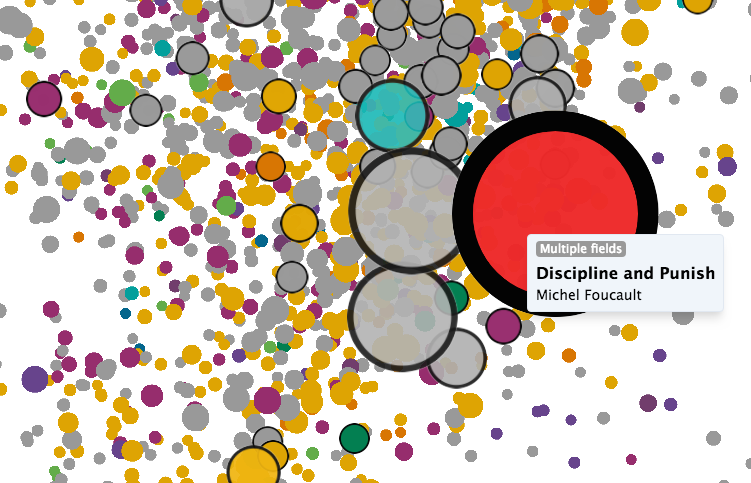
Michel Foucault holds by some measures the record for the greatest number of citations in the humanities. If you’ve read only one of his books, you’ve probably read Discipline and Punish, his 1975 study of the penal system — and current holder of sixteenth place on the Open Syllabus rankings. But zoom in on it and you’ll find plenty of relevant books and articles you might not have read: Alan Elsner’s Gates of Injustice, William Ian Miller’s The Anatomy of Disgust, Soledad Brother: The Prison Letters of George Jackson. Similarly, an excursion in the neighborhood of Benedict Anderson’s Imagined Communities brings encounters with other investigations of country and citizenship like Ernest Renan’s What Is a Nation? and Duncan S.A. Bell’s Mythscapes: Memory, Mythology, and National Identity.

In every sense, the results to be found in the Open Syllabus Galaxy are more interesting than those offered up by the standard you-may-also-like algorithms. Back in college you may have enjoyed, say, Edward Said’s Orientalism, but the range of texts that could accompany it would have been limited by the theme of the class and the intent of your instructor. Here you’ll find Noam Chomsky’s Failed States on one side, John R. Bowen’s Why the French Don’t Like Headscarves on another, Hans Wehr’s Dictionary of Modern Written Arabic on another, and even Messages to the World: The Statements of Osama bin Laden on another still. If we want to understand a subject, after all, we must read not just about it but around it. In college or elsewhere, you might well have heard that idea; here, you can see it. Enter the Open Syllabus Galaxy here.
Related Content:
David Foster Wallace’s 1994 Syllabus: How to Teach Serious Literature with Lightweight Books
Donald Barthelme’s Syllabus Highlights 81 Books Essential for a Literary Education
Junot Díaz’s Syllabi for His MIT Writing Classes, and the Novels on His Reading List
Based in Seoul, Colin Marshall writes and broadcasts on cities, language, and culture. His projects include the Substack newsletter Books on Cities, the book The Stateless City: a Walk through 21st-Century Los Angeles and the video series The City in Cinema. Follow him on Twitter at @colinmarshall or on Facebook.
Read More...Peter Gabriel Re-Records “Biko,” His Anti-Apartheid Protest Song, with Musicians Around the World
Wisdom, humour, compassion, understanding, brilliancy of intellect, unselfishness, modesty, courage—he had all these attributes… The government quite clearly never understood the extent to which Steve Biko was a man of peace. He was militant in standing up for his principles, yes, but his abiding goal was a peaceful reconciliation of all South Africans.
—Donald Woods
When South African police murdered Steve Biko in detention on August 18, 1977, they thought they were ridding themselves of a thorn in their side, that in killing him, they could forget about him. Senior TIME editor Tony Karon, who grew up in white South Africa, recorded what the Minister of Police said when announcing Biko’s death to “a conference of the ruling party”: “I am not glad and I am not sorry about Mr. Biko. It leaves me cold. I can say nothing to you. Any person who dies… I shall also be sorry if I die.” Then, writes Karon, “they laughed. Like B‑movie Nazis.”
Despite the apartheid state’s best efforts to destroy him, Biko’s death made him a martyr. “I didn’t know Steve Biko,” writes Karon, “but his death made clear to me, and hundreds of young white people like me, what millions of black South Africans knew from experience…. The fight to end apartheid had claimed many thousands of lives before his, and many thousands more would be killed after Biko’s murder. But no death shook my world, and the country all around me, more than Steve Biko’s.”
Biko helped found the South African Student’s Organization (SASO) while studying medicine at the University of Natal, and he founded the Black Consciousness Movement to advocate “self-awareness and self-reliance for Black people,” writes Mohammed Elnaiem at JSTOR Daily. It was a movement to center the experiences of Black South Africans. Yet as Biko understood the term, “Black” was a political class: his was “a movement for people who are oppressed,” he said, including so-called “colored” and Indian South Africans. “We believe,” says Biko in the interview above, “in a non-racial society.”
The government “soon realized,” Karon writes, “the radical movement was a threat to racial hierarchy in the country,” with its legal divisions of caste and class. They could not stop Biko’s message from resonating around the world. News of his arrest and death spread quickly and remained a powerful symbol of the regime’s brutality. In the music world, the news took the form of Peter Gabriel’s “Biko.” Released in 1980, the song became a major hit. It was, wrote critic Phil Sutcliffe, “so honest you might even risk calling it truth.” Gabriel himself, on the 40th anniversary of Biko’s death, wrote that “both music and lyric are simple but written to be direct and emotional.”
He did not need to embellish, especially in the song’s final line: “the eyes of the world are watching now, watching now.” Indeed, they were, as they are now, even in our states of pandemic isolation, watching the continued police brutality of governments built on racism, colonialism, slavery, apartheid, and exclusion. It’s an ideal time for Gabriel to re-release “Biko,” and re-record it with Playing for Change, the organization gathering famous and non-famous musicians around the world in remote collaborative covers of famous songs with universal resonance. “Biko” belongs in their company.
At the top, you can see the performance, which opens with the stunning voices of The Cape Town Ensemble choral group. Then bassist Meshell Ndegeocelo, Beninese singer Angélique Kidjo, and cellist Yo-Yo Ma join in with a Japanese percussion group and other musicians as Gabriel delivers the lyrics with as much conviction as he did over forty years ago. Just above, see a moving live performance of “Biko” from 1987, in a video directed by Lol Creme. Introducing the song, Gabriel calls the activist “a man who preached nonviolence in a state that has racism enshrined in its constitution.” Or as the lyrics put it in their devastatingly direct way: “It was business as usual / in police room 619.”
Related Content:
Musicians Around the World Play “Lean on Me,” the Uplifting Song by Bill Withers (RIP)
Read More...
Support Us
We're hoping to rely on loyal readers, rather than erratic ads. Please click the Donate button and support Open Culture. You can use Paypal, Venmo, Patreon, even Crypto! We thank you!

About Us

Open Culture scours the web for the best educational media. We find the free courses and audio books you need, the language lessons & educational videos you want, and plenty of enlightenment in between.
Advertise With Us
FREE UPDATES!
GET OUR DAILY EMAIL
Get the best cultural and educational resources on the web curated for you in a daily email. We never spam. Unsubscribe at any time.
FOLLOW ON SOCIAL MEDIA
Open Culture editor Dan Colman scours the web for the best educational media. He finds the free courses and audio books you need, the language lessons & movies you want, and plenty of enlightenment in between.
Advertise With Us

