The Origins of the Word “Gaslighting”: Scenes from the 1944 Film Gaslight
You’re not going out of your mind. You’re slowly and systematically being driven out of your mind. — Joseph Cotton to Ingrid Bergman in the 1944 film Gaslight.
Remember when the word “gaslighting” elicited knowing nods from black and white film buffs… and blank stares from pretty much everyone else?
Then along came 2016, and gaslighting entered the lexicon in a big way.
Merriam-Webster defines it as the “psychological manipulation of a person usually over an extended period of time that causes the victim to question the validity of their own thoughts, perception of reality, or memories and typically leads to confusion, loss of confidence and self-esteem, uncertainty of one’s emotional or mental stability, and a dependency on the perpetrator.”
Of course, you knew that already!
“Gaslighting” is unavoidable these days, five years after it was named 2016’s “most useful” and “likely to succeed” word by the American Dialect Society.
(“Normalize” was a runner up.)
As long as we’re playing word games, are you familiar with “denominalization”?
Also known as “verbing” or “verbification,” it’s the process whereby a noun is retooled as a verb.
Both figure prominently in Gaslight.
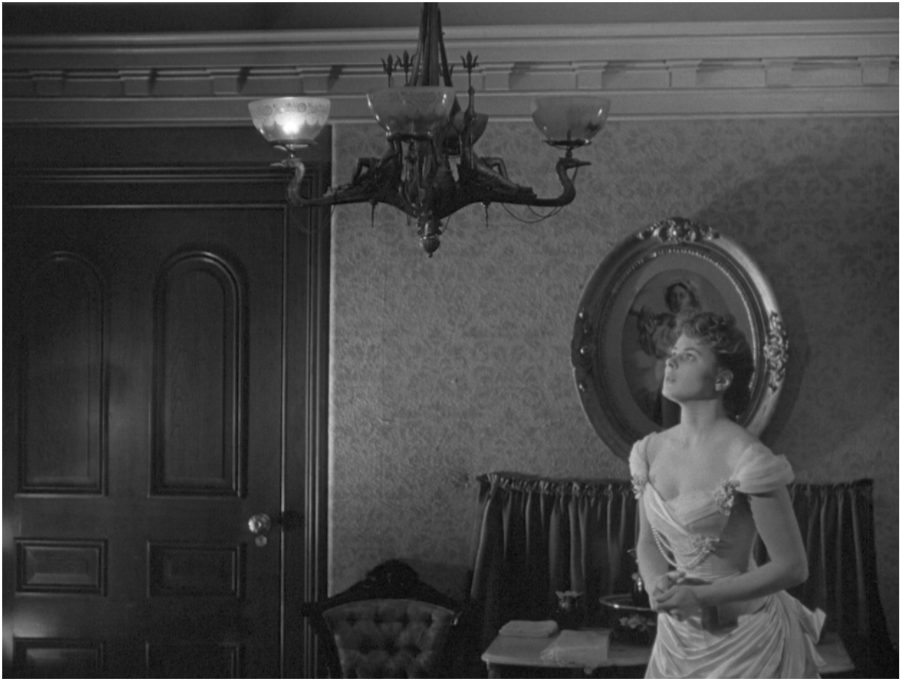
Have you seen the film?
Ingrid Bergman, playing opposite Charles Boyer, won an Academy award for her performance. A teenaged Angela Lansbury made her big screen debut.
In his review, The New York Times’ film critic Bosley Crowther steered clear of spoilers, while musing that the bulk of the theater-going public was probably already hip to the central conceit, following the successful Broadway run of Angel Street, the Patrick Hamilton thriller on which the film was based:
We can at least slip the information that the study is wholly concerned with the obvious endeavors of a husband to drive his wife slowly mad. And with Mr. Boyer doing the driving in his best dead-pan hypnotic style, while the flames flicker strangely in the gas-jets and the mood music bongs with heavy threats, it is no wonder that Miss Bergman goes to pieces in the most distressing way.
In the same review, Crowther sniped that Gaslight was “a no more illuminating title” than Angel Street.
Maybe that was true in 1944. Not anymore!
(Cunning linguists that we are, had the film retained the play’s title, 2022 may well have found us complaining that some villain tried to Angel Street us…)
In a column on production design for The Film Experience, critic Daniel Walber points out how Boyer destabilizes Bergman by fooling with their gas-powered lamps, and also how the film’s Academy Award-winning design team used the “constricting temporality” of a Victorian London lit by gas to set a foreboding mood:
Between the streetlights outside and the fixtures within, the mood is forever dimmed. The heaviness of the atmosphere brings us even closer to Paula’s mental state, trapping us with her. The detail is so precise, so committed that every flicker crawls under the skin, projecting terrible uncertainty and fear to the audience.
Readers who’ve yet to see the film may want to skip the below clip, as it does contain something close to a spoiler.
Those who’ve been on the receiving end of a vigorous gaslighting campaign?
Pass the popcorn.
Related Content:
Ingrid Bergman Remembers How Ernest Hemingway Helped Her Get the Part in For Whom the Bell Tolls
Ayun Halliday is the Chief Primatologist of the East Village Inky zine and author, most recently, of Creative, Not Famous: The Small Potato Manifesto. Follow her @AyunHalliday.
Read More...Bob Dylan’s Famous Televised Press Conference After He Went Electric (1965)
I don’t think I’m tangible to myself. I mean, I think one thing today and I think another thing tomorrow. I change during the course of a day. I wake and I’m one person, and when I go to sleep I know for certain I’m somebody else. I don’t know who I am most of the time. It doesn’t even matter to me. – Bob Dylan, 1997 Newsweek interview
A too-cool-for-school rock star emerged from seemingly nowhere when Bob Dylan went electric at Newport with his touring band, the Band — a Dylan unrecognizable to the earnest folkies who followed Bob Dylan the Greenwich Village troubadour and protest singer. Where did the real Dylan go — the Dylan every singer/songwriter with an acoustic guitar tried to become, until the coffee shop scene sagged with thousands of Dylan-wannabees? Dont Look Back, warned D.A. Pennebaker’s 1967 documentary on Dylan in his mid-sixties heyday.
“Don’t look back. Something might be gaining on you,” said Satchel Paige, giving Pennebaker his title and Dylan a career outlook. Those who stay stuck in the past — even the very recent past — would never get it, like Mr. Jones in “Ballad of a Thin Man,” a song critic Andy Gill described as “a furious, sneering, dressing-down of a hapless bourgeois intruder into the hipster world of freaks and weirdoes which Dylan now inhabited.” Those who looked for answers found them blowing in the wind, even when they went straight to the source.
Just above, see the only fully televised press conference Dylan ever gave, for KQED, the educational TV station in San Francisco. In attendance were members of the local and national press, reporters from several high school papers, Dylan’s entourage, and famous friends like Allen Ginsberg and promoter Bill Graham. It’s as much a performance as the next night’s show at the Berkeley Community Theater would be. “The questions,” notes Jonathan Cott, editor of The Essential Interviews, “ranged from standard straight press and TV reporters’ questions to teenage fan club questions to in-group personal queries and put ons, to questions by those who really had listened to Dylan’s songs.”
Dylan’s demeanor during the interview was perfectly captured by Cate Blanchett’s Oscar-nominated performance of a character named “Jude Quinn” in Todd Haynes’ 2007 art-house biopic, I’m Not There. In scenes inspired by the KQED press conference, Blanchett-as-Quinn toys with the press, just as Dylan threw labels like “folk rock” back at them and refused to get drawn into discussions of philosophy or politics. “I think of myself more as a song and dance man, y’know,” he says in mock self-effacement, his gaze impenetrable behind Ray-Bans and clouds of cigarette smoke.
Dylan liked I’m Not There, a film that tells his story through six fictional characters, played by six different actors. (“Do you think that the director was worried that people would understand it or not?” he said. “I don’t think he cared one bit.”) Unlike “Jude Quinn,” his post-folk manifestation in the mid-sixties did not burn out and die in a motorcycle accident, and he didn’t sneer at every question, though he did say he wrote “Ballad of a Thin Man” as a “response to people who ask me questions all the time. You just get tired of that every once in a while.… I figure a person’s life speaks for itself, right?”
But precisely what we do not find in Dylan’s music is biography. He keeps his interviewers (including Ginsberg, at 33:00 and Graham, at 25:31 ) guessing, often grasping after a soundbite that will sum up the new sound and image. Perhaps the most truthful one he gives them comes in response to the question, “What are you thinking about right now?” Dylan stares down at his cigarette, and the now-Nobel-prize-winning singer/songwriter says, “I’m thinking about this ash… the ash is creeping up on me somewhere — I’ve lost — lost touch with myself so I can’t tell where exactly it is.”
Read a full transcript of the press conference here.
Related Content:
Tangled Up in Blue: Deciphering a Bob Dylan Masterpiece
Josh Jones is a writer based in Durham, NC. Follow him at @jdmagness
Read More...How to Decode NASA’s Message to Aliens
When NASA spent close to a billion dollars on the Voyager program, launching a pair of probes from Cape Canaveral in 1977, its primary purpose was not to find intelligent extra-terrestrial life. The program grew out of ambitions for a “Grand Tour”: four robotic probes that would visit all the planets in the outer solar system, taking advantage of a 175-year alignment of Jupiter and Saturn. A downsized version produced Voyager 1 and 2, each craft “a miniature marvel,” writes the Attic. “Weighing less than a Volkswagen, each had 65,000 parts. Six thrusters powered by plutonium. Three gyroscopes. Assorted instruments to measure gravity, radiation, magnetic fields, and more. Design and assembly took years.”
Since reaching Jupiter in 1979, the two probes have sent back astonishing images from the great gas giants and the very edges of the solar system. “By 2030, Voyager 1 and 2 will cease communications for good,” says Cory Zapatka in the Verge Science video above, “and while they won’t be able to beam information back to Earth, they’re going to continue sailing through space at almost 60,000 kilometers per hour,” reaching interstellar unknowns their makers will never see. Voyager 1 was only supposed to last 10 years. In 2012, it left the solar system, to drift, along with its twin, “endlessly among the stars of our galaxy,” Timothy Ferris writes in The New Yorker, “unless someone or something encounters them someday.”
As deep space detritus, the probes will make excellent carriers for an interstellar message in a bottle, the Voyager team reasoned. The idea prompted the creation of the Golden Record, an LP fitted to each probe containing a message from humanity to the cosmos. “Etched in copper, plated with gold, and sealed in aluminum cases, the records are expected to remain intelligible for more than a billion years, making them the longest-lasting objects ever crafted by human hands.” Produced by Ferris and overseen by Carl Sagan and a team including his future wife, Ann Druyan, the Golden Record includes the work of Mozart, Chuck Berry, folk music from around the world, the sounds of waves and whales, and one of the most universal of human sounds, laughter (likely that of Sagan himself).
The Golden Record also includes 115 images, etched into its very surface. No, they are not digital files. “There are no jpegs or tifs included on it,” says Zapatka. After all, “The Voyager’s computer systems were only 69 kilobytes large, barely enough for one image, let alone 115.” These are analog still photographs and diagrams that must be reconstructed with mathematical formulae extracted from electronic tones. The process starts with the diagrams on the record’s cover — simple icons that contain an incredible density of information. We begin with two circles joined by a line. They are hydrogen atoms, the most plentiful gas in the universe, undergoing a change that occurs spontaneously once every 10 million years.
During this rare occurrence, the hydrogen atoms emit energy at wavelengths of 21 centimeters. This measurement is used as “a constant for all the other symbols on the record.” That’s an awful lot of background knowledge required to decipher what look to the scientifically untrained eye like a pair of tiny eyes behind a pair of odd eyeglasses. But for spacefaring aliens, “how hard could that be?” says Bill Nye above in an abridged description of how to decode the Golden Record. We may never, in a billion years, know if any extra-terrestrial species ever finds the record and makes the attempt. But the Golden Record has become as much an object of fascination for humans as it is a greeting from Earth to the galaxy. Learn more from NASA here about the images encoded on the Golden Record and order your own reproduction (on LP or CD) here.
Related Content:
NASA Lets You Download Free Posters Celebrating the 40th Anniversary of the Voyager Missions
Carl Sagan Warns Congress about Climate Change (1985)
Josh Jones is a writer and musician based in Durham, NC. Follow him at @jdmagness
Read More...Toni Morrison Lists the 10 Steps That Lead Countries to Fascism (1995)
Note: Toni Morrison’s speech begins around the 38:30 mark.
The term fascism gets thrown around a great deal these days, not always with high regard to consistency of meaning. Much like Orwellian, it now seems often to function primarily as a label for whichever political developments the speaker doesn’t like. Even back in the 1940s, Orwell himself took to the Tribune in an attempt to pin down what had already become a “much-abused word.” Half a century later, the question of what fascism actually is and how exactly it works was addressed by another novelist, and one of a seemingly quite different sensibility: Toni Morrison, author of The Bluest Eye and Beloved.
Fascism tends to come along with evocation of Nazi Germany. In her 1995 Charter Day address at Howard University, Morrison, too, brought out the specter of Hitler and his “final solution.” But “let us be reminded that before there is a final solution, there must be a first solution, a second one, even a third. The move toward a final solution is not a jump. It takes one step, then another, then another.” She proceeded to lay out a haunting hypothetical series of such steps as follows:
- Construct an internal enemy, as both focus and diversion.
- Isolate and demonize that enemy by unleashing and protecting the utterance of overt and coded name-calling and verbal abuse. Employ ad hominem attacks as legitimate charges against that enemy.
- Enlist and create sources and distributors of information who are willing to reinforce the demonizing process because it is profitable, because it grants power and because it works.
- Palisade all art forms; monitor, discredit or expel those that challenge or destabilize processes of demonization and deification.
- Subvert and malign all representatives of and sympathizers with this constructed enemy.
- Solicit, from among the enemy, collaborators who agree with and can sanitize the dispossession process.
- Pathologize the enemy in scholarly and popular mediums; recycle, for example, scientific racism and the myths of racial superiority in order to naturalize the pathology.
- Criminalize the enemy. Then prepare, budget for and rationalize the building of holding arenas for the enemy-especially its males and absolutely its children.
- Reward mindlessness and apathy with monumentalized entertainments and with little pleasures, tiny seductions, a few minutes on television, a few lines in the press, a little pseudo-success, the illusion of power and influence, a little fun, a little style, a little consequence.
- Maintain, at all costs, silence.
Like any good storyteller, Morrison stokes our imagination while turning us toward an examination of our own condition. Over the past quarter-century, many of the tendencies she describes have arguably become more pronounced in political and media environments around the world. A 21st-century reader may be given particular pause by step number nine. Since the 1990s, and especially in Morrison’s homeland of the United States of America, most entertainments have only grown more monumental, and most pleasures have only shrunk.
Later in her speech, Morrison foresees a time ahead “when our fears have all been serialized, our creativity censured, our ideas ‘market-placed,’ our rights sold, our intelligence sloganized, our strength downsized, our privacy auctioned; when the theatricality, the entertainment value, the marketing of life is complete.” Few of us here in 2022, whatever our political persuasion, could argue that her predictions were entirely unfounded. Fewer still have a clear answer to the question what to do when we “find ourselves living not in a nation but in a consortium of industries, and wholly unintelligible to ourselves except for what we see as through a screen darkly.”
via Kottke
Related Content:
Umberto Eco Makes a List of the 14 Common Features of Fascism
Why Should You Read Toni Morrison’s Beloved? An Animated Video Makes the Case
Based in Seoul, Colin Marshall writes and broadcasts on cities and culture. His projects include the book The Stateless City: a Walk through 21st-Century Los Angeles and the video series The City in Cinema. Follow him on Twitter at @colinmarshall or on Facebook.
Read More...Behold Medieval Snowball Fights: A Timeless Way of Having Fun
You can’t get too much winter in the winter
– Robert Frost, “Snow”
Snowy winter then responded with a voice severe:
May the cuckoo not come, let it sleep in dark hollows.
He is accustomed to bring hunger with him.– Anonymous poem in Medieval Latin, translated by Heather Williams
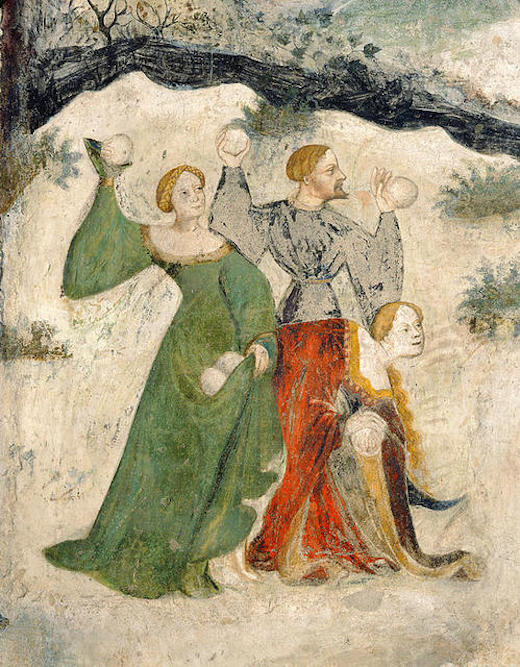
Winter may starve and freeze, but in each place where snow accumulates, we also find depictions of informal holidays — snow days — and one of their most exuberant pursuits. “Few seasonal activities are as universal — across time, place, or culture — as the snowball fight,” writes Public Domain Review. Some have even made it “into the annals of history.… According to what might be more fable than history, the teenage Napoleon Bonaparte famously organized a ten day snowball fight at his military school, complete with trenches, regimens, and rules of engagement.”
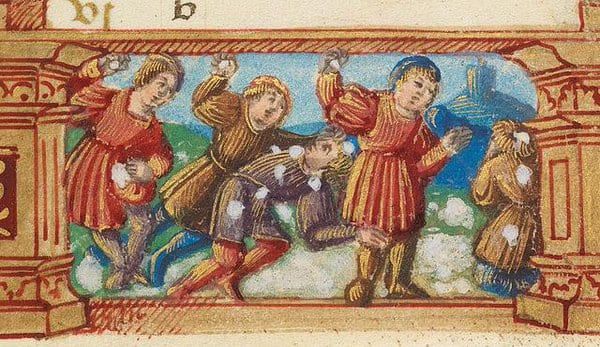
Snowball fights weren’t “confined to children either,” Arendse Lund writes. In the pages of illuminated Medieval manuscripts, “people of all ages, men and women, can be seen hefting an icy ball.” Such images defy a “conventional topos” — “the threat of winter” found in Old English poetry.
In one calendar poem, The Menologium, for example, “winter comes in like an invading warrior,” notes A Clerk of Oxford, “and puts autumn in chains, and the green fields which decorate the earth are permitted to stay with us no longer.… There are many, many examples of winter as danger and sorrow” in Medieval poetry.

The tradition of winter as a martial invader continues in modern verse. In Robert Frost, snow forms “soft bombs.” Even when one is safe and warm at home, snow banked high around the walls outside, winter threatens: the house is “frozen, brittle, all except this room you sit in.” But alongside these literary scenes of unbearable cold, we have the playfulness and sublimity of winter, its ability to elevate the ordinary, break up monotony, put a temporary end to daily drudgery. Winter brings its own form of beauty, and its own fun: the soft bomb of the snow ball.
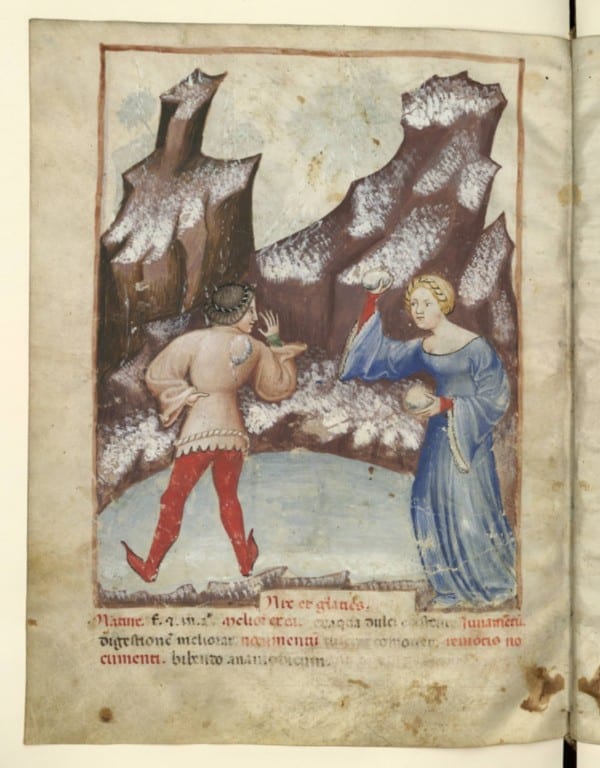
In one Middle English poem by Nicolas Bacon, titled “Of a Snow balle,” spring has nothing on winter even when it comes to love; the snowball fight becomes a pretext for a romantic encounter:
A wanton wenche vppon a colde daye
With Snowe balles prouoked me to playe:
But theis snowe balles soe hette my desyer
That I maye calle them balles of wylde fyer.
In the delightful images here, culled from a number of illuminated manuscripts (and one fresco, at the top), see Medieval Europeans play, flirt, and scoff at winter’s warning in lighthearted snowball fights of yore.

Related Content:
Josh Jones is a writer and musician based in Durham, NC. Follow him at @jdmagness
Read More...Charles and Ray Eames’ Powers of Ten Updated to Reflect Our Modern Understanding of the Universe
We’ve experienced some mindblowing technological advances in the years following designers Charles and Ray Eames’ 1977 film Powers of Ten: A Film Dealing with the Relative Size of Things in the Universe and the Effect of Adding Another Zero.
And y’know, all sorts of innovative strides in the fields of medicine, communications, and environmental sustainability.
In the above video for the BBC, particle physicist Brian Cox pays tribute to the Eames’ celebrated eight-and-a-half-minute documentary short, and uses the discoveries of the last four-and-a-half decades to kick the can a bit further down the road.
The original film helped ordinary viewers get a handle on the universe’s outer edges by telescoping up and out from a one-meter view of a picnic blanket in a Chicago park at the rate of one power of ten every 10 seconds.
Start with something everybody can understand, right?
At 100 (102) meters — slightly less than the total length of an American football field, the picnickers become part of the urban landscape, sharing their space with cars, boats at anchor in Lake Michigan, and a shocking dearth of fellow picnickers.
One more power of 10 and the picknickers disappear from view, eclipsed by Soldier Field, the Shedd Aquarium, the Field Museum and other longstanding downtown Chicago institutions.
At 1024 meters — 100 million light years away from the starting picnic blanket, the Eames butted up against the limits of the observable universe, at least as far as 1977 was concerned.
They reversed direction, hurtling back down to earth by one power of ten every two seconds. Without pausing for so much as handful of fruit or a slice of pie, they dove beneath the skin of a dozing picnicker’s hand, continuing their journey on a cellular, then sub-atomic level, ending inside a proton of a carbon atom within a DNA molecule in a white blood cell.
It still manages to put the mind in a whirl.
Sit tight, though, because, as Professor Cox points out, “Over 40 years later, we can show a bit more.”
2021 relocates the picnic blanket to a picturesque beach in Sicily, and forgoes the trip inside the human body in favor of Deep Space, though the method of travel remains the same — exponential, by powers of ten.
1013 meters finds us heading into interstellar space, on the heels of Voyagers 1 and 2, the twin spacecrafts launched the same year as the Eames’ Powers of Ten — 1977.
Having achieved their initial objective, the exploration of Jupiter and Saturn, these spacecrafts’ mission was expanded to Uranus, Neptune, and now, the outermost edge of the Sun’s domain. The data they, and other exploratory crafts, have sent back allow Cox and others in the scientific community to take us beyond the Eames’ outermost limits:
At 1026 meters, we switch our view to microwave. We can now see the current limit of our vision. This light forms a wall all around us. The light and dark patches show differences in temperature by fractions of a degree, revealing where matter was beginning to clump together to form the first galaxies shortly after the Big Bang. This light is known as the cosmic microwave background radiation.
1027 meters…1,000,000,000,000,000,000,000,000,000. Beyond this point, the nature of the Universe is truly uncharted and debated. This light was emitted around 380,000 years after the Big Bang. Before this time, the Universe was so hot that it was not transparent to light. Is there simply more universe out there, yet to be revealed? Or is this region still expanding, generating more universe, or even other universes with different physical properties to our own? How will our understanding of the Universe have changed by 2077? How many more powers of ten are out there?
According to NASA, the Voyager crafts have sufficient power and fuel to keep their “current suite of science instruments on” for another four years, at least. By then, Voyager 1 will be about 13.8 billion miles, and Voyager 2 some 11.4 billion miles from the Sun:
In about 40,000 years, Voyager 1 will drift within 1.6 light-years (9.3 trillion miles) of AC+79 3888, a star in the constellation of Camelopardalis which is heading toward the constellation Ophiuchus. In about 40,000 years, Voyager 2 will pass 1.7 light-years (9.7 trillion miles) from the star Ross 248 and in about 296,000 years, it will pass 4.3 light-years (25 trillion miles) from Sirius, the brightest star in the sky. The Voyagers are destined—perhaps eternally—to wander the Milky Way.
If this dizzying information makes you yearn for 1987’s simple pleasures, this Wayback Machine link includes a fun interactive for the original Powers of Ten. Click the “show text” option on an exponential slider tool to consider the scale of each stop in historic and tangible context.
Related Content:
Carl Sagan’s “The Pale Blue Dot” Animated
Ayun Halliday is the Chief Primatologist of the East Village Inky zine and author, most recently, of Creative, Not Famous: The Small Potato Manifesto. Follow her @AyunHalliday.
Read More...Watch Laurie Anderson’s Hypnotic Harvard Lecture Series on Poetry, Meditation, Death, New York & More
These days the term multimedia sounds thoroughly passé, like the apotheosis of the 1990s techno-cultural buzzword. But perhaps it also refers to a dimension of art first opened in that era, of a kind in which trend-chasers dabbled but whose potential they rarely bothered to properly explore. But having established herself as a formally and technologically daring artist long before the 1990s, Laurie Anderson was ideally placed to inhabit the multimedia era. In a way, she’s continued to inhabit it ever since, continually pressing new audiovisual platforms into the service of her signature qualities of expression: contemplative, articulate, highly digressive, and finally hypnotic.
Anderson’s commitment to this enterprise has brought her no few honors. Biographies often mention her time as NASA’s first (and, it seems, last) artist-in-residence; more recently, she was named Harvard University’s 2021 Charles Eliot Norton Professor of Poetry. This position entails the delivery of the Charles Eliot Norton Lecture, a series meant to deal with poetry “in the broadest sense,” encompassing “all poetic expression in language, music, or the fine arts.”
Norton lecturers previously featured here on Open Culture include Leonard Bernstein, Herbie Hancock, and Jorge Luis Borges. “I am pretty sure that the Norton committee at Harvard made an enormous mistake when they asked me to do this lecture series,” Anderson told the Harvard Gazette, “and it was really my own sense of the absurd that made me want to say yes.”
Few could seriously have doubted Anderson’s ability to rise to the occasion. She did, however, face a unique challenge in the history of the Norton Lectures: delivering them on Zoom, that now-ubiquitous video-conferencing application of the COVID-19 era. Despite belonging to a generation not all of whose members demonstrate great proficiency with such technologies, Anderson herself appears to have taken to Zoom like the proverbial duck to water. Such, at least, is the impression given by “Spending the War Without You: Virtual Backgrounds,” her six-part Norton Lecture series now available to watch on Youtube. Its subtitle hints at one feature of Zoom of which she makes rich use — but hardly the only feature.
Throughout “Spending the War Without You,” Anderson also superimposes a variety of virtual faces over her own: Sigmund Freud, Gertrude Stein, Loni Anderson, and even her musical collaborator Brian Eno. This sort of thing wouldn’t have been possible even in the longtime fantasy she cites as an inspiration for these lectures: hosting a radio show at 4:00 a.m., “a time when reality and dreams just sort of merge and it’s hard to tell the difference between them.” That’s just the right headspace in which to listen to Anderson make her elegantly spaced-out way through such topics as her life in New York, tai chi and meditation, language as a virus, the death of John Lennon, the culture of the internet, Catherine the Great, the combination of sound and image, The Wind in the Willows, non-fungible tokens, and American cheese. Taking advantage of her digital medium, she also plays the violin, explores virtual realms, and dances alongside her younger self.
The collision of all these elements feels not unlike Good Morning, Mr. Orwell, Nam June Paik’s television broadcast of New Year’s Day 1984. Anderson also took part in that project, sharing with Paik an artistic willingness to embrace new media. “I’ve almost always been a wirehead,” she says in these lectures 38 years later. “But it’s become a nightmare in some ways, with people attached now to their devices, with a death grip on their phones. At the same time, it’s the same machine that created celebrity culture.” Looking back on a “humiliating” clip of herself and Peter Gabriel performing on Good Morning, Mr. Orwell, she recalls her state of mind during the commercial and technological onrush of the 1980s: “Everything was moving fast, and I just wasn’t thinking. That’s my excuse, anyway.” See the full lecture series here, or up top. The lectures will be added to our collection: 1,700 Free Online Courses from Top Universities.
Related Content:
Hear Laurie Anderson Read from The Tibetan Book of the Dead on New Album Songs from the Bardo
Jorge Luis Borges’ 1967–8 Norton Lectures On Poetry (And Everything Else Literary)
Based in Seoul, Colin Marshall writes and broadcasts on cities and culture. His projects include the book The Stateless City: a Walk through 21st-Century Los Angeles and the video series The City in Cinema. Follow him on Twitter at @colinmarshall or on Facebook.
Read More...Jon Hamm Narrates a Modernized Version of Plato’s Allegory of the Cave, Helping to Diagnose Our Social Media-Induced Narcissism
The Matrix gave a generation or two reason to reconsider, or indeed first to consider, Plato’s allegory of the cave. That era-defining blockbuster’s cavalcade of slick visual effects came delivered atop a plot about humanity’s having been enslaved — plugged into a colossal machine, as I recall, like an array of living batteries — while convinced by a direct-to-brain simulation that it wasn’t. Here in real life, about two and a half millennia earlier, one of Plato’s dialogues had conjured up a not-dissimilar scenario. You can see it retold in the video above, a clip drawn from a form as representative of the early 21st century as The Matrix’s was of the late 20th: Legion, a dramatic television series based on a comic book.
“Imagine a cave, where those inside never see the outside world,” says narrator Jon Hamm (himself an icon of our Golden Age of Television, thanks to his lead performance in Mad Men). “Instead, they see shadows of that world projected on the cave wall. The world they see in the shadows is not the real world, but it’s real to them. If you were to show them the world as it actually is, they would reject it as incomprehensible.” Then, Hamm suggests transposing this relationship to reality into life as we know it — or rather, as we two-dimensionally perceive it on the screens of our phones. But “unlike the allegory of the cave, where the people are real and the shadows are false, here other people are the shadows.”
This propagates “the delusion of the narcissist, who believes that they alone are real. Their feelings are the only feelings that matter, because other people are just shadows, and shadows don’t feel.” And “if everyone lived in caves, then no one would be real. Not even you.” With the rise of digital communication in general and social media in particular, a great many of us have ensconced ourselves, by degrees and for the most part unconsciously, inside caves of our own. Over the past decade or so, increasingly sobering glimpses of the outside world have motivated some of us to seek diagnoses of our collective condition from thinkers of the past, such as social theorist Christopher Lasch.
“The new narcissist is haunted not by guilt but by anxiety,” Lasch writes The Culture of Narcissism. “Liberated from the superstitions of the past, he doubts even the reality of his own existence” — wonders, in other words, whether he isn’t one of the shadows himself. Nevertheless, he remains “facile at managing the impressions he gives to others, ravenous for admiration but contemptuous of those he manipulates into providing it,” and dependent on “constant infusions of approval and admiration.” Social media has revealed traces of this personality, belonging to one who “sees the world as a mirror of himself and has no interest in external events except as they throw back a reflection of his own image,” in us all. It thus gives us pause to remember that Lasch was writing all this in the 1970s; but then, Plato was writing in the fifth century B.C.
Related Content:
Plato’s Cave Allegory Animated Monty Python-Style
New Animation Explains Sherry Turkle’s Theories on Why Social Media Makes Us Lonely
A 1947 French Film Accurately Predicted Our 21st-Century Addiction to Smartphones
Based in Seoul, Colin Marshall writes and broadcasts on cities and culture. His projects include the book The Stateless City: a Walk through 21st-Century Los Angeles and the video series The City in Cinema. Follow him on Twitter at @colinmarshall or on Facebook.
Read More...Hear Debussy Play Debussy’s Most Famous Piece, “Clair de lune” (1913)
Claude Debussy died in 1918, at the age of 55: still quite young for a composer, and still quite early in the history of sound recording. This means that, a little over a century later, we have a great many recordings of Debussy’s music, but precious few recordings of Debussy’s music played by the man himself. Once he accompanied opera singer Mary Garden in the performance of three mélodies from Ariettes oubliées, his cycle based on the poetry of Paul Verlaine. Those recordings were made in 1904, and sound it. But in his final years, Debussy also preserved his playing with an outwardly more primitive technology that nevertheless sounds much more pleasing today: the piano roll.
Designed to be fed into and automatically reproduced by specially engineered instruments, the piano roll — an early form of the music media we’ve enjoyed over the past few generations — was commercially pioneered by the American company M. Welte & Sons. “It is impossible to attain a greater perfection of reproduction than that of the Welte apparatus,” Debussy once wrote to Edwin Welte, co-inventor of the family company’s Welte-Mignon Reproducing Piano.
The fourteen pieces Debussy recorded for Welte include the Symbolist- and Impressionist-inspired “La soirée dans Grenade,” previously featured here on Open Culture, as well as his most beloved and widely heard work, “Clair de lune.”
Immediately recognizable in isolation, the also Verlaine-based “Clair de lune” constitutes one of the four movements of the Suite bergamasque. The entire piece was first published in 1905, but Debussy had actually begun its composition fifteen years before that. The still-frequent use of the third movement in popular culture has, at this point, made it difficult to hear the essential qualities of the piece itself; under such circumstances, who better to bring those qualities out than the composer himself? The video at the top of the post presents a reproduction of “Clair de lune” from the piano roll that Debussy made 109 years ago, the next best thing to having him at the piano. Enthusiasts wonder what Debussy would have written had he lived longer; hearing this, they may also wonder what he would have recorded had he stuck around for the hi-fi age.
Related Content:
Debussy’s “Clair de lune”: The Classical Music Visualization with 21 Million Views
A Dancer Pays a Gravity-Defying Tribute to Claude Debussy
Hear Debussy Play Debussy: A Vintage Recording from 1913
Rachmaninoff Plays Rachmaninoff: Three Famous Pieces, 1919–1929
Hear Ravel Play Ravel in 1922
Based in Seoul, Colin Marshall writes and broadcasts on cities and culture. His projects include the book The Stateless City: a Walk through 21st-Century Los Angeles and the video series The City in Cinema. Follow him on Twitter at @colinmarshall or on Facebook.
Read More...Animals Laugh Too: UCLA Study Finds Laughter in 65 Species, from Rats to Cows
Every pet owner knows that animals love to play, but laughter seems reserved for humans, a few apes, and maybe a few birds good at mimicking humans and apes. As it turns out, according to a new article published in the journal Bioacoustics, laughter has been “documented in at least 65 species,” Jessica Wolf writes at UCLA Newsroom. “That list includes a variety of primates, domestic cows and dogs, foxes, seals, and mongooses, as well as three bird species, including parakeets and Australian magpies.” This is a far cry from just a few years ago when apes and rats were the “only known animals to get the giggles,” as Liz Langley wrote at National Geographic in 2015.
Yes, rats laugh. How do scientists know this? They tickle them, of course, as you can see in the video just above. (Rat tickling, it turns out, is good for the animals’ well being.) The purpose of this experiment was to better understand human touch — and tickling, says study author Michael Brecht, “is one of the most poorly understood forms of touch.”
Laughter, on the other hand, seems somewhat better understood, even among species separated from us by tens of millions of years of evolution. In their recent article, UCLA primatologist Sasha Winkler and UCLA professor of communication Greg Bryant describe how “play vocalizations” signal non-aggression during roughhousing. As Winkler puts it:
When we laugh, we are often providing information to others that we are having fun and also inviting others to join. Some scholars have suggested that this kind of vocal behavior is shared across many animals who play, and as such, laughter is our human version of an evolutionarily old vocal play signal.
Generally, humans are unlikely to recognize animal laughter as such or even perceive it at all. “Our review indicates that vocal play signals are usually inconspicuous,” the authors write. Rats, for example, make “ultrasonic vocalizations” beyond the range of human hearing. The play vocalizations of chimpanzees, on the other hand, are much more similar to human laughter, “although there are some differences,” Winkler notes in an interview. “Like, they vocalize in both the in-breath and out breath.”
Why study animal laughter? Beyond the inherent interest of the topic — an especially joyful one for scientific researchers — there’s the serious business of understanding how “human social complexity allowed laughter to evolve from a play-specific vocalization into a sophisticated pragmatic signal,” as Winkler and Bryant write. We use laughter to signal all kinds of intentions, not all of them playful. But no matter how many uses humans find for the vocal signal, we can see in this new review article how deeply non-aggressive play is embedded throughout the animal world and in our evolutionary history. Read “Play vocalisations and human laughter: a comparative review” here.
Related Content:
Eye of the Pangolin: The Search for an Animal on the Edge
Download Animals and Ethics 101: Thinking Critically About Animal Rights (Free)
Josh Jones is a writer and musician based in Durham, NC. Follow him at @jdmagness
Read More...Support Us
We're hoping to rely on loyal readers, rather than erratic ads. Please click the Donate button and support Open Culture. You can use Paypal, Venmo, Patreon, even Crypto! We thank you!

About Us

Open Culture scours the web for the best educational media. We find the free courses and audio books you need, the language lessons & educational videos you want, and plenty of enlightenment in between.
Advertise With Us
FREE UPDATES!
GET OUR DAILY EMAIL
Get the best cultural and educational resources on the web curated for you in a daily email. We never spam. Unsubscribe at any time.
FOLLOW ON SOCIAL MEDIA
Open Culture editor Dan Colman scours the web for the best educational media. He finds the free courses and audio books you need, the language lessons & movies you want, and plenty of enlightenment in between.
Advertise With Us

