Leonardo da Vinci’s Handwritten Resume (Circa 1482)
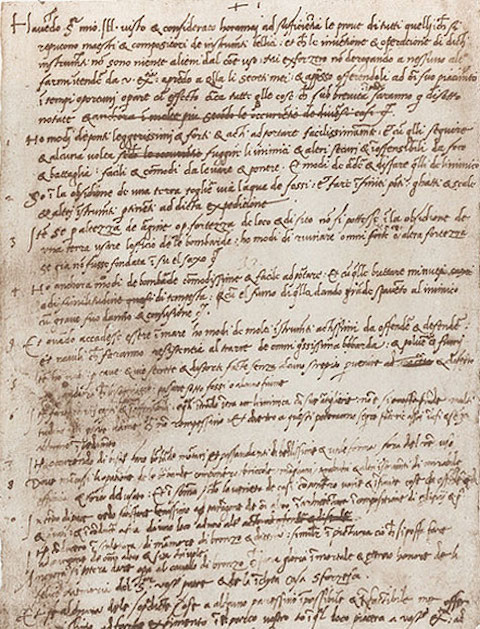
We know that Michelangelo wrote grocery lists; now we have evidence that Leonardo wrote resumes. “Before he was famous, before he painted the Mona Lisa and the Last Supper, before he invented the helicopter, before he drew the most famous image of man, before he was all of these things, Leonardo da Vinci was an artificer, an armorer, a maker of things that go ‘boom,’ ” writes Marc Cendella on his blog about job-searching and recruitment advice. “Like you, he had to put together a resume to get his next gig. So in 1482, at the age of 30, he wrote out a letter and a list of his capabilities and sent it off to Ludovico il Moro, Duke of Milan.” Having yet to establish his reputation as perhaps the Italian Renaissance’s most respected polymath, Leonardo spelled himself out, in translation, as follows:
Most Illustrious Lord, Having now sufficiently considered the specimens of all those who proclaim themselves skilled contrivers of instruments of war, and that the invention and operation of the said instruments are nothing different from those in common use: I shall endeavor, without prejudice to any one else, to explain myself to your Excellency, showing your Lordship my secret, and then offering them to your best pleasure and approbation to work with effect at opportune moments on all those things which, in part, shall be briefly noted below.
1. I have a sort of extremely light and strong bridges, adapted to be most easily carried, and with them you may pursue, and at any time flee from the enemy; and others, secure and indestructible by fire and battle, easy and convenient to lift and place. Also methods of burning and destroying those of the enemy.
2. I know how, when a place is besieged, to take the water out of the trenches, and make endless variety of bridges, and covered ways and ladders, and other machines pertaining to such expeditions.
3. If, by reason of the height of the banks, or the strength of the place and its position, it is impossible, when besieging a place, to avail oneself of the plan of bombardment, I have methods for destroying every rock or other fortress, even if it were founded on a rock, etc.
4. Again, I have kinds of mortars; most convenient and easy to carry; and with these I can fling small stones almost resembling a storm; and with the smoke of these cause great terror to the enemy, to his great detriment and confusion.
5. And if the fight should be at sea I have kinds of many machines most efficient for offense and defense; and vessels which will resist the attack of the largest guns and powder and fumes.
6. I have means by secret and tortuous mines and ways, made without noise, to reach a designated spot, even if it were needed to pass under a trench or a river.
7. I will make covered chariots, safe and unattackable, which, entering among the enemy with their artillery, there is no body of men so great but they would break them. And behind these, infantry could follow quite unhurt and without any hindrance.
8. In case of need I will make big guns, mortars, and light ordnance of fine and useful forms, out of the common type.
9. Where the operation of bombardment might fail, I would contrive catapults, mangonels, trabocchi, and other machines of marvellous efficacy and not in common use. And in short, according to the variety of cases, I can contrive various and endless means of offense and defense.
10. In times of peace I believe I can give perfect satisfaction and to the equal of any other in architecture and the composition of buildings public and private; and in guiding water from one place to another.
11. I can carry out sculpture in marble, bronze, or clay, and also I can do in painting whatever may be done, as well as any other, be he who he may.
Again, the bronze horse may be taken in hand, which is to be to the immortal glory and eternal honor of the prince your father of happy memory, and of the illustrious house of Sforza.
And if any of the above-named things seem to anyone to be impossible or not feasible, I am most ready to make the experiment in your park, or in whatever place may please your Excellency – to whom I comment myself with the utmost humility, etc.
Even the densest fifteenth-century Duke, I wager, could see the use in a man able to make portable bridges, get water out of trenches, destroy rock built upon rock, fling a storm of stones, fortify vessels, pass under rivers, and make everything from “big guns,” catapults, mangonels, and trabocchi to unattackable covered chariots. Though Leonardo understandably concentrates on his wartime engineering skills, he also touches on the range of other disciplines — Renaissance man, remember — he has mastered, like architecture, sculpture, and painting. Perhaps most impressively of all, he rattles off all these points without seeming particularly boastful. “You’ll notice he doesn’t recite past achievements,” Cendella adds, “because those are about his achievements, and not about the Duke’s needs.” Still, he might have added that, given just a few more years, he could design a pretty captivating organ.
Note: An earlier version of this post appeared on our site in 2014.
If you would like to support the mission of Open Culture, consider making a donation to our site. It’s hard to rely 100% on ads, and your contributions will help us continue providing the best free cultural and educational materials to learners everywhere. You can contribute through PayPal, Patreon, and Venmo (@openculture). Thanks!
Related Content:
Michelangelo’s Handwritten 16th-Century Grocery List
Leonardo Da Vinci’s To-Do List from 1490: The Plan of a Renaissance Man
Read More...What Makes Kazimir Malevich’s Black Square (1915) Not Just Art, But Important Art
Who created the first work of abstract art has long been a fraught question indeed. Better, perhaps, to ask who first said of a work of art that a kid could have made it. A strong contender in that division is the Russian artist Véra Pestel, whom history remembers as having reacted to Kazimir Malevich’s 1915 painting Black Square with the words “Anyone can do this! Even a child can do this!” Yes, writes novelist Tatyana Tolstaya a century later in the New Yorker, “any child could have performed this simple task, although perhaps children lack the patience to fill such a large section with the same color.” And in any case, time having taken its toll, Malevich’s square doesn’t look quite as black as it used to.
Nor was the square ever quite so square as we imagine it. “Its sides aren’t parallel or equal in length, and the shape isn’t quite centered on the canvas,” says the narrator of the animated TED-Ed lesson above. Instead, Malevich placed the form slightly off-kilter, giving it the appearance of movement, and the white surrounding it a living, vibrating quality.”
Fair enough, but is it art? If you’d asked Malevich himself, he might have said it surpassed art. In 1913, he “realized that even the most cutting-edge artists were still just painting objects from everyday life, but he was irresistibly drawn to what he called ‘the desert,’ where nothing is real except feeling.” Hence his invention of the style known as Suprematism, “a departure from the world of objects so extreme, it went beyond abstraction.”
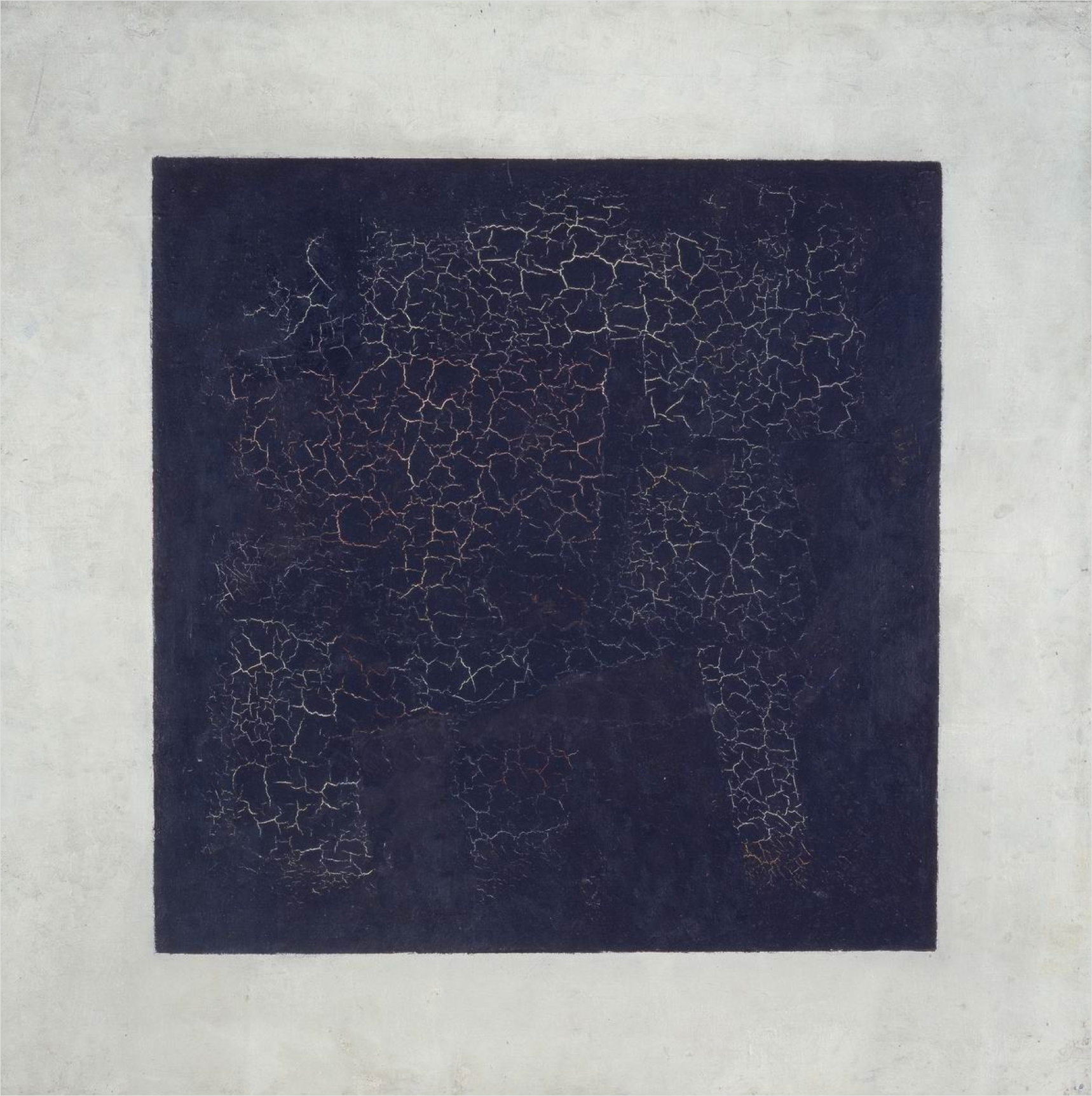
Malevich made bold claims for Suprematism in general and Black Square in particular. “Up until now there were no attempts at painting as such, without any attribute of real life,” he wrote. “Painting was the aesthetic side of a thing, but never was original and an end in itself.” As Tolstaya puts it, he “once and for all drew an uncrossable line that demarcated the chasm between old art and new art, between a man and his shadow, between a rose and a casket, between life and death, between God and the Devil. In his own words, he reduced everything to the ‘zero of form.’ ” She calls this zero’s emergence in such a stark form “one of the most frightening events in art in all of its history of existence.” If so, here we have an argument for not letting young children see Black Square and enduring the consequent nightmares — even if they could have painted it themselves.
Related content:
Steve Martin on How to Look at Abstract Art
An Interactive Social Network of Abstract Artists: Kandinsky, Picasso, Brancusi & Many More
Based in Seoul, Colin Marshall writes and broadcasts on cities, language, and culture. His projects include the Substack newsletter Books on Cities, the book The Stateless City: a Walk through 21st-Century Los Angeles and the video series The City in Cinema. Follow him on Twitter at @colinmarshall or on Facebook.
Read More...Why Henry VIII’s Codpiece Is So Monumental in Holbein’s Famous, Lost Portrait
During the 15th and 16th centuries, fashionable men sported a codpiece. Originally a garment designed to protect and support the proverbial “Willy” (especially when men wore tights), the codpiece morphed into something else–a sign of virility, “a bulging and absurd representation of masculinity itself.” The codpiece featured prominently in paintings by masters such as Titian, Giorgione, Bruegel and Holbein. Above, Evan Puschak (aka the Nerdwriter) introduces you to Holbein’s famous portrait of Henry VIII, “the poster boy for codpieces.”
For a deeper dive into the subject, you can read the New Yorker piece “A Brief History of the Codpiece, the Personal Protection for Renaissance Equipment.” And to go still deeper, see Michael Glover’s entire book dedicated to the subject, Thrust: A Spasmodic Pictorial History of the Codpiece in Art.
If you would like to support the mission of Open Culture, consider making a donation to our site. It’s hard to rely 100% on ads, and your contributions will help us continue providing the best free cultural and educational materials to learners everywhere. You can contribute through PayPal, Patreon, and Venmo (@openculture). Thanks!
Related Content
Free Course: An Introduction to the Art of the Italian Renaissance
Read More...
How Japanese Kintsugi Masters Restore Pottery by Beautifying the Cracks
A few years ago, we featured here on Open Culture the Japanese art of kintsugi, whose practitioners repair broken pottery with gold in a manner that emphasizes rather than hides the cracks. Since then, the idea seems to have captured the Western imagination, inspiring no few online investigations but also books with titles like Kintsugi Wellness: The Japanese Art of Nourishing Mind, Body, and Spirit, and Kintsugi: Embrace Your Imperfections and Find Happiness — the Japanese Way. But as kintsugist Yuki Matano reminds us, “kintsugi is mostly seen as a refined repairing technique in Japan. Japanese people do not usually associate kintsugi with art therapy or mental health.”
To get back to the essence of kintsugi, and gain a clearer understanding of its laborious physical nature, it couldn’t hurt to watch a few kintsugists at work. Take Hiroki Kiyokawa, who reflects on his 45 years practicing the art in Kyoto — not without expressing his own ideas about how he feels he’s also “restoring the broken parts of myself” — in the BBC video above.
Or, for a more modern presentation, have a look at this tutorial video from Chimahaga, a kintsugist who not long ago launched his own Youtube channel dedicated to explaining what he does. He’s even uploaded videos about not just kintsugi, (金継ぎ, or “golden joinery”), but also gintsugi (銀継ぎ), which achieves a different but equally striking effect using silver instead of gold.
Kintsugi clearly isn’t a hobby you can master over a few weekends. But you don’t have to be a lifelong Kyoto artisan to benefit from learning it, as emphasized by psychologist Alexa Altman in the video just above. Having learned kintsugi in Japan, she practices it here in a somewhat unconventional way, repairing not pottery damaged over time or by accident, but pottery which she’s smashed on purpose. The bowl, in this case, represents “some aspect of yourself”; the hammer is “an instrument of change”; the glue is “all about connection”; the holes and cracks “can be representations of loss”; the gold is “glory, a celebration.” Whether or not you accept these metaphors, those who practice kintsugi — or any craft demanding such a degree of patience and concentration — surely improve their psychological state in so doing.
Related Content:
Wabi-Sabi: A Short Film on the Beauty of Traditional Japan
20 Mesmerizing Videos of Japanese Artisans Creating Traditional Handicrafts
The Making of Japanese Handmade Paper: A Short Film Documents an 800-Year-Old Tradition
Watch a Japanese Craftsman Lovingly Bring a Tattered Old Book Back to Near Mint Condition
A Brief History of Japanese Art: From Prehistoric Pottery to Yayoi Kusama in Half an Hour
Based in Seoul, Colin Marshall writes and broadcasts on cities, language, and culture. His projects include the Substack newsletter Books on Cities, the book The Stateless City: a Walk through 21st-Century Los Angeles and the video series The City in Cinema. Follow him on Twitter at @colinmarshall or on Facebook.
Read More...When a Young Sofia Coppola & Zoe Cassavetes Made Their Own TV Show: Revisit Hi-Octane (1994)
It makes sense that Sofia Coppola and Zoe Cassavetes would be friends. Not only are they both respected filmmakers of Generation X, they’re both daughters of maverick American auteurs, a condition with its advantages as well as its disadvantages. The advantages, in Coppola’s case, have included the ability to get Zoetrope, her father Francis Ford Coppola’s production company, to foot the bill for a project like Hi-Octane: in the words of a 1994 W magazine profile, “a non-talk show in which Sofia and Zoe drive around and interview cool people, essentially their friends” — a group that included Keanu Reeves, Martin Scorsese, Gus Van Sant, and the Beastie Boys.
Coppola and Cassavetes didn’t do all the interviewing themselves. Their correspondents included the photographer Shawn Mortensen, whom they sent off to Paris Fashion Week to talk to the likes of Naomi Campbell, Karl Lagerfeld, and André Leon Talley, and Sonic Youth’s Thurston Moore, who hosted his own regular segment. “Thurston’s Alley” was usually shot literally there, in the alley alongside the building where he lived in New York, and, to it, he lured guests like Johnny Ramone and Sylvia Miles. But in one very special episode, he visits the Condé Nast building to interview none other than Anna Wintour — and, in one of the moments Hi-Octane’s viewers have never forgotten, to describe the mayonnaise-based hair styling technique of Pixies Bassist Kim Deal.
“I wrote the script ’cause I was so into cars,” the young Coppola told W. “And I have access to all these interesting people — these actors and musicians. But when you see them interviewed on television, they just talk about their characters and it’s so boring. The sets are always hideously ugly. TV people always say they want to cater to people my age, but they have no idea how to do it. So we just wanted to incorporate the things we’re interested in — cars, painting, music.” In one episode, she and Cassavetes take monster-truck lessons; in another, she gets a bass lesson from the Minutemen’s Mike Watt; another features an extended profile of psychedelo-sexual-apocalyptic painter Robert Williams, whom Coppola’s cousin Nicolas Cage turns up to praise as “a modern-day Hieronymus Bosch.”
Hi-Octane aired at 11:00 at night on Comedy Central, a time slot between Whose Line Is It Anyway? and Saturday Night Live. It only did so three times before its cancellation, but each of those broadcasts offers a strong if somewhat makeshift distillation of a certain mid-nineties Gen‑X sensibility, whose outward smirking disaffection is belied by its overpowering subcultural enthusiasm and sense of fun. “I wouldn’t change it because part of the sloppiness makes it unique and what it is,” Coppola said in a more recent interview. “I think if anything has sincerity and heart, this is it.” She may have known even at the time that it was all too pure to last. “Comedy Central says our show’s not funny enough,” she says to Cassavetes at the end of the second episode. “I think it’s funny that they gave us a show,” Cassavetes replies, and Coppola has to give it to her: “That is… that is funny.”
Related content:
Lick the Star: Sofia Coppola’s Very First Film Follows a 7th-Grade Conspiracy (1998)
Louis CK Ridicules Avant-Garde Art on 1990s MTV Show
Close Personal Friend: Watch a 1996 Portrait of Gen‑X Definer Douglas Coupland
Based in Seoul, Colin Marshall writes and broadcasts on cities, language, and culture. His projects include the Substack newsletter Books on Cities, the book The Stateless City: a Walk through 21st-Century Los Angeles and the video series The City in Cinema. Follow him on Twitter at @colinmarshall or on Facebook.
Read More...Noam Chomsky Explains Why Nobody Is Really a Moral Relativist, Even Michel Foucault
Noam Chomsky made his name as a linguist, which is easy to forget amid the wide range of subjects he has addressed, and continues to address, in his long career as a public intellectual. But on a deeper level, his commentary on politics, society, media, and a host of other broad fields sounds not unlike a natural outgrowth of his specialized linguistic theories. Throughout the past five or six decades, he’s occasionally made the connection explicit, or nearly so, by drawing analogies between language and other domains of human activity. Take the panel-discussion clip above, in which Chomsky faces the question of why he doesn’t accept the notion of cultural relativism, which holds moral norms as not absolute but created wholly within particular cultural contexts.
“There are no skeptics,” Chomsky says. “You can discuss it in a philosophy seminar, but no human being can, in fact, be a skeptic. They wouldn’t survive for two minutes if they were. I think pretty much the same is true of moral relativism. There are no moral relativists: there are people who profess it, you can discuss it abstractly, but it doesn’t exist in ordinary life.” He identifies “a tendency to move from the uncontroversial concept of moral relativism” — that, say, certain cultures at certain times hold certain moral values, and other cultures at other times hold other ones — “to a concept that is, in fact, incoherent, and that is to say that moral values can range indefinitely,” tethered to no objective basis.
If morality is transmitted through culture, “how does a person acquire his or her culture? You don’t get it by taking a pill. You acquire your culture by observing a rather limited number of behaviors and actions, and from those, constructing, somehow, in your mind, the set of attitudes and beliefs that constitutes culture.” He draws a natural comparison between this process and that of language acquisition, which also depends on “having a rich built-in array of constraints that allow the leap from scattered data to whatever it is that you acquire. That’s virtually logic.” And so, “even if you’re the most extreme cultural relativist, you are presupposing universal moral values. Those can be discovered.” When he spoke of “the most extreme cultural relativist,” he was thinking of Michel Foucault?
Back in 1971, Chomsky engaged the French philosopher of power in a debate, broadcast on Dutch television, about human nature and the origin of morality. There he practically lead with linguistics: a child learning to talk starts “with the knowledge that he’s hearing a human language of a very narrow and explicit type that permits a very small range of variation.” This “highly organized and very restrictive schematism” allows him to “make the huge leap from scattered and degenerate data to highly organized knowledge.” This mechanism “is one fundamental constituent of human nature,” in not just language but “other domains of human intelligence and other domains of human cognition and even behavior” as well. Perhaps we do have the freedom to speak, think, and act however we wish — but that very freedom, if Chomsky is correct, emerges only within strict, absolute, wholly un-relative natural boundaries.
Related content:
Michel Foucault and Noam Chomsky Debate Human Nature & Power on Dutch TV (1971)
An Animated Introduction to Michel Foucault, “Philosopher of Power”
Michel Foucault Offers a Clear, Compelling Introduction to His Philosophical Project (1966)
Moralities of Everyday Life: A Free Online Course from Yale University
Based in Seoul, Colin Marshall writes and broadcasts on cities, language, and culture. His projects include the Substack newsletter Books on Cities, the book The Stateless City: a Walk through 21st-Century Los Angeles and the video series The City in Cinema. Follow him on Twitter at @colinmarshall or on Facebook.
Read More...Behold the Jacobean Traveling Library: The 17th Century Forerunner to the Kindle
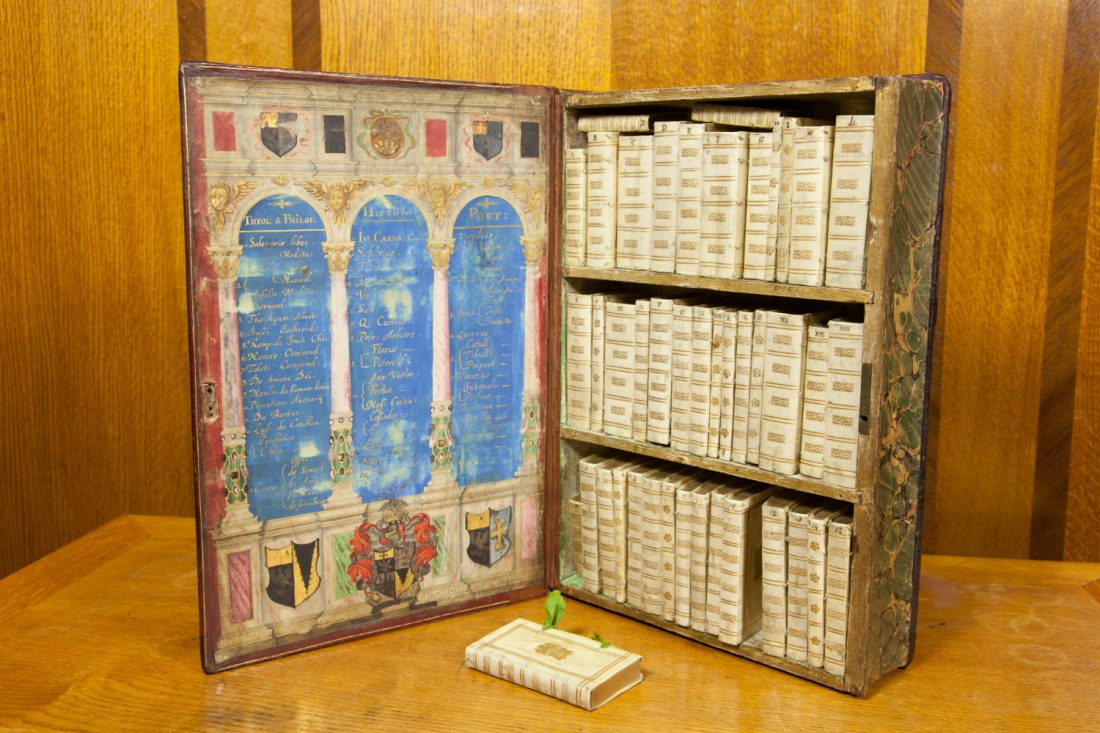
Image courtesy of the University at Leeds
In the striking image above, you can see an early experiment in making books portable–a 17th century precursor, if you will, to the modern day Kindle.
According to the library at the University of Leeds, this “Jacobean Travelling Library” dates back to 1617. That’s when William Hakewill, an English lawyer and MP, commissioned the miniature library–a big book, which itself holds 50 smaller books, all “bound in limp vellum covers with coloured fabric ties.” What books were in this portable library, meant to accompany noblemen on their journeys? Naturally the classics. Theology, philosophy, classical history and poetry. The works of Ovid, Seneca, Cicero, Virgil, Tacitus, and Saint Augustine. Many of the same texts that showed up in The Harvard Classics (now available online) three centuries later.
Apparently three other Jacobean Travelling Libraries were made. They now reside at the British Library, the Huntington Library in San Marino, California, and the Toledo Museum of Art in Toledo, Ohio.
If you would like to support the mission of Open Culture, consider making a donation to our site. It’s hard to rely 100% on ads, and your contributions will help us continue providing the best free cultural and educational materials to learners everywhere. You can contribute through PayPal, Patreon, and Venmo (@openculture). Thanks!
Related Content:
Napoleon’s Kindle: See the Miniaturized Traveling Library He Took on Military Campaigns
The Harvard Classics: Download All 51 Volumes as Free eBooks
The Fiske Reading Machine: The 1920s Precursor to the Kindle
Read More...Stream Hundreds of Hours of Studio Ghibli Movie Music That Will Help You Study, Work, or Simply Relax: My Neighbor Totoro, Spirited Away & More
The Boy and the Heron, the latest feature from master animator Hayao Miyazaki, opened in Japan this past summer. In that it marks his latest emergence from his supposed “retirement,” we could label it not just as late Miyazaki, but perhaps even “post-late” Miyazaki. But the film nevertheless shares significant qualities with his earlier work, not least a score composed by Joe Hisaishi. Since Nausicaä of the Valley of the Wind — which opened in 1984, even before the foundation of Studio Ghibli — Hisaishi’s music has done nearly as much to establish the sensibility of Miyazaki’s films as their lavish, imaginative animation, and you can stream hundreds of hours of it with this Youtube playlist.
Each of the playlist’s 121 two-hour videos offers musical selections from a mix of Ghibli movies, including Miyazaki favorites like My Neighbor Totoro, Porco Rosso, and Spirited Away, and also the works of other directors: Yoshifumi Kondō’s Whisper of the Heart, Hiromasa Yonebayashi’s Arrietty, Gorō Miyazaki’s From Up on Poppy Hill.
If you’ve seen those pictures, these quiet, often minimal renditions of their music will surely bring their animated fantasies right back to mind. Even if you haven’t, they can still fulfill the function promised by the videos’ titles of setting a mood conducive to study, work, or simple relaxation.
So beloved are Hisaishi’s scores, for Miyazaki and others (most notably comedian-auteur Takeshi Kitano), that it’s possible to know the music long before you’ve seen the movies. And even in performances considerably different from the versions heard on the actual soundtracks, they always sound immediately recognizable as Hisaishi’s work. Shaped by an eclectic set of influences (born Mamoru Fujisawa, he took on his professional name as an homage to Quincy Jones), he developed a compositional style neither strictly Eastern nor Western. The same can be said about Ghibli movies themselves, which often possess both fairy-tale European settings and Japanese philosophical underpinnings. Wherever you place yourself on the cultural map, you’d do well to make their music the soundtrack of your own life.
Related content:
Calm Down & Study with Relaxing Piano, Jazz & Harp Covers of Music from Hayao Miyazaki Films
De-Stress with 30 Minutes of Relaxing Visuals from Director Hayao Miyazaki
Based in Seoul, Colin Marshall writes and broadcasts on cities, language, and culture. His projects include the Substack newsletter Books on Cities, the book The Stateless City: a Walk through 21st-Century Los Angeles and the video series The City in Cinema. Follow him on Twitter at @colinmarshall or on Facebook.
Read More...Welcome to Llanfairpwllgwyngyllgogerychwyrndrobwllllantysiliogogogoc, the Town with the Longest Name in Europe
Its name can be squeezed onto a tea towel, a decorative plate, a magnet, a mug, and other touristic souvenirs, but has the northern Welsh town of Llanfairpwllgwyngyllgogerychwyrndrobwllllantysiliogogogoc been celebrated in song?
Indeed it has. The Great Big Story’s Human Condition episode, above, has vinyl proof, though the tune’s unlikely to give The White Cliffs of Dover, The Bonnie Banks of Loch Lomond, or The Rocky Road To Dublin much of a run for the money.
Still, whichever outside-the-box Victorian thinker had the bright idea to attract tourists by expanding the village’s original name — Pwllgwyngyll — by 46 letters was onto something.
Turns out you don’t need natural wonders or world-renowned cultural attractions to stake a claim, when out-of-towners will make the trip just to take photos of the local signage.

Image by Adraio, via Wikimedia Commons
Village Community Council Chairman Alun Mummery attributes the name-lengthening publicity stunt in 1869 to a local cobbler.
Or perhaps he was a tailor. That’s what poet John Morris-Jones, author of 1913’s A Welsh Grammar, Historical and Comparative, maintained, while refusing to outright identify this clever civic booster.
Wikipedia throws doubt on these origin stories by citing an entry in an ecclesiastical directory published a few years prior to 1869, which gave the full parish name as “Llanfairpwllgwyngyllgogerbwlltysiliogogo.”
(Close enough!)
Someone in the tourist information office told travel writer Dave Fox that it translates to “St. Mary’s Church in the hollow of white hazel near a rapid whirlpool and the Church of St. Tysilio near the red cave.”
It’s tempting to think this little Welsh town has the longest name in the world, but that honor actually goes to Bangkok.
Wait, what?
The name by which most foreigners know Thailand’s capital city is actually an archaic reference to its pre-1782 location.
Thai people call their capital Krung Thep — short for Krungthepmahanakornamornratanakosinmahintarayutthayamahadilokphopnopparatrajathaniburiromudomrajaniwesmahasatharnamornphimarnavatarnsathitsakkattiyavisanukamprasit.
It means “City of angels, great city of immortals, magnificent city of the nine gems, seat of the king, city of royal palaces, home of gods incarnate, erected by Vishvakarman at Indra’s behest” and looks like this, when written in Thai script:
กรุงเทพมหานคร อมรรัตนโกสินทร์ มหินทรายุธยามหาดิลก ภพนพรัตน์ ราชธานีบุรีรมย์ อุดมราชนิเวศน์ มหาสถาน อมรพิมาน อวตารสถิต สักกะทัตติยะ วิษณุกรรมประสิทธิ์
Llanfairpwllgwyngyllgogerychwyrndrobwllllantysiliogogogochians still get to brag that they have the longest town name in Europe.
Their football club, Clwb Pêl Droed Llanfairpwllgwyngyllgogerychwyrndrobwllllantysiliogogogoch Football Club — CPD Llanfairpwll FC for short — might well be the longest named football club in the world if it weren’t for that damn Amon Rattanakosin Krung Thep Mahanakhon Mahinthara Mahadilok Phop Noppharat Ratchathani Ayuthaya Burirom Udomratchaniwet Mahasathan Amon Piman Awatan Sathit Sakkathattiya Witsanukam Prasit Bravo Association Football Club (aka Bangkok Bravo FC).
Some of the fun of living in a town with such a cumbersome name must be amazing tourists by how casually it rolls off local tongues.
Pub owner Kevin Bryant obliges visitors from The Great Big Story by downing a pint on camera before rapping it out.
Anything for the local economy!
Llanfairpwllgwyngyllgogerychwyrndrobwllllantysiliogogogoc also got a boost from mentions on Groucho Marx’s quiz show, You Bet Your Life, in a Bossa Nova-inflected Stephen Sondheim song, and in several films, including 1968’s Barbarella.
As YouTuber Tom Scott points out below, long words are invariably shortened in everyday speech, and place names are no exception.
Postmaster Jim Evans advocates shortening the town name to Llanfairpwllgwyngyll.
When not actively impressing tourists, local people say Llanfairpwll.
Which is still a pretty impressive consonant to vowel ratio.
Related Content
The Medieval City Plan Generator: A Fun Way to Create Your Own Imaginary Medieval Cities
The Atlas of True Names Restores Modern Cities to Their Middle Earth-ish Roots
Fly Through 17th-Century London’s Gritty Streets with Prize-Winning Animations
– Ayun Halliday is the Chief Primatologist of the East Village Inky zine and author, most recently, of Creative, Not Famous: The Small Potato Manifesto and Creative, Not Famous Activity Book. Follow her @AyunHalliday.
Read More...Do You Think About Ancient Rome Every Day? Then Browse a Wealth of Videos, Maps & Photos That Explore the Roman Empire
This month, more than a few TikTok-using women have asked the men in their lives how often they think about the Roman Empire. And to the astonishment of these women, more than a few of these men have responded that they think about it on a daily basis, or even more often than that. By now, this particular manifestation of mutual incomprehension between the sexes has swept several social-media platforms, and according to reportage in the New York Times and Washington Post, it actually began on Instagram. “Ladies, many of you do not realize how often men think about the Roman Empire,” posted a Swedish ancient-Rome reenactor who calls himself Gaius Flavius. “Ask your husband/boyfriend/father/brother — you will be surprised by their answers!”
Even if you’re not a husband, boyfriend, father, or brother, you may count yourself among these Rome-enraptured men. You may think about Rome practically all day, every day, and not be a man at all. Or perhaps you’re one of the women who, hitherto unaware of the apparently widespread Roman intellectual proclivities among the opposite sex, have begun to feel a twinge of curiosity about the subject.
If so, you could do worse than start your historical journey to antiquity’s mightiest empire — the ancestor of today’s Western civilization — with this twenty-minute primer narrated by Succession’s Brian Cox. Consider also accompanying it with this animated map visualizing both the Roman Empire’s rise to cover half the known world and its subsequent fall — or this version with a scrolling timeline of the face of every emperor.
The word “Rome” commonly stands for the Roman Empire, but, of course, it can also refer to the great capital itself. Here on Open Culture, we’ve previously featured virtual tours and flyovers, as well as a physical scale model, of the ancient city of Rome at its peak. You can also watch a re-creation of the destruction of Pompeii, whose ash-preserved ruins have taught us a great deal about life in the Roman Empire. That empire could hardly have extended as far as it did without the technological marvel of Roman roads, which you can learn about through videos on their construction, subway-style maps, and even a trip-planning web application. Even the concrete used to build those roads — not to mention the Roman Empire’s formidable aqueducts — has been an object of fascination, not least because the secret of their durability has only recently come to light.
If Rome was about nothing but conquering emperors and sprawling infrastructure, it would be easy to explain its being a predominantly male interest. But we’ve also featured numerous other aspects of its culture, from the sound of Roman music and the Latin language to the colors of its statues. Like all human beings, ancient Romans ate food — whether by following recipes at home or going out to “snack bars” — and wore shoes (and sandals, alas, with socks). Our own fascination with its civilization has its own historical roots, as underscored by these nineteenth-century photographs of Roman ruins. Nor does that fascination know cultural boundaries. I live in Korea, and recently a man told me about his younger days as a soldier in KATUSA, the Korean Augmentation to the United States Army. Why did he enlist in that particular program? “I wanted to know what it would be like to serve the modern Roman Empire.”
Related Content:
The Splendid Book Design of the 1946 Edition of Gibbon’s Decline and Fall of the Roman Empire
What Life Was Like for Teenagers in Ancient Rome: Get a Glimpse from a TED-ED Animation
Based in Seoul, Colin Marshall writes and broadcasts on cities, language, and culture. His projects include the Substack newsletter Books on Cities, the book The Stateless City: a Walk through 21st-Century Los Angeles and the video series The City in Cinema. Follow him on Twitter at @colinmarshall or on Facebook.
Read More...Support Us
We're hoping to rely on loyal readers, rather than erratic ads. Please click the Donate button and support Open Culture. You can use Paypal, Venmo, Patreon, even Crypto! We thank you!

About Us

Open Culture scours the web for the best educational media. We find the free courses and audio books you need, the language lessons & educational videos you want, and plenty of enlightenment in between.
Advertise With Us
FREE UPDATES!
GET OUR DAILY EMAIL
Get the best cultural and educational resources on the web curated for you in a daily email. We never spam. Unsubscribe at any time.
FOLLOW ON SOCIAL MEDIA
Open Culture editor Dan Colman scours the web for the best educational media. He finds the free courses and audio books you need, the language lessons & movies you want, and plenty of enlightenment in between.
Advertise With Us


