John Steinbeck’s Six Tips for the Aspiring Writer and His Nobel Prize Speech
Today is the 110th birthday of writer John Steinbeck, whose great novel of the 1930s, The Grapes of Wrath, gives an eloquent and sympathetic voice to the dispossessed. In 1962, Steinbeck was awarded the Nobel Prize in Literature “for his realistic and imaginative writings, combining as they do sympathetic humour and keen social perception.” You can watch him deliver his Nobel speech above.
And for insights into how Steinbeck reached that pinnacle, you can read a collection of his observations on the art of fiction from the Fall, 1975 edition of The Paris Review, including six writing tips jotted down in a letter to a friend the same year he won the Nobel Prize. “The following,” Steinbeck writes, “are some of the things I have had to do to keep from going nuts.”
1. Abandon the idea that you are ever going to finish. Lose track of the 400 pages and write just one page for each day, it helps. Then when it gets finished, you are always surprised.
2. Write freely and as rapidly as possible and throw the whole thing on paper. Never correct or rewrite until the whole thing is down. Rewrite in process is usually found to be an excuse for not going on. It also interferes with flow and rhythm which can only come from a kind of unconscious association with the material.
3. Forget your generalized audience. In the first place, the nameless, faceless audience will scare you to death and in the second place, unlike the theater, it doesn’t exist. In writing, your audience is one single reader. I have found that sometimes it helps to pick out one person–a real person you know, or an imagined person and write to that one.
4. If a scene or a section gets the better of you and you still think you want it–bypass it and go on. When you have finished the whole you can come back to it and then you may find that the reason it gave trouble is because it didn’t belong there.
5. Beware of a scene that becomes too dear to you, dearer than the rest. It will usually be found that it is out of drawing.
6. If you are using dialogue–say it aloud as you write it. Only then will it have the sound of speech.
“As you write,” Steinbeck says, “trust the disconnections and the gaps. If you have written what your eye first saw and you are stopped, see again. See something else. Take a leap to another image. Don’t require of yourself that you understand the connection. Some of the most brilliant things that happen in fiction occur when the writer allows what seems to be a disconnected image to lead him or her away from the line that was being taken.”
Related content:
Writing Tips by Henry Miller, Elmore Leonard, Margaret Atwood, Neil Gaiman & George Orwell
Remembering Ernest Hemingway, Fifty Years After His Death
Read More...36 Free Oscar Winning Films Available on the Web
How about some hors d’oeuvres meant to accompany the main course, the 2014 Academy Awards? We scouted around the web and found 36 Oscar-winning (or nominated) films from previous years. The list includes many short films, but also some long ones, like Sergei Bondarchuk’s epic version of War & Peace. Sit back, enjoy, and let us know if we’re missing any other Oscar winners…
Find more films in our collection of 700 Free Movies Online.
- A Herb Alpert & the Tijuana Brass Double Feature — Free — A precursor to modern music videos, this Oscar-winning animated film by John & Faith Hubley is set to the music of two popular songs recorded by Herb Alpert. (1966)
- A Story of Healing — Free – Won Academy Award for best Documentary Short Subject. Follows a team of volunteers in Vietnam. (1997)
- Churchill’s Island — Free – WWII propaganda film chronicling the defense of Great Britain. Won the very first Academy Award for Documentary Short Subject. (1941)
- Der Fuehrer’s Face – Free – Disney’s anti-Nazi propaganda movie featuring Donald Duck. Won the Academy Award for Best Animated Short Film. (1942)
- Every Child – Free – Eugene Fedorenko’s animated short about an unwanted baby cared for by a homeless men. Won 1979 Oscar for Best Animated Short Film.
- Father and Daughter – Free – Michaël Dudok De Wit’s heartbreaking short won the 2000 Academy Award for Animated Short Film. (2000)
- Flamenco at 5:15 – Free – Oscar-winning short film about a flamenco dance class given to senior students. (1983)
- Franz Kafka’s It’s a Wonderful Life - Free — Directed by Peter Capaldi, the Oscar-winning short film shows Kafka, on Christmas Eve, struggling to come up with the opening line for his most famous work, The Metamorphosis. (1993)
- Glass - Free — Directed by Bert Haanstra, this short documentary about the glass industry won the Academy Award for Documentary Short Subject in 1959. (1958)
- Granny O’Grimm’s Sleeping Beauty- Free – 6 minute animated black comedy. Shortlisted for the 2010 Oscar for Best Animated Short Film. (2008)
- Logorama – Free – François Alaux and Herve de Crecy’s 17 minute film, Logorama, won the Oscar for Short Film (Animated) in 2009.
- If You Love This Planet – Free – Oscar-winning short film on the need for nuclear disarmament. (1982)
- I’ll Find a Way – Free – Oscar-winning documentary presents Nadia, a 9‑year-old girl with spina bifida. (1977)
- Is It Right to Be Always Right? — Free — Narrated by Orson Welles, this Oscar-winning film directed by Lee Mishkin is a parable that comments on divisions in the United States. (1970)
- J’attendrai le suivant – Free – A French film nominated for an Academy Award for the Best Short Film in 2002.
- Madame Tutli-Putli – Free – Oscar-nominated animated short film by Montreal filmmakers Chris Lavis and Maciek Szczerbowski. (2010)
- Neighbors – Free – Norman McLaren animates live actors with techniques normally used to put drawings/puppets into motion. Oscar winner. (1952)
- Ryan – Free – Oscar-winning animated short from Chris Landreth based on the life of Ryan Larkin, the influential Canadian animator. (2004)
- Special Delivery – Free – Hilarious story won 1978 Oscar for Best Animated Short Film.
- Superman – Free – Max Fleischer’s short animated movie. Nominated for the 1942 Academy Award for Best Short Subject: Cartoons. (1941)
- The Cathedral — Free — “The Cathedral” is the title of a sci fi short story by Jacek Dukaj. It was turned into a short animated movie by Tomasz Bagiński and nominated in 2002 for the Academy Award for Animated Short Film. (2002)
- The Critic - Free — Mel Brooks 1963 animation features an old Yiddish watching abstract animations. Hilarious film won Oscar. (1963)
- The Danish Poet — Free — Animated short film written, directed, and animated by Torill Kove and narrated by Liv Ullmann, won the Academy Award in 2006.
- The Dot and the Line - Free — Chuck Jones’ animated film celebrates geometry and hard work. (1965)
- The Fantastic Flying Books of Mr. Morris Lessmore — Free — Oscar-winning film by Moonbot Studios pays homage to a bygone era when elegantly printed books inhabited our world. (2011)
- The Hole – Free — A 15-minute animated film by John Hubley and Faith Hubley that won an Academy Award for Best Animated Short Film in 1962. Features the voice of Dizzy Gillespie. (1962)
- The Last Farm – Free – Short Icelandic film nominated for Oscar in 2006.
- The Lunch Date – Free – Adam Davidson’s commentary on race in America. The short film won an Oscar and a prize at Cannes. (1989)
- The Man with the The Golden Arm – Free — Directed by Otto Preminger. Starring Frank Sinatra and Kim Novak. Nominated for three Academy Awards. (1955)
- The Old Man and the Sea – Free – Aleksandr Petrov won the Academy Award for Short Film for this film that follows the plot of Ernest Hemingway’s classic 1952 novella. Made of 29,000 images painted on glass. (1999)
- The Red Balloon — Free — A short fantasy film directed by French filmmaker Albert Lamorisse. Won Academy Award for Best Original Screenplay and a Palme d’Or for Best Short Film at the Cannes Film Festival in 1956.
- The Sand Castle – Free – Short animated film about the sandman and the creatures he sculpts out of sand. 1977 Oscar-winner for Best Animated Short Film.
- Tin Toy – Free – John Lasseter created this Oscar-winning short film in 1988 at Pixar. It was the beginning of the company’s transition into being a premier animation studio.
- Toot, Whistle, Plunk and Boom – Free – Disney’s music education film. First cartoon released in widescreen CinemaScope. Won 1954 Academy Award for Best Short Subject (Cartoons). (1953)
- Walking – Free – Oscar-nominated animated short film by Ryan Larkin. (1969)
- War & Peace — Free — Soviet director Sergei Bondarchuk turns Tolstoy’s great novel into what Roger Ebert calls “the definitive epic of all time.” Won Academy Award – Best Foreign Language Film in 1969. (1965–1967)
- Why Man Creates - Free - Saul Bass’ Oscar-winning animation on the nature of creativity. (1963)
Related Content:
200 Free Documentaries Online
21 Free Hitchcock Movies Online
Tarkovsky Films Now Free Online
The 10 Greatest Films of All Time According to 846 Film Critics
Read More...The Fantastic Flying Books of Mr. Morris Lessmore: Film for Book Lovers Wins Oscar
Remember The Fantastic Flying Books of Mr. Morris Lessmore? The short film we featured a month ago? Well, it won an Oscar tonight for best animated short film, and we’re bringing it back for one more showing, plus adding it to our list of Oscar films available online.
The Fantastic Flying Books of Mr. Morris Lessmore offers a modern tribute to an old world. Made with an animation style that blends stop motion with computer animation and traditional hand-drawing, the silent film pays homage to a bygone era when elegantly printed books inhabited our world. The 15-minute short is the first made by Moonbot Studios, a fledgling animation shop in Shreveport, Louisiana. For their efforts, Moonbot’s founders (William Joyce, Brandon Oldenburg and Lampton Enochs) received an Oscar-nomination this week (Best Animated Short), putting them in competition with two other films featured on Open Culture: Sunday and Wild Life.
We recommend watching The Fantastic Flying Books of Mr. Morris Lessmore on YouTube, or downloading it for free in HD from iTunes. iPad owners will also want to consider buying the related app ($4.99) that turns the film into an interactive narrative experience.
For more animated bibliophilia, don’t miss:
Spike Jonze Presents a Stop Motion Film for Bibliophiles
Books Savored in Stop Motion Film
Going West: A Stop Motion Novel
Books Come to Life in Classic Cartoons from 1930s and 1940s
Read More...Inspirations: A Short Film Celebrating the Mathematical Art of M.C. Escher
Almost two years ago, Spanish filmmaker Cristóbal Vila shot an exquisite little film, Nature by Numbers, which captured the ways in which mathematical concepts (Fibonacci Sequence, Golden Number, etc.) reveal themselves in nature. And the short then clocked a good 2.1 million views on YouTube alone.
This week, Vila returns with a new film called Inspirations. In this case, the inspiration is M.C. Escher (1898–1972), the Dutch artist who explored a wide range of mathematical ideas with his woodcuts, lithographs, and mezzotints. Although Escher had no formal training in mathematics beyond secondary school, many mathematicians counted themselves as admirers of his work. (Visit this online gallery to get better acquainted with Escher’s art, and be sure to click on the thumbnails to enlarge the images). As Vila explains, Inspirations tries to imagine Escher’s workplace, “what things would surround an artist like him, so deeply interested in science in general and mathematics in particular.” It’s a three minutes of unbridled imagination.
If you would like to support the mission of Open Culture, consider making a donation to our site. It’s hard to rely 100% on ads, and your contributions will help us continue providing the best free cultural and educational materials to learners everywhere. You can contribute through PayPal, Patreon, and Venmo (@openculture). Thanks!
Read More...“The Periodic Table Table” — All The Elements in Hand-Carved Wood
In 2011, Theo Gray (co-founder of Wolfram Research, Popular Science columnist, and element collector) won the ACS Grady Stack Award for Interpreting Chemistry for the Public. And here you can see why. In this clip, Gray introduces you to his DIY masterpiece — the world’s first “periodic table table.” Yes, we’re talking about a hand-carved wooden table that brings to life the Periodic Table, and lets you play with the elements. The project began back in 2002, and now, a decade later, Gray puts it on display in a video produced by the American Chemical Society.
Related Content:
Chemistry on YouTube: “Periodic Table of Videos” Wins SPORE Prize
Read More...Harvard Thinks Big 2012: 8 All-Star Professors. 8 Big Ideas.
Earlier this month, Harvard students made their way to the Sanders Theatre for the 2012 edition of Harvard Thinks Big. It’s a TED-style event which gets pitched like this: “8 all-star professors. 8 big ideas. All ten minutes each.” You get the gist.
This year’s version had as much substance, though perhaps not quite the same sizzle, as the 2011 version, which featured talks by Steven Pinker, Lawrence Lessig, Daniel Gilbert and Elaine Scarry. Above, we have one talk from the latest Harvard Thinks Big. It features Daniel Lieberman, the renowned biologist (perhaps you know his work on barefoot running?) talking about how evolutionary biology explains why obesity is on the rise in the United States.
Other speakers at the event included Doug Melton, Eleanor Duckworth, Nicholas Christakis, Kaia Stern, Donhee Ham, Stephen Greenblatt, and Jill Lepore. The lectures can be watched via YouTube (follow the previous links) or via iTunes. Regrettably the talks by Greenblatt, Ham and Lepore haven’t made it to the web, at least not yet. When they do, we’ll mention it on our Twitter stream, where we post lots of other cultural goodies.
Related Content:
Harvard Presents Free Courses with the Open Learning Initiative
Harvard Thinks Green: Big Ideas from 6 All-Star Environment Profs
Why is the U.S. F’ed Up? 8 Lectures from Occupy Harvard Teach-In Provide Answers
Read More...The Birth of the Moon: How Did It Get There in the First Place?
The Moon is a mystery. For all its familiarity–the regularity of its phases, the fact that everywhere on Earth it looks the same–the Moon has always been an enigma, a luminous question mark rolling across the night sky.
In this new video from Cosmic Journeys, we learn about some of the latest scientific research into the structure and history of the Moon. In particular, we learn the latest ideas on what is perhaps the greatest of lunar mysteries: the question of how the Moon got there in the first place.
The leading candidate for an answer is the Giant Impact Hypothesis, which posits that sometime in the early stage of the Solar System–about four and a half billion years ago–a large proto-Earth collided with a Mars-sized body named “Theia,” causing a huge cloud of material from both bodies to fly out into space. Some of the material remained in the Earth’s orbit and coalesced into the Moon. It’s a fascinating hypothesis. To see more videos from the same series, visit the Cosmic Journeys channel on YouTube, or the SpaceRip blog.
Related Content:
A Year of the Moon in 2.5 Minutes
The Far Side of Moon: A Rare Glimpse from NASA
Read More...Watch Battleship Potemkin and Other Free Sergei Eisenstein Films
As a carless cinephile, I’ve spent hours upon hours listening to film podcasts while riding my bike or the train. Battleship Pretension, hosted by knowledgeable but still knowledge-hungry young critics Tyler Smith and David Bax, has long held top priority on these rides — and even if the title’s referent doesn’t flood your mind with memories of artistic awe, you probably get the pun. But if you want to go deeper and talk about how film editing went from grunt work to art form, you have little choice but to talk about Battleship Potemkin (1925) and its director, Sergei Eisenstein. A Russian double-threat of filmmaker and film theorist in the 1920s through the late 1940s, Eisenstein pioneered many now-essential editing techniques, figuring out how images could be arranged to serve not just a film’s story but its rhythm, its tone, and even its themes.
Like cinema itself, Eisenstein came from the theater. Unlike most of his contemporaries, he made great strides in dragging cinema out of the theater behind him, casting off staid storytelling habits in favor of the vast possibilities of the then-new medium, most of which remain uncharted even today. Tasked by his government with producing what came down to revolutionary propaganda, Eisenstein couldn’t push the thematic envelope very far. Even so, today’s filmmakers looking for ways to advance their form, or today’s filmgoers eager to learn more about how movies work, would do well to look at what Eisenstein managed to do 85 years ago, and how aesthetically exhilarating it all remains.
This you can do from the comfort of your computer by browsing Open Culture’s collection of Free Movies Online, where you’ll find links to Eisenstein pictures viewable at the click of the mouse, including the sweeping Alexander Nevsky, the doomed ¡Que viva México!, and of course, the iconic Battleship Potemkin (above). Watch a few, and you’ll see why Battleship Pretension’s listeners voted Eisenstein into the top hundred directors of all time. Smith and Bax called on yours truly to write his blurb on the list, but don’t take my word for the filmmaker’s importance; his movies, whether you catch them in a grand revival screening or on your web browser right now, show you everything you need to know.
Complete list of free Eisenstein films: Alexander Nevsky, Battleship Potemkin, October: Ten Days that Shook the World, Old and New, ¡Que viva México!, Romance Sentimentale, andStrike.
Colin Marshall hosts and produces Notebook on Cities and Culture. Follow him on Twitter at @colinmarshall.
Read More...Princeton v. Yale, 1903: The Oldest College Football Game on Film
You can thank Thomas Edison and his motion picture camera for many things: Bike Tricks Caught on Film in 1899; Footage of Mark Twain from 1909; The World’s First (and Slightly Scandalous) Hand-Tinted Motion Picture (1895); The First Kiss in Cinema, 1896; and now this — footage of the 1903 Princeton v. Yale football game. The two teams were undefeated, and 50,000 spectators were on hand. The video starts with the players taking the field (Princeton first, Yale second) and some panoramic views of Yale’s stadium. Then (around the 2:00 mark) we get to the highlights of the game.
The clip above is apparently the oldest collegiate football footage surviving today. And, in case you’re keeping score, Princeton won the game 11–6.
But if you’re counting the number of Free Courses provided by the two universities, we have the score at 38–1, with Yale coming out way on top.
via Retronaut and the Reel Mudd
Read More...30 Free Essays & Stories by David Foster Wallace on the Web
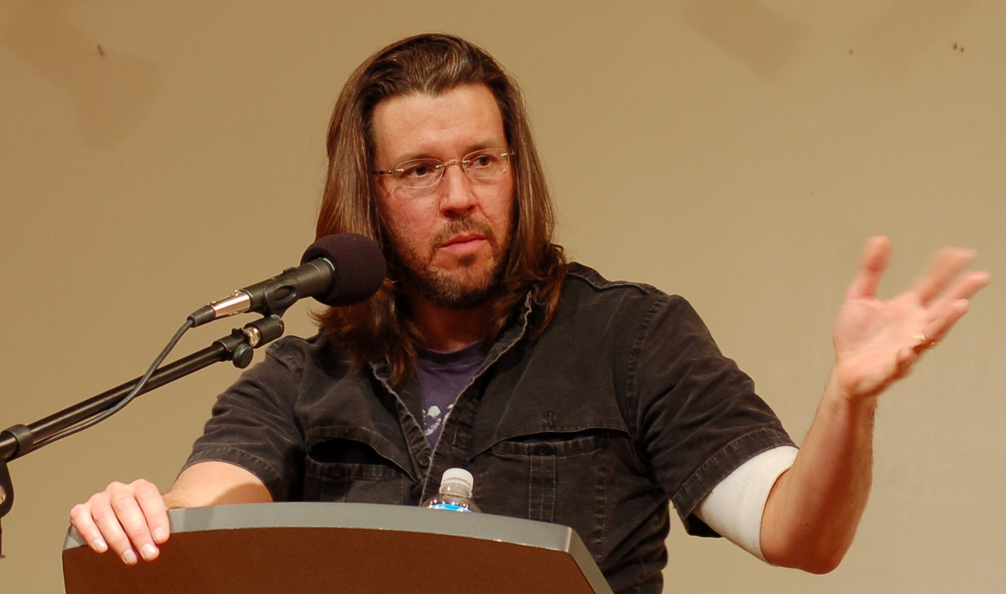
Image by Steve Rhodes, via Wikimedia Commons
We started the week expecting to publish one David Foster Wallace post. Then, because of the 50th birthday celebration, it turned into two. And now three. We spent some time tracking down free DFW stories and essays available on the web, and they’re all now listed in our collection, 800 Free eBooks for iPad, Kindle & Other Devices. But we didn’t want them to escape your attention. So here they are — 23 pieces published by David Foster Wallace between 1989 and 2011, mostly in major U.S. publications like The New Yorker, Harper’s, The Atlantic, and The Paris Review. Enjoy, and don’t miss our other collections of free writings by Philip K. Dick and Neil Gaiman.
- “9/11: The View From the Midwest” (Rolling Stone, October 25, 2001)
- “All That” (New Yorker, December 14, 2009)
- “An Interval” (New Yorker, January 30, 1995)
- “Asset” (New Yorker, January 30, 1995)
- “Backbone” An Excerpt from The Pale King (New Yorker, March 7, 2011)
- “Big Red Son” from Consider the Lobster & Other Essays
- “Brief Interviews with Hideous Men” (The Paris Review, Fall 1997)
- “Consider the Lobster” (Gourmet, August 2004)
- “David Lynch Keeps His Head” (Premiere, 1996)
- “Everything is Green” (Harpers, September 1989)
- “E Unibus Pluram: Television and U.S. Fiction” (The Review of Contemporary Fiction, June 22, 1993)
- “Federer as Religious Experience” (New York Times, August 20, 2006)
- “Good People” (New Yorker, February 5, 2007)
- “Host” (The Atlantic, April 2005)
- “Incarnations of Burned Children” (Esquire, April 21, 2009)
- “Laughing with Kafka” (Harper’s, January 1998)
- “Little Expressionless Animals” (The Paris Review, Spring 1988)
- “On Life and Work” (Kenyon College Commencement address, 2005)
- “Order and Flux in Northampton” (Conjunctions, 1991)
- “Rabbit Resurrected” (Harper’s, August 1992)
- “Several Birds” (New Yorker, June 17, 1994)
- “Shipping Out: On the (nearly lethal) comforts of a luxury cruise” (Harper’s, January 1996)
- “Tennis, trigonometry, tornadoes A Midwestern boyhood” (Harper’s, December 1991)
- “Tense Present: Democracy, English, and the wars over usage” (Harper’s, April 2001)
- “The Awakening of My Interest in Annular Systems” (Harper’s, September 1993)
- “The Compliance Branch” (Harper’s, February 2008)
- “The Depressed Person” (Harper’s, January 1998)
- “The String Theory” (Esquire, July 1996)
- “The Weasel, Twelve Monkeys And The Shrub” (Rolling Stone, April 2000)
- “Ticket to the Fair” (Harper’s, July 1994)
- “Wiggle Room” (New Yorker, March 9, 2009)
Related Content:
Free Philip K. Dick: Download 13 Great Science Fiction Stories
Neil Gaiman’s Free Short Stories
Read 17 Short Stories From Nobel Prize-Winning Writer Alice Munro Free Online
Read More...Support Us
We're hoping to rely on loyal readers, rather than erratic ads. Please click the Donate button and support Open Culture. You can use Paypal, Venmo, Patreon, even Crypto! We thank you!

About Us

Open Culture scours the web for the best educational media. We find the free courses and audio books you need, the language lessons & educational videos you want, and plenty of enlightenment in between.
Advertise With Us

FREE UPDATES!
GET OUR DAILY EMAIL
Get the best cultural and educational resources on the web curated for you in a daily email. We never spam. Unsubscribe at any time.
FOLLOW ON SOCIAL MEDIA

Open Culture editor Dan Colman scours the web for the best educational media. He finds the free courses and audio books you need, the language lessons & movies you want, and plenty of enlightenment in between.
Advertise With Us


